
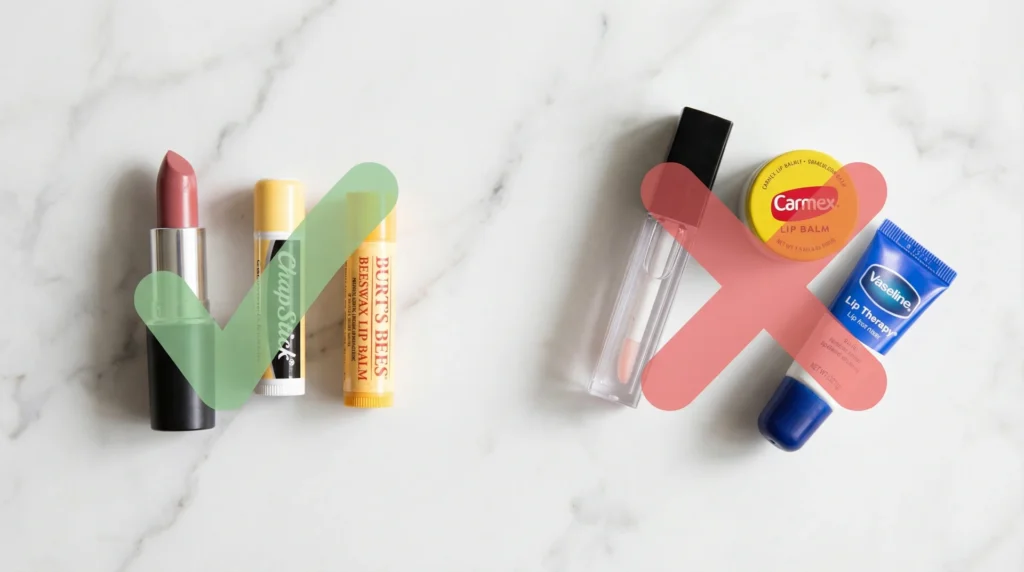
You’re standing at the security belt, bag open, bin waiting, and it suddenly hits you; does the ChapStick go in the little plastic bag or not?
I’ve packed makeup for bridal shoots, editorial sets, and travel days across the Pacific Northwest for years, and I still get asked this question constantly. So here’s the answer before anything else.
Solid stick lipstick and Chapstick are not liquids under TSA rules. They go straight into your carry-on, pocket, or purse, no quart bag, no restrictions, no size limit.
Lip gloss, liquid lipstick, lip oil, and gel-based balms like Carmex follow the 3-1-1 rule and belong in your clear liquids bag. If you’re unsure how lip gloss is classified at security, here’s a full breakdown of whether lip gloss counts as a liquid for TSA.
Everything below breaks it down product by product, because the word “balm” alone covers everything from a solid wax stick to petroleum jelly in a pot, and that difference matters at the checkpoint.
The One Test That Sorts Every Lip Product
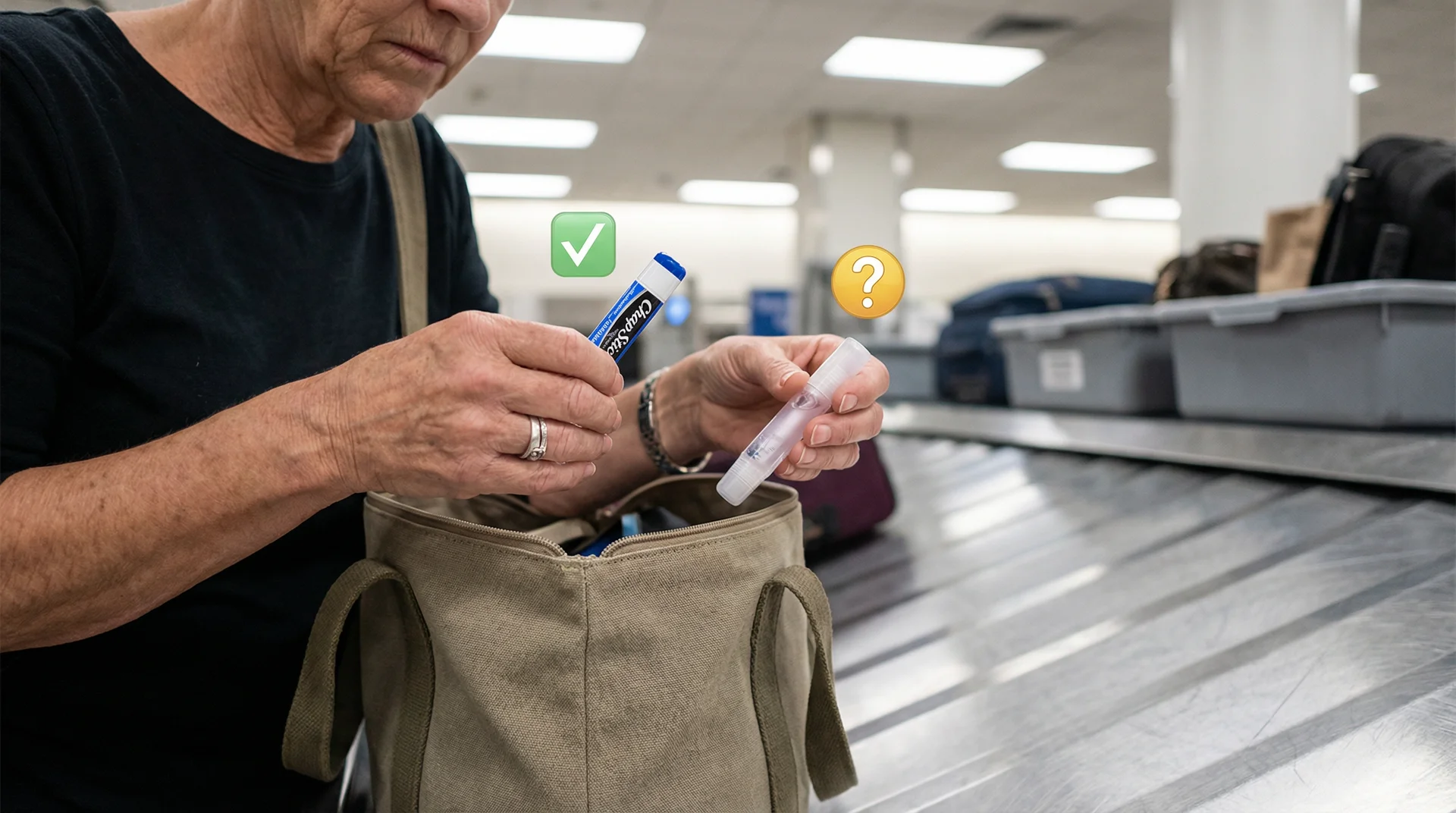
Before getting into specific products, here’s the mental test that TSA’s classification is built on: would this product hold its shape if you removed it from its packaging?
A bullet lipstick, taken out of the tube, keeps its form. A stick of Chapstick snapped off, but it holds together. A pot of Carmex tipped onto a surface spreads immediately. That physical behaviour separates a solid from a liquid, and it’s the fastest way to sort any product you’re unsure about.
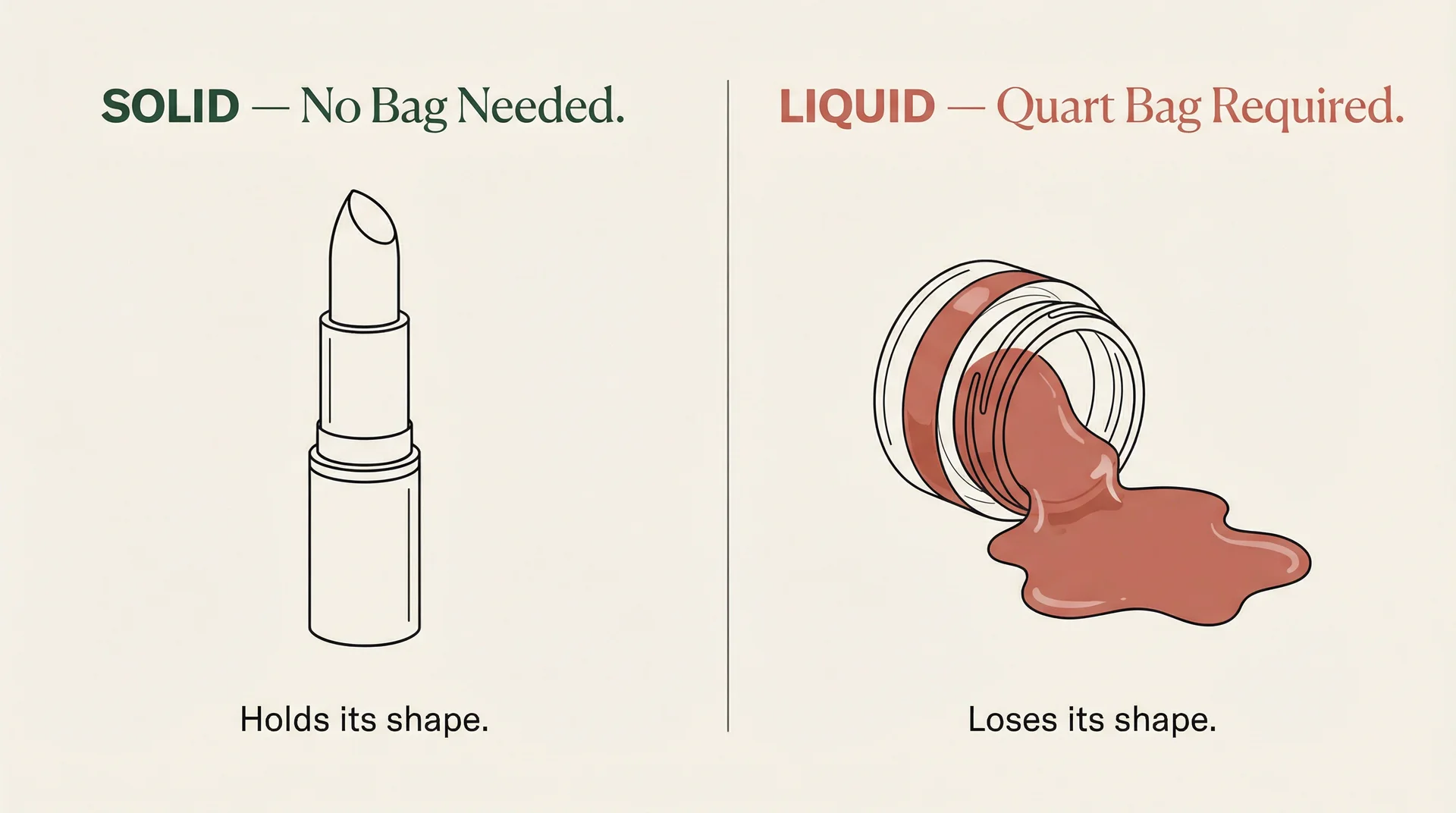
Traditional Bullet Lipstick (Twist-Up)
Solid. No restrictions whatsoever. You can carry as many as you want in your carry-on without placing them in your liquids bag or mentioning them at the checkpoint. There’s no quantity limit.
Every finish falls under this matte, satin, sheer, glossy. The format is what matters, and a structured twist-up bullet that holds its shape at room temperature qualifies as a solid every time.
One thing worth knowing: retract the bullet fully before capping before you pack. A partially extended tip is more likely to snap in a bag, and a damaged lipstick that looks melted on the X-ray can occasionally prompt a second look, though confiscation of a solid lipstick for that reason is genuinely rare.
ChapStick and Wax-Based Stick Lip Balm
Solid. Exempt from the 3-1-1 rule. This covers the original ChapStick tubes, Burt’s Bees sticks, EOS sticks in the twist-up format, and Aquaphor Lip Repair Stick. All wax-based, all solid, all bag-free.
Cabin air at cruising altitude runs around 20% humidity or lower, which is genuinely drying, and a solid stick lip balm is the easiest thing to keep accessible throughout a flight. I keep one in my coat pocket on every trip.
The Ones That Catch People Off Guard are Gel Balms
This is where most travellers get surprised. Products marketed as “balm” aren’t automatically solids. Gel-based and petroleum-based formulas behave as liquids under TSA rules because they flow, spread, or lose their shape when scooped from the container.
| Product | Format | TSA Classification | Quart Bag Required? |
|---|---|---|---|
| Carmex (tube or pot) | Gel | Liquid | Yes |
| Vaseline (tin or pot) | Petroleum jelly | Liquid | Yes |
| Blistex (most formulas) | Gel tube | Liquid | Yes |
| Aquaphor Ointment (tube) | Ointment | Liquid | Yes |
| Aquaphor Lip Repair Stick | Solid stick | Solid | No |
| Burt’s Bees Stick | Wax stick | Solid | No |
| EOS Stick | Wax stick | Solid | No |
| ChapStick Original | Wax stick | Solid | No |
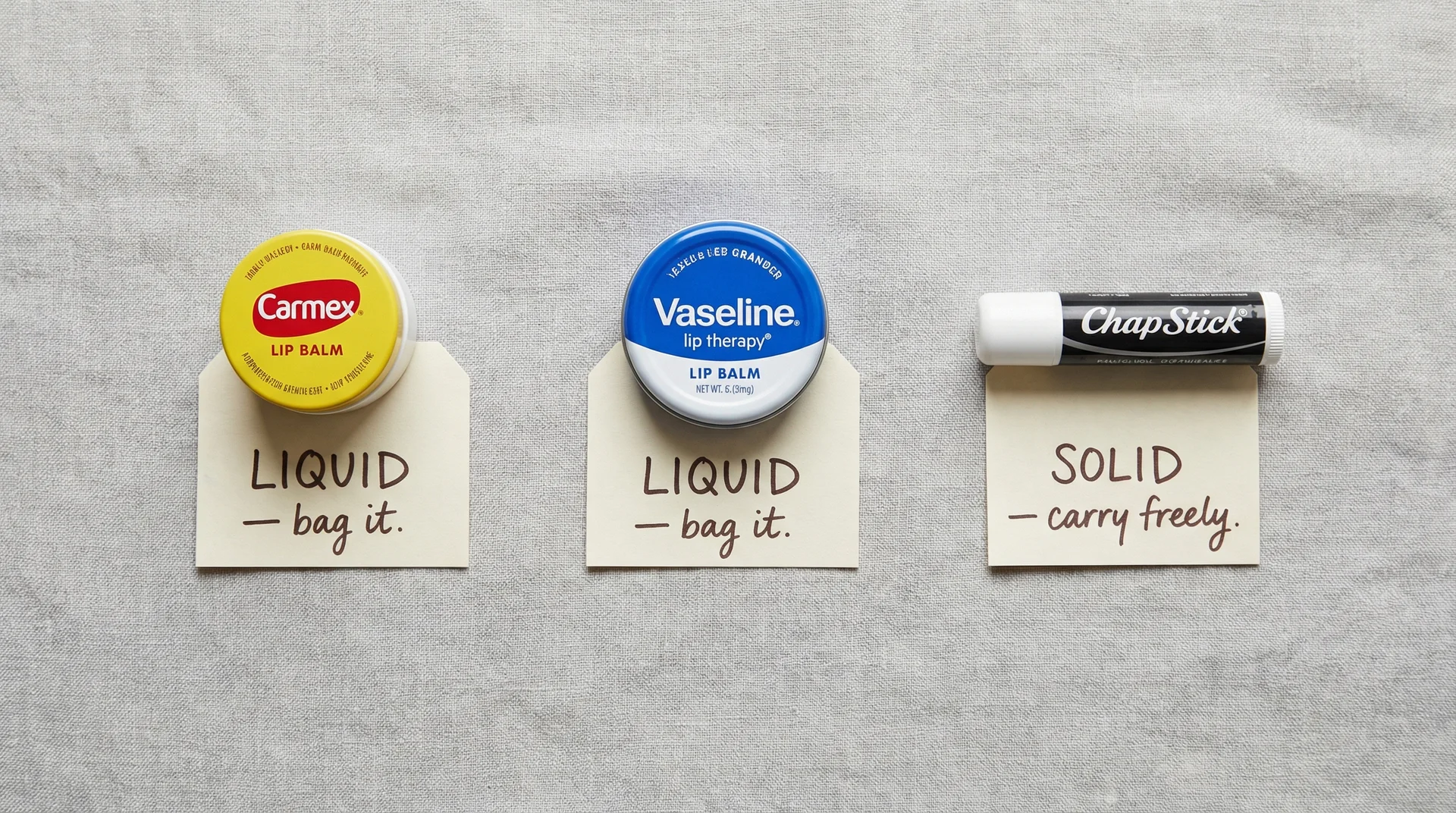
The container is the reliable tell. Anything in a squeeze tube, a pot, or a jar should go in your quart bag. If you can scoop it with your finger or squeeze it out, TSA treats it as a liquid regardless of what the brand calls it on the label.
Lip Gloss, Liquid Lipstick, Lip Stain, and Lip Oil (All Liquids)
No ambiguity in this category. All four follow the 3-1-1 rule in your carry-on.
Lip Gloss
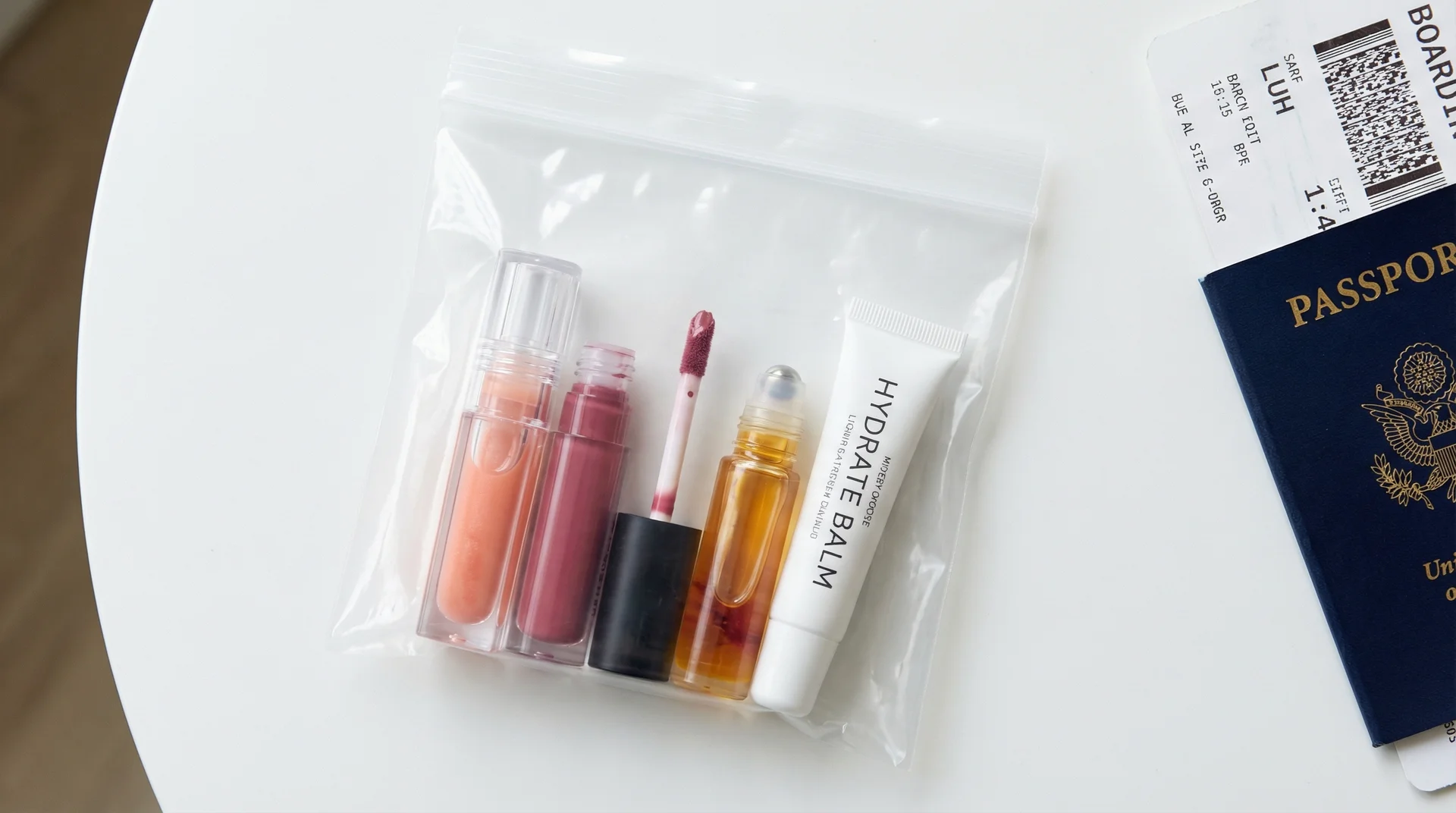
Wand-and-tube gloss and squeeze-tube gloss are liquids. They go in your quart bag, in containers of 3.4 oz (100ml) or less. Most retail glosses sit well below that limit.
A standard MAC Lipglass is 0.17 oz, a Fenty Gloss Bomb is 0.30 oz, but the bag requirement still applies regardless of size.
One practical heads-up: cabin pressure causes lip gloss to expand slightly, and you can end up with ooze around the cap when you open it mid-flight. Before you seal your liquid bag, press any excess air out of the tube and close the cap firmly. A small square of cling film over a wand applicator opening before capping adds real protection on longer flights.
Liquid Lipstick and Lip Stain
Anything in a tube with a doe-foot applicator is a liquid, regardless of how transfer-proof or matte the finish is once it dries. This includes NYX Soft Matte Lip Cream, Fenty Stunna Lip Paint, MAC Retro Matte Liquid Lip, and similar formulas. Lip stains with a brush or felt-tip applicator fall in the same category.
The good news is that liquid lipsticks and stains are almost universally small in volume, so they take up minimal quart bag space.
Lip Oil: The Category Most Travel Guides Skip
Lip oils have become one of the most widely used lip categories right now, and almost no TSA travel content addresses them clearly, so let me be direct: lip oils are liquids.
This includes Dior Lip Glow Oil, Rhode Peptide Lip Treatment in tube form, LANEIGE Lip Glowy Balm, and similar products. The formula is oil- or gel-based, it flows, and it belongs in your quart bag.
Rhode’s treatment in particular looks almost balm-like in photos, but the texture won’t hold its shape outside the tube. Quart bag. LANEIGE Lip Sleeping Mask in a pot follows the same logic as soft gel, pot format, liquid classification.
Rollerball lip oils fall in this category, too. The applicator style itself signals a liquid formula to most agents, so don’t rely on the product feeling light or dry to the touch.
The 3-1-1 Rule
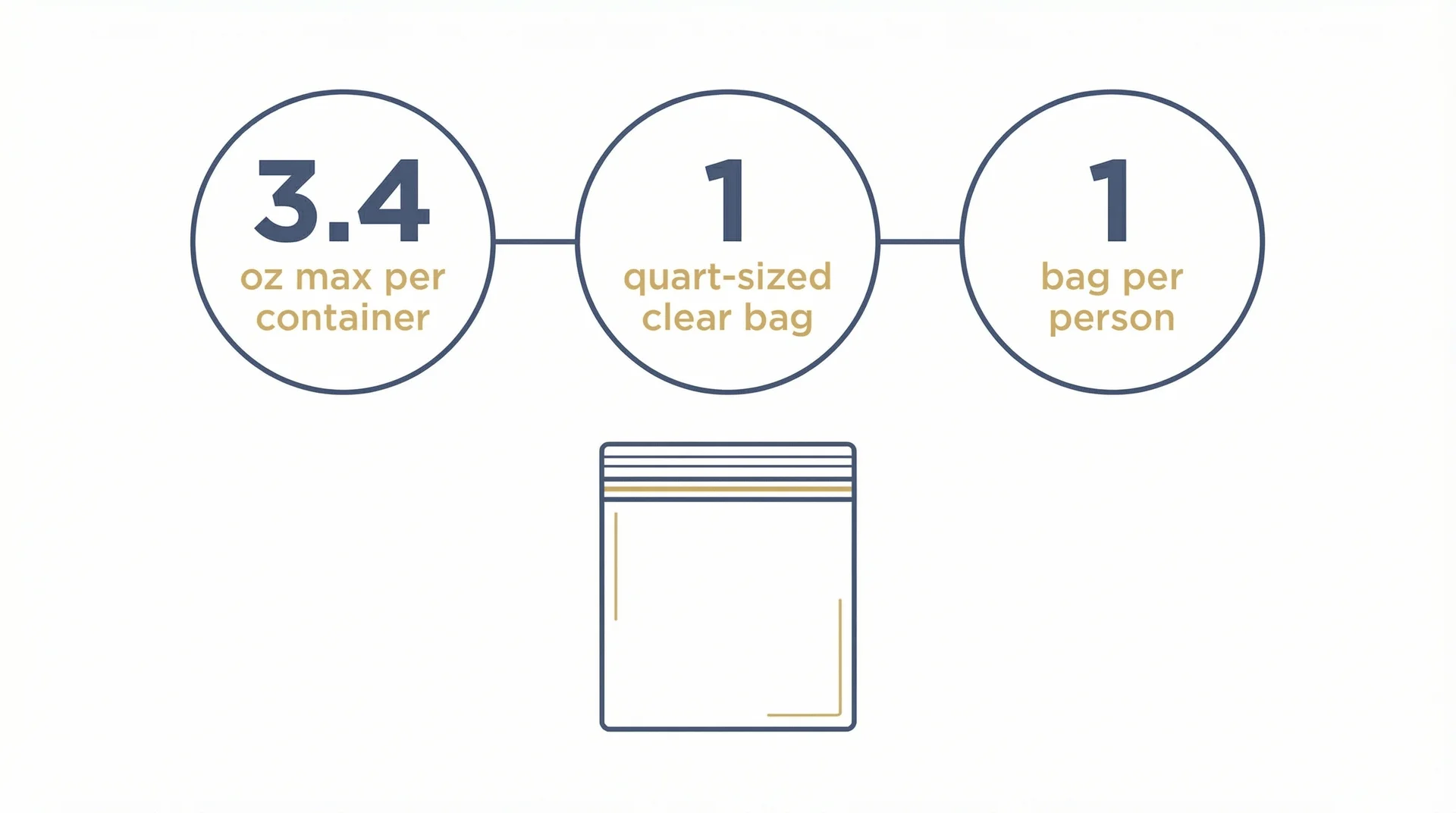
3.4 oz (100ml) is the maximum size per individual liquid container in your carry-on.
1 quart-sized clear zip-top bag holds all your liquids combined. That’s roughly 7×8 inches, one bag per person.
1 bag goes on the conveyor belt separately from your carry-on during X-ray screening.
A standard quart bag holds around 9 to 10 travel-sized containers packed efficiently. If you’re also carrying foundation, mascara, and moisturiser, your glosses and lip oils compete for that same real estate. The bag space, not the size limit on individual products, is where most people run out of room.
For your checked luggage, none of this applies. You can pack full-size lip gloss, oversized Vaseline, or any liquid lip product in any quantity. Seal caps well to handle pressure and rough handling, but there’s no TSA liquid restriction in checked bags.
What Happens If You Get It Wrong at Security
The reality is calmer than most people expect.
When Your Product Gets Flagged
If a gel balm or liquid lip product turns up in your carry-on outside the quart bag, an agent will typically ask you to bag it if it fits the size requirement, or surrender it if it doesn’t.
For something like a pot of Carmex, the interaction is brief. What extends the stop is not having your quart bag accessible, or carrying an oversized container that cannot be kept. Neither of those situations is dramatic, but both are avoidable.
The Products That Create the Most Friction
Based on what travellers report most often, these are the products that generate unexpected hold-ups:
- Gel balms in pots, particularly Vaseline and Carmex, because people assume “balm” means solid
- Lip gloss in multi-pack sets or jumbo tubes that push past 3.4 oz
- Lip products in unlabelled or decanted containers, because agents cannot verify contents easily
- Rollerball lip oils, because the applicator signals liquid even when the traveller hasn’t processed it that way
Agent Discretion Is Real, and It Matters
TSA guidelines are consistent on paper, but individual agents make the final call, and that call varies between checkpoints. The same pot of Carmex that passed without comment in Seattle might get pulled at JFK.
If you’re unsure about a product, you can ask an agent directly before your bag goes through the X-ray. Most agents respond well to a simple question rather than discovering the item themselves.
The TSA’s AskTSA service on X (formerly Twitter) also answers packing questions in advance if you want written confirmation for a specific product.
Flying Internationally? The Rules Shift A Lot!
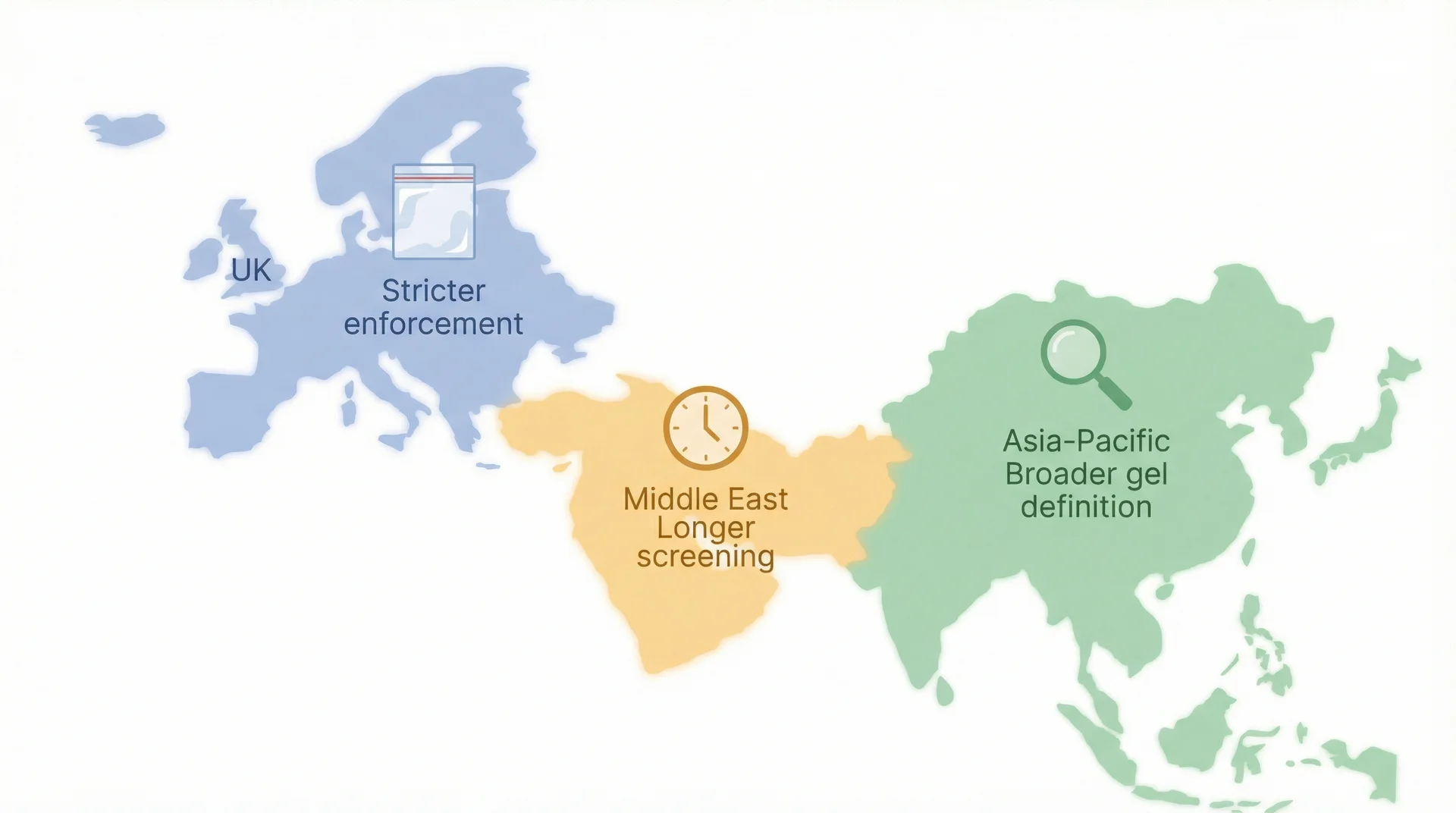
TSA governs US domestic departures and flights leaving the United States. Every other country’s airport security authority sets its own rules, and they don’t always match.
UK and EU Airports
UK airports follow the same 100ml liquid limit, but enforcement is often stricter in practice. Heathrow has flagged solid lipstick as a liquid before, which sits outside TSA’s US interpretation, but it happens often enough that frequent flyers through London keep their solid products accessible rather than buried in a bag. EU airports, particularly in France and Germany, tend to be thorough with any gel-format product.
One specific note for CDG: French airports often require a standard food-type quart bag rather than a branded TSA-style zipper bag. Worth knowing before you pack.
Asia, the Middle East, and Australia
Some airports across Asia apply a broader definition of “gel,” meaning products that clear security in North America can receive additional scrutiny. Middle Eastern airports occasionally run longer screening times for Western cosmetics in general. Australia follows similar 100ml limits, but sometimes interprets gel-format products more expansively than North American agents do.
The practical takeaway for any international trip is the same: pack defensively, keep your liquids bag perfectly organised, and shift toward solid alternatives wherever possible to reduce friction.
Duty-Free Lip Products
If you buy a liquid lip product at an international duty-free shop after clearing security, it travels in the sealed, transparent, tamper-evident retail bag from the retailer.
That sealed bag protects you at US re-entry screening under TSA rules, but it does not necessarily protect you at every connecting airport’s security checkpoint. Read the sticker on the bag and check the specific rules for your layover airport before you assume you’re covered.
How to Pack Your Lip Products Like Someone Who Does This Regularly
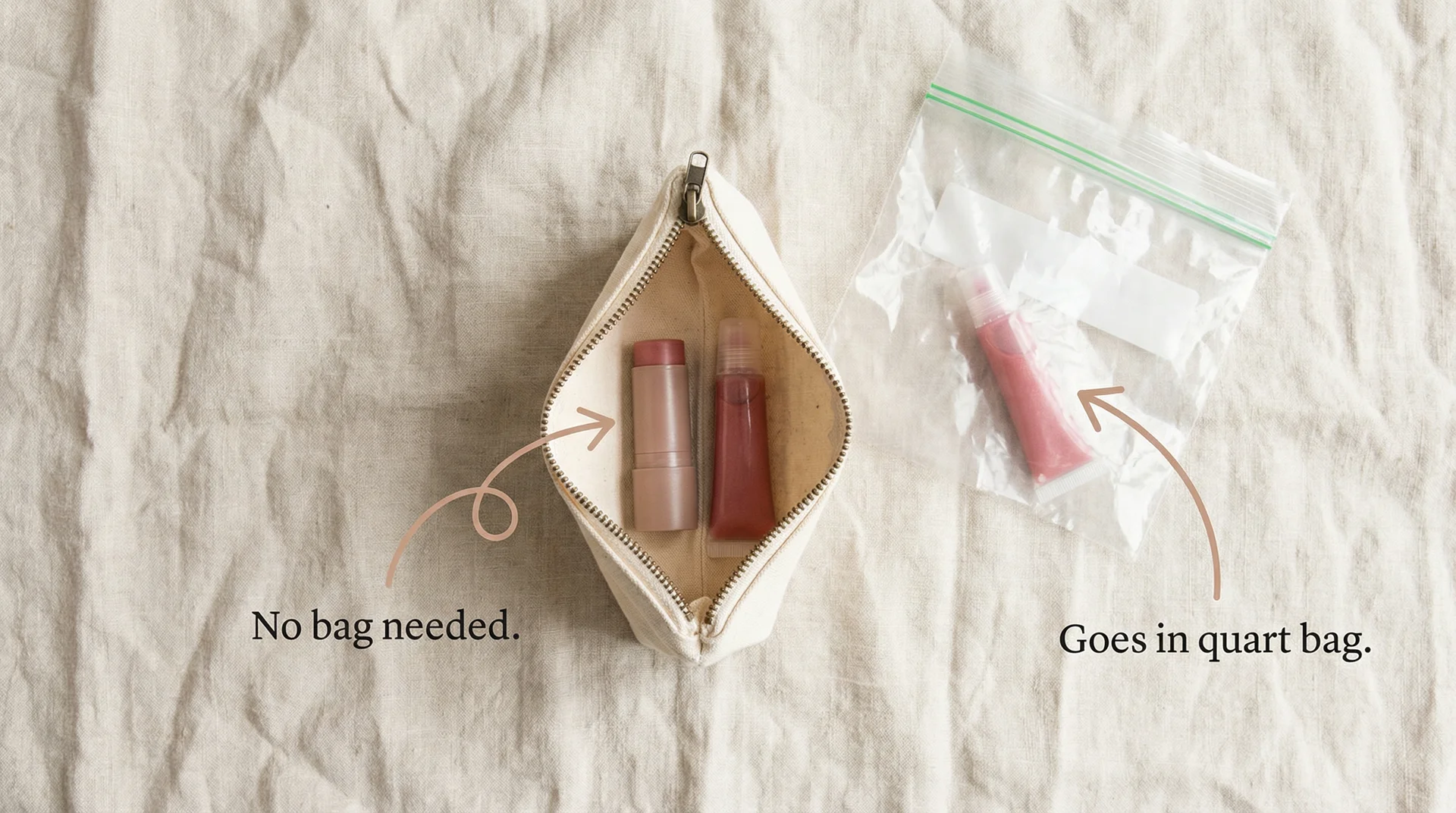
When I’m preparing for a shoot or a travel day, my approach to lip products comes down to reducing decision-making at the checkpoint. Over time, I’ve landed on a few principles that hold up consistently.
Carry one solid, bring one liquid if you want it. A solid tinted balm covers most of what you need: hydration, a bit of warmth, or colour without touching your quart bag. If I want a gloss on top, one small tube goes in with my liquids. That’s the full system for personal travel days.
Use products that do two things. A tinted stick balm (solid) replaces both a sheer gloss and a moisturising base layer. A wax-based lip and cheek stick is still a solid and still bag-free. Choosing dual-purpose products over single-purpose ones reduces your liquid load and opens space in your quart bag for things that genuinely need it.
Know your products before you pack them. Pick up each lip product you’re considering and look at the format.
Does it twist up from a solid base? Carry it anywhere. Does it come out of a squeeze tube, a pot you scoop from, or a wand you pull from a liquid reservoir? Quart bag. Running through this takes less than a minute and eliminates all the checkpoint guesswork.
Full Quick-Reference Table
| Lip Product | TSA Classification | Quart Bag Required? | Size Limit? |
|---|---|---|---|
| Bullet/twist-up lipstick | Solid | No | No |
| ChapStick (stick) | Solid | No | No |
| Burt’s Bees stick balm | Solid | No | No |
| EOS stick balm | Solid | No | No |
| Aquaphor Lip Repair Stick | Solid | No | No |
| Tinted stick balm | Solid | No | No |
| Carmex (tube or pot) | Liquid/Gel | Yes | 3.4 oz max |
| Vaseline (tin or pot) | Liquid | Yes | 3.4 oz max |
| Blistex (tube) | Liquid/Gel | Yes | 3.4 oz max |
| Aquaphor Ointment (tube) | Liquid | Yes | 3.4 oz max |
| Lip gloss (wand or tube) | Liquid | Yes | 3.4 oz max |
| Liquid lipstick (doe-foot) | Liquid | Yes | 3.4 oz max |
| Lip stain (brush/felt tip) | Liquid | Yes | 3.4 oz max |
| Lip oil (all formats) | Liquid | Yes | 3.4 oz max |
| Rollerball lip oil | Liquid | Yes | 3.4 oz max |
| Lip sleeping mask (pot) | Liquid/Gel | Yes | 3.4 oz max |
Frequently Asked Questions
Can I bring multiple lipsticks on a plane?
You can bring as many solid stick lipsticks as you want in your carry-on. There’s no quantity limit on solid cosmetics, and they don’t need to go in your liquids bag or be declared at the checkpoint.
Does lip gloss have to go in the quart bag?
Yes. Lip gloss is a liquid under TSA rules and belongs in your clear, quart-sized bag. Every container needs to be 3.4 oz or smaller. Most commercial glosses are well under that limit, but the bag requirement applies regardless of size.
Is Carmex a liquid for TSA?
Yes. Carmex in tube or pot form is a gel under TSA rules and must go in your quart bag within the 3.4-oz limit. Most other medicated gel balm formulas follow the same classification.
Can I carry ChapStick in my pocket through airport security?
You can. Solid stick ChapStick is not a liquid and doesn’t need to be removed, bagged, or declared at security.
What about lip balm in a pot or jar?
Pot and jar formats are treated as liquids regardless of how waxy the formula feels, because the product loses its shape when scooped or spread. Bag them with your other liquid cosmetics.
Can I pack liquid lip products in my checked luggage?
Yes, with no size restrictions. The 3-1-1 rule applies only to carry-on bags. In checked luggage, you can pack full-size glosses, lip oils, and gel balms in any quantity. Seal caps carefully to handle pressure changes and baggage handling.
What happens if TSA flags my lip product?
For a product that’s within the size limit but unpacked incorrectly, the agent will typically ask you to bag it. For an oversized container, it gets surrendered at the checkpoint. The interaction is brief in both cases. If you’re unsure about a product ahead of time, the TSA’s AskTSA service on X can give you a direct answer before you travel.
Once you see that TSA’s entire liquid classification is built on one question, does it hold its shape? Everything else follows logically.
Your solid stick products travel freely. Your glosses, lip oils, and gel balms follow the 3-1-1 rule.
And when you’re in doubt at the checkpoint, a quick question to the agent beats a confiscated product every time.