
Of all the ingredient combination questions I get from clients, azelaic acid with tretinoin comes up the most.
Usually, the person asking has been on tretinoin for a few months and has heard that azelaic acid might help with the pigmentation or redness they are still dealing with.
Sometimes they are just starting out and want to build the most effective routine possible from day one.
The short answer is yes, you can use azelaic acid with tretinoin, and in the right routine, they work better together than either one does alone.
The longer answer involves understanding what each ingredient actually does, how to layer them without turning your skin into a reaction waiting to happen, and whether azelaic acid or its more powerful relative, isotretinoin, belongs in your particular situation.
That last part matters more than most skincare content acknowledges. The word isotretinoin gets dropped into tretinoin conversations constantly, and most people have a vague sense that it is stronger or more serious, without knowing exactly how different these two medications actually are.
I want to clear all of this up in one place so you can make an informed decision about your own routine.
What Azelaic Acid Actually Does
Azelaic acid tends to get underestimated, and I think it is because it lacks the dramatic reputation of retinoids or the instant results promise of exfoliating acids. It is quieter than both of those, which is part of what makes it so genuinely useful.
Azelaic acid is a dicarboxylic acid that occurs naturally in grains like wheat and barley.
In skincare, it does three things that matter: it kills the bacteria responsible for acne, it calms inflammation, and it blocks the enzyme tyrosinase, which drives melanin production in the skin.
That combination is rare in a single ingredient. Most acne treatments are not also pigmentation treatments. Most pigmentation treatments are not also anti-inflammatory. Azelaic acid covers all three, which is why it holds a permanent place in my practice.
It is also one of the very few active ingredients considered safe during pregnancy, which matters to a significant portion of my clients who are managing skin concerns through hormonal shifts and cannot use retinoids.
Azelaic acid comes in two forms from an access standpoint.
- Over-the-counter formulations in the US are capped at 10%, which is still genuinely useful as a maintenance or supportive ingredient in a broader routine.
- Prescription concentrations of 15% and 20% are where the clinical results for acne and melasma are most documented.
If you are managing active acne or significant hyperpigmentation, the prescription strength is worth having a conversation with your dermatologist about.
What Tretinoin Does Differently
Tretinoin works through a completely different mechanism than azelaic acid, which is exactly why the two can complement each other rather than duplicate effort.
Tretinoin is a vitamin A derivative, a retinoid that binds to receptors inside skin cells and changes how those cells behave at the genetic level.
It accelerates cell turnover, increases collagen production, unclogs pores, and, over time, improves texture, pigmentation, and signs of photoaging. It is one of the most researched topical ingredients available and has decades of dermatological use behind it.
The trade-off is the adjustment period. Tretinoin irritates most skin when it is first introduced, sometimes significantly.
Redness, flaking, dryness, and a temporary worsening of breakouts are common in the first four to eight weeks. I have covered the full tretinoin application process and ramp-up schedule on this site, but the relevant point here is that this irritation response is exactly where azelaic acid becomes a useful partner.
Can You Use Azelaic Acid with Tretinoin?
Yes, and I recommend this combination more than almost any other pairing for clients dealing with acne alongside hyperpigmentation or redness.
The two ingredients address skin concerns through different pathways, which means they add up rather than overlap.
Here is what the combination gives you that neither ingredient provides alone:
- Tretinoin handles cell turnover, collagen production, pore clearing, and deep pigmentation improvement
- Azelaic acid manages the bacterial load, driving active breakouts, calms the inflammation that worsens both acne and pigmentation, and adds a second mechanism for fading dark spots through tyrosinase inhibition
The anti-inflammatory action of azelaic acid is particularly valuable during the early weeks of tretinoin use when the skin is adjusting, and irritation runs highest.
I have seen this combination keep clients on their tretinoin routine through a difficult adjustment period when azelaic acid alone was doing enough irritation management to prevent them from quitting.
| There is one thing to be honest about: both ingredients can cause irritation, particularly when you first introduce them. Layering two active ingredients before your skin has adjusted to either of them is the fastest route to a reaction that sets you back weeks. The way you introduce them and the order in which you apply them matter considerably. |
How to Layer Azelaic Acid with Tretinoin: The Two Approaches
There are two practical ways to use these ingredients together, and which one works for you depends on how established your skin’s tolerance already is.
Option 1: Separate Them by Time of Day
This is the approach I start almost every client on, and it is the most reliable way to enjoy the full benefit of both ingredients without compounding irritation.
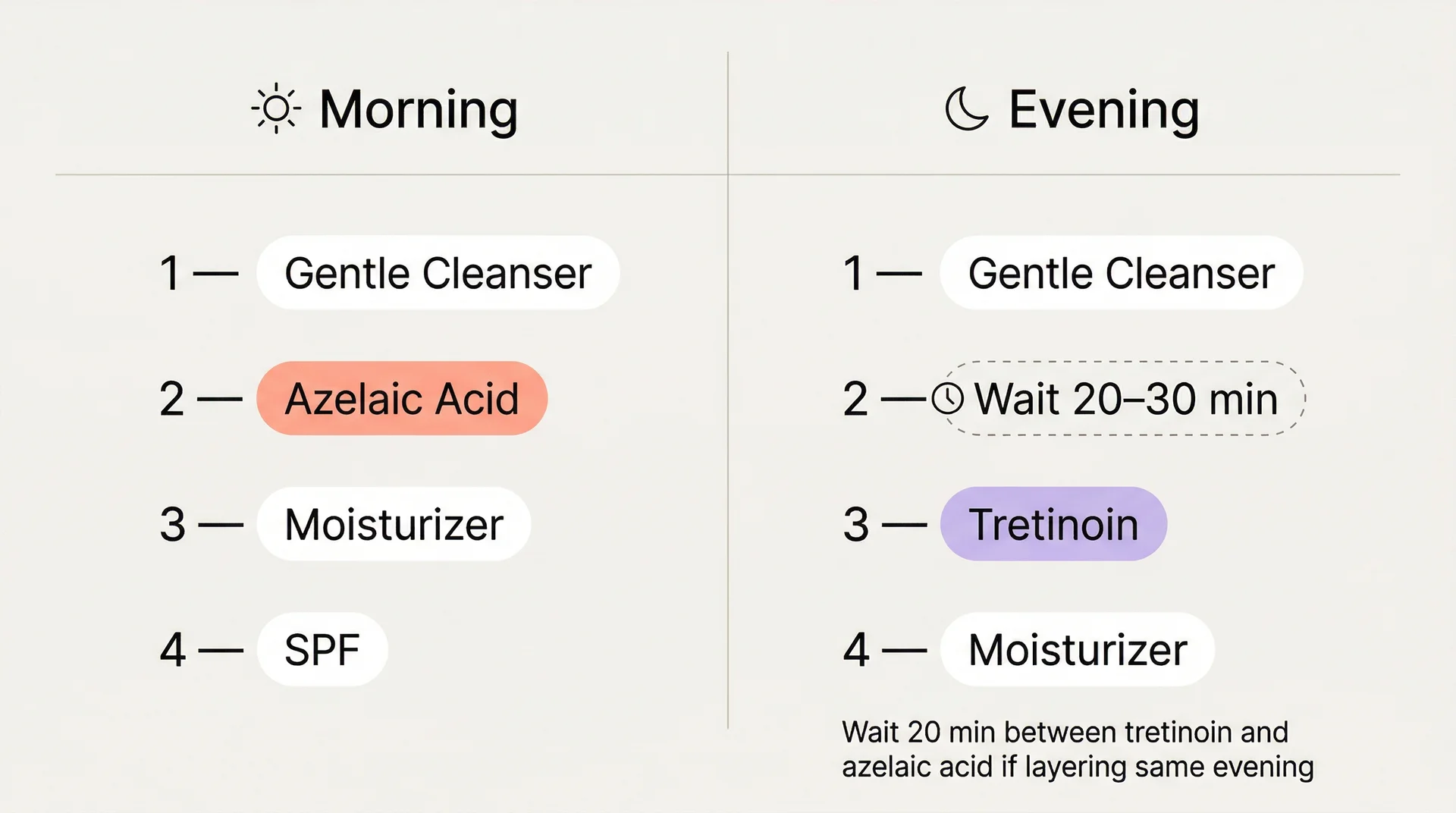
Morning routine: Gentle cleanser → azelaic acid → moisturizer → SPF
Evening routine: Gentle cleanser → wait 20 to 30 minutes → tretinoin → moisturizer
Applying azelaic acid in the morning and tretinoin at night keeps each ingredient working independently, reduces the total irritation load your skin processes at once, and fits naturally into the rhythm of a morning-protection and evening-treatment routine.
This is the version I default to for any client in their first three months on tretinoin, anyone with sensitive skin, and anyone who has had a previous reaction to either ingredient.
Option 2: Same Evening Routine
Once your skin has adjusted to tretinoin over three or more months and the irritation response has largely settled, you can apply both in the same evening routine. The layering order matters here.
Evening routine: Gentle cleanser → wait 20 to 30 minutes → tretinoin → wait 20 minutes → azelaic acid → moisturizer
Tretinoin goes on first, directly to dry skin, because it needs unobstructed contact with the skin to work most effectively.
Azelaic acid goes on after, where it works on the upper layers and provides its anti-inflammatory and pigmentation-inhibiting effects without significantly interfering with what tretinoin is doing below.
Some clients with very sensitive skin do better reversing this order, applying azelaic acid first as a mild buffer before tretinoin.
I have found both sequences work, and the one your skin tolerates better is the right one for your skin. What matters more than perfect order is consistent use of both.
A routine overview by experience level:
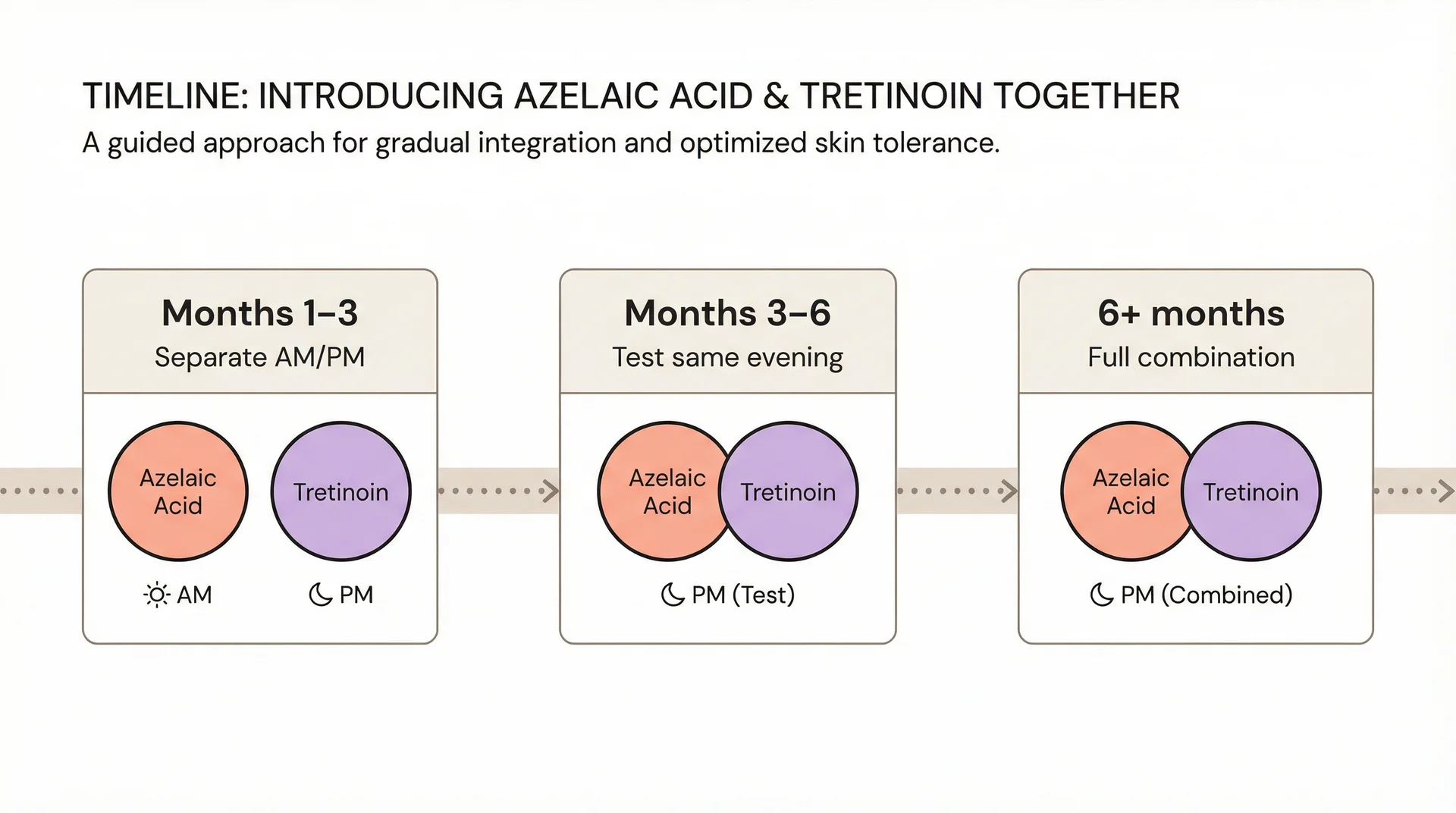
| Stage | Azelaic acid | Tretinoin | Notes |
|---|---|---|---|
| Months 1 to 3 on tretinoin | Morning | Evening | Separate completely to reduce irritation |
| Months 3 to 6 | Morning or evening | Evening | Test same-evening layering if skin has adjusted |
| 6 months and beyond | Evening | Evening | Full combination routine when fully tolerated |
Which Skin Types Benefit Most From This Combination
I want to be specific about this because the combination is not the right starting point for every skin type, and I would rather give you an honest assessment than a blanket recommendation.
Azelaic Acid with Tretinoin combination works particularly well for:
- Skin dealing with both active acne and post-inflammatory hyperpigmentation simultaneously, which is extremely common in my practice, especially among clients with medium to deeper skin tones
- Rosacea-prone skin using low-strength tretinoin, where azelaic acid’s anti-inflammatory properties actively support rosacea management alongside the tretinoin
- Oily and combination skin managing ongoing breakouts while working toward the texture and anti-aging benefits of tretinoin
- Skin that has struggled with tretinoin irritation in the past and needs additional barrier support through the adjustment period
Azelaic Acid with Tretinoin combination needs more caution for:
- Very sensitive or reactive skin types that have not yet adjusted to either ingredient individually
- Anyone with a compromised skin barrier from eczema or over-exfoliation, where adding azelaic acid on top of tretinoin can tip the skin into a prolonged reaction
If you fall into either of the cautious categories, the separated morning-and-evening approach is where to start, and doing so with the guidance of a dermatologist who can monitor your skin’s response is worth it.
Isotretinoin vs Tretinoin: What Actually Separates Them
This is the part of the conversation that I think most skincare content handles too briefly.
It is probably because the medications are so different that a real explanation takes more than a paragraph.
But if you are reading a blog about tretinoin and azelaic acid, the isotretinoin question is likely somewhere in your mind, and it deserves a proper answer.
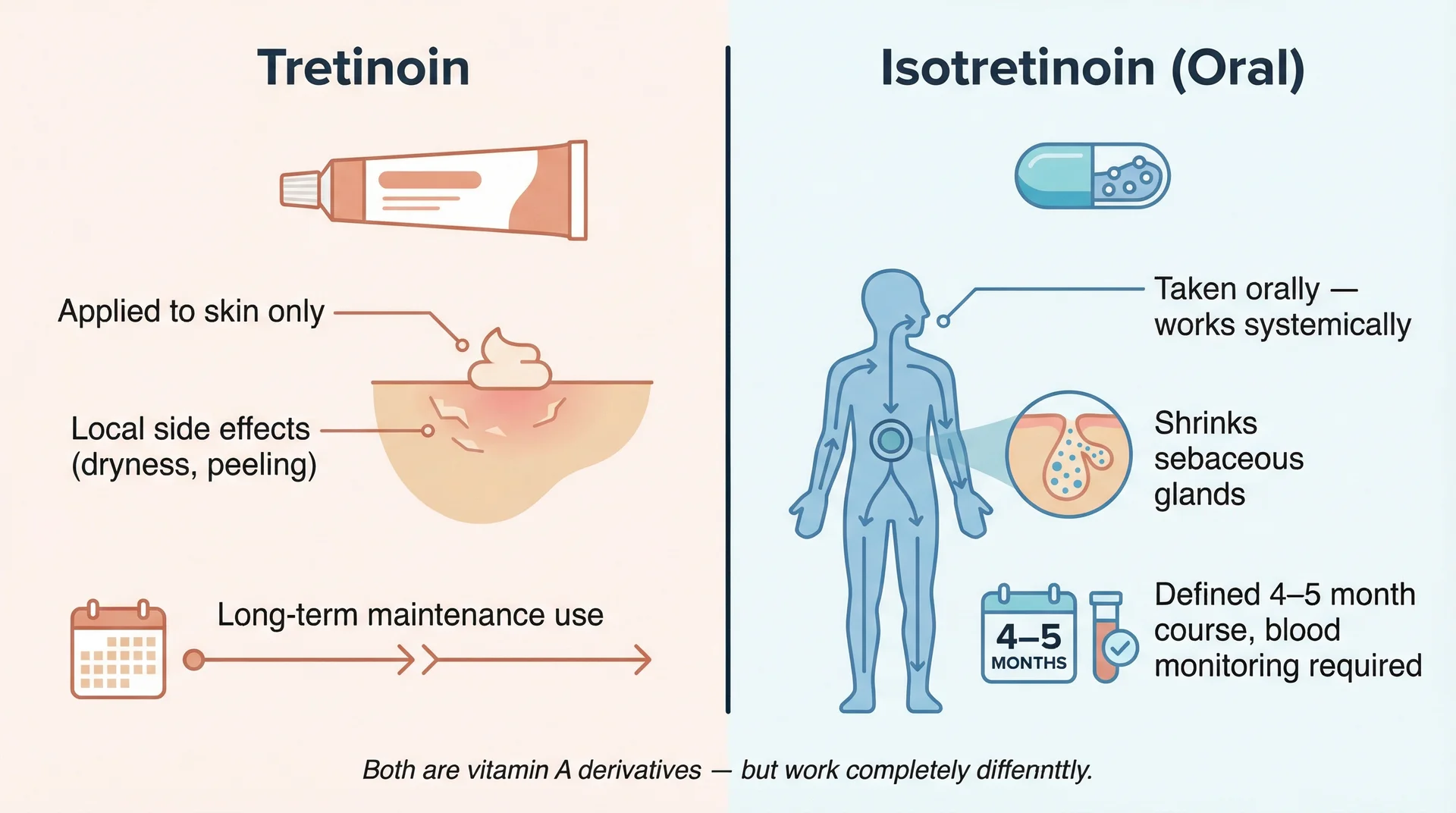
Tretinoin and isotretinoin are both vitamin A derivatives. That shared origin is where the similarity largely ends.
Tretinoin
It is a topical medication applied directly to the skin. It works locally, meaning its effects stay at the skin surface.
It accelerates cell turnover, increases collagen, clears pores, and fades pigmentation.
It is prescription-only but widely accessible through dermatologists and telehealth platforms.
The side effects are primarily local: redness, peeling, dryness, and sensitivity during the adjustment period.
It is a long-term maintenance ingredient that people use for years or decades.
Isotretinoin
It is an oral medication, most recognized by its former brand name Accutane. It works systemically, meaning it circulates through the entire body via the bloodstream.
Its primary mechanism is a dramatic reduction in sebum production by shrinking the sebaceous glands.
It addresses all four major drivers of acne simultaneously: excess oil production, clogged pores, bacterial environment, and inflammation.
It is reserved for severe, cystic, or nodular acne that has not responded to other treatments, including topical tretinoin and antibiotics.
The side effect profile of isotretinoin is substantially more serious than that of tretinoin. Dry lips, dry eyes, dry skin, and joint pain are common during the course. It carries severe risks for pregnant people and requires mandatory contraception and regular blood monitoring throughout treatment. It is not a routine skincare ingredient. It is a controlled medication with a defined treatment course, typically four to five months, after which most patients experience prolonged remission. |
Isotretinoin vs Tretinoin comparison at a glance:
| Tretinoin | Isotretinoin | |
|---|---|---|
| Form | Topical cream or gel | Oral capsule |
| How it works | Locally on skin cells | Systemically through the bloodstream |
| Best for | Mild to moderate acne, anti-aging, and pigmentation | Severe, cystic, or treatment-resistant acne |
| Side effects | Local: dryness, peeling, irritation | Systemic: dry lips, eyes, joints, mood changes |
| Duration | Long-term maintenance | Defined course, typically 4 to 5 months |
| Monitoring required | Minimal | Regular blood tests, mandatory contraception |
| Access | Prescription, widely available | Prescription, tightly controlled |
The question I get asked most directly is: if isotretinoin is more powerful, should I just go straight to that? My answer, every time, is that power and appropriateness are not the same thing. Isotretinoin is the right tool for severe, persistent, cystic acne that is affecting quality of life and has not responded to anything else. It carries real risks that are worth taking in that context. For the vast majority of people dealing with moderate acne, texture, and pigmentation, topical tretinoin used consistently and correctly produces excellent results without those systemic risks. |
Most clients I have worked with who were considering isotretinoin had never actually given tretinoin a proper run.
Proper meaning three to six months, correct application method, appropriate supporting routine, consistent use through the adjustment period. Tretinoin, when used well, is a genuinely powerful treatment.
Isotretinoin is in a different category of both efficacy and risk, and the decision to pursue it belongs with a dermatologist who knows your full skin history.
What to Avoid When Using Azelaic Acid and Tretinoin Together
When you have two actives in your routine, the temptation to add more is real. I see it constantly.
Someone starts seeing progress and decides to add a glycolic acid toner or a strong vitamin C serum at night because progress feels good and more feels better.
More, in this context, usually means more irritation, a compromised barrier, and results that plateau or reverse because the skin spends its energy repairing damage rather than rebuilding itself.
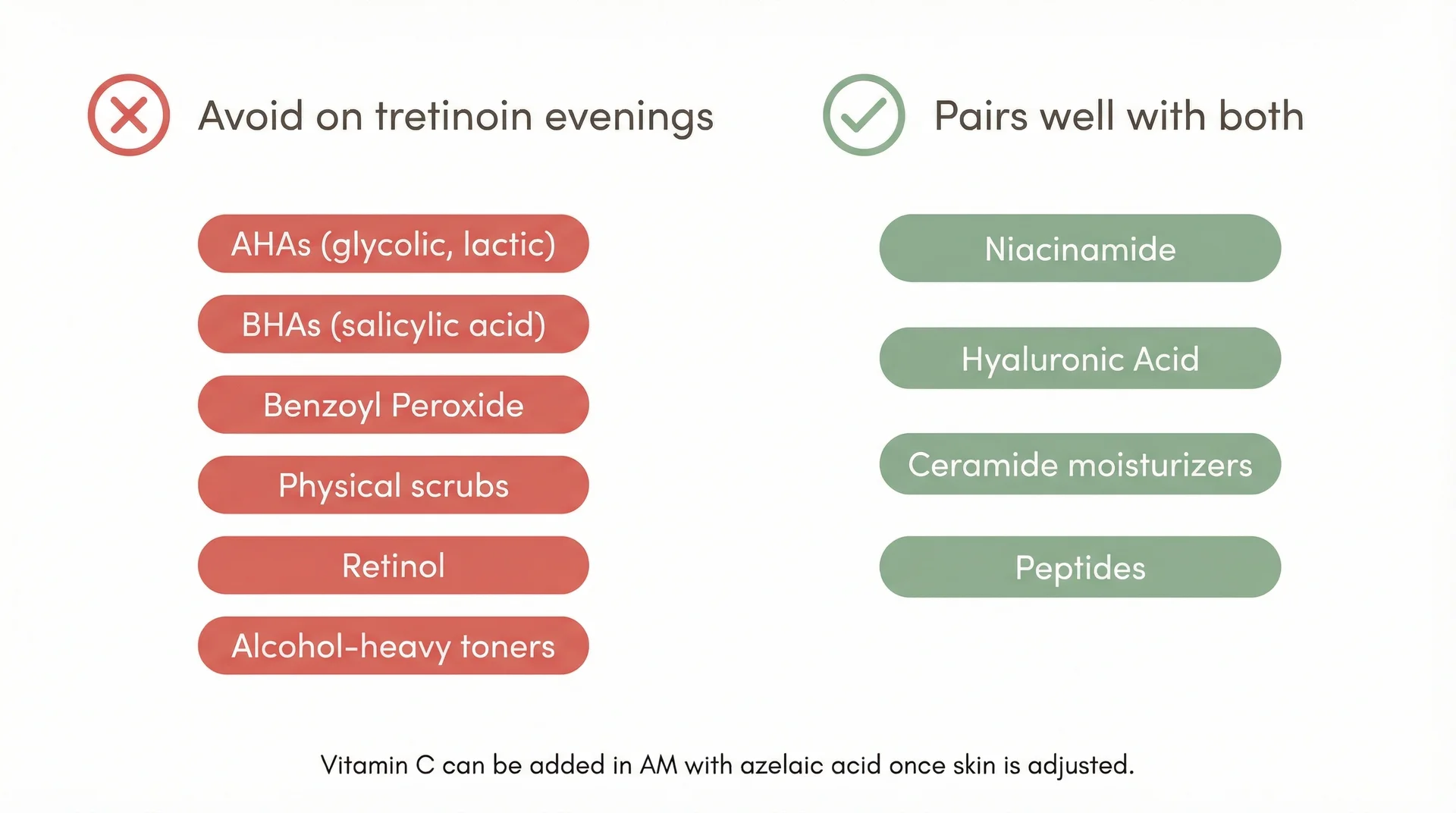
On evenings when you use tretinoin, avoid:
- AHAs and BHAs, glycolic acid, lactic acid, salicylic acid
- Benzoyl peroxide, which can degrade tretinoin’s stability when applied in the same routine
- Physical exfoliants or scrubs
- Additional retinoids or retinol
- Alcohol-heavy toners
On mornings when you use azelaic acid, keep the routine clean:
- Gentle cleanser, azelaic acid, moisturizer, SPF
- Vitamin C can layer well with azelaic acid in the morning for pigmentation-focused routines, but introduce it separately and only after your skin has adjusted to both tretinoin and azelaic acid
What plays well with both:
- Niacinamide, which complements both ingredients and supports barrier function
- Hyaluronic acid as a hydrating layer
- Ceramide-rich moisturizers
- Peptides on top of the routine
Frequently Asked Questions
Do I use azelaic acid first or tretinoin?
Tretinoin goes on first, applied to completely dry skin. Wait 20 minutes, then layer azelaic acid on top. Tretinoin needs direct skin contact to work effectively. If you are separating them across morning and evening routines, the order becomes irrelevant.
Can I do azelaic acid in the morning and tretinoin at night?
This is actually the setup I recommend most for beginners. Azelaic acid in the morning pairs naturally with SPF, and tretinoin stays in its most effective environment at night. It keeps irritation low and lets both ingredients do their jobs without competing.
What skin concerns do azelaic acid and tretinoin treat?
Together, they cover a lot of ground. Tretinoin handles cell turnover, fine lines, clogged pores, and deep pigmentation. Azelaic acid manages active acne bacteria, redness, and surface-level dark spots. The overlap of pigmentation and acne is what makes this combination particularly effective for most skin types.
What is the 1 2 3 rule for tretinoin?
The 1 2 3 rule refers to a gradual introduction approach: use tretinoin once a week in week one, twice a week in week two, and three times a week in week three before building further. It keeps the adjustment period manageable and reduces the likelihood of early irritation pushing you to quit.
Who should avoid isotretinoin?
Anyone who is pregnant, trying to conceive, or breastfeeding should avoid it entirely due to severe birth defect risks. People with liver conditions, very high cholesterol, or a history of depression need careful evaluation before starting. It also requires close monitoring throughout the course, so it is not suitable for anyone unable to commit to regular blood testing.
Does tretinoin work the same as Accutane?
No, and the difference is significant. Tretinoin is a topical that works locally on skin cell turnover and pore function. Accutane, the brand name for oral isotretinoin, works systemically by shrinking sebaceous glands and dramatically cutting oil production across the whole body. Different mechanisms, different use cases, different risk profiles entirely.
Conclusion
Azelaic acid and tretinoin are two of the most reliably effective ingredients available for acne, pigmentation, and long-term skin health, and they work better together than most people realize.
The combination is not complicated once you understand what each ingredient is doing and why the order and timing of application matter.
The isotretinoin question is worth taking seriously if you are at a crossroads with persistent, severe acne that topical treatments have not moved.
But for the majority of people reading this, a well-built routine around tretinoin and azelaic acid, used consistently and supported by the right moisturizer and daily SPF, covers more ground than most people expect it to.
Give the combination time. Skin that has spent years building up pigmentation and congestion does not clear in a month.
What I have seen consistently across my practice is that the clients who stay patient, keep their routines simple, and resist the urge to add more actives are the ones who come back six months later with genuinely different skin.