
Yes, You Can Paint a Metal Roof (But Read This First)
Yes, you can paint a metal roof. Most metal roofs are paintable, and the process can restore appearance, slow surface rust, and improve reflectivity. But “can” and “should” are different questions.
A metal roof only paints well when three things are true:
(1) the surface is properly prepped,
(2) the existing coating is compatible with your new paint, and
(3) the roof is structurally sound (no active leaks, no widespread corrosion holes, no major fastener failure).
If your roof has active leaks, perforated panels, or a manufacturer’s warranty that prohibits field painting, painting can become an expensive short-term cosmetic fix or create new problems like peeling, blistering, and trapped moisture.
This guide answers the three questions that matter: Can you paint it? (yes, usually). Can you DIY it? (depends on pitch, access, and your comfort with heights). How much does a pro charge? (actual 2025–2026 pricing ranges).
5-Minute Roof Check (Before You Decide Anything)
From the ground or a safely positioned ladder, do NOT walk the roof yet:
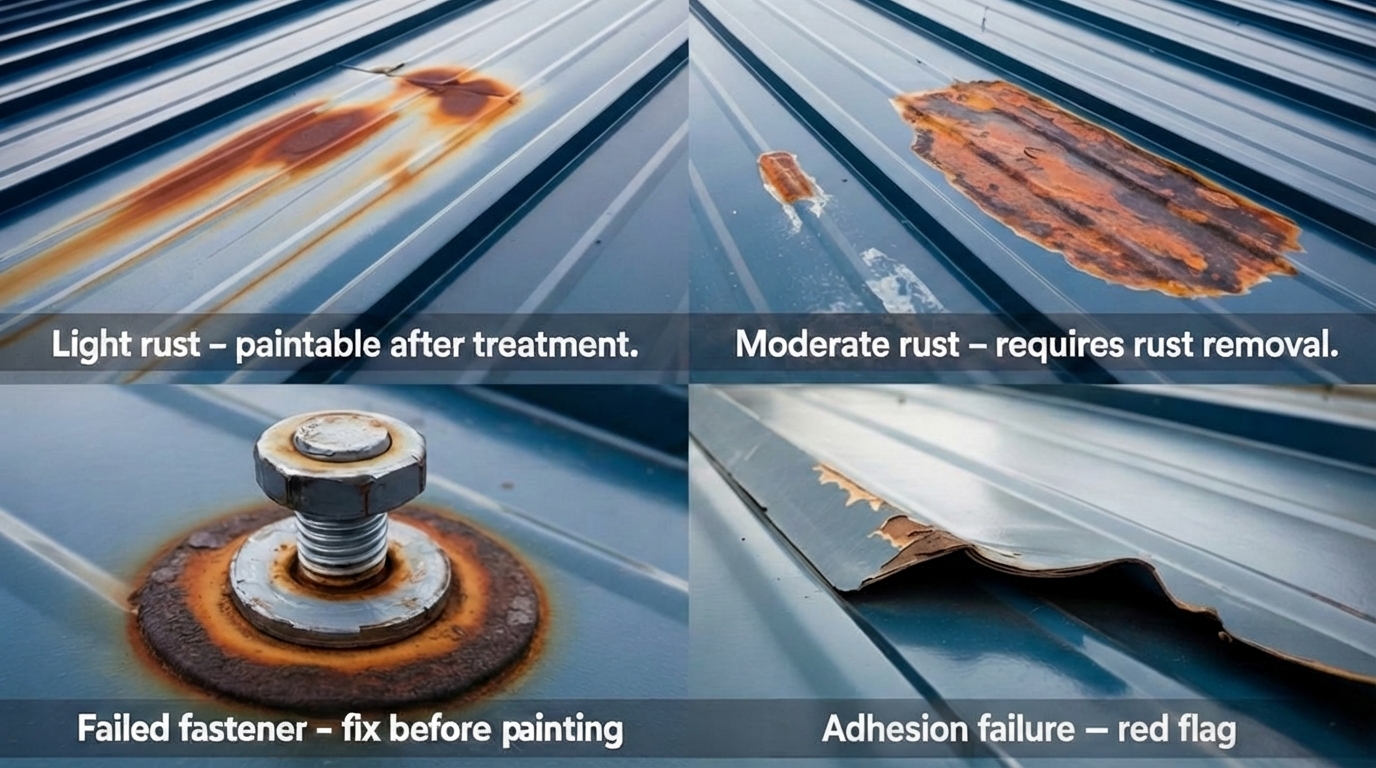
- Rust severity: Is it surface staining (light) or pitting/flaking/holes (heavy)?
- Peeling paint: Is there old paint flaking or curling? (Widespread peeling = red flag)
- Fasteners: Can you spot backed-out screws, missing washers, or rust halos around fastener heads?
- Seams/gaps: Do ridge caps or lap seams look separated or lifted?
- Leaks: Any interior stains, water marks on the soffit, or drips after rain?
- Access/pitch: Can you safely reach the roof? Is the pitch steep (>6:12) or moderate?
Decision trigger: If you see holes, widespread peeling, or active leaks, don’t plan to paint as the main fix; plan repairs or a professional evaluation first.
Can You Paint Your Metal Roof? (The Real Yes/No)
Paint is a good fit when:
- The roof is structurally sound (no holes, no persistent leaks, fasteners are tight).
- Rust is light to moderate (surface staining, minor pitting, but metal is intact).
- The existing coating is stable (not peeling across large areas).
- You can properly prep (clean, de-chalk, treat rust, prime where needed).
- You’re okay with maintenance (painted roofs aren’t “set and forget”).
Paint is NOT a good fit when:
- Rust is advanced (pitting, flaking, holes, widespread fastener failure).
- You’re using paint to avoid repairs (leaks, loose panels, and failed flashings must be fixed first).
- You can’t identify the existing coating, and won’t do adhesion test patches.
- Your warranty or insurer prohibits field painting.
- The roof is unsafe to access (very steep, high, and no proper ladder placement).
Bottom line: If your roof is mostly sound and the issues are cosmetic (fading, chalking, light rust, sealant issues), painting works. If the roof has structural problems, painting is a band-aid; fix the underlying issue first.
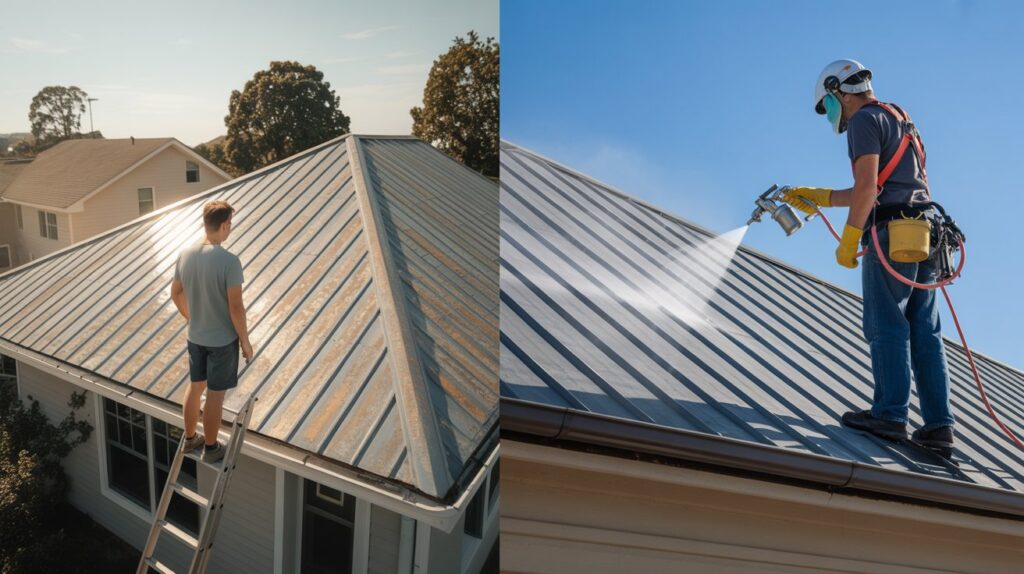
Can You DIY It? Honest Assessment (Skill + Safety + Time)
This is where most homeowners get stuck. The honest answer depends on three things: roof pitch, your access/safety comfort, and prep willingness.
DIY is realistic when:
- Roof pitch is 4:12 to 6:12 (moderate slope, manageable with proper ladder setup).
- You can set up safe access (stable ladder, roof jacks, or scaffolding; not climbing around on a slippery roof).
- The roof is simple (few penetrations, straightforward eaves, no complex valleys).
- Rust is light/spotty (not widespread pitting or scaling).
- You’re willing to spend 40–60 hours on prep (cleaning, de-chalking, rust treatment, primer).
- You’re comfortable following detailed instructions (primer compatibility, recoat windows, temperature/humidity rules).
DIY is risky or unrealistic when:
- Roof pitch is >7:12 (steep; fall risk increases dramatically).
- You’re uncomfortable on ladders or at heights (don’t override this feeling).
- The roof is high (>25 feet), or access is awkward (no stable ladder placement).
- Rust is widespread/structural (requires professional-grade rust treatment and judgment).
- Previous paint is peeling extensively (requires stripping or abrasion, but it is labor-intensive).
- You can’t commit 3–5 days to the project (rushing = poor results).
- If you have any physical limitations (back issues, balance problems, joint pain).
What does DIY actually look like? (time + cost breakdown)
If you can DIY, here’s what you’re signing up for:
| Phase | Time | Cost (materials) | Reality check |
|---|---|---|---|
| Cleaning + rinsing | 1 day (8-10 hrs) | $50-150 (cleaner, hose, brushes) | Physically demanding; may need to repeat if the first rinse is still chalky |
| De-chalking + surface prep | 1-2 days (8-16 hrs) | $100-300 (abrasive pads, wire brushes, safety gear) | Tedious; tests your patience. This is where most DIY jobs get rushed. |
| Rust treatment + primer | 1 day (6-8 hrs) | $200-500 (rust converter/removal tools, primer, brushes/roller) | Rust treatment varies by severity; primer must dry fully before topcoat. |
| Topcoat application | 1-2 days (8-12 hrs) | $300-800 (paint, roller/sprayer, masking, overspray protection) | Spraying is faster, but overspray is a real problem. Rolling is slower but more controlled. |
| Cure time + touch-ups | 3-7 days (waiting) | $0-100 (touch-up paint, small brush) | Don’t walk on the roof during the cure. Plan for a second coat if required. |
| TOTAL | 4-6 days active + 3-7 days cure | $650–1,750 | Prep is 60% of the work; painting is 40%. |
DIY cost reality: $650–$1,750 in materials + your labor (no hourly cost, but real-time investment).
Safety gear you must buy (non-negotiable):
- Fall protection harness + anchor point (if roof pitch >6:12): $150–300
- Slip-resistant roof shoes: $50–100
- Safety glasses, gloves, dust mask: $30–50
Professional Charges of Painting a Metal Roof (2025–2026)
If you’re hiring a pro, here’s what you’re paying for and why.
How pros price metal roof painting
Contractors typically charge in three ways :
- Per square foot (most common for residential)
- Hourly rate (less common; usually for estimates/consultations)
- Flat project fee (common for larger jobs with a clear scope)
Metal roof painting costs: National averages
Cost per square foot (labor + materials combined)
Based on current market data:
- $1.20–$2.70 per sq ft is the typical range for labor + materials on a straightforward job.
- $2.00–$3.50 per sq ft if the roof has rust that needs treatment or prep is heavy.
- $3.00–$5.00+ per sq ft if there’s extensive peeling/stripping, coastal environment, or premium coatings.
Example cost calculations:
| Roof size | Light prep (per sq ft) | Heavy prep (per sq ft) | Rough total cost |
|---|---|---|---|
| 1,000 sq ft | $1.50 | $2.50 | $1,500–$2,500 |
| 2,000 sq ft | $1.50 | $2.50 | $3,000–$5,000 |
| 3,000 sq ft | $1.50 | $2.50 | $4,500–$7,500 |
National average total project cost: $1,500–$4,500 for a typical 2,000 sq ft residential roof (light to moderate prep).
Labor rates by contractor experience level (hourly, if you see this quoted)
- Entry-level/newer contractor: $40–$60/hour
- Mid-range/experienced contractor: $60–$90/hour
- Premium/specialized contractor: $100+/hour
What this means: A 2,000 sq ft roof with moderate prep might take 30–50 hours of labor. At $60–$80/hour, that’s $1,800–$4,000 in labor alone, plus materials.
What’s included in a pro estimate (and what isn’t)
Typically INCLUDED:
- Surface cleaning and de-chalking
- Spot rust treatment (converter or light removal)
- Primer application (if required by system)
- Topcoat application (usually 1–2 coats)
- Basic cleanup and masking
Typically NOT INCLUDED (and why they cost extra):
- Fastener replacement ($200–$800 depending on quantity)
- Seam repair/caulking ($500–$2,000)
- Flashing repair ($300–$1,500)
- Stripping/abrasion of old paint (adds $0.50–$1.50/sq ft)
- Rust removal (beyond spot treatment; adds $0.50–$2.00/sq ft)
- Premium coatings (urethane vs. acrylic; adds $0.30–$1.00/sq ft)
Pro tip: When you get an estimate, ask: “What’s included in your base price, and what costs extra?” This prevents surprise invoices.
Factors that increase the professional cost
- Roof pitch (steep roofs = more safety equipment, slower work)
- Rust severity (light rust = spot treatment; heavy rust = removal/stripping)
- Previous paint condition (stable = straightforward; peeling = strip/abrasion needed)
- Coating system (acrylic is cheaper; urethane/specialty coatings cost more)
- Location/accessibility (high roof, no ladder access, complex geometry = higher cost)
- Warranty (some contractors charge more for extended workmanship warranties)
What warranty/guarantee do you get with a pro?
Standard contractor warranties:
- Material warranty: 5–10 years (from the paint manufacturer, not the contractor)
- Workmanship warranty: 1–3 years (contractor guarantees adhesion, coverage, and no peeling due to poor application)
- Adhesion guarantee: Some contractors offer “if it peels due to our prep/application, we’ll redo it free.”
What voids the warranty:
- Improper maintenance (not cleaning periodically)
- Damage from weather events (hail, extreme heat)
- Failure to follow recoat intervals
- Painting over improper substrate (contractor’s fault, not yours)
Always get this in writing. Don’t rely on verbal promises.
Paint Types & Systems Explained (What You’re Paying For)
Different coating systems have different costs, durability, and prep requirements. Here’s what pros typically recommend:
System 1: Acrylic topcoat (most common, DIY-friendly)
- Cost: $1.20–$2.00 per sq ft (labor + materials)
- Lifespan: 7–12 years (varies by climate, prep)
- Prep required: Clean, de-chalk, and prime if bare metal
- Best for: Light cosmetic fading, stable existing finish
- Pros: affordable, easy to apply, good UV resistance
- Cons: not ideal for high-rust areas, needs recoating sooner
System 2: Urethane topcoat (tougher, more expensive)
- Cost: $2.00–$3.50 per sq ft (labor + materials)
- Lifespan: 10–15 years (better durability)
- Prep required: Same as acrylic, sometimes stricter
- Best for: Harsh environments (coastal, salt air), high-wear areas
- Pros: tougher film, longer lifespan, better in extreme conditions
- Cons: more expensive, stricter application requirements (temp/humidity)
System 3: Rust-inhibitive primer + topcoat (for rust issues)
- Cost: $1.50–$2.70 per sq ft (labor + materials)
- Lifespan: 8–14 years (depends on rust severity and climate)
- Prep required: Rust removal or conversion, full primer coverage
- Best for: Moderate rust, exposed fasteners, older roofs
- Pros: addresses rust at the source, good adhesion on bare metal
- Cons: requires more prep work, longer cure times
System 4: Elastomeric/reflective coating (premium option)
- Cost: $2.50–$4.00 per sq ft (labor + materials)
- Lifespan: 10–15 years
- Prep required: Heavy cleaning, sometimes primer
- Best for: Energy efficiency (heat reflection), older/damaged roofs, coastal areas
- Pros: reflects heat (lowers cooling costs), bridges small cracks, very durable
- Cons: expensive, thicker application (slower), fewer color options
Comparison Table: DIY vs. Professional (Cost + Outcome)
| Factor | DIY | Professional |
|---|---|---|
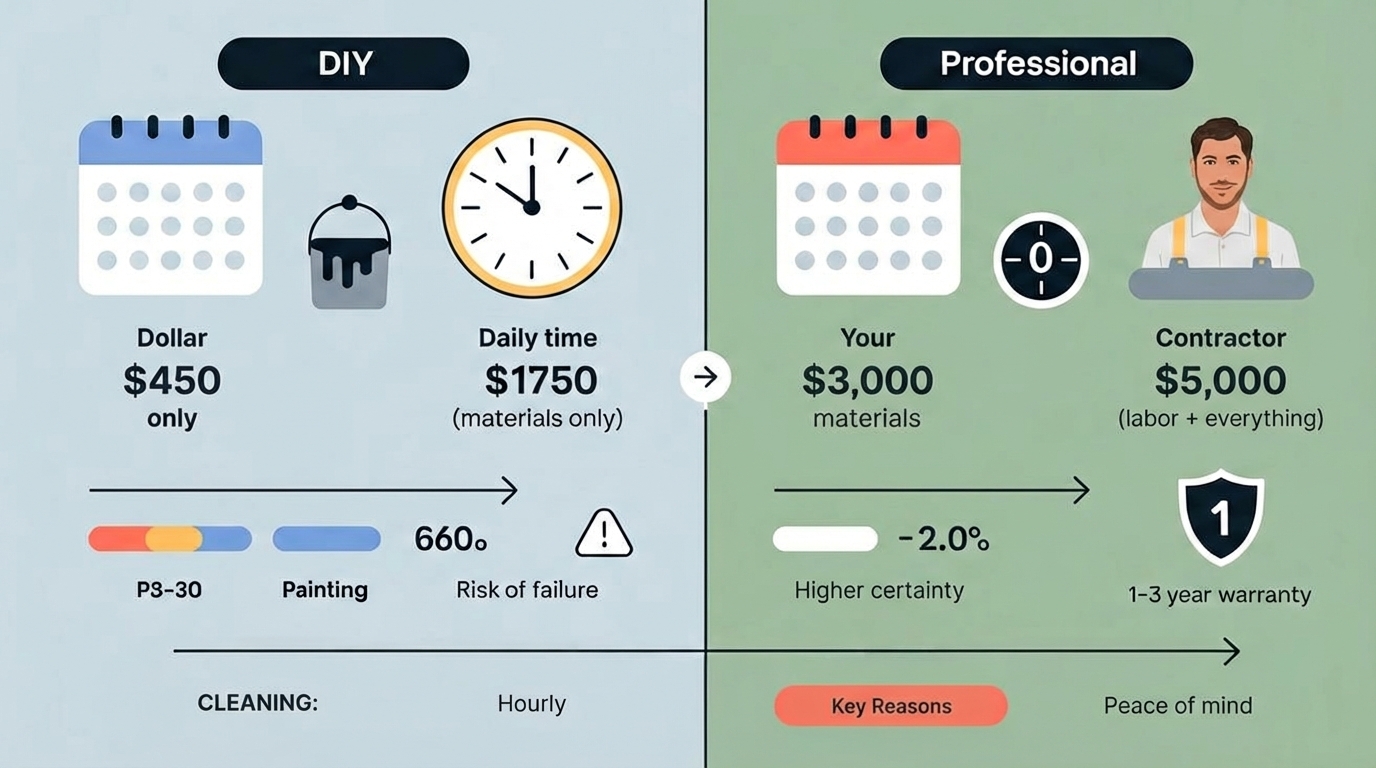
| Total cost (2,000 sq ft) | $650–$1,750 (materials only) | $3,000–$5,000 (labor + materials) |
| Your time investment | 40–60 hours active + 3–7 days cure | 0 (you wait) |
| Prep quality | Depends on your effort; often rushed | Consistent, equipment-backed |
| Warranty | None (you’re responsible) | 1–3 years on workmanship |
| Risk of failure | Moderate to high (adhesion, coverage) | Low (if contractor is reputable) |
| Best for | Simple roofs, light fading, experienced DIYers | Complex roofs, rust issues, peace of mind |
| Worst case | Paint peels in 2–3 years; redo the entire job | Rare; covered under warranty |
Common Mistakes That Ruin DIY Jobs (Learn from Others)
If you’re leaning toward DIY, avoid these pitfalls:
- Painting over chalking without de-chalking first
- Chalk is a bonding killer. If your hand comes away powdery after cleaning, keep cleaning.
- Skipping primer on bare metal
- Bare metal will rust under paint. Always prime bare spots.
- Painting when the roof is damp (including morning dew)
- Moisture under paint causes blistering and adhesion failure. Wait for full dry-out.
- Ignoring fastener/seam repairs
- Paint doesn’t seal loose screws or open seams. Fix them first.
- Applying paint too thin or unevenly
- Thin spots fail early. Use a roller/sprayer to ensure consistent coverage and thickness.
- Not respecting recoat windows
- Recoating too early or too late can cause poor adhesion between coats.
- Painting in bad weather (wind, heat, humidity extremes)
- Coatings need stable conditions to cure. Check the product data sheet for limits.
FAQ: Real Questions About Metal Roof Painting
Can I paint my metal roof myself if I’ve never done it before?
Short answer: It depends on your roof pitch, access, and willingness to spend 40–60 hours on prep.
If your roof is a moderate pitch (4:12–6:12), you can safely set up a ladder, the rust is light, and you’re willing to follow instructions carefully, then yes—DIY is possible. But know that prep is 60% of the work, and rushing it is the #1 reason DIY jobs fail.
If your roof is steep (>7:12), you’re uncomfortable on ladders, or rust is widespread, hire a pro. It’s not worth the fall risk.
How much does it cost to hire a professional to paint a metal roof?
National average (2025–2026):
- $1,500–$4,500 for a typical 2,000 sq ft roof (light to moderate prep).
- $1.20–$2.70 per square foot is the standard pricing range.
- Add $500–$2,000+ if the roof has rust that needs removal, extensive peeling, or fastener/seam repairs.
What affects the price:
- Roof size and pitch (steeper = more expensive)
- Rust severity (light = cheaper; heavy = more labor)
- Existing paint condition (stable = cheaper; peeling = more prep)
- Coating system (acrylic < urethane < specialty coatings)
- Your location (urban areas tend to be higher)
Get 2–3 quotes. Prices vary by contractor and region.
Will painting my metal roof void the warranty?
Maybe. Some manufacturer warranties restrict field painting or require specific prep/coatings and approved contractors.
Before you paint:
- Find your warranty paperwork (or contact the original installer).
- Ask: “Does the warranty allow field painting? Under what conditions?”
- If repainting requires an authorized contractor, get that in writing.
Pro tip: If you hire a contractor, ask them to provide documentation that your warranty remains valid.
How long does a painted metal roof last?
Typical lifespan:
- Acrylic coating: 7–12 years (varies by climate and prep quality)
- Urethane coating: 10–15 years (more durable)
- Rust-inhibitive system: 8–14 years (depends on rust severity)
What affects longevity:
- Prep quality (poor prep = shorter lifespan)
- Climate (harsh sun, salt air, humidity = shorter lifespan)
- Maintenance (periodic cleaning extends life; neglect shortens it)
- Paint system quality (cheap paint fails sooner)
Bottom line: A well-prepped job with a quality system can last 12–15 years. A rushed DIY job might peel in 3–5 years.
Can I paint over existing paint on my metal roof?
Only if the existing paint is stable and you address chalking.
Safe to paint over when:
- The existing paint is adhered (not peeling/flaking).
- You’ve removed chalking (wipe test shows minimal residue).
- You’ve tested adhesion on a small area first.
Not safe to paint over when:
- Widespread peeling or blistering (paint will peel with the old coat).
- Unknown existing coating (do a test patch first).
- Incompatible coatings (e.g., oil-based under water-based; usually fail).
Pro rule: If more than 10–15% of the old paint is peeling, plan for abrasion/stripping—don’t paint over failure.
What’s the best time of year to paint a metal roof?
Ideal conditions:
- Temperature: 50–85°F (check product data sheet for exact limits)
- Humidity: <85% (avoid damp/humid mornings)
- Weather: No rain in forecast during application + initial cure (usually 24–48 hrs)
- Wind: Low wind (prevents overspray and uneven drying)
Best seasons: Spring and fall (stable temps, lower humidity). Avoid summer heat extremes and winter cold.
Next Steps: Your Decision Path
If you’re leaning toward DIY:
- Do the 5-minute roof check (above). If you see holes, widespread peeling, or active leaks, stop here and hire a pro.
- Confirm your roof pitch and access safety. If >7:12 or access is risky, hire a pro.
- Identify your roof type and existing coating. If unknown, plan adhesion test patches.
- Classify your roof condition (sound finish, spot rust, heavy peeling, coastal). Pick the matching system.
- Budget 40–60 hours and $650–$1,750. If you can’t commit, hire a pro.
- Get the paint manufacturer’s data sheet. Follow prep + application + cure instructions exactly.
- Buy safety gear first (harness, gloves, shoes, glasses). Don’t skip this.
If you’re leaning toward hiring a pro:
- Get 2–3 contractor quotes. Ask what’s included (prep, primer, topcoat, warranty).
- Confirm warranty status. Ask if field painting voids any existing coverage.
- Ask about their coating system and why it’s right for your roof.
- Get references. Ask to see photos of similar jobs and call 1–2 past customers.
- Confirm timeline and weather windows. Painting takes 3–5 days of active work + cure time.
- Get everything in writing: scope, cost, warranty, timeline.
If you’re still unsure (DIY vs. pro):
Ask yourself these three questions:
- Can I safely access my roof? (Yes = DIY is possible. No = hire a pro.)
- Am I willing to spend 40–60 hours on prep? (Yes = DIY is viable. No = hire a pro.)
- Can I commit to following the instructions exactly? (Yes = DIY works. No = hire a pro.)
If you answer yes to all three, DIY is realistic. If you answer no to any, hire a professional.
Final Verdict: Can You Paint a Metal Roof?
Yes, you can paint a metal roof.
- Can you DIY it? Depends on pitch, access, and prep willingness. If you’re unsure, hire a pro.
- How much does a pro cost? $1,500–$4,500 for a typical residential roof (2,000 sq ft), or $1.20–$2.70 per square foot.
- Is it worth it? If your roof is sound and the issues are cosmetic (fading, chalking, light rust), painting extends the life and improves the appearance. If the roof has structural problems, painting is a band-aid—fix the underlying issue first.
- Bottom line: Paint a metal roof when the foundation is solid. Prep is the real job. Safety comes first. If you’re not confident, hire a professional.