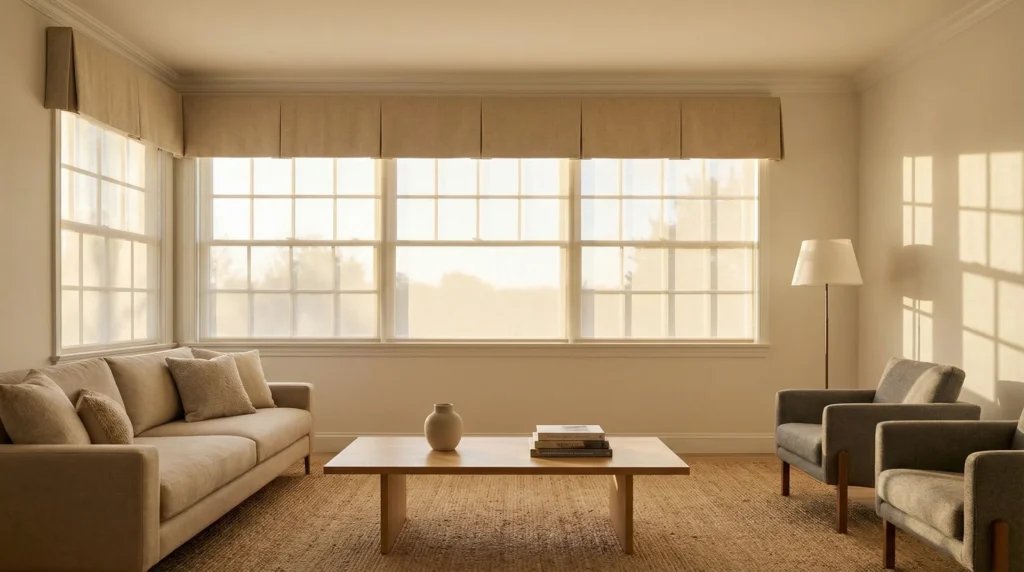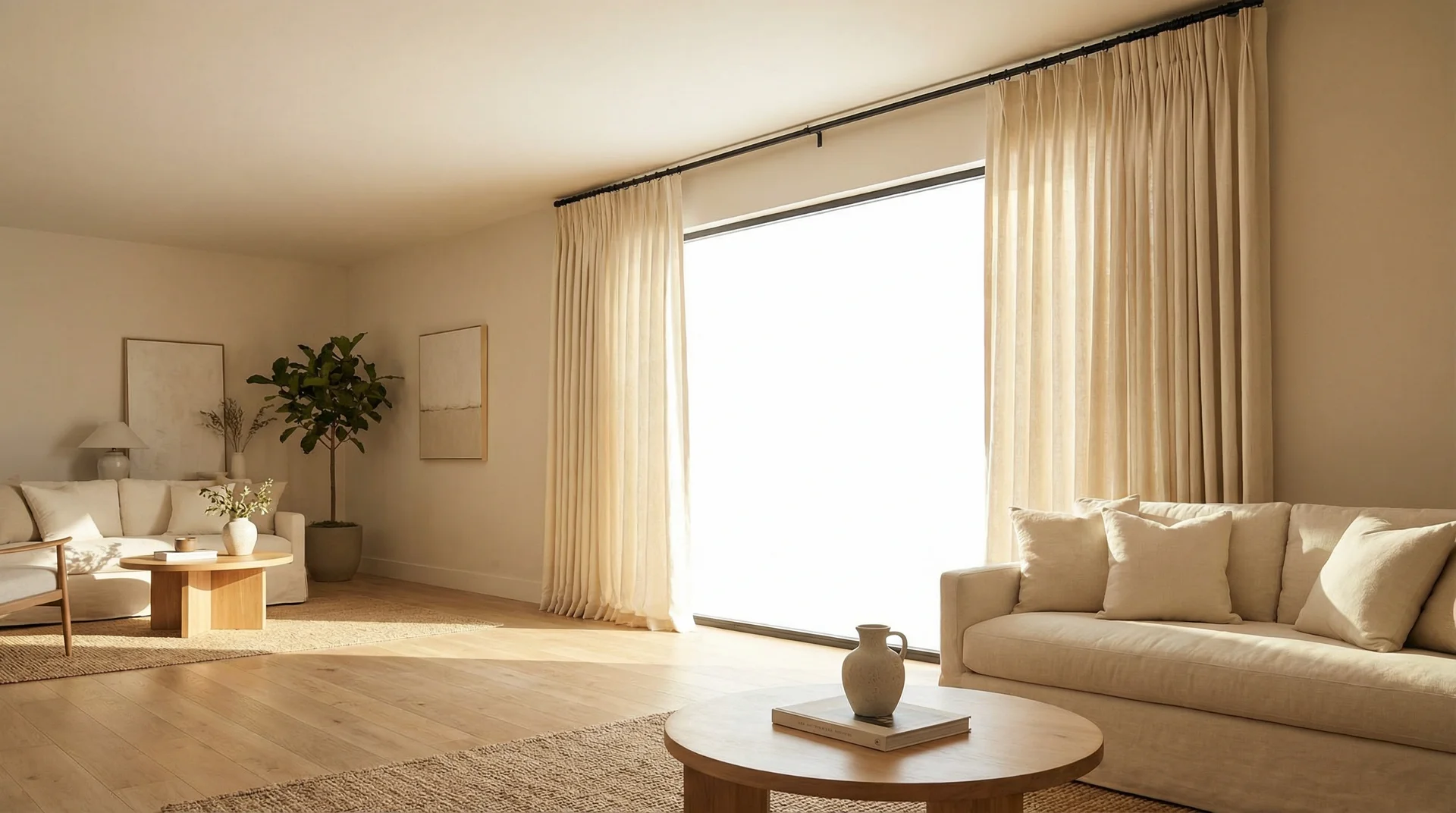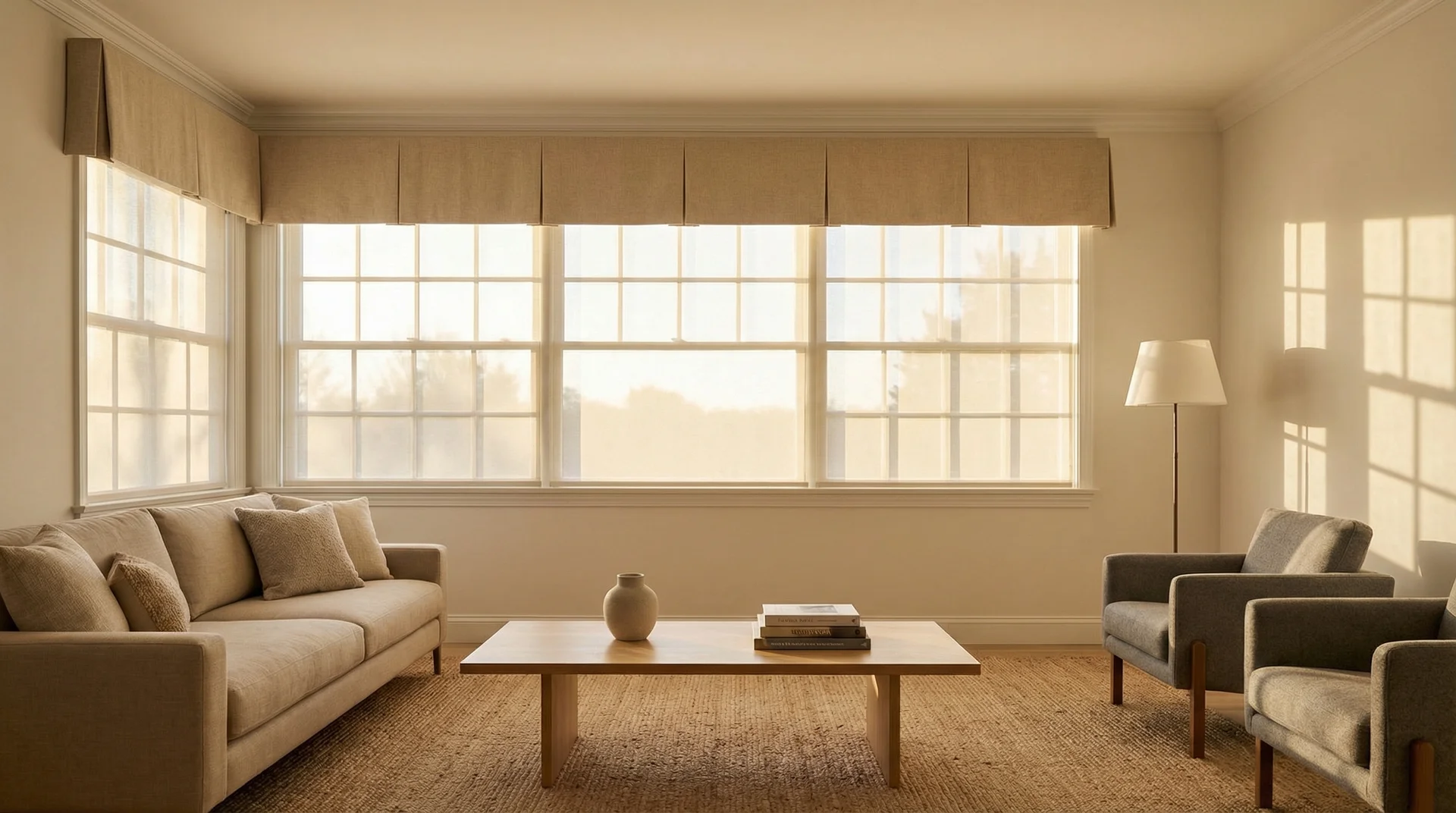
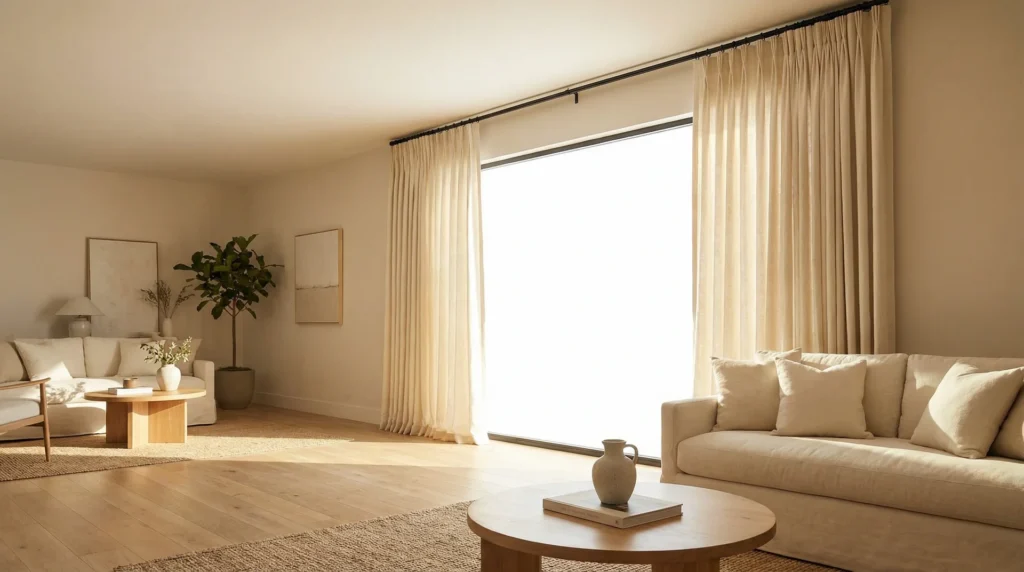
Here is the short answer before anything else: hang your rod 4 to 6 inches below the ceiling, extend it 8 to 12 inches beyond each side of the window frame, and choose fabric with enough body to drape without sagging across a wide span. Use a fullness ratio of 2 to 2.5 times your total rod width to calculate how many panels you need, and choose pinch pleat or wave headings over tab top or rod pocket styles.
I have spent over a decade advising homeowners on window treatments in residential design consultations, and the mistakes I see on large windows repeat themselves so consistently that I could name them in my sleep. This guide walks you through every one of them so you can avoid the expensive rework I have watched too many people go through.
Why Large Windows Break the Standard Curtain Rules
The curtain industry builds its standard sizing around windows that measure roughly 36 to 48 inches wide and 60 to 84 inches tall. When your window measures 96 inches wide, 120 inches tall, or both, you have stepped outside the range most retail curtain advice was written for. Three things go wrong when people ignore this.
- The scale problem. A panel that looks full and generous on a 42-inch window looks limp and undersized on a 96-inch one. Sparse fabric coverage reads as neglect rather than minimalism at larger scales.
- The sag problem. Lightweight fabrics that hold their shape on smaller windows start to pull and look uneven across wider spans. More surface area catches more light and exposes every flaw in the fabric’s weight.
- The hardware problem. A standard curtain rod over 72 inches will bow in the middle without a centre support bracket. It happens gradually, which is exactly why people miss it until it is obvious.
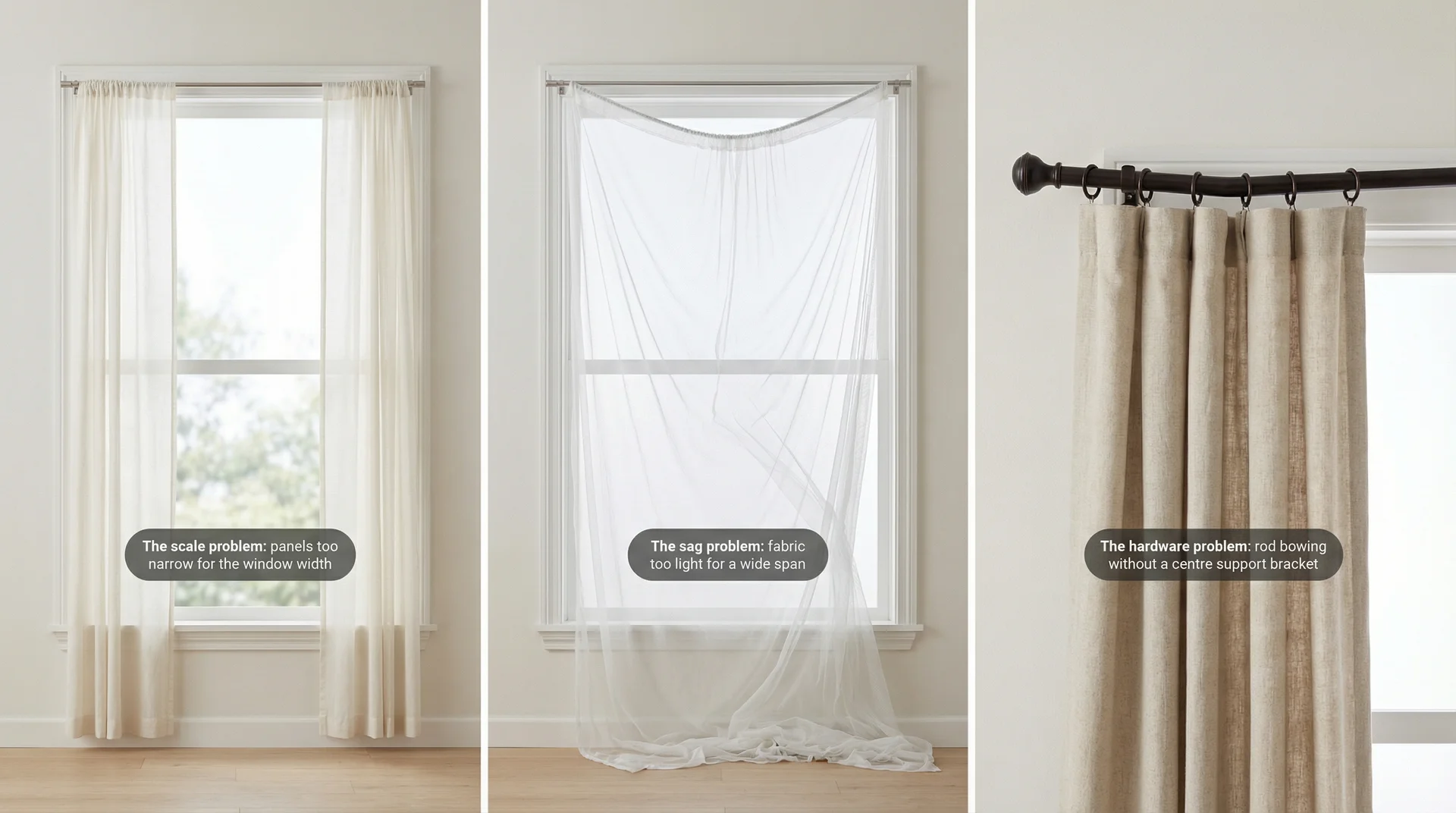
The bigger the window, the more unforgiving it is. Scale amplifies both good decisions and bad ones.
Getting the Measurements Right
Every fabric, heading, and hardware question becomes answerable once you have your numbers. Before anything else, write down the width of your window frame, the height from floor to ceiling, the gap between your ceiling and the top of the window frame, and the wall space flanking each side of the window.
How high to hang the rod
Mount your rod 4 to 6 inches below the ceiling, regardless of where the window frame ends. This single decision does more for the room than any fabric choice. It makes the ceiling feel higher, and the window feel architectural.
When I shifted to recommending this approach consistently in client consultations, homeowners kept saying something felt different about the room without being able to name what had changed. It was always the rod height.
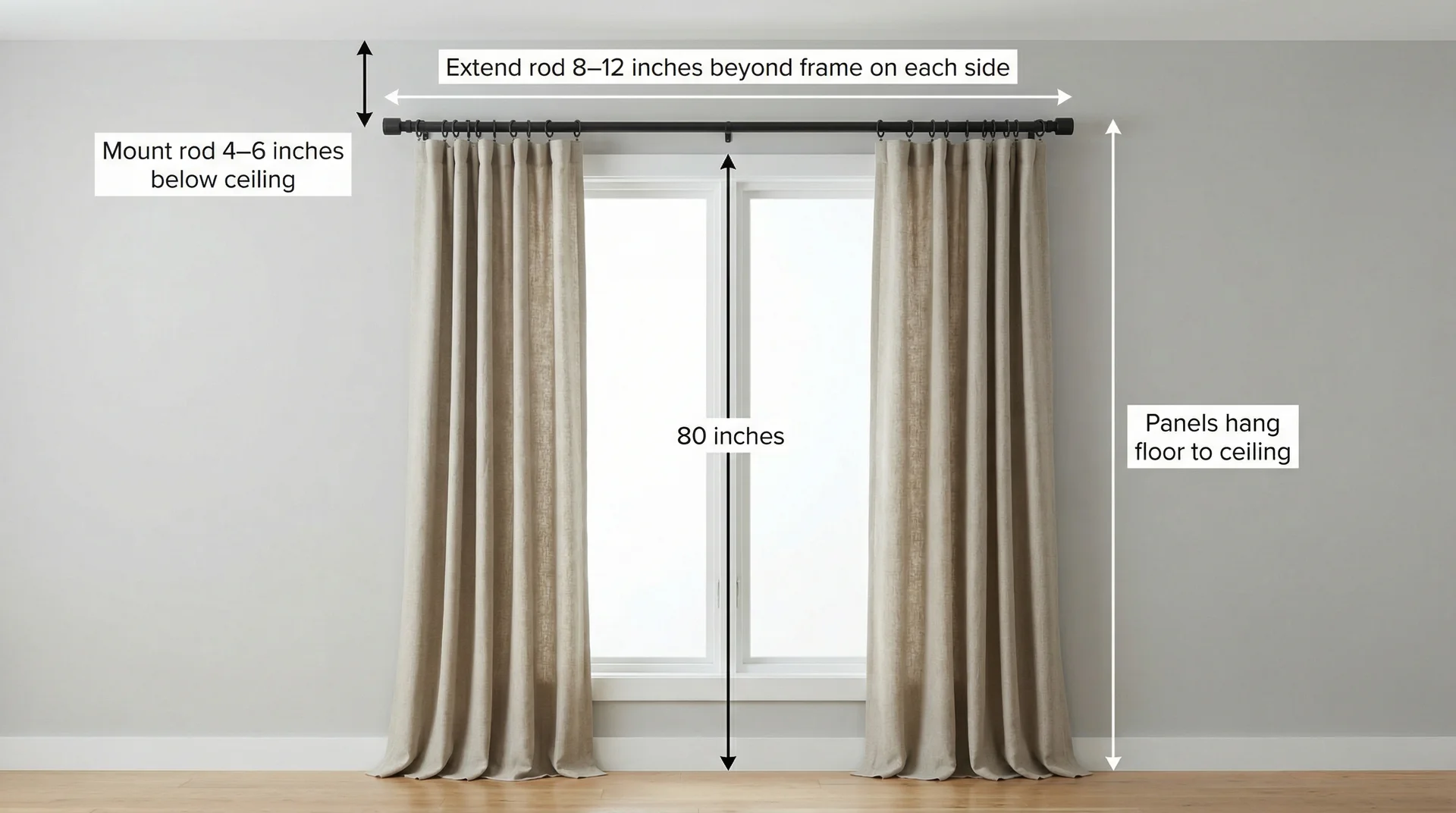
How far to extend the rod beyond the frame
Extend your rod 8 to 12 inches beyond each side of the window frame so panels stack completely clear of the glass when open. On a window that measures 80 inches wide, losing 6 inches of glass on each side to stacked fabric means blocking almost 15% of your available daylight. On large windows, that loss is visible and worth protecting against.
The fullness ratio: how many panels you need
Your total fabric width needs to be 2 to 2.5 times your total rod width for curtains to drape with any body or presence. This is the calculation most people skip, and it explains most of the “it just looks flat” complaints I hear.
- Measure your total rod width in inches.
- Multiply by 2 to 2.5 to get the total fabric needed.
- Divide by the width of one panel to get your panel count.
- Round up to the nearest even number so you can split panels evenly on each side.
Example: A 120-inch rod at 2.25 times fullness needs 270 inches of fabric. With 54-inch panels, that gives you 5 panels. Round up to 6 and hang 3 on each side.
Pinch pleat and wave headings need the higher end of that ratio (2.25 to 2.5). Eyelet and grommet headings work well at 2 to 2.2 times fullness.
How long should the curtains be?
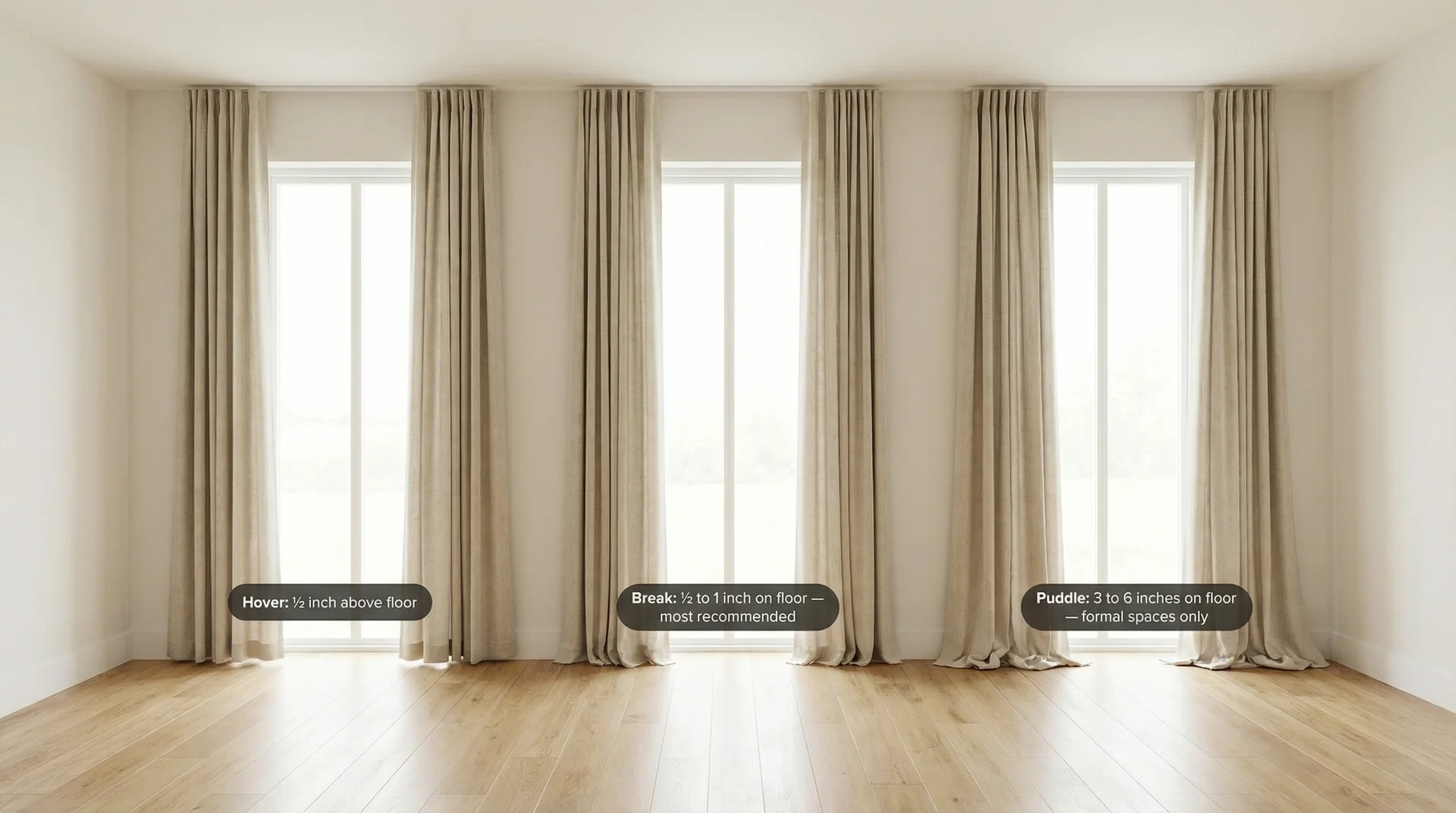
On large windows, curtains that hover several inches above the floor look unfinished. The scale demands that the fabric feel grounded. You have three options:
| Length style | Clearance from the floor | Best for | Caveat |
|---|---|---|---|
| Hover | ½ inch above the floor | High-traffic rooms, pets, and children | Safest choice if measuring feels uncertain |
| Break | ½ to 1 inch on the floor | Living rooms, bedrooms, most spaces | Polished and forgiving — my default recommendation |
| Puddle | 3 to 6 inches on the floor | Formal, low-traffic rooms | Collects dust; needs frequent adjusting |
Choosing the Right Fabric
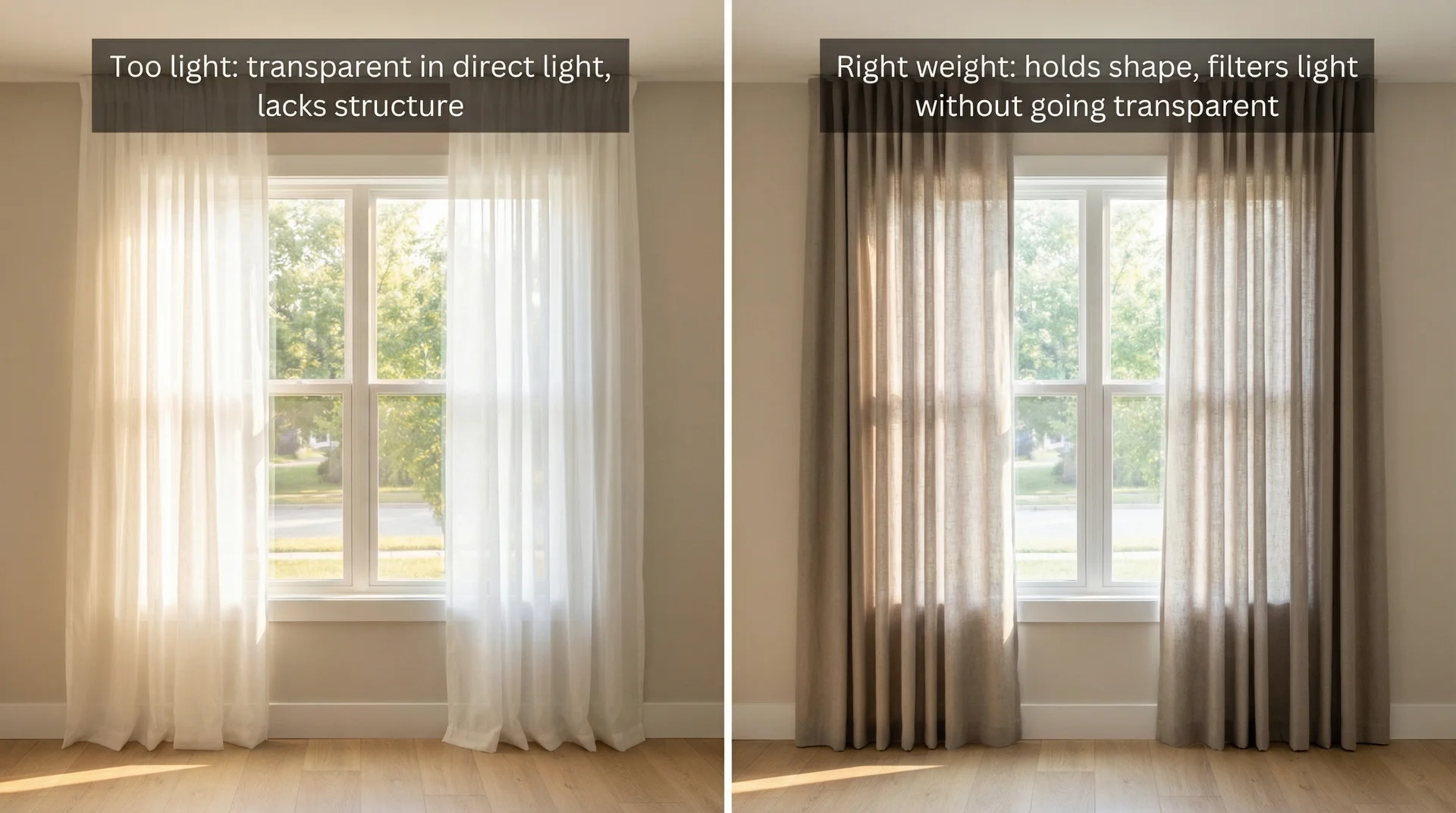
Fabric choice is where I see the most expensive mistakes. A homeowner orders gorgeous, airy linen sheers because they look beautiful in lifestyle photography.
Then the panels arrive, hang across a 110-inch south-facing window, and billow, sag, and go transparent in afternoon light. The fabric was not wrong. The application was.
Large window surfaces amplify every property of a fabric: light ones become more translucent, lightweight weaves sag more visibly, and thin hems catch every draft.
The test I use at fabric stores: hold a corner of the fabric and let it hang. If it falls into a clean fold, it has enough body for a large window. If it collapses or goes limp at the edges, it is too light to perform well at scale.
Sheer and semi-sheer fabrics
Sheers work best on large windows as part of a layered system rather than a standalone treatment. Cotton voile, linen gauze, and polyester sheer fabrics all drape beautifully with a heavier panel behind them.
On their own, across a bright, large window, they will disappoint you in at least one condition: daytime privacy, evening visibility from outside, or afternoon light intensity. One technical detail most product listings skip: sheer on wide windows need interlined rod pockets, the heading starts sagging and bunching within a few months.
Medium-weight fabrics
Linen blends, cotton-polyester weaves, and textured cotton sit in the sweet spot for most large-window applications. They drape with real movement and body, hold their shape across wide spans, and work in layered or standalone configurations.
I reach for medium-weight linen blend more than any other fabric in my styling work because it reads as both casual and polished, depending on how you hang it.
Heavy fabrics: velvet, brocade, and blackout
Heavy fabrics earn their place on large windows, especially when energy efficiency matters. Large windows are among the most significant sources of heat loss in winter and heat gain in summer.
According to the U.S. Department of Energy, heat gain and loss through windows accounts for 25 to 30% of residential heating and cooling energy use.
Thermal blackout lining meaningfully reduces that exchange. In an east-facing bedroom with a large window, full blackout lining behind a decorative panel is simply the practical baseline. Just make sure your hardware can carry the weight — more on that in the hardware section below.
Pattern and print on large windows
This is something most curtain guides skip entirely. Pattern scale matters enormously on large windows. A small repeat that looks charming on a standard window becomes visually noisy and busy across 120 inches of fabric.
On large windows, choose large-scale patterns with enough breathing room in the repeat, or go with solids and subtle textures entirely. The window itself is already a strong visual element. A competing pattern rarely improves that.
Layering: the solution to the light-and-privacy conflict
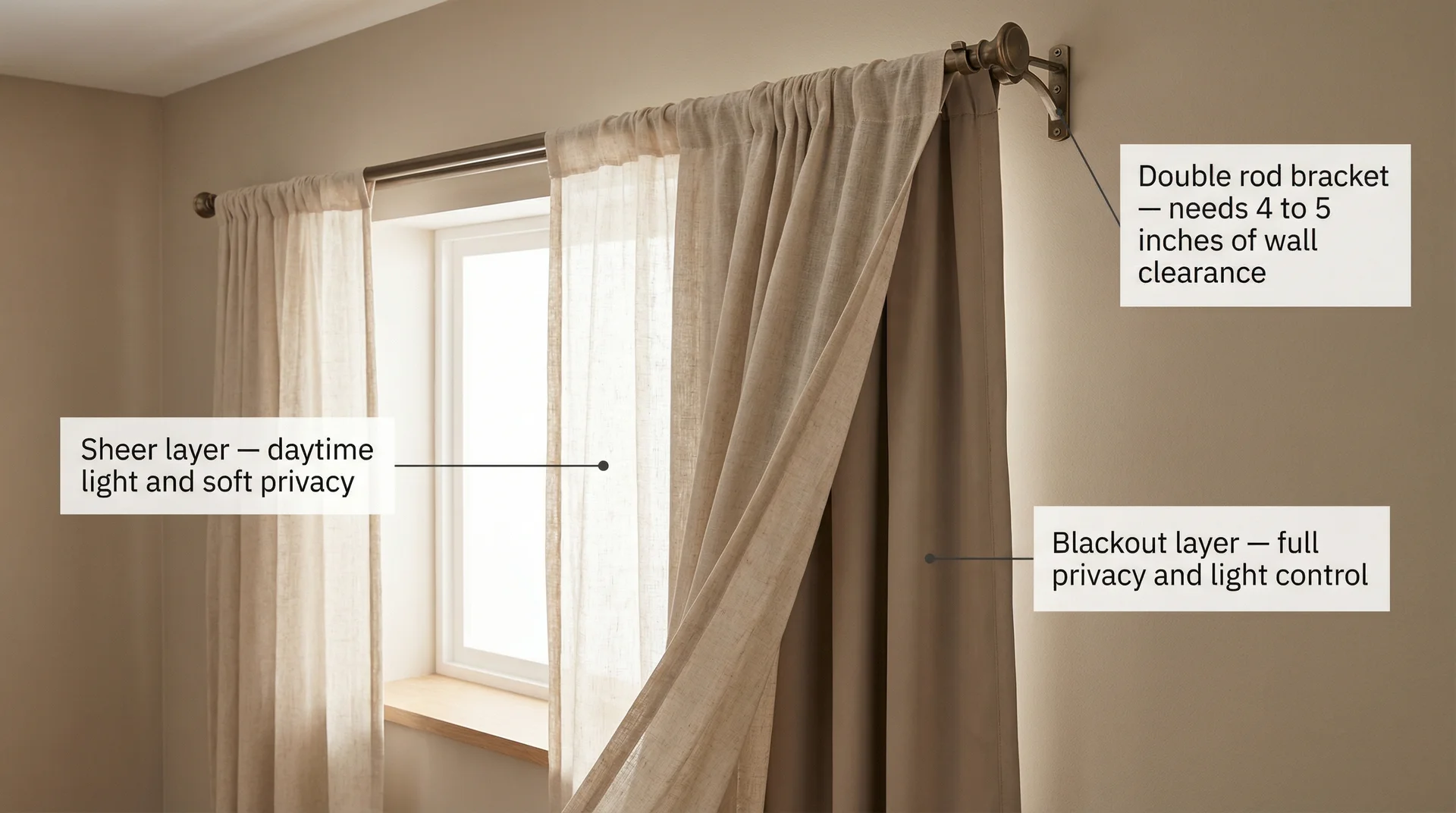
The question I hear most often from people with large windows is some version of: I want light, but I also need privacy, so what do I do? The answer is layering.
A sheer panel closest to the glass handles daytime privacy and filters harsh light. A medium to heavyweight panel on a separate rod closes when you need full coverage.
The double-rod setup requires brackets that extend 4 to 5 inches from the wall so the panels do not crowd each other. This is the configuration I use on nearly every large-window living room and bedroom project because it gives you genuine flexibility across different times of day without asking you to choose between light and privacy.
| Fabric type | Best exposure | Works alone? | Best paired with |
|---|---|---|---|
| Sheer / voile | North or east-facing | Only in low-privacy rooms | Blackout or lined panel behind |
| Linen blend (medium) | Any | Yes, in most rooms | Sheer for south/west-facing |
| Cotton-poly weave | Any | Yes | Blackout lining for bedrooms |
| Velvet / brocade | Any, best in low-light rooms | Yes, with lining | Sheer for daytime layering |
| Thermal blackout | South, west, east-facing | Yes | Decorative front panel |
Curtain Heading Styles for Large Windows
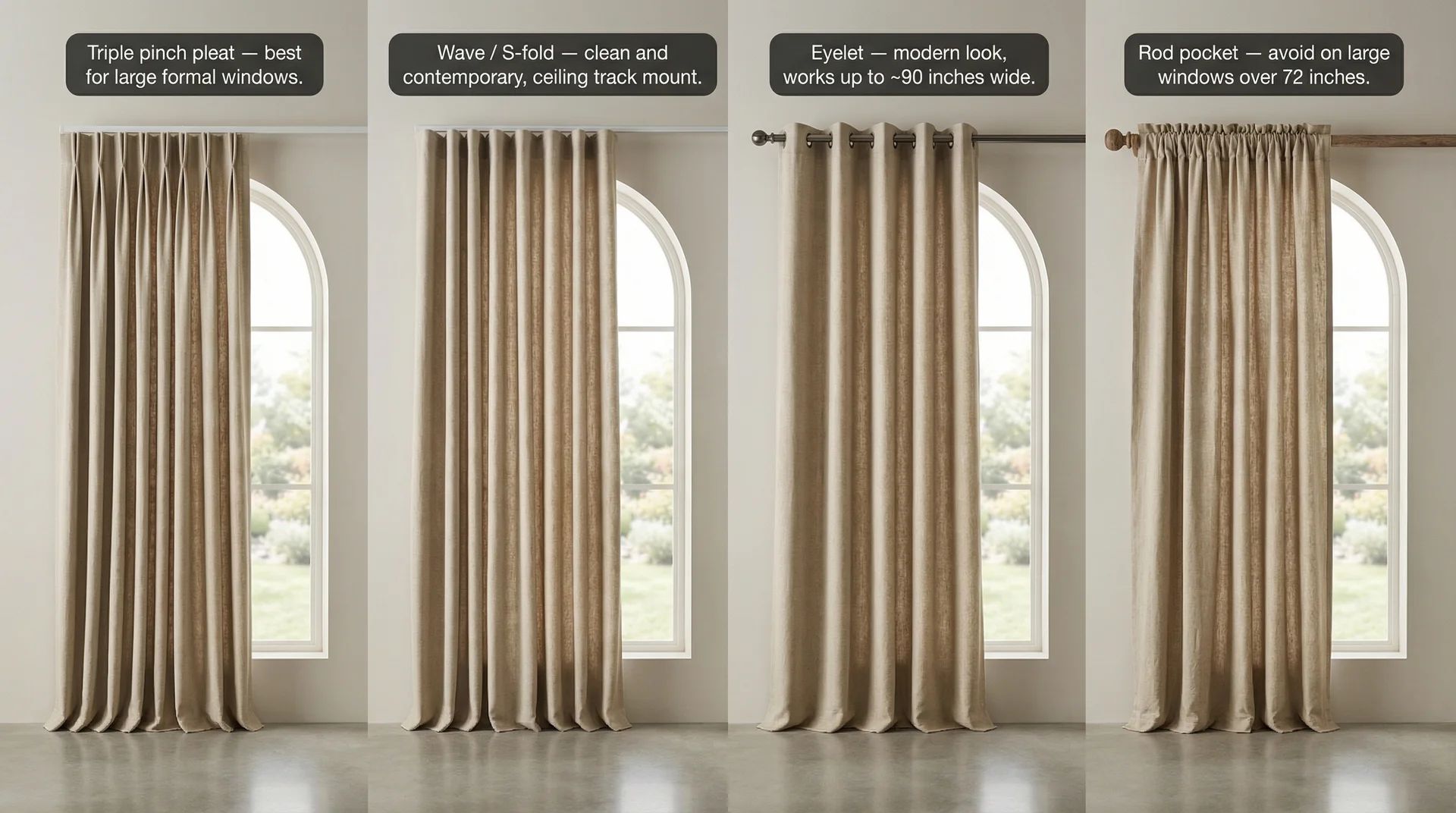
On a large window, heading style determines how the curtain moves, how it stacks when open, and how it holds its shape across the span over time. Getting this wrong means the whole panel system underperforms regardless of how good the fabric is.
Pinch pleat
Pinch pleat creates structured, uniform folds that give large window curtains an architectural quality.
On large windows, I almost always recommend triple pinch pleat over single – the added fold creates more definition, and the panels hang with noticeably more presence.
It works best on medium and heavy fabrics, requires a fullness ratio of 2.25 to 2.5, and uses hook and ring hardware so panels come down easily for washing. If I had to choose one heading for a formal or high-visibility large window, this would be it.
Wave heading
Wave heading creates evenly spaced, uniform curves from the top to the bottom of the panel. It works on ceiling-mounted tracks rather than decorative rods, which makes the hardware disappear entirely into the ceiling line.
I use this in almost every large-window project where the room has a modern or transitional aesthetic, and it consistently gets the most comments from visitors. Search for “wave heading” or “S-fold” curtains, they are more widely available as ready-made than most people realise.
Eyelet and grommet
Eyelet headings slide easily and suit contemporary spaces. On large windows, the limitation is that very wide eyelet panels can develop an uneven accordion effect, particularly with lighter fabrics. They work well on windows up to about 90 inches wide.
Tab top and rod pocket: when to say no
Both styles look appealing in photographs and work fine on smaller windows. On large windows, tab tops sag and stretch across wide spans and rod pockets make the panels difficult to open and close.
My recommendation: if your window measures more than 72 inches wide, avoid both heading styles.
| Heading style | Large window verdict | Best room type | Hardware needed |
|---|---|---|---|
| Pinch pleat (triple) | Excellent — top recommendation | Living rooms, formal spaces | Rod with rings and hooks |
| Wave / S-fold | Excellent for modern rooms | Contemporary, transitional spaces | Ceiling-mounted track |
| Eyelet/grommet | Good up to ~90 inches wide | Modern, casual spaces | Standard decorative rod |
| Pencil pleat | Good — less formal than pinch | Most rooms | Rod with rings and hooks |
| Tab top | Avoid over 72 inches wide | Small, casual windows only | Standard rod |
| Rod pocket | Avoid over 72 inches wide | Small stationary panels only | Standard rod |
Hardware That Can Handle the Job
Hardware is the part people consistently under-invest in, and on large windows, the consequences show up quickly. Even a quality rod starts to bow within weeks when it spans 96 to 120 inches under the weight of substantial fabric.
The centre support bracket
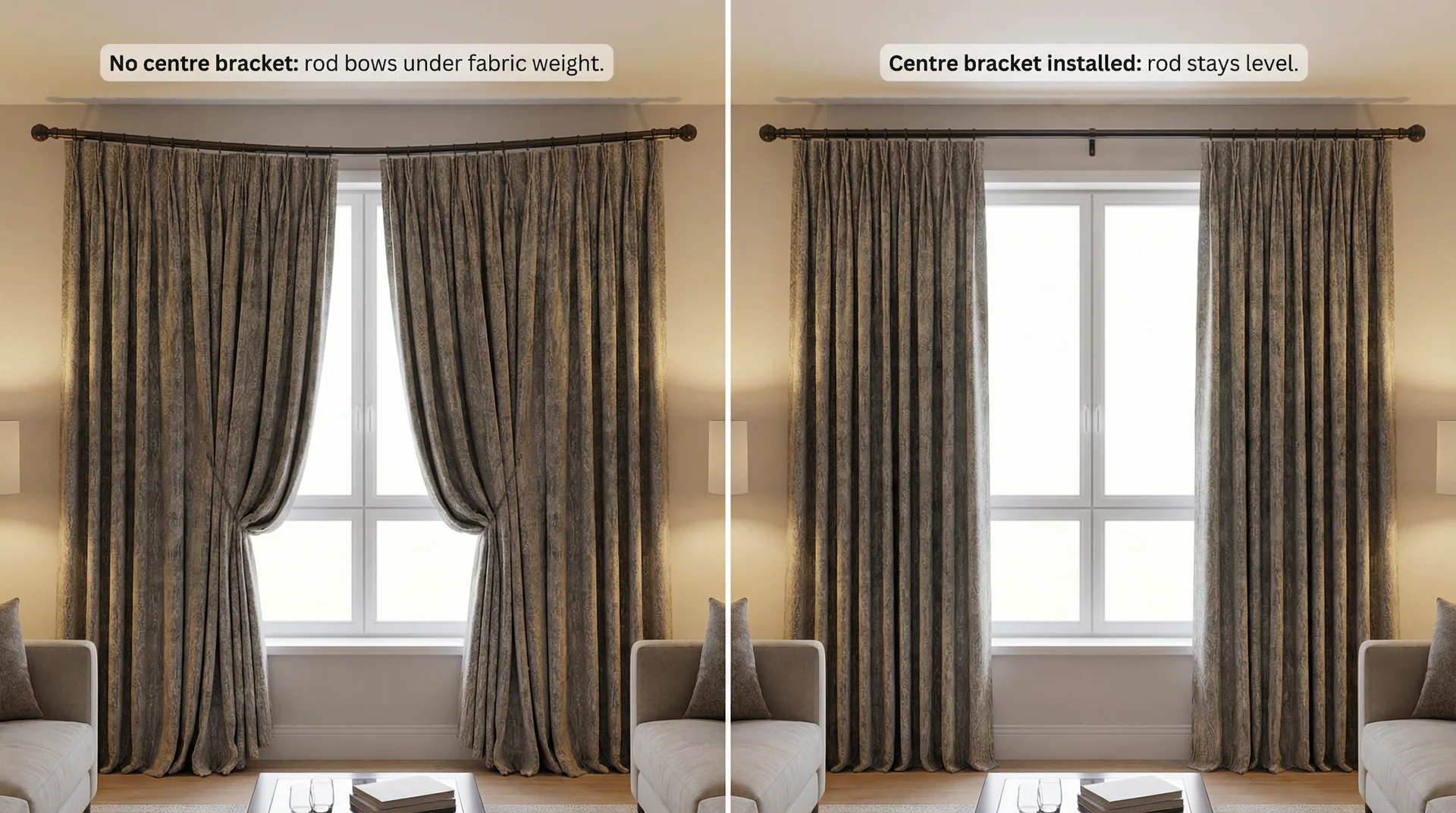
Any rod spanning more than 66 inches needs at least one centre support bracket. On rods over 100 inches, plan for two. Even quality, heavy-gauge rods bow under fabric weight across long spans. The centre bracket carries the load and keeps the rod level. Install it before you hang a single panel.
Rod diameter and material
Choose a minimum diameter of 1 inch for large window rods. For heavy fabric, move up to 1.25 or 1.5 inches. Wrought iron and steel carry the most weight reliably. Hollow aluminium and thin wood rods can flex under sustained load. Always check the rod’s stated weight capacity against your estimated panel weight before buying.
Ceiling-mounted tracks
For windows wider than 120 to 140 inches, or any room where you want the hardware to disappear, ceiling-mounted tracks are worth the investment. The track sits flush against the ceiling, the curtains hang straight to the floor, and the visual line is completely uninterrupted.
This is the system I specify most often on floor-to-ceiling window projects. The cost runs two to four times that of a decorative rod, and on a window that anchors the main living space it consistently delivers the most refined result.
Double rods for layered panels
Double rod brackets need to extend 4 to 5 inches from the wall so both rods sit clear of each other and the panels do not drag. Check the bracket depth specification before buying — product images rarely make this dimension clear. Also, confirm the rod diameter matches the bracket channel size before purchasing them separately. A 1.25-inch rod will not seat properly in a bracket built for a 1-inch rod, and this mismatch tends to show up weeks after installation when the weight has done its work.
Curtains vs Blinds for Large Windows
This question comes up often enough that it deserves a direct answer. Curtains and blinds serve different needs on large windows, and in many rooms, the right answer is both working together.
Curtains give you softness, warmth, acoustic benefit (fabric absorbs sound meaningfully in large rooms), and the ability to completely transform the visual scale of a wall. They work best when the window is a focal point and the room benefits from the textile’s presence.
Blinds give you precise light control, easy maintenance, and cleaner sightlines. Roller blinds and cellular shades, in particular, work well on large windows because they can be made to measure at a reasonable cost and operate smoothly across wide spans without any of the hardware headaches curtains carry.
Where I land on this in most residential projects: if the room is a main living space or bedroom where comfort and warmth matter, curtains win or curtains layer over a simple roller blind for light control. If the space is a home office, kitchen, or utilitarian room where you need clean lines and easy maintenance over aesthetics, blinds alone are usually the better answer.
Styling by Room
Large living room windows
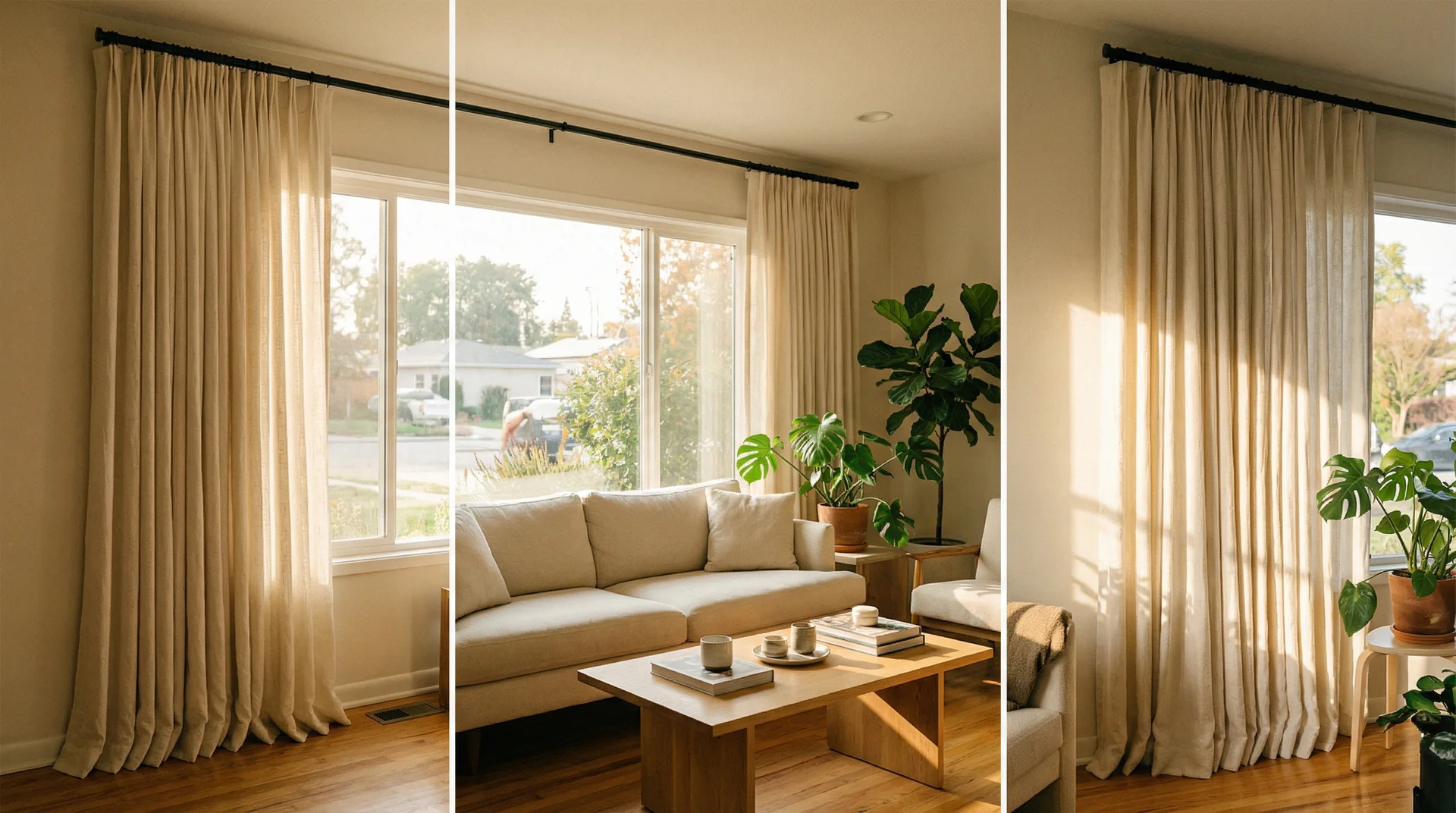
The living room wants to balance openness with privacy and light control. A layered system works best here: a sheer or semi-sheer panel for daytime and a medium to heavyweight panel behind it for evenings.
Pull the panels wide enough to clear the full glass surface when open. For colour, going one to two shades warmer than your wall colour tends to look more considered than stark white, which reads as clinical against a large window wall.
Large bedroom windows
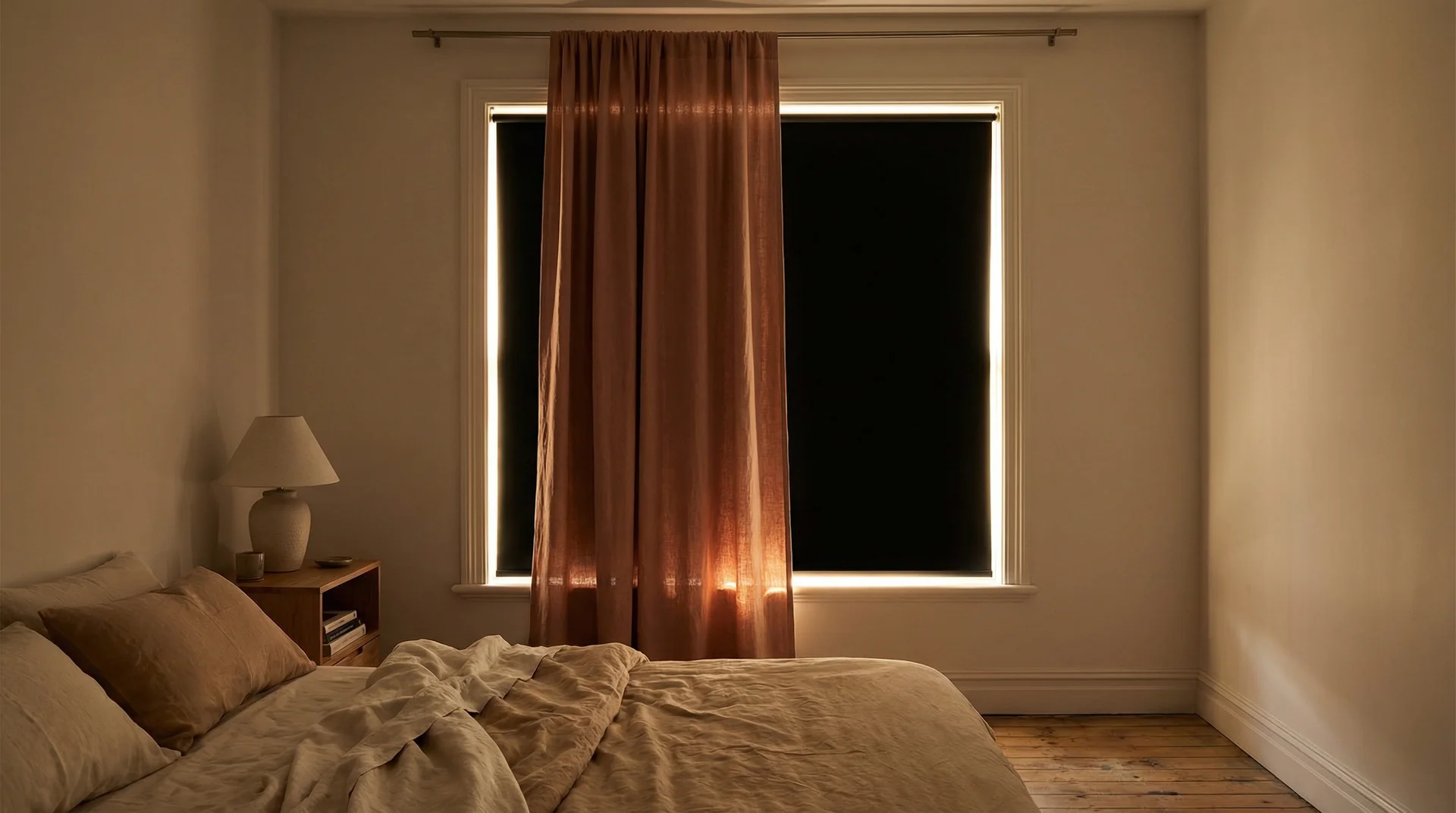
East-facing large bedroom windows are genuinely disruptive without proper coverage.
Sunrise through a large window that only has light-filtering fabric is not a gentle wake-up. In any bedroom with a large east or south-facing window, full blackout lining is the baseline: either as a separate panel behind a decorative front panel, or integrated as a lining into the front panel itself.
The decorative layer can still be something beautiful, a warm linen in a deeper tone, a soft velvet, a subtle texture. The blackout does its work behind the scenes.
Floor-to-ceiling windows
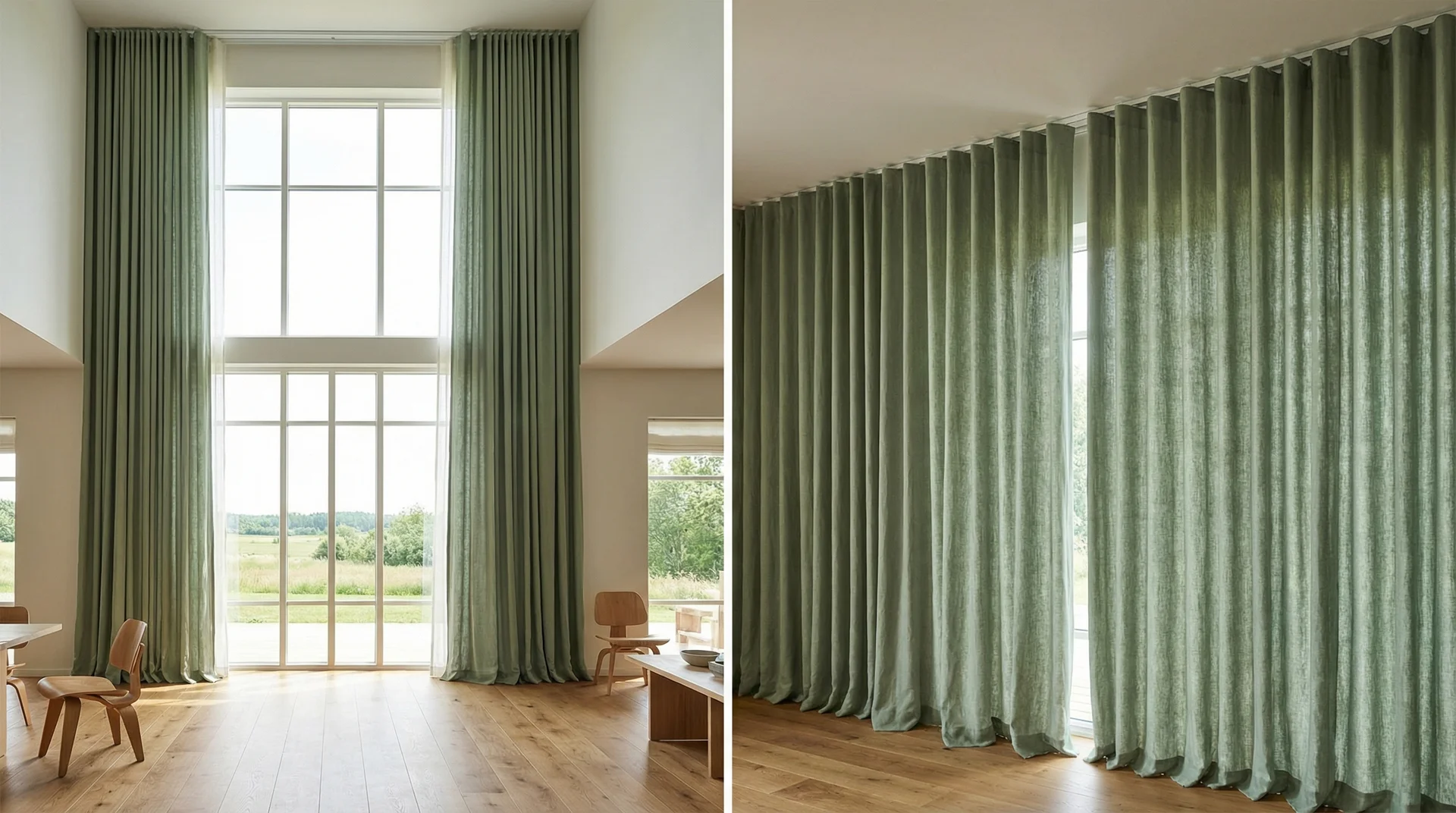
The most common mistake I see in floor-to-ceiling window spaces is choosing a busy fabric or large-scale pattern that fights the proportions. Solids and subtle textures almost always perform better at this scale.
The window is the statement, and the curtain is the frame. Keep the heading clean, keep the fabric grounded, and let the height carry the room.
Large sliding glass doors and patio doors
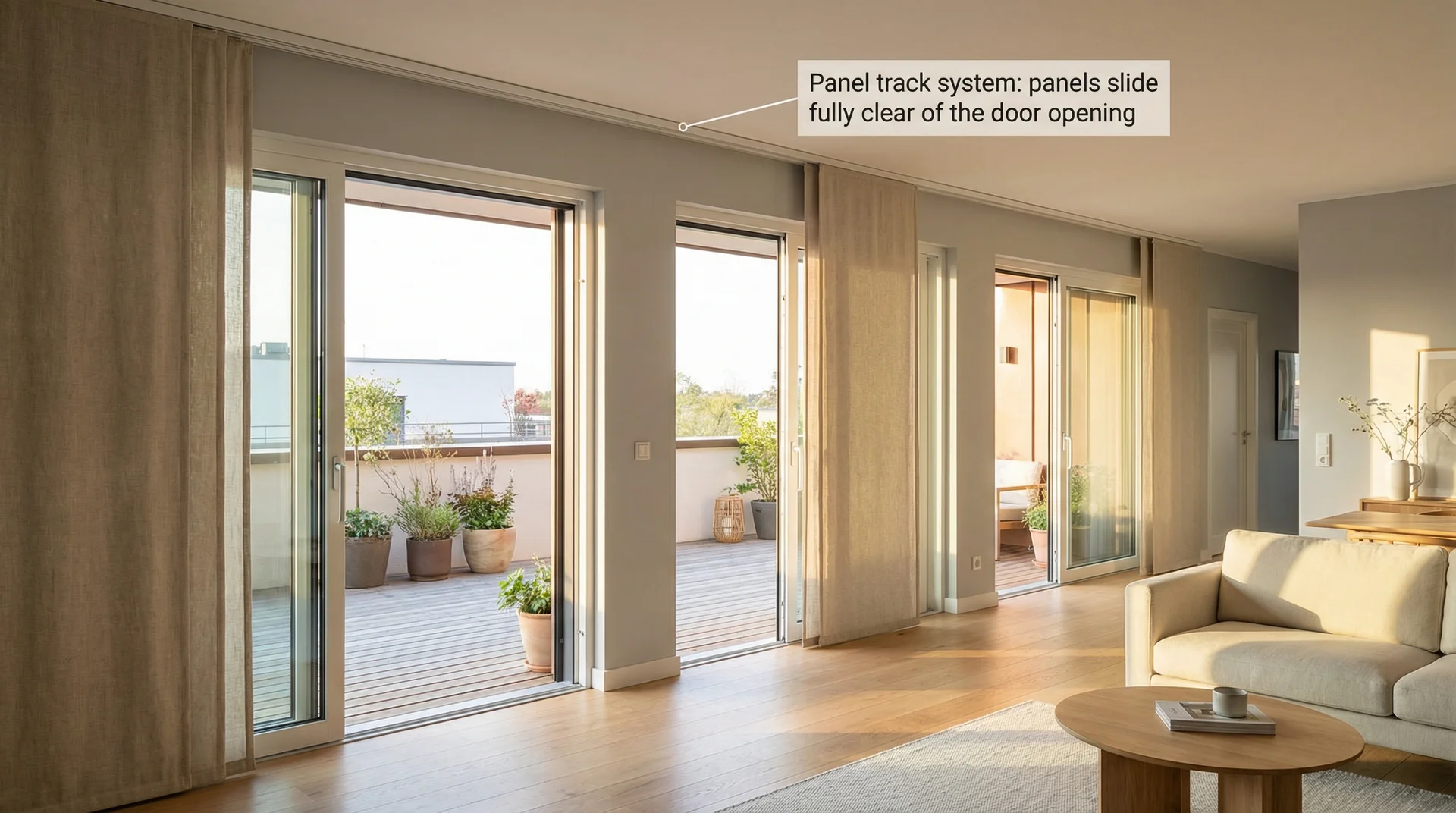 Traditional rod-mounted panels on a sliding door create a real problem: the stacked panels always sit in front of part of the door and reduce how far it opens. I worked on a home with three adjacent sliding glass doors spanning nearly 18 feet of glass wall.
The owners kept their drapes permanently tied back because they blocked access. We replaced the system with a ceiling-mounted panel track in natural linen, and they used the curtains every day from that point on.
For sliding doors, track systems, or panel track blinds are the right solution. Standard curtain rods are not.
What Do Curtains for Large Windows Cost?
Cost is the question people are searching for an answer to, and most guides sidestep it. Here is a realistic breakdown based on the US market.
| Option | Cost per panel (approx.) | What you get | Best for |
|---|---|---|---|
| Budget ready-made (IKEA, Amazon) | $20 to $60 | Standard sizes, limited fabric weight options | Temporary solutions or low-priority rooms |
| Mid-range ready-made (Wayfair, Target, H&M Home) | $40 to $120 | More fabric options, better quality weaves | Most rooms where standard sizing works |
| Semi-custom (Pottery Barn, Restoration Hardware, West Elm) | $80 to $250 | More length and width options, lining choices | Large windows needing non-standard lengths |
| Custom (local workroom or online custom) | $150 to $500+ | Any size, any fabric, any heading style | Floor-to-ceiling, oversized, or statement windows |
For most large windows, the semi-custom route from retailers like Pottery Barn or Restoration Hardware covers the sizing gap between standard ready-made and fully custom, at a price point that makes sense for a main living space or bedroom.
For truly oversized windows or floor-to-ceiling spans in a prominent room, custom is usually worth it because the cost of getting the proportions wrong on a statement window is higher than the cost of getting them right the first time.
Hardware adds to this. A quality rod with a centre support bracket and rings for a large window typically runs $80 to $200. Ceiling-mounted track systems run $150 to $400 for a standard large window span, not including installation.
Common Mistakes to Avoid
I have seen the same errors enough times in client homes and my own early project work to list them plainly.
- Buying panels before measuring the rod width. Most people measure the window frame width and buy panels to match it. The rod extends 8 to 12 inches beyond the frame on each side. Always measure the full rod width and apply the fullness ratio to that number.
- Choosing fabric from a small swatch under indoor lighting. A swatch in a store looks very different from 270 inches of that fabric across a sunlit window. Request the largest sample available and hold it up to your window at different times of day before committing.
- Skipping the centre support bracket. Covered above, but worth repeating here: this is the most common hardware mistake and the most visible one once the bow appears.
- Hanging the rod at window frame height. The rod belongs near the ceiling. Hanging it just above the window frame cuts the visual height of the room and makes the window look smaller than it is.
- Using a small-scale pattern on a large window. Small repeats multiply across a wide span and read as visual noise. Scale your pattern to your window or use a solid.
- Ordering one panel per side on a large window. A single panel per side on a 96-inch or wider window never achieves sufficient fullness, regardless of how wide the panel is. Calculate the fullness ratio and order accordingly.
Frequently Asked Questions
How many curtain panels do I need for a large window?
Multiply your total rod width by 2 to 2.5 to get the total fabric you need, then divide by the width of one panel and round up to the nearest even number.
For a 120-inch rod at 2.25 times fullness, that means 270 inches of fabric needed. With 54-inch panels, order 6 panels and hang 3 on each side.
Can you use regular curtains on large windows?
On windows up to about 96 inches wide, yes, if you buy enough panels to meet the fullness ratio and choose fabric with sufficient weight.
Above that width, or for floor-to-ceiling windows, standard 84 to 96-inch panel lengths will fall short and leave the window looking unfinished at the bottom. Semi-custom or custom length options become necessary.
Should curtains touch the floor on large windows?
Yes, in almost every case. A half-inch break on the floor is the most practical and polished choice for most rooms.
Curtains that hover several inches above the floor on a large window look unfinished at scale. The only exception is very high-traffic spaces where practicality genuinely outweighs aesthetics.
Are curtains or blinds better for large windows?
For main living spaces and bedrooms where warmth and visual presence matter, curtains win, or they layer over a simple roller blind. For utilitarian rooms where clean lines and easy maintenance matter more than aesthetics, blinds alone are the better answer.
Many large windows benefit from both: a roller blind for precise light control and a curtain panel for softness and warmth.
What is the best fabric for a large south-facing window?
A medium-weight linen blend is the front panel, layered with a thermal-lined or blackout panel behind it. South-facing large windows receive intense direct light for most of the day.
A standalone lightweight fabric will go transparent and provide almost no privacy when the sun is directly behind it. The layered approach gives you a beautiful face fabric with a functional lining managing the light and heat.
How do you make a large window look proportionate?
Hang the rod close to the ceiling, use floor-length panels that fully clear the glass when open, and choose fabric that drapes cleanly without fighting the proportions.
The problem most people are actually trying to solve when they want a large window to look smaller is that their curtains are not keeping up with the window’s scale. The right fullness ratio, rod height, and fabric weight solve that entirely.
Final Thoughts
Every large-window project I have worked on comes down to the same sequence: measure first, choose fabric for weight and function, pick a heading that suits the scale, and invest in hardware that can carry the load.
Follow that order, and the decisions fall into place. The window is already doing the architectural work. Your job is to dress it in a way that keeps up.