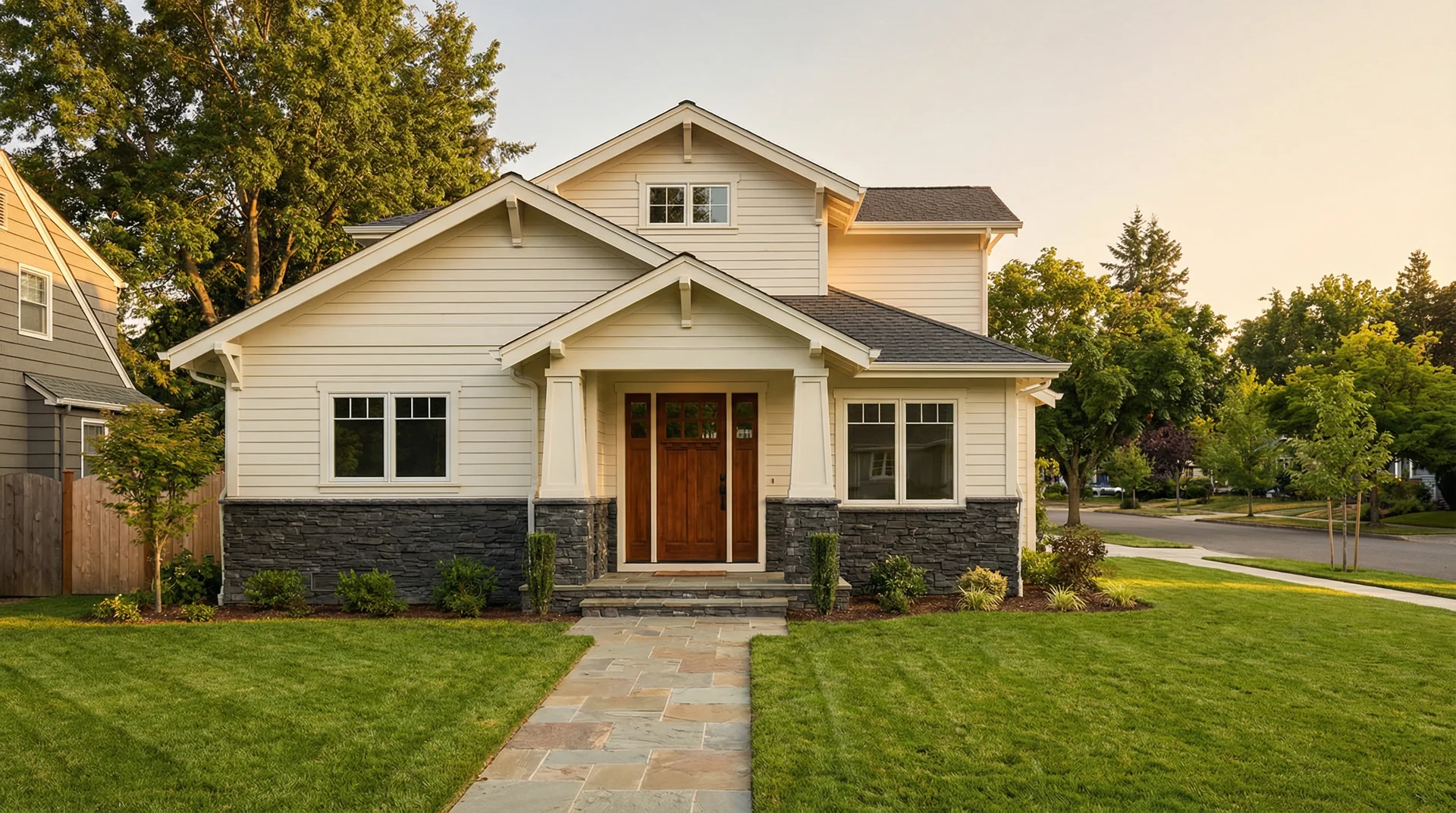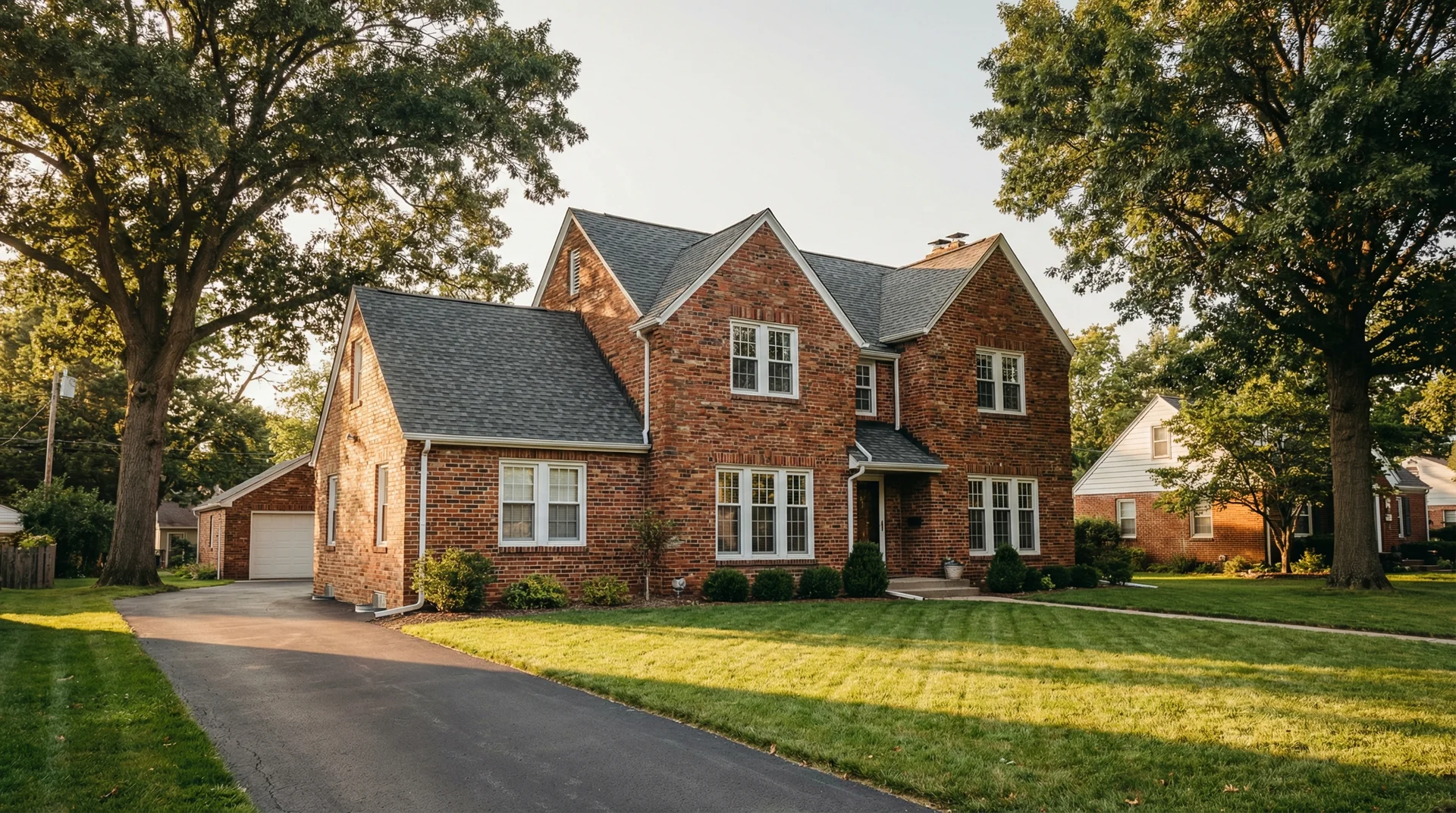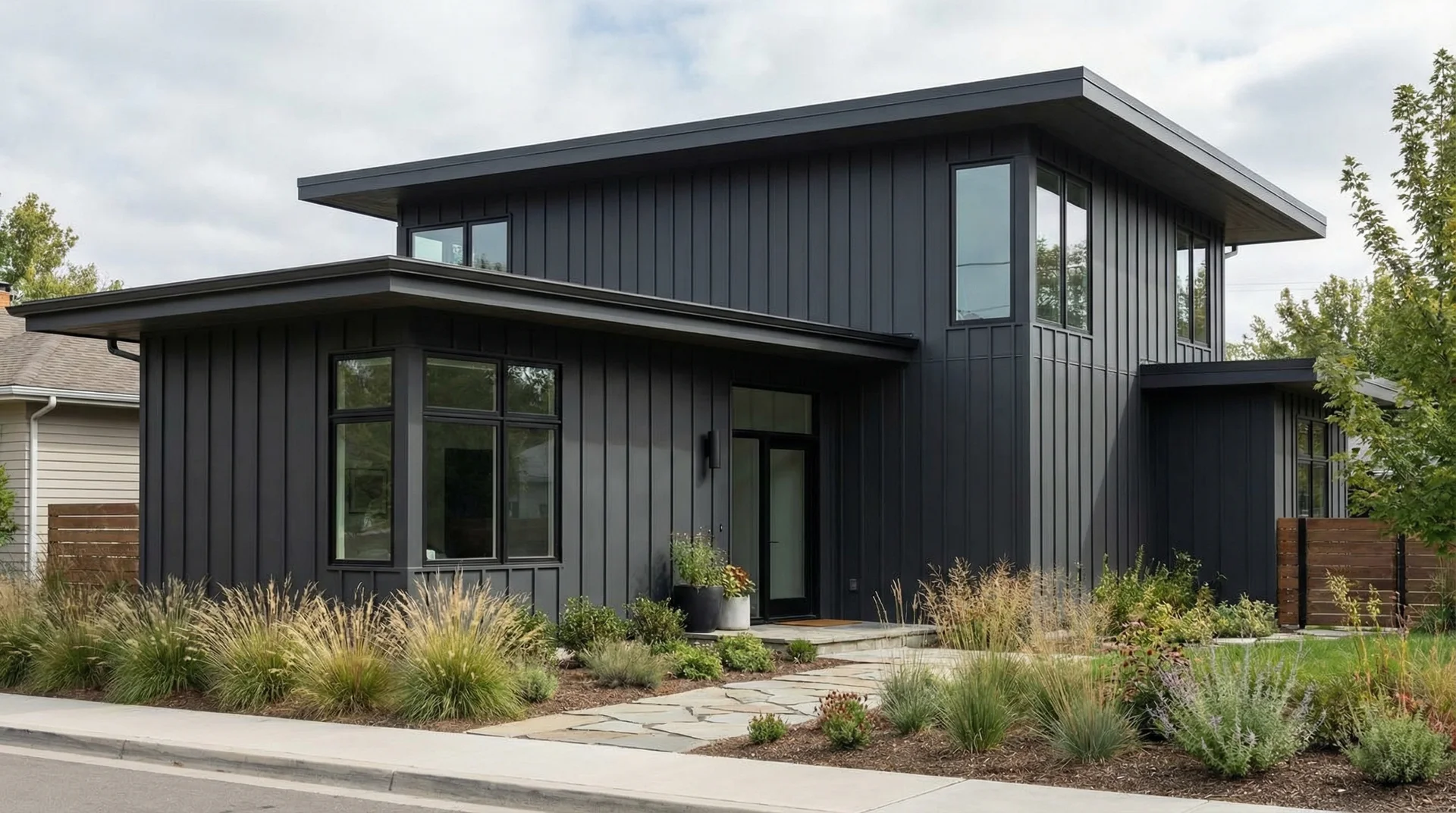
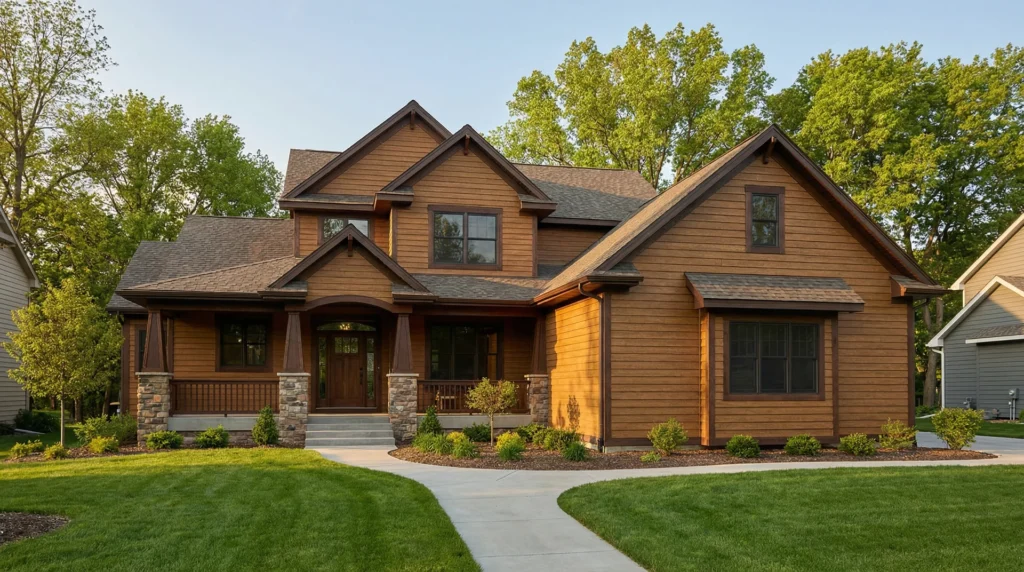
One of the conversations I have most often with homeowners goes something like this. They walk me around their home. Natural cedar siding is everywhere, with beautiful wood grain and deep color, but sections near the foundation are soft to the touch, corner boards are splitting, and the last time anyone painted it was at least seven years ago.
They want the look they have. They do not want the maintenance cycle they have.
Engineered wood siding is where that conversation almost always lands.
LP SmartSide is the product I specify most often in this category, and I have been doing so long enough to know both its genuine strengths and the specific ways it fails when the installation details are not right. The strengths are real.
The installation requirements are non-negotiable. The 50-year warranty gets used heavily in contractor sales conversations, but it has conditions every homeowner should understand before it becomes the primary reason for choosing the product.
| The short answer: Engineered wood siding costs $5.50 to $10.50 per square foot installed, looks convincingly like natural cedar, resists insects and fungal decay through zinc-borate treatment, holds paint roughly twice as long as natural wood, and carries a 50-year prorated warranty from LP. Its primary vulnerability is moisture infiltration through improperly sealed cut edges, unsealed butt joints, or installation too close to grade. In dry to moderate climates with correct installation, it is one of the strongest value propositions in residential siding. In high-moisture climates or with an incomplete installation technique, it fails predictably and sometimes quickly. |
What Engineered Wood Siding Is and How It Differs from Natural Wood
The name creates some confusion because “engineered wood” is used across multiple product categories: flooring, structural beams, and furniture. In the siding context, it refers to a composite panel made from real wood that has been processed, chemically treated, and reformed into a material that performs better than untreated lumber in exterior applications.
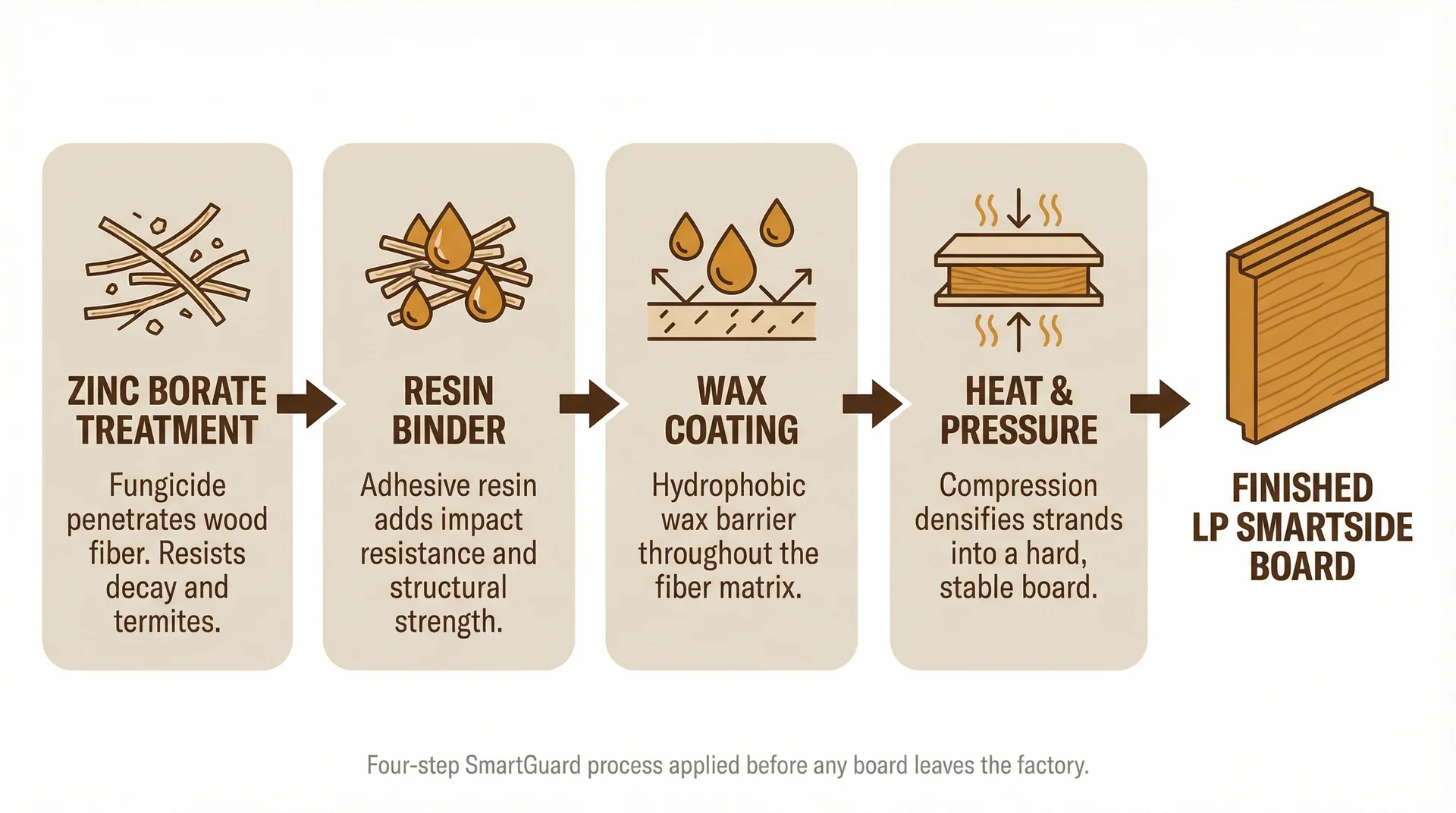
LP SmartSide, the dominant brand in US residential engineered wood siding, starts with wood strands, not chips or sawdust, but deliberately sized strands of wood fiber. These go through LP’s SmartGuard manufacturing process, which involves four distinct treatment steps before a board reaches a job site.
Step 1: Zinc borate treatment. Zinc borate is applied to the wood strands. It is an EPA-registered preservative and fungicide that inhibits wood-destroying fungi and deters termites. This treatment penetrates the fiber structure rather than sitting only at the surface, which is the critical distinction from paint-on treatments applied to natural wood.
Step 2: Resin binder application. Adhesive resins bind the treated strands together. These resins are the structural binder that contributes significantly to impact resistance and dimensional stability.
Step 3: Wax coating. Water-resistant waxes coat the strands to increase moisture resistance. This creates a hydrophobic barrier within the fiber matrix rather than only at the outer face.
Step 4: Heat and pressure compression. The treated strands are compressed under controlled heat and pressure into boards. This densifies the material, producing a panel significantly harder and more dimensionally stable than loose-strand products like OSB.
The result is a board that carries real wood grain, embossed through the manufacturing process, not applied as a surface print, in 16-foot lengths. That 16-foot length matters practically: fewer butt joints across a wall face means fewer moisture entry points and a cleaner visual result.
What Engineered Wood Is Not
Engineered wood siding is not fiber cement. The distinction matters for fire resistance, moisture tolerance, and climate suitability. Fiber cement is non-combustible; engineered wood is a wood-based product that burns. Fiber cement absorbs essentially no moisture; engineered wood manages moisture better than natural wood but remains a wood-core product that responds to sustained moisture exposure.
Engineered wood siding is also not the failed OSB-based products that generated class action lawsuits against Louisiana-Pacific in the 1990s. Those failures were traced to a different manufacturing process that proved inadequate for exterior conditions.
LP SmartSide uses fundamentally different engineered strand technology. The product that generates complaints and warranty claims today almost always traces to an installation error, not a material failure.
LP SmartSide Product Lines
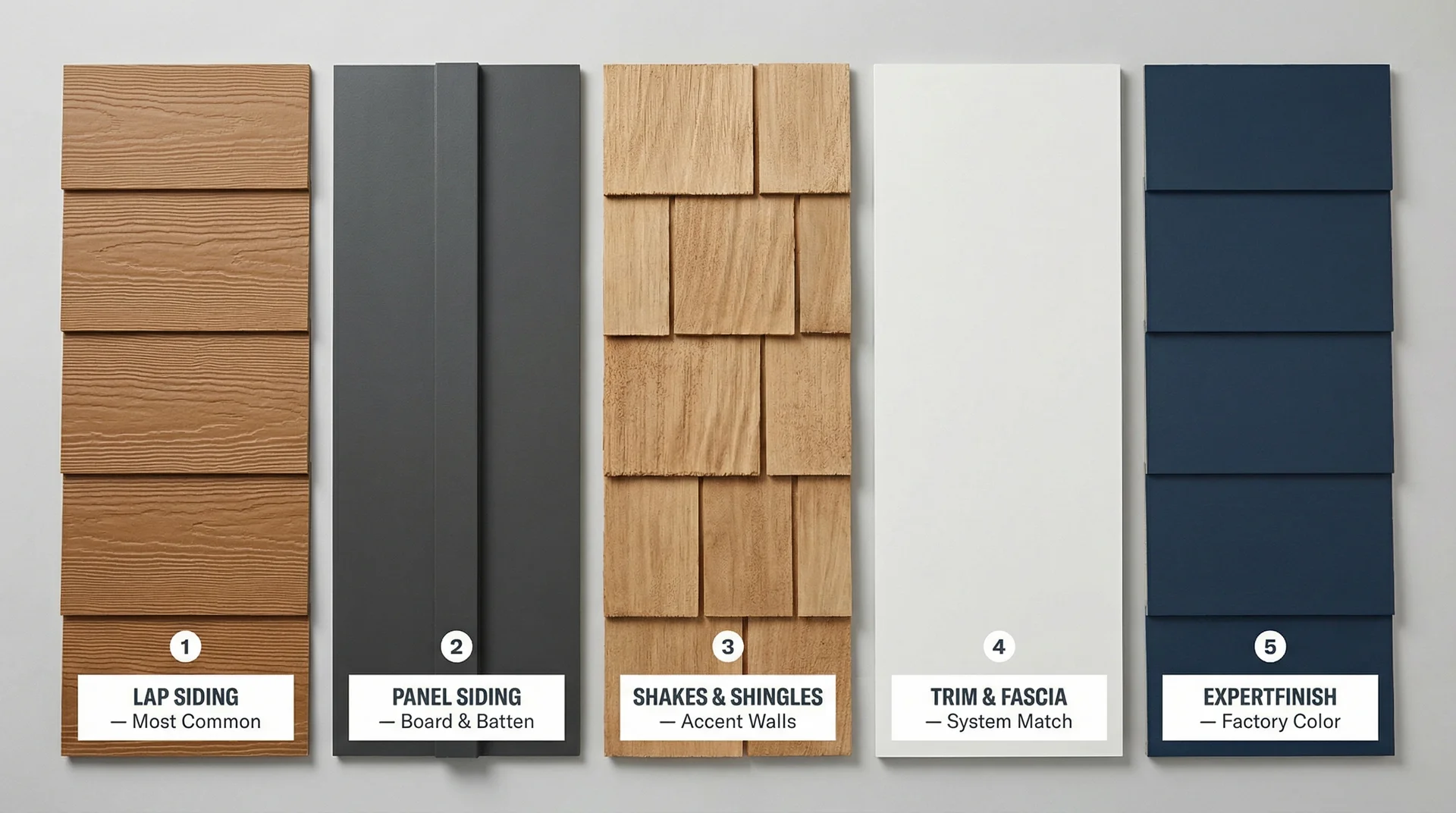
Most homeowners do not realize LP SmartSide is a product family, not a single board. Knowing the options helps you match product to application.
Lap siding is the most common choice, installed horizontally. It comes in widths from 6 to 12 inches and textures ranging from smooth to deep cedar grain. This is the product that defines the classic wood-look exterior most homeowners picture.
Panel siding installs vertically and works well for contemporary designs, board-and-batten looks, and large surface areas where speed of installation matters. Panels cover more square footage per piece, which can reduce labor time on straightforward walls.
Shakes and shingles are designed for accent walls, gables, and architectural features rather than full-home applications. The profile replicates hand-split cedar shakes reasonably well.
Trim, fascia, and soffit products are engineered to match the siding system and carry the same SmartGuard treatment. Using LP trim alongside LP siding keeps warranty coverage consistent across the entire cladding system.
ExpertFinish is LP’s factory-applied color system. Instead of field-painting primed boards on site, you receive boards with a factory-applied acrylic latex finish in 16 colors. The ExpertFinish lap product also has a proprietary joint that eliminates the need for seam caulking at butt joints, which removes one of the most common installation failure points. ExpertFinish carries a finish warranty on top of the structural warranty.
If your crew has any history of skipping cut-edge priming or rushing caulk at butt joints, ExpertFinish is worth the additional material cost. It removes two of the most common installation shortcuts from the equation.
The 50-Year Warranty: What It Covers and What Voids It
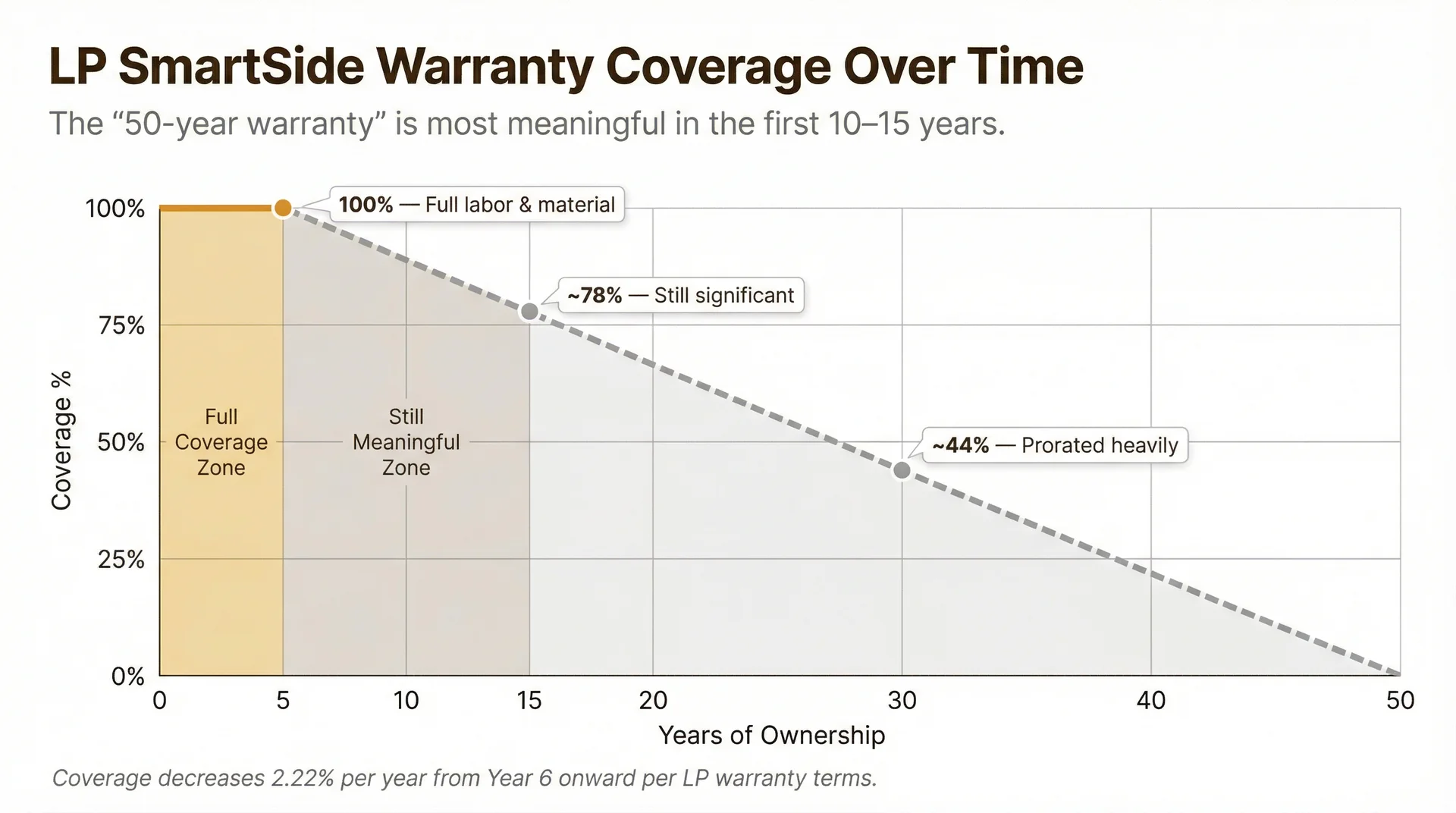
The 50-year warranty is the most prominently marketed feature of LP SmartSide and deserves careful reading before it becomes the deciding factor in a purchase decision.
LP SmartSide’s warranty operates in two tiers.
- During the first five years, LP covers 100% of material and labor costs if the product fails due to manufacturing defects.
- From year six onward, coverage decreases by 2.22% per year. By year 15, you are at approximately 80% coverage. By year 30, approximately 44%. By year 50, coverage is essentially nominal. The “50-year warranty” is most accurately described as a warranty that remains meaningful for roughly the first 10 to 15 years of ownership.
What the warranty does not cover. These exclusions are printed in the warranty document:
Swelling and edge checking. LP explicitly states that swelling and edge checking are natural properties of wood-based products and are excluded from coverage. In high-humidity climates, this exclusion is significant. The manufacturer does not warrant the product against its most predictable failure mode in wet conditions.
Improper installation. Any failure resulting from installation that does not follow LP’s published requirements voids the warranty entirely. This is not a fine-print technicality. It is the most common reason warranty claims are denied.
Geographic exclusions. LP does not warrant SmartSide products in Alaska, Hawaii, Northern California north of I-80, or west of the Cascades in Washington, Oregon, and California. These are among the highest-moisture residential markets in the country. The geographic exclusions exist because LP recognizes the product cannot reliably meet its performance claims in these climate zones.
Pest-related damage. Damage from insects is not covered, even though the zinc-borate treatment is marketed as an insect deterrent. The treatment deters; it does not guarantee against all insect activity in all conditions.
Woodpecker damage is also excluded and worth specific mention. Woodpeckers drill into wood-core siding when they detect insects behind the panel or during territorial drumming behavior. In areas with known woodpecker activity, this is a material consideration.
What does the warranty mean practically?
A warranty claim on a product that failed due to unsealed cut edges is still a failed installation that required remediation time, disruption, and cost, regardless of reimbursement. Installation quality, not warranty coverage, determines whether engineered wood siding performs as intended on your home.
The Moisture Risk: When Engineered Wood Fails and Why
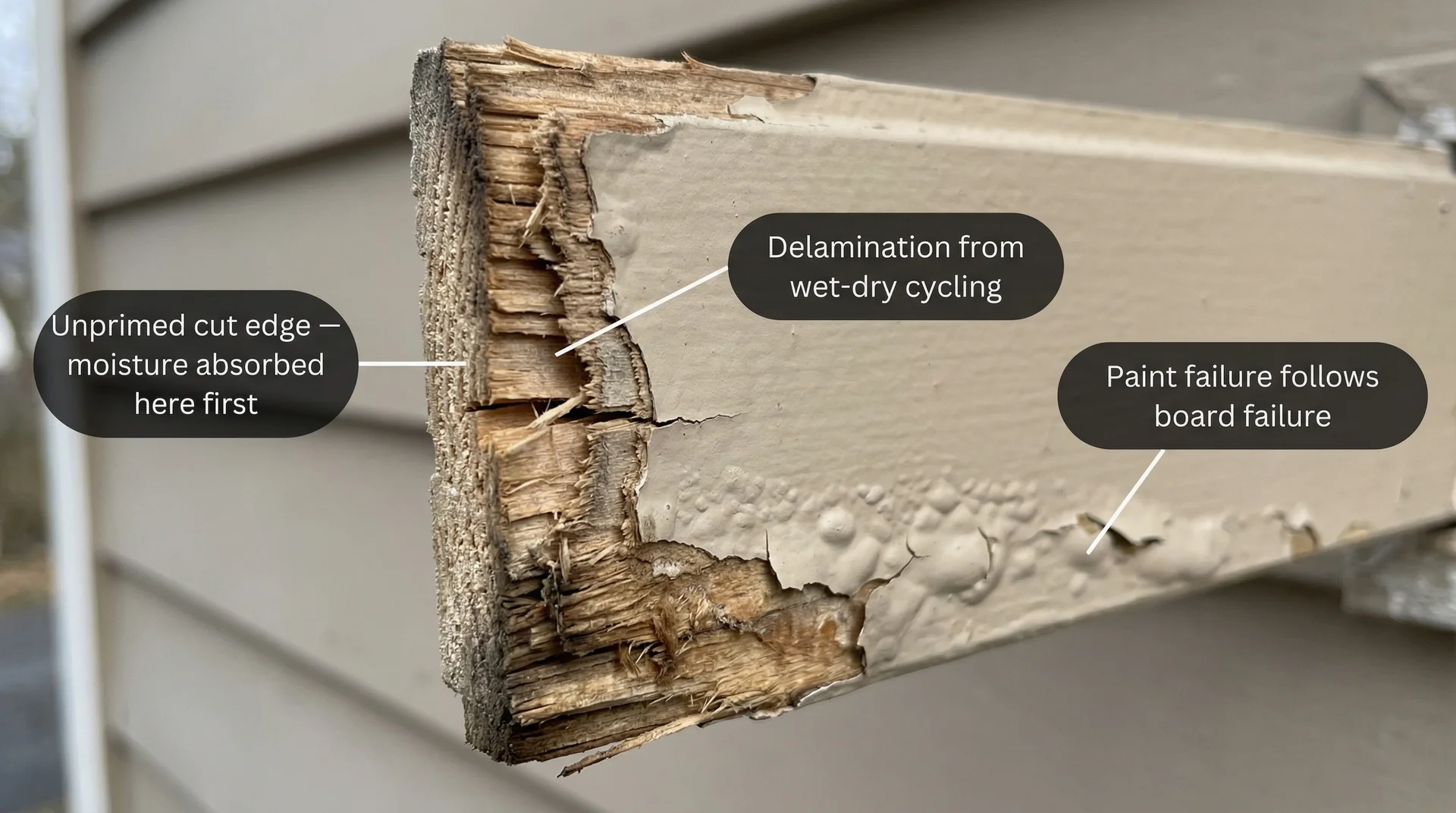
Moisture is engineered wood’s genuine vulnerability, and it is not a random or unforeseeable failure mode. It is a predictable consequence of specific, avoidable installation shortcuts.
The failure mechanism. Wood-core composite panels have directional moisture vulnerability. The face of LP SmartSide, the embossed, wax-coated, overlay-protected outer surface, resists moisture effectively under normal weather exposure. The cut edges are a different situation.
When a board is cut to length during installation, the cut exposes raw wood fiber at the board end. This cross-section has no wax coating, no overlay protection, and no zinc-borate surface treatment adequate to prevent rapid moisture absorption.
An unprimed cut edge absorbs water like a sponge. The absorbed moisture causes the wood strands to swell. The swelling puts mechanical stress on the resin binder. Over multiple wet-dry cycles, the bond degrades, the edge delaminates, and the board end fails visibly.
LP’s installation manual requires that every cut edge be primed or sealed immediately during installation. Not the next day. Not after the wall is up. Immediately, while the cut end is accessible.
Home inspectors consistently report finding missed cut-edge priming on the majority of LP SmartSide installations they inspect. This is the single most common installation shortcut on engineered wood jobs and the single most common cause of warranty claims being denied.
The butt joint problem. Where two boards meet end-to-end on a wall, LP requires a 3/16-inch gap. This allows boards to expand and contract with temperature and humidity changes without buckling against each other.
It also prevents the direct board-to-board contact that concentrates moisture at the joint and accelerates edge deterioration.
Many installers fit boards tight to each other because it looks cleaner and because the habit transfers from installing natural wood, which does not have the same thermal expansion requirements.
The ground clearance requirement. LP requires a minimum 6-inch clearance between the bottom course of siding and finished grade. This prevents wicking of soil moisture into the bottom edge of the first course.
Landscaping changes after installation, adding mulch, raising grade, planting beds against the house, can reduce the clearance that was correct at installation. A periodic check of bottom-course clearance is part of any engineered wood siding maintenance routine.
High-moisture climates. In climates with sustained high humidity, the Pacific Northwest west of the Cascades, coastal New England, the Southeast, and the Gulf Coast, the moisture environment is simply more demanding than LP SmartSide’s design parameters are intended to handle reliably.
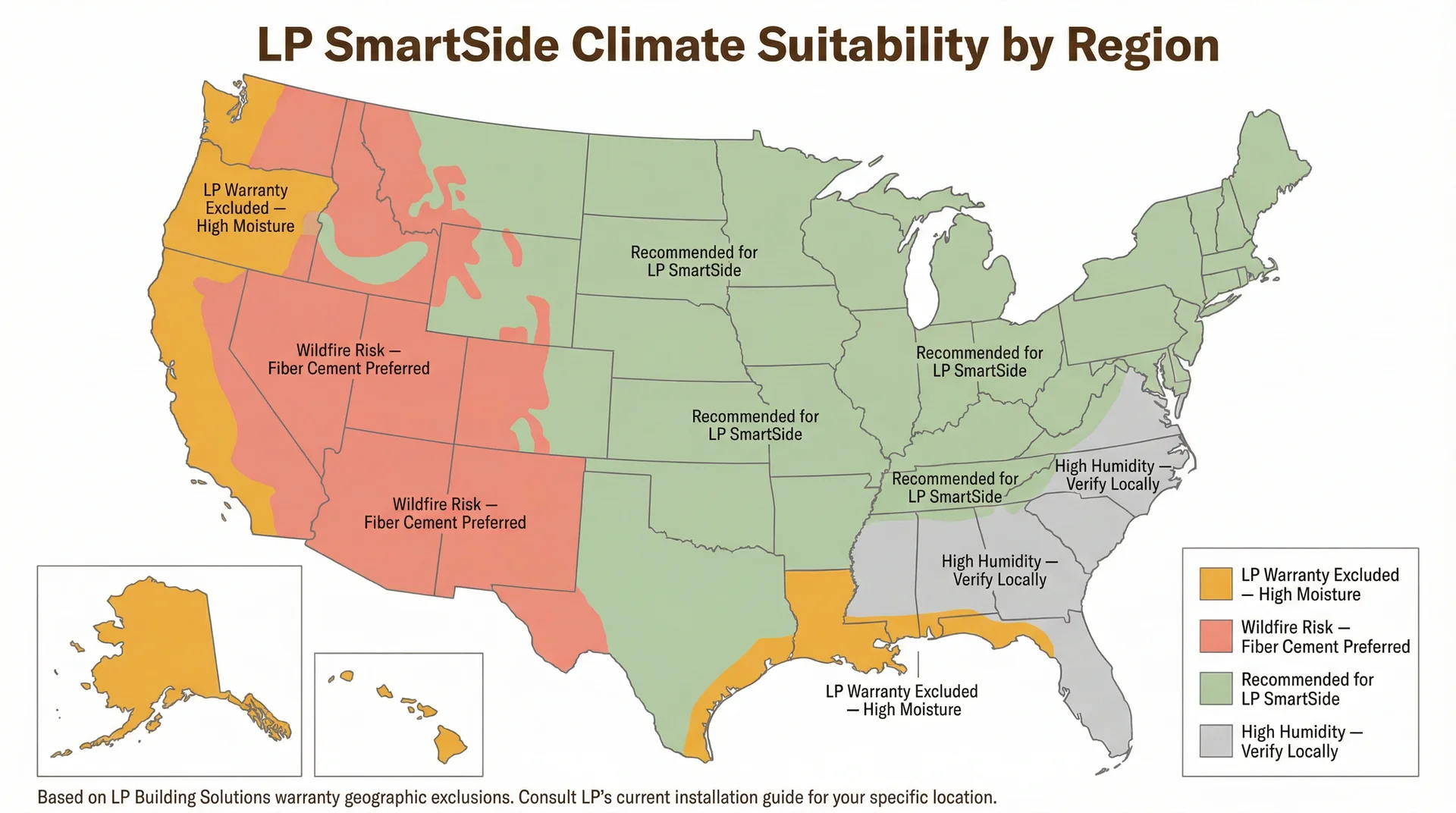
This is why LP does not warranty the product west of the Cascades. The zinc-borate and wax treatment system delays moisture infiltration; it does not prevent it indefinitely in conditions where the material is never fully dry.
In these climates, the honest recommendation for a homeowner who wants a wood aesthetic is either natural cedar, which has genuine natural rot resistance through its oils, or fiber cement with a wood-grain profile, which has no wood core and therefore no moisture absorption vulnerability.
Hail and Impact Resistance
This is something competitors and marketing highlight, but most guides underexplain. LP SmartSide has been tested to handle impacts from hailstones and windblown debris at velocities that would crack or dent fiber cement.
The compression process that densifies the strand board creates a surface that absorbs impact energy rather than fracturing under it. For homeowners in the Midwest and Southern Plains, where hail is a recurring event, this is a functional advantage worth factoring into the material decision alongside moisture performance.
Engineered Wood: Cost and How It Compares
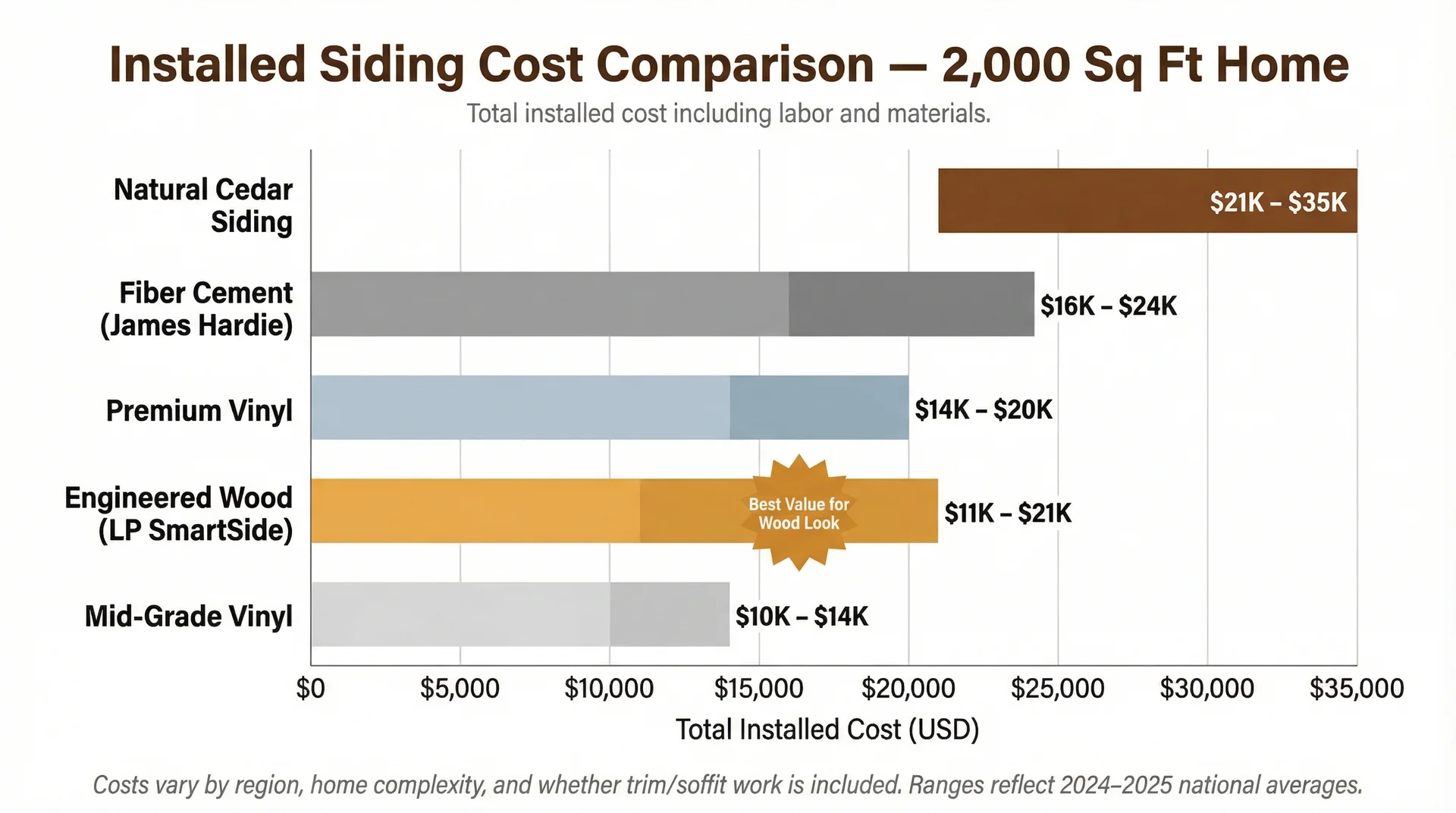
Cost is where engineered wood siding wins its clearest argument. It occupies a useful position in the market, significantly less expensive than fiber cement and natural cedar, meaningfully more durable and lower-maintenance than vinyl, with a realistic aesthetic that satisfies most homeowners who want a wood-look exterior.
Installed cost breakdown:
| Cost Component | Range |
|---|---|
| LP SmartSide material (panels) | $3.50–$4.50/sq. ft. |
| Additional materials (trim, housewrap, fasteners) | $2.00–$3.00/sq. ft. |
| Labor (installation) | $4.00–$6.00/sq. ft. |
| Total installed (standard lap) | $5.50–$10.50/sq. ft. |
In high-cost markets like Chicago or coastal metros, installed cost trends toward the upper end. In regional Midwest and Mountain West markets, the lower to middle of the range is more typical. For a 2,000 square foot home, a complete LP SmartSide re-siding project runs roughly $11,000 to $21,000, depending on region, home complexity, and whether trim and soffit work is included.
How it compares to alternatives:
- Fiber cement: $16,000–$24,000 for the same home
- Natural cedar siding: $21,000–$35,000
- Premium vinyl: $14,000–$20,000
- Mid-grade vinyl: $10,000–$14,000
Engineered wood siding sits between premium vinyl and fiber cement in both cost and capability. It delivers a substantially more authentic wood aesthetic than vinyl. It costs meaningfully less than fiber cement.
Its maintenance requirements, repainting every 8 to 14 years depending on climate and sun exposure, are more demanding than fiber cement but far less demanding than natural wood.
Engineered Wood vs. Fiber Cement: The Comparison That Shapes Most Decisions
| Factor | Engineered Wood (LP SmartSide) | Fiber Cement (James Hardie) |
|---|---|---|
| Material core | Wood strands + resin | Portland cement + cellulose + sand |
| Weight | Light, easier to handle | Heavy, professional labor required |
| Fire resistance | Combustible | Non-combustible, Class A rated |
| Moisture tolerance | Moderate, vulnerable at cut edges | High, absorbs essentially no moisture |
| Paint hold | 8–14 years between repaints | 15–25 years between repaints |
| Warranty | 50-year prorated (full yrs 1–5) | 30-year non-prorated |
| Installed cost | $5.50–$10.50/sq. ft. | $8–$12/sq. ft. |
| Climate suitability | Moderate climates | All climates |
| Fire zone suitability | No | Yes |
| Geographic warranty exclusions | Several high-moisture regions | None |
| Hail resistance | Excellent | Good |
The clearest decision rule: if you live in a wildfire risk zone, a high-humidity coastal climate, or anywhere LP excludes from its warranty, fiber cement is the correct material. If you live in a moderate climate, want a wood aesthetic, and your budget sits meaningfully below fiber cement, LP SmartSide installed correctly is a sound choice.
Engineered Wood vs. Natural Wood
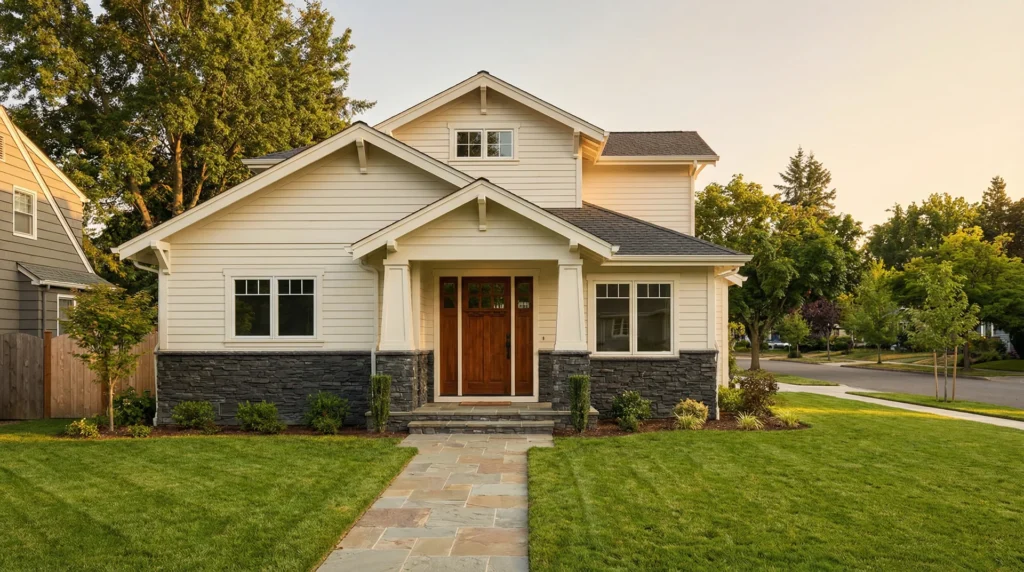
Natural wood has an aesthetic that LP SmartSide approximates but does not fully replicate. I installed LP SmartSide on a craftsman-style home alongside natural cedar clapboards on an addition that matched the existing structure.
Standing on the street, the two walls were nearly indistinguishable. Standing three feet from the wall on a bright day, the engineered wood’s embossed grain read slightly more uniform and slightly less deep than the authentic cedar grain beside it.
That visual difference matters to some homeowners and not at all to others.
What natural wood has that LP SmartSide does not: genuine grain variation, the ability to be stained rather than only painted, and the material integrity that allows authentic restoration of historic structures where material authenticity matters. LP SmartSide requires paint. It cannot be stained to a natural wood appearance.
What LP SmartSide has that natural wood does not: a doubled paint cycle, built-in insect and fungal resistance, greater dimensional stability across temperature swings, and roughly 50% lower material cost.
Sustainability and Environmental Considerations
LP manufactures SmartSide using 100% sustainably sourced wood fiber. The strand-based manufacturing process uses a higher proportion of each log than traditional milling, generating less waste per linear foot of siding produced.
LP has also verified that its SmartSide product portfolio is carbon negative, meaning the products store more carbon than the total greenhouse gas emissions released across their lifecycle, including manufacturing, transport, and installation.
For homeowners weighing environmental impact alongside performance, this is a meaningful differentiator against vinyl siding, which is not biodegradable, and against fiber cement, which has an energy-intensive Portland cement manufacturing process.
Energy Efficiency
Siding alone does not provide meaningful thermal insulation. What engineered wood does contribute is air-sealing performance when installed over continuous house wrap, and dimensional stability that keeps the cladding layer tight against the structure over time.
When combined with proper wall cavity insulation and a continuous weather-resistive barrier, LP SmartSide supports a complete building envelope that performs well across temperature extremes.
LP also makes SmartSide in an insulated panel format for new construction applications where R-value at the cladding layer is part of the wall system design.
Maintenance Schedule of Engineered Wood
Engineered wood siding does not maintain itself. The maintenance requirements are genuinely lighter than natural wood, but they are real, and the consequences of skipping them compound over time.
Annual maintenance:
Wash the siding once per year using mild detergent and a soft brush or low-pressure water. Remove dirt, mildew, and debris from the surface and from any horizontal trim ledges where moisture collects. Do not use a pressure washer at high pressure. The surface overlay that provides moisture resistance can be damaged by direct high-pressure water contact.
Inspect all caulked joints, particularly at butt joints, around windows and doors, and at trim intersections. Flexible caulk shrinks and cracks over time. Gaps in caulk at butt joints are direct moisture entry points. Replace cracked or missing caulk immediately.
Check the bottom-course clearance from grade. Mulch beds, landscaping changes, and soil settling can reduce the 6-inch minimum clearance LP requires. If clearance has been reduced, address it before the next rainy season.
Adjust irrigation systems so sprinkler heads do not spray directly onto the siding surface. Sustained wetting from irrigation causes the same moisture problems as inadequate ground clearance.
Every 3 to 5 years:
Inspect the paint film condition. LP SmartSide holds paint longer than natural wood, but paint does eventually chalk, fade, and crack. Cracked paint film is a moisture entry path at any penetration point.
Touch up any areas showing paint failure before they become board failures. Full repainting cycles run every 8 to 14 years, depending on climate, sun exposure, and paint quality. Using a high-quality acrylic exterior paint over the original primer extends the repaint cycle and protects the substrate.
Seasonal considerations:
After winter, inspect for any boards that show swelling, cracking, or paint delamination caused by freeze-thaw cycling. Catch these early and address them before spring moisture compounds the damage.
After summer in high-UV regions, check south and west-facing walls for paint film degradation, which progresses faster on high-exposure elevations.
LP SmartSide: DIY vs. Professional Installation
LP SmartSide is lighter and easier to cut than fiber cement, which makes it genuinely more accessible to experienced DIY installers than competing products. The boards are cut with standard woodworking saws, accept nails with a standard pneumatic nailer, and do not require the silica dust precautions that fiber cement demands.
That said, the installation details that determine whether the product performs correctly, cut-edge priming, butt joint gapping, grade clearance, flashing at roof intersections, are the same details that are routinely skipped by both inexperienced DIYers and professional crews moving quickly. A homeowner who reads LP’s installation guide thoroughly and follows it literally can achieve a correct installation. A homeowner who assumes the installation is similar to vinyl siding will almost certainly miss the specific requirements that differentiate this product.
For most homeowners, professional installation by a contractor who has documented experience with LP SmartSide specifically is the safer path. The cost savings on labor are real but not large relative to the total project cost, and the consequences of missed installation details are significant.
What Good Installation Looks Like
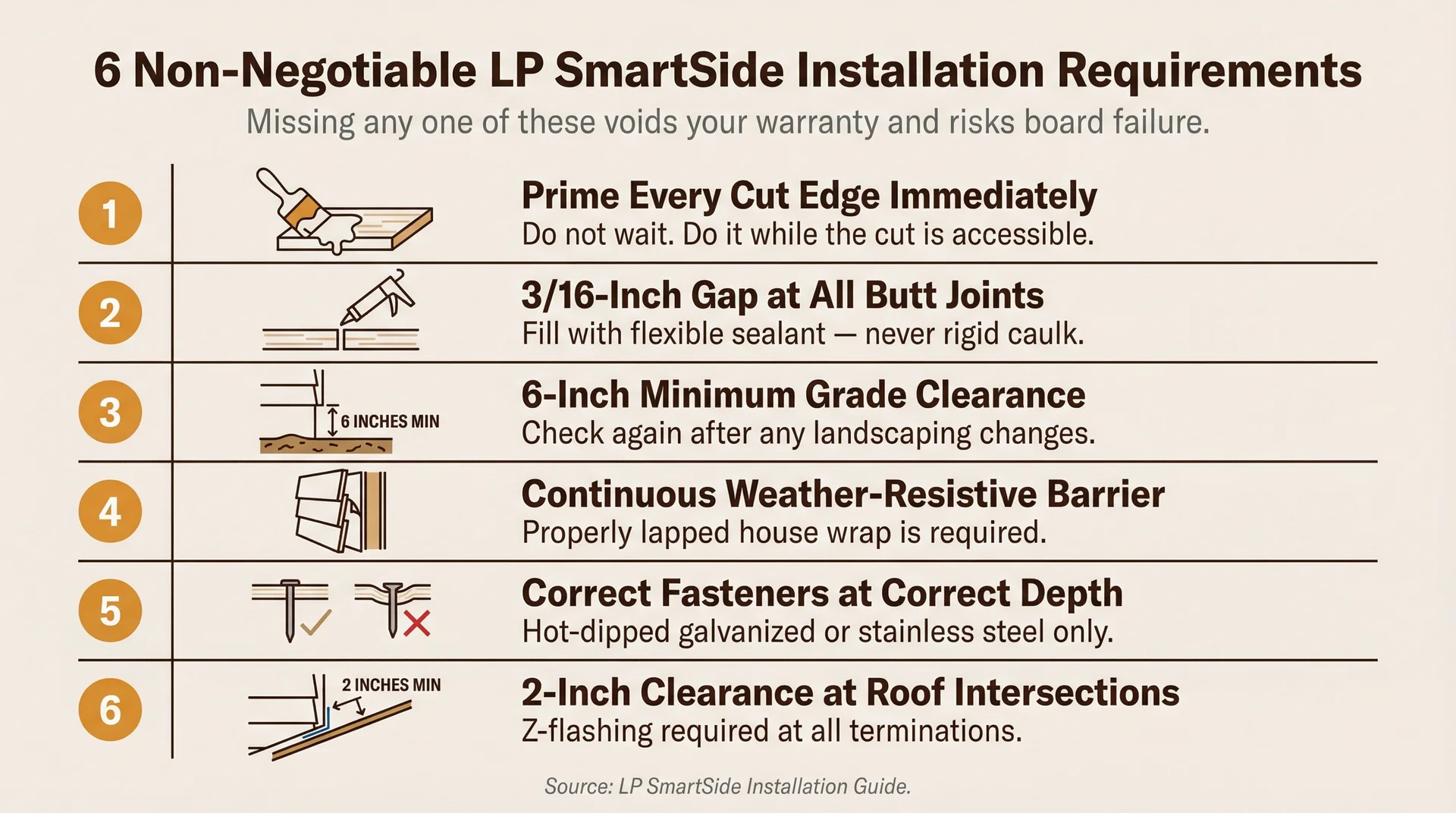
Installation quality is the determining factor in whether engineered wood siding performs as intended. These are the non-negotiable requirements.
Prime or seal every cut edge immediately. A foam brush, small paint roller, or spray bottle with primer accomplishes this in seconds per cut. Skipping it creates a moisture entry point that will eventually cause visible failure at that board end.
Maintain 3/16-inch gaps at all butt joints. The gap should be uniform, visible, and consistent. Fill it with a flexible bead of exterior sealant that prevents moisture entry while accommodating movement. Do not fill it solid with rigid caulk.
Maintain a minimum 6-inch clearance from grade. This requires planning at the bottom course and communication to whoever is responsible for landscaping after installation.
Install over a continuous, properly lapped weather-resistive barrier. House wrap behind engineered wood siding is required and serves the same moisture management function as it does behind any other cladding system.
Use correct fasteners. LP requires hot-dipped galvanized or stainless steel nails of specified diameter and length, driven at specified depth. Overdriven nails split the surface overlay and create a moisture entry point. Underdriven nails create loose panels that flex and fatigue the overlay coating over time.
Maintain a minimum 2-inch clearance at roof intersections. Protected by Z-flashing, this clearance prevents wicking of roof drainage moisture into the board ends at that termination.
Questions to Ask a Contractor Before Signing
Not every contractor who installs LP SmartSide follows LP’s installation guide. These questions separate experienced installers from crews transferring habits from vinyl or fiber cement work.
Ask specifically how they handle cut edges during installation. Ask what gap they leave at butt joints and how they seal them. Ask what clearance they maintain from the finished grade. Ask what nail specification they use for LP SmartSide. Ask whether they are familiar with LP’s installation guide and whether they follow it on every job.
A contractor who answers the cutting-edge question without prompting demonstrates they understand the material. A contractor who says “we follow standard siding installation procedure” does not understand that LP SmartSide has specific requirements that differ from other products. Walk away.
LP also maintains a Preferred Contractor program. Contractors who complete LP’s training and meet installation standards can be found through LP’s website. This is not a guarantee of quality, but it is a reasonable starting filter.
Is Engineered Wood Siding Right for Your Home?
Engineered wood siding is the right choice if:
You live in a moderate climate, the Midwest, mid-Atlantic, most of the Mountain West outside high-humidity zones, and parts of the South with defined dry seasons. You want the visual quality of wood without wood’s aggressive maintenance cycle.
Your budget sits below fiber cement but you want better performance and more authentic aesthetics than vinyl. You can confirm your contractor understands and follows LP’s installation requirements, particularly cut-edge priming. Your home is not in a wildfire risk zone or a climate that LP excludes from warranty coverage.
Consider fiber cement instead if:
You live in the Pacific Northwest west of the Cascades, coastal New England, the Southeast, or any region where LP’s warranty exclusions apply. Your home is in a wildfire risk zone where non-combustible cladding is required or strongly advisable.
You want a fire-rated material that qualifies for insurance premium reductions. You plan to own the home long enough that fiber cement’s 15-to-25-year paint cycle represents a meaningful quality-of-life difference over engineered wood’s 8-to-14-year cycle.
Frequently Asked Questions
How long does LP SmartSide last?
With correct installation and maintenance, LP SmartSide lasts 20 to 50 years. The 50-year warranty is prorated, with full coverage applying only for the first five years. In appropriate climates with correct installation, the product reliably reaches 30 to 40 years.
Can LP SmartSide be painted any color?
Yes. LP SmartSide ships either primed, ready to paint any color, or in the ExpertFinish pre-painted system offering 16 factory colors. Unlike vinyl siding, LP SmartSide can be repainted in any exterior-grade paint color at any point.
Can LP SmartSide be stained rather than painted?
No. The manufacturing process and surface overlay require paint. Homeowners who want a natural stained-wood appearance need natural wood.
Is LP SmartSide good for wet climates?
LP does not warrant SmartSide products in Alaska, Hawaii, Northern California north of I-80, or west of the Cascades in Washington, Oregon, and California. In these climates, fiber cement is the appropriate material for a wood aesthetic installation.
What is the SmartGuard process?
SmartGuard is LP’s proprietary manufacturing treatment: zinc borate application, resin binder, wax coating, and heat and pressure compression. It gives LP SmartSide its insect and fungal resistance relative to untreated natural wood. It does not make the product waterproof. It makes it moisture-resistant when installation details are correct.
Does LP SmartSide attract woodpeckers?
Yes. Woodpecker damage is documented in regions where woodpeckers are present, and LP’s warranty does not cover it. In areas with known woodpecker activity, this is worth discussing before choosing engineered wood over fiber cement.
Does LP SmartSide add to home resale value?
Generally, yes, in the same way that any quality cladding replacement adds to resale value compared to deteriorating original siding. Buyers and appraisers respond to fresh exterior cladding, and a correctly installed LP SmartSide job is visually indistinguishable from more expensive materials at street level. The resale premium relative to fiber cement is less clear, since fiber cement is the preferred material in higher-end market segments.
Is engineered wood siding eco-friendly?
LP uses 100% sustainably sourced wood fiber, and the SmartSide product portfolio has been verified as carbon negative across its full lifecycle. It is a more environmentally defensible choice than vinyl and comparable to fiber cement on sustainability metrics.