I remember sitting on the floor of an empty master bedroom once, tape measure in hand, trying to figure out why a room that looked fine on the floor plan felt so wrong in person.
The dimensions said 12 by 14 feet. The king bed the homeowner had already purchased said otherwise.
So let me give you the direct answer first.
| A standard master bedroom measures between 200 and 250 square feet, with the most common size landing around 14 by 16 feet. Anything above 300 square feet moves into master suite territory. Anything below 180 square feet will feel genuinely limited once you place a king bed and a dresser inside. |
The number alone, though, tells only half the story. The room’s shape, ceiling height, door swings, and the furniture you plan to bring in all determine whether a space actually lives the way you need it to.
I’ve seen 300-square-foot bedrooms that felt claustrophobic and 180-square-foot rooms that felt like calm, well-edited retreats. The difference was never just the square footage.
What Qualifies as a Master Bedroom?
The term “master bedroom” has shifted quietly over the last decade. Many builders and designers, myself included, now use “primary bedroom” instead.
The practical definition stays the same: it is the largest sleeping space in the home, reserved for the homeowners, and it consistently offers more than a standard bedroom does.
A primary bedroom typically includes:
- An en-suite or directly connected bathroom
- A walk-in closet or significantly larger closet space
- Higher ceilings in newer constructions
- Better natural light orientation, often facing east or south
From a real estate standpoint, a room qualifies as a legal bedroom when it meets the minimum square footage under the International Residential Code, has at least one window with egress capability, and meets the minimum ceiling height requirement.
A master bedroom simply sits at the top of that category in terms of size and finish.
Master Bedroom Sizes by Home Type
The sizing patterns across construction eras are remarkably consistent once you group them. Here is what you typically encounter:
| Home Type | Typical Size | Square Footage |
|---|---|---|
| Apartment / Condo | 10 × 12 ft | ~120 sq ft |
| Starter Home (pre-1980) | 11 × 13 ft | ~143 sq ft |
| Average Single-Family (1980s–2000s) | 12 × 14 ft to 14 × 16 ft | 168–224 sq ft |
| Modern New Build | 14 × 18 ft to 16 × 20 ft | 252–320 sq ft |
| Luxury Home / Master Suite | 18 × 22 ft and above | 396+ sq ft |
The National Association of Home Builders tracked that the average new single-family home in the U.S. grew from around 1,660 square feet in 1973 to over 2,500 square feet by the 2010s, and primary bedrooms expanded alongside that growth.
Older homes treated bedrooms as purely functional sleeping rooms. Today, the primary bedroom functions more like a private apartment within the home.
How Does a Master Bedroom Compare to Other Bedrooms?
This comes up often, especially when homeowners are evaluating a floor plan or trying to decide how much size difference is actually meaningful between rooms.
| Bedroom Type | Typical Size Range | Square Footage |
|---|---|---|
| Master / Primary Bedroom | 14 × 16 ft to 16 × 20 ft | 224–320 sq ft |
| Secondary Bedroom | 10 × 12 ft to 12 × 14 ft | 120–168 sq ft |
| Guest Bedroom | 10 × 11 ft to 12 × 12 ft | 110–144 sq ft |
| Children’s Bedroom | 9 × 10 ft to 11 × 12 ft | 90–132 sq ft |
| Minimum Legal Bedroom (IRC) | 7 × 10 ft minimum | 70 sq ft |
The master bedroom typically runs 60 to 100 square feet larger than a secondary bedroom in the same home. That gap is what makes the difference between fitting a king bed comfortably and making do with a queen.
It also explains why staging a secondary bedroom as the primary can be a difficult sell to buyers.
What Fits in a Master Bedroom? The Furniture Reality Check
Furniture sizing is where most people experience genuine frustration, and it deserves its own honest conversation.
Bed Sizes and Their True Footprint
Your bed anchors the room. Everything else organizes around it.
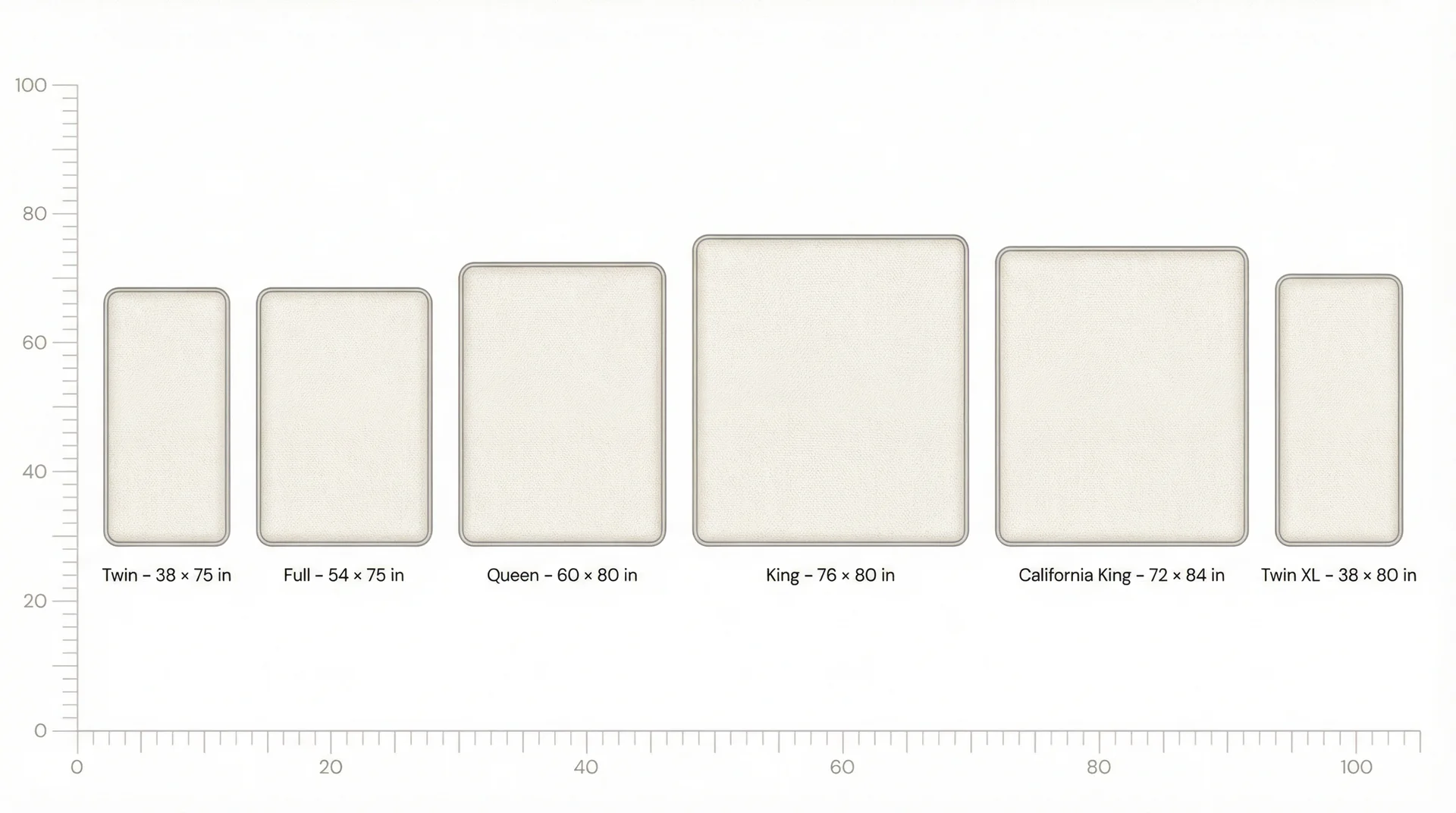
| Bed Size | Dimensions | Minimum Room Width | Recommended Room Size |
|---|---|---|---|
| Twin | 38 × 75 in | 8 ft | 10 × 10 ft |
| Full / Double | 54 × 75 in | 9 ft | 10 × 12 ft |
| Queen | 60 × 80 in | 10 ft | 12 × 12 ft |
| King | 76 × 80 in | 12 ft | 13 × 16 ft |
| California King | 72 × 84 in | 12 ft | 13 × 18 ft |
Measure the bed before you fall in love with the room. I’ve had clients purchase a California King for a 12 × 13 bedroom, and the bed consumed the room entirely. You could barely open the closet door without turning sideways.
Clearance Space That Actually Matters
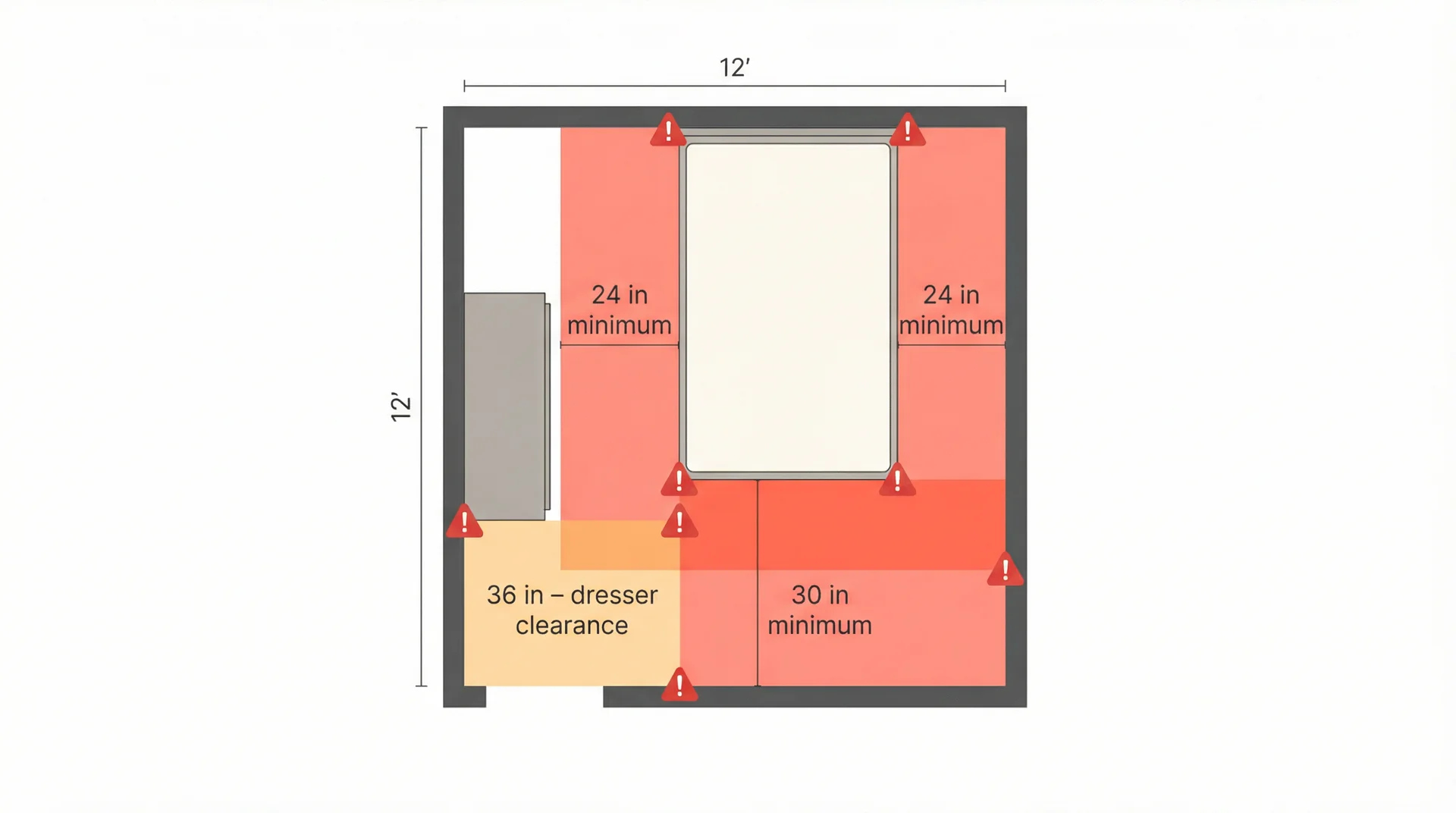
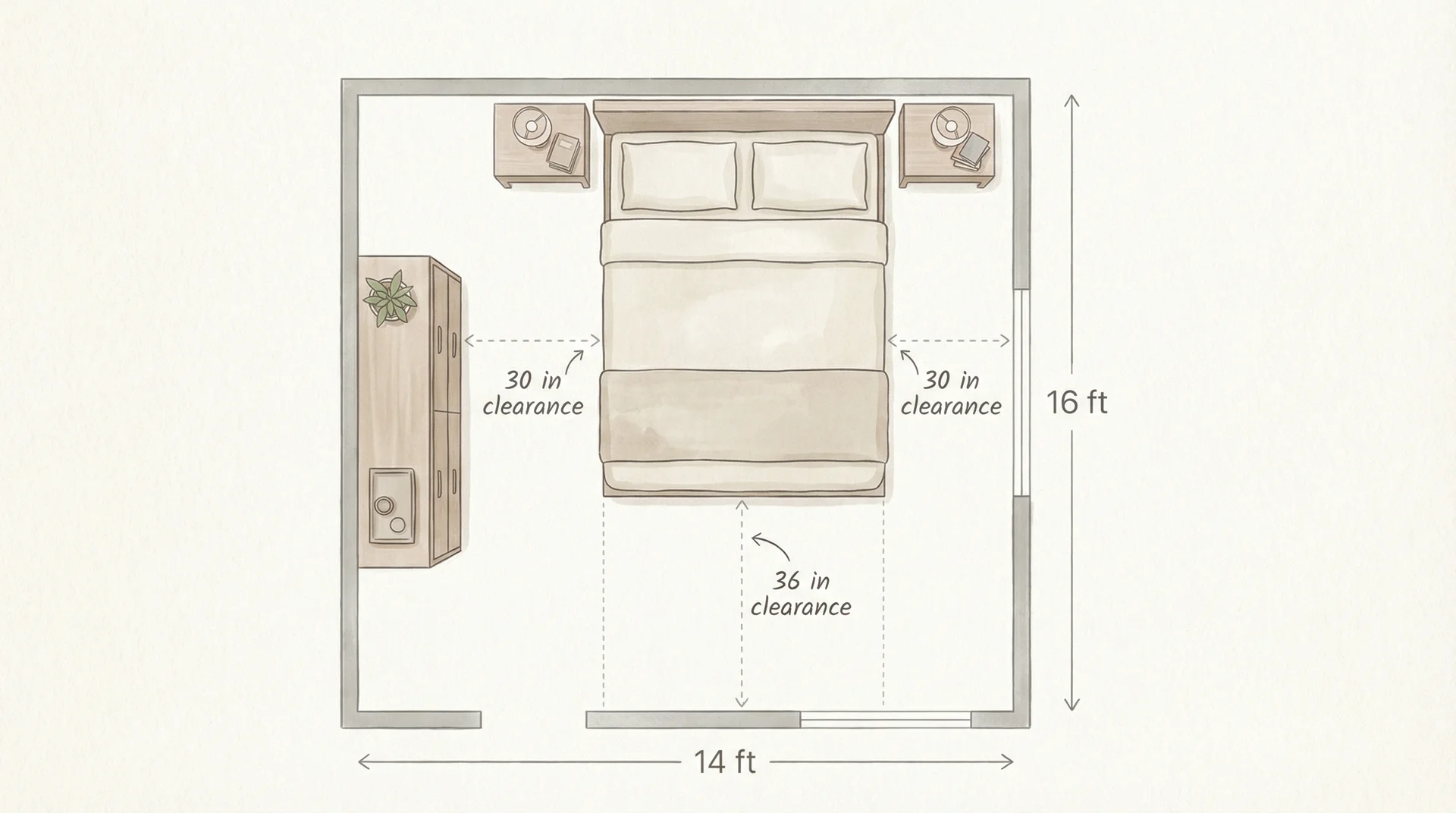
Beyond the bed itself, your circulation space determines whether the room functions daily without frustration.
- Sides of the bed: at least 24 inches, ideally 30 to 36 inches
- Foot of the bed: at least 30 inches for comfortable movement
- In front of a dresser or wardrobe: at least 36 inches to open drawers fully
- Walking paths through the room: at least 24 inches wide, ideally 36 inches
When you add all of this together, a king bed in a 12 × 12 room leaves almost no room to breathe. The math simply does not work comfortably.
Is My Master Bedroom Too Small?
This question comes up more than almost any other in my consulting work. Here is a quick framework I use with homeowners.
Your room is likely too small if:
- You cannot place your bed with at least 24 inches of clearance on both accessible sides
- Opening dresser drawers requires moving another piece of furniture
- The door to the en-suite or closet swings into a piece of furniture
- You feel rushed or constrained during your morning routine
- Guests comment that the room looks like a showroom (everything is pushed against the walls)
Your room is workable but needs editing if:
- You have the clearance you need, but feel like the room is cluttered
- You have furniture that serves no real function but fills space out of habit
- The layout works physically, but nothing in the room feels intentional
Your room is actually fine if:
- You have full clearance, comfortable pathways, and adequate storage
- The room feels calm when you walk into it at the end of the day
- Your morning routine flows without friction
Most rooms that feel too small are actually rooms that have too much in them.
The Shape Problem Nobody Talks About Enough
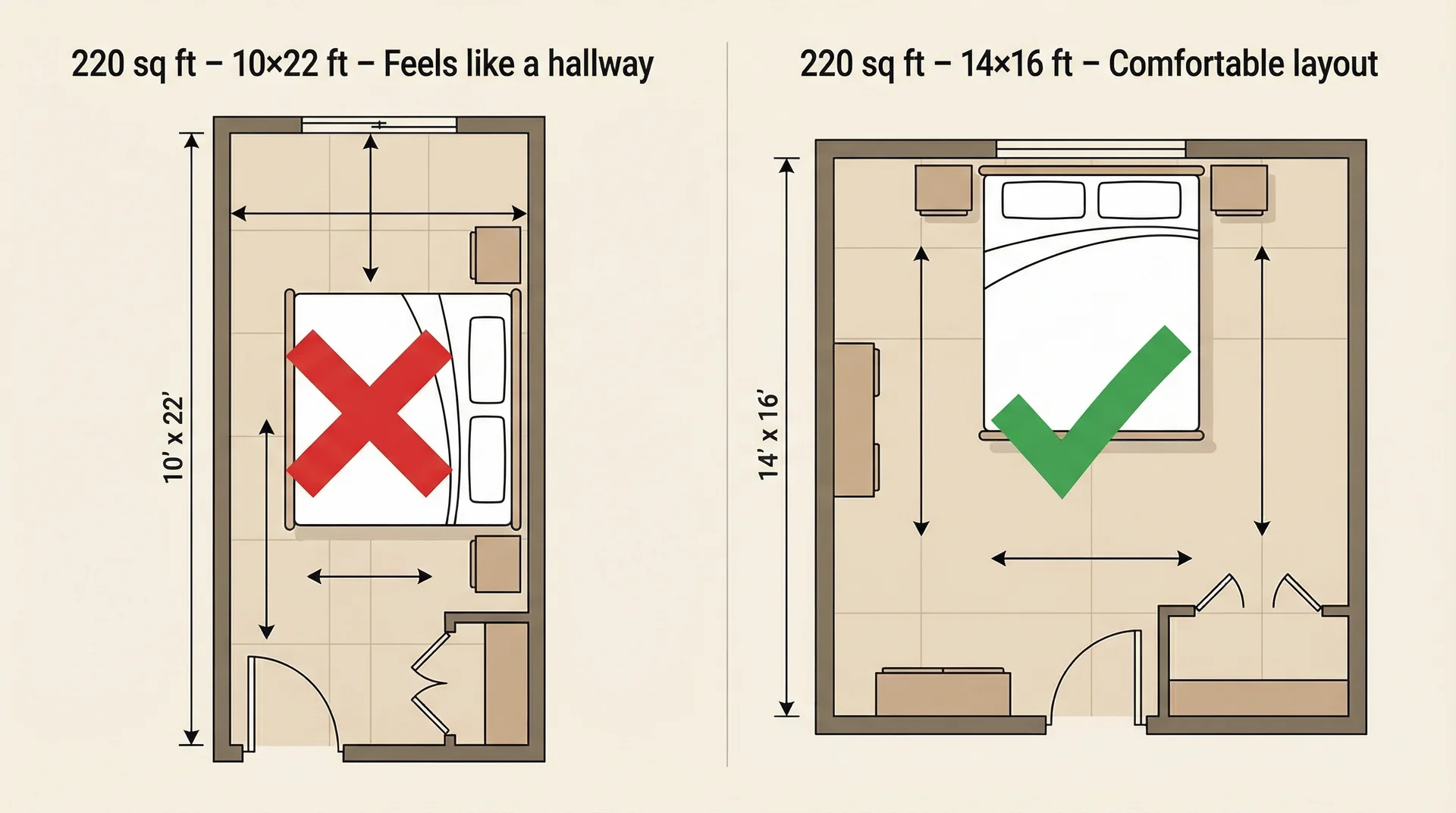
Square footage is the headline number, but room shape is the director. I’ve walked into a 220-square-foot bedroom that was 10 feet wide and 22 feet long, and it functioned essentially as a hallway with a bed in it. Furniture placement was a nightmare, and the narrow width made a king bed completely impossible.
The most functional master bedrooms tend to have a width-to-length ratio close to 1:1.4 or 1:1.5.
A 12 × 17 or 14 × 20 room will almost always feel more livable than a 10 × 24 room with the same square footage.
A room’s shape determines its soul. Square footage just tells you how loud that soul can speak.
When evaluating a room, walk its width first. If you cannot comfortably place your bed perpendicular to the longest wall with clearance on both sides, the room will always feel like it is working against you.
How to Figure Out the Right Size for Your Master Bedroom
Whether you are renovating, building new, or trying to make the most of what you have, these are the steps I walk every homeowner through before we talk numbers.
Step 1: Write Your Furniture List First
A bedroom that needs to hold a king bed, two nightstands, a six-drawer dresser, a bench at the foot of the bed, and a reading chair needs at minimum 250 to 280 square feet. A bedroom that only needs a queen bed and two nightstands can function beautifully at 160 to 180 square feet.
Your furniture list is your real brief, not the square footage on the listing.
Step 2: Use a Simple Space Planning Formula
Add up the floor footprint of every piece of furniture, then add your clearance space around each item. The total gives you your minimum functional square footage.
A practical example:
- King bed (6.3 × 6.7 ft): approximately 42 sq ft
- Two nightstands (1.5 × 2 ft each): approximately 6 sq ft
- Six-drawer dresser (3 × 1.5 ft): approximately 4.5 sq ft
- Clearances around all pieces: approximately 60 to 80 sq ft
- Total minimum: approximately 112 to 132 sq ft of active floor space
That means you want at least a 13 × 14 or 12 × 15 room to house all of that without it feeling tight. The extra square footage gives you the visual breathing room that makes a space feel calm rather than crammed.
Step 3: Sketch the Room Before You Commit
I still sketch rooms by hand before moving to any digital tool. Graph paper works well: let each square represent one square foot. Draw the room outline, mark the doors and windows, and place your furniture to scale.
This process almost always reveals something: a furniture piece that won’t fit where you imagined, or a layout possibility you hadn’t considered. It takes 20 minutes and saves weeks of frustration.
Small Master Bedrooms: Making Every Square Foot Work
If your master bedroom is below 180 square feet, you have a compact room by modern standards. That does not mean you have a bad room. Some of the most beautiful primary bedrooms I’ve ever worked on were compact.
The key is editing ruthlessly and being strategic about every decision.
Furniture Rules for a Small Master
Choose a queen over a king if the room is under 12 feet wide. A queen in a well-designed room will always feel more comfortable than a king that has been forced into a space that cannot hold it.
Go vertical with storage. Tall wardrobes and floor-to-ceiling shelving draw the eye upward and free up floor space. In rooms where a walk-in closet is not possible, a built-in wardrobe wall can completely transform the function and the aesthetic.
Choose furniture with exposed legs. Pieces that float above the floor create a visual lightness that makes the room feel larger. A bed frame with legs, a dresser that sits on feet rather than a plinth base, and open-leg bedside tables all contribute to this effect.
Use a single, large rug rather than multiple small ones. One rug that extends at least 18 inches beyond the sides and foot of the bed unifies the space and makes it feel intentional.
Color and Light for Small Spaces
Lighter walls do expand a room visually, and this is not just interior design mythology. Lighter surfaces reflect more light and reduce the visual compression that darker rooms create.
The effect works most powerfully when the ceiling, trim, and walls sit in the same tonal family, creating a continuous, unbroken envelope of light.
Very pale warm whites, soft sage greens, and dusty pale blues work beautifully in compact master bedrooms. The rooms feel serene, even at 160 square feet.
Large Master Bedrooms: Filling Space Intentionally
A large master bedroom, anything above 280 to 300 square feet, comes with its own design challenge: the room often feels like a hotel lobby rather than a personal retreat.
Zone the room deliberately. Large bedrooms benefit from being treated as two or three distinct areas rather than one open expanse.
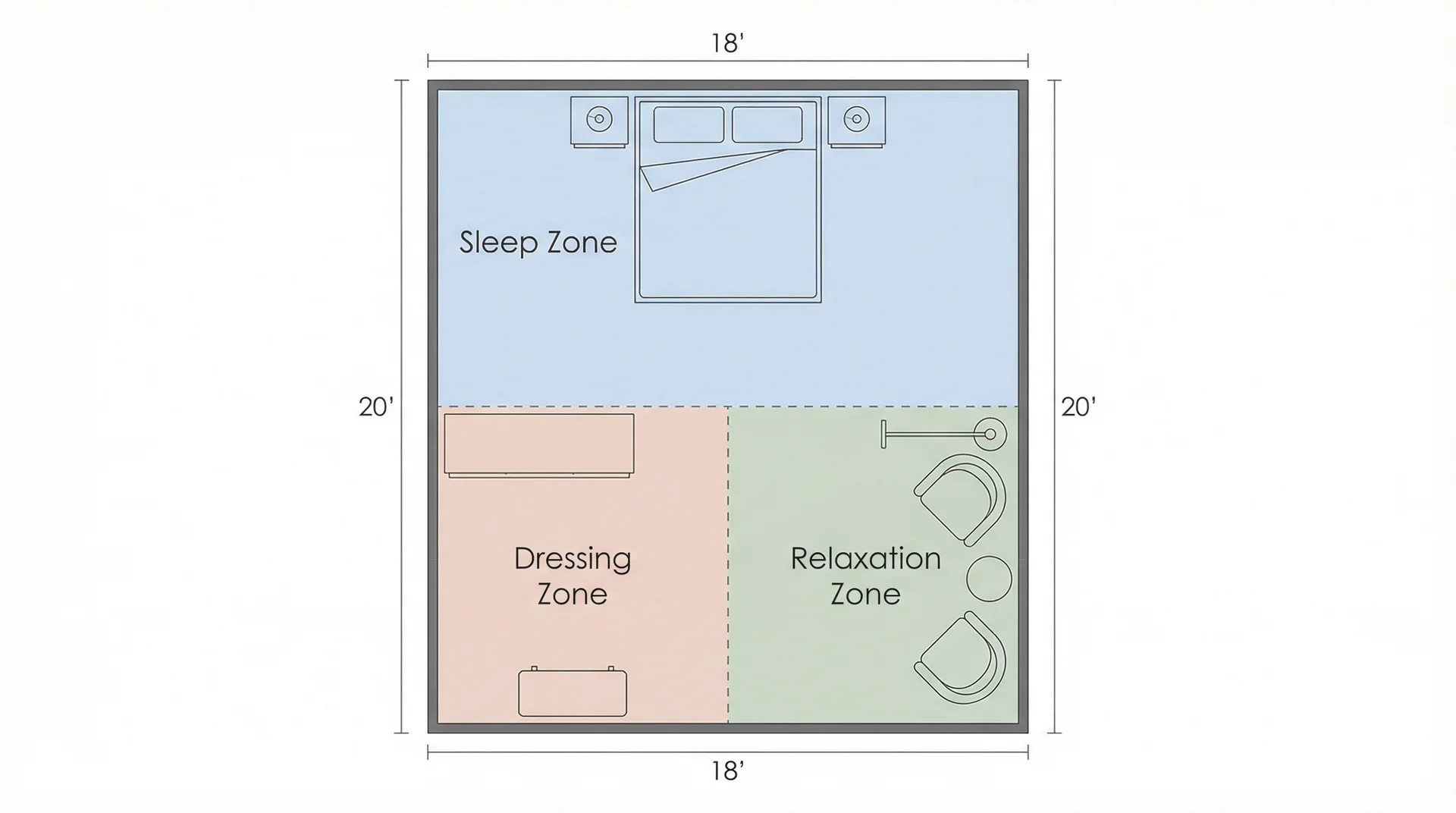
Common zoning approaches that work well:
- Sleep zone: bed, nightstands, reading lights
- Dressing zone: dresser, mirror, seating bench, or ottoman
- Relaxation zone: armchairs or a small sofa, a floor lamp, a side table
- Work zone (optional): a small desk in a corner or window bay
A large area rug under the bed anchors the sleep zone and gives the room a visual center of gravity. Without it, even a beautifully furnished large bedroom can feel adrift.
Scale your furniture to the room. A petite queen bed in a 350-square-foot room will look lost. A king bed with a tall upholstered headboard and flanking full-height wardrobes will feel appropriately anchored.
The Ceiling Height Variable
Ceiling height dramatically affects how a room feels, and most size conversations ignore it entirely.
Standard ceiling height in most homes sits at 8 feet. Anything below that starts to feel oppressive, especially in a bedroom where you spend long, horizontal hours. Anything at 9 feet or above gives the room an immediate sense of airiness.
In rooms with low ceilings, vertical design choices help lift the perceived height: tall headboards, floor-length curtains hung close to the ceiling, and vertically oriented art all contribute to this effect.
In rooms with very high ceilings, the opposite challenge appears. Lower pendant lights, horizontally oriented artwork, and warm-toned materials bring the space back to a human scale.
How Master Bedroom Size Affects Home Value
From a real estate perspective, the primary bedroom size influences buyer perception consistently. The primary bedroom ranks among the top three features homebuyers evaluate, alongside kitchen quality and overall square footage.
Buyers in competitive markets expect a primary bedroom that can hold a king bed with comfortable clearance on both sides, ideally with a dedicated dressing area or walk-in closet. Rooms that fall short of this show up in buyer feedback as a reason for hesitation, even when the rest of the home scores well.
From my experience working alongside real estate agents during property styling projects, staging the primary bedroom thoughtfully matters enormously. A well-sized room that has been poorly furnished looks smaller than it actually is. A compact room that has been thoughtfully scaled and styled feels genuinely inviting.
Building Code Minimums vs. Comfort Standards
If you are building or renovating significantly, local building codes will specify minimum bedroom dimensions. In the United States, the International Residential Code sets the minimum at 70 square feet for a single occupant, with no dimension being less than 7 feet in any direction.
These minimums exist for safety and habitability, not comfort. A master bedroom built to code minimums will technically qualify as a legal bedroom, but will feel inadequate for the use most homeowners envision.
Treat the code minimum as the legal floor. Design from a comfort-based starting point instead.
Master Bedroom Sizes Around the World
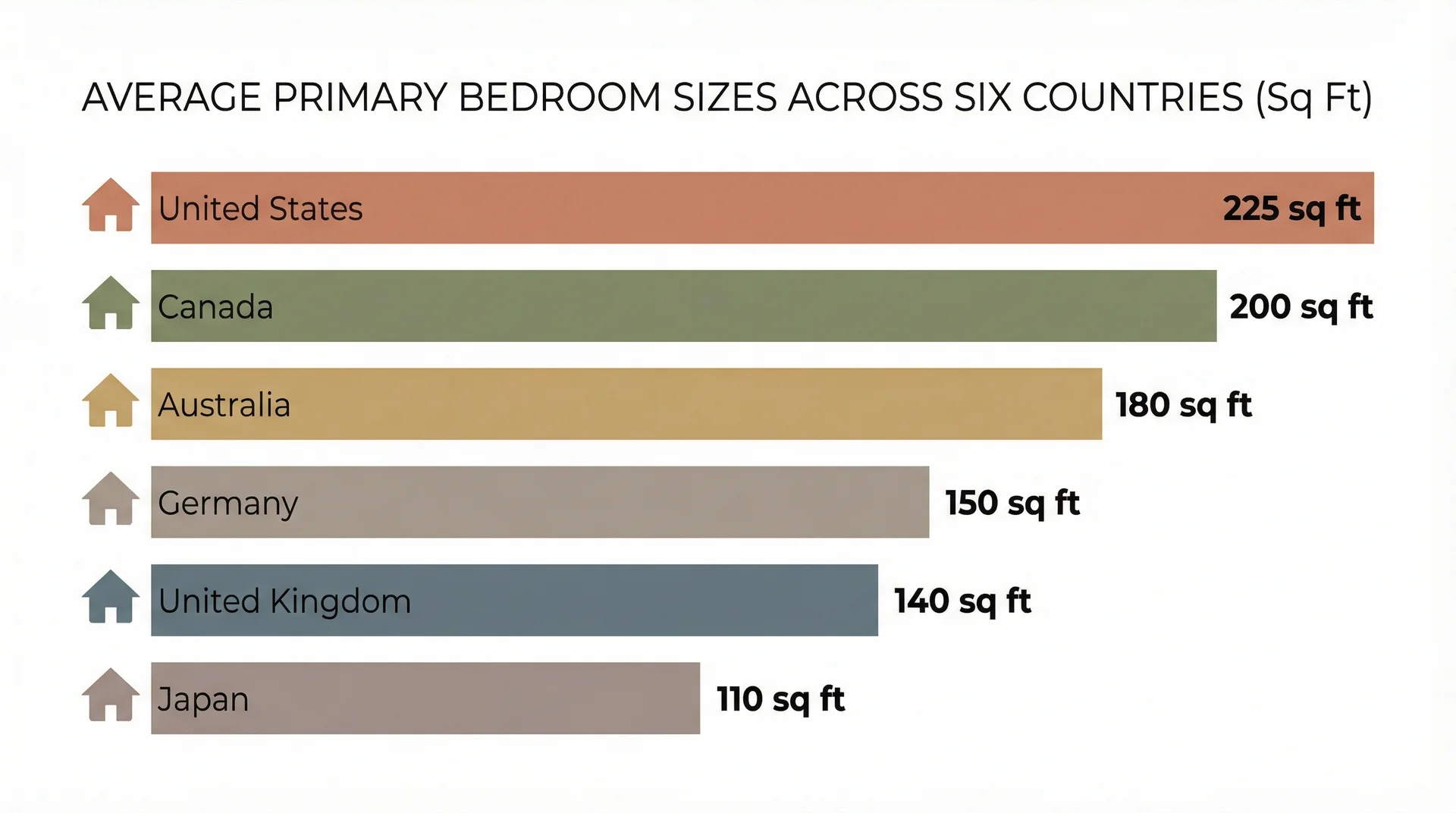
What Americans consider a small master bedroom would be considered generous in many parts of Europe and Asia. Here is a quick comparison from housing reports and residential planning standards across regions:
| Country / Region | Average Primary Bedroom Size |
|---|---|
| United States | 200–250 sq ft |
| Canada | 180–220 sq ft |
| Australia | 160–200 sq ft |
| United Kingdom | 120–160 sq ft |
| Germany | 130–170 sq ft |
| Japan | 90–130 sq ft |
The U.S. sits at the larger end of the global spectrum, which also explains why European “small space” design advice often feels misaligned with American bedroom challenges.
Quick Reference: Master Bedroom Size by Situation
| Your Situation | Recommended Minimum | Ideal Size |
|---|---|---|
| Queen bed only, minimal furniture | 10 × 12 ft (120 sq ft) | 12 × 14 ft (168 sq ft) |
| King bed, nightstands, one dresser | 13 × 14 ft (182 sq ft) | 14 × 16 ft (224 sq ft) |
| King bed, full furniture suite | 14 × 16 ft (224 sq ft) | 16 × 18 ft (288 sq ft) |
| King bed, sitting area, dressing zone | 16 × 18 ft (288 sq ft) | 18 × 20 ft (360 sq ft) |
| Full master suite with all zones | 20 × 22 ft (440 sq ft) | 22 × 24 ft (528 sq ft) |
Frequently Asked Questions
What is the standard size of a master bedroom?
The standard master bedroom in a modern single-family home measures between 14 × 16 feet and 16 × 20 feet, which translates to roughly 224 to 320 square feet. Older homes from pre-1980 construction often run smaller, typically around 12 × 14 feet or 168 square feet.
What is the minimum size for a master bedroom?
The International Residential Code sets the legal minimum at 70 square feet with no dimension shorter than 7 feet. For a comfortable master bedroom that can hold a queen bed with proper clearance, you realistically need at least 120 square feet, and for a king bed, at least 180 square feet.
What is the ideal master bedroom size for a king bed?
A king bed measures 76 × 80 inches. To place it comfortably with adequate clearance on all sides, you need a room that is at least 13 × 16 feet, with 14 × 16 feet being the practical sweet spot for most homeowners.
How big is a master bedroom in a new construction home?
New construction master bedrooms in the U.S. typically range from 14 × 18 feet to 16 × 20 feet, or roughly 252 to 320 square feet, reflecting the broader trend toward larger primary suites in homes built after 2000.
What size rug do I need for a master bedroom?
For a king bed, a rug measuring 9 × 12 feet works well. For a queen bed, an 8 × 10-foot rug is typically sufficient. The rug should extend at least 18 inches beyond the sides and foot of the bed to frame the sleep zone properly.
Does the master bedroom size affect home resale value?
Yes. The primary bedroom consistently ranks among the top features buyers evaluate. A room that cannot comfortably accommodate a king bed with clear walkways often shows up in buyer feedback as a concern, even in otherwise well-regarded homes.
What is the difference between a master bedroom and a primary bedroom?
The terms are largely interchangeable in practical use. “Primary bedroom” has become the preferred term among designers and real estate professionals in recent years. Both refer to the largest bedroom in the home, typically featuring an en-suite bathroom and superior closet space.
Wrapping Up
Square footage gives you a starting point. Your life gives you the real brief.
The master bedroom that works best for you holds everything you need, lets you move freely through your morning routine, and genuinely feels restful when you walk into it at the end of the day.
Measure your furniture before anything else. Sketch your layout on graph paper. Stand in the room and walk through your daily routine from start to finish.
Those three steps will tell you more about whether a master bedroom is the right size for your needs than any number on a spec sheet ever will.
And if the room still feels like it is not quite working, the fix is usually better decisions about what goes inside it, not a search for more square footage.