
I use songwriting exercises to remove decision fatigue and keep my writing consistent. Instead of waiting for inspiration, I rely on short, focused drills that train specific parts of the craft (lyrics, melody, harmony, rhythm, or storytelling). This approach has helped me write more songs with less resistance.
Most writer’s block isn’t a creative problem; it’s a process problem. When I sit down without structure, I overthink. Exercises solve that by giving me a clear constraint and a clear finish line. I’m not trying to write a great song in that moment; I’m trying to complete the exercise. The quality improves as a byproduct.
Everything in this guide is built around that principle. Each exercise is designed to be done quickly, without setup, and without self-editing. I’ve organized them by purpose so you can choose exactly what to work on in a given session, whether that’s lyrics, melody, or creative momentum.
Let’s get started.
How I Use These Songwriting Exercises Effectively
I treat songwriting exercises as practice, not performance. When I sit down to write, my only goal is to complete the exercise, not to finish a song. This single shift removes pressure and keeps me moving forward even on low-energy days.
I keep sessions short. Most exercises in this guide take between 3 and 15 minutes, and I stop when the timer ends even if the idea feels unfinished. Stopping early preserves momentum and prevents burnout. I can always return to strong fragments later.
I also separate creation from evaluation. While doing an exercise, I do not edit lyrics, judge melodies, or rethink choices. Evaluation happens later, usually at the end of the week.
I note which exercises I completed and what ideas surfaced, not whether the output was “good.” Over time, patterns emerge. Strong songs almost always come from consistent reps, not isolated breakthroughs.
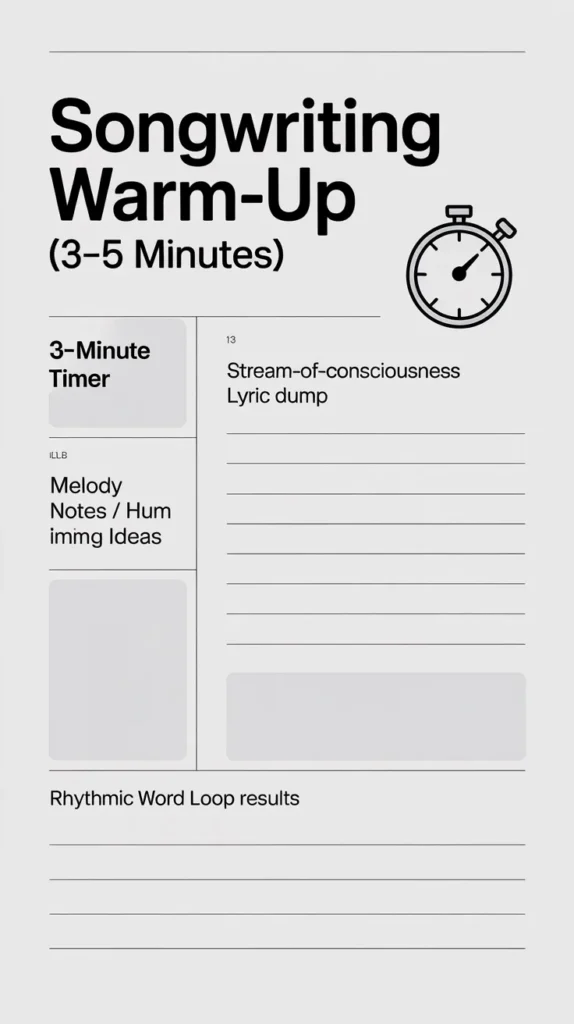
Songwriting Warm-Up Exercises (3–5 Minutes)
Stream-of-Consciousness Lyric Dump
I set a timer for three minutes and write without stopping. I don’t reread, correct, or structure anything. If I run out of ideas, I repeat the last word until something new appears.
This exercise consistently produces unexpected phrases and emotional language I would not reach through deliberate writing. I often highlight one or two lines afterward and discard the rest.
Melody Without Meaning
I play a single chord or loop and sing nonsense syllables for two to three minutes. I avoid real words entirely and focus only on melodic shape and phrasing.
This works because language often limits melody. When meaning is removed, my ear takes over. Many of my strongest hooks started as wordless recordings from this exercise.
Rhythmic Word Loop
I choose one word or short phrase and repeat it rhythmically over a beat. With each repetition, I shift emphasis, spacing, or syllable count.
This sharpens my sense of groove and teaches me how small rhythmic changes can make a lyric feel static or alive. It’s especially useful before writing verses.
These warm-ups are optional but effective. I rarely skip them because they reduce the mental effort required to start writing.
Lyric-Focused Songwriting Exercises
When I want to improve my lyrics, I work on clarity and specificity rather than cleverness. These exercises help me avoid vague language and force stronger imagery, emotion, and intent.
Object-Based Writing Exercise
I pick a random, ordinary object and describe it without naming it. I focus on texture, weight, temperature, and emotional association rather than function.
The constraint prevents abstraction. By the end, I usually have lines that work as metaphors without trying to be poetic on purpose. This is one of the fastest ways I know to generate non-generic lyrics.
Five-Senses Drill
I choose a specific moment and write one line for each sense: sight, sound, smell, touch, and taste. I do not explain the emotion directly. I let the details carry it.
This exercise exposes weak writing immediately. If a line relies on emotion words instead of sensory detail, it doesn’t survive this drill. The result is usually tighter, more grounded imagery.
Emotional Rewrite Exercise
I take a neutral lyric and rewrite it from a different emotional stance (anger, regret, relief, or indifference) without changing the situation itself.
This shows me how emotion alters word choice, pacing, and imagery. It’s especially useful when a lyric feels flat but the idea is strong.
Melody & Harmony Songwriting Exercises
When my songs feel lyrically strong but musically predictable, I shift focus to melody and harmony. These exercises introduce constraints that force me to make deliberate musical choices instead of defaulting to habit.
One-Chord Melody Challenge
I loop a single chord and write as many melodic phrases as possible over it. I limit myself to short phrases and record everything without judging it.
The lack of harmonic movement exposes weak melodies immediately. If a melody works over one chord, it usually holds up when harmony is added later.
Chord Progression Flip
I start with a familiar chord progression and change one expectation—reorder the chords, replace one chord with an unexpected substitute, or extend a chord longer than feels comfortable.
This breaks muscle memory. Instead of writing what my hands already know, I’m forced to listen and respond. It often leads to progressions that feel familiar but not generic.
Scale-Limited Melody Writing
I restrict myself to three to five notes from a scale and write a complete melodic idea using only those notes.
This constraint improves phrasing and contour. With fewer options, every note choice matters, and the melody becomes more intentional rather than decorative.
Timed Songwriting Workouts
Timed workouts are how I maintain output when motivation is low. A fixed time limit removes indecision and forces commitment. I treat the timer as non-negotiable and stop when it ends.
The 10-Minute Songwriting Workout
I break ten minutes into clear stages:
- Minutes 1–2: Free-write lyrics without structure
- Minutes 3–5: Highlight one strong line and rewrite it three ways
- Minutes 6–8: Create a melody for the best version
- Minutes 9–10: Record a rough voice note
This workout consistently produces usable fragments. Even when nothing feels complete, I almost always leave with a line or melodic idea worth saving.
The 15-Minute Daily Songwriting Routine
This is my default routine when I write every day:
- 5 minutes: Warm-up (any exercise from earlier sections)
- 7 minutes: One focused drill (lyrics, melody, or harmony)
- 3 minutes: Notes on what worked and what didn’t
The reflection matters. Over time, it reveals which exercises produce the strongest material for me personally.
Genre & Style Challenge Exercises
When my writing starts feeling comfortable, I introduce style-based constraints. These exercises force adaptation without imitation and help me understand why certain genres and artists work the way they do.
Genre Translation Exercise
I write a short verse or chorus in one genre, then rewrite the same idea in a different genre. The lyrics stay conceptually the same, but rhythm, phrasing, and imagery change to match the new style.
This exposes genre mechanics quickly. I learn which elements are structural and which are flexible, and I often discover versions that feel more natural than the original.
Artist-Style Constraint Exercise
I choose an artist and study one narrow aspect of their work—song length, verse structure, lyrical density, or melodic range. I then write a song using only that constraint, not their melodies or lyrics.
This keeps the exercise ethical and productive. I’m borrowing frameworks, not content. It improves versatility and prevents stylistic stagnation.
I use these challenges sparingly, usually after several days of standard exercises. They are most effective when I already have momentum and want to stretch beyond my defaults.
Songwriting Prompt Bank
I use prompts when I want to bypass taste and judgment completely. A good prompt removes choice and forces motion. I don’t evaluate whether a prompt feels “inspiring” before starting—I start, then let the writing decide.
I group prompts by function rather than theme. This makes it easier to pick one based on what I need in a session.
Emotional Prompts
Use these when the writing feels emotionally flat or distant.
- Write about relief that arrives too late
- Write about wanting something you would never admit out loud
- Write about guilt without explaining the cause
- Write from the moment after an argument ends
- Write about calm that feels suspicious
- Write about missing someone you chose to leave
- Write about being proud of something no one noticed
- Write about resentment disguised as politeness
Situational Prompts
Use these to generate narrative movement.
- A conversation that never happened but should have
- The last five minutes before leaving a place for good
- Hearing news secondhand that should have come directly
- Waiting for someone who said they’d be late
- Realizing you misread the entire situation
- Running into someone at the wrong time
- Being told the truth casually
- Standing in a place that no longer feels familiar
Object-Based Prompts
I use objects to avoid abstraction and force specificity.
- A cracked phone screen
- A locked door you don’t have the key to
- An old receipt
- A watch that stopped working
- A half-empty glass
- Shoes by the door that aren’t yours
- A light left on overnight
- A bag you forgot to unpack
First-Line Prompts
I treat these as non-negotiable opening lines.
- “We were almost honest that night”
- “It didn’t feel like leaving until it did”
- “You said it casually, which made it worse”
- “I heard the truth from someone else”
- “The quiet wasn’t peaceful anymore”
- “I stayed longer than I should have”
- “Nothing was wrong until it was”
- “I didn’t recognize the version of me that stayed”
Conceptual Prompts
These work best when I want something less literal.
- Write about time as a physical location
- Write about memory as weight
- Write about distance without mentioning space
- Write about repetition without using the word “again”
- Write about waiting without referencing time
- Write about silence as communication
- Write about certainty as a mistake
Constraint-Based Prompt Variations
When a prompt feels too open, I add one constraint:
- No adjectives
- Maximum six lines
- Only one vowel
- No past tense
- Each line must begin with the same word
Constraints prevent drifting and usually improve focus.
I rarely use prompts to finish songs. I use them to generate raw material. Later, during review, I extract what feels honest or unexpected and discard the rest without hesitation.
How I Track Progress Using Songwriting Exercises
I track progress to identify patterns, not to measure quality. Most useful insights come from volume and repetition, not from judging individual outputs.
After each session, I note three things:
- Which exercise I did
- What type of material emerged (lyrics, melody, concept)
- One line or idea worth revisiting, if any
Once a week, I do a short review. I scan everything I created and highlight fragments that still hold attention after time has passed. Those fragments become starting points for full songs. If nothing stands out, I move on without forcing it.
Over time, this process reveals which exercises reliably produce usable material for me. Some drills are good for momentum, others for depth. Tracking makes that difference visible.
Progress in songwriting is rarely linear. What improves first is decision-making speed, not output quality. These exercises accelerate that shift by reducing hesitation and increasing volume.
Tools that Enhance My Songwriting Exercises
I use tools to remove friction, not to complicate the process. The best tools are fast, familiar, and easy to abandon mid-idea. Anything that slows capture kills momentum. Below are the tools I consistently rely on, with specific use cases.
Voice Recording Apps (Non-Negotiable)
Most melodic ideas disappear if they aren’t captured immediately. I record everything, even fragments.
- Voice Memos (iOS): Simple, instant, zero setup. My default for melody-first writing.
- Easy Voice Recorder (Android): Reliable and lightweight for quick capture.
How I use them: I name recordings by date and exercise type, not by “song title.” This keeps things objective.
DAWs for Loop-Based Writing
I only open a DAW when I want structure or repetition.
- Ableton Live: Ideal for loop-based exercises, rhythmic ideas, and fast arrangement sketches.
- GarageBand: Useful for quick demos without technical overhead.
How I use them: I create one-track sessions for exercises to avoid overproducing too early.
Timers (Underrated but Critical)
Time limits keep exercises from turning into unfocused sessions.
- Google Timer: Fastest option. No app needed.
- Forest App: Helpful when distractions are an issue.
How I use them: Timer starts before I decide what to write. Decision-making happens inside the time block.
Writing & Note-Taking Tools
Lyrics don’t need formatting. They need speed.
- Google Docs: Searchable, accessible everywhere, good for dumping raw text.
- Notion: Useful for organizing exercises, prompts, and weekly reviews.
How I use them: One document per week. No folders by “song.” Organization happens later.
Prompt & Constraint Generators (Optional)
I only use these when choice paralysis sets in.
- Random Word Generator: Good for object-based and metaphor exercises.
- Oblique Strategies: Useful for breaking creative habits through abstract constraints.
Tools should disappear once the exercise starts. If I notice myself tweaking settings instead of writing, I remove the tool from the process.
What Working Songwriters Actually Do
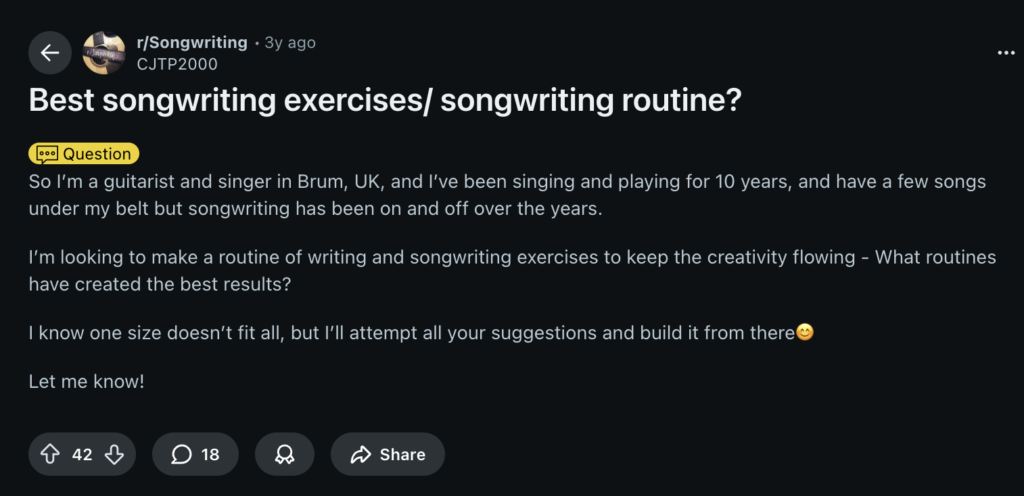
Across different styles and experience levels, effective songwriting routines follow the same principles. Read what people said about songwriting exercises in this Reddit thread.
They separate creative phases. Idea generation, drafting, editing, and recording are treated as distinct modes. Most blocks happen when writers try to do all of them at once.
They use free writing regularly. Timed, stream-of-consciousness writing appears consistently. The goal is flow, not quality. Meaning is shaped later.
They rely on constraints instead of inspiration. Limits (keys, chord functions, genre shifts, structural contrast) reduce decision fatigue and expand musical vocabulary.
They treat learning songs as songwriting practice. Revoicing, reharmonizing, and studying existing songs increases speed and fluency when writing original material.
They finish songs, even imperfect ones. Completion builds momentum. Placeholder lyrics and rough demos are normal. Distance improves judgment more than over-editing.
They record everything and review selectively. Ideas are captured quickly and evaluated later. Only what holds up over time gets developed.
They build availability into daily life. Regular input (listening, observing, reading) supports output. Creativity responds to attention, not pressure.
Common Mistakes to Avoid When Doing Songwriting Exercises
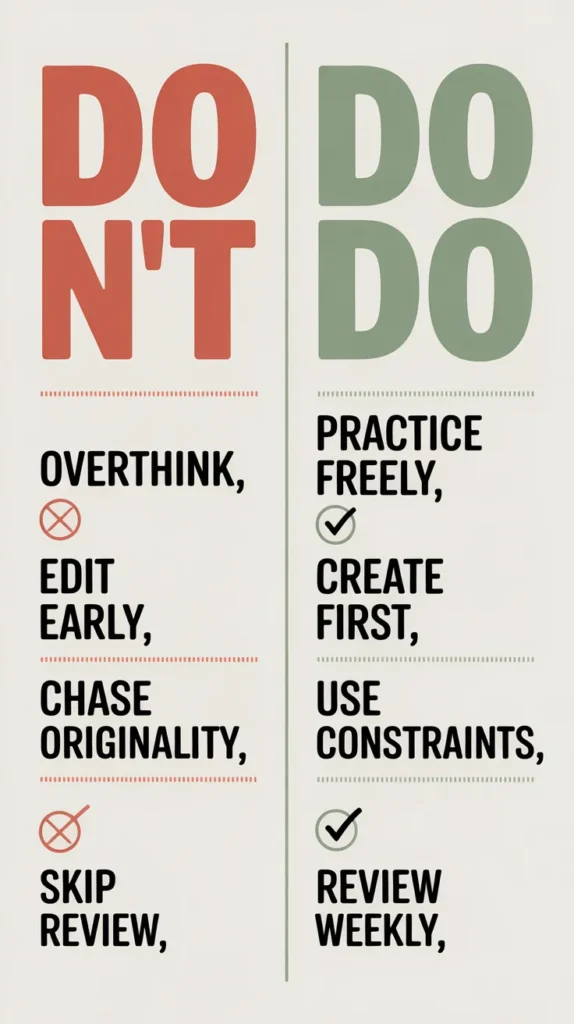
Most songwriting exercises fail not because the exercise is bad, but because of how it’s used. These are the mistakes I actively avoid to keep the practice productive.
- Treating Exercises Like Finished Songs: If I start evaluating an exercise as if it needs to become a complete song, I slow down and second-guess every decision. Exercises are inputs. Their value is in volume and exploration, not polish. When something shows potential, I mark it and move on. Finishing comes later, in a different mindset.
- Editing While Creating: Editing during an exercise kills momentum. Even small corrections break flow. I don’t fix lines, change chords, or rerecord takes while the timer is running. I only allow edits during review sessions. Separating these phases keeps output high and judgment low.
- Overusing the Same Exercise: Repeating one favorite exercise too often leads to repetitive results. I rotate drills intentionally, even if some feel uncomfortable. Discomfort is usually a signal that I’m learning something new.
- Chasing Originality Too Early: Trying to be “unique” during practice creates unnecessary pressure. Originality emerges through repetition, not intention. I focus on clarity and completion. Style takes care of itself over time.
- Skipping Review Entirely: Never reviewing exercises means good ideas get buried. I don’t review everything, but I do review consistently. A short weekly scan is enough to surface usable material.
Avoiding these mistakes keeps songwriting exercises lightweight and sustainable. The goal is momentum, not perfection.
Turning Exercises into Finished Songs
Songwriting exercises are not the work itself; they are the preparation for it. I don’t expect them to produce complete songs on demand.
I expect them to produce material (lines, melodies, structures, emotional angles) that I can return to with intention.
When I decide to turn an exercise into a song, I switch modes. I stop generating and start selecting.
I look for fragments that still feel honest after time has passed. If an idea survives distance, it’s worth developing. If it doesn’t, I let it go without regret.
The biggest shift these exercises create is reliability. I’m no longer dependent on mood, motivation, or inspiration to write.
I have a system that works even on unremarkable days. Over time, that consistency compounds into better judgment, faster decisions, and stronger songs.