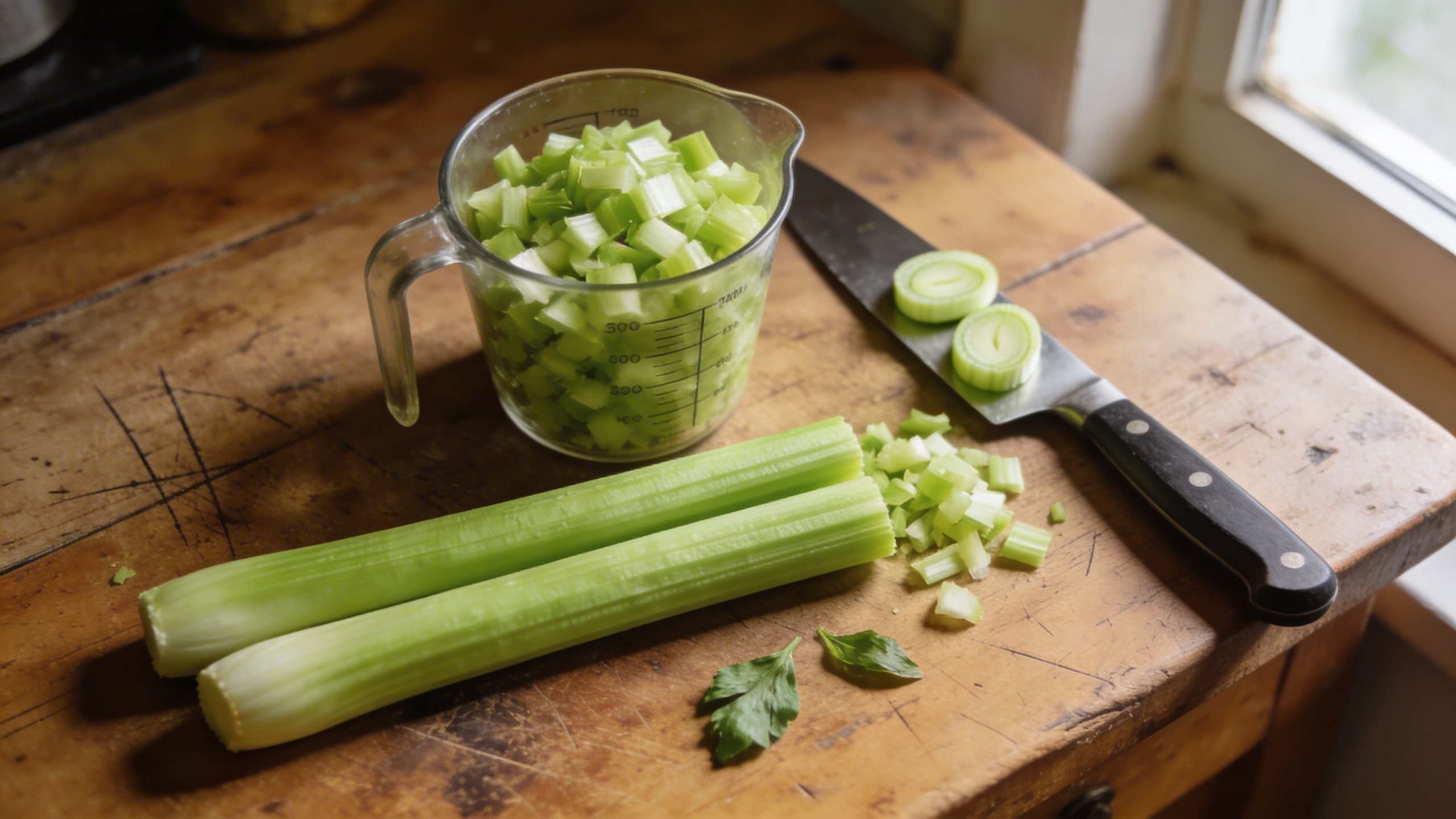
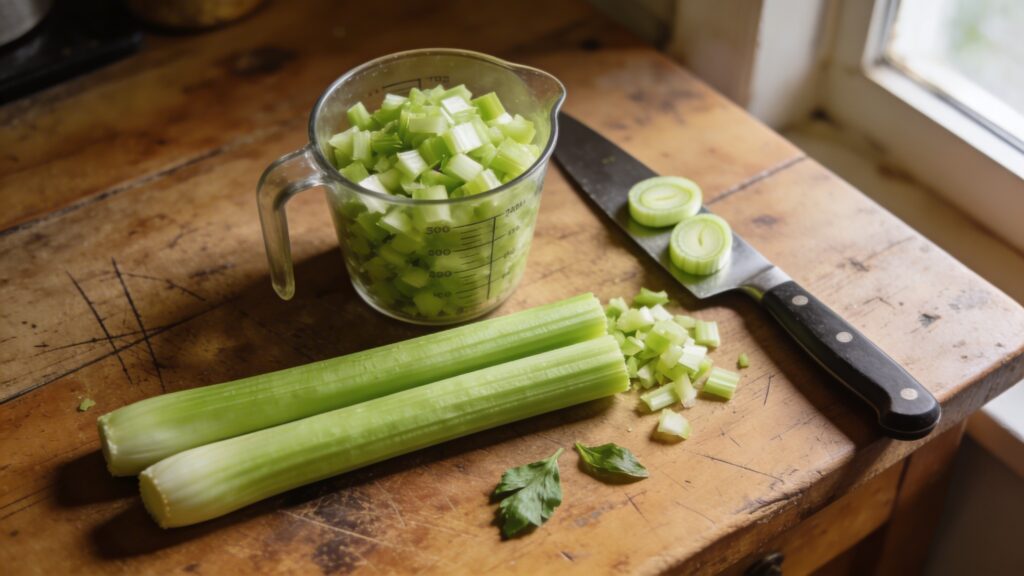
You are standing in your kitchen with a recipe open in front of you, and it calls for one cup of chopped celery.
You look at the bunch sitting on your counter, and you genuinely have no idea how many stalks to grab.
After over a decade of working in professional kitchens and developing recipes for home cooks, I can tell you that celery is one of those ingredients where the conversion actually matters.
Get it wrong, and you either overwhelm a dish or leave it tasting flat.
How Many Stalks of Celery Do You Actually Need?
If Your Recipe Says 1 Cup of Chopped or Sliced Celery
Two medium stalks will get you to one cup reliably.
A medium stalk runs about 7.5 to 8 inches long and weighs roughly 40 grams, according to USDA FoodData Central.
When you chop it into half-inch pieces or slice it into thin half-moons, you get approximately half a cup per stalk.
| What You Need | How Many Stalks |
|---|---|
| ½ cup chopped or sliced | 1 medium stalk |
| 1 cup chopped or sliced | 2 medium stalks |
| 1 cup finely minced | 3 medium stalks |
| 2 cups chopped | 4 medium stalks |
| Full bunch yield | 4 to 4.5 cups chopped |
If Your Recipe Says 1 Cup of Finely Minced Celery
Minced celery packs denser into a measuring cup than you expect, but you actually need more stalks to get there.
When you mince celery very finely, the pieces settle tightly and fill less visual space per gram than a rough chop. I discovered this while developing a celery-based stuffing recipe.
I kept coming up short on volume after mincing everything down because the finely cut pieces had released some moisture and compacted into the cup more densely than I anticipated.
Three medium stalks of celery for one cup of finely minced celery is the reliable number from my repeated testing.
How Many Cups in a Full Bunch of Celery
A standard bunch from the grocery store contains 8 to 9 stalks and weighs close to one pound or 453 grams.
That whole bunch will yield approximately 4 to 4.5 cups of chopped celery once you trim the ends and remove any damaged outer stalks.
If a recipe calls for 2 cups of chopped celery, you are using roughly half a bunch.
Celery Hearts vs a Full Bunch: Why the Count Changes
Many grocery stores sell both full bunches and celery hearts.
Hearts are the pale, tender inner stalks sold pre-trimmed, with the tough outer stalks removed.
Because heart stalks are shorter and narrower than outer stalks, you will need 3 to 4 heart stalks to reach 1 cup chopped, rather than the standard 2.
If your recipe calls for celery and your store only has hearts, adjust your stalk count upward by one to two stalks.
Why the Celery Cut Type Changes Everything
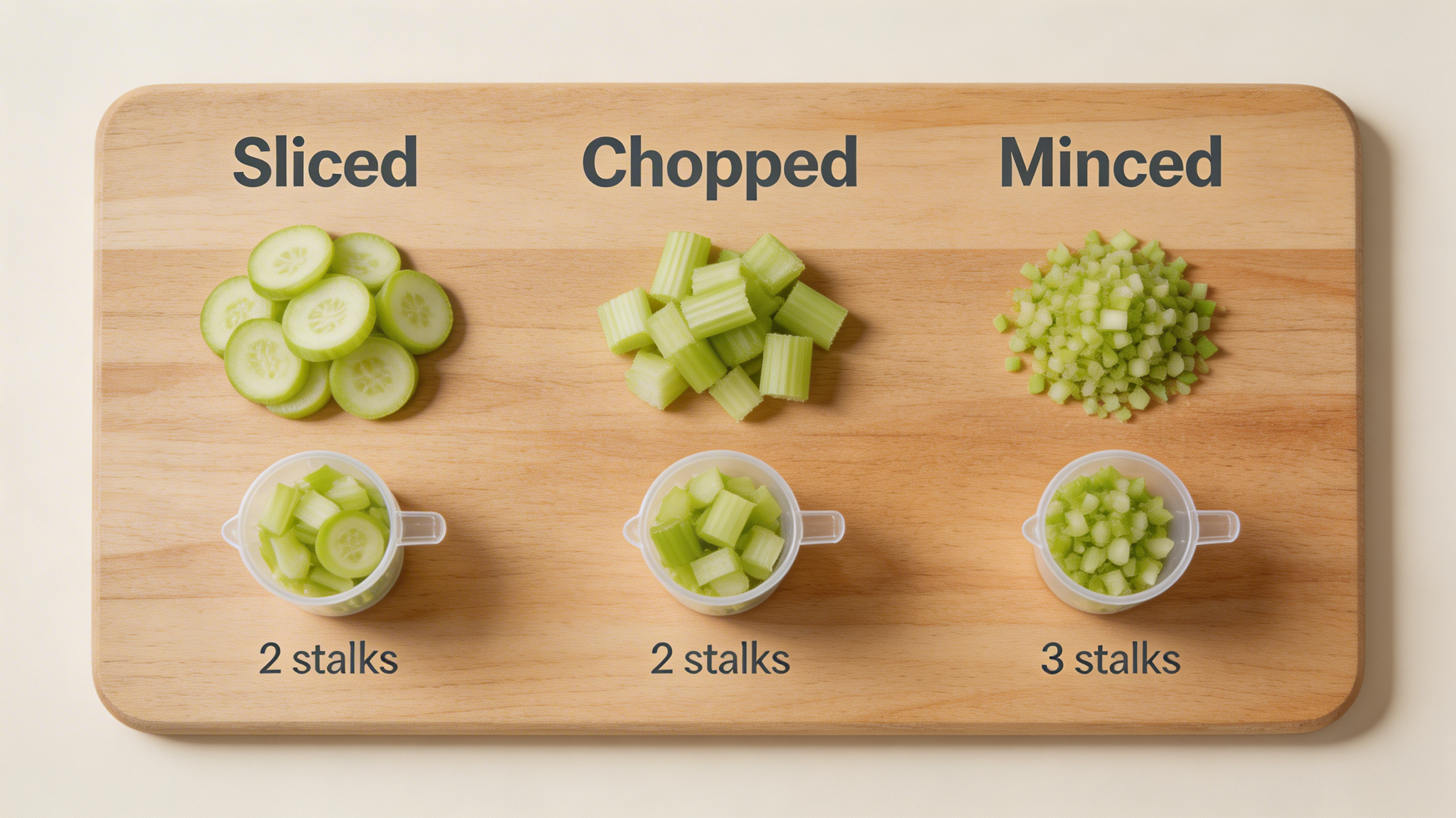
1. Chopped vs. Sliced
When you slice celery into thin rounds or half-moons, the pieces are uniform and stack against each other with small gaps between them.
When you chop it into irregular pieces, you get more surface variation and slightly more air pockets in the cup.
Sliced and chopped celery yield roughly the same cup measurement, but the texture and how they behave in a dish differ. For soup or stew, either works. For a salad where texture matters, slicing gives a cleaner bite.
I always slice for salads and chop for cooked dishes, where the celery softens down anyway.
2. Minced Celery
When you mince celery, you are breaking the cell walls much more aggressively.
The pieces release a little moisture as you cut, and they compact differently in a measuring cup. You get more flavor per bite, but less volume per stalk in terms of measurement.
That is why three stalks for one cup is the right number when mincing, while two stalks cover a rough chop or slice.
3. Cooked Celery Loses Volume
This is something most recipes do not account for clearly.
Celery loses roughly 35 to 40% of its raw volume when cooked, because heat drives out moisture and the cell walls collapse.
In practical terms, 1 cup of raw chopped celery reduces to about two-thirds of a cup after 20 minutes of simmering.
If a recipe specifies a coo, ked volume for example, “1 cup cooked celery,” start with approximately 1.5 to 1.75 cups raw to hit that target after cooking.
The Size of the Stalk Matters Too
| Stalk Size | Approximate Length | Approximate Weight |
|---|---|---|
| Large | 11 to 12 inches | ~64 grams |
| Medium | 7.5 to 8 inches | ~40 grams |
| Small | About 5 inches | ~17 grams |
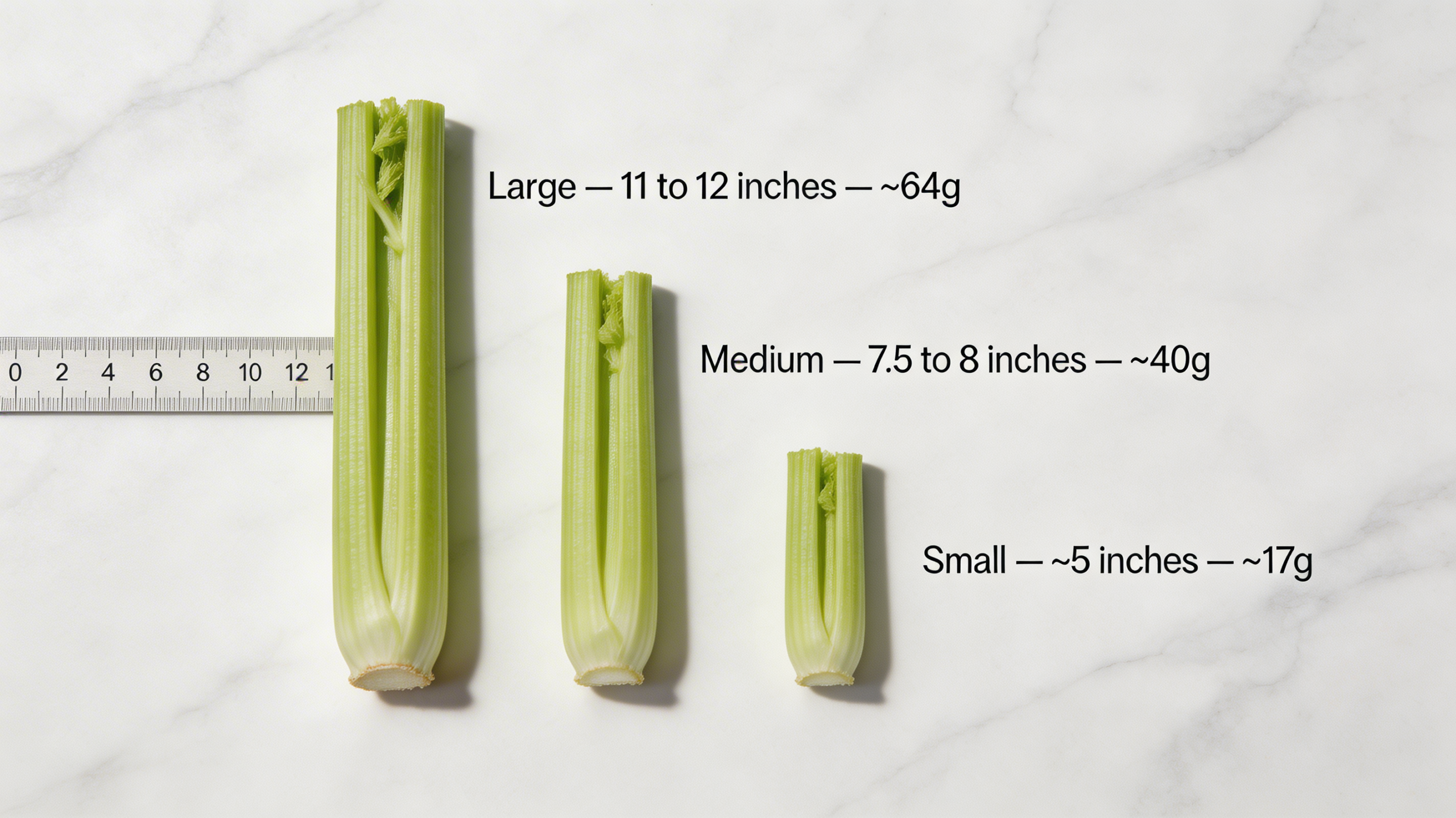
If your bunch has a lot of small inner stalks, you may need an extra one to hit your cup mark. The inner pale stalks are sweeter and more tender.
I use them raw, in salads, but they are shorter and yield less volume per stalk.
Buying the Right Amount of Celery at the Grocery Store
Should You Buy a Full Bunch or Individual Stalks?
Most grocery stores sell celery by the bunch, and a full bunch gives you far more than one recipe typically calls for. If your recipe needs one cup of chopped celery, you are only using a quarter of that bunch.
My honest advice is to always buy the full bunch and plan for the rest. Celery keeps well in the refrigerator when stored properly, and you will find yourself reaching for it more often once it is already prepped and sitting in your fridge.
Some stores sell individual stalks by weight, and that option makes sense if you genuinely only need one or two stalks.
In my experience, loose stalks are often the outer stalks separated from an older bunch; the older bunch, the whole bunch is usually the better buy.
How Far Does One Bunch Actually Go?
- Chicken noodle soup (4 servings): usually 2 to 3 stalks, about 1 to 1.5 cups chopped
- Mirepoix base (onion, carrot, celery): typically 2 stalks, about 1 cup
- Tuna or chicken salad (4 servings): usually 1 to 2 stalks, about half a cup to 1 cup
- Stocks and broths: often the whole bunch, leaves included
One bunch comfortably covers two to three of these recipes before you run out.
What to Do When the Recipe Calls for Just 1 or 2 Stalks
Pull from the outer stalks for cooked applications and save the sweeter inner stalks for raw eating or salads.
The outer stalks have a more pronounced, slightly bitter celery flavor that holds up through heat, while the inner stalks are gentler and more pleasant eaten raw.
Quick Weight Reference for Precise Cooks
| Measurement | Approximate Weight |
|---|---|
| 1 large stalk | ~64 g / 2.3 oz |
| 1 medium stalk | ~40 g / 1.4 oz |
| 1 small stalk | ~17 g / 0.6 oz |
| 1 cup chopped celery | ~101 g / 3.6 oz |
| 1 tablespoon minced celery | ~7.5 g |
| 1 whole bunch (8–9 stalks) | ~453 g / 1 lb |
One cup of chopped celery weighs approximately 101 grams (source: USDA FoodData Central). Use this number when scaling a recipe up or calculating nutrition information.
Dried Celery Flake Conversion
If a recipe calls for fresh celery and you only have dried celery flakes, use a 10:1 ratio as a starting point. One cup of fresh chopped celery equals approximately 3 tablespoons of dried flakes.
Because dried celery has a more concentrated flavor, many cooks use only 2 tablespoons and adjust from there.
Rehydrate dried flakes by covering them in water for about 5 minutes, then drain before using in cooked dishes.
Celery Juice Conversion
For juicing, 4 to 5 medium stalks produce approximately 1 cup of pure celery juice.
A full bunch of 8 to 9 stalks will yield just over 1 cup of juice.
Yield varies slightly depending on the juicer and how fresh the celery is; older stalks that have lost moisture will yield less.
A Note on Celeriac
Celeriac is the bulbous root variety of the celery plant and measures completely differently.
One cup of celeriac weighs approximately 156 grams, significantly heavier than an equal volume of chopped stalks.
The two are not interchangeable in most recipes.
How to Prep Celery So Your Measurements Are Always Accurate
Washing Celery Properly
Celery has no protective skin, so it absorbs whatever it comes into contact with from the soil and from handling.
Rinse each stalk under cold running water and run your fingers along the surface, especially in the curved inner side where dirt settles.
For farmers’ market celery, soak the stalks in a bowl of cold water for a few minutes before rinsing.
Dry the stalks with a clean towel before cutting wet celery slips on the cutting board, as it leads to less consistent cuts, which affects your measurements more than you might expect.
De-Stringing: Do It Strategically, Not Aggressively
Use a vegetable peeler to remove the most prominent fibrous strings from the outer convex edge of each stalk before measuring or chopping. Over-peeling wastes edible mass. Remove only the visible strings running along the outside, not the entire surface. This step also gives you cleaner, more consistent pieces when measuring by cup.
The Three Cuts Home Cooks Use Most
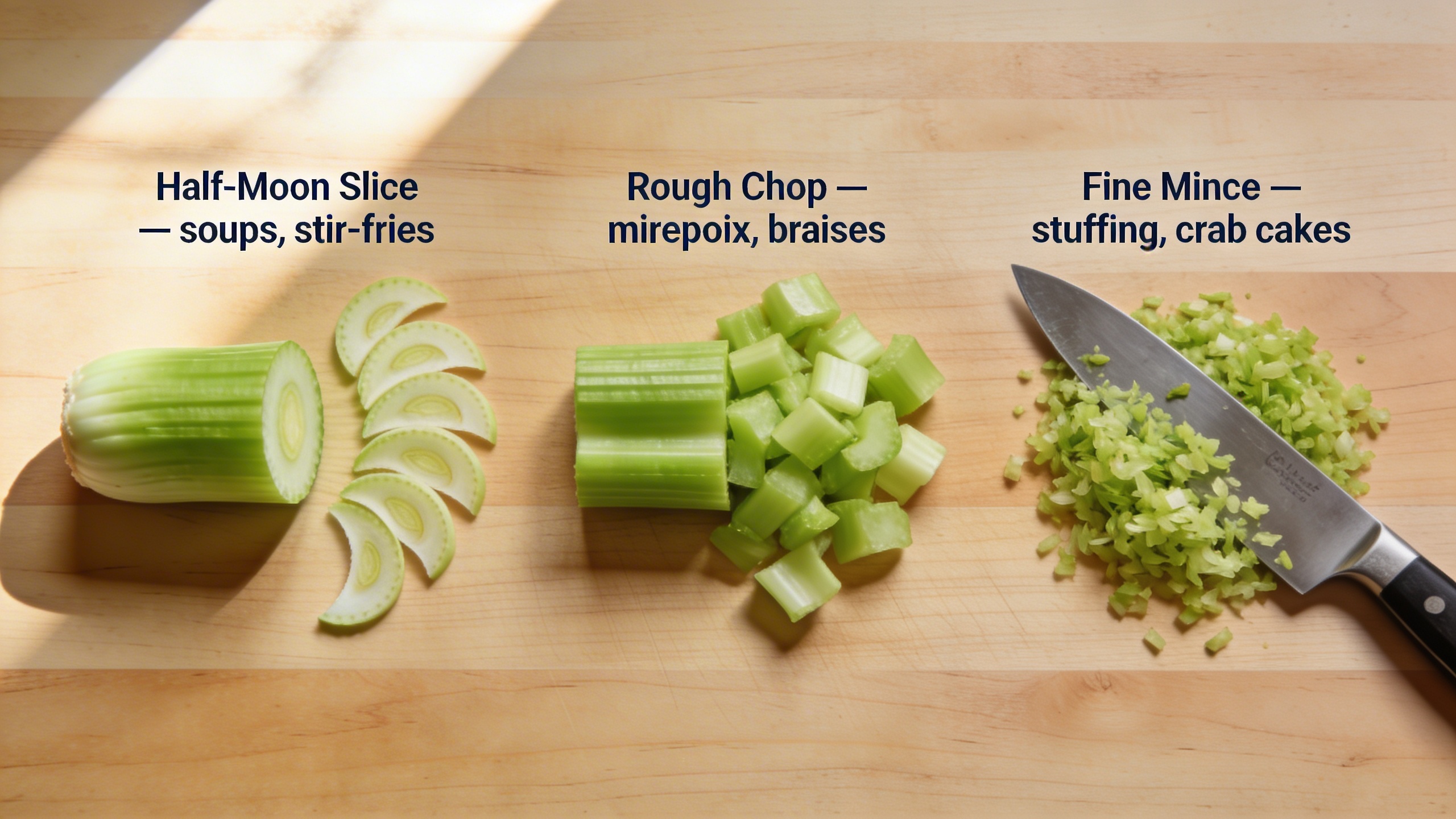
The half-moon slice is the most common cut for soups, stews, and stir-fries. Cut the stalk crosswise into pieces about a quarter to half an inch thick. This cut releases the most flavor surface area and softens evenly in liquid.
The rough chop gives you irregular, chunky pieces roughly half an inch to an inch in size. Use this for slow-cooked dishes, braises, and mirepoix, where the celery cooks down and releases its flavor into the liquid.
The fine mince reduces celery to very small, even pieces, usually an eighth of an inch or smaller. Use this for stuffings, meatloaves, crab cakes, and anywhere you want celery flavor without visible chunks.
A Trick for Faster & More Consistent Prep
| Stack three or four stalks side by side on your cutting board and press them flat together. Trim the top and bottom in one single cut, then slice or chop through all of them at once. You cut your prep time down significantly, and the pieces are more consistent because the stalks support each other. Consistent piece size means more predictable cup measurements every time. |
Storing Celery After Prepping
Pre-cut celery dries out faster than whole stalks. Place your cut pieces in an airtight container, cover with cold water, seal, and refrigerate.
Change the water every day or two. Cut celery stored this way stays crisp for four to five days, ideal for meal prep.
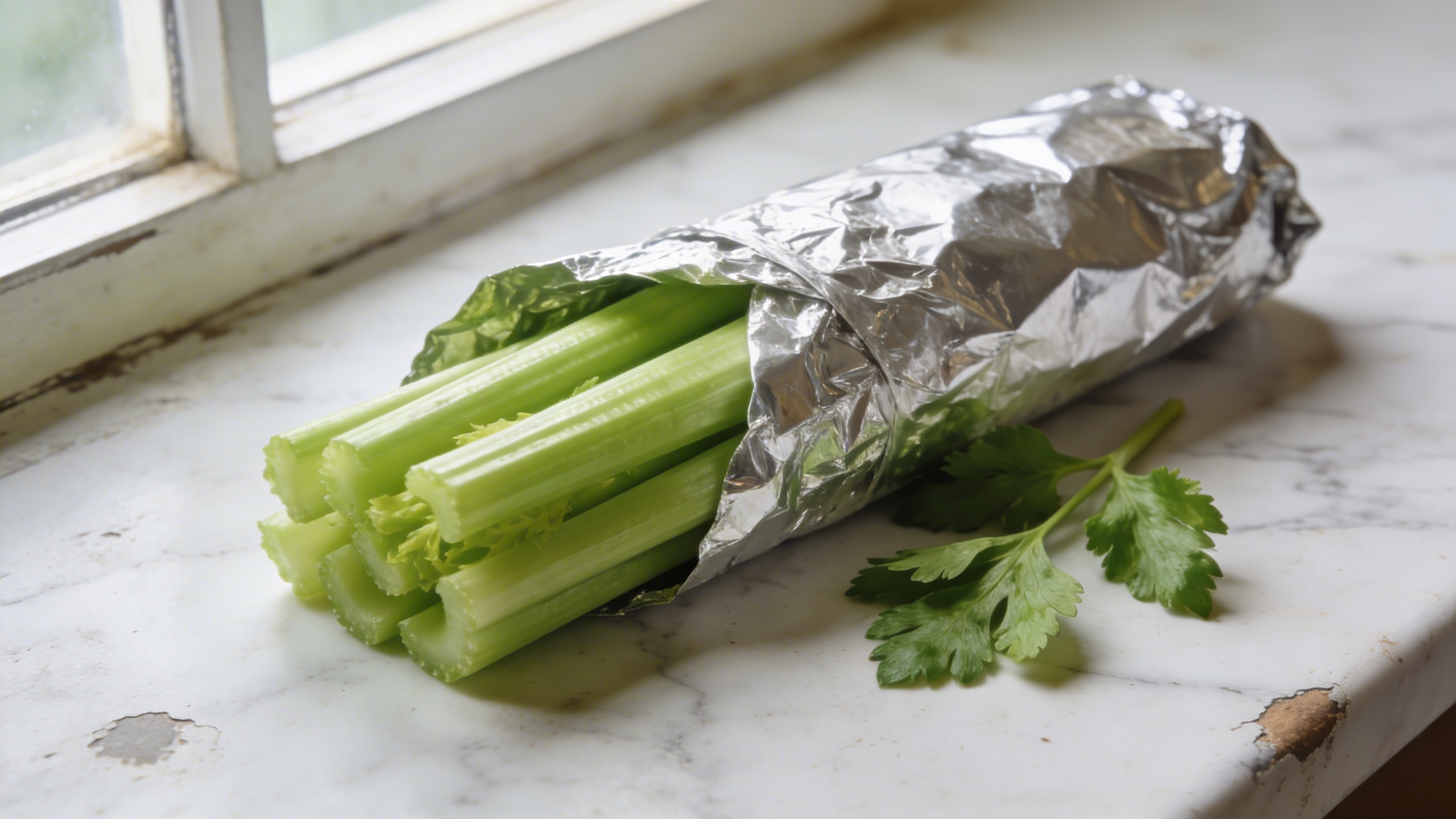
For storing a full bunch, the foil wrapping method keeps celery crisp for 2 to 4 weeks. See our full celery storage guide for step-by-step instructions on every method.
The Celery Leaves: Do Not Throw Them Away
The leaves at the top of celery stalks carry an intense, concentrated flavor that is more aromatic and herbal than the stalk itself.
In professional kitchens, we treat celery leaves almost like fresh herbs.
Scatter them over a finished soup the way you would use parsley, fold them into grain salads, or add them to a stock pot.
If you have more leaves than you can use, dry them in a low oven for about an hour and store them in a jar as a dried herb. They keep for months.
Smart Swaps When You Do Not Have Enough Celery
For crunch and freshness in raw applications:
- Cucumber (milder, higher water content)
- Fennel stalks (similar crunch with a slightly anise note)
- Sliced green apple (works well in salads and slaws)
For cooked dishes where celery adds background flavor:
- Leeks (sweeter, similar aromatic quality)
- Fennel bulb (excellent in soups and braises)
- Cooked cabbage (works in long-cooked dishes where texture is secondary)
Celery seed as a flavour substitute: If you have no fresh celery at all, celery seed from the spice aisle adds celery flavor to soups, stocks, and braised dishes without any prep.
Use about half a teaspoon of celery seed to approximate the flavor of one stalk in a cooked dish. It will not add texture, but it preserves the aromatic depth.
What Celery Actually Gives You Nutritionally
| Nutrient | Amount Per Cup (101g) |
|---|---|
| Calories | 14 kcal |
| Carbohydrates | 3 g |
| Dietary Fiber | 1.6 g |
| Natural Sugar | 1.4 g |
| Protein | 0.7 g |
| Potassium | 263 mg (6% DV) |
| Calcium | 40 mg (3% DV) |
Celery is about 95% water, which explains the extremely low calorie count. You are adding volume, crunch, and flavor to a dish for almost zero caloric cost.
Celery functions as a flavor amplifier rather than a starring ingredient.
Its potassium content supports the way we perceive saltiness in a dish, which means adding celery to soups and stocks can reduce how much added salt you need to make a dish taste full and rounded.
I consider this actively when developing lower-sodium recipes; it is one of the reasons celery appears in so many traditional cuisines across Europe and Asia.
Celery in Soups, Stocks, and Stews
In French culinary tradition, the combination of onion, carrot, and celery is called mirepoix, and it forms the flavor base for countless soups, sauces, and braises.
Celery contributes what chefs call “background flavor, undertone flavor”, a savory, slightly bitter, aromatic note that makes other ingredients taste more fully like themselves without announcing its own presence.
Two stalks in a chicken stock elevate the entire batch, and the dish will taste noticeably more complete.
The Full Celery Conversion Cheat Sheet
| Measurement | Stalks Needed | Weight |
|---|---|---|
| ½ cup chopped or sliced | 1 medium stalk | ~50 g |
| 1 cup chopped or sliced | 2 medium stalks | ~101 g |
| 1 cup finely minced | 3 medium stalks | ~101 g |
| 2 cups chopped | 4 medium stalks | ~200 g |
| 1 tablespoon minced | Less than ½ stalk | ~7.5 g |
| Full bunch yield | 8 to 9 stalks | ~453 g / 4 to 4.5 cups |
| 1 cup celery hearts (chopped) | 3 to 4 heart stalks | ~101 g |
| 1 cup cooked (start raw with) | ~3 medium stalks raw | ~150–160 g raw |
| 1 cup celery juice | 4 to 5 medium stalks | ~200–225 g |
| 1 cup fresh = dried flakes | 3 tablespoons dried flakes | N/A |
A few reminders worth keeping with this table:
- Large stalks (11 to 12 inches) yield more per stalk; you may need one fewer
- Small inner stalks yield less; you may need one more
- Finely minced celery always needs an extra stalk compared to a rough chop
- Celery hearts require more stalks per cup than full-bunch outer stalks
- Cooked celery shrinks by 35 to 40% account for this when a recipe specifies a cooked volume