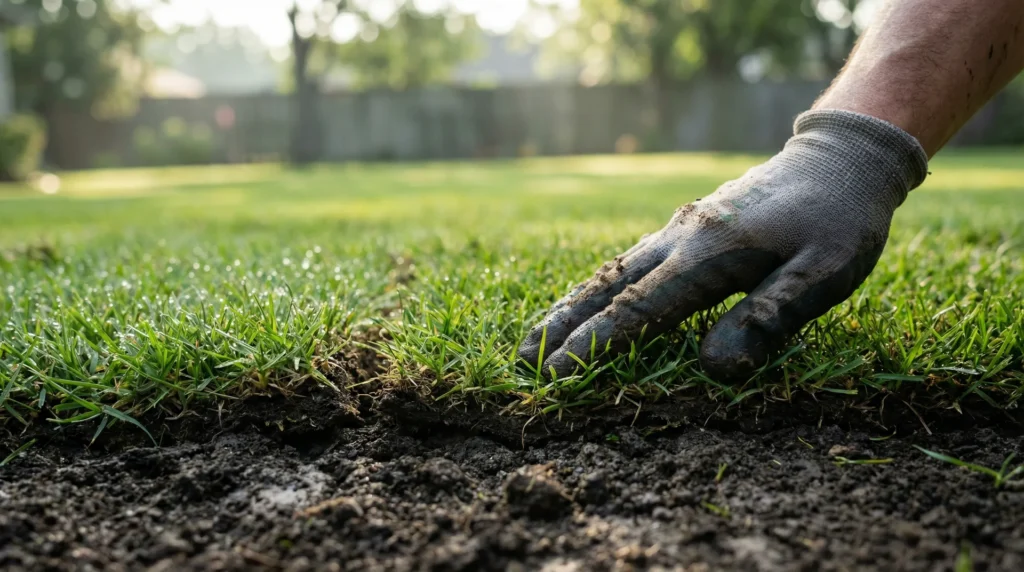
The first sod installation I oversaw in early June nearly failed by day five. We had rolled out 800 square feet of Kentucky Bluegrass across a sloped suburban yard, and the edges started curling on day three.
By day five, brown patches spread from the corners inward. The sod was dying, and the reason was straightforward: we had underwatered it during the most critical window of its life.
That experience taught me more about new sod care than any textbook ever did. Since then, I have guided dozens of homeowners through the same anxiety-filled first weeks, and the question I hear most is always the same: how often should I water new sod?
So here is the direct answer before anything else:
Water the new sod 2 to 3 times daily for the first week, keeping the top 2 inches of soil consistently moist. Reduce to once daily in weeks 2 and 3, then shift to deep watering every 2 to 3 days from week 4 onward. Target roughly 1 inch of water per day in week 1, tapering to 1 to 1.5 inches per week once roots establish. |
Everything below builds on that answer, because the real challenge is knowing why it works, when to adjust it, and what your sod signals when things go sideways.
What Sod Goes Through the Moment It Leaves the Farm
Most people treat sod like carpet: roll it out and walk away. However, sod is a living plant that has just experienced one of the most stressful events of its life.
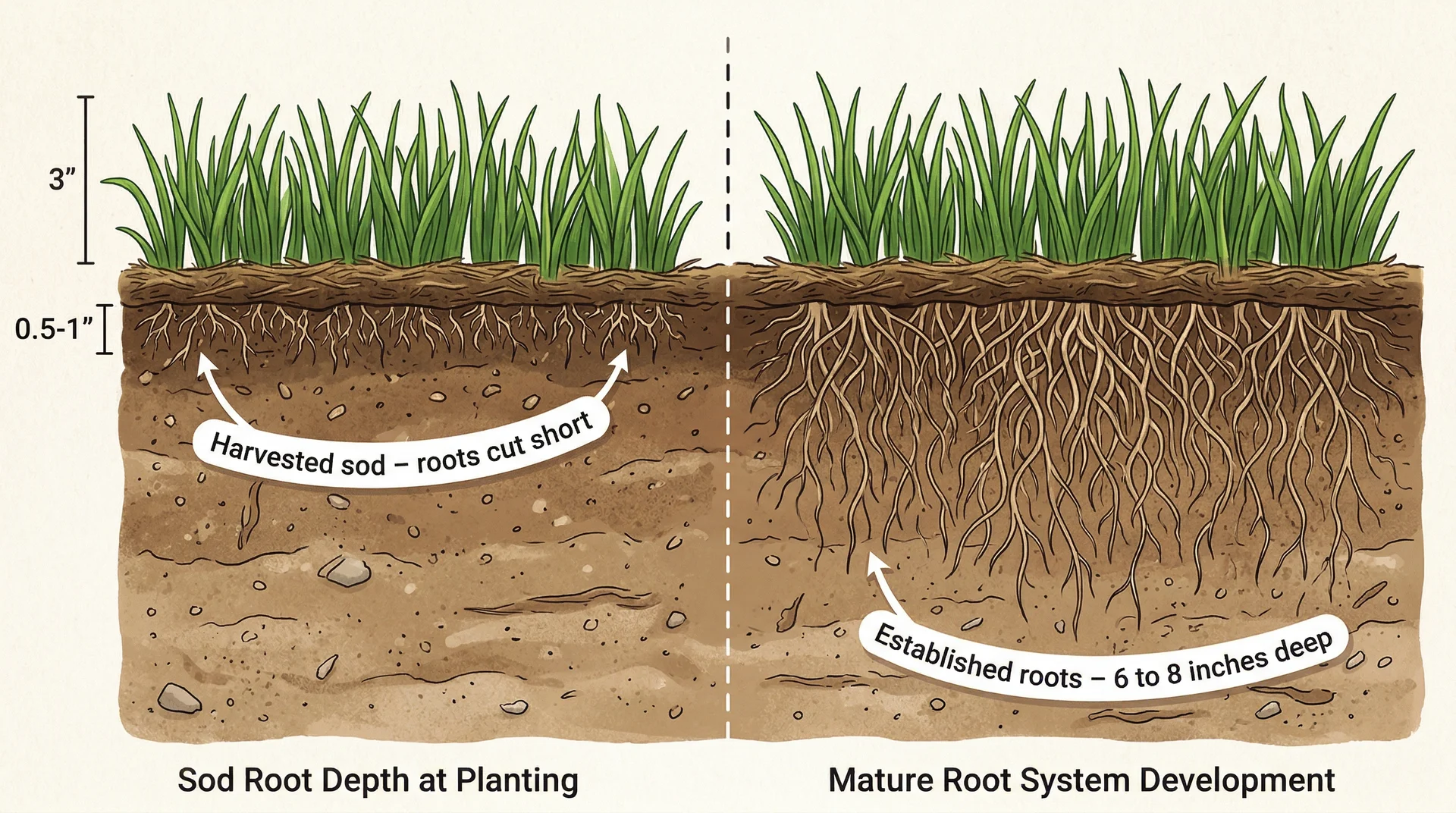
When sod gets harvested, it gets cut with a root mat of roughly half an inch to one inch in depth. That means the majority of the root system stays behind in the farm’s soil.
What you lay down is a grass plant running on reserve energy, with almost no ability to absorb water from the soil beneath it until it re-establishes contact.
The scientific term for this process is rhizogenesis, the regeneration of new roots into the underlying soil. It depends entirely on two things: soil-to-sod contact and consistent moisture.
Without moisture, the root tips dry out before they can penetrate the new soil, and the decline starts fast. Your job in those first weeks is to support that invisible underground process.
How Much Water Does New Sod Need? (By Inches, Not Just Time)
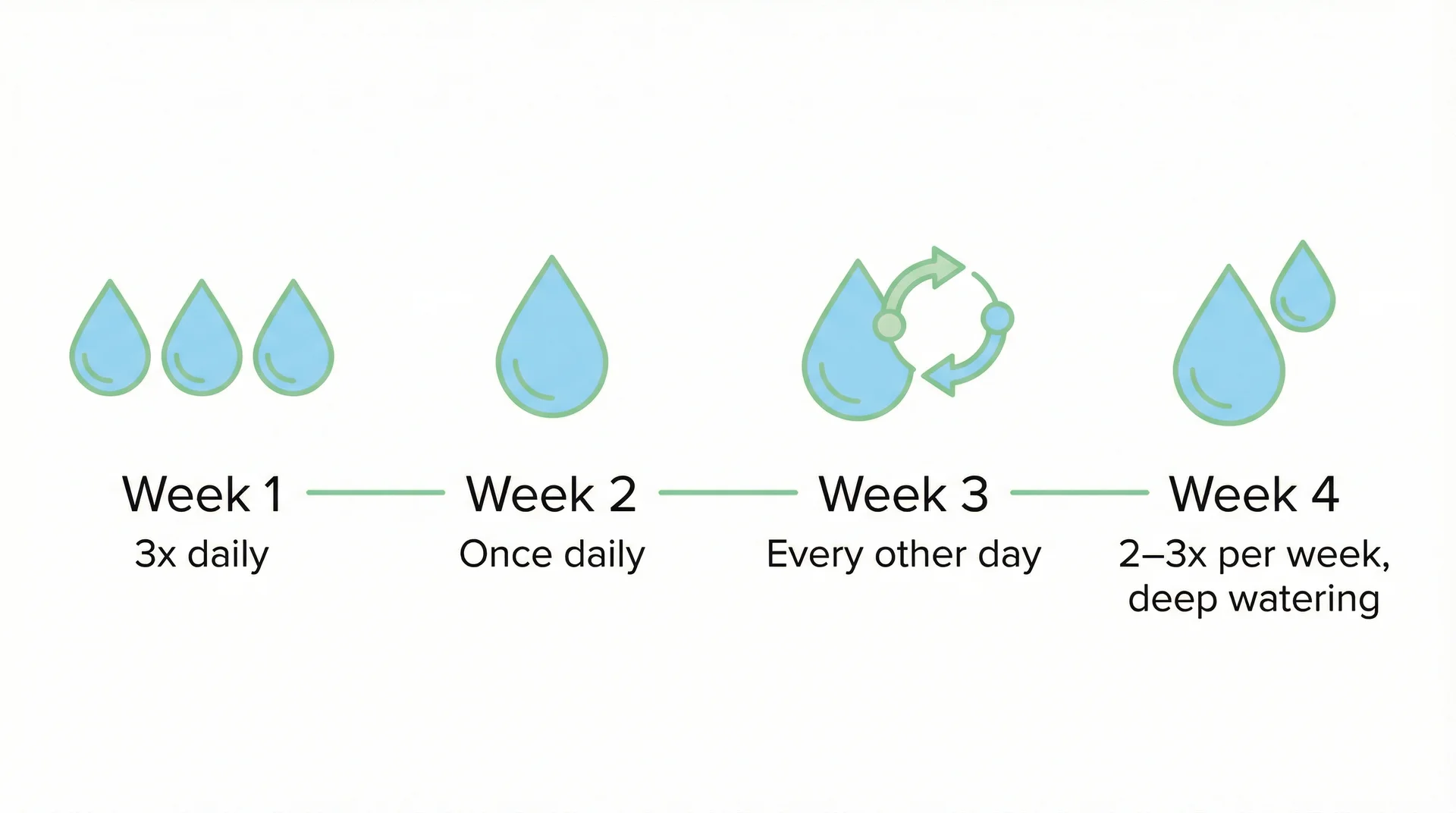
Before getting into the weekly schedule, here is a reference most guides skip: the actual water volume targets by establishment phase.
| Phase | Inches of Water Per Day | Frequency |
|---|---|---|
| Week 1 | 1 inch per day (split across sessions) | 2 to 3 times daily |
| Week 2 | 0.5 to 0.75 inches per day | Once daily |
| Week 3 | 0.5 inches every other day | Every other day |
| Week 4 and beyond | 1 to 1.5 inches per week total | 2 to 3 times per week |
A simple rain gauge placed on your lawn tells you exactly how much water your sprinklers deliver per session.
Most homeowners are surprised to discover their sprinklers deliver far less per minute than they assumed. Run a zone for 15 minutes, check the gauge, and calculate from there.
The Week-by-Week Sod Watering Schedule
Week 1: Keep It Consistently Moist
The goal in the first seven days is to keep the sod and the top 2 inches of underlying soil moist at all times. You are not trying to water deeply yet. You are preventing the sod from ever drying out long enough to stress the root tips.
| Time of Day | Duration | Goal |
|---|---|---|
| Early morning (6 AM) | 15 to 20 minutes | Primary hydration before heat builds |
| Midday (12 to 1 PM) | 10 to 15 minutes | Offset heat and evaporation loss |
| Late afternoon (4 to 5 PM) | 10 minutes | Top off moisture before evening |
The midday watering is the one most people skip, having heard that midday watering “burns” grass. That is a myth with no real scientific backing. More water evaporates in the heat, so you adjust the duration rather than skipping it. In week 1, keeping the sod moist matters more than perfect efficiency.
In temperatures above 90°F or on windy days, a fourth light session around 8 PM can genuinely save your sod. Make sure the grass blades have time to dry before full dark to reduce fungal risk.
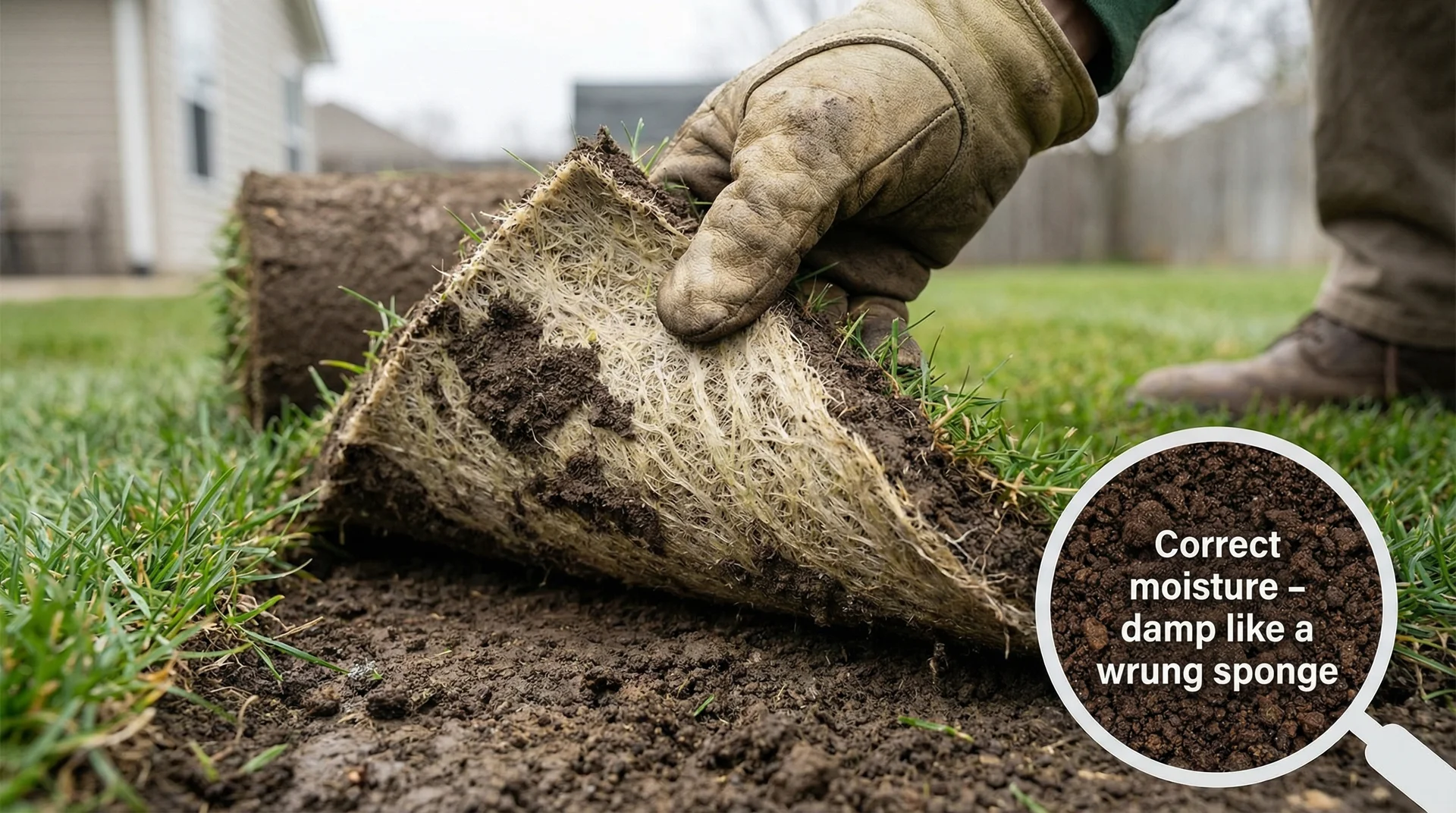
How to check if you have watered enough: Pull back a corner of the sod after watering. The soil underneath and the first inch of native soil below should feel like a wrung-out sponge: damp throughout but without standing water.
If it feels dry and crumbly below the mat, add more water. If you are standing in a puddle, pull back on duration.
Week 2 and 3: Transition to Deeper, Less Frequent Watering
By week 2, the root tips are beginning to push downward into the native soil. This is the point where the strategy needs to shift. Continuing to water lightly and frequently trains the roots to stay shallow, and shallow roots mean a lawn that struggles through heat and drought for years.
| Week | Frequency | Duration Per Session | Target Soil Depth |
|---|---|---|---|
| Week 2 | Once daily | 20 to 30 minutes | 3 to 4 inches |
| Week 3 | Every other day | 30 to 40 minutes | 4 to 6 inches |
Grass roots follow moisture downward. When water penetrates 4 to 6 inches deep, roots chase it and establish a stronger anchor system. This principle applies across all my landscape projects: encouraging downward root growth early is the single most impactful thing you can do for a plant’s long-term resilience.
Check your penetration depth with a screwdriver test: Push a thin screwdriver straight into the ground after watering. It should slide in with minimal resistance to the depth you are targeting. If it hits resistance at 2 inches, water longer.
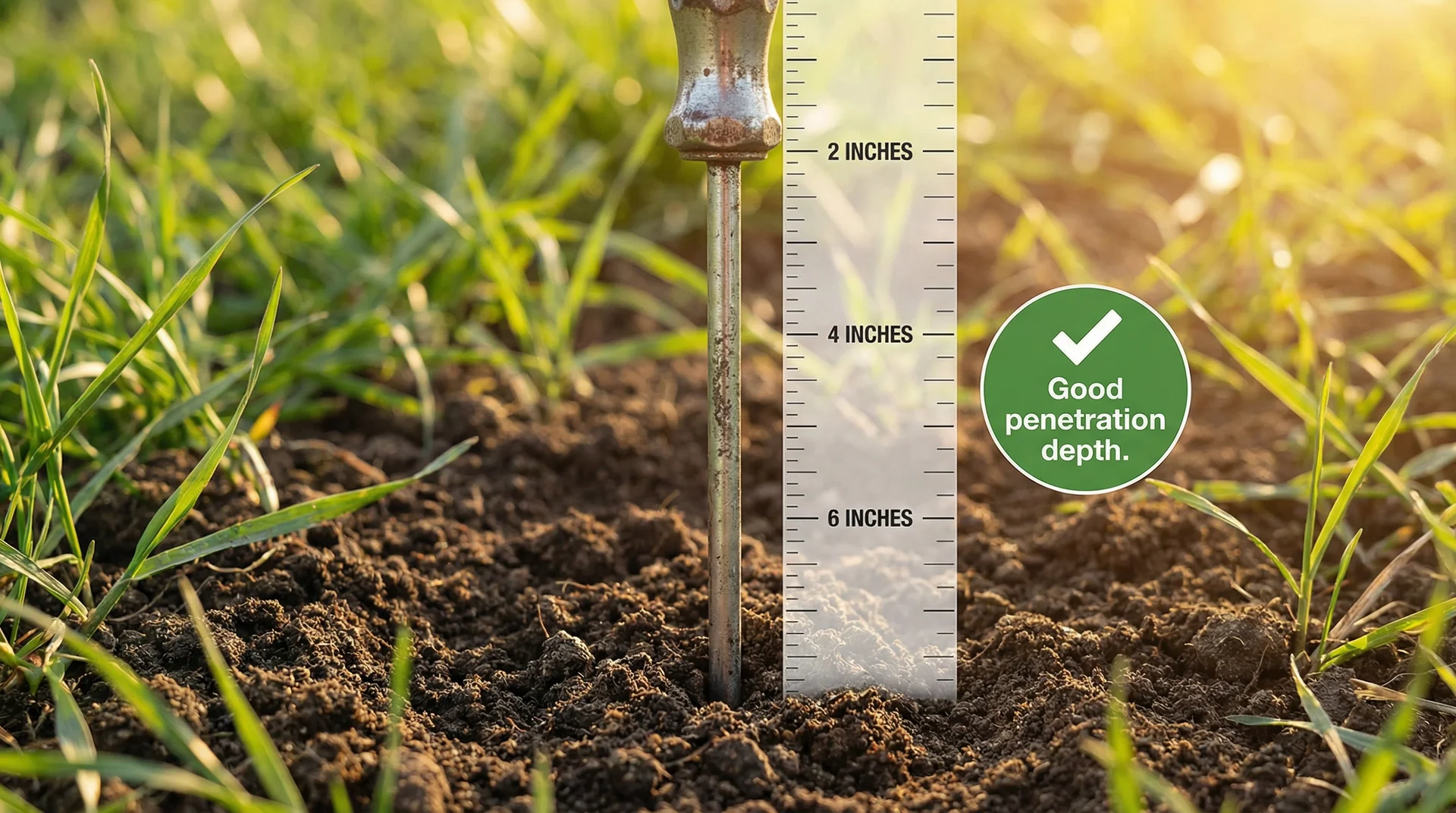
If it goes in smoothly past 6 inches, you are likely overwatering, or your soil drains slowly.
Week 4 and Beyond: When to Stop Watering New Sod So Frequently
This is the question I get most often after week 1 schedules: When can I stop watering so much?
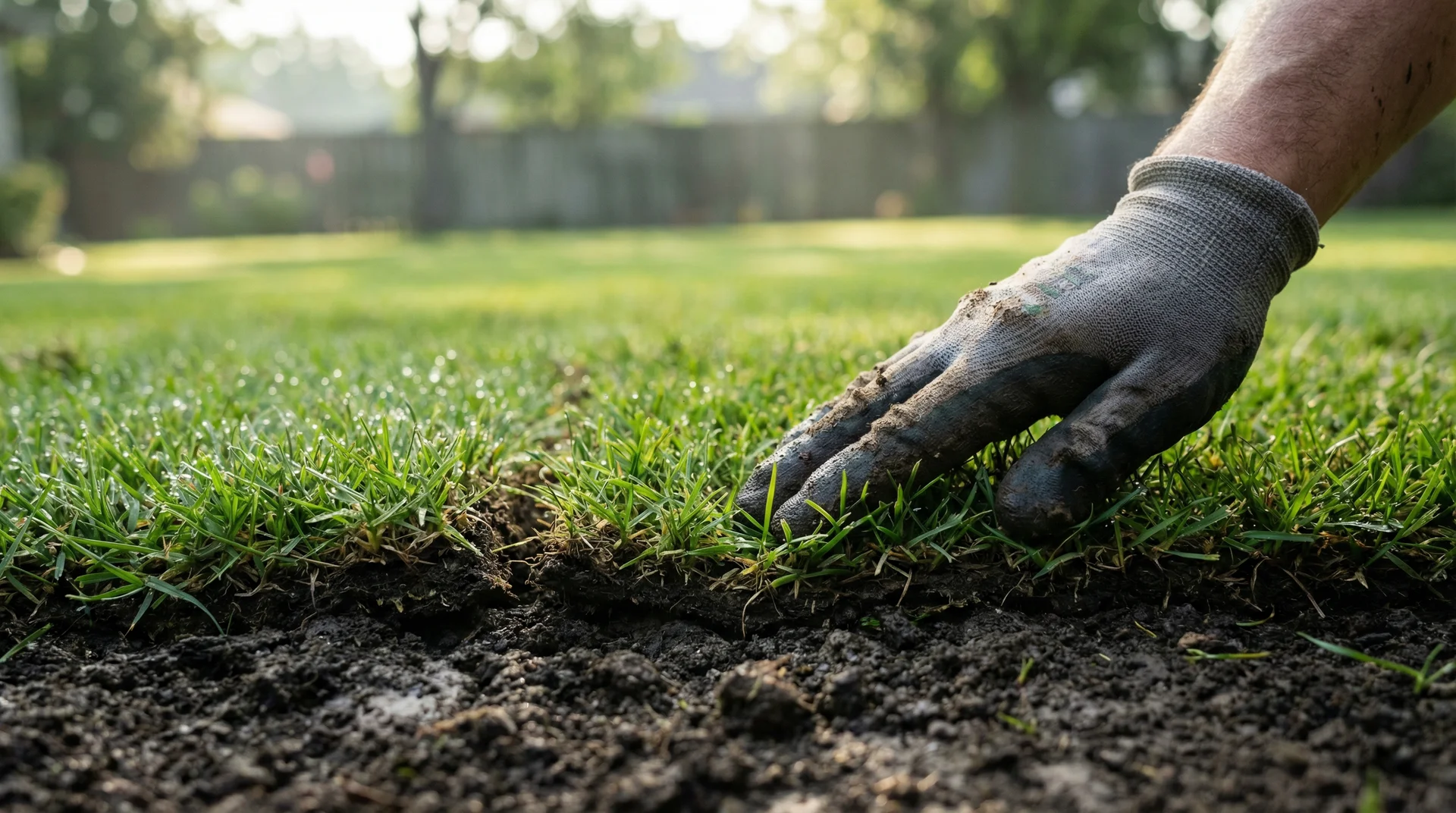
The answer is tied to one physical check, not a calendar date. Grab a corner of the sod and give it a firm pull.
If it resists and holds, the roots have knitted into the native soil, and you are ready to reduce watering. If it lifts easily, give it another week on the Week 3 schedule.
Once your sod passes the tug test:
- Frequency: 2 to 3 times per week
- Volume: 1 to 1.5 inches per week total, including rainfall
- Best time: Early morning between 4 AM and 9 AM
- Target depth: 6 to 8 inches of soil penetration per session
Watering Schedules by Grass Type
One of the most important variables that generic schedules skip over is grass species. Different varieties have meaningfully different water requirements during establishment, and using the wrong schedule for your grass type can cost you the entire lawn.
| Grass Type | Climate | Week 1 Frequency | Establishment Water Need | Drought Tolerance Once Established |
|---|---|---|---|---|
| Kentucky Bluegrass | Cool-season | 3 times daily | High | Moderate |
| Tall Fescue | Cool-season | 2 to 3 times daily | Moderate to high | Moderate to good |
| Bermuda Grass | Warm-season | 2 to 3 times daily | Moderate | Very high |
| Zoysia Grass | Warm-season | 2 times daily | Moderate | High |
| St. Augustine | Warm-season | 2 to 3 times daily | High | Moderate |
| Centipede Grass | Warm-season | 2 times daily | Low to moderate | Moderate |
Kentucky Bluegrass, which is the species we nearly lost on that June project, is one of the thirstiest during establishment because it forms a dense, fibrous root mat that takes longer to penetrate compacted or clay-heavy soils.
Bermuda, on the other hand, roots aggressively and can tolerate a slightly more forgiving schedule by week 2 without a significant setback.
Reading Your Sod: What It Looks Like When Something Is Wrong
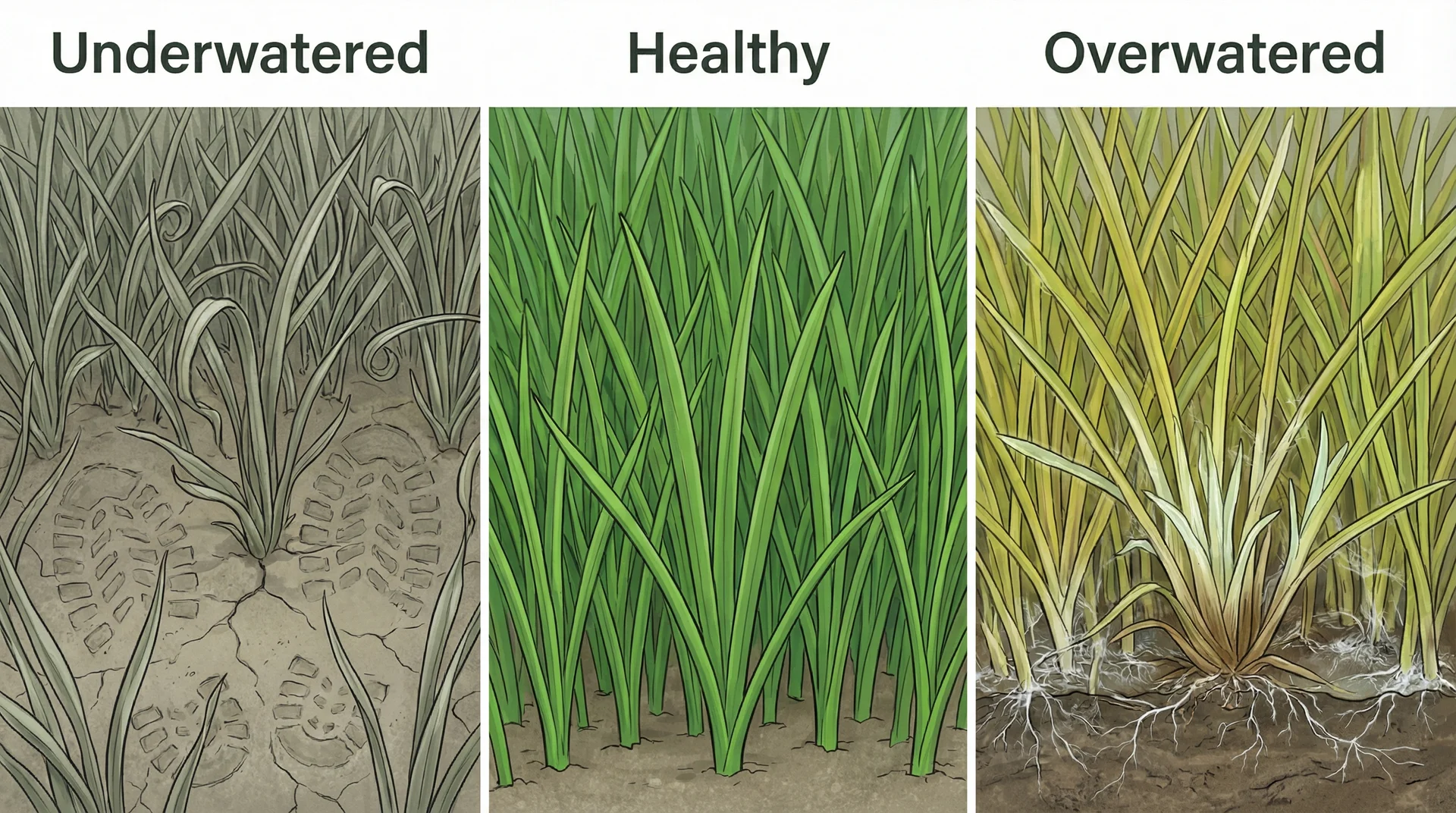
Learning to read your lawn’s visual cues is one of the most practical skills you can develop. Here is how to distinguish between underwatering and overwatering.
Signs Your Sod Needs More Water
Colour shift to dull blue-green: Healthy turfgrass is vivid and saturated. When it looks grey-green or muted, the plant is entering drought stress.
Leaf blade folding or rolling: Many grass species respond to dehydration by folding their blades lengthwise to reduce surface area and slow moisture loss. If blades look like tiny rolled tubes rather than flat leaves, the sod is stressed.
Footprints that stay visible: Walk across your lawn and look back. Healthy, hydrated grass springs back within seconds. Stressed grass stays compressed because the leaf cells lack the turgor pressure needed to recover.
Signs You Are Overwatering
Soft, spongy feel underfoot: Persistent saturation drives out oxygen, suffocating roots and creating ideal conditions for root rot.
Yellowing that spreads from the crown upward: Overwatered grass often yellows from the base up. Pale yellow-green new growth alongside yellowing older growth points to excess moisture.
Fungal patches in early morning: Circular patches of discoloured or matted grass with white or grey threads visible are a clear indicator of fungal disease driven by consistently wet conditions.
Overwatering kills more new sod than drought does. The instinct to give it more water when in doubt is understandable, but it often backfires. Soil needs oxygen as much as it needs moisture. This is something I tell almost every client in the first consultation, and it has proven true more times than I can count.
How Your Soil Type Changes the Schedule
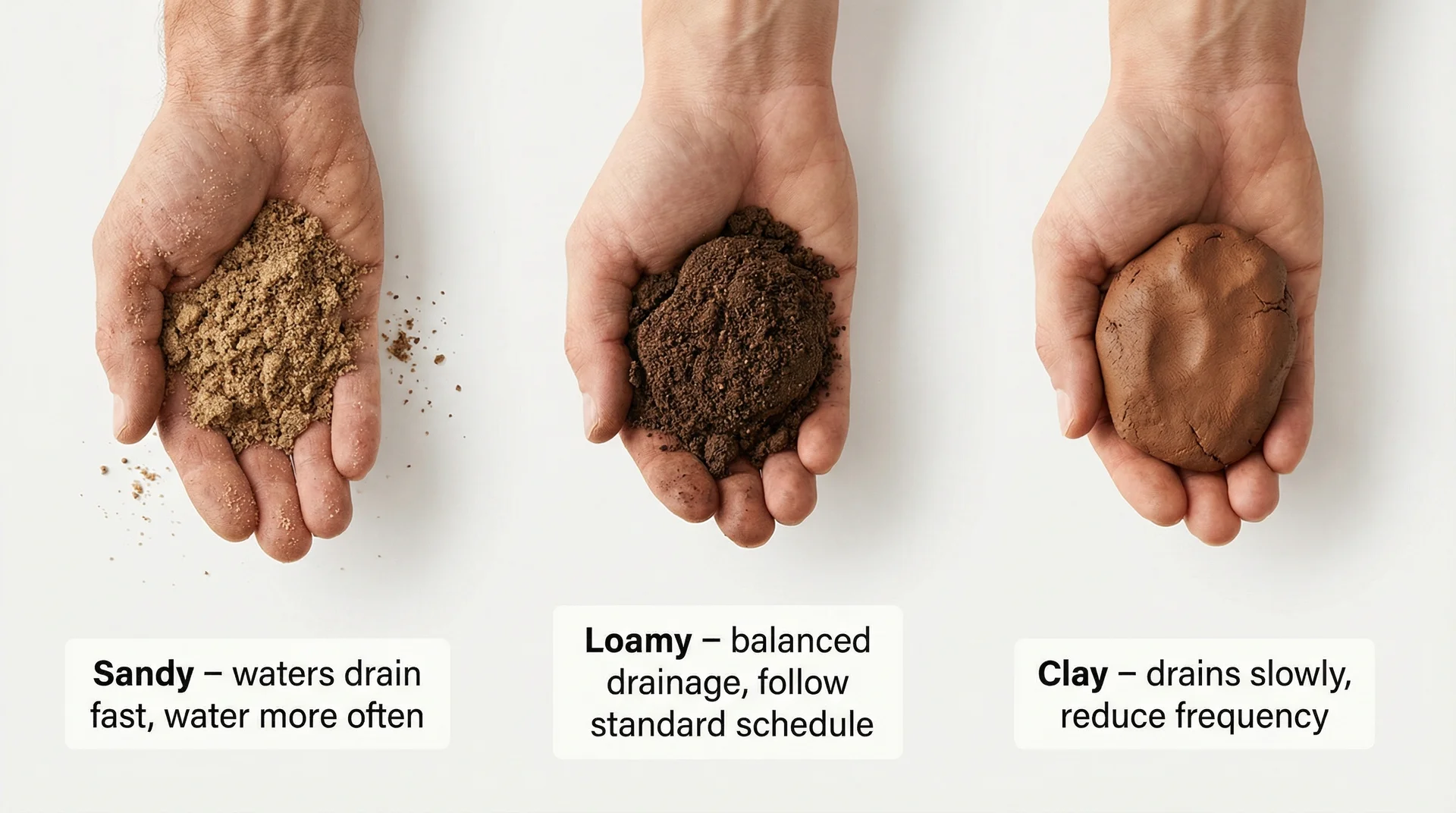
Sandy soils and clay soils behave like completely different planets when it comes to water retention. A schedule built for loam will either starve or suffocate sod on the wrong soil type.
| Soil Type | Water Retention | Drainage Speed | Schedule Adjustment |
|---|---|---|---|
| Sandy Soil | Low | Very fast | Water more frequently, shorter gaps |
| Loamy Soil | Moderate | Balanced | Follow the standard schedule |
| Clay Soil | High | Slow | Reduce frequency, watch for pooling |
| Compacted Soil | Low to Moderate | Slow | Aerate before installation, where possible |
On a project with heavy red clay soil, I cut back week 1 watering from three times daily to twice daily and still had to manage standing water in low spots after rain.
The sod established well, but it required close observation in the first two weeks to avoid root suffocation.
Quick soil test: Squeeze a handful of moist soil. Sandy soil crumbles immediately. Clay soil holds its shape and feels smooth and sticky. Loamy soil holds briefly, then breaks apart with a gentle press.
Watering New Sod in Summer Heat: What Changes
Summer installations come with compounding challenges: high evaporation rates, warm soil temperatures, and intense sun exposure that stresses the sod before roots even have a chance to establish.
In temperatures above 85°F:
- Add a midday watering session regardless of your schedule phase
- Check the sod corners and edges twice daily since they dry out faster than the centre
- Water slightly longer per session to compensate for evaporation loss at the surface
- Avoid letting even a single session slip during peak heat weeks
Shaded areas of your yard retain moisture 30 to 40 percent longer than full-sun sections.
Apply a single watering schedule uniformly across an uneven yard, and you will end up with overwatered shaded areas and underwatered sunny ones.
Walk your yard and observe which zones dry first, then adjust zone timing on your irrigation controller accordingly.
How to Water New Sod Without an Irrigation System
In-ground irrigation is convenient, but a significant portion of homeowners lay sod without it. Doing this well requires more attention, but it is entirely achievable.
Oscillating sprinklers cover wide rectangular areas and work well for flat, open lawns. Connect two or three to cover the full area, moving them as needed to prevent uneven coverage.
Rotary or impact sprinklers offer better reach and hold up better in wind. For exposed or irregularly shaped yards, these are the more reliable choice.
Soaker hoses along edges are genuinely useful for the first two weeks. Edges dry out faster than the centre because they face air exposure on multiple sides, especially sod laid along driveways or walkways. A soaker hose run along the border supplements your sprinkler coverage where it matters most.
Practical tip: Overlap your sprinkler coverage areas by about 20 percent. This eliminates dry strips that form at the boundaries of coverage zones, which are one of the most common causes of patchy establishment I see in lawns watered without built-in irrigation.
Adjusting for Rain: Does Rainfall Count?
Rain counts toward your watering goal, but with caveats. A brief afternoon shower that drops a quarter inch of rain does little if high temperatures and sun follow immediately after.
A slow overnight rain delivering half an inch or more can replace one or two scheduled waterings comfortably.
Keep a simple rain gauge on your lawn and log precipitation. When rainfall covers your daily inch target in week 1, skip your next scheduled session. When it falls short, supplement accordingly.
This removes the guesswork and prevents the common mistake of watering on top of adequate natural rainfall, which is one of the fastest ways to oversaturate new sod.
Special Situations Worth Knowing About
Sod on Slopes
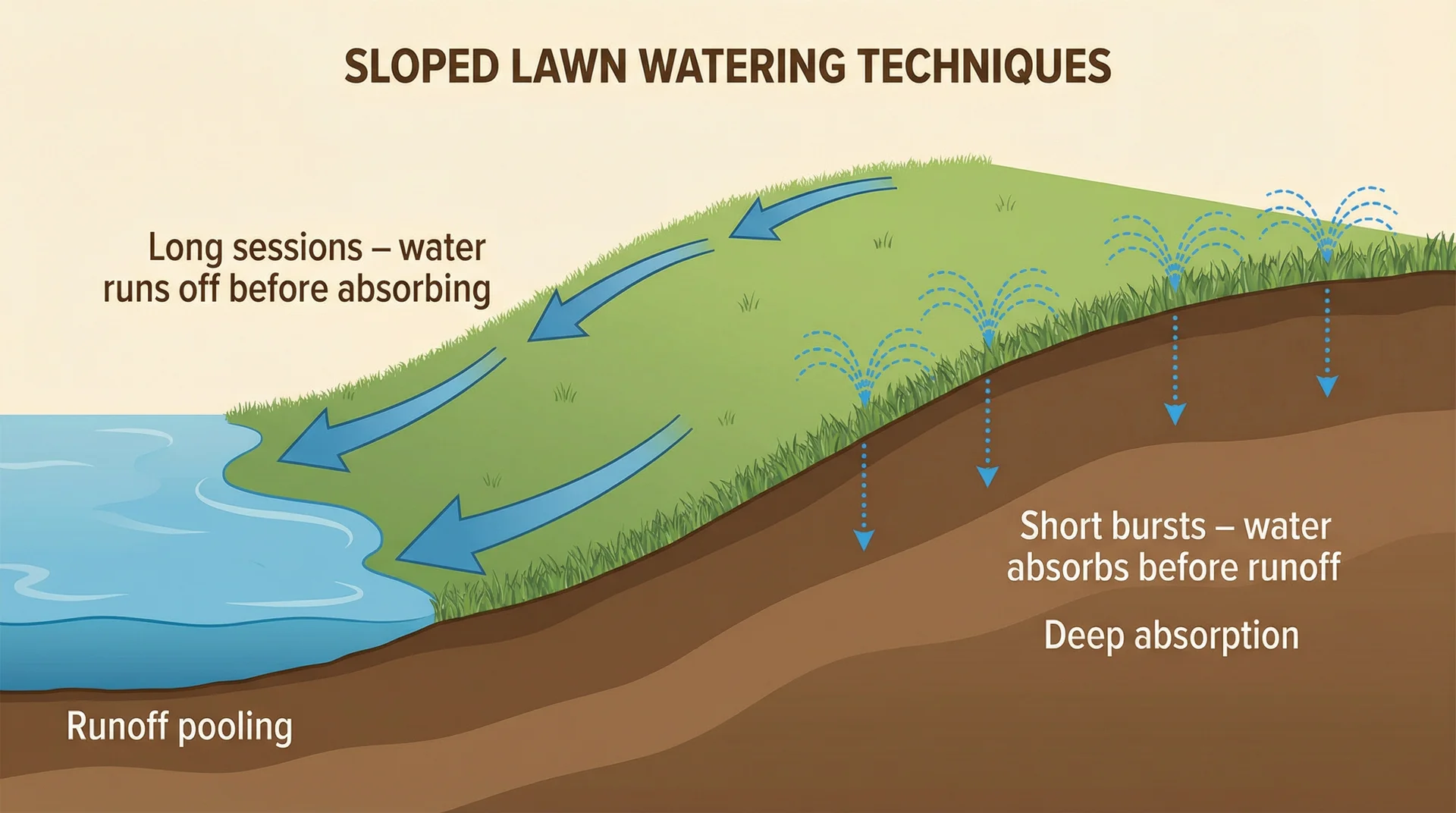
Water on sloped areas runs off before it can soak in. Use shorter, more frequent bursts of watering to let each application absorb before the next one starts. Some installers use biodegradable netting on steep grades during establishment, which also helps water penetrate more evenly.
Sod Laid in Fall or Winter
Cool-season grasses laid in fall require far less frequent watering because evaporation is minimal and natural rainfall is more consistent. Once-daily watering in the first week is often sufficient, and natural precipitation may cover weeks 2 and 3 entirely.
Root establishment slows in cold soil temperatures, so patience matters more in fall installations, but the reduced watering demand makes the whole process more forgiving.
Sod Around Newly Planted Trees or Shrubs
Trees and shrubs prefer deep, infrequent watering, which aligns with your week 4 and beyond routine.
In the first few weeks of sod establishment, hand-water your trees and shrubs separately to give each plant precisely what it needs rather than forcing a compromise between two different watering needs.
Watering New Sod: A Quick-Reference Checklist
Week 1
- Water 2 to 3 times daily
- Target 1 inch of water per day across all sessions
- Check soil moisture under sod corners twice daily
- Avoid foot traffic
- Add sessions during extreme heat or wind
Weeks 2 and 3
- Reduce to once-daily watering, then every other day watering
- Confirm 4 to 6 inch penetration with the screwdriver test
- Monitor for yellowing or fungal patches
- Subtract recorded rainfall from daily targets
Week 4 and Beyond
- Perform a tug test to confirm root establishment
- Shift to 2 to 3 times per week, deep sessions
- Water early in the morning only
- Plan first mow once grass reaches 3.5 to 4 inches
The First Mow: How It Connects to Your Watering Schedule
Mowing and watering connect more closely than most people realise. Mowing new sod before roots have anchored pulls and tears the mat rather than cutting it cleanly, undoing weeks of careful watering work.
Wait until your sod passes the tug test and the grass reaches 3.5 to 4 inches in height. Hold off on watering for 24 to 48 hours before mowing so the surface firms up. Mowing soft, wet sod causes wheel ruts and tearing. After the first mow, resume your regular watering schedule.
Set your mower to remove no more than one-third of the grass blade in a single pass. Cutting too low forces the plant to dedicate energy to leaf recovery rather than root development, which is the opposite of what you want at this stage.
Frequently Asked Questions
Can you overwater new sod?
Absolutely, and it happens more often than underwatering. Persistently saturated soil suffocates roots by displacing oxygen. Signs include spongy turf underfoot, crown yellowing, and fungal patches. If your sod looks yellow and wet simultaneously, reduce watering frequency before adding more.
How long should I run my sprinklers for new sod?
This depends on your sprinkler output, but a general guide for rotary heads is 20 to 30 minutes per zone per session in week 1. For oscillating sprinklers, 15 to 20 minutes typically delivers sufficient coverage. Always verify with a rain gauge rather than relying on assumed output.
What if my sod has dry edges, but the middle looks fine?
Edges dry out faster than the centre because they face air exposure on multiple sides. Hand-water the edges with a gentle spray setting in addition to your regular sprinkler schedule for the first two weeks.
Should I fertilise new sod during the watering phase?
Most commercially produced sod arrives pre-fertilised from the farm. Adding fertiliser in the first four weeks can burn the shallow root system. Wait until after the first mow and then consult your sod supplier or local extension service about a starter fertiliser appropriate for your grass type and soil.
How do I know when to stop watering new sod so frequently?
The tug test is your most reliable indicator. When the sod resists a firm pull and holds firmly to the native soil, you are ready to reduce frequency. On a calendar basis, most sod reaches this point between weeks 3 and 5, depending on grass type, temperature, and soil conditions.
What a Well-Watered Lawn Looks Like at Six Weeks
Six weeks after that June installation, where we nearly lost the Kentucky Bluegrass, the lawn had become one of the healthiest I had seen come out of a difficult start.
The client followed the revised schedule, hand-watered edges daily, and tracked rainfall with a simple gauge. By week six, 800 square feet showed dense, even growth with the kind of uniformity that takes inattentive lawns an entire season to achieve.
Healthy, well-established sod at six weeks feels springy and firm underfoot. The colour runs consistently and is saturated across the full surface. Footprints disappear within seconds. And the lawn holds firmly when you tug it.
Getting there takes attention in those first weeks, but the process becomes second nature once you understand what your sod needs and why. You now have that understanding, and your lawn will reflect it.