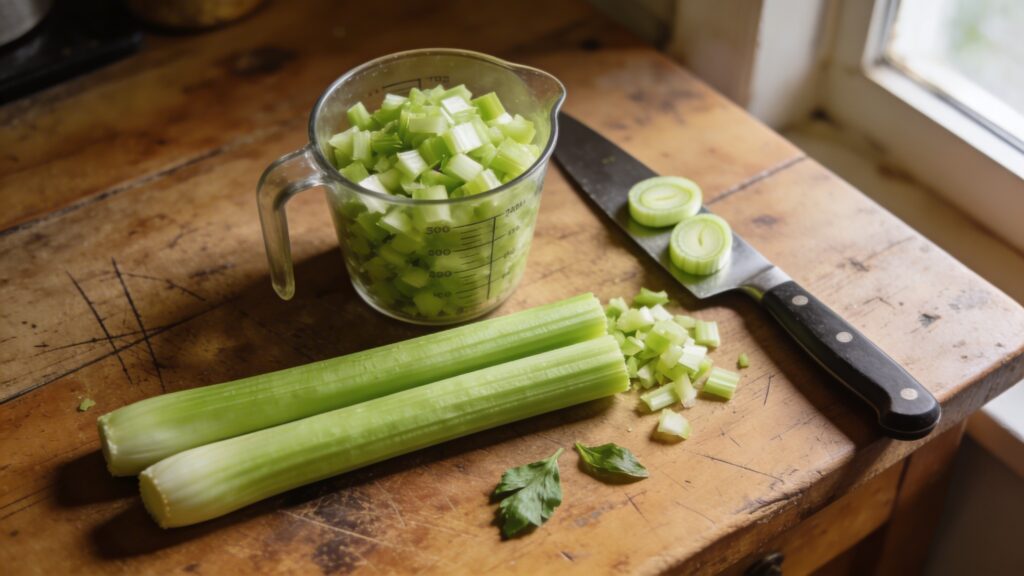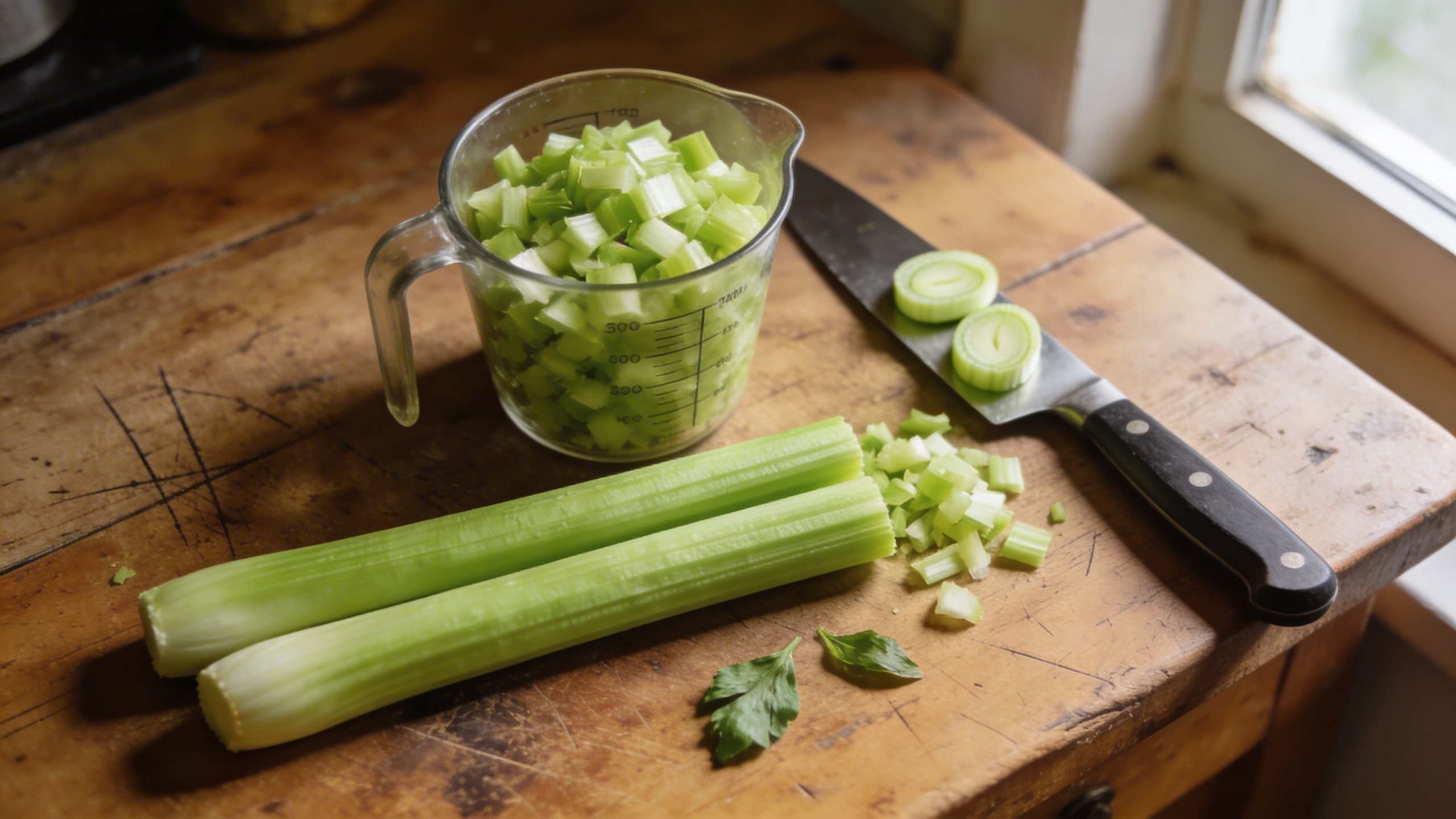
To learn how to chop celery, trim both ends of the rib, lay it flat on a stable cutting board with the curved side down, and cut straight across using a sharp chef’s knife.
For soups and stews, cut quarter-inch slices. For salads and stir-fries, use a thinner eighth of an inch.
For a fine dice, split the rib lengthwise first, then cut across at even intervals.
Why the Way You Chop Celery Actually Changes the Dish
There is a moment in culinary school that happens to almost every student during the first serious week of knife work.
The instructor places a bunch of celery on the prep counter and tells the class to dice it. The assumption in the room is always the same. Celery is the easy one. The warm-up before the real work.
That assumption gets corrected quickly. Celery is curved, fibrous, and prone to rolling.
It has strings that behave differently under heat than the flesh around them. Different parts of the same bunch taste meaningfully different from each other.
The cut you choose changes the flavor output in a finished dish, not just the appearance of it on the plate.
How the Wrong Cut Changes Texture and Flavor
When you cut celery across the grain into thick, uneven pieces, you get two problems at once. The fibrous strings running along the outer ribs stay intact and get chewier under heat rather than softening.
At the same time, thick pieces take significantly longer to cook through. By the time the celery softens, everything else in your pan has already gone past where you wanted it.
There is also a flavor dimension that does not get discussed enough. Celery releases its aromatic compounds through cell damage, meaning the surface area of your cut directly affects how much flavor it contributes.
A bias cut or a fine dice releases noticeably more flavor into a broth than a rough, uneven chop. In a restaurant kitchen, that difference is the margin between a stock that tastes built and one that tastes thin.
Why Uniform Cuts Matter Beyond Aesthetics
Uniform cuts cook evenly. When every piece of celery in your pan matches in size, they hit the right texture at the same moment. You do not end up with some pieces turning mushy while others are still fibrous and underdone.
This matters especially in dishes where celery stays visible, such as a stir-fry, a braised chicken, or a grain salad, where the texture of each bite matters to the person eating it.
| Cut Consistency | Result in Cooking |
|---|---|
| Uniform, matched pieces | Even cooking, consistent texture throughout |
| Mixed sizes, rough chop | Uneven doneness. Some pieces are mushy, some are firm |
| Too thick across the grain | Stringy texture survives heat, chewy mouthfeel |
| Too thin without technique | Pieces disintegrate, lose structure in wet dishes |
The One Thing Most Home Cooks Get Wrong: The Strings
The strings are the most misunderstood part of working with celery. They are not a defect. According to the National Center for Biotechnology Information, they are vascular bundles, the system the plant uses to move water and nutrients through the stalk.
Celery is roughly 95 percent water, and those fibrous strands are the plumbing that keeps it hydrated from root to leaf.
Whether to remove them depends entirely on what you are cooking:
- Raw preparations such as slaws, salads, and crudités benefit from destringing the outer ribs. The difference in a raw celery salad between a destrung rib and an unpeeled one is immediately noticeable.
- Cooked preparations such as soups, stews, and stocks generally do not require destringing because extended heat breaks down the fibers.
- Quick-cooked dishes such as stir-fries and sautés sit in the middle. Destrung the outer ribs when celery is in large pieces. Skip it for finely diced celery.
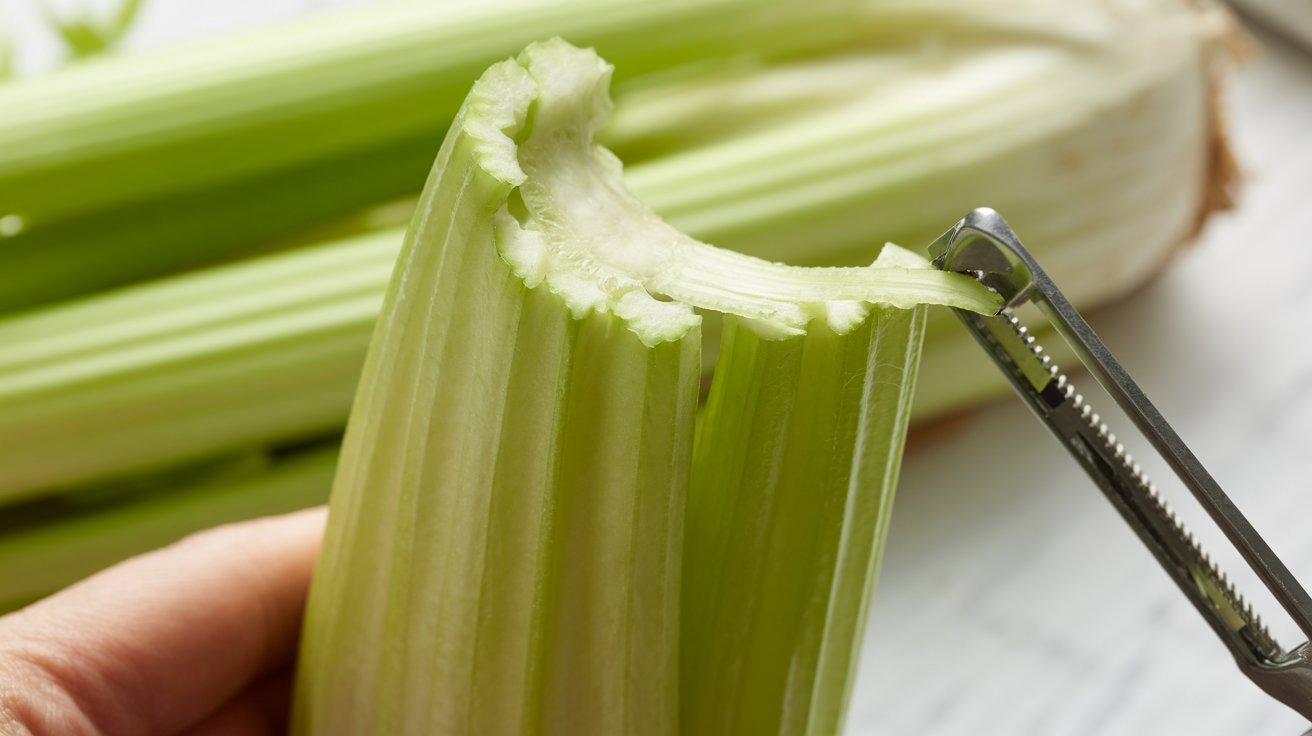
The fastest method: draw a vegetable peeler lightly along the curved outer face of the stalk. One or two passes remove the strings without taking much of the rib itself.
Before You Pick Up the Knife: Choosing and Prepping Celery
How to Pick Celery Worth Chopping
Most people grab the first bunch they see. A quick ten-second check avoids a lot of limp, flavorless prep work:
- Firmness. Squeeze the base gently. It should feel solid and dense, not soft or pliable.
- Color. Look for bright, consistent pale to medium green. Yellowing or browning at the edges means the outer ribs will be tough and bitter.
- Leaves. Fresh, green leaves signal a recently harvested bunch. Wilted or absent leaves mean it has been sitting too long.
- Rib size. Thinner inner ribs are sweeter and more tender. Thick outer ribs carry more fiber and a sharper flavor. Knowing which part you are working with helps you choose the right cut.
Washing and Drying Celery Before Cutting
Separate the ribs from the base before washing. Running water over a tightly packed bunch barely reaches the inner stalks, and that is exactly where dirt collects.
Pull each rib away individually, hold it under cold running water, and run your fingers along the inner concave face.
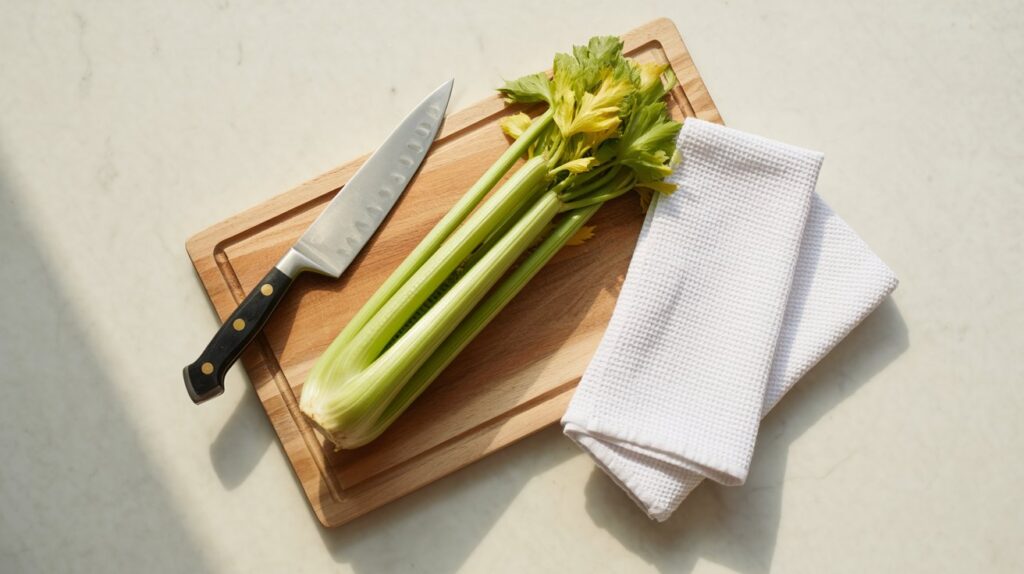
The step most home cooks skip, and the one that most affects your cuts, is drying the ribs before you start. Wet celery slides under the knife. It resists clean cuts and makes your board slippery, compromising both precision and safety. Pat each rib dry with a clean kitchen towel before you begin.
| Preparation Type | Destringing Needed? | Reason |
|---|---|---|
| Raw salads, slaws, crudités | Yes, outer ribs | Strings are chewy and unpleasant raw |
| Large-cut stir-fries or sautés | Outer ribs only | Pieces big enough that the strings stay noticeable |
| Soups, stews, braises | No | Heat breaks down fibers over cooking time |
| Stocks and broths | No | Whole or rough pieces. Texture irrelevant |
| Fine dice | No | Cuts are small enough that the strings do not register |
The Only Tools You Need
Your Knife: Why Sharpness Changes Everything
A sharp knife moves through celery in one clean motion. A dull knife pushes against the curved rib, causes it to shift on the board, and gives you uneven cuts. More importantly, a dull knife forces you to press harder, which is where accidents happen.
For celery specifically, a chef’s knife between 8 and 10 inches gives you the length to handle a full rib in one stroke. A santoku works equally well. Its flat blade profile suits celery’s shape because it reduces the rocking motion that causes rounding on cuts you want flat.
Quick sharpness test: slide the blade gently across your thumbnail at a low angle. A sharp knife catches slightly and stops. A dull one slides straight across. If yours slides, sharpen it before you start.
Your Cutting Board: Stability Matters More Than Material
The board needs to stay still and give you enough room to work. Place a damp kitchen towel underneath before you start. This single step eliminates sliding completely and costs nothing.
A wood or thick plastic board at least 12 by 18 inches gives you the workspace to line up multiple ribs and work through them efficiently.
Avoid glass or ceramic surfaces entirely. They dull knife edges aggressively and give you no grip on curved vegetables.
Optional Tools That Are Actually Useful
- Vegetable peeler. Doubles as your fastest destringing tool. A Y-peeler gives better control on curved surfaces than a straight swivel peeler.
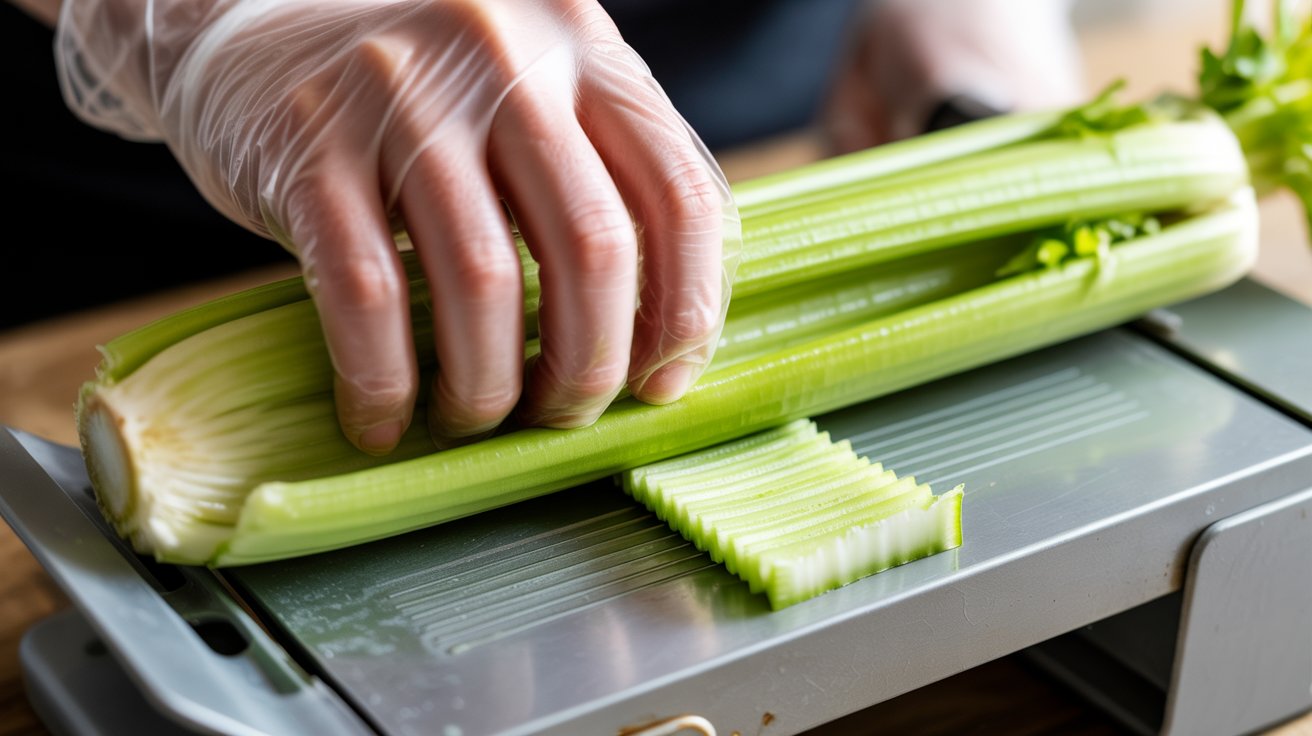
- Mandoline slicer. Useful specifically for shaved celery at paper-thin thickness. Outside of that application, you do not need one for celery work. Always use a cut-resistant glove. Celery’s narrow ribs give your fingers very little clearance from the blade.
- Salad spinner. Faster and more thorough than hand-drying when prepping a large bunch.
“The best kitchen tool is always the one you know how to use well. A sharp chef’s knife in a confident hand outperforms any gadget in a hesitant one.” — Ross Delgado, Recipe Developer
How to Chop Celery: Every Cut You Will Ever Need
These cuts are organised by how you will actually use them in the kitchen, by the dish you are making, rather than by difficulty. Before any cut: ribs dry, board stable, knife sharp.
1. The Basic Crosswise Slice
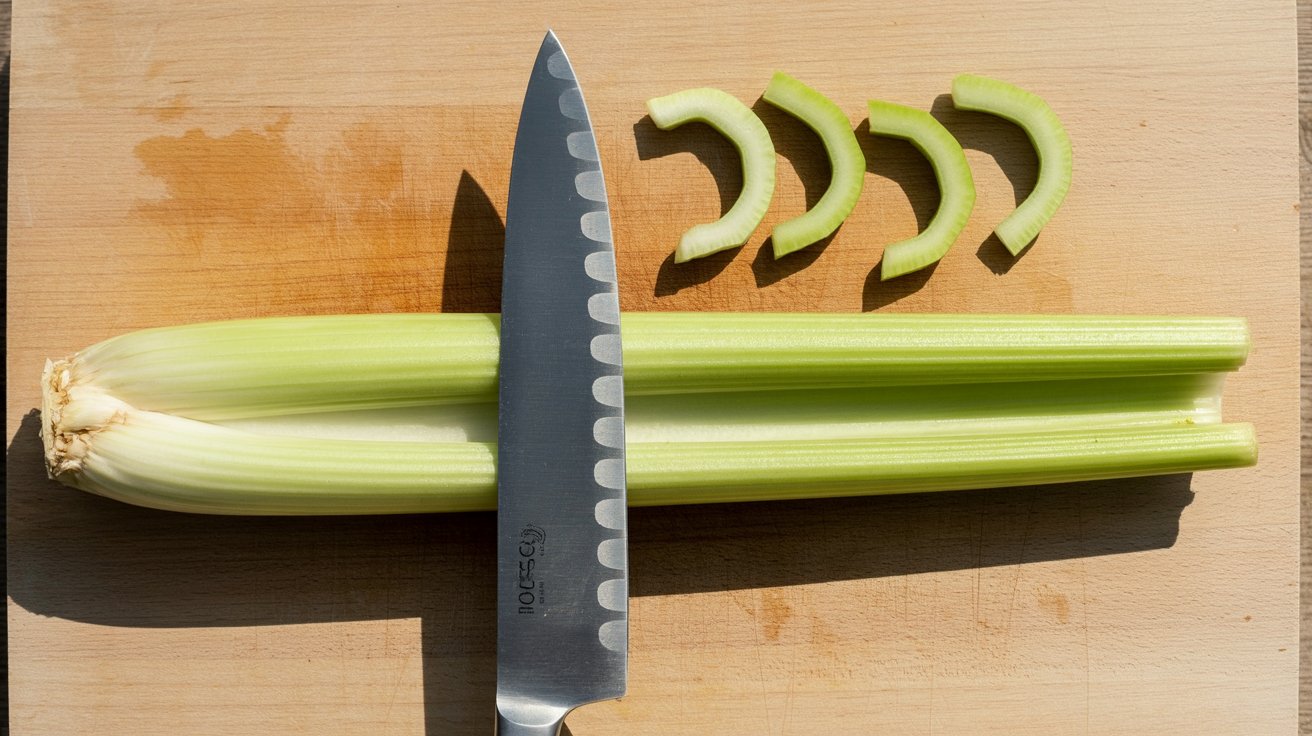
This is the cut you will use most often and the right place to build confidence with celery before moving to anything more involved.
- Lay a dry rib flat on your board, curved side down, so it sits stable without rolling.
- Trim the base end where the rib attaches to the bunch, roughly half an inch. Trim the leaf end. If the leaves look fresh, set them aside rather than discarding them.
- Hold the rib steady with a claw grip. Fingertips curled inward, knuckles forward as a guide for the blade.
- Cut straight across in one smooth downward motion. The result is a curved, C-shaped slice.
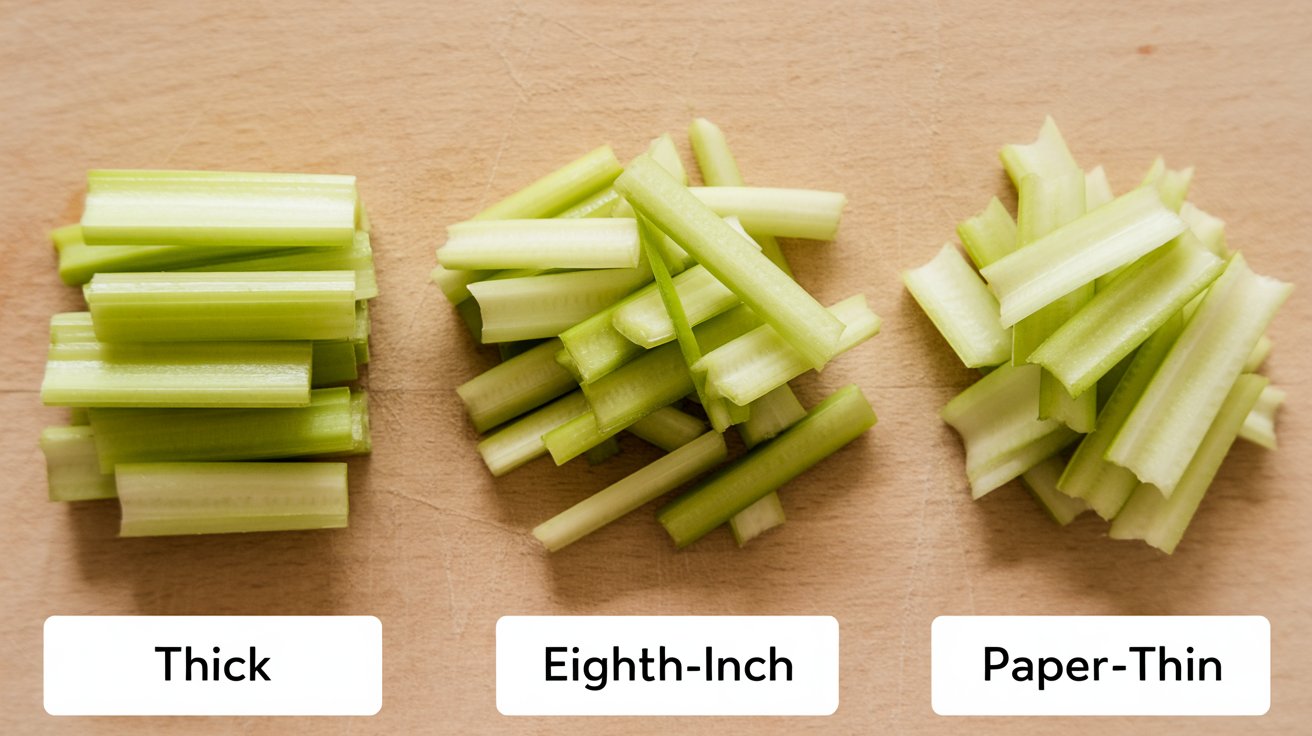
| Thickness | Best Use |
|---|---|
| 1/4 inch | Soups, stews, braises. Softens fully during cooking |
| 1/8 inch | Stir-fries, sautés. Cooks quickly, holds a slight bite |
| Paper thin | Raw salads, slaws. Delicate texture, maximum crunch |
2. Celery Sticks and Batons
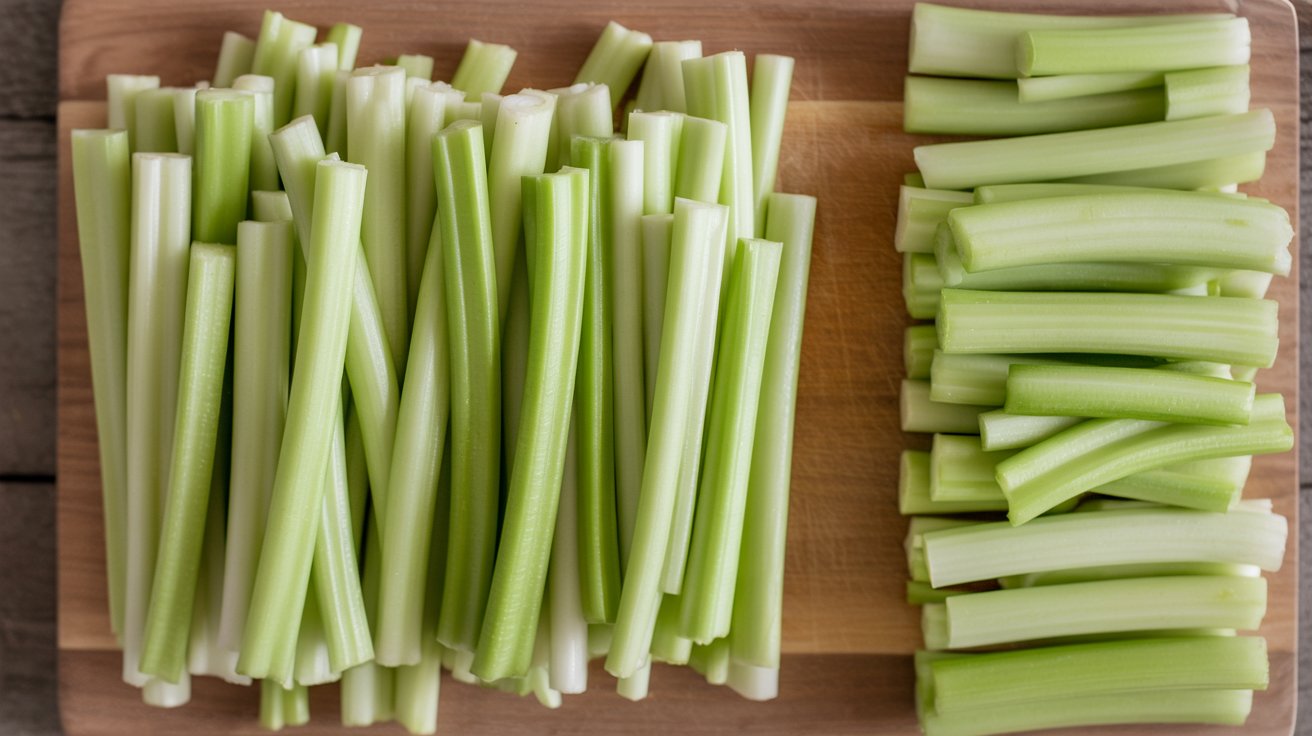
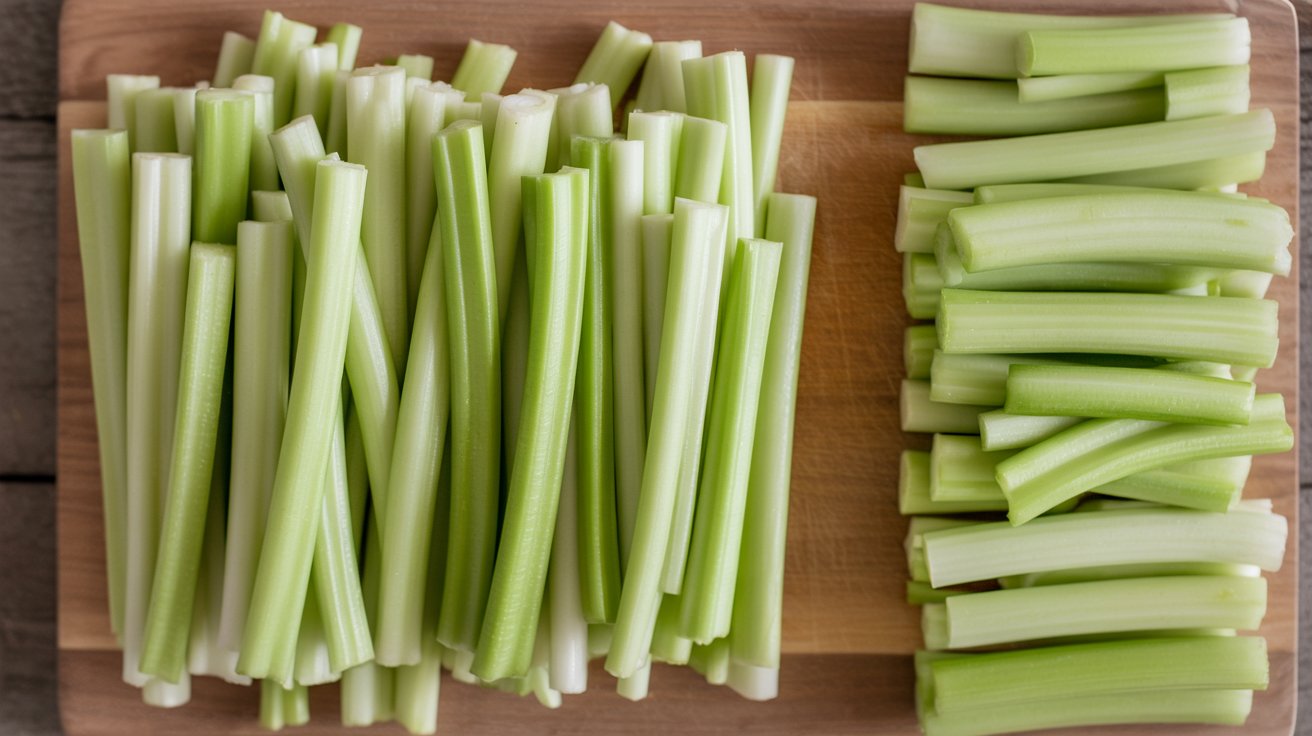
- Trim both ends of the rib.
- Cut crosswise into your desired length. Typically, 3 to 4 inches for snacking sticks, 2 inches for stir-fry batons.
- Stand each section upright on the board and cut straight down to split into even strips. A standard rib gives you two or three strips, depending on its width.
For snacking and crudités, the inner ribs work better. They are narrower, more uniform in thickness, and noticeably sweeter than the outer stalks. For stir-fry batons, outer ribs hold up better to high heat because their denser structure keeps them from going limp before they pick up any color.
3. The Diagonal/Bias Cut
Cutting at a 30 to 45 degree angle increases the exposed surface area of each piece, which means more flavor releases into whatever liquid or fat the celery is cooking in. It also creates an elongated oval shape that reads as intentional on the plate rather than a plain crosswise slice.
- Trim and dry the rib.
- Position your knife at roughly 45 degrees to the length of the rib rather than perpendicular to it.
- Cut through in one clean motion, maintaining that angle consistently across the whole rib.
The most common mistake: letting the angle drift midway through the rib, which gives you lopsided pieces. Keep your eye on where the knife meets the celery at the far edge of the board, and your angle stays true.
Use this cut for Asian-inspired stir-fries, braised dishes where you want the celery to absorb more sauce, and anywhere the visual presentation of the vegetable matters to the final plate.
4. Diced Celery: Small, Medium, and Large
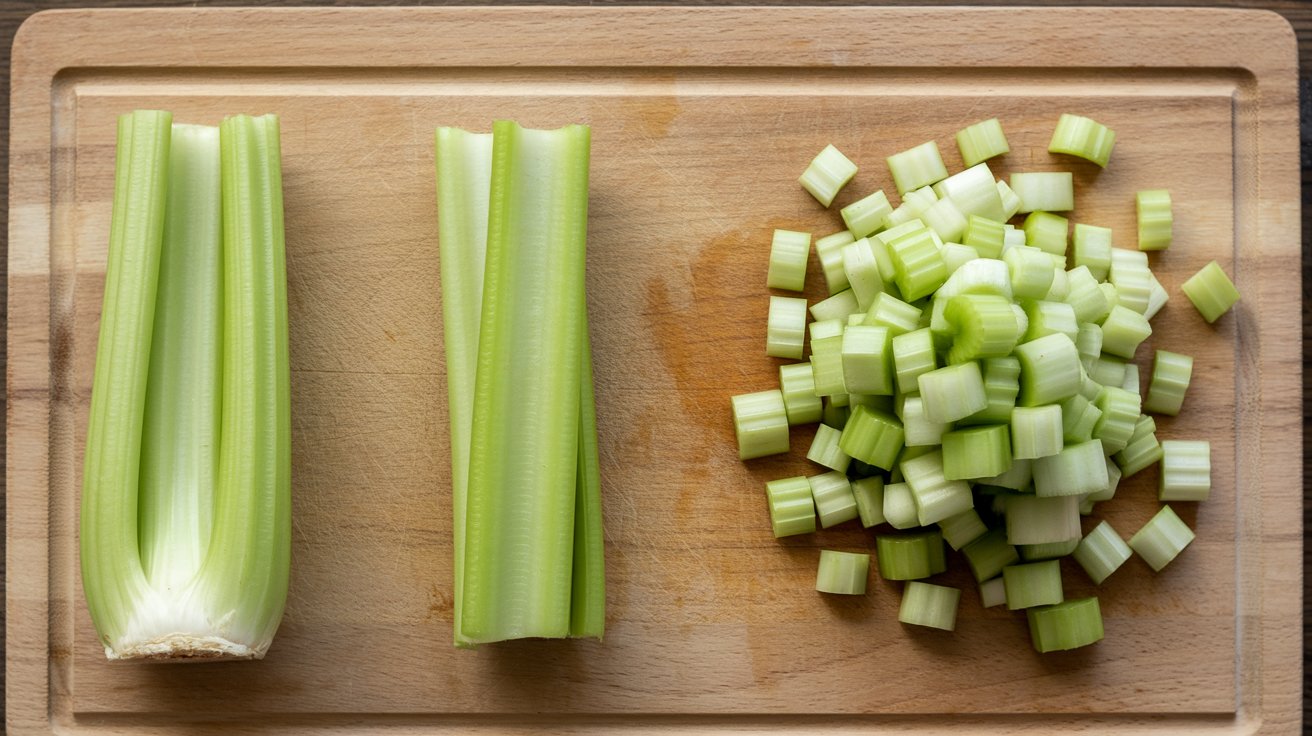
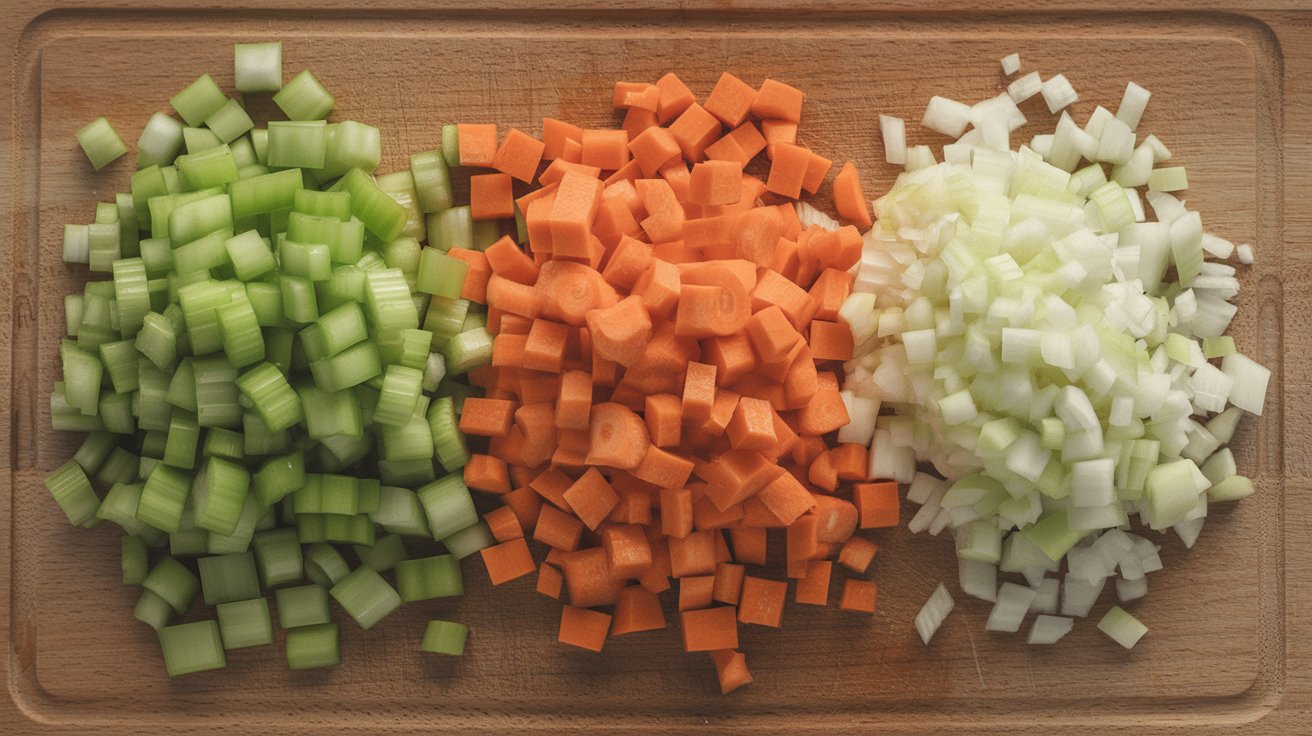
Diced celery is the foundation of mirepoix, stuffings, stocks, and pasta salads. Getting the dice consistent makes a real difference across all of those applications.
- Trim both ends of the rib.
- Split the rib lengthwise. One cut down the center for a standard rib, two cuts for a very wide outer rib. You are creating flat-faced strips that sit stably on the board for the final crosswise cuts.
- Line the strips up together and cut across at even intervals. The interval you choose determines your dice size.
| Dice Size | Cut Interval | Common Use |
|---|---|---|
| Large dice | 3/4 inch | Chunky soups, stews, slow braises |
| Medium dice | 1/2 inch | Mirepoix, pasta salads, grain bowls |
| Small dice | 1/4 inch | Stuffings, sauces, quick-cooked dishes |
| Fine dice (brunoise) | 1/8 inch | Finishing garnish, delicate sauces, raw applications |
The fine dice, called brunoise in classical French technique, is where consistent technique shows most clearly. Any variation in your lengthwise strips translates directly into irregular final pieces. Take your time with the splitting step, and the crosswise cuts take care of themselves.
5. Julienned Celery: Matchstick Cuts
Long, thin, and almost delicate in a way that crosswise slices and dice do not achieve. Particularly effective in slaws and Asian-inspired salads, where the texture is more interesting than a standard crosswise slice.
- Cut the rib into 2 to 3-inch lengths crosswise.
- Lay each section flat and slice lengthwise into thin planks, roughly 1/8 inch thick.
- Stack two or three planks and cut lengthwise again into thin matchsticks.
Use this cut for slaws, fresh salads with Asian dressings, garnishes for ramen or noodle dishes, and anywhere you want celery to add crunch without dominating the bite.
6. Celery Ribs as Boats
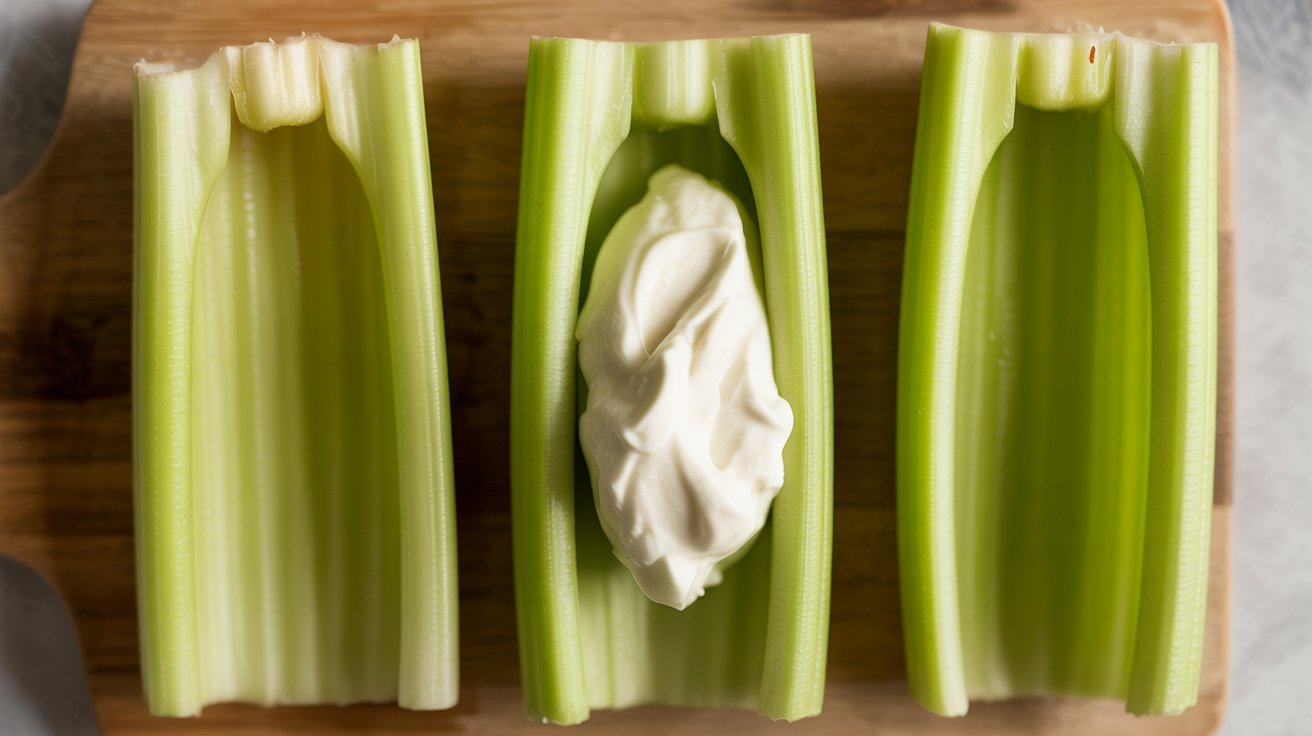
Separate the inner ribs. Their natural concave curve is what makes them useful as a vessel. Trim the base end and the leaf end. Cut crosswise into 3 to 4-inch lengths for serving as individual boats.
The inner ribs work best here because their walls are thicker relative to their width, which means they hold fillings without collapsing. Use them for peanut butter, cream cheese, tuna salad, or any dip-style filling where you want something sturdy enough to pick up and eat cleanly.
7. Shaved Celery: The Cut Most Home Cooks Have Not Tried
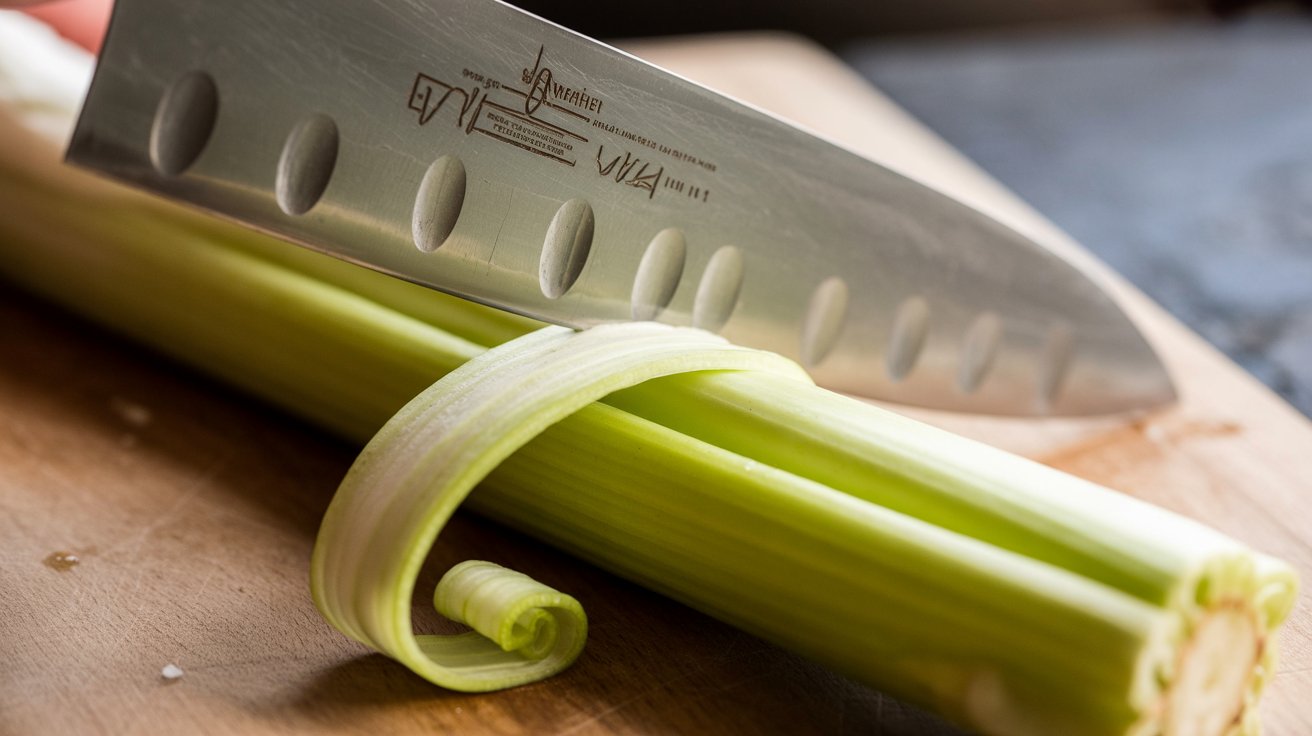
At paper-thin thickness, celery loses the aggressive crunch and sharpness that some people find off-putting and becomes almost tender. Mild, aromatic, and surprisingly elegant when dressed simply with good olive oil, lemon, and salt.
With a knife: Cut lengthwise along the rib using the thinnest, lightest cuts you can manage while keeping the blade moving forward rather than rocking.
With a mandoline: Run each rib lengthwise across the blade set to 1 to 1.5 millimeters. Use a cut-resistant glove without exception. Stop cutting when the rib becomes too short to control safely.
Use shaved celery for light salads with shaved Parmesan and toasted walnuts, as a bed under grilled fish, or as a finishing element on composed dishes where you want celery’s flavor present without its texture dominating.
What to Do With the Parts Most People Throw Away
Celery Leaves Are Basically Free Herbs
Celery leaves taste more intensely of celery than the ribs do. They carry a slight bitterness alongside the familiar aromatic quality, which makes them behave more like an herb than a vegetable in the kitchen.
The pale yellow-green leaves from the heart of the bunch are the mildest and most versatile. Good raw, good cooked, good as a garnish. The darker outer leaves are stronger and slightly more bitter, which makes them better suited to cooking applications where heat mellows them out.
Ways to use celery leaves:
- Torn into a green salad in place of parsley. They pair particularly well with apple, walnut, and blue cheese combinations.
- Scattered over a finished soup as a garnish. They wilt in the residual heat and add flavor and visual freshness.
- Mixed into stuffing alongside sage and thyme. They hold up well during oven time and add depth that straight celery ribs do not contribute.
- Used as a bed for serving grilled fish or chicken. The leaves wilt under the heat of the protein and release their aroma as the plate reaches the table.
The Celery Heart: The Sweetest Part of the Bunch
The heart of the celery bunch, those pale, tightly packed inner ribs with their attached leaves, is sweeter and more tender than anything on the outside. Reduced light exposure during growth keeps chlorophyll levels lower, which corresponds directly to lower bitterness and a more delicate flavor.
Prep the heart separately from the outer ribs whenever the dish is raw or lightly cooked. In a braised application that cooks for an hour, the distinction disappears. But in a fresh celery salad or a crudité platter where the flavor of the celery itself is prominent, using heart ribs makes a noticeable difference in how approachable the dish tastes.
Celery Scraps and Ends: Do Not Throw Them Out
The trimmed base, leaf tips, and rough outer pieces that are not worth cutting into neat shapes all carry genuine flavor. Keep a zip-lock bag in your freezer specifically for vegetable scraps.
Celery goes in alongside onion skins, carrot tops, and herb stems. When the bag is full, everything goes into a pot of water for stock. A stock made without celery scraps tastes noticeably flatter than one made with them.
- Vegetable stock. Add scraps directly to cold water with other aromatics, bring to a gentle simmer, and cook for 45 minutes to an hour.
- Braising liquid. Rough celery pieces added to a braise contribute flavor to the liquid, which absorbs and carries through to the finished dish.
- Infused cooking water. A couple of celery scraps added to the water you boil grains in adds a subtle savory note to rice, farro, or barley.
Which Celery Cut Goes in Which Dish
Soups, Stews, and Braised Dishes
Best cuts: Medium dice, large dice, crosswise slices at 1/4 inch.
In wet, long-cooking dishes, celery’s job is to release its aromatics into the liquid and soften to a texture that complements the other ingredients without calling attention to itself. Uniformity matters for even softening, but there is no need for the precision of a fine dice here.
The mirepoix ratio, two parts onion to one part carrot to one part celery by weight, is the foundation of French cooking and appears in some form across dozens of cuisines globally. Getting your celery to match the size of your carrot and onion pieces is the most impactful single use of consistent knife work in everyday home cooking.
Stir-Fries and Sautéed Dishes
Best cuts: Bias cut, batons, thin crosswise slices at 1/8 inch.
High heat and short cooking times mean celery needs maximum surface area and minimum thickness. The bias cut excels here. The increased surface area picks up the flavors of the wok or pan faster, and the diagonal shape visually suits the dish.
Add celery after aromatics like garlic and ginger have gone in, but before leafy vegetables or proteins that cook quickly. Celery needs about 2 to 3 minutes in a hot pan to reach the right point: tender but with a residual bite, not soft and collapsed.
Raw Dishes: Salads, Slaws, and Crudités
Best cuts: Thin crosswise slices, julienne, shaved, sticks, and batons.
Raw preparations are where cut quality shows most clearly because there is no heat to mask uneven pieces or compensate for rough edges. This is also where destringing the outer ribs makes the most practical difference.
For slaws, julienned celery mixed with shredded cabbage, apple, and a mustard vinaigrette is one of the most underrated side dishes in any repertoire. It comes together in under ten minutes and keeps well in the refrigerator for two days.
For salads, thin crosswise slices at 1/8 inch bring the right balance of crunch and manageability. Go thinner, and the pieces feel fragile. Go thicker, and they dominate the texture of every bite.
Stocks, Broths, and Aromatics
Best cuts: Rough crosswise chop, or whole and halved ribs.
Precision is irrelevant here. What matters more than cut size is which part of the bunch you use. The outer ribs and scraps contribute a more intense flavor. The heart ribs contribute a sweeter, more delicate note. Using a combination of both gives your stock a more rounded aromatic profile than using either exclusively.
A good stock is built on patience and aromatics in the right proportions. Celery is always part of that foundation, never an afterthought.
How to Keep Chopped Celery Fresh After Cutting
The best method for keeping celery fresh is to submerge the pieces in cold water in a sealed container and refrigerate. This keeps celery hydrated and crisp for up to two weeks. Change the water every two to three days.
For diced celery going into cooked dishes only, a sealed airtight container without water works fine for five to seven days. The slight softening at the cut edges will not matter once it hits a hot pan.
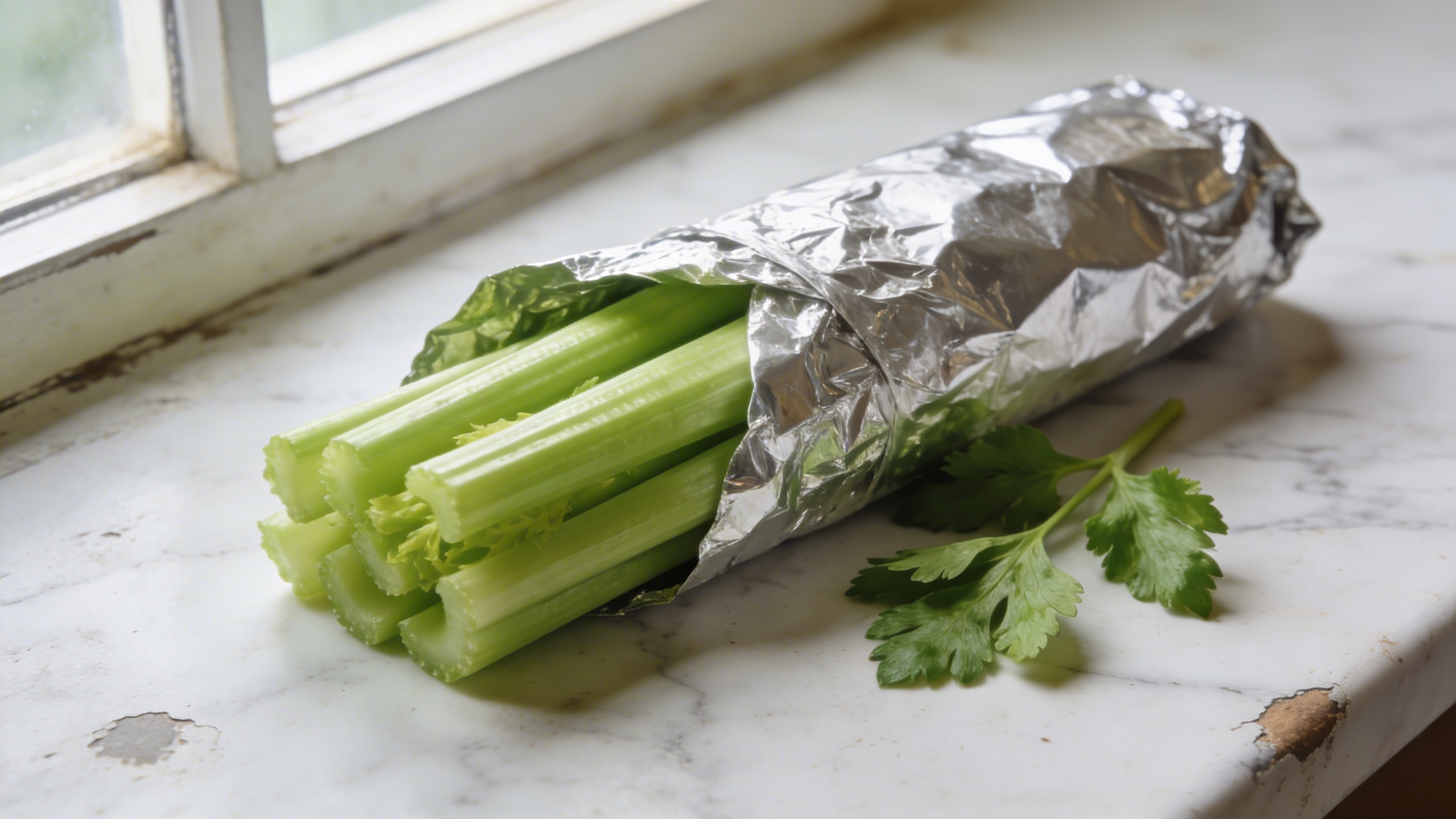
For the complete storage guide, including the foil-wrap method for whole bunches, freezing instructions, and how to revive limp celery, see the full celery storage guide.
How Much Celery Do You Need?
As a quick reference, one medium celery rib yields roughly 1/2 cup when chopped into a medium dice. Two ribs give you approximately one cup.
Sizes vary between inner and outer ribs, so for precision in baking or cooking where measurements are critical, use a measuring cup rather than counting stalks.
For exact stalk-to-cup conversions for every cut size, see how many stalks of celery are in a cup.
Common Questions About Chopping Celery
How thin should I slice celery?
For cooked dishes like soups and stews, cut at 1/4 inch. Thick enough to hold some texture after extended heat.
For stir-fries and sautés, 1/8 inch gives you pieces that cook quickly and still have a slight bite.
For raw salads, go as thin as you can manage cleanly with your knife, or use a mandoline for paper-thin shaved slices.
Can you chop celery ahead of time?
Yes. Store chopped celery submerged in cold water in a sealed container in the refrigerator for up to two weeks.
For diced celery going into cooked dishes, a sealed container without water keeps it usable for five to seven days.
Should you wash celery before or after chopping?
Before. Wash each rib individually under cold running water, paying attention to the inner concave face where dirt collects.
Then dry the ribs thoroughly before cutting. Wet celery slides under the knife and gives you less clean cuts.
Why does my celery go limp after cutting?
Cut celery loses moisture from its exposed surfaces quickly. Submerging the pieces in cold water in a sealed container stops that process and keeps them firm.
If you have already cut your celery and it has gone slightly limp, a 20 to 30 minute soak in ice-cold water will firm it back up.
Does the way you cut celery affect the flavor?
Yes, meaningfully. Celery releases its aromatic compounds through cell damage, so the more surface area a cut creates, the more flavor the celery contributes to the dish.
A fine dice or a bias cut releases noticeably more flavor into a broth or sauce than a thick, rough chop.
The cut you choose matters not just for texture but for the taste of the finished dish.
A Few Safety Notes Worth Reading Once
The Claw Grip
Every cut in this guide assumes you are holding the celery with a claw grip.
Fingertips curled inward toward the palm, knuckles angled forward to guide the side of the blade. Your knuckles physically stop the knife from reaching your fingertips.
Form this habit with celery, and it becomes automatic by the time you are working with something more difficult.
Stabilising Curved Ribs Before Cutting
Celery’s curved outer ribs do not sit flat on a cutting board naturally. They rock. Before any cut on an outer rib, place it curved side down and confirm it is sitting as stably as possible.
If it moves, make one flat cut along the curved face to create a stable base, then proceed from there.
Wet Boards and Dull Knives
A wet cutting board and a dull knife create the conditions for most kitchen accidents during vegetable prep. A damp towel under the board and a quick, sharpness test before you start takes under a minute and is worth building into your prep routine as fixed habits.
The Last Chop
Celery rewards you for paying attention to it. The cuts and techniques here are not complicated. What they require is the kind of deliberate attention that separates cooking that feels like a chore from cooking that consistently works.
Once you understand the ingredient, the prep becomes second nature.