
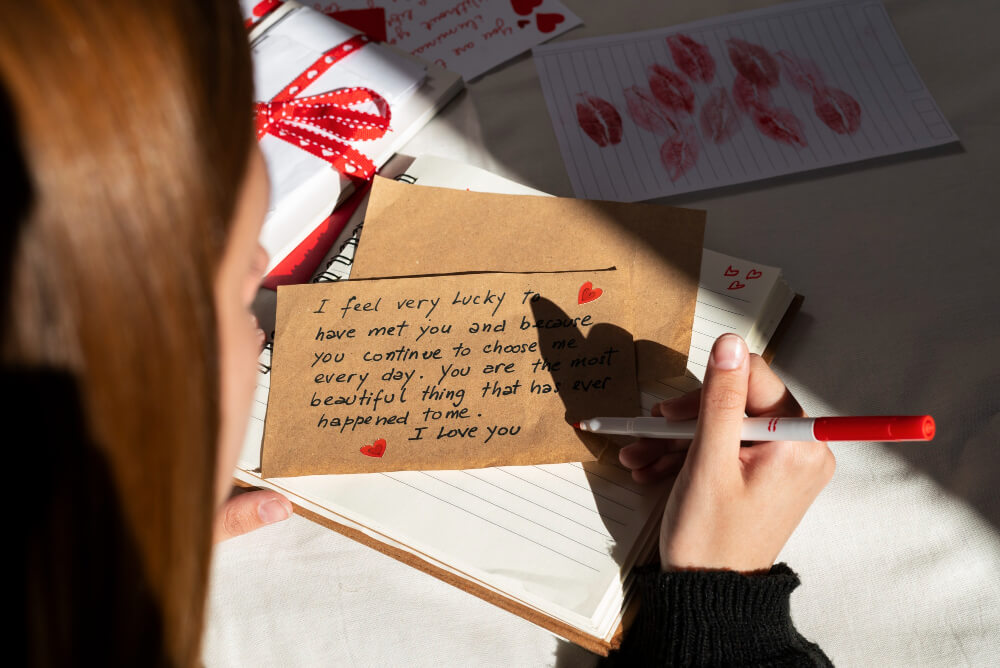
Write a love letter to your crush knowing this: it will make your hands shake a little. Pause over every sentence. Delete and rewrite the same line more times than you’d like to admit. I’ve been there like you, sitting with a half-written note open on my laptop, wondering if honesty feels brave or reckless in that moment.
Over time, and through more attempts than I’ll publicly claim, I’ve learned that writing to a crush isn’t about sounding romantic. It’s about sounding real. Approach this kind of letter differently than you would any other form of writing. Don’t try to impress. Don’t try to predict their reaction. Write to create clarity and for yourself first, and for them second.
A crush exists in that space between hope and uncertainty, and your words need to respect both. Say enough to be understood, but not so much that you overwhelm the person on the other side of the page.
What I’ve learned in my life – through awkward confessions, beautifully timed ones, and a few that never got sent, is that the best love letters to a crush feel calm, grounded, and human. They don’t rush emotion or demand an outcome. They simply open a door and allow the other person to decide whether they want to step through it.
If you’re here, chances are you don’t want to “get it right” in a cinematic sense. You want to express something honest without losing your dignity, your boundaries, or your sense of self. That’s exactly what this guide is for.
Understand What You’re Really Writing (And Why That Matters)
Write this letter with clarity about its purpose, because a crush letter is not a declaration of eternal love but simply an introduction to a possibility. Learn this early and you save yourself a lot of unnecessary heartache.
I didn’t always understand this. In my early attempts, I treated feelings like something that needed to be released all at once, as if holding back meant being dishonest. It took time to realize that restraint is not dishonesty; it’s respect.
A crush exists before certainty. You don’t yet have shared memories, inside jokes that belong only to the two of you, or the safety net of mutual commitment. That means your letter should never try to borrow emotional weight from a relationship that doesn’t exist yet.
When people say a letter “comes on too strong,” this is usually why because it asks the reader to emotionally catch up to feelings they didn’t have time to grow into.
Think of this letter as a bridge, not a destination. You’re not asking someone to meet you at the far end of your emotions; you’re inviting them to take a few steps closer and see how it feels. Once I started writing from that mindset, my letters changed entirely. They became calmer, clearer, and ironically far more impactful.
Write with the understanding that your goal isn’t to persuade. It’s to communicate. You’re offering honesty, not pressure. Curiosity, not expectation. And when you write from that place, the letter reads less like a confession and more like a genuine human connection waiting to happen.
Get Honest With Yourself Before You Write a Single Word

Pause before you start the letter. Sit with the feeling instead of rushing to explain it. One of the biggest mistakes I’ve seen—both in my own life and in letters people later ask me to read is writing too fast, as if the act itself will relieve the tension. It doesn’t. Clarity does.
Before you write to your crush, write for yourself. You don’t need a journal entry or a dramatic monologue—just a few honest answers. This step quietly determines whether your letter will feel grounded or emotionally overwhelming.
Ask yourself these questions first:
-
What am I actually hoping for after they read this?
-
Do I want connection, clarity, or courage?
-
Am I okay if the answer isn’t what I hope?
-
Am I writing because I feel ready or because I feel anxious?
I’ve learned that when a letter is written from anxiety, it reads like urgency. When it’s written from readiness, it reads like confidence.
| If your letter feels like… | It might actually be… | What to do instead |
|---|---|---|
| A long emotional release | Built-up uncertainty | Trim it. Keep only what matters |
| A list of everything you admire | Idealization | Choose one or two real, grounded traits |
| A plea for reassurance | Fear of rejection | Shift to an open-ended tone |
| Something you’d be embarrassed to reread | Emotional overload | Step away and revisit later |
A love letter to a crush should feel steady, not heavy. If it feels heavy, it’s asking the reader to carry emotions that aren’t theirs yet.
I didn’t always do this step. And every time I skipped it, the letter said more than it should have—or asked for more than it had earned. Once I started slowing down, the words naturally softened. They became intentional. And that’s when the letters began to feel less risky and more honest.
Only after you understand why you’re writing should you move on to how you’ll say it.
Choose the Right Format and Moment (It Matters More Than You Think)
You need to decide how and when to send this letter before you worry about the words themselves. I used to believe that the message was everything and that the format was just a delivery detail. Experience taught me otherwise. The same words can feel thoughtful in one setting and overwhelming in another.
A love letter doesn’t exist in isolation. It lands in someone’s life, on a specific day, in a specific mood. Paying attention to that context isn’t overthinking, it’s emotional intelligence.
Pick a format that matches your connection
Use this as a guideline, not a rulebook:
- Handwritten letter: Choose this only if you already share a certain closeness or mutual warmth. Handwritten notes feel intimate by default. When the connection isn’t there yet, that intimacy can feel sudden rather than sweet.
- Email or long message: This works well when you communicate digitally often and comfortably. It gives the reader space to absorb your words privately, without the pressure of reacting immediately.
- Short, intentional message: Sometimes less truly is more. When feelings are new or fragile, a concise message can feel safer and more inviting than a full letter.
Timing is emotional, not just practical
I’ve learned to ask one simple question before sending anything: “Would I want to receive this today?”
Avoid sending your letter:
-
Late at night, when emotions feel amplified
-
During stressful or chaotic periods in their life
-
Right after an emotionally charged interaction
Aim for a moment that feels neutral or gently positive. Calm timing gives your words room to breathe.
Thoughtful timing doesn’t weaken honesty—it protects it.
Once, I waited three extra days to send a letter I’d already written. Nothing about my feelings changed—but the response did. The difference wasn’t the words. It was the moment.
When you choose the right format and timing, you’re already halfway to being understood—before the letter is even read.
Start the Letter Gently, Not Dramatically
Begin the letter as if you’re opening a conversation, not delivering a revelation. This is one of the hardest instincts to override, especially when feelings have been building quietly for a long time. I used to believe that honesty meant saying the most important thing first. Experience taught me that honesty lands better when it’s paced.
The opening sets the emotional temperature of everything that follows. If you start too intensely, the reader doesn’t ease into your words—they brace for them.
Think of the opening as emotional grounding
Your first few lines should do one thing well: help them feel safe continuing to read.
That means:
-
Acknowledge shared context
-
Refer to something familiar or neutral
-
Let the tone feel calm and human
Avoid opening with declarations, confessions, or emotional summaries. Even when the feeling is strong, let it arrive gradually.
A helpful mental shift
Instead of asking yourself: “How do I make this meaningful?”
Ask: “How do I make this easy to receive?”
That single shift changed the way I wrote entirely.
What a gentle opening does emotionally
-
It lowers emotional pressure
-
It invites curiosity instead of shock
-
It signals respect for the reader’s pace
Once, I rewrote an opening line five times not to make it prettier, but to make it quieter. The final version didn’t sparkle. It felt steady. And that steadiness carried the rest of the letter effortlessly.
The strongest openings don’t announce feelings. They create space for them.
When you start gently, you give your words permission to unfold naturally—and you give the reader permission to stay with you all the way through.
Express Your Feelings Clearly (Without Making Them Carry the Weight)
Say how you feel, but let the feeling stand on its own. This is the heart of the letter, and it’s where clarity matters more than poetry.
I used to hide behind beautiful phrasing, thinking it softened vulnerability. In reality, it blurred it. The most effective letters I’ve written were the ones where the feeling was simple, direct, and unburdened.
Expressing interest doesn’t require intensity. It requires honesty.
Keep the language clean and grounded
Use words that feel natural in your voice. Avoid dramatizing the emotion or framing it as something overwhelming or life-altering. A crush is meaningful but it doesn’t need to be monumental to be sincere.
A helpful rule I follow:
-
If the sentence would feel heavy to say out loud, rewrite it.
Clarity should feel calm when read back to you.
Let the feeling belong to you
This part is subtle but crucial. Don’t frame your feelings as something they need to respond to immediately, fix, or reciprocate. State them as your experience, not a request.
You’re sharing information—not issuing a demand.
The most respectful confessions don’t ask for reassurance. They offer truth.
There was a time when I thought softer language made rejection easier. What I learned instead was that clear language makes everything easier—for both people. It allows the reader to understand you without feeling rushed into a reaction.
When you express your feelings this way, you keep the letter honest, dignified, and emotionally fair.
Invite a Response but Without Cornering Them
Create an opening for reply, not an obligation. This part of the letter matters just as much as expressing how you feel, because it determines whether the reader feels free or pressured when they reach the end. I’ve learned that people don’t pull away from honesty; they pull away from feeling trapped by it.
An invitation feels very different from a request for validation.
Decide what kind of response you’re actually seeking
Before you write this section, be clear with yourself. Are you hoping to:
-
Hear how they feel?
-
Spend time together?
-
Simply let them know, with no expectation?
Each intention calls for a different kind of closing. Mixing them often creates confusion.
Keep the ask simple and spacious
If you choose to invite a response, do it in a way that gives them room to think. Avoid urgency, timelines, or emotional stakes. A calm invitation signals confidence—and respect.
This is where restraint becomes generosity.
Giving someone space is not a lack of interest. It’s proof of emotional safety.
Once, I removed a single line that subtly pushed for reassurance. The response I received later was slower—but far more thoughtful. That taught me something lasting: people respond best when they feel unhurried.
When you invite a response without pressure, you allow whatever comes next to be genuine—and that’s always worth more than a quick answer.
End the Letter With Calm Confidence, Not Emotional Finality
Close the letter in a way that leaves the door open rather than sealing the moment in intensity. The ending is often where nerves resurface—where the temptation to soften everything with extra emotion sneaks back in. I’ve made that mistake before, adding lines at the end that undid the balance I’d worked so hard to maintain.
A strong ending doesn’t summarize your feelings. It respects them—and then lets them rest.
Keep the closing grounded and true to your connection
Choose a sign-off that matches where you actually stand with this person, not where you hope to be. Over-familiar closings can feel premature, while overly formal ones can feel distant. Aim for natural, not symbolic.
Ask yourself:
-
Would this closing feel comfortable if I ran into them tomorrow?
-
Does it sound like me, or like a version of me trying to be brave?
Avoid the “last push”
The final lines should not:
-
Re-explain your feelings
-
Apologize for having them
-
Soften the possibility of rejection
Trust that what you’ve already written is enough.
Confidence in writing shows up as restraint, not insistence.
The best endings I’ve written were almost quiet. No dramatic flourish. No emotional safety net. Just a respectful close that allowed the letter to stand on its own.
When you end this way, you leave the reader with clarity—not pressure—and that’s exactly how you want to be remembered after the last line is read.
Prepare Yourself for What Comes After You Send It
Accept that the hardest part often begins after the letter leaves your hands. This is something no one warns you about. Writing feels active. Waiting feels exposed. I’ve learned that how you handle the aftermath matters just as much as how you chose your words.
Once you send the letter, your job is no longer to explain, clarify, or emotionally manage the outcome. Your job is to stay grounded.
Expect a pause and let it exist
Not everyone processes feelings at the same speed. Silence doesn’t automatically mean rejection, and a quick response doesn’t always mean certainty. I’ve received replies days later that were thoughtful, kind, and honest because the person needed time to sit with what I shared.
Resist the urge to:
-
Follow up too quickly
-
Re-read your letter obsessively
-
Mentally rewrite it after it’s already sent
What’s done is done and that’s not a loss of control, it’s an act of trust.
Prepare for different outcomes without rehearsing pain
It helps to gently acknowledge the possibilities without dramatizing them.
-
If they reciprocate, let things unfold naturally
-
If they’re unsure, respect the pace they set
-
If they don’t feel the same, allow yourself to feel disappointed without feeling diminished
None of these outcomes invalidate the courage it took to write.
You don’t lose dignity by being honest. You lose it by trying to control what honesty invites.
One of the most freeing realisations I had was this: the letter did its job the moment it was sent. Whatever happens next is information—not a verdict on your worth.
When you prepare yourself emotionally, you remain steady no matter what the response looks like. And that steadiness stays with you long after this particular crush fades or deepens.
Recognize the Most Common Mistakes Before They Happen
Learn from what usually goes wrong—so you don’t have to learn the hard way. I didn’t always spot these patterns early. Most of them only became obvious after a letter was sent and reread with clearer eyes.
The good news is that almost every misstep comes from the same place: caring deeply, but rushing the expression of it.
Awareness here isn’t about self-criticism. It’s about refinement.
Mistakes that quietly weaken an otherwise good letter
Writing to be chosen instead of writing to be known. When approval becomes the goal, the tone shifts. The letter starts asking instead of sharing.
Oversharing emotional history. A crush doesn’t need your full romantic backstory. Depth comes from presence, not disclosure.
Apologizing for your feelings. Phrases that minimize or excuse your honesty make it feel smaller than it is.
Turning vulnerability into performance. If a line exists to sound impressive rather than true, it usually shows.
Trying to pre-handle rejection inside the letter. Soft disclaimers and emotional escape hatches dilute clarity.
A simple litmus test I always use
Underline the sentences that:
-
Ask for reassurance
-
Explain your courage
-
Justify why you’re writing
If removing them doesn’t change the meaning, they don’t belong.
A strong letter doesn’t defend itself. It simply stands.
Every time I edited with this mindset, the letter became shorter—and stronger. The confidence wasn’t louder. It was cleaner.
Avoiding these mistakes doesn’t make your letter less emotional. It makes it emotionally honest, which is far more compelling than intensity ever could be.
Write the Letter Even If You’re Not Ready to Send It
Give yourself permission to write without committing to delivery. This is one of the most underrated parts of the process—and the one that taught me the most about myself.
Some of the best letters I’ve written were never meant to be sent. They clarified my feelings, softened my urgency, and showed me what was real versus what was imagined.
Writing is not a contract. It’s a mirror.
Use the letter as a way to sort signal from noise
When you write without the pressure of being read, patterns emerge quickly:
-
What you repeat is usually what matters
-
What feels dramatic on the page often feels smaller a day later
-
What remains true after time is worth keeping
I’ve written letters, closed the document, and returned days later only to realize I didn’t want to send that version of myself and that was the insight I needed.
Try this grounding exercise
Write the letter fully. Then wait 24 hours. When you reread it, ask:
-
Does this still feel calm?
-
Do I feel proud of this voice?
-
Would I be okay if this changed nothing?
If the answer is yes, you’re closer to readiness than you think.
Not every love letter is meant to be delivered. Some are meant to teach you what you’re ready for.
Ironically, the moment I stopped forcing myself to send every letter was the moment my writing became clearer—and my choices more intentional. Whether you send it or not, the act of writing already moves you forward.
And sometimes, that’s exactly what you needed.
Let Honesty Be the Brave Part & Not the Outcome
End this process understanding that the courage wasn’t in how the letter was received it was in your willingness to write it at all.
I’ve seen people measure success by responses, timing, or reciprocation. That’s never felt right to me. The real shift happens earlier, in the moment you choose clarity over silence.
Writing to a crush teaches you something quietly powerful: you can hold feelings without letting them control you. You can speak without demanding certainty. You can be open and still grounded.
Some letters lead to conversations. Some lead to relationships. Some simply close a chapter that needed closing. All of them, when written honestly, leave you more self-aware than before.
If you take anything from this, let it be this write in a way you’ll respect yourself for later. No matter what comes back, you’ll know you showed up with sincerity, restraint, and care.
And that kind of honesty has a way of shaping you long after the crush itself fades.