A few years into my consulting work, a client called me three days after painting her living room wall in a shade called Amber Harvest. She said it looked like the inside of a pumpkin. I drove over, walked in, and honestly? The wall was fine.
The problem was the cool-grey sofa pressed against it, the icy blue throw on the armrest, and a stark white ceiling doing nothing to tie the room together. Once we warmed up the surrounding elements, that wall became the best thing in her home.
That visit taught me something I still repeat to clients: burnt orange is rarely the problem. The context around it is.
So if you love the idea of a rustic burnt orange living room but feel unsure about committing, here is what you actually came to find out.
A rustic burnt orange living room works when you pair the color with warm natural materials like wood, leather, jute, and stone, keep it in the right proportion relative to your neutral base, and choose the right shade for your light conditions. That is the whole formula. Everything else in this guide helps you execute those three things well, whether you are starting with one cushion or repainting a wall.
| Editorial note: The paint shade names and product recommendations throughout this guide reflect options widely available in the US market as of 2026. Always test samples in your specific room before purchasing. |
Rustic Burnt Orange Living Room Ideas to Inspire Your Next Refresh
Most people who search for this don’t have a renovation on the horizon. They just want to know what this palette is capable of. So before we get into the how, here are twelve rooms worth saving, each one a different version of what rustic burnt orange looks like in practice.
1. The Reclaimed Wood and Burnt Orange Cabin Look
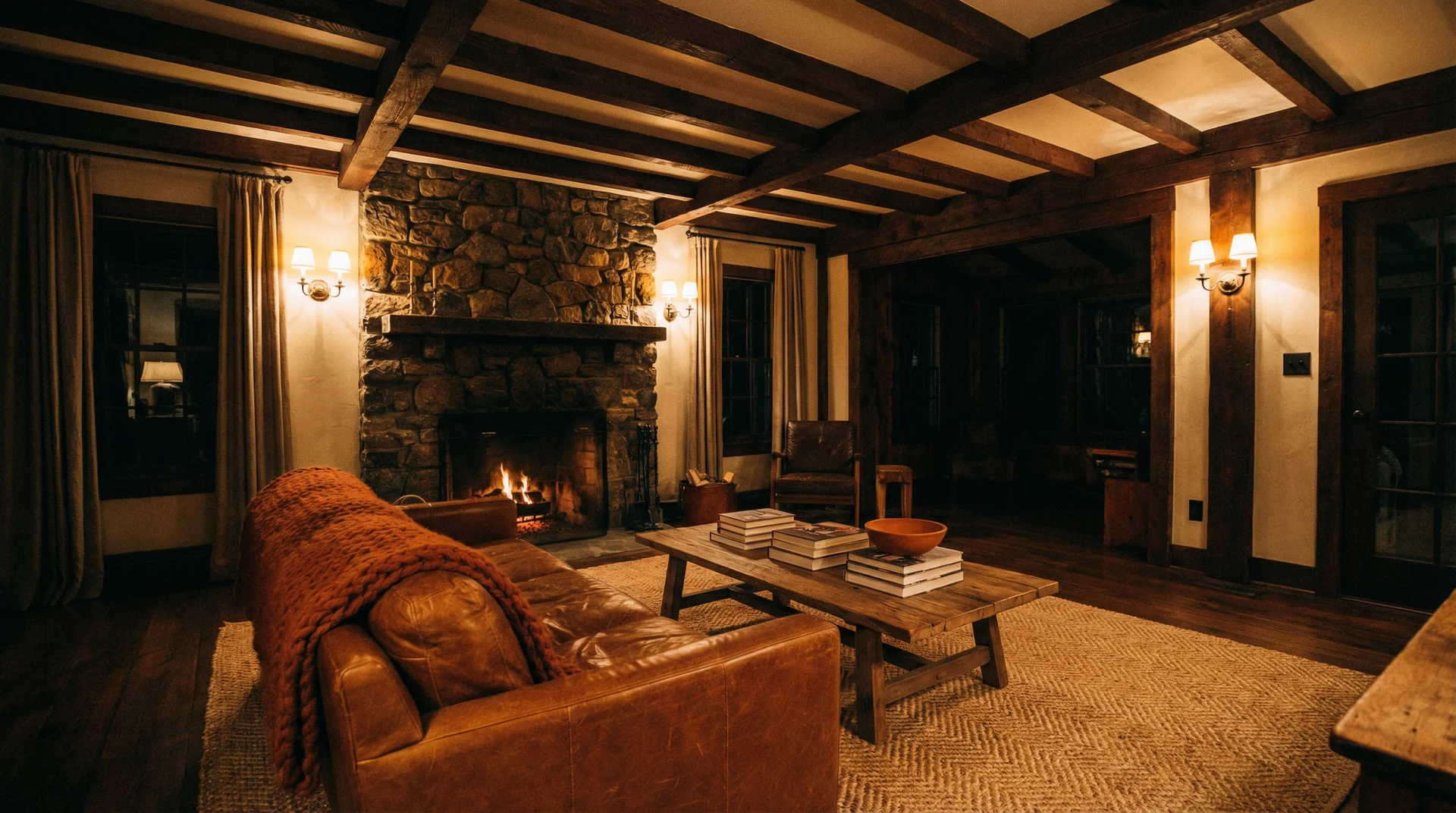
This is the version people picture when they say “rustic.” Dark walnut beams, a stone fireplace, a cognac leather sofa with a burnt orange wool throw tossed over one arm. It looks like nobody designed it, which is exactly the point.
Rooms like this take years to accumulate in real life, but the palette itself is simple: one warm, saturated color, natural materials in dark and earthy tones, and almost no accessories that feel purchased-for-the-look.
2. Burnt Orange Sofa Against Warm Cream Walls
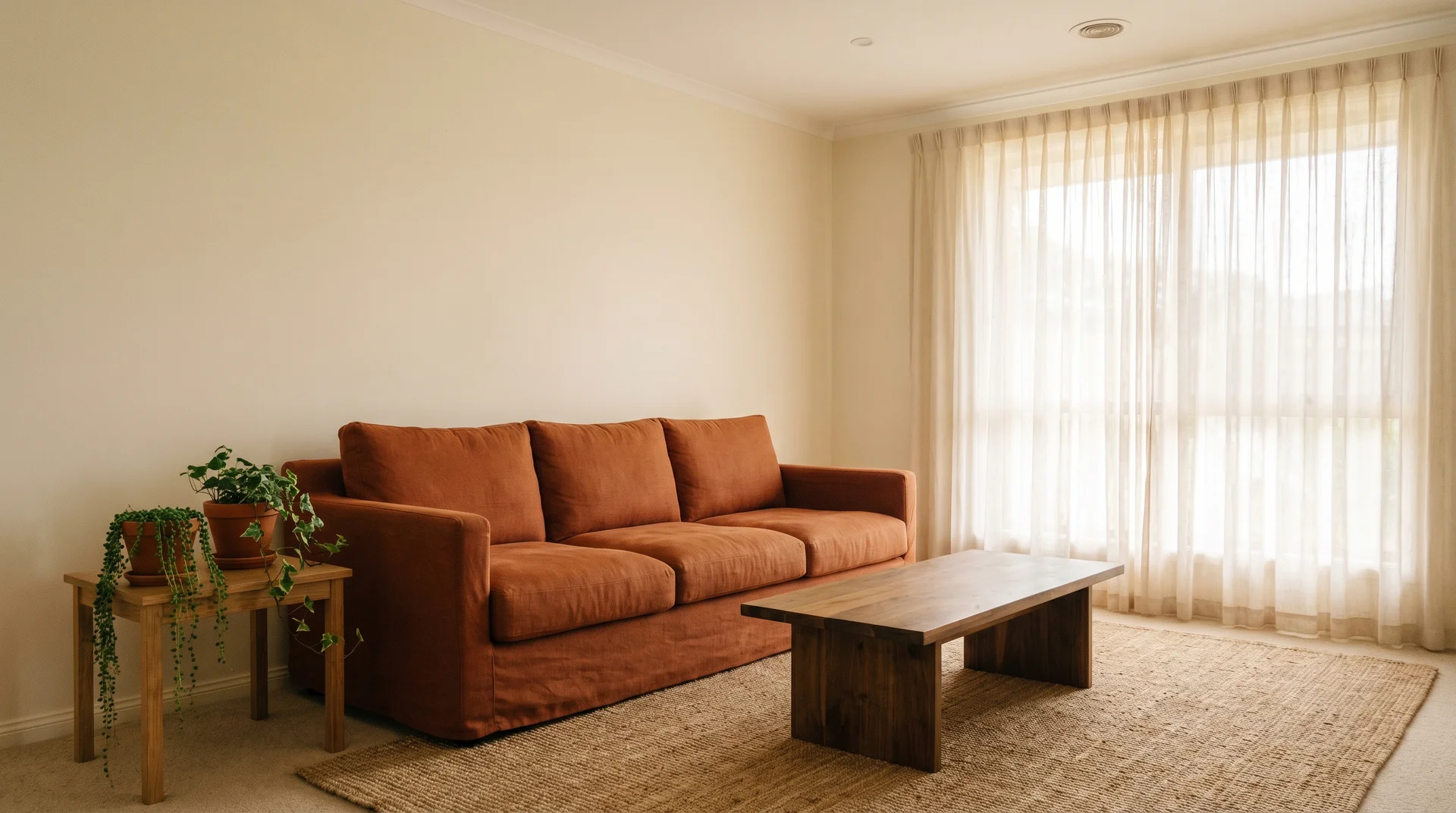
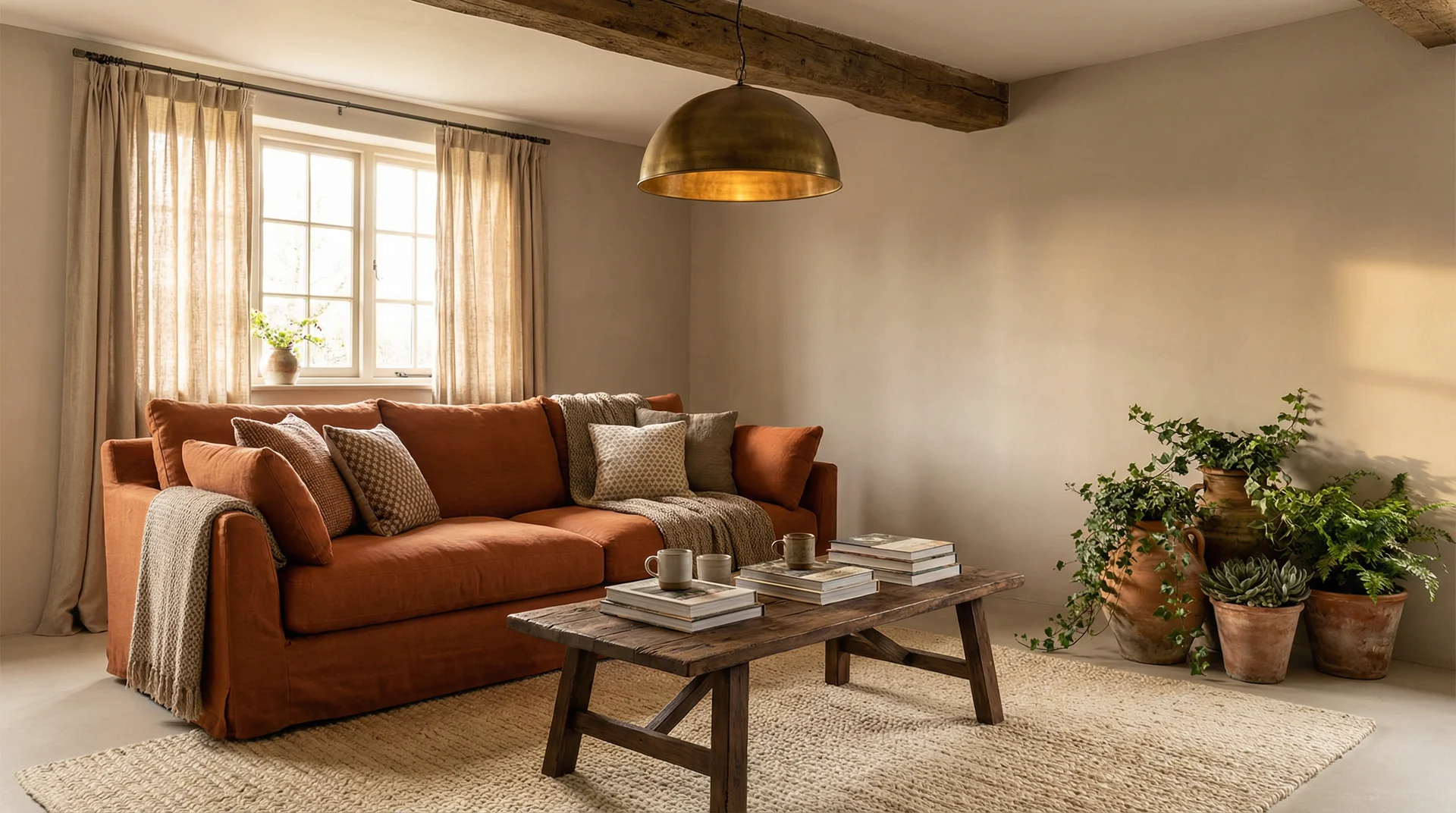
Sometimes the simplest version is the best version. Warm cream walls, a burnt orange linen sofa, a jute rug, and nothing else competing for attention. The sofa carries the whole palette.
This approach works especially well in smaller rooms or in homes where the architecture already has personality, because the color does the work and the room doesn’t feel overworked.
3. Burnt Orange and Olive Green Earthy Space
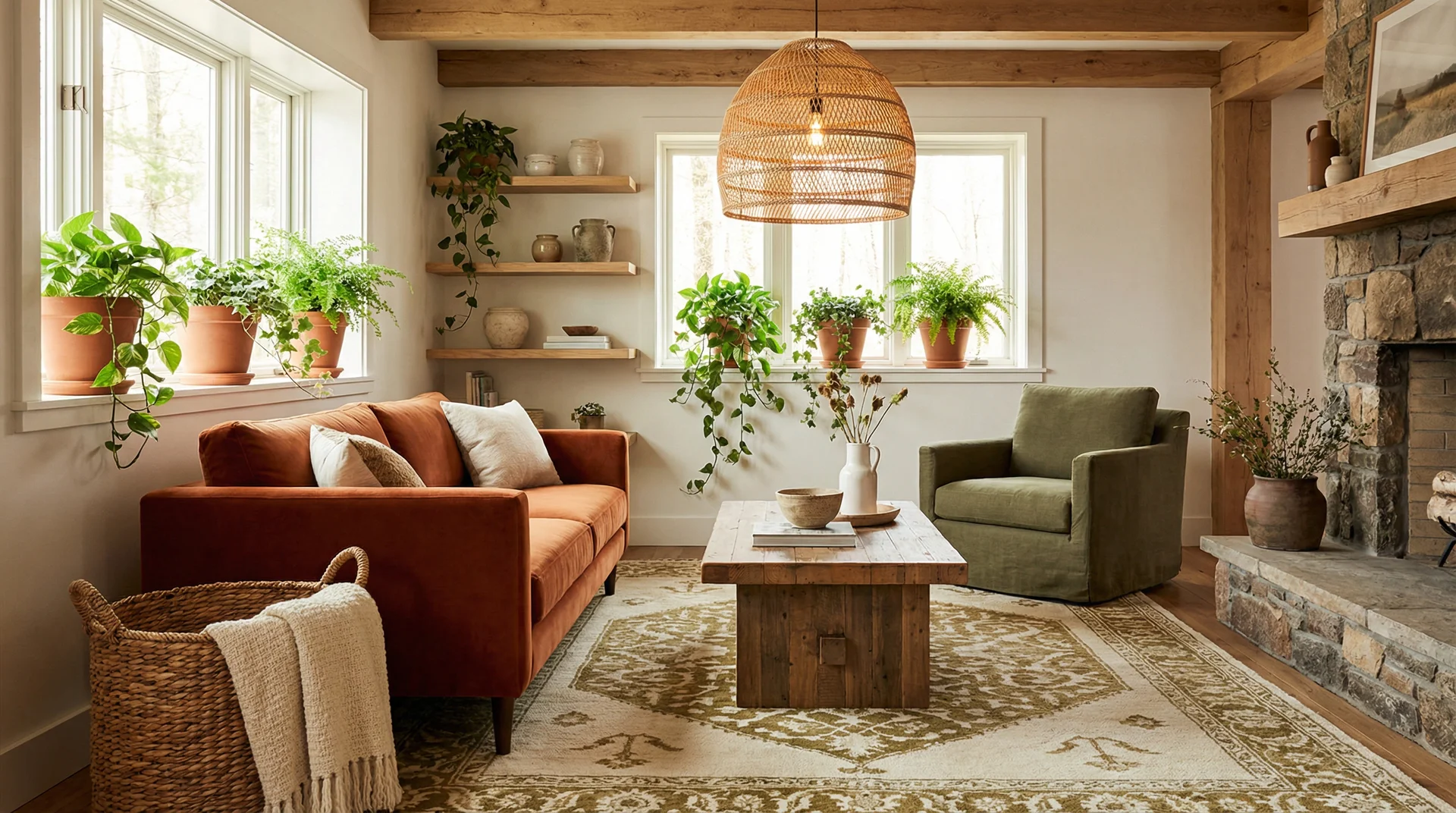
Olive green and burnt orange are one of those combinations that look collected rather than coordinated. An olive armchair beside a burnt orange sofa, a rattan pendant light, woven baskets on the floor, trailing plants in terracotta pots.
Every element references something natural, and the room reads as an extension of the outdoors. This is the palette for people who want a living room that feels genuinely grown rather than styled.
4. The Navy and Burnt Orange Contrast Room
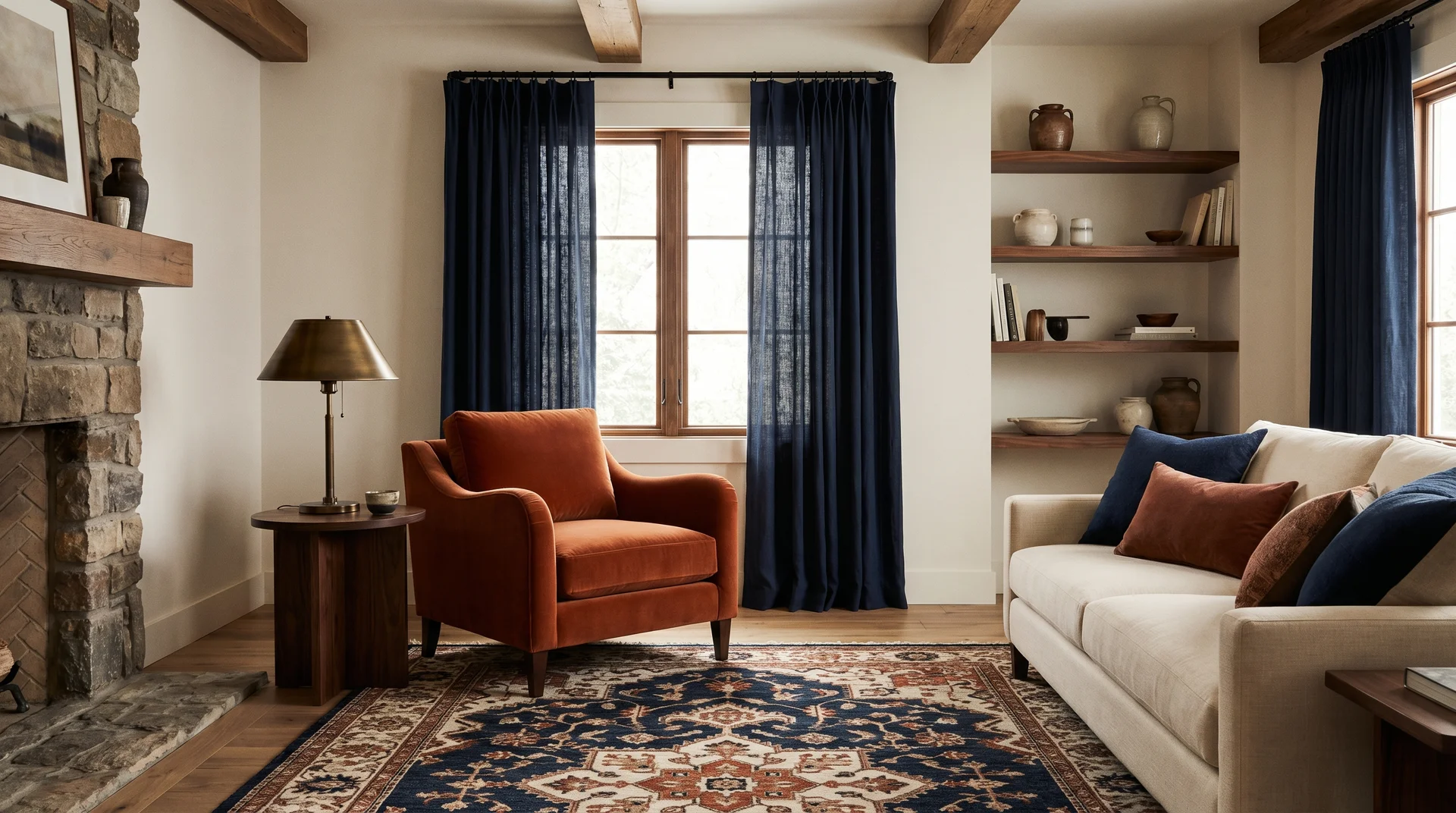
Navy and burnt orange sit on opposite sides of the color wheel, which means they do something useful for each other: the navy makes the orange look richer, and the orange stops the navy from reading cold.
In a rustic context, the trick is keeping the materials warm, walnut rather than lacquer, aged brass rather than chrome, linen rather than polyester. Done that way, the contrast feels considered rather than graphic.
5. Terracotta Walls With Burnt Orange Accents
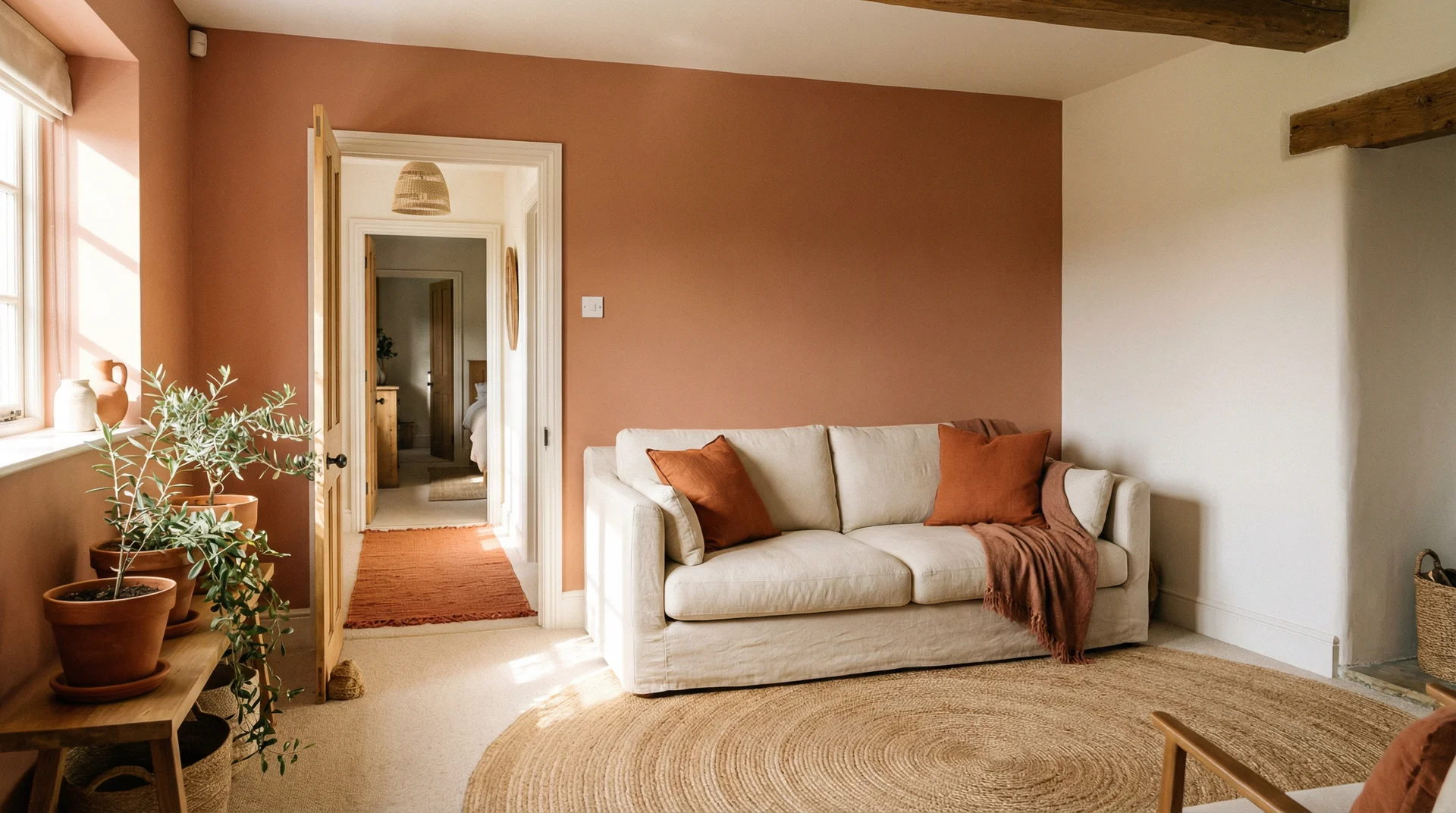
Terracotta walls with burnt orange accents are a tonal approach, and it is one of the most low-risk ways to live inside this palette fully. The walls do the colour work quietly, and the burnt orange appears only in cushions and a throw.
Because the tones are closely related, the room reads as cohesive and intentional rather than bold. This is the version I recommend to clients who love the palette but describe themselves as “not really a color person.”
6. The Boho Rustic Layer
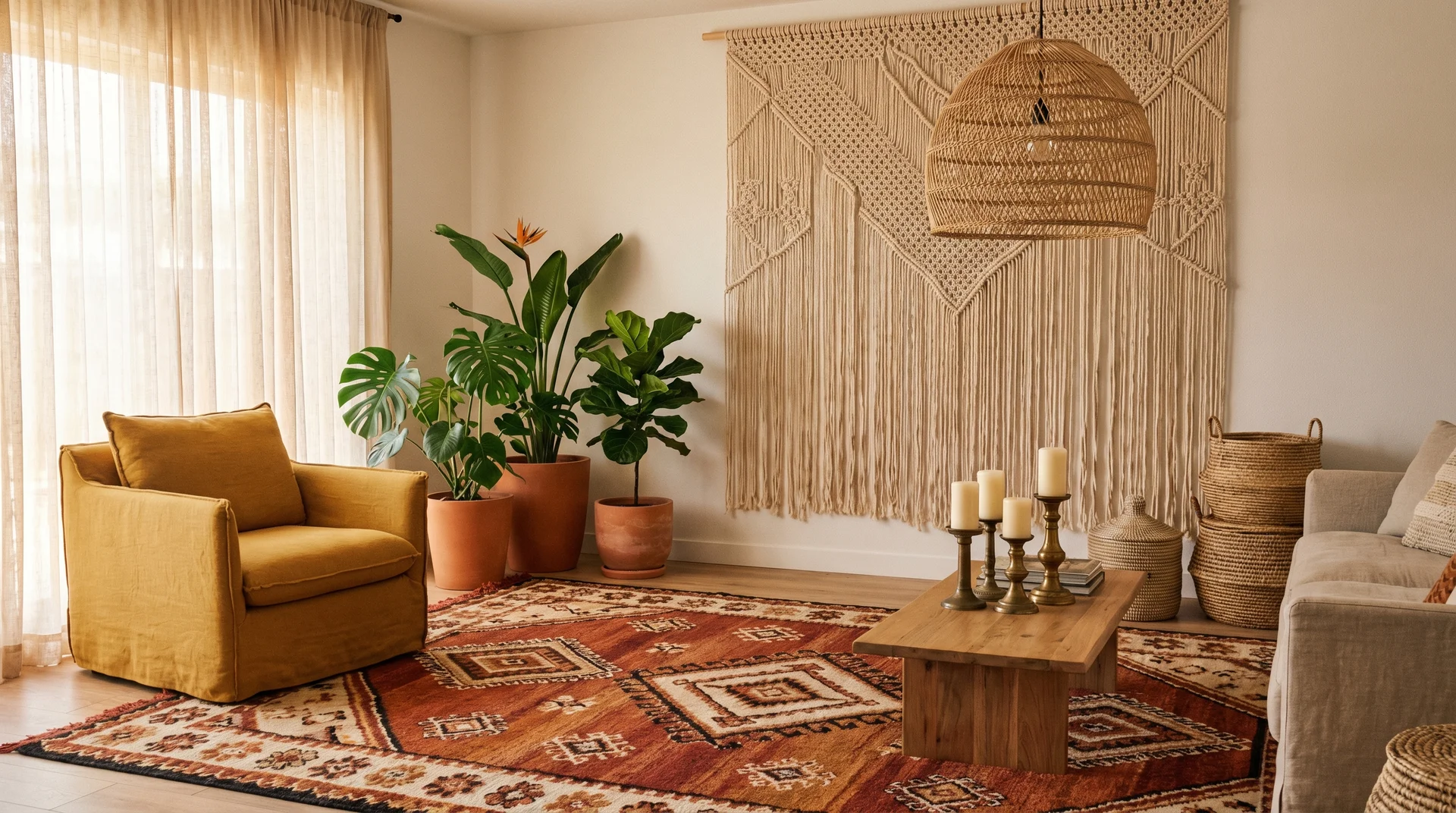
This version has the most personality of the twelve. A Moroccan-style rug in burnt orange and rust, a mustard armchair, a macramé wall hanging, rattan everywhere, and plants in every corner. The boho rustic look works because it has no strict rules.
Things can come from different places, different periods, different cultures. The palette is the connective thread, and as long as you keep the tones warm and earthy, almost everything else can co-exist without a fight.
7. Burnt Orange Curtains in a Neutral Rustic Room
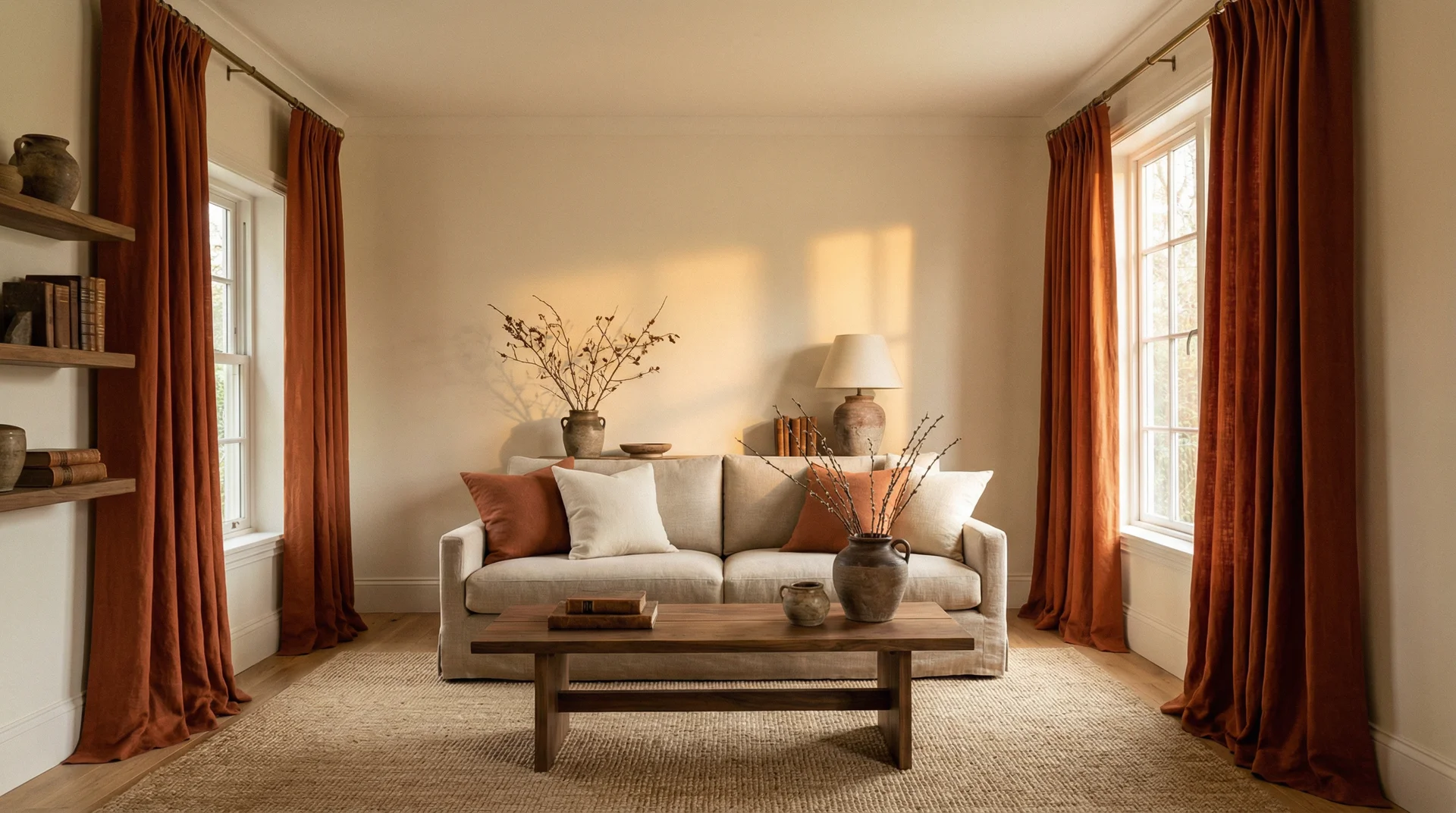
If you want this palette with zero commitment to furniture or paint, curtains are the answer. In a room that is otherwise entirely cream and walnut, floor-length burnt orange linen curtains do the work of an accent wall without touching a surface you cannot easily undo.
The key is hanging them properly: high above the window frame, wide on both sides, long enough to reach the floor. Get those three things right, and the curtains stop looking like a window treatment and start looking like a design decision.
8. The Burnt Orange Reading Nook
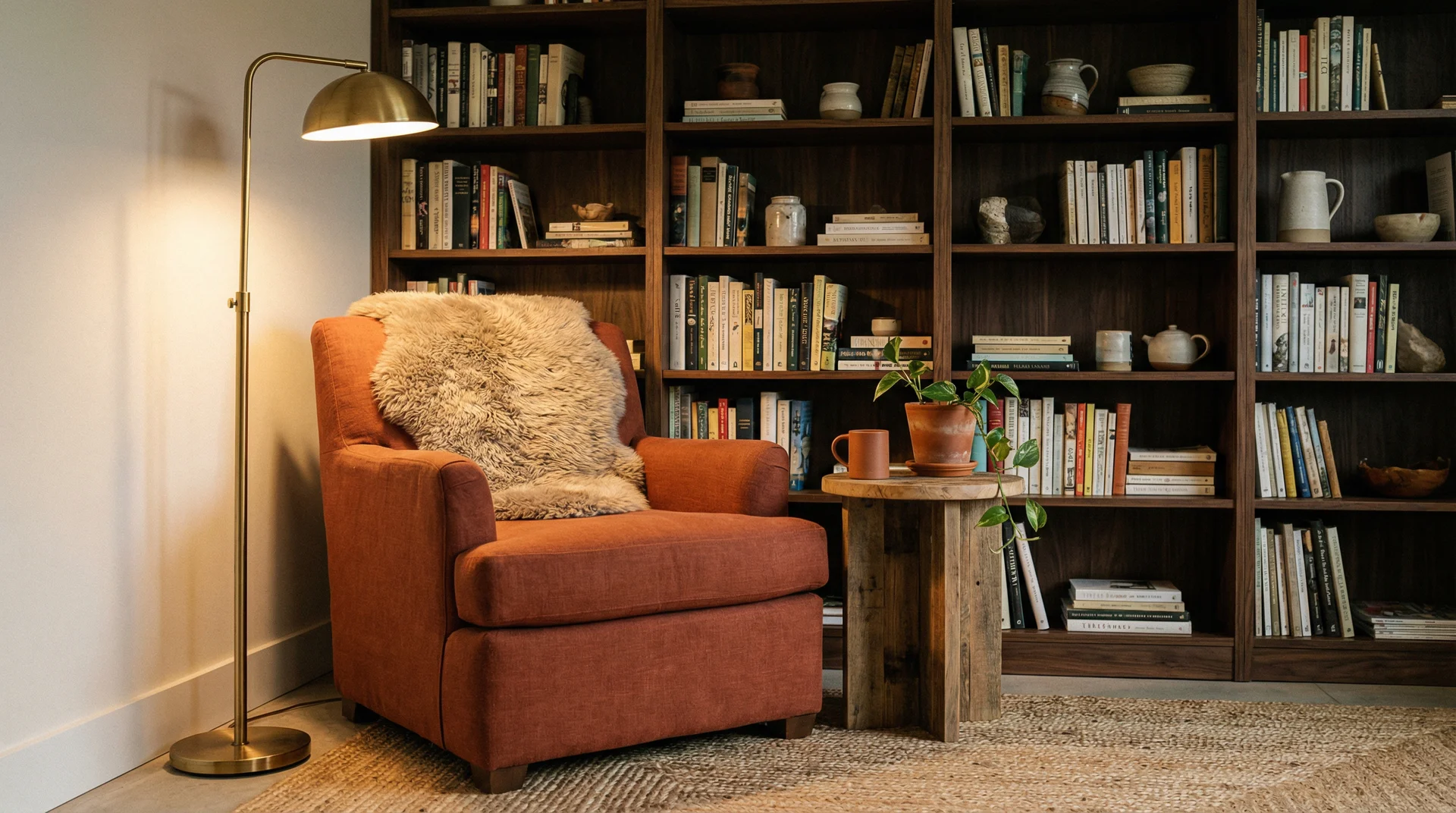
A single burnt orange armchair, a sheepskin throw, a brass floor lamp, and a floor-to-ceiling bookshelf in dark walnut. You don’t need a whole room.
Sometimes a corner is enough, and this corner says everything you need to say about this palette: warm, worn-in, and genuinely inviting.
I have styled versions of this nook in at least half a dozen client homes, and it is consistently the corner that people gravitate toward when they visit.
9. Burnt Orange Accent Wall With Dark Wood Furniture
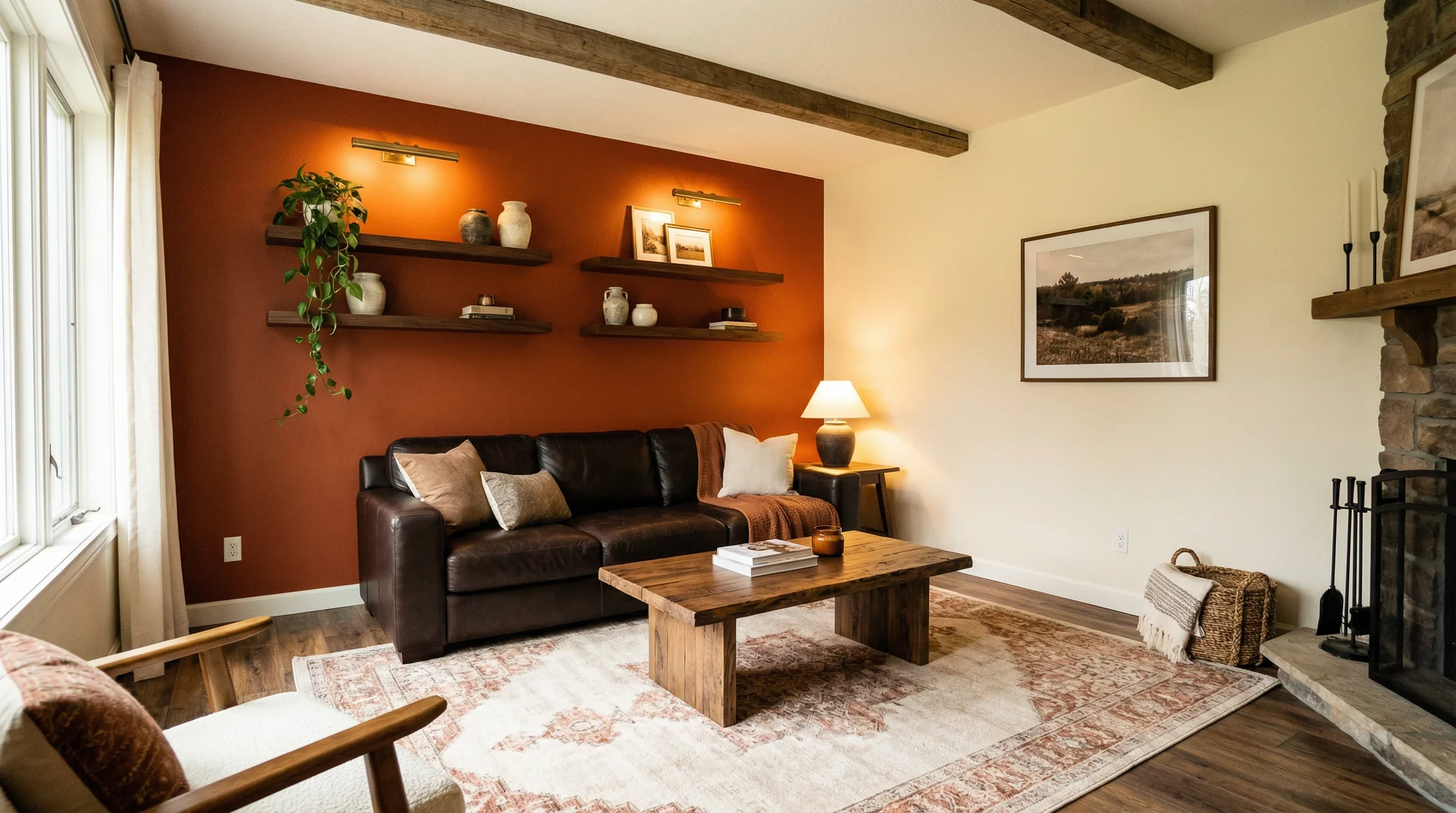
One wall in Sherwin-Williams Cavern Clay, the other three in warm cream, a dark leather sofa, walnut shelving, and brass hardware. This is the most dramatic version of the palette done cleanly. The key is that everything except the wall stays calm and grounded.
When clients want something that feels like a real commitment, this is what I show them. It reads confident without reading maximalist.
10. The Warm Minimalist Rustic Take
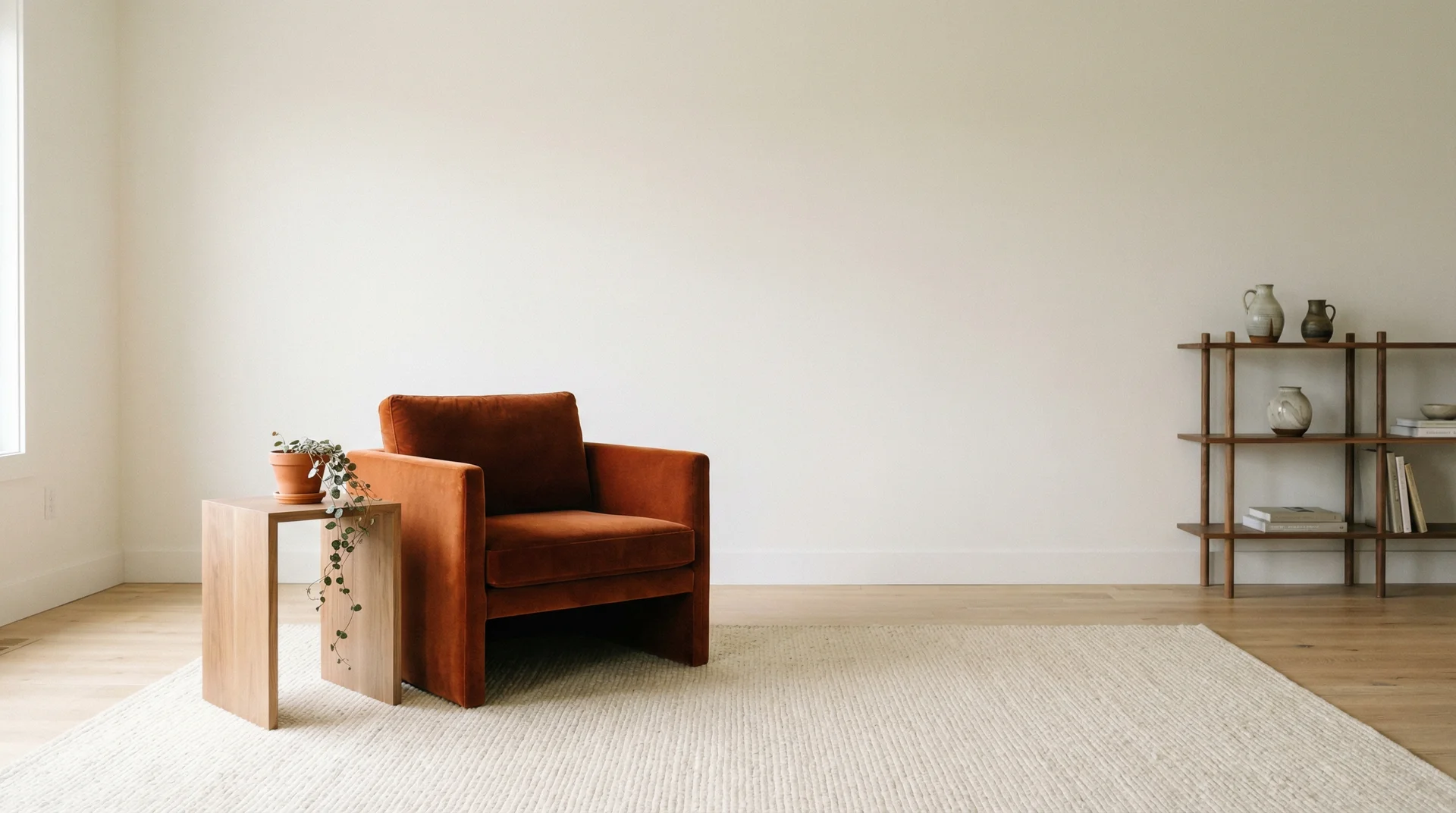
Burnt orange has the most impact when it has the least competition. One armchair in a rich burnt orange velvet, white oak floors, warm white walls, a terracotta pot, and nothing else.
This is the version for people who love clean, quiet rooms but want one piece that carries real warmth. The colour does not need to be everywhere to be felt. Sometimes one chair is the whole statement.
11. Rustic Burnt Orange and Mustard Yellow
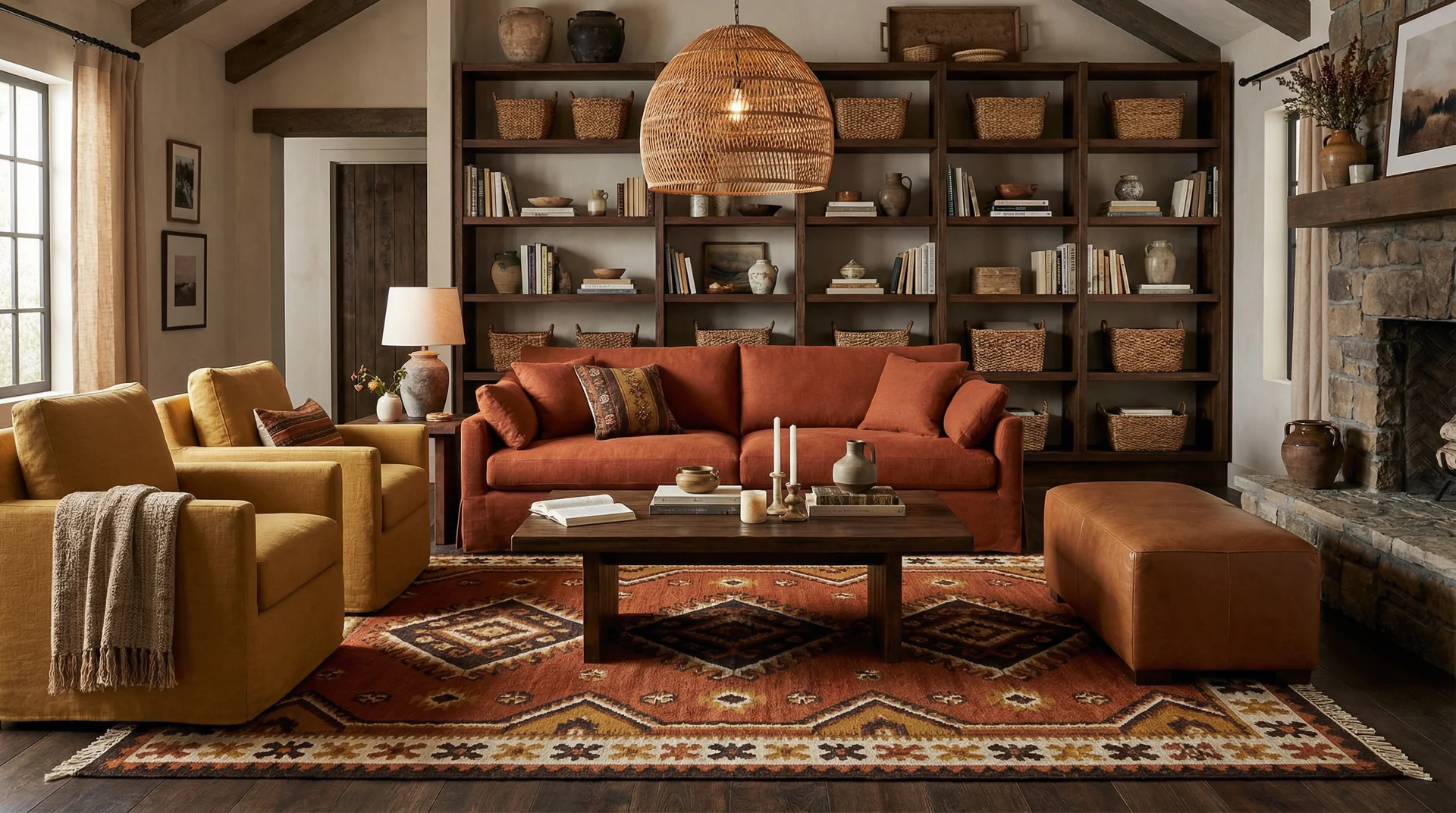
Burnt orange and mustard yellow are closely related on the colour wheel, which means they create harmony rather than contrast. The room reads as autumnal in a rich, intentional way, not in a seasonal decoration store way.
If you want a palette that feels fully committed and unapologetically warm, this combination delivers it. The deep, patterned rug is what ties it together. Without it, the sofa and chairs feel like mismatched pieces. With it, the whole room reads as a considered whole.
12. Burnt Orange Living Room With Black Accents
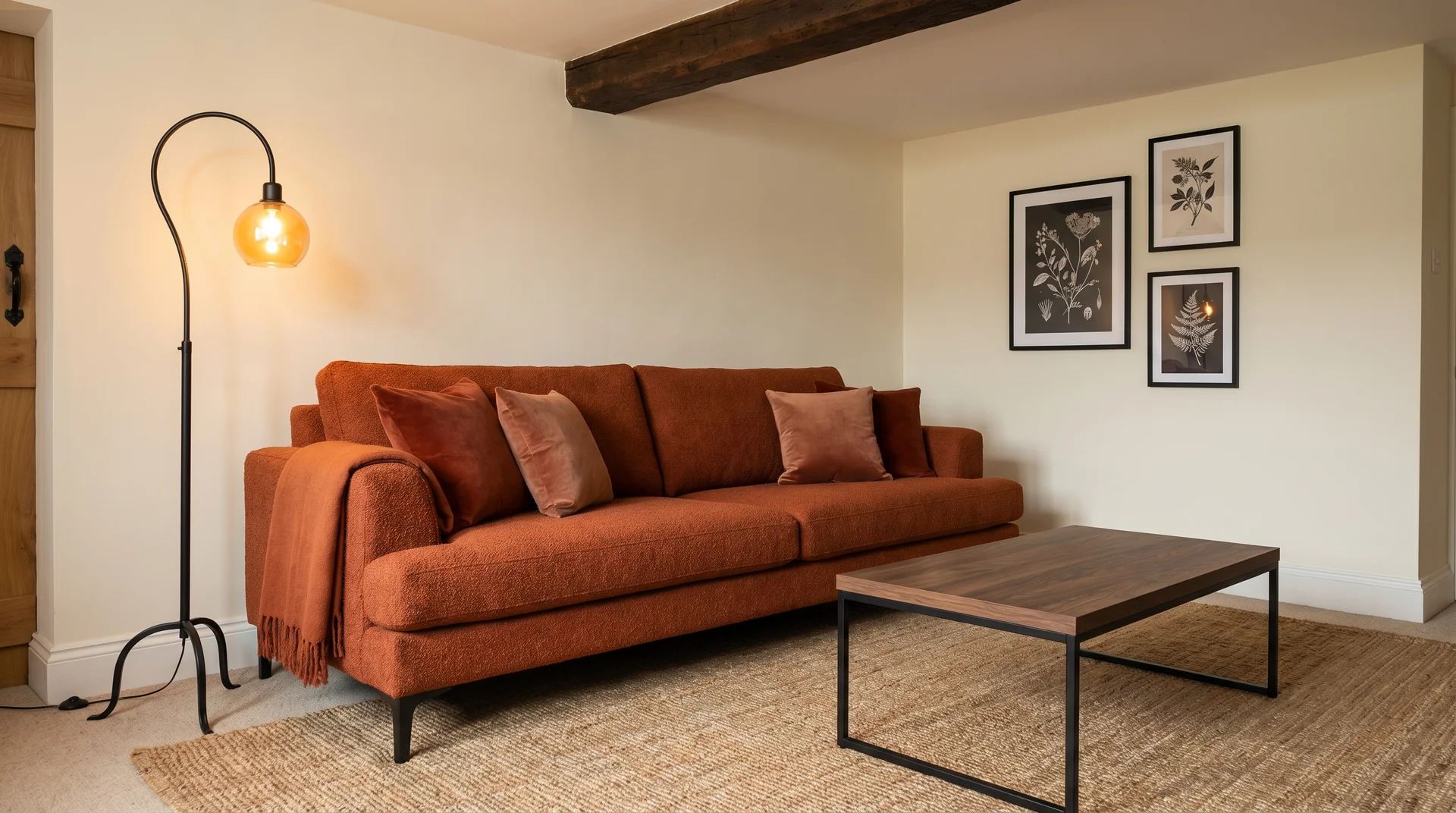
Black grounding a burnt orange room is one of those combinations that looks more intentional than it sounds. A black wrought iron floor lamp, black picture frames, and a dark exposed beam overhead.
The black stops the orange from reading sweet or kitschy, and it adds a modern edge that keeps the room from sliding into full country-cottage territory. If you want rustic burnt orange without the farmhouse association, this is the version to look at.
Rustic Burnt Orange Living Room Looks You Can Recreate Instantly
Look 1: Start With What Your Neutral Sofa Already Has
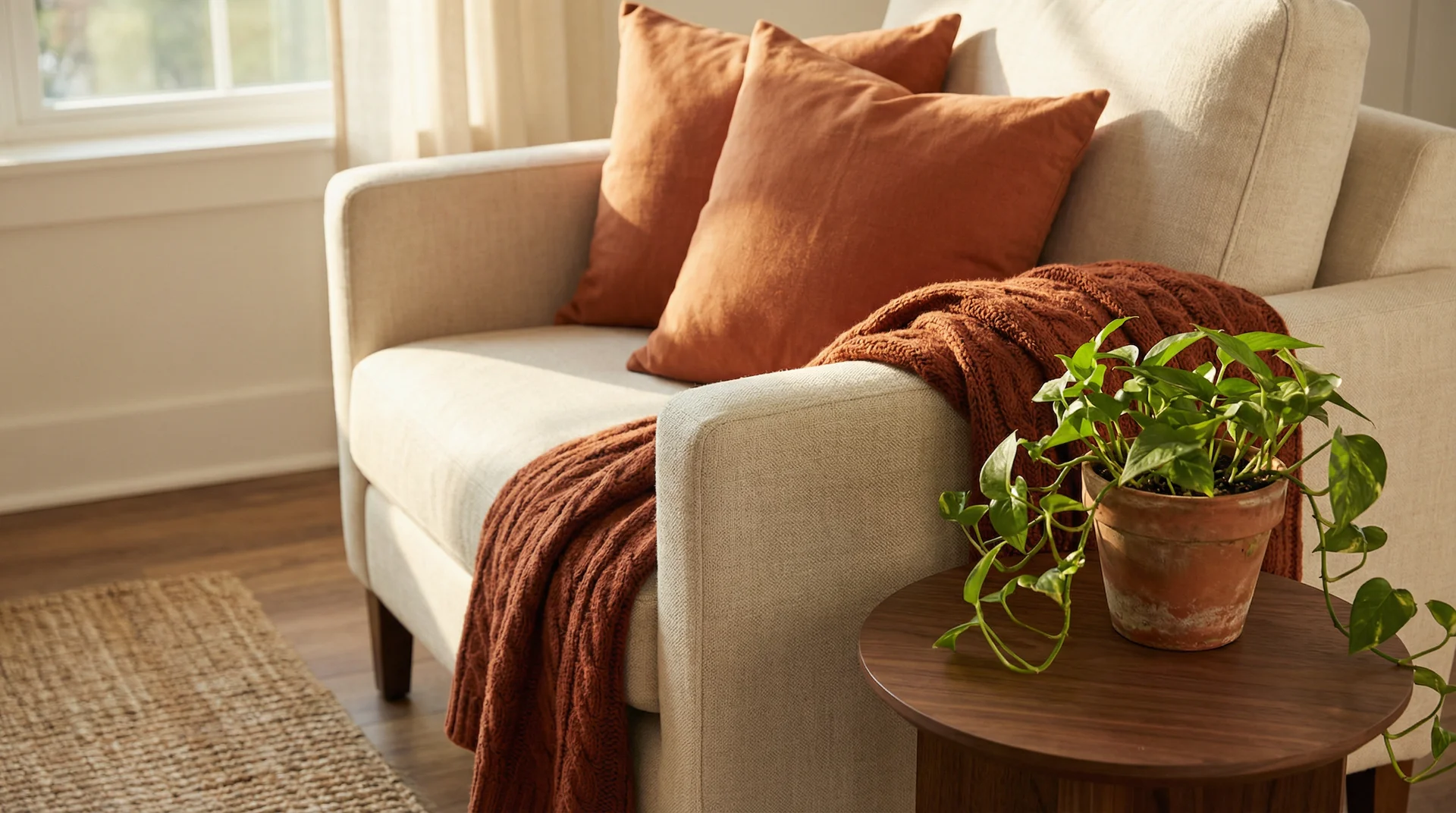
You don’t need a new sofa. If you have a cream, beige, oatmeal, or grey-beige sofa, you already have the neutral base this palette needs. Add two burnt orange cushion covers, one rust-toned throw, a jute rug in natural undyed tones, and a terracotta planter with a trailing plant.
Total investment for this version sits comfortably under $150, depending on where you shop. The room changes. Significantly.
Look 2: One Wall, Everything Else Stays Put
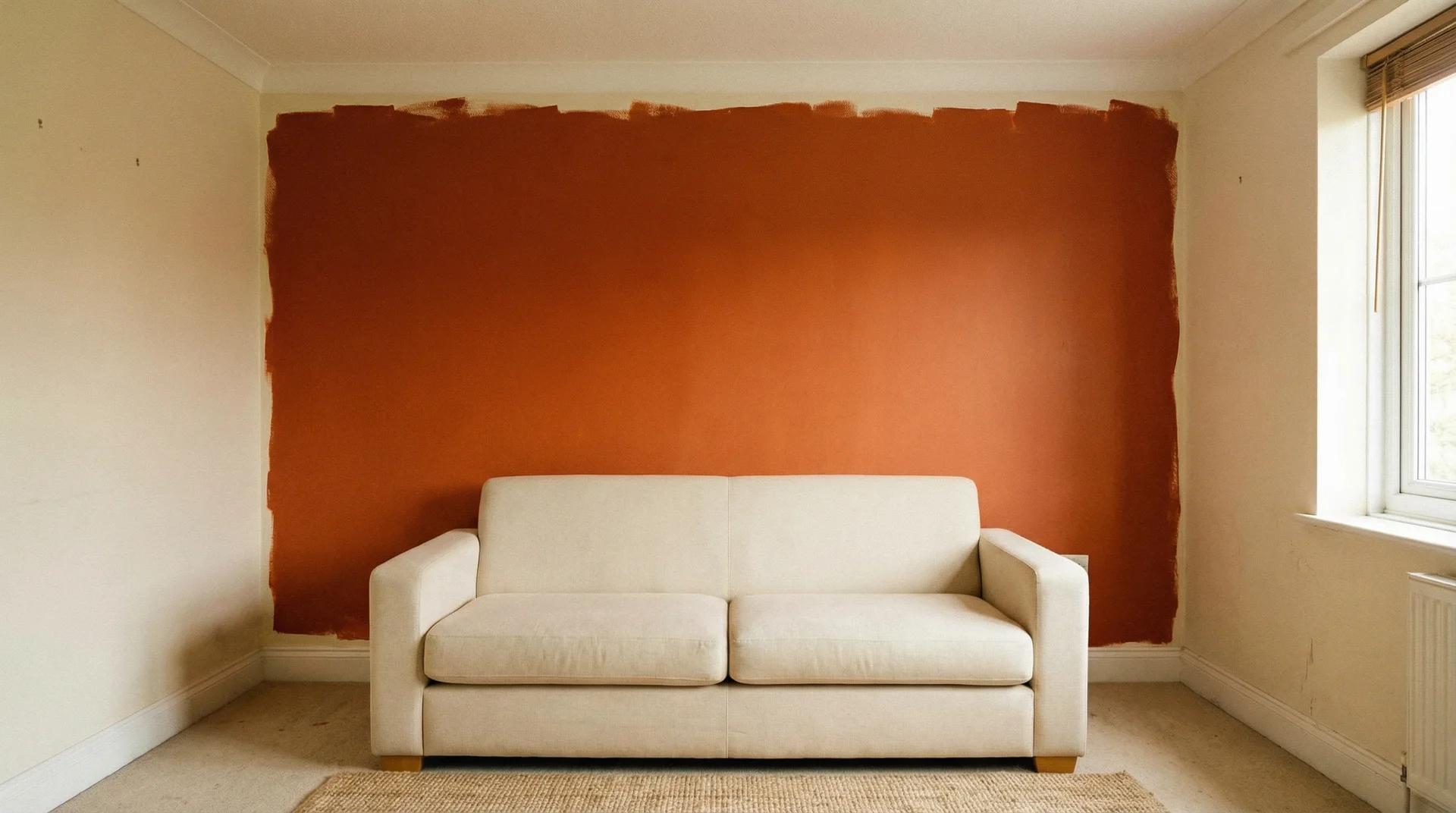
If you want to test this palette at scale without buying anything, paint the wall behind your sofa. Just that one wall.
Sherwin-Williams Copper Harbor (SW 6634) is the shade I recommend for this specific scenario, because it is muted enough to feel sophisticated in rooms that are otherwise untouched, and warm enough to read as intentional rather than accidental. Keep every piece of furniture exactly where it is.
See what the room becomes in two days.
Look 3: Dark Floors Are Already Half the Work
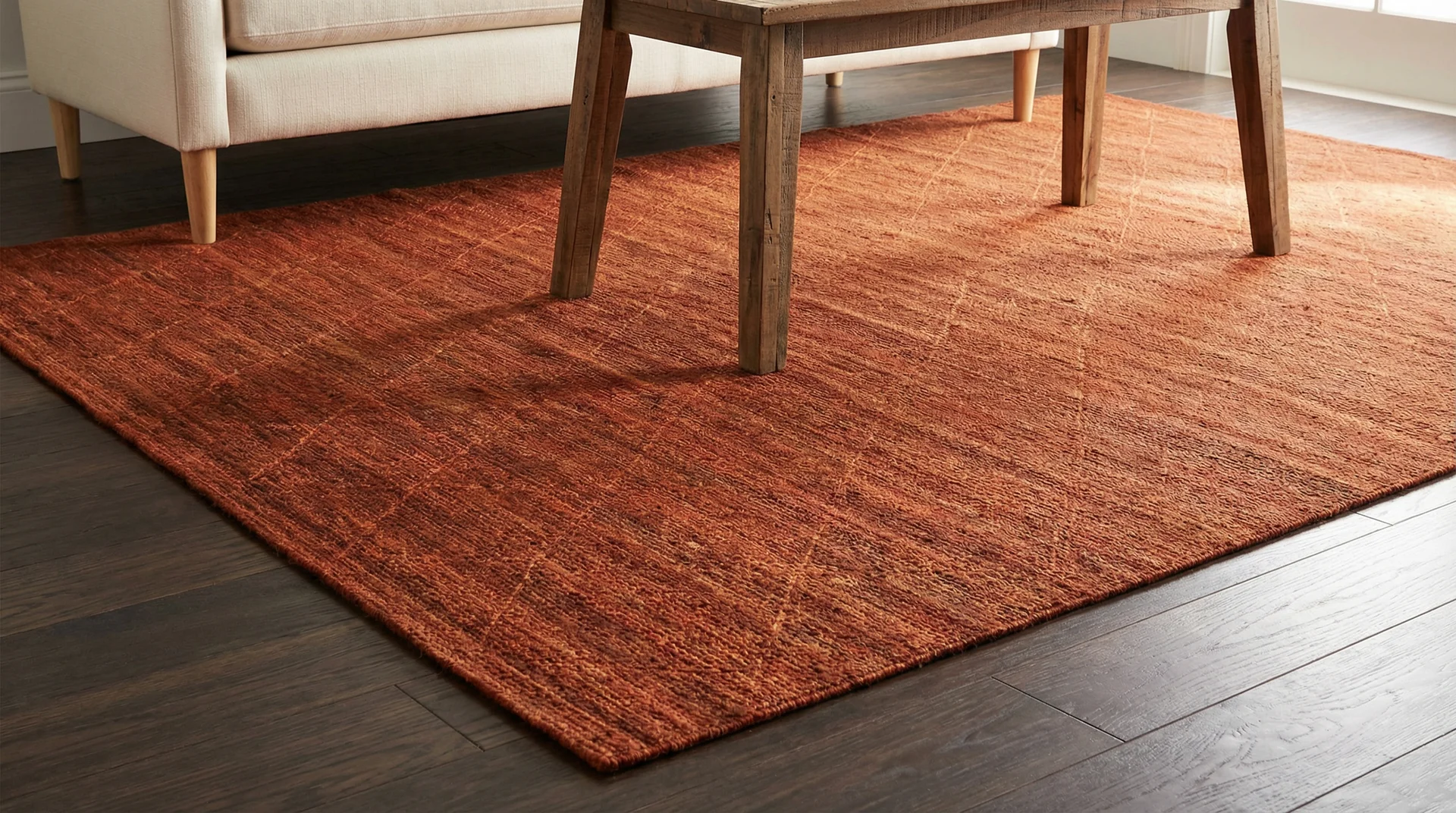
If your living room has dark hardwood, dark tile, or dark laminate flooring, you are already halfway to this palette. Dark floors are what ground burnt orange and stop it from floating.
A burnt orange area rug on dark hardwood is one of the most forgiving, highest-impact combinations I know. You don’t need to change the floor, paint the walls, or buy new furniture. The rug does the work.
Look 4: The Renter’s Version
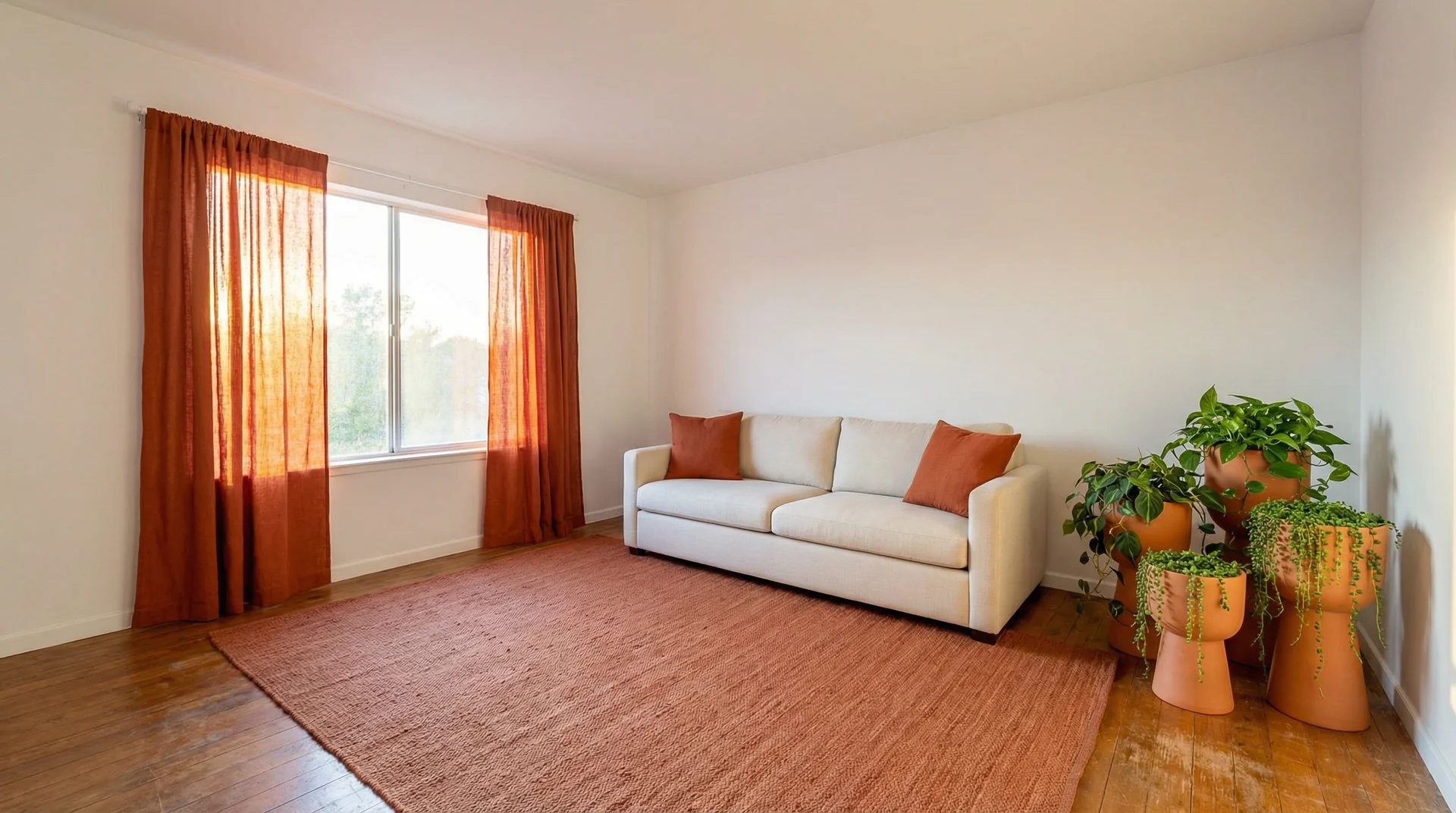
You cannot paint. You may not be able to put large holes in walls. You can still have this palette entirely.
Burnt orange linen curtains hung on a tension rod or a removable adhesive rod bracket, a large terracotta-toned area rug, two burnt orange cushions on whatever sofa you have, and a cluster of terracotta planters with living plants in one corner. No surface gets touched. No deposit is risked.
The room still shifts into the warm, earthy territory this palette delivers.
Look 5: The Full Commitment, Four Decisions Only
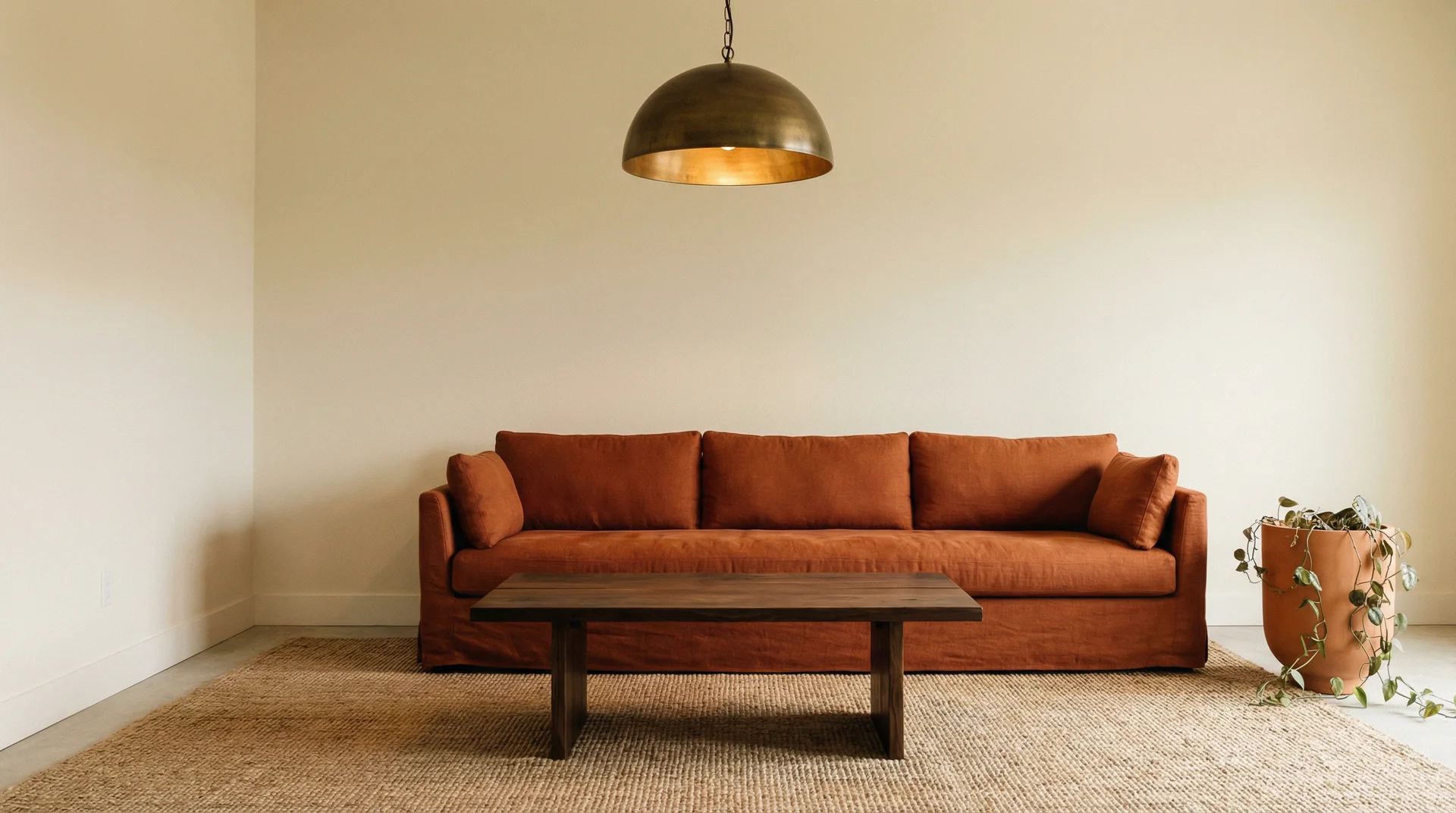
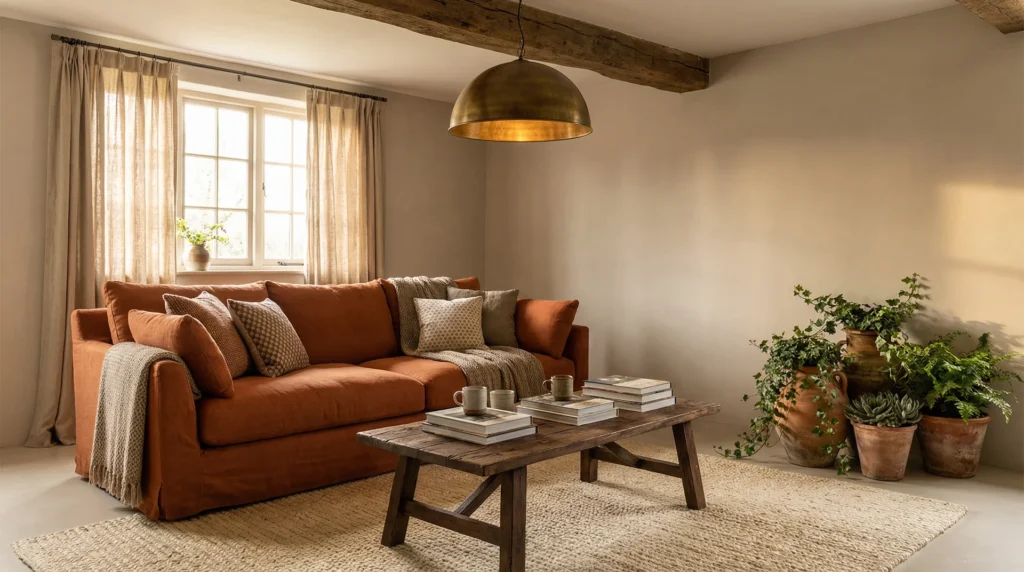
A burnt orange sofa. Warm cream walls. A dark walnut coffee table. An aged brass pendant light. Those are four decisions, and they resolve a room completely. Nothing else is required.
No accent wall, no gallery arrangement, no accessories beyond a single terracotta planter if you want it. This version works because it refuses to overcomplicate itself. The sofa is the palette. Everything else is support.
Look 6: The Bohemian Version, No Furniture Purchase Needed
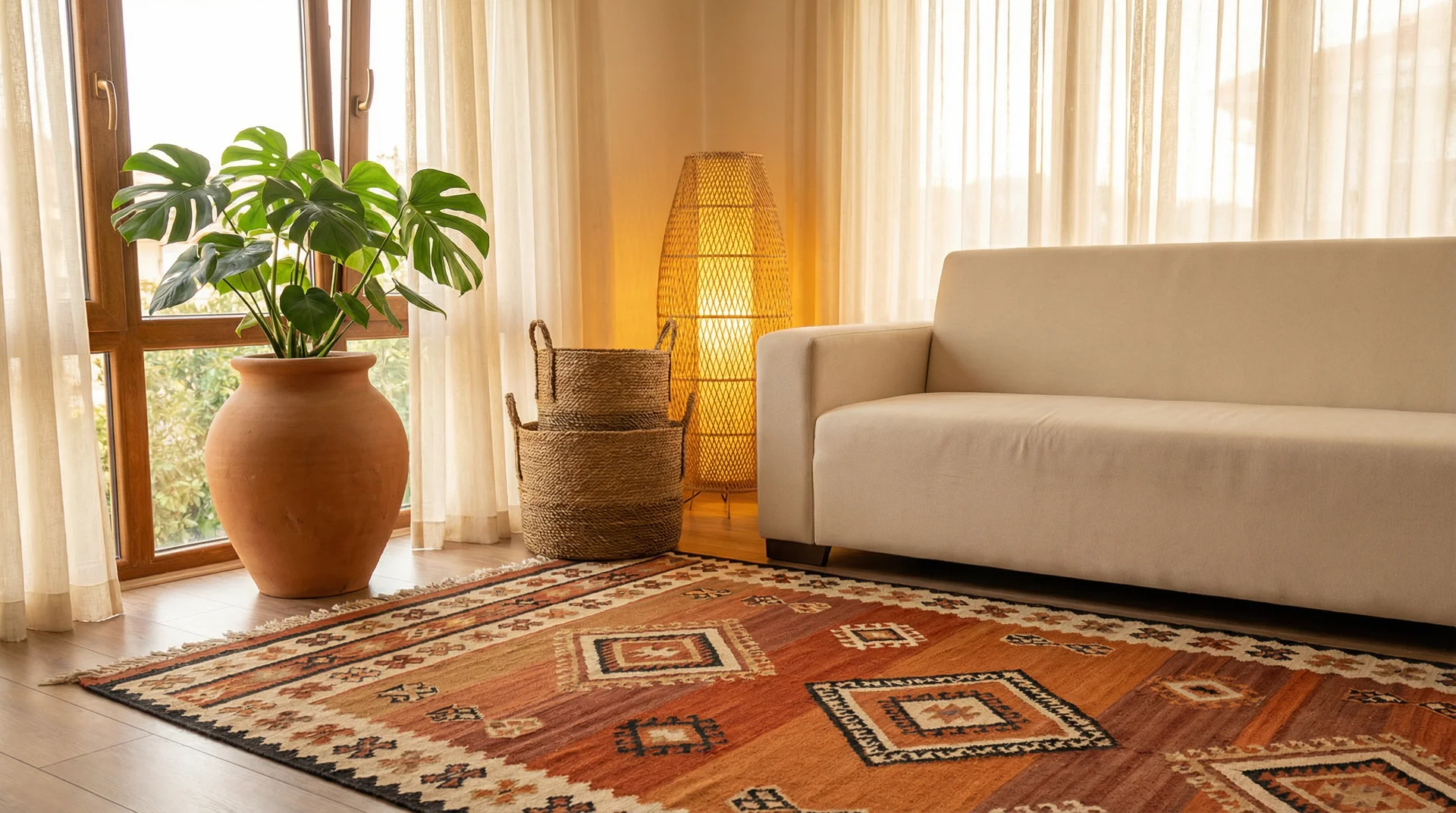
A Moroccan-style rug in burnt orange, rust, cream, and black with a geometric pattern. A rattan floor lamp in the corner with a warm bulb. Two woven baskets are stacked beside the sofa. One oversized terracotta planter with a large-leafed plant. That is the whole look.
The rug does most of the work. If your sofa is neutral, it becomes part of this palette by proximity. If your sofa is an unexpected color, the rug either harmonizes with it or gives you a reason to throw a cream cover over it while you figure out the next step.
Look 7: If You Have a Fireplace, You Already Have the Anchor
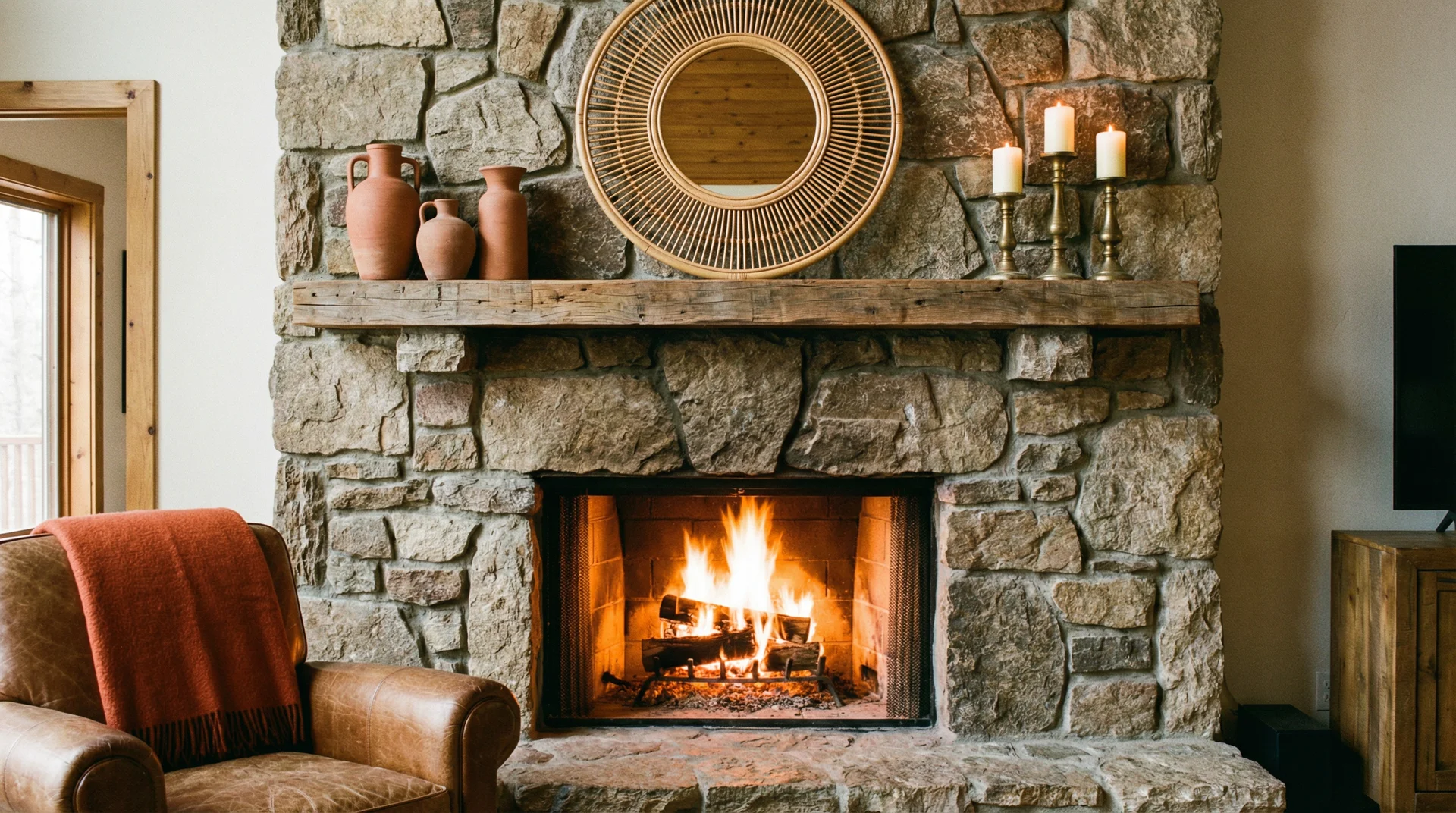
A stone or brick fireplace surround is the strongest rustic anchor a room can have.
If you have one, you need almost nothing else to create this palette. Style the mantle with a cluster of terracotta vessels in varying heights, add one warm-toned artwork or a circular rattan mirror above it, group three pillar candles in aged brass holders to one side, and drape a burnt orange wool throw over the armchair you probably already have nearby.
The fireplace does the rustic work. Your job is just to warm the accessories around it.
Look 8: The Smallest Possible Version That Still Works
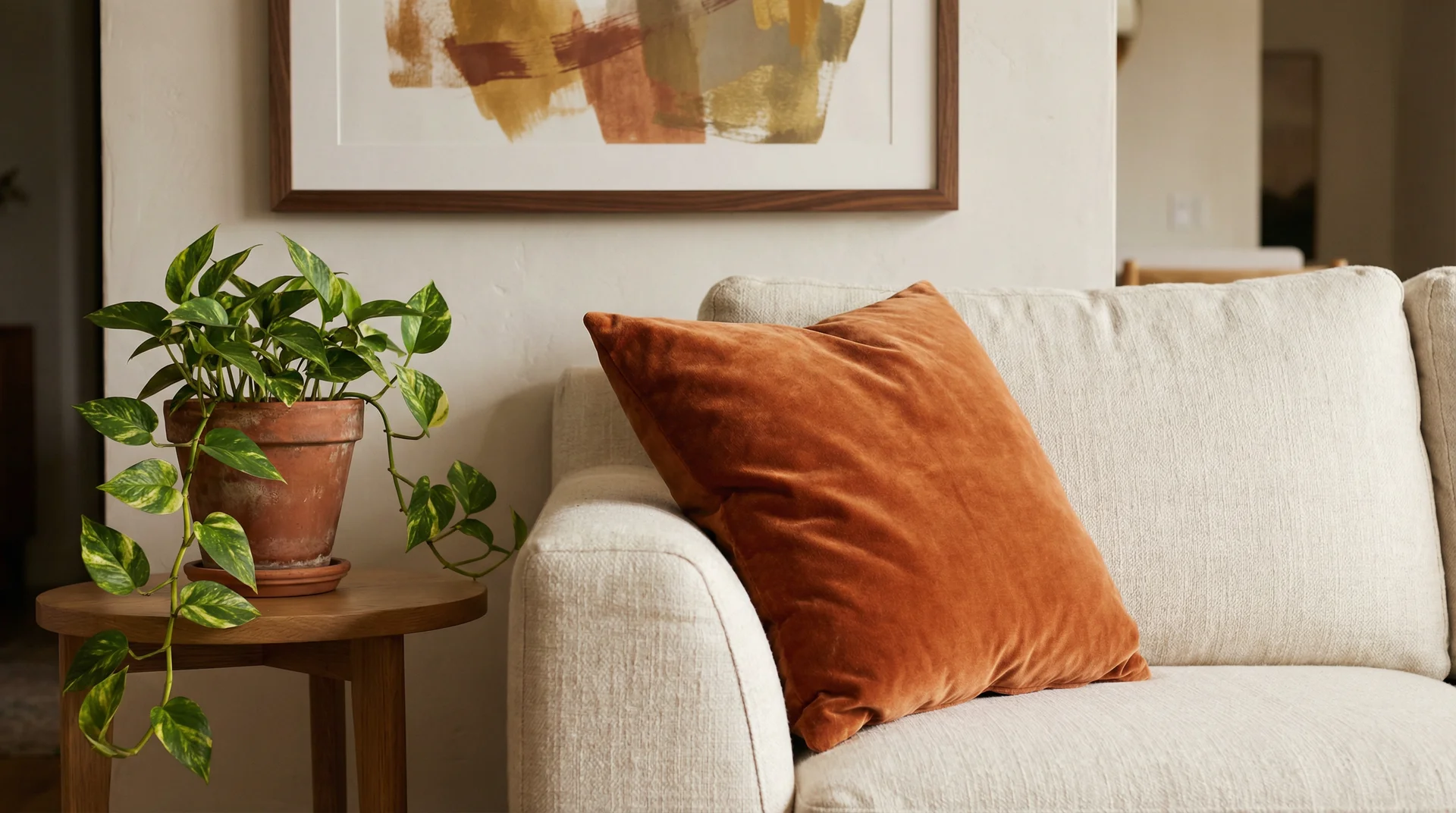
One burnt orange velvet cushion. One terracotta pot with a trailing plant. One piece of warm-toned wall art with earthy ochre or rust tones. All three together, in a room that is otherwise completely untouched, cost under $60 and move the needle more than most people expect. This is not a completed room.
It is a proof of concept. And a proof of concept is sometimes exactly what you need before you decide whether to go further.
What Makes a Living Room Truly “Rustic Burnt Orange”
Burnt orange sits deep on the color spectrum, pulled toward red and brown. That earthiness is what separates it from a bright pumpkin orange. But the color alone does not make a room rustic. The materials around it do.
When I talk about rustic interiors, I mean spaces where natural materials carry the visual weight: wood grain, stone, woven fiber, and aged leather. Burnt orange belongs in this context because it speaks the same visual language.
It reads like dried leaves, terracotta clay, autumn bark. Place a burnt orange sofa in a room with glass, chrome, and polished concrete, and it will not read rustic at all. For that specific quality, you need the material palette to support it:
- Reclaimed or dark-stained wood in furniture legs, coffee tables, and shelving
- Leather in cognac brown, dark chocolate, or natural tan
- Woven textures like jute, dark wood rugs, rattan lampshades, linen curtains, woven baskets
- Stone or brick as a fireplace surround or exposed wall element
- Wrought iron or aged brass as hardware, lighting, or curtain rods
When two or three of those materials appear alongside burnt orange, the room settles into the warm, grounded feeling people mean when they say “rustic.”
Burnt Orange vs. Terracotta vs. Rust: Getting the Shade Right for Your Rustic Living Room
These three names get used interchangeably. They are related, but they are not the same, and getting this distinction right saves you from ordering paint that looks nothing like your reference image.
| Shade | Undertone | Best for |
|---|---|---|
| Burnt Orange | Red-orange, moderate depth | Accent walls, sofas, statement pieces |
| Terracotta | Orange-brown, dusty clay quality | Walls, planters, small accents |
| Rust | Red-brown, oxidized | Textiles, accessories, secondary tones |
For a rustic living room, all three work beautifully together as a layered palette. I often suggest terracotta on the walls, burnt orange on a single statement piece, and rust in the textiles. That tonal variation prevents the room from reading as one flat block of warm color.
Will Burnt Orange Overpower My Room?
This is the question I hear most. The honest answer: yes, it can, but only when used without understanding proportion, light, and the neutral base around it.
The 60-30-10 Rule for a Rustic Burnt Orange Color Palette
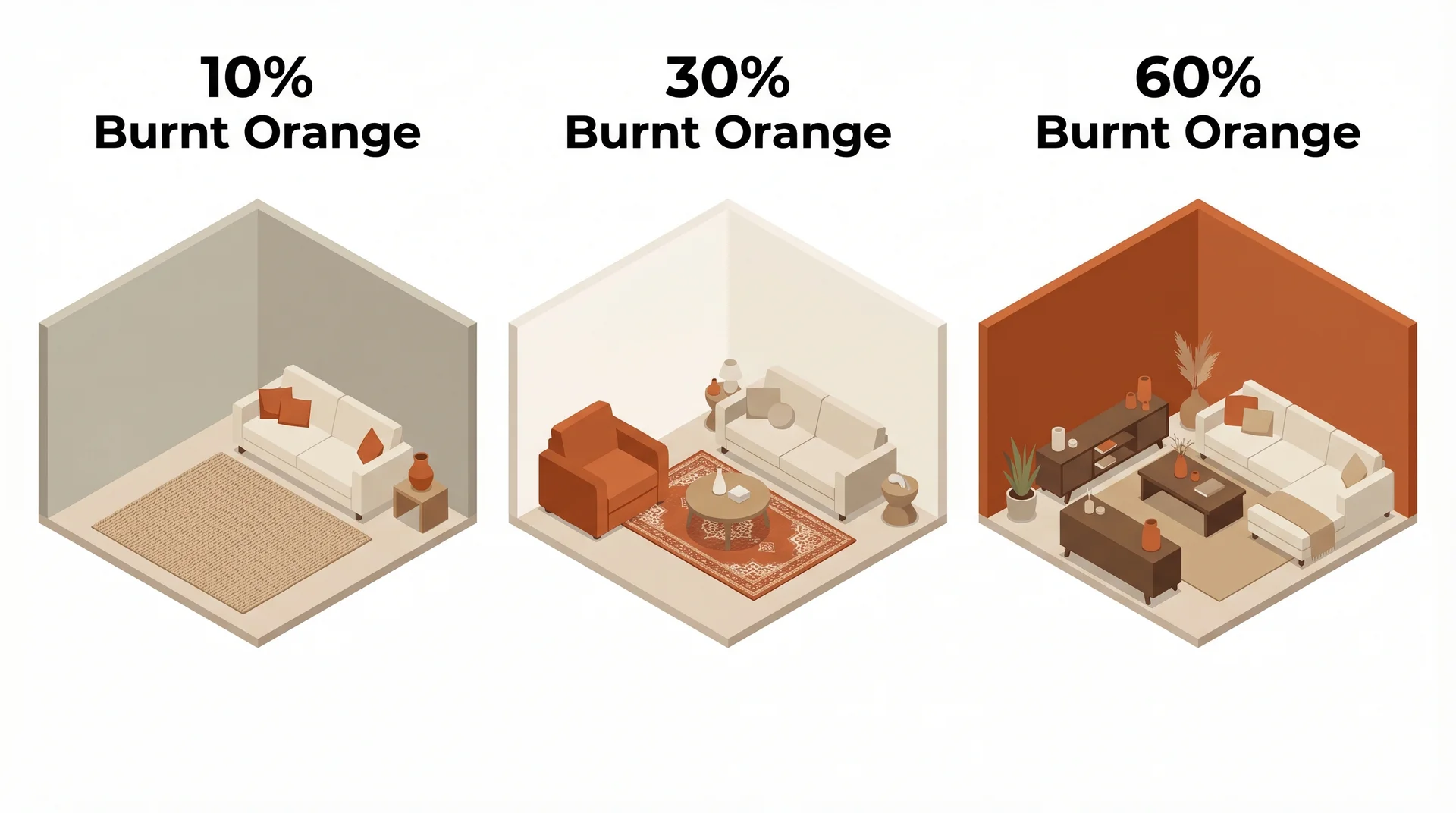
Designers use a proportion guideline: 60% dominant neutral, 30% secondary color, 10% accent. Here is how it plays out in practice:
Burnt orange as your accent (10%): Walls, large sofa, and rug stay neutral. Burnt orange comes through cushions, a throw, a lamp, terracotta pottery. Lowest risk, works in almost any existing room.
Burnt orange as your secondary color (30%): Walls stay neutral, but the sofa or an armchair carries the color. The rug might pick up the tone too. The color becomes the personality of the space without dominating every surface.
Burnt orange as your dominant color (60%): It lives on two or three walls. Everything else stays calm: warm creams, chocolate browns, aged leather, dark wood. This is where the most mistakes happen. People go orange on the walls and then also choose orange-adjacent furniture, and the room tips over.
How Natural Light Changes Burnt Orange (More Than the Paint Chip Does)
The color on a chip in a store looks almost nothing like the same shade on your wall. Burnt orange is especially reactive to light:
- In a south-facing room with generous afternoon sun, a mid-depth shade like Sherwin-Williams Copper Harbor (SW 6634) glows warmly and looks grounded
- In a north-facing room, the same shade reads dingy, even brownish. Go slightly lighter and more saturated to compensate
- Under warm Edison-style or tungsten bulbs, burnt orange deepens and becomes genuinely rich. This is why it photographs so beautifully in evening settings
- Under cool LED lighting, it flattens and looks more muted than intended
Test your paint in the room at three times: morning, early afternoon, and evening, with your actual lamps on. The afternoon chip reading alone will mislead you almost every time.
Burnt Orange in Small Living Rooms: What Actually Happens
The rule that warm colors make small rooms feel smaller is oversimplified. What actually makes a small room feel smaller is high contrast without depth. Burnt orange in a small room can feel intentional and cozy when:
- The ceiling stays light or white, lifting the eye upward
- Furniture has legs rather than sitting directly on the floor, keeping the visual floor visible
- A rug anchors the seating area with a lighter or contrasting ground
- Burnt orange is limited to one wall or soft furnishings
Where it goes wrong in small rooms: all four walls painted, paired with heavy dark furniture, and no visual relief. The color itself is not the culprit.
Building the Rustic Burnt Orange Color Palette: What Actually Works Together
The Neutral Foundation
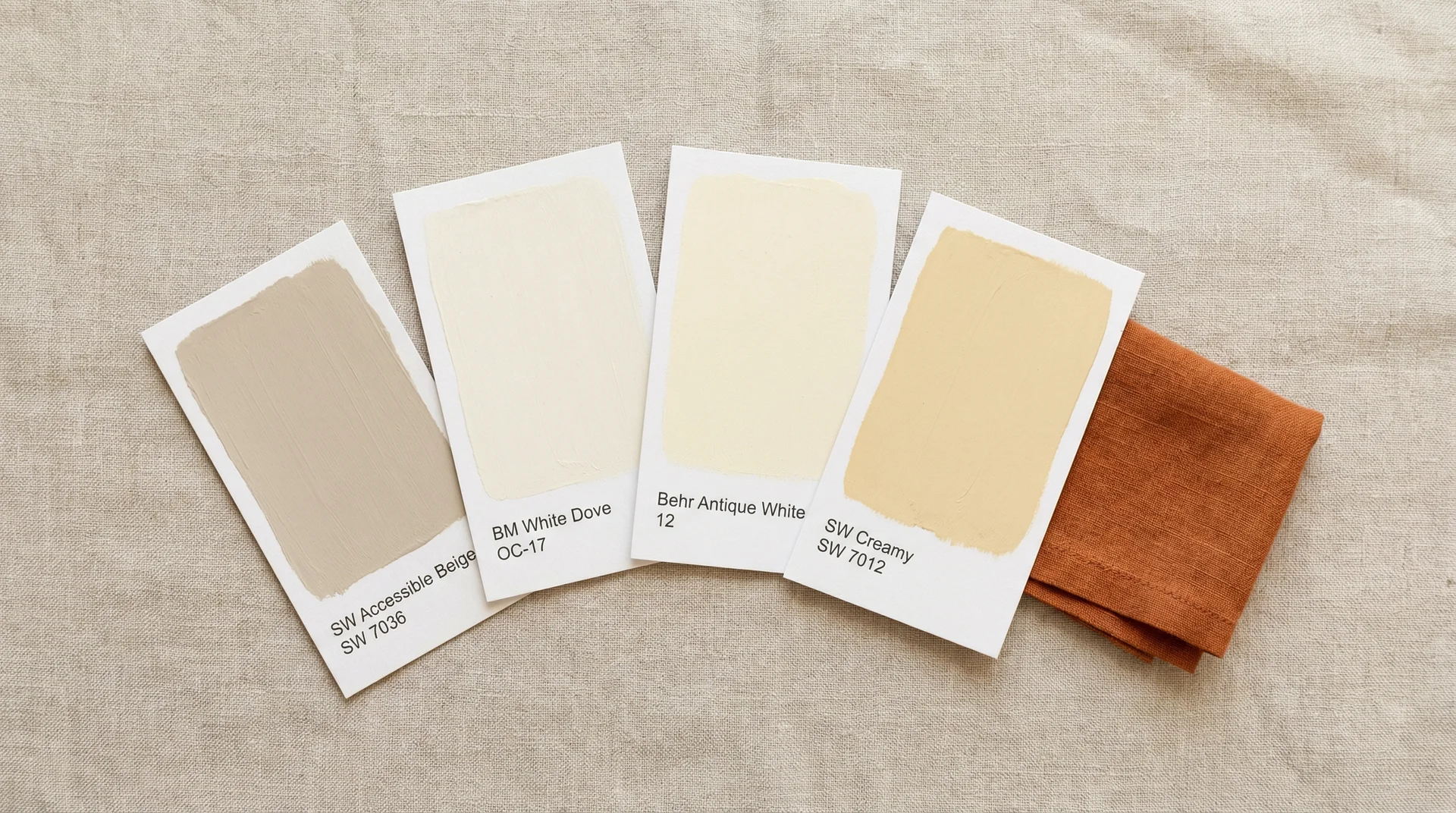
If burnt orange appears on a sofa, rug, or accent wall, the surrounding walls and large furniture pieces need warm neutrals. The word “warm” matters here. Cool grey and bright white are neutrals, but they fight burnt orange rather than sitting comfortably next to it.
Warm neutrals that genuinely work alongside rustic burnt orange in US homes:
- Sherwin-Williams Accessible Beige (SW 7036): A warm greige with enough beige to calm the room and enough grey to feel sophisticated. One of my most-used background colors for earthy palettes.
- Benjamin Moore White Dove (OC-17): A creamy off-white that avoids the harshness of pure white. Excellent as a ceiling color when walls carry the orange.
- Behr Antique White (12): Warm, soft white with yellow undertones that complements terracotta and burnt orange without competing.
- Sherwin-Williams Creamy (SW 7012): Slightly more golden than White Dove, especially at home in rooms with walnut wood tones.
For walls that go beyond off-white, warm taupes like Benjamin Moore Revere Pewter (HC-172) and earthy creams like Behr Toasted Coconut (N230-4) give a layered, textured backdrop that suits the rustic aesthetic well.
The Bold Contrast Palette for Rustic Burnt Orange Living Rooms
Burnt orange and deep cool-toned colors create contrast that feels both exciting and considered. The reason: orange and blue sit opposite each other on the color wheel, intensifying each other when placed nearby. The rustic version of this is layered and collected, not graphic.
Burnt orange and navy: Navy curtains or a navy sofa alongside burnt orange accents read intentional and sophisticated. You can even go navy on one wall if burnt orange stays in textiles and accessories.
Burnt orange and deep teal: Slightly more bohemian, suits rustic spaces with global or eclectic influences. Teal throw pillows on a burnt orange sofa, or a teal-glazed ceramic lamp, give the room a traveled feel.
Burnt orange and charcoal: Charcoal brings a modern edge while still feeling warm enough to coexist with the orange. Dark-stained furniture with charcoal upholstery alongside burnt orange walls works especially well in rooms with exposed wood beams or brick.
The Earthy Harmony Palette (The Most Distinctly Rustic Option)
This is the palette I return to most often on rustic projects, because it feels least like a “designed” room and most like a space gathered over time.
| Color | How to use it alongside burnt orange |
|---|---|
| Olive green | Accent chair, cushions, or plants. Grounds the orange without sharp contrast. |
| Warm brown | Wood furniture, leather seating, dark picture frames. Anchors and adds depth. |
| Ochre or mustard | A rug, a single throw pillow, or artwork. Picks up the yellow undertones in burnt orange. |
| Cream | Dominant neutral on walls and large upholstered pieces. Holds everything together. |
This palette works in rooms of almost any size, which is one reason I recommend it as a starting point for people who are unsure about how far to push the color.
What Not to Pair With Burnt Orange in a Rustic Space
- Cool-toned grey walls: Greys with blue or green undertones pull against the warmth and make the palette feel unresolved
- Bright pure white: Too stark next to burnt orange; reads as modern rather than rustic, and often looks like a mistake rather than an intentional choice
- Silver metallics: Chrome and silver are too industrial for this palette. Use copper, aged brass, and black wrought iron instead
- Lavender or purple accents: Can work in bold eclectic spaces, but in a rustic room, they almost always feel jarring
Burnt Orange Curtains: The Often-Overlooked Way to Bring the Color In
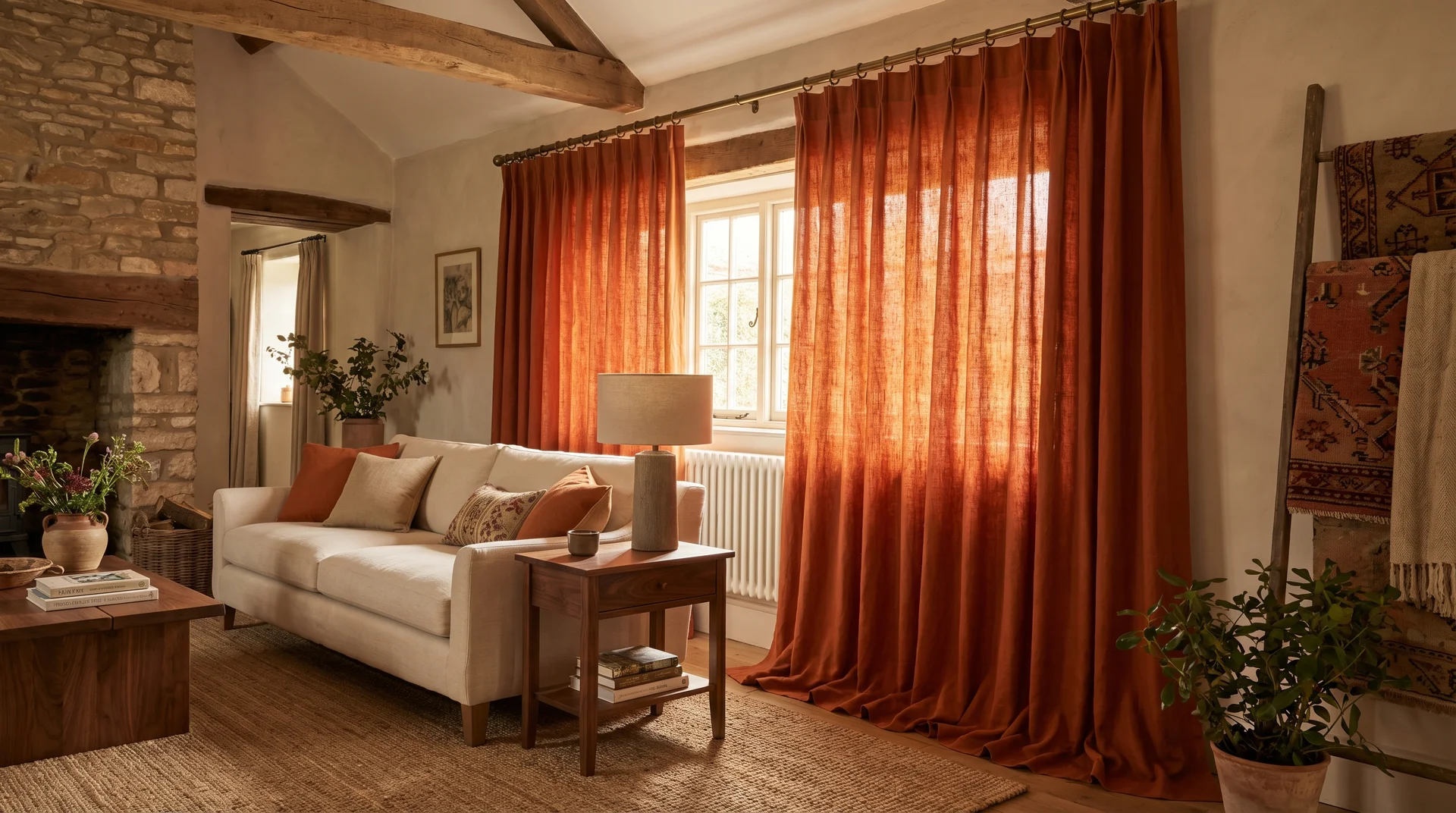
Curtains cover significant wall space, which makes them one of the most impactful ways to introduce burnt orange without painting or buying new furniture. This approach works especially well in north-facing rooms where an accent wall might feel too heavy.
A few things I have learned from styling rooms with burnt orange curtains:
Fabric matters as much as color. Linen curtains in burnt orange filter light warmly and work well in farmhouse or relaxed rustic rooms. Velvet curtains in the same shade feel more formal and elevated, better suited to a grander or more collected aesthetic. Mid-weight cotton blends offer the most versatility for everyday living.
Pair them with a neutral sofa. If the curtains carry the orange, the sofa and rug should step back into cream, warm taupe, or a natural linen tone. This is not a rule that applies everywhere, but in a rustic context, letting the curtains be the color story keeps the room from feeling crowded.
Hang them high and wide.Mount the rod as close to the ceiling as practical and extend it six to eight inches past the window frame on each side. This makes any room feel taller and lets the curtains frame rather than crowd the windows.
Common Mistakes in Rustic Burnt Orange Living Rooms (And How to Avoid Them)
After more than a decade working in residential interiors, these are the errors I see most consistently. They are fixable once you can name them.
Going all-in before testing the palette. Someone falls in love with an image, buys the sofa, paints the wall, and then discovers the two shades of burnt orange they chose from different sources have different undertones that fight each other. Assemble your palette in samples first: paint chips on the wall, fabric swatches on the sofa, a rug swatch on the floor. Give yourself a week with everything together before committing.
Mixing cool-toned neutrals into a warm palette. Cool grey walls, bright white with blue undertones, silver fixtures — any of these create a visual tension alongside burnt orange that never resolves. Your neutrals need warm undertones too.
Ignoring the ceiling and floor. A burnt orange accent wall can be completely undermined by a cold blue-tinted white ceiling and grey flooring. The ceiling and floor are large color planes. A ceiling in warm white or cream and flooring in warm wood, stone, or a jute rug will support the palette. Ignoring them means two large surfaces that work against everything you have chosen.
Over-accessorizing once the color is in. Burnt orange is doing significant visual work. The room needs fewer objects than a neutral room does. When clients finish their rooms and then feel compelled to fill every surface with terracotta pots, woven baskets, warm-toned art, and orange pillows, the result is busy rather than curated. Give the color room to breathe.
Buying from a screen without ordering samples. Paint on a monitor is almost always more saturated than paint on a wall. What looks like a rich warm burnt orange online can read much closer to construction-cone orange in certain light conditions. Every major US brand, including Sherwin-Williams, Benjamin Moore, and Behr, offers sample pots. Order at least two shades that interest you, paint them in 12 x 12-inch swatches directly on your wall, and live with them for at least three days before deciding.
Frequently Asked Questions
Is burnt orange in style for 2025 and 2026?
Burnt orange has moved well beyond trend status. It sits in the same category as terracotta and warm neutrals, colors with proven staying power because they connect to natural materials and earthy warmth rather than seasonal fashion cycles.
The broader shift toward warm, biophilic interiors means it is as relevant in 2026 as it has been in the last five years.
What color walls go best with burnt orange furniture in a rustic living room?
Warm cream, off-white with beige undertones, or a warm greige are the most reliable background colors. Sherwin-Williams Accessible Beige (SW 7036) and Benjamin Moore White Dove (OC-17) consistently perform well in this context.
If you want something more interesting than a plain neutral, a muted terracotta on the walls with burnt orange furniture creates a rich, earthy layered look.
Does burnt orange work in a small living room?
It works well when used selectively. Keep walls in a light, warm neutral and deliver the color through a single statement furniture piece, a rug, or curtains. Avoid painting all four walls and pairing that with dark furniture, as the combination can make the space feel confined.
When approached with proportion in mind, burnt orange in a small room feels intentional rather than overwhelming.
What is the difference between rust, terracotta, and burnt orange?
Rust has the most red and brown in it, looks like oxidized metal, and is the darkest and most muted of the three. Terracotta is earthy and clay-like with a dusty quality, the color of unglazed pottery.
Burnt orange is the most saturated, sitting between a true orange and a rust tone, with enough depth to feel rich rather than bright. In a rustic living room, all three layers work well together.
Can I mix burnt orange with grey in a rustic living room?
You can, but the grey needs warm undertones rather than cool ones. A grey with blue or green undertones fights the warmth of the orange. A greige, something with beige or brown bias, settles much more naturally alongside burnt orange.
In a rustic context, I tend to push clients toward warm taupe rather than a true grey, because the warmth supports the wood and natural fiber palette that makes the space feel rustic.
What kind of lighting works best in a burnt orange living room?
Warm bulbs in the 2700K to 3000K range. Edison-style filament bulbs in brass or copper pendants are a particularly good fit. Layer your sources, combining a ceiling fixture with table lamps and a floor lamp, so the room has depth and warmth rather than a single flat overhead wash.
Final Thoughts
A rustic burnt orange living room is one of those spaces that feels immediately welcoming. The color carries warmth, shelter, and the kind of light that comes through a window in late October.
When it is in the right setting with the right materials, a room stops looking like a collection of furniture and starts feeling like somewhere you actually want to be.
Start where it feels manageable. A cushion, a throw, a terracotta planter on a shelf. See how the color sits in your room. Build from there.