You reach for your toner. Then your serum. And somewhere in the middle of that two-second decision, a small voice asks: Which one goes first?
I have heard this question more times than I can count. Clients sit in my treatment chair, rattling off their routines, and somewhere between the cleanser and the moisturizer, the order falls apart.
They have been applying their serum before their toner for months. The serum costs them sixty dollars a bottle. And their skin has been quietly under-absorbing every single drop of it.
So here is the answer, upfront: you apply toner before serum, every single time.
Toner goes on first because it prepares the surface of your skin to actually receive what comes next. It adjusts the pH, delivers a layer of hydration, and opens the skin up for better ingredient penetration.
When your serum lands on a prepped, slightly damp, pH-balanced surface, it absorbs the way it was formulated to. When it lands on dry, un-toned skin, it sits. It pulls unevenly. Some of it evaporates before it even has a chance to do its job.
That is the short answer. But if you want to understand why this is true at a skin-biology level, and how to apply it correctly based on your toner type, your serum ingredients, and your skin condition, keep reading.
The rule is simple. The application of that rule is where most people quietly go wrong.
Quick Reference: Toner vs. Serum at a Glance
| Feature | Toner | Serum |
|---|---|---|
| Purpose | Prep and balance | Targeted treatment |
| Texture | Watery, lightweight | Slightly thicker, gel or fluid |
| When to apply | Immediately after the cleanser | After toner, before moisturiser |
| Primary function | Restore pH, hydrate surface, prime absorption | Deliver active ingredients deep into skin |
| Can you skip it? | Yes, for some skin types | Not if you are targeting a specific concern |
Toner Before Serum: Why Most People Still Get It Wrong
The “toner first” rule exists because of how your skin barrier is structured and how products penetrate it.
Your skin has a naturally acidic pH, sitting somewhere between 4.5 and 5.5 on the pH scale.
Cleansing, especially with foaming or alkaline cleansers, disrupts that balance. It pushes your skin’s pH slightly upward, toward a more neutral or alkaline state.
Many serums, particularly actives like Vitamin C or retinoids, are formulated to work within a specific pH window. When your skin is sitting at the wrong pH after cleansing, your serum is not operating in its ideal environment.
Toner brings your skin back to where it needs to be before the serum arrives.
A note on older toners: If you tried toners years ago and found them drying or irritating, those were likely alcohol-based astringents.
Modern toners are a different product entirely: hydrating, pH-correcting, and formulated to support your barrier rather than strip it. The category has changed significantly over the past decade.
The Simple Rule Robin Uses With Every Client
After a decade of building routines for clients managing everything from acne to rosacea to post-treatment sensitivity, I follow one consistent rule: hydrate and prepare the canvas before you apply the treatment.
When a client tells me their serum is not working, the first thing I ask is what they are doing in the two steps before it. Nine times out of ten, the serum is fine. The sequence is the problem.
Why the “Thinnest to Thickest” Advice Alone Is Not Enough
You have probably read the “layer thinnest to thickest” rule online. It is useful as a starting point, but it leaves a gap. Toner and some serums can have very similar consistencies.
The more reliable framework combines two principles: layer by function first (prep before treatment), then layer by consistency within categories of similar function.
Together, these two rules cover every scenario the “thinnest to thickest” shortcut misses.
What Happens to Your Skin When You Apply These Products
Skincare advice often gives you the what without the why. People who understand the mechanism are the ones who actually follow through correctly.
So here is what is happening at the skin level when you apply toner followed by serum.
How Your Skin Barrier Receives Product
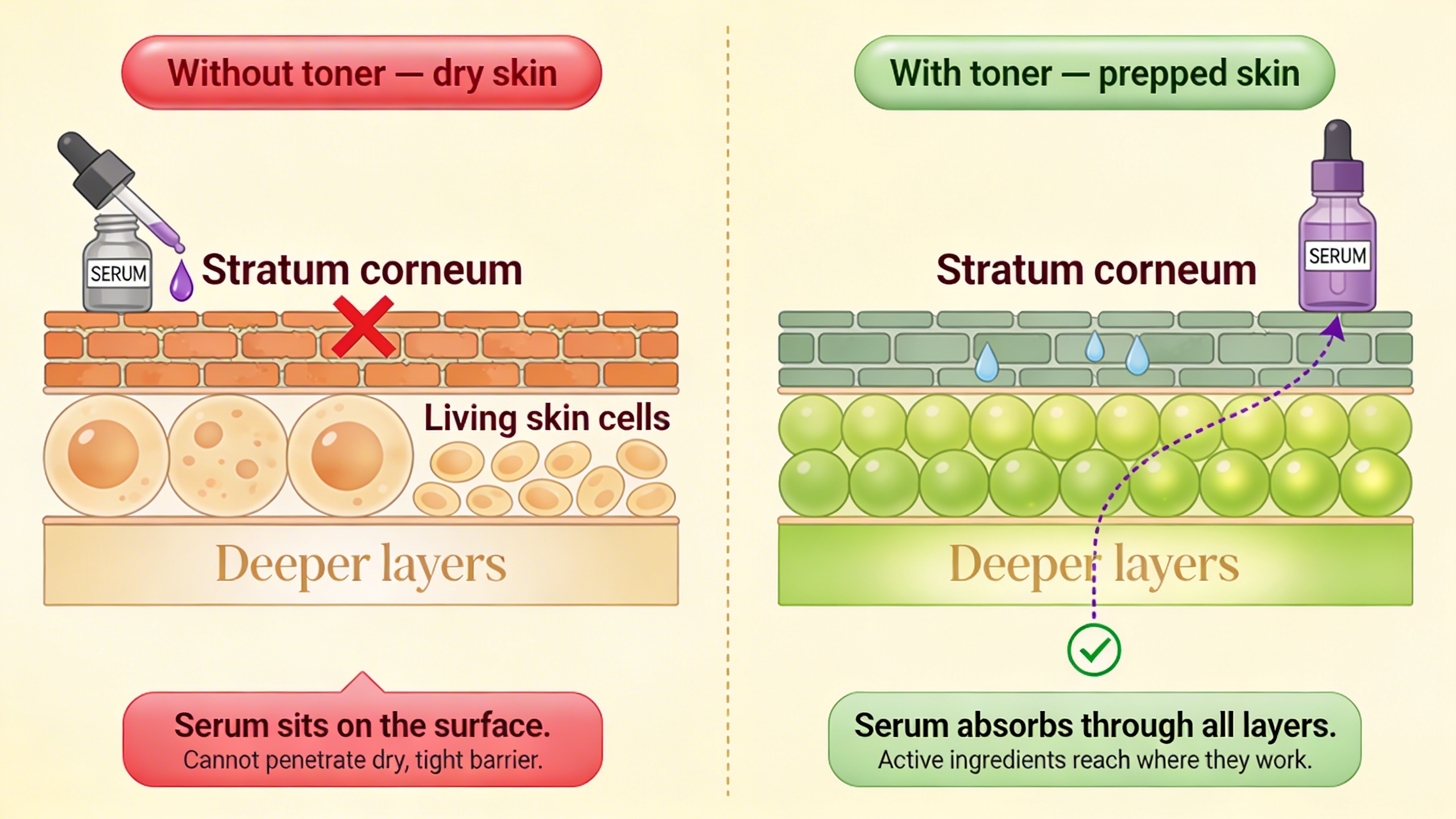
Your skin’s outermost layer, the stratum corneum, is made up of dead skin cells bound together by lipids in a structure researchers often describe as “bricks and mortar.”
This layer is semi-permeable, meaning it allows some things through and blocks others.
The size of the molecule, the formulation of the product, and the current state of your skin’s surface all affect how well something penetrates.
When your skin is dehydrated or sitting at the wrong pH, that outer layer tightens. It behaves more like a wall than a gateway. Products sit on top of it rather than absorbing into it.
You can apply the most expensive serum in the world onto skin in this state and get a fraction of the benefit you paid for.
What Toner Is Actually Doing Before the Serum?
A good toner does three things simultaneously.
- First, it softens the outer layer of skin by delivering an initial wave of hydration.
- Second, it corrects the pH that cleansing disrupted.
- Third, it primes the skin’s surface to be receptive to what follows.
Think of it as the difference between trying to press a label onto a dusty, uneven surface versus pressing it onto a clean, slightly moist one.
Why Serum Needs a Prepared Surface?
I had a client, a woman in her mid-forties, come to me after six months of using a hyaluronic acid serum with no visible improvement in her skin’s hydration.
She was applying it after cleansing, on completely dry skin, then sealing it with moisturizer. On paper, her routine looked solid. In practice, the HA serum was evaporating before it had anything to bind to.
Hyaluronic acid is a humectant. It works by drawing moisture from its environment and binding it to the skin.
When you apply it to completely dry skin in a low-humidity environment, it pulls moisture from deeper skin layers, which is counterproductive.
Applying it onto skin that is slightly damp from toner gives it exactly the moisture it needs to function correctly.
The Absorption Window: Why Timing Between Steps Matters More Than Most Blogs Admit
One thing rarely addressed in general skincare content is the absorption window.
After applying toner, there is a brief period, roughly 20 to 60 seconds, where your skin is in an optimal receptive state.
The surface is hydrated, the pH is corrected, and the skin is slightly plumped. Applying your serum within this window maximises what your skin takes in.
If you wait too long, the toner evaporates, your skin returns to its baseline state, and you have lost the prep advantage.
You do not need to rush, but you also do not need to scroll your phone between steps.
Do All Toners Behave the Same?
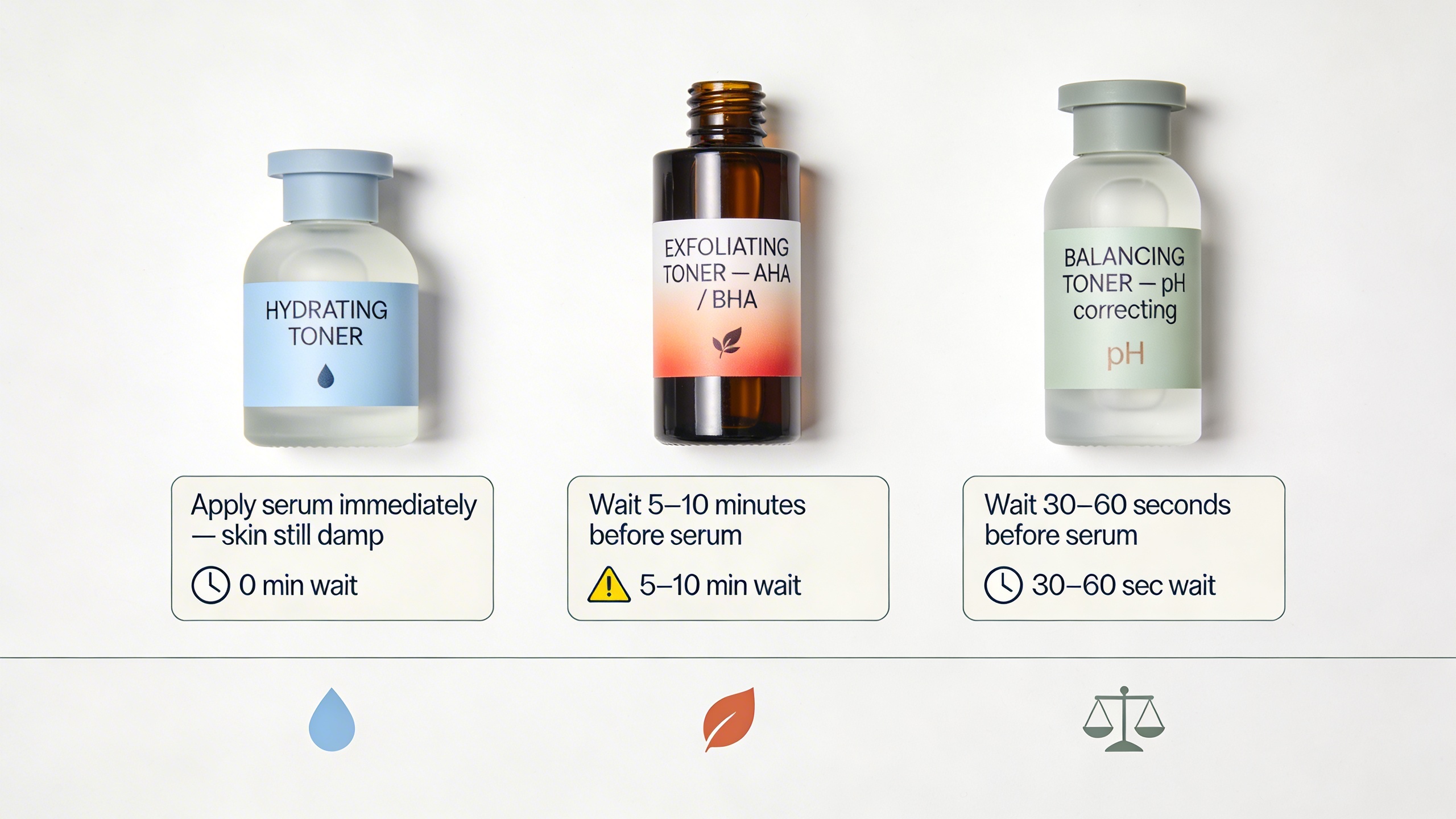
This is where routines get personal. “Toner” is a category that covers wildly different products with wildly different functions. The rule for how to sequence them with your serum changes depending on what type of toner you are using.
Hydrating Toners (Essence-Style): Apply Serum While Skin Is Still Damp
Hydrating toners, often marketed as essences or first serums, are the most forgiving to work with.
They are typically water-based, sometimes contain hyaluronic acid or glycerin, and their entire job is to deliver an initial hydration hit and soften the skin surface.
With these, you want to apply your serum while your skin still feels slightly tacky or damp from the toner.
The serum absorbs more evenly across a hydrated surface, and humectant-based serums especially perform better in this state. You do not need to wait between these two steps at all.
Exfoliating Toners (AHAs, BHAs): You Need a Buffer Before Your Serum
This is the category that catches people off guard. Glycolic acid toners, lactic acid toners, and salicylic acid toners are active treatments in toner form.
They exfoliate, they lower the surface pH significantly (sometimes down to 3.0 to 3.5), and they make the skin temporarily more sensitive and more permeable.
Applying an active serum immediately after an exfoliating toner can lead to over-sensitisation. You are stacking two active treatments on skin that has just been chemically exfoliated.
I have seen this cause redness, stinging, and barrier disruption in clients who had no idea that it was the reason.
My recommendation: wait at least 5 to 10 minutes after an exfoliating toner before applying your serum. Allow the active acids to complete their work, let your skin settle slightly, then proceed.
A good general guideline I share with clients: if your toner tingles, wait before adding more. Your skin is telling you something.
Balancing and pH-Correcting Toners: The Wait Time Debate, Settled
Traditional balancing toners, formulated to restore your skin’s natural pH after cleansing without delivering heavy exfoliation or intense hydration, sit somewhere in the middle.
They are gentler than exfoliating toners but more functional than plain water.
With these, a short wait of about 30 seconds to a minute is ideal. You want the toner to fully settle before you layer anything over it, but you do not need to time it rigorously.
By the time you pick up your serum, uncap it, and dispense it, the window is about right.
What Happens When You Pair the Wrong Toner Type With an Active Serum
Here is a scenario I see too often. Someone uses a glycolic acid toner in the morning, skips the wait, and immediately applies a Vitamin C serum. Both products are acidic. Both are active.
Together, without a buffer, they push the skin’s pH to an uncomfortable extreme and increase the risk of sensitivity, especially around the nose, mouth, and forehead, where skin is naturally thinner.
The fix is straightforward.
Either separate these products (exfoliating toner at night, Vitamin C serum in the morning), or observe the wait time between them if you use them in the same routine. Your skin can handle both, just not simultaneously and without respect for timing.
The Routine That Actually Works, Built Around Your Skin and Not a Generic Chart
Morning Routine: Layering for Protection and Treatment
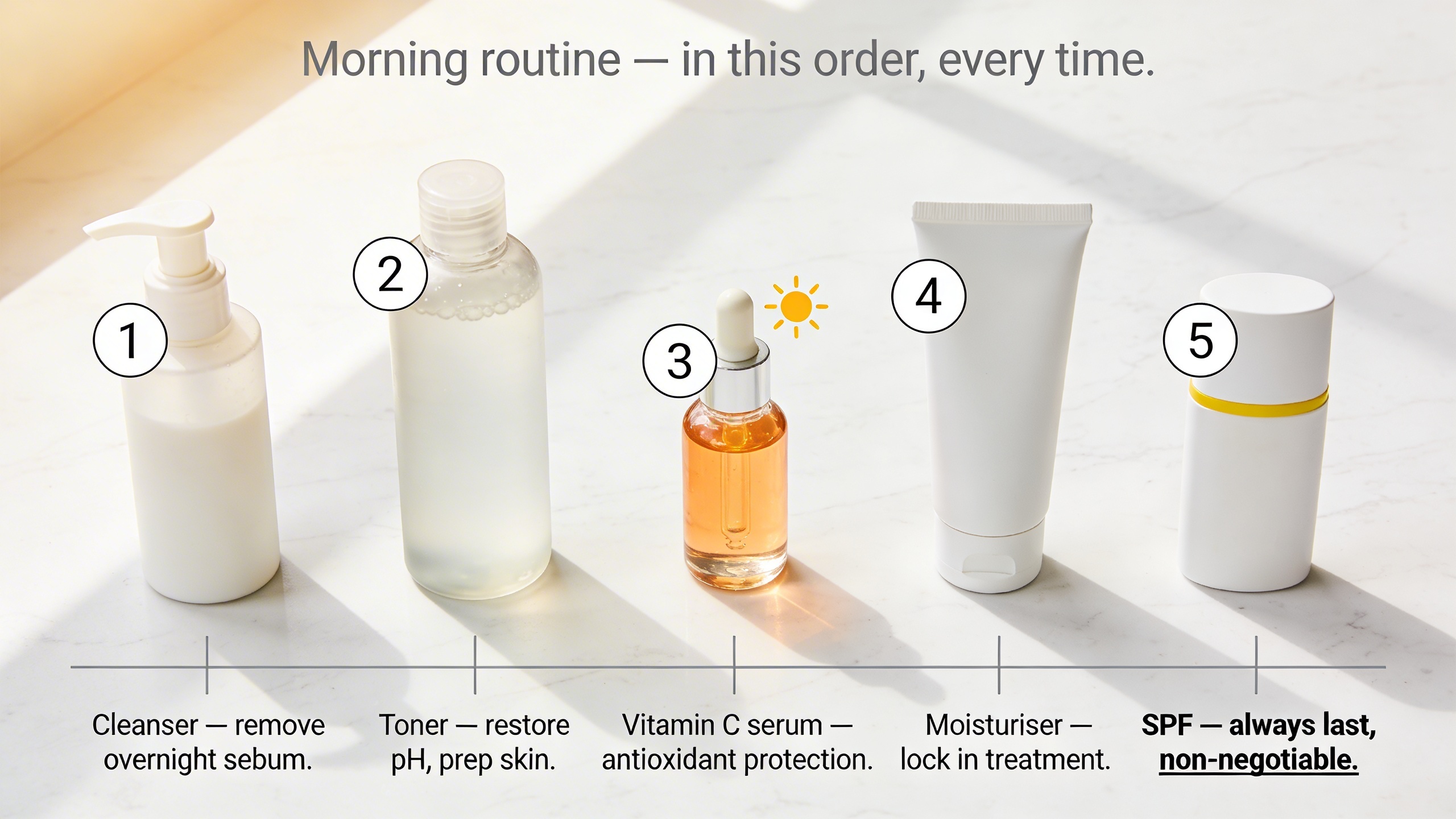
The morning routine has a primary goal: to protect. You are preparing your skin to face UV, pollution, and environmental stressors throughout the day. Every step should serve that goal.
| Step | Product | Purpose |
|---|---|---|
| 1 | Cleanser (gentle, low-foaming) | Remove overnight sebum and product residue |
| 2 | Toner | Restore pH, prep for absorption |
| 3 | Vitamin C or antioxidant serum | Protect against oxidative stress |
| 4 | Moisturiser | Reinforce barrier, lock in treatment |
| 5 | Eye cream (optional) | Dab gently around the orbital bone before moisturiser if using; the eye area is thinner and more sensitive than the rest of the face |
| 6 | SPF 30 or higher | Non-negotiable protection |
SPF is always last in the morning, on top of everything else. Layering anything over SPF disrupts its film integrity and reduces its protection factor.
Evening Routine: When Repair and Actives Come Into Play
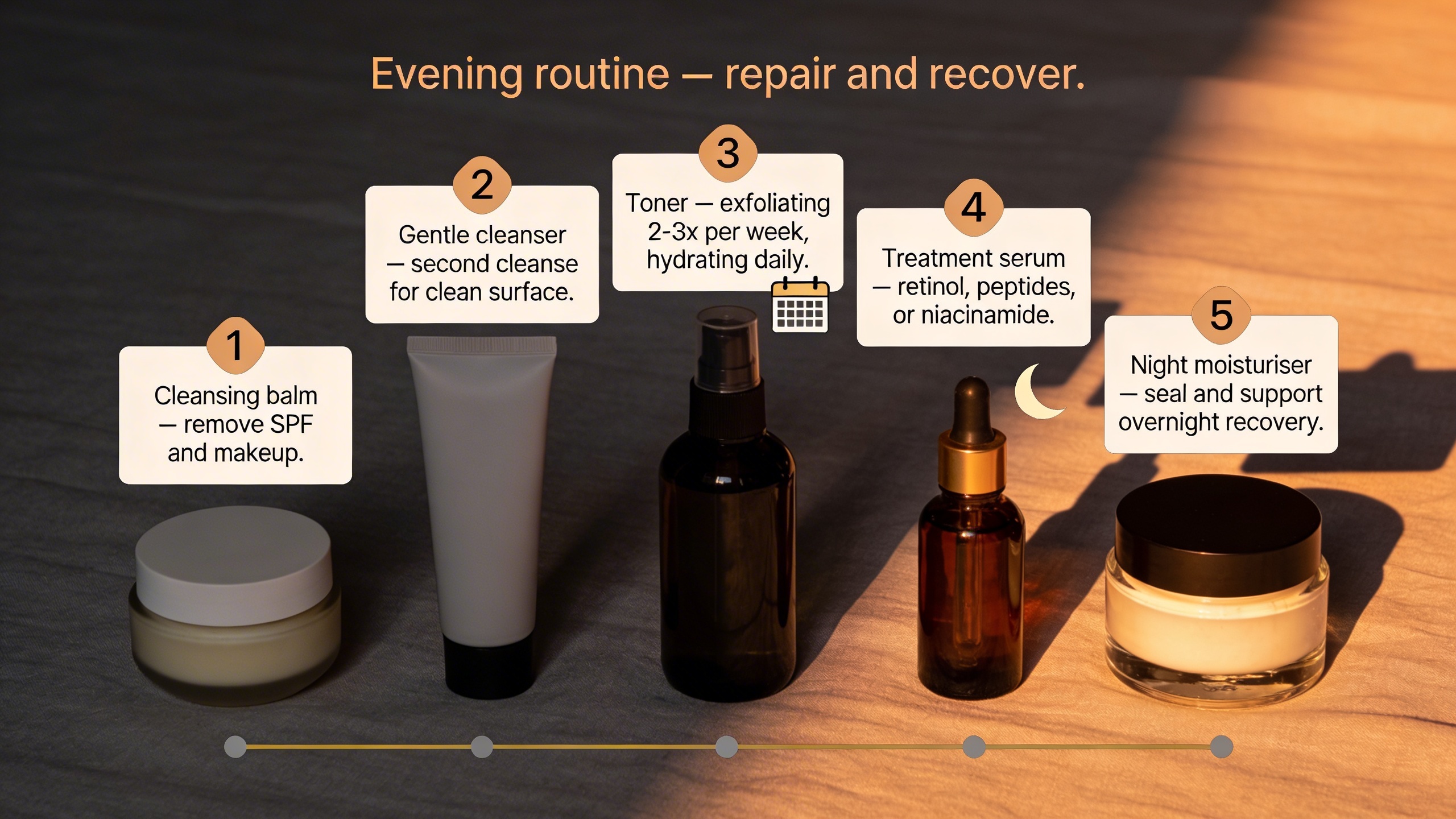
The evening routine has a different goal: repair. Your skin does most of its renewal work overnight, and your evening product choices should support that process.
| Step | Product | Purpose |
|---|---|---|
| 1 | Oil or balm cleanser | Remove SPF, makeup, and pollution |
| 2 | Water-based cleanser | Second cleanse for a clean surface |
| 3 | Exfoliating toner (2 to 3x per week) OR hydrating toner (daily) | Depends on your skin concern |
| 4 | Treatment serum (retinol, peptides, niacinamide) | Targeted repair and regeneration |
| 5 | Spot treatment (if needed) | Apply directly to blemishes after serum; salicylic acid or benzoyl peroxide formulas need direct skin contact to work |
| 6 | Richer moisturiser or barrier cream | Seal and support overnight recovery |
For Sensitive or Compromised Skin Barriers: A More Cautious Sequence
If your skin barrier is compromised, which shows up as persistent redness, flaking, stinging when you apply products, or a feeling of tightness that does not resolve with moisturiser, I would recommend simplifying the routine down to its core three steps for at least two to four weeks.
Simplified barrier-repair sequence:
- Gentle, fragrance-free cleanser
- Hydrating toner (no actives, no fragrance)
- Ceramide-rich moisturiser
Hold the actives. Adding more activities to a compromised barrier is like trying to renovate a structurally unsound house. You reinforce the structure first, then you build.
For Acne-Prone Skin: The Order That Prevents Congestion and Irritation
Acne-prone skin tends to respond well to BHA toners (salicylic acid specifically, because it is oil-soluble and penetrates into the pore lining). The sequence I recommend for this skin type is:
- Gel or foaming cleanser
- Salicylic acid toner (wait 5 minutes)
- Spot treatment directly on active blemishes, if needed (let it dry fully before the next step)
- Niacinamide or lightweight hydrating serum
- Oil-free, non-comedogenic moisturiser
- SPF in the morning
Avoid layering niacinamide directly with Vitamin C in the same routine if your skin reacts easily. At high concentrations, they can form a compound that causes flushing in some skin types. Using them at different times of day is the simpler solution.
Serum Ingredients & Why the Order of The Toner is Important?
Serums are not interchangeable. A hyaluronic acid serum and a retinol serum have almost nothing in common beyond the word “serum” on their packaging.
Understanding what is inside your serum changes how you apply your toner and how long you wait between the two.
Vitamin C Serums: pH Sensitivity and Why It Matters After Toner
L-ascorbic acid (the most effective and most studied form of Vitamin C) is pH-dependent. It requires a skin surface pH of around 3.5 to work optimally.
Most cleanser-toned skin sits around 5.0 to 5.5, which is close but slightly above that ideal range.
This is one scenario where applying your Vitamin C serum fairly quickly after your balancing toner, without a long wait, actually works in your favour.
You are layering the acidic serum onto a surface that has been freshly balanced and is still slightly receptive, rather than waiting for the surface to shift again.
Hyaluronic Acid Serums: Why They Demand Damp Skin to Work
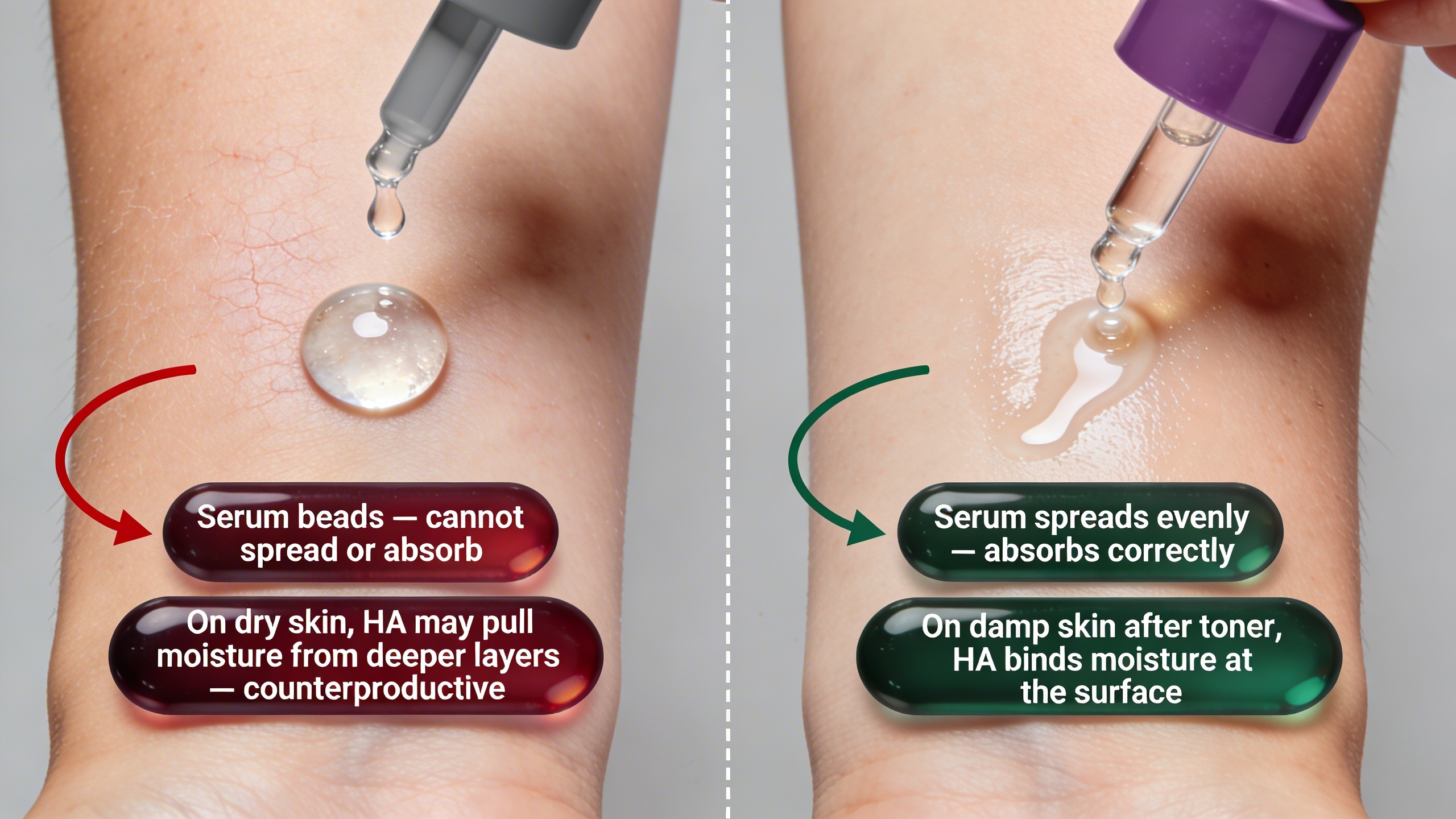
Hyaluronic acid draws water from its environment. On skin that is dry and in low ambient humidity, it can pull from deeper layers rather than from the surface or from the air. This is why HA serums applied to completely dry skin sometimes make the skin feel tighter rather than more hydrated.
Apply your HA serum while your skin still feels faintly damp from toner, then seal it immediately with a moisturiser. The moisturiser acts as a physical barrier that holds the moisture in place rather than letting it evaporate.
Retinol and Retinoid Serums: Layering Rules That Protect Your Barrier
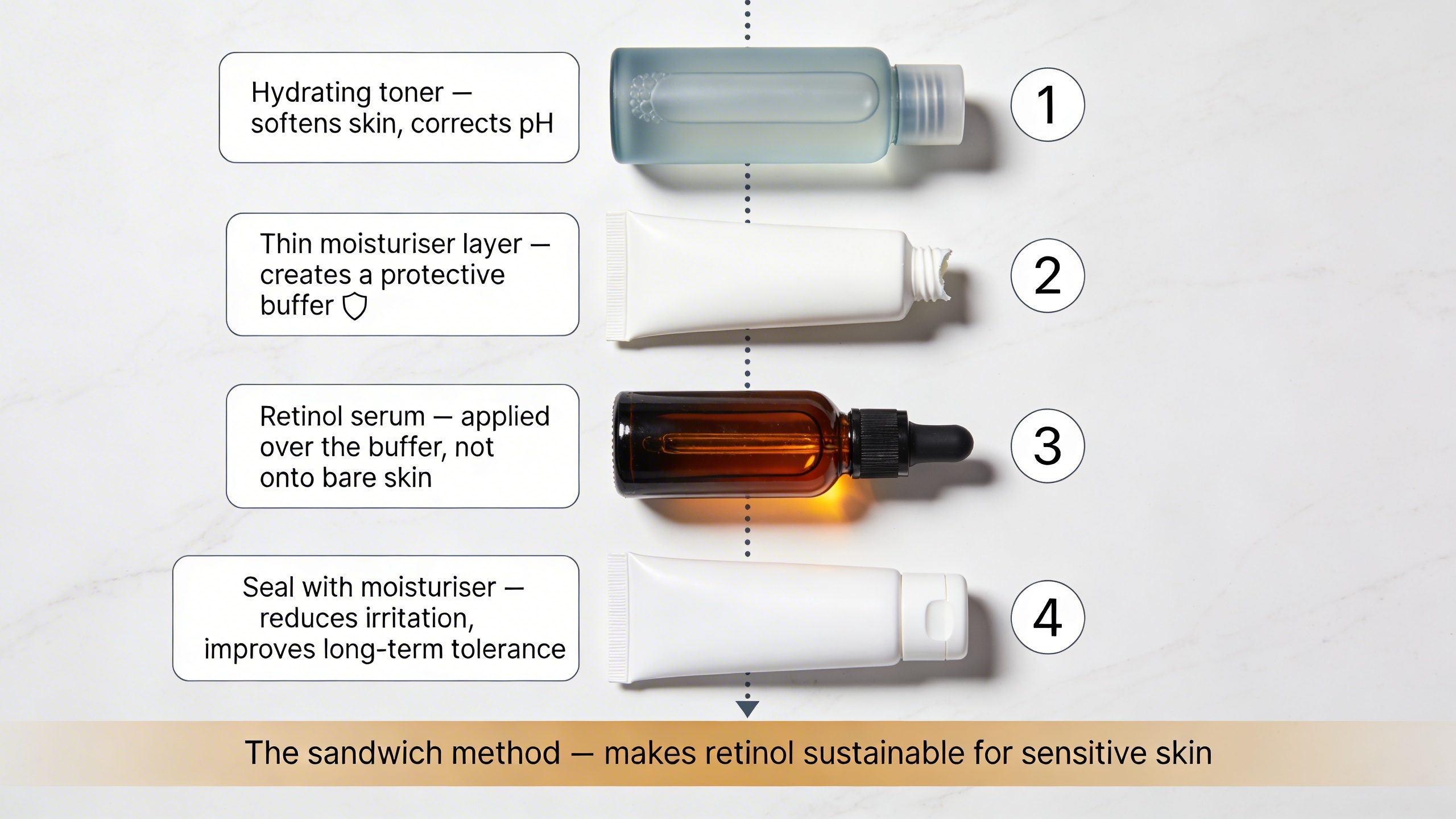
Retinoids are the gold standard for anti-ageing and acne treatment, and they are also the ingredient I see most commonly misused in layering. Retinol is most effective at a pH between 5.0 and 6.0, which is actually a slightly higher, gentler range than most acids. Applying it directly after an exfoliating toner (which pushes pH lower) creates unnecessary irritation.
The approach I recommend most often for retinol users is sometimes called the “sandwich method”:
- Apply a hydrating toner
- Apply a thin layer of plain moisturiser
- Apply retinol serum over the moisturiser
- Seal with another light layer of moisturiser if needed
This does not eliminate the retinol’s efficacy. It buffers the delivery, reduces the probability of irritation, and makes it far more sustainable as a long-term practice.
Niacinamide Serums: The Most Forgiving, and Still Not Order-Proof
Niacinamide (Vitamin B3) is one of the most well-tolerated actives in skincare. It works across a wide pH range, pairs well with most other ingredients, and suits almost every skin type. It addresses hyperpigmentation, enlarged pores, oil regulation, and barrier reinforcement simultaneously.
Despite its flexibility, niacinamide still performs best on a properly prepped surface. Applying it after toner ensures even distribution across the skin rather than patchy absorption, which is especially noticeable when treating uneven skin tone.
Common Mistakes I Still See (And How to Fix Them)
Applying Serum on Completely Dry Skin and Wondering Why It Piles Up
Pilling, where your serum or moisturiser balls up on the skin surface rather than absorbing, is one of the most common complaints I hear. People assume the product is low quality. Usually, the issue is the application surface.
When skin is dry and dehydrated, the outer layer resists penetration. Products sit on top of it and, when you rub them in, they bunch up rather than absorb.
Adding toner before your serum creates enough surface hydration that products spread and absorb evenly. If your serum is pilling, add a toner step before it.
Give it two weeks. The pilling usually resolves completely.
Using an Exfoliating Toner Daily and Layering Actives Right After
The appeal of daily exfoliation is understandable: your skin looks bright, pores appear smaller, and texture improves quickly.
The problem is that daily exfoliating toner use, especially with AHAs at higher concentrations, keeps the skin in a state of mild ongoing inflammation.
Layering an active serum on top of that, without a wait time and without giving the skin recovery days, accelerates barrier breakdown.
A schedule that works better:
| Day | Toner Type | Serum |
|---|---|---|
| Monday | Exfoliating | Hydrating serum only (give skin a break) |
| Tuesday | Hydrating | Active serum (Vitamin C, niacinamide) |
| Wednesday | Exfoliating | Hydrating serum only |
| Thursday | Hydrating | Active serum |
| Friday | Exfoliating | Hydrating serum only |
| Weekend | Hydrating | Gentle recovery serums (peptides, ceramides) |
Skipping Toner and Expecting Serum to Do All the Heavy Lifting
Some skin types genuinely do not need toner, and I will address that below.
For others, especially those dealing with textural concerns, dullness, or poor serum absorption, skipping toner removes the foundation before building the rest.
If your serum is expensive and you want to protect that investment, toner is the step that makes the serum work harder.
Over-Layering: When More Products in the Right Order Still Backfire
There is a point of diminishing returns in skincare layering. I have reviewed routines where clients are applying seven or eight products in sequence, every single one correctly ordered, and still experiencing breakouts, sensitivity, and congestion.
More products interact with each other. They compete for absorption. They can combine into an occlusive layer that traps dead cells and sebum.
If your skin is struggling and your routine is long, simplify first. Identify the three or four products doing the most meaningful work and build from there.
Do You Even Need a Toner?
No, not everyone needs a toner.
Skin Types That Genuinely Benefit From Toner
- Oily and acne-prone skin benefits significantly from toners, particularly BHAs that address congestion at the pore level.
- Dull or textured skin responds well to mild AHA toners that accelerate cell turnover and improve surface clarity.
- Dehydrated skin (skin that is oily but lacking water) benefits from hydrating toners that deliver a water-binding layer before serum.
- Skin recovering from treatments like chemical peels or laser can benefit from gentle, fragrance-free hydrating toners during the healing phase.
Skin Types That Can Skip It
- Normal skin with a stable barrier that tolerates products well and does not experience dullness, congestion, or dryness.
- Minimal routine users who are meeting their skin goals with cleanser, one serum, and moisturiser.
- Reactive or allergy-prone skin that flares with too many products in the routine. In these cases, fewer steps are safer.
Toner is a useful step, and for most skin types it adds measurable value. However, it is a supporting actor, and if removing it simplifies a routine that is otherwise working well, removing it is a valid choice.
What to Use Instead of Toner If You’re Keeping Your Routine Minimal
If you want the benefits of toner without an extra product step, two options cover most of the same ground:
- Micellar water as your second cleanse. It removes residue, does not disrupt pH as aggressively as foam cleansers, and leaves skin ready for serum.
- Apply your HA serum onto slightly damp skin immediately after patting your face dry. You replicate the “damp surface” benefit of toner by using the residual moisture from cleansing.
Where Does Everything Else Fit? (Essence, Ampoule, Face Oil)
Toner vs Essence: Are You Doubling Up for No Reason?
The line between toner and essence has genuinely blurred.
Many Korean essences are simply thicker, more hydration-dense versions of what Western skincare markets as toner.
If you are using both a toner and an essence, apply the lighter, more watery product first, then the thicker one.
If your “toner” is an essence in everything but name (thick, ferment-based, nutrient-dense), treat it as such and apply it before your serum rather than before a second essence.
| Product | Where It Goes |
|---|---|
| Toner (watery) | After cleanse, before everything |
| Essence (slightly thicker) | After toner, before serum |
| Serum | After essence/toner, before moisturiser |
| Ampoule | After serum, before moisturiser |
| Eye cream | After serum, before moisturiser; apply with ring finger in gentle tapping motions around the orbital bone |
| Moisturiser | Penultimate step |
| Face oil | Always last (at night) |
Ampoule Before or After Serum?
Ampoules are highly concentrated and usually lighter in texture than serums.
Apply them before your serum if they are thinner, or after your serum if they are thicker.
Because ampoules are treatment-focused, they belong in the active treatment layer of your routine.
Face Oil Always Goes Last. Here Is Why.
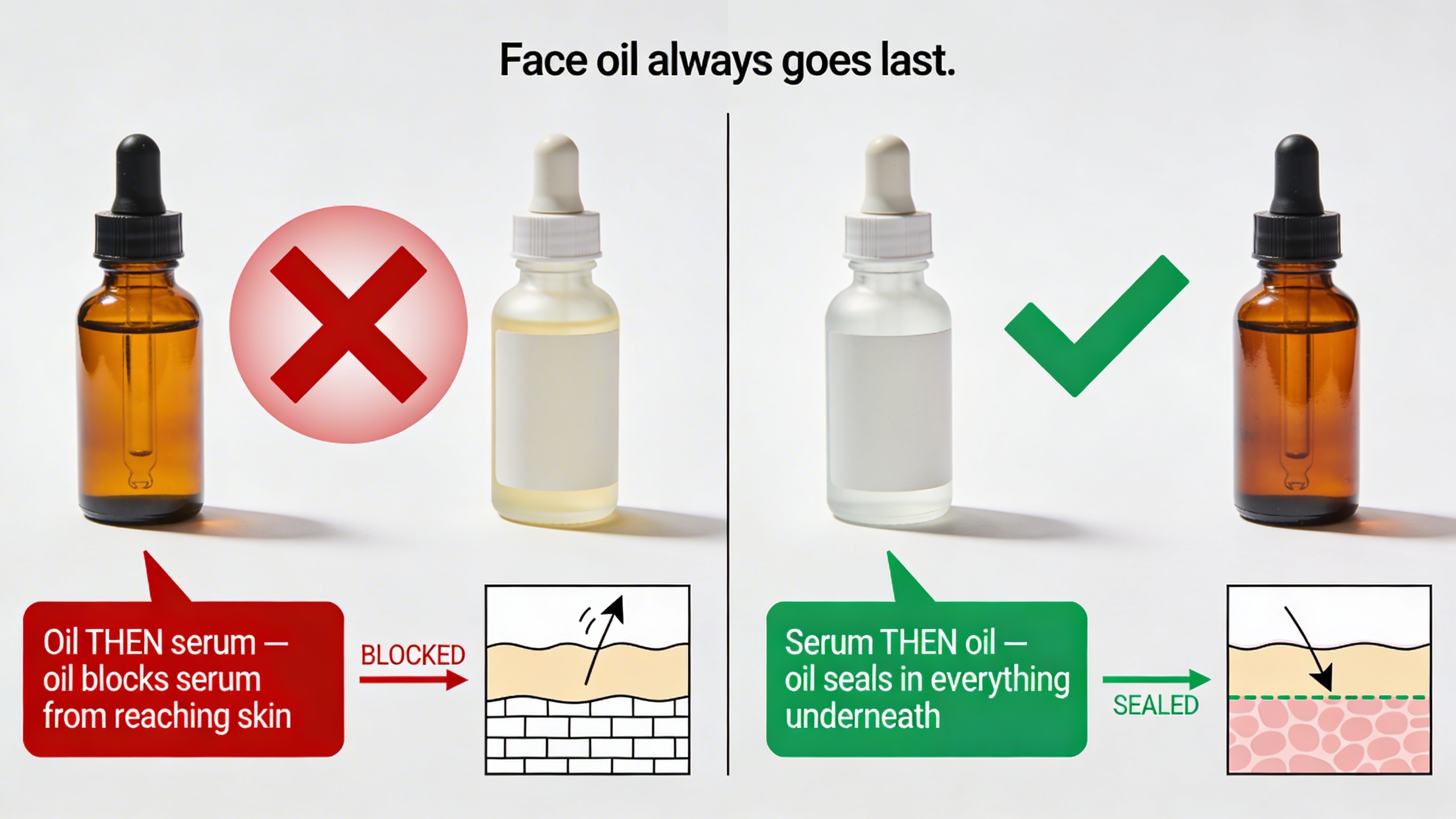
Face oils are occlusive. They form a semi-permeable layer on the skin’s surface that slows moisture evaporation.
Applying a face oil before a water-based serum blocks the serum’s absorption pathway. The serum sits on top of the oil rather than penetrating the skin.
Oil goes on last in your evening routine, after moisturiser. In the morning, skip the facial oil entirely if you are wearing SPF (it compromises the SPF film).
Frequently Asked Questions About Toner and Serum Order
What Happens If I Apply Serum Before Toner?
Your serum lands on skin that may be sitting at the wrong pH after cleansing and has not been softened or hydrated.
The absorption is less efficient, distribution may be uneven, and products like HA serum can behave counterproductively on a dry surface. You do not ruin your skin, but you do reduce the return on your investment.
Can I Mix Toner and Serum Together to Save Time?
Mixing products outside of their intended formulations can alter their stability, pH, and efficacy. Some ingredient combinations produce unwanted reactions when combined. Apply them sequentially rather than simultaneously.
How Long Should I Wait Between Toner and Serum?
- Hydrating toners: 20 to 60 seconds is enough; apply while skin is still slightly damp.
- Exfoliating toners: wait 5 to 10 minutes before layering an active serum.
- Balancing toners: 30 to 60 seconds is the comfortable range.
Is It Okay to Use Toner Both Morning and Night?
Yes, with one qualification: match the toner type to the goal of that routine. Use a hydrating or balancing toner in the morning to prep for your protective routine.
Reserve your exfoliating toner for the evening, when your skin has time to recover overnight and is not heading into sun exposure.
My Skin Feels Fine Doing It the Wrong Way. Should I Change?
Your skin tolerating the wrong order does not mean it is getting the best possible result. “Fine” is a low bar when you are spending money on serums and investing time into a routine.
Adjusting the order costs you nothing and typically improves your results within two to three weeks.
Which Should I Invest in First, a Good Toner or a Good Serum?
Invest in the serum first. The serum carries your active ingredients and targets your specific skin concern.
Toner amplifies its delivery, but a good serum applied to skin without toner still outperforms a budget serum applied to perfectly prepped skin.
Build your foundation first, then optimise the supporting steps.
Where Does Eye Cream Go in This Routine?
Eye cream goes after your serum and before your moisturiser.
The skin around your eyes is thinner and more sensitive than the rest of your face, so it benefits from having the serum absorb first before you apply eye cream.
Use your ring finger and tap gently around the orbital bone rather than rubbing.
If your eye cream is thicker than your moisturiser, apply moisturiser first and eye cream after.
Where Does Spot Treatment Fit In?
Spot treatment goes after toner and before serum for direct contact with the skin, or after serum if you prefer to apply it on top.
What matters most is that it is not buried under moisturiser, where it cannot reach the blemish effectively.
Let it dry fully before the next step.
Build a Routine That Respects Your Skin’s Intelligence
Skincare content on the internet tends to treat your skin like a problem to be solved with the right combination of products. I have spent ten years in a clinical setting watching that mindset cause more harm than good.
People over-buy, over-layer, and over-treat because they are chasing a perfect formula rather than learning to read what their own skin is telling them.
The toner-before-serum rule is a small thing. But the reason I care about people understanding why it matters is that understanding transfers.
When you know how your skin receives products, when you understand pH and absorption windows and surface preparation, you stop making decisions based on marketing and start making them based on mechanism.
At TheSoulNook, every piece of guidance I write comes from the same place: your skin is intelligent, adaptive, and entirely capable of being healthy when you give it the right conditions. Your routine should support that, not override it.
Start with toner. Apply your serum while your skin is still slightly damp. Seal it with a moisturiser. Then leave your skin alone. You will see what it can do.