
Metal roofs shed water fast. That’s great, until the runoff overshoots your gutters, overwhelms a downspout, or dumps right next to your foundation.
The best gutter setup for a metal roof depends on three decisions:
- gutter style (K-style, half-round, or box),
- gutter material (aluminum, steel, or copper), and
- installation details (hanger method, slope, and downspout placement).
Most homeowners do well with 6-inch K-style seamless aluminum, but if you have heavy snow, extreme wind, lots of trees, or long roof runs, a different profile or material may protect your home better.
Below, I’ll help you choose the right system without guesswork.
By Jordan Blake, certified home improvement professional (12+ years in residential remodeling) with a Construction Management diploma from Penn Foster College. My approach is simple: pick what performs, install it safely, and avoid the “looks fine until the first storm” setups.
The 3 Decisions that Prevent Overflow on a Metal Roof
If you’re feeling stuck, it’s usually because you’re trying to pick “the best gutter” before you’ve answered three practical questions.
1. Gutter shape: Can it catch and move fast runoff?
Metal roofs can send water to the eave quickly, especially on steep pitches, long runs, and at valleys. Your gutter shape determines how much water it can carry and how easily debris clears.
2. Gutter material: Will it survive dents, corrosion, and temperature swings?
Gutters live a hard life: ladders, branches, hail, ice, and sun. Material choice affects longevity, noise, denting, and how the system expands and contracts.
3. Installation method: Is it attached the right way for a metal roof?
A good gutter installed poorly is still a problem. The “how” matters: hanger style, fascia condition, correct slope, and where downspouts go.
Quick Fit Check: Match Gutters to your Metal Roof Situation
Before we get into the types, check which of these sounds like your house. This helps you skip the options that won’t work.
| Roof / Environment Condition | What Your Gutter System Needs | Why It Matters |
|---|---|---|
| Long roof runs, steep pitch, or heavy rainfall | Larger gutter profile (often 6-inch ) and smart downspout placement | More roof area and faster water flow require a higher capacity, so the gutter doesn’t overflow during storms |
| Valleys that dump a lot of water | Larger gutter, extra downspouts, and sometimes a valley splash diverter | Roof valleys concentrate water into one spot, which can overwhelm standard gutters |
| Heavy snow or frequent ice | Stronger materials, robust hangers, and proper snow/ice planning | Gutters must handle the weight and impact of sliding snow and ice without bending or pulling away |
| Lots of nearby trees (leaves, pine needles) | Clog-resistant design, possible gutter guards, and a maintenance plan | Organic debris builds up quickly and can block water flow if the system isn’t designed for it |
Types of Gutters for Retal Roofs (Profiles)
When homeowners ask me, “What types of gutters work on a metal roof?” they usually mean gutter profiles. Here are the three you’ll see most often.
K-style gutters (the most common all-around choice)
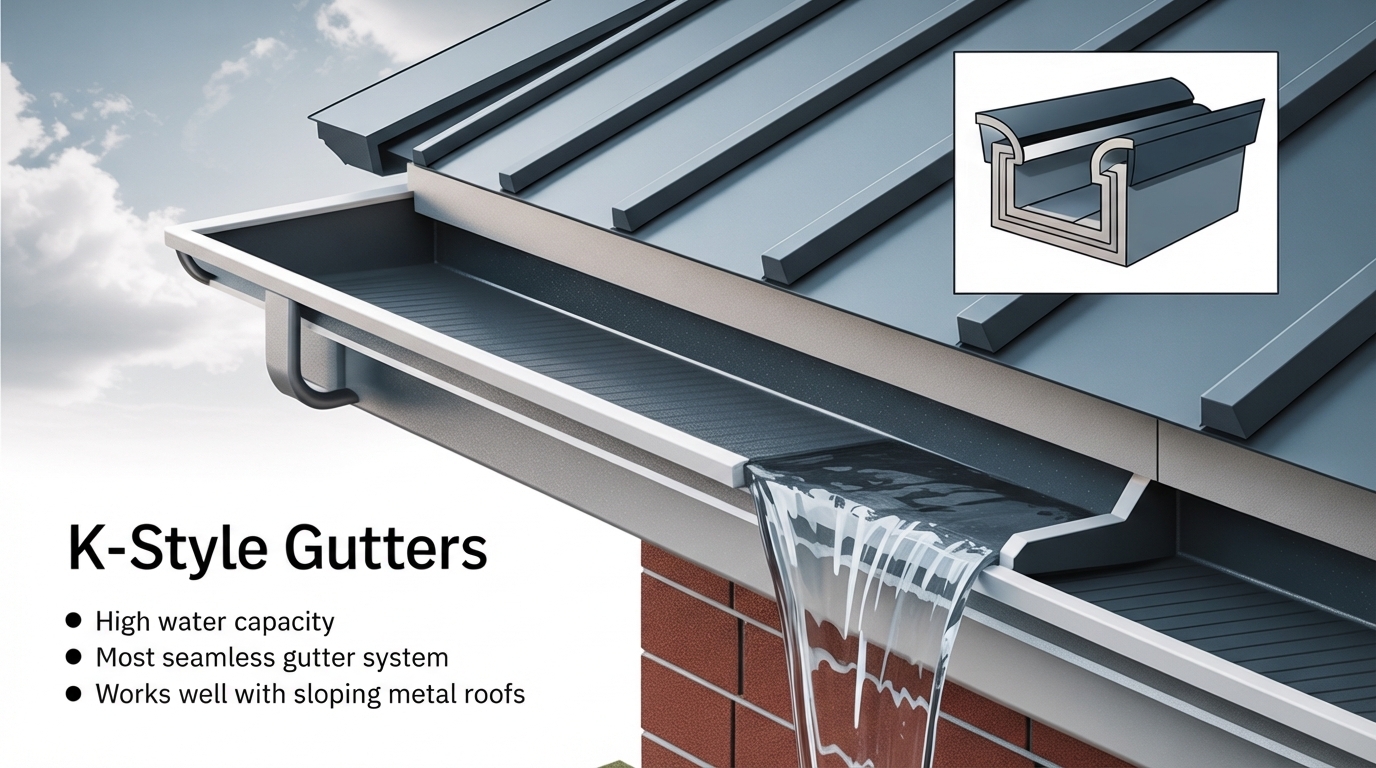
What they are: K-style gutters have a flat back and bottom with a decorative front profile. They mount neatly to fascia boards and typically hold a lot of water for their size.
Why they work well on metal roofs: They offer strong capacity and are widely available in seamless systems, which reduces leak points.
Best for:
- Most modern homes
- Heavy rainfall areas (especially in 6-inch)
- Homeowners who want easy sourcing and repairs
Watch-outs:
- The profile can trap debris in corners if you never clean them
- If undersized or missing downspouts, they still overflow (metal roofs expose bad sizing fast)
Half-round gutters (smooth flow, easier cleaning for many homes)
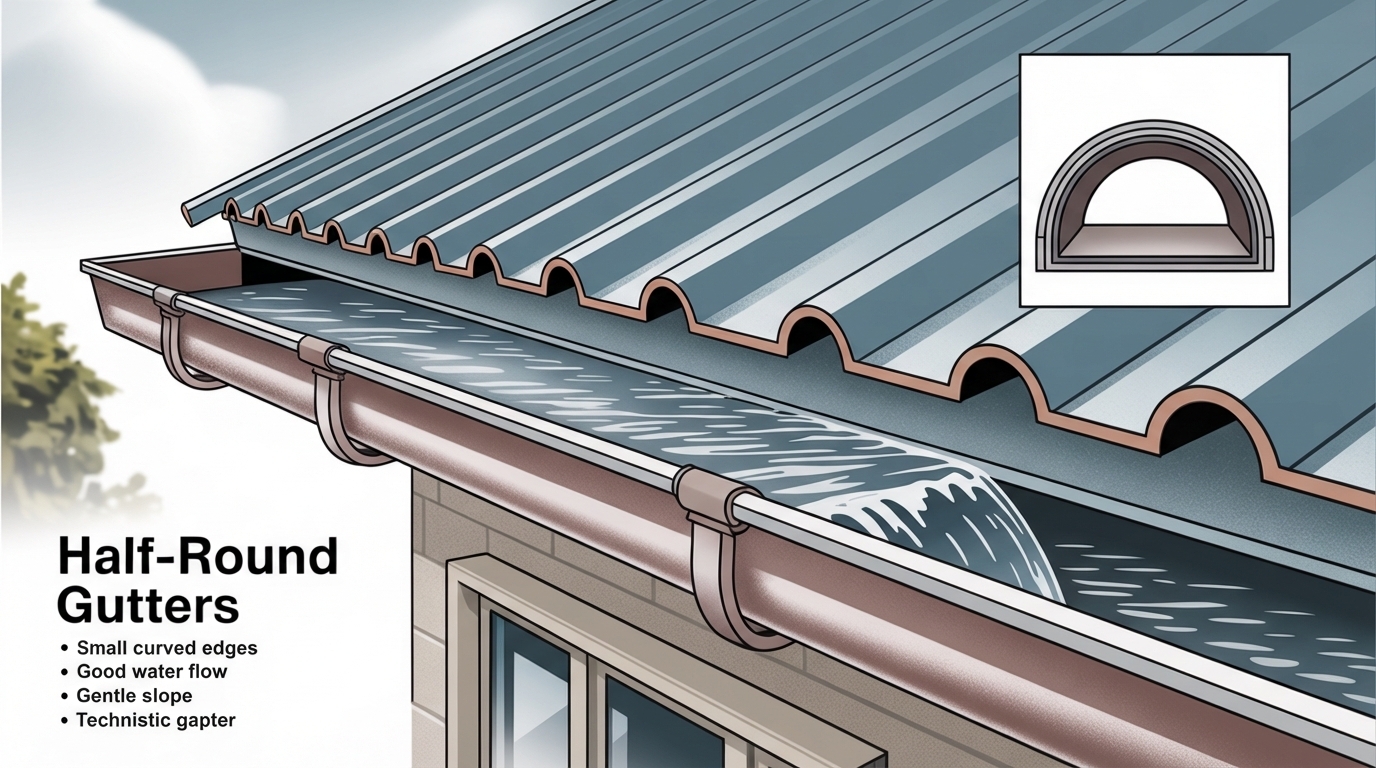
What they are: A rounded, half-cylinder shape. Water and small debris tend to move through more smoothly.
Why they work well on metal roofs: The smooth interior can reduce buildup and make cleaning simpler, great if you’ll actually maintain them.
Best for:
- Traditional or historic-style homes
- Areas with moderate debris
- Homeowners who prioritize easier cleaning and classic looks
Watch-outs:
- May require more precise mounting/support to avoid sagging
- Capacity varies by size; don’t assume “pretty” equals “enough.”
Box gutters (high-volume and often custom)
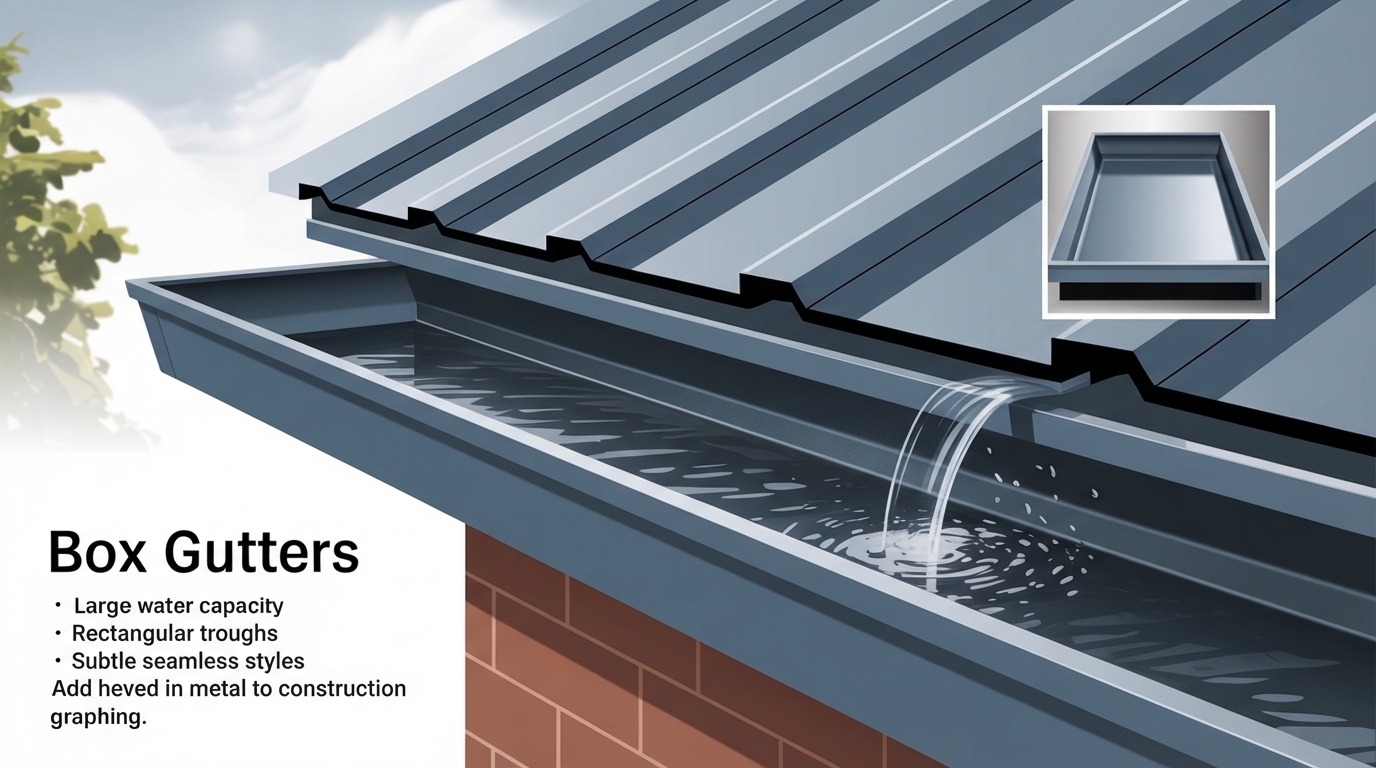
What they are: Box gutters are more rectangular and can have a larger capacity. Some are integrated into the roof edge design; others are built as a distinct, squared profile.
Why they work well on metal roofs: If you have huge roof planes or water concentration points, box-style capacity can be a real advantage.
Best for:
- Large homes, commercial-style runs, or complex rooflines
- Situations where you need high flow handling
Watch-outs:
- Installation quality is everything; mistakes can create chronic leak issues
- Often higher cost and more custom work
- Maintenance access may be trickier depending on the design
Gutter Materials for Metal Roofs: Aluminum vs. Steel vs. Copper
Material choice is where homeowners get upsold or undersold.
Aluminum gutters (popular for good reason)
Pros:
- Doesn’t rust
- Lightweight (easier install)
- Usually, the best cost-to-performance value
- Common in seamless systems
Cons:
- Can withstand hail, ladders, or falling branches
- Can flex more than steel if hangers are spaced poorly
My take: If you want a sensible, budget-smart solution, seamless aluminum is usually the starting point.
Steel gutters (stronger, better dent resistance)
Pros:
- More impact-resistant than aluminum
- Can feel “sturdier” in harsh weather regions
- Often, a good pairing conceptually with metal roofing (durability mindset)
Cons:
- Can corrode if coatings are compromised or if you live in highly corrosive environments
- Heavier; installation needs solid fascia and proper hangers
My take: If you get hail, heavy snow sliding, or you’ve dented gutters before, steel can be worth it—provided it’s properly coated and installed.
Copper gutters (premium looks, premium cost)
Pros:
- Beautiful aging/patina
- Long lifespan when installed correctly
- Strong curb appeal
Cons:
- Expensive and often requires specialized installation.
- Still can dent (it’s softer than people assume)
- Not the “value” choice for most homeowners
My take: Copper is an aesthetics-forward decision. If that’s your priority and the budget supports it, it can be excellent.
What about vinyl?
Vinyl is lightweight and cheap, but for metal roofs where runoff is fast, and winters can be harsh, vinyl often isn’t my first recommendation for long-term performance.
Comparison table: Choose Your Gutter Profile Quickly
Use this as your fast filter. Then we’ll talk sizing and installation.
| What you care about | K-style | Half-round | Box |
|---|---|---|---|
| Rain-handling capacity (typical) | High | Medium–High | Very high |
| Debris/clog tendency | Medium | Low | Medium |
| Ease of cleaning | Medium | High | Low–Medium (depends on access) |
| Best fit | Most homes, easy sourcing | Traditional looks, smoother flow | Large/complex roofs, high-volume drainage |
| Cost (relative) | $$ | $$–$$$ | $$$ |
Sizing that actually works: 5-inch vs. 6-inch (and why downspouts are half the battle)
People fixate on gutter width and forget the rest of the system. Here’s the reality:
When 6-inch gutters make sense
Consider a 6-inch if you have:
- A steep metal roof pitch
- Long gutter runs
- Heavy rainfall
- Big valleys dumping into a small section
- Frequent overflow even after cleaning
A metal roof can “outflow” a 5-inch system in the right conditions. That doesn’t mean 5-inch is wrong; it’s just that it needs to match your roof and rainfall.
Downspouts: the overlooked overflow fix
If your gutter is filling and spilling, sometimes the gutter isn’t the main problem – the downspouts are.
Practical upgrades that work:
- Add an additional downspout near a valley discharge zone
- Increase downspout size where appropriate
- Reduce long stretches that rely on a single downspout at the far end
Don’t ignore where the water goes
Even a perfect gutter can cause damage if the downspout dumps water next to the house.
Simple foundation-protecting add-ons:
- Downspout extensions
- Splash blocks
- Buried drains (if grading and drainage are done correctly)
Metal-roof-specific installation notes (this is where most failures happen)
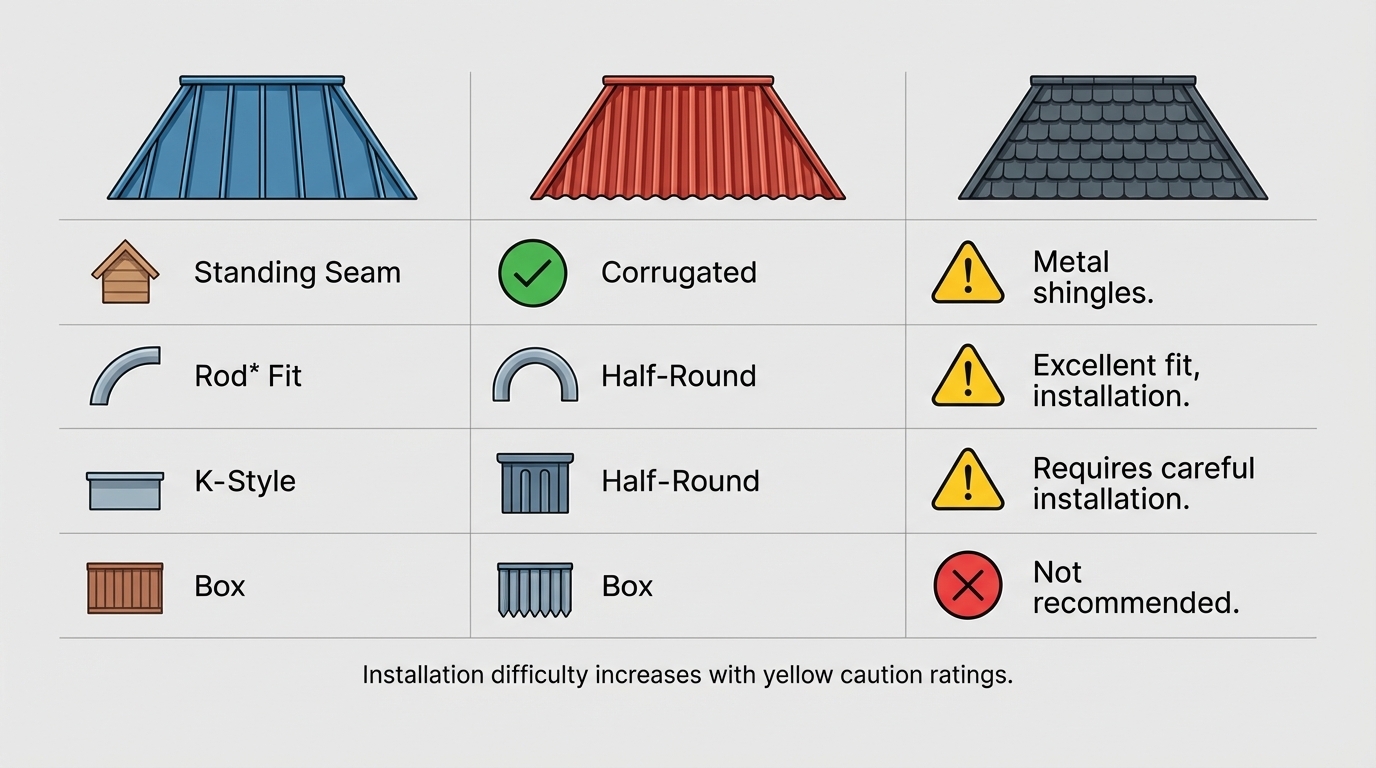
If you only read one “pro tip” section, make it this one.
Use the right attachment approach (and avoid risky methods)
For metal roofs, you generally want gutters attached securely to the fascia with proper hangers/brackets. What you want to avoid is a setup that compromises the roof system or relies on questionable strap methods tied into the roof deck.
If your installer suggests fastening approaches that interact with the roofing panels in a way the roof manufacturer wouldn’t approve, pause and ask questions.
Mounting height matters on metal roofs
Metal roofs can shed water in a sheet. If the gutter sits too low relative to the drip edge and roofline, water can overshoot in heavy rain.
Metal roofs can shed water in a sheet. If the panels are older or the coating is fading, it’s also a good time to check whether the roof needs maintenance or repainting. I have a full guide on painting a metal roof that explains when repainting is worth it and how to do it safely.
A good installer will:
- Align the gutter to “catch” the runoff path
- Ensure drip edge/flashing details direct water into the trough
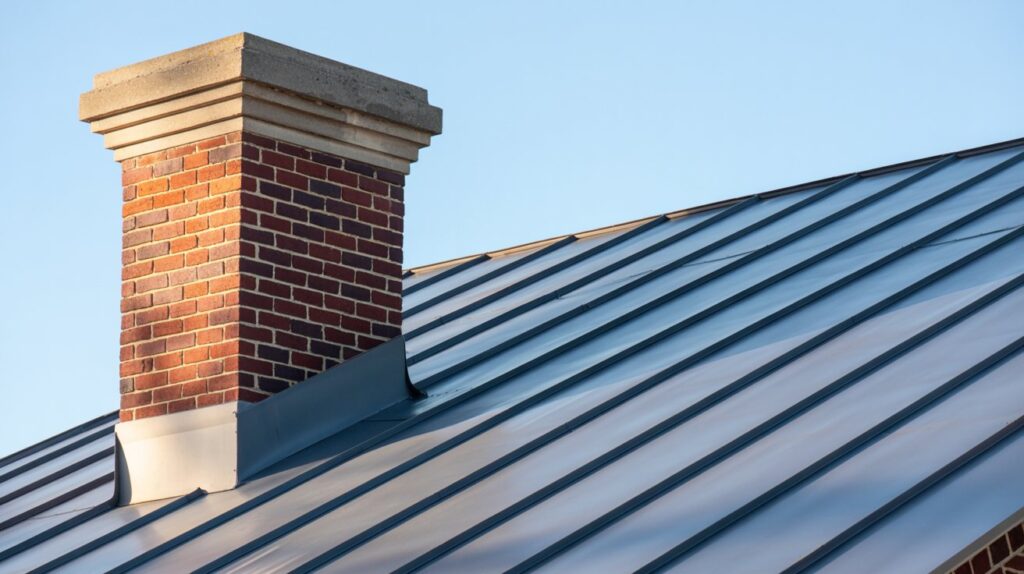
Water control starts at the details, and that includes roof penetrations like chimneys. If you’re noticing stains or moisture near a chimney area, the gutter might look fine, but the flashing could be the culprit.
I’ve got a detailed walkthrough on metal roof around chimney flashing fixes and leak prevention that covers the most common leak points and how to diagnose them before you blame the gutters.
Slope: “looks level” isn’t the goal
Gutters need a consistent slope toward the downspout. Too flat leads to standing water (and corrosion, mosquitoes, debris buildup). Too steep looks odd and may still not drain well if downspouts are undersized.
Snow and ice: plan for sliding snow
On metal roofs, snow can slide fast and hit gutters hard.
If you live in snow country, discuss:
- Snow guards above gutters to reduce sudden snow slides
- Stronger hanger systems and tighter spacing
- Heat cable planning (where appropriate and safe)
Gutter Guards on Metal Roofs
Guards can be helpful, but they’re not magic. I like them when they reduce a real maintenance burden without creating new problems.
When guards are a good idea
- Heavy leaf load, and you can’t (or won’t) clean gutters often
- Pine needles are constantly clogging outlets
- You’ve had overflow because of debris, not because of sizing
When to be careful
- Freezing climates: guards can contribute to ice buildup if water can’t flow freely
- Low-slope gutters: anything that slows drainage can increase standing water risk
- If your actual issue is a poor slope or too few downspouts, guards won’t fix it.
My rule: fix sizing, slope, and downspouts first. Then consider guards.
Cost & Longevity: How to Budget Without Getting Upsold
Prices vary widely by region, access, and home design, so I won’t throw out a single “typical” number and pretend it applies everywhere. Instead, focus on what drives your quote.
What changes the price quickly
- Material choice (aluminum vs steel vs copper)
- Seamless vs sectional
- Home height and roof access
- Number of corners/angles
- Number and size of downspouts
- Fascia repairs (common and worth doing correctly)
Where spending more is often worth it
- Moving from a 5-inch to a 6-inch if you’ve had overflow
- Adding downspouts where valleys dump water
- Strong hanger systems and correct spacing
- Proper water discharge away from the foundation
Where “premium” might not matter
- Upgrading to the fanciest material if your main issue is poor drainage design
- Paying for guards when you haven’t fixed slope/clogging outlets
DIY vs. pro: what I’d recommend for homeowners (safely)
I’m DIY-friendly, but I’m also ladder-safety serious.
DIY-friendly tasks
- Inspecting for overflow stains, sagging runs, and loose hangers
- Cleaning gutters (with proper ladder technique and a spotter when possible)
- Adding downspout extensions and splash blocks
- Checking that water discharges away from the house
Pro-only (in most cases)
- Installing full gutter runs on multi-story homes
- Correcting pitch/slope over long distances
- Box gutter work or integrated systems
- Fascia replacement/repair
- Anything requiring roof access on steep metal pitches
If you’re unsure, hire it out. One fall or one compromised roof detail costs more than professional labor.
What to ask a contractor (quick checklist)
- What size gutters and why?
- Where will downspouts go, especially near valleys?
- How will you ensure the correct slope?
- What hanger type and spacing will you use?
- How will water be discharged away from the foundation?
Frequently Asked Questions
Do metal roofs require special gutters?
Not “special” in the sense of a unique brand-only system, but metal roofs often need better capacity planning and better installation details because runoff is faster and can overshoot poorly placed gutters.
What’s the best gutter type for heavy rain on a metal roof?
Often 6-inch K-style is the practical winner, but heavy rain performance is also about downspout sizing and placement. A smaller gutter with smart downspouts can outperform a bigger gutter with a poor drainage layout.
Can you use gutter guards with a metal roof?
Yes. Choose guards based on your debris type and climate, and make sure your system drains quickly. Guards won’t fix bad slopes or undersized downspouts.
What’s better for metal roofs – aluminum or steel gutters?
Aluminum is usually the best value and won’t rust. Steel offers better dent resistance and can be a strong choice in harsh weather, as long as it’s properly coated and installed on solid fascia.
My Practical Recommendations
If you want the safest “most homes” choice
Go with seamless K-style in aluminum, and seriously consider 6-inch if you have steep pitch, long runs, or heavy rainfall.
If you deal with snow slides, hail, or frequent denting
Consider steel with robust hangers and snow management planning (snow guards where appropriate).
If you care most about classic aesthetics and easy cleaning
Look at a half-round (in aluminum, steel, or copper, depending on budget and goals), sized correctly and supported properly.
If you want, tell me your region/climate, whether your roof is standing seam or corrugated, and whether you’ve had overflow at valleys, and I’ll suggest the most likely best setup (profile, size, material, and downspout strategy) in a few bullet points in the comments below.