
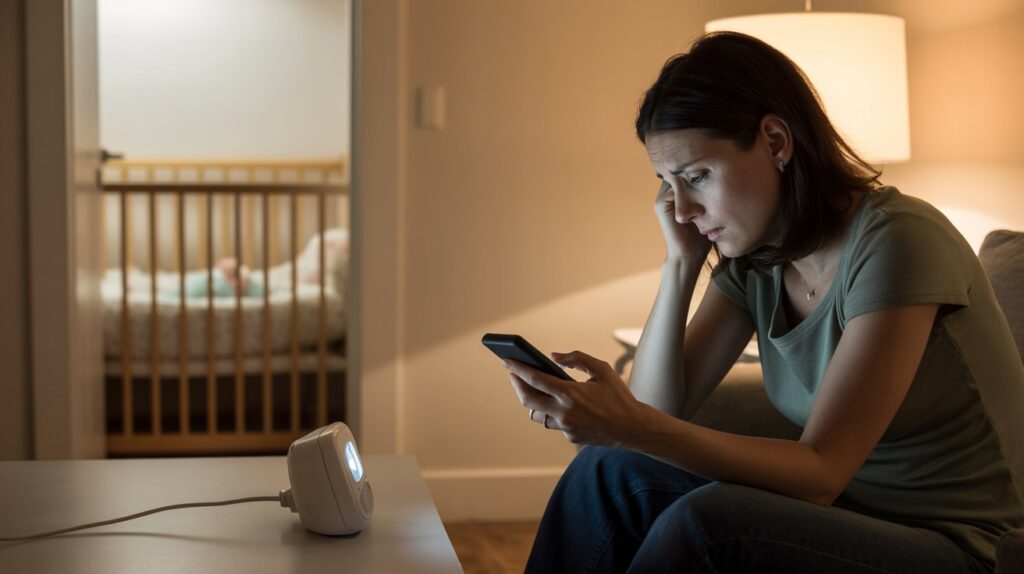
I remember sitting in my living room at 2 a.m., scrolling through parent forums on my phone while my nephew slept upstairs.
His mother had texted me earlier that day with a simple question that carried so much weight: Why isn’t he crawling yet? He’s eight months old.
I’ve spent years teaching child development and advising parents through these exact moments of doubt, and I recognized the tremor that every parent feels when their baby doesn’t hit a milestone “on schedule.”
Here’s what I told her then, and what I’m telling you right now:
Most babies begin crawling between 6 and 10 months old, with many settling into consistent crawling around 8 to 9 months. If your baby hasn’t started yet, I want you to take a breath.
This timeline is far more flexible than you’ve probably read online, and I’ve worked with hundreds of families who discovered that their “late” crawler was actually developing exactly as their unique body and brain needed them to.
The Real Truth About Crawling Timelines
The truth I’ve learned through years in both education and parental advisory work breaks down into something simple:
Your baby’s crawling journey belongs entirely to them. It’s not a race, it’s not a predictor of future intelligence, and it certainly isn’t a reflection of your parenting.
Actually, crawling is a window into how your child’s nervous system, muscles, and emerging personality all work together to explore the world around them.
When I work with anxious parents, I share what I’ve observed repeatedly: the baby who crawled at five months and the baby who crawled at thirteen months look virtually identical by age three.
Same coordination. Same strength. Same confidence. The crawling timeline simply doesn’t matter as much as you think it does right now.
When Do Babies Actually Start Crawling?
The typical timeline looks like this:
| Age Range | What You’ll Observe |
|---|---|
| 4-6 months | Baby rocks back and forth on the belly, pushes with arms, and may scoot backward or sideways |
| 6-8 months | Baby might rock on hands and knees, pivot in circles, and begin exploring forward movement |
| 8-10 months | Traditional crawling emerges; the baby may also cruise along furniture or pull up |
| 10-12 months | Some babies perfect crawling; others skip it entirely and move toward pulling up and walking |
| 12+ months | Late crawlers often catch up without any developmental concerns |
Think of it like knowing that most people learn to drive around age sixteen. Some drive at fourteen, some at eighteen, and a few never drive at all. None of those variations means something went wrong.
I’ve watched babies who crawled at five months grow into cautious toddlers, and I’ve seen babies who didn’t crawl until eleven months become fearless explorers by age two. The starting age told me nothing about where they’d end up.
The Standard Range: 6-10 Months (And Why It’s Flexible)
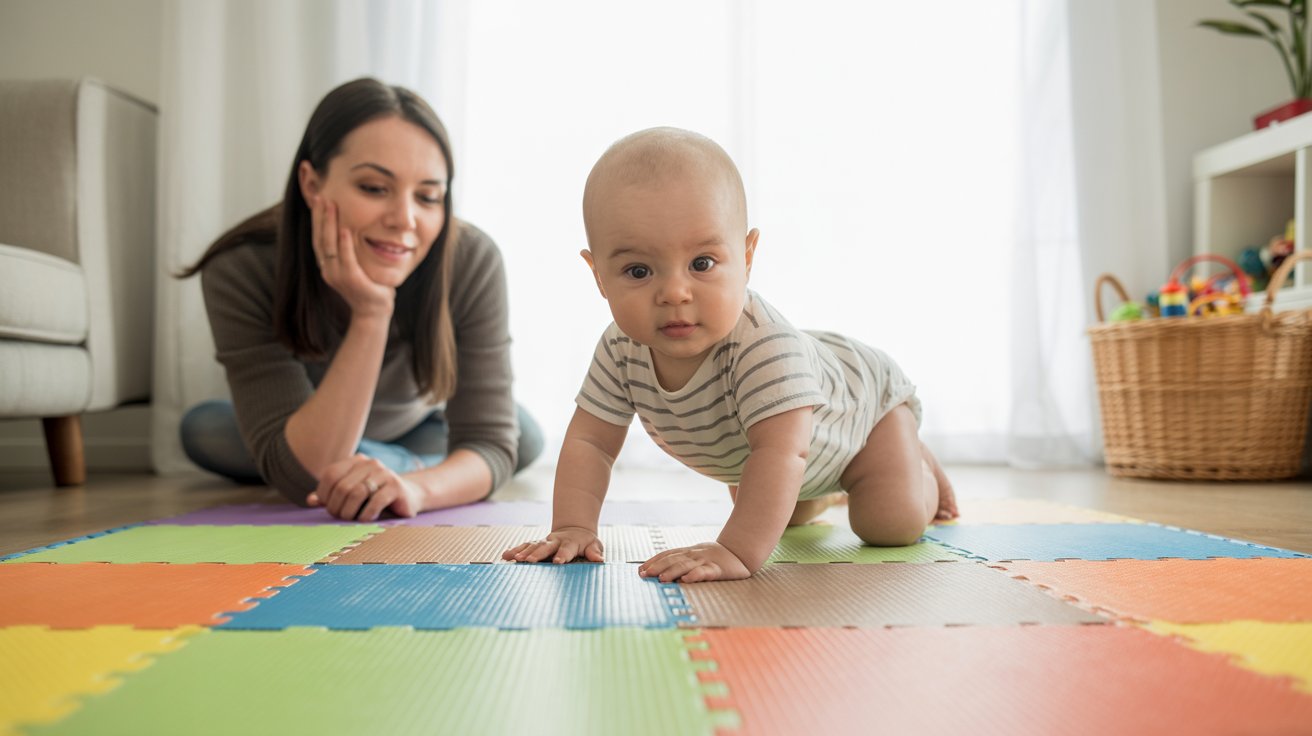
When I first began teaching developmental psychology, I thought crawling was a single, definable milestone. Then I started observing real babies in real homes, and I learned that crawling isn’t one thing; it’s actually a category of movements that your baby invents for themselves.
Your baby might move in any of these ways, and all of them count as crawling:
- Bottom scooting like a penguin (dragging with both hands while the bottom slides forward)
- Commando crawling (dragging their body across the floor with just their arms)
- Rockety-hopping (launching themselves forward in small jumps)
- Crawling backward before crawling forward
- Bear crawling (hands and feet, bottom in the air)
- Traditional hands-and-knees crawling (what most people imagine)
All of these movements serve the same purpose: your baby is learning to move independently through space.
Why does the 6-10 month window exist?
As per the Cleveland Clinic, the six-to-ten-month range exists because this is when most babies develop the physical and neurological foundation to support forward movement:
Their neck muscles have strengthened enough to support their head consistently. Their core has developed the stability needed to support their torso upright. Their brains have made the neural connections necessary to coordinate arms and legs in a new way.
But here’s what I’ve discovered through working with countless families: development doesn’t follow a calendar. Some babies’ brains wire up these connections earlier. Some wire them up later. Neither timeline indicates anything about intelligence, athleticism, or future achievement.
Early Birds vs. Late Bloomers: What’s Normal?
I had a conversation last year with a mother named Sarah, who told me her daughter crawled at five months. Sarah beamed with pride, and I heard the unspoken subtext: “My baby is advanced.” Then she paused and added something important: “But honestly, I wasn’t ready. She got into everything immediately, and I had to baby-proof my entire house in a panic.”
Three months later, I met another mother, Emma, whose son didn’t crawl until thirteen months. Emma had spent weeks wondering if something was wrong.
She’d read articles suggesting that late crawling indicated developmental delay. She was relieved, almost tearful, when her pediatrician assured her he was developing normally.
Both of those babies are now toddlers. Both are healthy, curious, and completely within the normal range.
What I learned from Sarah and Emma’s experiences:
“Early” and “late” are just labels we attach to development, and they carry emotional weight that doesn’t always reflect reality.
Early Crawling (5-7 months)
Your baby’s physical development moved ahead of the curve. They might be naturally coordinated, or they might simply have had the right combination of genetics, tummy time, and motivation. Some early crawlers are particularly curious about their environment and push themselves to move faster to explore it.
I worked with one family where the baby crawled at six months. The parents felt validated, celebrated, and almost proud. But within weeks, they realized that early crawling meant constant vigilance. Their baby got into cabinets they hadn’t even thought about baby-proofing yet. They weren’t prepared for how quickly mobility changes everything.
Late Crawling (11-14 months)
Your baby took a different developmental path. Some babies spend more time perfecting their core strength before they begin forward movement. Some babies are naturally cautious and want to feel more confident before they venture into space. Some babies skip crawling altogether and move directly toward pulling up and walking.
I’ve noticed that late crawlers often move with more confidence once they do start. They’ve spent those extra weeks building strength, so when they finally crawl, they’re already fairly stable. They’re less likely to face-plant repeatedly.
None of these patterns indicates delay.
Here’s what the research actually shows: By age two or three, crawling timing has virtually no correlation with later motor skills, intelligence, or athletic ability. The baby who crawled at five months and the baby who crawled at thirteen months often show identical physical capabilities a few years later.
Is My Baby Delayed? Decoding Your Unique Situation
This is the section where I shift into what I call “the truth-telling,” because I know this is what brought you here. You’re worried.
You’ve compared your baby to someone else’s baby, or to some developmental milestone chart, and you’re wondering if your child is behind. This worry is real, and it’s valid. It comes from a place of deep love. You want your child to thrive, and when you sense that something might be off, your instinct is to investigate, to fix it, to help.
That instinct is beautiful. I just want to help you channel it productively.
Here’s what I’ve learned: most babies who aren’t crawling by ten months are developing completely normally. Some are simply building strength, coordination, and confidence at their own pace. Some are naturally cautious. Some are focused on other developmental achievements: their language skills, their social awareness, and their ability to sit independently without tipping over.
But here’s also what I’ve learned: some babies do benefit from a little extra support, not because something is “wrong,” but because every baby learns best when they have the right conditions and encouragement.
Common Reasons for Variations (No Two Babies Are Alike)
When I sit with a parent who’s concerned about crawling delays, I ask them to think about their baby’s entire development, not just one milestone. I learned this approach in my educational background, where we always look at the whole child, not isolated skills.
Muscle tone and strength development
I’ve noticed that babies with naturally lower muscle tone take longer to build the strength needed for crawling. This doesn’t mean they’re weaker in a permanent senseit just means their muscles are developing on a different timeline.
I worked with one family where the baby had a naturally relaxed muscle tone. The parents worried for months. Then their pediatrician explained something crucial: some babies are just born this way, and they typically catch up completely by age two or three. That baby eventually crawled at thirteen months and walked at eighteen months, and by age three was completely typically developing.
Personality and temperament
I’ve worked with naturally cautious babies who spent months watching their siblings move before they attempted it themselves. These babies aren’t delayedthey’re thorough. They’re building confidence internally before they express it externally.
I’ve also worked with fearless babies who fling themselves forward at six months because they feel no hesitation. Both approaches work. I’ve seen cautious babies grow into careful, thoughtful children who take calculated risks. I’ve seen fearless crawlers grow into adventurous kids who try new things without hesitation.
Environmental factors
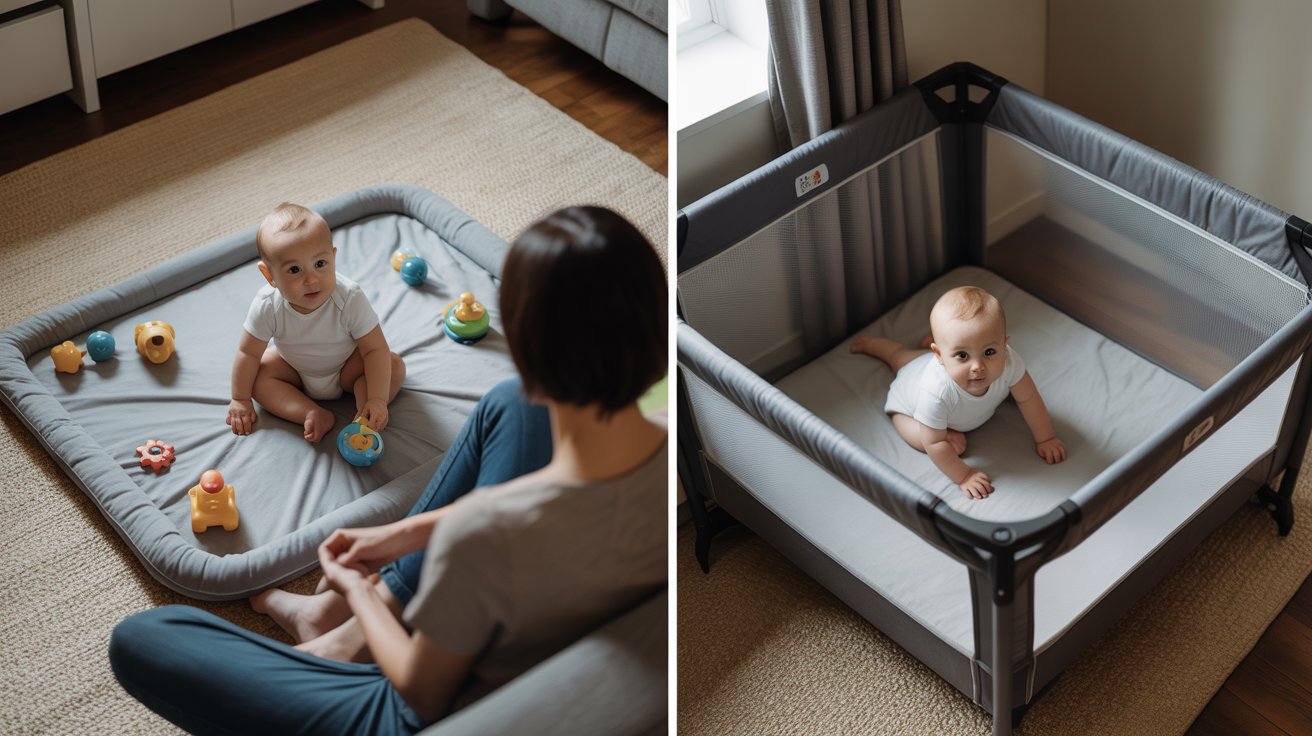
This is where I see parents sometimes inadvertently slow their baby’s crawling development. If your baby spends most of their day in a bouncer, swing, or playpen, they have limited opportunities to practice the movements that build crawling strength. I’m not here to judge. I understand that parents are busy and need their hands free sometimes. But I’ve noticed that babies who spend more time on the floor with freedom to move do tend to crawl earlier.
One family I worked with kept their baby in a playpen most of the day while managing two older kids. The baby wasn’t crawling at ten months, and the parents were concerned. When I suggested increasing floor timeeven just thirty minutes a dayeverything changed. Within six weeks, the baby crawled. It wasn’t because something was wrong; it was simply that the baby needed more practice opportunities.
Genetic patterns
Some families simply crawl later. I worked with one family where both parents didn’t crawl until after twelve months, and sure enough, all three of their children followed the same pattern. Their pediatrician wasn’t concerned because she knew the family history. Your family’s developmental timeline might be completely different from your neighbor’s.
Birth circumstances
Babies born prematurely develop on a corrected age, not their chronological age, for about the first two years. So if your baby was born three months early, you’d expect crawling closer to nine months chronologically, since their corrected age would be around six months.
I’ve worked with parents who became unnecessarily worried because they didn’t realize this adjustment. Their eleven-month-old baby wasn’t crawling yet, but their corrected age was only eight months. Once they understood the adjustment, their worry dissolved.
Health and physical factors
Sometimes a baby’s development is affected by tongue tie, ear infections, vision issues, or other physical factors that are completely treatable. I don’t mention this to scare you, but to remind you that if your baby seems to struggle with movement in addition to delayed crawling, it’s worth mentioning to your pediatrician.
Red Flags vs. Reassuring Signs: When to Check In
I want to be completely honest with you here, because clarity matters.
Most babies who aren’t crawling by twelve months are developing normally. But some signs warrant a conversation with your pediatrician, not out of panic, but out of care.
You might want to mention it to your doctor if:
- Your baby shows no interest in reaching for objects or moving toward things they want. By eight months, most babies are actively motivated to move. If your baby seems content to stay in one place and doesn’t seem to want to move toward toys or people, that’s worth mentioning.
- Your baby has low muscle tone across their whole body, not just for crawling. If your baby feels floppy when you pick them up, struggles to sit independently, or seems weak in their arms and legs, that’s worth exploring.
- Your baby has significant asymmetry; they favor one side dramatically or seem to have difficulty moving one arm or leg. Some asymmetry is normal, but significant differences should be checked.
- Your baby isn’t hitting other milestones alongside crawling. If your baby isn’t babbling, doesn’t turn toward sounds, isn’t making eye contact, or seems behind in other ways, your pediatrician should know.
You can feel reassured if:
- Your baby is reaching, grasping, and showing interest in exploring objects. Motivation to reach and explore is actually a better indicator of development than crawling itself.
- Your baby is babbling, laughing, making eye contact, and engaged with you and their environment. Communication and social skills matter more than movement timing.
- Your baby is building strength steadily. They might be working on sitting independently, or they might be starting to push up on their hands, even if they’re not crawling yet. Progress matters more than arrival.
- Your baby has a family history of late crawling or walking. Genetics matter.
- Your pediatrician isn’t concerned. If you’ve mentioned it to your doctor and they’re not worried, I’d encourage you to release that worry too.
Inside Your Baby’s Brain and Body: What Drives Crawling
Because when you understand the neurology and physiology behind it, you stop seeing crawling as a box to check and start seeing it as a remarkable achievement.
When I teach developmental psychology, I always start by explaining that crawling requires integration across multiple systems in your baby’s body and brain. It’s not just about muscle strength. It’s about:
- Coordination between limbs
- Balance and spatial awareness
- Motivation to explore
- Confidence to attempt movement
- Neurological pathways firing in the right sequence
Your baby’s brain is literally rewiring itself during this period. The neural pathways that allow them to think “I want that toy” and then execute the plan to move toward it are being built week by week. The cerebellum, which controls balance and coordination, is developing rapidly. The motor cortex is making new connections that allow voluntary control of arms and legs.
Meanwhile, your baby’s body is also getting stronger. The muscles in their neck, shoulders, back, and core are building endurance and strength. Their legs are developing the ability to push. Their proprioception, their sense of where their body is in space, is sharpening. All of this happens gradually, and all of it is necessary before your baby can successfully crawl.
Key Developmental Building Blocks Before Crawling
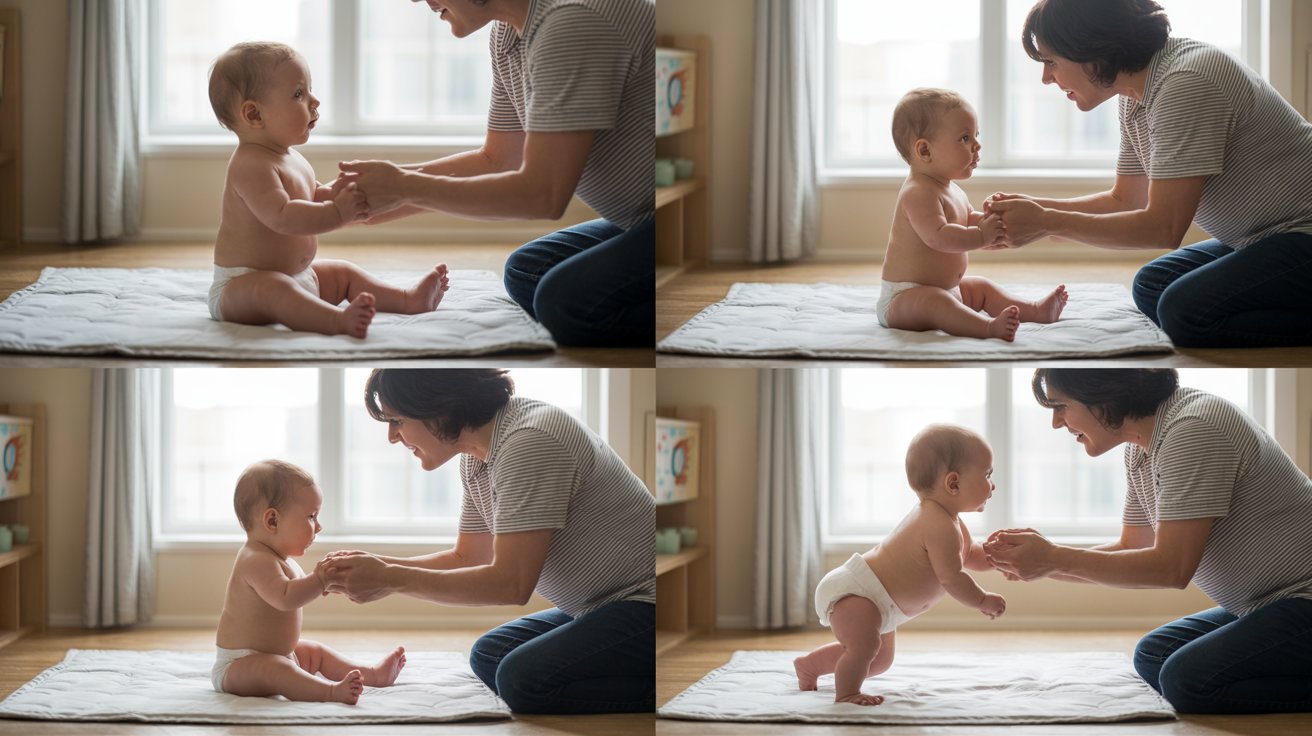
I’ve noticed that parents often focus exclusively on crawling and miss the beautiful progression that leads to it.
Understanding these building blocks helps you recognize that your baby is making progress even before they crawl.
Neck Control (roughly 1-3 months)
Your baby lifts their head off the ground. This seems simple, but it’s foundational. Their neck muscles are learning to work against gravity. Without neck control, everything that comes after is impossible.
Rolling Over (roughly 3-6 months)
Your baby begins to roll from back to stomach and stomach to back. This is where intentional movement begins. Your baby is discovering that they can move themselves through space. Rolling requires coordination between different muscle groups and balance adjustment. It’s a huge achievement.
Sitting with Support and Then Independently (roughly 4-8 months)
Your baby learns to sit upright. This is harder than it sounds. Sitting requires core strength, balance, and the ability to make tiny micro-adjustments to stay upright. Once your baby can sit independently, they’ve freed up their hands to explore objects more fully. This is when learning accelerates.
Rocking on Hands and Knees (roughly 6-8 months)
Your baby gets into a position on their hands and knees and rocks back and forth. This looks simple, but it’s the direct precursor to crawling. Your baby is building the strength and coordination necessary for forward movement. They’re also learning the feeling of weight shifting in their body. This rocking phase is crucial, even though some parents skip it entirely.
Backward Movement (roughly 6-8 months)
Many babies move backward before they move forward. This happens because pushing is easier than pulling. Your baby might scoot backward on their bottom or crawl backward on their hands and knees. This is completely normal and completely fine. Forward movement will come.
Forward Movement (roughly 8-10 months)
Finally, your baby figures out how to coordinate their limbs to move forward. Or sometimes they skip crawling and move to pulling up and walking. Every path is valid.
How Tummy Time and Play Shape Readiness
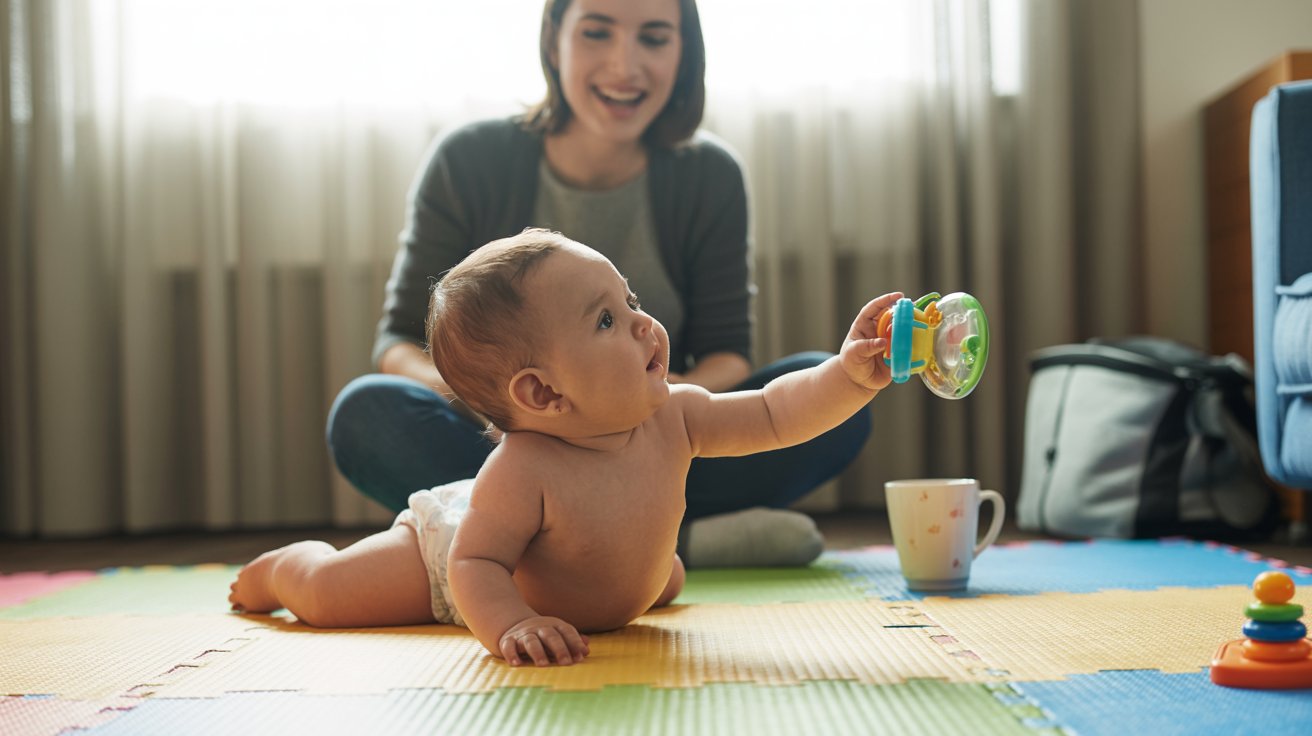
I learned early in my teaching career that the environment shapes development. Your baby’s brain and body develop through interaction with their surroundings. Tummy time is the single most important activity for building crawling readiness, and I want to explain why.
Why tummy time matters:
When your baby is on their tummy, gravity pulls their head down. Their neck muscles have to work to lift it. Their arms and shoulders naturally engage to help them look around. If there’s an interesting object nearby, your baby reaches for it, which builds arm strength and motivation simultaneously. Over weeks and months of tummy time, the cumulative effect is enormous.
But here’s what I’ve discovered: tummy time only works if your baby is on their tummy. If your baby screams the moment you place them down and you immediately pick them up, they’re not getting the benefit. This is where it gets tricky, because some babies genuinely hate tummy time early on. Their neck control is poor, so their head falls awkwardly. They feel insecure. They’re not ready.
Building Tummy Time Confidence
I recommend a gentle progression that respects your baby’s readiness:
- Start tummy time early and start gently. Even newborns can tolerate a few minutes of tummy time. Place your baby on your chest while you’re lying downthat’s tummy time too, and many babies prefer it.
- Gradually increase the duration and challenge. Once your baby is two months old, try placing them on a firm surface like a play mat, but stay right there with them. Make it fun. Get down on the mat with them. Smile at them. Put interesting objects nearby.
- Watch for their tummy time sweet spot. Some babies do best in the morning when they’re well-rested. Some do best after feeding. Experiment and notice the pattern.
If your baby absolutely refuses tummy time, you have options:
- Try tummy time on a small incline, which is less intense
- Place them over a rolled-up towel, which gives them support
- Try baby-wearing, which builds strength while your baby is comfortable
- Avoid letting the struggle create negative associations with movement
Beyond Tummy Time: Play as Development
Beyond tummy time, play is where the real magic happens. I’ve watched babies develop crawling readiness through play that has nothing to do with forcing movement.
- Place interesting objects just out of reach. Your baby will naturally reach for them, building arm and shoulder strength. As they get older, they’ll be motivated to move toward objects they want.
- Create a safe space for exploration. Baby-proof a room or a large area so your baby can move freely without you constantly redirecting them. Babies learn best when they feel safe to experiment.
- Play alongside your baby. Get down on the floor with them. Crawl yourself. Show them what’s possible. Make it a game rather than a developmental task.
- Vary their positions. Side-lying, sitting with support, hands and knees, crawling backward, expose your baby to different ways of moving.
- Celebrate effort over achievement. When your baby pushes up on their hands, cheer. When they rock forward, celebrate. Don’t wait for the moment they crawl to praise their progress.
I worked with a family where the parents were so focused on crawling that they forgot to enjoy their baby’s current stage. Once I encouraged them to simply play with their ten-month-old without the agenda of making them crawl, something shifted. The baby relaxed. The parents relaxed. Within two weeks, crawling happened naturally because the pressure had lifted.
Hands-On Ways to Nurture Crawling (Without Pressure)
I want to emphasize something important here, and I’m saying this after years of watching parents almost inadvertently pressure their babies:
Crawling develops best in a low-pressure environment where your baby feels safe to experiment.
The anxiety you feel about crawling can transmit itself to your baby. Your baby reads your body language, your tone, and your stress level. If you’re anxious and hovering, your baby might feel that anxiety. If you’re relaxed and present, your baby feels safe.
That said, you’re not passive in this process. You create the conditions for crawling to emerge. You don’t force it, but you do invite it.
Daily Routines That Spark Movement
I’ve found that the families whose babies crawl most confidently are the ones who weave movement opportunities throughout their day naturally, not as separate “therapy” sessions.
Morning Floor Time
Start each day with fifteen to twenty minutes of floor time while your baby is rested and in a good mood. This isn’t forced tummy timeit’s simply your baby on the floor with you nearby, free to move however they want. Put some toys around, get down there with them, and let play unfold naturally.
I’ve noticed that babies who have consistent morning floor time develop movement skills faster because they’re practicing during their peak energy hours.
Movement Breaks After Meals
After feeding, give your baby some time on the floor rather than immediately placing them in a chair or bouncer. Their belly is full, they’re content, and they’re often in a good mood. This is a natural window for movement practice.
Transitions Throughout the Day
Every time you move from one room to another, set your baby down on the floor for a moment. Let them practice whatever movement they’re currently working on. These little moments add up significantly.
If you’re going to the bathroom, put your baby down in the hallway. If you’re moving to the kitchen, place them on the kitchen floor. You’re building a natural rhythm where movement is integrated into daily life.
Evening Wind-Down Time
Some babies and toddlers actually wind down better with some gentle movement before bed. If your baby is wound up at 6 p.m., fifteen minutes of free movement on the floor might help them relax before dinner and bedtime.
Weekend Exploration
Use weekends to take your baby to different environments when possible. Parks, grass, and different surfaces, your baby’s brain learns through varied sensory input. The feel of grass under hands, the stability of different surfaces, and the visual interest of a new space all contribute to movement development.
Toys, Games, and Safe Spaces to Encourage Exploration
I’ve noticed that parents often buy baby toys without thinking about whether those toys actually encourage movement. The best toys for crawling development are those that motivate your baby to move.
Rolling Toys That Move Away From Your Baby. Balls, rolling cars, and anything that rolls encourage your baby to chase them. The chasing motion builds movement skills and creates natural motivation. Your baby isn’t doing therapy; they’re just chasing something fun.
Toys Positioned Just Out of Reach. Place a toy just beyond where your baby can easily grasp it. Not so far that they get frustrated, but far enough that they have to reach or move to get it. This creates natural motivation to move.
Climbing Structures Designed for Babies. Soft climbing cubes or wedges allow your baby to practice different movement patterns. Your baby might crawl over them, under them, or around them. Each experience builds coordination and confidence.
Tunnel Toys. Some babies love crawling through tunnels. The tunnel creates a motivating game and gives your baby a sense of achievement when they make it through.
Mirrors. Babies are fascinated by their own reflection. Placing a baby-safe mirror low on the wall gives your baby motivation to move toward it and see themselves.
Musical Toys. Toys that make sounds when your baby presses them give immediate feedback for movement and motivate continued engagement.
The toy doesn’t matter as much as your presence and engagement. A baby with a pile of expensive toys but no adult interaction will develop less quickly than a baby with a cardboard box and an attentive parent. The toy is just an invitation. You are the real draw.
How do I encourage play with toys?
- Start the game. Press the button, watch the light, make the noise. Get your baby interested.
- Place the toy just slightly out of reach. Let your baby figure out how to get to it.
- Play alongside your baby. If your baby is moving toward a toy, crawl alongside them. Make it a game: “Oh, you’re going to get that ball! I’m coming too!”
- Celebrate the journey. When your baby takes three movement attempts to reach a toy and finally gets it, celebrate all three attempts. The effort is what builds skill.
Nutrition and Health Factors for Strong Muscles
This is a piece I don’t see discussed often enough in crawling conversations, but I learned early in my education background that physical development is deeply connected to nutrition.
Your baby’s muscles develop from the protein they consume. Iron supports oxygen transport to muscles. Fat (yes, healthy fats) supports brain development and myelin formation, which is essential for motor control. Well-nourished babies simply develop stronger muscles faster.
Here’s what I recommend:
If you’re breastfeeding, make sure you’re eating enough protein and healthy fats yourself. If you’re formula-feeding, ensure you’re using iron-fortified formula and following preparation guidelines. Once your baby starts eating solids around six months, prioritize protein-rich foods like:
- Yogurt
- Eggs
- Ground meat
- Beans
- Nut butters
- Soft cheeses
A Note Beyond Nutrition
I’ve noticed that babies who get adequate sleep develop motor skills more robustly. Sleep is when the brain consolidates what it’s learned and when physical growth happens. A well-rested baby practices movement skills more confidently.
I also want to mention that crawling readiness is sometimes affected by medical factors that are completely treatable. Tongue tie can affect a baby’s posture and movement patterns. Ear infections can affect balance. Reflux can make tummy time uncomfortable. Vision issues might affect motivation to reach and move. If your baby seems to struggle with movement in ways that feel beyond normal variation, it’s worth mentioning to your pediatrician.
What Comes After Crawling? The Bigger Milestone Picture!
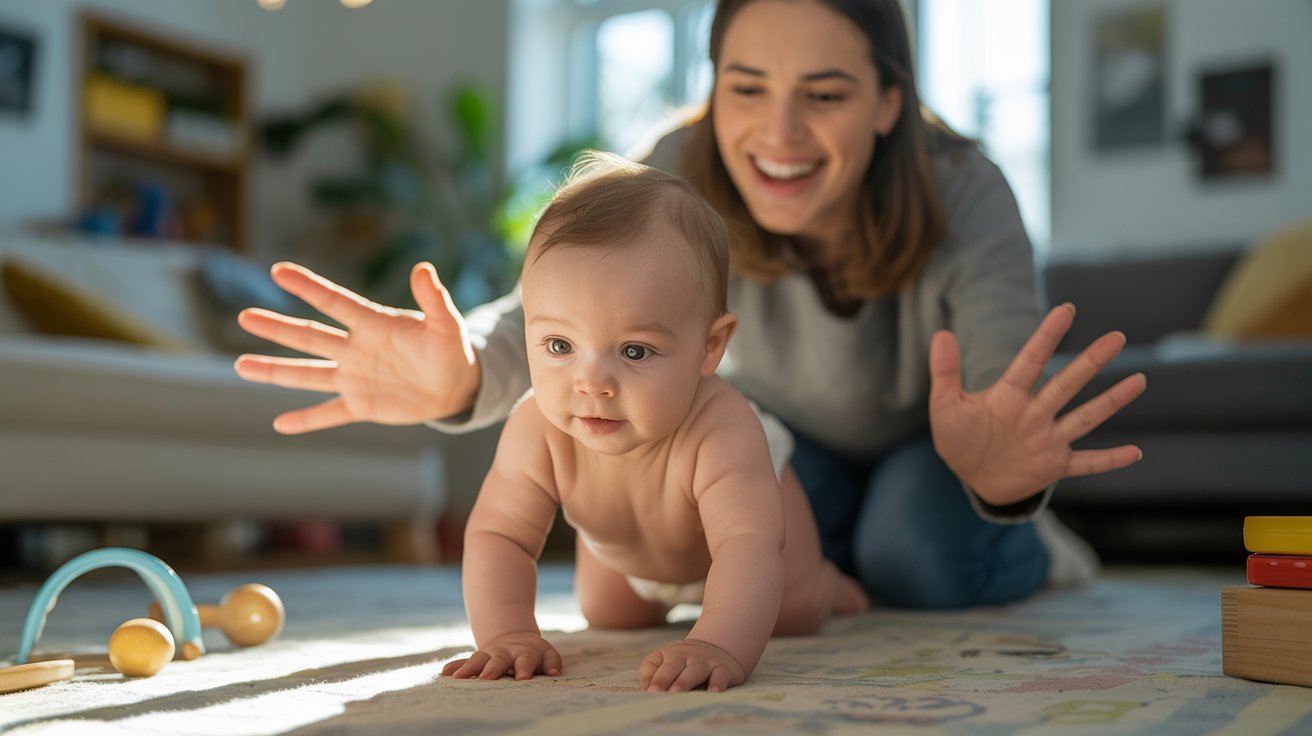
I want to shift perspective here, because I think one of the reasons parents get so anxious about crawling is that they don’t understand what it means developmentally.
Crawling isn’t the goal; independence is.
Crawling is simply one path your baby might take toward independence. Some babies take that path. Some skip it. All roads eventually lead to the same destination: a child who can move through the world on their own terms.
When I work with parents who are anxious about crawling, I often ask them: “What are you really worried about?”
Usually, they’re not worried about crawling itself. They’re worried that if their baby doesn’t crawl, they won’t walk. Or they won’t be coordinated. Or they’ll be behind. Or something is wrong.
Crawling timing tells you almost nothing about future motor development, as quoted by Parenting Science in this insightful piece. The baby who crawled at five months and the baby who crawled at thirteen months look virtually identical at age three. They run the same, jump the same, and have the same coordination and strength.
What matters is the journey from dependent to independent. Crawling is one version of that journey. There are others.
Transition to Pulling Up and Cruising
As your baby gains confidence with crawling (or while they’re still working on it, or even if they never crawl), they’ll start to notice that they can pull themselves up on furniture.
- Around 8-10 months: Your baby might grab your pant leg and pull themselves up to standing.
- Around 10-12 months: Your baby might use furniture to pull themselves to a standing position.
- Around 12-15 months: Your baby might cruise along furniturewalking sideways while holding on.
Here’s what I’ve learned: some babies do this while they’re still perfecting crawling. Some babies do this before they crawl. Some babies crawl, then sit down, then crawl again, then pull up, in no particular order. Development isn’t linear. It’s messy, non-sequential, and individual.
What you’ll notice is that your baby’s confidence grows. Standing feels more stable. Walking feels more possible. One day, probably when you’re not even paying attention, your baby will let go of the furniture and take a step toward you. It might be one wobbly step. It might be five steps. But that moment when your baby chooses to walk is coming.
And here’s what’s true: Whether your baby crawled, bottom-shuffled, bear-crawled, commando-crawled, or skipped crawling entirely, they will walk. I have never met an adult who doesn’t walk because they didn’t crawl as a baby. The human body is built to move upright. Your baby is built for it, too.
Emotional Milestones Tied to Mobility
There’s something deeper happening when your baby begins to move independently, and I want to honor it because it’s profound.
When your baby crawls, they begin to separate from you in tiny ways. They move away from you to explore something interesting. They come back to you for reassurance. They move away again. This back-and-forth is how independence develops. This is how your baby learns that they can go out into the world and that you’ll still be there when they come back.
When your baby gains mobility, their sense of agency expands. They’re no longer dependent on you to bring the world to them. They can move toward what interests them. This builds confidence and autonomy.
I worked with a mother named Jennifer who had significant anxiety when her daughter first crawled. Jennifer realized, in hindsight, that she hadn’t wanted her daughter to move away from her. Jennifer had been enjoying the stage of her daughter being immobile and dependent. When mobility came, Jennifer had to grieve a stage of parenting while simultaneously celebrating her daughter’s growth.
This is real. If you feel conflicting emotions when your baby starts to move, you’re normal. You’re watching your baby become slightly more independent. You’re simultaneously losing the stage of having a baby who needs you in the most basic ways. Both feelings can exist at the same time.
Busting Crawling Myths That Fuel Worry
After years in education and parental advisory work, I’ve noticed that myths about crawling development persist because they sound logical, even though research doesn’t support them.
I want to directly address the myths I hear most often.
Myth: All Babies Crawl the Same Way
I’ve watched so many parents worry because their baby crawls “wrong.” The baby crawls backward instead of forward. The baby crawls on their bottom instead of hands and knees. The baby does a commando crawl, dragging their body forward with their arms.
Here’s the truth: There is no “right” way to crawl.
Babies are biomechanically individual. Their weight distribution, muscle tone, leg length, arm length, and even their temperament all influence how they choose to move.
I watched one baby inch along on her belly like a soldier, completely efficient and effective. She crawled that way for months while her parents worried it was abnormal. Eventually, she transitioned to a more traditional crawl. She’s now a completely normally developing toddler.
I watched another baby shuffle on his bottom like a penguin. His grandmother fretted because it wasn’t “real crawling.” His pediatrician assured us that bottom-scooting is a perfectly valid form of crawling. He walked at fourteen months with no issues whatsoever.
The different styles of crawling don’t predict anything. They’re just different solutions your baby’s brain and body find to the problem of moving forward. Trust that your baby knows how to move their own body.
Myth: Skipping Crawling Harms Development
This is the myth that terrifies parents the most, and I want to put it to rest completely.
I’ve worked with families where babies went from sitting to pulling up to walking without ever crawling. These parents lived in fear that their child had missed a crucial developmental stage.
Here’s what research shows, and what I’ve observed: Crawling is not necessary for normal development. It’s common, yes. It’s beneficial, yes. But it’s not required.
Some babies skip crawling because they lack the motivation to crawl when walking is so close. Some skip it because they have a different body type or muscle tone that makes walking more efficient than crawling. Some skip it because they’re just wired differently. All of these babies develop perfectly normal motor skills.
I knew a child who went from sitting to cruising to walking at 14 months without ever crawling. At age six, that child was the most athletic kid in the kindergarten class. The skipped crawling stage was irrelevant to later development.
Crawling is an excellent tool for building strength, coordination, and confidence. But it’s one tool among many. Your baby will find the tools they need.
Celebrate Your Baby’s Journey
I’m going to end this where I started, with something personal.
My nephew, the one whose mother texted me at all hours worrying about crawling, is now three years old. He didn’t crawl until eleven months. His mother swears she can still remember the anxiety she felt, wondering if something was wrong.
What strikes me now, watching him navigate the world with confidence and joy, is how little that crawling timeline matters. It’s been completely eclipsed by who he is now.