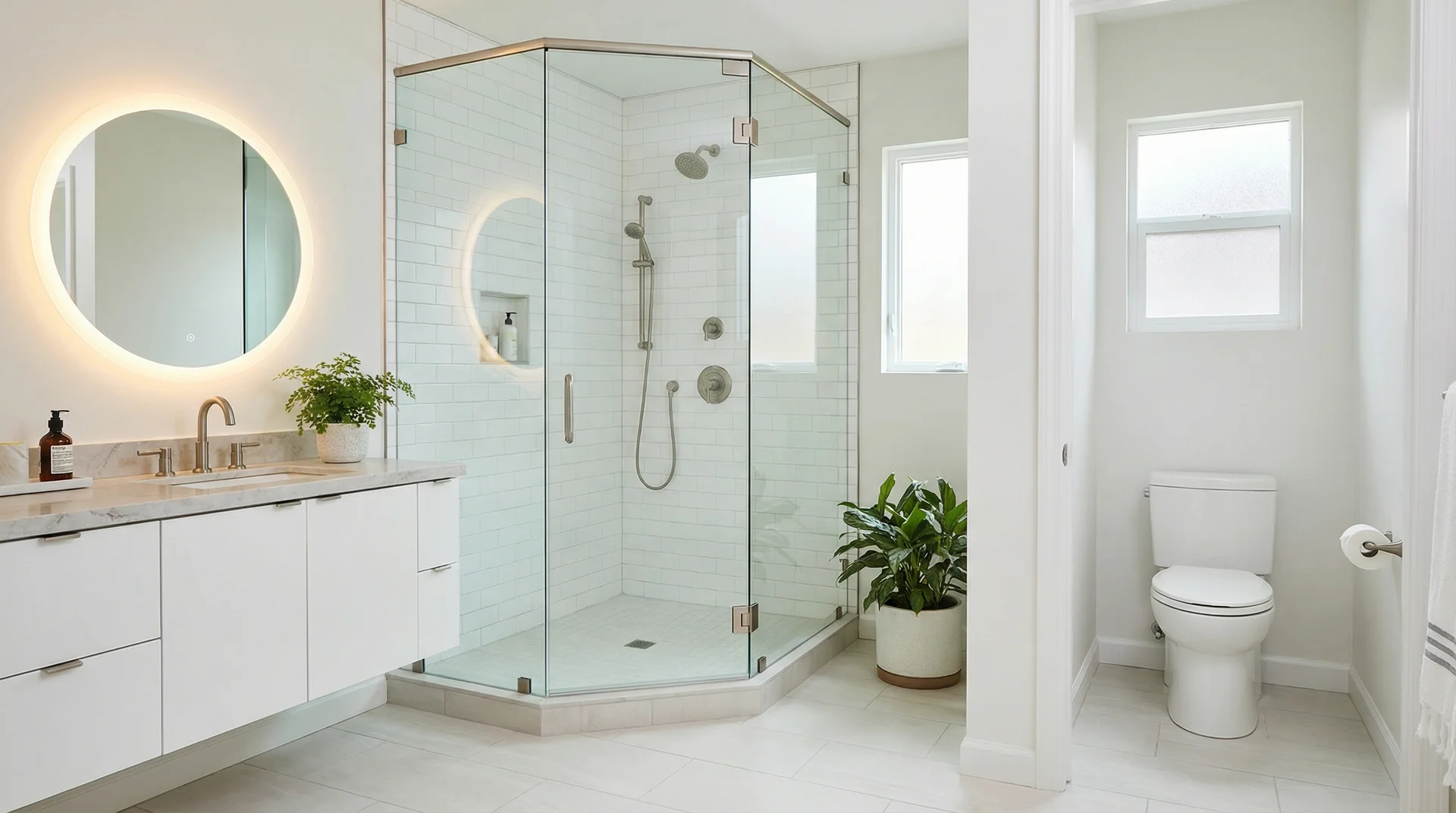
When a client called me in a mild panic about her home listing, describing her bathroom as “three-quarter,” she had absolutely no idea what it meant or whether it was a good thing.
She thought it sounded incomplete, like something was missing.
I remember sitting across from her at her kitchen table, flipping through the floor plans, and explaining it the way I always do with homeowners who feel lost in contractor jargon.
A 3/4 bathroom gives you a toilet, a sink, and a shower. No bathtub, and that’s completely intentional.
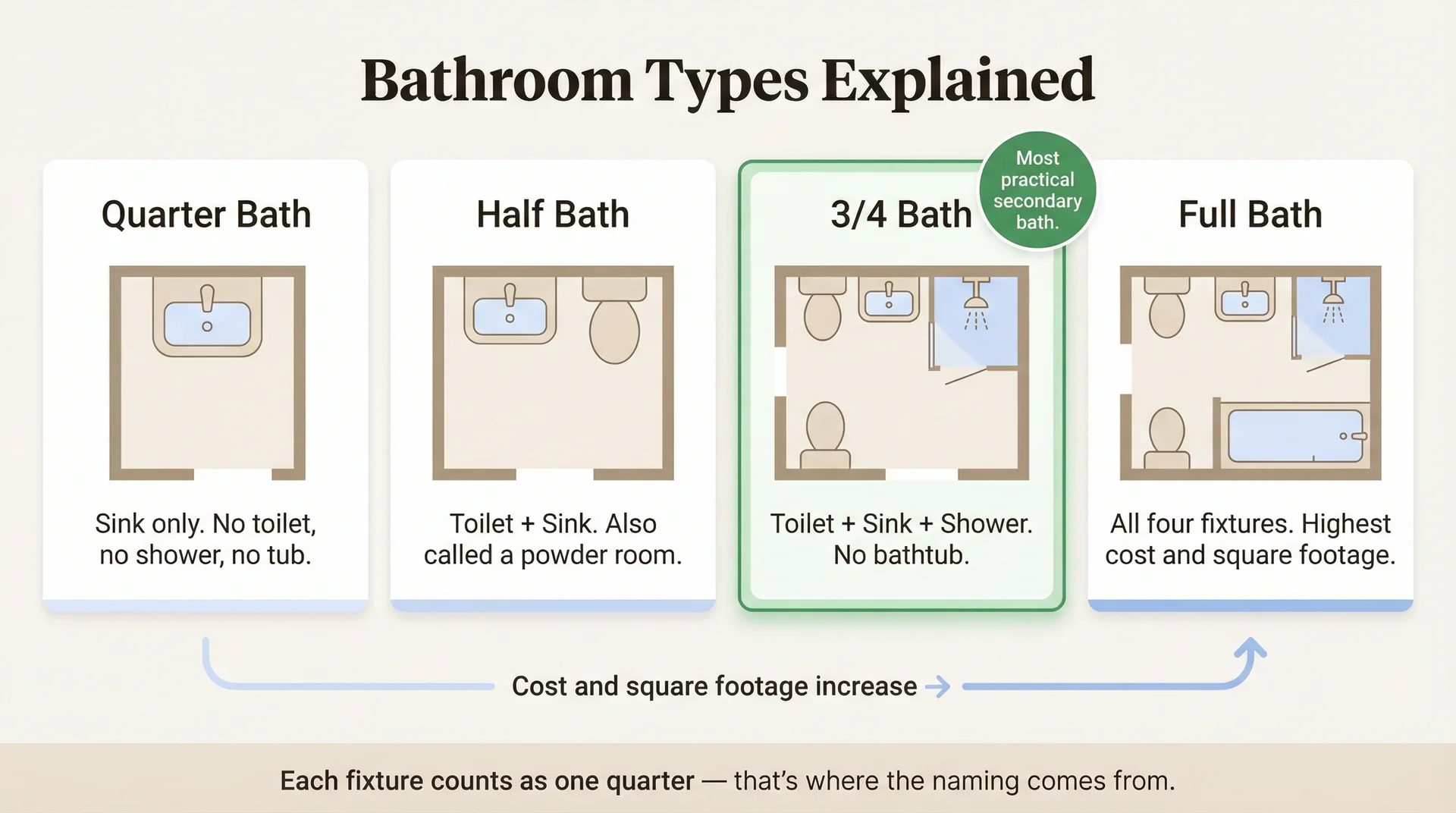
The name comes from a straightforward logic in residential design. A full bathroom contains four elements: a toilet, a sink, a shower, and a bathtub. Each element counts as one quarter.
A 3/4 bathroom includes three of those four. Once you understand that logic, the whole naming system clicks.
Quick answer: A 3/4 bathroom is a bathroom that includes a toilet, a sink, and a shower, but no bathtub. It typically requires a minimum of 36 to 40 square feet and works exceptionally well as a guest bath, basement addition, or secondary bathroom in a family home.
Now let’s go deeper into why this bathroom type deserves more respect than it gets, what a two-piece toilet has to do with it, and how to design one that actually feels generous even in a tight footprint.
What Exactly Goes Into a 3/4 Bathroom?
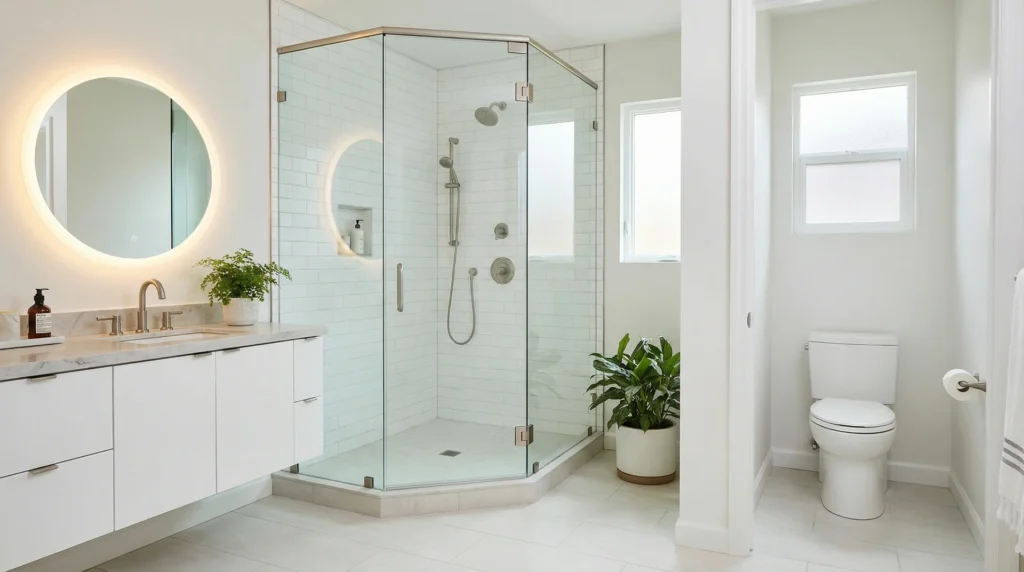
Most people picture a 3/4 bathroom as something small and afterthought-ish.
A lot of poorly executed ones do feel that way.
The truth is that a well-planned 3/4 bathroom can feel just as intentional and comfortable as any full bath in your home.
The three core components are:
- A toilet (we’ll get into two-piece toilets specifically further down)
- A sink or vanity with proper storage and countertop space
- A shower enclosure ranging from a basic corner stall to a tiled walk-in design
What determines the quality of your experience isn’t the absence of a tub. It’s the quality of the decisions made around these three elements.
How a 3/4 Bathroom Compares to Other Bathroom Types
| Bathroom Type | Toilet | Sink | Shower | Bathtub |
|---|---|---|---|---|
| Quarter Bath | No | Yes | No | No |
| Half Bath | Yes | Yes | No | No |
| 3/4 Bath | Yes | Yes | Yes | No |
| Full Bath | Yes | Yes | Yes | Yes |
The half bath, which most people know as a powder room, gives you a toilet and a sink.
The 3/4 bath adds a shower. The full bath adds a tub. Each step up adds square footage requirements and cost.
What Is the Minimum Size for a 3/4 Bathroom?
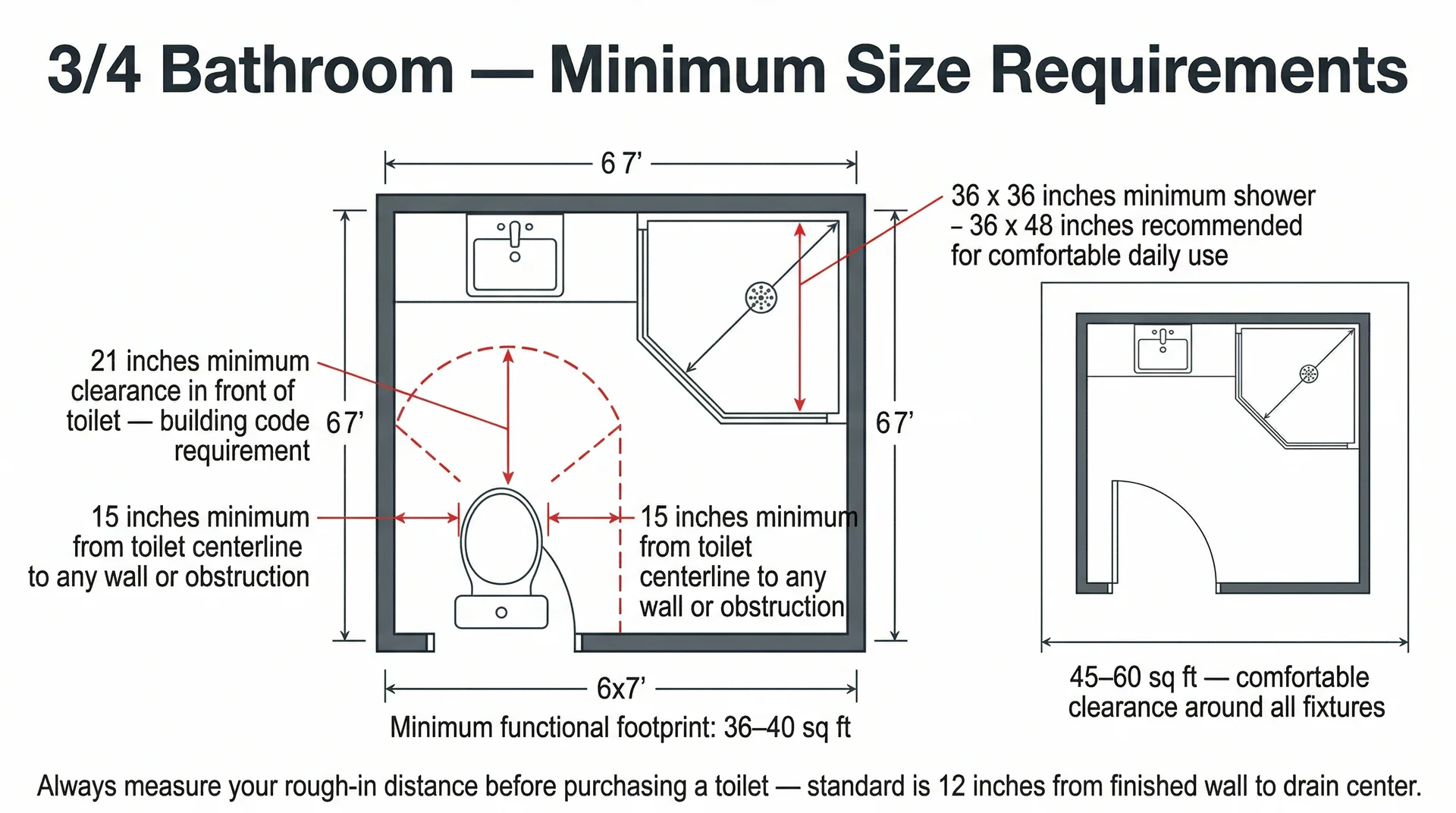
The minimum functional footprint for a 3/4 bathroom sits at 36 to 40 square feet, though 45 to 60 square feet gives you comfortable clearance around all three fixtures.
Building codes in most U.S. states require at least 21 inches of clearance in front of the toilet and 15 inches from the toilet centerline to any side wall or obstruction.
Your shower enclosure needs a minimum of 36×36 inches, though 36×48 inches is the realistic, comfortable standard.
If you’re planning an addition or a basement conversion, working with at least 50 square feet gives your designer room to create a layout that feels considered rather than squeezed.
Is a 3/4 Bathroom Right for Your Home?
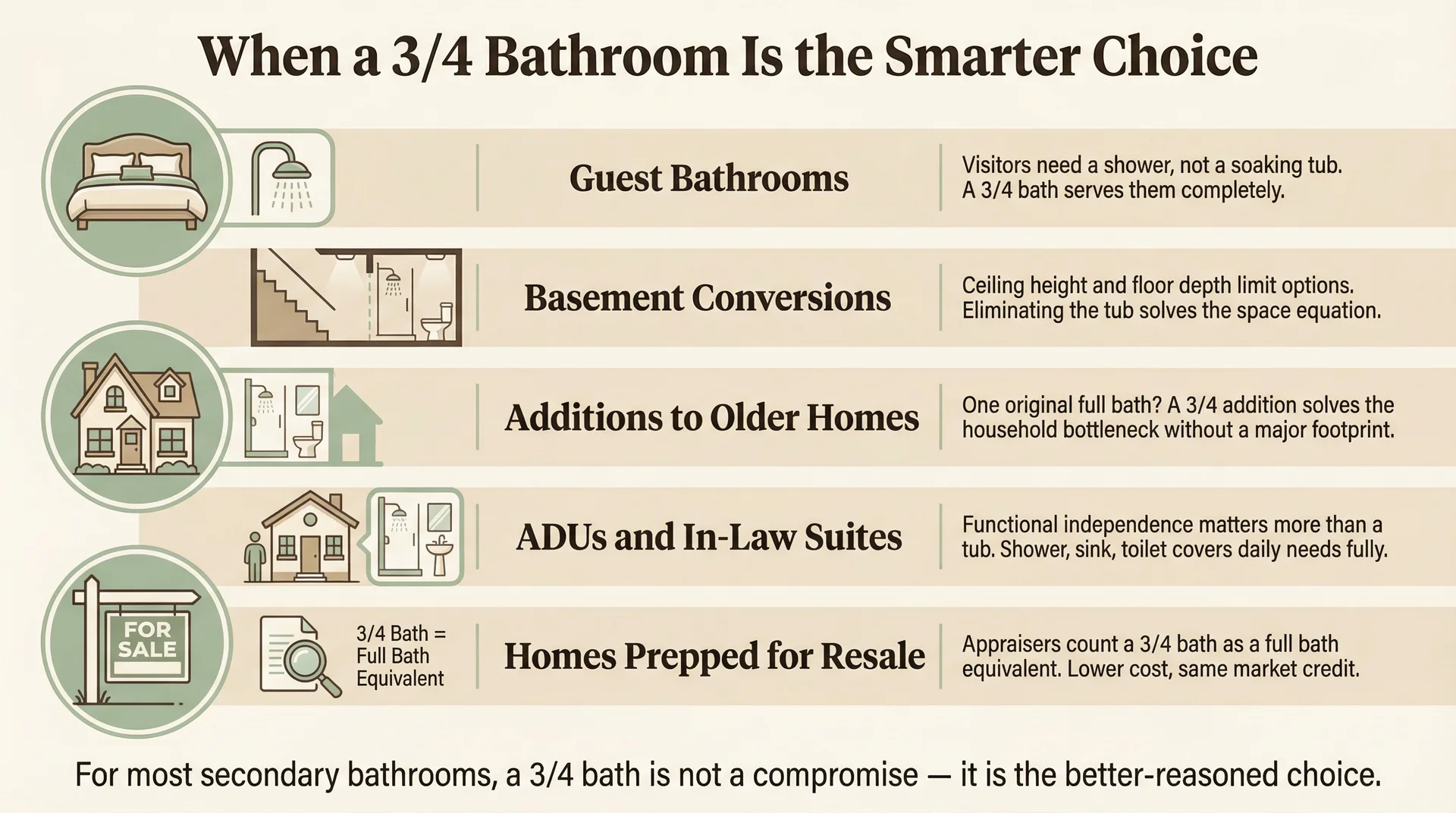
My honest answer from years of working with homeowners: for most households, a 3/4 bathroom is the smarter choice for a secondary bathroom.
Here’s why. The majority of American households report that bathtubs in secondary bathrooms get used infrequently.
Adults shower almost exclusively. Children who need baths usually share the primary full bathroom.
When you look at actual usage patterns, dedicating square footage and budget to a tub in a secondary bath often means investing in something that collects cleaning product residue more than use.
A 3/4 bathroom makes particular sense in these situations:
- Guest bathrooms where visitors need a shower but not a soaking tub
- Basement conversions where ceiling height and floor space limit options
- Additions to older homes with only one original full bath
- ADUs or in-law suites where functional independence matters
- Homes are being prepped for resale since adding a 3/4 bath adds measurable value
Does a 3/4 Bathroom Add Home Value?
Yes, meaningfully.
According to data from the National Association of Realtors, adding a bathroom to a home returns approximately 60 to 70 percent of the project cost at resale on average.
A 3/4 bathroom addition costs significantly less than a full bath addition because it eliminates the tub, the plumbing associated with it, and often the square footage required to house it properly.
That lower cost-to-value ratio makes a 3/4 bathroom one of the better investments in residential renovation.
Real estate appraisers typically count a 3/4 bathroom as a full bathroom equivalent in market comparisons, which means you get the appraisal credit without the full construction cost.
I worked with a couple converting their basement into a guest suite.
After mapping out plumbing rough-in costs and available square footage, we built a well-appointed 3/4 bath instead of a full bath.
The result was a spacious frameless shower, a proper double vanity, and a toilet alcove with a privacy wall.
Their adult children visit regularly, and nobody has once mentioned the missing tub.
Designing Your 3/4 Bathroom: Making Every Square Foot Work
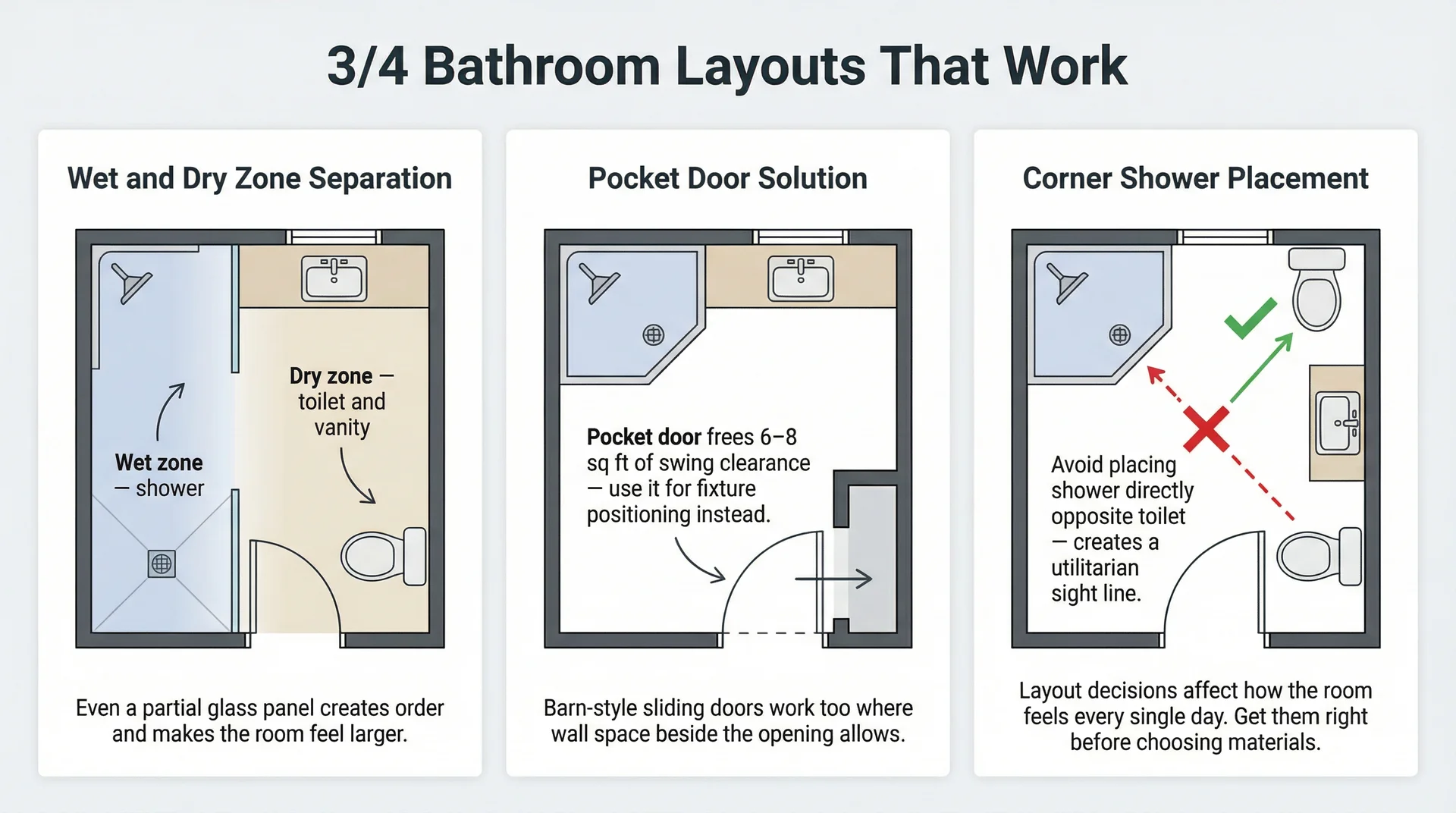
Small bathrooms require more thought, not less. The homeowners happiest with their 3/4 bathrooms are the ones who treated spatial planning as seriously as they would a larger room.
Layouts That Actually Work
Separate your wet and dry zones. Your shower is the wet zone. Your toilet and vanity are the dry zone.
Even a frosted glass panel or a partial wall between them creates a sense of order that makes the room feel larger.
When these zones bleed into each other without separation, the bathroom reads as chaotic, regardless of how nice the materials are.
Reconsider your door swing. In a tight 3/4 bathroom, an inward-swinging door can force your toilet or vanity into an uncomfortable position.
Pocket doors solve this elegantly. They disappear into the wall and free up floor space.
Barn-style sliding doors work well if the layout allows wall space beside the opening.
Think carefully about shower placement. A corner shower maximizes space efficiency in a rectangular footprint.
A walk-in shower without a door, designed with a proper curb or sloped floor, creates an open feel in larger footprints.
Placing the shower directly opposite the toilet creates a sight line that makes the room feel more utilitarian than it needs to be.
Space-Saving Strategies That Don’t Sacrifice Style
- Floating vanities lift off the floor visually and create a sense of spaciousness
- Recessed medicine cabinets add storage depth without claiming any room inches
- Niches in the shower wall eliminate corner caddies and hanging organizers
- Vertical storage towers beside the vanity use wall height instead of floor space
- Frameless glass shower enclosures keep sightlines open and let light travel through the room
The Role of Light and Color
I once redesigned a 45-square-foot 3/4 bathroom that felt genuinely oppressive. Deep slate gray tile floor to ceiling, a dim, warm vanity light. It felt like a cave.
We kept the footprint exactly the same. Large-format porcelain in a soft, warm white replaced the dark tile.
A vertical LED mirror replaced the single vanity fixture. A solar tube skylight went into the shower ceiling.
The homeowner cried when she saw the finished result, which remains a career highlight.
Color temperature matters significantly in bathrooms. Aim for 2700K to 3000K lighting for a warm, flattering tone that still reads as clean. Above 4000K starts to feel clinical.
For walls, soft whites, warm greiges, and muted sage greens expand visual space while keeping the room inviting.
Common Mistakes to Avoid in a 3/4 Bathroom
These are the errors I see most often in renovation projects, and nearly all of them are avoidable with upfront planning.
- Undersizing the shower. A 32×32 inch shower is technically code-compliant but feels uncomfortable in daily use. Go to 36×48 inches minimum wherever your layout allows.
- Ignoring the rough-in measurement. The toilet rough-in is the distance from the finished wall to the center of the drain. Standard rough-in is 12 inches. Older homes sometimes have 10 or 14-inch rough-ins. Buying the wrong toilet for your rough-in is an expensive mistake.
- Skipping the ventilation upgrade. Builders often install the cheapest exhaust fan that meets code. It’s almost never adequate for a regularly used shower bathroom.
- Prioritizing looks over layout. A beautiful tile selection on a bad layout still gives you a bathroom that feels frustrating to use every day.
- Over-accessorizing a small space. Every decorative element in a small bathroom competes for visual attention. Edit aggressively and let the materials carry the room.
The Heart of the Bathroom: Understanding Your Toilet Options
Your toilet selection matters more to the daily function of a 3/4 bathroom than most other decisions, and the two-piece toilet is where most homeowners start.
What Makes a Toilet “Two-Piece”?
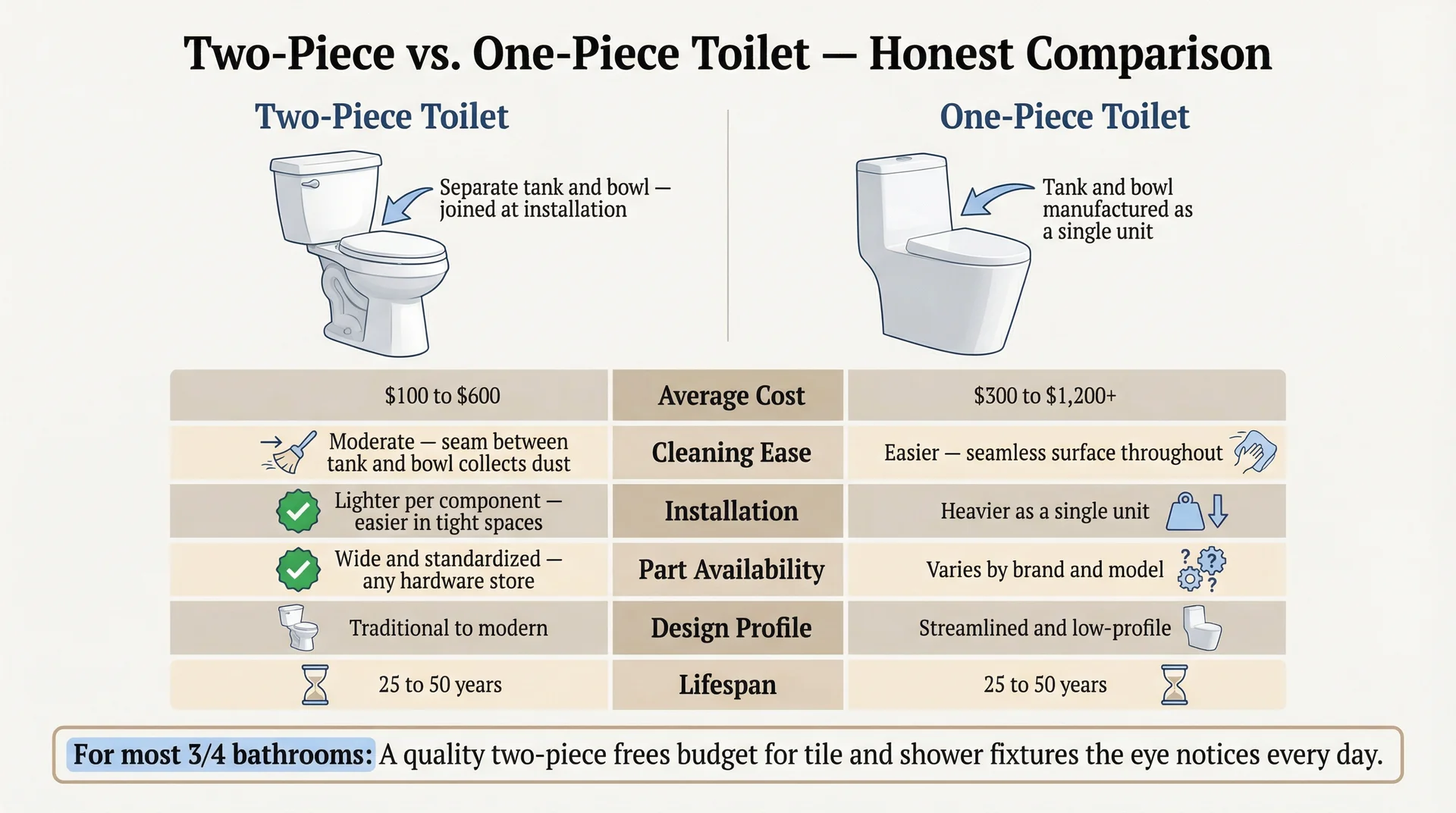
A two-piece toilet consists of two separately manufactured components: the tank and the bowl.
The tank sits on top of the bowl and gets secured at the connection point with bolts and a gasket. When you picture a traditional residential toilet, you’re picturing a two-piece.
The manufacturing process produces each component independently, which keeps price points generally lower than one-piece designs. But “two-piece” is a construction descriptor, not a quality descriptor.
Two-piece toilets span an enormous quality range. A builder-grade model runs $100 to $150.
A premium two-piece from Toto or Kohler with a skirted trapway, slow-close seat, and dual-flush system sits between $400 and $700.
The price reflects flushing technology, ceramic quality, and finish durability, not the number of pieces.
Why the Two-Piece Toilet Earns Its Place in a 3/4 Bathroom
Repair accessibility is a genuine advantage.
Because the tank and bowl are separate, replacing a fill valve, flapper, or flush handle is straightforward with parts available at any hardware store.
Sourcing parts for proprietary one-piece mechanisms can get complicated depending on the brand.
Installation flexibility matters in renovation contexts.
Two-piece toilets weigh less per component than one-piece models, which makes maneuvering them through tight basement stairwells or narrow hallways significantly easier.
If you’ve carried a one-piece toilet down a basement staircase, you understand why this matters.
Budget distribution is something I always discuss with clients. A solid mid-range two-piece toilet frees up money for better tile, a nicer vanity, or higher-quality shower fixtures. The toilet is the workhorse of the bathroom.
Spending $600 on a one-piece when a $280 two-piece performs identically in flushing power means you’ve given up $320 that could have gone toward something the eye notices every single day.
How Long Does a Two-Piece Toilet Last?
A quality two-piece toilet lasts 25 to 50 years with proper maintenance.
The ceramic bowl and tank themselves rarely fail. What wears out are the internal mechanisms: flappers, fill valves, and flush handles.
These parts cost between $5 and $30 and take under an hour to replace.
The accessible, standardized nature of two-piece components makes long-term maintenance genuinely manageable for a motivated homeowner.
Two-Piece vs. One-Piece Toilets: The Honest Comparison
| Feature | Two-Piece Toilet | One-Piece Toilet |
|---|---|---|
| Average Cost | $100 to $600 | $300 to $1,200+ |
| Cleaning Ease | Moderate (seam between tank and bowl) | Easier (seamless surface) |
| Installation Weight | Lighter per component | Heavier as a single unit |
| Part Availability | Wide and standardized | Varies by brand |
| Design Profile | Traditional to modern | Streamlined, lower profile |
| Ideal Bathroom Style | Most styles | Contemporary and minimalist |
| Lifespan | 25 to 50 years | 25 to 50 years |
| Rough-in Flexibility | High | Moderate |
The cleaning point deserves mention because it comes up in almost every conversation.
The junction between tank and bowl creates a small ledge where moisture and dust collect. It requires deliberate attention when cleaning.
Two-piece models with a skirted trapway and a smoothed tank-to-bowl connection significantly reduce this issue and are worth looking for specifically.
The one-piece toilet’s main advantages are aesthetics and cleaning simplicity.
The streamlined silhouette suits contemporary and minimalist bathrooms particularly well.
In a 3/4 bathroom with a walk-in shower, floating vanity, and clean-lined tile, a one-piece toilet fits that visual language beautifully. You pay a premium for that coherence.
The Flush Technology Question!
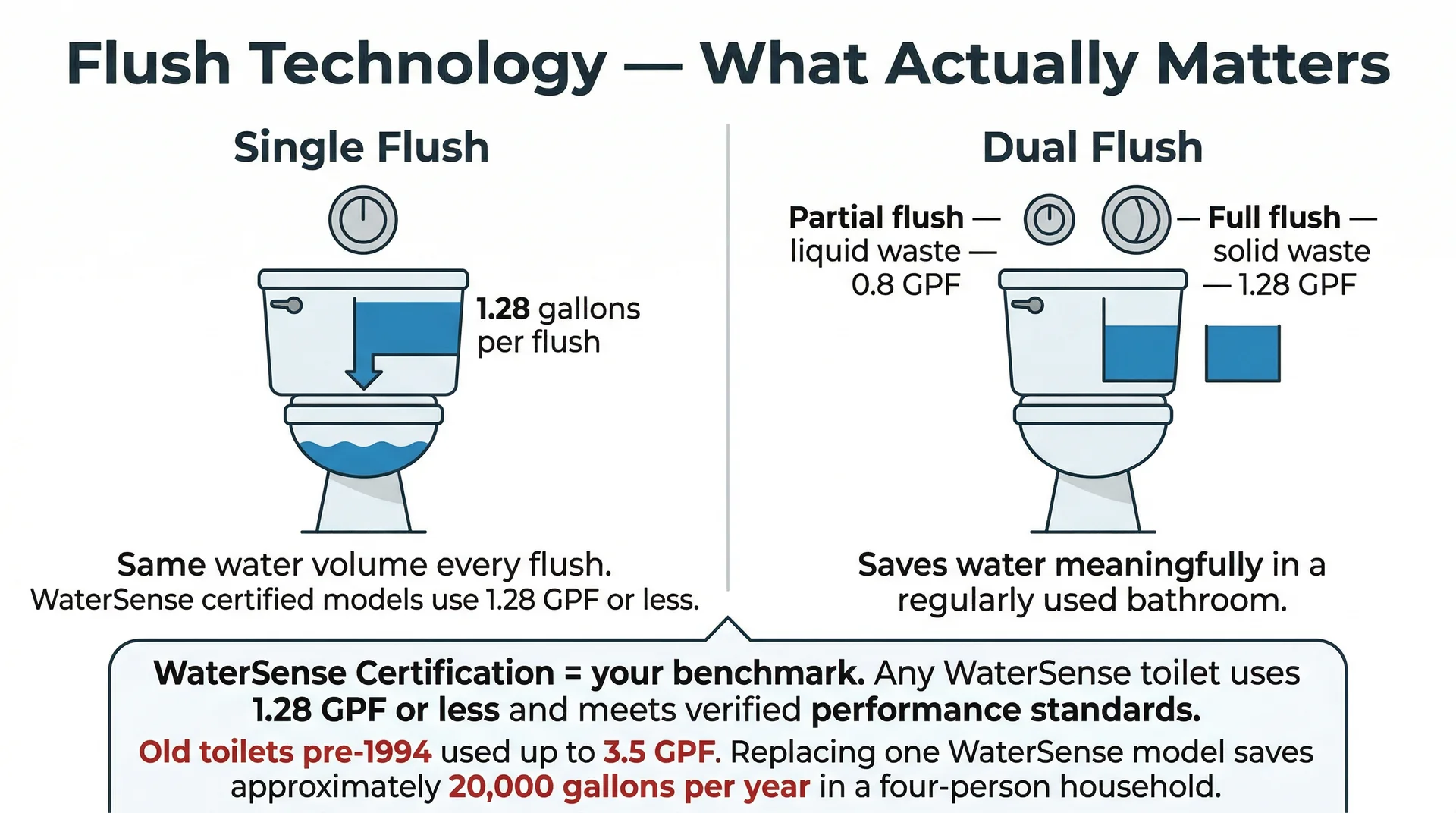
Whether you choose one-piece or two-piece, flush technology matters more to daily performance than construction format.
Single-flush toilets use the same water volume per flush, typically 1.28 gallons per flush (GPF) for WaterSense-certified models.
Dual-flush toilets offer a partial flush for liquid waste and a full flush for solid waste, reducing consumption meaningfully in a regularly used bathroom.
The EPA’s WaterSense certification is your benchmark. Any WaterSense-certified toilet uses 1.28 GPF or less and meets verified performance standards.
Older toilets from before 1994 used up to 3.5 GPF. If your 3/4 bathroom has an older toilet, replacing it with a WaterSense model pays for itself in water savings over time.
Can You Add a Tub to a 3/4 Bathroom Later?
Technically, yes, but practically, it depends on your square footage and plumbing rough-in locations.
Converting a 3/4 bathroom to a full bath requires a minimum of 60 square feet to accommodate a standard 5-foot bathtub alongside the remaining fixtures without violating clearance codes.
The plumbing rough-in for a tub drain needs to be added if it wasn’t originally planned.
For most homeowners, the cost and disruption of that conversion make it more practical to simply design the bathroom that serves your long-term needs from the start.
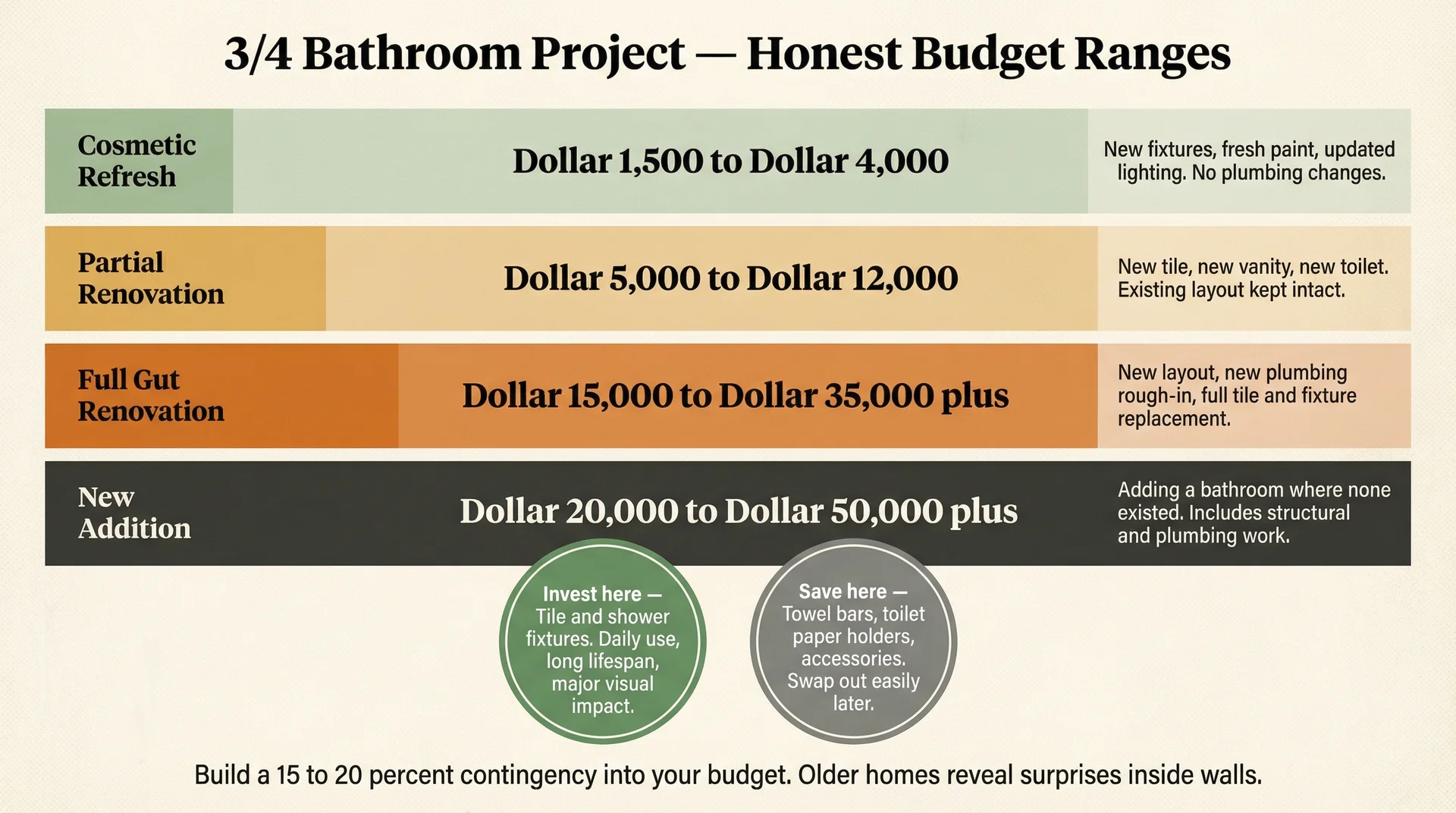
Budgeting Honestly for Your 3/4 Bathroom Project
| Scope | Estimated Cost Range |
|---|---|
| Cosmetic refresh (fixtures, paint, lighting) | $1,500 to $4,000 |
| Partial renovation (new tile, vanity, toilet) | $5,000 to $12,000 |
| Full gut renovation (new layout, plumbing) | $15,000 to $35,000+ |
| New addition (adding a bath where none existed) | $20,000 to $50,000+ |
These ranges reflect real market variability. Older homes frequently reveal surprises inside walls that add to the budget.
Build a 15 to 20 percent contingency into your budget and plan to use some of it.
Invest in: tile and shower fixtures. These take the most daily abuse and determine how the space looks and performs for the long term.
Save on: towel bars, toilet paper holders, and accessories. These swap out easily later without disrupting anything structural.
Eco-Friendly Choices That Actually Make Sense
WaterSense-certified toilets at 1.28 GPF or less are the non-negotiable starting point.
In a four-person household, upgrading from a 3.5 GPF toilet saves approximately 20,000 gallons of water per year.
Low-flow showerheads certified by WaterSense use no more than 2.0 GPF while maintaining pressure through aeration technology.
Brands like Speakman, Moen, and High Sierra make low-flow models that homeowners consistently describe as feeling as satisfying as conventional pressure.
Ventilation is an environmental and health choice that gets overlooked.
Use one CFM per square foot of bathroom space as your baseline, and go higher if your showers run long.
A humidity-sensing fan that automatically removes the human error factor entirely and keeps your bathroom surfaces healthier for longer.
For materials, large-format porcelain tile installed well lasts 20 to 30 years, which is itself a sustainability argument.
Choosing quality over cheapness is an environmental decision as much as an aesthetic one.
Frequently Asked Questions
What is the difference between a 3/4 bathroom and a full bathroom?
A full bathroom contains a toilet, sink, shower, and bathtub. A 3/4 bathroom contains a toilet, sink, and shower, but no bathtub.
The absence of the tub reduces both the square footage required and the overall construction cost.
Does a 3/4 bathroom add home value?
Yes. Real estate appraisers typically treat a 3/4 bathroom as equivalent to a full bathroom in market comparisons.
Adding one returns approximately 60 to 70 percent of project cost at resale on average, according to NAR data, and the lower construction cost compared to a full bath often makes the return ratio more favorable.
What is the minimum size for a 3/4 bathroom?
The functional minimum is 36 to 40 square feet. Comfortable clearance around all three fixtures typically requires 45 to 60 square feet.
Building codes require at least 21 inches of clearance in front of the toilet and 15 inches from the toilet centerline to any wall or obstruction.
Is a two-piece toilet better than a one-piece?
Neither is objectively better. Two-piece toilets offer lower cost, easier part replacement, and wider style selection.
One-piece toilets offer a cleaner aesthetic, easier surface cleaning, and a lower profile.
For most 3/4 bathrooms, a quality two-piece toilet is the practical choice because it frees budget for other elements and performs identically in daily use.
How long does a two-piece toilet last?
With proper maintenance, a quality two-piece toilet lasts 25 to 50 years.
The ceramic components essentially do not wear out.
Internal mechanisms like flappers and fill valves wear over time, but cost very little to replace and take under an hour for most homeowners.
What is the rough-in size for a toilet in a 3/4 bathroom?
Standard rough-in is 12 inches from the finished wall to the center of the toilet drain.
Older homes sometimes have 10 or 14-inch rough-ins. Always measure your rough-in before purchasing a toilet to confirm compatibility.
Final Thoughts
By the time you’ve thought through all of these elements, a 3/4 bathroom stops feeling like a compromise and starts feeling like a considered design choice.
The absence of a bathtub creates room for a shower experience that can be significantly more generous, a vanity area that breathes, and a bathroom that genuinely serves your household’s real patterns of use.
The two-piece toilet fits naturally into this picture because it delivers reliable performance, accessible maintenance, and enough design variety to suit everything from a classic subway-tiled bathroom to a sleek contemporary one.
For most homeowners, it’s the right starting point.
What I’ve seen consistently across years of residential design work is that the bathrooms people love most are rarely the most expensive ones.
They’re the ones where someone paid attention to how the space would actually be used and made decisions that reflected real life.
A well-designed 3/4 bathroom with the right fixtures, thoughtful lighting, and a shower that feels like a proper retreat can do exactly that within almost any budget.