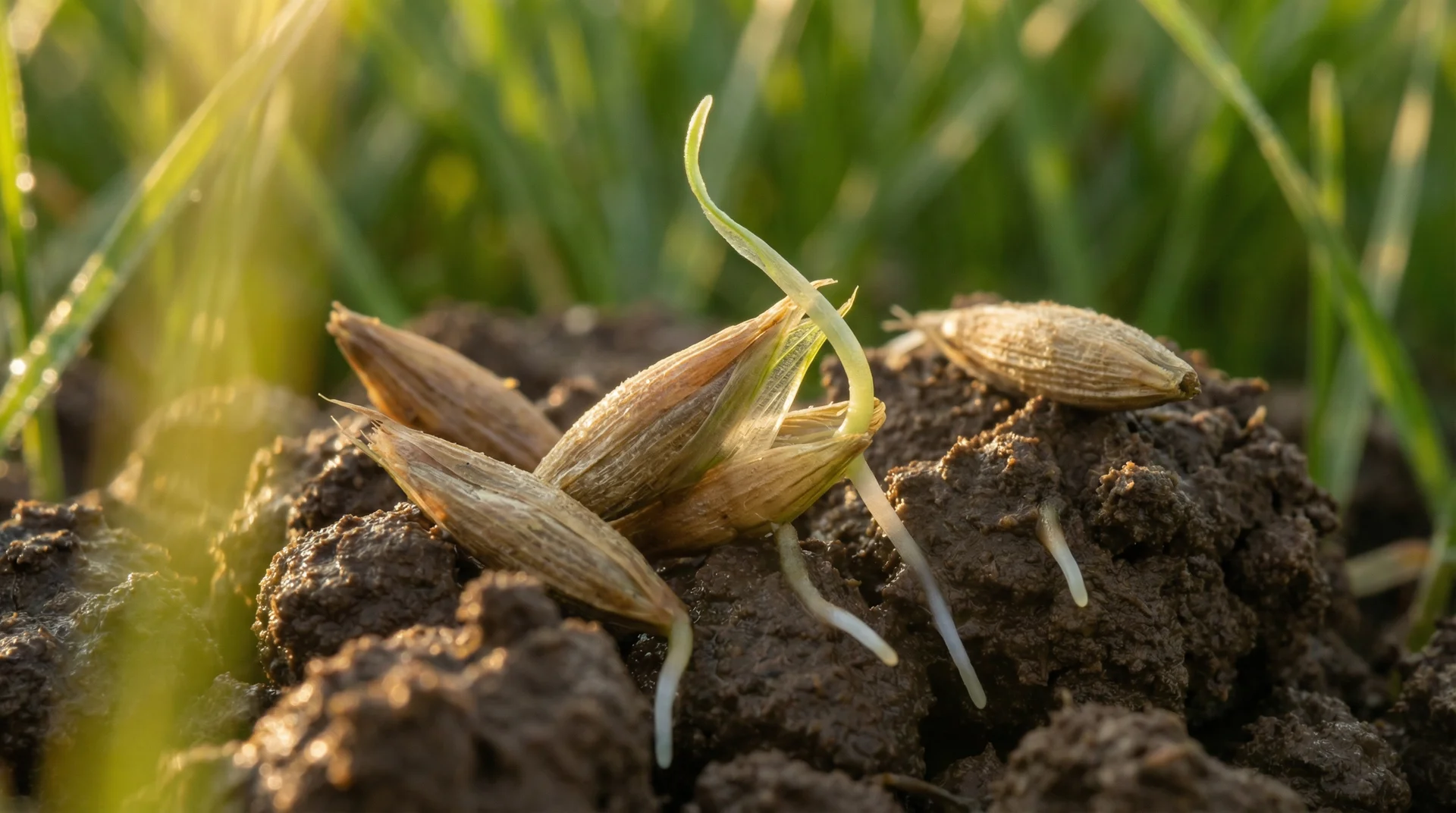
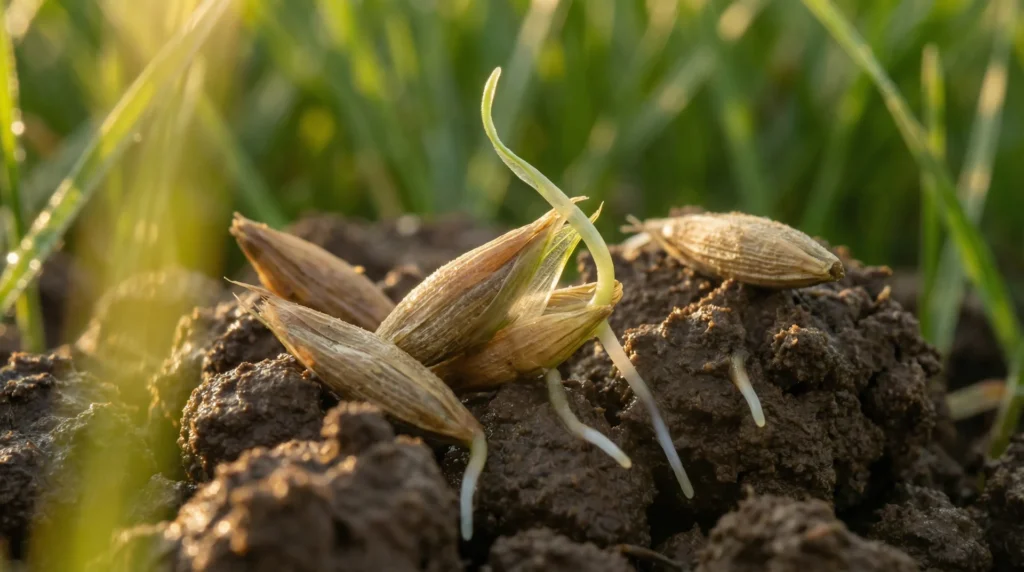
Yes, grass seed germinates on top of the soil. It does not need to be buried.
What it needs is consistent moisture, the right soil temperature, and direct contact with the soil surface beneath it.
Seeds buried deeper than ½ inch often fail entirely because the emerging shoot burns through its stored energy before reaching light. So the instinct to push seeds deep into the ground is actually working against you.
The real question is not whether surface germination works. It does. The question is whether your surface is prepared well enough to let it happen.
A seed tossed onto hard, compacted ground sits in the air, dries out within hours, and never anchors. A seed sitting on a loosened, lightly topdressed surface with consistent moisture will sprout reliably within the window for its grass type.
That distinction is everything, and the rest of this guide walks you through it completely.
Does Grass Seed Go on Top of Soil or Under It?
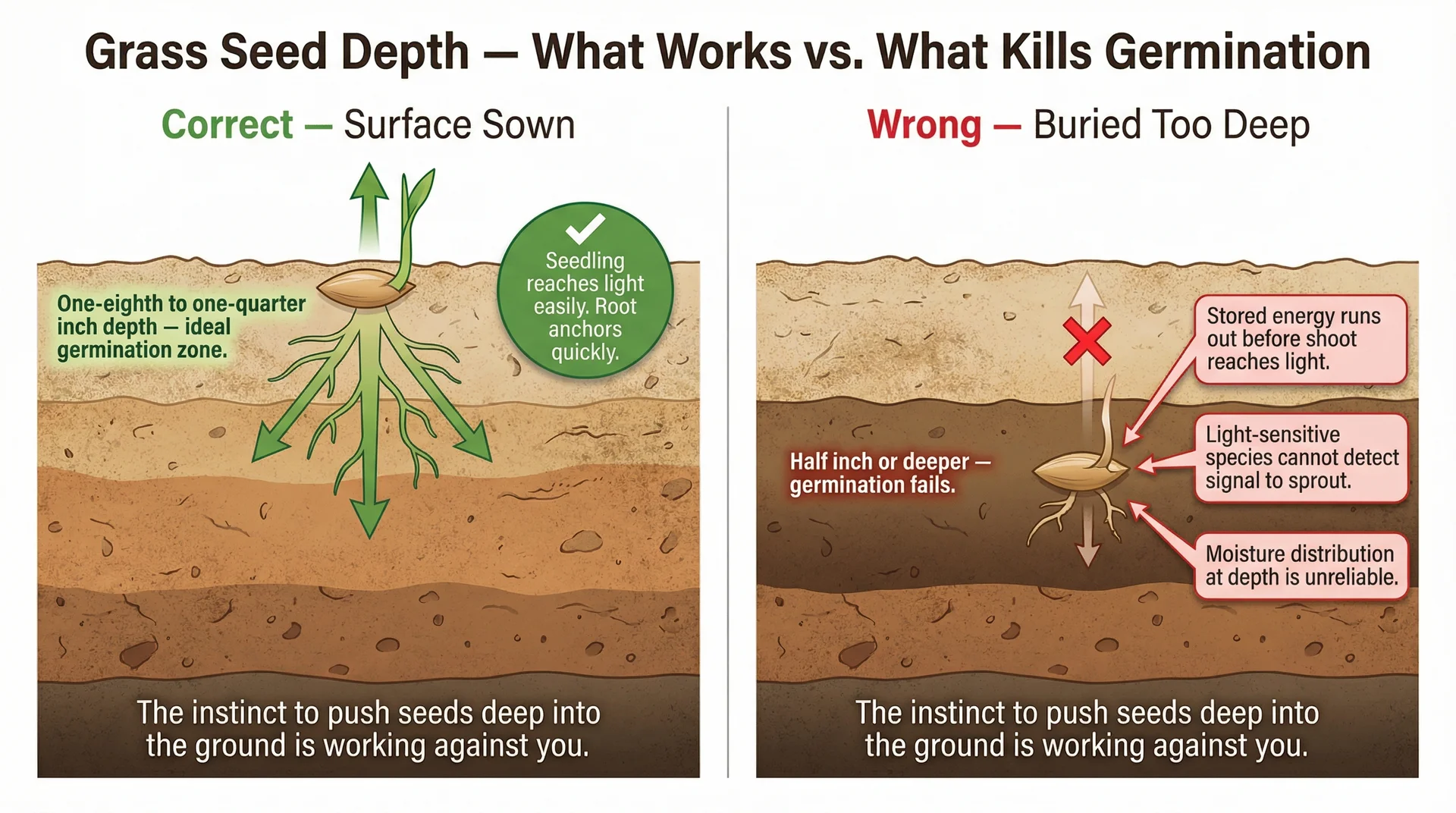
This is one of the most frequently searched variations of this question, and the answer surprises many people. Grass seed goes on the soil surface, or barely beneath it, never deeply under it.
Most turf grass varieties germinate best at a soil depth of just ⅛ to ¼ inch. Fine fescues and bentgrasses sit even closer to the surface. Planting deeper than ½ inch significantly reduces germination rates because:
- The seedling runs out of stored energy, pushing upward through too much material
- Light-sensitive species cannot detect the signal to begin sprouting
- Moisture distribution at depth is less reliable for the delicate germination stage
The ideal scenario is a seed that sits nestled just into the top layer of loosened soil, almost visible, lightly covered, and anchored enough that moisture surrounds it from below and above.
What Grass Seed Actually Needs to Germinate
Understanding what happens inside the seed changes how you approach the whole process.
A grass seed contains a dormant embryo surrounded by stored nutrients.
When water, warmth, and surface contact align, the embryo absorbs moisture, activates its internal chemistry, and pushes a root downward and a shoot upward. At this stage, any interruption ends the process.
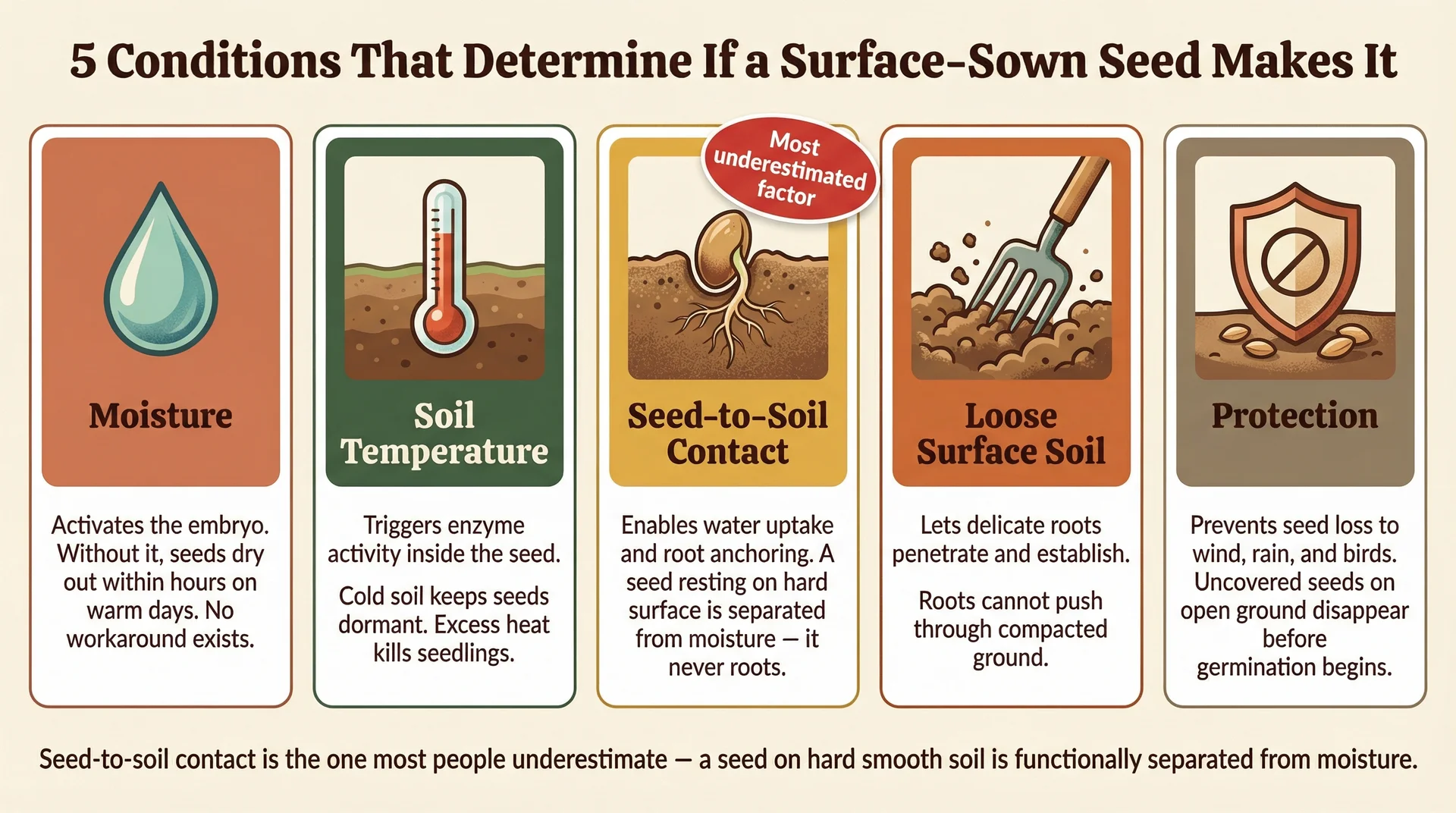
Here are the five conditions that determine whether a surface-sown seed makes it:
| Factor | What It Does | What Happens Without It |
|---|---|---|
| Moisture | Activates the embryo and sustains germination | Seed dries out within hours on warm days |
| Soil Temperature | Triggers enzyme activity inside the seed | Cold soil keeps seeds dormant; excess heat kills seedlings |
| Seed-to-Soil Contact | Enables water uptake and root anchoring | The seed sits in the air, fails to absorb moisture, and never roots |
| Loose Surface Soil | Let’s delicate roots penetrate and establish | Roots cannot push through compacted ground |
| Protection | Prevents seed loss to wind, rain, and birds | Seeds disappear before germination begins |
Of these five, seed-to-soil contact is the one most people underestimate.
A seed resting on a smooth, hard surface is technically on the soil but functionally separated from it. The root has nowhere to go.
What Happens If You Don’t Cover Grass Seed
Leaving seeds completely exposed without any topdressing or surface preparation leads to a predictable set of problems:
- Rapid moisture loss: The surface layer of soil dries fast, especially on warm or breezy days. Uncovered seeds dry out before the embryo fully activates.
- No root anchorage: Without even minimal soil contact, the emerging root tip finds nothing to grip, and the seedling tips over and dies.
- Bird and wind losses: An uncovered seed on an open surface is easy pickings. A single morning of bird activity can clear a freshly seeded lawn.
- Washout during rain: Light rain creates surface runoff that clusters seeds into low spots or washes them to the edges of the area entirely.
- Patchy, uneven germination: Even if some seeds survive the above, the result is inconsistent density across the lawn.
None of this means surface sowing fails. It means surface sowing without preparation fails. The preparation is what makes the difference.
Why Your Seeds Probably Failed Before
Let me describe a situation I have seen more times than I can count. A homeowner notices thin patches in their lawn in early autumn.
They pick up a bag of grass seed, scatter it across the lawn by hand, water it a couple of times, and wait.
Two weeks later, nothing grows except the local birds look well-fed.
The seeds failed for entirely fixable reasons:
- The surface was compacted and smooth, so seeds sat on the thatch layer and dried out
- Watering happened once a day or less, and surface-sown seeds need light watering two to three times daily during germination
- No mechanical disturbance beforehand meant the seeds had nothing to settle into
- Uneven hand-scattering created dense clumps in some spots and bare soil in others
None of that is the seed’s fault. The seed performs when you give it the right conditions.
How to Prepare Your Surface So Seeds Actually Germinate
Working on a thinning lawn after a dry summer in Portland a few years back, I used this exact sequence to recover the coverage without stripping and re-laying the entire area.
Within three weeks of overseeding in early September, the lawn had visibly filled in. This preparation method is what made it work.
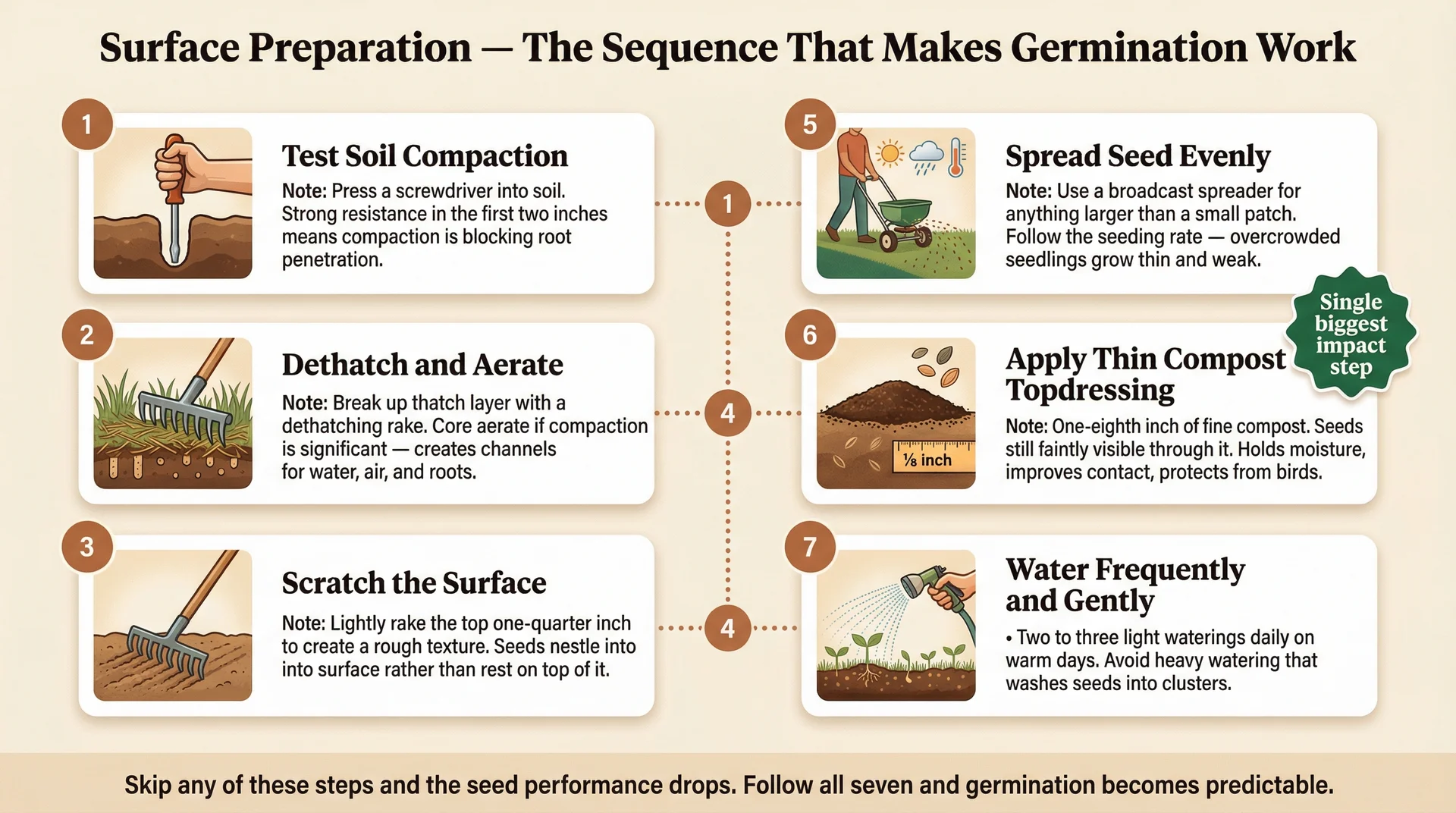
Step 1: Test the Soil Compaction
Press a screwdriver into the soil. If it meets strong resistance in the first two inches, compaction is blocking root penetration, and you need to address that before sowing anything.
Step 2: Dethatch and Aerate
For an existing lawn, run a dethatching rake or scarifier across the surface to break up the thatch layer sitting between the grass and soil. Follow with core aeration if compaction is significant.
Core aeration pulls small plugs of soil out, creating channels for water, air, and roots to move through. A manual core aerator handles areas up to around 1,500 square feet without any power equipment.
For bare patches or new areas, loosen the top two to three inches of soil with a fork or tiller and level the surface.
Step 3: Scratch the Surface
After aeration, lightly rake the top ¼ inch of soil to create a slightly rough texture. This texture lets seeds nestle into the surface rather than rest on top of it. Think of it as creating grip.
Step 4: Choose a Seed that Matches Your Conditions
This is where I see people lose the whole project before it starts. Buying the wrong seed for your climate, shade level, or soil type guarantees failure regardless of surface preparation.
| Condition | Recommended Grass Type |
|---|---|
| Full sun, warm climate | Bermudagrass, Zoysia |
| Full sun, cool climate | Kentucky Bluegrass, Perennial Ryegrass |
| Partial to full shade | Fine Fescue, Tall Fescue |
| High foot traffic | Perennial Ryegrass, Tall Fescue |
| Drought-prone soil | Buffalo Grass, Tall Fescue |
When I work on residential projects, I always check the local climate zone, the amount of daily sun the lawn receives, and how the space gets used before recommending any seed variety. Long-term success depends on that match.
Step 5: Spread the Seed Evenly with a Spreader
Use a broadcast spreader for anything larger than a small patch. Hand broadcasting creates clumps and bare zones.
Follow the seeding rate on the packaging and resist going heavier, because overcrowded seedlings compete with each other and grow thin and weak.
Step 6: Apply a Thin Topdressing of Compost
This single step has the biggest impact on surface germination success. After spreading seed, apply a layer of fine compost or screened topsoil across the area.
Aim for ⅛ inch deep – just enough that you can still see seeds through the material if you look closely.
This light layer does three things simultaneously:
- Holds moisture directly around the seed
- Improves seed-to-soil contact by pressing seeds gently against the surface
- Protects seeds from birds and light wind displacement
In my own garden, I have run comparative patches with and without topdressing side by side.
The top-dressed sections germinate faster and more evenly every single time.
Step 7: Water Frequently and Gently
Keep the top inch of soil consistently moist throughout germination. On warm or breezy days, water lightly two to three times per day using a soft spray setting.
Avoid heavy watering that washes seeds into clusters.
Once seedlings reach about one inch tall, shift to less frequent but deeper watering to encourage roots to grow downward.
Will Grass Seed Germinate Without Watering?
No. Moisture is the one factor that has no workaround.
A grass seed sitting in dry soil, regardless of how perfectly everything else is set up, stays dormant until water arrives.
In climates with reliable autumn rainfall, you may need to supplement less. In drier regions or during dry spells, daily watering is non-negotiable during the germination window.
If rainfall does the watering for you, make sure the rain is gentle. Heavy downpours on freshly seeded ground wash seeds into low spots and create exactly the uneven patchy germination you are trying to avoid.
After any significant rain, check the area and redistribute seeds that have clustered.
How Much Soil to Put Over Grass Seed
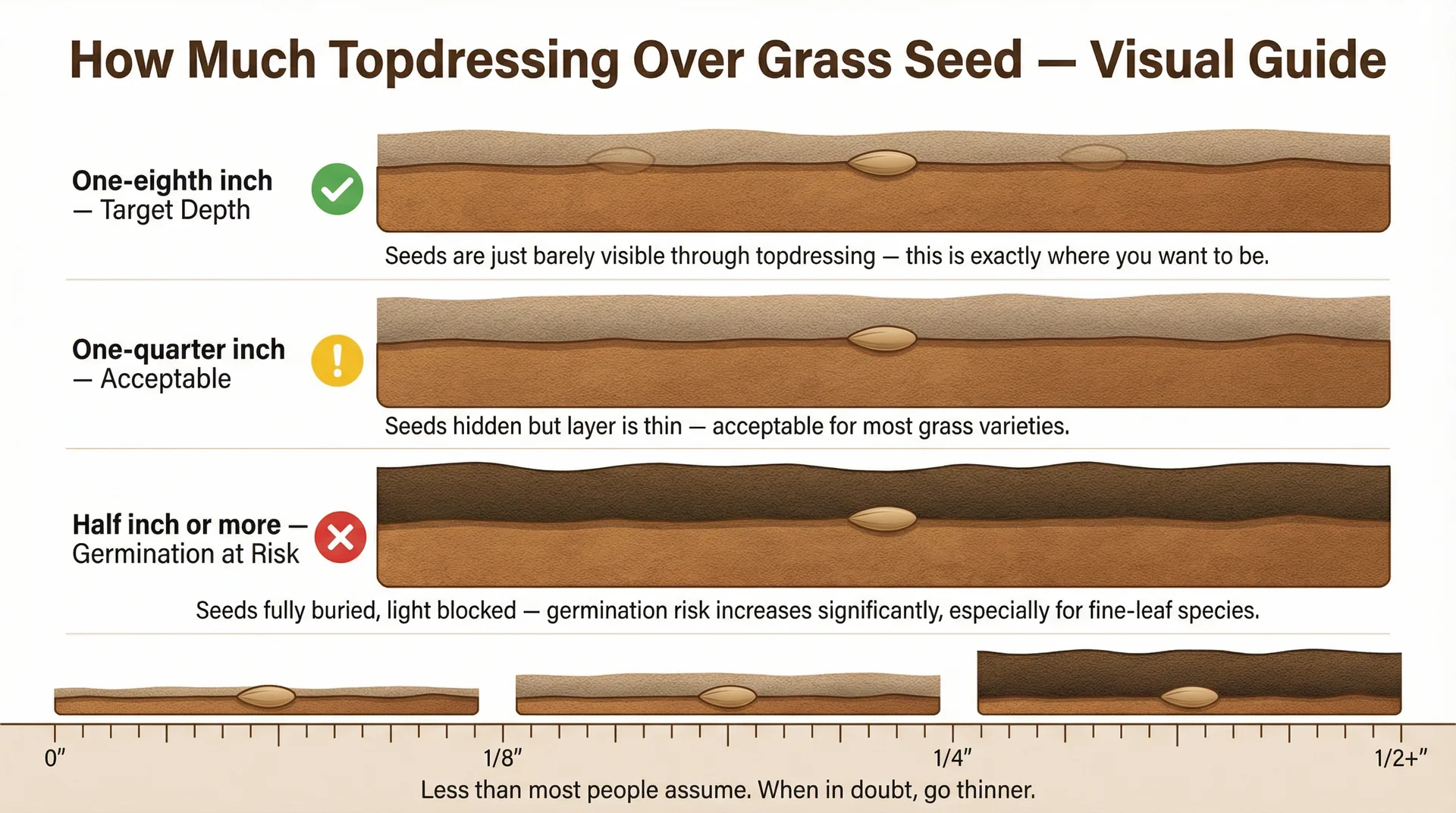
The answer here is less than most people assume. A topdressing of ⅛ inch is ideal. Up to ¼ inch is acceptable for most grass varieties.
Beyond ½ inch and you risk suppressing germination entirely, particularly for fine-leaf species.
A useful visual guide:
- ⅛ inch: Seeds are just barely visible through the topdressing – this is the target
- ¼ inch: Seeds are hidden, but the layer looks thin – acceptable
- ½ inch or more: Seeds are fully buried, and light is blocked – germination risk increases significantly
The goal is to surround the seed with moisture-retaining material without creating a barrier that the emerging seedling has to fight through.
Overseeding vs. Seeding a New Lawn: Same Rules, Different Scale
These two approaches share the same germination principles but differ in scope and preparation intensity.
Overseeding means spreading seed over an existing lawn to improve density and fill thin patches. The existing grass provides some natural protection and moisture retention. Preparation focuses on dethatching, aerating, and topdressing.
New lawn seeding means establishing grass on bare soil from scratch. Soil preparation is more intensive, including tilling, leveling, and often amending soil with compost before sowing. Protection measures like straw mulch are more important because there is no existing turf to provide any buffer.
Both methods use surface or near-surface sowing. Both require the same moisture management and seed-to-soil contact principles. The difference is how much prep work precedes the actual sowing.
The Best Time of Year to Surface Sow
Timing determines your success ceiling before the seed even hits the ground.
Cool-season grasses (fescues, bluegrass, ryegrass): Sow in early autumn. Soil holds warmth from summer, air temperatures drop to reduce heat stress, and autumn rainfall supports moisture needs naturally. Spring is a secondary option, though weed competition is significantly higher.
Warm-season grasses (bermuda, zoysia, buffalo): Sow in late spring through early summer when soil temperatures consistently reach 65°F or above.
Sowing cool-season seed in midsummer heat, or warm-season seed in early spring cold, sets up failure regardless of how well you execute everything else.
How Long Does Germination Take by Grass Type
| Grass Type | Germination Time | Optimal Soil Temp |
|---|---|---|
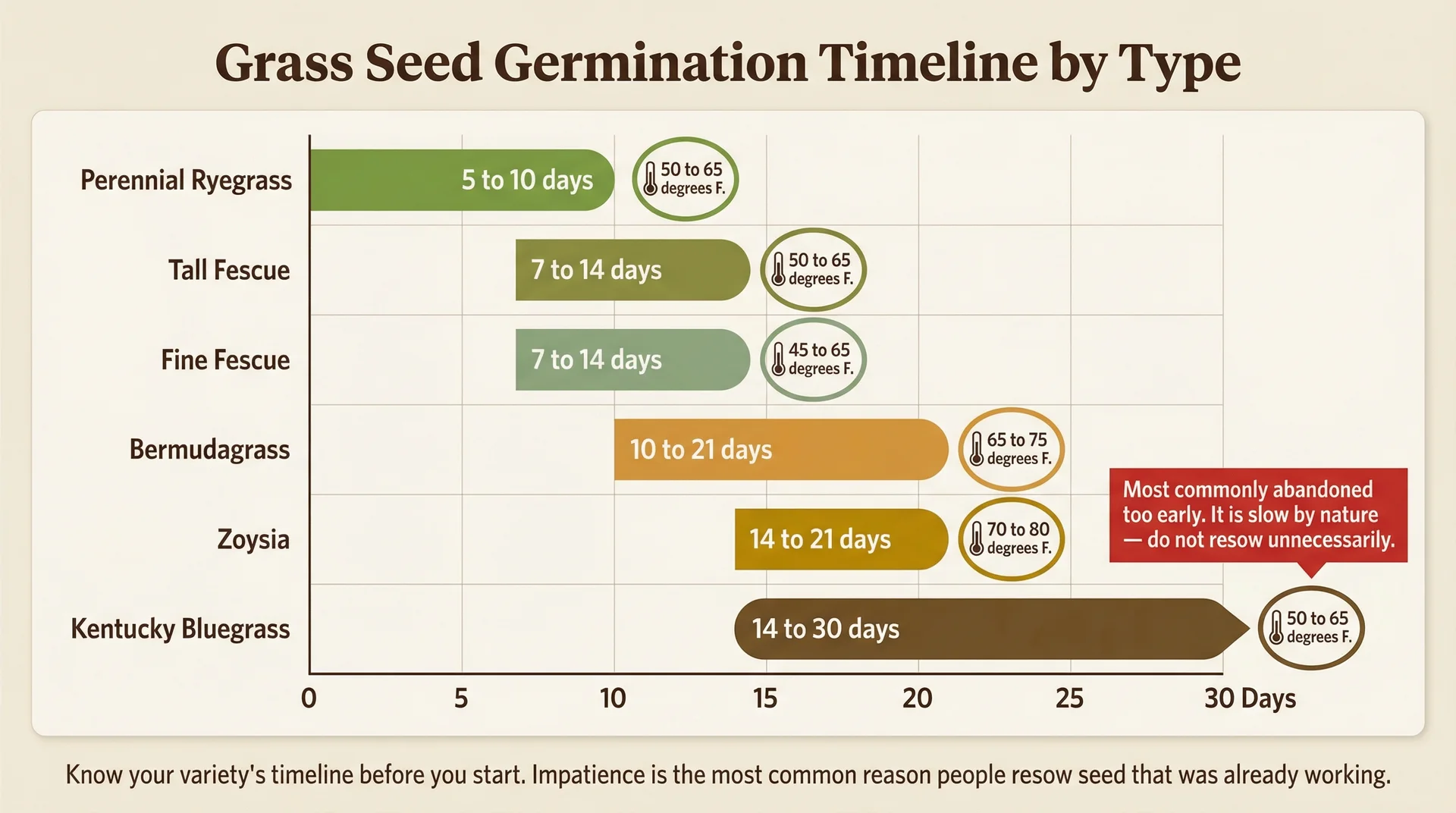
| Perennial Ryegrass | 5 to 10 days | 50 to 65°F |
| Tall Fescue | 7 to 14 days | 50 to 65°F |
| Fine Fescue | 7 to 14 days | 45 to 65°F |
| Kentucky Bluegrass | 14 to 30 days | 50 to 65°F |
| Bermudagrass | 10 to 21 days | 65 to 75°F |
| Zoysia | 14 to 21 days | 70 to 80°F |
Kentucky Bluegrass consistently surprises people with how long it takes.
Clients who sow it and expect to see results in a week often give up and resow unnecessarily, which just creates a mess. Knowing the timeline for your specific variety saves a lot of frustration.
Signs That Grass Seed Is Germinating
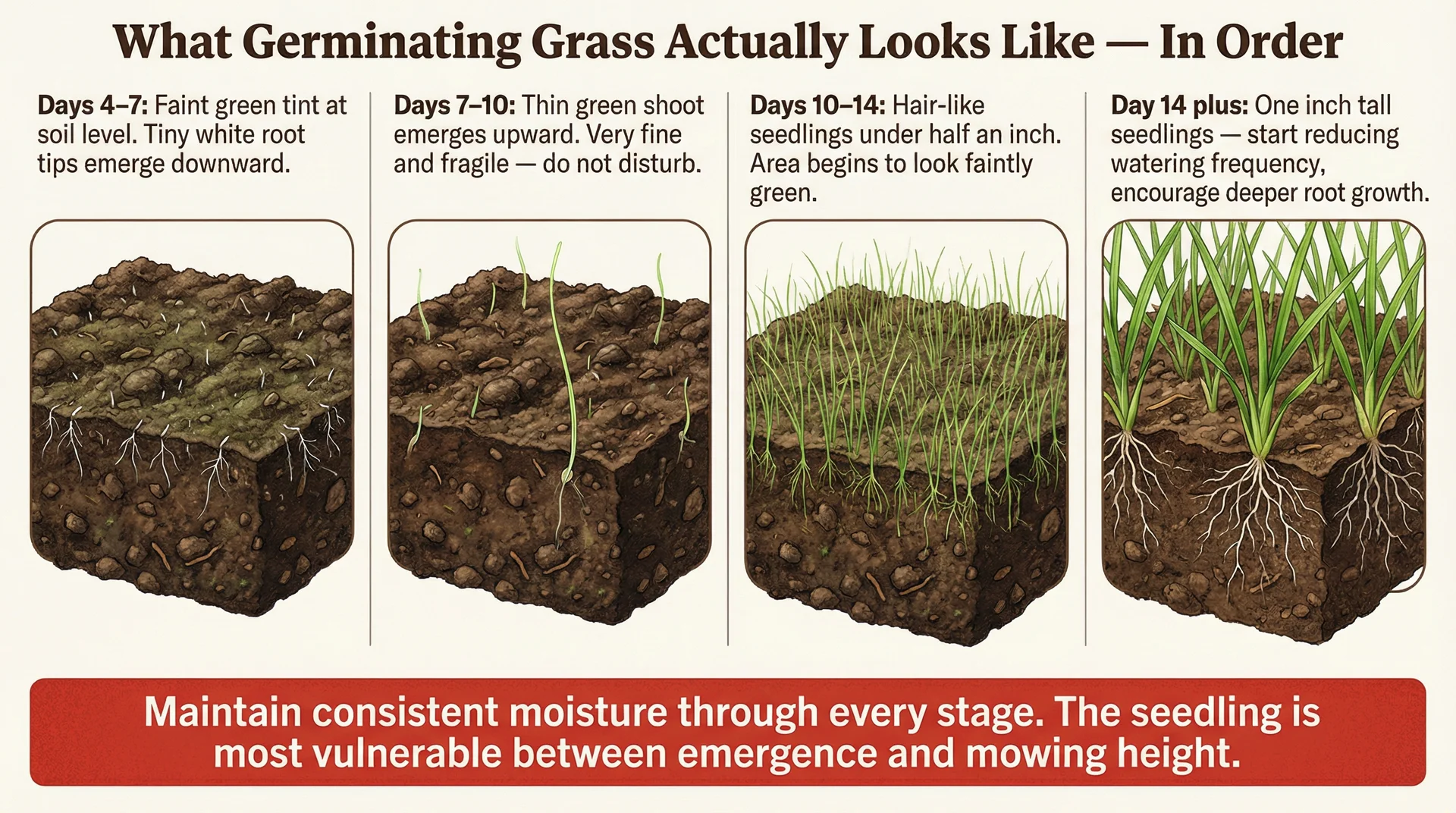
Knowing what to look for keeps you from second-guessing the process or overwatering out of anxiety.
The first sign appears as a faint green tint across the soil surface, usually visible around day four to seven for fast-germinating varieties like ryegrass.
Look closely at the soil level rather than standing back and scanning from a distance.
What you will see in sequence:
- Tiny white root tips are just barely pushing into the surface soil
- A thin green thread of a shoot emerging upward from the seed
- Hair-like seedlings standing less than ½ inch tall, very fine and fragile
- A general greening of the area as seedlings reach one inch and begin to look like actual grass
During this entire window, maintain consistent moisture. The seedling is at its most vulnerable between emergence and the point where it reaches mowing height.
Protecting Seeds After Sowing: What Birds, Rain, and Traffic Do to Your Lawn
Birds: A flock working a freshly seeded lawn in the morning can clear significant areas. Use a light straw mulch over the seeded area, or lay bird netting just above the surface, supported on short stakes. Remove the netting once seedlings reach one inch.
Rain: Light rain helps. Heavy rain damages. After any significant downpour, walk the area and check that seeds have not pooled in low spots or washed to the lawn’s edges.
Foot traffic and pets: Keep the area completely off-limits until the seedlings reach at least two inches tall and have been mowed once. Even light foot traffic on new seedlings breaks the shallow root system before it establishes.
Pre-emergent herbicides: Do not apply these to or near a seeded area. Pre-emergents block germination at the cellular level and will prevent your grass seeds from sprouting.
Troubleshooting: When Things Go Wrong After Sowing
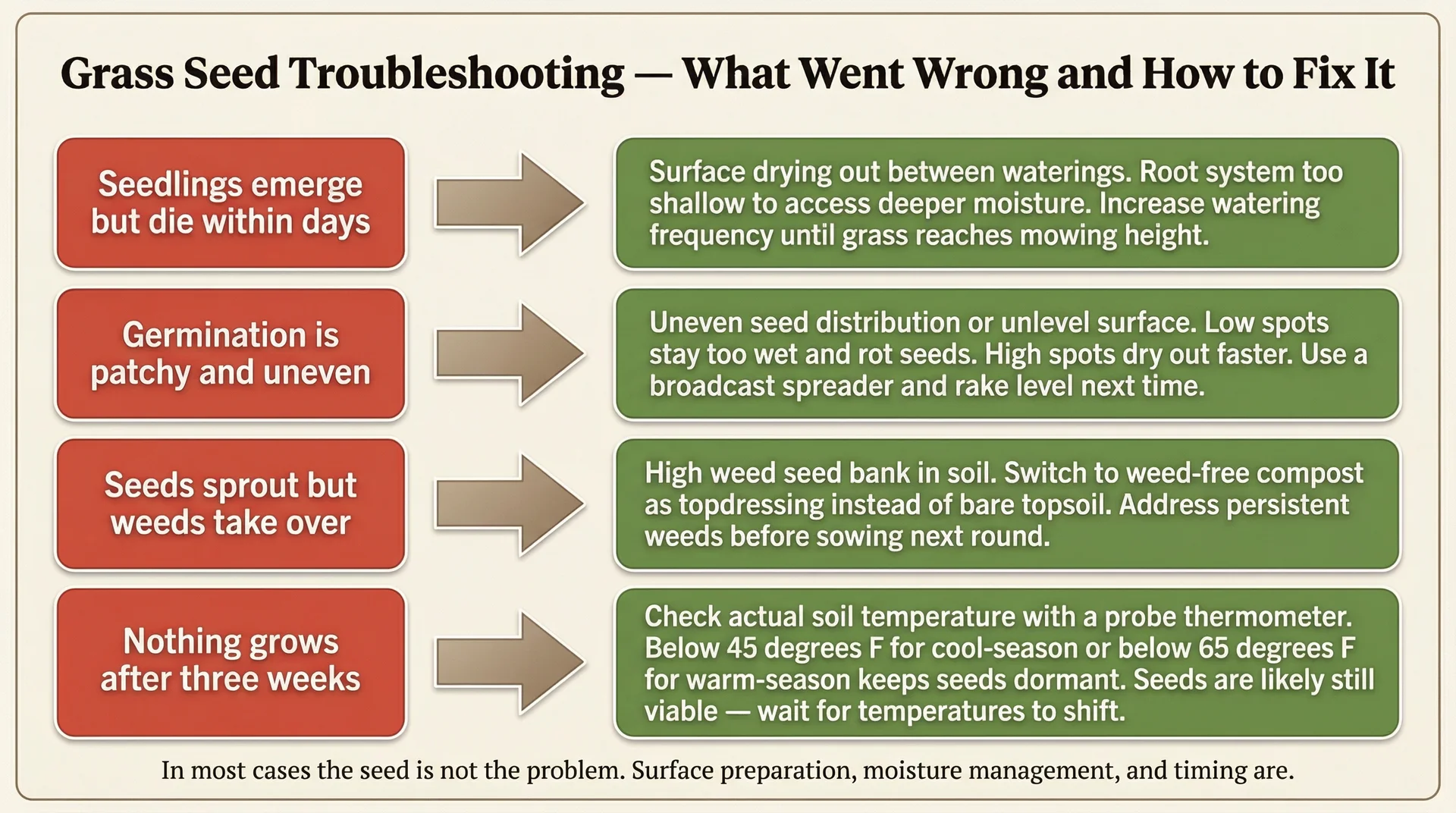
Seeds germinate, but seedlings die within days: The surface is drying out between watering sessions. The root system has not gone deep enough yet to access moisture below the surface layer. Increase watering frequency until the grass reaches mowing height.
Germination is patchy and uneven: Either the seed distribution was uneven, or the surface is not level. Low spots stay too wet and rot seeds. High spots dry out faster. A broadcast spreader and a raked, level surface prevent this on the next attempt.
Seeds sprout, but weeds take over: A high weed seed bank in the soil means weed species germinate faster than grass. Use weed-free compost as your topdressing instead of bare topsoil to reduce this risk. Address persistent weeds before sowing.
Nothing grows after three weeks: Check the actual soil temperature with a probe thermometer. Soil below 45°F for cool-season grass or below 65°F for warm-season grass keeps seeds dormant. They are likely still viable; keep the area moist and wait for temperatures to shift.
The Bottom Line
Grass seed germinates well on the soil surface when the soil is prepared, the moisture is consistent, and a thin layer of compost holds everything in place.
You do not need buried seeds, expensive equipment, or complicated techniques.
You need a loose surface, the right seed for your conditions, ⅛ inch of compost topdressing, and disciplined watering through the first two weeks.
Get those four things right, and you will watch your lawn fill in the way you hoped it would.