
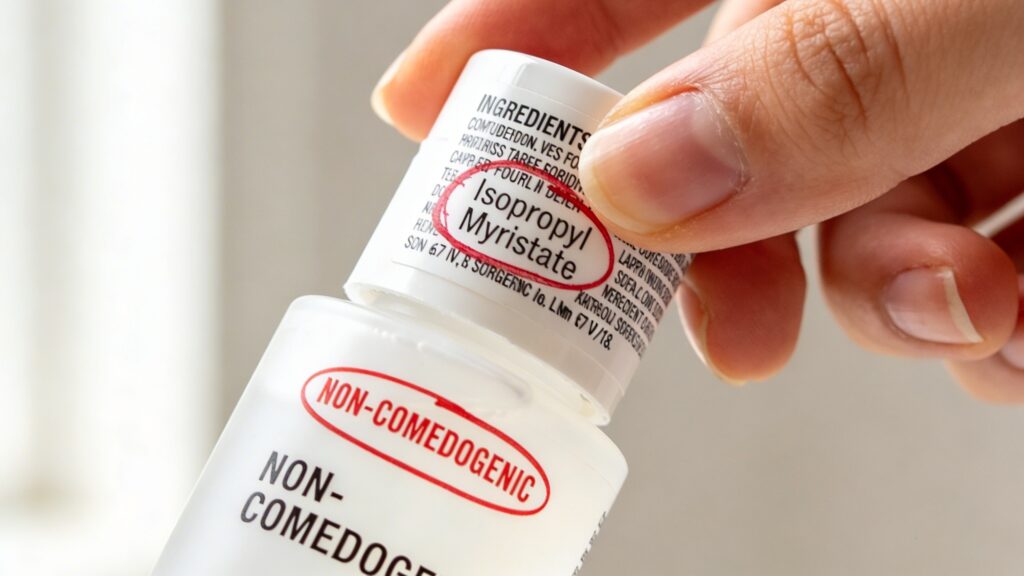
A noncomedogenic toner is one formulated without ingredients known to clog pores or trigger comedones, the blocked follicles that become blackheads, whiteheads, and acne blemishes. The problem is that “noncomedogenic” is an unregulated term. Any brand can print it on a label without third-party verification. |
Brands stamp it on products that contain lanolin, coconut oil, or isopropyl myristate.
They rely on the fact that most consumers trust the label more than the ingredient list.
A client came to me two years ago whose breakouts had not resolved despite switching her entire routine to products labeled noncomedogenic.
When we went through her toner together, the fourth ingredient was isopropyl myristate, a known pore-clogging emollient with a comedogenic rating of 5 out of 5.
The label said non-comedogenic. The formula said otherwise.
This guide gives you what the label cannot: a clinical understanding, the specific ingredients that clog pores versus those that do not, and what to actually look for when choosing a noncomedogenic toner for every acne-prone skin type.
What Non-Comedogenic Actually Means
The science behind comedones
A comedone is a pore blocked by a combination of excess sebum, dead skin cells, and debris.
Open comedones are blackheads; the pore is blocked but exposed to air, which oxidises the contents and turns them dark.
Closed comedones are whiteheads; the pore is completely blocked beneath the skin surface.
Both are the earliest stages of acne. When comedones become infected with Cutibacterium acnes bacteria, they progress into papules, pustules, and nodules.
Comedogenic ingredients accelerate this process.
They are typically heavy, occlusive, or lipid-rich compounds that sit on the skin surface, trap sebum inside the follicle, and prevent it from draining normally.
Noncomedogenic ingredients, by contrast, do not create this blockage. They hydrate, treat, and support without interfering with the follicle.
The Comedogenic Rating Scale
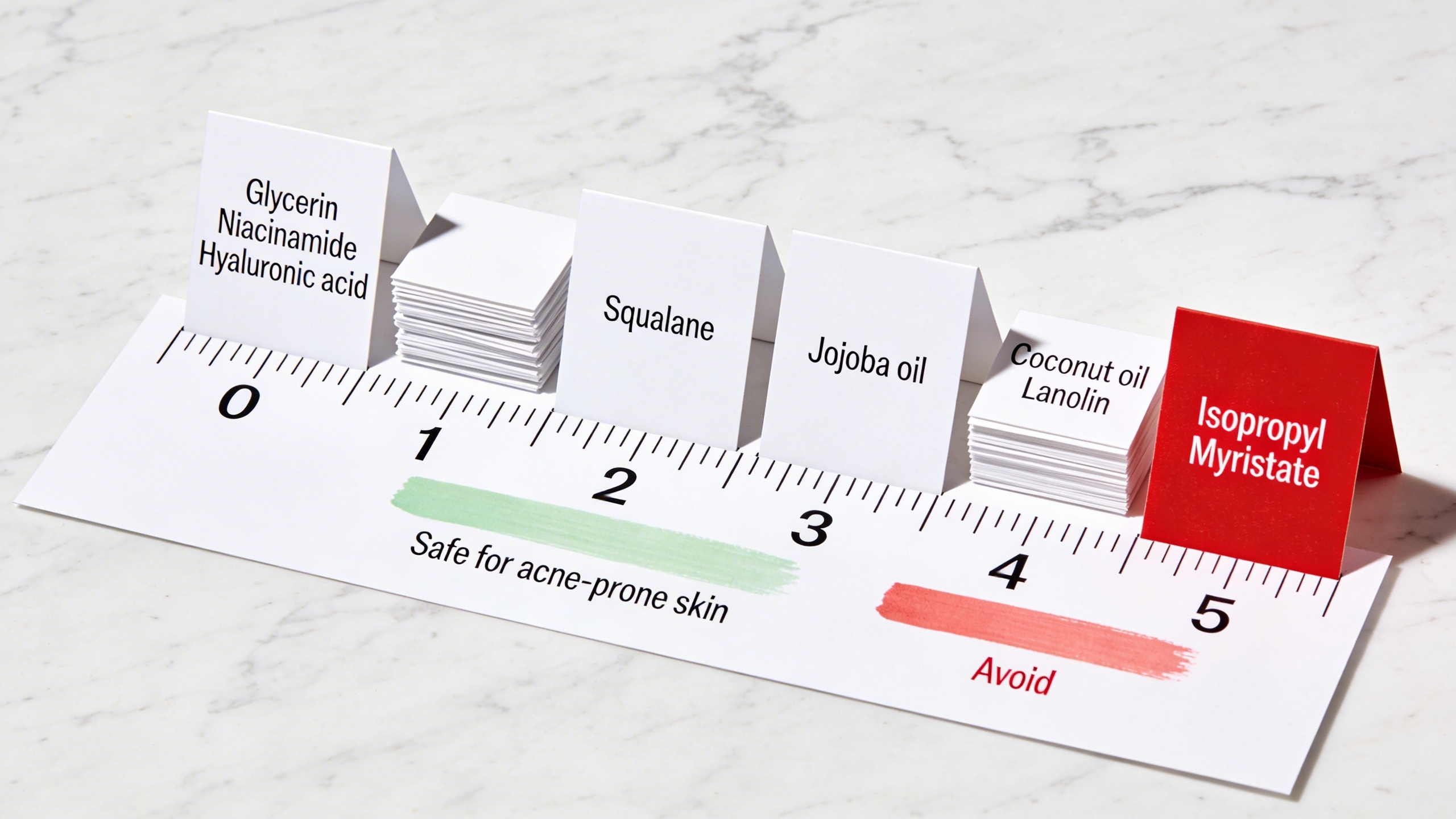
Ingredients are rated on a comedogenic scale from 0 to 5.
- A rating of 0 means the ingredient will not clog pores.
- Ratings of 0 to 2 are generally considered non-comedogenic.
- Ratings of 3 and above are considered comedogenic, with 4 and 5 being the most problematic for acne-prone skin.
The scale has a significant limitation.
The original research used rabbit ear skin as the testing model, which is far more sensitive than human facial skin.
Ingredients that tested as comedogenic in rabbit ears sometimes perform neutrally or even positively on human skin.
The scale is a useful starting framework, not an absolute verdict on every ingredient for every person.
Why the FDA does not regulate the non-comedogenic claim
In the United States, the FDA does not define, regulate, or verify the term “noncomedogenic.”
Any brand can apply it to any product without testing. Some brands conduct their own testing. Many do not.
The practical consequence is that a product labeled noncomedogenic may still contain individual ingredients with high comedogenic ratings, and those ingredients may clog your pores regardless of what the front of the packaging says.
The only reliable protection is reading the ingredient list yourself. This guide gives you the tools to do that.
How can a combination of non-comedogenic ingredients still clog pores?
Even if every individual ingredient in a toner has a comedogenic rating of 0 to 2, the combination of multiple non-comedogenic ingredients can interact to form a more occlusive layer than any single ingredient alone.
The American Academy of Dermatology noted in 1989 that products containing three or more noncomedogenic ingredients should still be tested as a complete formula.
Individual ingredient ratings are a starting point, not a guarantee of the whole formula’s behaviour on your skin.
Non Comedogenic vs Oil-Free: They Are Not the Same Thing
This distinction matters, and most skincare content conflates them.
Oil-free simply means a product contains no added oils, mineral oil, plant oils, or synthetic oils.
Non-comedogenic means a product is formulated to avoid pore-clogging ingredients, which is a different category entirely.
Some oils are non-comedogenic.
- Squalane has a comedogenic rating of 0.
- Jojoba oil has a rating of 2. Both are oils.
Both are regularly used in products marketed to acne-prone skin. An oil-free product, by contrast, could still contain isopropyl myristate (rating: 5), lanolin (rating: 4), or cocoa butter (rating: 4), none of which are oils but all of which clog pores.
If your skin is acne-prone, “noncomedogenic” is the label you want, not “oil-free.”
And within that, reading the ingredient list is the verification step that the label cannot provide.
Pore-Clogging Ingredients to Avoid in a Toner
| Ingredient | Comedogenic Rating | Why It’s Problematic |
|---|---|---|
| Isopropyl Myristate | 5 | Highly pore-clogging; common in “non-comedogenic” products |
| Coconut Oil & Derivatives | 4 | Occlusive; traps sebum in acne-prone skin |
| Lanolin & Derivatives | 4 | Heavy, blocked follicle drainage |
| Cocoa Butter | 4 | Deeply occlusive; traps oil in pores |
| Algae Extract (Certain Types) | Up to 5 | Some forms highly comedogenic (e.g., laminaria digitata) |
| Dimethicone (High Concentration) | Varies | Can form a film that interferes with pore drainage |
| Alcohol (Denat/Ethanol High %) | Not comedogenic | Causes rebound oil production → indirect congestion |
Non-Comedogenic Ingredients
| Ingredient | Comedogenic Rating | What It Does |
|---|---|---|
| Salicylic Acid (BHA) | 0 | Penetrates pores, clears congestion, reduces inflammation |
| Niacinamide (Vitamin B3) | 0 | Controls oil, reduces pores, fades marks, and strengthens barrier |
| Glycerin | 0 | Hydrates without clogging; safest humectant |
| Hyaluronic Acid | 0 | Binds water to skin; ideal for dehydrated oily skin |
| Centella Asiatica (CICA) | 0 | Soothes inflammation, supports barrier repair |
| Heartleaf Extract | 0 | Anti-inflammatory, antibacterial; good for active acne |
| Witch Hazel (Alcohol-Free) | 0 | Mild astringent without stripping skin |
| Squalane | 0–1 | Lightweight oil; hydrates without clogging |
| Zinc (PCA/Gluconate) | 0 | Controls oil, antibacterial, and reduces inflammation |
| Low % AHAs (Lactic/Mandelic) | 0 | Exfoliates gently; prevents buildup of dead skin |
Quick Reference: Comedogenic Ratings for Common Toner Ingredients
| Ingredient | Rating (0–5) | Safe for acne-prone skin? |
|---|---|---|
| Glycerin | 0 | Yes |
| Hyaluronic acid/sodium hyaluronate | 0 | Yes |
| Niacinamide | 0 | Yes, actively beneficial |
| Salicylic acid | 0 | Yes, actively clears pores |
| Centella asiatica | 0 | Yes |
| Heartleaf extract | 0 | Yes, anti-inflammatory |
| Squalane | 0–1 | Yes, for most acne-prone skin |
| Zinc PCA / zinc gluconate | 0 | Yes, sebum-regulating |
| Witch hazel (distilled, alcohol-free) | 0 | Yes, in balanced formulas |
| Jojoba oil | 2 | Generally, yes, patch test first |
| Dimethicone (high concentration) | 2–3 | Use with caution |
| Coconut oil | 4 | No |
| Lanolin | 4 | No |
| Cocoa butter | 4 | No |
| Isopropyl myristate | 5 | No, avoid entirely |
| Certain algae extracts | Up to 5 | No, check the specific form |
How to Check Whether Your Current Toner Is Actually Non-Comedogenic
Step 1: Read the ingredient list, not the label
Ingredients are listed in order of concentration from highest to lowest. The first five ingredients make up the bulk of the formula.
Cross-reference the first five against the comedogenic rating table above.
If a known pore-clogger appears in the first five, the formula contains a meaningful concentration of that ingredient.
Step 2: Use CosDNA or INCIDecoder to check the full list
CosDNA and INCIDecoder are free tools that allow you to paste a product’s full ingredient list and generate a breakdown that includes comedogenic ratings, potential irritants, and function of each ingredient.
They are not infallible; the comedogenic data is based on the original rabbit-ear research with all its limitations, but they are the fastest way to identify likely problem ingredients before you commit to a product.
Step 3: Patch test for two to five days before full routine use
Apply a small amount of the toner behind the ear or on the inner forearm for two to five days.
For acne-prone skin specifically, testing on a small area of the face, perhaps the cheek or jawline, for five to seven days gives you more relevant data, since facial skin behaves differently from ear or forearm skin.
If small closed comedones appear during the patch test window, the formula is likely contributing to congestion.
Step 4: Give it four weeks of consistent use before making a final judgment
Breakouts that appear in the first week of a new toner are often not caused by the toner.
Skin purging is a real phenomenon: ingredients like AHAs, BHAs, and retinoids can accelerate the cellular turnover process, bringing existing congestion to the surface faster than it would have appeared otherwise.
True purging resolves within four to six weeks.
New breakouts in areas not typically prone to congestion, or breakouts that do not resolve within that window, are more likely to indicate a comedogenic reaction.
Purging versus breaking out: how to tell the difference?
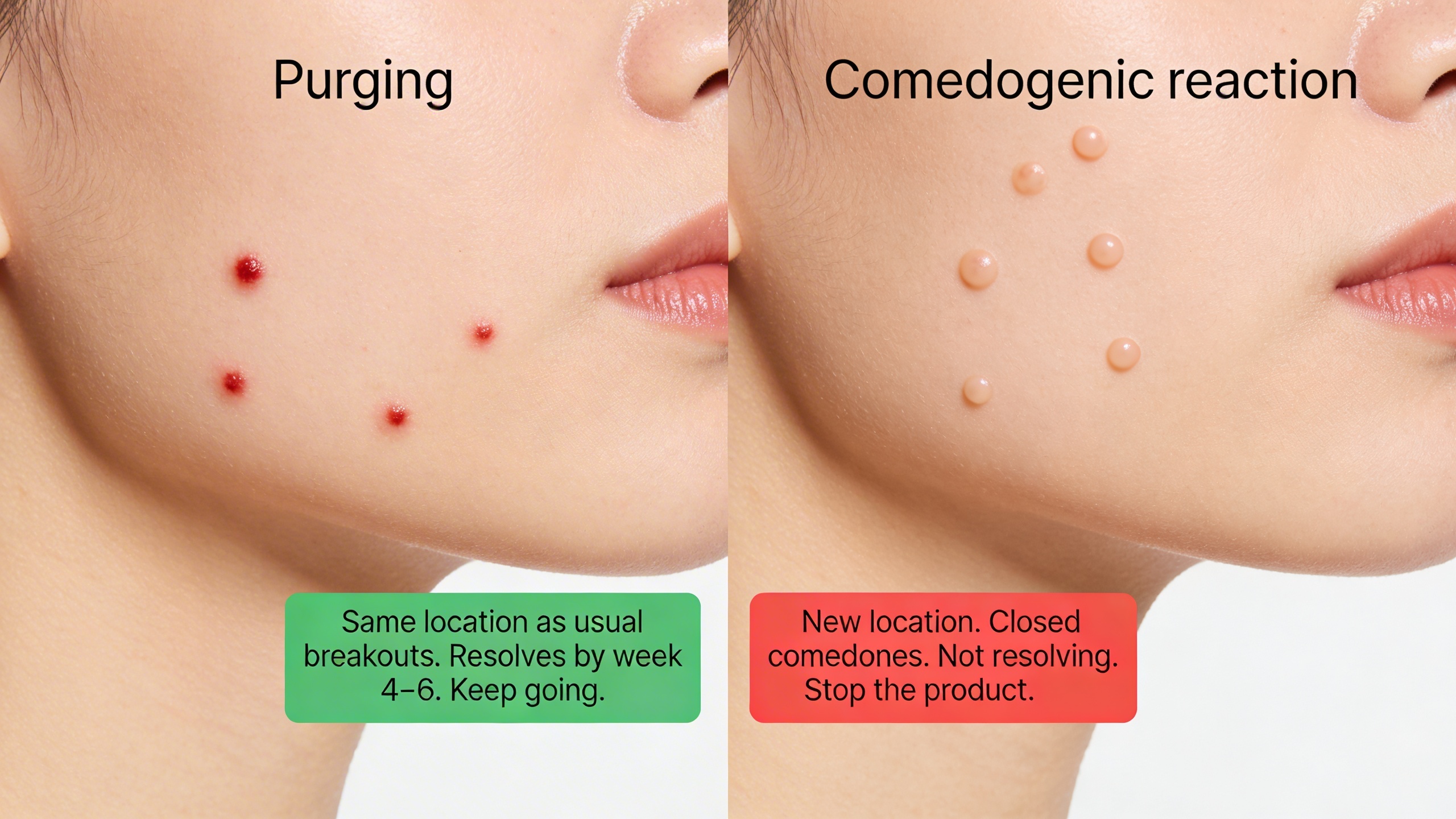
Purging happens in areas where you normally break out, uses the same type of blemish you typically get, and resolves within four to six weeks of consistent product use.
A comedogenic reaction causes new breakouts in areas where you do not normally break out, produces different blemish types (often closed comedones or milia), and does not improve with continued use.
If the breakouts are in new locations or are not resolving by week six, stop the product and reassess.
Scheduling exfoliating toner around other actives
| Day | Toner type | Treatment serum |
|---|---|---|
| Monday | Exfoliating (AHA or BHA) | A hydrating serum only gives skin recovery time |
| Tuesday | Hydrating | Niacinamide or retinol |
| Wednesday | Exfoliating | Hydrating serum only |
| Thursday | Hydrating | Niacinamide or retinol |
| Friday | Exfoliating | Hydrating serum only |
| Weekend | Hydrating | Peptides or barrier-repair serum |
Mistakes Robin Sees Directly Related to Non-Comedogenic Toner Use
Trusting the label without reading the ingredient list
The clinical case in the introduction was not an isolated incident. I see it regularly.
In almost every case, at least one product contains isopropyl myristate, a coconut-derived emollient, or a high-concentration silicone sitting in the top five ingredients.
The label and the formula told different stories. The ingredient list was telling the truth.
Using a “natural” toner and assuming it is non-comedogenic
Coconut oil has a comedogenic rating of 4.
Olive oil has a comedogenic rating of 2 to 3. Almond oil has a comedogenic rating of 2.
All three appear in products marketed as natural, clean, and safe for acne-prone skin.
“Natural” is not a synonym for noncomedogenic.
Some of the most pore-clogging ingredients in skincare are plant-derived. Check the ingredient list regardless of the marketing language on the front of the bottle.
Using an alcohol-heavy toner to control oil and create more oiliness
Alcohol-based toners create a temporary reduction in surface oil and a tight, clean sensation that feels like they are working. The skin responds by increasing sebum production to compensate for the stripping.
Over days and weeks of use, many people on alcohol-based toners produce more oil, not less, because the skin is in a constant cycle of being stripped and compensating. Switching to a non-comedogenic hydrating toner breaks this cycle.
Skipping moisturiser to avoid clogging pores
A common mistake among acne-prone skin types who fear that any moisturiser will cause breakouts.
Skipping moisturiser leaves the barrier exposed, causes dehydration, and triggers the same sebum overproduction cycle that alcohol-based toners create.
The non-comedogenic toner does not replace moisturiser. Its job is to prepare the skin.
A lightweight non-comedogenic moisturiser over the top is what seals that preparation in place and prevents the skin from compensating with excess oil.
Final Word
The noncomedogenic label exists because the problem it addresses is real.
Pore-clogging ingredients in skincare products genuinely contribute to breakouts, and avoiding them makes a measurable difference for acne-prone skin.
The label’s weakness is that it is unverified and frequently inaccurate. The ingredient list is always the more reliable document.
A genuinely non-comedogenic toner, applied correctly to slightly damp skin and followed by the right serum and moisturiser, makes the entire acne-prone skin routine more effective.
Not because it is a silver bullet, but because it creates the conditions in which every other product can do its job without fighting the pore-clogging interference that many routines unknowingly introduce at the first step.