
|
No. You do not wash off toner. Modern toners are formulated to stay on your skin and absorb into it. Washing one off removes the active ingredients before they have had any chance to work, and defeats the entire purpose of applying it. The only exceptions to this rule are specific high-strength exfoliating formulas that instruct you to rinse, and those products will say so clearly on their packaging. If your toner has no rinse instruction, leave it on. |
I have been working with clients in a clinical setting for over ten years.
The toner question comes up in one form or another in almost every new client consultation.
Mostly because people were taught incorrectly, or because they experienced an old-school alcohol-based toner that felt so harsh they assumed rinsing it off was the sensible thing to do.
Those instincts made sense for that generation of products. For modern toners, they work against you.
This guide covers the complete answer: the science behind why toner stays on, which toner types have different rules, and how to build it into a routine that compounds over time.
Why Toner Is Designed to Stay on Your Skin
What toner is actually doing after you apply it
A modern hydrating toner is not a surface cleanser because it does multiple things simultaneously: restoring the pH your cleanser disrupted, depositing humectants like hyaluronic acid and glycerin onto the skin surface, softening the outermost layer of skin cells, and priming that surface to receive and absorb the serum or moisturiser coming next.
None of those things can happen if you rinse it off thirty seconds after applying it.
The humectants need time to bind to the skin surface. The pH correction happens as the formula interacts with the skin, not instantaneously.
The priming effect on the skin’s outer layer requires the product to sit, absorb, and do its work.
Washing it off is the equivalent of applying sunscreen and then rinsing your face. The product existed on your skin, but it did nothing.
The pH window that makes your other products work
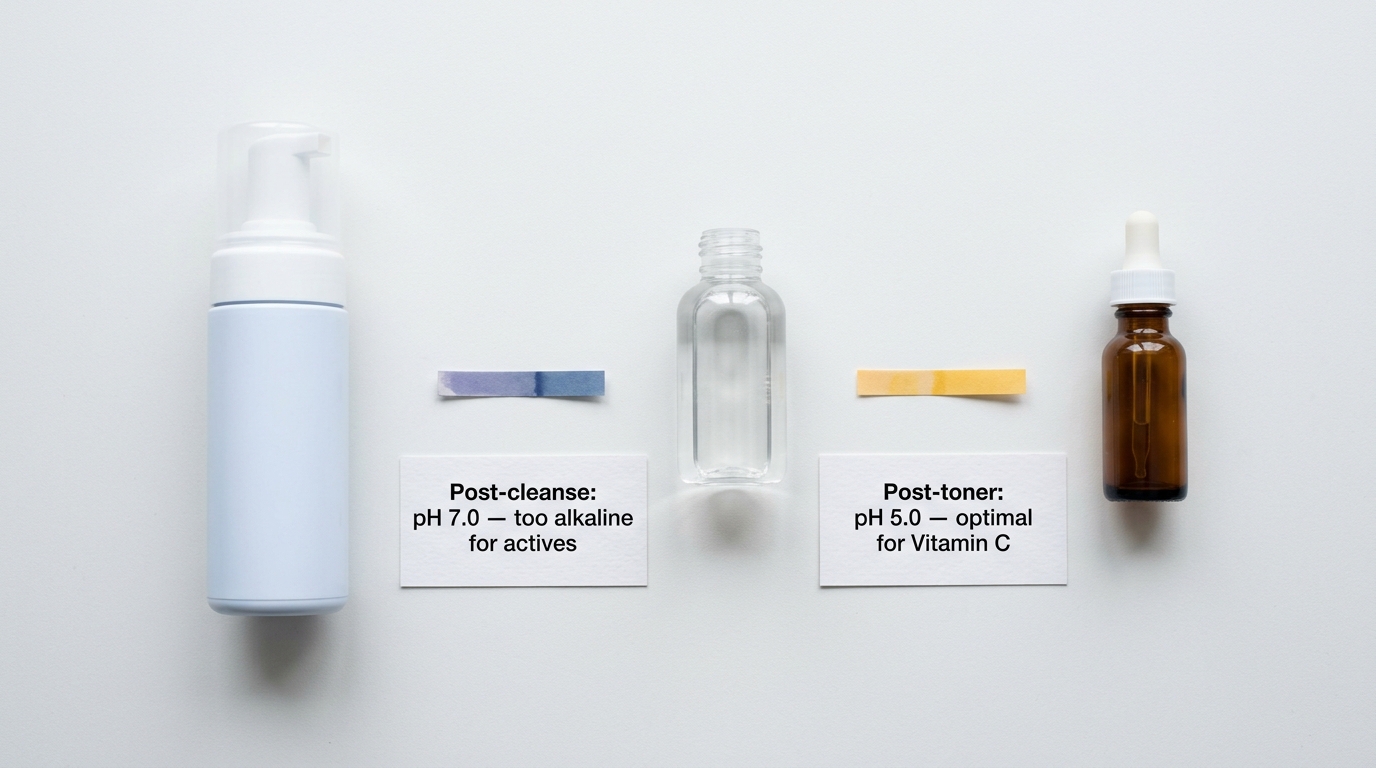
Your skin maintains a naturally acidic pH between 4.5 and 5.5.
Most cleansers, particularly foaming formulas, temporarily push that pH upward toward alkaline territory.
An alkaline skin surface is more vulnerable to irritation, loses moisture faster, and does not provide the correct environment for pH-dependent actives to perform.
Vitamin C serums work optimally at a pH of around 3.5. Retinol works best between 5.0 and 6.0.
Neither of those windows is accessible on skin that has just been cleansed and not toned.
A toner restores the correct pH within seconds of application. If you wash the toner off, you are washing off the pH correction along with it and returning your skin to its post-cleanse alkaline state before the serum even arrives.
The absorption window: the 20 to 60 seconds that matter
After you apply toner, there is a brief window of 20 to 60 seconds, where your skin is in an optimal state for the next step: hydrated, pH-corrected, and primed to absorb.
Your serum applied within this window penetrates more efficiently than it would on dry, un-toned skin.
Washing the toner off not only removes its own benefits but also eliminates this window, meaning your serum lands on skin that is less receptive than if you had skipped the toner altogether.
When you apply a toner immediately after cleansing, you increase the water content of the outer skin layer, which improves product absorption. It acts like a sponge, helping other skincare ingredients sink in.
Why did people start washing toner off in the first place
Traditional toners, the kind that dominated Western skincare for decades, were alcohol-heavy astringents. They stung. They left a tight, squeaky sensation.
For many people, rinsing them off after a minute felt like the only way to make the experience tolerable.
Those products were genuinely harsh, and the instinct to rinse was a reasonable response to them. Modern toners are categorically different.
They are hydrating, pH-correcting, and formulated with ingredients that need time to absorb.
The rinsing habit carried over from one generation of product to another, a completely different one.
The Exceptions: When You Actually Do Wash a Toner Off
The “do not wash off” rule applies to the vast majority of modern toners. There are genuine exceptions, and knowing them prevents both irritation and confusion.
High-strength exfoliating toners with a rinse instruction
Some professional-grade or high-concentration acid toners, typically those with glycolic acid above 10 percent, lactic acid above 10 percent, or TCA-adjacent formulas, are intended as short-contact treatments.
You apply them, leave them for a specified window (usually two to five minutes), and then rinse. These products will have a clear rinse instruction on the packaging. If a product tells you to rinse, rinse.
These are not your everyday toners. They sit in treatment territory, closer to a chemical peel than a daily prep step.
Using them without rinsing when the product instructs you to rinse can cause significant irritation, redness, and barrier damage, particularly on dry, sensitive, or darker skin tones that are more prone to post-inflammatory hyperpigmentation.
Toner is used before a clay or mud mask.
Some people apply toner as a pre-mask step to ensure the skin surface is clean before a clay or mud mask sits on it for ten to fifteen minutes.
When the mask comes off, either rinse or wipe the toner that comes with it. This is technically “washing off the toner,” but it is not the toner’s primary application in your routine.
You would still apply toner as a leave-on step after the mask in the normal sequence. Pre-mask toner use is an additional step, not a replacement for the leave-on application.
If your skin is reacting
If you apply a toner and experience significant burning, stinging, or a spreading redness within the first minute, rinse it off with cool water immediately.
This is not a sign that the toner is “working.”
It is a sign that the formula is not suited to your skin in its current state, either because the concentration is too high, the ingredient is an allergen for you, or your barrier is too compromised to tolerate even a gentle active.
Rinsing in this scenario is the correct response. Then reassess the product.
How to tell whether your toner should be rinsed or left on?
Read the packaging. Any toner formulated as a rinse-off treatment will say so explicitly.
If the packaging says nothing about rinsing, the product is designed to be left on.
A toner that tingles slightly is not necessarily one that needs rinsing because mild tingling from a low-dose AHA toner is normal and resolves within seconds.
Burning, spreading redness, or stinging that intensifies after application is a signal to rinse and reconsider the product.
Every Toner Type and Its Specific Leave-On Rules
| Toner type | Rinse or leave on | Wait before the next step | Application method |
|---|---|---|---|
| Hydrating / essence-style toner | Leave on | 20 to 60 seconds, apply serum while damp | Clean hands, press and pat |
| Balancing / pH-correcting toner | Leave on | 30 to 60 seconds | Clean hands or a cotton pad |
| Low-dose AHA toner (glycolic under 10%) | Leave on | 5 to 10 minutes before any active serum | Cotton pad for even distribution |
| BHA toner (salicylic acid 0.5 to 2%) | Leave on | 5 minutes before the next step | Cotton pad or clean hands |
| High-strength AHA (above 10%) with rinse instruction | Rinse as directed | Follow the packaging instructions exactly | Cotton pad, avoid the eye area |
| Toner pads (hydrating) | Leave on | 20 to 60 seconds | Smooth side of the pad |
| Toner pads (exfoliating) | Leave on | 5 minutes before the next step | Textured side, 2 to 3 times per week only |
| Mist-format toner | Leave on | 20 to 30 seconds | Spray then press gently — do not wipe |
The “do not wash off” rule is universal, but the application details are not.
Different toner formulations have different absorption times, follow-up windows, and sequencing requirements.
Understanding your specific toner type prevents the most common mistakes.
Hydrating Toners and Essence-Style Toners
Leave on: apply serum immediately while still damp
This is the most common modern toner format. These formulas are water-based, humectant-rich, and designed to absorb within 20 to 30 seconds.
Do not rinse. Do not wait long before your next step; apply your serum while your skin still feels faintly tacky. This slight dampness is the optimal absorption window.
Patting the toner in with clean hands is the most efficient method. Using a cotton pad wastes product and increases friction on dry skin.
Low-Dose Exfoliating Toners (AHA or BHA at Everyday Strength)
Leave on: wait 5 to 10 minutes before serum
These include:
- Glycolic acid (5–7%)
- Lactic acid (5–10%)
- Salicylic acid (0.5–2%)
These toners stay on the skin but require a buffer time before layering additional actives.
The acids continue working during this period.
Applying Vitamin C or retinol immediately can disrupt skin pH and increase irritation risk.
Use these 2–3 times per week, not daily. On alternate days, use a hydrating toner to support your skin barrier.
Balancing and pH-Correcting Toners
Leave on: wait 30 to 60 seconds before serum
These traditional toners are designed to restore pH without strong exfoliation or heavy hydration.
They absorb quickly, typically within 30 to 60 seconds. You do not need to time this precisely by the time you open and apply your serum; your skin is ready.
Do not rinse.
High-Strength Exfoliating Toners (With Rinse Instructions)
Rinse as directed
These are professional-grade formulas, typically above 10% acid concentration.
Follow the instructions exactly:
- Rinse when directed
- Do not use daily
- Do not leave on unless explicitly stated
These function more like at-home peels than everyday toners. Misuse can damage your skin barrier.
Toner Pads
Leave on: smooth side for hydration, textured side for exfoliation
These are pre-soaked cotton or fiber pads.
The toner residue left on your skin after swiping is intentional; it should not be rinsed off.
- Smooth side → hydration
- Textured side → gentle exfoliation (limit to 2–3 times per week)
Mist-Format Toners
Leave on: do not rub after spraying
Mist toners are sprayed directly onto the face and should be left to absorb naturally.
For hydrating mists, you can lightly press the product into your skin using clean palms.
Avoid rubbing or wiping, as this disrupts even distribution and adds unnecessary friction.
What You Have Been Losing by Washing Toner Off
If you have been rinsing your toner or if someone you know has, here is what has been happening to the routine as a result.
The serum that follows your toner performs measurably better when it lands on a hydrated, pH-corrected surface.
Multiple applications on toned versus un-toned skin show a consistent difference in how evenly serums spread and how completely they absorb.
If your serum has been landing on dry, post-cleanse skin because you rinsed the toner off, you have been getting a fraction of the absorption you paid for.
Your pH Has Been Wrong for Your Actives.
If you use a Vitamin C serum and you rinse your toner off before applying it, your Vitamin C is landing on skin sitting at approximately pH 7.0, which is the neutral post-cleanse state after rinsing.
L-ascorbic acid, the most effective form of Vitamin C, requires a pH of around 3.5 to activate. The gap between 7.0 and 3.5 is not a minor variable.
It is the difference between a serum that does its job and a serum that sits on the surface of skin it was never able to activate in.
Your Skin May Have Been Drier
I have had clients who told me toner made their skin feel dry and tight.
When I asked how they used it, they said they applied it, waited a minute, and then rinsed it off before moisturising because they thought that was the correct method.
Their skin was dry because they were removing the humectants the toner had just delivered, then applying moisturiser onto a stripped, pH-disrupted surface.
How to Apply Toner Correctly So It Can Do Its Job
Apply to slightly damp skin
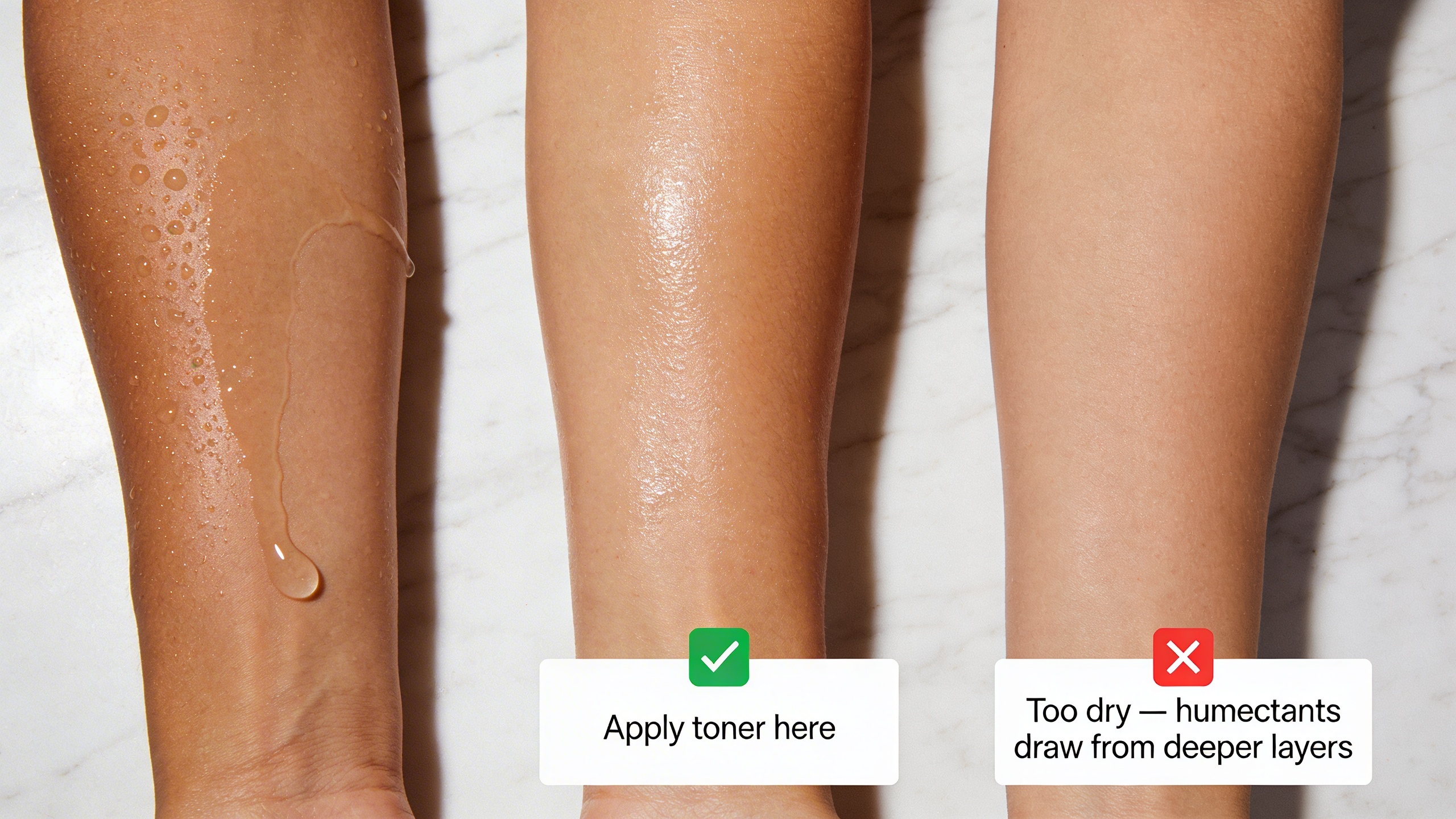
After cleansing, pat your face with a clean towel, but stop before your skin is completely dry.
You want it faintly damp, not dripping. Applying toner onto slightly damp skin gives its humectants immediate moisture to bind to at the surface.
On completely dry skin in a low-humidity environment, humectants like hyaluronic acid can draw moisture from deeper skin layers rather than from the surface or from the air, which is counterproductive.
Move from cleanser to toner within 30 to 60 seconds of patting dry.
Use clean hands, not a cotton pad, for hydrating toners
Dispense a few drops or a small pool into clean palms, press your hands together to warm the product slightly, then press and pat it gently across your face.
The warmth from your hands helps absorption.
The pressing motion distributes the product evenly without the friction or waste of a cotton pad. Cotton pads absorb a significant portion of the toner before it even reaches your skin, and the dragging motion can aggravate dry or sensitised skin.
Cotton pads are appropriate for exfoliating toners specifically, where the mechanical action of the pad helps distribute the acid and gently lift the surface cells it has loosened.
For hydrating toners, hands are always the better tool.
Do not let it fully dry before applying your serum
The most common mistake after correctly leaving toner on is waiting too long before the next step.
If your toner has fully evaporated and your skin has returned to its baseline state, you have lost the prep advantage. You do not need to rush.
By the time you pick up your serum, uncap it, and dispense it, the timing is usually about right.
What you want to avoid is walking away between steps and returning to skin that is completely dry again.
For very dry or dehydrated skin: layer it
Two to three thin layers of a hydrating toner, pressing each one in and allowing 20 to 30 seconds of absorption before the next, deliver significantly more hydration than a single application. This is drawn from the K-beauty “7 skin method.”
Two to three layers achieve the benefit without the time commitment.
Stop when skin feels plump and slightly tacky. This technique applies only to purely hydrating, non-active toners. Never layer an exfoliating toner this way.
Frequently Asked Questions
Do you wash off toner before moisturiser?
No. Toner goes on, absorbs for 20 to 60 seconds depending on type, and then your moisturiser goes directly over it.
Washing the toner off before moisturising removes the pH correction, the humectant layer, and the primed surface that makes your moisturiser absorb better.
The correct sequence is cleanser, toner (leave on), serum (leave on), moisturiser (leave on).
What happens if you leave toner on too long before the next step?
If you wait too long, the toner evaporates, and your skin returns to its baseline state. You lose the absorption window and the pH correction advantage.
Your serum then lands on un-prepped skin. You have not damaged anything by waiting — you have simply lost the benefit of the toner step.
The fix is to move to your serum while the skin still feels faintly damp or tacky from the toner.
Should toner be left on overnight?
A hydrating toner applied in your evening routine is absorbed within seconds and is effectively part of the skin’s surface long before you sleep.
There is nothing to “leave on” in the sense of a sleeping mask; it absorbs and is gone.
What you are leaving on overnight is the effect of its ingredients, which is exactly correct. An exfoliating toner with acids should not be applied as a final step before sleep.
It should be followed by a serum and moisturiser within the normal routine sequence.
Can you use toner without washing your face first?
No. Toner is not a cleanser and is not designed to replace cleansing.
Applying it to uncleaned skin means it is landing on a surface covered in sebum, SPF residue, pollution, and makeup.
The toner’s pH-correcting and priming functions cannot work correctly on an uncleansed surface. Cleanse first, then tone.
Is it okay to apply toner with fingers instead of a cotton pad?
For hydrating toners, clean hands are the preferred method.
You lose less product than you would to a cotton pad, you reduce friction on the skin, and the warmth of your palms marginally improves absorption.
Cotton pads are appropriate for exfoliating toners where you want the mechanical action of the pad. For anything hydrating, use your hands.
Can toner be used as a face wash?
No. A toner does not contain the surfactants needed to lift and remove oil, SPF, makeup, and environmental debris from the skin surface.
Using it as a cleanser leaves your skin with residue on it and delivers the toner onto a dirty surface, where it cannot function correctly.
Cleanse with an actual cleanser, then apply toner as the separate step it is designed to be.
My skin felt tight after the toner. Does that mean I should rinse it off?
Tightness after a modern hydrating toner is almost always a sign that the toner is not suited to your skin type or that it contains alcohol or astringents.
The correct response is to switch products, not to rinse the one you have.
If you have an alcohol-based or astringent toner and it is making your skin feel tight, that product is actively working against your barrier and should be replaced with a fragrance-free, alcohol-free hydrating formula. Rinsing it off is a short-term fix for a product selection problem.
Do you wash off micellar water the same way as toner?
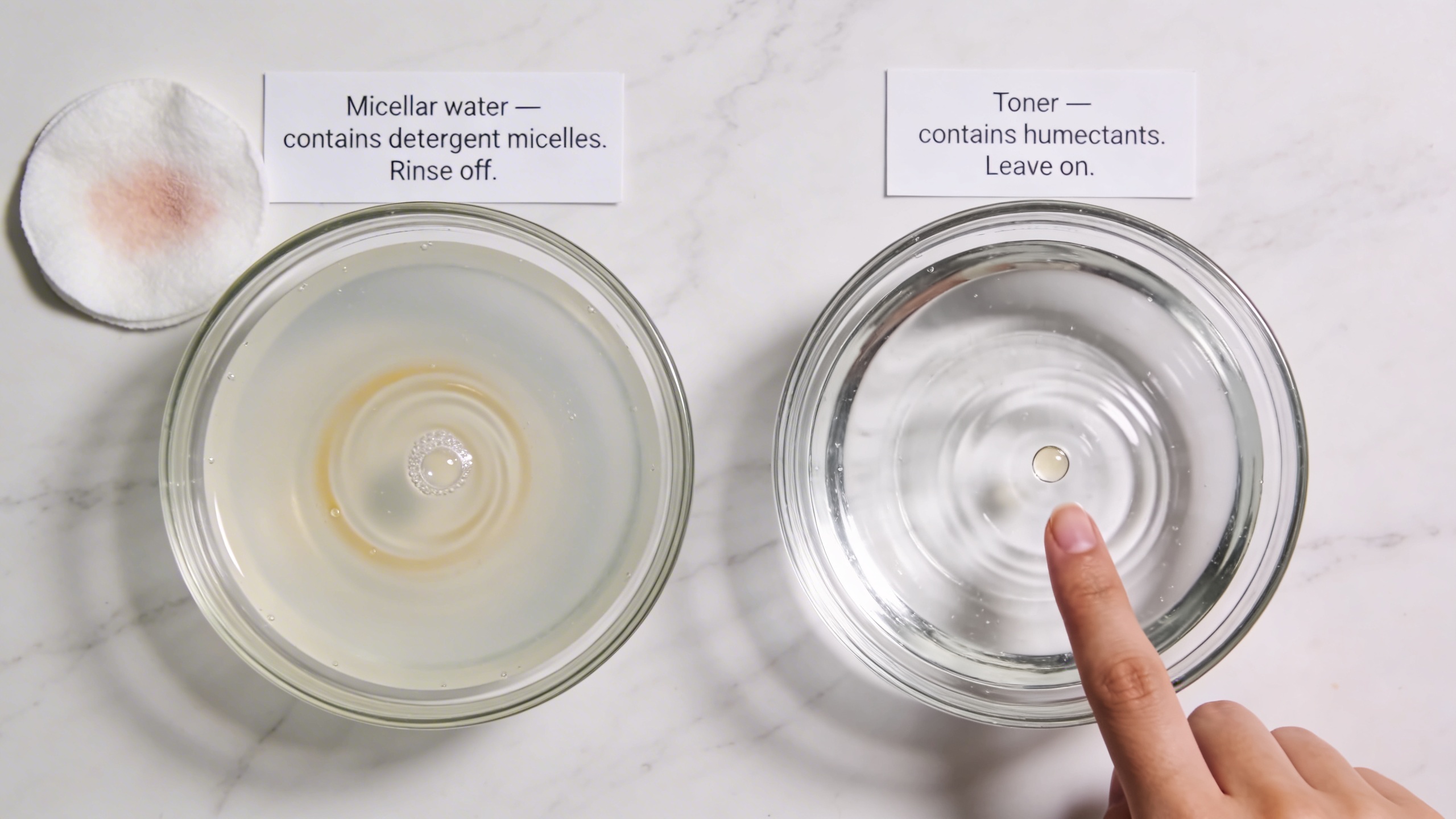
Micellar water is a cleanser, not a toner, despite what many brands suggest about leaving it on.
It contains small amounts of detergents that remove oil and makeup.
For dry, sensitive, or barrier-compromised skin, leaving micellar water on the skin is not advisable; those detergents can cause ongoing mild irritation.
Micellar water should ideally be followed by a rinse or a second cleanse. Toner, by contrast, is designed to stay on.
They are different categories of products with different formulation intentions.
Final Word
The question of whether to wash off toner is one of the clearest examples of how a single outdated habit can quietly undermine an otherwise well-considered routine. The habit made sense for one generation of products.
It does not make sense for the products most people are using now.
Leave the toner on. Let it absorb. Apply your serum while your skin is still faintly damp.
That thirty-second sequence is doing more work for the rest of your routine than most people realise until they stop rinsing and start noticing the difference.
If you have been rinsing your toner off, you have not been doing damage. You have simply been paying for a step that was not completing its job.
That is entirely fixable, starting with your next routine.