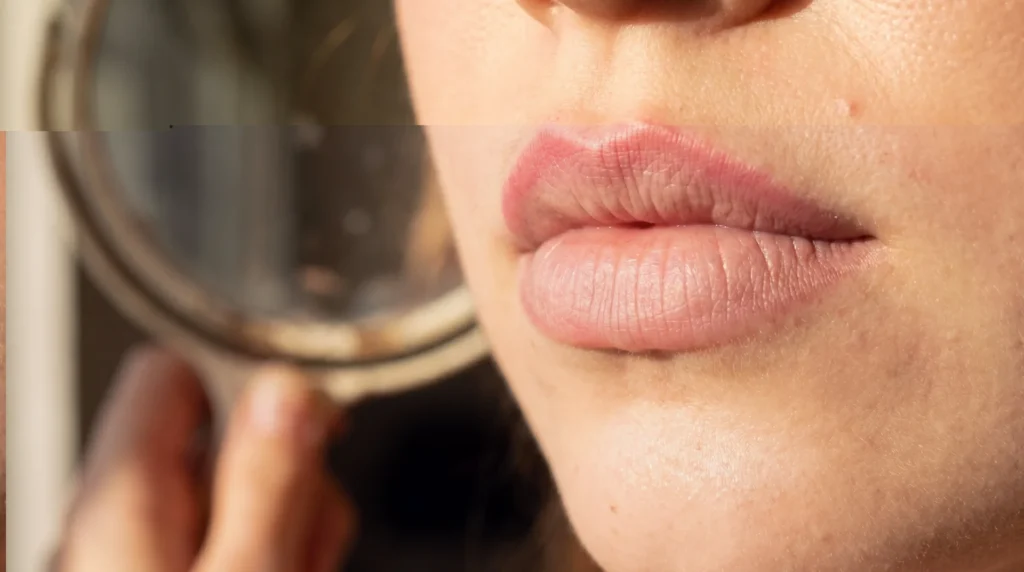
Something happens around the 3-year mark. You catch your reflection, maybe in bathroom light that’s a little too honest, and you study your lips the way you haven’t in months.
The soft rose flush you fell in love with has drifted cooler. Maybe it’s grey at the edges, faded almost completely through the center, or uneven in a way you can’t quite name. You wonder if this is normal, if something went wrong, or if you should have booked a touch-up a year ago.
| Here’s what I want to tell you first: what you’re seeing is almost certainly normal. Three years sit right at the natural lifespan of lip blush pigment. Fading, color shifting, and uneven tone are expected at this stage. It doesn’t mean the procedure failed. |
It means you’ve reached the crossroads every lip blush client eventually reaches, and your options from here are more manageable than they look right now.
I’ve worked as a makeup artist across bridal, editorial, and fashion shoots for years. I see lip blush at every stage of its life. The 3-year mark is one I recognize almost immediately in clients who come in for consultations.
There’s a particular mix of curiosity and quiet alarm that tends to come with it, and this piece is my honest attempt to work through both.
| Note: This article is for informational purposes only. Before booking any refresh, correction, or removal treatment, consult a qualified PMU artist or dermatologist who can assess your lip pigment and skin type in person. |
What Your Lip Blush Actually Looks Like at the 3-Year Mark
How Lip Blush Fades Year by Year
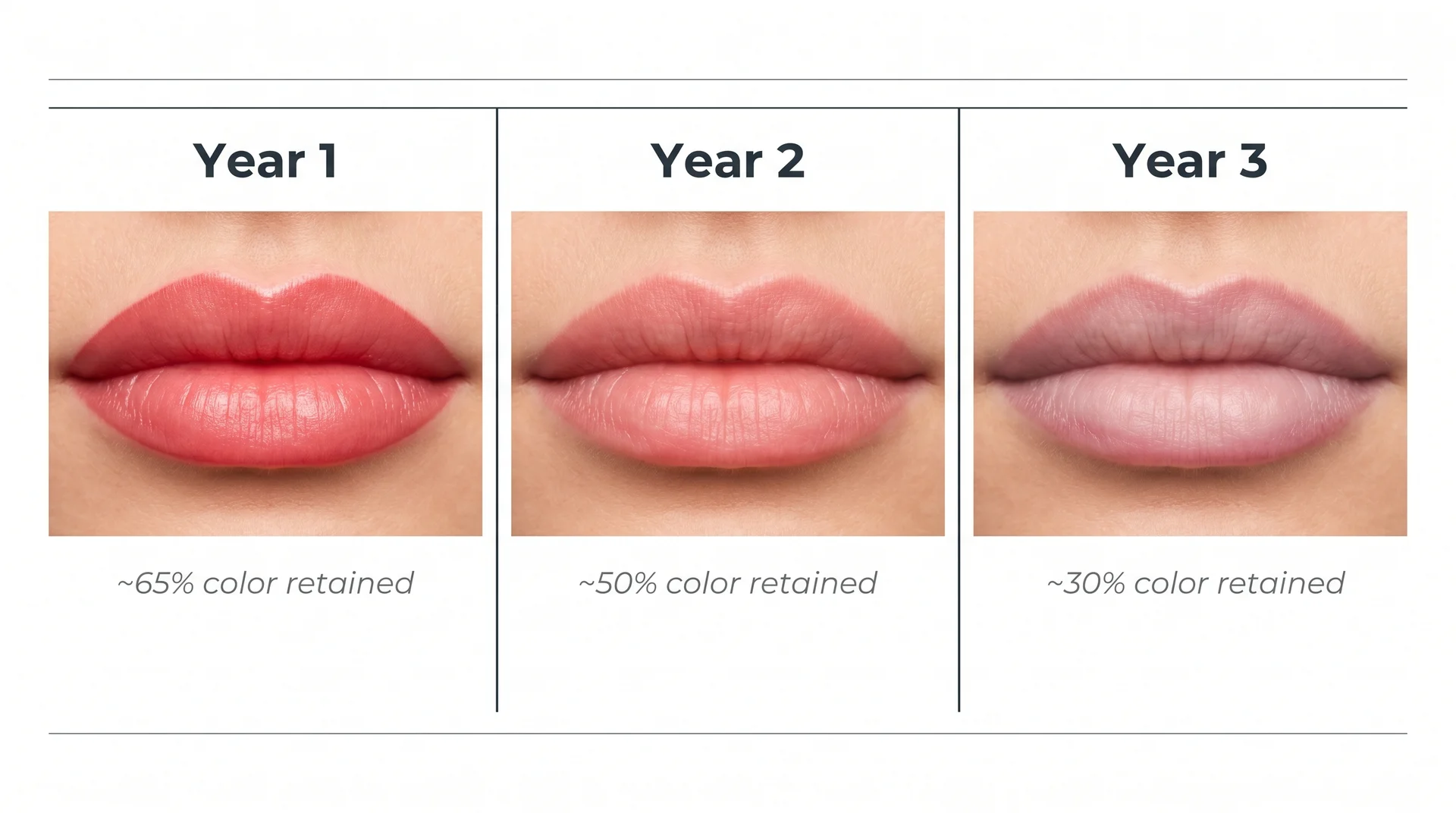
Lip blush doesn’t fade in a straight line, and it doesn’t fade evenly across the lip. The inner lip fades faster because it’s constantly exposed to saliva, food, and movement.
The vermillion border, the visible edge where your lip meets your skin, holds pigment longer because it sees far less daily disturbance.
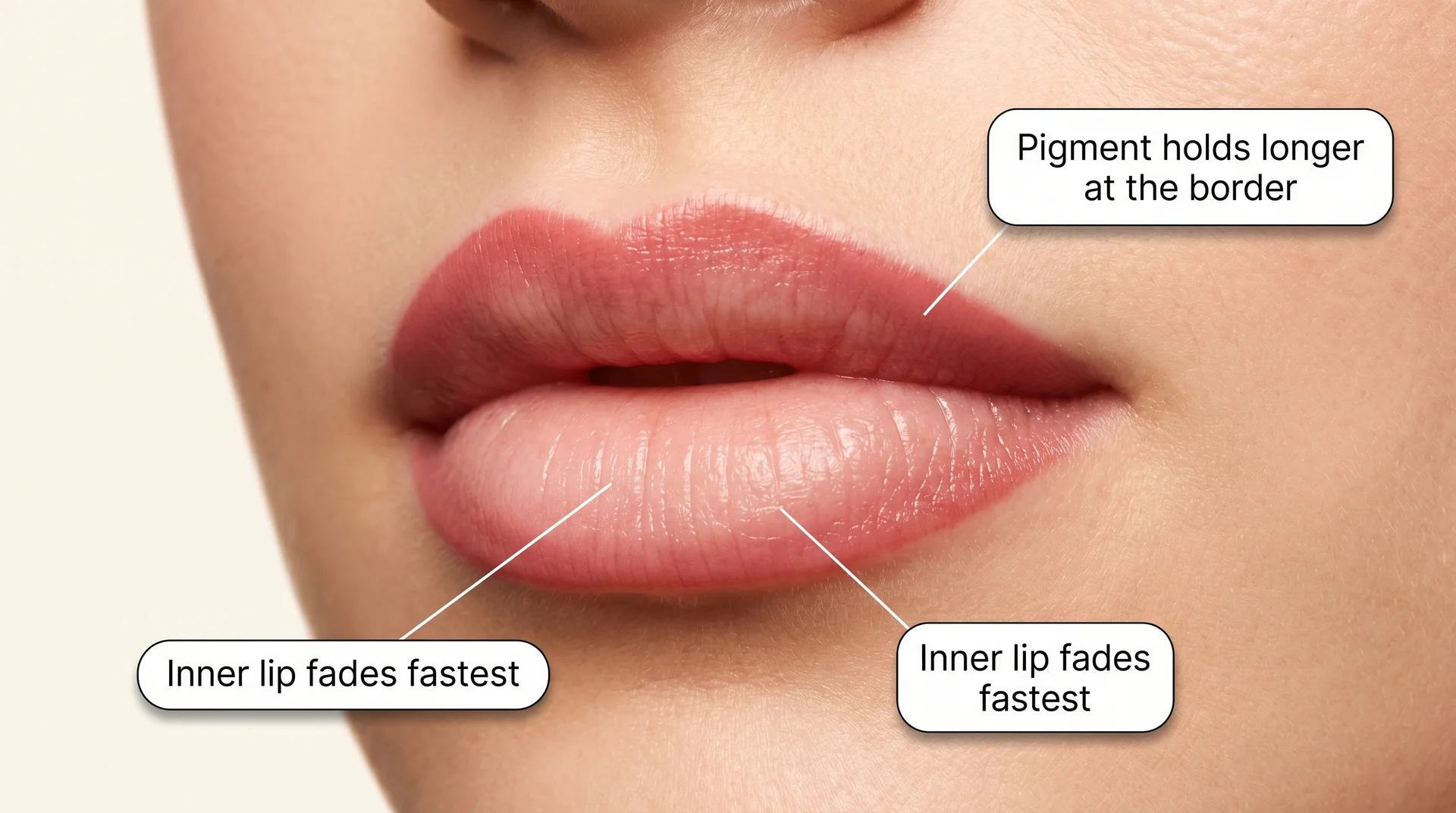
By year three, most people notice a lip that’s lighter in the center and slightly more defined at the edge. That’s a normal aging pattern, not an error.
| Timeline | What You Typically See | Approximate Color Retained |
|---|---|---|
| Right after the procedure | Intense, swollen, 30–50% darker than the final healed result | N/A (still healing) |
| Month 1–3 | Color settles and softens significantly into the skin | 50–70% of peak vibrancy |
| Year 1 | Still fresh and vibrant, with minor softening around the inner lip | 60–70% retained |
| Year 2 | Noticeable softening, inner lip fading faster than the border | 40–60% retained |
| Year 3 | Significantly faded, possible color shift to grey, ashy, or cool-toned | 20–40% retained |
| Year 4–5+ | Very faint to no visible tint remaining | 5–20% retained |
Signs Your Lip Blush Has Aged Well
Some lips at 3 years look genuinely beautiful. The pigment has mellowed into the skin and reads as a natural color rather than a treatment. Here’s what well-aged lip blush looks like:
- A soft flush of warmth is still visible, even without any other lip product on top
- The fading is relatively even across the surface, with no harsh ring or outline effect
- The shade has drifted slightly cooler or more neutral, but it still flatters your skin tone
- There are no grey, purple, or muddy patches
- You still feel enhanced rather than self-conscious
If this is where you are, you’re in a good position. A touch-up would be a nice enhancement, but there’s no urgency. You have time to decide.
Signs Something Needs Attention
- The color has shifted to grey, ashy, purple, or muddy brown. This is one of the most common concerns at 3 years and has a specific, addressable cause.
- There’s a visible dark ring around the lip border while the center has faded, creating an unintentional liner-like outline.
- The pigment is patchy, with some areas fully faded and others still holding color in a way that looks uneven.
- Your lips feel worse without lipstick than they did before you ever got the procedure. That feeling is a useful guide.
All of these patterns are correctable. The approach depends on which one you’re dealing with, and I’ll walk through each option below.
Why Lip Blush Color Shifts Over Time
The Science Behind the Color Change, Made Simple
The pigments used in lip blush are a mix of organic and inorganic compounds, and they don’t all break down at the same speed.
Warm tones, the pinks and corals and peach shades most people choose, tend to fade faster because their organic color molecules are more susceptible to UV light and the body’s natural immune response.
What lingers after those warm tones break down is often the cooler, more stable undertone embedded in the original pigment formula.
Titanium dioxide is one of the most common culprits behind the grey-tone shift at 3 years. It’s a white compound used in lighter, pastel lip blush formulas to soften the color.
Over time, it can oxidize beneath the skin and produce grey, blue, or even slightly black undertones that have nothing to do with your original color choice. If your lips looked peachy-pink in year one and now read as ashy or cool, this is likely what’s happening.
Iron oxide pigments, the inorganic component in most PMU formulas, are more stable but can drift cooler or more muted over the years as the surrounding tissue chemistry changes.
Your own natural lip melanin also plays a role. As the pigment fades, your natural lip tone re-emerges and interacts with whatever pigment remains, sometimes producing a mixed result that looks muddy or uneven.
Skin type matters more than most people realize. People with faster cell turnover, typically younger clients or those with oilier skin, tend to see quicker fading. Slower cell turnover, which comes with drier skin and age, often preserves the pigment longer.
This is why two people who got lip blush on the same day can look completely different at the 3-year mark.
Why the Border Looks Darker Than the Center at 3 Years
This is a normal pattern, not an error in the original procedure.
The vermillion border sits in a different type of tissue than the inner lip mucosa. It’s less exposed to saliva and friction, so the pigment embedded there lasts longer.
The inner lip is essentially in a constantly moist, high-movement environment, and it fades proportionally faster. At year three, the gap between the border and the center becomes very visible.
A targeted touch-up that focuses on rebuilding the center to match the border resolves this effectively in most cases.
What Your Specific Fading Pattern Is Telling You
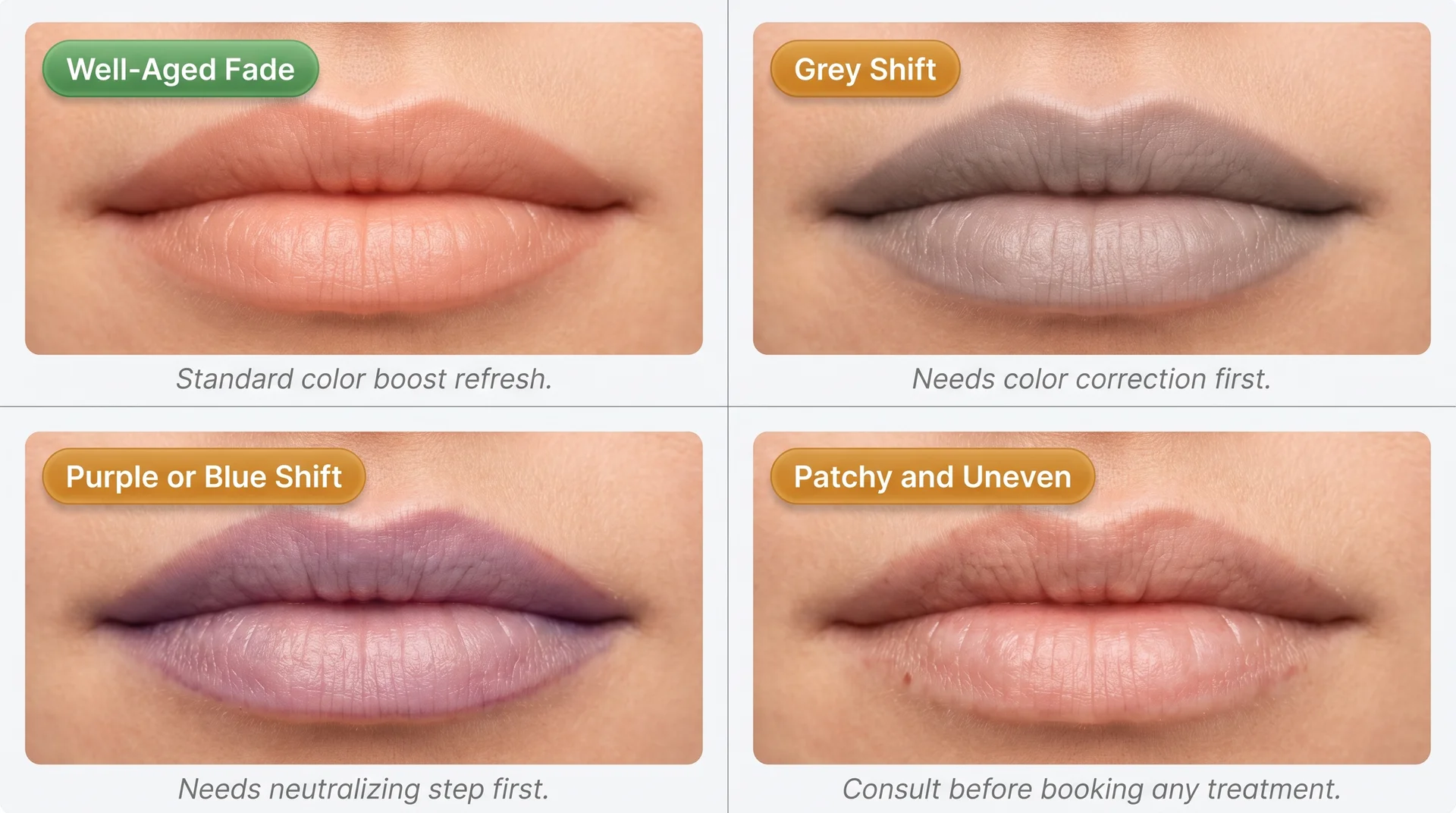
| What You’re Seeing | What It Likely Means | What Usually Helps |
|---|---|---|
| Faded to a soft peachy or nude tone | Healthy aging, inorganic pigment base | Standard color boost refresh |
| Faded to grey or ashy overall | Titanium dioxide oxidation | Neutralize the color correction first, then refresh |
| Faded to purple or cool-blue | Cool-toned pigment interacting with natural melanin | Warm-toned neutralizer before new color is applied |
| Dark border with faded center | Normal differential fading | Targeted center top-up to rebalance |
| Patchy and uneven across the lip | Variable pigment retention, often oily skin or missed initial touch-up | Full refresh with a color correction assessment first |
| Fully faded, no tint remaining | The procedure has completed its lifespan | Clean slate for a completely fresh treatment |
If you can identify which row you’re in before you book, you’ll have a much more productive consultation and a clearer sense of what to expect from any treatment.
The 3-Year Crossroads: Your Real Options for Lip Blush
Option 1: A Color Boost Refresh
A color boost at 3 years is a shorter, less intensive appointment than your original procedure. Because the pigment has faded significantly, there’s less saturation in the tissue, which makes it easier for your artist to work with.
You’re refreshing a soft canvas. The healing process afterward is comparable to the original, though some clients report slightly less swelling. Plan to wait 4 to 6 weeks before evaluating the final healed result.
In the US, a 3-year color boost refresh typically costs between $150 and $350, which is roughly 30–50% of what an initial procedure runs. Initial procedures range from $400 to $800 in most cities, and up to $1,200 or more in higher-end markets like New York or Beverly Hills.
Color corrections, which require additional skill and time, are generally priced higher than a standard refresh. Always confirm what’s included in the quoted price before booking.
Before this appointment, I always tell clients: bring a photo of your original healed result if you have one, and bring a reference of a shade you love now. Three years is a long time.
Your hair may have changed, your everyday makeup may look different, and the color that felt right initially may not be exactly what you’d choose today. Most artists genuinely welcome that conversation.
This option works best when:
- You’re still happy with the style and shape of your original lip blush
- The fading is relatively even, and you mainly want the color restored
- Your lip blush hasn’t developed grey or purple color distortion
Is it safe to keep refreshing every few years?
Yes, with one caveat. Each session adds pigment to tissue that already carries some residual color.
A skilled artist accounts for this and adjusts the saturation accordingly. The risk comes from layering refresh after refresh with heavy pigment loads, which can create a buildup that’s harder to correct later.
The goal at year three is to top up what’s faded, not re-saturate from scratch.
Option 2: A Color Change
At 3 years, with the pigment significantly faded, you have more flexibility to shift direction than you would at the 1-year mark. If you started with a soft pink and you’re now drawn to something more nude, berry-toned, or warmer, this is a realistic conversation to have with an experienced PMU artist.
A full color change works best when the original pigment has faded to a light, even base. If significant pigment remains, particularly in a shade that conflicts with your desired new color, your artist may recommend a neutralizing step first.
That’s normal practice and adds one step to the process. Look for an artist with documented, healed results from color change work specifically. Fresh application photos taken the same day don’t show you what the color will actually look like after it settles.
Option 3: Let It Fully Fade
This is a completely valid choice and one that deserves more acknowledgment. If your priorities have shifted, if you’ve decided you don’t want to maintain the procedure long term, or if you’re simply not in love with how the color has aged, letting the pigment continue to fade is a legitimate path.
Most lip blush pigment fades fully or nearly fully within 3 to 5 years. One thing worth watching is titanium dioxide residue, which can persist slightly longer as a faint, chalky ghost, particularly with lighter original shades.
If this becomes a concern, a brief consultation with a PMU specialist can clarify whether any simple intervention makes sense. For most people, letting it fade naturally is painless, costs nothing, and leaves the lips in excellent condition for a fresh treatment whenever you’re ready.
Option 4: Targeted Color Correction
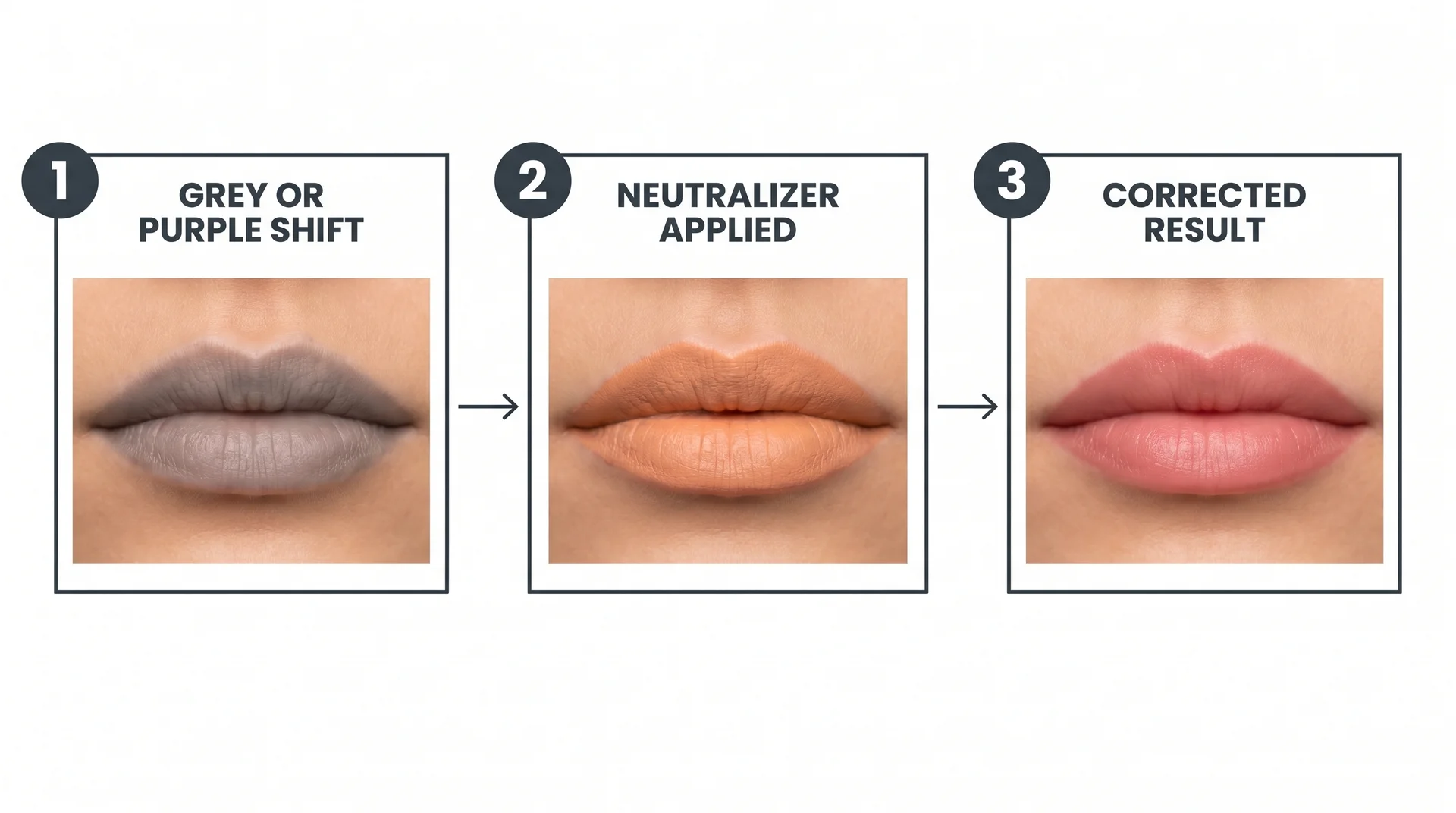
If your lip blush has shifted to grey, purple, or an ashy tone, a standard refresh with your original color won’t fix it. Adding pink over grey tends to produce a muddy, unpredictable result.
What you need first is a neutralizing step, where a warm-toned pigment, typically a peach or orange base, is used to counteract the cool shift before any new color goes on top.
Color correction is a specialized skill. It requires an artist who understands pigment theory and has specific experience with faded or shifted cosmetic tattoos. Book a consultation before committing to any treatment, not a treatment directly.
In more significant cases, laser removal is sometimes discussed.
One important consideration: laser treatment on cosmetic lip pigment carries a specific risk called paradoxical darkening, where the laser transforms certain pigment compounds, particularly iron oxides and titanium dioxide, into darker or greyer tones rather than breaking them down.
Experienced practitioners know to perform a small test patch first. Any provider worth seeing will explain this risk to you upfront without needing to be asked.
Questions to Ask Your PMU Artist Before Any 3-Year Treatment
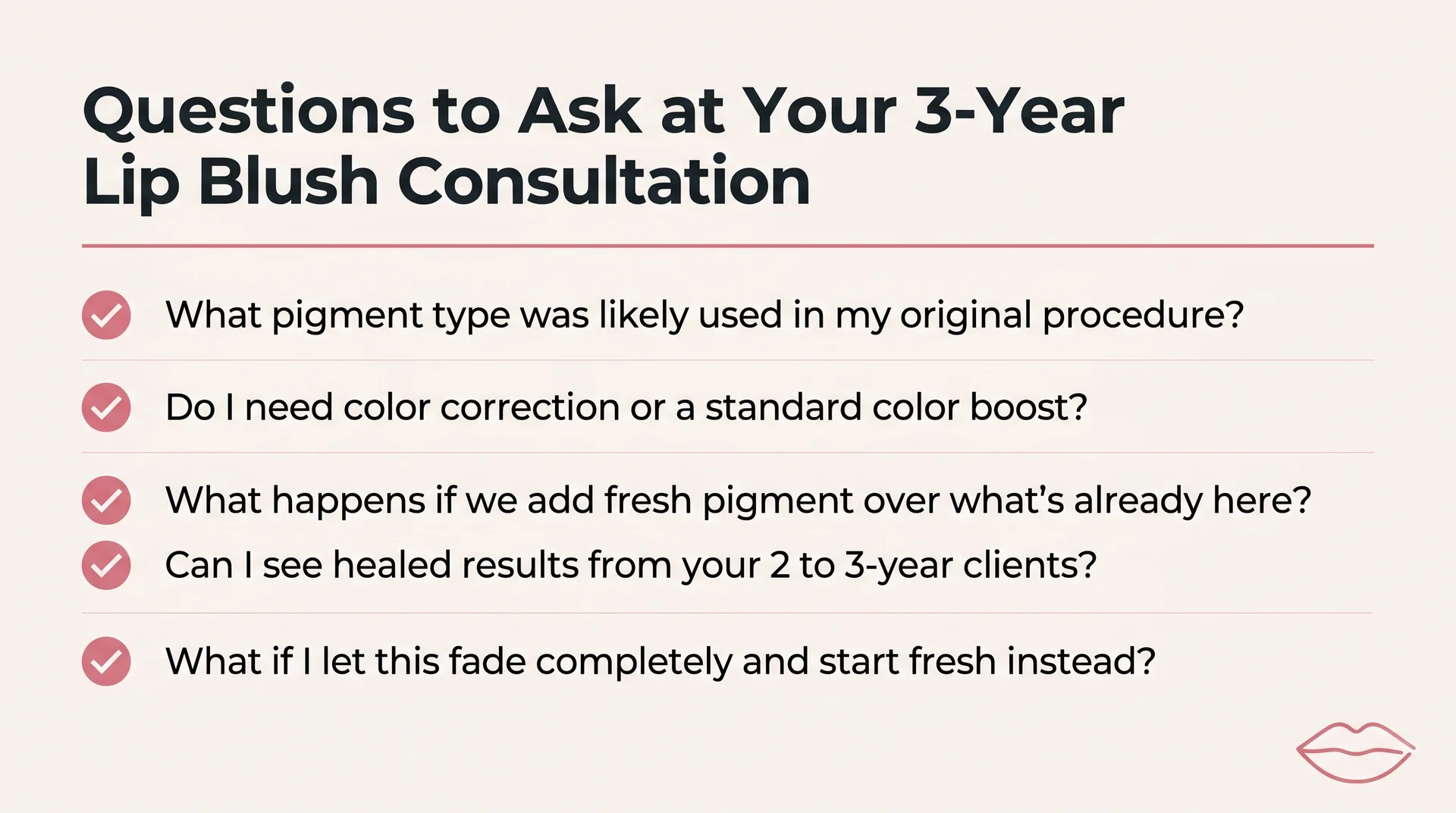
Walking into a consultation with the right questions makes a meaningful difference in the outcome. Here are the ones I’d ask:
- “Can you identify what pigment type was likely used in my original procedure?” This helps the artist determine whether a neutralizer is needed before a refresh.
- “Based on what you see, do I need a color correction or a standard color boost?” These are two different procedures with different price points and healing timelines.
- “What happens if we just add more of my original color over what’s here?” A good artist will tell you honestly whether that produces a predictable result or a muddy one.
- “Can I see healed results from clients at the 2 to 3-year stage?” Fresh application photos are not useful for assessing long-term quality.
- “What will the color look like if I let this fade further and then start fresh?” A clean slate is sometimes the better long-term move.
How to Care for Your Lip Blush Right Now at the 3-Year Mark
Your Year-3 Lip Care Routine
The biggest enemy of lip blush pigment at any stage is UV exposure. Use a lip balm with at least SPF 30 every morning and reapply if you’re spending time outdoors. Sunlight breaks down pigment molecules faster than almost anything else.
Moisture is the second priority. A thick lip balm or ointment at night maintains the lip membrane and keeps the remaining pigment stable. If you use retinol, acids, or other active ingredients in your skincare, apply balm to your lips before those products go on.
Actives that migrate into the lip zone can accelerate fading and irritate the tissue in ways that complicate future treatments.
If you’re curious about which ingredients in your current routine might be affecting your skin’s barrier, our guide to choosing the best Korean toners covers how to read ingredient lists for AHAs, BHAs, and retinoids, so you know what to keep away from your lips.
Things to avoid at this stage:
- Harsh lip scrubs or physical exfoliants
- Glycolic, lactic, or salicylic acid in products that contact the lips directly
- Prolonged swimming in chlorinated pools
- Picking at any areas where pigment looks patchy or flaking
One Important Health Check Before You Book Any Refresh
If you’ve ever had a cold sore or oral herpes, tell your PMU artist before booking. Any needle-based procedure on the lips, including a refresh or color correction, can trigger an outbreak.
Most reputable artists will recommend you speak with your physician about an antiviral prescription, typically valacyclovir, taken a few days before and after the procedure.
This isn’t a reason to avoid the treatment. It’s simply something to plan for in advance, and any experienced artist will bring it up in your consultation anyway. If they don’t, raise it yourself.
What Not to Do While You’re Still Deciding
One thing I hear from clients is that they panicked when they noticed the 3-year shift and booked an appointment before they really understood what was happening. Give yourself a few weeks to observe your lips in different lights, with and without makeup, before you commit to any treatment.
Don’t experiment with DIY fixes in the meantime. Lemon juice, home acids, and abrasive scrubs don’t correct pigment problems. They irritate the tissue, which can make a future professional treatment more complicated and, in some cases, more expensive.
How to Make Faded Lip Blush Look Beautiful with Makeup Right Now
Faded lip blush is actually one of the better makeup canvases I work with. The residual pigment adds a built-in warmth and slight definition that responds beautifully to a sheer product on top.
A glossy tinted balm in a warm nude or soft berry shade placed over that residual color creates a result that looks more natural than lipstick applied to completely bare lips, because the underlying tint prevents the product from sitting flat or looking opaque.
If you’re dealing with the border-darker-than-center issue, a nude lip liner blended inward from the border softens the ring effect before you apply anything else on top.
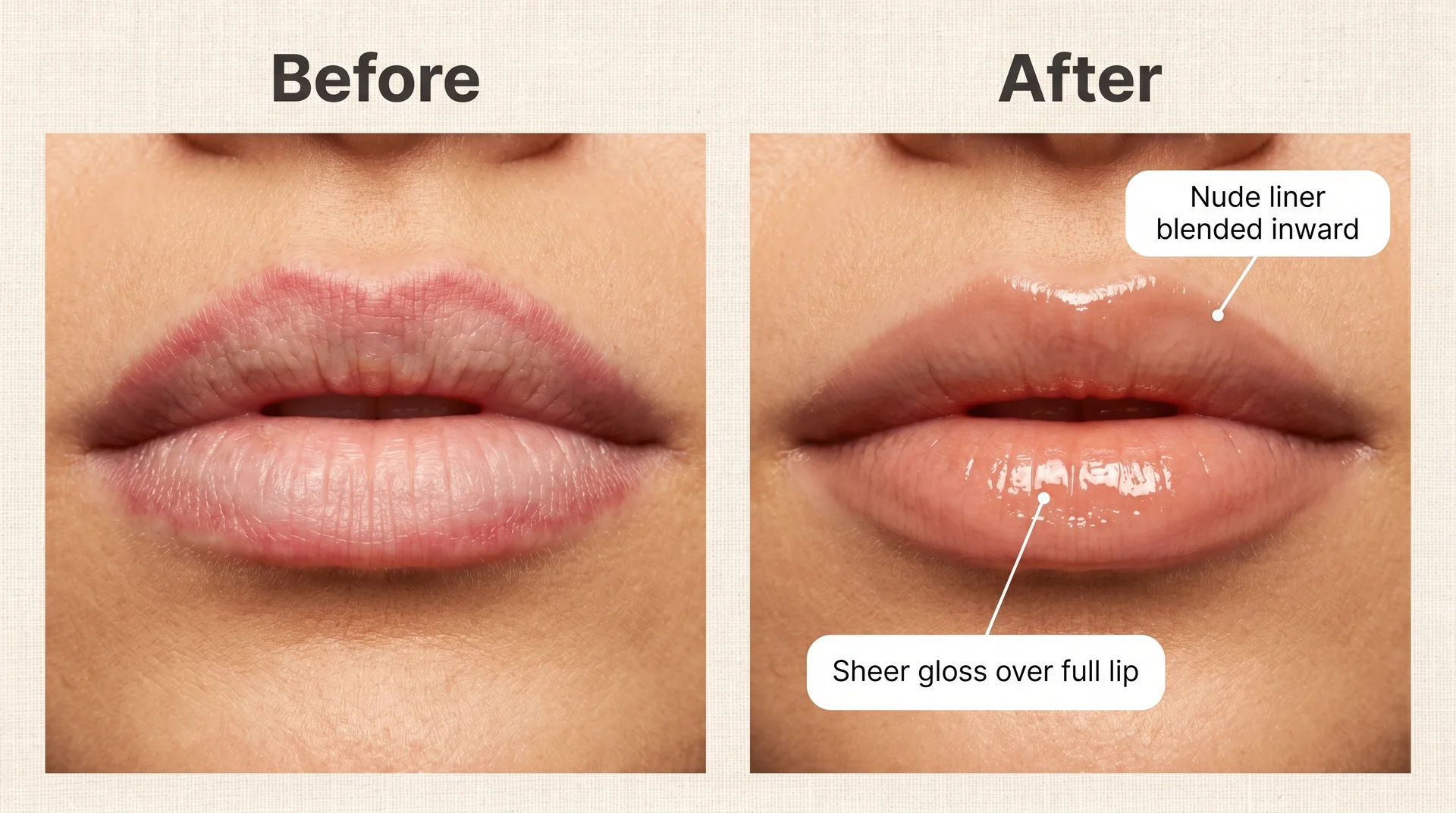
For clients who want more coverage, a sheer lipstick over a nude liner base gives enough color to feel polished without fighting the faded pigment underneath. This kind of layering works with the aging, not against it.
If you haven’t already thought through your full getting-ready routine and how lip prep fits into it, our guide to whether to do hair or makeup first is worth a read, particularly for anyone managing lip color alongside a full beauty routine before an event.
Frequently Asked Questions
Is It Normal for Lip Blush to Look Grey or Purple After 3 Years?
Yes, and it’s one of the most common concerns at this stage. The warm pigment molecules fade faster than the cooler, more stable compounds in the formula. Titanium dioxide, used to create lighter or pastel colors, can oxidize over time and leave a grey or cool undertone behind. This isn’t a sign of a bad procedure. It’s a known characteristic of how certain pigment types age in the skin, and a color correction treatment addresses it effectively.
Can I Get a Touch-Up After 3 Years, or Has It Been Too Long?
Three years is within the ideal window for a refresh, and you haven’t waited too long. In some ways, 3 years is a cleaner canvas than 1 year because more of the original saturation has faded, giving your artist more flexibility. The process is straightforward for most clients, and the healing timeline is similar to your original experience.
How Much Does a 3-Year Lip Blush Refresh Cost?
A standard color boost at 3 years typically runs between $150 and $350 in the US, compared to the initial procedure cost of $400 to $800 or more. Color corrections, which require a neutralizing step before the new pigment is applied, are priced higher. Always confirm what’s included during your consultation. In higher-cost markets like New York, Los Angeles, or Miami, these figures lean toward the upper end of the range.
Will My Lip Blush Fully Disappear If I Skip the Touch-Up?
Most lip blush pigment fades to a cosmetically negligible level within 3 to 5 years without any touch-up. In some cases, a very faint residue along the border can persist slightly longer. This is usually too subtle to be a concern, but if it is, a specialist can advise on whether any simple intervention makes sense for your specific situation.
Do I Need Color Correction or a Standard Refresh?
If your lips have faded to a lighter, softer version of the original color and the tone still reads as warm or neutral, a standard refresh will likely do exactly what you need. If the color has shifted to grey, purple, ashy, or muddy, you need color correction before a refresh. Adding pink or coral over a grey base produces an unpredictable result. A good practitioner will assess this clearly during your consultation.
Can I Completely Change My Lip Blush Color at 3 Years?
Yes, with the right artist and the right approach. The more faded your original pigment, the more flexibility exists for a color shift. A full color change requires an artist who understands how residual pigment interacts with new color. In some cases, a neutralizing step is needed first. Book a consultation before the treatment, not the treatment directly, so you can discuss what’s realistic for your specific lips.
Is It Safe to Keep Getting Refreshes Every Few Years?
Yes, as long as each refresh is performed by a skilled artist who adjusts for the pigment already present in your lips. The risk isn’t in refreshing, it’s in layering heavy pigment loads on top of existing saturation without accounting for what’s already there. At 3 years with significant fading, most clients are working with a light enough base that a refresh is entirely safe and straightforward.
Before You Book Anything
Before you pick up the phone, spend a few days just noticing. Look at your lips in natural light with no makeup on, and notice how you feel. Then add a sheer lipstick and notice how that changes things. The gap between those two feelings is your clearest guide to what kind of treatment, if any, is actually right for you right now.
Whatever you decide, make sure the person doing it has seen this stage before. The 3-year lip blush client is a specific kind of consultation. Experience with this crossroads makes a real difference in the outcome.
If you’ve ever been through a semi-permanent treatment and wondered what to expect years down the line, our piece on thread brow lift results and long-term expectations covers similar territory for brows, and many of the same pigment and longevity questions apply.
Your lips aren’t broken. They’ve simply arrived at a place where you get to choose what comes next. That’s worth approaching with curiosity rather than urgency, because the decision you make from a clear, informed place will always serve you better than the one you make in front of the bathroom mirror on a bad morning.