
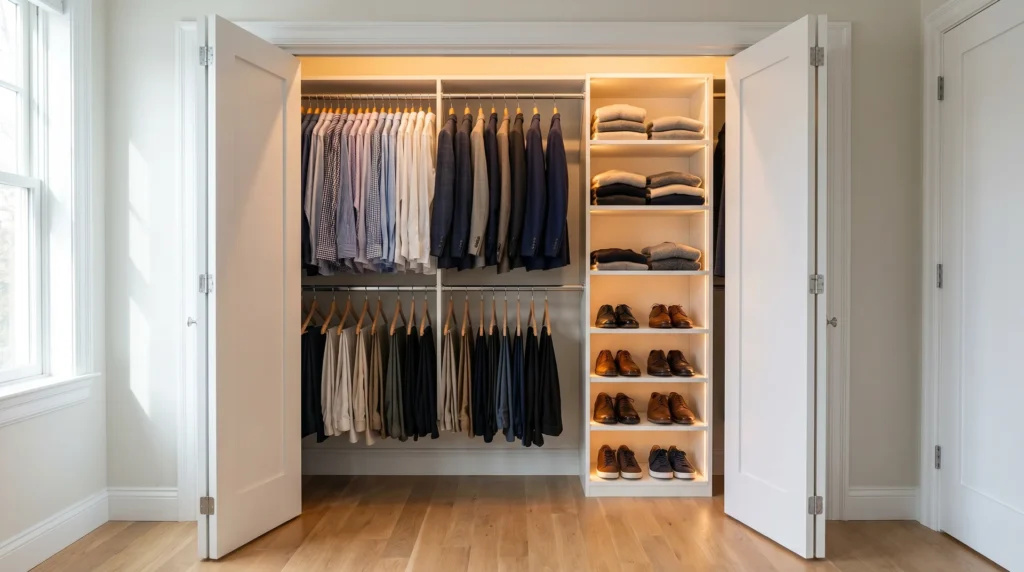
You open the door and stand there for a second. The coat is bunched against the wall. Shoes have crept to the floor because there’s nowhere else for them.
You’ve had this closet for years, and it still doesn’t work, and somewhere in the back of your mind, you’ve started wondering whether the problem is the closet itself or just the way you’re using it.
That question is a better one than “What are the standard dimensions?” Because the numbers alone won’t tell you much without the context behind them.
The standard reach-in closet is 24 inches deep, 36 to 96 inches wide, and 84 to 96 inches tall. That’s the direct answer, and you deserve to have it early. But those numbers are a starting point, not a verdict.
Over a decade working in residential design, including years as a design consultant at a regional furniture retailer and later as an independent interior styling advisor, I’ve measured closets that hit every standard dimension and still failed the people using them.
This piece covers both. You’ll get every relevant number and its real-world translation, for real wardrobes, in real bedrooms.
| Dimension | Standard Range | Notes |
|---|---|---|
| Depth | 24 inches | Minimum comfortable for standard hangers |
| Width | 36 to 96 inches | Most bedroom reach-ins are 60 to 72 inches |
| Height | 84 to 96 inches | Aligns with standard 8-foot ceiling |
| Single rod height | 60 to 66 inches from the floor | Shirts, blazers, mid-length dresses |
| Double rod, upper | 78 to 80 inches from the floor | Short-hang items: shirts, blouses |
| Double rod, lower | 40 to 42 inches from the floor | Folded pants, skirts, shorter pieces |
| Top shelf | 80 to 84 inches from the floor | Limit depth to 11 to 12 inches |
| Bottom shelf clearance | 16 inches from the floor | Room for tall boots and floor bins |
| Rod distance from the back wall | 12 to 14 inches | Keeps hangers centered, clothes free |
Reach-In Closet Depth: The Measurement That Makes or Breaks It
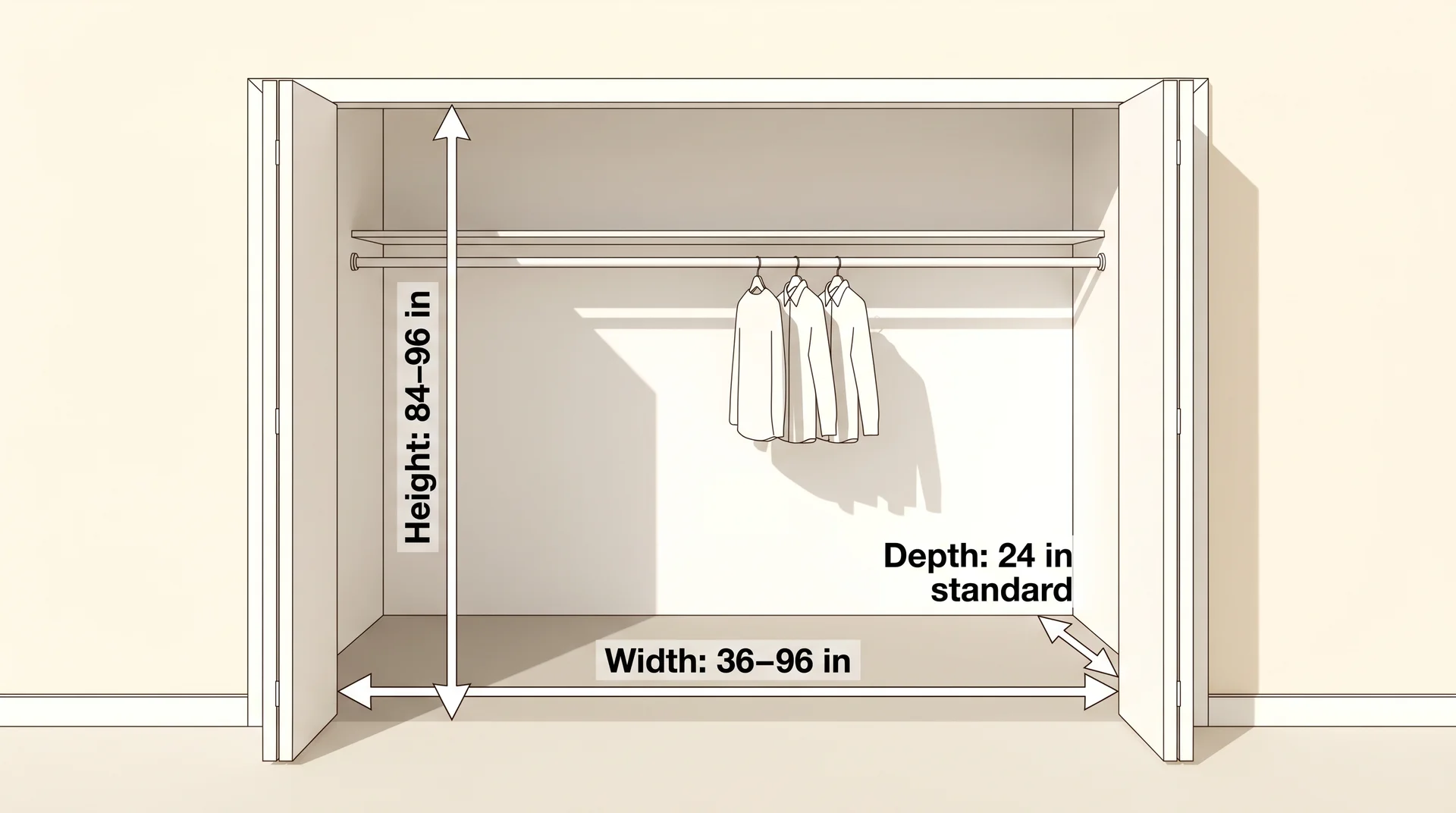
Depth is the single most consequential reach-in dimension, and it’s usually the one you can’t change, because it was set by the wall framing when the house was built.
A standard hanger is 17 to 18 inches wide. Add a garment, and you’re looking at roughly 20 inches from the back wall to the front of the clothing. The 24-inch standard gives clothes 4 inches of breathing room, keeping them from pressing against the back wall and from catching on the door trim when you reach in.
At 22 inches: Standard hangers still work, but the margin is thin. Sliding doors become more problematic here because the door track can eat into usable depth. Bulkier coats will brush the back wall. Most wardrobes can manage.
At 20 inches: You’re in tight territory. Switching to slim velvet hangers helps considerably. For anything below 20 inches, a shelf-only layout often serves better than forcing a hanging system into a space that was never sized for one.
At 28 to 30 inches: Worth considering if you’re building new and your wardrobe runs toward structured blazers, winter coats, or wide-shouldered garments. The extra depth also creates room for built-in floor drawers without blocking hanging access above them.
Going deeper than 30 inches in a reach-in is almost never worth it. Items pushed to the back become hard to see and retrieve, and you lose the closet’s primary advantage: fast, frictionless access to everything in it.
How to Measure Your Reach-In Closet Before Buying or Building
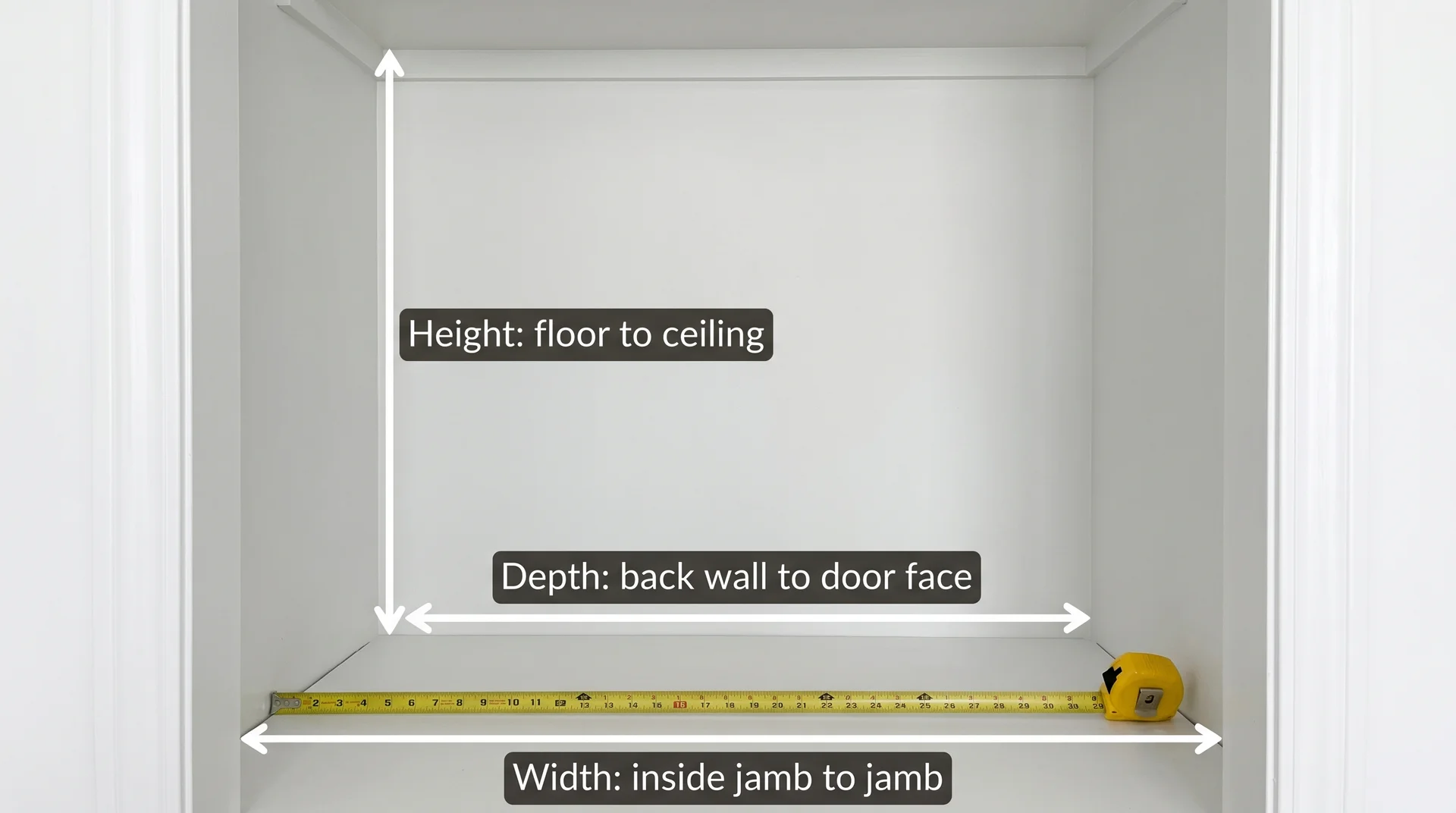
This step is where most planning mistakes start, and it takes about five minutes to get right.
Measure the width from inside jamb to inside jamb. Note any return walls, the short side walls just inside a sliding door track, because these steal usable hanging width and often trip up modular system planning.
Measure depth from the back wall to the inside face of the door or track, not to the trim. If you have a sliding door with a track inside the opening, subtract the track width from your usable depth.
Measure height from the floor to the ceiling or soffit.
Photograph the interior while you’re at it. If you’re planning a double-rod system or a tower unit, note where the light fixture sits. Any upper shelf configuration should clear the light by at least 6 inches to stay within safe clearance guidelines for enclosed fixtures.
Standard Reach-In Closet Width: Where Storage Capacity Lives
Width is where your actual storage comes from. Extending width delivers far more return than extending depth, because more width means more rod length, more shelf surface, and more room to organize by clothing category.
36 to 48 inches (3 to 4 feet): The guest room or children’s closet tier. A 4-foot-wide closet with a double-rod setup gives you 8 linear feet of hanging capacity, which covers a modest everyday wardrobe for one person without an elaborate system.
60 to 72 inches (5 to 6 feet): The most common primary bedroom width for one person. With a double-rod section on one side and a shelving column on the other, this width holds a full wardrobe for someone with a moderate collection and leaves room to get dressed without feeling pressed.
84 to 96 inches (7 to 8 feet): The two-person threshold. Below 84 inches, two people sharing a reach-in will feel the squeeze. At this width, each person gets roughly 4 feet of hanging rod, which is the practical benchmark most closet designers use as a functional minimum per person.
Reach-In Closet Height and What It Allows
Most reach-in closets are built to 84 to 96 inches tall, matching the standard 8-foot ceiling. At 84 inches, you can fit a single rod with a top shelf comfortably. At 96 inches, you unlock a double-rod setup plus a top shelf, with space above the upper rod for seasonal bins.
If your closet ceiling sits below 84 inches, a double-rod layout becomes difficult, and a single rod flanked by shelf columns typically performs better than trying to crowd two rods into a space that can’t properly clear them. For ceilings above 9 feet, that extra height serves best as a dedicated seasonal shelf. A pull-down rod mechanism can make a higher rod genuinely usable instead of just technically present.
Why Your Reach-In Closet Feels Wrong Even When the Dimensions Are Standard
This is the section most guides skip, and it’s the most useful part for the majority of readers.
The default builder-grade setup, one rod and one shelf, uses roughly 30 percent of a closet’s total cubic volume. The zone above the rod becomes dead space. The zone below the rod, a wide-open cavity roughly 5 feet tall, becomes a floor pile. The system practically encourages disorder.
If you’ve already confirmed your closet is 24 inches deep and 6 feet wide, and it still fails you every morning, the dimensions aren’t your problem.
The Single-Rod Problem in Standard Reach-In Closets
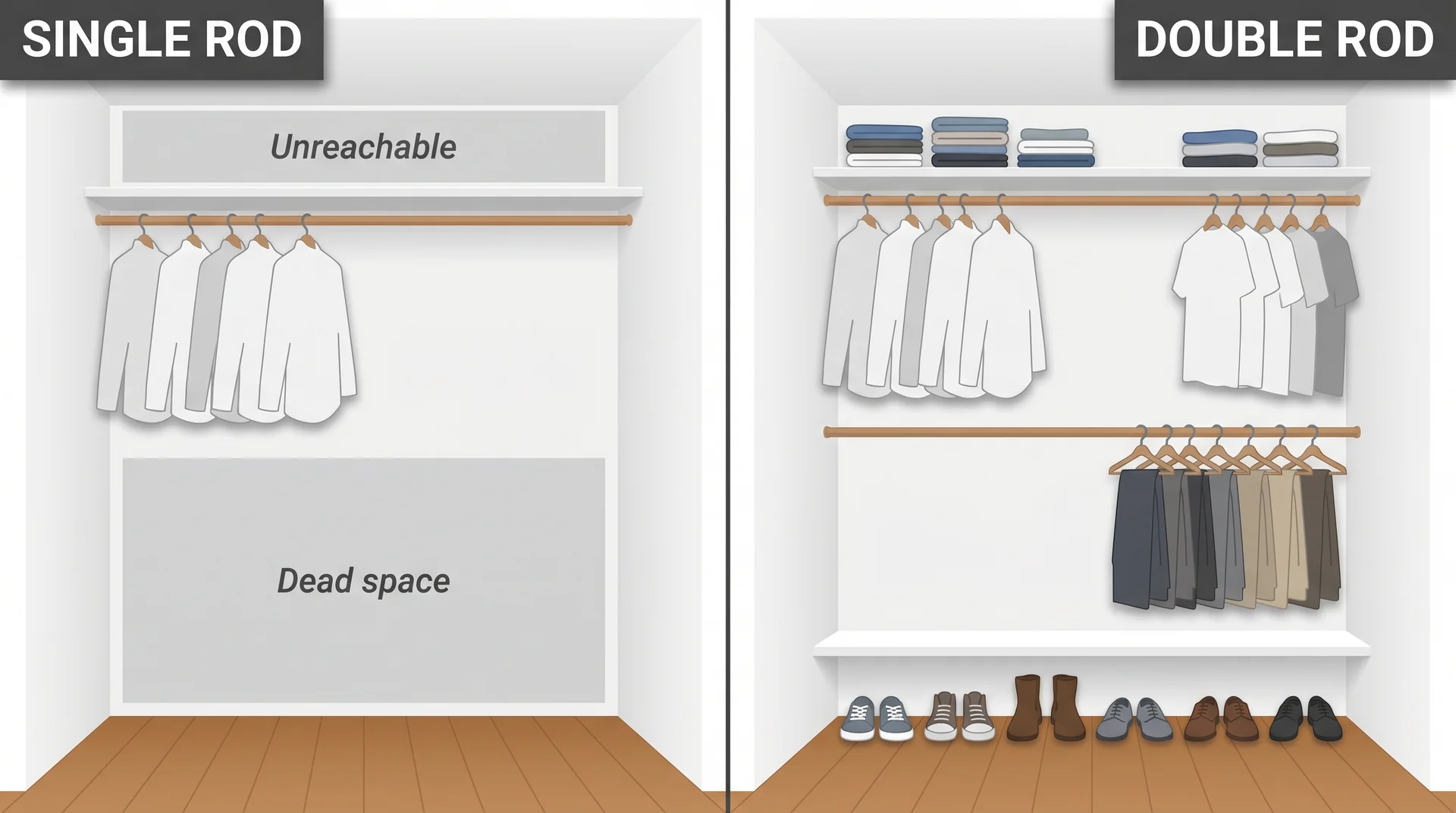
A single rod at 60 inches leaves a 5-foot cavity below it and another zone above the top shelf that’s too high for daily use.
A double-rod configuration within that same footprint immediately doubles hanging capacity and eliminates the dead zone below. It’s the single highest-return upgrade you can make to a reach-in closet without touching a wall.
How Door Type Affects Your Usable Reach-In Closet Dimensions
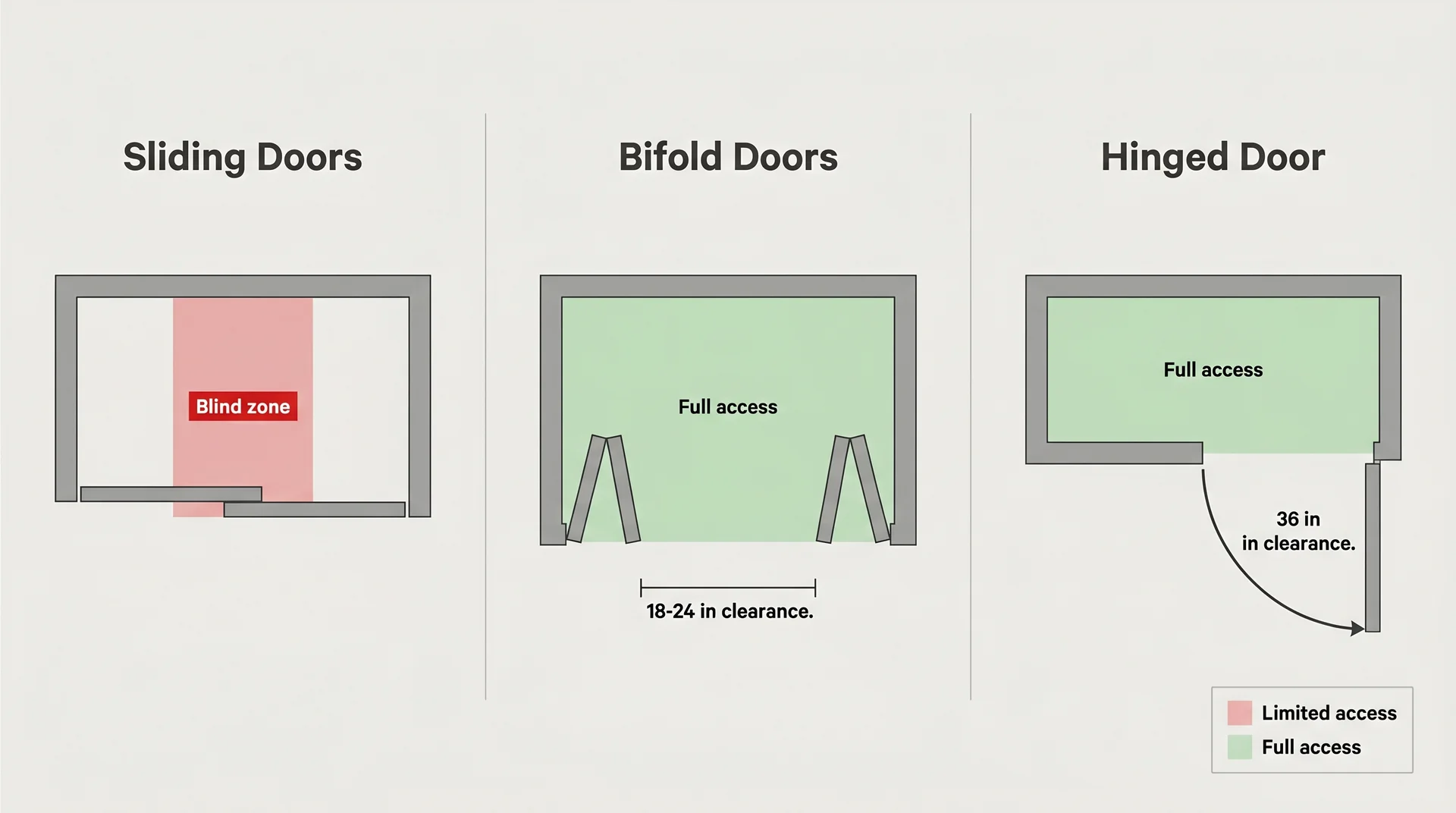
The door configuration changes how much of your closet you can actually reach, and it’s consistently overlooked in planning.
Sliding or bypass doors give you access to only half the opening at a time. Anything centered behind the overlap point between the two panels is consistently hard to reach. If you have sliding doors, place everyday items toward the sides where each panel opens, and reserve the center space for less-accessed seasonal pieces.
Bifold doors expose most of the opening in one motion, but they need 18 to 24 inches of clear floor space directly in front of the closet to swing open properly.
Hinged swing-out doors give the best full access. They expose the entire opening without creating blind zones, but they require 24 to 36 inches of clear floor space in front.
Pocket doors are the cleanest option for access and are worth considering in a renovation, though they’re not a retrofit fix.
If your bathroom is part of the same project, the same door-type thinking applies directly.
Our guide to bathroom door dimensions and which style fits your layout covers how pocket, hinged, and sliding doors each change what’s possible in a bathroom entry.
Closet Rod Heights and Shelf Spacing: The Interior Dimensions That Run Your Morning
The overall size tells you what’s possible. The rod heights and shelf spacing determine whether the closet is genuinely pleasant to use or quietly miserable every single day.
Single-Rod Closet Dimensions
A single rod at 60 to 66 inches from the floor suits most adults between 5’4″ and 5’10”. Shirts, blouses, blazers, and folded pants all hang with clearance from the floor at this height. For shorter users, dropping the rod to 58 to 60 inches makes a noticeable difference in how easily garments come on and off without reaching. For coat closets, set the rod at 66 to 70 inches to give full-length coats enough floor clearance.
Double-Rod Reach-In Closet Dimensions
Place the upper rod at 78 to 80 inches and the lower rod at 40 to 42 inches, keeping at least 38 inches of clearance between them. This gives shirts on the upper rod room to hang freely and lets you lift garments off the lower rod without catching on the one above.
Use the upper rod for short-hang items: shirts, blouses, blazers, and dress pants folded over a hanger. Use the lower rod for pants hung at the cuff, skirts, and shorter dresses.
A useful sizing rule: allow 4 feet of rod length per person. At roughly 2.5 inches of rod space per garment, 4 feet holds around 20 hanging pieces with comfortable spacing between them. If your wardrobe runs heavier, add rod length before adding an organizer system.
Shelf Spacing Inside a Reach-In Closet
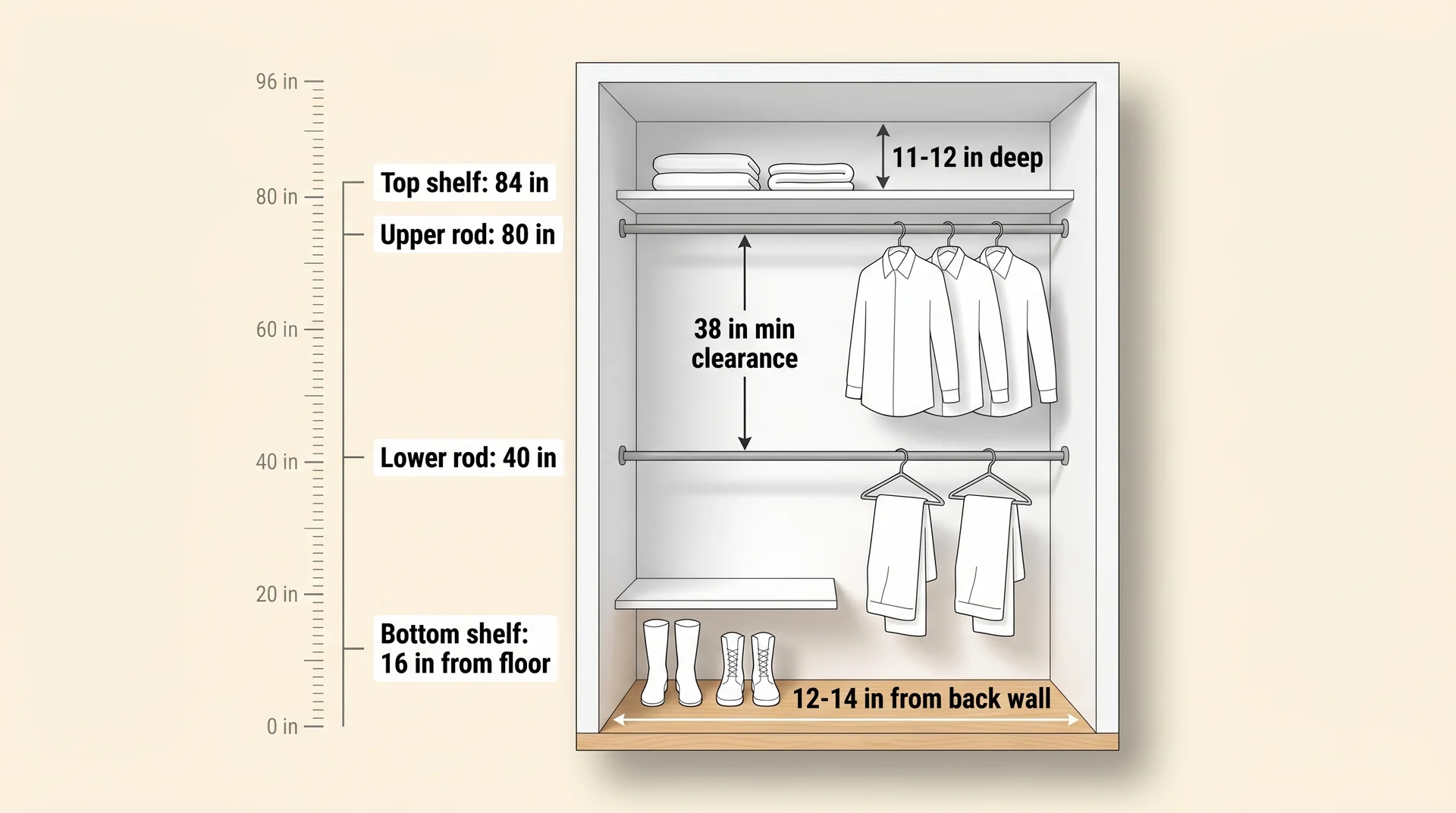
Match shelf spacing to what you’re storing rather than defaulting to a uniform gap across every level:
- Folded clothes (sweaters, jeans, T-shirts): 12 inches between shelves, minimum
- Flat shoes and low heels: 6 to 7 inches between shelves
- Boots: 10 to 12 inches between shelves
- Bags and storage bins: 24 inches between shelves
- Top shelf: set at 80 to 84 inches from the floor; limit depth to 11 to 12 inches so items remain reachable without a stool
- Bottom shelf: position 16 inches from the floor to allow tall boots to stand upright in the zone underneath
Keep your rod 12 to 14 inches from the back wall. At 12 inches, hangers sit centered and clothes hang freely. At 14 inches, you get a little more airflow around delicate or heavier fabrics, which matters in closets that stay warm.
Reach-In Closet Lighting
Dimensions solve the layout. Lighting determines whether you can actually see it. A single overhead bulb in a 6-foot reach-in creates shadows deep enough to lose things in regularly. LED strip lights mounted under the top shelf illuminate the full hanging zone without requiring any electrical work.
Motion-sensor puck lights are an easy retrofit for closets with no existing ceiling fixture.
If you’re painting the closet interior at the same time, flat and matte paint finishes hide surface imperfections more effectively than higher sheens in enclosed spaces, and a light neutral on the walls and ceiling makes the space feel more open under limited light.
Reach-In Closet Dimensions by Household Type and Room
Standard dimensions are a framework. The right configuration inside that framework depends entirely on who’s using the closet and what they’re storing in it.
Guest Room and Children’s Reach-In Closet (36 to 48 Inches Wide)
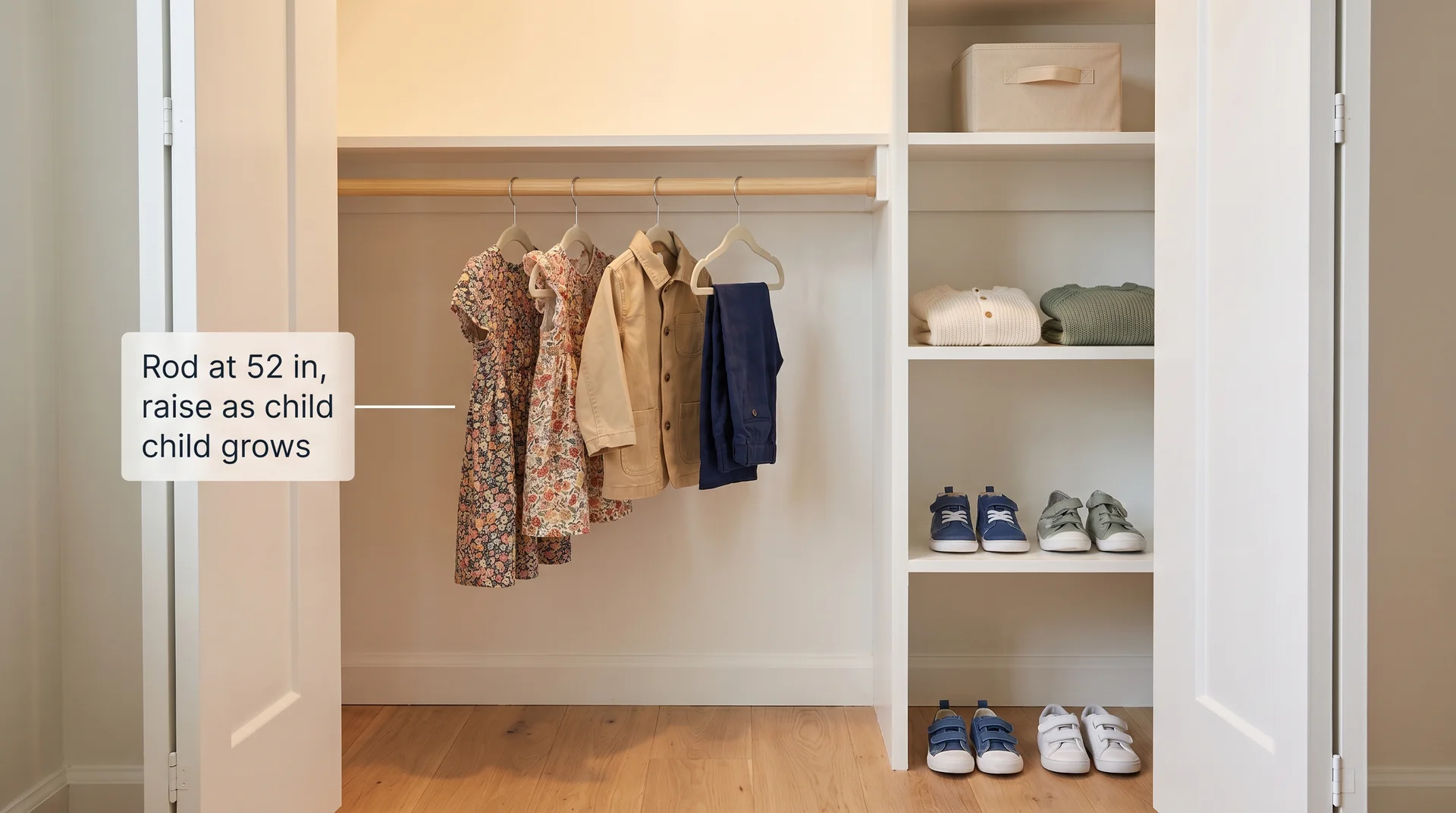
Simplicity serves this width better than complexity. A single hanging section with adjustable shelves to one side holds a guest’s travel wardrobe or a child’s everyday clothing without requiring an elaborate system.
For children’s closets, start the rod at 48 to 54 inches from the floor so they can reach their own clothes, then raise it as they grow. Adjustable shelving standards pay for themselves here; a fixed rod requires a contractor visit every time the child grows a few inches.
Single-Person Primary Bedroom Reach-In (60 to 72 Inches Wide)
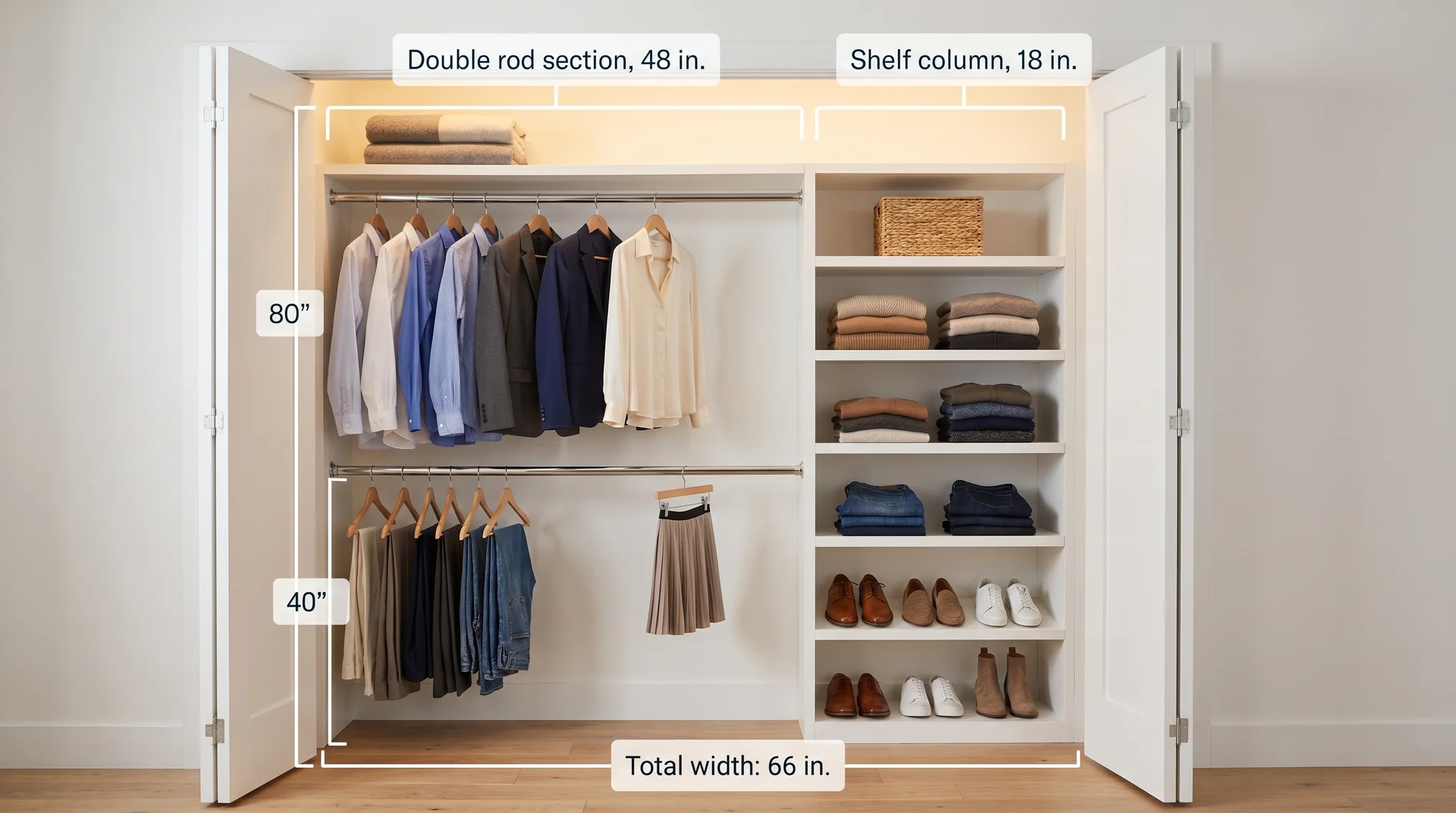
The layout that consistently performs best at this width: a double-rod section spanning 48 inches on one side and a vertical shelving column 12 to 18 inches wide on the other.
The column holds shoes at the bottom and folded items above, while the double-rod side handles the full hanging wardrobe. If you prefer drawers, a 12-inch-wide single tower stores underwear, socks, and accessories without competing with hanging space.
Shared Primary Bedroom Reach-In (84 to 96 Inches Wide)
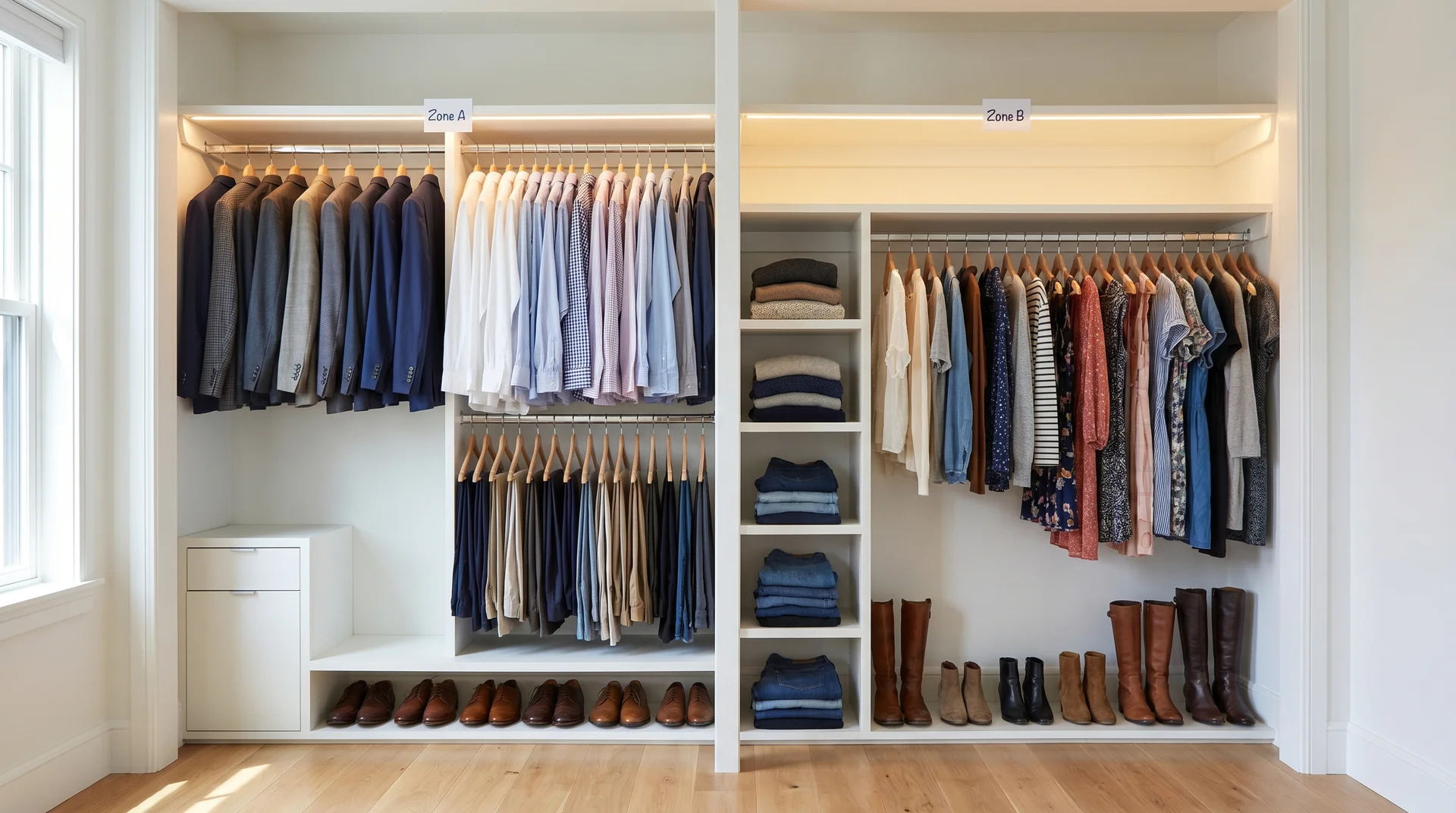
Two people sharing a reach-in closet is one of the most common household frustrations I hear about, and it’s fixable. Treat the closet as two separate zones rather than a shared mass. Divide the width by wardrobe size, assign each zone clear ownership, and resist the tendency to let overflow creep across the midpoint.
At 84 inches wide, each person gets 42 inches of hanging length, which is just under the 4-foot benchmark. That’s workable. At 96 inches, each person gets 48 inches, which comfortably holds a full wardrobe for someone with average clothing volume.
What to Do When Your Reach-In Closet Dimensions Fall Below Standard
Most people aren’t building new closets. They’re trying to make peace with the one they already have.
Closets Shallower Than 24 Inches
At 22 inches: Slim velvet hangers shave 2 to 3 inches off the profile of each hanging piece, and that margin matters in a closet this tight. Avoid shelf systems that protrude into the hanging zone; wall-mounted shelving keeps the depth working for you rather than against you.
At 20 inches: Think through what genuinely must hang versus what could fold. A well-organized shelf column takes up zero hanging depth. If you can limit the hanging section to only what truly needs it, a 20-inch closet can function for a limited wardrobe without constant frustration.
Below 20 inches: A shelf-only layout is almost always the better decision. Shallow cubbies for shoes, folded shelving for clothing, and hooks on the back wall for bags and accessories can make a very narrow niche genuinely useful.
Closets Narrower Than 36 Inches
Below 36 inches, a single rod with one shelf is about all the space practically allows. Below 30 inches wide, the closet functions better as a utility niche, a linen space, or a pantry than as a clothing closet. Supplementing with a freestanding armoire in the bedroom often beats retrofitting a space that simply can’t hold a full wardrobe.
Closets With Lower-Than-Standard Ceilings
Older homes sometimes have closet ceilings below 84 inches, occasionally as low as 7 feet. At this height, a single rod flanked by shelf columns typically performs better than crowding two rods into a space that can’t clear them properly. The ceiling isn’t the enemy; it just dictates the format.
Standard Reach-In Closet Dimensions for New Construction and Renovation
If you’re framing a new closet or directing a contractor on a renovation, these are the numbers to confirm before the walls go up.
Absolute minimum for a functional reach-in: 24 inches deep, 36 inches wide, 84 inches tall. This works, but it serves one person with a modest wardrobe and no room for error.
Recommended for a single-person primary bedroom: 24 inches deep, 60 to 72 inches wide, 96 inches tall. This gives you a full double-rod setup, a shelving column, and a top shelf for seasonal storage.
For two people: 24 inches deep, 84 to 96 inches wide, 96 inches tall. This is where a shared reach-in actually starts functioning without negotiation.
For door rough openings: the standard door height is 80 inches. For a hinged door, plan a 30 to 36-inch opening. For bifold configurations, the opening spans 48 to 72 inches, depending on panel count.
If you’re weighing a double hinged door for the opening instead of a bifold or bypass, the sizing logic is different anf that’s where my guide to standard closet double door widths covers exactly what to plan for before framing.
Leave at least 24 inches of floor clearance in front of a sliding door and 36 inches in front of a swing-out door. These clearances seem generous until you skip them and realize the door won’t fully open without moving furniture.
When Your Reach-In Closet Dimensions Call for a Custom System
The closet that works is rarely the biggest one in the house. It’s the one where every inch knows its job.
There’s a meaningful difference between a configuration problem and a footprint problem.
A configuration problem shows up as dead space: the cavity above hanging clothes, the floor pile under the rod, the shelf nobody reaches regularly. These are fixable with adjustable shelving, double rods, and better layout planning. The closet doesn’t need rebuilding.
A footprint problem looks different. If your closet is shallower than 20 inches and can’t be deepened, shared by two people in less than 72 inches of width, or has a return wall or angled ceiling that standard modular systems can’t accommodate, the issue is structural.
Semi-custom or fully custom systems designed around those specific constraints perform far better than off-the-shelf solutions in these situations.
For straight-run closets between 36 and 72 inches wide at standard depth, a quality modular DIY system installed carefully delivers excellent value.
Reach-in custom systems typically range from around $542 for a basic rod-and-shelf configuration to $1,765 for an 8-foot system with drawers and specialty accessories.
Small walk-in configurations start at approximately $3,645. If those numbers feel significant right now, start with a good modular system and upgrade selectively once you’ve lived with the layout for a season.
Frequently Asked Questions
What is the standard size of a reach-in closet?
<strong>The standard reach-in closet is 24 inches deep, 36 to 96 inches wide, and 84 to 96 inches tall.</strong> Most bedroom reach-ins fall between 60 and 72 inches wide, giving one person comfortable storage for both a hanging zone and a shelving section within the same footprint.
What is the minimum depth for a reach-in closet?
The minimum comfortable depth for a hanging closet is 24 inches. A 22-inch depth is workable with slim hangers and careful door placement. Anything below 20 inches deep functions better as a shelf-only space than a hanging closet.
How wide should a reach-in closet be for two people?
A two-person reach-in works best at 84 to 96 inches wide, giving each person roughly 42 to 48 inches of rod space. That aligns with the 4-feet-per-person benchmark most closet designers use as a functional starting point for a shared wardrobe.
What height should closet rods be in a reach-in closet?
For a single rod, 60 to 66 inches from the floor suits most adult wardrobes. For a double-rod system, place the upper rod at 78 to 80 inches and the lower rod at 40 to 42 inches, with at least 38 inches of clearance between them.
What is the ideal shelf depth for a reach-in closet?
Match depth to what you’re storing. Use 11 to 12 inches for a top shelf, 12 inches for folded clothing, 12 to 14 inches for shoes, and up to 16 inches for bags and bins. Shelves deeper than 12 inches on upper levels push items out of comfortable reach for most people and create the same dead-zone problem as a shelf that’s set too high.
Can a reach-in closet work at only 20 inches deep?
A 20-inch depth is functional but limiting, especially with sliding doors. Slim velvet hangers reduce hanger width enough to make a real difference. For closets this shallow, a shelf-heavy layout often outperforms a hanging-heavy one.
Why does my reach-in closet feel small even though it’s a standard size?
The most common reason is a single-rod builder configuration that leaves the top and bottom thirds of the closet as dead space. A double-rod setup, correctly spaced shelf heights, and a narrow shelving column transform how a standard-sized closet performs without changing its dimensions at all.
End Note
The dimensions give you the walls. What you do inside them determines whether the closet actually works. Whether you’re measuring an existing space, planning a renovation, or figuring out why a technically standard closet refuses to function, configuration always matters more than square footage.
Get the rod heights right, match the shelf spacing to what you actually own, and give every inch a specific purpose. A closet built that way outperforms one twice its size every single time.