A few years back, I was called out to look at a home where the owner had noticed something soft near the base of his exterior wall. He’d lived in that house for over a decade and never given the siding a second thought. When I pressed my thumb against the bottom edge of one of the panels, it gave way like wet cardboard.
That’s hardboard siding doing what hardboard siding eventually does.
If you’re reading this because a home inspector flagged something, or your exterior paint is peeling faster than it should, or you just bought a house built in the 1980s, and someone mentioned “pressboard” or “Masonite,” I want to get you to the answer quickly.
| Hardboard siding is an engineered wood product made from compressed wood fibers, resins, and wax. It was installed on millions of American homes between the late 1970s and mid-1990s, looked convincing when it went up, and carries one fundamental flaw: it absorbs moisture. Over time, that moisture causes swelling, warping, rot, and real structural damage. |
Whether you keep it, maintain it, or replace it depends on what condition it’s in right now. I’ll walk you through everything you need to know to make that call.
Do You Actually Have Hardboard Siding? How to Tell?
Everything else in this guide depends on whether you actually have this material. Let’s settle that before moving on.
What to Look For on the Outside
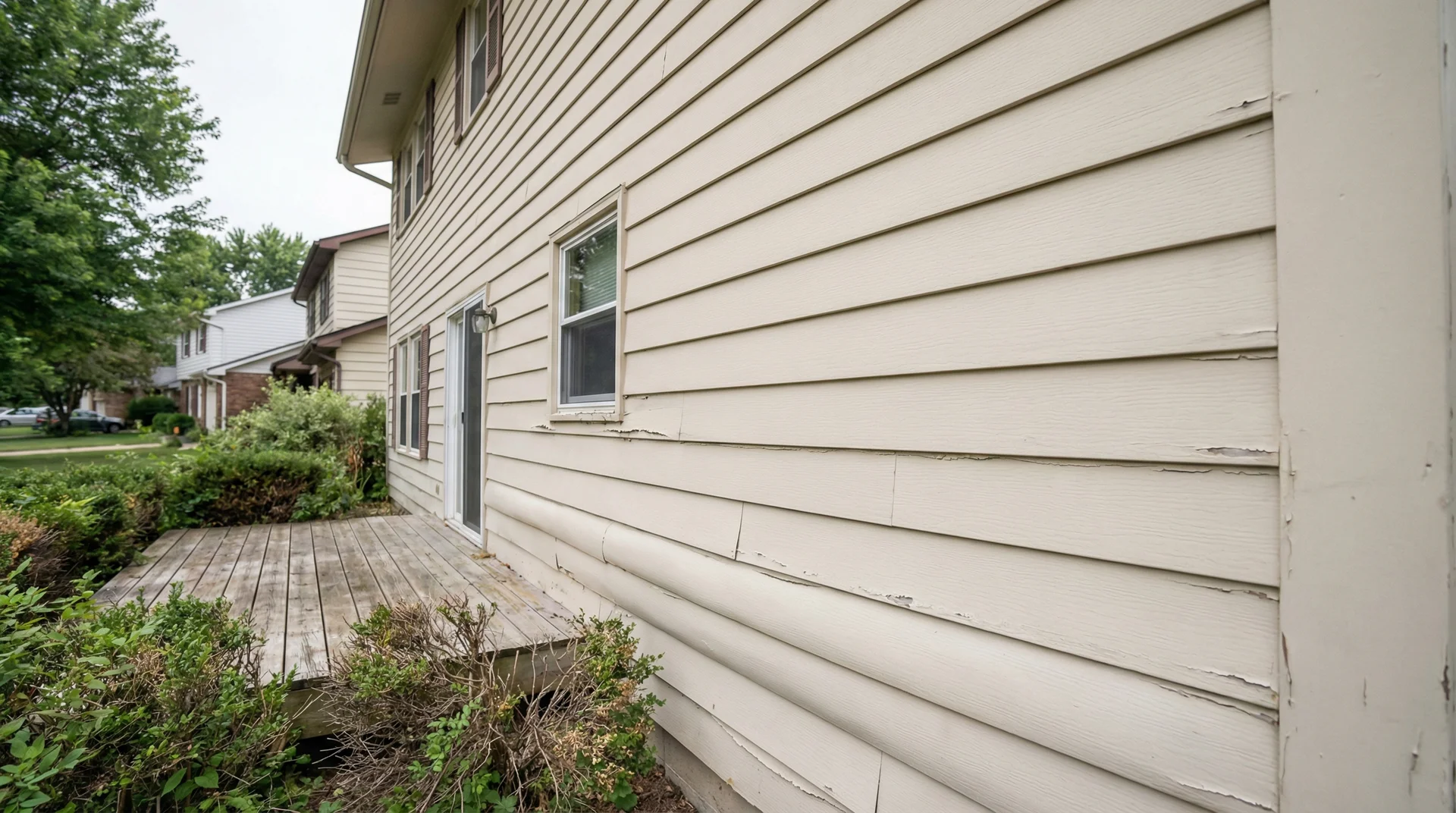
Walk the full perimeter and look closely at the siding panels. Hardboard typically runs in horizontal laps with a wood grain texture pressed into the surface. From ten feet away, it looks convincingly like painted wood. Up close, it feels lighter and slightly hollow compared to real timber.
Signs that point toward hardboard:
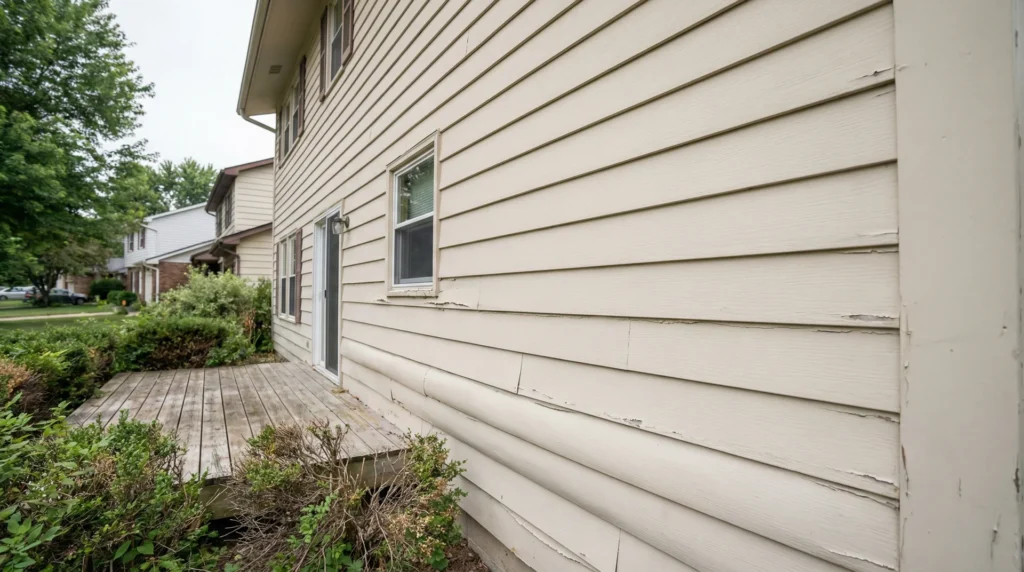
- Bottom edges of panels that look swollen or rounded, as though the board absorbed water and puffed out
- Paint peeling at seams or along the base of each course before peeling anywhere else
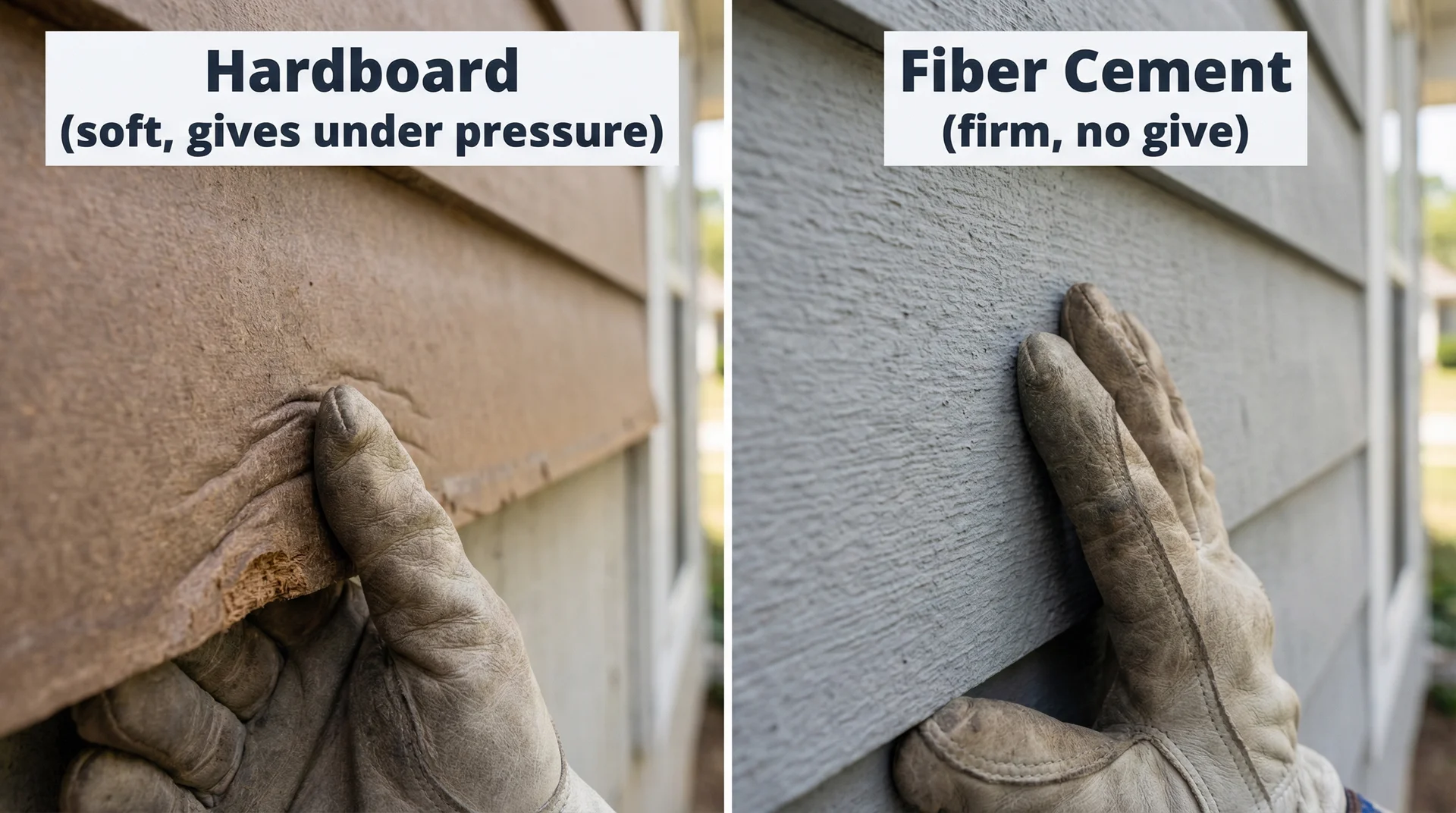
- Soft or spongy spots when you press firmly with your thumb
- Nail heads rusting or pulling forward through the surface
- Gaps are opening at seams between panels, especially near windows and doors
If two or more of those describe what you’re seeing, there’s a strong chance you’re looking at hardboard.
How to Confirm It From the Attic or an Unfinished Wall
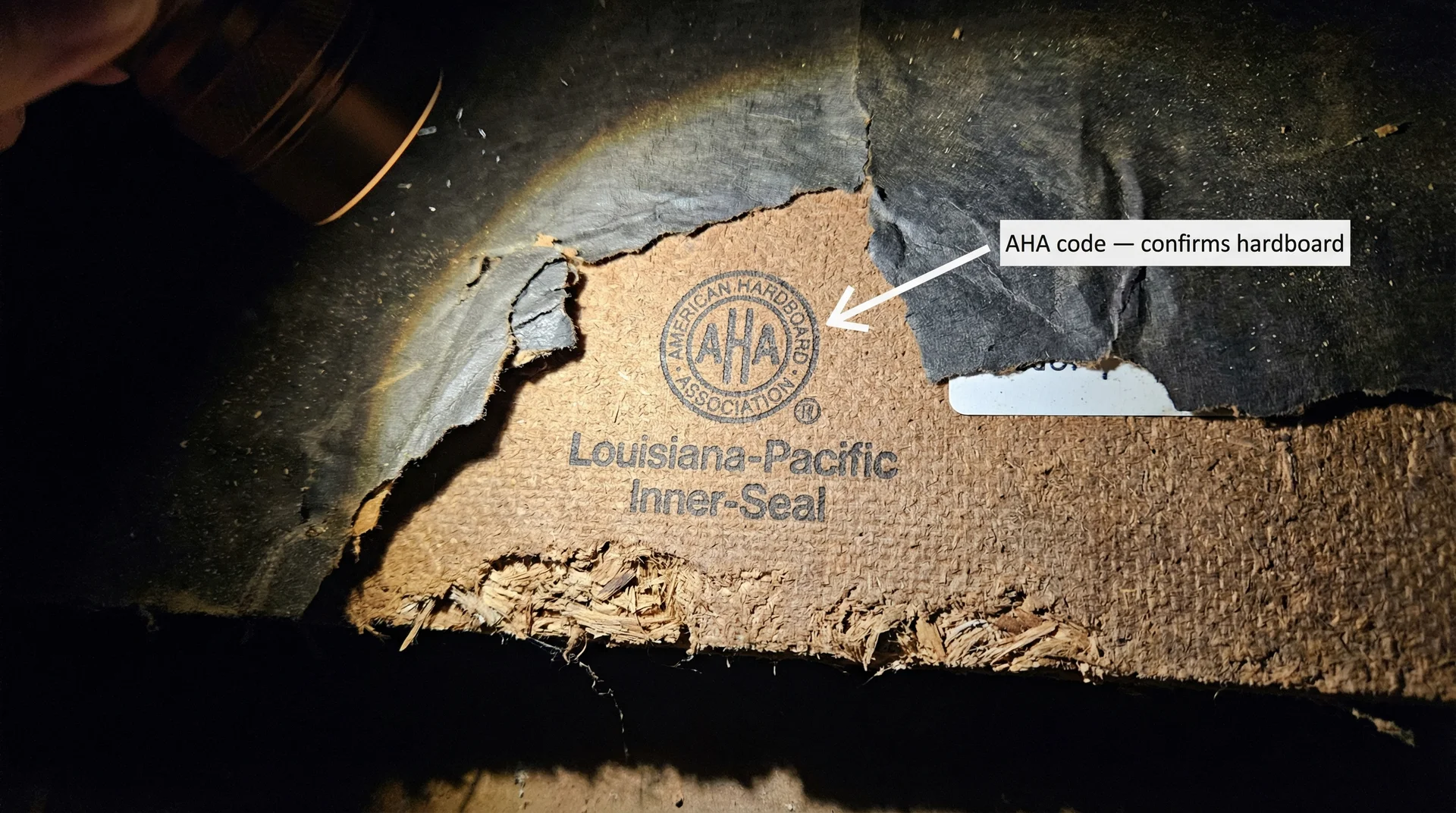
Go to an unfinished area, your attic or garage wall works well. Hardboard siding will typically show an AHA stamp on the panel back.
AHA stands for the American Hardboard Association, and that code was required on all certified products. Pull back the tar paper and look for the manufacturer’s name directly on the material.
Common names include Masonite (Omniwood), Louisiana-Pacific (LP Inner-Seal), Georgia Pacific, Weyerhaeuser, ABTiCO/Abitibi-Price, and Boise Cascade.
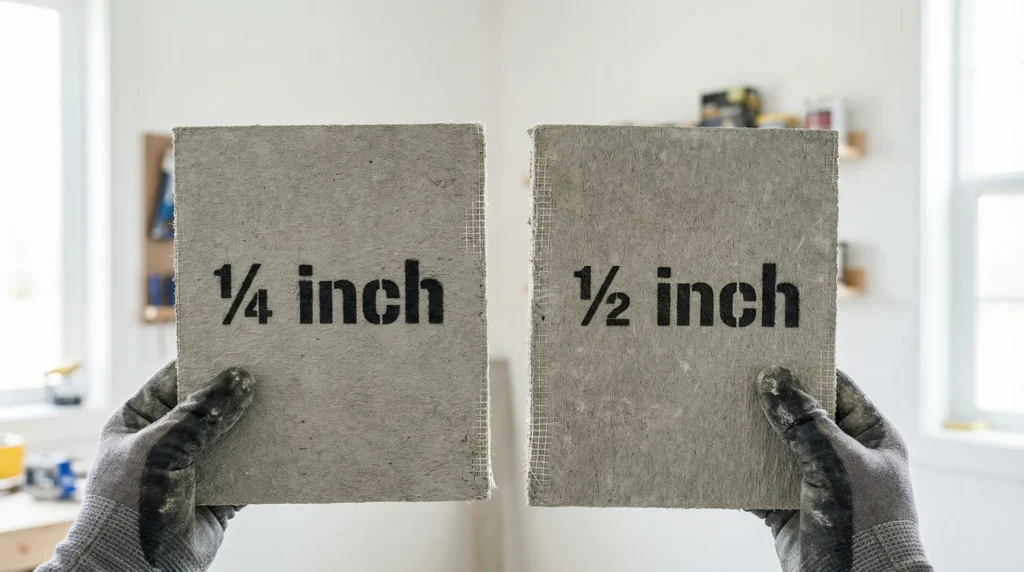
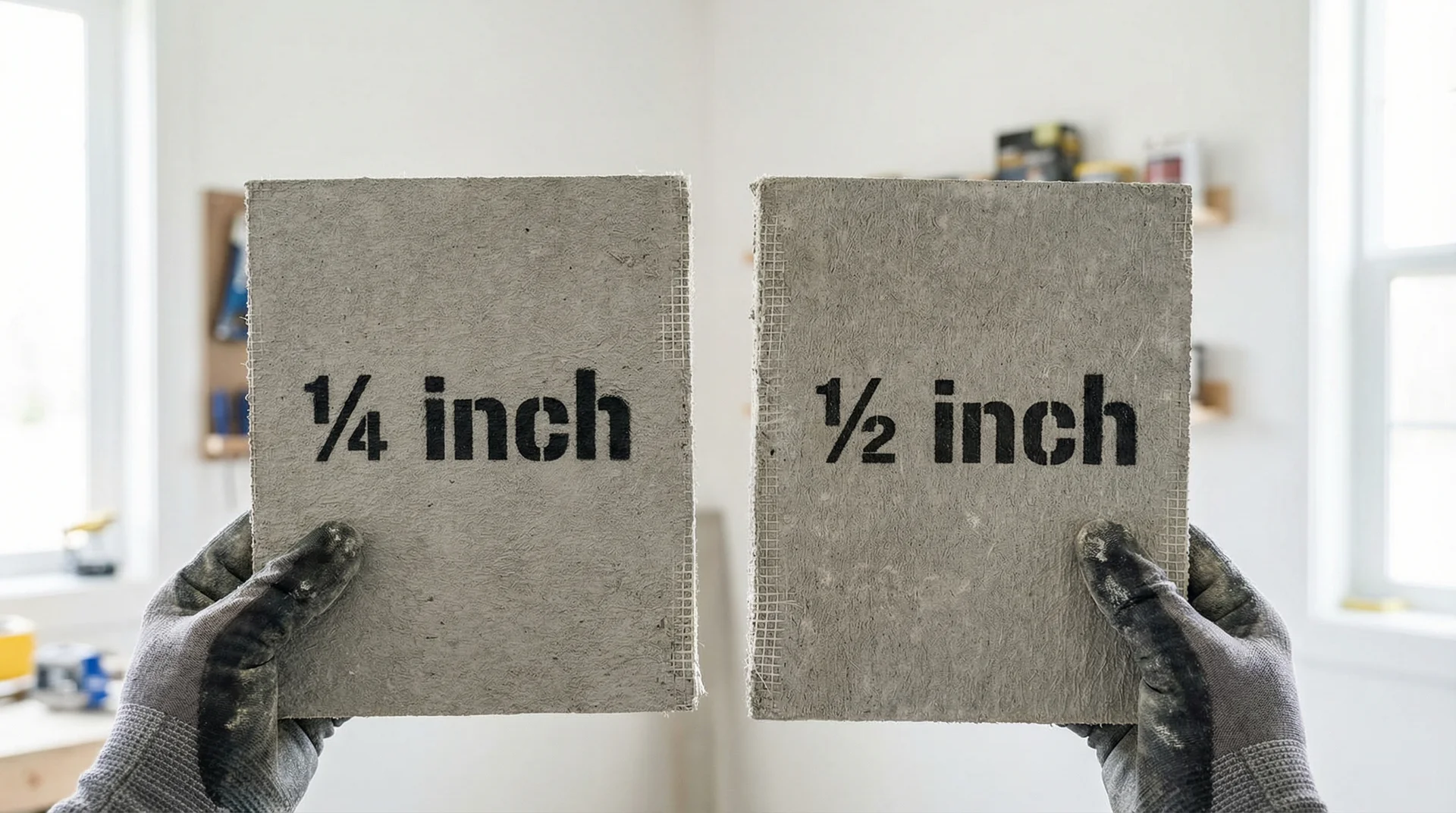
One more tell: look at the cut edges. Hardboard shows visible wood fiber and chip texture along any raw edge, almost like dense particleboard.
What Hardboard Gets Confused With Most Often
| Material | Looks Like | Key Difference |
|---|---|---|
| HardiePlank (fiber cement) | Very similar wood grain, horizontal laps | Heavier, more rigid, does not swell |
| Hardboard siding | Wood grain, horizontal laps | Lighter, absorbs moisture, pre-2000 homes |
| OSB / Plywood sheathing | Flat, layered | Goes behind the siding, not on it |
| T1-11 board siding | Vertical grooves | Thicker, common on barns and outbuildings |
| Vinyl siding | Uniform color, hollow sound | Plastic-based, much lighter |
The most consequential mix-up I see is homeowners confusing hardboard with HardiePlank. James Hardie fiber cement sounds similar, costs more upfront, and performs completely differently. If your home was built after 2000, it almost certainly isn’t hardboard. If it went up between 1978 and 1995, it very well could be.
When genuinely unsure, get a licensed exterior contractor to look before you make any decisions.
So What Is Hardboard Siding, Exactly?
Now that you’ve confirmed what you have, here’s the full picture of the material and why it landed on so many American homes.
How It’s Made
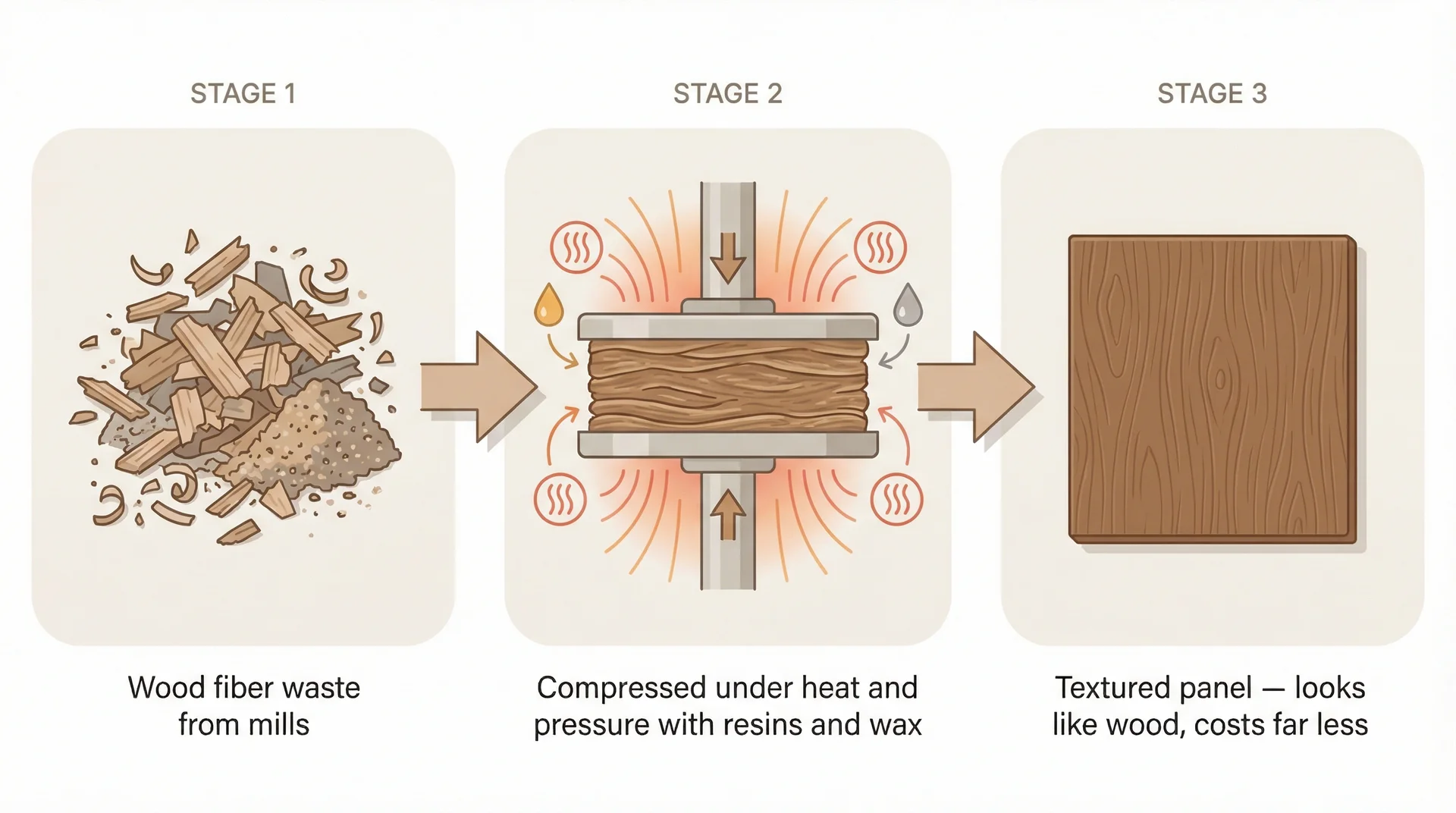
Hardboard starts as wood fiber sourced from waste wood, sawdust,and chips from mills. Manufacturers grind that material down, mix it with synthetic resins and wax, then compress everything under high heat and pressure until it forms a dense, uniform panel. The surface gets textured with molds that press wood grain patterns in before the panel cures.
Two main production styles existed:
Pressboard-style hardboard is processed wood combined with adhesives to form the composite panel.
Masonite-style hardboard involved steaming wood chips into fibrous pulp first, producing a smoother, more uniform board.
Both looked convincingly like painted wood and could be cut, nailed, and painted using standard carpentry tools. Think of hardboard like a very dense stack of paper: as long as the factory seal and paint stay perfect, it performs reasonably.
The moment that the seal breaks through a nail hole, a scratch, or the settling of the house, water finds its way in. Once water reaches the core, the fibers swell, and the glue holding everything together starts to fail.
As one experienced contractor put it plainly: when the glue fails, the board reverts to what it always was. Sawdust.
Why It Was Everywhere in the ’80s and ’90s
The timing of hardboard’s popularity matches the American housing boom almost exactly. Builders needed exterior cladding that looked like wood, installed fast, and stayed within budget.
William H. Mason had developed the core manufacturing process back in the 1920s, looking for a way to use waste coming out of his sawmill. By the time residential construction scaled up in the late 1970s, hardboard manufacturing had matured enough to meet that demand.
For builders working on tight schedules and tighter budgets, it checked every box: affordable, workable, versatile in textures, and convincing from the street.
For about fifteen years, it genuinely seemed like a smart product. The problems came later.
The Class-Action Lawsuit You Deserve to Know About
In 1994 and 1995, homeowners across the country filed class-action lawsuits against major manufacturers, including Masonite and Louisiana-Pacific. The settlements covered homes built with qualifying products between January 1, 1980, and January 15, 1998 (exact dates varied by manufacturer).
Those settlement windows are now permanently closed. If your siding is failing today, the cost of repair or replacement falls entirely on you. Following those lawsuits, almost every major manufacturer ceased production entirely, which creates a problem that persists today: you cannot order matching replacement boards.
Hardboard siding is no longer manufactured for exterior residential use. When sections fail, your only options are different materials with slightly different thicknesses and textures.
The Real Problems With Hardboard Siding
Here’s what I actually see in the field, because the technical explanation and the field reality are two different things.
Moisture Is at the Root of Everything
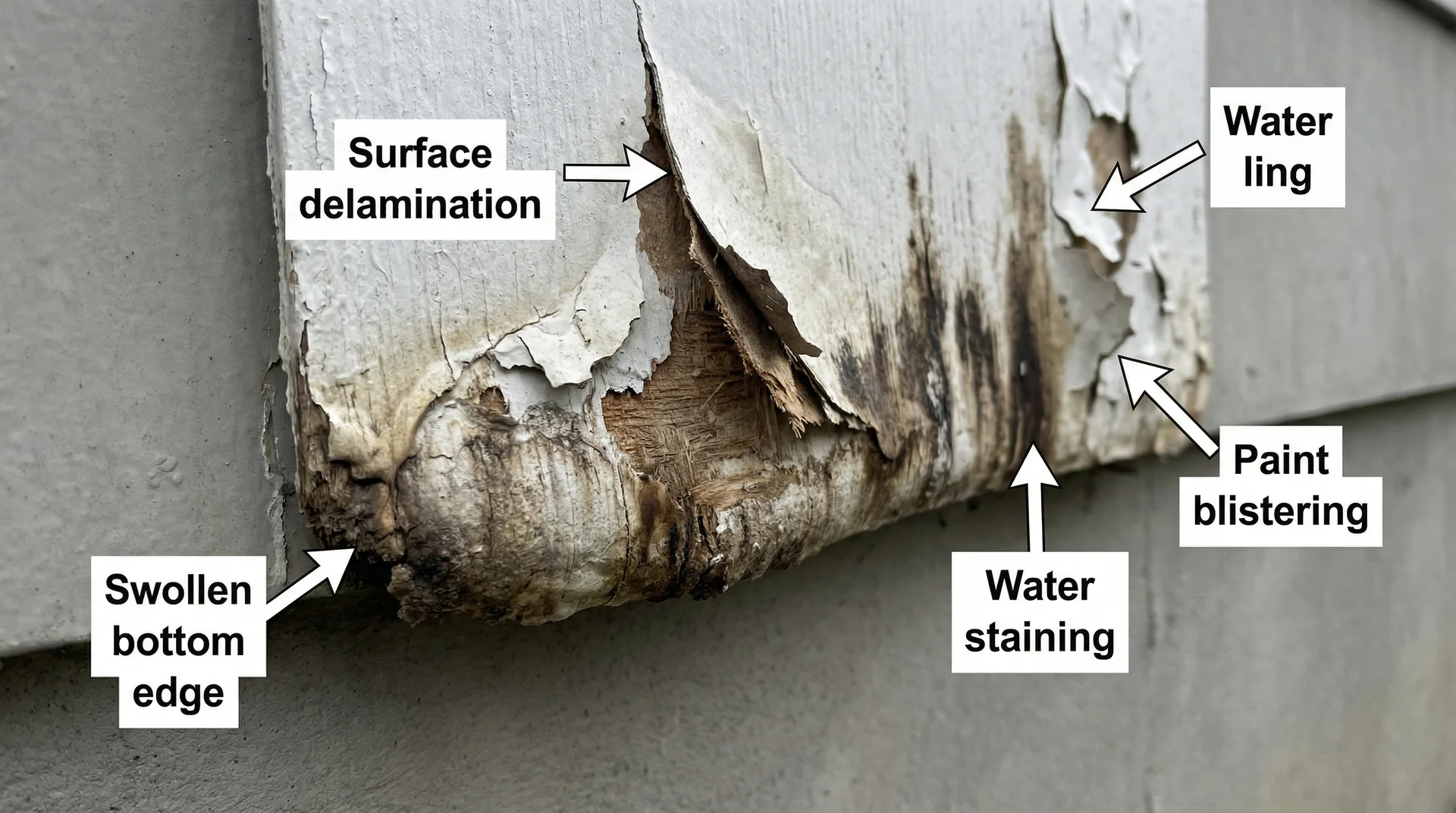
Hardboard’s fundamental weakness is that paint is the only thing standing between the wood fiber core and the outside world. Real wood has natural oils and a cellular structure that gives it some ability to handle moisture cycles. Hardboard has no such built-in defense.
When paint fails, even in a small area, water starts working into the panel from the edges and surface simultaneously. The fibers absorb it, the panel swells, swelling creates gaps at the seams, gaps let in more water, and the cycle accelerates until the panel delaminates, softens, and eventually crumbles.
Early-stage moisture damage looks like swollen edges and peeling paint. Late-stage looks like panels you can push your fingers through. The distance between those two stages can be as short as two or three wet winters if maintenance has been neglected.
Improper Installation Made Everything Worse
A significant portion of the worst hardboard failures I’ve seen weren’t purely material failures; they were installation failures, and the material couldn’t survive. In fact, replacing hardboard siding represents close to 50% of the siding work many exterior contractors do, and during inspections, the same installation errors show up repeatedly:
- Siding installed too close to grade: bottom courses within an inch or two of soil, mulch, or concrete. Water splashes up, stays in contact, and never dries
- Missing or deteriorated shear wall: builders in the late 1980s often installed only one or two plywood shear walls and ran hardboard directly over studs everywhere else. That setup cannot handle moisture cycling properly
- Unsealed cut ends: the cut edge of a hardboard panel acts like an open straw for moisture, especially around windows, doors, and rooflines
- Missing Z-bar flashing: inadequate flashing around gutter-to-siding transitions and over window head trim allowed water to run directly behind panels without any diversion
- No expansion gaps: panels installed without room to breathe buckle off the wall as they expand. If your wall looks wavy when you look down the length of it, expansion buckling from moisture is almost certainly the cause
When I see hardboard that has held up reasonably well for 30 or more years, I almost always find the original installation was careful, and the homeowner stayed on top of painting and caulking throughout. Sloppy installation without maintenance produces the crumbling panels I described at the start.
Climate Makes a Meaningful Difference
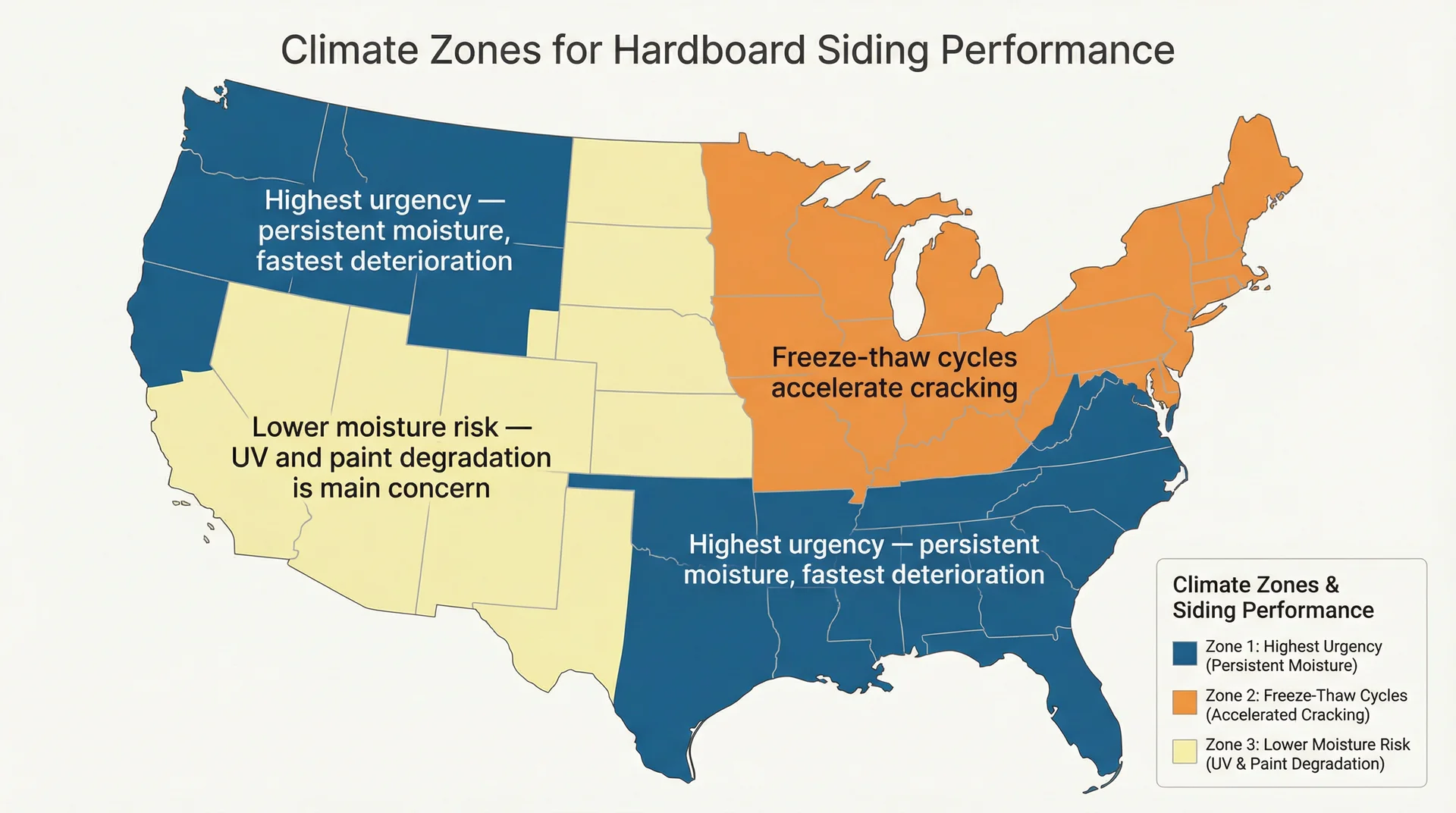
Humid Southeast and Pacific Northwest: Highest urgency. Persistent moisture and frequent rain give hardboard almost no chance to dry out between wet cycles.
Midwest and Northeast: Freeze-thaw cycles are particularly destructive. Water works into small cracks, freezes, expands, and opens those cracks wider with each winter.
Arid Southwest: Hardboard holds up better here because moisture exposure is limited. UV degradation of the paint coating is the bigger concern and still needs addressing on schedule.
Two Concerns Most People Don’t Ask About Directly
Termites and wood-boring insects. Because hardboard is wood-fiber-based, it attracts termites the same way natural wood does. If the siding sits against soil or landscape timber, the risk increases substantially. I’ve opened up walls on hardboard-sided homes and found active termite damage that had spread into the sheathing before anyone noticed.
Asbestos and older homes. Hardboard itself typically doesn’t contain asbestos, but homes built before 1980 often have asbestos present in other wall assembly components, such as felt paper, house wrap, caulking compounds, and some adhesives. Before you or anyone disturbs any exterior material on a pre-1980 home, arrange for professional materials testing first.
Hardboard Siding: A Quick Look at Pros and Cons
Since so many homeowners searching this topic are weighing the material’s history against their current situation, here’s a straightforward summary:
| What It Offers | The Reality | |
|---|---|---|
| Cost | One of the most affordable siding options per sq. ft. | Long-term maintenance costs offset the upfront savings |
| Appearance | Convincing wood grain, many textures, and profiles | Fades and fails faster than fiber cement or vinyl |
| Workability | Cuts and nails like wood with standard tools | That workability also makes it easy to install incorrectly |
| Insulation | Decent R-value contribution, adds some thermal resistance | Loses insulating value quickly once moisture intrudes |
| Eco angle | Made largely from recycled wood waste fiber | Formaldehyde resins in older versions are a concern |
| Durability | Can last 15–30 years with diligent maintenance | Most installations are past or approaching the end of life |
| Availability | Was widely available through the early 1990s | No longer manufactured; replacement matching is impossible |
Is Your Hardboard Siding Still Okay, or Is It Time to Act?
Early Warning Signs You Can Catch Yourself
Walk the perimeter and look for:
- Paint peeling or bubbling along the bottom edge of boards and around window and door trim
- Visible swelling or rounding at panel bottoms
- Seams that have widened or opened
- Dark staining suggests moisture has already penetrated
- Rusty nail heads poking forward or leaving rust streaks on the paint below
- A wavy appearance when you look down the face of a wall (expansion buckling)
Finding one sign in a single location doesn’t mean you have a crisis. Finding several across multiple walls usually does.
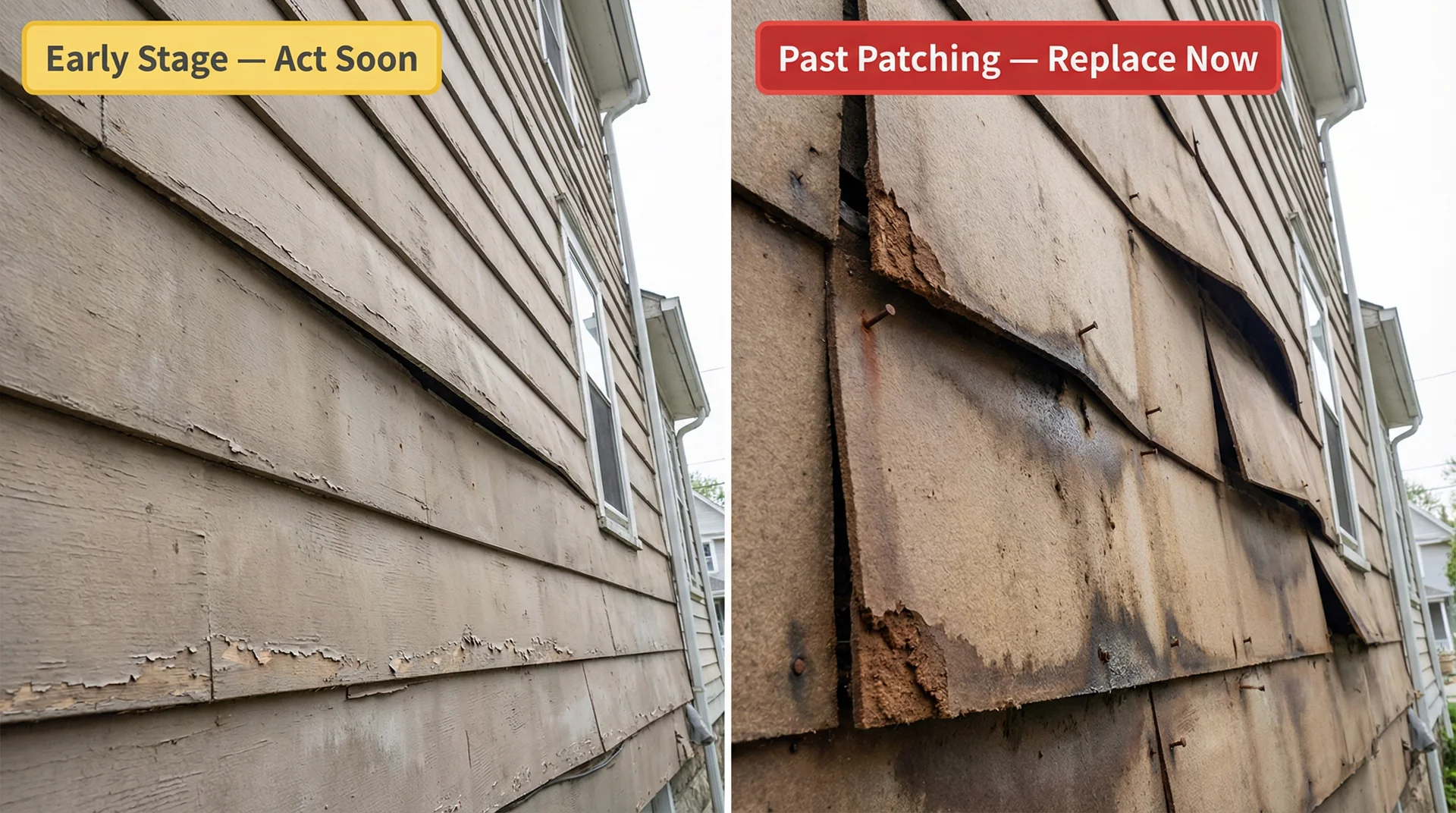
Signs That Mean You’re Past Patching
- Panels that feel soft or give under firm hand pressure
- Boards showing crumbling, cracking, or material separation at edges
- Visible rot or discoloration on the wall sheathing through a seam or behind a loose board
- Buckling where panels have pulled away from the wall face
- Interior moisture signs near exterior walls – staining on drywall, musty odor, or damp insulation
The sheathing point matters most. When water reaches the structural sheathing, you’re no longer dealing with a cladding problem. You’re dealing with potential structural damage, mold risk, and insulation failure.
When to Call a Contractor vs. When to Monitor
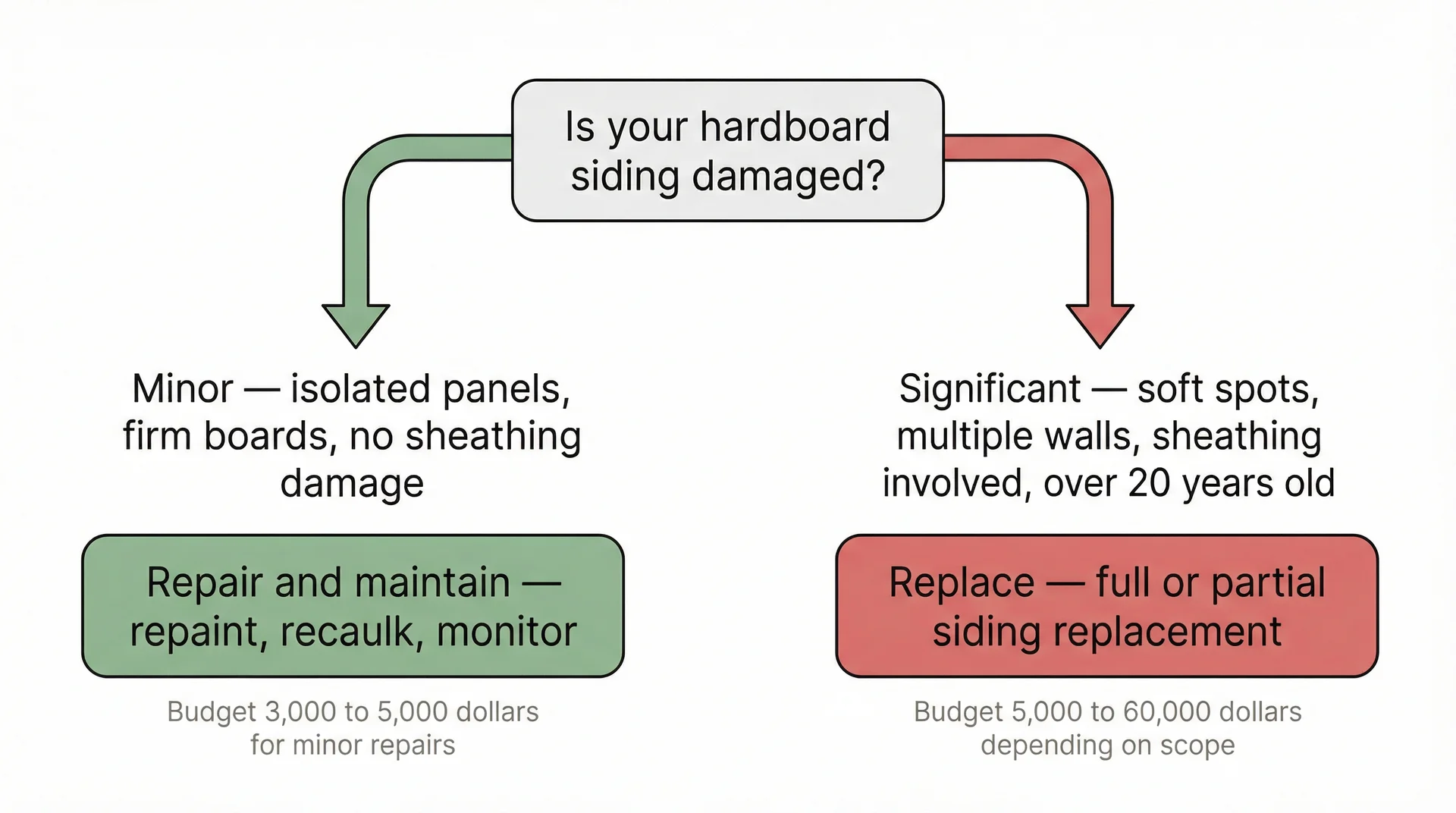
Monitor it yourself if: You find minor surface peeling in one or two isolated spots, boards feel firm when pressed, and seams and caulking are otherwise intact. Schedule a repaint and recaulk within the next season.
Call a professional if: You find soft spots anywhere, multiple areas show paint failure, seams are opening, or you see any sign that water has reached the sheathing.
Act urgently if: Boards are crumbling, pulling away from the wall, or you can see into the wall cavity through gaps. Delay adds cost fast at this stage. My general threshold: more than two or three boards with active rot, or damage that has reached the sheathing anywhere, puts you in full replacement territory.
Repair or Replace? A Framework for the Decision!
When Repair Makes Sense
Localized damage, like in one or two panels in a single area with no sheathing involvement, can sometimes be addressed through spot repair.
But because hardboard is no longer manufactured, you cannot buy matching boards. Fiber cement and LP SmartSide are close in profile but differ slightly in thickness and texture, so a spot repair will likely show.
Many homeowners choose to replace an entire wall rather than a few boards for this reason, since full-wall replacement looks consistent and allows a complete sheathing inspection at the same time.
Caulking and repainting as a maintenance measure makes sense when boards are structurally sound, and you press firmly and find every panel solid.
When Replacement Is the Smarter Investment
I lean toward replacement when:
- The siding is more than 20 years old and is showing damage in multiple locations
- Active moisture damage has reached the sheathing anywhere on the structure
- The homeowner plans to sell within the next three to five years
- The overall paint system is failing broadly rather than in isolated spots
- Insect damage is present
On the selling point specifically, buyers and their inspectors know about hardboard siding. Failing hardboard is a disclosure-required material defect in most U.S. states, and it affects both the sale price and buyer confidence. Replacing before listing generally yields a better return than discounting the asking price.
What Replacement Actually Costs
| Scope of Work | Typical Cost Range |
|---|---|
| Minor repairs to isolated panels | $3,000 to $5,000 |
| Partial replacement (one or two walls) | $5,000 to $15,000 |
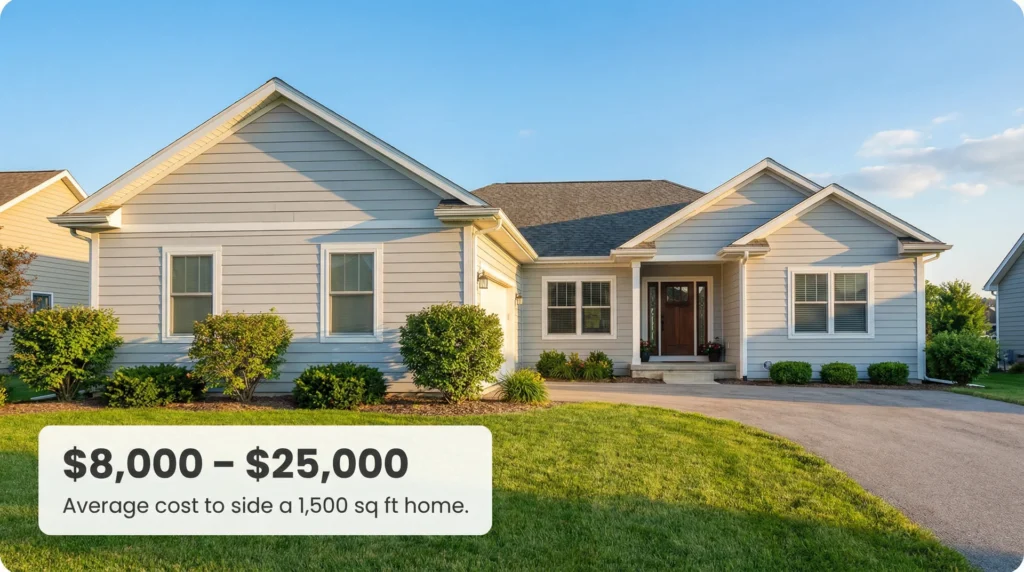
| Full home re-siding (average-size home) | $25,000 to $60,000+ |
These figures cover materials, labor, disposal, and basic sheathing repairs. They don’t account for significant structural remediation if water damage has penetrated deeply, which is exactly why I always tell homeowners to budget a 10-to-20% contingency.
What goes on behind old hardboard is genuinely unpredictable until you open it up.
The math that lands every time: repairing siding costs less than repairing water damage inside the wall. Every homeowner I’ve seen delay a siding replacement to save money has faced remediation costs that exceeded what the siding itself would have cost.
What to Replace It With: Honest Comparisons From Someone Who Has Installed All of These
Fiber Cement Siding (James Hardie and Similar)
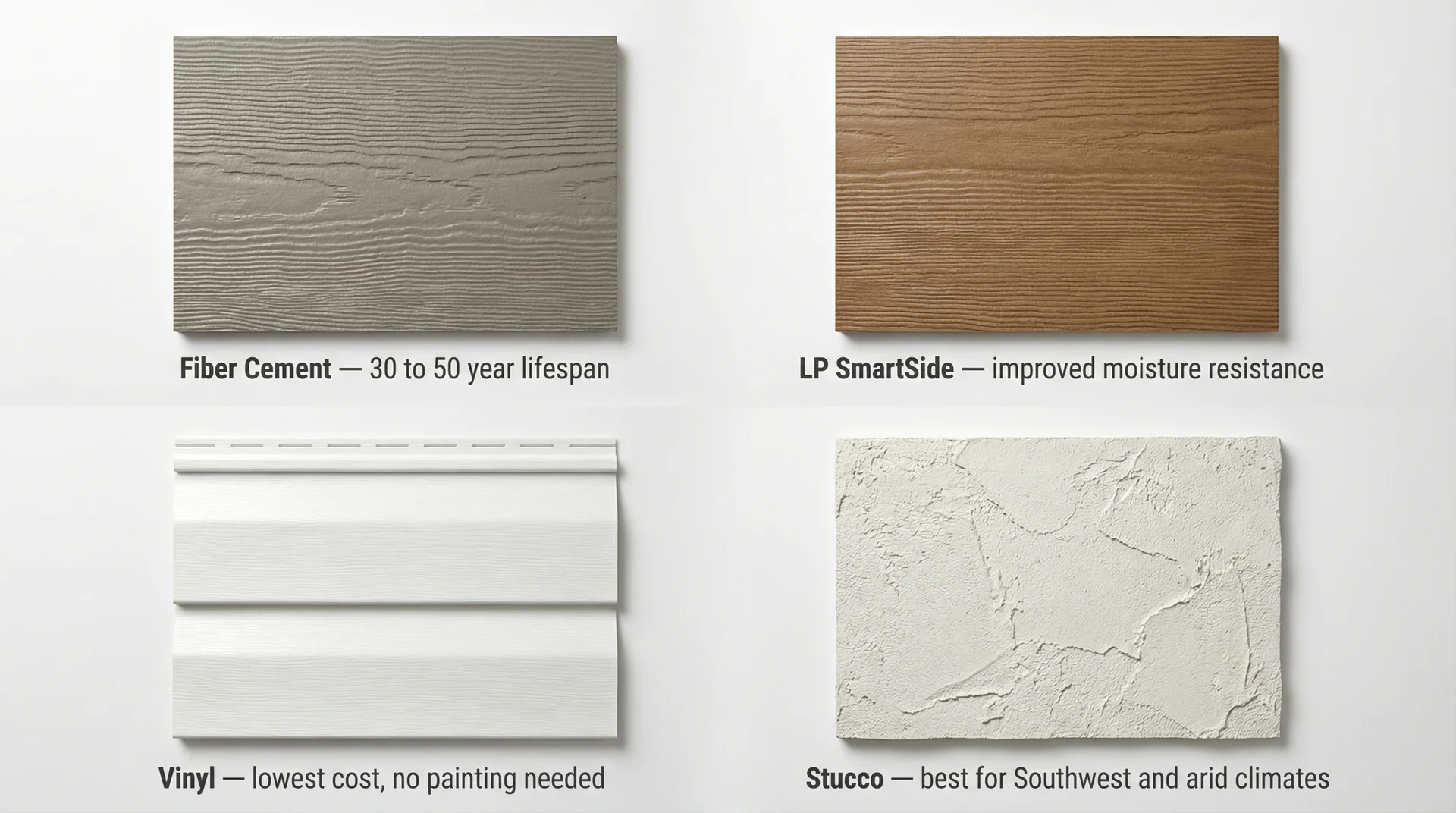
Fiber cement combines Portland cement, ground sand, cellulose fiber, and water into a panel that genuinely does not absorb moisture the way wood-based products do. It doesn’t feed termites. It carries a Class A fire rating.
James Hardie manufactures climate-specific versions formulated for the Pacific Northwest’s wet winters, the Southeast’s humidity, and the Southwest’s UV exposure. Expected lifespan runs 30 to 50 years with far less ongoing intervention than hardboard ever required.
The upfront cost is higher, installation takes more time because panels are heavier and require specific fastening patterns, and it needs painting. When you factor in maintenance frequency and lifespan, fiber cement usually wins the long-term cost comparison clearly.
For anyone in a humid climate or a high-fire-risk zone, this is the answer I give without hesitation.
LP SmartSide Engineered Wood
LP SmartSide is what I recommend for homeowners who want the warmth of a wood-based product without repeating the original hardboard’s mistakes. LP manufactures it with a proprietary treatment process that addresses moisture resistance at the manufacturing stage, not just through paint as an afterthought.
It installs similarly to hardboard, feels familiar to contractors who grew up working with wood products, and comes in profiles that closely mimic traditional lap siding. The cost sits between vinyl and fiber cement, making it attractive for mid-range budgets.
One caveat that applies to any engineered wood product: installation quality matters enormously. Sealed cut ends and proper clearances from grade are non-negotiable.
Vinyl Siding
Vinyl is the most affordable option in most U.S. markets and delivers on its core promises: no rot, no painting required, no termite risk, and low ongoing maintenance. For a homeowner on a tight budget who wants to solve the siding problem and not think about it again for twenty years, vinyl is a legitimate answer.
The tradeoffs are aesthetic and physical. Vinyl doesn’t convincingly replicate wood regardless of what product descriptions claim. In freeze-thaw climates, thinner vinyl panels can become brittle and crack from impact.
Darker vinyl colors absorb heat and can warp in sustained high temperatures. Thicker-gauge vinyl costs more upfront and eliminates most of those concerns.
Stucco
Stucco earns a mention because it comes up in comparisons, particularly for homeowners in the Southwest and Mountain West. It handles extreme temperatures well and can last decades when properly applied.
The installation is more involved than panel siding, requires professional application to perform correctly, and repairs can be difficult to match seamlessly. For the right climate and architectural style, it’s a solid option worth discussing with a contractor.
What I Would Choose
If it’s my house in a moderate climate, I’m choosing fiber cement, and I’m done thinking about siding for the rest of the time I own the property. If budget is a genuine constraint, LP SmartSide gets the wood aesthetic with dramatically better performance than the original hardboard.
Vinyl is right when eliminating ongoing maintenance costs entirely is the priority.
The answer for your home depends on your climate, budget, plans to sell, and what the rest of your exterior looks like, and a contractor worth their license will walk through all of those variables with you before recommending a specific product.
Basic Hardboard Siding Installation: What Was Required and Why It Mattered
Since original installation errors caused so many of the failures homeowners deal with today, it helps to understand what correct installation actually looked like. This context also matters if you’re overseeing a replacement project and want to know what to ask your contractor.
Proper hardboard siding installation involved these steps:
- Apply a moisture-resistive barrier over the sheathing before any panels go up
- Install a level starter strip along the bottom edge of the wall as the foundation for the first course
- Measure and cut panels with a fine-tooth circular saw blade, leaving approximately 1/8-inch expansion gaps between panels
- Seal all cut ends with paint or end-cut sealant before installation. This step was skipped constantly and is responsible for enormous amounts of the rot I find in older installations
- Fasten with galvanized nails driven into studs, flush with the surface but never overdriven
- Install Z-bar flashing over all horizontal trim and around windows before siding panels go up around those areas
- Caulk all seams, joints, nail holes, and penetrations with exterior-grade siliconized caulk before painting
- Apply two coats of exterior paint over primed panels, maintaining a continuous moisture barrier
Skipping or shortcutting any of these steps, particularly end sealing, flashing, and caulking, is what sent so many 1980s installations into failure decades before they should have reached the end of life.
If You’re Keeping Your Hardboard Siding for Now: A Maintenance Plan That Works
Inspect Twice a Year, Every Year
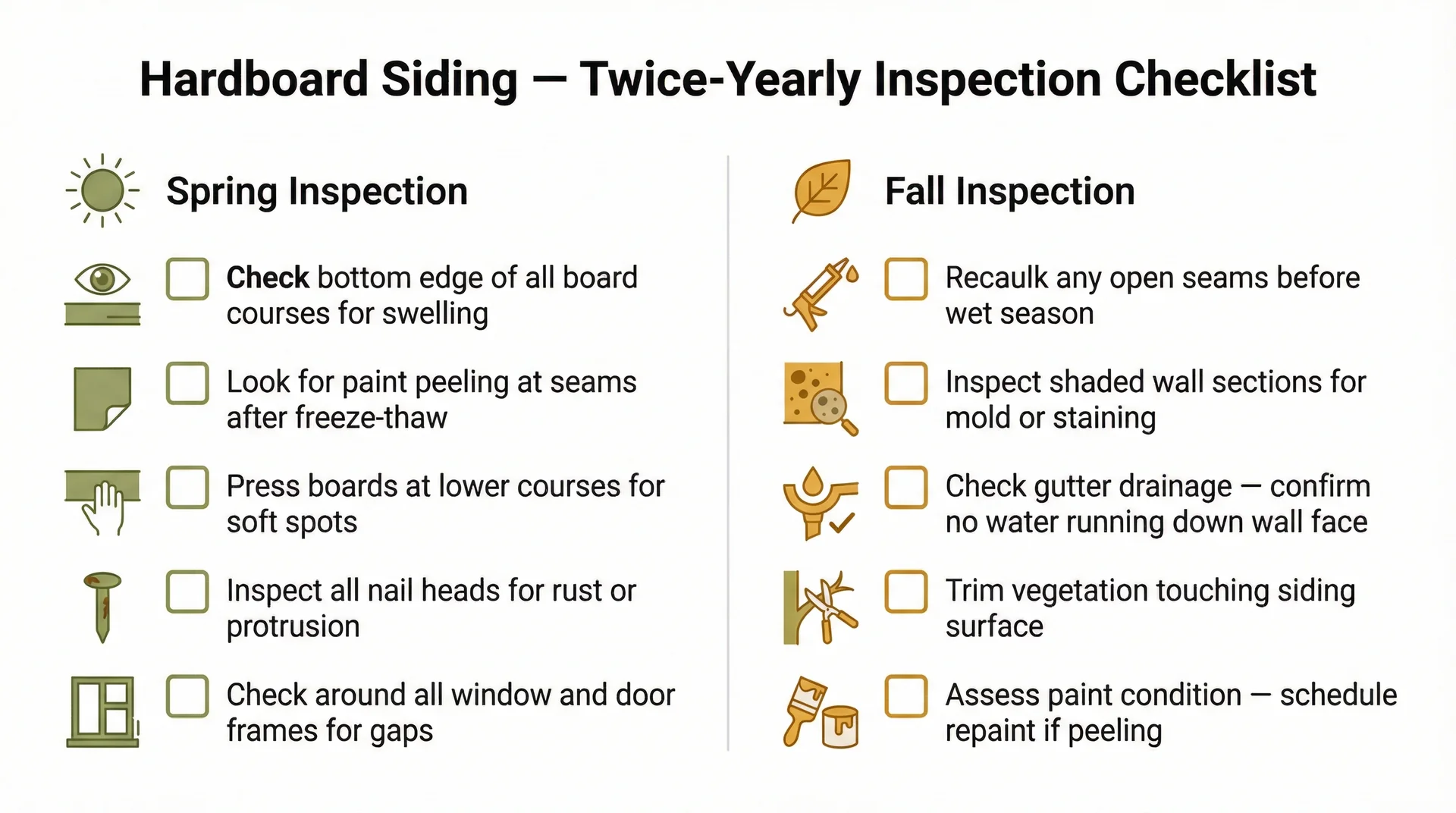
Spring and fall are your windows. Spring catches freeze-thaw damage after winter. Fall lets you identify and seal vulnerabilities before the next wet season.
During each inspection, focus on:
- Bottom edge of every board course
- Every penetration point – windows, doors, electrical outlets, hose bibs, light fixtures
- Corners and angle changes where walls meet
- Shaded sections, which dry out more slowly and deteriorate faster
- Nail heads across the full surface
Painting and Sealing: Non-Negotiable
Repaint every three to five years – not seven to ten. Before any paint application, recaulk every seam, joint, nail hole, and penetration point with quality exterior-grade siliconized caulk and let it cure fully before painting over it.
Never use a pressure washer on hardboard siding. The water pressure forces moisture directly into any micro-crack in the surface coating and accelerates exactly the damage you’re trying to prevent. Clean the surface with a soft brush, mild detergent, and a garden hose at normal pressure.
Landscape and Drainage Habits That Protect the Siding
- Maintain at least six inches of clearance between soil or mulch and the bottom edge of the siding (eight to ten inches is better)
- Position lawn sprinklers so no spray hits the siding directly
- Keep gutters clean and free-flowing – overflowing gutters run water down the wall face and saturate the top edge of every course below
- Trim back any shrubs, vines, or trees whose foliage touches or grows against the siding surface
Frequently Asked Questions About Hardboard Siding
Is hardboard siding the same as Hardie board?
These get confused constantly, and the names don’t help. Hardboard siding is an older engineered wood product made from compressed wood fibers. Hardie board (James Hardie fiber cement) is a cement-based product. Different composition, different performance, completely different lifespan. If your home was built after 2000, you almost certainly have fiber cement.
Is hardboard siding still being manufactured?
Following the class-action lawsuits of the mid-1990s, almost all major manufacturers stopped production. Hardboard siding is no longer available as a new exterior cladding product in the United States, which is why matching replacement boards for spot repairs is so difficult.
How long does hardboard siding last?
With proper installation and consistent maintenance, regular repainting and caulking of hardboard siding can last 15 to 30 years. Many installations show significant problems well before the 20-year mark, particularly where maintenance was inconsistent or installation clearances were insufficient.
Can you paint over damaged hardboard siding?
In the very early stages of surface paint failure, where boards are still structurally sound, repainting after thorough caulking and surface preparation can extend useful life. Once swelling, delamination, or soft spots are present, paint is a cosmetic cover, not a repair.
What is the best replacement for hardboard siding?
Fiber cement siding, particularly James Hardie products formulated for your specific climate region, offers the best long-term performance. LP SmartSide engineered wood is a strong mid-range alternative. Vinyl is the most cost-effective option for homeowners prioritizing low maintenance above everything else.
Does hardboard siding contain asbestos?
Hardboard itself typically does not. However, homes built before 1980 often have asbestos present in other wall assembly components, such as felt paper, house wrap, caulking compounds, and adhesives. Get professional testing done before anyone disturbs any exterior material on a pre-1980 home.
Do I need to disclose hardboard siding when selling my home?
In most U.S. states, known material defects, including failing siding, require disclosure to potential buyers. Specific requirements vary by state, so consult a real estate attorney familiar with your local laws. What I can tell you from experience is that buyers and their inspectors know what failing hardboard looks like, and undisclosed siding problems discovered after closing create real legal exposure for sellers.
What are the signs that hardboard siding needs to be replaced immediately?
If you see boards crumbling when touched, panels pulling away from the wall, water stains appearing on interior drywall near exterior walls, or any visible rot on the sheathing behind the siding, those are conditions requiring immediate attention. Delay at that stage multiplies the total repair cost significantly.
One Last Thing
The homeowner I mentioned at the start ended up replacing two full walls. Behind the panels, we found sheathing that had absorbed moisture for several years and required partial replacement as well. The total cost ran higher than it would have if he’d addressed the early warning signs he’d noticed and ignored for a couple of seasons.
Hardboard siding that gets consistent attention can serve a home well for decades. Hardboard siding that gets ignored tends to fail in ways that reach well past the siding itself.
You now know what to look for, what it means, and what your realistic options are, and that puts you significantly ahead of where most homeowners are when I arrive on the first site visit.