
If your skin feels persistently tight after cleansing, looks dull by midday, or shows fine lines that seem more pronounced than they should, you are not imagining it.
Clients come to me with exactly this frustration. Their routines look reasonable on paper. Their serums are not performing. The missing link, more often than not, is a well-chosen hydrating toner applied before anything else.
A hydrating toner is not a splash of scented water. It rebalances your skin’s pH after cleansing, deposits a first layer of humectants directly onto the surface, and creates the conditions that allow everything applied after it to actually work.
For dry and aging skin, this is not an optional step. It is the foundation that determines whether your serum absorbs or merely sits.
This guide covers the biology behind why this skin type needs the step, the exact ingredients to look for and those to avoid, how to apply it correctly, and how to build it into a routine that compounds over time.
Why Dry and Aging Skin Needs a Hydrating Toner More Than Most
What Is Actually Happening Inside Dry Skin
Dry skin means your skin barrier, the outermost layer responsible for holding moisture in and keeping irritants out, is not functioning at full capacity.
The result is transepidermal water loss (TEWL): water evaporating through the skin’s surface faster than the skin can replace it. You feel it as tightness, see it as dullness, and notice it as a roughness that no amount of moisturiser fully resolves.
A hydrating toner is the first intervention after cleansing. It delivers humectants to a surface that has just been disrupted by water and cleanser, beginning moisture restoration before your serum or moisturiser arrives.
How Aging Changes What Your Skin Needs
Collagen production begins declining in our mid-twenties and accelerates significantly after forty.
Sebum production can drop by up to sixty percent in mature skin. Elastin weakens. The barrier thins. What felt like occasional dryness at thirty becomes a daily reality by fifty.
The practical result is less natural cushioning, less oil to slow moisture evaporation, and a weaker barrier to protect what moisture remains.
A hydrating toner provides an immediate moisture deposit right after cleansing, before natural oils have a chance to fully evaporate.
A good toner gives mature skin that first drink of water after cleansing, helping to plump and soothe before anything else is applied.
The pH Problem
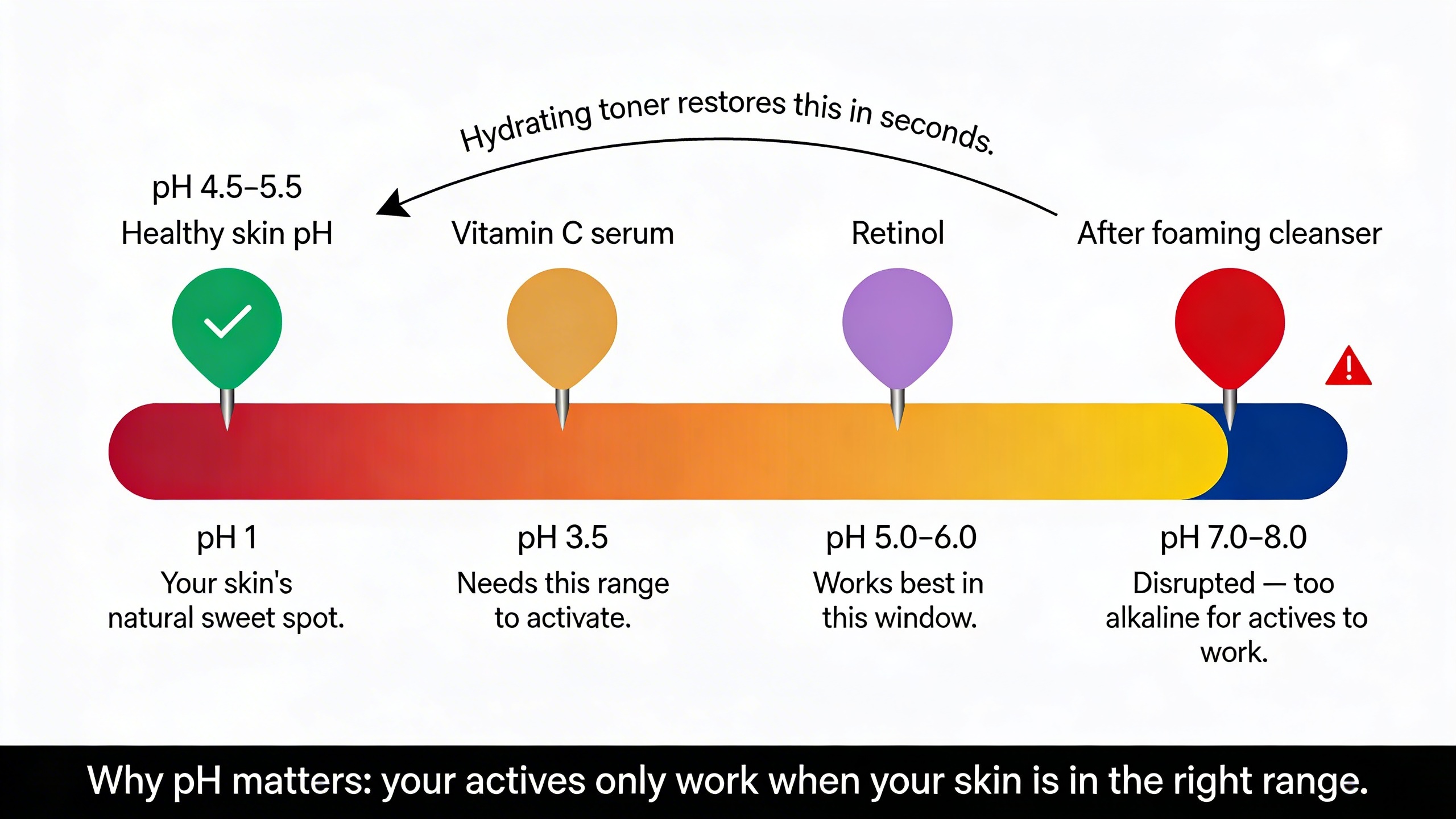
Your skin maintains a naturally acidic pH between 4.5 and 5.5. Most cleansers, especially foaming formulas, temporarily push that pH upward.
An alkaline skin surface loses moisture faster and does not provide the right environment for pH-dependent actives to perform.
A well-formulated hydrating toner restores your skin’s pH within seconds of application, setting the stage for every product that follows.
Ingredients That Make a Real Difference
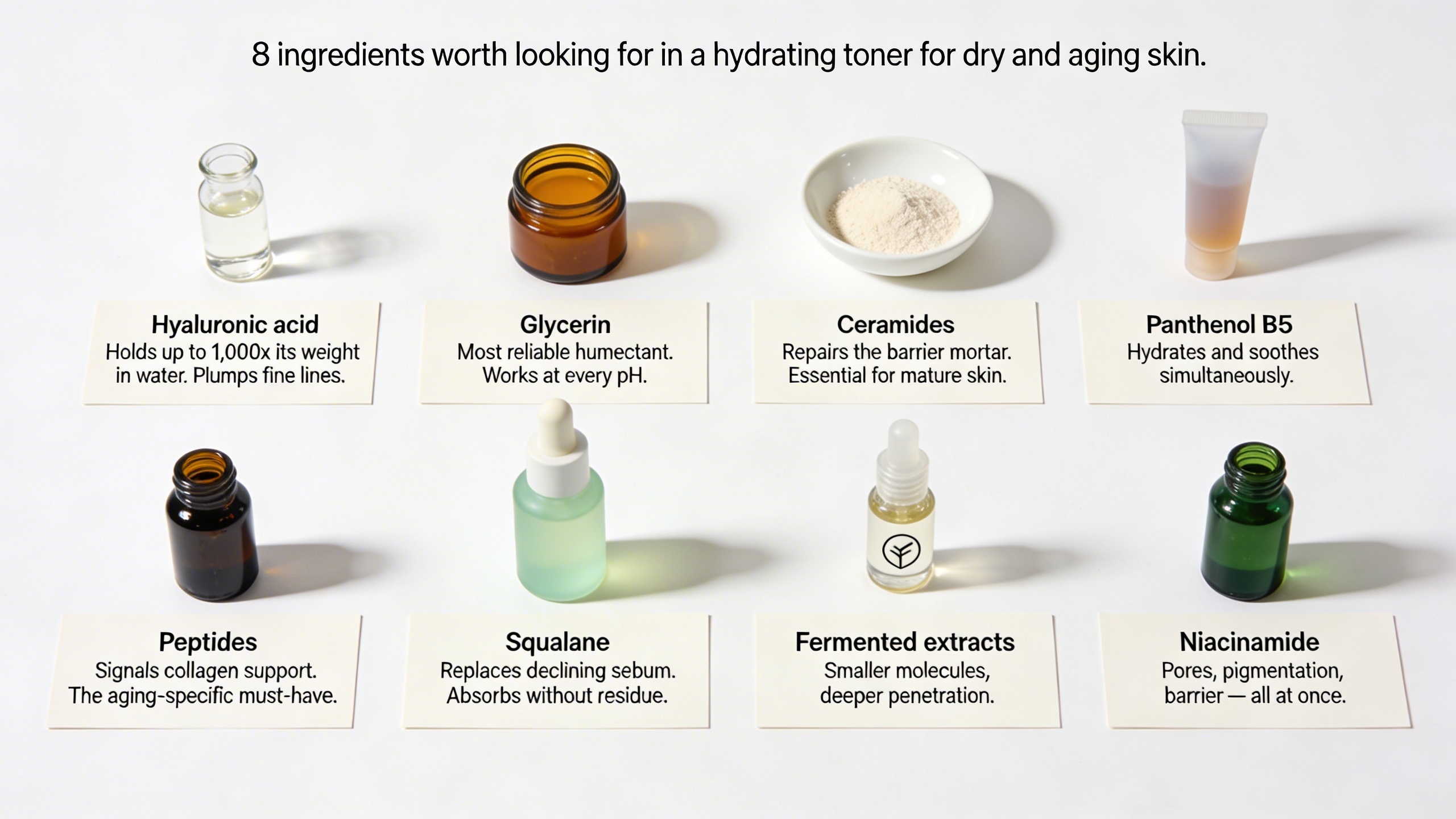
The ingredient list is the only honest indicator of what a toner will do. Below are the categories and specific ingredients worth prioritising, in order of importance for dry and aging skin.
Humectants
Hyaluronic acid and sodium hyaluronate
Can hold up to 1,000 times its weight in water. Plumps the skin and softens the appearance of fine lines. Sodium hyaluronate is a smaller molecule that penetrates more deeply. Products containing both forms deliver surface and deeper hydration simultaneously.
Glycerin
One of the most reliable and well-researched humectants available. Works across a wide pH range and pairs well with every other ingredient on this list. Even budget toners can be effective if glycerin sits high on the ingredient list.
Sodium PCA
A natural component of your skin’s own moisturising factor — the system the skin uses to keep itself hydrated. Its presence supplements what dry and mature skin can no longer produce adequately on its own. Particularly effective for skin that stays tight even after applying other products.
Panthenol (Vitamin B5)
Functions as both a humectant and a skin-repairing agent. Draws moisture in, supports barrier function, and has measurable soothing properties. For skin that is both dry and reactive, panthenol does more work than a single-function humectant.
Ceramides and lipids
Ceramides are fatty acids that act as the mortar between skin cells, preventing moisture loss and blocking irritants.
Mature and dry skin is typically ceramide-depleted. Look for formulas listing ceramide NP, ceramide AP, ceramide EOP, cholesterol, and fatty acids together.
These five work synergistically and reflect how a healthy barrier is actually structured.
A product listing only one ceramide type is less effective than one replicating the full lipid profile.
Peptides
Peptides are short amino acid chains that signal the skin to support its own collagen and elastin.
As collagen declines with age, delivering peptides at every step, including the toner, creates a cumulative benefit that a serum alone cannot replicate.
Look for palmitoyl tripeptide, acetyl hexapeptide, or similar peptide complexes on the ingredient list.
Squalane
As sebum production declines, the skin loses its natural lipid cushion.
Squalane is a lightweight, plant-derived oil that closely mimics the skin’s own sebum.
It absorbs quickly, does not interfere with layers applied over it, and helps compensate for the lipid deficit that contributes to dryness and fragility in mature skin.
Fermented ingredients
Fermentation breaks down skincare ingredients into smaller molecular fragments that penetrate the skin more efficiently.
Galactomyces ferment filtrate, Saccharomyces ferment, and bifida ferment lysate are the most common examples.
Their presence means the humectants and ceramides around them absorb more effectively rather than sitting on the surface.
Antioxidants
Aging skin is more vulnerable to oxidative damage from UV and pollution.
Antioxidants in a toner provide an early protective layer before your Vitamin C serum or SPF. Green tea extract, Vitamin E, niacinamide, and coenzyme Q10 are the most reliably effective.
Niacinamide also addresses hyperpigmentation, enlarged pores, and oil regulation, making it one of the most multifunctional actives available for mature skin.
Soothing botanicals
Aloe vera hydrates and calms. Chamomile soothes without fragrance.
Centella asiatica (CICA) actively supports barrier repair while reducing redness.
Rose water provides gentle hydration and is one of the few naturally scented ingredients that do not commonly trigger sensitivity in mature skin.
What to Avoid in a Hydrating Toner for Dry and Aging Skin
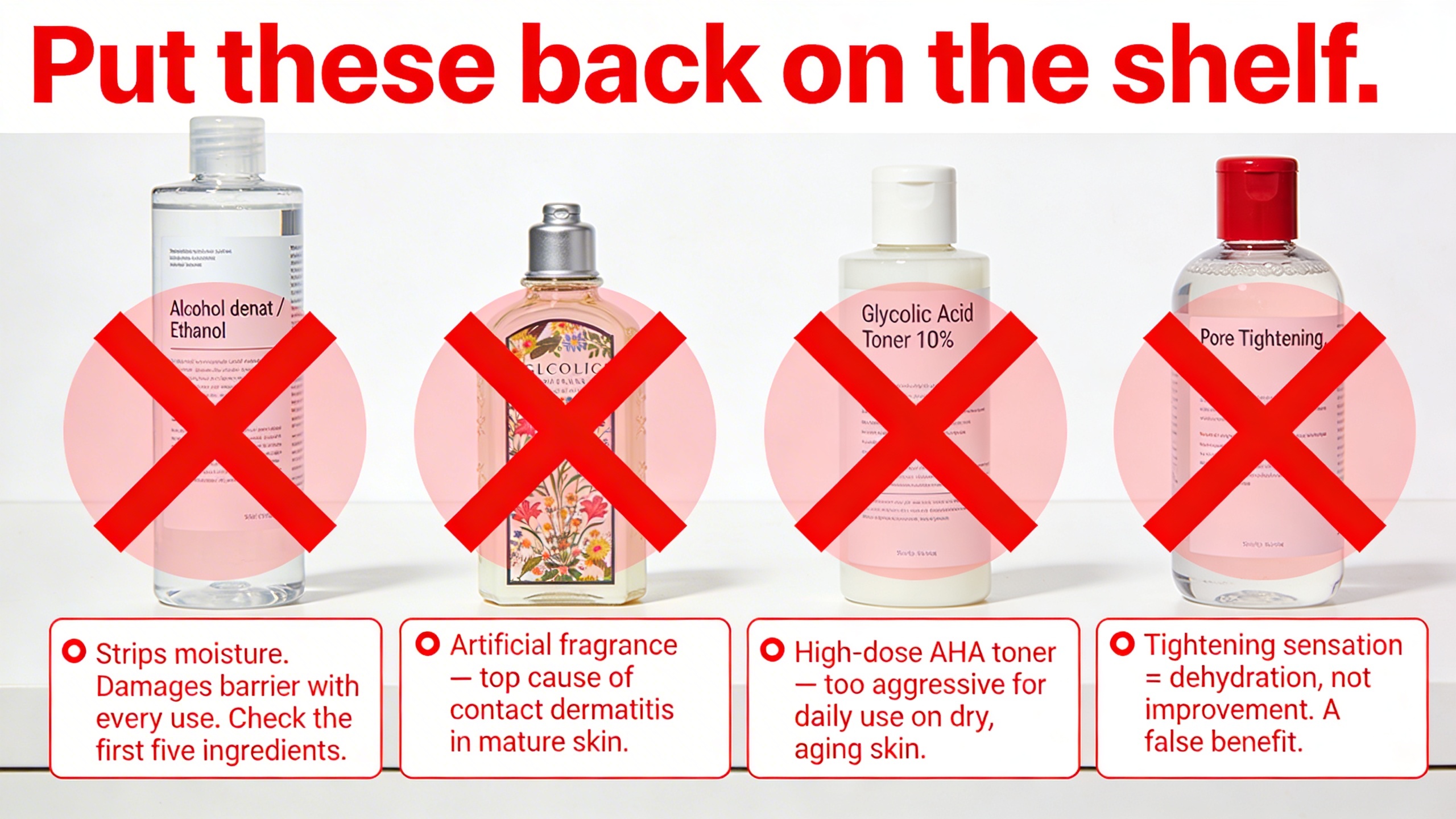
High-concentration alcohol (ethanol, isopropyl alcohol, alcohol denat)
The most important warning for this skin type.
Alcohol-based toners strip natural oils, accelerate moisture evaporation, and damage the barrier with every use.
They produce a temporary tightening that feels like efficacy but is simply dehydration.
Check the ingredient list: if any form of alcohol appears in the first five ingredients, leave it on the shelf.
Artificial fragrance and synthetic dyes
Fragrance is one of the most common causes of contact dermatitis. Mature skin with a compromised barrier is particularly vulnerable. It offers no functional benefit and carries a real irritation risk.
Look for “fragrance-free,” specifically, not “unscented”, unscented products can still contain masking fragrances.
High-dose exfoliating acids (glycolic acid, strong witch hazel)
A toner is not the right vehicle for aggressive exfoliation in dry and aging skin.
High concentrations push already fragile skin into a cycle of over-exfoliation: temporary brightness followed by redness, increased sensitivity, and worsening tightness.
If you use exfoliating acids, apply them as a separate treatment two to three times per week. Your daily toner should be building the barrier, not exfoliating it.
The “tightening” sensation as a quality signal
Traditional toners that promise to tighten pores achieve that sensation through alcohol or astringents that temporarily dehydrate the surface.
That is not firmness. True improvement in pore appearance and skin texture comes from long-term barrier support and consistent hydration.
A toner that leaves skin feeling tight is telling you it has taken something away.
How to Apply a Hydrating Toner Correctly
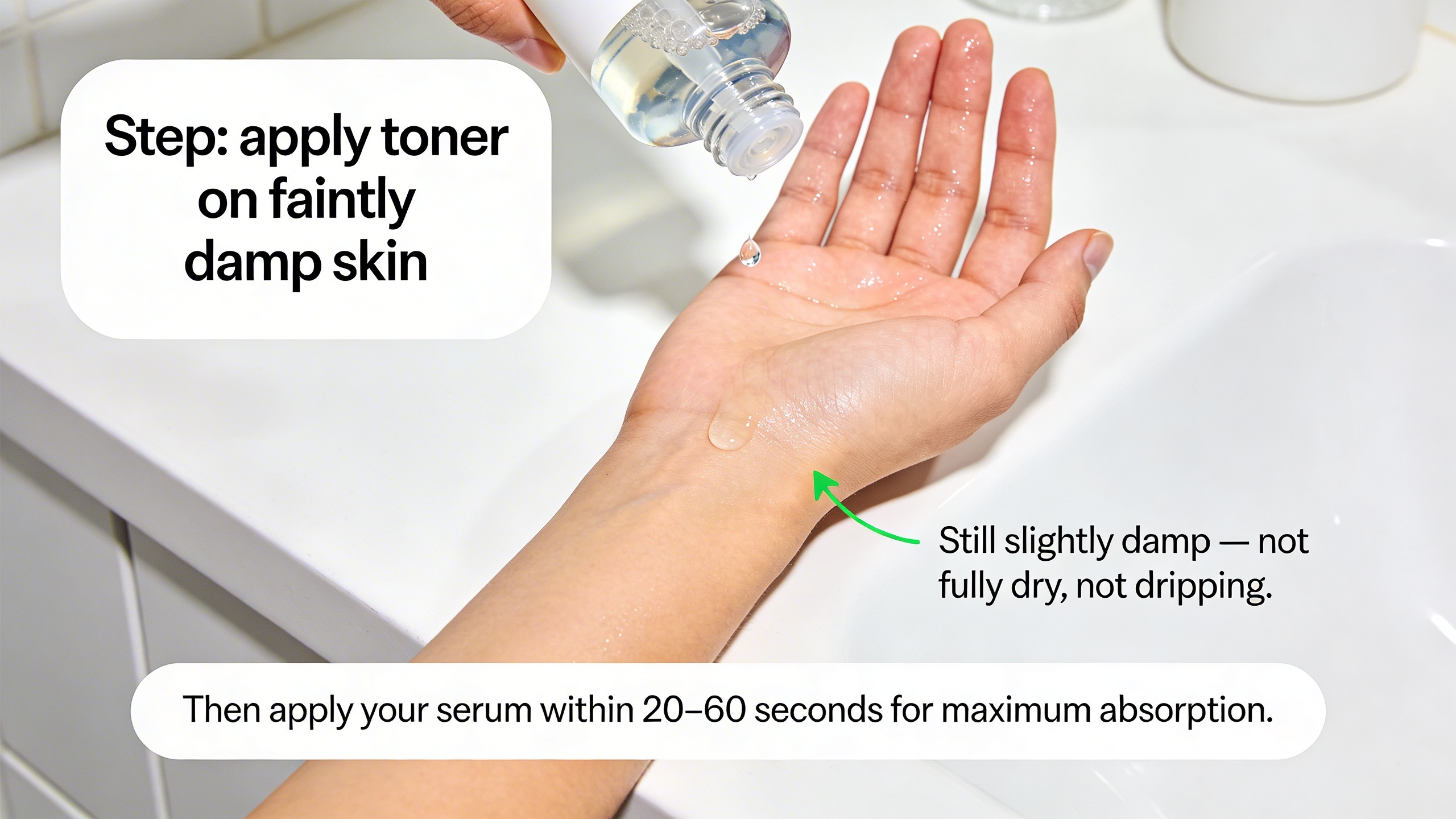
The damp skin rule
After cleansing, pat your face with a clean towel, but stop before your skin is completely dry. You want it faintly damp, not dripping.
Applying toner onto slightly damp skin gives its humectants immediate moisture to work with, improving both distribution and absorption.
Applying onto completely dry skin is not wrong, but the results are noticeably different over time.
Hands versus cotton pad
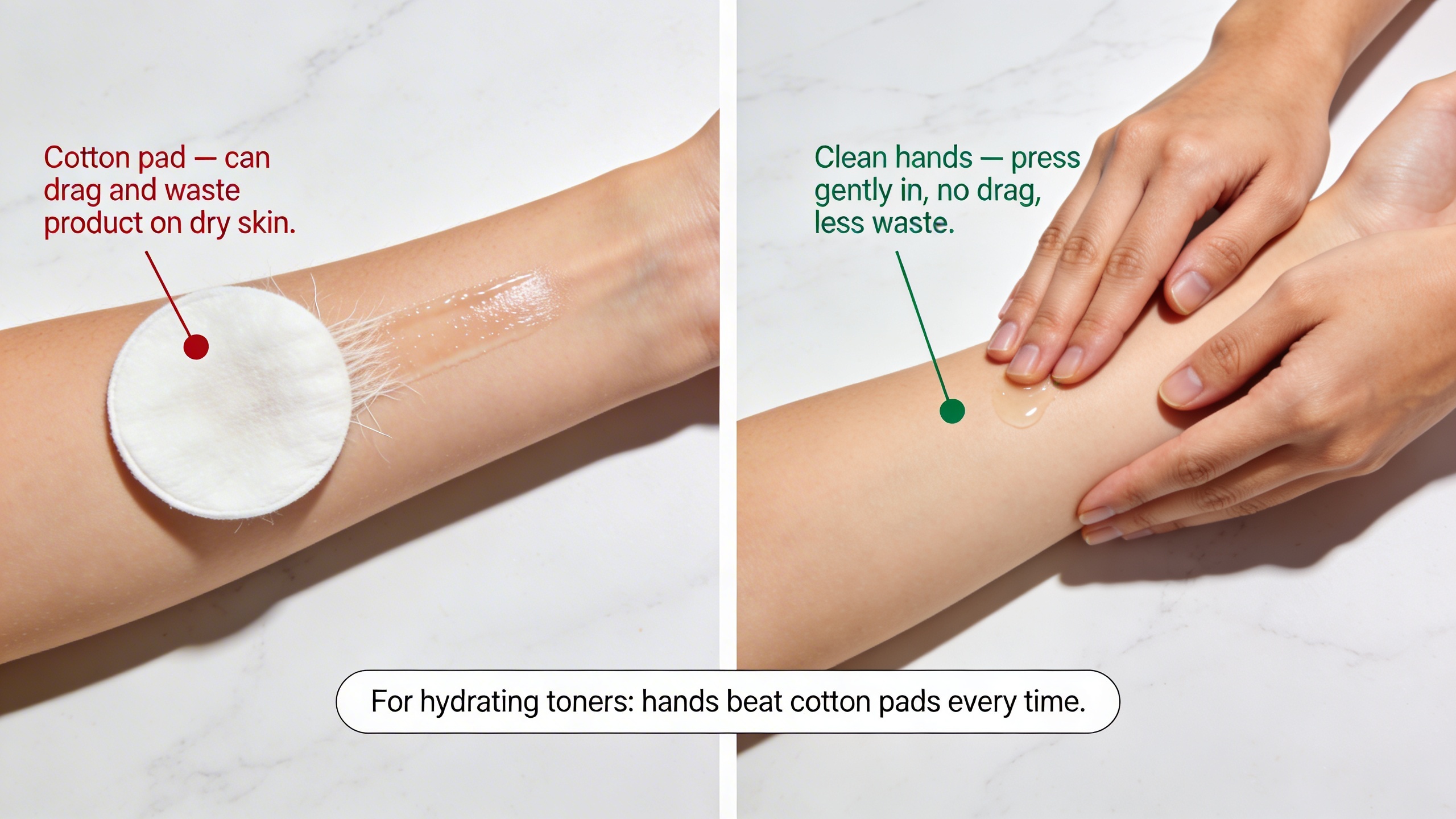
For watery toners, clean hands are more hygienic, waste less product, and allow you to press the formula gently into the skin rather than drag it across the surface.
For thicker essence-style formulas, pressing with your palms in gentle upward motions distributes the product evenly without the pulling force that aggravates dry or sensitised skin.
Cotton pads are appropriate when you want mild mechanical exfoliation, not for a hydrating toner whose job is to absorb, not wipe away.
The absorption window
There is a 20 to 60 second window after applying toner where your skin is in an optimal receptive state: slightly hydrated, pH-corrected, and primed to absorb.
Apply your serum within this window. You do not need to time it precisely. By the time you pick up your serum, uncap it, and dispense it, the window is about right.
What you want to avoid is walking away between steps and returning to completely dry skin.
For a full breakdown of why this timing matters and how different serum ingredients behave on a toned versus un-toned surface, read our guide on the correct toner and serum order.
Layering your toner
For very dry or dehydrated skin, applying two to three thin layers and pressing each one in before the next can significantly improve comfort and plumpness.
This draws from the K-beauty “7 skin method.” Two to three layers deliver the benefit without the time commitment.
This technique applies only to purely hydrating, non-active toners. Never layer an exfoliating toner this way.
Building the Right Routine Around Your Hydrating Toner
Morning sequence
- Gentle, low-foaming cleanser. Remove overnight sebum and product residue without stripping.
- Hydrating toner. Apply onto slightly damp skin. Restore pH and lay the first layer of hydration.
- Vitamin C or antioxidant serum. Apply while skin is still faintly damp. The prepped surface improves absorption.
- Moisturiser. Seal everything in and reinforce the barrier for the day ahead.
- SPF 30 or higher. Always the final morning step. Nothing goes over SPF.
Evening sequence
- Oil or balm cleanser. Remove SPF, makeup, and pollution particles.
- Water-based cleanser. Second cleanse for a clean surface.
- Hydrating toner. On nights using retinoids, a generous toner layer first significantly reduces irritation risk without reducing efficacy.
- Treatment serum (retinol, peptides, or niacinamide). Applied to a prepared surface rather than dry post-cleanse skin.
- Richer night moisturiser or barrier cream. Seal and support overnight recovery.
Do You Need Morning & Evening Toner?
Not necessarily. One well-chosen toner used generously in the evening and lightly in the morning covers most needs.
A richer essence-style formula reserved for evenings is a worthwhile upgrade for very dry or mature skin, but not a requirement if budget is a consideration.
How to Read an Ingredient List and Know What You Are Actually Buying
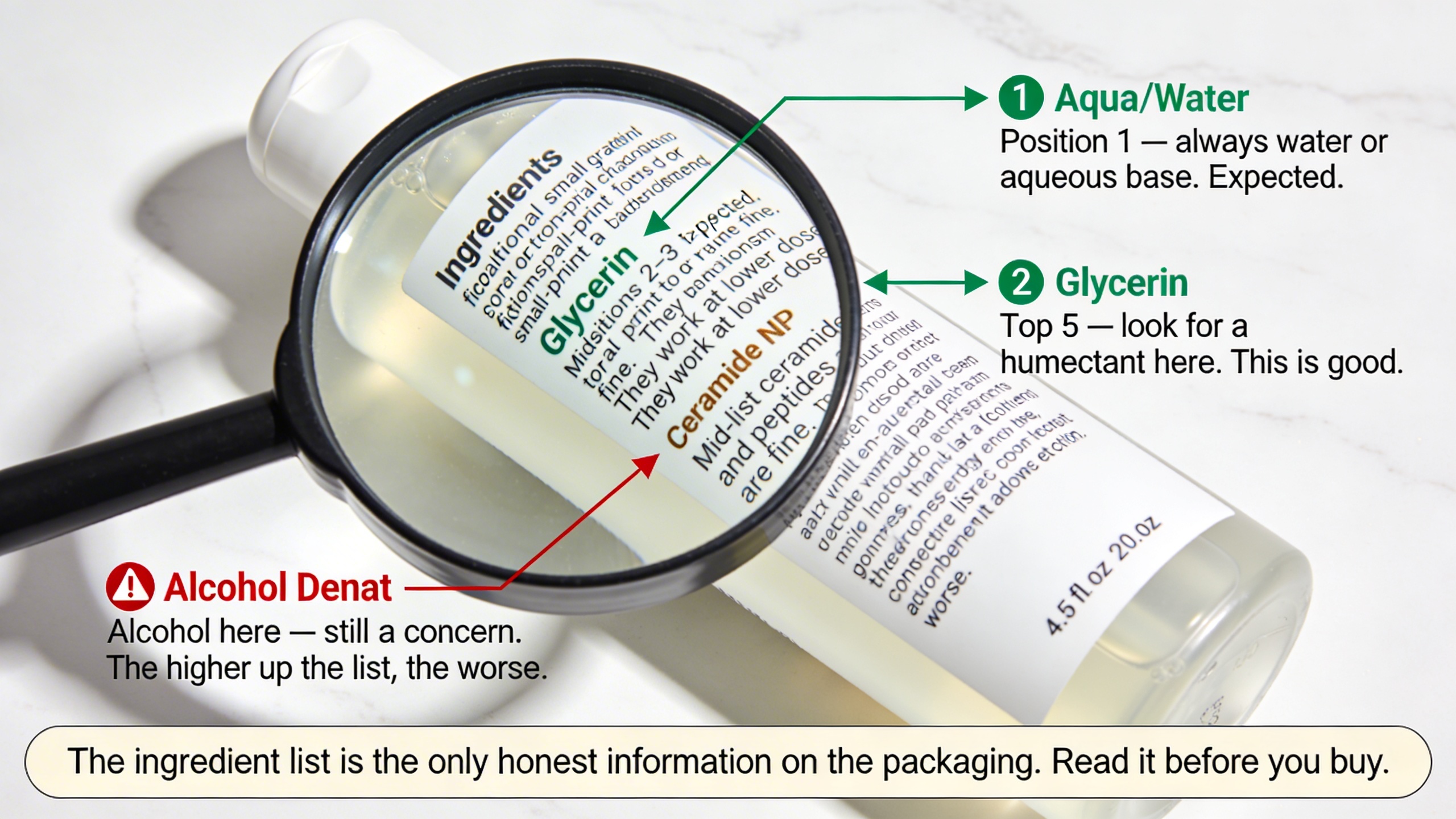
Ingredients are listed in order of concentration from highest to lowest.
The first five ingredients make up the bulk of what you are applying. A product can feature hyaluronic acid on the front label and list it fifteenth on the ingredient list, at a concentration too low to do anything meaningful.
What to look for in the first five ingredients?
Water or an aqueous base is expected at position one. After that, look for at least one humectant, glycerin, hyaluronic acid, or sodium PCA, in the top five.
Ceramides, peptides, and fermented ingredients work at lower concentrations, so their position further down the list is fine. What should never appear in the first five: alcohol, fragrance, or high-dose exfoliating acids.
What Ingredients to Prioritise for Your Specific Concern
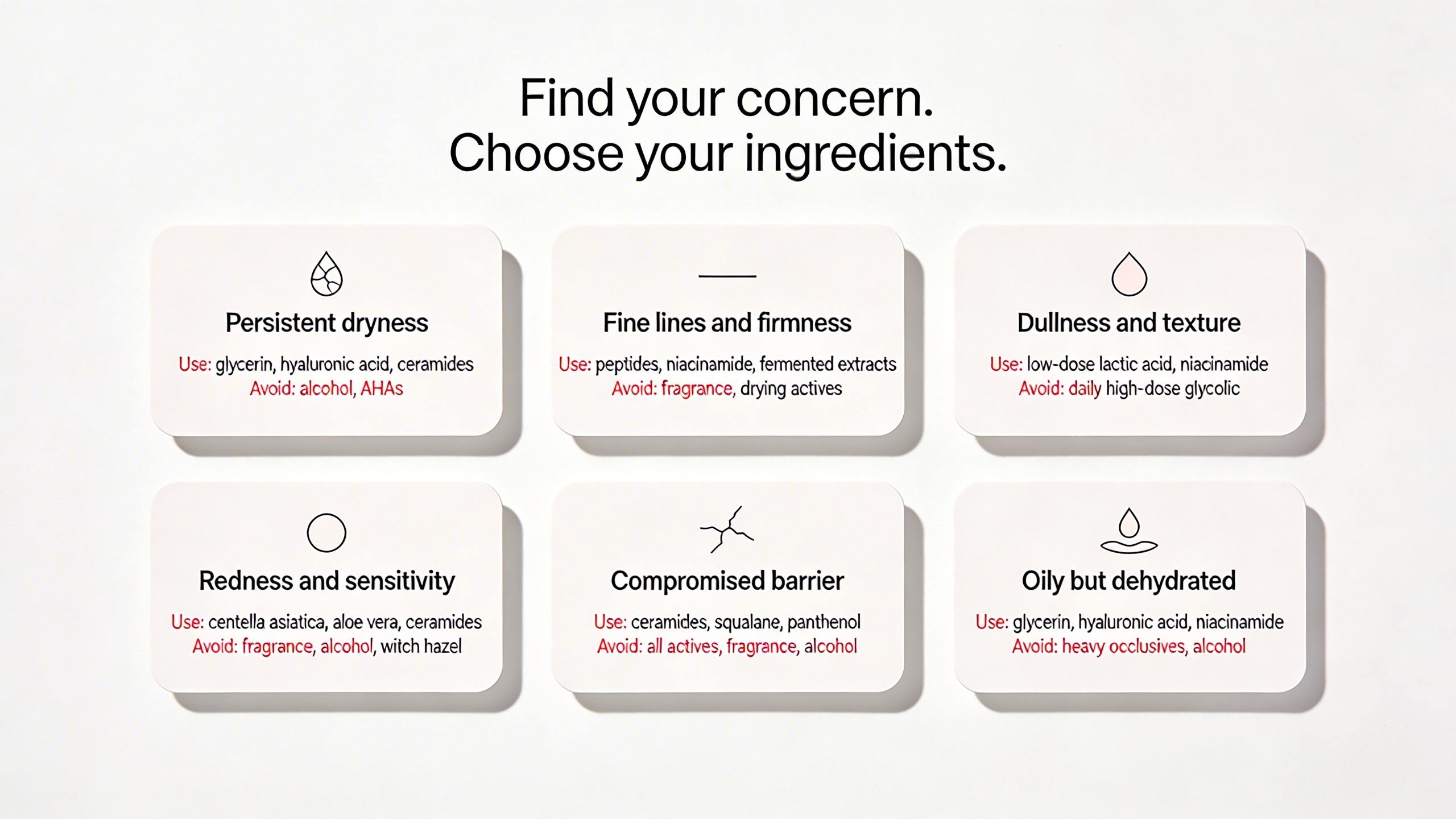
| Skin concern | Prioritise | Avoid |
|---|---|---|
| Persistent tightness and dryness | Glycerin, hyaluronic acid, sodium PCA, ceramides | Alcohol, high-dose AHAs, astringents |
| Fine lines and loss of firmness | Peptides, niacinamide, fermented extracts, panthenol | Fragrance, drying actives |
| Dullness and uneven texture | Low-dose lactic acid (2–5%), niacinamide, antioxidants | Daily high-dose glycolic acid |
| Redness and sensitivity with dryness | Centella asiatica, aloe vera, chamomile, panthenol, ceramides | Fragrance, alcohol, and witch hazel are high on the list |
| Post-treatment or compromised barrier | Ceramides, squalane, panthenol, aloe vera | All actives, fragrance, alcohol |
| Dryness with oiliness (dehydrated skin) | Glycerin, hyaluronic acid, niacinamide, lightweight squalane | Heavy occlusive toners, alcohol |
Frequently Asked Questions
Can a hydrating toner replace a serum?
No. A hydrating toner prepares the skin and delivers initial moisture.
Serums are formulated at higher active concentrations to target specific concerns: collagen loss, hyperpigmentation, deep hydration, and acne. The toner makes the serum work better.
It does not do the serum’s job.
How often should I use a hydrating toner?
Twice daily, morning and evening, after every cleanse.
A well-formulated hydrating toner contains nothing harsh enough to warrant limiting its use. Restoring moisture after cleansing is daily maintenance, not an occasional treatment.
Will a hydrating toner make my skin oily?
No. Oily skin is sometimes dehydrated skin compensating for a moisture deficit by overproducing sebum.
Consistent hydration with a toner can, over time, reduce that overproduction response. Hydrating toners for dry and aging skin are lightweight and absorb cleanly.
Is witch hazel acceptable in a hydrating toner for mature skin?
With caution. Witch hazel is primarily an astringent. For dry and aging skin, a toner that appears high on the ingredient list is likely working against you.
If it appears near the bottom alongside clear humectants and barrier ingredients, it may be acceptable, but it should not be the reason you choose that product.
What is the difference between an essence and a hydrating toner?
The distinction has blurred. Traditionally, toners balanced pH, and essences delivered the first treatment layer.
Today, the most effective hydrating toners function as essence-toner hybrids: pH correction plus concentrated active hydration. For practical purposes, read the ingredient list and assess the texture rather than relying on category names.
Do I need a different toner for morning and evening?
Not necessarily. One well-chosen toner covers both routines. If your skin is very dry or you use retinoids at night, a richer essence-style formula for evenings is a worthwhile upgrade, but not a requirement.
Where does a hydrating toner fit if I also use an exfoliating toner?
Keep them separate. Use your exfoliating toner two to three evenings per week as a dedicated treatment step.
On all other days, morning and evening, use your hydrating toner. Never use them together in the same routine.
The hydrating toner is your daily baseline. The exfoliating toner is an occasional treatment.
My skin feels fine without a toner. Do I still need one?
If your barrier is stable, your serums are performing, and you have no tightness or dullness, then your routine is already working, and a toner is optional.
For most people with dry and aging skin, the problem exists, and the toner’s contribution is measurable.
“Fine” is a low bar when you are investing in a full skincare routine.
Final Word From Robin
The toner category has been muddied for decades by alcohol-based astringents marketed under the same name. Modern hydrating toners, particularly essence-style and fermented formulas, are categorically different products.
For dry and aging skin, they are the step that determines whether the rest of the routine performs or merely sits on the surface.
Understanding what your skin is doing, biologically declining in ceramide production, losing its natural lipid cushion, and struggling to retain the moisture it has, makes the role of a well-chosen toner obvious.
You are not adding a step for the sake of it.
You are giving barrier-compromised skin what it needs to receive everything else you apply.
Prioritise formulas with multiple humectants, ceramides, and peptides. Avoid alcohol and fragrance. Apply onto slightly damp skin. Give it four weeks of consistent use. Your skin’s response will tell you more than any ingredient list can.