
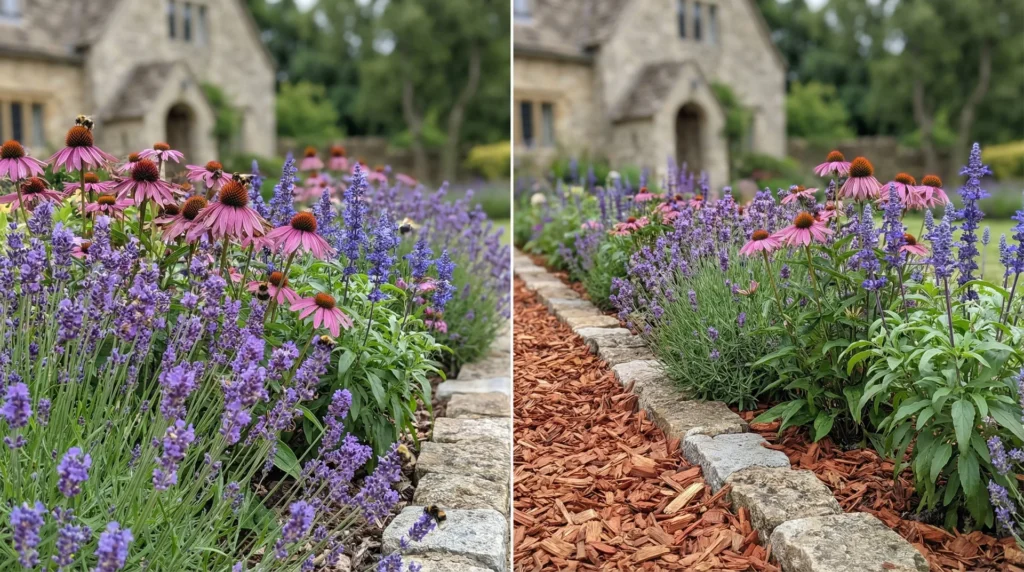
I want to save you the frustration I felt when I first used cedar mulch incorrectly across an entire residential project.
The client loved the look, the beds smelled incredible, and everything seemed perfect until about six weeks later.
I noticed the pollinator activity had dropped significantly around her cottage garden borders.
That experience taught me something no textbook clearly spelled out: cedar mulch is genuinely one of the best mulching materials, but only when you understand exactly where it belongs and where it absolutely does not.
Here is the short answer you probably came looking for.
| Cedar mulch works beautifully for weed suppression, moisture retention, and pest deterrence around trees, shrubs, and decorative pathways. |
It lasts longer than most organic mulches, looks consistently attractive, and carries natural oils that keep certain insects away.
The real concern comes when you use it in the wrong spots, specifically near pollinator gardens, vegetable beds, or newly planted seedlings, where soil biology and insect activity matter deeply.
Once you know where to place it and where to reach for something else, cedar mulch becomes one of the most reliable tools in your landscaping toolkit.
Why Gardeners Feel Confused About Cedar Mulch
I hear this question constantly from homeowners who read contradictory things online: “I read cedar mulch is great for keeping pests away, but then I also read it harms good bugs. Which is true?”
Both are true, and that creates the confusion. Cedar mulch contains natural compounds like thujopsene and other volatile oils.
These compounds do not discriminate neatly between insects you want and insects you would rather keep out of your garden.
When you spread cedar mulch broadly across an entire garden, you broadcast that chemical signal everywhere, and it affects the whole ecosystem of that space.
The gardeners who swear by cedar mulch and those who swear off it both describe real experiences. They just happened to use it in very different contexts.
My job, and what I will walk you through here, is to help you understand that context clearly so you can make the right call for your specific garden.
What Cedar Mulch Actually Does to Your Soil and Garden
Before we explore the full pros and cons, I want to give you a grounded picture of what cedar mulch does physically and chemically in your garden. Most of the benefits and drawbacks flow directly from these core behaviours.
Cedar mulch comes from shredded or chipped wood and bark of cedar trees, most commonly Eastern Red Cedar or Western Red Cedar.
You will find it as finely shredded material, which breaks down slightly faster, or as more uniform chips, which offer a coarser look and even slower decomposition.
The bark and heartwood of cedar carry high concentrations of natural oils and phenolic compounds.
These compounds give cedar its signature scent, its resistance to rot, and its insect-repelling properties.
When you lay cedar mulch in your garden, these actions begin:
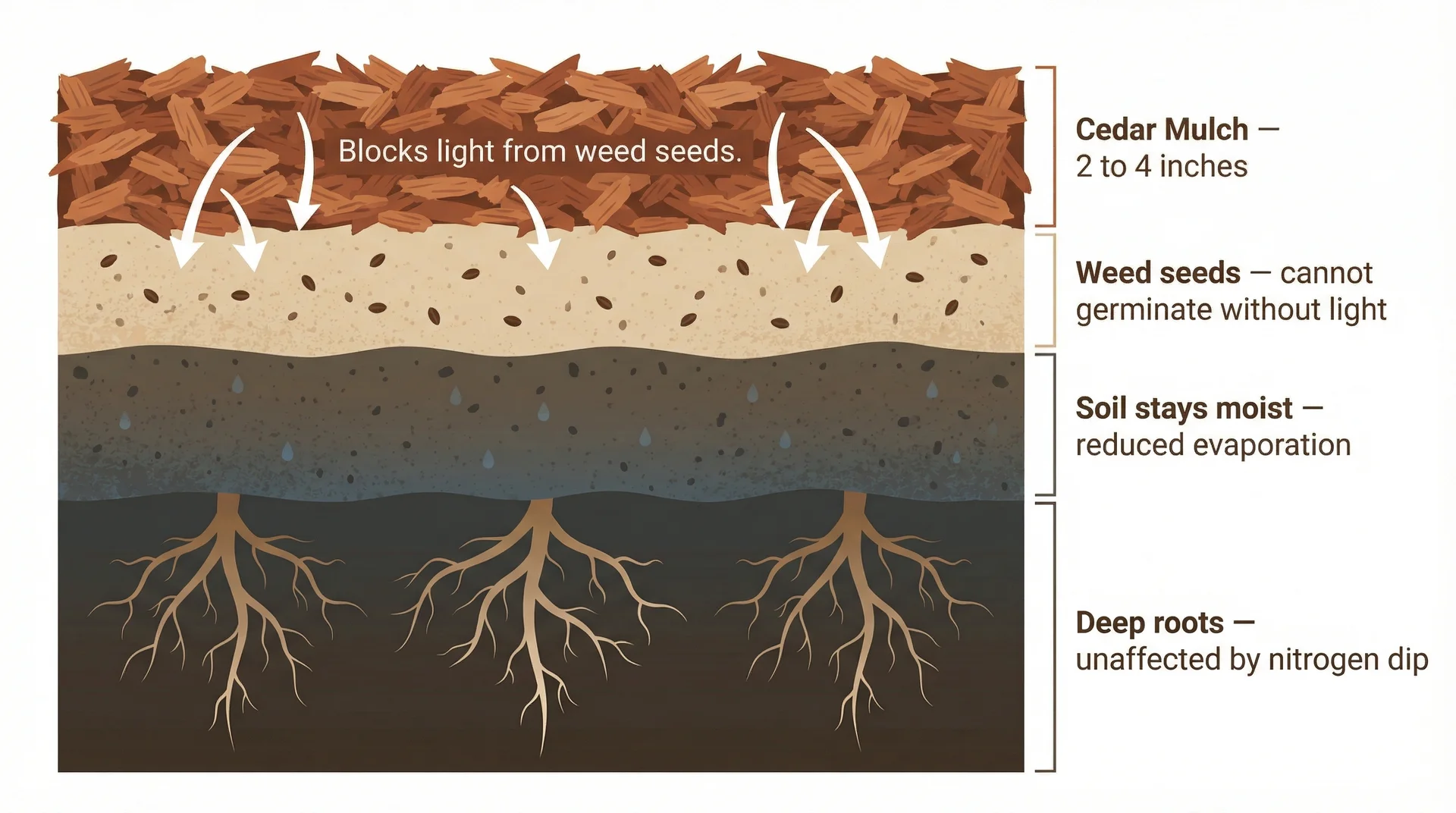
- The surface layer creates a physical barrier that blocks light from reaching weed seeds in your soil. Most annual weed seeds need light to germinate, so a consistent 2 to 4 inch layer of cedar mulch significantly reduces your weeding workload.
- The wood fibres interlock and mat slightly over time, which helps the mulch stay in place even during heavy rainfall or overhead irrigation. I often prefer cedar over lighter materials like pine straw for sloped garden beds because of this stability.
- Natural oils leach gradually into the surrounding soil as the mulch weathers and decomposes. This is where cedar’s allelopathic qualities come in. Research published in Frontiers in Plant Science confirms cedar mulch exhibits mild allelopathic effects, meaning it releases compounds that can suppress the germination of certain plants, including some weeds.
- Decomposition happens slowly compared to most organic mulches. Hardwood bark mulch might need replenishing every season. Cedar mulch, especially from the heartwood, can hold its colour and structure for two to three years in most climates before it needs significant topping up.
That slow decomposition is a double-edged reality.
On the one hand, you save money and labour over time.
On the other hand, cedar does not feed your soil as quickly as faster-decomposing mulches like compost or leaf mold do. If soil enrichment is your primary goal, cedar is not the right tool for that particular job.
The Honest Pros of Cedar Mulch
It Keeps Weeds Down Better Than Most Alternatives
I have tested many mulching materials across the residential projects I work on, and cedar consistently delivers some of the strongest weed suppression results.
The combination of physical coverage and the mild allelopathic effect gives it an edge over thinner or more loosely structured mulches.
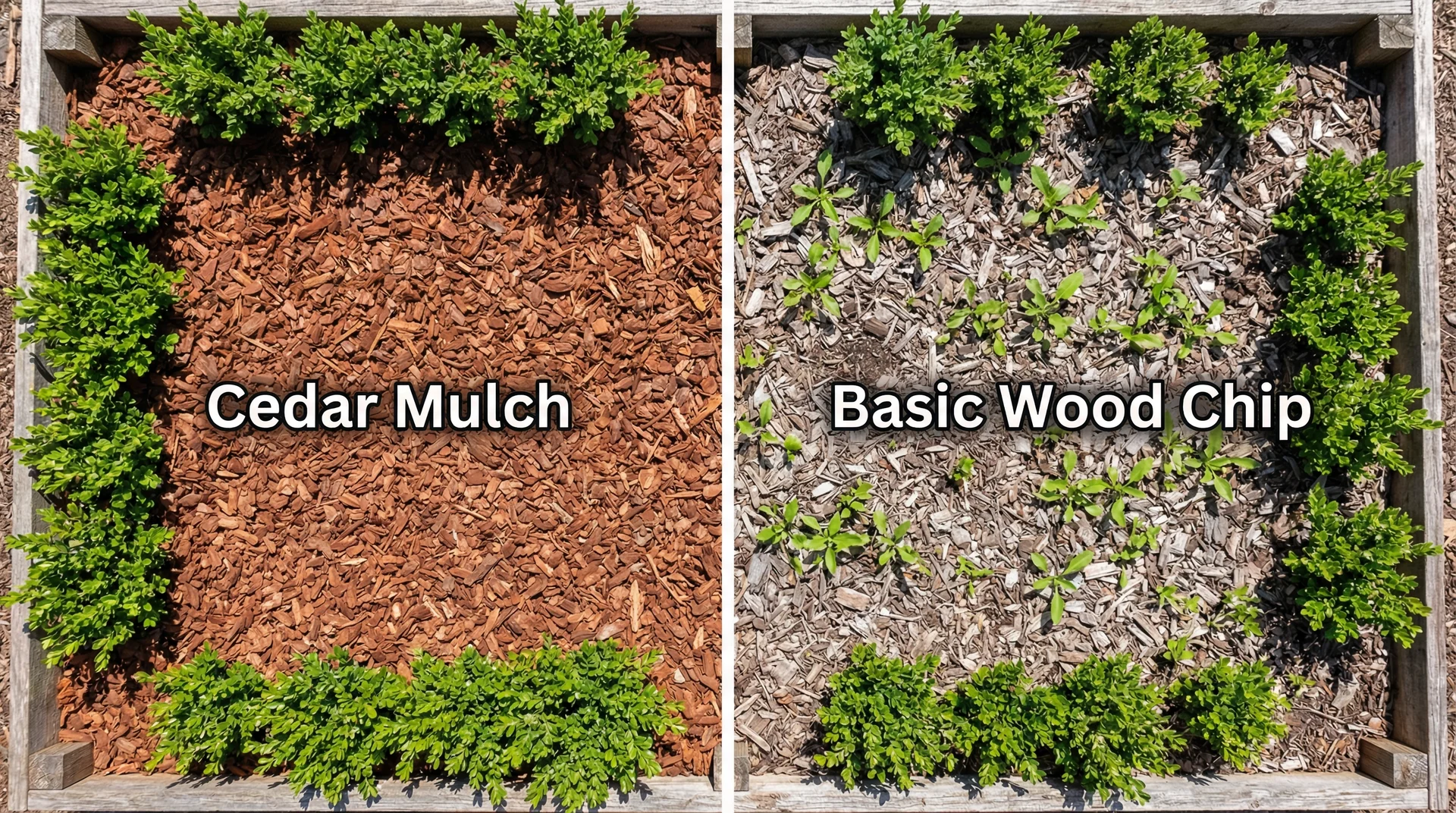
In a backyard redesign I worked on in a suburb outside Portland, we used cedar mulch around a formal boxwood hedge and along a flagstone pathway. That area stayed nearly weed-free for an entire growing season with a single application.
The client’s comparison bed, which used a basic wood chip mulch, needed two rounds of hand-weeding by midsummer. The cedar bed needed none.
The best mulch is the one that does your work for you through the whole season.” – A principle I share with every client
Cedar Repels a Range of Unwanted Insects
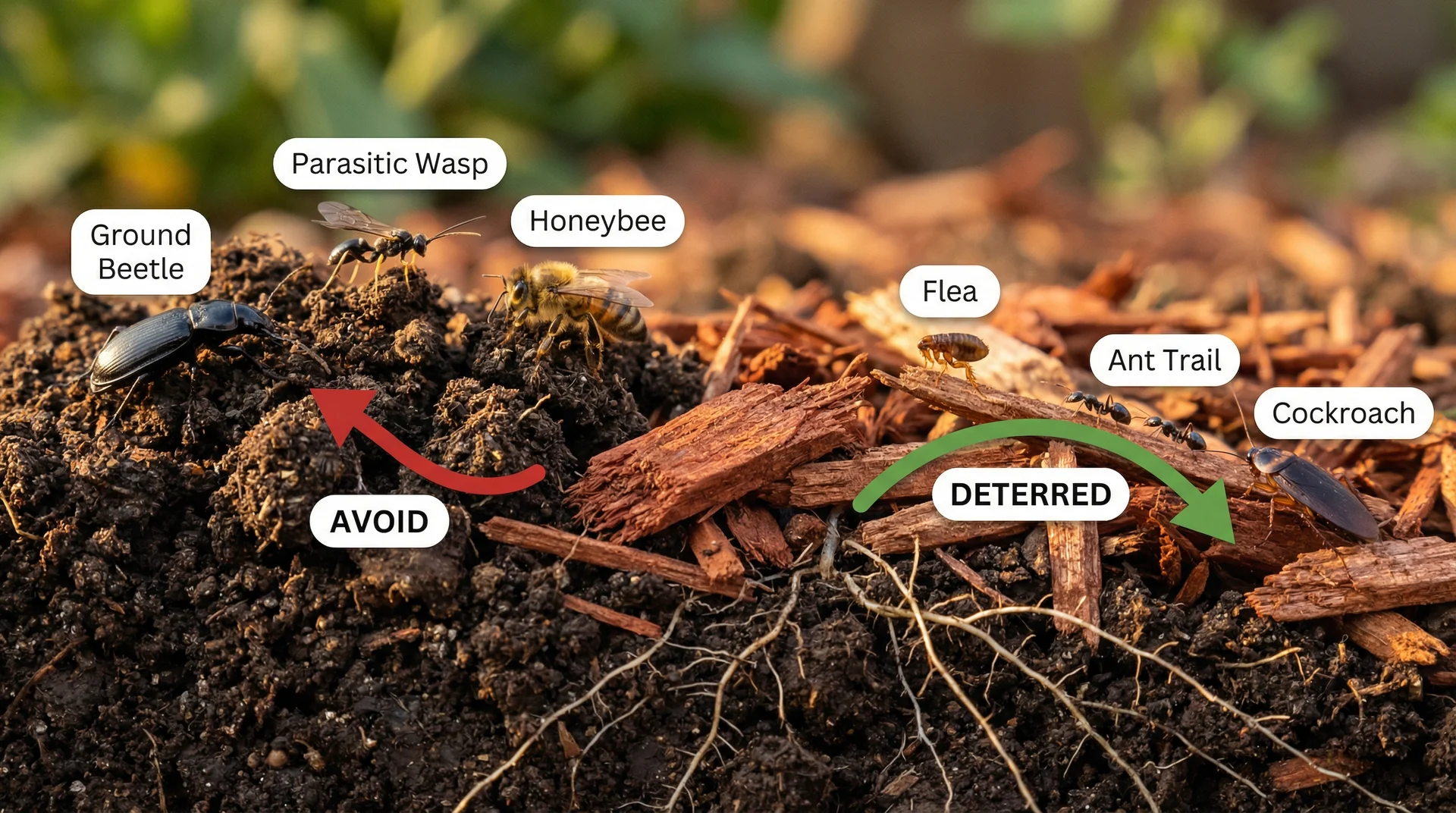
The natural oils in cedar, particularly thujopsene and cedrene, genuinely deter several pest species. Fleas find cedar strongly unappealing, making it a practical choice for households with pets.
A study published in the Journal of Economic Entomology found that cedar mulch reduced Argentine ant nest activity compared to cypress and pine straw mulches. This is meaningful for anyone who has dealt with ant colonies tunnelling through their garden beds.
Cedar also creates an inhospitable environment for certain moth larvae and cockroaches, which is why cedar wood has been used in wardrobes for generations. In the garden, this translates to a reduced likelihood of soil-dwelling larvae causing root damage near your mulched beds.
Where this benefit matters most:
- Around the perimeter of the home, particularly near foundations, where fleas, ants, and cockroaches seek entry.
- In pet-friendly garden zones.
- Along pathways where you want to minimise insect activity underfoot.
- Around ornamental shrubs vulnerable to specific pest pressure.
The Durability and Appearance Hold Up Through the Seasons
Cedar mulch holds its colour and structure longer than most organic alternatives. Even the normal mulch is highly durable, but it won’t be fair a comparison to cedar mulch which is superior.
Fresh cedar has a warm reddish-brown tone that looks beautiful and gives a garden a polished, intentional appearance. Over time, it weathers to a softer silver-grey that suits naturalistic and cottage-style gardens equally well.
In high-wind areas or on properties with strong irrigation systems, cedar’s interlocking fibres prevent the displacement that lighter mulches suffer. I have seen pine straw migrate halfway across a garden after a heavy storm.
Cedar beds, even on slight slopes, tend to stay put. That structural stability reduces maintenance time and keeps garden beds looking intentional rather than chaotic after bad weather.
Moisture Retention Works Reliably Across Climates
Cedar mulch reduces soil moisture evaporation by creating an insulating layer between the soil surface and the open air. This means your soil dries out more slowly between watering sessions, which benefits plant roots during dry spells and reduces your overall irrigation needs.
I worked on a project in a drought-prone California neighbourhood where water conservation was a genuine priority. We used a 3-inch cedar mulch layer throughout the ornamental beds and around established fruit trees.
Over that first summer, the client reported watering her trees about 30% less frequently while maintaining the same soil moisture levels she had tracked. The cedar mulch paid for itself in that single season through water savings alone.
The Honest Cons of Cedar Mulch
Cedar Can Disrupt the Beneficial Insect Community
This is the concern I take most seriously, and the one I discuss most with clients before they commit to cedar mulch across an entire garden.
The same volatile oils that repel fleas and ants also deter ground beetles, parasitic wasps, and certain beneficial beetles that prey on aphids and other garden pests.
When cedar mulch covers large areas, particularly areas adjacent to flowering plants, you can inadvertently reduce the population of insects vital for pest management and pollination.
I noticed this firsthand in a project where cedar mulch had been applied broadly around a mixed perennial border that included lavender, salvia, and echinacea. The plants were healthy, but the pollinator activity was noticeably lower than in comparable gardens I had worked on nearby.
We eventually pulled the cedar back from that border and replaced it with a fine bark mulch, and the insect activity recovered meaningfully over the following growing season.
The practical guideline I follow in my own designs:
| Garden Zone | Cedar Mulch Suitable? | Recommended Instead |
|---|---|---|
| Pathways and hardscape edges | Yes, ideal | N/A |
| Around established trees and shrubs | Yes, works well | N/A |
| Pollinator garden borders | Use with caution | Fine bark or leaf mold |
| Vegetable and kitchen garden beds | Not recommended | Compost, straw |
| Annual flower beds | Use with caution | Shredded hardwood |
| Foundation plantings | Yes, excellent choice | N/A |
| Cottage garden borders | Limited use | Shredded hardwood |
Cedar Costs More Upfront Than Most Organic Mulches
Cedar mulch typically runs between 5and5 and 5and9 per cubic foot, depending on your region, the supplier, and whether you choose shredded cedar bark or chipped cedar heartwood.
By comparison, basic hardwood mulch often runs 3to3 to 3to5 per cubic foot, and locally sourced wood chips can come free or at a very low cost.
For a small garden bed, the price difference feels marginal. For a large landscape project, that cost difference becomes a genuine budget conversation.
I always present clients with the full cost picture: yes, cedar costs more upfront, but because it needs replacing less frequently, the three-year cost comparison often shifts in cedar’s favour.
For budget-conscious homeowners on expansive properties, a hybrid approach using cedar in high-visibility or high-traffic zones and a more affordable mulch in secondary areas often makes the most practical sense.
Cedar Slows Soil Enrichment
Cedar’s slow decomposition rate, which you gain as a durability benefit, also means it contributes less organic matter to your soil over time compared to faster-decomposing mulches.
If your soil is already rich and well-structured, this is not a significant concern. If you are building up depleted urban soil or trying to support heavy feeders like vegetables and annual flowers, you want a mulch that actively contributes to soil biology as it breaks down.
A simple way to address this: apply a thin layer of compost directly to the soil surface before laying your cedar mulch on top.
The compost feeds your soil and its microbial community, and the cedar sits above it as the protective, weed-suppressing cover layer. This layered approach gives you the best of both materials without compromising either function.
Freshly Applied Cedar Can Temporarily Affect Soil Nitrogen
This effect surprises many people. When fresh cedar mulch begins breaking down, the decomposition process temporarily draws nitrogen from the surface layer of your soil.
Soil microbes consume available nitrogen as they work to break down the carbon-heavy wood fibres, which can create a brief nitrogen deficit at the soil surface.
This effect is most pronounced when:
- You work fresh cedar mulch directly into the soil (something you should avoid entirely).
- You apply it very thickly around plants that are nitrogen-sensitive or already stressed.
- You use it around newly planted annuals or seedlings with shallow root systems.
Established trees and shrubs with deep root systems pull nitrogen from well below the mulch layer, so this temporary depletion does not affect them meaningfully.
The issue mainly arises with shallow-rooted plants or seedlings planted immediately after mulching. My standard practice is to wait two to three weeks after laying cedar mulch before planting annuals into a bed, which gives the surface dynamics time to stabilise.
Cedar Mulch Compared to Other Common Mulches
Because I work across a wide range of garden styles and climates, I use many different mulching materials depending on what each zone of a garden needs. Here is how cedar measures up against the alternatives most homeowners seriously consider:
| Mulch Type | Weed Suppression | Pest Deterrence | Soil Enrichment | Durability | Cost (Relative) | Best For |
|---|---|---|---|---|---|---|
| Cedar Mulch | Excellent | Strong | Low | High | Medium-High | Ornamental beds, pathways, around trees |
| Pine Straw | Good | Low | Medium | Medium | Low-Medium | Acid-loving plants, slopes |
| Shredded Hardwood | Very Good | Low | Medium-High | Medium | Low-Medium | General garden use |
| Cypress Mulch | Very Good | Medium | Low | High | Medium | Ornamental beds (sustainability concerns) |
| Compost | Moderate | Low | Excellent | Low | Low-Medium | Vegetable beds, annual borders |
| Rubber Mulch | Excellent | None | None | Very High | High | Playgrounds, commercial settings |
| Gravel or Stone | Good | None | None | Permanent | Medium-High | Xeriscaping, rock gardens |
| Leaf Mold | Moderate | Low | Excellent | Low | Very Low | Woodland gardens, soil building |
The table above reflects my honest working experience with each material. None is universally superior because every garden has different zones with different needs.
The mistake most people make is choosing one mulch for the entire property and applying it uniformly everywhere, which is rarely the most effective or sustainable approach.
Where Cedar Mulch Genuinely Belongs in Your Garden
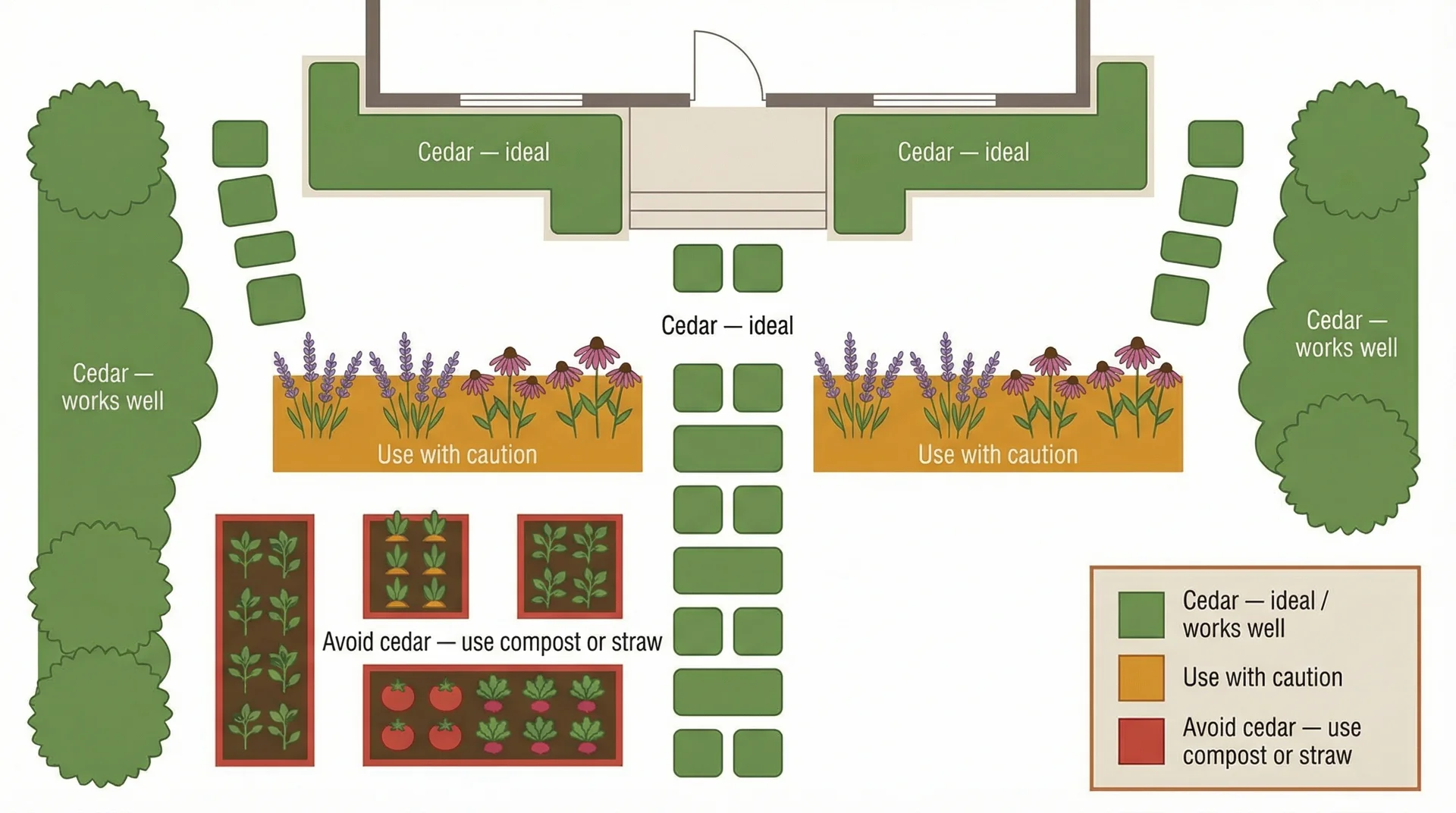
I want to give you a specific, practical picture of the situations where cedar mulch consistently performs at its best, drawn from the residential projects I have worked on over the years.
Around Established Trees and Large Shrubs
Cedar mulch performs exceptionally well when used in a proper mulch ring around mature trees and established shrubs. A 2 to 4 inch layer extending out to the drip line suppresses grass competition, retains soil moisture, moderates soil temperature, and protects surface roots from compaction.
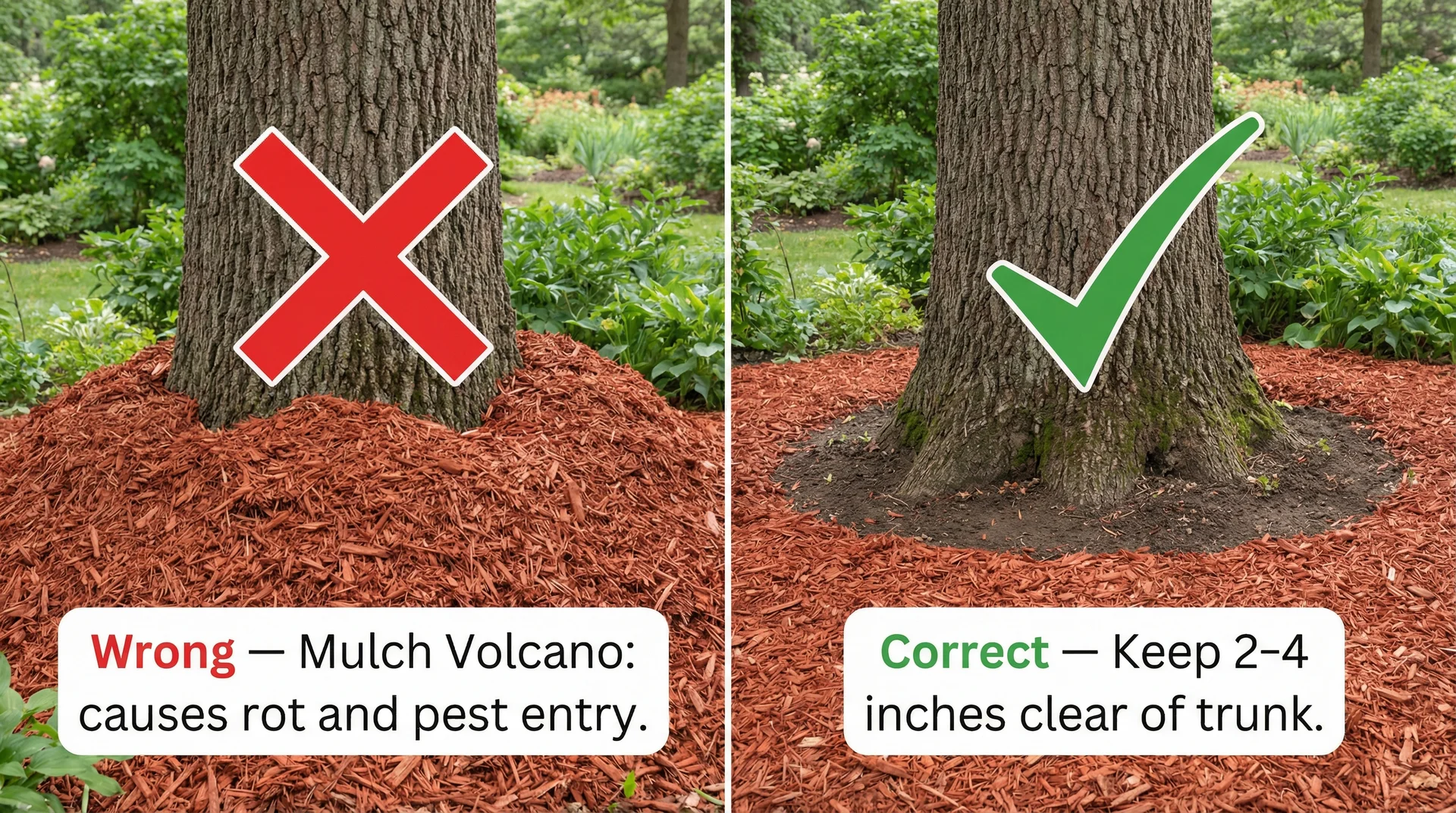
The one absolute rule here: keep the mulch several inches away from the trunk itself.
Mulch piled against a trunk, often called a “mulch volcano,” traps moisture against the bark and creates conditions for fungal rot and pest entry.
Along Pathways and Hardscape Edges
Cedar mulch is one of my first choices for filling in between stepping stones or lining the edges of formal garden pathways.
Its density and fibre structure handle foot traffic better than lighter materials, it stays in place without heavy edging, and it contributes to that polished, finished quality that makes a garden look like a considered design.
The natural scent also adds a pleasant sensory element to a walk through the garden, which clients consistently love.
In Front-Yard Foundation Planting Beds
The area between a home’s foundation and the public street benefits enormously from cedar mulch.
Pest deterrence near the foundation is genuinely useful here; weed suppression keeps the area looking maintained with minimal effort, and durability means the beds hold their appearance through the year without much intervention.
For clients who want a low-maintenance front yard that always looks sharp, cedar in the foundation beds is almost always part of my recommendation.
In Large Ornamental Beds Away from Pollinators
Formal rose gardens, structured evergreen shrub plantings, ornamental grass borders, and similar planting schemes that do not depend heavily on pollinator or beneficial insect activity are well-suited to cedar mulch.
These beds benefit from the weed suppression and moisture retention without the trade-off that would concern me in a pollinator-focused planting.
How to Apply Cedar Mulch the Right Way
Even the best mulching material can cause problems when applied poorly. Here is the approach I use across every project, refined through much trial and observation over the years.
- Prepare the bed before you mulch. Clear existing weeds by hand or with a hoe, and give the soil a good drink of water if conditions are dry. Mulching over dry soil locks in the dryness rather than the moisture, which defeats the purpose.
- Aim for a depth of 2 to 4 inches. This range gives you effective weed suppression and moisture retention without smothering the soil. Going deeper than 4 inches can reduce oxygen exchange and create anaerobic conditions that harm root systems over time.
- Keep mulch away from plant stems and tree trunks. Leave a clear ring of 2 to 4 inches around every plant base. This is the most consistently ignored piece of mulching advice, and ignoring it causes real problems, including crown rot, bark deterioration, and pest harborage.
- Fluff and refresh rather than layer over old mulch every season. Cedar mulch does not always need replacing each year, but it does benefit from being gently raked and turned over to restore its texture and aeration. Top up with fresh material only when the existing layer has compacted and thinned to below 2 inches.
- Consider a compost layer beneath the cedar if your soil needs building. A half-inch layer of finished compost applied to the soil surface before laying cedar mulch gives your soil biology a feed while the cedar above it handles the practical work of weed suppression and moisture retention.
Common Cedar Mulch Questions I Get Asked Often
Will cedar mulch kill my plants?
Established plants with developed root systems handle cedar mulch without issues when applied correctly at the right depth and kept away from stems.
The concern arises specifically with seedlings and fresh transplants, where mild allelopathic compounds and temporary nitrogen draw during decomposition can cause stress.
I recommend waiting until transplants are well-established before mulching around them with cedar, and I avoid using cedar in beds where I am direct-sowing seeds.
Does cedar mulch actually keep termites away?
Cedar heartwood contains compounds that termites find unappealing. Research supports the idea that fresh, intact cedar heartwood acts as a deterrent.
The complication is that mulched cedar, which has been shredded and is actively decomposing, offers less of this protection than solid cedar wood.
Using cedar mulch against a house foundation may reduce termite pressure somewhat, but it will not provide complete protection, and I would never recommend relying on it as a sole termite management strategy in regions with high termite pressure.
Is cedar mulch safe for pets and children?
Generally, cedar mulch is considered safe for pets and children. The natural oils are typically not harmful in incidental contact. However, I always advise against pets consuming large quantities of any mulch, as it can cause digestive upset.
For very young children who explore by putting things in their mouths, a finer, less aromatic mulch like composted bark might be a gentler option, but cedar itself is not toxic in the way some chemically treated mulches can be.
How often do I need to replace cedar mulch?
Under most conditions, cedar mulch holds its structure well for two to three years before it needs significant replacement. An annual refresh, which involves fluffing the existing layer and topping up thin spots, is often sufficient for the first couple of years.
The colour fades from its original warm brown to a grey tone over time, which some gardeners find equally appealing in a naturalistic setting.
Can I use cedar mulch in my vegetable garden?
I personally avoid cedar mulch in dedicated vegetable beds.
The allelopathic compounds can affect seed germination; the slow decomposition does not contribute to the soil fertility that heavy-feeding vegetables need, and the potential impact on beneficial insects, including pollinators, matters significantly in a productive food garden.
Compost, straw, or fine bark mulch serves vegetable gardens much better.
The Bottom Line on Cedar Mulch for Your Sustainable Garden
Cedar mulch earns its reputation as a premium landscaping material when you use it in the right places and with the right expectations. It suppresses weeds reliably, retains moisture effectively, deters a wide range of pest insects, and holds its visual quality longer than most alternatives.
These are real, meaningful benefits that translate to less maintenance time and healthier plants in the appropriate garden zones.
The limitations are equally real. Cedar’s impact on beneficial insects deserves genuine consideration before you spread it through a garden that depends on pollinators and predatory insects.
It’s slower contribution to soil organic matter means it works best in zones where you are maintaining established plants rather than actively building soil health.
And the upfront cost, while justified by longevity, requires honest budget planning for large-scale applications. From a sustainability perspective, always seek cedar mulch from responsibly managed forests to align with eco-conscious gardening practices.
What I have found across years of garden design work is that the gardens where cedar mulch performs best are those where someone has thought carefully about each zone’s function and chosen materials accordingly.
Cedar at the foundation, along the pathways, and around the mature ornamental shrubs. A richer organic mulch in the vegetable garden and the pollinator borders.
That kind of intentional, zone-specific approach consistently produces healthier, more beautiful, and more sustainable gardens than any single-material approach ever does.