
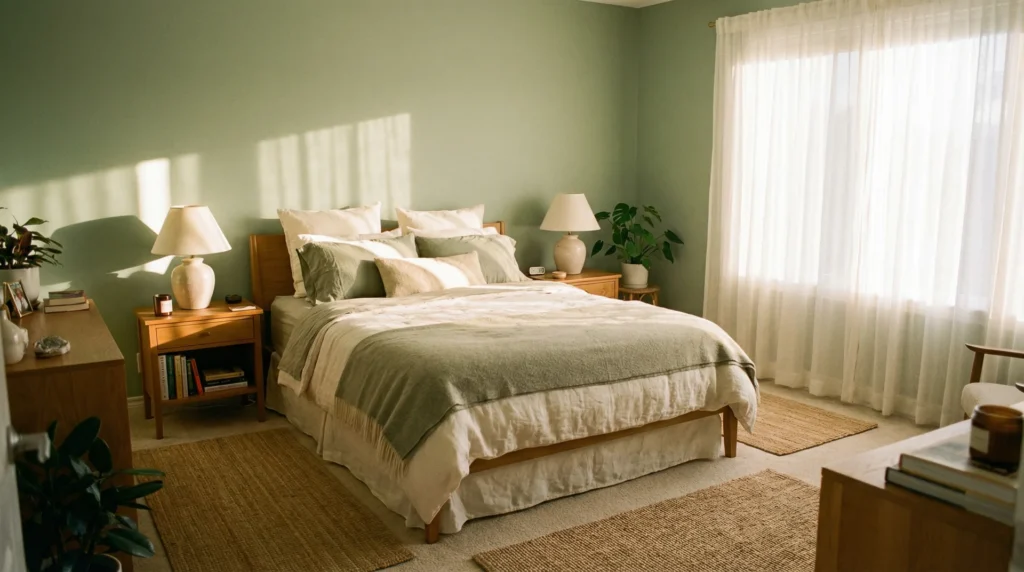
Years ago, I walked into a client’s bedroom and felt it immediately. The room had gorgeous furniture, a beautiful window that let in the morning light, and freshly painted walls in the softest sage green you could imagine.
Yet something about being in that room made me feel uneasy, almost restless. The bed sat at an angle in the corner, the dresser blocked the window by about a foot, and you had to shuffle sideways to get to the closet. The furniture was fighting the room instead of living inside it.
That discomfort you feel in a poorly arranged bedroom is real, and it goes deeper than aesthetics.
After a decade working in residential design, first as a design consultant for a regional furniture retailer and later running my own interior styling practice, I have seen this exact problem in more homes than I can count.
Homeowners invest in beautiful pieces, spend hours choosing the right colors, and still end up with a bedroom that feels off. The reason almost always comes back to furniture placement.
So let me give you the short answer first, because I know that is why you are here.
| Place your bed on the wall opposite or adjacent to the main entry door, keep a minimum of 24 to 36 inches of clearance around walkable sides, and build every other furniture decision around that anchor point. |
Everything else, the dresser, the nightstands, the seating, grows from that one decision. Once you anchor the bed correctly, the rest of the room tends to fall into place with far less effort than most people expect.
If you want to understand why some bedrooms feel like sanctuaries while others feel like storage units you happen to sleep in, keep reading.
Before Moving Bedroom Furniture: Know What You Are Working With
Most arrangement frustration starts because people try to place furniture before they understand the room. Walking through this inventory first saves you from moving the same heavy dresser three times.
The Standard Bedroom Furniture Inventory
A functional bedroom typically works with these pieces, and knowing which ones you actually need before you start planning prevents the room from becoming overcrowded before you have even begun.
Essential pieces:
- Bed frame and headboard
- Mattress (size determines everything else, so confirm this first)
- At least one nightstand, ideally two for a shared bedroom
- Primary storage: dresser, wardrobe, or built-in closet
Secondary pieces (add only if the room supports them):
- Bench or ottoman at the foot of the bed
- Accent chair or reading seat
- Vanity or dressing table
- Bookcase or open shelving unit
The number of secondary pieces your room can hold depends entirely on the square footage and clearance your layout allows. A common mistake I see is treating all of these as essentials rather than options.
Why Layout Matters More Than the Furniture Itself
Research in environmental psychology consistently links bedroom layout to sleep quality and stress levels.
A study published in the Journal of Environmental Psychology found that spatial clutter and disrupted circulation paths in sleeping environments contribute to elevated cortisol levels and reduced sleep onset efficiency. In plain terms, a poorly arranged room makes it harder for your brain to switch off.
I started asking clients about their sleep quality before I even looked at their floor plan. The clients who mentioned waking up tired, or who said the room never felt restful, almost always had one thing in common.
Their bed was positioned in a way that created either a blocked sightline to the door or a cluttered circulation path. The brain reads both as low-level threats, and the nervous system stays slightly activated because of it.
The Most Common Mistakes People Make (And Why They Happen)
| Mistake | Why It Happens | What It Costs You |
|---|---|---|
| Pushing all furniture against the walls | Feels like it opens the centre | Makes the room feel hollow and institutional |
| Placing the bed in a corner | Trying to “save space.” | Blocks one person’s entry, creating an imbalance |
| Blocking windows with tall furniture | Default placement without a plan | Loses natural light and visual breathing room |
| Overloading one side of the room | Adding pieces without a floor plan | Creates visual heaviness and disrupts flow |
| Choosing furniture too large for the room | Buying for looks over dimensions | Makes even a reasonable layout feel suffocating |
These happen because most people arrange furniture based on what feels logical in the moment, rather than what serves the room’s dimensions and daily function over time.
Measure and Plan Before You Move a Single Thing
Planning sounds tedious, I know. But every single client who let me insist on measurement first sent me a message afterward saying it saved them from at least one costly mistake.
How to Measure Your Room Properly
Measure the full length and width of the room, ceiling height, and every piece of furniture you plan to use. Then note the following in your room sketch:
- The position and swing width of every door
- The position, width, and sill height of every window
- The location of electrical outlets, switches, and vents
- Any fixed features like radiators, alcoves, or built-in wardrobes
Draw a Floor Plan (Even a Rough One)
You do not need software for this. A piece of graph paper where each square represents one foot works well. Draw the room to scale, mark all fixed elements, and cut out small paper rectangles scaled to your furniture dimensions. Move those paper cutouts around on the floor plan before you move a single piece of actual furniture.
Free digital tools like Roomstyler or IKEA’s room planner work well if you prefer a screen-based option.
The Clearance Numbers You Need to Know
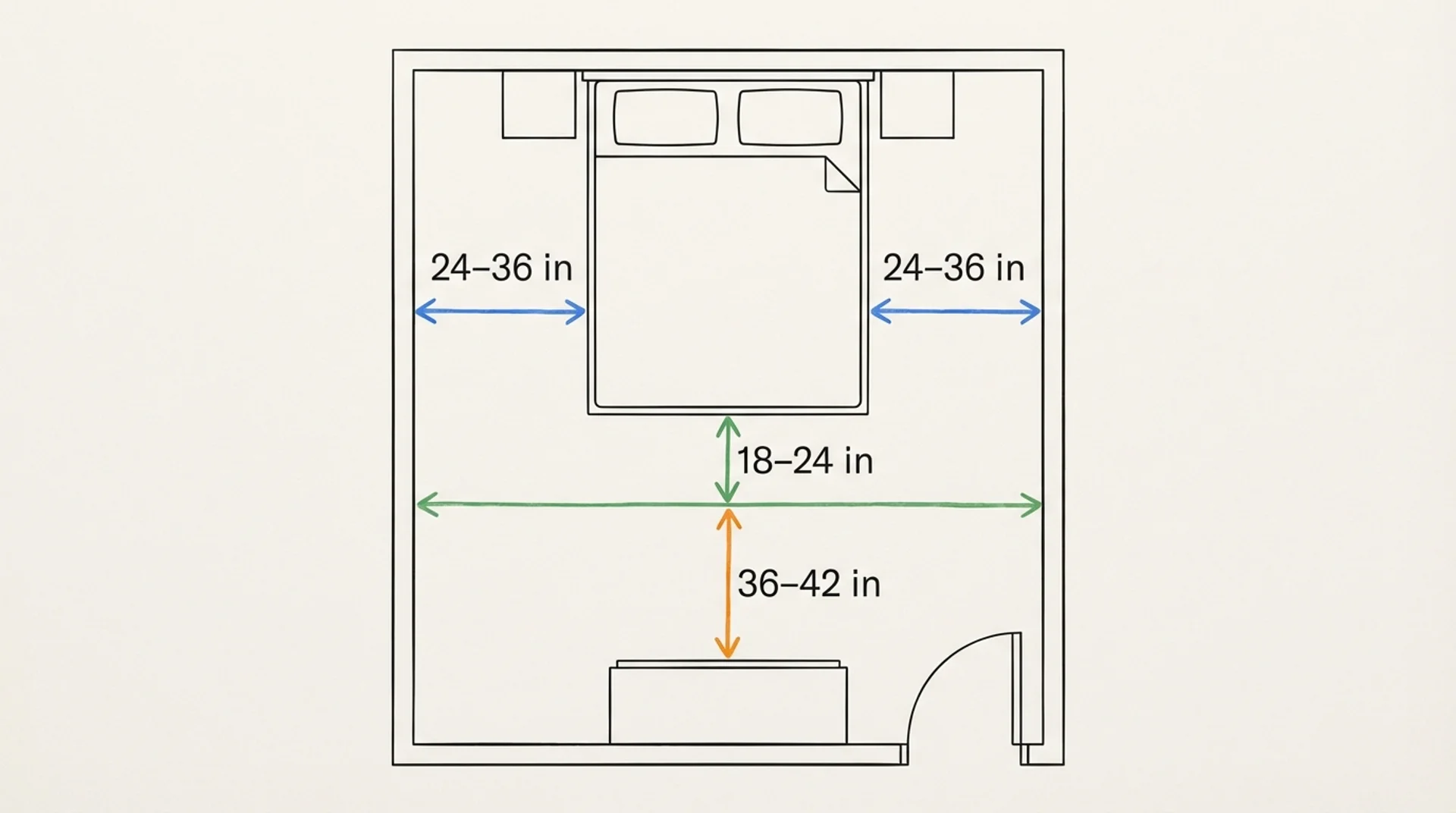
Clearance, meaning the walkable space between and around furniture, determines whether a room feels livable or just full. These are the measurements I work with across every project:
| Area | Minimum Clearance | Ideal Clearance |
|---|---|---|
| Walking on the sides of the bed | 24 inches | 30 to 36 inches |
| Foot of the bed (to next piece) | 18 inches | 24 inches |
| In front of the dresser drawers | 36 inches | 42 inches |
| Wardrobe or closet door swing | Full door width + 12 inches | Full door width + 18 inches |
| Main circulation path | 36 inches | 42 inches |
When a bedroom feels cramped, the furniture is rarely the actual problem. The missing clearance is.
The Bed: The One Placement Decision That Changes Everything
The bed is the largest piece of furniture in the room and carries the most visual weight. Every other placement decision you make will either support or compete with where the bed sits.
The Commanding Position (And Why Feng Shui Got This Right)
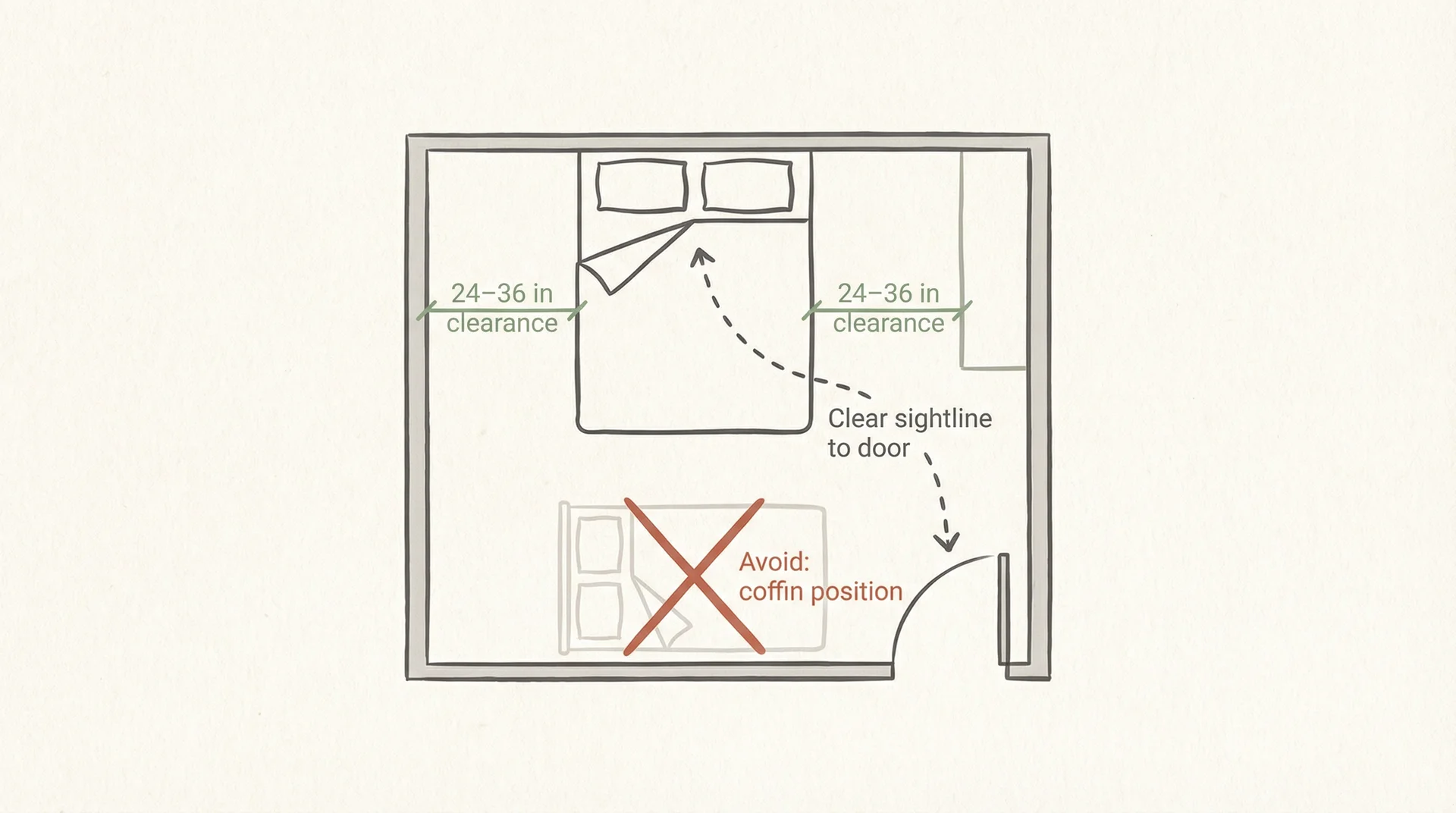
The most universally effective bed placement puts the headboard against the wall that faces the entry door, without being directly in line with it.
Interior designers call this the commanding position, and it appears in Feng Shui principles for the same reason it appears in spatial psychology: when you can see the door from the bed without being in the direct path of whoever opens it, the brain reads the room as safe and settled.
Beyond the psychological benefit, the commanding position almost always produces the most visually balanced layout because it creates symmetry on both sides of the bed.
The wall you choose for the bed should ideally:
- Allow the headboard to rest against a solid wall with no window directly behind it (drafts, glare, and curtain interference make this uncomfortable over time)
- Centre the bed so both sides have roughly equal clearance, giving two people equal access
- Keep the bed away from the main door’s direct swing path
Can a Bed Face the Door?
This comes up often, and the short answer is: facing the door is fine, being directly in line with it is not.
A bed placed so your feet point directly at an open door can feel unsettling, and in Feng Shui, this is specifically called the “coffin position.” The discomfort most people feel is real, even if the reasoning behind it varies. Position the bed so the door is visible from it but not directly aligned with the foot of the bed.
Bed Placement by Room Size
Specific room dimensions change, which layouts are actually possible, and this is where most general guides leave readers without real answers.
10×10 bedroom: This is one of the tightest standard bedroom sizes. A full or queen bed on the shortest wall works, but you will likely have only one accessible side. Opt for a wall-mounted nightstand on the less accessible side to maintain functionality without eating into floor space. Skip secondary furniture entirely unless the closet is built-in and takes storage off the floor plan.
10×12 bedroom: A queen bed fits comfortably on the 12-foot wall with 24 to 30 inches of clearance on both sides. A slim dresser fits on the 10-foot wall opposite. This size supports one nightstand on each side of the bed if they are compact.
12×12 bedroom: A queen or small king works here. Centering the bed on one of the walls gives you a balanced, commanding position arrangement. A dresser fits on the adjacent wall with full drawer clearance, and a single accent chair in the corner near the window is possible without compromising circulation.
12×14 or larger: This size gives you genuine layout flexibility. A king bed becomes viable. You can include a seating piece at the foot of the bed and a full dresser with comfortable clearance. Floating the bed slightly away from the wall (4 to 6 inches) creates a more intentional, finished look.
For shared bedrooms and couples specifically, both sides of the bed should have at least 24 inches of clearance and a functional nightstand.
I have seen too many shared bedrooms where one person climbs over the other to get in and out of bed simply because the accessible-side clearance was not accounted for in the planning stage. Equal access is not a luxury; it is a basic functionality requirement for a two-person bedroom.
Bed Placement by Room Shape
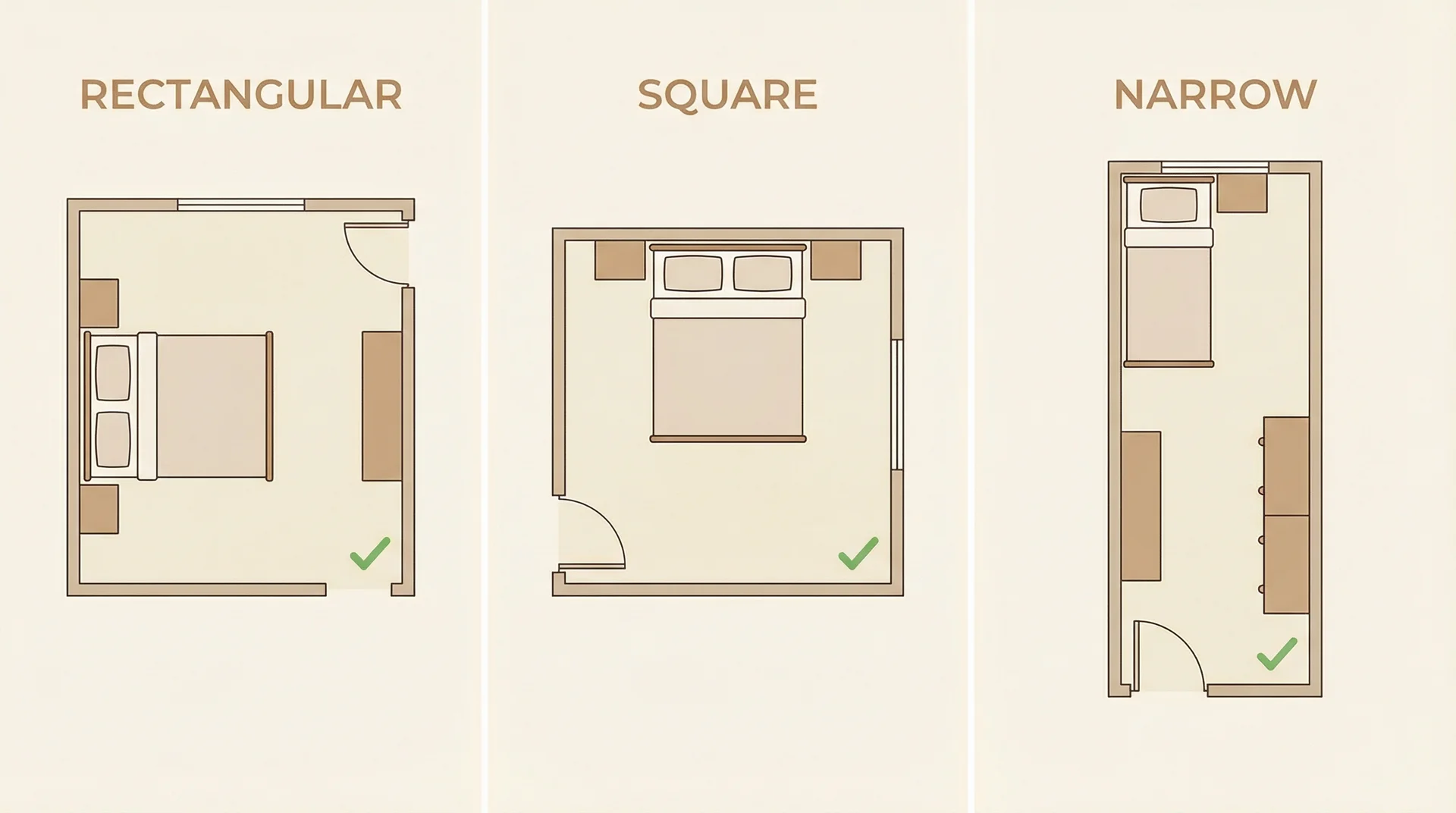
Rectangular rooms: Place the bed on one of the shorter walls so it faces the length of the room. This makes the room feel proportionate and gives you a clear visual axis for the remaining furniture.
Square rooms: Centering the bed on any wall tends to work well. Resist the temptation to push everything to the perimeter. Floating the bed slightly away from side walls creates a more finished look, even in a compact square room.
Long, narrow rooms: The instinct is to place the bed along the long wall, but this makes the room feel like a hallway. Center the bed on the narrow wall instead and run a longer dresser or wardrobe along one of the long walls to add visual width.
L-shaped or irregular rooms: Use the most recessed section for the sleeping area. A low bookcase or bench can subtly mark where the sleeping zone begins without building a wall. A round rug in the center of an irregular room creates a visual anchor that makes the asymmetry feel intentional.
The Small Bedroom: How to Make It Feel Enough
Small bedrooms are something I find genuinely interesting to work in because the constraints force creative thinking that larger rooms simply do not require. The goal is never to make a small room look big. The goal is to make it feel enough, which is a different and far more achievable target.
Furniture Choices That Work for Small Rooms
Choose furniture with legs over furniture that sits flush to the floor. Beds and nightstands with visible legs create the impression of more floor space because the eye can see the floor continuing beneath the furniture.
Go taller rather than wider. A tall, narrow dresser takes up less floor space than a wide, low one and usually offers more storage. Vertical space is underused in almost every small bedroom I have ever worked in.
Multifunctional pieces are worth the investment. An ottoman that opens for storage, a bed frame with built-in drawers, a nightstand with deep shelves rather than a flat surface: these reduce the total number of pieces the room needs to carry.
Consider a wall-mounted headboard. Removing the traditional bed frame’s headboard footprint and mounting a padded headboard directly to the wall saves 6 to 8 inches of depth, which genuinely transforms tight spaces.
Visual Strategies That Actually Work
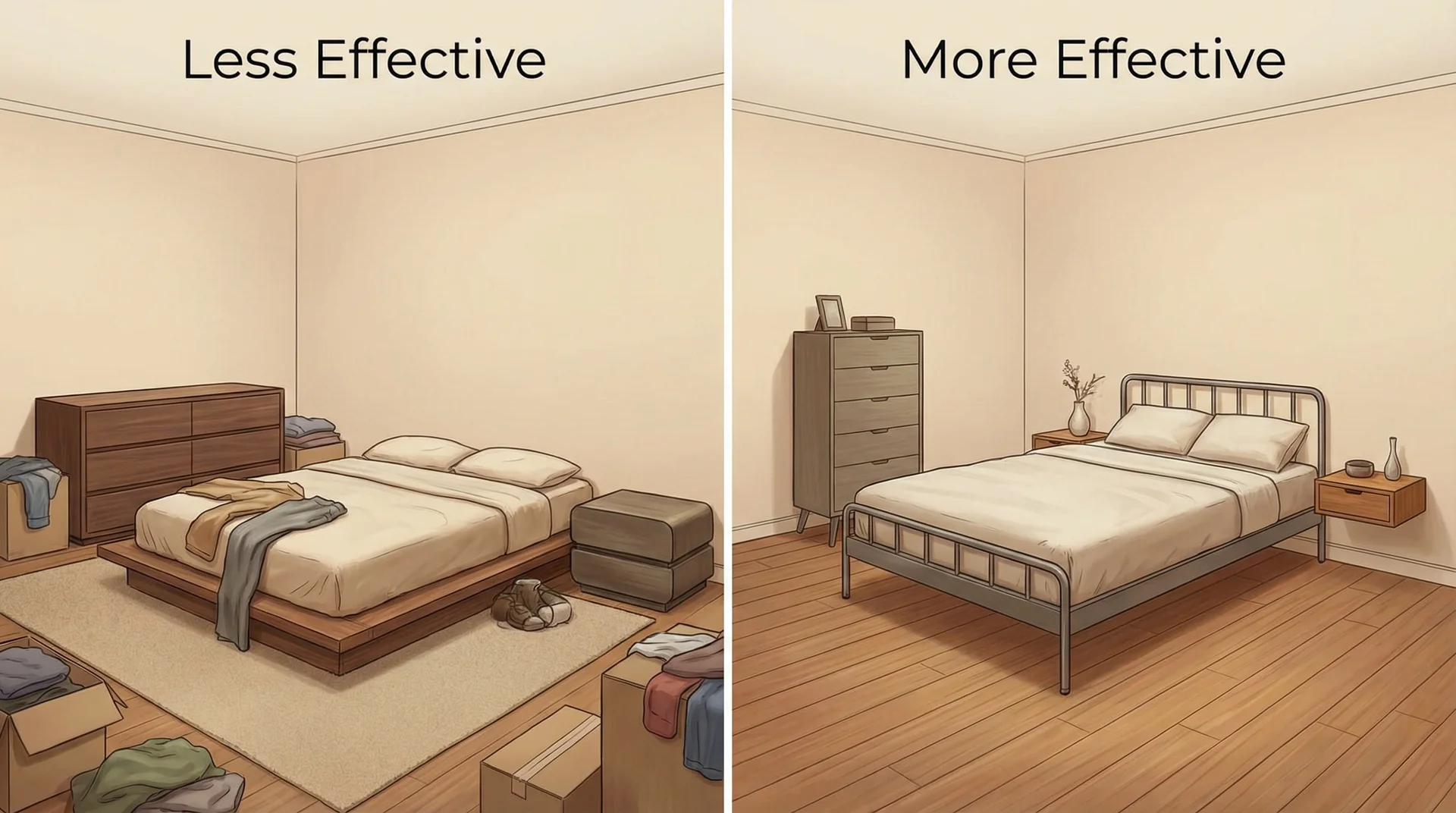
- A large mirror on the wall opposite or adjacent to the window reflects light and creates depth
- Curtains hung close to the ceiling and falling to the floor make the ceilings feel higher
- A cohesive, light palette on walls and bedding makes the room read as more unified and less segmented
- Keeping as much floor visible as possible, even minimally, makes the space feel larger
Furniture by Function: Where Each Piece Belongs and Why
Nightstands and Bedside Lighting
Nightstands should sit at roughly the same height as your mattress top, or within two to three inches of it. Reaching up or bending down to access your water, book, or lamp in the night disrupts your sleep in a small but consistent way.
If your room does not have space for traditional nightstands:
- Wall-mounted floating shelves at mattress height take up zero floor space
- A slim C-shaped side table that tucks partially under the bed frame
- A bedside caddy that hangs from the mattress base works for the smallest rooms
For lighting, a wall-mounted sconce with a swing arm is one of the most useful bedside additions in a small room because it frees the nightstand surface entirely.
Dressers and Storage Placement
The dresser tends to land wherever there is leftover wall space after the bed goes in, and that approach almost always creates a problem later. Think about the dresser as part of your morning routine. You open it in low light, sometimes while someone else is still sleeping. Its placement should support that habit.
I recommend placing the dresser where your best natural light falls during your getting-ready time, usually near the window but positioned so it does not block the light path into the room. One thing I always check: confirm the dresser drawers have full clearance to open completely. I have seen beautifully planned rooms where drawers could only open three-quarters of the way because of a tight wall angle that no one caught during planning.
Seating: When It Adds Value and When It Just Gets in the Way
A bench at the foot of the bed looks and functions beautifully, as long as the room has enough depth to support it without eating into the circulation path. The clearance between the bed and the bench should be at least 18 inches, ideally 24 inches.
For smaller rooms, a single upholstered chair in the corner near the window often adds more value than a bench because it creates a secondary zone without disrupting the main path through the room. Seating in the bedroom is about creating one moment of comfort beyond the bed itself, and that distinction matters when you are deciding whether to include it at all.
Working With Awkward Rooms
Alcoves and Recesses
If your bedroom has an alcove large enough for the bed, use it. An alcove bed is one of the most space-efficient arrangements possible because the surrounding walls do the visual work of a headboard and nightstands. Add floating shelves within the alcove above and beside the bed to use that space further.
If the alcove is too small for the bed, fit your wardrobe or a built-in shelving unit inside it. Placing storage in a recessed space frees the flat walls for more open, breathable furniture arrangements.
Slanted Ceilings
Map your ceiling height carefully before placing any furniture in a room with slanted sections. Keep your tallest furniture (wardrobes, tall bookshelves) on the walls where the ceiling is at full height, and keep low-profile pieces (the bed, a bench, a nightstand) under or near the slanted sections.
I always ask clients to lie on the floor in the proposed bed position for a few minutes before finalizing a layout in rooms with slanted ceilings. A slope that feels cosy when you are standing can feel oppressive when it falls directly over where you sit up each morning.
Lighting, Color, and Textiles: The Finishing Layers
Lighting Layers and Why They Matter
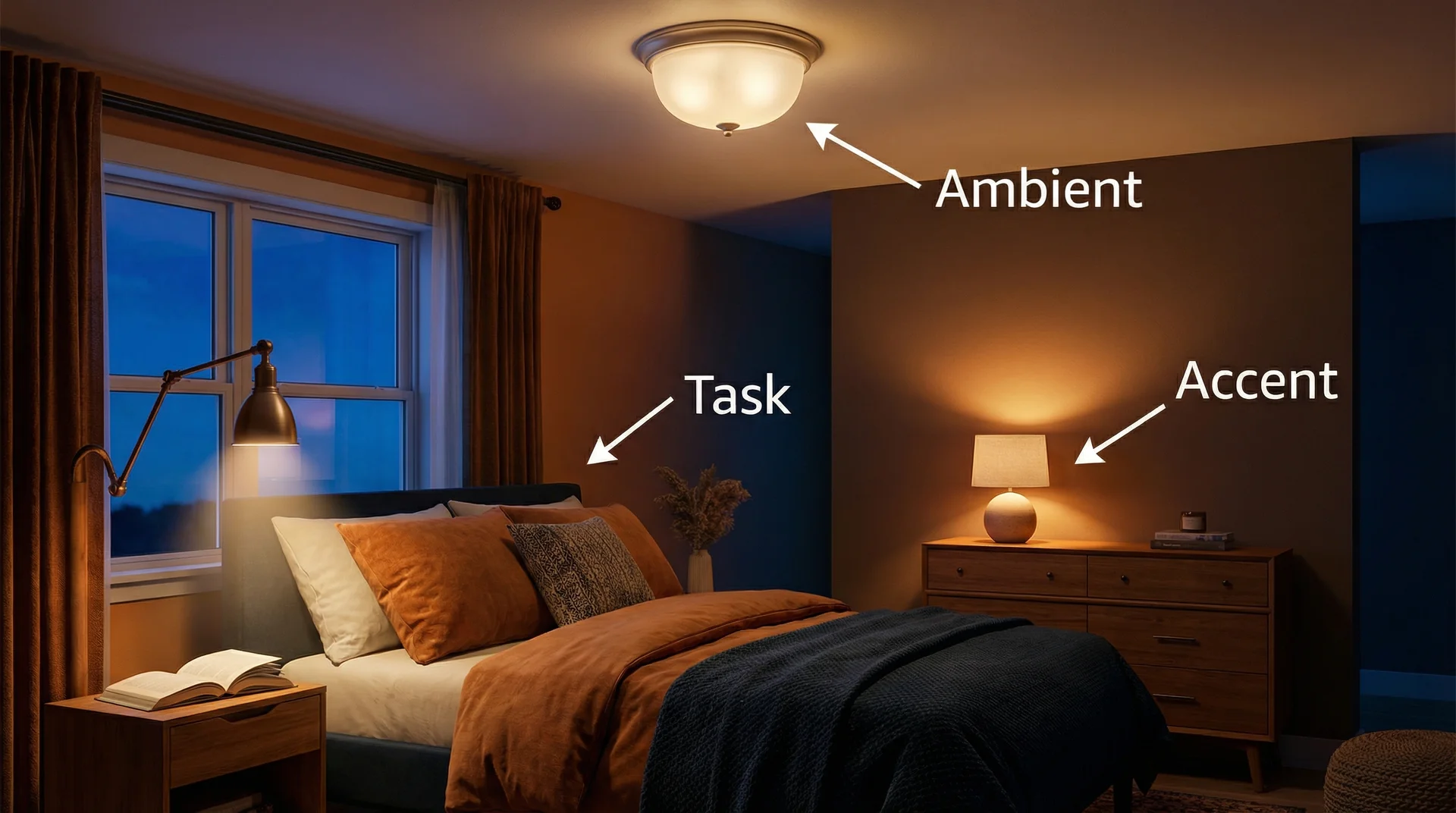
A bedroom with a single overhead light source will never fully feel like a retreat. Overhead lighting is functional but flat. The rooms that genuinely feel like sanctuaries have lighting at multiple heights and with multiple purposes.
| Lighting Layer | Function | Placement |
|---|---|---|
| Ambient | General illumination | Ceiling fixture or recessed lights |
| Task | Reading, dressing, getting ready | Bedside lamps, wall sconces, dresser lamp |
| Accent | Mood and atmosphere | LED strips, warm-toned table lamp |
Warm-toned bulbs in the 2700K to 3000K range contribute meaningfully to evening wind-down. The brain responds to warm light as a sleep signal, so the bulb color is a functional choice, not just an aesthetic one.
Color and Textiles
A color that looks perfect on a paint sample under a store’s fluorescent light can feel completely different at 7 am through east-facing windows. I always recommend ordering paint samples and living with them for at least three days before committing. Check the sample at morning light, midday, and evening.
For textiles, layering different textures within a limited color palette creates richness without visual chaos. A linen duvet, a chunky knit throw, and a velvet pillow in the same neutral family give the eye something interesting to rest on without asking the brain to process too much contrast.
Your Bedroom Arrangement Checklist
Run through this before you move anything. I use a version of this with every new styling client to make sure nothing falls through the gaps.
Planning
- Measure the room’s full dimensions, including ceiling height
- Measure all furniture pieces you plan to use
- Note all doors, windows, outlets, and vents
- Sketch or digitally plan the layout to scale
Bed Placement
- Identify the commanding position wall (facing the door, not in direct line with it)
- Confirm the headboard wall works without a window directly behind it, or plan for how to manage it
- Ensure a minimum of 24 inches of clearance on the walkable sides of the bed
- Centre the bed on its wall where possible
- Confirm both sides have equal access to shared bedrooms
Supporting Furniture
- Nightstands sit at mattress-top height with a full lamp and surface access
- The dresser is positioned with full drawer clearance and accessible morning light
- Wardrobe or closet door swings have at least 12 inches of standing space
- Seating has at least 18 inches of clearance from the foot of the bed
Finishing Layers
- Lighting planned at three levels: ambient, task, and accent
- Paint samples are tested in real conditions before committing
- Textiles layered by texture within a consistent color range
Frequently Asked Questions About Arranging Bedroom Furniture
What is the best wall to place a bed against?
The wall that faces the entry door, without being directly in line with it, tends to work best. This placement, known as the commanding position, gives you a clear sightline to the door from the bed and creates the most naturally balanced layout for the rest of the room’s furniture.
Should a bed face the door?
The bed can face the door, but the foot of the bed should not point directly at the open doorway. This alignment, which Feng Shui refers to as the coffin position, tends to feel unsettling to most people even without knowing why. A slight angle or lateral offset from the door avoids this entirely.
Where should a dresser go in a bedroom?
Near your best natural morning light, on a wall that does not block the window or the main circulation path. Confirm the drawers have at least 36 inches of clearance to open fully before committing to a position.
How do you arrange furniture in a small bedroom?
Start with the bed on the commanding position wall, use furniture with visible legs to create the impression of floor space, go vertical with storage rather than wide, and remove any secondary pieces the room cannot support with proper clearance. Keeping the floor as visible as possible makes the biggest difference.
Can you put a bed in the middle of a room?
In larger rooms (12×14 or above), a bed floated away from the wall with the headboard centred can look intentional and elegant. In smaller rooms, floating the bed wastes floor space you cannot afford to give up, and typically makes circulation worse.
What direction should a bed face for better sleep?
Feng Shui recommends aligning the bed so the head points toward a solid wall with the door in view. From a sleep science perspective, avoiding positions that create drafts from windows behind the head and keeping the bed away from direct door-swing interference tends to produce the most consistent sleep comfort.
A Final Thought
The bedroom arrangement that works for you is the one that supports how you actually live. I have walked away from projects where the technically correct layout did not account for the fact that one client always reads in bed and needed a stronger bedside light, or that another got up before dawn and needed a clear path to the bathroom without turning on any lights.
Your bedroom is working when it disappears into the background of your daily life. When you stop noticing it because it simply works, that is when you know you have the arrangement right.
Take your time with this. Measure, sketch it out, sleep on the idea, and trust that the effort you put into planning now will pay for itself in years of comfort ahead.