
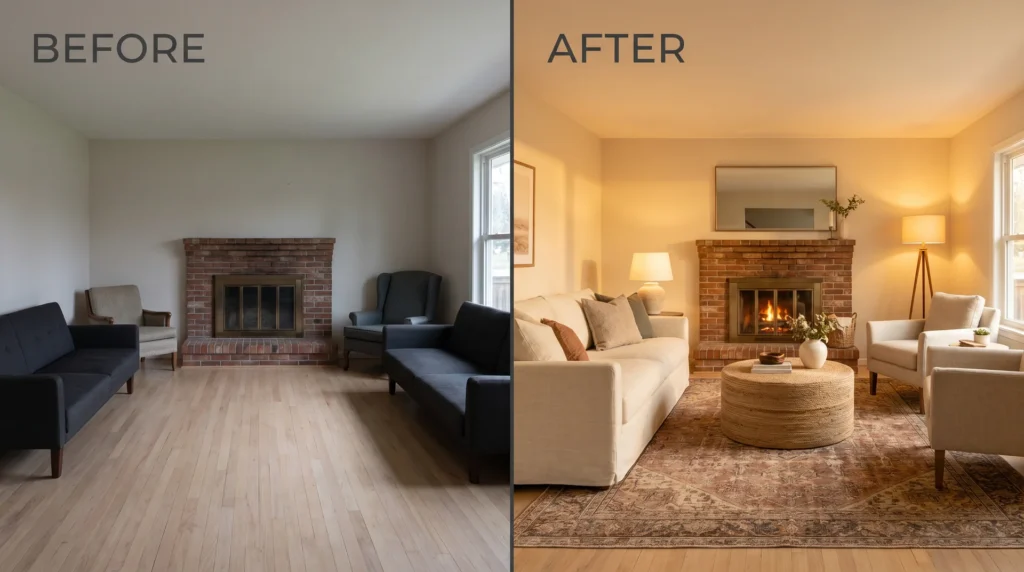
The fireplace was probably the reason you loved the room. You walked in, saw the hearth, and thought: this is it. Then the furniture went in, and nothing about it worked.
The sofa landed in a strange spot, the TV became a whole separate problem, and the room started to feel like a collection of decent pieces that can’t agree on what they’re doing.
You’re not imagining it, and it’s not a taste problem. It’s a layout problem, and layout problems have logical solutions. Most awkward living room layouts with a fireplace can be fixed without renovation. What they need is a different order of decisions.
I’ve worked on rooms like this for over a decade, first as a design consultant, later as an independent styling advisor. The fireplace that promises everything and delivers a layout headache was one of the most common things clients brought to me.
This guide walks through five real before-and-after scenarios, the furniture rules specific to fireplace rooms, and the TV-versus-fireplace conflict resolved properly.
| Design note: All clearance measurements reflect general best practices for residential spaces. For any work involving your fireplace’s gas, electrical, or ventilation systems, consult a licensed contractor before making changes. |
Why a Fireplace Makes Your Living Room Layout Harder Than It Should Be
The Double Focal Point Problem in Living Rooms With a Fireplace
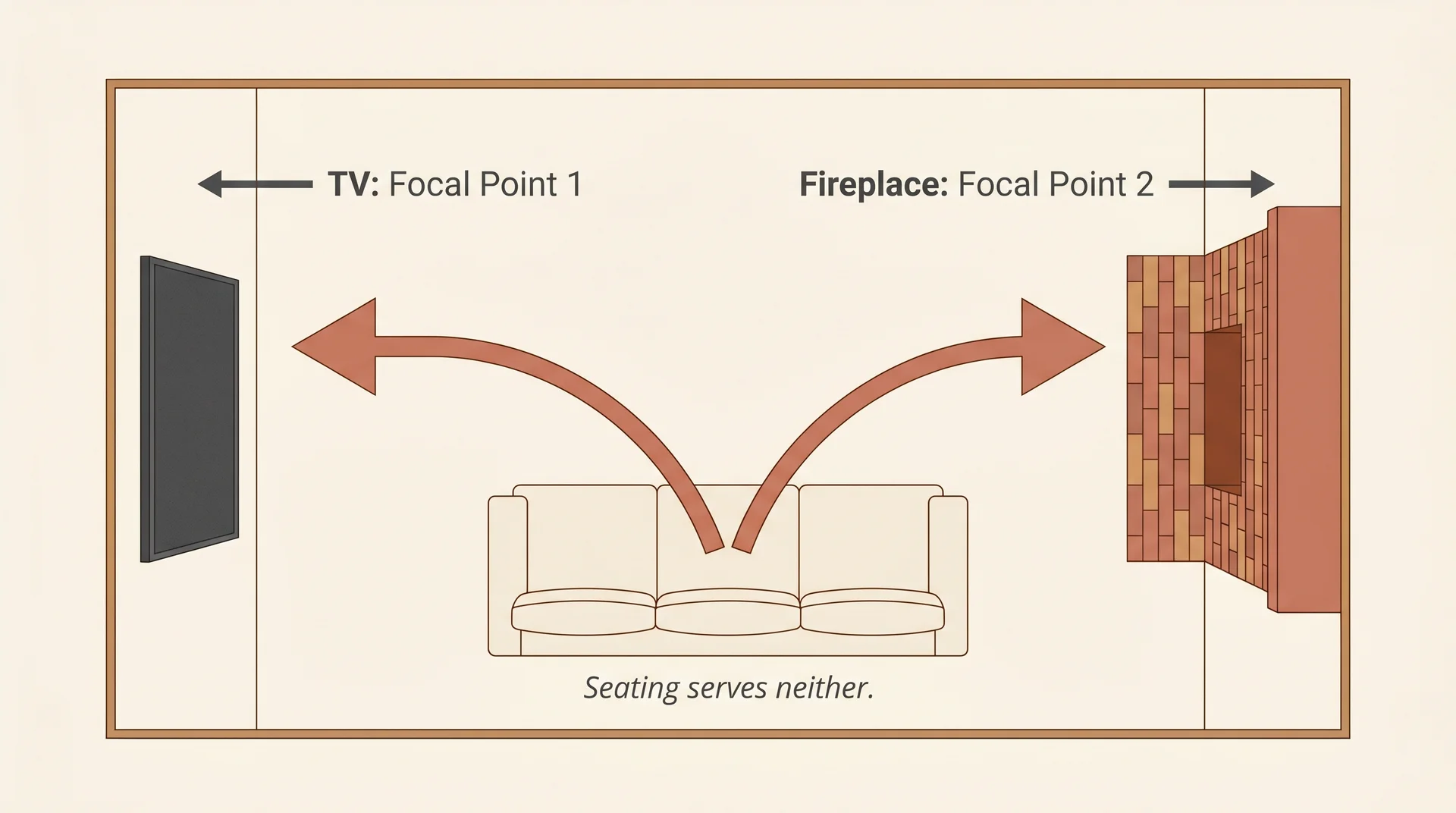
Every living room works better with a single focal point. For most of design history, the fireplace held that position without competition. Then came the television, and the situation changed in a way that most furniture arrangements still haven’t resolved.
“Most living rooms with a fireplace aren’t missing furniture. They’re missing a decision about which wall wins.”
When two features each pull the eye in different directions, seating ends up serving neither of them well. The sofa faces the TV, and the fireplace disappears from the experience of the room. It faces the fireplace, and watching anything requires a neck angle that becomes uncomfortable in minutes.
You try to split the difference, and the room lands in an indeterminate middle that feels perpetually off. The layout hasn’t resolved the conflict. It’s absorbed it.
Why Corner and Off-Center Fireplace Rooms Break Balance
A centered fireplace on a flat wall gives you something to mirror. Seating can face it directly, and the room settles into balance without much effort.
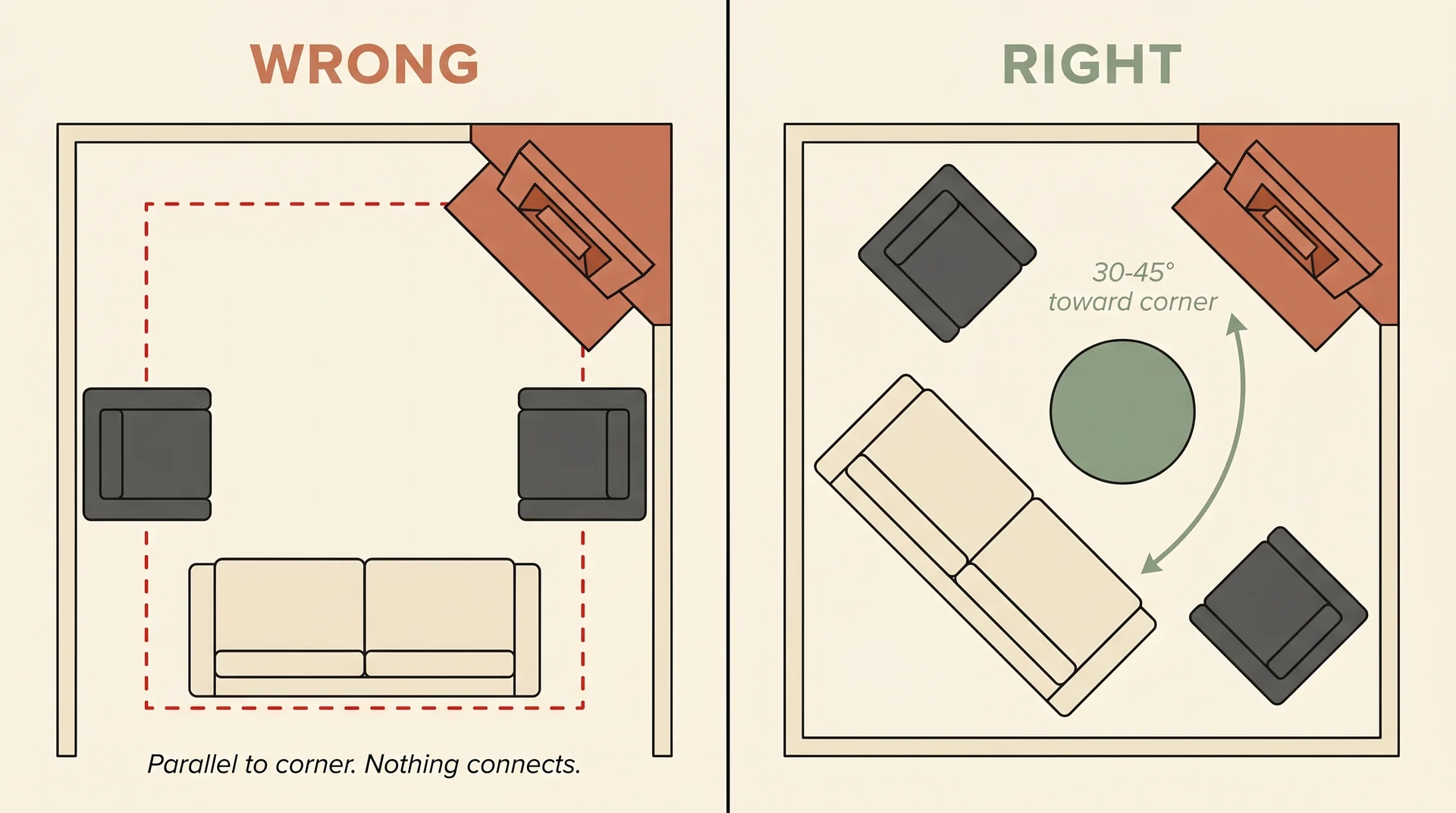
Corner fireplaces don’t offer that. They pull the eye diagonally while furniture naturally wants to align with walls, and those two directions don’t reconcile easily. Every arrangement feels compromised: chairs are too far to one side, the sofa faces nothing cleanly, and the rug can’t anchor the space.
Off-center fireplaces create a different version of the same problem. One side of the wall carries the visual weight of the chimney breast and surround, while the other sits empty. The instinct is to center the sofa on the wall, but that approach makes the imbalance more visible, not less.
How Traffic Flow Quietly Ruins a Good Living Room Layout With a Fireplace
What people describe as a furniture placement problem is often a traffic flow problem in disguise. When a sofa blocks the natural path from the entry to the kitchen, every person in the room performs an awkward dance around it multiple times a day.
When chairs get pushed to corners to open up space, they become furniture nobody actually uses. The frustration you feel standing in the room is the room telling you that movement is compromised, even when the furniture itself looks reasonably placed.
Diagnose Your Awkward Living Room Layout With a Fireplace Before Moving Anything
Three Questions Every Fireplace Room Needs Answered First
Question 1: Where does traffic naturally move in this room?
Stand at the entry and walk, without deliberating, toward wherever you’d naturally go next. Do it twice. The path your body takes without thinking is the walkway your layout needs to protect. Everything else works around it.
Question 2: Which focal point do you actually use more?
For most households, the honest answer is the TV most of the time and the fireplace occasionally. That’s a valid answer. Commit to one primary focal point and serve it directly. Keep the secondary element in peripheral view rather than competing with the view.
Question 3: Is your fireplace functional or mainly architectural?
A fireplace you actually use on winter evenings needs seating within six to ten feet, oriented so you can feel the warmth and see the flames. A fireplace you can see from across the room but can’t feel is a fixture. Once you arrange yourself around a room. This distinction changes the entire placement logic.
How to Measure and Map Your Space Before Rearranging
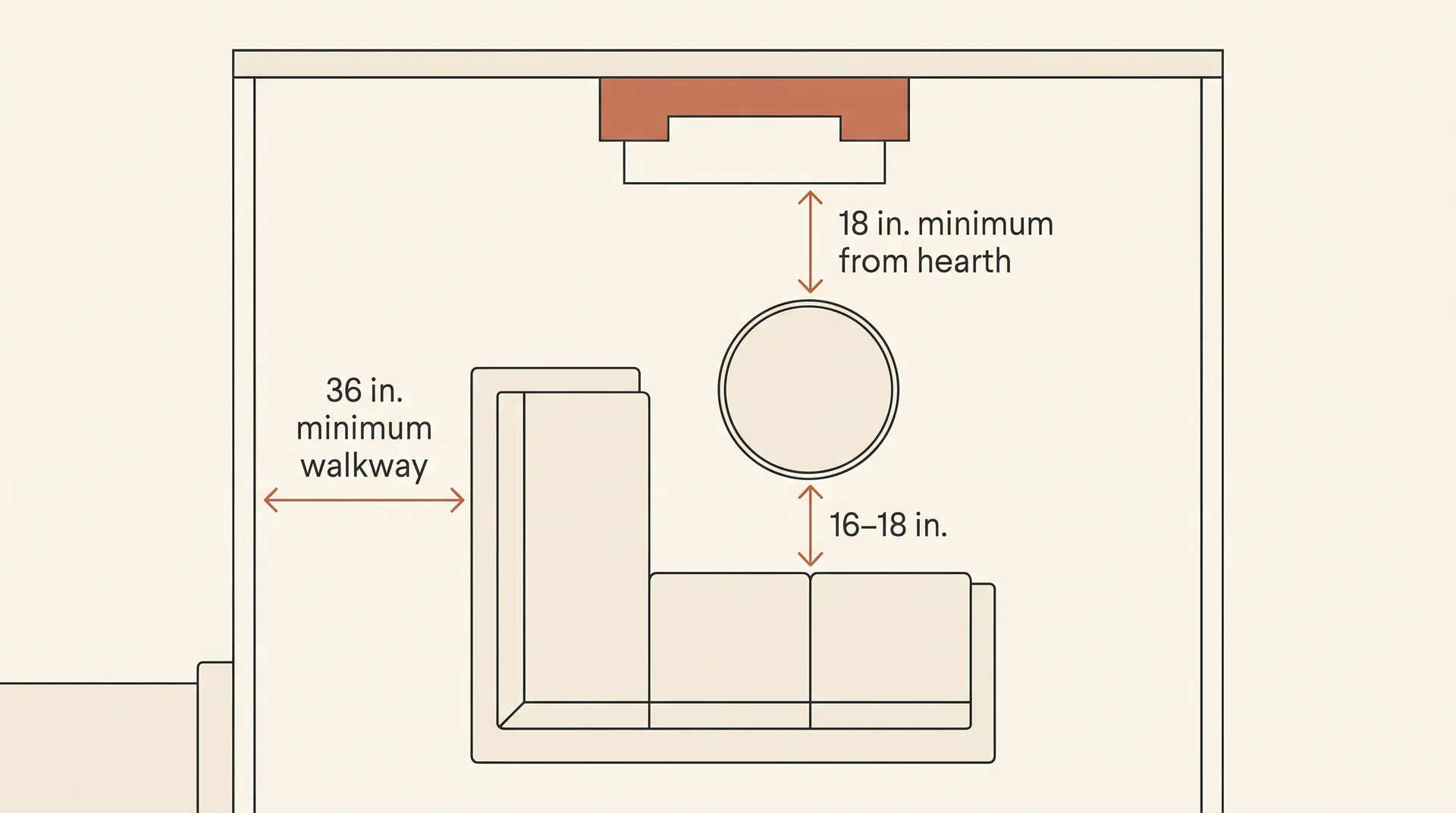
Write down every measurement that matters before touching anything: wall lengths, doorway widths, window placements, and the fireplace surround’s footprint and hearth projection. Mark every doorway, because doors dictate traffic paths and traffic paths dictate where large furniture can and cannot go.
The three clearance numbers you’ll return to throughout any fireplace layout:
| Clearance Type | Minimum Distance |
|---|---|
| Walkway between furniture pieces | 36 inches |
| Between the sofa front and the coffee table | 16 to 18 inches |
| Between any seating and an active hearth | 18 inches minimum |
A free floor plan app like RoomSketcher or Magicplan lets you test configurations before your back pays the price of finding out. Twenty minutes on a sketch before moving the sofa is genuinely one of the most useful things you can do.
How to Fix an Awkward Living Room Layout With a Fireplace, Step by Step
Work through this in order. Skipping the sequence is how people end up cycling through configurations and arriving back close to where they started.
- Map your traffic flow first. Identify the natural walkways in the room and treat them as non-negotiable. No piece of furniture should block them.
- Decide on your primary focal point. Choose one: the fireplace or the TV. The layout will serve one directly and keep the other in peripheral view. Commit to this before moving anything.
- Measure the room and your furniture. Write down wall lengths, doorway positions, window locations, and the footprint of each major piece. Note the fireplace surround and hearth projection.
- Anchor the sofa first, floating it at least 18 inches from the wall. The sofa is the largest piece and sets the direction of everything else. Position it relative to your primary focal point.
- Layer in accent chairs, coffee table, rug, and lighting. Angle chairs toward the center. Size the rug so the seating’s front legs rest on it. Layer lighting around the fire rather than competing with it. Check every walkway and sightline before finalising.
Before and After: Five Awkward Living Room Fireplace Layout Fixes
Before and After: Corner Fireplace Living Room With No Logical Front Row
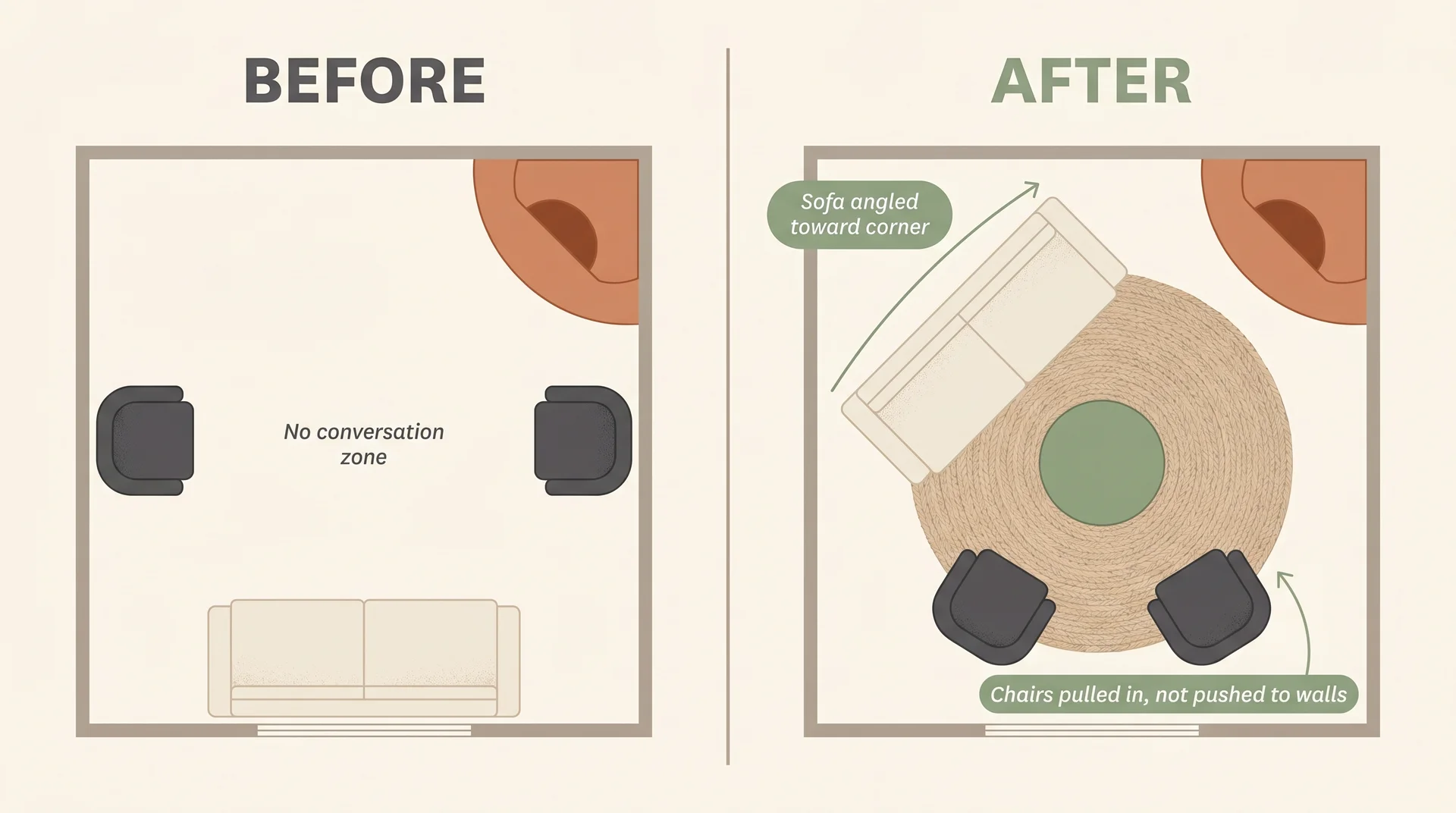
Before: The sofa sat flat against the wall directly opposite the corner fireplace, as far from the hearth as physically possible. Two armchairs were pushed against the side walls. No conversation zone existed. The chairs stayed empty unless the sofa was already full. The fireplace was technically visible from every seat, but it contributed nothing to the experience of the room.
The core problem: Never place furniture parallel to a corner fireplace. This is the most reliable way to make a corner fireplace room feel awkward. Parallel placement creates corners that jut out, disrupts traffic flow, and results in seating that faces nothing. The furniture was treating a corner fireplace like a flat-wall fireplace, and the room showed it.
After: The sofa came off the wall and angled roughly 30 to 45 degrees toward the fireplace, floating in the room with a console table behind it for definition. The armchairs moved in to face the sofa, creating a conversation triangle with the fireplace at its visual center. A round coffee table unified the angled arrangement. Where the corner fireplace felt like an obstacle, the diagonal arrangement made the room feel designed around it.
Worth noting: If the corner fireplace is relatively small or sits in a room where the TV is the primary use, it’s also completely valid to treat the fireplace as secondary. Face the sofa toward the flat TV wall and let the corner fireplace contribute warmth and visual depth from its position without demanding the furniture face it. Both approaches work. The key is choosing one and committing to it.
Before and After: Off-Center Fireplace Living Room on an Unbalanced Wall
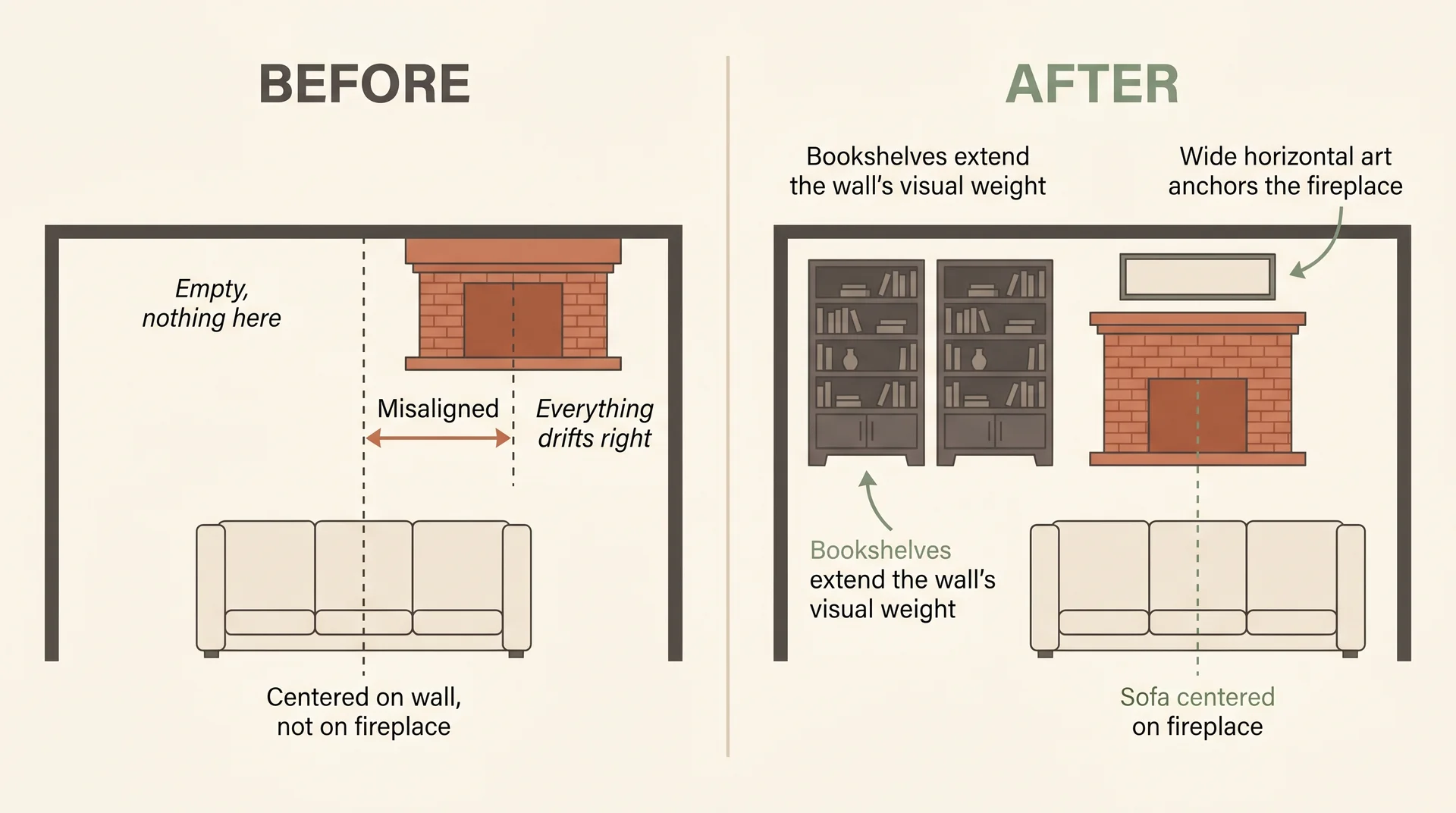
Before: The fireplace sat noticeably off-center on the main wall. The sofa was centered on the wall, which made the asymmetry more visible. The left side felt completely empty. The right side felt slightly cluttered because everything drifted toward the hearth.
The core problem: Centering furniture on the wall rather than on the fireplace highlights the imbalance rather than resolving it. The eye goes to the fireplace, measures the empty space beside it, and reads the room as unfinished.
After: Freestanding bookshelves were placed on the lighter side of the fireplace wall to extend its visual weight and create manufactured symmetry. The sofa shifted slightly to center itself on the fireplace rather than the wall. A large horizontal piece of art above the mantle, kept low and wide, anchored the fireplace as a deliberate design choice. You can’t move the fireplace, but you can extend the weight of the wall to meet it. If the surround itself is dated or orange-toned brick that’s working against the room, a whitewash treatment on the brick can turn it into a feature worth anchoring the room around rather than a detail you’re trying to balance away from.
Before and After: The TV vs. Fireplace Standoff in an Awkward Living Room
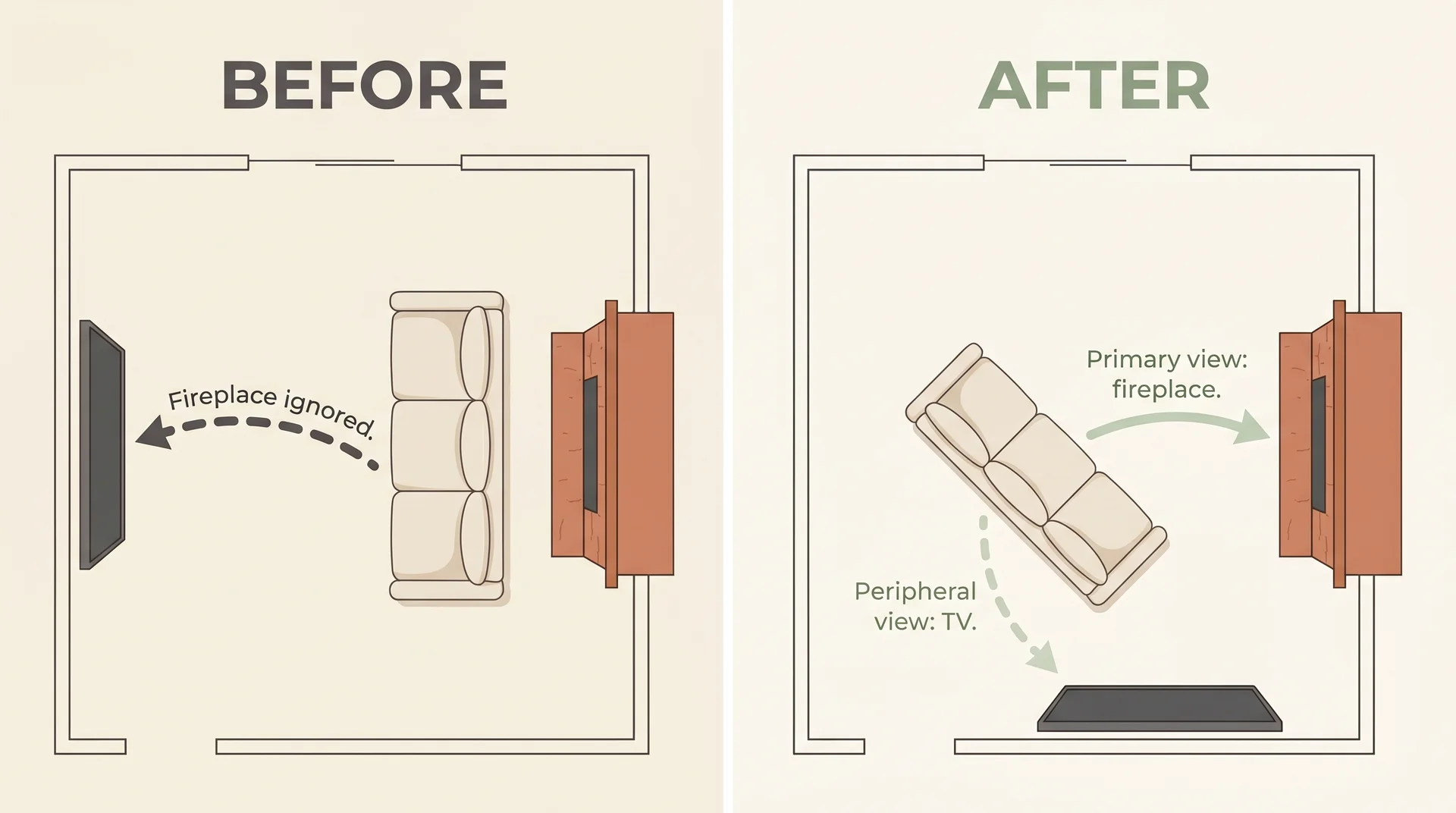
Before: The TV was mounted on the wall directly opposite the fireplace. The sofa sat between them, facing the TV, with the fireplace completely at its back. The fireplace was architecturally prominent and experientially irrelevant. The room felt like two spaces sharing one floor.
The core problem: Placing the TV on the wall opposite the fireplace is the most common layout mistake in this type of room. It forces seating to choose one anchor and abandon the other. One thing worth knowing: don’t assume that because there’s a TV outlet on a particular wall, the TV has to live there. Moving an outlet is inexpensive compared to a room that never settles into a working layout.
After: The TV moved to the wall adjacent to the fireplace, mounted at true eye level for seated viewers. The sofa was repositioned to face the fireplace wall at a slight angle, which brought the TV into comfortable peripheral view. A sectional with an angled chaise worked well here because its longer side oriented toward the TV for evening watching, while the main body faced the fireplace for conversation.
Why it works: Adjacent placement collapses two focal points into one general direction. Everything is broadly in front of you, and the room settles.
Before and After: Narrow Living Room With a Fireplace That Felt Like a Corridor
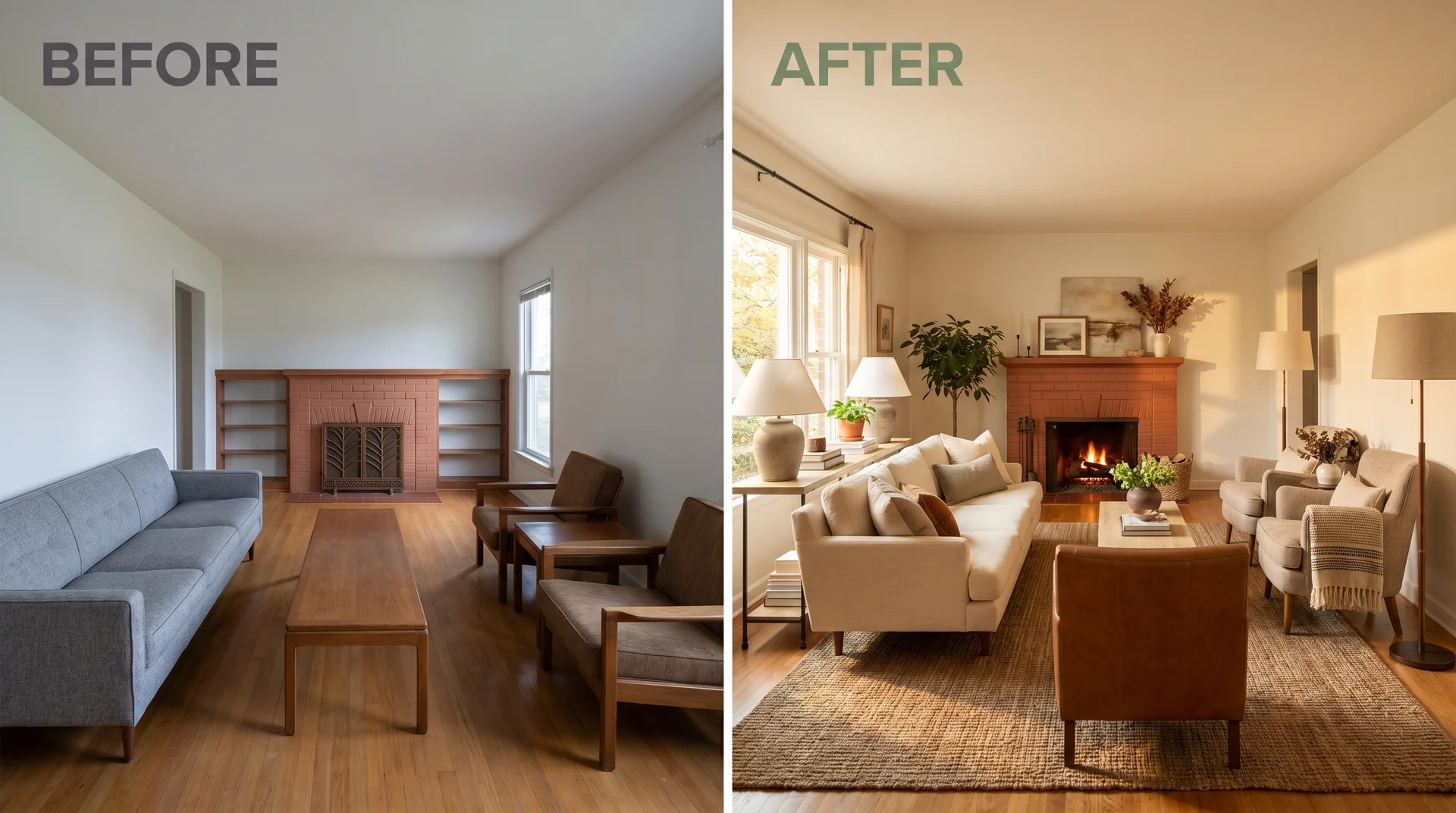
Before: A long, narrow room with the fireplace centered on one of the short end walls. Furniture lined both long walls facing each other, the coffee table running down the center. The room functioned like a waiting area. The fireplace sat at the far end, too distant to feel like anything other than background architecture.
The core problem: Furniture against both long walls in a narrow room creates a corridor effect. Traffic runs through the center, and seating lines a pathway rather than creates a gathering space.
After: The sofa came away from the long wall and floated, turned slightly toward the fireplace end rather than facing directly across the room. One armchair is angled toward the sofa rather than mirroring it across the space. A narrow console table behind the sofa suggested the seating area was its own zone. Two accent chairs at the fireplace end are angled toward the hearth, creating a secondary cluster worth using. Floating furniture in a narrow room creates walkways on the perimeter and a defined zone in the center, making the room feel wider rather than tighter.
Before and After: Open-Plan Space That Never Felt Like a Defined Living Room
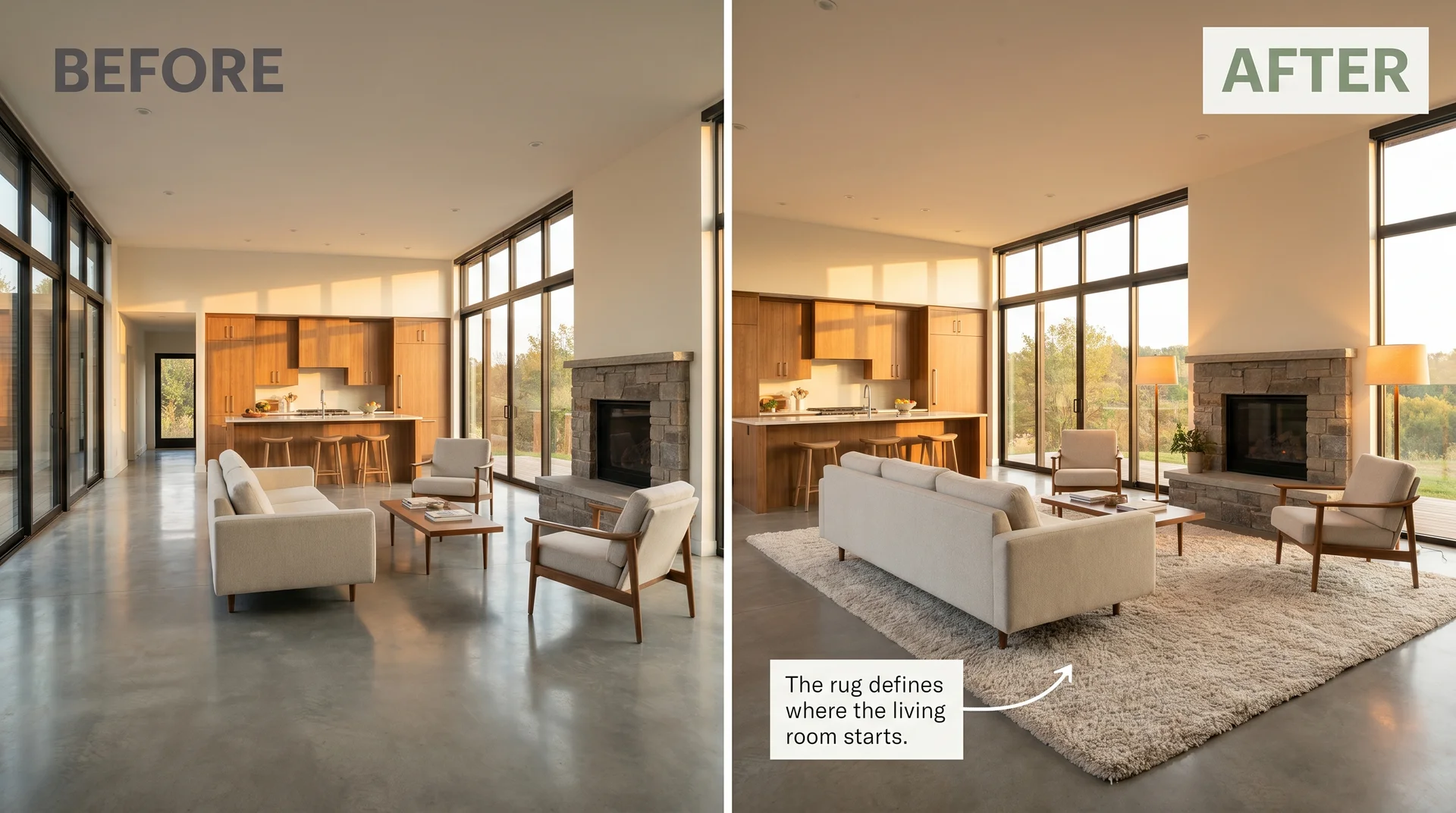
Before: A large open-plan ground floor with a fireplace on the living area wall. The furniture sat in the general vicinity of the hearth, but nothing defined it as its own space. You could see the kitchen from every seat. The sofa floated in too much empty space, and the fireplace sat at the edge of the arrangement rather than at its center.
The core problem: Open-plan spaces lose their living room quality when the seating zone isn’t physically defined. Without walls to contain it, furniture floats in a visual field that includes everything else in the floor plan.
After: A large area rug came in first, sized generously enough for the front legs of all seating to rest on it. This defined the seating zone before anything else moved. The sofa was repositioned so its back faced the kitchen, creating a visual separation between spaces. Accent chairs flanked the fireplace, pulling it back to the center of the arrangement. Two floor lamps framed the seating group and reinforced the zone’s boundaries with light. In an open-plan space, the rug is the room. Everything else layers on top of that foundation. If you’re building out a warm, earthy palette around a fireplace-centered arrangement, these rustic burnt orange living room ideas show how color can anchor a seating zone and tie the whole room together.
Furniture Placement Rules That Work in Awkward Fireplace Rooms
Float Your Sofa at Least 18 Inches From the Wall
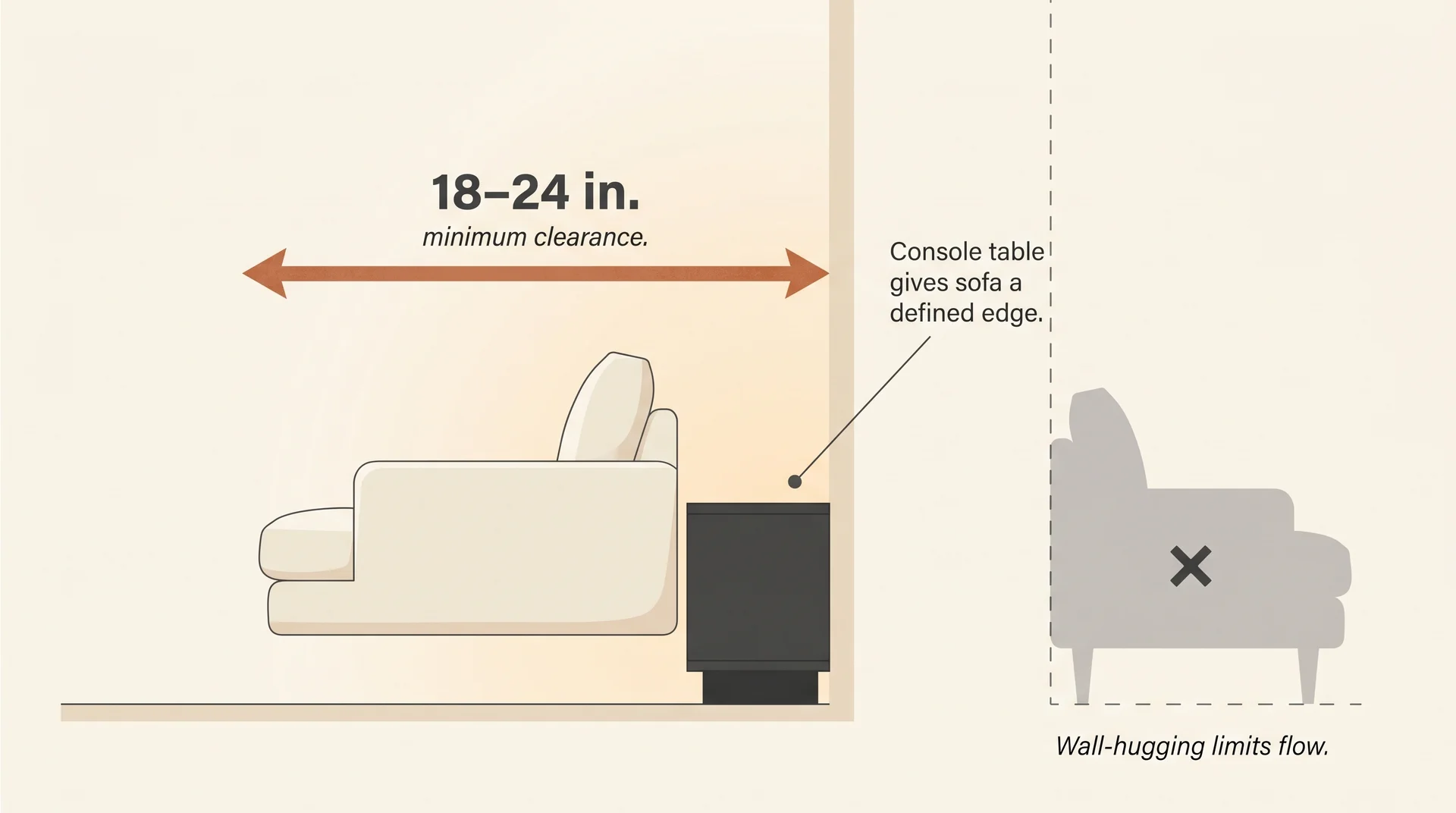
Wall-hugging creates a perimeter of furniture around an empty center, and the fireplace ends up outside the conversation zone rather than inside it. Pull the sofa at least 18 to 24 inches from the wall behind it.
A console table or low credenza behind it gives a defined back edge without needing a wall. The front of the sofa should sit 16 to 18 inches from the coffee table, and the whole seating group should land within six to ten feet of the fireplace if you want the hearth to feel like part of the gathering.
The Two-Thirds Sofa Rule in Fireplace Rooms
A sofa should visually fill roughly two-thirds of the wall it anchors against. Too small, and the room feels undefined. Too large, and it overwhelms every other placement decision.
In a fireplace room, this matters more than usual because the fireplace already commands significant visual weight. An undersized sofa next to a prominent chimney breast makes the seating read as secondary to the architecture rather than in conversation with it.
Where Accent Chairs Belong Around a Fireplace Layout
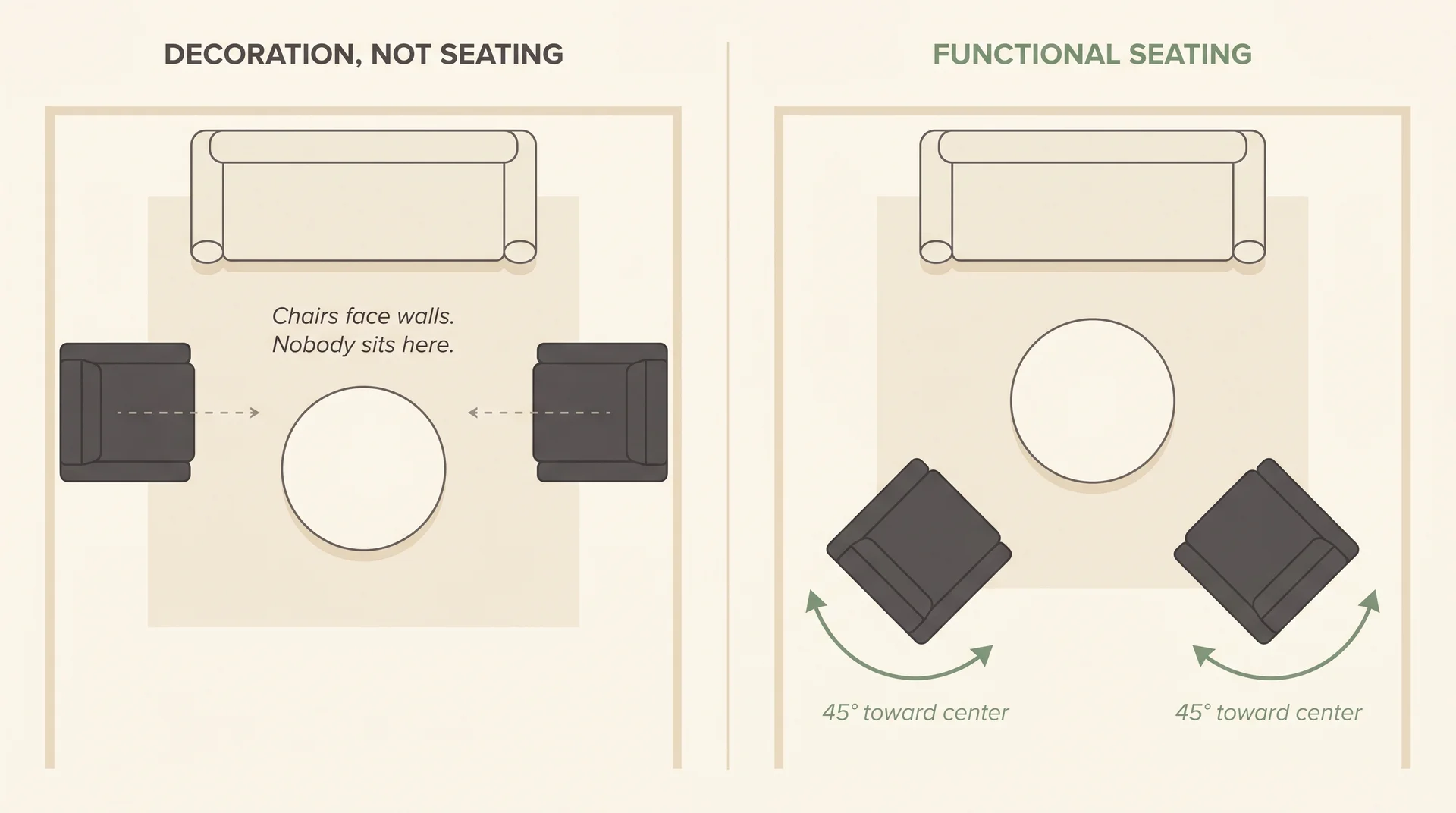
Accent chairs pushed flat against side walls are decoration, not seating. Position accent chairs at roughly 45 degrees to the sofa, angling toward the center of the grouping, with their backs not touching any wall.
This feels like a lot of room to give up when you’re standing in the space. Once you sit down, the room feels like it finally makes sense.
Choosing the Right Coffee Table Shape for Angled Fireplace Layouts
Rectangular coffee tables are designed for rectangular seating arrangements. When your layout has any angle to it, whether from a corner fireplace, an angled sofa, or a sectional, a rectangular table fights the geometry.
Round and oval tables resolve angled arrangements without effort and read as the center of the group regardless of approach angle. In small or visually busy fireplace rooms, a glass-top round table adds a functional surface without the visual weight of a solid piece.
Solving the TV and Fireplace Layout Problem in Awkward Living Rooms
When Mounting the TV Above the Fireplace Actually Works
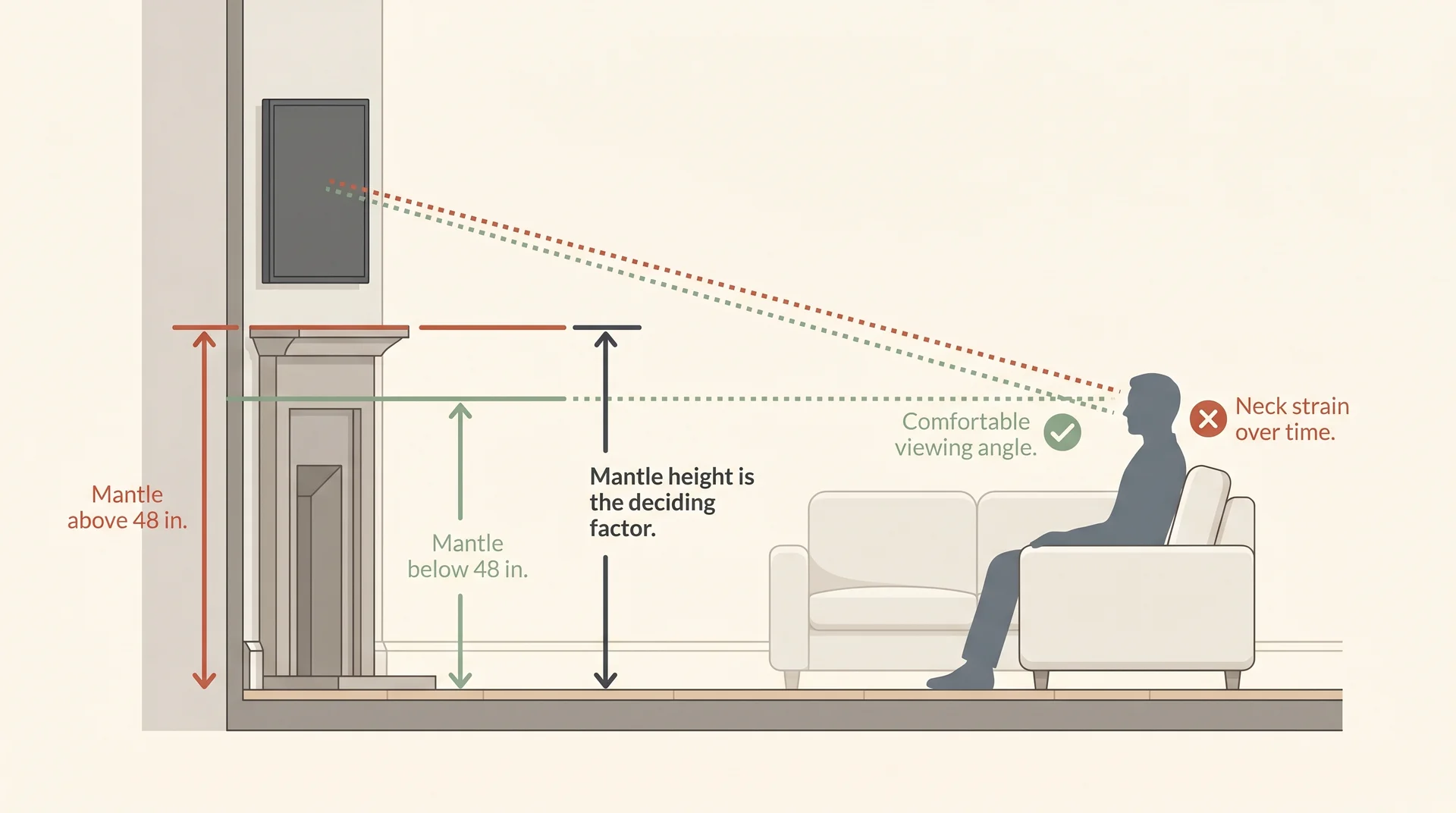
This placement works under specific conditions: the mantel sits below 48 inches from the floor, the primary seating is at least eight to ten feet back, and the TV is a display-type model that reads as art when not in use.
It doesn’t work when the mantel is high, the seating is close, or the ceiling is low. A quick test: sit in your usual viewing spot and tilt your head to the angle the mounted TV requires. Hold it for ten minutes. If you feel it, you already have your answer.
Adjacent Wall Placement: The Cleanest Fix for the TV and Fireplace Conflict
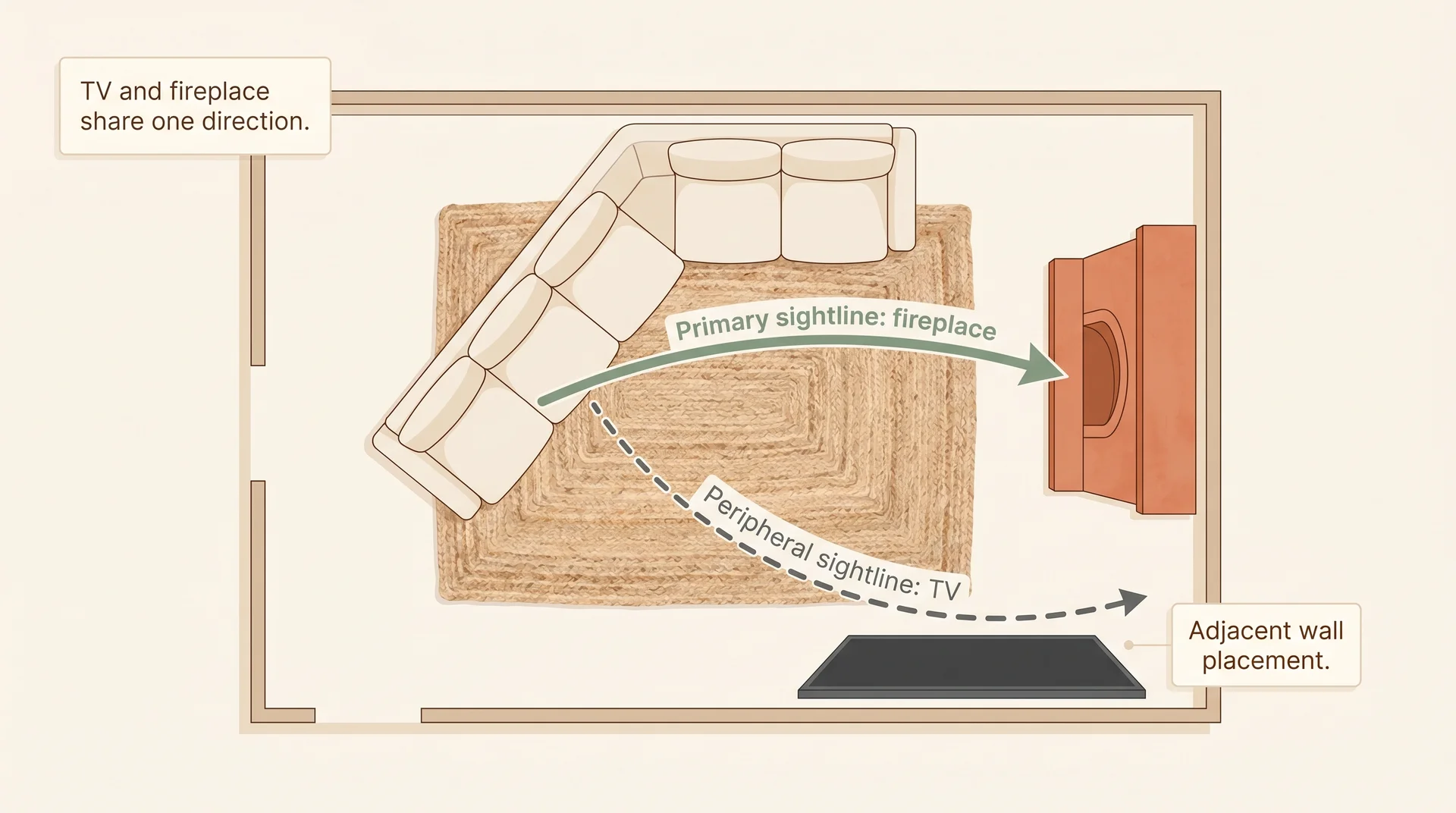
Move the TV to the wall next to the fireplace rather than opposite it. Mount it at 42 to 48 inches from the center of the screen for comfortable seated viewing. Arrange the seating so it faces the fireplace wall at a slight angle, bringing the adjacent TV into view without requiring significant head movement.
In rooms with an alcove beside the chimney breast, the TV can sit in that nook at roughly the same level as the fireplace opening. Balance the opposite alcove with shelving or framed art to maintain visual symmetry across the wall.
Corner TV Placement for Corner Fireplace Living Rooms
When the fireplace takes a corner, placing the TV on a flat wall usually works better than trying to integrate both into the same corner.
An articulating wall mount lets you adjust the screen angle across different seating positions without committing to a single rigid configuration.
Center the primary seating on the flat TV wall and let the corner fireplace contribute warmth and visual depth from its position.
Swivel Chairs as the Fix That Doesn’t Require Moving Anything Else
If the room’s architecture genuinely doesn’t allow the TV and fireplace to share or adjoin a wall, swivel accent chairs remove the need to solve an architectural problem architecturally.
A swivel chair lets the person sitting in it face the fireplace during conversation and rotate toward the TV during viewing. For clients who’d tried every other configuration, this was consistently the answer that made the room livable without any structural change.
What Rugs, Lighting, and Scale Add to a Fireplace Room Transformation
Rug Sizing: The Mistake That Undermines Good Fireplace Layouts
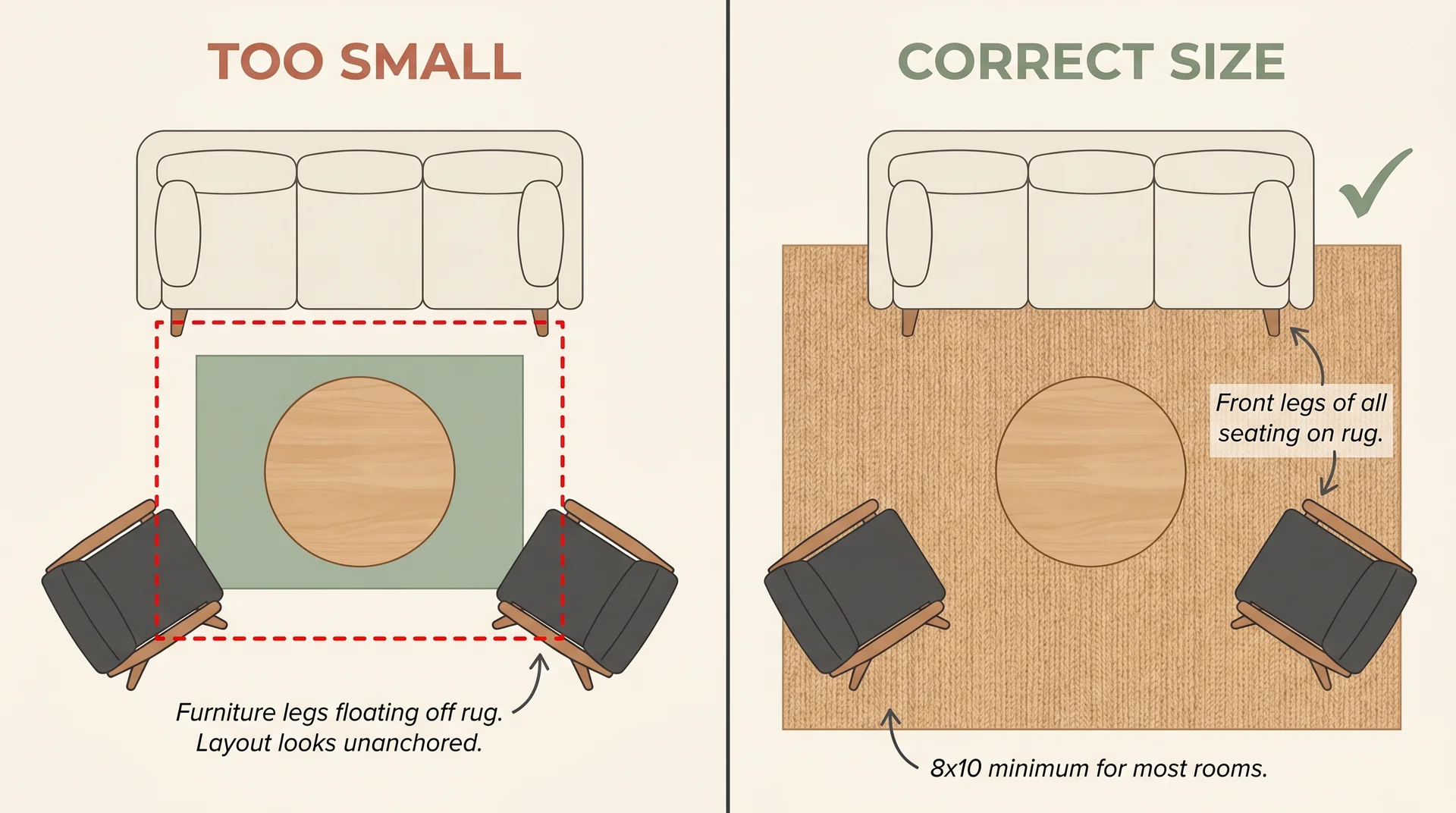
The most frequent problem in fireplace room makeovers isn’t the sofa position. It’s the rug. An undersized rug visually disconnects furniture from each other and from the floor, making even a well-arranged room look unanchored and unintentional.
| Room Size | Recommended Minimum Rug Size |
|---|---|
| Small living room (up to 12 x 15 ft) | 5 x 8 or 6 x 9 |
| Medium living room (12 x 15 to 15 x 20 ft) | 8 x 10 |
| Large living room (15 x 20 ft and above) | 9 x 12 or larger |
For a fireplace seating group, the rug needs to be large enough for the front legs of the sofa and both accent chairs to rest on it. If all four legs of every piece sit on the rug, that’s ideal. The rug is what tells the room, and everyone in it, that the furniture grouping is intentional.
Layered Lighting in Living Rooms With a Fireplace
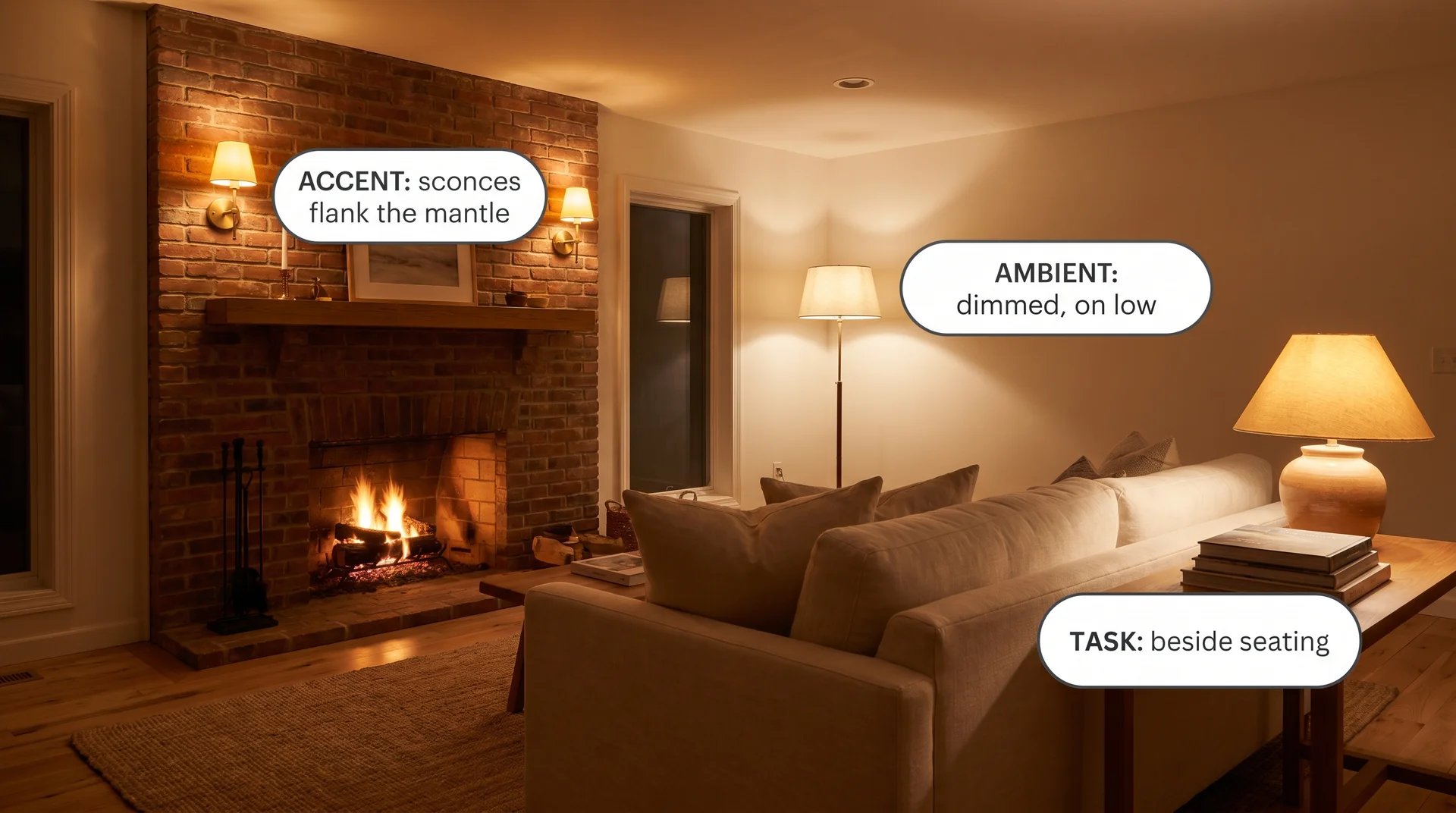
A single overhead light in a fireplace room is almost always the wrong answer. It flattens the space and competes with the warmth of the fire rather than working alongside it.
Layer three types: ambient (overhead, on a dimmer), accent (sconces flanking the mantle, a floor lamp in a corner), and task (table lamps beside the sofa or reading chairs). When the fire is on, bring the overhead down or off. The fireplace is itself a light source. Build the plan around it.
Mirrors and Built-Ins to Balance an Awkward Fireplace Wall
A large horizontal mirror above the mantle on an off-center fireplace both expands the room visually and creates a design moment that draws the eye to the hearth rather than the empty space beside it.
Built-in shelving flanking an off-center fireplace creates manufactured symmetry. Freestanding bookshelves in matching finishes achieve a similar effect at a fraction of the cost and with no construction commitment.
On a corner fireplace wall, a single large-scale piece of art on the adjacent flat wall can anchor the composition and balance the fireplace surround’s visual weight without any structural change. Scale matters here: too small reads as decorative. Large enough, and it anchors the wall the way architecture would.
Mistakes That Keep Awkward Living Room Fireplace Layouts Stuck
- Furniture against every wall. It looks organized in isolation. In practice, it creates a perimeter around an empty center and places the fireplace outside the conversation zone rather than inside it.
- Placing any furniture parallel to a corner fireplace. This is the most reliable way to make a corner fireplace room feel awkward. Angle the furniture toward the corner instead.
- The rug is too small. An undersized rug makes a good arrangement look unresolved. It’s one of the most common problems in fireplace rooms and one of the cheapest to fix.
- TV mounted above a high mantel with close seating. A mantel above 48 inches with seating within six feet creates a viewing angle that builds into real neck strain over time.
- Assuming the TV outlet determines TV placement. Moving an outlet is inexpensive compared to a room that never settles into a good layout. It’s worth doing.
- Rectangular coffee table in an angled arrangement. Its corners jut out, it resists the visual flow, and it creates physical friction in the layout. A round or oval table resolves most angled configurations without any other change.
- Accent chairs are positioned decoratively rather than functionally. Chairs against walls facing nothing don’t contribute to the room. Pull them in, angle them toward the center, and the conversation quality of the space changes immediately.
- No layered lighting. A single overhead fixture will always make a fireplace room feel flat, regardless of how well the furniture is arranged.
Frequently Asked Questions
How do you arrange furniture in a living room with an off-center fireplace?
Center the sofa on the fireplace itself, not on the wall. Add shelving, flanking art, or a tall plant on the lighter side of the fireplace wall to extend its visual weight and create manufactured symmetry. A large horizontal mirror above the mantle draws the eye to the fireplace and away from the empty space beside it.
Should the sofa face the fireplace or the TV in an awkward layout?
Arrange the sofa to face the TV comfortably and keep the fireplace within peripheral view. Moving the TV to the wall adjacent to the fireplace rather than opposite it usually resolves the conflict without either element losing its role in the room.
What is the best layout for a living room with a corner fireplace?
Angle the sofa 30 to 45 degrees toward the fireplace rather than keeping it parallel to the surrounding walls. Bring accent chairs toward the center of the arrangement. Use a round or oval coffee table to unify the angled grouping. Place a console table behind the floating sofa for a defined back edge without needing a wall.
Is it okay to mount the TV above the fireplace?
It can work when the mantel is below 48 inches, and the seating is at least eight to ten feet back. A mantel above 48 inches with close seating causes real neck strain over time. A tilting articulating wall mount improves the angle in borderline situations.
How far should furniture sit from the fireplace?
The minimum safe clearance from seating to an active hearth is 18 inches. For comfortable warmth and natural conversation, six to ten feet from the fireplace is the ideal range for the primary sofa. Beyond ten feet, you lose the experiential connection to the fire even when it’s burning.
Can you create a proper conversation area in a small living room with a fireplace?
Yes. Keep the seating group tight and facing each other, with the fireplace as the visual anchor behind one of the seats. A small round coffee table keeps the center clear without sacrificing the gathered, intimate quality of the arrangement.
How do you handle a corner fireplace and TV in the same room?
Place the TV on the flat wall adjacent to the corner fireplace and center the primary sofa on that TV wall. This lets the corner fireplace contribute warmth and ambiance without forcing the seating to choose between two incompatible directions. An articulating wall mount lets you adjust the screen angle as needed across different seating positions.