
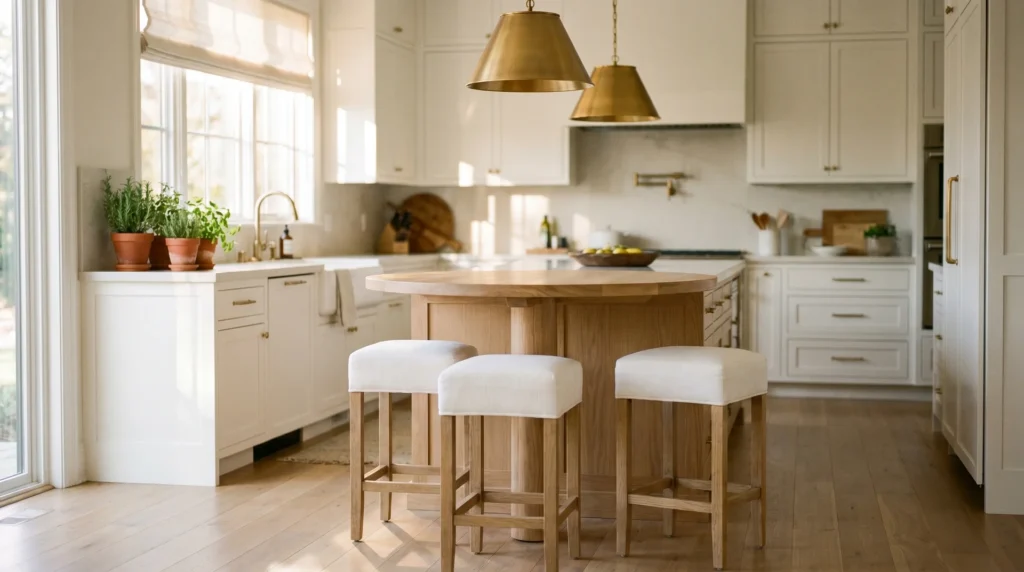
A counter height table stands 34 to 36 inches tall. That’s the answer. If that’s all you came for, you’ve got it.
But if you’re asking because you’re shopping for one, figuring out which stools pair with it, or trying to decide whether this is the right table for your kitchen, keep reading.
The number alone won’t save you from the mistake I’ve watched dozens of clients make over the years: buying a beautiful table and then spending weeks searching for stools that don’t quite fit, or realizing too late that the setup works for adults but creates daily frustration for their kids.
In over a decade of working in residential design, first as a design consultant for a furniture retailer and later as an independent interior styling advisor, I’ve spent a lot of time in people’s kitchens and dining spaces.
Counter height tables come up constantly. They sound simple until you’re comparing listings online and suddenly “counter height,” “bar height,” and “pub height” are all showing up in the same search results.
This guide covers the full picture: the exact dimensions, how they compare to your other options, which stool height actually pairs correctly, who this table suits and who it genuinely doesn’t, and the one measuring mistake that causes more returns than almost anything else.
Counter Height, Dining Height, and Bar Height
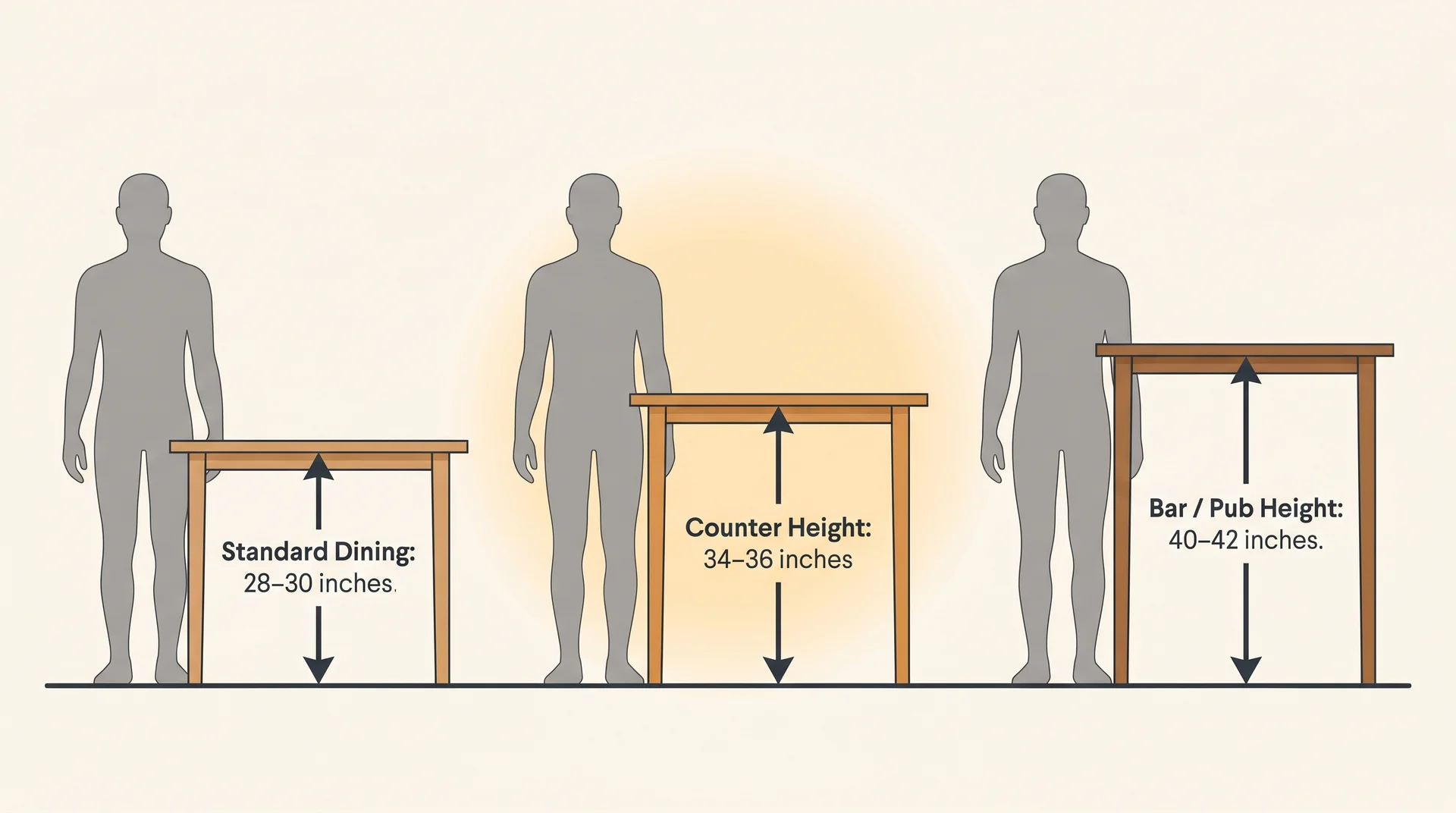
Before you decide on a counter height table, you need to understand where it sits relative to the other options. These heights cover nearly every dining and kitchen table on the market, and the differences matter far more than a few inches would suggest.
| Table Type | Surface Height | Ideal Stool or Chair Seat Height | Best For |
|---|---|---|---|
| Standard Dining | 28 to 30 inches | 17 to 19 inches | Formal dining, families with young children, and long meals |
| Counter Height | 34 to 36 inches | 24 to 26 inches | Casual dining, kitchen islands, prep-plus-eat spaces, WFH |
| Bar / Pub Height | 40 to 42 inches | 28 to 30 inches | Entertaining, compact footprints, social, and standing-friendly |
| Spectator Height | 46 to 48 inches | 32 to 34 inches | Commercial venues, such as viewing areas, are rarely used in homes |
Standard dining tables are the most common setup in American homes. Your feet rest flat on the floor, regular dining chairs fit without any drama, and the whole arrangement feels grounded and settled. If you have young children or host long, formal dinners, this height tends to serve people better over time.
Counter height tables sit at 34 to 36 inches, matching the height of your kitchen countertops and most kitchen islands. The stools are taller than regular dining chairs and typically include footrests because your feet can’t reach the floor from a 24-inch seat. They’re versatile in a way standard tables aren’t: you can eat at them, prep food on them, work from them, and use them as an overflow surface when you’re cooking for a crowd.
Bar height tables, sometimes called pub or high-top tables, sit at 40 to 42 inches and pair with bar stools in the 28 to 30-inch seat height range. They work well in entertainment rooms and smaller apartments where a compact footprint matters more than long-term seated comfort. Most people find them fine for a drink and a quick meal, but tiring for longer sits.
Spectator height tables at 46 to 48 inches are rarely found in homes. You’ll mostly see them in commercial venues, sports bars, and viewing areas. If you encounter this category while shopping, it’s worth knowing it exists so you don’t accidentally purchase the wrong stool for it.
Why Counter Height Tables Sit at 34 to 36 Inches
The measurement isn’t arbitrary. Standard kitchen countertops in the US are built to the same height, based on ergonomic research that found this range works well for adults doing tasks while standing at a comfortable angle.
Counter height tables adopted that number so they could serve double duty: a place to eat, and an extension of your kitchen workflow. This is also why a counter-height table can sit flush with your island visually, creating a cohesive line across the space instead of a dropped-down table that fights with everything around it.
Early in my career, I sold and placed more counter-height tables than I can count. The clients who loved them most were the ones who understood this connection to the kitchen environment.
They weren’t just buying a taller dining table; they were adding a surface that genuinely extended how the kitchen functioned. The clients who regretted them were usually the ones who chose the height for the look alone, without thinking about who was actually going to sit there every day.
Matching the Right Stool Height to Your Counter Height Table
This is where most purchases go wrong. You order a counter height table, you pick stools that look right in the photos, everything arrives, and the legroom feels off. Either your knees press up into the underside of the table, or you’re sitting so low that you’re reaching upward to eat. The table looks fine. The stools look fine. Together, they feel wrong.
The problem is almost always the same: people measure the top surface of the table and work from that number.
You should measure from the floor to the underside of the tabletop.
Get the height match right, and the table disappears into the room. Get it wrong, and it’s all you’ll ever notice. That underside clearance is what determines actual legroom. The tabletop itself has thickness, usually one to two inches, and many tables have aprons or support rails underneath that reduce clearance further.
If you measure from the top and ignore what’s happening underneath, you can end up with a stool that technically pairs with a 36-inch table but feels cramped because the table’s apron steals the last inch your thighs need.
The 10 to 12-Inch Rule for Counter Height Seating
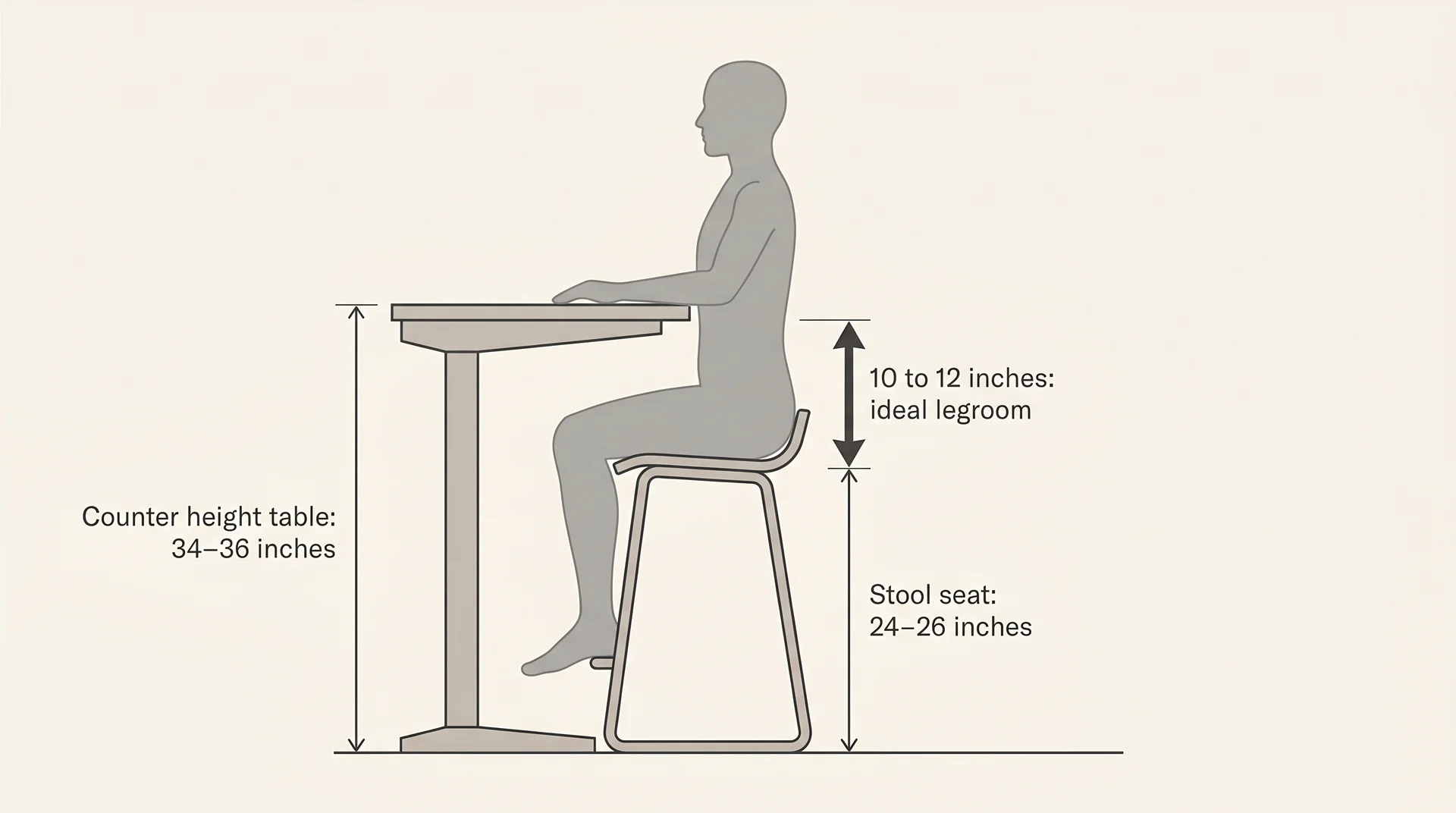
Once you have your underside measurement, subtract 10 to 12 inches. That’s your target stool seat height.
For a typical 36-inch counter height table with one inch of top thickness, the underside sits at roughly 35 inches. Subtract 10 to 12 inches, and you’re looking for stools with a seat height of 23 to 25 inches.
That gap gives your legs enough room to sit without feeling squeezed, and keeps your arms at a natural angle for eating or working. If the gap falls under 10 inches, you’ll feel tightness across your thighs within minutes. Over 12 inches, and you’ll find yourself hunching forward or perching at the stool’s edge to reach the surface comfortably.
How to Measure Correctly Before You Buy
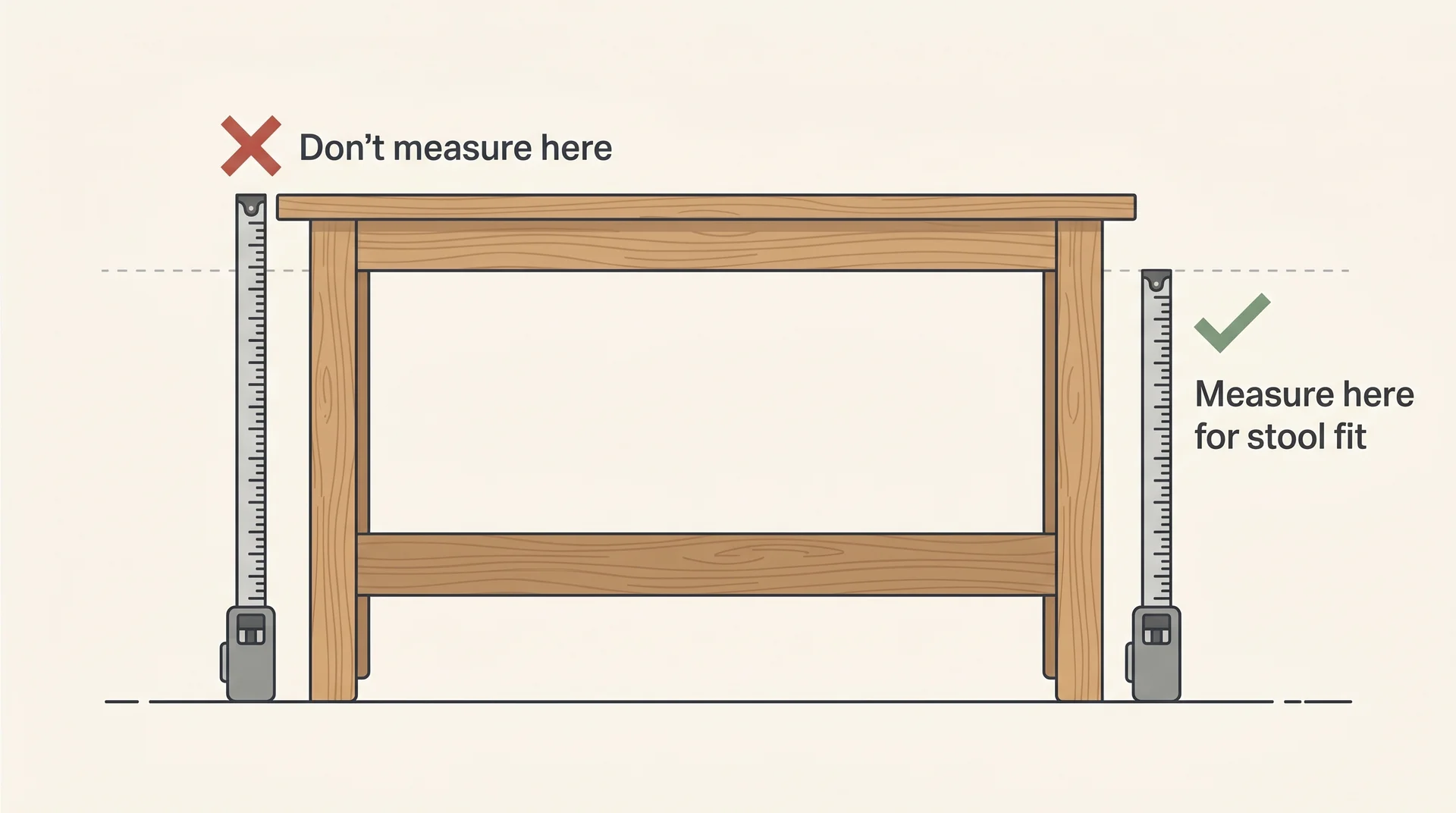
- Measure from the floor to the underside of the table surface, not the top.
- Subtract 10 to 12 inches. That’s your stool seat height target.
- Also, check the horizontal overhang depth: aim for at least 10 to 12 inches of knee clearance from the table edge inward.
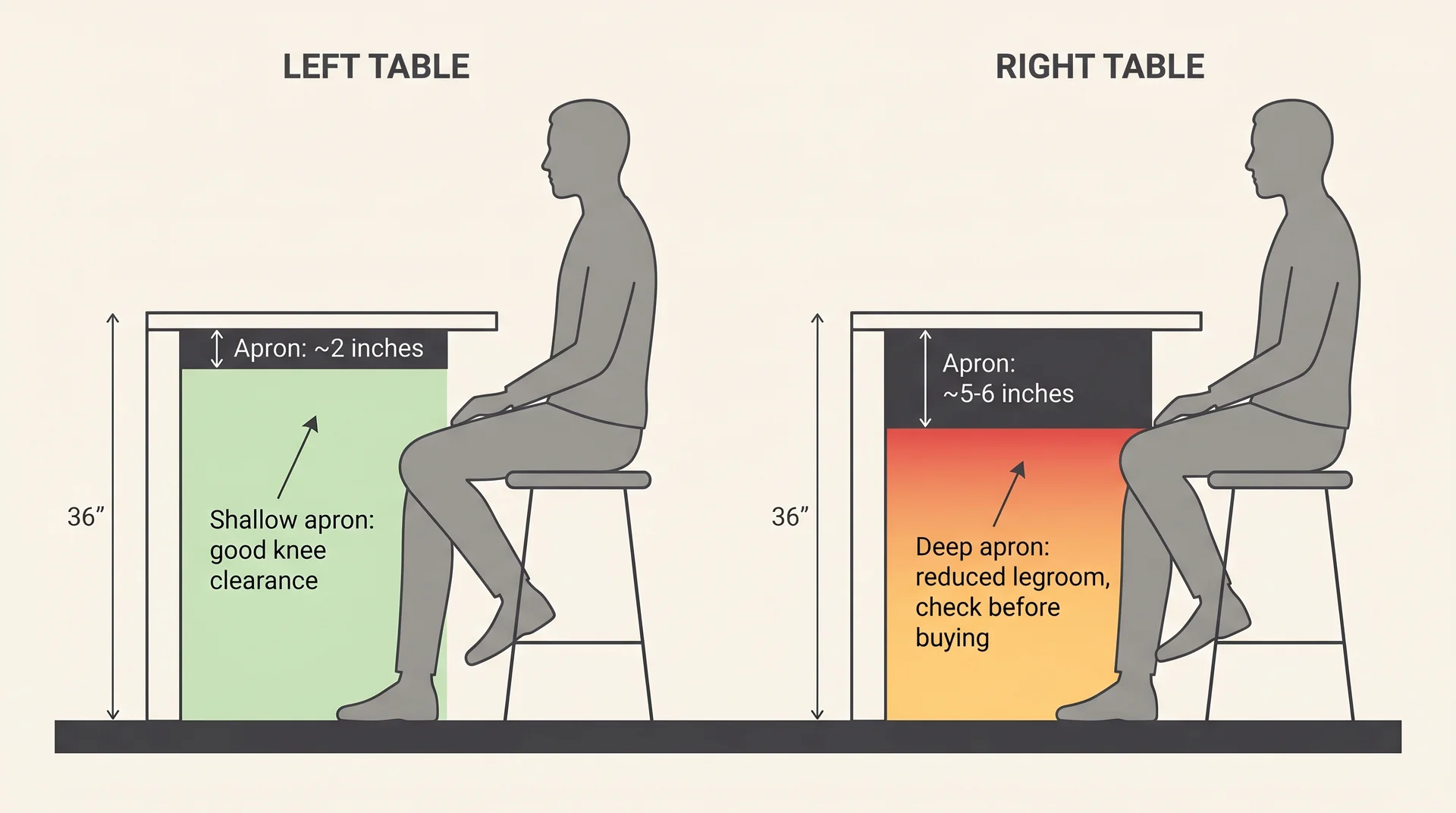
- If the table has an apron, measure its depth too. A deep apron reduces usable legroom even when the overall height is correct.
Armless vs. Armed Stools at Counter Height
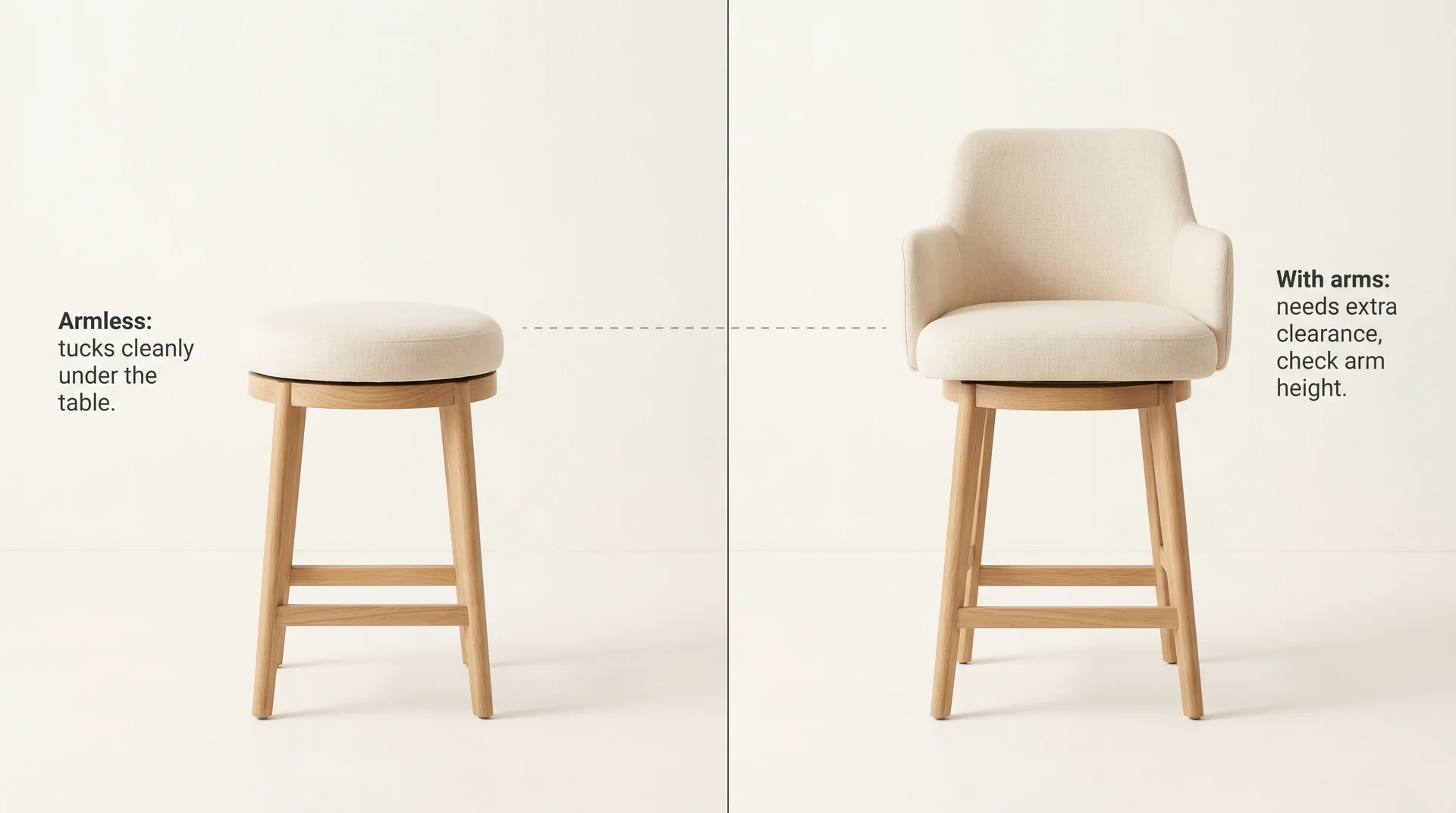
Armrests add comfort for longer sits, but they also add width and limit how far a stool can tuck under the table. In a small kitchen or tight breakfast nook, stools with arms can make the space feel crowded and harder to move around.
Armless and backless counter stools tuck neatly underneath, keep the visual footprint clean, and make the room read larger. If your kitchen is spacious and you plan to use the table for longer meals or work sessions, a low-arm stool is worth considering, but always check that the arm height clears the table underside when the stool is pulled in.
Fixed vs. Adjustable: When Flexibility Matters
Fixed-height stools look cleaner and tend to be more stable. If everyone in your household is a similar height, they’re usually the right call. Adjustable stools make more sense in households where multiple people of different heights use the same table regularly.
The tradeoff is that most adjustable models have a gas-lift column and a wider base, which can look bulkier than a fixed stool. If you do go adjustable, always confirm the actual height range in the product specs, because “counter height adjustable” can mean different things across different brands.
How Many Counter Height Stools Fit at Your Table?
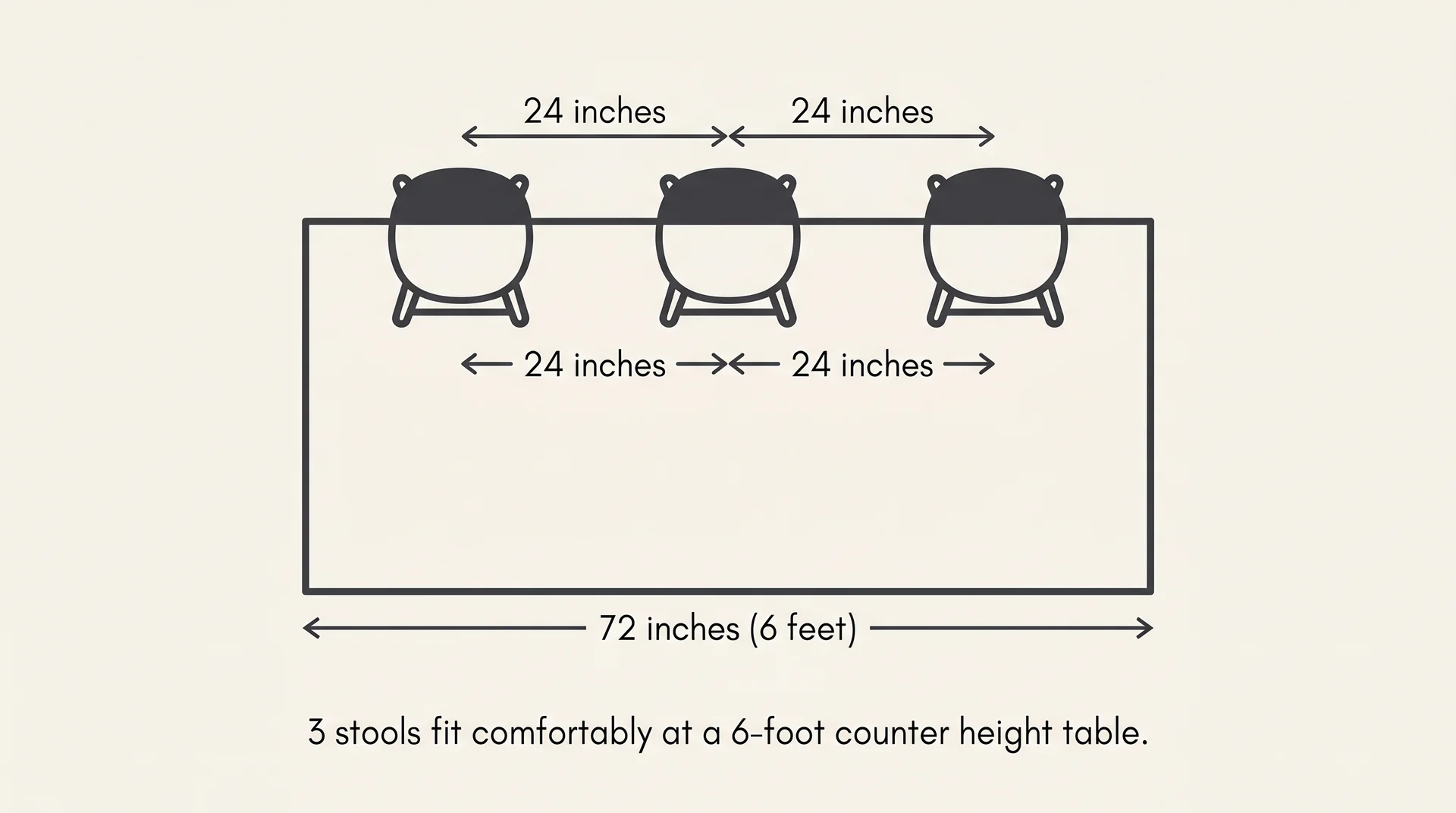
Plan for 24 to 30 inches of table edge per stool. For stools with arms or swivel mechanisms, give yourself closer to 30 inches per seat. Here’s how that plays out across common table lengths:
- 48-inch table (4 feet): 2 stools comfortably
- 60-inch table (5 feet): 2 to 3 stools
- 72-inch table (6 feet): 3 stools, or 2 with extra breathing room
- 84 to 96-inch table (7 to 8 feet): 3 to 4 stools
A common mistake is placing four stools along a six-foot table because it “looks like it should fit.” The people sitting at the ends end up with no elbow room, and pulling the stools out to get in and out becomes a small daily annoyance. More stools is rarely better if the spacing is wrong.
Is a Counter Height Table Right for Your Home?
This is the question I always ask clients before we order anything. The height looks appealing in a showroom, but your home has specific people in it with specific needs. Counter height tables suit some situations very well and fit others poorly, and the honest answer depends on who’s actually using the table every day.
Families with Young Children
Counter height tables are a poor fit for toddlers and children under six or seven. High chairs are designed to work with standard 30-inch dining tables, and most won’t position a young child correctly at a counter height surface.
Kids transitioning out of high chairs often struggle with counter stools, and the lack of floor contact means younger children can’t sit independently without help. I’ve had clients fall in love with a counter height set and quietly replace it two years later when managing small children at a tall table wore them down.
If your household includes young children right now, a standard dining table serves your family better. You can revisit counter height when the kids are older and more independent.
Small Kitchens and Open-Plan Layouts
Counter height tables work very well here. The elevated profile reveals more floor space underneath, which makes a room read larger and more open.
In open-plan homes where the kitchen flows into a living area, a counter-height table can also work as a natural visual divider between the two zones without needing a physical partition.
Compact round counter height tables do a lot of work in small apartments, where they seat two comfortably, tuck against a wall when needed, and don’t visually dominate the space the way a larger dining set would.
If you’re also thinking about a kitchen island alongside this table, it’s worth reading through our guide on kitchen island height, since the two decisions are closely linked in open-plan spaces.
People Who Want One Table to Do Multiple Jobs
This is where counter-height tables earn their place. Because the surface matches your kitchen counters, the table naturally extends your prep workspace.
You can chop food on it, plate a meal at it, eat at it, help kids with homework at it, and sit with a laptop at it, all without the table feeling like a compromise.
The standing desk angle is real, too: at 36 inches, you can push the stool out of the way and work standing without needing a separate piece of furniture. If your home involves a lot of working from the kitchen, counter height is one of the more practical choices available.
Taller Adults
Standard 30-inch dining tables are actively uncomfortable for adults over six feet tall. The knees press toward the table underside, the elbows hang at an awkward angle, and eating a full meal involves a series of small physical adjustments.
Counter height solves this without going all the way to bar height, which can feel too elevated for daily meals. If your household runs tall, counter height is worth serious consideration even if the “casual kitchen vibe” isn’t your primary design goal. Comfort over repeated daily use matters more than the style category label.
Older Adults and Accessibility
Counter-height tables present real challenges for older adults and people with limited mobility. The stools require a controlled lowering and rising motion that’s harder than it sounds when knees or hips aren’t fully cooperative.
The footrest helps, but it’s still a more physically demanding seating arrangement than a standard dining chair with feet flat on the floor. If you’re furnishing a home where accessibility matters for any member of the household, a standard dining table with well-chosen chairs is the more inclusive setup.
Using a Counter Height Table as a Kitchen Island Alternative
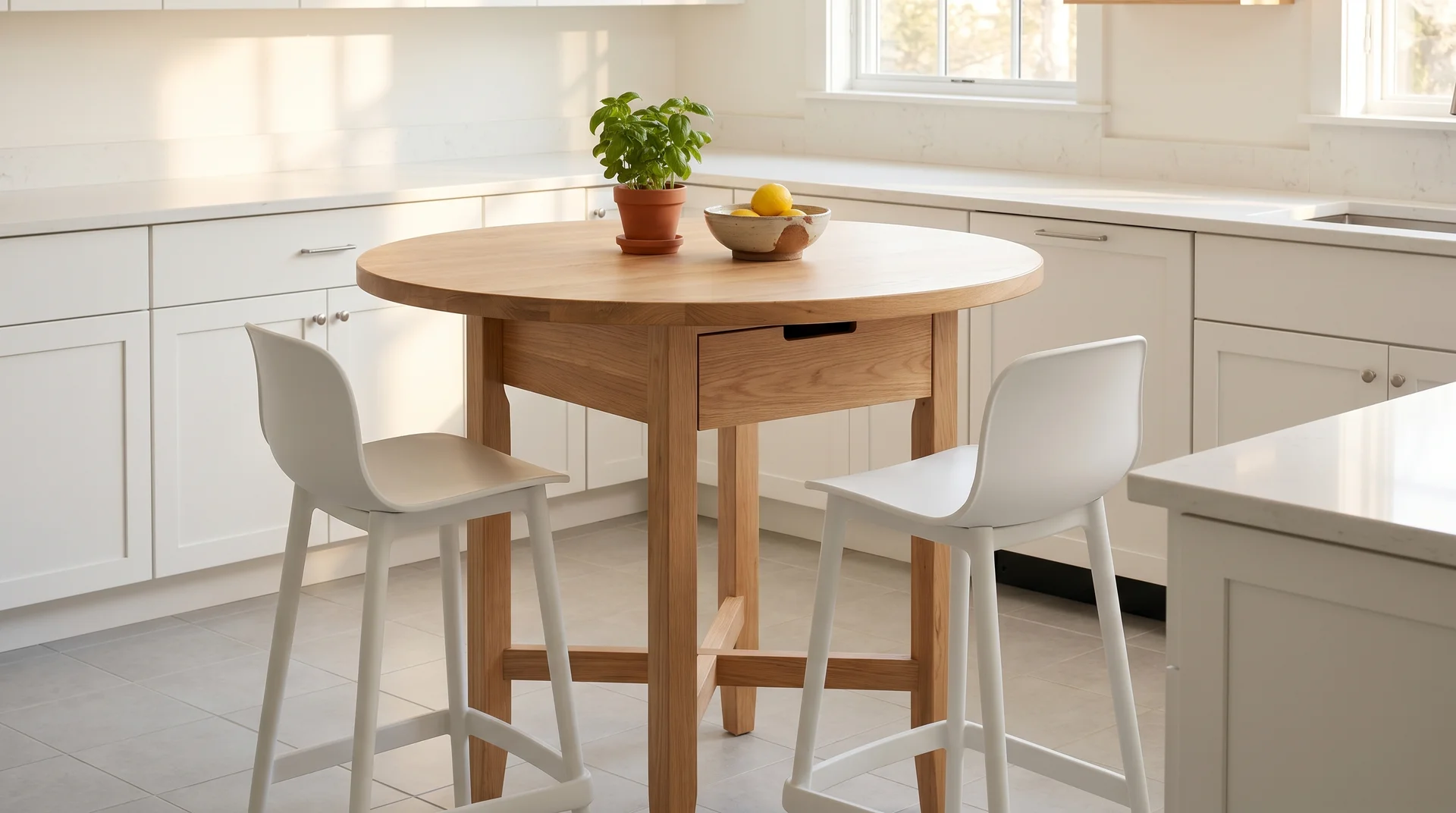
In rental apartments and smaller homes where a built-in island isn’t possible, a counter-height table positioned in or near the kitchen can fill that role without any construction or permanent changes. The surface sits at the same height as your counters, so it works as overflow prep space, a casual eating spot, and a place to keep company with whoever is cooking, all in one piece of furniture.
If you’re thinking about this approach, look for a table with storage built into the base. Drawers or shelving at that level keep kitchen tools, placemats, or dry goods within reach and make the table feel purposeful rather than like an afterthought.
Also, confirm there’s at least 10 to 12 inches of overhang on the stool side for proper knee clearance, and leave at least 36 to 42 inches of clearance on all sides for comfortable movement around the table during cooking.
Counter Height Table Buying Mistakes Worth Knowing About
These come up repeatedly across different households and different price points. None of them is obvious until you’ve seen them play out.
- Buy the table before confirming stool availability. Find and confirm the stools before you commit to the table. A beautiful table with no compatible stools in the right height range is a months-long sourcing problem.
- Measuring the top surface instead of the underside. The underside clearance determines legroom. Measure from the floor to the underside, then subtract 10 to 12 inches.
- Ignoring the space around the table. Allow at least 36 inches between the table edge and the nearest wall or cabinet. If that space is also a walkway, 44 inches is a better target. Tight clearance makes even a great table feel like an obstacle in daily life.
- Choosing stools based on looks alone. Seat depth matters for long-term comfort. A seat that looks sleek in product photos can feel shallow after 30 minutes. If you can test a stool in person before buying, do it. If you’re buying online, check the seat dimensions in the product specs and prioritize a flexible return policy.
- Not accounting for the table’s apron depth. An apron is the decorative or structural frame running under the tabletop edge. A deep apron reduces usable knee clearance even when the overall table height is technically correct. Check this before ordering.
A Note on Outdoor Counter Height Tables
If you’re shopping for an outdoor counter height table, the same 34 to 36-inch standard applies, but you’ll find a wider acceptable range in practice, sometimes listed as 33 to 37 inches. This accounts for uneven outdoor surfaces, different patio materials, and weather-related dimensional changes in wood furniture.
The stool height formula still holds: measure the underside of the surface, subtract 10 to 12 inches, and you have your target seat height. Outdoor bar and counter stools also tend to have heavier bases and wider footprints for stability, so plan for slightly more spacing per stool than you would indoors.
Counter Height Table Quick-Reference Guide
| Measurement | Standard Range | Notes |
|---|---|---|
| Table surface height | 34 to 36 inches | 36 inches is most common in the US |
| Stool seat height | 24 to 26 inches | Always measure the table underside first |
| Seat-to-table gap (legroom) | 10 to 12 inches | Measured from the seat top to the table underside |
| Knee overhang clearance | 10 to 12 inches | Measured horizontally from the table edge inward |
| Table edge per stool | 24 to 30 inches | Add 2 to 4 inches for arms or swivel mechanisms |
| Clearance around the table | 36 to 44 inches | 44 inches if the space is also a walkway |
| Outdoor counter height | 33 to 37 inches | A wider range accounts for uneven surfaces |
Frequently Asked Questions
How Tall Is a Counter Height Table?
A counter height table measures 34 to 36 inches from the floor to the tabletop. The 36-inch height is the most common in the US and matches standard kitchen counter height.
What Is the Difference Between Counter Height and Bar Height?
Counter height tables sit at 34 to 36 inches. Bar height tables sit at 40 to 42 inches. Bar height is roughly six inches taller and requires stools with a seat height of 28 to 30 inches. Counter height is better suited to daily dining and kitchen use. Bar height is better suited to entertaining and casual social settings.
What Stool Height Do I Need for a Counter Height Table?
For a 34 to 36-inch table, look for stools with a seat height of 24 to 26 inches. For the most accurate result, measure from the floor to the underside of your specific table and subtract 10 to 12 inches.
Can a Counter-Height Table Work as a Kitchen Island?
Yes, particularly in rental apartments or homes where a built-in island isn’t possible. Look for a table with base storage and confirm the overhang gives at least 10 to 12 inches of knee clearance on the stool side.
Is Counter Height Good for Kids?
It works reasonably well for children seven and older who can manage a taller seat independently. For toddlers and younger children, a standard 30-inch dining table is a safer and more practical setup.
Does a Counter Height Table Make a Room Look Bigger?
Generally yes. The elevated profile reveals more floor space underneath and draws the eye upward, which gives a room a more open feel. This is especially useful in compact kitchens and small apartments.
Can You Use Regular Dining Chairs with a Counter-Height Table?
No. A standard dining chair with an 18-inch seat height will put the seated person well below the table surface. Counter height tables require stools or chairs built specifically for that height range, with a seat height of 24 to 26 inches.
How Many Stools Fit at a 6-Foot Counter Height Table?
Two to three stools fit comfortably at a 72-inch table, depending on stool width. Plan for 24 to 30 inches of table edge per stool and leave a few extra inches at each end.
Final Thoughts
Getting a counter height table right comes down to three decisions made in the right order: confirm the table height, measure for stool clearance, and check that your space can comfortably hold both.
The height itself is the easy part. What trips people up is everything that follows from it. Take the underside measurement seriously, match it to your stool height, and the rest of the decision gets a lot simpler.