
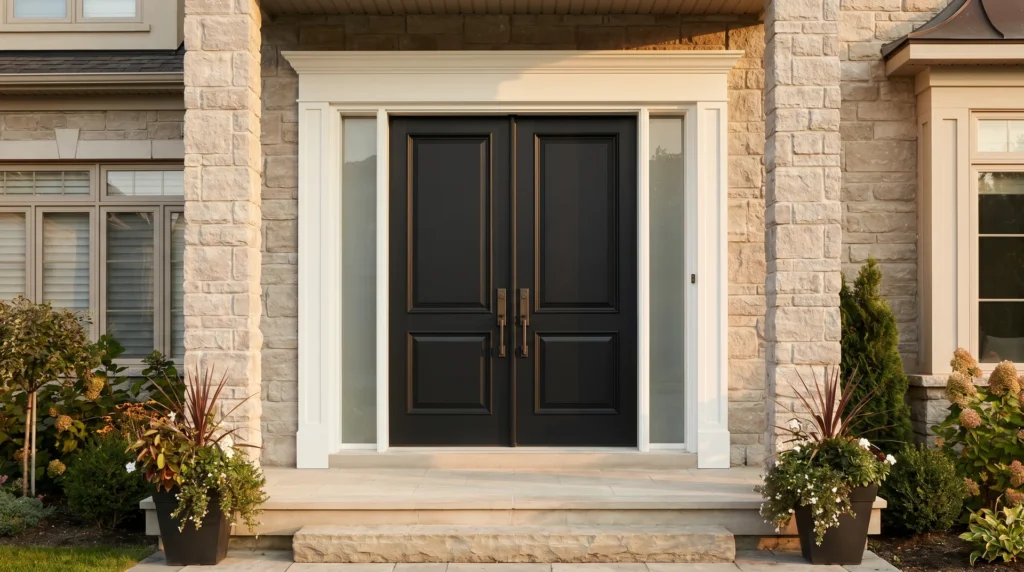
The first time I measured a doorway for a double door installation, I made the mistake almost every homeowner makes.
I measured the door itself, not the rough opening. The numbers looked right, the door arrived, and the existing framing told a very different story. That experience cost time, a restocking fee, and about ten days of delays on a project that should have taken two.
Here’s the direct answer before anything else: standard double doors are 60 to 72 inches wide in total, with each panel running 30 to 36 inches. Standard height is 80 inches, though 84-inch and 96-inch versions are widely available in newer builds with taller ceilings.
That number covers the most common scenario: a front entry double door on a residential home. If you’re working with interior double doors, French doors, closet configurations, or a patio sliding system, the sizing logic is different.
And then there’s the rough opening, the frame, and whether your existing wall can actually support a double configuration. All of that matters, and it’s all covered here.
Standard Double Door Width: The Direct Answer by Door Type
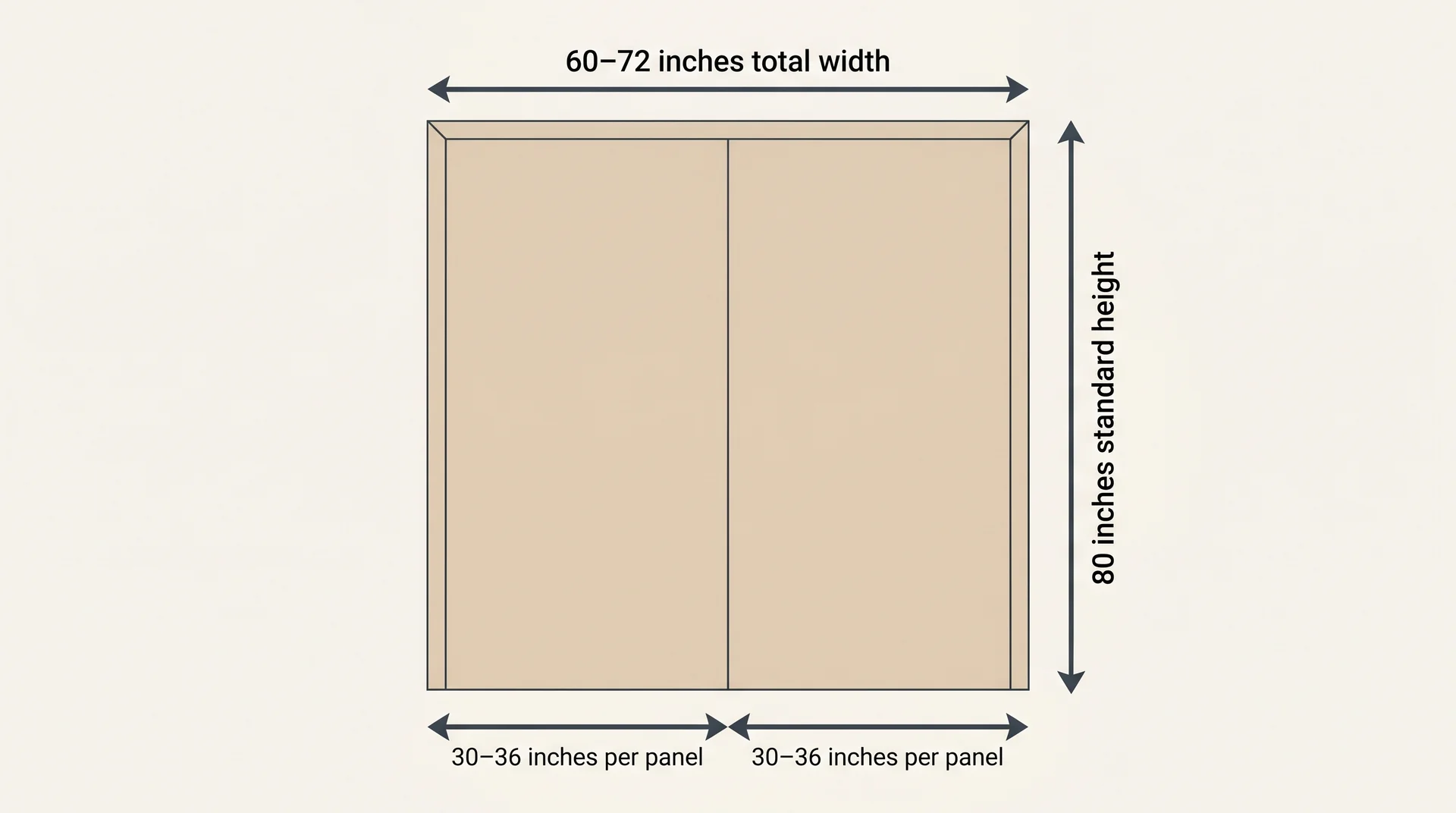
Standard double doors in US residential construction run 60 to 72 inches total width. Each panel is 30 to 36 inches. Standard height is 80 inches, with 84-inch and 96-inch options for taller ceilings. Standard thickness on exterior double doors is 1¾ inches.
These measurements refer to the door slab, which is the panel itself. The frame, the rough opening, and the installation clearance all require additional space. That distinction is where most ordering mistakes happen, and we’ll cover it in detail further down.
The Most Common Configuration
For front entry double doors, 72 inches total (two 36-inch panels) is the most common choice in US residential construction. It reads substantial from the street, handles furniture movement without drama, and is available in the widest range of styles and materials.
The 60-inch configuration (two 30-inch panels) shows up more often in interior applications, master suite entries, and older homes with tighter wall sections.
One thing worth knowing up front: in most double door setups, one panel is the “active” leaf you open daily, while the other stays fixed with flush bolts. You release the fixed panel when you need full width, like moving a large piece of furniture. This affects how you think about real-world clear opening width.
Standard Double Door Widths by Door Type
Front Entry Double Doors (Exterior)
| Configuration | Total Width | Each Panel | Height Range |
|---|---|---|---|
| Standard residential | 60–72 inches | 30–36 inches | 80 inches |
| Oversized / statement entry | 84–96 inches | 42–48 inches | 80–96 inches |
For most US homes, a 72-inch exterior double door is the benchmark. It fits standard residential construction, it’s stocked by virtually every manufacturer, and it gives the curb appeal that makes a double entry worth choosing over a single door with sidelights.
The 96-inch configurations are beautiful, but they’re typically custom orders with longer lead times and hardware sized for heavier panels. For a standard door replacement, the cost difference is rarely justified.
Interior Double Doors and Room Dividers
Interior double doors run narrower than exterior ones. Standard total widths are 48 to 72 inches, with each panel measuring 24 to 36 inches. The most common configuration for a living-to-dining room transition is 60 inches total. Master suite entries frequently use this same size.
Swing clearance is a bigger constraint indoors. Each panel needs clear floor space equal to its own width to open fully. A 60-inch interior double door requires 30 inches of clearance on each side.
In a furnished room, measure that before you commit. A 72-inch double door in a room with 8 to 9-foot ceilings reads proportional and grounded. That same width under 10-foot ceilings can start to look squat, and an 84-inch or 96-inch door often works better there. Width and height are always in conversation with each other.
Closet Double Doors
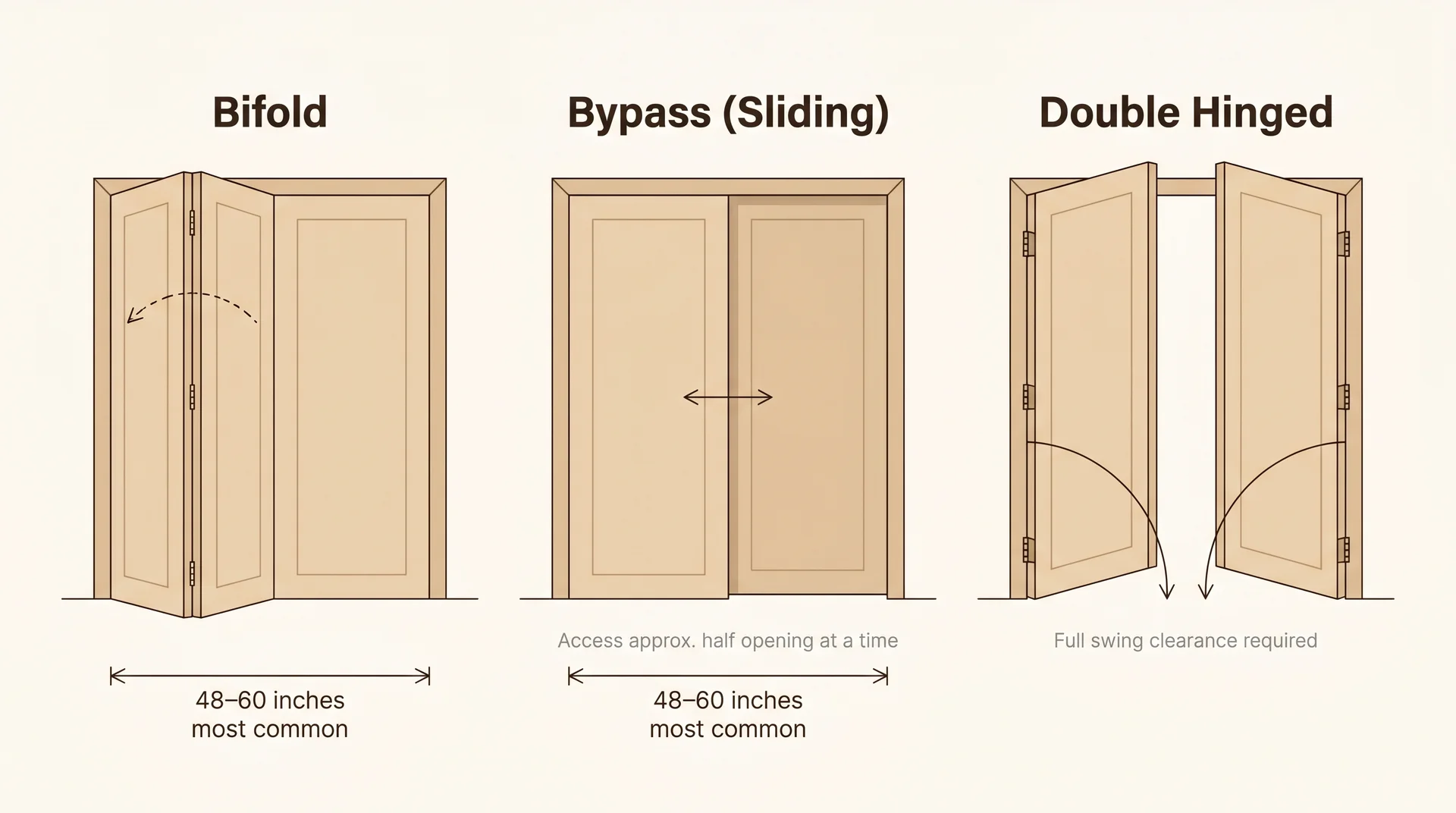
Closet double doors work differently from passage or entry configurations because they’re almost always bifold or bypass rather than swinging. Standard bifold closet door widths range from 24 to 72 inches total, with individual panels running 12 to 36 inches. Bypass (sliding) closet doors typically come in widths of 48, 60, and 72 inches.
- Bifold closet doors: 24–72 inches total width, most common at 48 and 60 inches
- Bypass (sliding) closet doors: 48–72 inches are most common; panels overlap when open, so you access roughly half the opening at a time
- Double-hinged closet doors: Follow the same sizing as interior passage double doors, 48–72 inches, but require full swing clearance into the room
If you’re planning a reach-in closet build-out alongside a door replacement, the door width and the internal shelving layout need to be planned together. Our reach-in closet dimensions guide covers how door type affects internal access zones.
French Doors
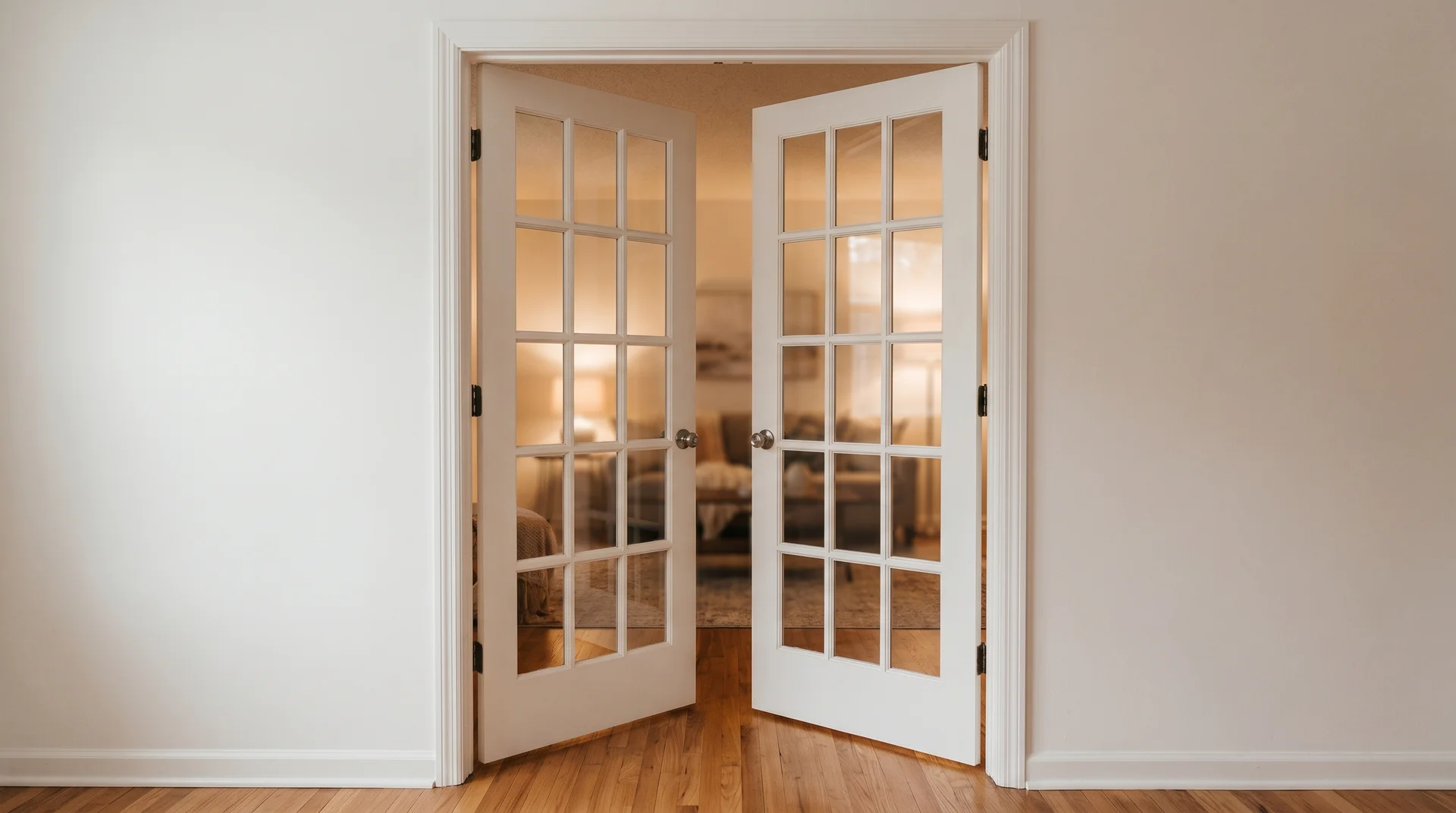
French doors are a style of double door, not a separate size category. What makes them French doors is the glass across most of the panel surface, and the way both panels meet at the center without a fixed sidelight between them.
Interior French doors run 48 to 72 inches total, with 60 inches being the most common for living spaces. Exterior French doors used as patio access run 60 to 72 inches standard, up to 96 inches in premium configurations. Frosted or divided-lite interior French doors at 60 inches feel proportional in rooms with 8 to 9-foot ceilings.
At 72 inches total, the door width wants more height in the surrounding architecture. If you’re working with standard ceilings and a 72-inch rough opening, consider adding a transom above the frame. It gives the opening the vertical dimension it needs to feel balanced and brings in light.
Patio and Sliding Door Systems
Sliding patio doors don’t require swing clearance because the panels travel along a track. In rooms where floor space is tight, that distinction matters.
| System Type | Standard Width Range | Notes |
|---|---|---|
| Standard sliding glass doors | 60–96 inches | One fixed panel, one sliding |
| French-style swinging patio doors | 60–72 inches | Both panels swing, clearance required |
| Multi-slide systems | 108–144 inches | Multiple panels, stacked to one side |
| Bi-fold systems | Up to 144 inches and wider | Near-full opening, structural work is usually required |
The wider sliding and bi-fold systems function more as architectural openings than conventional doors. A 144-inch bi-fold doesn’t just connect a living room to a patio; it dissolves the wall between them. Openings that wide typically require engineering input alongside the door selection.
Rough Opening vs. Door Width: Where Most Mistakes Happen
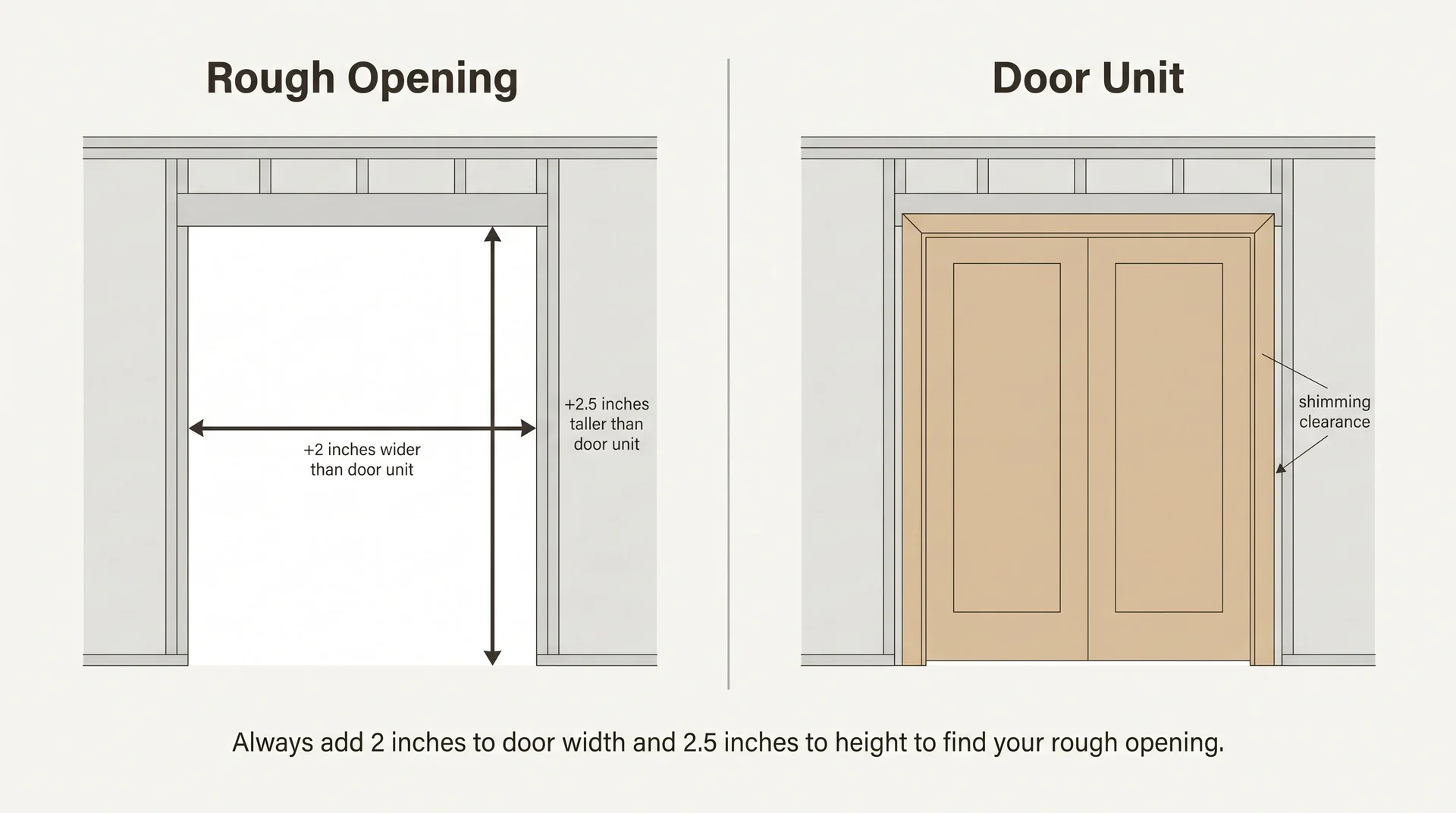
Getting the door size right is a ten-minute job. Getting it wrong is a two-week project. The single most common ordering mistake: confusing the door width with the rough opening.
The rough opening is the framed hole in your wall before the door unit goes in. It’s always larger than the door itself because it needs to accommodate the door frame, shims, and a small clearance gap around the entire unit.
The Formula Every Homeowner Needs
Rough opening width = door unit width + 2 inches.
Rough opening height = door unit height + 2.5 inches.
A standard 72-inch double door requires a rough opening of approximately 74 inches wide and 82.5 inches tall. A 60-inch door needs a 62-inch-wide rough opening. Always confirm against your specific manufacturer’s installation guide, as frame thickness varies between products.
If you’re measuring an existing opening, the reverse math works like this: measure the rough opening width, subtract 2 inches, and that’s the maximum door unit width you can order.
Prehung vs. Slab: Which Measurement You Actually Need
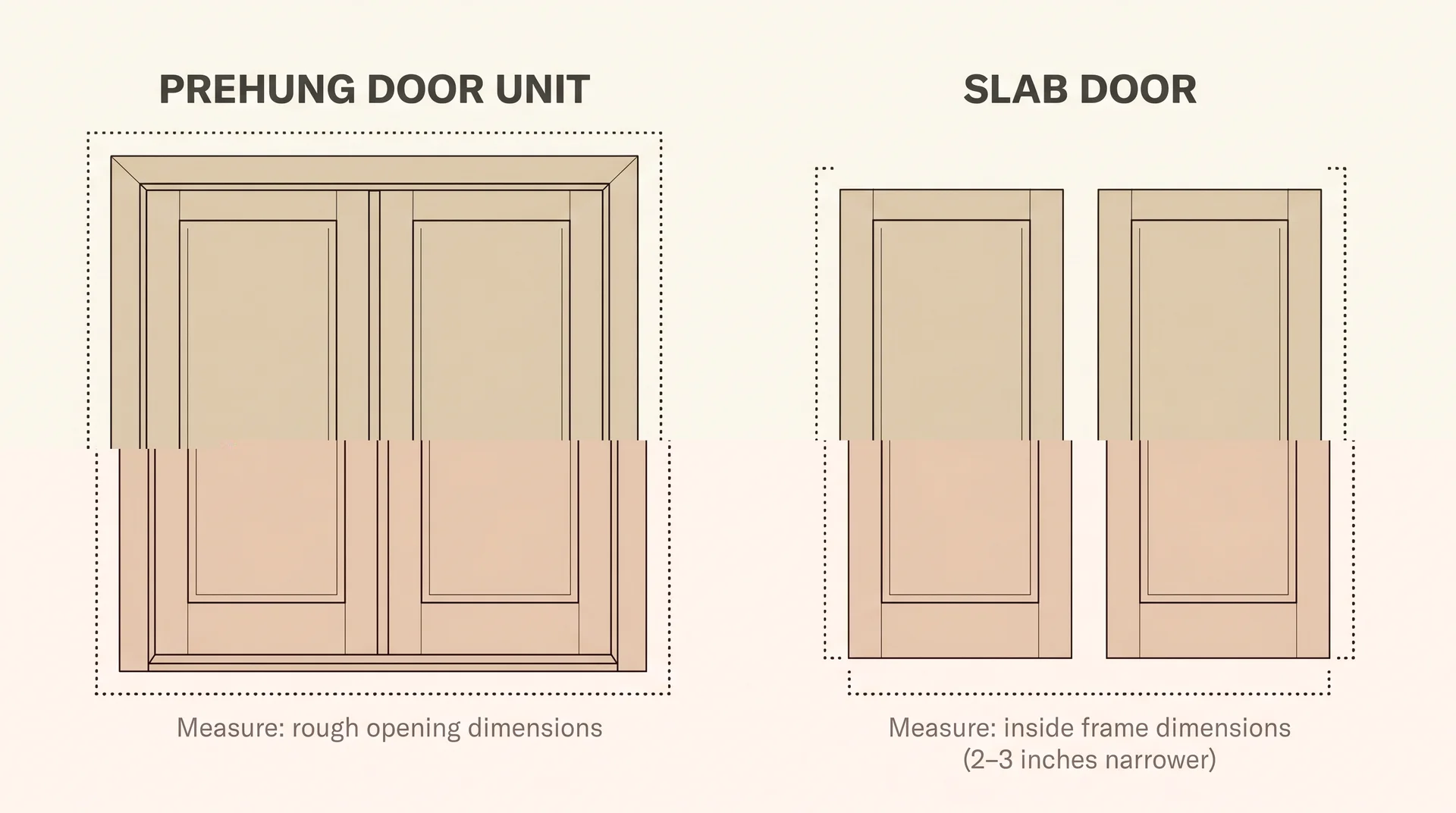
A prehung door comes with the frame already attached. You’re installing the whole unit, frame and all, into the rough opening. A slab door is just the panel, which goes into your existing frame. If you’re ordering prehung, work with rough opening dimensions.
If you’re ordering a slab, work with the inside frame dimensions, which are typically 2 to 3 inches narrower than the rough opening. Mixing these up is one of the most expensive ordering mistakes you can make.
Inswing vs. Outswing and How Each Affects Your Space
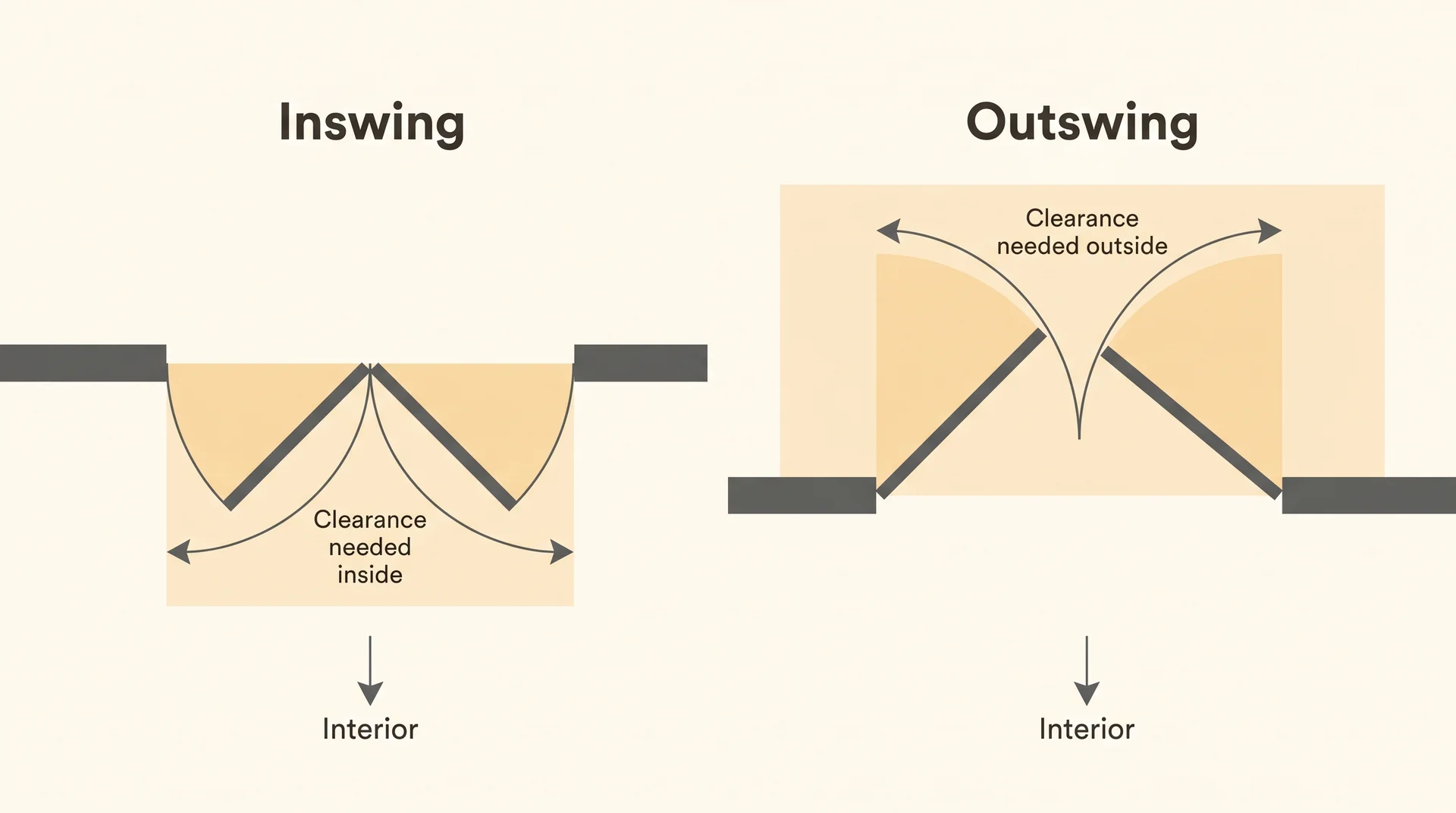
Most residential exterior double doors are set to inswing, meaning both panels swing inward. Outswing configurations exist and are sometimes preferred in climates with heavy snowfall or on entries with limited interior depth. The difference matters for clearance planning.
An inswing double door requires clear floor space on the interior side equal to the full door width. An outswing door needs that clearance on the exterior, which affects your landing or porch. Neither is better by default — the right choice depends on what the space can absorb.
Converting a Single Door Opening to a Standard Double Door Width
A standard single exterior door opening has a rough opening of approximately 38 inches wide. A standard double door requires a rough opening of 62 to 74 inches. Those numbers don’t overlap. You cannot fit a true double door into a single-door rough opening without structural work to widen it.
What that work involves depends on your wall:
- Non-load-bearing wall: Remove studs, install a new header at the correct span, reframe the rough opening sides, and patch the surrounding wall. Budget several thousand dollars in labor, including finishing. Achievable with the right contractor.
- Load-bearing wall: Scope expands significantly. Requires temporary shoring, an engineered header sized for the new span, and sometimes a foundation assessment. Get a structural engineer involved before committing to plans.
A practical alternative worth serious consideration: adding sidelights to your existing single door. A 36-inch front door with 12-inch sidelights on each side creates a visual footprint of 60 inches. It delivers a lot of the presence of a double entry without widening the structural opening. In many architectural situations, it’s the more refined result.
A note on structural work: Any modification to a load-bearing wall, or any project requiring changes to door framing or headers, should be assessed by a licensed contractor or structural engineer before you proceed. Building permits are typically required for door opening modifications in most US jurisdictions.
ADA Double Door Width Requirements and What They Mean at Home
The Americans with Disabilities Act establishes minimum door clearance standards for commercial spaces. Understanding these standards is useful for residential design, too, especially for homeowners thinking long-term.
ADA requires a minimum clear opening of 32 inches when a door is open to 90 degrees. For double doors, at least one active leaf must meet this requirement individually.
In a standard 72-inch double door where one 36-inch panel is the active leaf, you get approximately 33 to 34 inches of clear opening comfortably above the minimum. The door thickness and jamb stop account for the difference between the nominal width and the actual passable space.
I bring this up in residential projects because aging in place is a real planning consideration, even for clients in their 30s and 40s. A 72-inch double door configuration handles wheelchairs, walkers, and medical equipment comfortably through the active leaf. Building for that flexibility costs nothing extra when it aligns with a standard configuration anyway.
How to Measure Your Door Opening Correctly
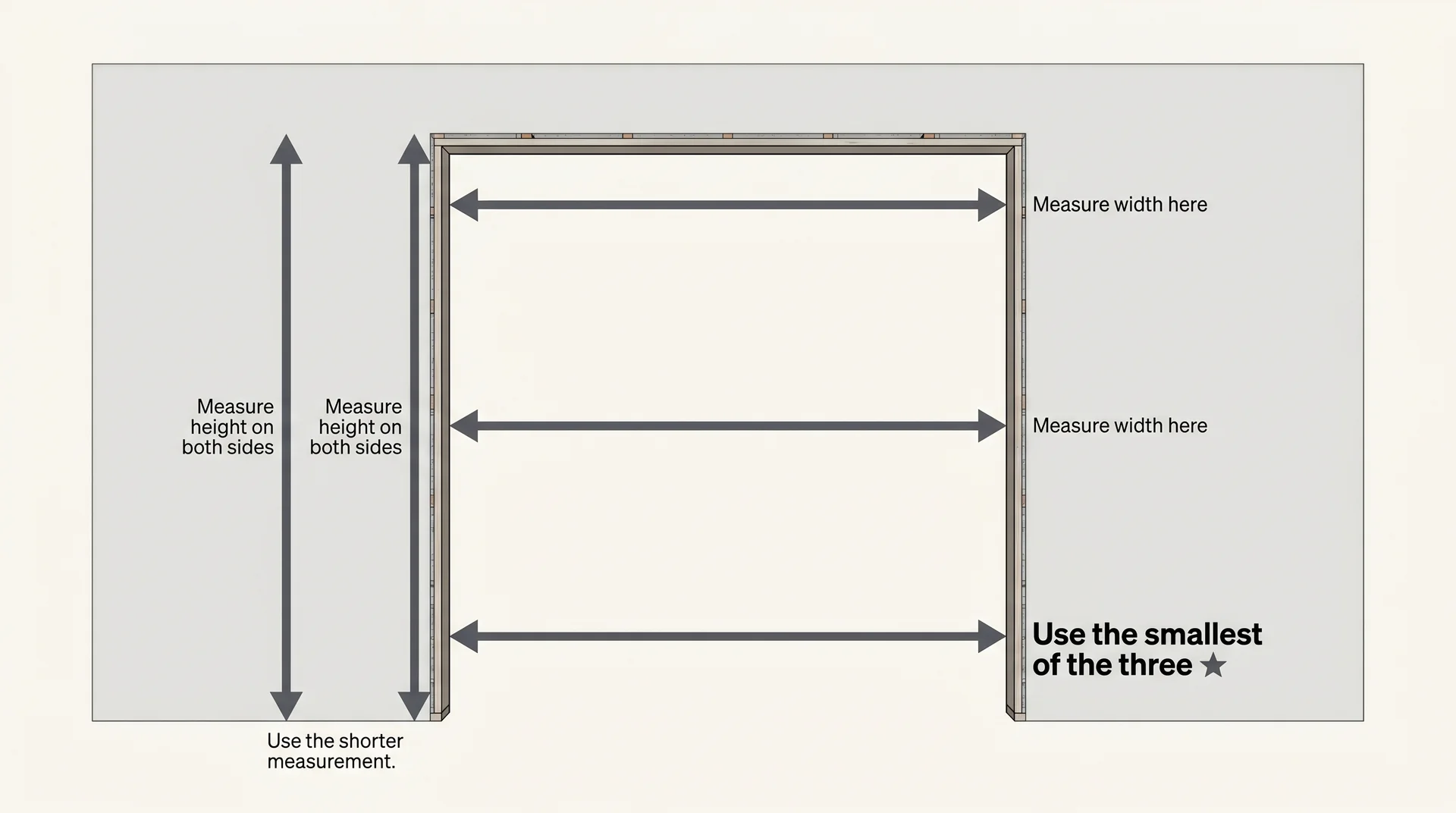
Whether you’re buying a replacement door or assessing a conversion, accurate measurement is where the project either goes smoothly or doesn’t.
- Step 1: Measure the width at three heights: top, middle, and bottom. Walls and frames are rarely perfectly square, especially in older homes. Record all three and use the smallest as your working width.
- Step 2: Measure the height on both sides from the finished floor to the top of the rough opening. Use the shortest measurement.
- Step 3: Decide whether you’re installing a prehung unit (use rough opening dimensions) or a slab (use inside frame dimensions).
- Step 4: Run the rough opening math in reverse if needed. Subtract 2 inches from the rough opening width and 2.5 inches from the height to find the maximum door unit that fits.
If your numbers don’t land on a standard size, you have two options: a custom order or minor reframing. For openings that are an inch or two off, minor reframing is usually the simpler path.
For openings that are significantly non-standard, particularly in homes built before standardized sizing became common, a professional measurement before ordering is worth every dollar.
The interior trim and door casing that finishes the installation also need to suit the frame depth. Our guide to interior trim profiles covers the most common options for finishing a door installation cleanly.
The Design Side: Choosing the Right Double Door Width for Your Home
Knowing the standard sizes gets you to the right order form. Knowing how the width reads in your specific space gets you to the right result.
Proportion and the Front Facade
A 60-inch double door on a wide craftsman home with a broad front porch can look underwhelming. A 72-inch pair on a narrow townhouse entry can feel visually heavy. Width has to be read in relationship to the facade around it, the ceiling height inside the entry, and the visual weight of the surrounding trim and cladding.
A principle I’ve applied across many residential projects: for wall sections under 10 feet wide, 60 inches is usually the better-proportioned choice. For walls 12 feet and wider, the 72-inch configuration delivers the sense of arrival that double doors are supposed to give.
When Sidelights Work Better Than Double Doors
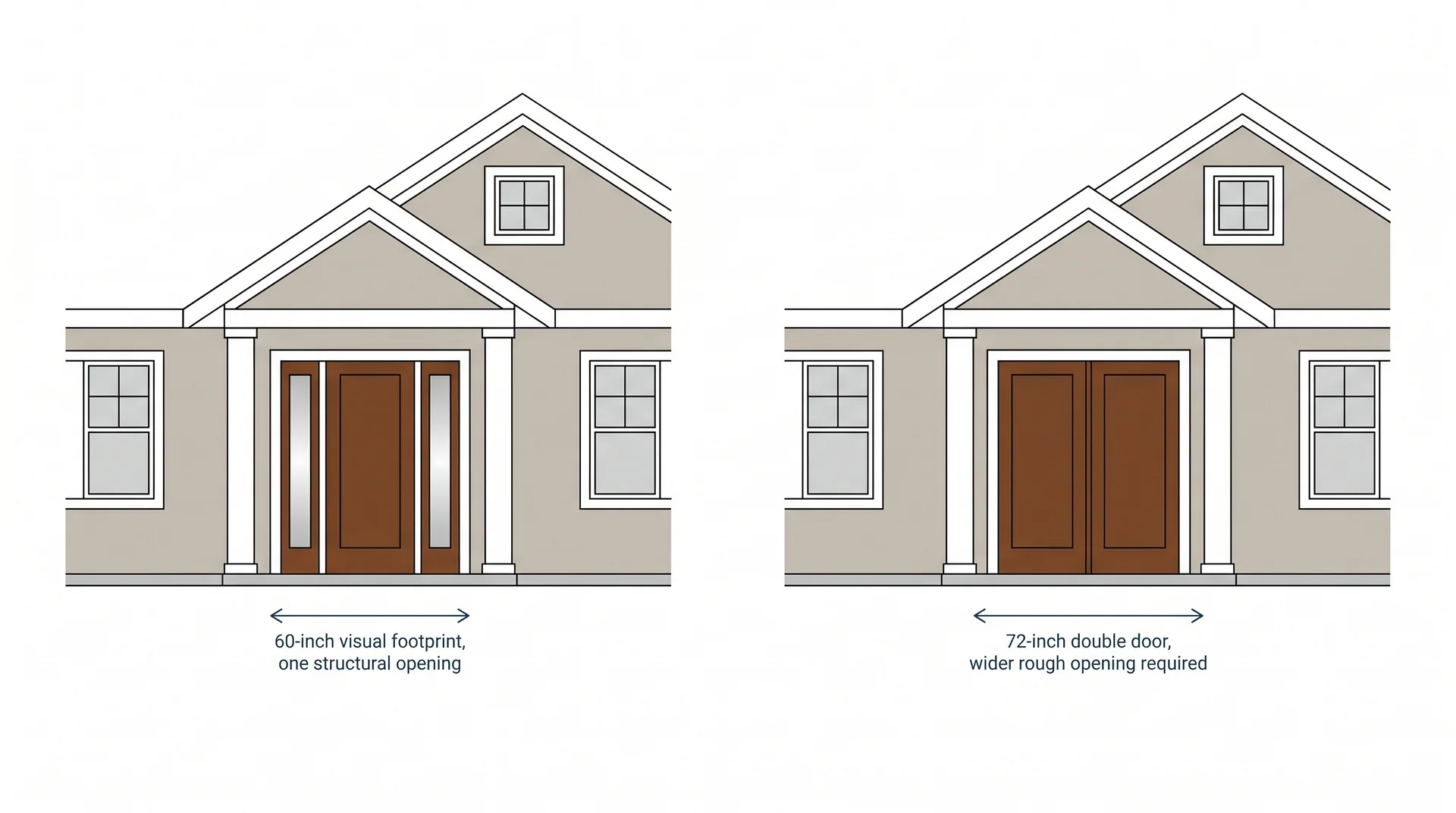
For narrower facades or walls where swing clearance is a real constraint, sidelights are often the stronger design call. A 36-inch entry door with 12-inch sidelights on both sides creates a visual unit 60 inches wide. It reads as a significant entry from the street, preserves wall space, and avoids the structural work of widening the opening.
I’ve specified this configuration on projects where double doors were the first instinct, and the sidelight entry consistently produced the cleaner result. The fixed vertical glass panels flanking a solid door can read as more refined than swinging double panels, depending on the architectural context.
Material, Weight, and Hardware at Wider Sizes
As panels get wider, they get heavier, especially in solid wood or steel. A 36-inch solid wood panel weighs considerably more than a 30-inch one, and a pair of them needs hardware to match.
Look for hinges rated for the panel weight, a multi-point locking system on exterior double doors, and pulls or handles sized proportionally to the door; a small lever handle on a large door looks like an afterthought.
For exterior double doors in wider configurations, expect to spend $1,500 to $5,000 or more for the door unit alone, with installation adding $500 to $2,000 depending on whether reframing is needed. Custom and oversized configurations push significantly higher.
Standard Double Door Width Quick-Reference Chart
| Door Type | Total Width | Each Panel | Standard Height |
|---|---|---|---|
| Front entry, standard | 60–72 inches | 30–36 inches | 80 inches |
| Front entry, oversized | 84–96 inches | 42–48 inches | 80–96 inches |
| Interior room divider | 48–72 inches | 24–36 inches | 80 inches |
| French door, interior | 48–72 inches | 24–36 inches | 80 inches |
| French door, exterior/patio | 60–96 inches | 30–48 inches | 80–96 inches |
| Closet bifold double door | 24–72 inches | 12–36 inches | 80 inches |
| Closet bypass (sliding) | 48–72 inches | varies | 80 inches |
| Patio sliding, standard | 60–96 inches | varies | 80 inches |
| Multi-slide / bi-fold | 108 inches and wider | varies | 80–96 inches |
All measurements refer to the door slab. Add 2 inches to any total width and 2.5 inches to height for the required rough opening.
Frequently Asked Questions
What Is the Standard Width of Double Front Doors?
Standard double front doors are 60 to 72 inches in total width, with each panel measuring 30 to 36 inches. The 72-inch configuration (two 36-inch panels) is the most common choice in US residential construction.
What Is the Rough Opening for a 72-Inch Double Door?
A 72-inch double door requires a rough opening of approximately 74 inches wide and 82.5 inches tall. Always confirm against your specific manufacturer’s installation guide.
Can I Convert My Single Door Opening to Double Doors?
A standard single door opening (roughly 38 inches rough opening) can’t accommodate a standard double door without structural work to widen it. For non-load-bearing walls, it’s an achievable renovation. For load-bearing walls, it requires a structural assessment. A sidelight entry is often the more practical path when full conversion isn’t feasible.
Do Both Panels of a Double Door Open?
In most residential configurations, one panel is the active leaf used daily, and the other stays fixed with flush bolts. Both panels open when you need full-width access. Some configurations have both leaves active, but this is less common in standard residential installations.
Are Double Doors ADA Compliant?
A double door where the active leaf is 36 inches wide provides approximately 33 to 34 inches of clear opening, which meets the ADA minimum of 32 inches. For double doors, at least one active leaf must individually meet the 32-inch clear opening requirement.
What’s the Difference Between French Doors and Double Doors?
French doors are a style of double door. They feature glass panes across most of the panel surface and meet at the center without a fixed sidelight between them. All French doors are technically double doors, but most double doors are not French doors.
How Wide Are Standard Closet Double Doors?
Bifold closet double doors range from 24 to 72 inches total, with 48 and 60 inches being the most common widths. Bypass (sliding) closet doors are typically 48, 60, or 72 inches wide. Unlike passage double doors, closet doors don’t require full swing clearance into the room.
What Is the Rough Opening for a 60-Inch Double Door?
A 60-inch double door requires a rough opening of approximately 62 inches wide and 82.5 inches tall.
Final Thoughts
Sizing a double door is a practical decision and a design one. The number is the starting point proportion, swing clearance, structural reality, and how the door reads against your home’s architecture are what make it right.
For most front entries, the 72-inch configuration is the reliable benchmark. For interior applications and master suites, the 60-inch version handles most situations well. And if your wall situation makes a true double door structurally complicated, a sidelight entry is worth serious consideration before you commit to reframing work.
Measure carefully, account for the rough opening, and think about how the door reads in relationship to everything around it.