
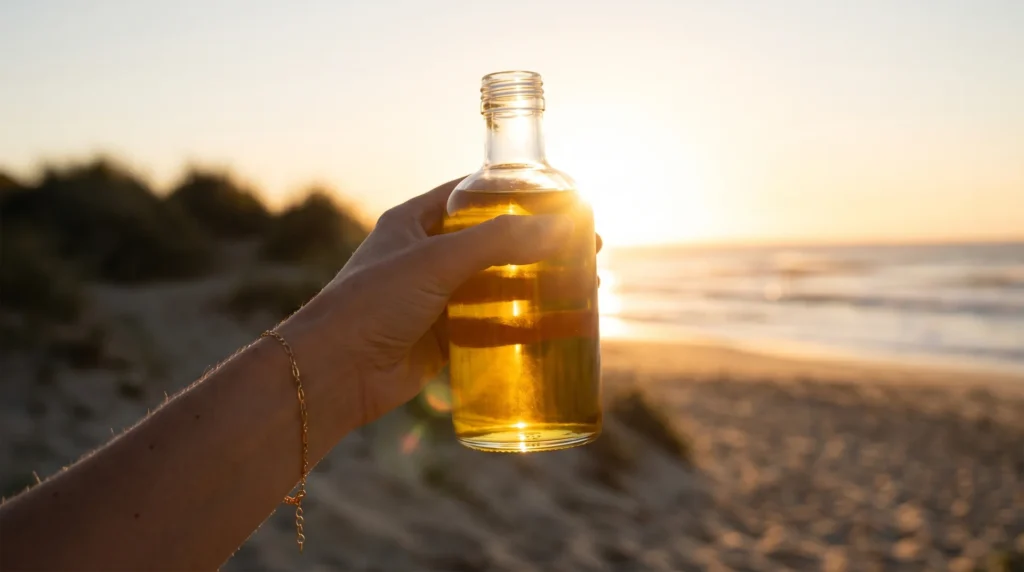
Baby oil does speed up tanning. That part is true. The problem is that it speeds up everything else, burning, barrier damage, and the kind of UV exposure that compounds quietly over the years.
Before you reach for that bottle at the beach, here’s what’s actually happening when mineral oil meets sun exposure, and what works considerably better.
| A note before you read: tanning of any kind involves UV exposure, which carries real health risks. This article covers how baby oil interacts with sun exposure and how to reduce harm if you choose to tan. It is not a recommendation to skip sun protection. If you have a history of sun damage or are managing a skin condition, speak with a dermatologist before changing your sun care routine. |
What Baby Oil Actually Does to Your Skin in the Sun
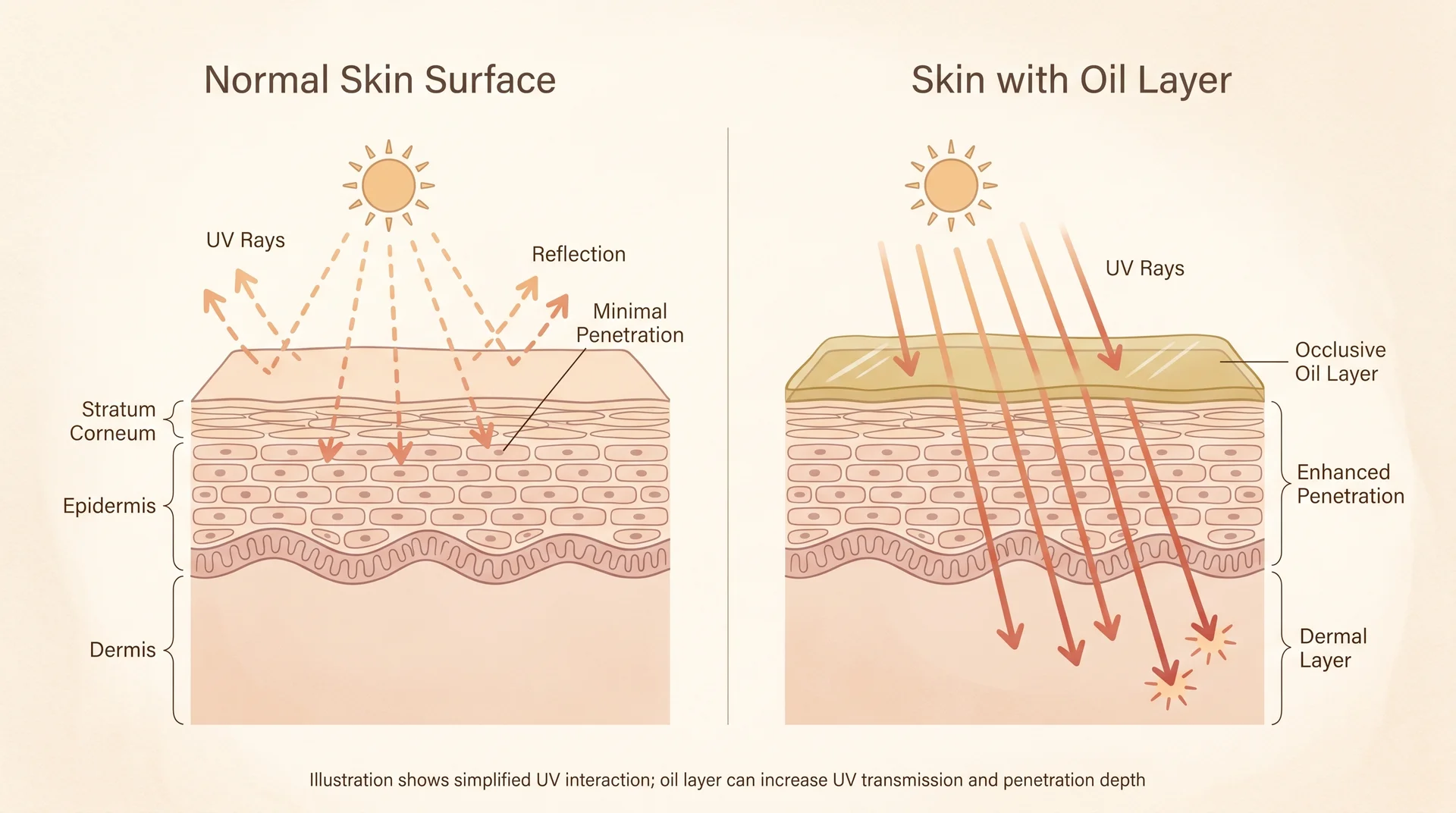
Baby oil is primarily mineral oil, a refined petroleum derivative that sits on the surface of the skin rather than absorbing into it. As a moisturizer, that quality works in its favor. It forms an occlusive layer that seals in moisture and slows water loss. In a sun context, that same property works against you.
Why It Speeds Up Color (and Burning)
Baby oil accelerates UV penetration by reducing the skin’s natural light-reflective surface, which means more UV rays reach the deeper layers of the epidermis. When you apply it before going outside, you’re removing the surface resistance that naturally slows that process. The result is faster color, but faster color and a better tan are not the same thing.
A significant portion of the early color you see after using baby oil in the sun is erythema, the redness phase that precedes burning, not melanin deepening. Many people mistake that initial flush for a base tan coming in, when what’s actually happening is the skin’s first inflammatory response to overexposure. The tan you see two days later often follows a burn, not a clean melanin build.
The Occlusive Layer Problem
When oil sits on the surface of the skin, it also traps heat. Skin that is hot and occluded absorbs UV differently from skin that is dry and ventilated. In my clinical work, clients who had been using body oils in direct sun consistently showed more heat-induced redness and pigmentation irregularities than those who hadn’t. It’s a combination problem, not just a UV problem in isolation.
Most standard baby oil formulas also contain fragrance. Fragrance becomes photosensitizing under UV exposure, meaning it can trigger phototoxic or photoallergic reactions, particularly in people with sensitive or reactive skin. If you’ve ever noticed patches of darkening or irritation after a day in the sun with a scented body product, that’s likely the mechanism at work.
If you’re considering adding iodine to baby oil as a combination that’s trending again, iodine is a documented
photosensitizer that acts directly on UV reactivity, not just on surface irritation.
The compounded effect is considerably more significant than fragrance sensitization alone.
The Real Risks of Using Baby Oil for Tanning
The risks are listed vaguely in a lot of coverage. Here’s what they look like in practice.
Sunburn and Blistering
Baby oil contains no SPF and no UV filters, so your skin has zero chemical protection while receiving amplified UV exposure. The combination moves fast. What takes 45 minutes to turn into a burn with no product on may take 15 minutes with baby oil, depending on your skin type, UV index, and time of day.
Fair skin and unexposed skin with no baseline melanin depth are especially vulnerable to severe burns, including blistering, which damages the dermal layer and increases scarring risk.
A blistering sunburn is not just cosmetically damaging. The American Academy of Dermatology notes that even a single blistering sunburn in childhood can significantly raise a person’s lifetime risk of melanoma.
Sunburn also causes dehydration, and a burn that covers a large portion of the body can require medical attention.
Premature Aging and Pigment Damage
The UV damage that causes premature aging is primarily UVA-driven, and UVA operates silently. You don’t visibly burn from UVA; you age. It breaks down collagen and elastin in the dermis, causing fine lines, laxity, and sunspots that typically become visible in your late 30s and 40s. With baby oil amplifying both UVA and UVB penetration, you’re stacking both types of damage in every session.
Melasma and post-inflammatory hyperpigmentation are also concerns. Heat and UV together are a known trigger for both conditions. Clients who tanned heavily in their 20s using body oils tend to present with more significant pigmentation irregularities by their mid-30s, and once that pigment is established, it’s slow to treat.
Skin Cancer Risk
The Skin Cancer Foundation reports that one in five Americans will develop skin cancer by age 70, with UV exposure being the primary modifiable risk factor.
Any practice that amplifies UV penetration without offsetting it with protection increases cumulative exposure. Using baby oil for tanning removes the one element that could reduce harm, which is sunscreen, and adds something that increases it, which is amplified UV absorption.
Does Baby Oil Actually Give You a Better Tan?
Baby oil produces faster color, but it does not reliably produce a better tan. Here’s the practical answer to the question most people are actually asking.
Melanin tanning, the kind that comes from a gradual deepening of pigment, happens over time as melanocytes ramp up production in response to UV. It’s a slower process.
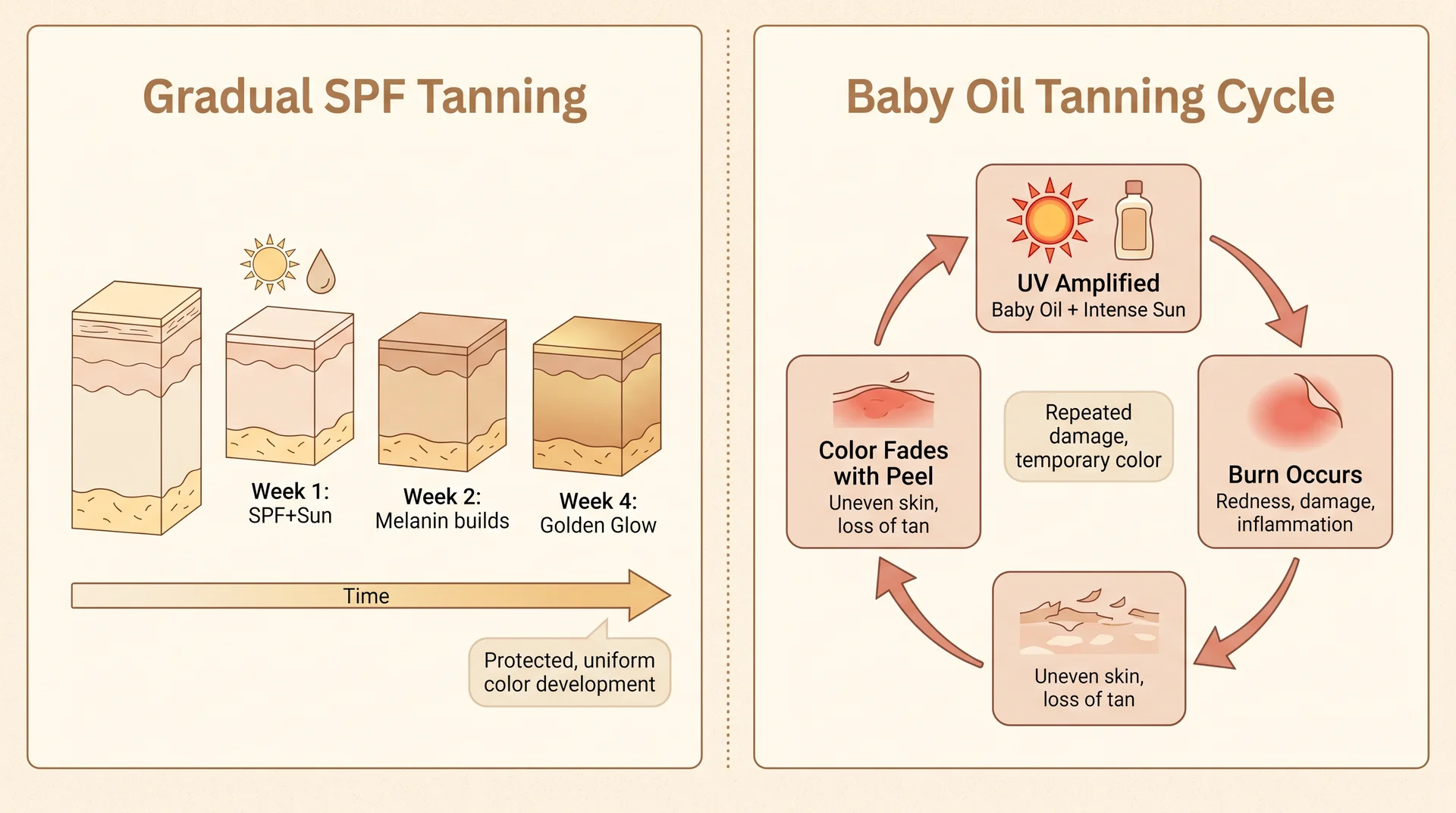
What baby oil accelerates is the entire UV response, including burning, which disrupts the tan cycle. If you burn and peel, you lose the color you just developed, along with the damaged surface skin. Many people using baby oil cycle through burn, tan, and peel repeatedly without ever building the even, lasting base they’re after.
From an esthetician’s perspective, clients with the most consistent, even tans were the ones who built exposure gradually over weeks with adequate SPF, not the ones trying to accelerate with oil. The oil shortcut tends to produce blotchy, uneven color and sets the skin back with each damage cycle.
Baby Oil vs. Tanning Oil: What’s the Actual Difference?
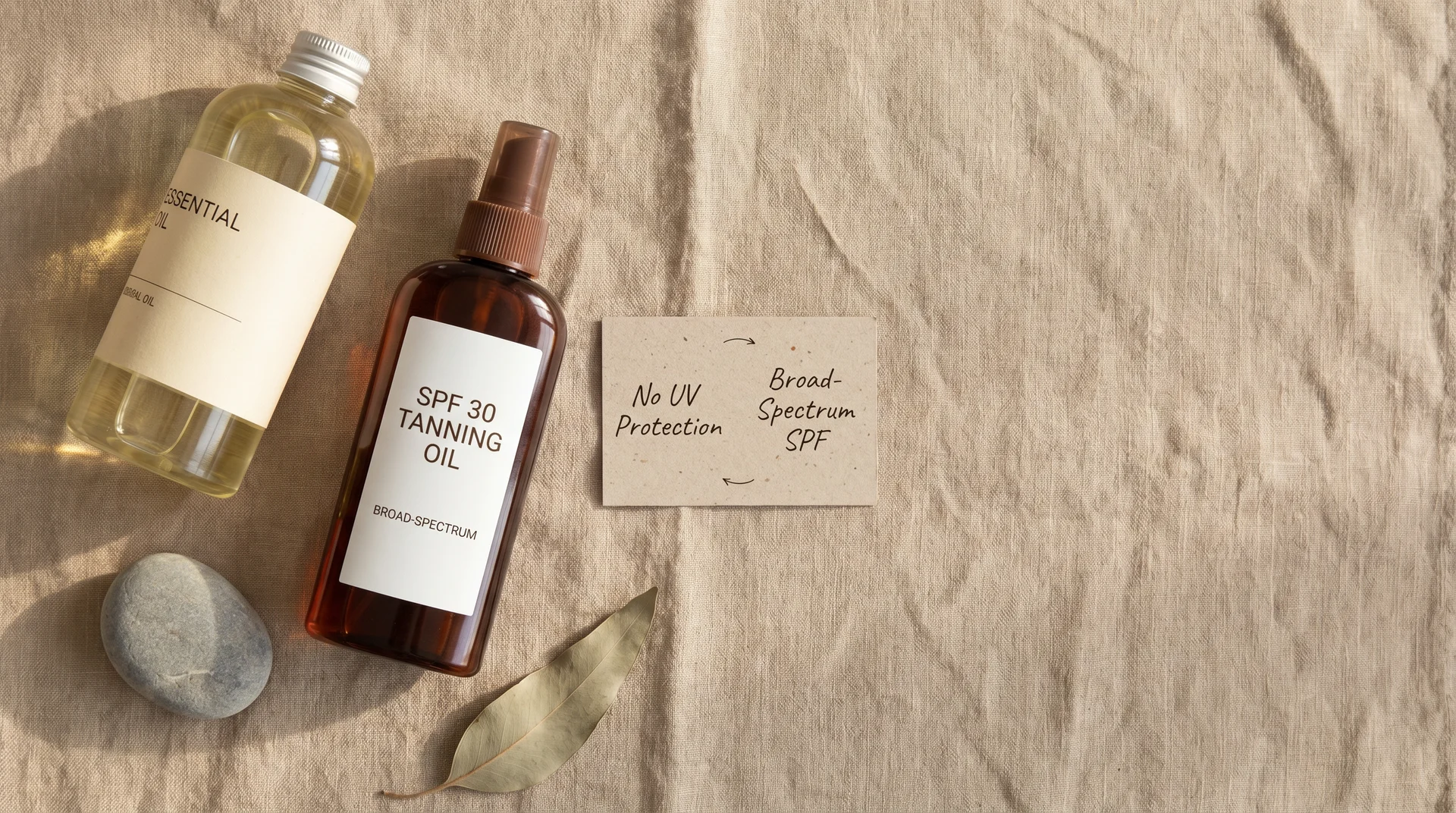
This comparison trips a lot of people up because the products look similar and are often shelved near each other. They work very differently.
| Feature | Baby Oil (Standard) | Tanning Oil with SPF |
|---|---|---|
| Primary ingredient | Mineral oil | Mixed oils (coconut, jojoba, argan) |
| Sun protection | None | Broad-spectrum SPF 15 to 50 |
| UV behavior | Amplifies UV penetration | Filters UV while allowing gradual tanning |
| Skin benefit | Occlusive moisturizer only | Moisturizer plus UV filter, often with antioxidants |
| Recommended timing | After sun, for post-exposure hydration | Before and during sun exposure |
SPF tanning oils still facilitate UV exposure rather than eliminate it, which means cumulative skin damage continues even when you’re using them. The SPF reduces the rate of that damage significantly, but it does not remove it.
If you choose a tanning oil, the practical minimum is SPF 30, broad-spectrum coverage against both UVA and UVB, and water resistance if you’ll be swimming or sweating. Reapplication every two hours is not optional, regardless of the SPF number on the label.
Safer Alternatives That Still Get You a Tan
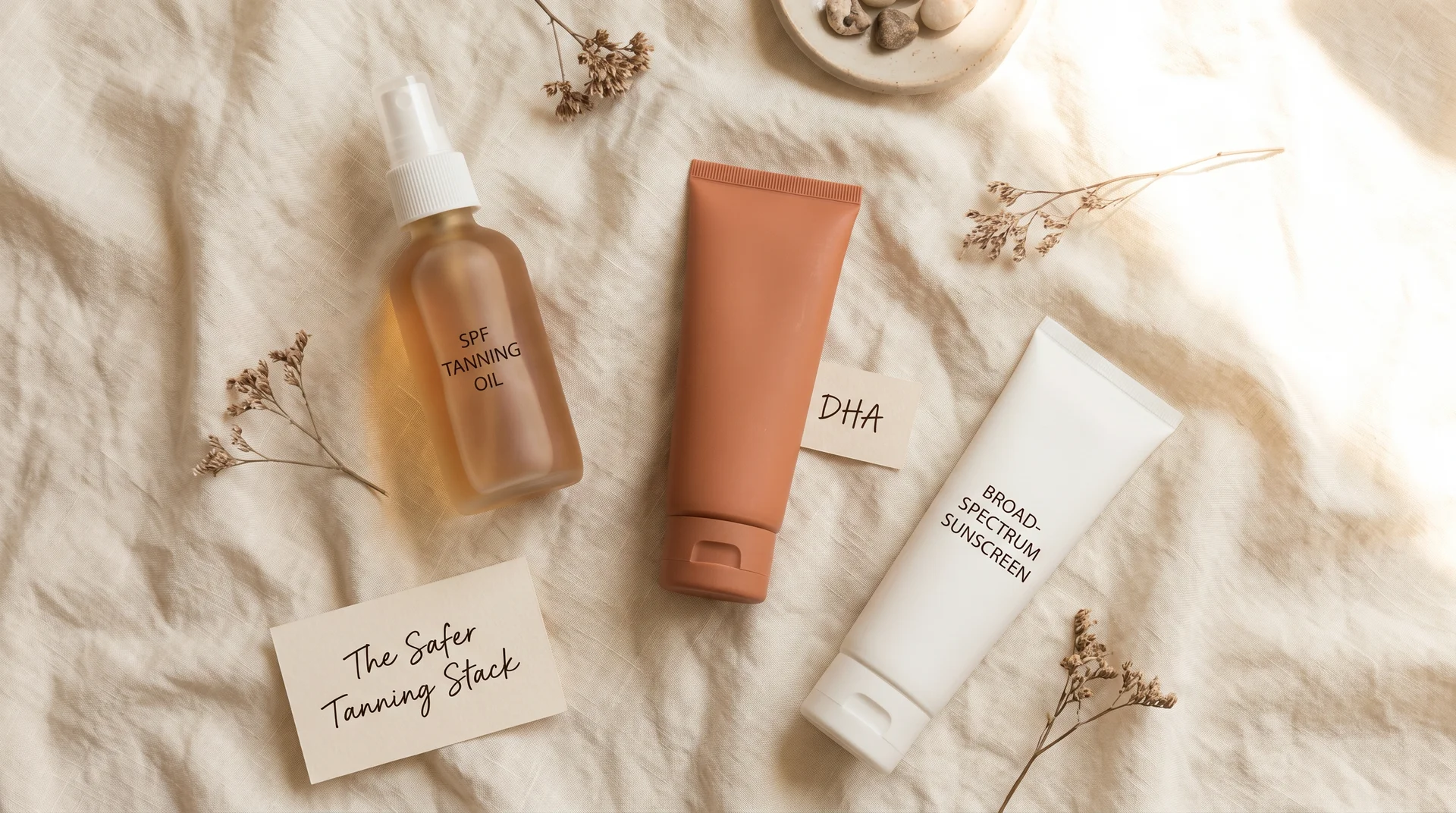
The goal is color, not specifically UV exposure. There are multiple routes to the same result with significantly less damage involved.
SPF Tanning Oils
If you want the oil texture and the feel of a tanning oil, SPF-formulated versions are a meaningful upgrade from baby oil. Brands like Sun Bum, Sol de Janeiro, and Hawaiian Tropic offer SPF 30 to 50 tanning oils that hydrate the skin while providing real UV protection. They let color build more gradually, which is exactly the point.
One important layering note: applying your sunscreen first and then the tanning oil on top gives you more reliable protection than mixing them. Mixing oils with sunscreen can disrupt the film-forming agents in the sunscreen formula and reduce its actual SPF efficacy. Sunscreen first, then oil, is the correct order if you want both benefits.
Self-Tanners with DHA
Self-tanners are the only method that produces visible color without UV exposure at all. Modern DHA-based formulations have improved considerably from the streaky orange results people associate with earlier versions. DHA, a sugar-derived compound, reacts with amino acids in the surface layer of the skin to produce a color response that reads as a natural-looking tan.
The key to an even result is preparation: exfoliate the day before, pay extra attention to blending around knees, elbows, and ankles where skin is drier, and color tends to concentrate, and start with a lighter formula if you want a gradual, buildable glow. DHA does not provide any sun protection, so you still need SPF applied on top for any outdoor time.
Tanning Gradually with SPF
It’s a persistent misconception that SPF prevents you from tanning at all. Even SPF 50 allows a small percentage of UV rays through. What changes is the rate; you tan more slowly, which also means more evenly and with a far lower chance of burning.
Applying SPF 30 to 50 consistently and building outdoor exposure over several weeks produces the most lasting, even color because you’re not resetting the process with burns that cause peeling.
Going outside before 10 a.m. or after 4 p.m. when the UV index is lower is also genuinely effective harm reduction. A UV index of 3 or below still produces a gradual tan over time, just more slowly than peak midday hours.
After You’ve Used Baby Oil in the Sun: Skin Recovery
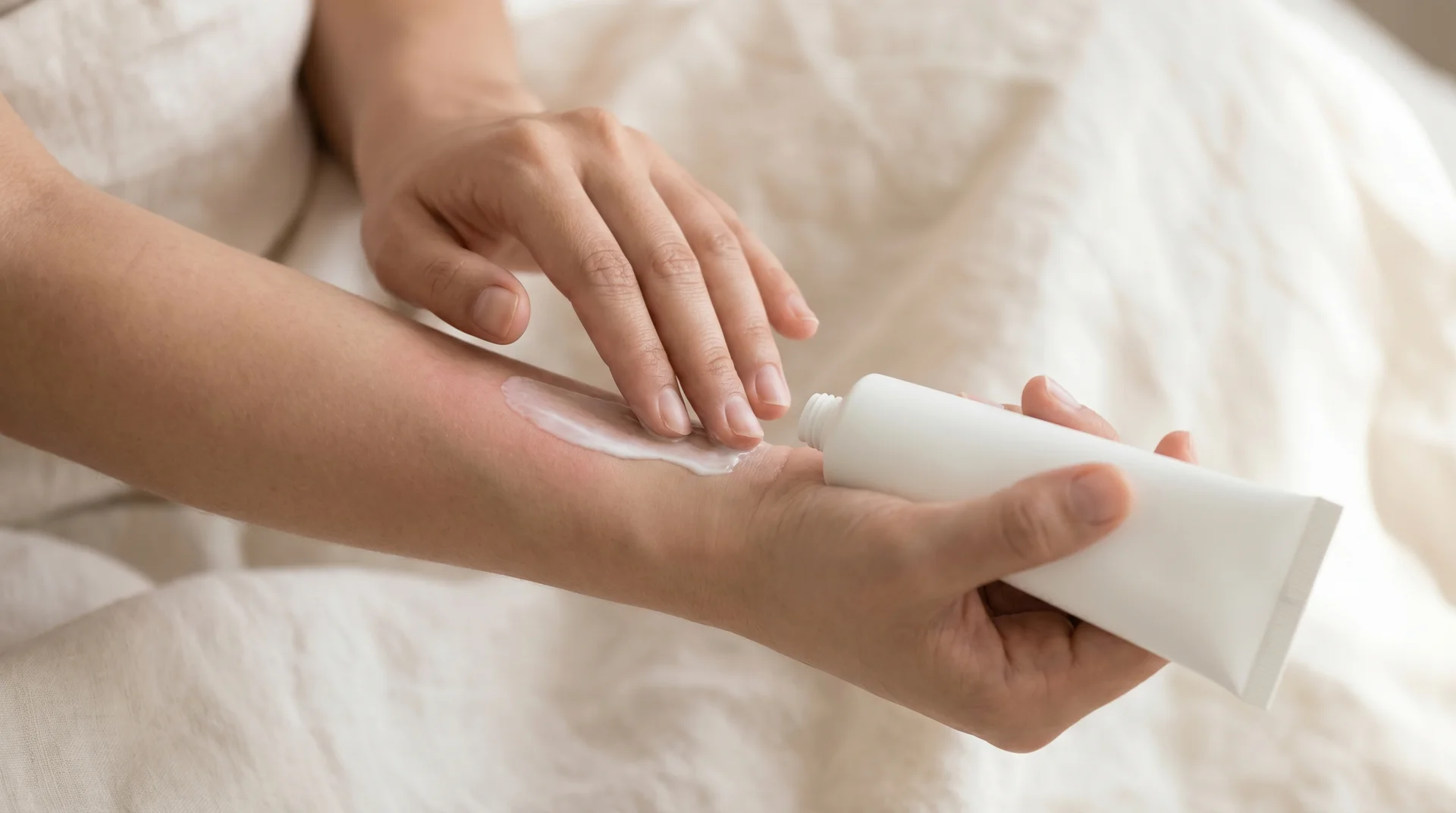
If you’ve already used baby oil outdoors and ended up with a burn, here’s what actually helps the skin recover.
- Get out of the sun immediately at the first sign of redness. UV damage continues for several hours after exposure ends, but removing the source is still the right first step.
- Cool the skin gently with lukewarm water rather than cold. Cold water can cause vasoconstriction that intensifies discomfort in already inflamed skin. A cool shower for 10 to 15 minutes is appropriate.
- Apply pure aloe vera gel with no alcohol or added fragrance. Both irritate damaged skin. Look for formulations where aloe is the primary ingredient, not a trace addition to a heavily fragranced lotion.
- Avoid all actives like retinoids, AHAs, BHAs, vitamin C, and anything exfoliating until the burn has fully resolved. Your skin barrier is compromised, and any penetrating ingredient will cause disproportionate irritation.
- Moisturize with a gentle, fragrance-free emollient. Products with ceramides and hyaluronic acid support barrier repair without adding unnecessary sensitizers. CeraVe Moisturizing Cream or Vanicream are reliable options.
- Stay out of the sun while the skin is healing. Applying any tanning product to burned, sensitized skin will worsen the damage significantly.
If blisters form, leave them intact. Blisters protect the underlying damaged skin from infection. If blistering is widespread or accompanied by fever, chills, or nausea, those are signs of sun poisoning that warrant a call to your doctor rather than home care.
What I Use Instead
After a decade of working with clients managing sun-compromised skin, I stopped recommending any unprotected tanning approach. The cumulative picture is difficult to ignore when you’re seeing the same clients over the years and watching pigmentation irregularities compound session by session.
For clients who genuinely want color, my standard recommendation is a DHA self-tanner for immediate visible results, combined with an SPF 30 to 50 tanning oil for any gradual natural deepening they want when spending time outdoors. If you’d rather skip the commercial products and build your own, our full guide to making tanning oil at home by skin type covers which carrier oils to use, what to avoid, and exactly how to layer it over SPF for safe use.
That combination gives you actual control; you’re not dependent on whether you’ll burn on a particular day, and you’re not relying entirely on self-tan color that fades within a week.
<p>Baby oil has a real place in a skincare routine. Applied to damp skin right after a shower, it’s an effective and affordable body moisturizer that performs well. As a pre-sun product, it has no legitimate role in the routine at all.
Baby oil has a real place in a skincare routine. Applied to damp skin right after a shower, it’s an effective and affordable body moisturizer that performs well. As a pre-sun product, it has no legitimate role in the routine at all.