
That matters because your spray tan color lives in those cells, and anything that speeds up their departure takes your tan with it.
The good news: you probably already own something that works. CeraVe, Aveeno, Hempz, and a handful of other widely available lotions are some of the best options out there.
As long as you start at the right time and skip a few specific ingredients. Here’s exactly what to use, what to avoid, and why the elbows and knees always seem to fade first, no matter what you do.
Why the Right Lotion Actually Matters
Moisturizing after a spray tan extends its life not because hydration somehow “sets” the color, but because dry skin sheds faster. When the outermost skin cells dry out and flake off ahead of schedule, your tan goes with them, unevenly, in patches, and usually within three to four days instead of the full seven to ten.
How DHA Binds to Your Skin (and Why It Fades)
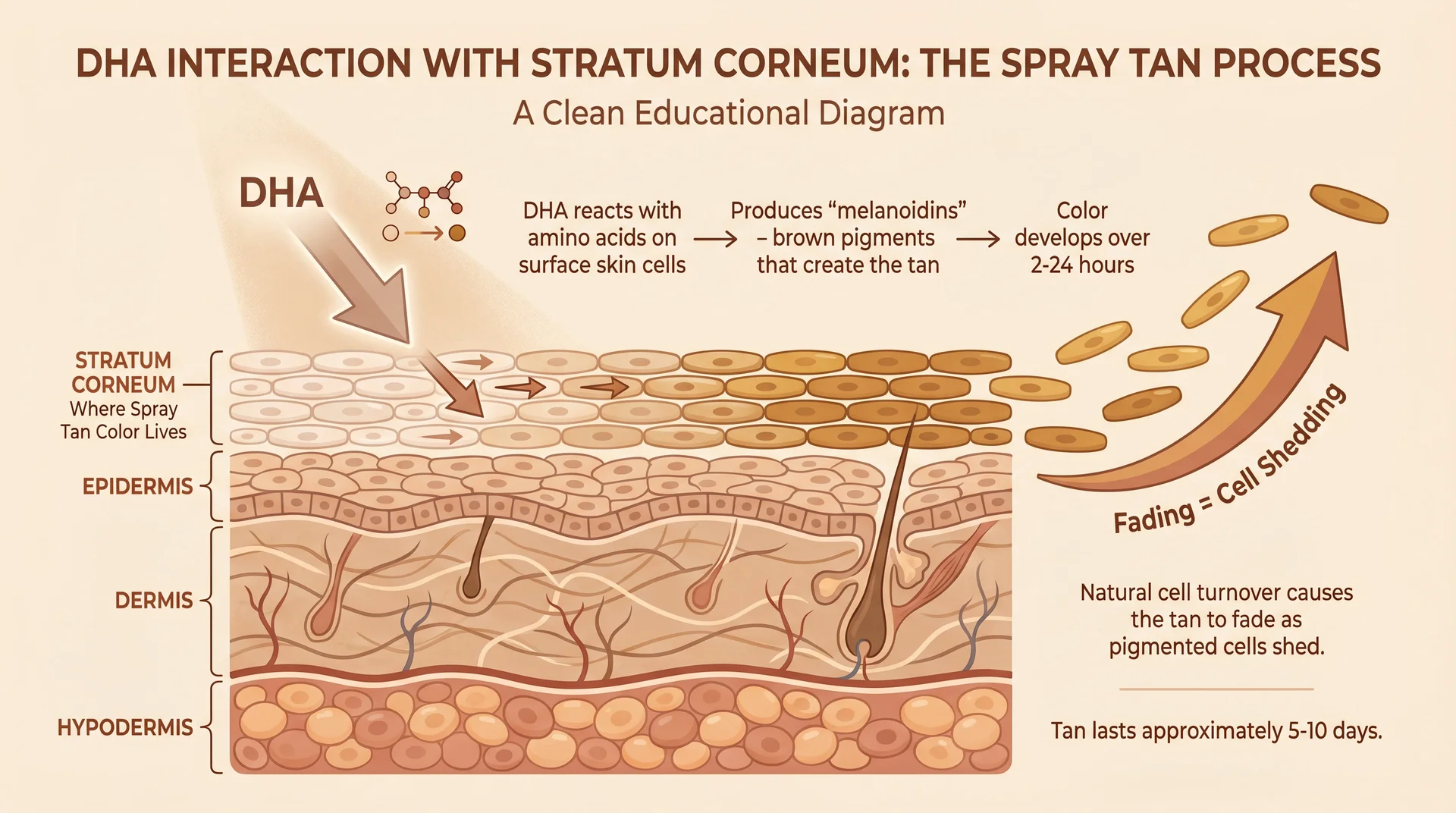
Spray tan solutions work through a compound called dihydroxyacetone, or DHA. It reacts with the free amino acids in the cells of your stratum corneum, the outermost layer of skin, producing a brown pigment through a process similar to the Maillard reaction that browns food. No UV exposure needed. The color is entirely in those surface cells.
This is the same mechanism at work in DHA bronzer tanning bed lotions; the color lives in the stratum corneum either way, which is why the aftercare rules are identical whether your tan came from a studio spray or a tanning bed bronzer formula.
Because it lives in the stratum corneum and nowhere deeper, the tan fades as those cells naturally shed. The average skin cell turnover cycle runs about 28 days for young adults and speeds up with dryness, exfoliation, or certain skincare actives. Every product you apply after a spray tan either supports that skin layer or works against it. There’s no neutral.
This is why “can I use regular lotion after a spray tan?” doesn’t have a single answer. Some regular lotions are excellent. Others — even ones that look gentle and moisturizing contain ingredients that actively accelerate shedding. The label matters.
When to Start Moisturizing After a Spray Tan
Wait until after your first real shower to apply any lotion, not before or during the development window. Applying moisturizer while the DHA is still reacting with your skin can cause streaking, smearing, and uneven color development. The tan needs dry skin to set correctly.
- For a standard overnight spray tan: shower after 8 to 10 hours, then begin moisturizing immediately after you dry off.
- For a rapid development tan (1 to 3 hours): rinse with water only at the recommended time, but wait a full 24 hours before applying any lotion product — the color continues developing after the rinse, and your skin needs time to complete that process before you add anything topical.
The window right after your shower is the best time to apply lotion. Your skin has just absorbed warmth and water, and layering on a moisturizer immediately helps trap that hydration. Pat dry gently, skip the aggressive towel rubbing, and apply your lotion while your skin is still slightly damp.
The Best Lotions to Use After a Spray Tan
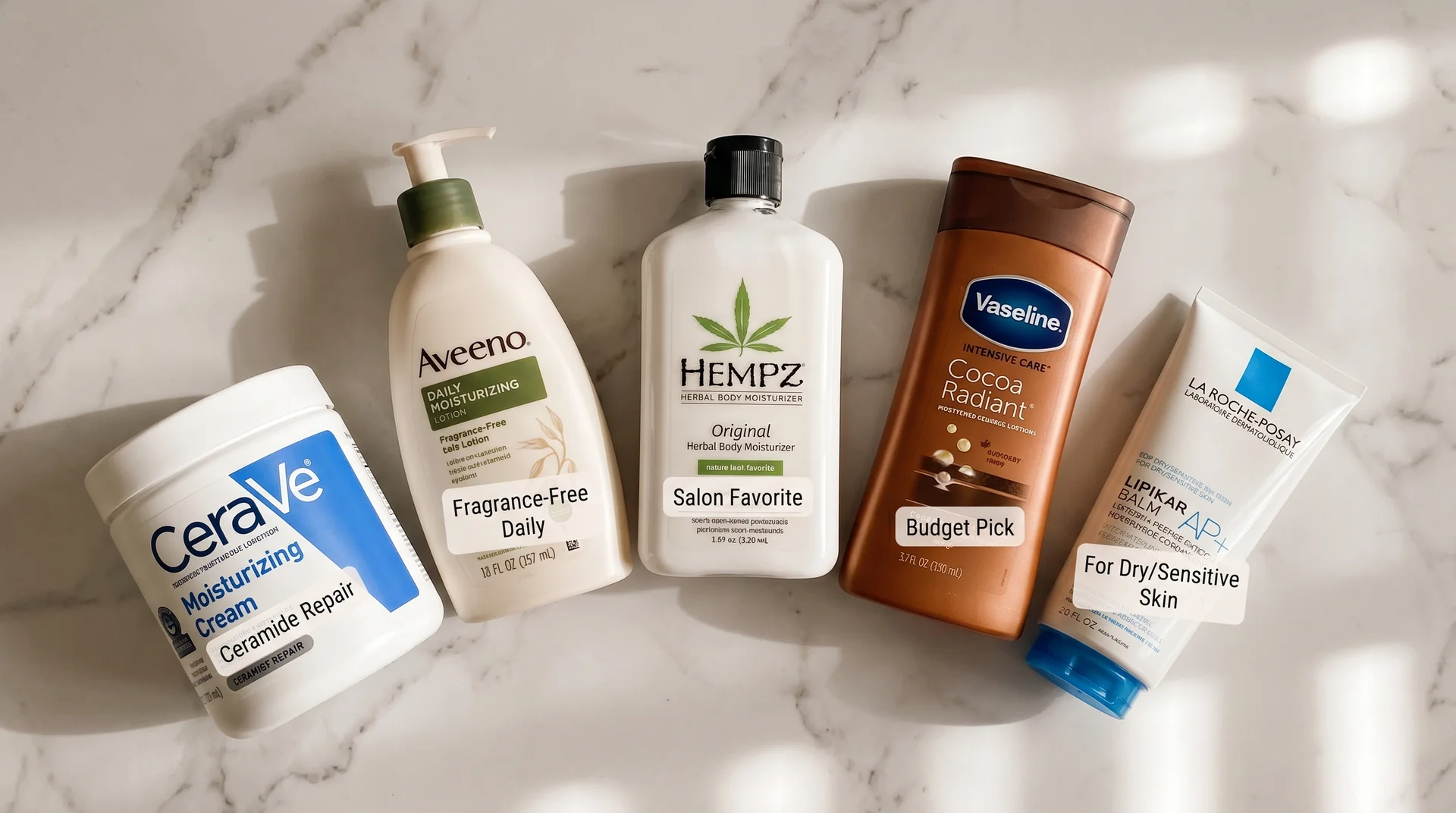
All five options below are fragrance-free or low-fragrance, free of mineral oil and exfoliating actives, and available at most drugstores or online without specialty ordering. I’ve recommended each of these in clinical settings to clients managing sensitive or reactive skin. They’re not just spray-tan safe, they’re genuinely good for the skin barrier.
| Lotion | Key Ingredients | Best For | Where to Find |
|---|---|---|---|
| CeraVe Moisturizing Cream | Ceramides, hyaluronic acid, MVE technology | Sensitive skin, comprehensive barrier support | Drugstore, Amazon |
| Aveeno Daily Moisturizing Lotion | Colloidal oat, glycerin | Every day use, budget-friendly, fragrance-free | Drugstore, grocery |
| Hempz Original Herbal Body Moisturizer | Hemp seed oil, shea butter, vitamins A, C, E | Tanning salon favorite, lightly scented | Salon retail, Amazon |
| Vaseline Intensive Care Cocoa Radiant | Cocoa butter, glycerin, petrolatum-free formula | Very dry skin, budget option | Drugstore, grocery |
| La Roche-Posay Lipikar Balm AP+ | Shea butter, niacinamide, glycerin | Dry, compromised, or eczema-prone skin | Drugstore, online |
CeraVe Moisturizing Cream
CeraVe Moisturizing Cream is my first recommendation for post-spray tan care because it does something most lotions don’t: it actively reinforces the skin barrier rather than just sitting on top of it.
The ceramides in this formula replenish what the skin barrier naturally produces, and the hyaluronic acid draws water into the stratum corneum and holds it there. For skin that’s been through a tanning treatment, that combination is the right kind of support.
It’s fragrance-free, non-comedogenic, and formulated without any exfoliating actives. A client of mine with chronically dry, reactive skin switched to CeraVe after years of watching her tans fade within three days; the difference was noticeable within a single tan cycle. It’s not a glamorous product, but it works.
Aveeno Daily Moisturizing Lotion
Aveeno’s Daily Moisturizing Lotion has earned its reputation as a reliable, uncomplicated option. The colloidal oat soothes and calms the skin without any exfoliating action, and the glycerin keeps the formula lightweight enough for daily use. It absorbs quickly, which matters when you’re trying to moisturize and get dressed without spending twenty minutes waiting for a cream to soak in.
The fragrance-free version is the one to choose after a spray tan. The lightly scented versions contain perfume compounds that don’t always play nicely with DHA color over time.
Hempz Original Herbal Body Moisturizer
Hempz Original Herbal Body Moisturizer has been a staple in spray-tanning studios for years, and for good reason. The hemp seed oil provides essential fatty acids that support barrier function without disrupting DHA development, and the shea butter creates a soft, supple finish that makes tanned skin look better, not just feel better. It has a light herbal scent that most people find pleasant rather than overpowering.
Worth noting: Hempz also offers a tan-extending version that falls into DHA bronzer and accelerator territory, a different product with a different purpose. If you want gradual color maintenance layered on top of your existing tan, that option exists. If you want pure hydration without additional color development, stick with the original.
Vaseline Intensive Care Cocoa Radiant
Vaseline Intensive Care Cocoa Radiant is one of the most underrated options on this list. It’s widely available, inexpensive, and the cocoa butter and glycerin formula is both effective and free of the harmful actives that strip color. The subtle warmth of the cocoa butter also complements a tan visually, giving skin a healthy-looking sheen.
One caution: this is not the same as pure petroleum jelly (Vaseline original), which creates a heavy occlusive barrier that can interfere with product absorption and fade certain spray tan formulas over time. The Intensive Care lotion formulation is completely different from the original petroleum jelly product.
If you’ve been reaching for baby oil for tanning or moisturizing before sun exposure, it carries the same occlusive concern, plus the added risk of amplifying UV damage with no SPF protection. The Intensive Care lotion formulation is a different product entirely.
La Roche-Posay Lipikar Balm AP+
For anyone managing dry, compromised, or eczema-prone skin, La Roche-Posay Lipikar Balm AP+ is the most targeted option here. The niacinamide supports barrier repair, the shea butter delivers rich moisture, and the formula is specifically designed for the most reactive skin types. If standard moisturizers leave your skin feeling tight or irritated after a spray tan, this is worth trying.
It is heavier than the other options and takes slightly longer to absorb, which makes it better suited for an evening application than a morning one. Apply before bed, let it fully sink in overnight, and your skin will be in noticeably better shape by morning.
Ingredients to Look For in a Post-Tan Lotion
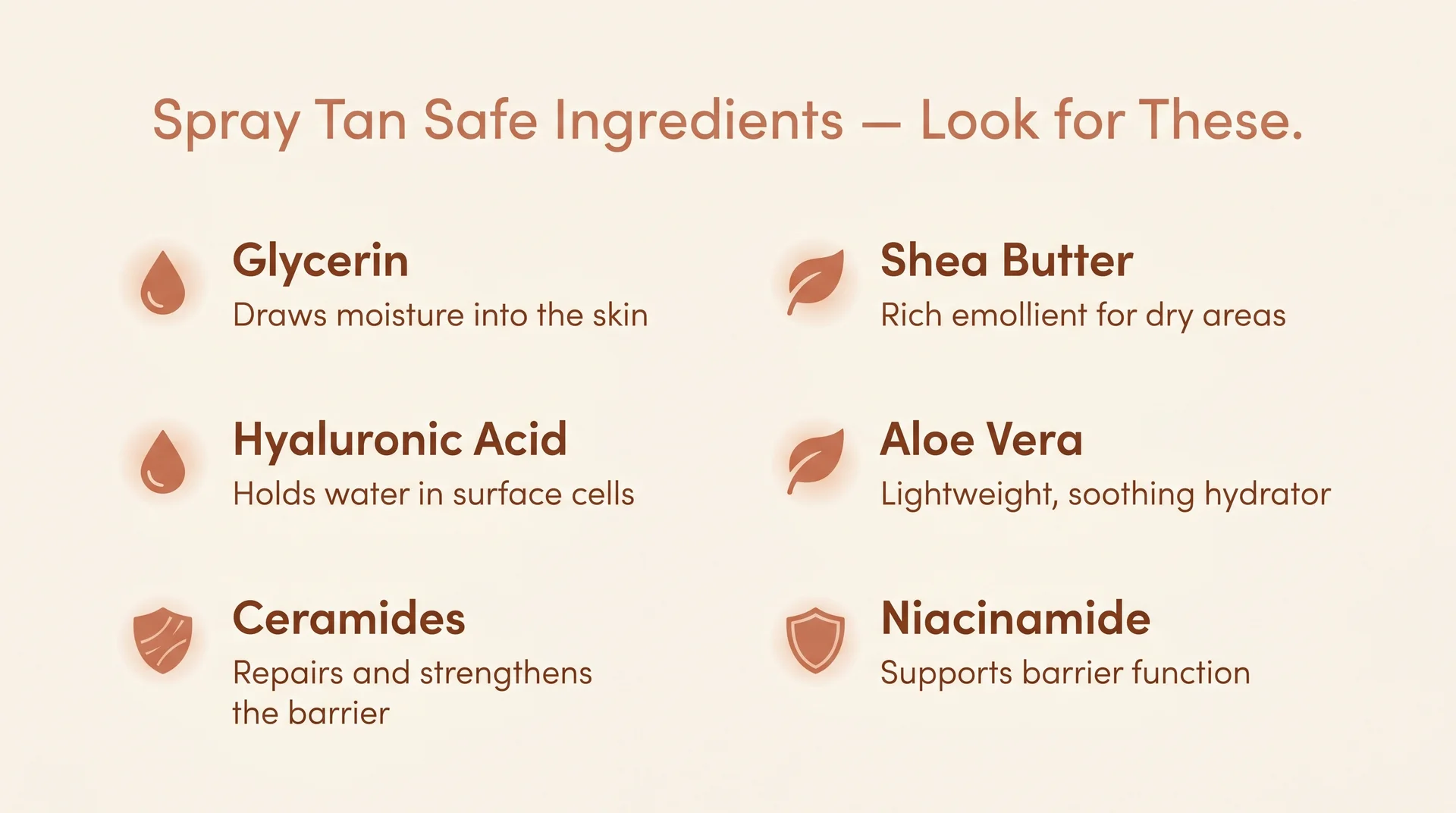
The best moisturizers for spray tan aftercare work as humectants, emollients, or occlusives, ideally more than one category at once. Here’s what each does and which ingredients deliver it.
- Glycerin: A humectant that pulls moisture from the air into the skin. Lightweight, non-irritating, and compatible with all spray tan formulas. It’s in nearly every lotion on the recommended list above.
- Hyaluronic acid: Another humectant with a particularly high water-retention capacity. Works best when applied to slightly damp skin, which is exactly the post-shower window we’re working in.
- Ceramides: Lipids that naturally occur in the skin barrier. Replenishing them via a ceramide-containing lotion supports cell cohesion and slows the cell-shedding process at a structural level. This is the most direct way to extend a tan from the inside out.
- Shea butter: A rich emollient that softens and seals the skin surface. Safe for spray tans and excellent for dry areas. Works best in formulated lotions rather than as a standalone application.
- Aloe vera: A lightweight, soothing hydrator that works well in the first day or two after a spray tan when skin may be slightly sensitized from the tanning solution. Calms minor irritation without disrupting color.
- Niacinamide: Supports barrier function and works well in the La Roche-Posay formula above. Not an exfoliant, despite being an active ingredient. Safe to use post-spray tan in standard lotion concentrations.
Ingredients to Avoid (And Why They Break Down Your Tan)
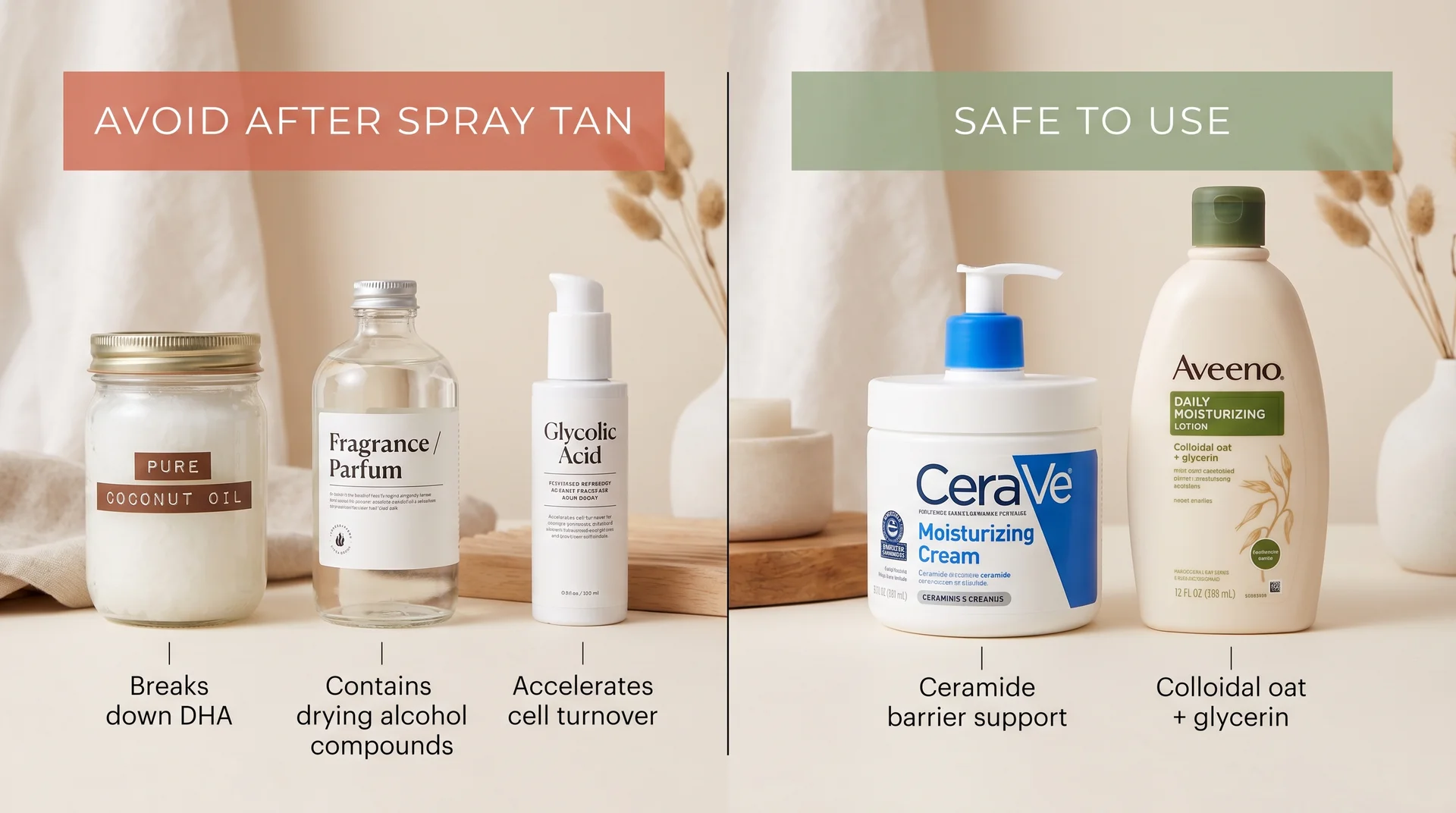
The ingredient avoidance list for spray tan aftercare is longer than most people expect, and a lot of lotions that look perfectly gentle contain at least one offender. Here’s what to watch for and why each one is a problem.
Exfoliating Acids: AHAs, BHAs, and Retinol
These are the most damaging categories for spray tan longevity. Alpha hydroxy acids (glycolic acid, lactic acid), beta hydroxy acids (salicylic acid), and retinol all work by accelerating the skin’s natural cell turnover cycle, which is exactly what you don’t want when your tan is sitting in those surface cells.
Because DHA color is bound to the stratum corneum, these actives are essentially running a controlled demolition on the substrate your tan lives in. They don’t just fade the color faster; they cause uneven, patchy fading because cell turnover doesn’t happen uniformly across the skin’s surface. If your tan is fading in irregular streaks or developing a crepey appearance by day three, an exfoliating active is usually the cause.
This includes anti-aging creams, acne-targeting body washes, brightening lotions, and anything marketed for “skin renewal.” Read the ingredient list. If glycolic, lactic, salicylic, or any form of retinoid appears, set it aside for the duration of your tan.
Mineral Oil and Heavy Petroleum Products
Mineral oil is a petroleum byproduct found in many drugstore lotions, often listed as Liquidum Paraffinum, Paraffin Oil, or Petrolatum on labels. It creates an occlusive barrier on the skin’s surface that can interfere with DHA color over time, causing the tan to break down unevenly or lift away from the skin in a way that looks patchy rather than gradual. It also slows the skin’s natural moisture absorption, which means you’re coating rather than actually hydrating.
Alcohol and Synthetic Fragrances
Isopropyl alcohol and denatured alcohol (listed as alcohol denat. on most labels) are fast-drying and deeply dehydrating. A lotion that evaporates quickly and leaves skin feeling tight is usually alcohol-heavy. That dryness directly accelerates the cell-shedding process, which directly shortens the tan.
Synthetic fragrances are a related problem. Many contain alcohol compounds as delivery agents, and others contain sensitizing chemicals that irritate freshly treated skin. The rule here is simple: if it smells like a candle store, it’s not safe for a spray tan. “Fragrance” or “parfum” on an ingredient label is a catch-all term that can contain dozens of individual compounds, some of which are actively drying.
The Coconut Oil Question
Here’s where almost every article on this topic oversimplifies or contradicts itself. The real answer depends entirely on the form you’re applying it in.
Pure coconut oil applied directly to the skin can break down DHA and cause patchy fading. The molecule is relatively large, absorbs slowly, and the oil’s concentration at the surface level is high enough to interact with the tanning compound in the skin. People who swear by it often have more tolerant skin types or shorter tan windows, but the risk of blotching is real and consistent enough that I don’t recommend it to clients during a spray tan cycle.
Coconut oil listed in the ingredient list of a formulated lotion is a different matter entirely. When it appears at a low percentage in a blend alongside other ingredients, like in the Hempz formula above. The concentration is far lower, and the delivery mechanism is different. The skin receives the moisturizing benefit of its fatty acids without the surface-level oil load that causes fading. If your lotion contains coconut oil as a secondary or tertiary ingredient, you’re fine. If you’re applying a jar of coconut oil directly to your skin, you’re taking a gamble.
The Elbows, Knees, and Ankles Problem
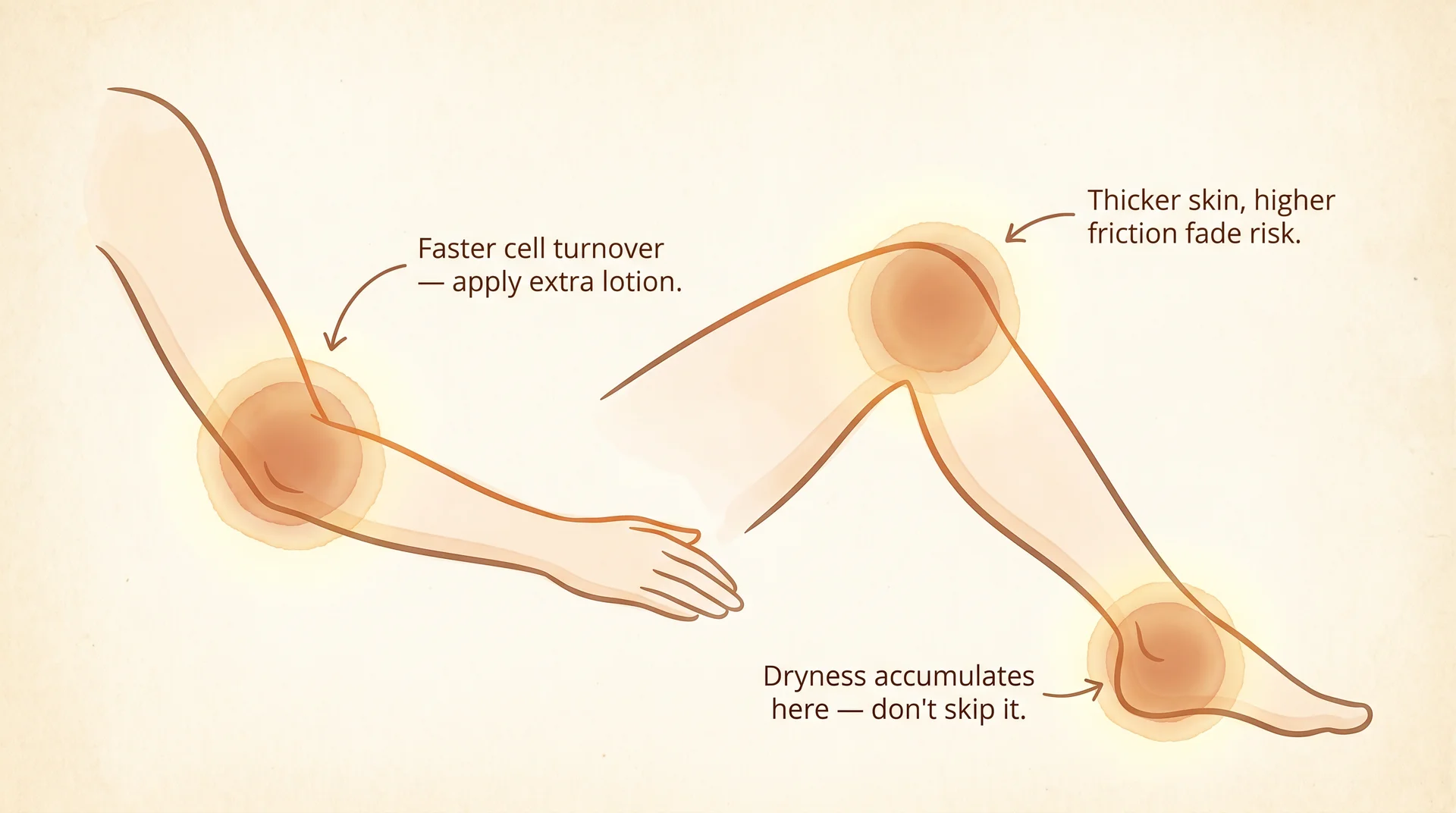
If your tan always fades first at the joints and extremities, even when you’re moisturizing daily, that’s not a product failure. It’s anatomy.
The skin on elbows, knees, and ankles is structurally different from the rest of the body. It’s thicker, has a higher density of dead skin cell buildup, and experiences constant friction from movement and clothing. All of that means the stratum corneum in these areas turns over faster than it does on, say, your thigh. The DHA reaction still happens, but the cells carrying the color shed sooner.
The fix is targeted application, not just more frequent moisturizing. Spending an extra thirty seconds massaging lotion into the knees, the fronts of the elbows, and the inner ankles after every shower will make a visible difference in how evenly your tan fades. These areas also tend to be the driest, which compounds the issue that dry skin at joints can look ashy or patchy against tanned surrounding skin.
One practical note from working with clients: if you’re using a richer cream on these areas specifically while using a lighter lotion elsewhere, that’s a smart approach. La Roche-Posay Lipikar Balm on the elbows and knees, Aveeno everywhere else. You don’t need to use the same product all over.
How Often Should You Moisturize After a Spray Tan?
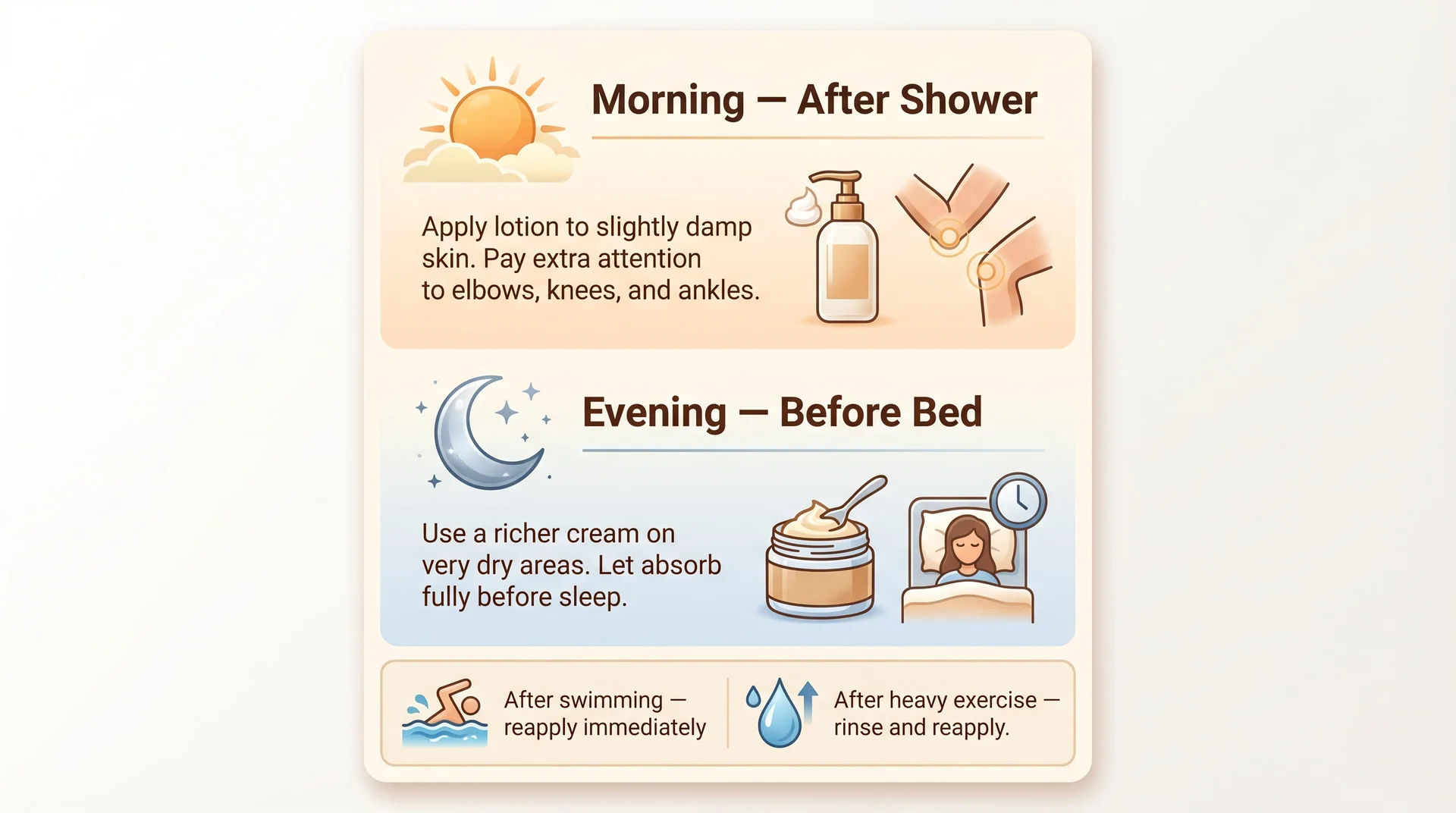
Moisturize at least once a day, directly after your shower. Twice a day, morning after showering and before bed, is better if your skin is on the dry side or you’re in a low-humidity environment. The post-shower application is the most effective because you’re locking in the moisture the skin has already absorbed from the warm water.
Two additional situations where you’ll want to add an extra application regardless of your usual routine: after swimming (chlorine is harsh on both skin and spray tan color: rinse and moisturize as soon as you get out), and after sweating heavily. Sweat can cause the tan to fade unevenly at friction points, and rehydrating the skin promptly limits how much damage accumulates.
Daily moisturizing consistently extended client spray tans from five to six days to eight to ten days in my experience, a meaningful difference when you’ve planned a tan around a specific event or trip. The product matters, but the consistency matters more.
| A note on skincare and individual skin responses: if you have a skin condition, active dermatitis, or a sensitive skin type, consider doing a patch test with any new lotion on a small area of skin before applying it fully. While the products listed here are formulated for sensitive skin, individual reactions vary. |