| This article is for informational purposes only and does not replace professional medical advice. If your sore throat is severe, lasts beyond 7 to 10 days, or comes with fever, rash, or difficulty swallowing, please see a healthcare provider. |
You are standing in the kitchen at 11 p.m., your throat feels like someone dragged sandpaper across it, and you are staring at six different tea boxes, wondering which one will actually help. I have been in that spot, and I have also spent years helping clients figure out this same question from across the table.
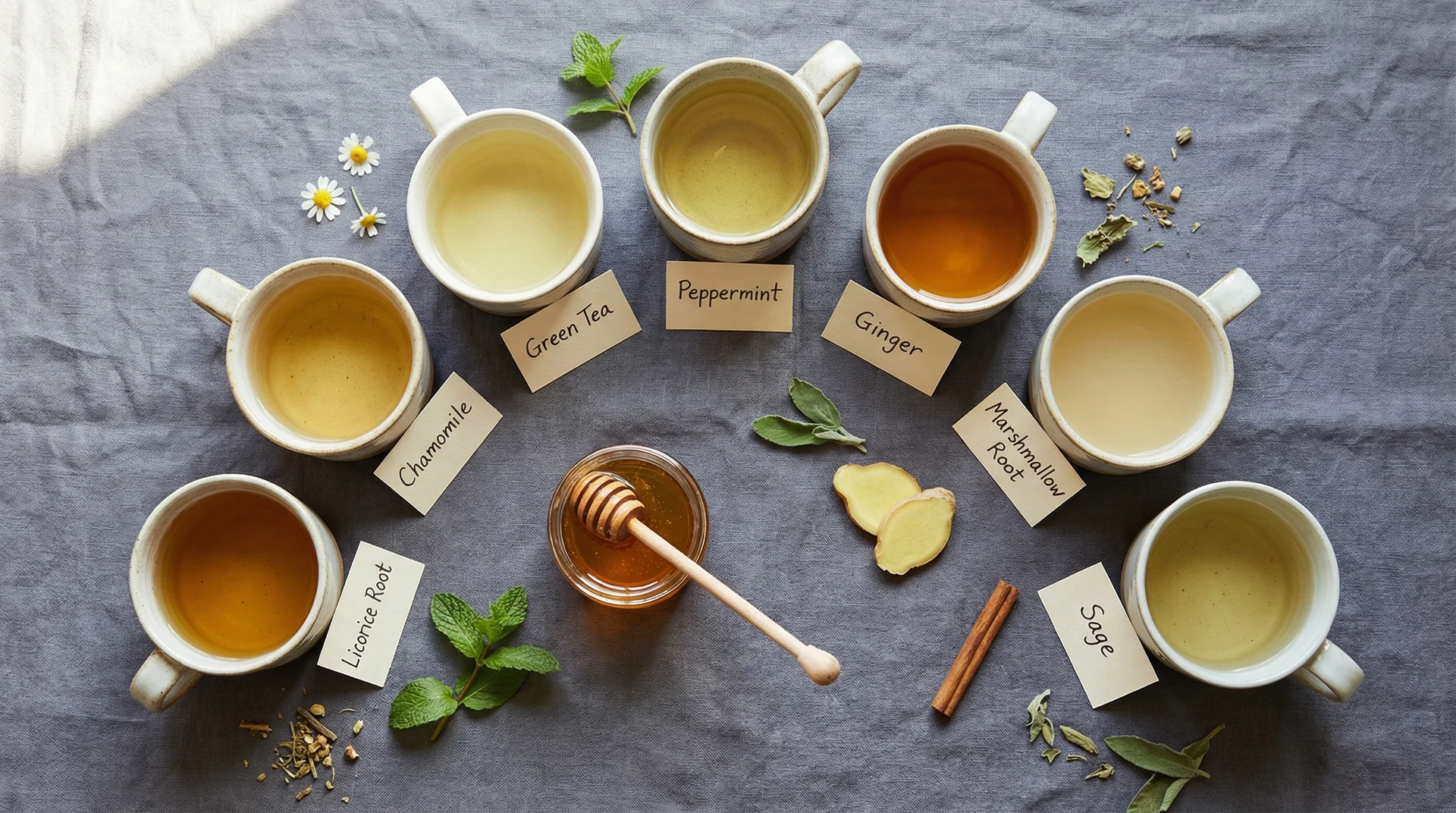
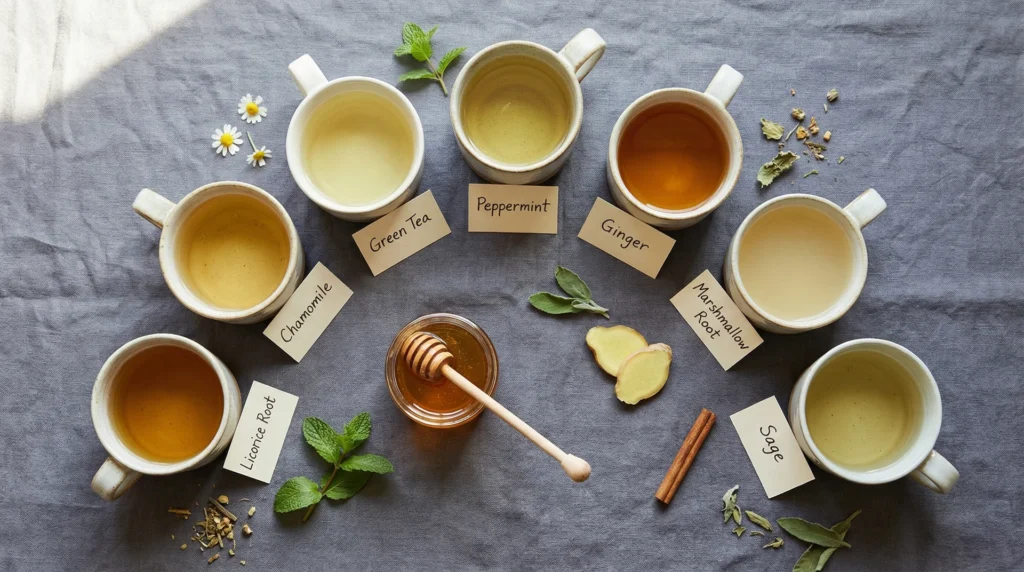
Here is the short version before anything else: green tea and chamomile are the most research-supported options for a sore throat. Mint tea works well when congestion is driving the irritation, but it can make things worse if acid reflux is the actual cause. Licorice root and slippery elm coat the throat more effectively than anything else when swallowing is the main problem. Ginger tea is your call when post-nasal drip is keeping the scratchiness going.
If you want the reasoning and a clear guide to which one to pour based on what your throat is doing tonight, keep reading.
The Short Answer: Which Tea Should You Grab Right Now
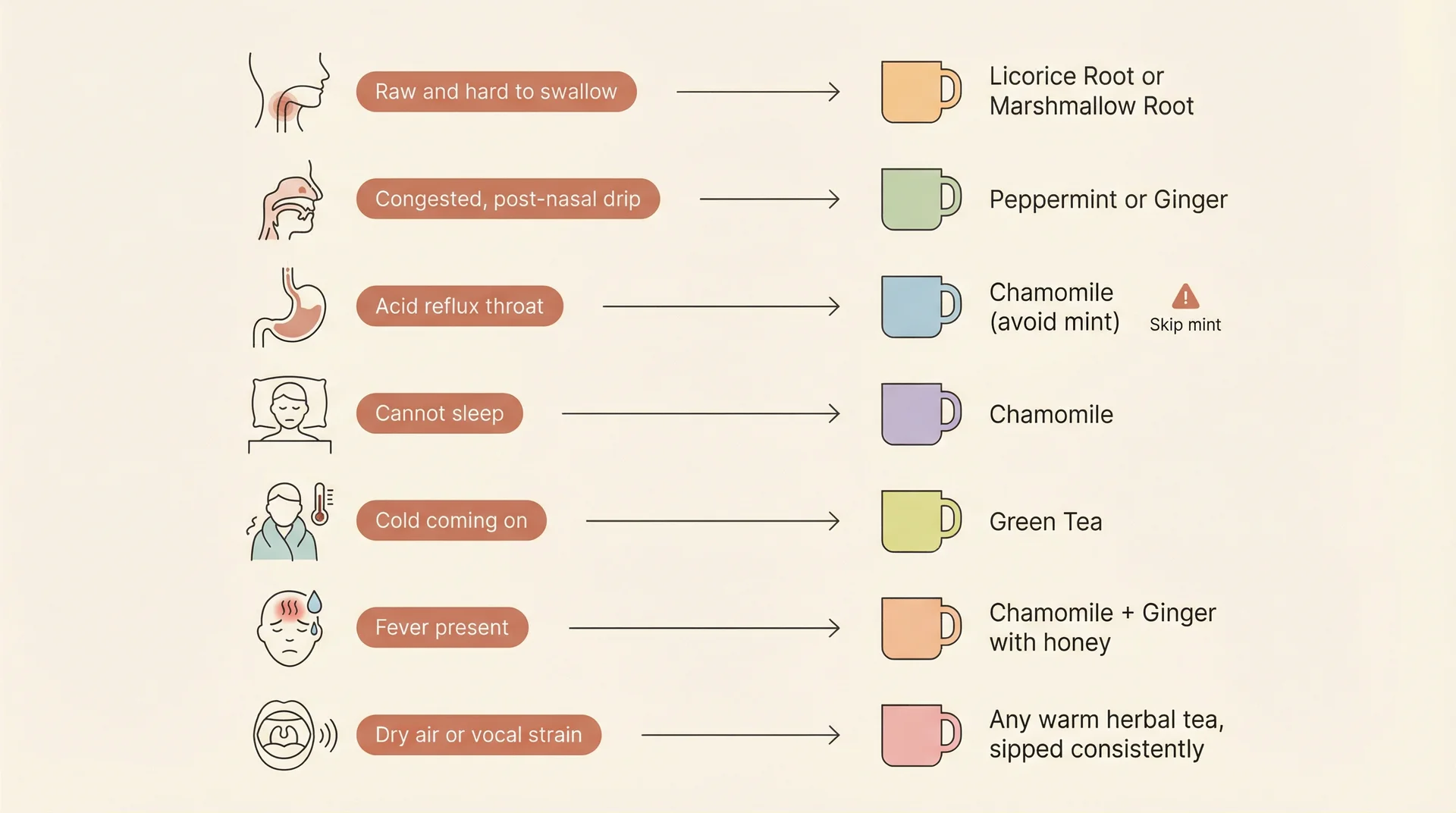
Your throat pain has a specific character to it, and that character tells you quite a bit about which tea will address it. Most people grab whatever is in the cabinet without thinking about it. That is fine most of the time. If you want to be more precise:
| What does your throat feel like | Best tea to start with |
|---|---|
| Raw, scratchy, hard to swallow | Licorice root or slippery elm |
| Congested and dripping down the back of your throat | Peppermint or ginger |
| Sore from acid reflux or heartburn | Chamomile or plain warm water (skip mint entirely) |
| Painful, and you cannot sleep | Chamomile |
| Mildly sore with a cold coming on | Green tea, gargled then sipped |
| Very sore with a fever | Chamomile or ginger with honey, and call your doctor if the fever climbs above 101°F |
| Sore after a lot of talking or dry air | Any warm herbal tea, sipped consistently throughout the day |
Why Tea Actually Helps a Sore Throat
Warm liquid does something specific to an irritated throat that most people feel but cannot quite explain. When warm fluid passes over inflamed pharyngeal tissue, it increases local blood circulation, brings more immune cells to the area, and relaxes the surrounding muscles. That is why your throat always feels worse when you breathe cold air and noticeably better after the first few sips of something warm.
Beyond temperature, many teas carry bioactive compounds that work directly on the mechanisms behind throat pain. Catechins in green tea interfere with viral replication. Menthol in peppermint activates cold-sensitive nerve receptors to temporarily blunt pain perception. Apigenin in chamomile reduces the inflammatory signaling that makes throat tissue swell. Mucilage in slippery elm and marshmallow root forms a physical gel coating over raw mucosal tissue.
These are not interchangeable effects. They address different things. Understanding which one your throat needs is the difference between the tea that helps and the one that does nothing.
What Warm Liquid Does to Inflamed Throat Tissue
Inflammation involves the widening of blood vessels and the accumulation of inflammatory mediators like prostaglandins and cytokines in the affected area. Warm liquid from a teacup does not reverse that process, but it works alongside it. The external heat encourages blood flow, which accelerates the immune response. The moisture keeps the mucous membrane from drying out, and a dry, cracked mucosal surface is both more painful and more vulnerable to secondary infection.
This is also why frequency matters more than volume. Sipping warm tea every hour or two keeps the throat consistently moist. Two large mugs in the morning and nothing until evening does not accomplish the same thing.
Why the Type of Tea Matters Beyond Just Being Warm
The warmth is the baseline. The tea is the variable. Plain hot water soothes a sore throat. Hot water with green tea in it does that and also delivers antioxidant and antiviral compounds to the tissue on the way down. Hot water with slippery elm dissolved in it does the same and leaves a protective gel coating behind. The vehicle matters, and so does what is inside it.
Is Green Tea Good for a Sore Throat?
Yes, and it is one of the few teas where the evidence is specific enough to say something concrete.
What the Research Actually Shows
Green tea contains catechins, a class of polyphenolic antioxidants, with EGCG (epigallocatechin gallate) being the most studied. Research published in Anesthesiology and Pain Medicine found that patients who gargled green tea after surgery had measurably less throat pain than those who gargled distilled water, because of the catechins’ anti-inflammatory activity and their interaction with glycoproteins in throat tissue.
One detail most articles skip: that study used postoperative sore throat, which is mechanical irritation from an endotracheal tube, not viral pharyngitis. The mechanism of relief overlaps because inflammation is inflammation, but you should understand that no clinical trial has followed cold patients who drank green tea and measured recovery time specifically. What is reasonable to say is that catechins do real work on inflamed tissue, even if the precise magnitude in a typical cold is still being mapped out.
Drink It or Gargle It?
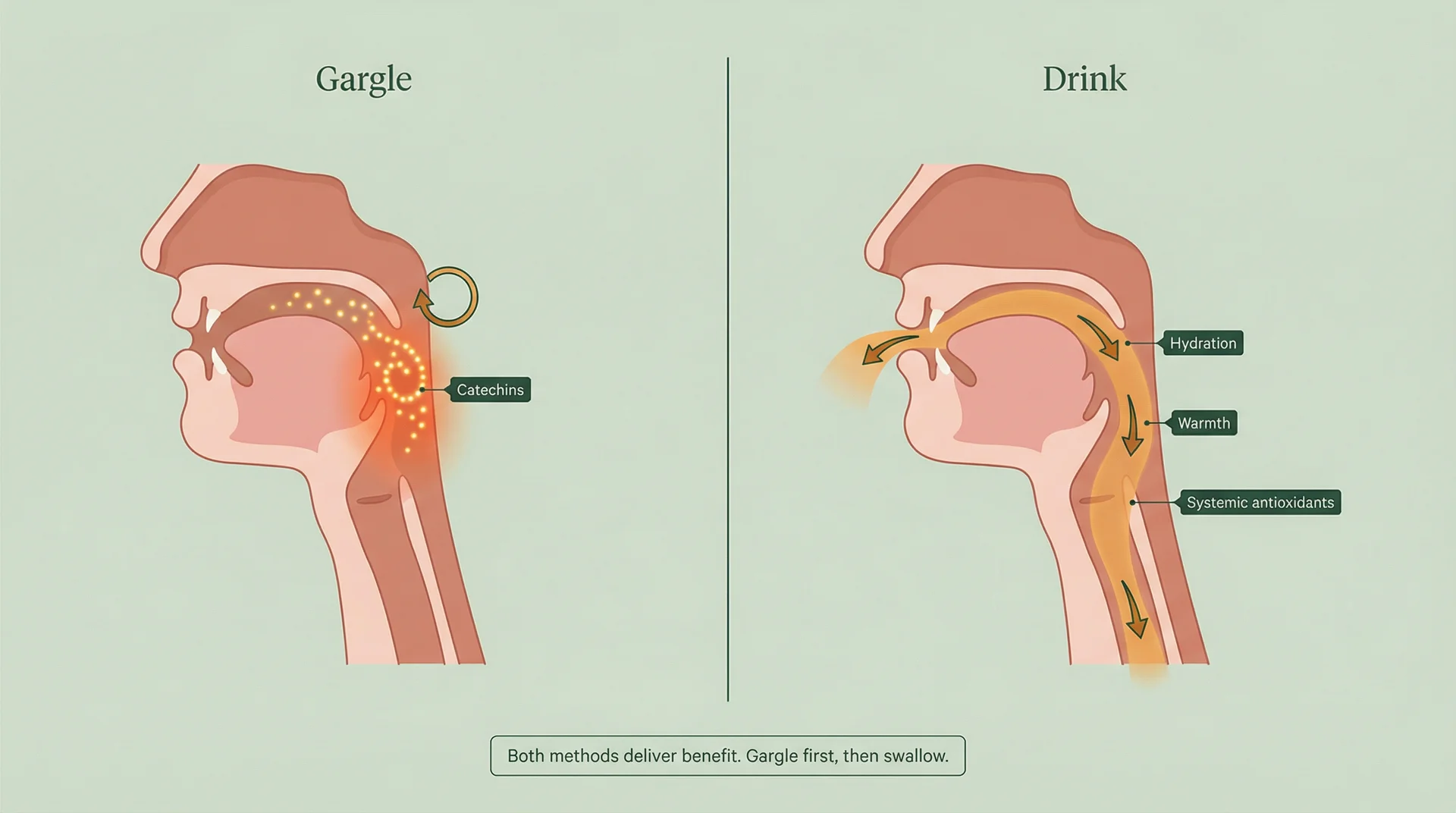
Both for different reasons. Gargling puts catechins in direct contact with the pharyngeal tissue where the inflammation sits. Drinking provides hydration and the warming effect on the way down. I tend to recommend both in the first 24 to 48 hours of a sore throat.
How to brew it: Steep one green tea bag in 8 oz of water just off the boil for 2 to 3 minutes. Let it cool to a comfortable temperature, gargle for 30 seconds, then swallow. Repeat two or three times throughout the day. Do not oversteep green tea. Anything past 3 minutes turns the cup bitter and increases tannin astringency on an already tender throat.
The Caffeine Question When You Are Sick
Green tea carries roughly 25 to 35 milligrams of caffeine per cup. When you are feverish and your sleep is already disrupted, caffeine can compound the problem. My usual suggestion: one cup of green tea in the morning for the catechin benefit, then switch to decaf green tea or a caffeine-free herbal option for the rest of the day. Decaf green tea retains most of its polyphenol content.
Is Mint Tea Good for a Sore Throat?
This is the question I get most often from clients who have tried it and are not sure whether it helped or hurt. The answer depends entirely on what is causing your sore throat.
What Menthol Does and Does Not Do
Menthol, the primary active compound in peppermint, activates TRPM8 receptors, which are cold-sensitive receptors in the mucous membranes. Your brain registers a cooling sensation, and the threshold for pain perception in that area temporarily rises. This is genuine relief in the sense that it modifies how your nervous system processes the discomfort. It is also temporary. You are not reducing the inflammation. You are changing how your nervous system reads it while the menthol is present.
Beyond menthol, peppermint contains rosmarinic acid and flavonoids with documented anti-inflammatory properties. Research published in The Journal of Ethnopharmacology found that mentha extracts inhibited certain bacteria responsible for respiratory infections. The evidence is still early, but it is not nothing.
Peppermint vs. Spearmint: Which One Works Better
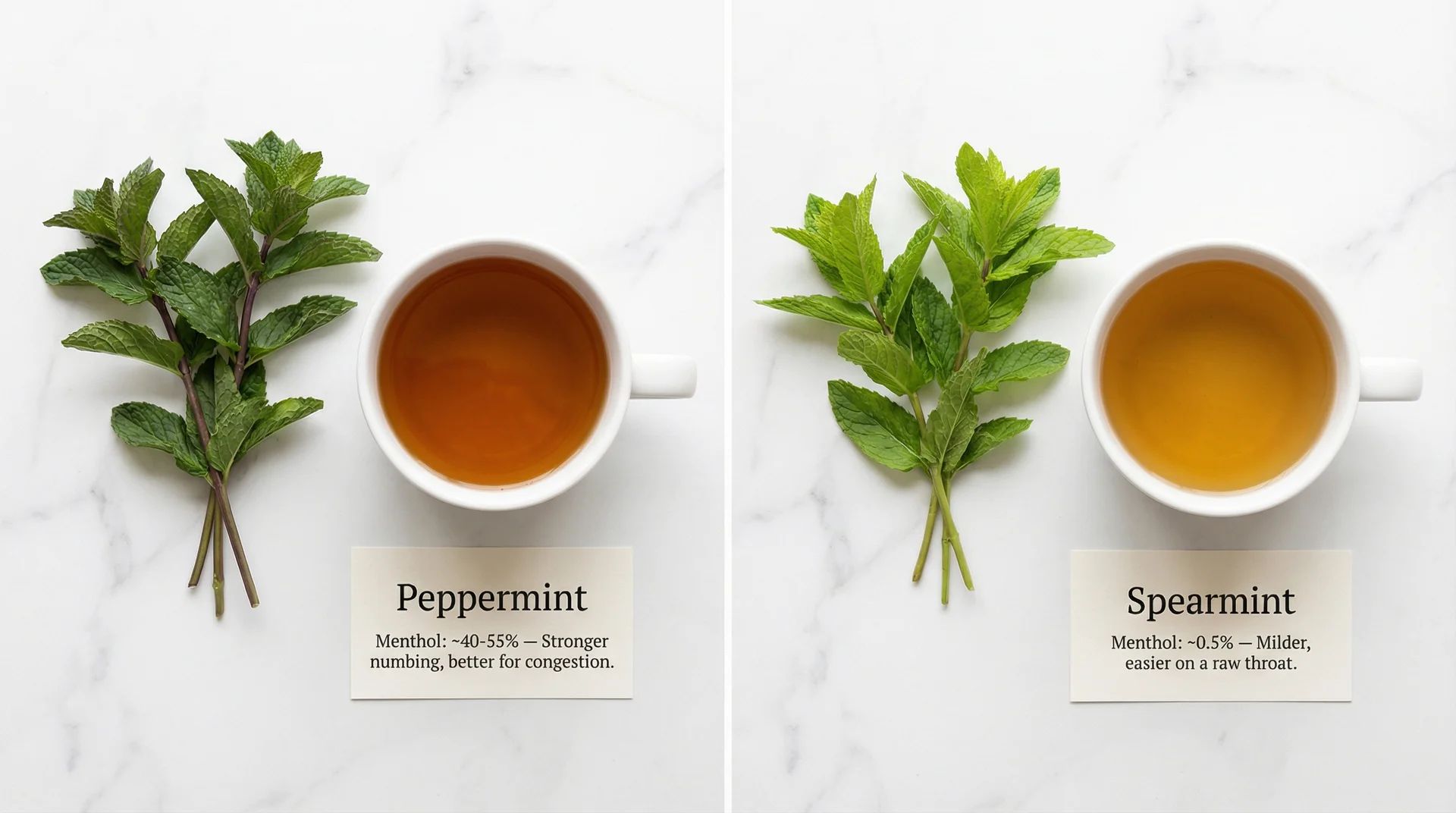
Peppermint has a menthol concentration of roughly 40 to 55 percent. Spearmint sits around 0.5 percent. That difference produces a meaningfully different experience in the throat. Peppermint delivers stronger numbing and decongestant relief, which is useful when congestion is making the throat worse. Spearmint offers gentler warmth with a milder mint flavor, which is easier to tolerate when the throat is very raw, and peppermint feels abrasive.
If post-nasal drip is keeping your throat irritated, peppermint is the stronger choice. If your throat is inflamed but your sinuses are clear, spearmint is often more comfortable to sip.
How to brew it: Steep a peppermint tea bag, or a small handful of fresh peppermint leaves, in 8 oz of just-boiled water for 5 to 7 minutes. Cover the cup while steeping to trap the menthol vapors. Inhale the steam gently before you sip.
When Mint Tea Makes a Sore Throat Worse
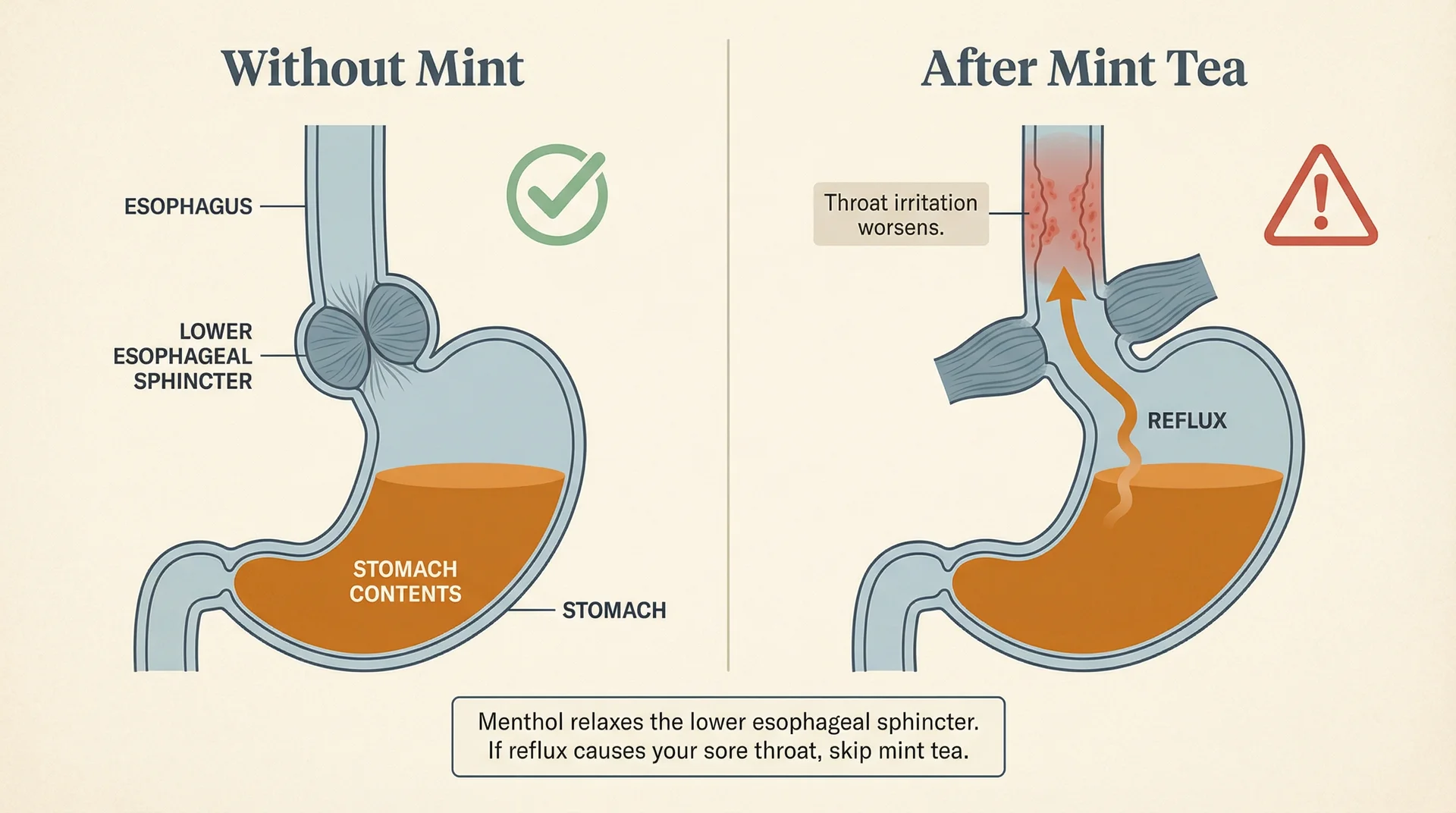
This is the section most articles miss or bury, and it is the most important one if you have tried mint tea and felt no better, or felt worse.
Menthol relaxes smooth muscle, including the lower esophageal sphincter, the ring of muscle that keeps stomach acid from rising into the esophagus and throat. If your sore throat comes from acid reflux or GERD, drinking mint tea opens the door for more acid to reach the already-irritated tissue above it. The cooling sensation feels temporarily soothing. The damage underneath it continues.
I see this regularly in clients with silent reflux, where they do not always feel classic heartburn but do have chronic throat irritation, hoarseness, or the constant need to clear their throat. They drink peppermint tea because it feels cooling, and then wonder why they are not improving. If your sore throat comes back repeatedly, is worse in the morning, or is accompanied by any burning sensation in the chest or upper stomach, skip mint entirely and use chamomile instead.
The Rest of the Lineup: Teas Worth Having in Your Cabinet
Chamomile: The Nighttime Workhorse
Chamomile contains apigenin and chamazulene, two flavonoids with anti-inflammatory properties. Apigenin also has a mild sedative effect through its interaction with GABA receptors in the brain. The reason I recommend chamomile specifically for evening use is that it addresses two of the most frustrating aspects of being sick at night: the throat that keeps waking you up and the inability to fall back asleep.
A cup of chamomile tea with a teaspoon of raw honey about 30 minutes before bed consistently outperforms other evening options in my experience with clients. Sleep is when cytokine production peaks and tissue repair happens. Chamomile helps you get there.
How to brew it: Steep one chamomile tea bag, or one tablespoon of dried chamomile flowers, in 8 oz of just-boiled water for 5 to 10 minutes. Longer steeping releases more apigenin. Add honey after steeping.
Licorice Root Tea: For When Swallowing Is the Problem
Licorice root contains glycyrrhizin, a compound with documented anti-inflammatory and mild antiviral activity. What makes it genuinely useful for sore throats is also its demulcent effect, meaning it coats mucous membranes with a slippery, protective layer. If swallowing is painful rather than just scratchy, licorice root addresses that more directly than most teas.
It also has a natural sweetness that makes it easy to drink enough of when you feel terrible and have no appetite for anything.
Two important cautions: keep licorice root to a short-term remedy, three to five days maximum, and it is not appropriate for people with high blood pressure, kidney disease, or pregnancy. Long-term use of glycyrrhizin raises blood pressure by interfering with aldosterone metabolism.
How to brew it: Steep a licorice root tea bag in 8 oz of just-boiled water for 5 to 10 minutes. Most people find it sweet enough without honey, but a small amount of raw honey alongside it works well.
Marshmallow Root Tea: The Physical Coater
Marshmallow root contains mucilage, a polysaccharide that dissolves in hot water and forms a viscous, gel-like consistency. When you drink marshmallow root tea, that gel coats the esophagus and pharynx as it passes through. It is physically protective rather than anti-inflammatory in a pharmacological sense. Think of it as a temporary bandage over raw tissue.
This is how it differs from licorice root. Licorice root works on inflammatory signaling and has a systemic effect. Marshmallow root is a mechanical coater. For a throat that is very raw and where every swallow hurts, combining both makes sense.
Marshmallow root appears in many commercial “throat coat” blends alongside slippery elm and licorice for exactly this reason. If you find a product called Throat Coat by Traditional Medicinals or a similar formulation at a pharmacy, that blend captures all three demulcent herbs together and is a practical option when you want one bag that does most of the coating work.
How to brew it: Steep one marshmallow root tea bag in 8 oz of just-boiled water for 10 to 15 minutes. Cover the cup while it steeps. The longer steeping releases more mucilage. The tea will feel slightly thicker than regular tea, and that is what you want.
Slippery Elm Tea: When the Scratchiness Will Not Let Up
Slippery elm bark contains a similar mucilage to marshmallow root and works through the same coating mechanism. The two herbs are often combined in throat tea formulations because their mucilage compositions are slightly different and complement each other. Slippery elm has a longer history of use in North American herbal medicine, with Indigenous communities using the inner bark of the elm tree for throat and stomach complaints for centuries.
On its own, slippery elm has a mild, slightly earthy flavor. It dissolves best when stirred into water that is just below boiling rather than at a full rolling boil.
Sage Tea: The One Nobody Talks About
Sage contains rosmarinic acid, salvigenin, and several flavonoids with antibacterial activity against Streptococcus species, the bacteria behind strep throat. A study published in European Journal of Medical Research found that a sage and echinacea throat spray performed comparably to a lidocaine-based spray for acute pharyngitis pain. That is a meaningful result for an herb that rarely makes these lists.
How to brew it: Steep four or five fresh sage leaves, or one teaspoon of dried sage, in 8 oz of just-boiled water for 10 minutes. Strain before drinking. The flavor is herbal and slightly medicinal. Honey makes it considerably more palatable.
Echinacea Tea: Honest Assessment
Echinacea comes up constantly in conversations about immune support, and the evidence is genuinely mixed. The 2014 Cochrane review found that certain echinacea preparations may modestly reduce the chance of catching a cold when taken preventively. The benefit of treating an existing sore throat or cold is less consistent.
I do not tell clients to avoid echinacea tea. I tell them to hold it in an appropriate proportion. It is a useful complement to ginger, honey, and the more mechanistically clear teas. Treating it as the cornerstone of recovery gives it more credit than the current evidence supports.
Black Tea: When You Still Need Caffeine
Some people simply cannot function without a morning cup of something caffeinated, and trying to eliminate caffeine entirely while sick adds one more stressor to a situation that already has plenty. If that sounds familiar, black tea with honey is a substantially better choice than coffee. Black tea contains theaflavins and thearubigins, polyphenols with documented antimicrobial properties. One study published in PeerJ found black tea effective against several bacterial strains.
How to brew it: Steep for no more than 3 minutes. Longer steeping raises tannin concentration and makes the tea astringent on a raw throat. Add honey immediately.
A DIY Sore Throat Tea Recipe Worth Making
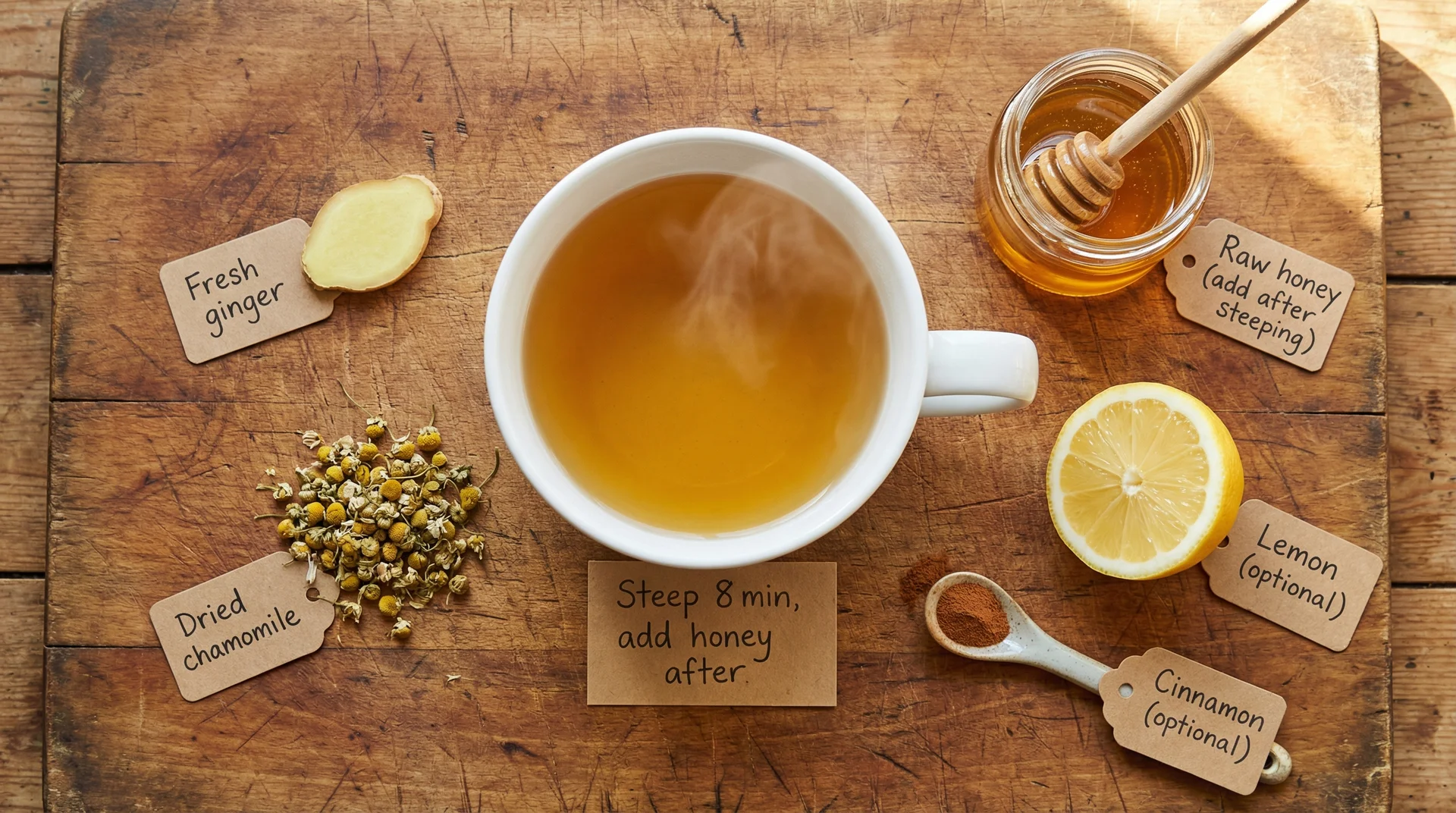
When my throat is at its worst, and I want one cup that does the most possible work, this is the combination I reach for. You do not need all of these, but each addition builds on the last.
Ingredients:
- 1 cup water, just off the boil
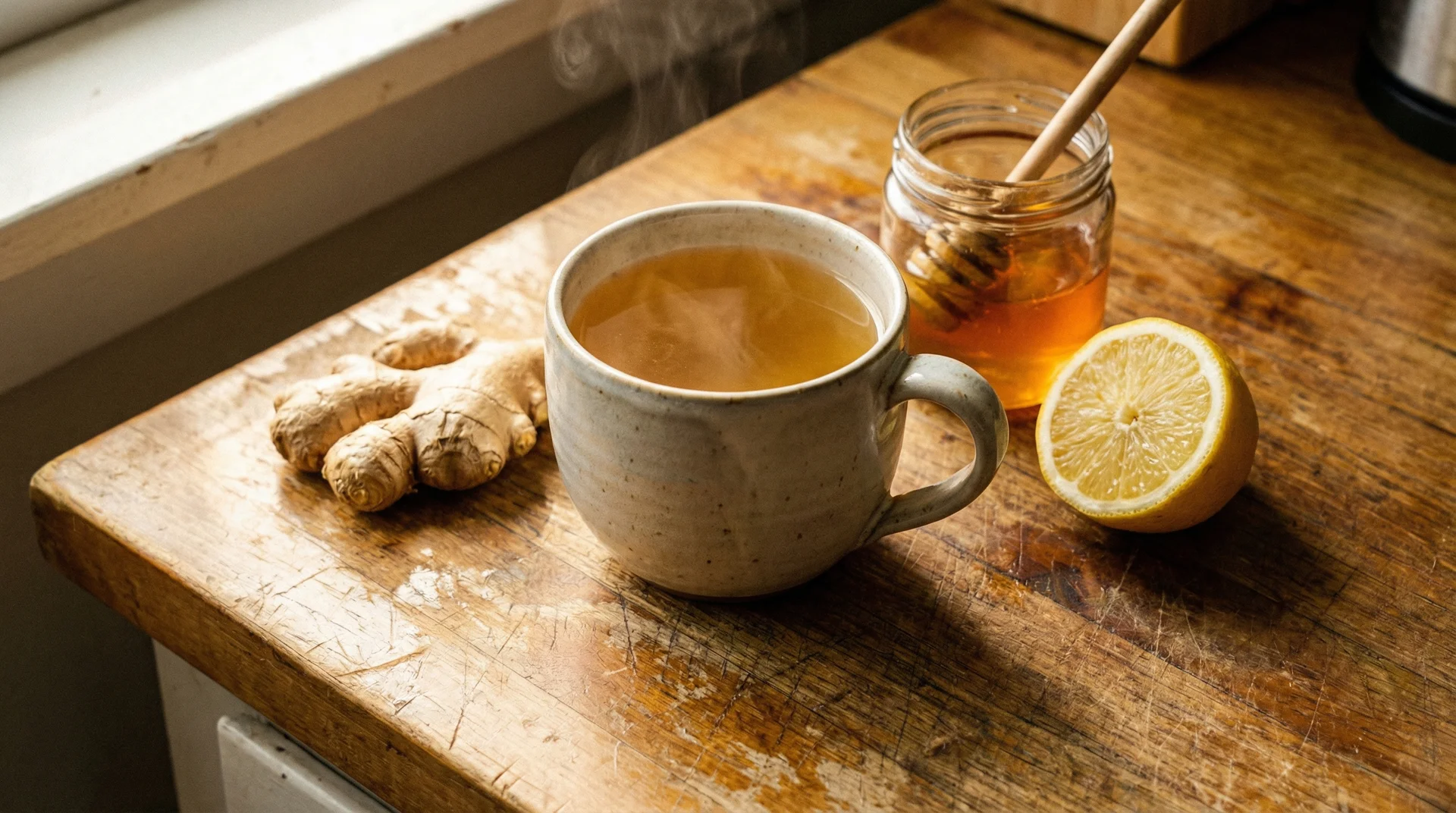
- 1 slice of fresh ginger, about the size of a quarter
- 1 teaspoon dried chamomile flowers, or 1 chamomile tea bag
- 1 teaspoon raw honey, added after steeping
- A small squeeze of fresh lemon (optional, skip this if your throat is very raw)
- A pinch of cinnamon (optional)
Method: Combine the ginger and chamomile in a mug. Pour the hot water over, cover, and steep for 8 minutes. Strain, let it cool for 3 to 4 minutes, then stir in the honey. Sip slowly. This version gives you ginger’s anti-inflammatory gingerols, chamomile’s apigenin, honey’s antimicrobial and coating properties, and the warmth that ties all of it together.
For a stronger coating effect, add half a teaspoon of marshmallow root powder to the mug before steeping and increase the steeping time to 12 minutes.
How to Make Any Throat Tea Work Harder
The Honey Rule
Raw honey has documented antimicrobial activity, partly from its hydrogen peroxide content and from defensin-1, an antimicrobial peptide. A 2021 review in BMJ Evidence-Based Medicine found honey more effective than standard over-the-counter care at relieving upper respiratory symptoms, including cough.
Add one to two teaspoons of raw honey after the water has boiled. Heat destroys honey’s beneficial compounds. The honey should dissolve into warm tea, not boiling liquid.
Children under one year old should never have honey due to the risk of infant botulism.
Temperature Is Not Optional
The ideal temperature for a sore throat tea is around 130 to 140°F. Comfortably warm in the cup, without that slight burning sensation that tells you to wait. Scalding liquid damages the mucosal lining you are trying to help. Give your tea 3 to 5 minutes after steeping before you sip.
How Often to Drink
Sip something warm every one to two hours while you are awake, not just at meal times. Consistent mucosal hydration is more effective than larger amounts taken infrequently. A thermos filled in the morning removes the friction of making a fresh cup every hour, and that friction is very real when you feel terrible.
Teas to Skip When Your Throat Is Sore
A few specific situations call for avoiding what would otherwise be reasonable choices:
- Peppermint tea when your sore throat comes from acid reflux, GERD, or silent reflux. Menthol relaxes the esophageal sphincter and allows more acid to rise into the throat, even when the cooling sensation feels temporarily soothing.
- Very strongly steeped black tea without honey when your throat is raw and inflamed. High tannin concentrations are astringent and add dryness to tissue that needs moisture.
- Licorice root tea beyond five consecutive days, particularly if you have hypertension or are pregnant. The glycyrrhizin in licorice root raises blood pressure with sustained use.
- Any tea is served scalding hot. The temperature threshold where warm becomes harmful to mucosal tissue is real, and people consistently underestimate how often they drink tea before it has cooled enough.
When Tea Is Not Enough
Most sore throats respond well to consistent home care and resolve within five to seven days. See a doctor if you notice any of the following:
- White patches or pus on the tonsils or the back of the throat
- Fever above 101°F that is not coming down
- Throat pain that is getting worse rather than gradually improving after 48 hours
- Severe pain concentrated on one side of the throat only
- Difficulty breathing or a feeling that the throat is closing
- A skin rash appearing alongside throat symptoms
Strep throat in particular needs antibiotics. Tea will make you more comfortable while you wait for a test result or while the medication starts working, but it does not treat the infection. If your throat is getting worse instead of better after two full days of home care, that is a signal to stop managing it at home.
Frequently Asked Questions
What is the best tea for a sore throat?
Green tea and chamomile have the most research support across the broadest range of sore throat types. Green tea works best in the first 48 hours of a viral illness. Chamomile is the strongest choice for evening use and sleep disruption. If swallowing is the specific problem, licorice root or a commercial throat coat blend with marshmallow root addresses that more directly.
Is green tea good for a sore throat?
Yes. Green tea’s catechins have documented antiviral activity and reduce inflammation in throat tissue. Gargle it and then drink it for the best effect. If you are feverish or struggling to sleep, switch to decaf green tea in the afternoon.
Is mint tea good for a sore throat?
For most sore throats, yes. Peppermint’s menthol temporarily numbs pain receptors and acts as a decongestant when congestion is part of the picture. If your sore throat is caused by acid reflux or GERD, mint is the wrong choice.
Can peppermint tea make a sore throat worse?
It can, specifically when the underlying cause is acid reflux. It can also feel abrasive on a very raw throat if brewed at high concentration. Spearmint is a gentler alternative when peppermint feels too intense.
What tea is best for a sore throat at night?
Chamomile. The apigenin in chamomile improves sleep quality alongside its anti-inflammatory effect on the throat. It is caffeine-free and gentle enough to drink right before bed.
What tea helps a sore throat with congestion?
Peppermint or ginger. Peppermint’s menthol acts as a natural decongestant. Ginger’s gingerols help thin mucus and reduce post-nasal drip, which often extends how long the throat stays irritated.
What is throat coat tea, and does it work?
Throat coat tea is a category of herbal blends, most associated with Traditional Medicinals’ Throat Coat product, that combines demulcent herbs like slippery elm, marshmallow root, and licorice root. These herbs form a mucilage-based gel coating in the throat. For raw, painful throats where the main complaint is the physical scratchiness and difficulty swallowing, these blends work well. They do not treat infection, but they reduce the discomfort significantly while your body handles the underlying cause.
How often should you drink tea when your throat is sore?
Every one to two hours while you are awake. Keeping the throat consistently moist matters more than the amount you drink in any single sitting. A thermos is the most practical approach here.
Can children drink tea for a sore throat?
Chamomile and mild ginger tea are generally appropriate for children over the age of one. Never add honey for children under one year old. Keep temperatures comfortably warm rather than hot, and avoid caffeinated teas for younger children. If the child is very young or the symptoms seem serious, speak to a pediatrician first.
Is it better to gargle green tea or drink it?
Both serve different purposes. Gargling puts catechins in direct contact with inflamed pharyngeal tissue. Drinking provides hydration and systemic antioxidant delivery. When you are in the first two days of a sore throat, gargle for 30 seconds and then swallow, two to three times a day.