| This article is for informational purposes only and does not replace professional medical advice. If your sore throat is severe, lasts longer than 7 to 10 days, or comes with a high fever, white patches on the throat, or difficulty swallowing, see a healthcare provider. |
You wake up with a scratchy throat, and the coffee maker is already running. The question arrives before you have even fully opened your eyes: is this going to make things worse?
Here is the direct answer: coffee can genuinely help a sore throat, or it can make it more irritating, and the difference comes down to three things: what is causing your throat pain, what kind of coffee you are making, and what you put in it. For a viral sore throat from a cold or flu, a warm cup made the right way gives real, temporary relief backed by research. For a sore throat coming from acid reflux, coffee works directly against you, and no amount of honey changes that.
I see this come up constantly with the clients I work with in nutrition practice. People want a simple yes or no, which is understandable, but the type of sore throat you have changes everything. The sections below break that down in a way you can actually use on a sick morning.
What Coffee Actually Does to an Irritated Throat
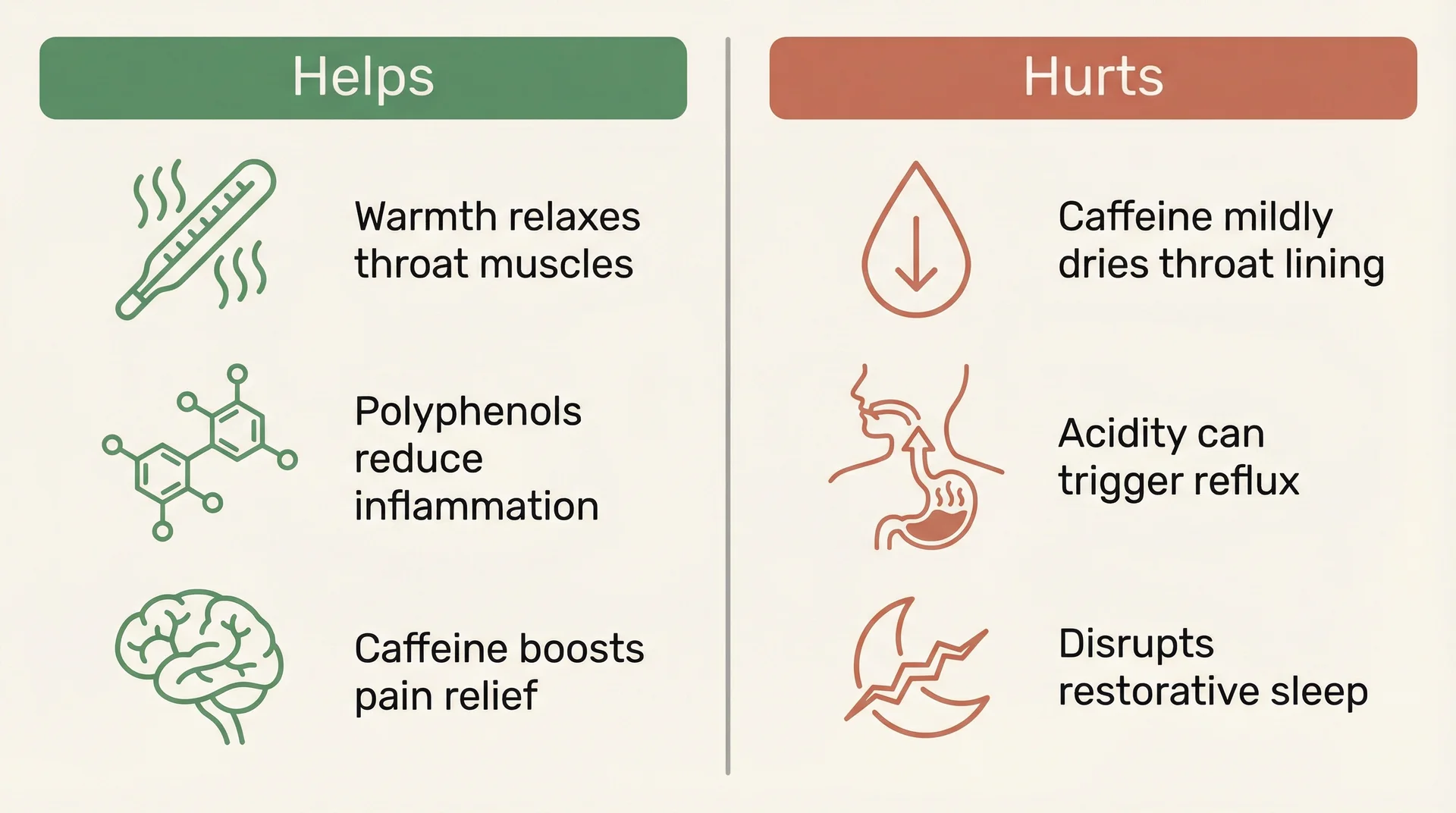
Before getting into which sore throats respond well to coffee and which do not, it helps to understand the two competing things happening in your body when you drink it while sick.
The Case For Coffee: Warmth, Antioxidants, and Caffeine’s Pain-Relieving Effect
Warm liquids do measurable things to a sore throat. The heat increases blood flow to the inflamed pharyngeal tissues, relaxes the surrounding muscles, stimulates saliva production, and helps thin mucus. This is why most people reach for something warm instinctively when their throat hurts, and the instinct is correct.
Coffee adds two things on top of basic warmth. First, it contains polyphenols and chlorogenic acids, which are anti-inflammatory compounds. The effect from a single cup is modest, but real. Second, and this is the part most people do not know about: caffeine has a documented pain-relieving effect on throat pain specifically.
A randomized controlled trial published in Archives of Internal Medicine (Schachtel et al., 1991) tested aspirin alone against aspirin combined with caffeine in patients with acute sore throat. The aspirin-caffeine combination produced measurable pain relief at the 15-minute mark, earlier and more effectively than aspirin alone. Your morning cup contains roughly 100 mg of caffeine, which sits in the same range used clinically as an analgesic adjuvant. The mechanism is real.
A Cochrane-reviewed study in PMC also found that ibuprofen combined with around 100 mg of caffeine, the amount in a standard cup of coffee, produced better pain relief than ibuprofen alone. If you take ibuprofen for sore throat pain and wash it down with coffee rather than water, you are likely getting a mild but real boost in pain relief.
The Case Against Coffee: Dehydration, Acidity, and the Reflux Problem
Caffeine is a mild diuretic, though it is worth being precise here. GoodRx notes that the diuretic effect of moderate coffee consumption is too mild to cause clinical dehydration in most people. The real concern is more specific: caffeine can reduce moisture in the mucosal lining of the throat over time, leaving the protective layer drier and more vulnerable to irritation, particularly if you are not replacing fluids alongside your coffee.
Coffee also sits at a pH between 4.85 and 5.10, which makes it moderately acidic. That acidity can irritate the mucosal lining of the throat directly. More importantly, both the caffeine and the natural acids in coffee cause the lower esophageal sphincter (the muscular valve between your esophagus and stomach) to relax. When that valve opens, stomach acid rises into the throat. For anyone whose sore throat comes from acid reflux rather than infection, coffee accelerates the exact process causing the pain.
There is also a recovery angle that rarely gets mentioned. Caffeine delays sleep onset and reduces sleep quality, and your immune system does significant repair work during deep sleep. Drinking multiple cups while sick genuinely slows recovery because the rest your body needs is harder to get.
One more thing worth raising if you are already taking cold or flu medication: Harvard Health notes that pseudoephedrine (found in common decongestants like Sudafed), combined with caffeine, can produce restlessness, jitteriness, and sleep disruption significantly worse than either alone. If you are on a decongestant, keep your coffee intake to one cup and take the medication at a separate time rather than washing it down with your morning brew.
Your Sore Throat Type Changes the Answer Entirely
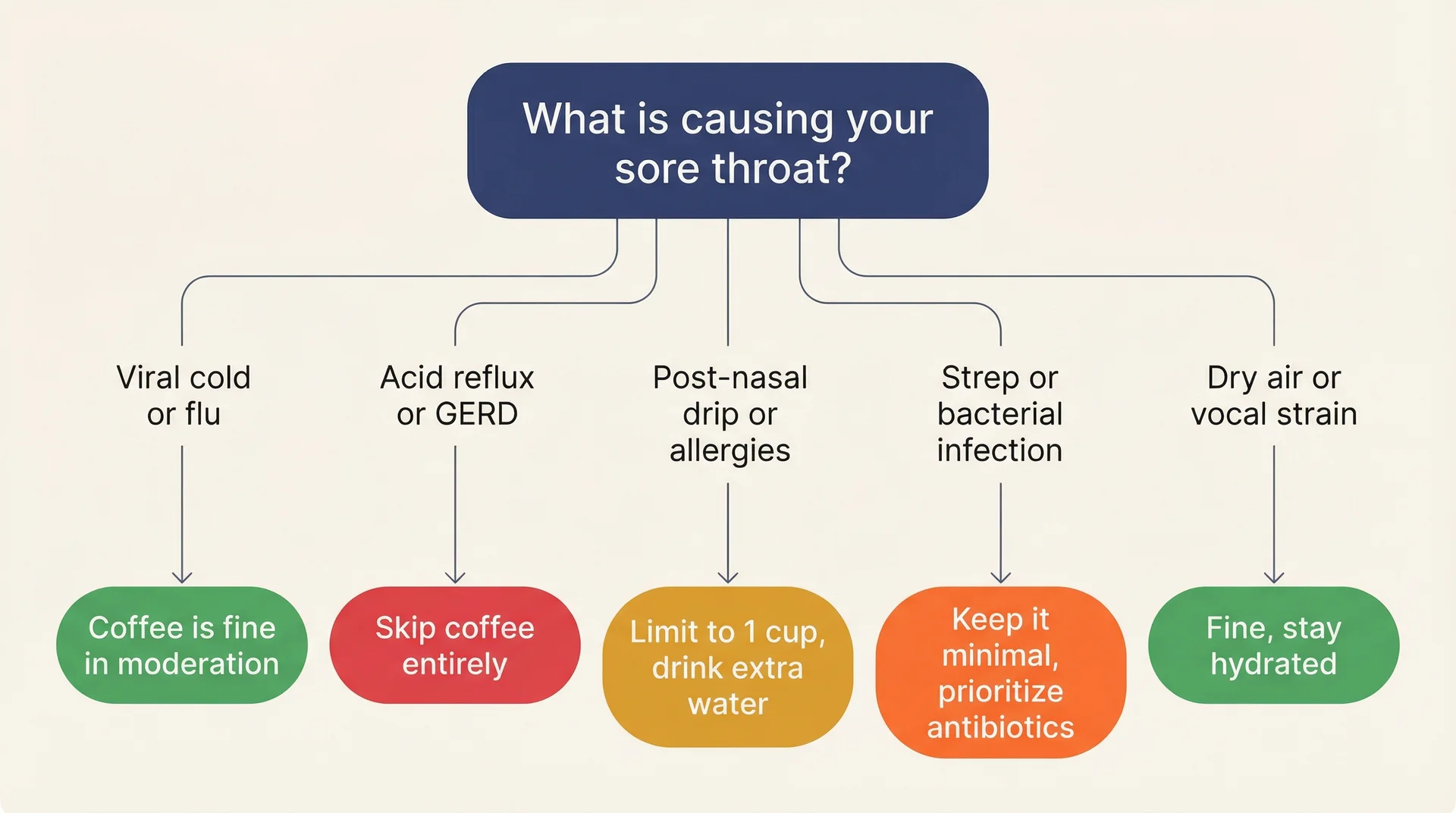
This is where the real clinical nuance lives. A blanket “coffee is fine” or “skip it entirely” recommendation ignores the fact that sore throats come from very different sources, and the right drink depends on which one you are dealing with.
Viral Sore Throat (Cold, Flu, COVID-19)
This is the most common type, and coffee is generally fine here with conditions. The warmth helps. Caffeine provides mild pain relief. The polyphenols offer a small anti-inflammatory contribution. In my experience, clients who feel worse after a cup in this situation are almost always drinking it too hot, too strong, or with dairy and sugar.
| Factor | What to Do |
|---|---|
| Temperature | Lukewarm, not hot. Hot liquids irritate an already inflamed surface. |
| Quantity | One to two cups maximum per day |
| Additions | Raw honey instead of sugar; oat or almond milk instead of dairy |
| Hydration | One full glass of water for every cup of coffee |
| Timing | Avoid coffee close to bedtime; restorative sleep matters more than the last cup |
Sore Throat from Acid Reflux or GERD
This is the hard no, and it deserves directness. Coffee relaxes the lower esophageal sphincter, stomach acid rises, and it reaches already-irritated throat tissue. Switching to decaf reduces the caffeine load but still leaves the acidity problem in place. If you consistently notice your sore throat flares after your morning coffee, or the burning sits lower in your throat and upper chest rather than at the back of the mouth, reflux may be the cause. Around 20 to 30 percent of American adults experience GERD symptoms regularly, and many people with reflux-related throat pain never connect it to their coffee habit.
Plain warm water, chamomile tea, or unsweetened aloe vera juice are the right choices here. Coffee belongs on pause until the throat lining calms down.
Post-Nasal Drip or Allergy Sore Throat
The irritation here comes from mucus draining down the back of the throat. Caffeine’s mild diuretic effect matters more in this situation because post-nasal drip already dries out the throat lining. Coffee is not a hard no, but pairing it with at least two large glasses of water is non-negotiable.
Bacterial Infection (Strep Throat)
Strep requires antibiotics. No drink treats it. Coffee’s acidity adds irritation to a throat surface that is already raw and inflamed, so keeping it to a minimum and adding raw honey makes sense while medication does the actual work.
Dry Air or Vocal Strain
Coffee is generally fine here as long as you match it with water. Consistent hydration throughout the day matters more than the specific drink you choose.
The Coffee-with-Honey Combination Deserves More Than a Passing Mention

A study published in the Primary Care Respiratory Journal (Raeessi et al., 2013) looked at honey-coffee treatment in patients with persistent post-infectious cough and sore throat. Patients received a honey-coffee paste dissolved in warm water every eight hours for a week. The honey-coffee group showed significantly better symptom reduction compared to a steroid group and a standard cough syrup group.
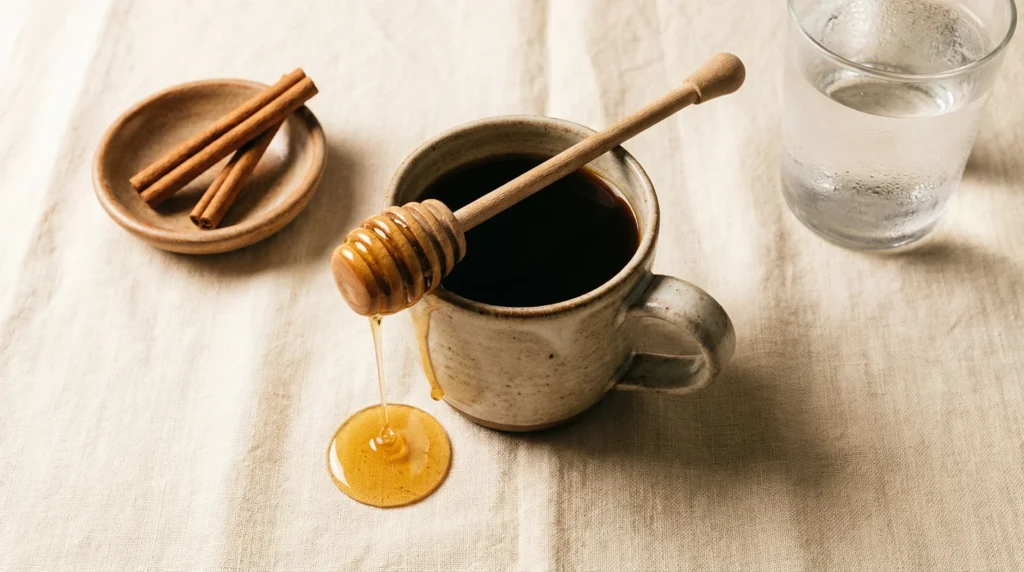
What makes this combination work is not just warmth. Honey contains hydrogen peroxide and methylglyoxal, which have documented antimicrobial activity. It also coats the throat lining in a way that buffers some of coffee’s acidity. The coating effect is temporary, around 20 minutes, but for someone struggling to swallow comfortably in the morning, that is meaningful.
Two things matter for this to work:
- Add honey after the coffee cools to lukewarm. Boiling temperatures degrade honey’s active antimicrobial compounds.
- Use raw honey. Processed honey loses much of its beneficial enzyme activity during pasteurization.
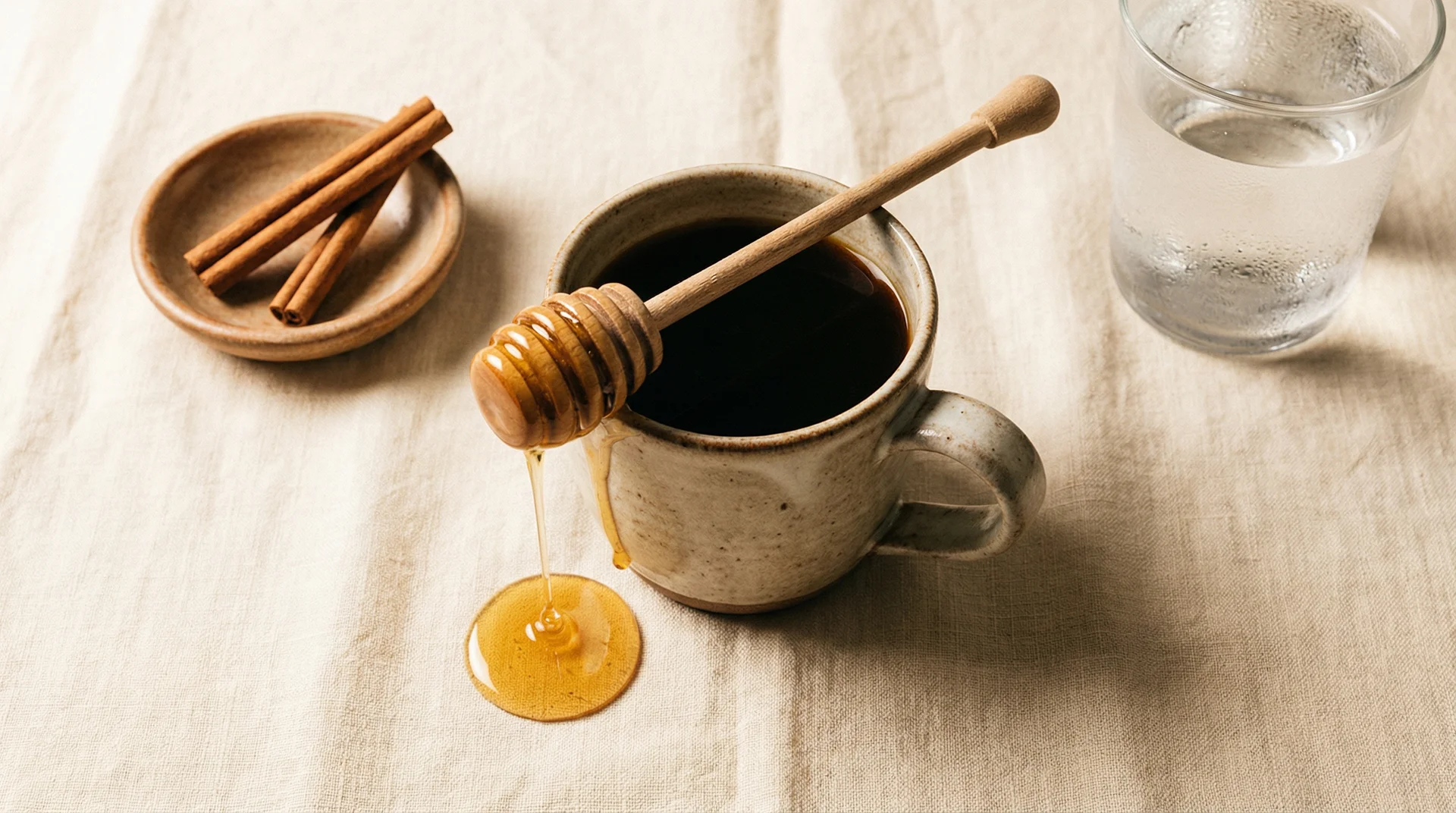
A practical ratio: two teaspoons of raw honey in six to eight ounces of lukewarm coffee. Sip slowly enough that it coats the throat rather than going straight down.
What Kind of Coffee Is Least Irritating When You Are Sick
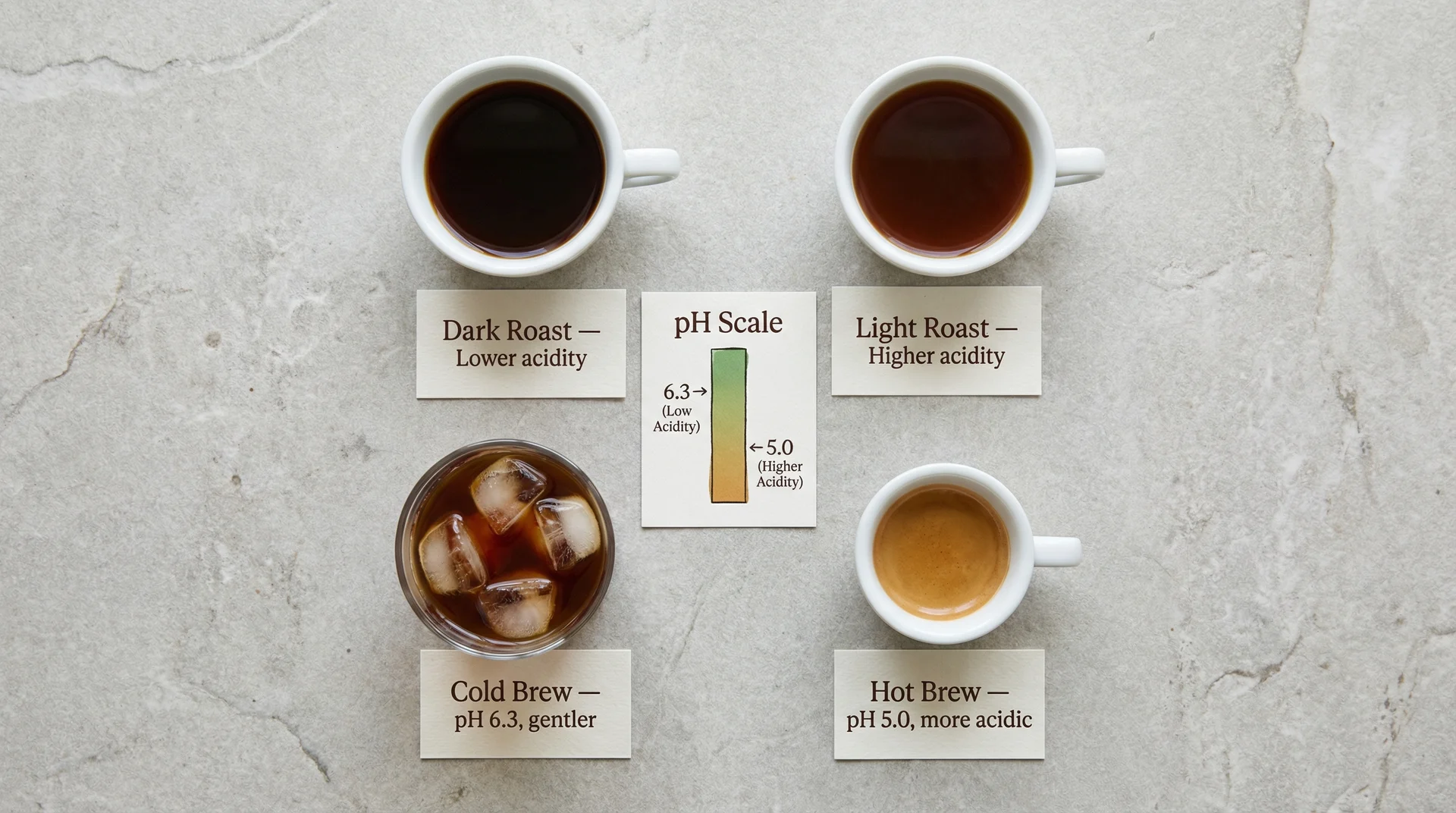
People are going to make coffee whether they are sick or not. The useful question is how to make a less irritating version.
Decaf vs. regular: Decaf removes most of the caffeine, which reduces the mild diuretic effect and eliminates sleep disruption as a concern. It still has coffee’s natural acidity, so it does not help reflux-related sore throats, but for a viral sore throat, it is a genuine step down in irritation potential. I recommend this routinely to clients who want the morning ritual without the caffeine downsides while sick.
Cold brew vs. hot-brewed: Cold brew has a measurably higher pH than hot-brewed coffee, typically around 6.3 compared to hot brew’s 5.0. The cold extraction draws out fewer acids. If iced coffee sounds appealing on a sore throat day, cold brew is the less irritating option. Cold brew tends to be higher in caffeine, so the hydration rule applies even more firmly.
Dark roast vs. light roast: Dark roast is less acidic than light roast because the extended roasting process breaks down chlorogenic acids. This surprises most people. If you have a choice, dark roast is the gentler option for an irritated throat.
What to add and what to skip:
Worth adding:
- Raw honey, for the antimicrobial and coating effect described above
- Oat milk or almond milk, which do not carry the same mucus-thickening risk as dairy for some people
- A pinch of cinnamon, for mild anti-inflammatory benefit
Worth skipping:
- Sugar, which promotes inflammation
- Dairy milk and cream can thicken mucus for people who are already congested
- Flavored syrups, which are primarily sugar with no therapeutic value
Signs That Coffee Is Making Your Sore Throat Worse
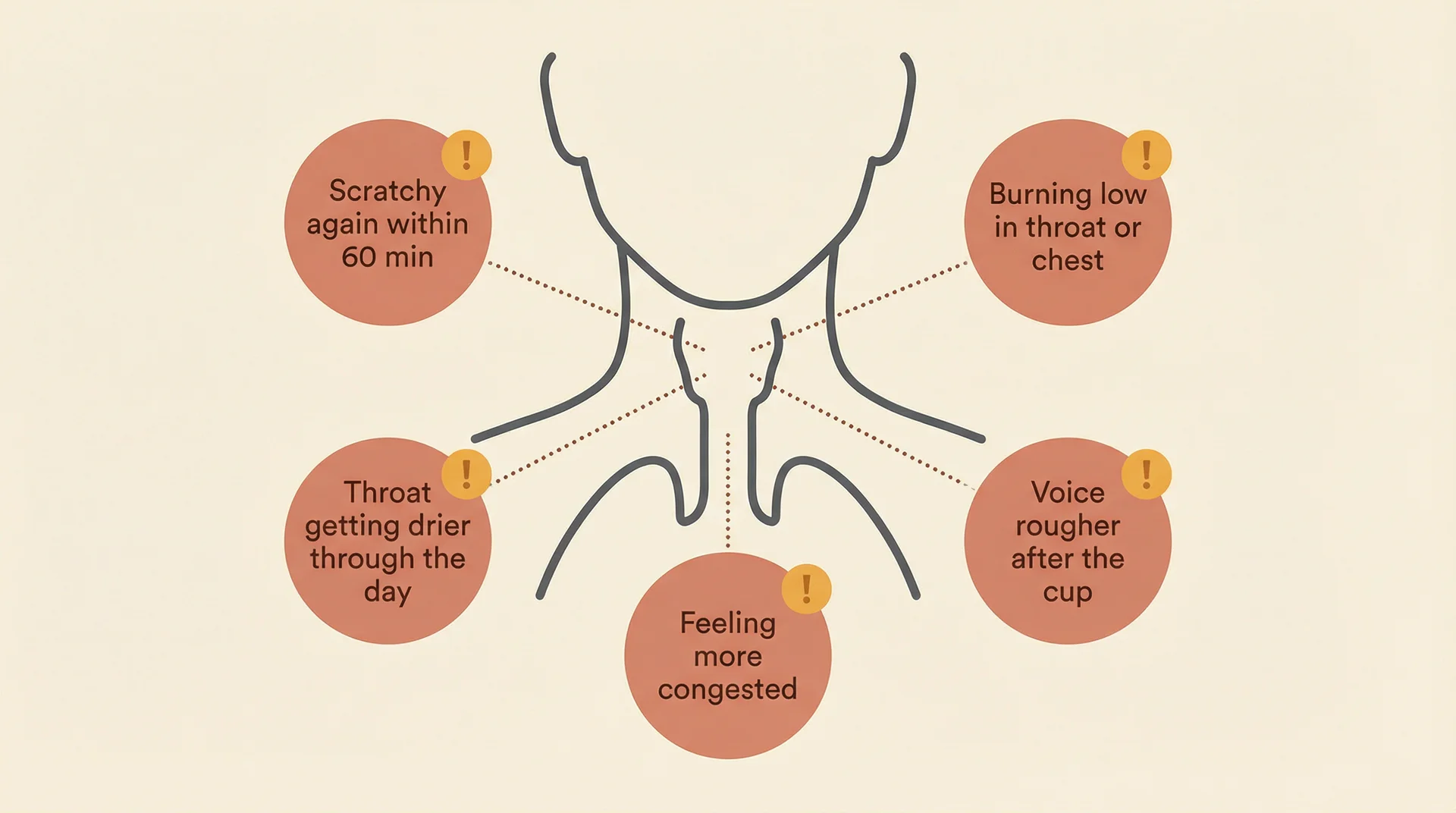
Some people feel clearly better after a cup, and some feel worse. Many feel brief relief followed by increased scratchiness and wonder why.
Watch for these signals:
- Your throat feels more irritated within 30 to 60 minutes of finishing the cup, after a brief window of relief
- A burning sensation sits lower in your throat or upper chest rather than at the back of the mouth (a reflux signal worth taking seriously)
- Your voice sounds rougher after the cup than before it
- You feel more congested rather than less after drinking
- You are urinating frequently, and your throat feels progressively drier throughout the day
When any of these appear, switch to warm water with honey or chamomile tea for the rest of the day. A second cup will not improve the result.
When to Skip Coffee Entirely Until You Recover
Temporary abstinence from coffee is not a moral position. It is sometimes just the faster path back to feeling well. I frame it this way with clients because the framing of “you have to give it up” tends to create resistance that gets in the way of practical decisions.
Skip coffee when:
- Your sore throat comes from confirmed or suspected acid reflux. The chemistry works against recovery here regardless of roast, additives, or temperature.
- You have a fever above 101°F (38.3°C). Fever already stresses fluid balance, and adding a diuretic to that increases mucus thickness.
- Swallowing is very painful. Coffee’s acidity on a severely raw surface adds irritation at exactly the wrong moment.
- You need more sleep to recover. Caffeine’s half-life runs five to seven hours in the body, so an afternoon cup stays active well into the night.
- You are taking a decongestant containing pseudoephedrine. Combining the two stimulants amplifies side effects, particularly restlessness and elevated heart rate, without improving symptom relief. Space them apart by at least an hour, and keep the coffee to one cup.
Frequently Asked Questions
Is coffee good for a sore throat?
Coffee can help a sore throat caused by a viral infection or dry air, mostly because of the warmth and caffeine’s mild pain-relieving effect. It works against a sore throat caused by acid reflux because it relaxes the valve that keeps stomach acid from rising into the throat. The cause of your sore throat matters more than the coffee itself.
Can I drink iced coffee with a sore throat?
You can. Cold temperatures provide temporary numbing relief for acute throat pain. Cold brew is a better choice than standard iced coffee because its pH is higher and its acidity is lower. The caffeine still has a mild diuretic effect, so pair it with water.
Does coffee with honey help a sore throat?
A published clinical study found that a honey-coffee mixture reduced persistent sore throat and cough symptoms more effectively than a steroid medication or standard cough syrup over one week. Add honey after the coffee cools to lukewarm; heat degrades honey’s active antimicrobial enzymes.
Does decaf coffee help a sore throat?
Decaf removes most of the caffeine, reducing the mild diuretic effect and eliminating sleep disruption as a concern. It still carries coffee’s natural acidity, so it is not suitable if your throat pain comes from reflux. For a viral sore throat, decaf with raw honey is a reasonable option.
Can coffee make a sore throat worse?
Yes, through three routes: the mild drying effect of caffeine on throat membranes, direct mucosal irritation from coffee’s acidity, and acid reflux triggered by both caffeine and acidity, relaxing the esophageal valve. Drinking coffee very hot adds a fourth problem, which is thermal irritation to already inflamed tissue.
Does coffee cause sore throats in otherwise healthy people?
Caffeine does not directly cause sore throats, but heavy regular coffee consumption can contribute to mild chronic throat irritation through dehydration of throat membranes over time. In people with undiagnosed mild GERD, the daily caffeine habit quietly worsens acid exposure in the throat.
Is black coffee better than coffee with milk for a sore throat?
Black coffee with raw honey is generally better than coffee with dairy milk. Dairy does not increase mucus production according to research, but it can make existing mucus feel thicker and harder to clear for some people. Oat milk or almond milk are solid middle-ground alternatives.
How much coffee can I drink with a sore throat?
One to two cups per day is the practical upper limit. More than that increases cumulative acid exposure and makes it harder to achieve restorative sleep. Drink at least one full glass of water alongside each cup.
When to See a Doctor
Home remedies, including a thoughtfully made cup of coffee, handle the majority of sore throats well. See a doctor if your sore throat:
- Lasts longer than seven to ten days without clear improvement
- Comes with a fever above 101°F (38.3°C)
- Produces white patches or pus visible at the back of the throat
- Makes swallowing progressively more painful rather than gradually easier
- Sits on one side of the throat only
- Arrives alongside a skin rash
- Comes with ear pain, facial swelling, or any difficulty breathing
These symptoms do not automatically signal something serious, but they are beyond what a warm drink can reasonably address on its own.
Final Note
The truth about coffee and a sore throat is that most of the advice online is either too cautious or not cautious enough. Coffee is not on a forbidden list, and it is not a treatment. For a viral sore throat, a lukewarm cup with raw honey and oat milk is a genuinely evidence-supported comfort measure. For a reflux-related sore throat, it belongs on hold. Knowing which one you are dealing with makes the difference.
Most people I work with already have a sense of how their body responds to coffee when they are sick. This is mostly about giving that instinct a clearer framework to work with.