
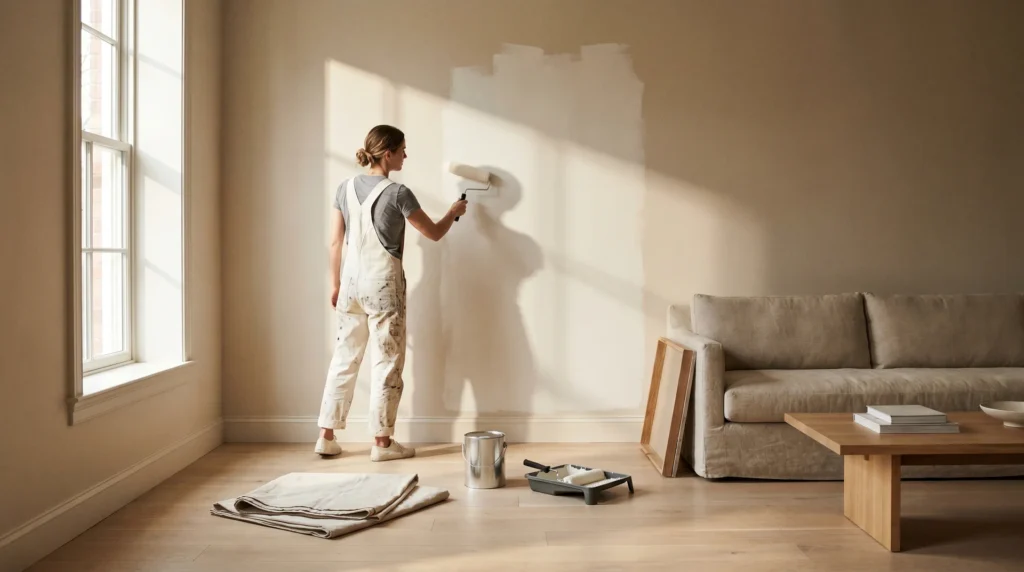
If you’re standing in a freshly painted room right now, wondering whether you can go again, here’s the direct answer: with latex or water-based paint, wait 2 to 4 hours before applying the second coat. With oil-based paint, wait the full 24 hours. Those two numbers cover the majority of interior and exterior paint projects in most homes.
The catch is that the wall feels dry in about an hour. You press a finger to it, nothing transfers, and it looks ready. It isn’t. “Dry to the touch” and “ready to recoat” are two completely different points in the drying process, and confusing them is where most paint jobs go wrong.
I’ve watched this happen to careful, well-prepared homeowners more times than I can count, in projects where the prep was thorough, the paint was quality, and the only mistake was going back in 45 minutes too early.
Two weeks later: peeling, uneven color, and a wall that has to be repainted from scratch. The paint was never the problem.
How Long to Wait Between Coats of Paint: Recoat Times by Paint Type
The recoat time on a paint can label is the minimum waiting period before the next coat can be applied without disrupting the one underneath. It shifts based on paint type, finish, and room conditions.
Here’s how the most common paints break down under normal conditions, roughly 60–75°F, around 50% humidity, with reasonable airflow.
| Paint Type | Dry to the touch | Recoat Time | Full Cure |
|---|---|---|---|
| Latex / Water-based (flat or matte) | 30–60 min | 1–2 hours | 2–4 weeks |
| Latex (eggshell or satin) | 1 hour | 2–3 hours | 2–4 weeks |
| Latex (semi-gloss or gloss) | 1–2 hours | 2–4 hours | 2–4 weeks |
| Oil-based paint | 6–8 hours | 24 hours | Up to 30 days |
| Water-based primer | 30 min | 1 hour | N/A |
| Oil-based primer | 4–6 hours | 8–12 hours | N/A |
| Chalk paint | 20–30 min | 30–60 min | 3–4 weeks |
Latex and Water-Based Paint
Latex is the standard choice for interior walls and ceilings, and its recoat window makes a one-day room project genuinely feasible. The variation within that 1-to-4-hour range comes down to the finish.
Flat and matte paints contain fewer binders, so they release moisture faster and dry sooner. Semi-gloss and gloss paints have more binders, which is what makes them durable and washable over time, but it also extends the dry window.
Under good conditions, a flat matte paint can be ready for a second coat in 90 minutes. A semi-gloss in a humid bathroom in July may need the full 4 hours.
Oil-Based Paint
Oil-based paint requires a full 24 hours between coats, with no shortcuts. Rushing it doesn’t just risk an uneven finish; it causes wrinkling, lifting, and a surface that has to be stripped and started over. If you’re using oil-based paint on trim, cabinetry, or doors, apply the first coat in the morning and plan to return the next day. The sequence matters more than the speed.
Primer Recoat Time
Primer has its own recoat schedule, separate from the topcoat, and it’s one that people often overlook. Fast-drying water-based primers are ready for a topcoat in about an hour. Standard oil-based primers can take up to 12 hours. Applying your first color coat before the primer has set defeats the reason you used primer at all.
Chalk Paint and Specialty Paints
Chalk paint dries faster than almost anything else, typically ready to recoat in 30 to 60 minutes, which makes it well-suited for furniture projects. Limewash and milk paint behave more like latex in terms of timing.
For any product outside a standard latex or oil-based formula, check the manufacturer’s label rather than assume the timelines above apply.
Dry to the Touch vs. Ready for a Second Coat: What Each Stage Actually Means
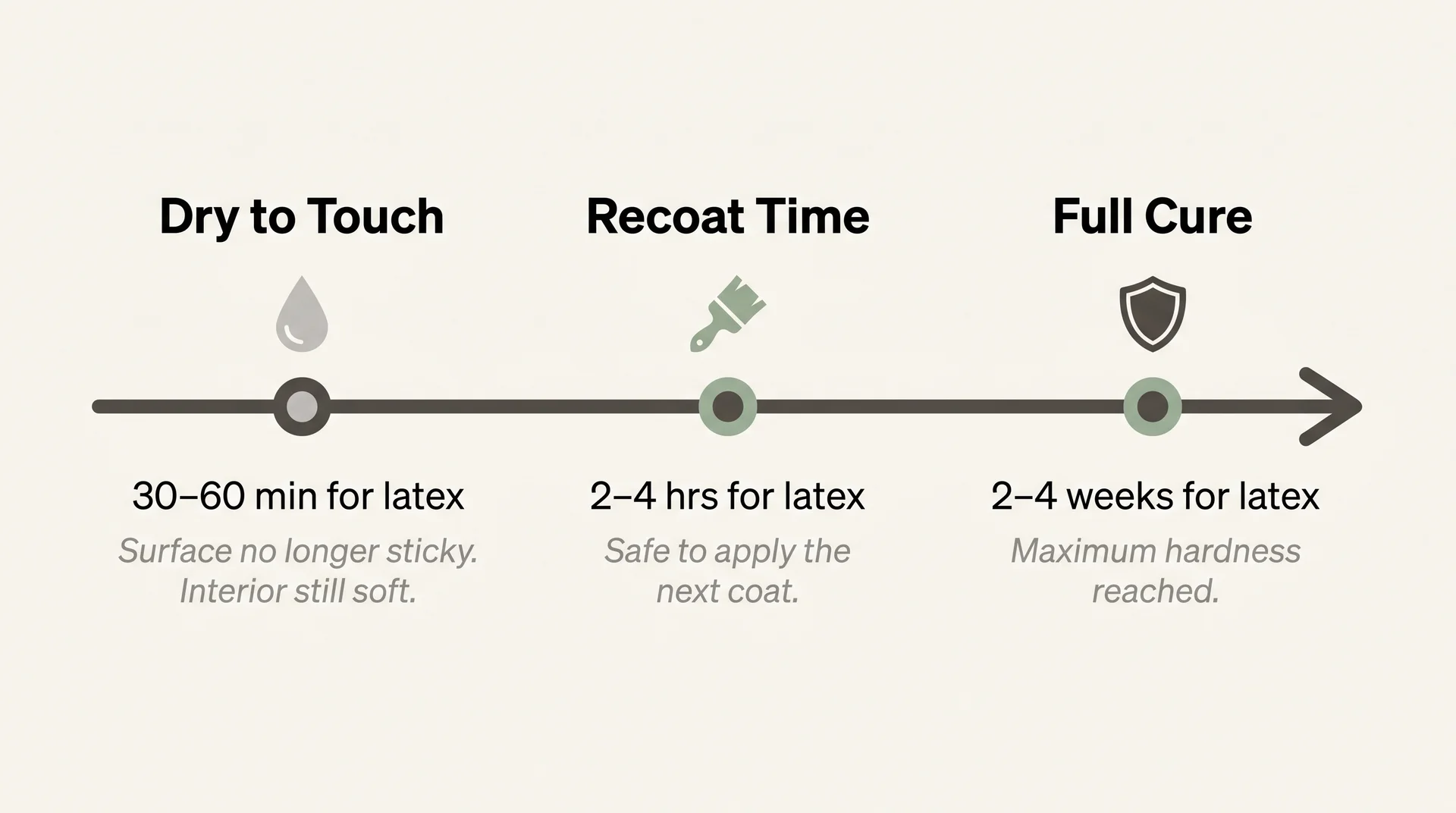
Understanding these three stages is the difference between a paint job that holds for years and one that needs to be redone in weeks.
Dry to the Touch
At this stage, the solvent (water in water-based paints) has evaporated from the very surface of the paint film. The wall no longer feels wet or sticky. What’s happening underneath is that the deeper layers are still soft and still curing.
Pressing on a dry-to-touch wall at this stage leaves a small indent. Running a roller over it means rolling right over something that hasn’t structurally set, and you’ll feel the first coat dragging under the pressure.
Recoat Time
This is the number on the can, and it’s the one that governs a two-coat project. The paint film has hardened enough to accept a second coat without the layers interfering with each other.
The chemical curing process is still active beneath the surface, but the film is stable enough to work over. Always use this number, not the dry-to-touch window, when deciding whether to apply another coat.
Full Cure Time
Full cure is when the paint reaches maximum hardness. For latex, this is 2 to 4 weeks. For oil-based paint, it can run up to 30 days. A wall can look and feel completely dry well before it reaches this point, and that gap is where a lot of post-painting damage happens.
In the course of working with homeowners on interior styling and paint projects over the years, the cure timeline is the one that catches people most off guard. A freshly painted room looks finished after the second coat dries.
Then someone drives picture hooks into the wall on Day 4 and finds the paint chipping in a small ring around each anchor point. The paint was fine. It just hadn’t finished curing, and the impact broke the surface before the film could absorb it.
How to Tell When Paint Is Ready for a Second Coat
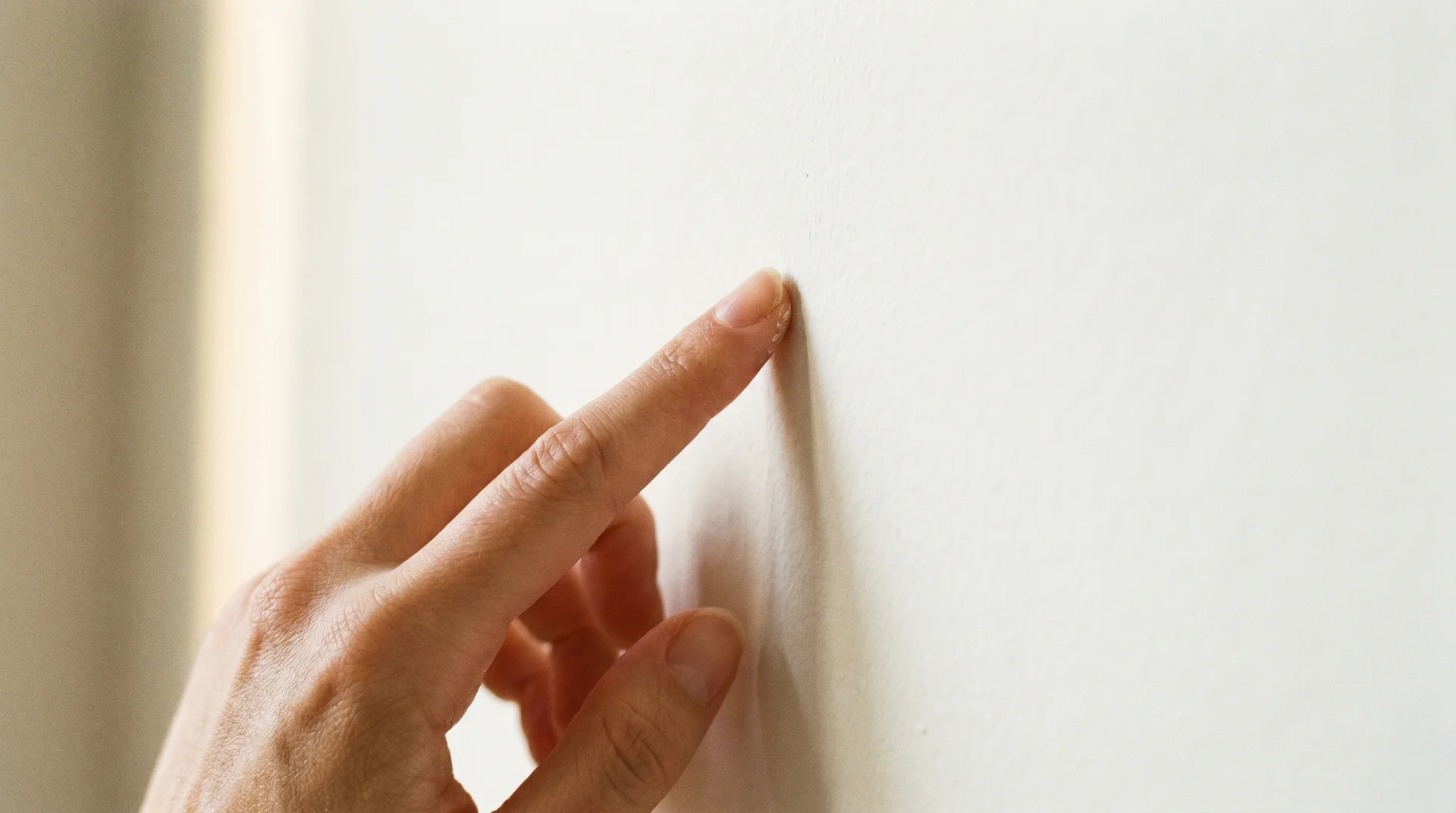
Following the recoat time on the can is the most reliable method. These three practical tests confirm whether your wall is actually ready before you go back in.
- Touch test: Press a fingertip lightly against an inconspicuous spot, such as behind a door or near a baseboard. If the surface feels cool, slightly soft, or leaves any impression at all, give it more time. It should feel completely dry and room temperature before you recoat.
- Visual test: Look at the wall from a low angle with a light source raking across the surface. Any wet-looking patches or areas with inconsistent sheen mean the coat isn’t ready. The finish should look even and uniform, matte or consistent across the whole surface.
- Smell test: Fresh paint has a noticeable odor that fades as the solvents evaporate. If the smell in the room is still strong, the paint is still releasing moisture and needs more time.
If any of these tests gives you doubt, wait another 30 minutes. The cost of waiting is nothing. The cost of going too early is a second coat that has to come off.
What Happens If You Apply the Second Coat of Paint Too Soon
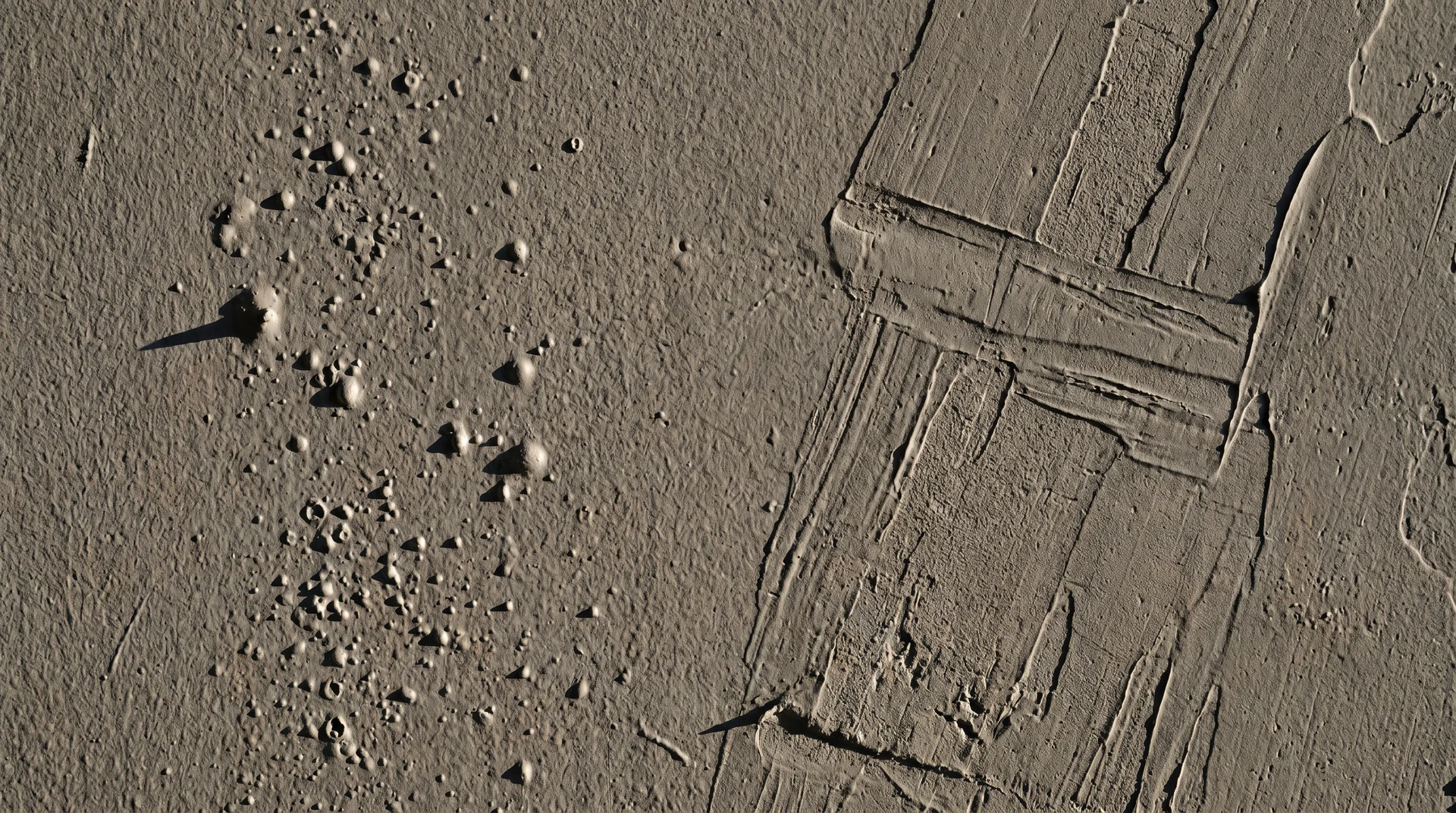
Streaks and Roller Drag
When the first coat hasn’t fully set, the roller grabs the surface as it moves across it. The soft underlayer smears into the second coat, creating visible stroke lines and uneven texture.
These are not technique problems, and rolling more carefully won’t fix them. The result shows as lines, ridges, and color variation that looks different depending on the angle of the light, regardless of how many additional coats go on afterward.
Bubbling and Lifting
Moisture trapped between two paint layers has to go somewhere. As the first coat continues to cure, it pushes that moisture up through the second coat, forming small blisters on the surface. These may not appear immediately.
Sometimes they show up hours or days after the second coat has dried. By the time you notice them, they’re set into the film, and fixing them means sanding back to the base coat on the affected section.
The Real Cost of Rushing a Recoat
Fixing a rushed paint job means sanding, re-priming in most cases, and repainting full sections or walls. There’s a version of this calculation that every experienced painter learns at least once.
The time you save by skipping the wait is always smaller than the time you spend undoing what follows.
I’ve seen homeowners shave 90 minutes off a Saturday project by recoating early, then spend an entire Sunday sanding a bubbled wall, priming it again, and repainting it from scratch.
The original wait would have taken less than half the time of the fix. Add the cost of additional primer and paint on top of that, and rushing the second coat is the single most expensive shortcut in a DIY paint project.
What Affects How Long Paint Takes to Dry Between Coats
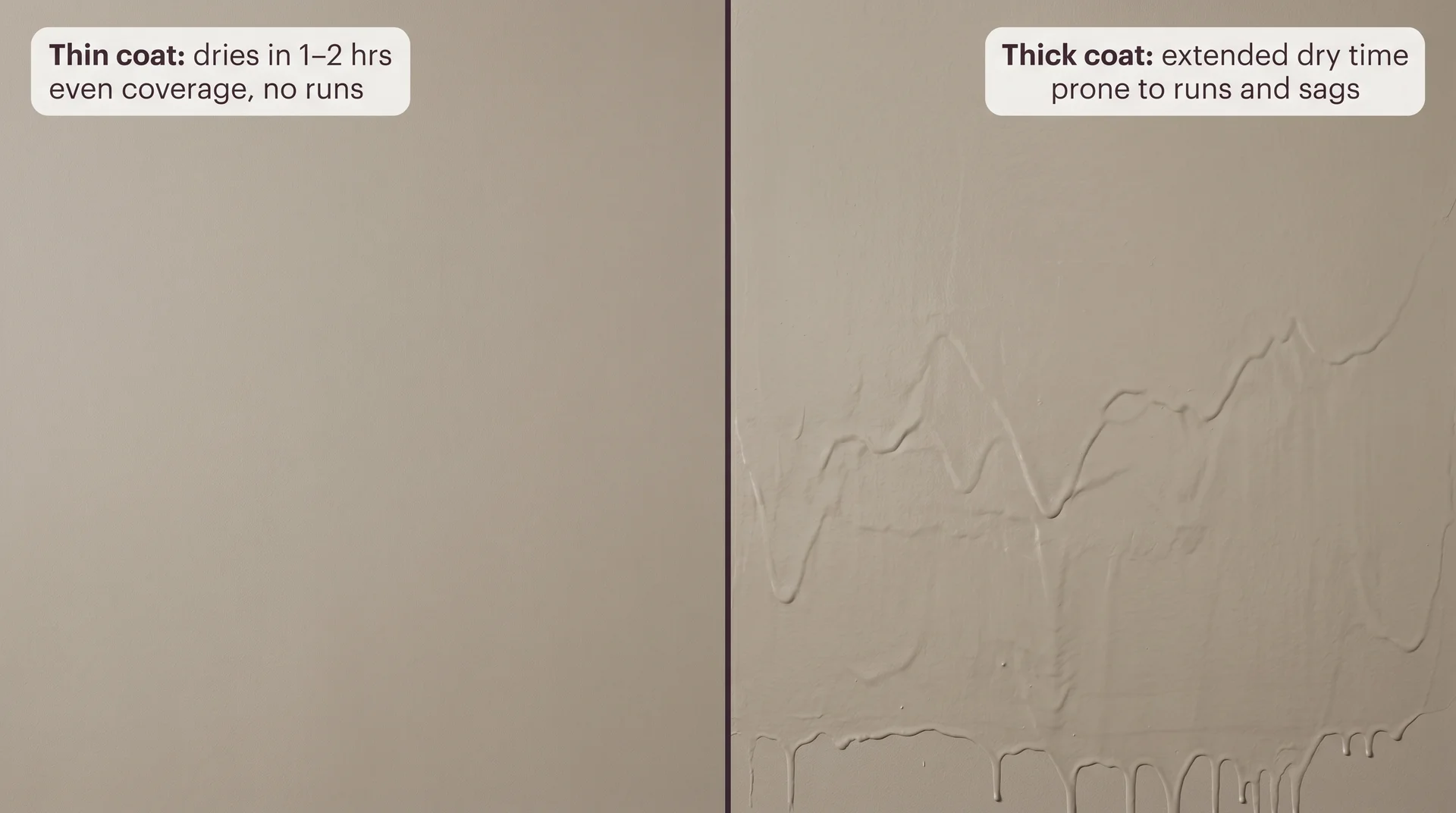
The timelines in the table above are starting points. These are the variables that push them up or down on any given day.
Humidity
Humidity is the most underestimated factor in home painting. Paint dries through evaporation, and at 70% relative humidity or higher, the air can’t absorb moisture efficiently, which slows the whole process down.
A standard 2-hour recoat window can stretch to 3 or 4 hours in a humid bathroom, a basement, or on a rainy day. The ideal painting environment sits around 40 to 50% relative humidity.
A cheap hygrometer from any hardware store tells you exactly where a room stands, and a dehumidifier running in the space makes a measurable difference during humid summer months.
Temperature
Paint dries best between 60 and 75°F. Below 50°F, the drying process slows significantly, and the paint film may not bond properly at all. Above 90°F, the surface dries too fast while the interior stays wet, which creates adhesion problems between coats.
If you’re painting in a cold room with a space heater, make sure the entire room reaches an even temperature before you start, not just the area near the heat source.
Ventilation and Airflow
Good airflow accelerates drying by moving fresh air across the paint surface continuously, which helps moisture evaporate faster.
Opening two points in the room, a window and a door, for example, creates cross-ventilation that outperforms a single open window by a meaningful margin. If you use a fan, point it toward a window rather than directly at the wall.
A fan aimed straight at a wet surface causes uneven drying and can leave texture marks in the film.
Safety note: Always ensure proper ventilation when painting indoors, regardless of paint type.
Even low-VOC paints release fumes during application and the drying process. Open windows, run a fan pointed outward, and check the product label for any specific ventilation requirements before you start.
Coat Thickness
Thick coats of paint take far longer to dry than thin ones. More paint means more solvent to evaporate, and the deeper layers always dry last. Two thin coats dry faster in total than one heavy coat, cover more evenly, and produce a better long-term result.
If you’re fully reloading the roller on every single pass, you’re likely applying more paint than the surface needs.
Surface Type
New drywall is porous and absorbs more paint than a previously painted wall, which affects both how the first coat sits and how long it takes to dry. High-gloss surfaces need light sanding between coats for the new paint to bond properly.
Wood trim and doors absorb paint differently depending on whether they’re bare, primed, or previously finished, and this affects dry times on oil-based products in particular.
How Long to Wait Between Coats Based on Paint Finish
Most guides treat all latex paint as a single category with one recoat time. The sheen you choose changes the timeline.
Paints with higher sheen contain more binders, the components that give the dried film its hardness, durability, and washability.
More binders mean a longer drying window. The payoff is a surface that holds up to cleaning and daily contact far better than a flat paint would.
| Finish | Typical Recoat Time | Common Uses |
|---|---|---|
| Flat / Matte | 1–2 hours | Ceilings, low-traffic walls |
| Eggshell | 1–2 hours | Living rooms, bedrooms |
| Satin | 2–3 hours | Hallways, kids’ rooms, family spaces |
| Semi-Gloss | 2–4 hours | Trim, bathrooms, kitchens |
| High-Gloss | 3–4+ hours | Trim, doors, accent details |
High gloss is the least forgiving finish in terms of timing. Any second coat applied before the first has fully set shows every roller stroke and brush line under direct or raking light. If conditions in the room are humid, add 30 to 60 minutes onto whatever the label recommends before touching it again.
How to Speed Up Drying Time Between Coats of Paint
These are the methods that genuinely work, and one common approach that causes more problems than it solves.
- Improve ventilation first. Cross-ventilation with two open points in a room moves more air than a single fan. It costs nothing and makes the clearest difference of anything on this list.
- Run a dehumidifier in bathrooms, basements, or any space where humidity exceeds 55%. This matters most in summer or in climates with high ambient humidity.
- Keep the room temperature between 65 and 70°F. Temperatures warmer than 75°F can cause uneven surface drying with the interior layer still wet underneath. Cooler than 60°F extends the wait considerably.
- Apply thinner coats. Two thin coats dry faster in total than one heavy coat, cover more evenly, and produce a better result. Reload the roller less than feels natural; you’ll cover more area than you expect with each pass.
- Store tools properly during the wait. Wrap rollers and brushes tightly in plastic wrap or seal them in a plastic bag and place them in the refrigerator. This keeps them fresh between coats without drying out, so you don’t need to clean and prep them again before the second application.
What to avoid: using a hair dryer or heat gun to force-dry a painted wall. It pushes surface drying while the interior layer stays wet, and the paint film never bonds correctly. The wall feels dry in minutes. Chips, lifting, and early peeling show up over the following weeks.
How Long Can You Wait Between Coats of Paint Before It’s a Problem
For standard interior latex paint, waiting days or even weeks between coats is fine. When you return to the project, wipe the surface with a dry cloth to remove dust, check for grease or handprints near switches and doorframes, and apply the second coat normally. Re-priming is usually not necessary.
The exception is high-gloss and semi-gloss finishes. After more than a week, a light pass with 220-grit sandpaper improves adhesion for the next coat. It takes about 20 minutes in a standard room and is worth doing before you apply anything over it.
For exterior paint, UV exposure begins to affect the surface chemistry of a dried coat within a few weeks, particularly on south-facing walls in sunny climates.
If your exterior project has a gap longer than two weeks between coats, sand lightly and wipe down before continuing. The extra prep takes far less time than peeling paint does.
Can You Do Two Coats of Paint in One Day?
Yes, with latex paint and good conditions, two coats on interior walls is completely achievable in a single day. Here’s a realistic timeline for a standard-size room.
| Time | Task |
|---|---|
| 8:00 AM | Prep: tape edges, lay drop cloths, fill holes, sand patches |
| 9:00 AM | Apply the first coat |
| 11:00–11:30 AM | Run touch test and visual check on first coat |
| 11:30 AM | Apply a second coat if the first coat passes readiness tests |
| 1:30 PM | The second coat is dry to the touch |
| Evening | The room is dry; avoid contact with the walls overnight |
This timeline works for flat or eggshell latex under good conditions. Add an extra hour if you’re using satin. Add 30 to 60 minutes if the room is humid.
Open windows at 9 AM and keep them open through the morning; cross-ventilation during the first coat’s drying window often determines whether the 11:30 schedule holds or slips.
For rooms where the trim and doors are getting oil-based paint, and the walls are getting latex, sequence the work across two days.
Apply oil-based paint to all trim, baseboards, and doors on Day 1 in the morning. By Day 2, the oil-based product has had the full overnight window, and you can cut in cleanly against it when you apply the latex wall coats.
Both products get the time they need without the project stretching into a third day.
When Is It Safe to Move Back In After Painting
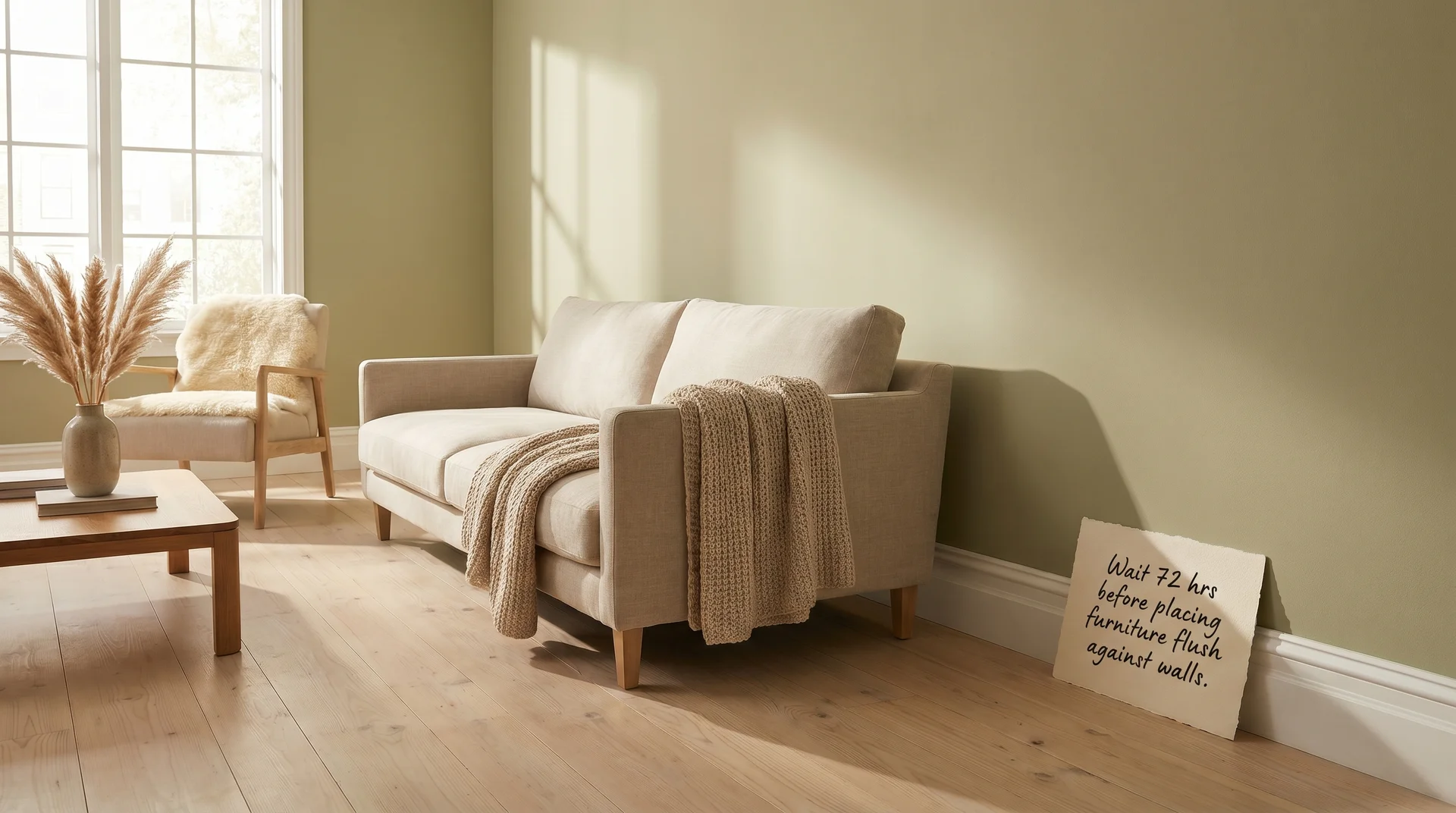
Moving Furniture Back
Give walls 48 to 72 hours before anything makes sustained contact with them. If you need large furniture pieces back in the room sooner, keep them 2 to 3 inches from the surface for the first few days. Latex paint in its early curing phase is soft enough to pick up pressure marks and can transfer color onto light-colored upholstery or fabric.
Hanging Art and Hardware
For lightweight framed pieces, 48 hours is generally safe. For heavier items requiring anchors or screws driven into the wall, wait at least two weeks. Driving hardware into uncured paint causes the film to crack in a small ring around the entry point. It’s easy to avoid entirely by waiting, and much harder to fix once it’s happened.
Cleaning Painted Walls
Wait the full cure period, 2 to 4 weeks for latex, before cleaning or wiping down walls. When you do clean for the first time, use a lightly dampened cloth with no cleaning products. Scrubbing a newly painted wall, even one that looks and feels completely dry, can lift the paint film. The surface looks done well before the chemistry finishes.
Frequently Asked Questions
Is 2 Hours Long Enough Between Coats of Paint?
For flat and matte latex paint under good conditions (65–75°F, around 50% humidity, with airflow), yes. For eggshell, satin, or semi-gloss finishes, give it at least 2 to 3 hours. For high-gloss paint or rooms that run humid or cool, wait the full 4 hours and confirm with the touch and visual tests before going back in.
What Happens If You Apply the Second Coat Too Soon?
The second coat drags the soft first coat, leaving streaks and roller marks that can’t be fixed by adding more paint. Trapped moisture between the layers causes bubbling or blistering that often appears hours or days later. In most cases, the affected section needs to be sanded back, primed, and repainted from the base.
Can You Wait Too Long Between Coats of Paint?
For standard interior latex paint, waiting days or even weeks between coats is generally fine, as long as you clean the surface before recoating. For high-gloss finishes, a light sanding after more than a week improves adhesion. For exterior surfaces, avoid letting a coat sit without a follow-up for more than two weeks, particularly in sunny climates where UV exposure affects the surface.
How Many Coats of Paint Does a Wall Need?
Most interior walls need two finish coats over a properly primed surface. Going from a dark color to a lighter one often requires three coats or a tinted primer to achieve even coverage. If you’re refreshing the same color over a clean, sound surface, one coat can be sufficient. The number of coats matters less than each coat being applied correctly and given enough time to dry.
Does Primer Count as One of the Coats of Paint?
No. Primer and finish paint are different products that do different jobs. Primer creates the adhesion layer that the topcoat bonds to. Most rooms still need two coats of finish paint over a coat of primer. Using primer doesn’t reduce the number of finish coats required; it improves how well they adhere and how evenly they cover, particularly on new drywall, patched surfaces, or significant color changes.
Final Thoughts
Timing between coats carries the same weight as brushwork and surface prep. It’s the part of the process that doesn’t show in the finished room when it’s done right, and shows clearly when it isn’t. The color on your wall is what everyone notices. The time you give it to dry properly is what decides how long it stays that way.
Follow the recoat times on your paint can, adjust for humidity and temperature, and confirm with the touch and visual tests before going back in. Two thin coats applied with the right timing will always outperform two coats applied 45 minutes apart. The project finishes faster when you work with the drying process instead of against it.
Recoat times vary by product formulation and brand. Always check the specific instructions on your paint can label before starting, and follow any additional guidance from the manufacturer. For enclosed spaces or products with higher VOC content, ensure adequate ventilation throughout the application and drying process.