
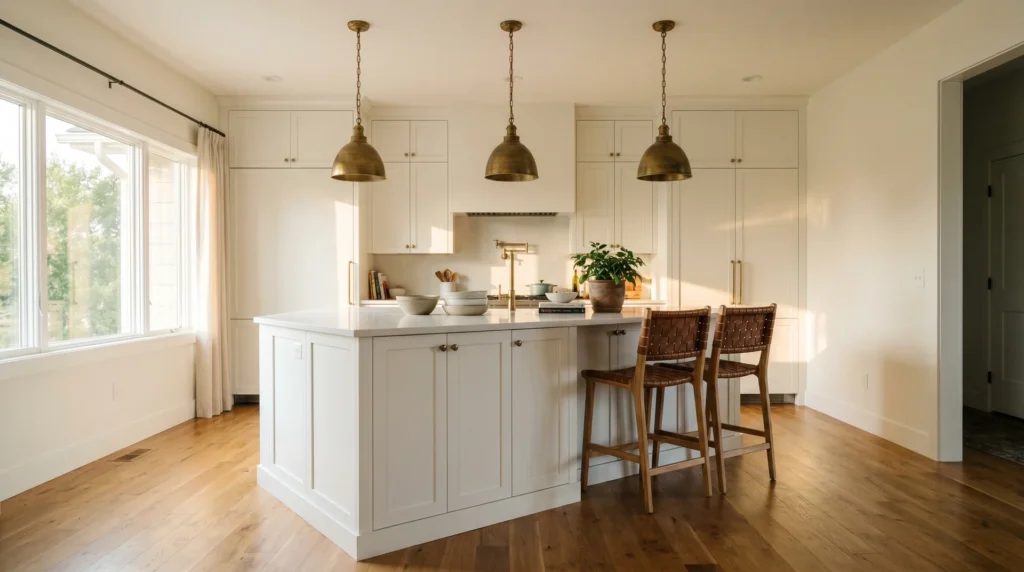
You’re standing at your kitchen island. Maybe you’ve had it for years, and your lower back has been quietly protesting every time you cook a big meal.
Maybe you’re mid-renovation, and someone just asked you what height you want, and you typed “standard kitchen island height” into Google and got five different answers that all said 36 inches while somehow still leaving you more confused.
Either way, you’re here because this decision feels more complicated than it should, and you want someone to give you a straight answer.
| Here it is: the standard kitchen island height is 36 inches, and for many households it works beautifully. For many others, it’s a number that sounds right until you’re hunched over it six months later, wondering why your shoulders ache. The measurement isn’t the problem. The problem is that most people choose a height before they’ve asked the right questions about how they actually live in their kitchen. |
I’ve been working in residential interior design and space planning for over a decade. In that time, I’ve seen clients spend months agonizing over cabinet finishes and countertop materials, then make the height decision in thirty seconds because “that’s what everyone does.”
The height is the one dimension that affects your body every single day, and it deserves more than thirty seconds.
Why the Standard Kitchen Island Height Doesn’t Always Work
The 36-inch benchmark was designed around an adult of roughly average height, built to align with standard base cabinet construction. It’s not a bad number. It’s a starting point.
Here’s what it doesn’t account for: it doesn’t know you’re 6’2″ and have been quietly bending your neck forward every time you slice vegetables. It doesn’t know your mother-in-law uses a walker.
It doesn’t know that your primary use for the island is rolling out pie dough, which ergonomically benefits from a surface a few inches lower than your standard prep height.
Where the 36-Inch Kitchen Island Benchmark Comes From
The 36-inch standard emerged from mid-century American kitchen manufacturing. Base cabinets measure 34.5 inches tall. A countertop adds between 0.75 and 1.5 inches on top of that, landing the finished surface at 35.25 to 36 inches.
Note that countertop thickness matters more than most people realise: a thick stone slab at 1.5 inches versus a standard laminate at 0.75 inches can shift your finished height by nearly an inch, which matters when you’re targeting a specific ergonomic height. Always choose your countertop material in coordination with your cabinet height, not independently.
The National Kitchen and Bath Association (NKBA) recommends 36 inches as the baseline for food prep and general kitchen tasks. It suits most people most of the time. That caveat, “most people most of the time,” is the one worth holding onto.
The One Question to Ask Before You Look at Any Measurement
Who uses this island most, what do they do at it, and for how long? If your answer is “I cook at it daily for an hour, and my partner occasionally eats breakfast there,” your priority is ergonomic prep height for your body.
If your answer is “we mostly use it for drinks and entertaining while I cook at the stove,” your priority shifts toward seating comfort. The number follows the answer, not the other way around.
The Three Standard Kitchen Island Heights and What Each One Is For
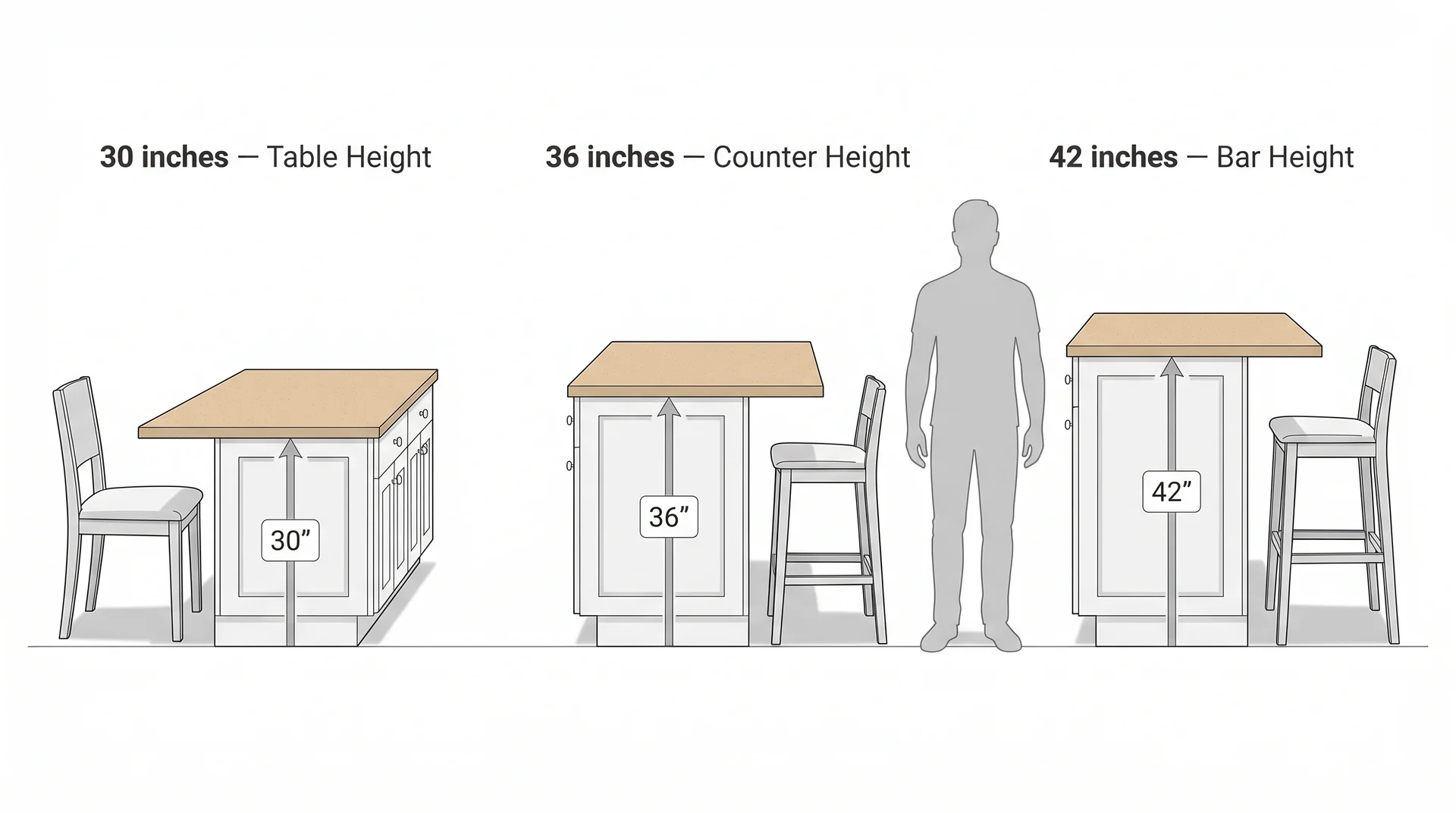
There are three functional height zones for a kitchen island. Most guides present them as a list of numbers. Here’s what each one actually means for how your kitchen feels to live in.
36 Inches (Counter Height)
Best for: food prep-heavy households, kitchens needing visual continuity, families with children, and anyone designing with future accessibility in mind.
Counter height aligns with your existing countertops, giving you one seamless workflow surface. It accommodates counter stools comfortably, and those stools are shorter and easier to climb than bar stools, which matters more than people realise until they have guests of different ages in the kitchen.
If you’re weighing a standalone counter height dining table alongside or instead of a built-in island, the stool height rules and clearance measurements work exactly the same way.
42 Inches (Bar Height)
Best for: open-plan kitchens where the island defines the cooking zone, social kitchens built for gathering, and households that rarely prep heavy meals at the island itself. A 42-inch island creates visual separation in an open-plan layout, reads like a bar, and gives the kitchen a distinct zone that feels intentionally separate from the living area.
Here’s what I’ll tell you plainly, because most guides tiptoe around it: bar height is increasingly falling out of favour in residential design. It’s genuinely uncomfortable for children, shorter adults, and anyone who tries to prep food at it for any length of time.
The stools required are tall enough that feet dangle without a footrest. Standing at 42 inches to chop vegetables raises your elbows into an uncomfortable position after about twenty minutes.
If you’re choosing it because it “looks more interesting,” think carefully about how often aesthetics will matter to you on a Tuesday evening when you’re just trying to make dinner.
30 Inches (Table Height)
Best for: households that want seated dining without a separate table, families with young children, and anyone with wheelchair accessibility or mobility requirements.
At this height, you use regular dining chairs instead of stools. Most people find dining chairs more comfortable for longer sitting, easier to get in and out of, and more stable for children.
I’ve recommended table-height islands to clients in compact open-plan layouts with no room for both a proper dining table and a traditional island. The result was one piece of furniture that handled both jobs beautifully and felt far more human in scale than a towering 42-inch bar.
If you’re designing with accessibility in mind across the whole house, it’s worth applying the same thinking to your bathroom entry as our guide to bathroom door width for aging-in-place design covers the clearances, and ADA benchmarks that makes a real difference, room by room.
Kitchen Island Ergonomics: What Your Body Is Actually Telling You
Your ideal kitchen island height isn’t a number someone else calculated. It’s specific to your body, and you can find it in about two minutes.
The Self-Test Every Homeowner Should Do Before Deciding
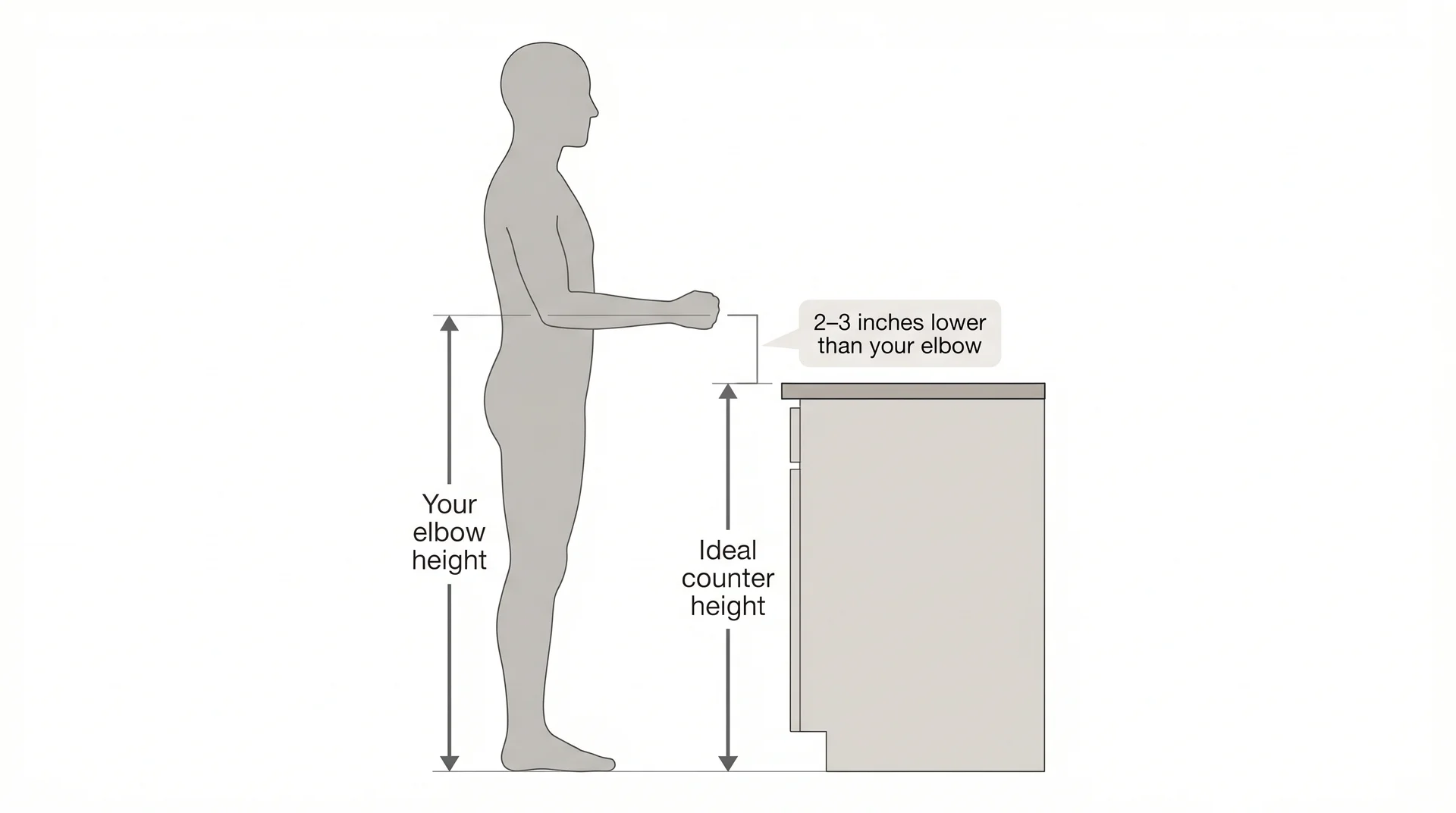
Stand in your kitchen with your arms relaxed at your sides. Bend your elbows to roughly 90 degrees so your forearms are parallel to the floor. Now lower your hands two to three inches.
That position, relaxed forearms slightly below elbow height, is where your prep surface should ideally sit. It lets you apply downward pressure while chopping or kneading without raising your shoulders or rounding your back.
If you can get to a kitchen showroom before committing to a height, spend ten minutes actually standing at different island heights and going through the motions of chopping and kneading. The difference between 36 inches and 38 inches is subtle to the eye and significant to your spine after a year of daily cooking.
Why Two People of the Same Height Can Need Different Kitchen Island Heights
Torso-to-leg ratio matters as much as overall height. Two people who are both 5’7″ can have meaningfully different elbow heights depending on whether their height comes from their torso or their legs.
Someone with a long torso may find 36 inches genuinely low. Someone with longer legs and a shorter torso may find it perfectly comfortable. This is why the self-test beats the measurement every time, and why “just go with standard” can quietly go wrong even for people of average height.
Designing for Two Different Heights in One Household
If the height range between the primary users is four inches or less, a well-chosen single height usually serves everyone reasonably well. Beyond that gap, “let’s go with standard” doesn’t resolve the conflict; it just defaults to someone’s discomfort.
Practical solutions that actually work: a custom height of 38 to 39 inches splits the difference for households where the primary users are 5’6″ and 6’0″. Adjustable-height stools solve the seating half of the equation for everyone.
Seating at Your Kitchen Island: Counter Height vs. Bar Height
Most homeowners want both a practical cooking surface and a place where people gather and eat. That’s a reasonable thing to want.
The tension comes from the fact that the ideal height for standing prep and the ideal height for comfortable seated dining are genuinely different. Here’s how to navigate that honestly.
The Case for a Single-Level Island at 36 Inches
A single-height island at 36 inches with a proper seating overhang handles both prep and dining better than most people expect. With a 12 to 15-inch overhang, counter-height stools at 24 to 26 inches sit comfortably on the surface.
The island maintains a clean, continuous countertop that flows with the rest of the kitchen. No visual interruptions, no awkward transitions, more usable countertop surface.
Modern kitchen design has largely moved toward this cleaner, lower-profile approach, and I’ve shifted most of my island recommendations in this direction over the past several years. Client feedback has been consistently positive.
Two-Tier Kitchen Islands: When They Work, When They Don’t
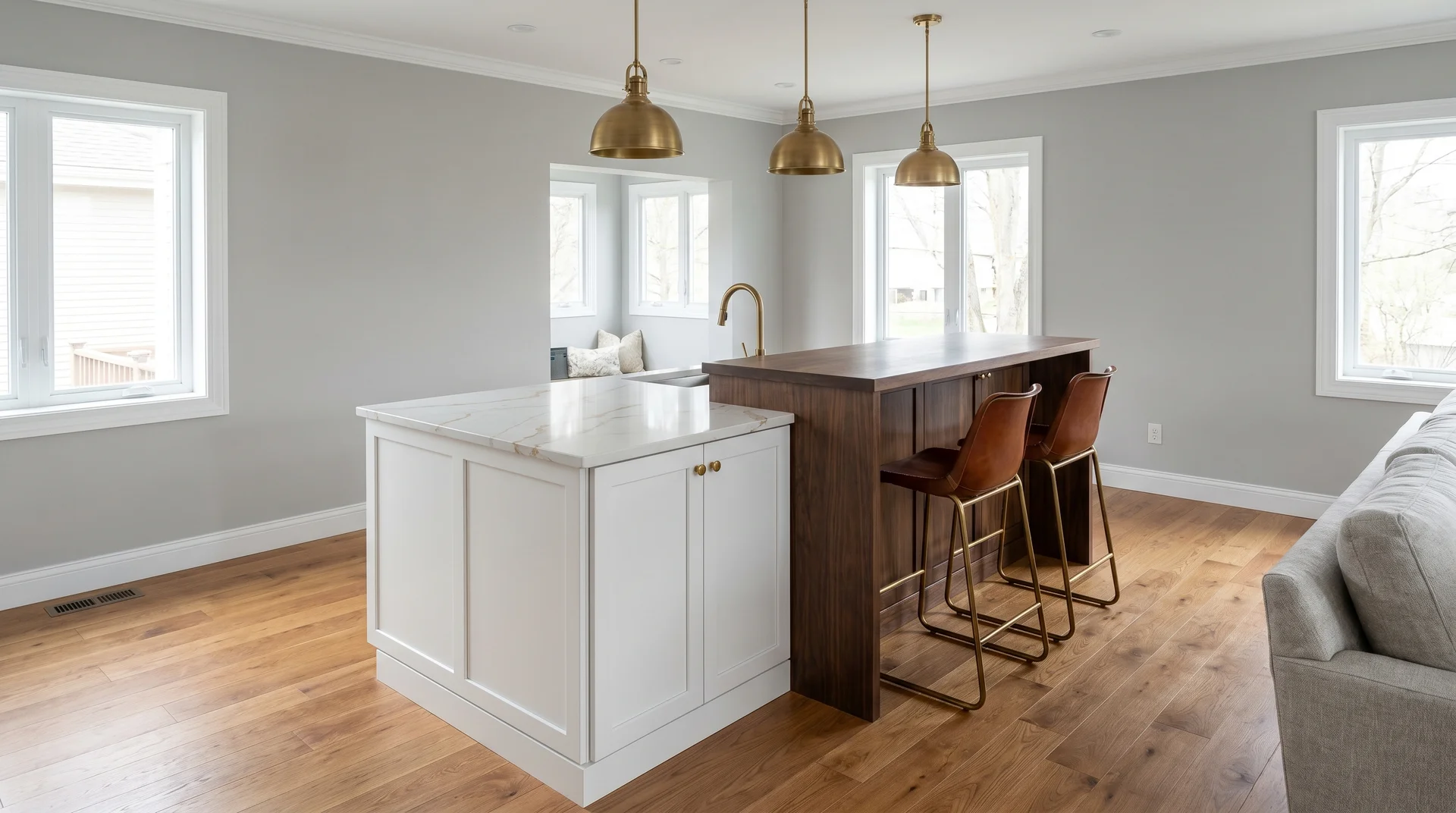
The builder-standard two-tier island with a 36-inch prep section and a 42-inch raised bar along one edge has aged. It was ubiquitous in American kitchens in the 2000s and early 2010s and reads as dated now, particularly in kitchens aiming for a contemporary or transitional aesthetic.
That said, a thoughtfully designed two-tier island is a genuine functional solution in the right context. It makes real sense when one person cooks at the island while others eat simultaneously, and you need physical separation between those two activities, or when you want to hide kitchen clutter from a connected living area.
Where it goes wrong: small kitchens with low ceilings, contemporary interiors where clean lines are the priority, and households where the raised tier ends up accumulating mail because nobody actually sits there. Be honest with yourself about whether both tiers will genuinely be used.
Matching Stool Height to Kitchen Island Height (And Why Getting It Wrong Hurts)
The stool-to-island relationship is the most practically botched dimension in kitchen design.
I’ve walked into homes where the island is beautiful, and the stools are technically “bar stools,” and everyone is either craning their necks upward or sitting with their chins almost at counter level because the measurements were never actually matched.
The 10 to 12-Inch Clearance Rule
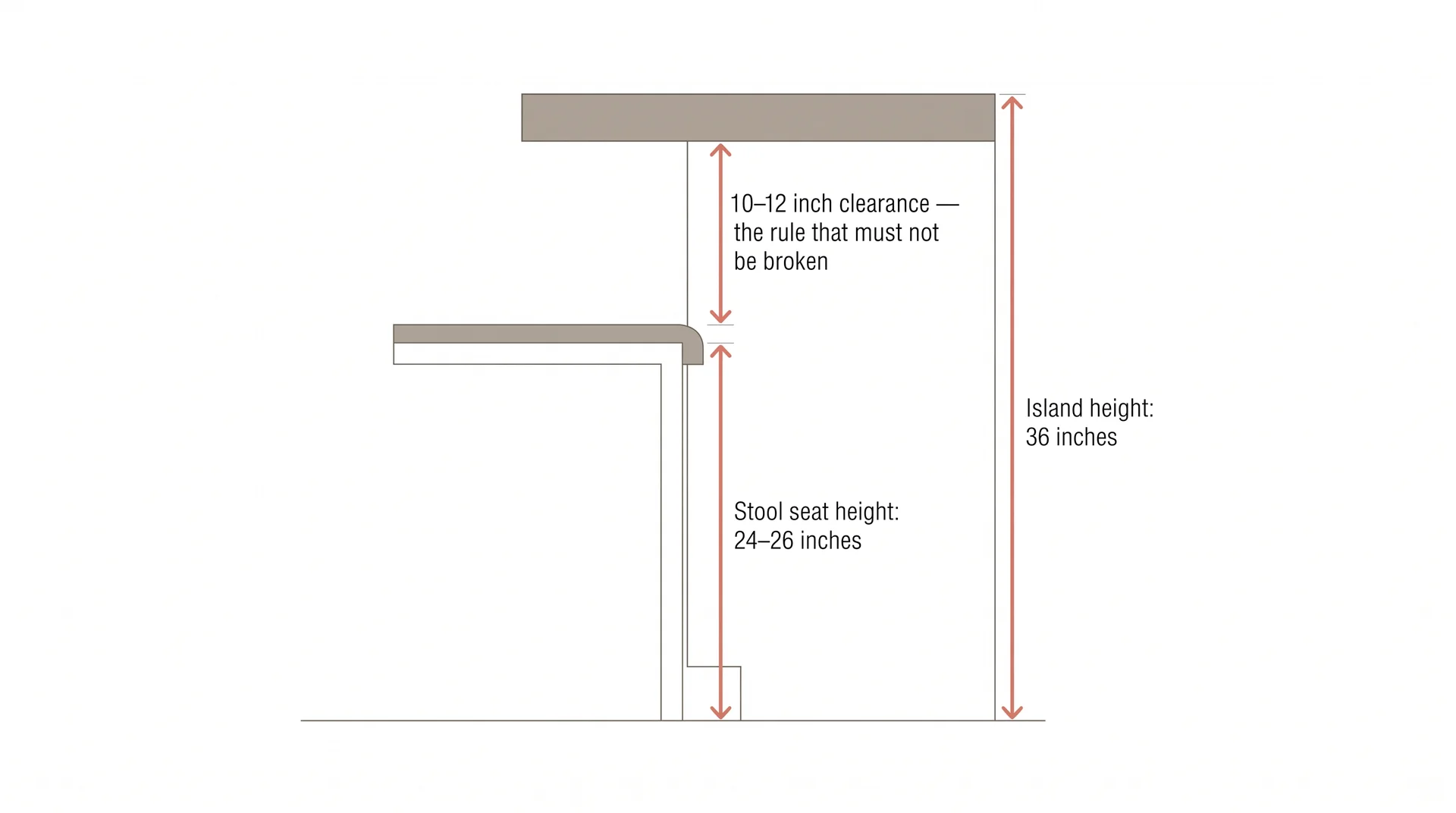
The gap between the stool seat and the underside of the counter needs to be 10 to 12 inches. That’s the clearance your legs need to sit comfortably without your knees pressing into the counter base. Everything else follows from that one measurement.
| Island Height | Stool Seat Height | Leg Clearance Gap | Best For |
|---|---|---|---|
| 36″ (counter height) | 24″–26″ | 10–12″ | Every day use, families, mixed ages |
| 42″ (bar height) | 28″–30″ | 12–14″ | Entertaining, adult-only households |
| 30″ (table height) | 18″–20″ (dining chair) | 10–12″ | Families, accessibility, seated dining |
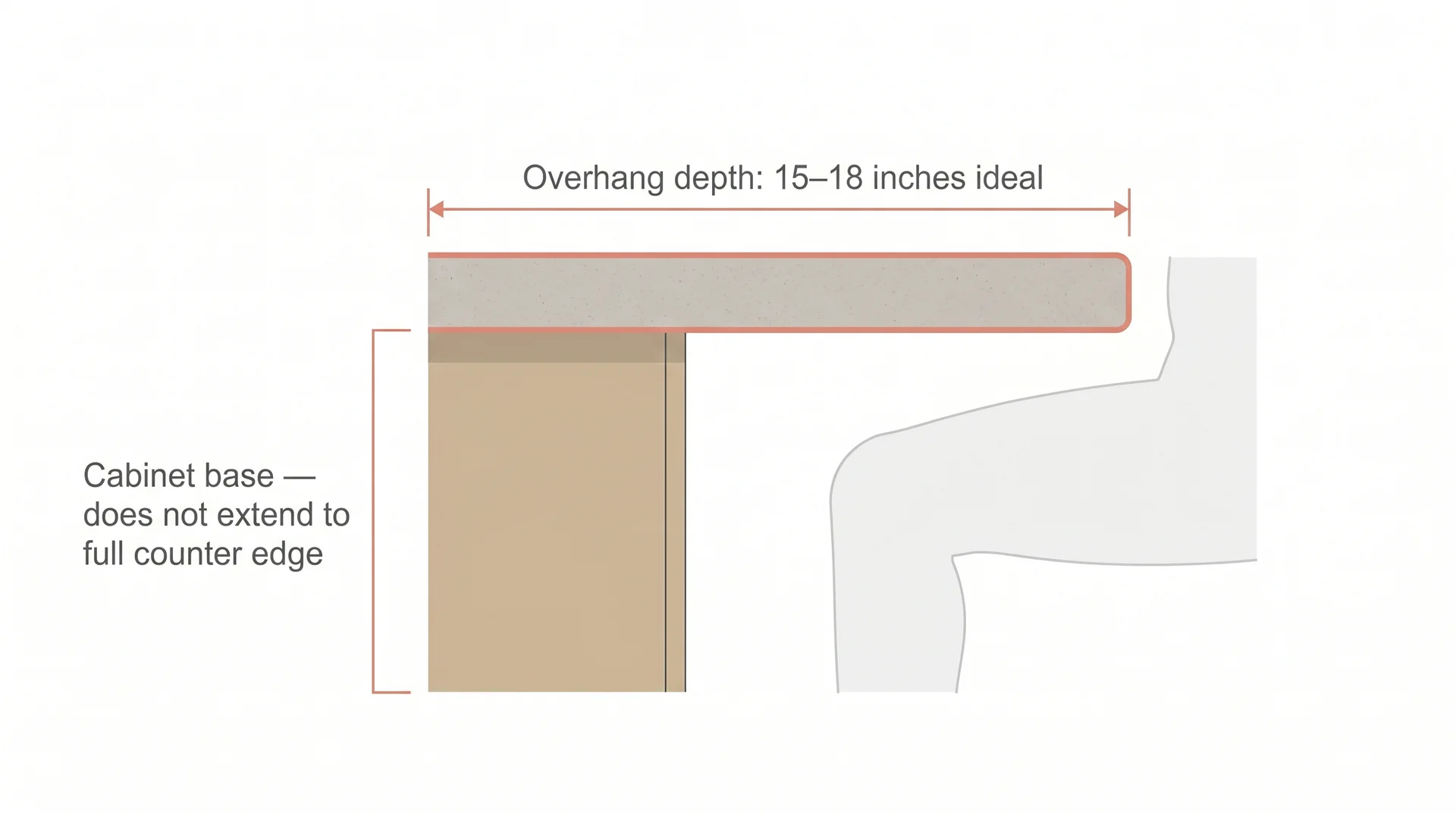
The overhang depth matters equally. For counter-height seating, allow a minimum of 15 inches of overhang from the counter edge. Twelve inches is technically functional, but it starts to feel cramped quickly. If seating is a priority in your design, plan for 15 to 18 inches, and you’ll never wish it were shallower.
At bar height, a footrest ring is non-negotiable. At 42 inches, feet rarely reach the floor from a stool, and the pressure that builds on the backs of the thighs from dangling feet is genuinely uncomfortable over time. Every bar-height stool should have a footrest, full stop.
The Backless Stool Trap
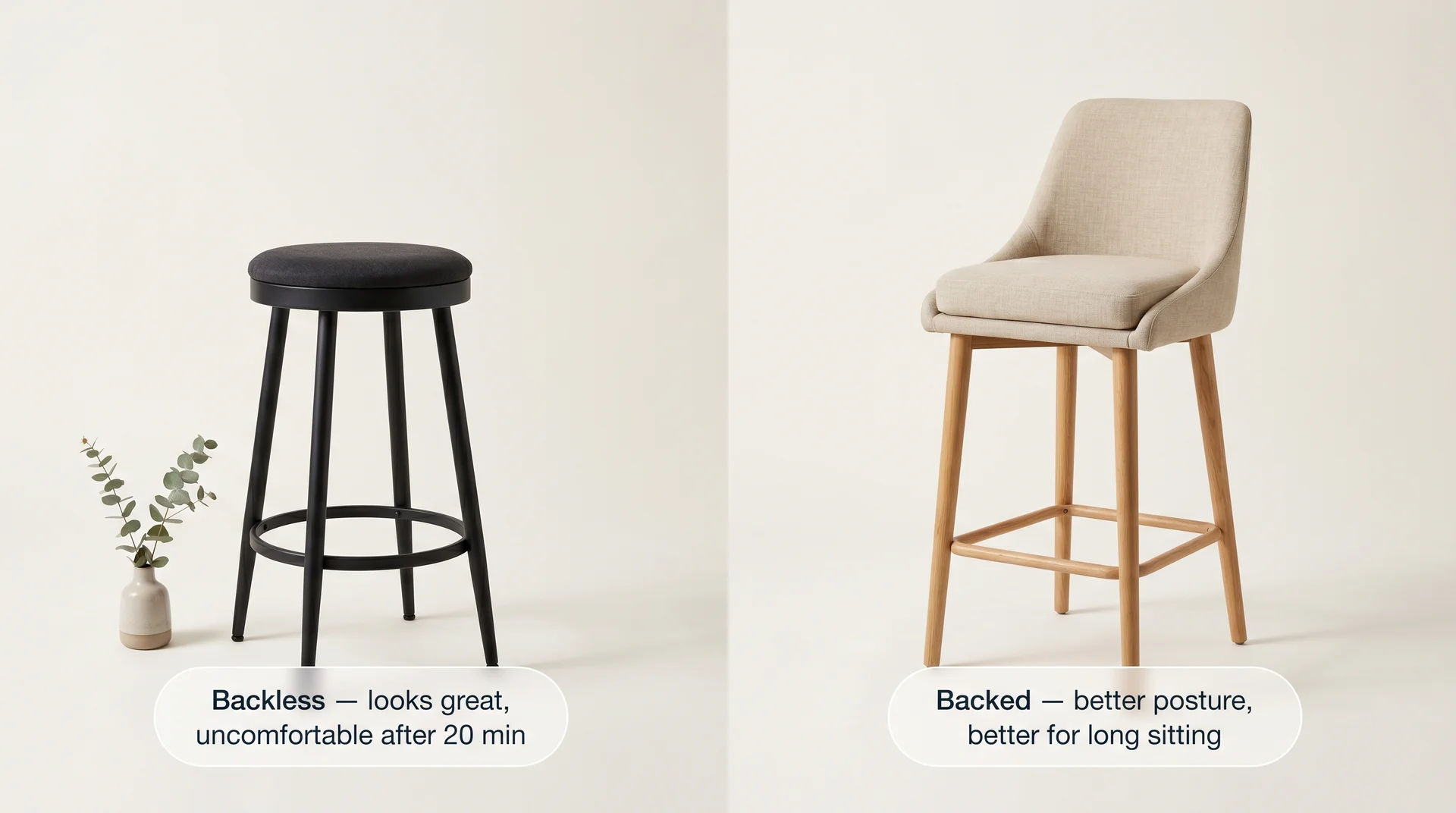
Backless stools are everywhere in kitchen design right now, and they look genuinely elegant. They tuck under the counter cleanly, they photograph well, and they have a quiet simplicity that works across many aesthetic directions.
They’re also, in my experience, the most returned and replaced seating choice in kitchen design.
Without a backrest, anyone sitting for more than about twenty minutes starts to either perch rigidly or slump forward. The slump puts cumulative strain on the lower back and shoulders. If your island is primarily a quick-breakfast spot, backless works.
If it’s where your family eats dinner, where kids do homework, or where guests settle in for conversation, invest in a stool with proper back support. Your guests will actually stay and enjoy being there, which is presumably the point.
How Many Stools Fit Your Kitchen Island
Allow 24 to 28 inches of width per person for comfortable seating without elbow-bumping. Divide your usable overhang length by 26 as a midpoint estimate. If your seating section runs 78 inches, three stools fit with space to spare.
If it runs 52 inches, two stools at 24 inches each are your practical maximum. Leave a few extra inches at any open corner so people can pull in and out without awkwardness.
Space and Clearance Around Your Kitchen Island
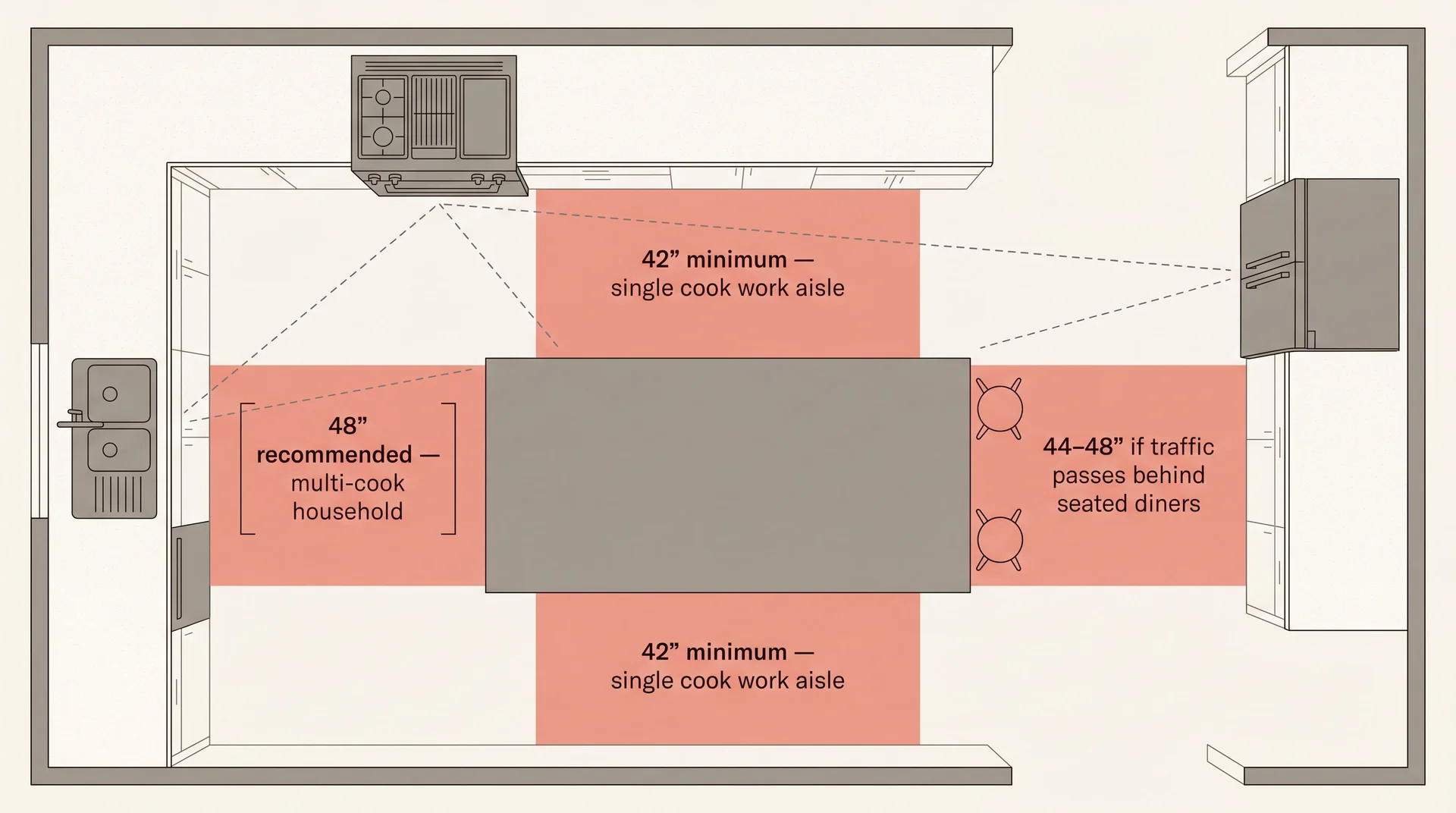
This is the dimension most homeowners forget to plan until they’re standing in a finished kitchen that feels uncomfortably tight.
Kitchen island height and size both affect how much usable space remains around it, and getting the clearances right is what separates a kitchen that flows from one that creates daily friction.
The NKBA recommends a minimum of 42 inches of clearance in work aisles for a single cook, and 48 inches for a kitchen with multiple cooks.
These aren’t arbitrary numbers. A cook needs to turn around, bend down to reach lower cabinets, and pull pans from the oven without colliding with anyone passing behind them.
- Minimum walkway (single cook): 42 inches on all working sides of the island
- Recommended walkway (multi-cook household): 48 inches
- Behind seated diners, no traffic passing: 32 inches minimum
- Behind seated diners with traffic passing: 44 to 48 inches
- Wheelchair access behind seated diners: 44 inches minimum
Account for appliance door swings, too. A dishwasher needs 21 to 24 inches of clearance to load properly. An oven door can extend 20 or more inches when fully open. If your island sits directly across from either, measure the open-door projection before finalising the island’s position, not after.
The kitchen work triangle, the movement path between your sink, stove, and refrigerator, should also stay intact. No leg of the work triangle should be obstructed by your island by more than 12 inches. An island that interrupts the triangle doesn’t just feel inconvenient. It actively makes cooking slower and more tiring every single day.
A practical rule of thumb: if your kitchen is less than 13 feet wide, a fixed island with walkways on both sides is likely to feel too tight. Consider a peninsula or a mobile island instead.
Custom Kitchen Island Heights: When Your Household Doesn’t Fit the Average
Designing for Taller Cooks (5’10” and Above)
The ergonomic sweet spot for taller cooks is generally 38 to 40 inches, with 38 to 39 inches being the most practical range. Over the course of a renovation that will last ten to twenty years, the cumulative effect of a slight forward lean matters. Ways to achieve a custom height without a full custom cabinet build:
- Thicker countertop material: A 2-inch stone slab versus a 0.75-inch laminate adds over an inch to your finished surface height
- Taller cabinet bases: Some manufacturers offer 35-inch base cabinets instead of the standard 34.5-inch base cabinets
- A riser under the cabinet base: Less elegant but effective for freestanding islands and barely visible once installed
- Custom furniture-style legs: On furniture-style islands, replacing legs with slightly taller versions is a straightforward modification
This subtle adjustment is one of the highest-satisfaction changes I recommend. Clients who go up even two inches notice it immediately in how their body feels after a long cooking session.
Designing for Shorter Adults and Children
For primary users around 5’3″ and under, 34 to 36 inches is the comfortable range. For households with children who actively use the island, a built-in step-stool niche in the island base is one of the most practical features I’ve ever recommended.
It keeps the step accessible and out of the way, and children can use the island safely at a functional height without anyone managing a loose stool being dragged around the kitchen. Adjustable-height stools solve the seating side of this equation for mixed-age households.
Accessible Kitchen Island Heights: ADA and Mobility Specifications
| Note: If someone in your household has specific mobility, disability, or accessibility requirements, the measurements below reflect ADA guidelines and are intended as a starting reference. Always consult an occupational therapist or a certified aging-in-place specialist alongside your contractor for guidance tailored to your specific situation. |
If someone in your household uses a wheelchair or has significant mobility limitations, the standard height range doesn’t work. These are the measurements that matter:
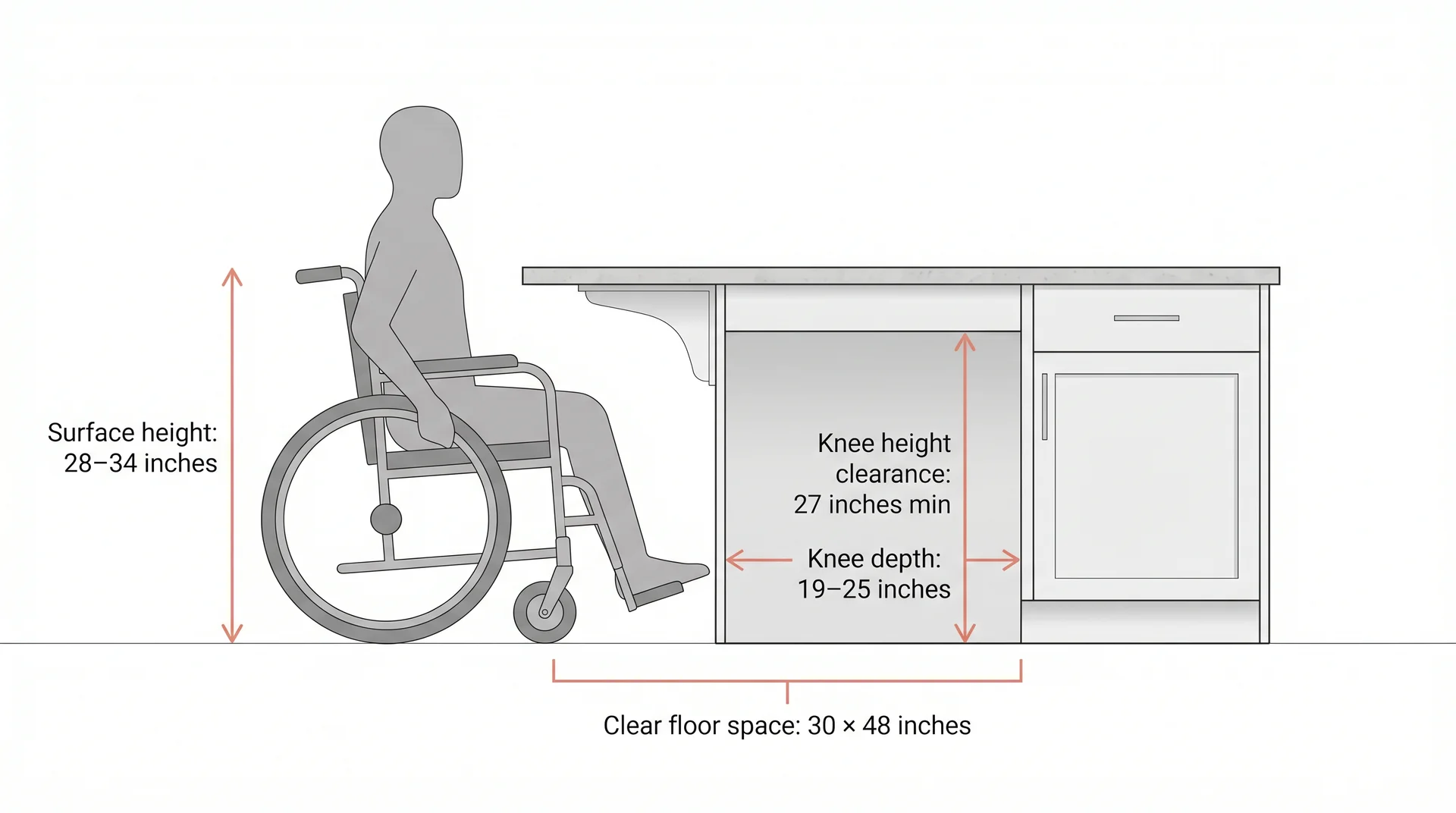
| Dimension | ADA Specification |
|---|---|
| Surface height | 28″–34″ from floor to counter |
| Knee clearance (height) | 27″ minimum |
| Knee clearance (depth) | 19″ minimum, 25″ preferred |
| Clear floor approach space | 30″ × 48″ minimum |
| Toe clearance | 9″ high, 6″ deep minimum |
A surface at 30 to 32 inches works for both wheelchair access and seated dining, which gives you genuine functional flexibility across multiple uses.
How Kitchen Island Height Changes the Look of Your Whole Space
Height isn’t only a functional decision. It shapes how your kitchen reads visually, how it flows into connected spaces, and how large or intimate it feels day to day.
A 36-inch island keeps sight lines open. In a kitchen that connects to a living or dining area, counter height lets you see across the whole space from either direction, making the room feel larger and more cohesive.
This works especially well under standard 8 or 9-foot ceilings, where a taller island would create a proportional imbalance. A 42-inch island creates a zone.
It acts as a natural room divider in open-plan layouts and gives the kitchen a defined visual boundary, which can be striking in a kitchen with 10-foot ceilings and a generous floor plan but heavy and confining in a compact space or under lower ceilings.
A rough proportion rule I use with clients: the gap between the top of your island and your ceiling should be at least twice the island’s own height. In an 8-foot ceiling kitchen, a 36-inch island leaves 60 inches above it, which feels balanced. A 42-inch island leaves 54 inches and still works, but starts to feel tighter.
Pendant lighting placement also shifts with island height. The standard guidance is to hang pendant lights 30 to 36 inches above the countertop surface. At 36 inches, that puts pendant bottoms at roughly 66 to 72 inches from the floor, comfortable clearance for most adults.
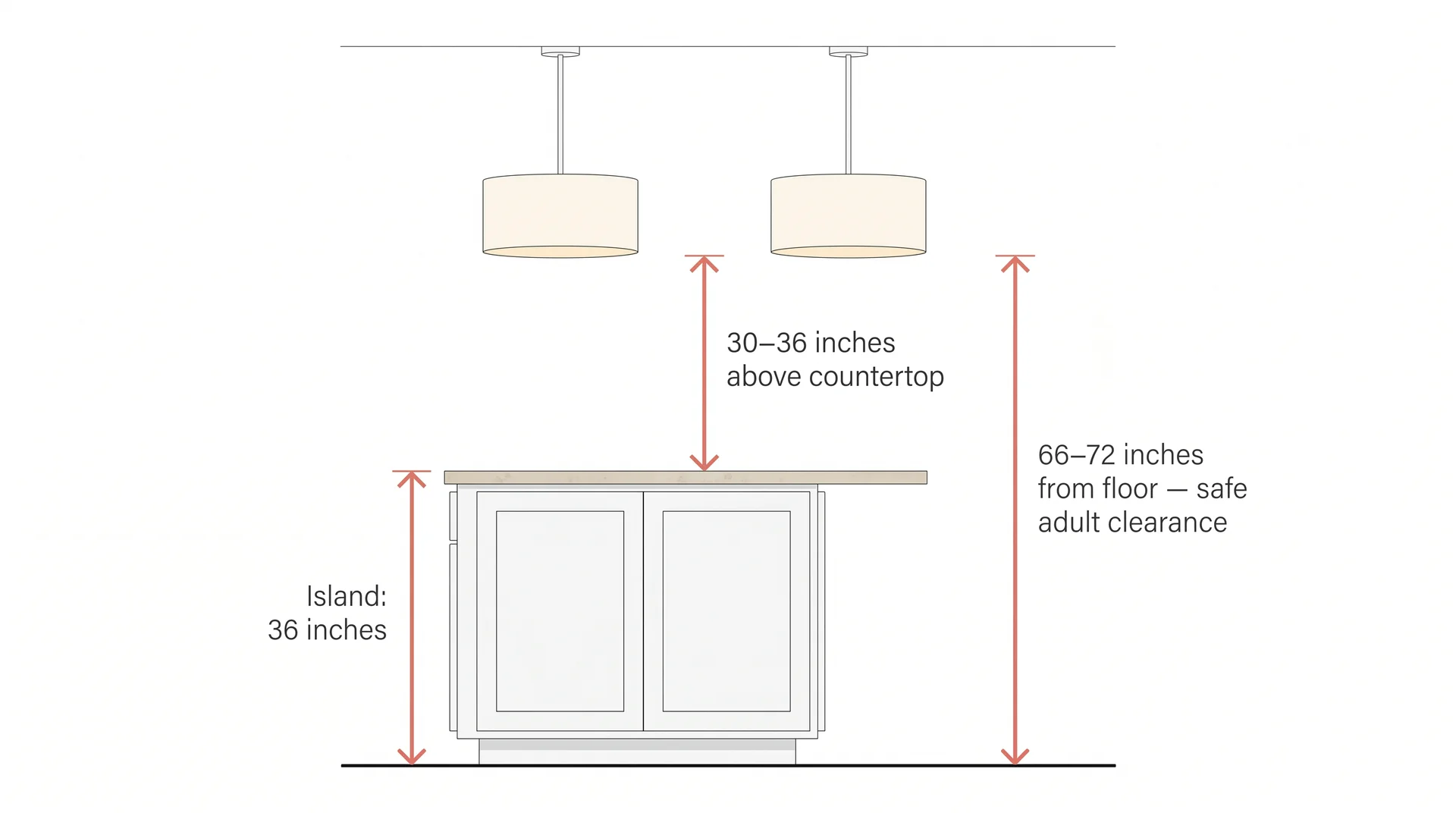
At 42 inches, the calculation changes, and lights set for a 36-inch surface will end up too close to the counter. Plan your lighting height alongside your island height, not as an afterthought.
If you’re planning other bold design choices at the same time, like a standout cabinet colour or a statement kitchen palette, it’s worth thinking through height and colour together.
The visual weight of a 42-inch island reads very differently from that of a 36-inch island, and both interact with colour in distinct ways. Our guide to red kitchen ideas walks through how bold colour choices interact with layout and proportion, which is a useful companion read if you’re designing from scratch.
Edwina’s 5-Question Decision Framework
After years of working through this with clients, five questions consistently surface the right answer. They’re not a formula. They’re a way of making sure you’re designing for your actual household instead of an imagined one.
- Who is the primary cook, and what is their elbow height at 90 degrees? Measure this. Your prep surface should sit two to three inches below that point.
- Is this island primarily for cooking, eating, socialising, or a genuine mix of all three? If cooking dominates, prioritise prep ergonomics. If eating and socialising dominate, prioritise seating comfort. If it’s genuinely mixed, a single-level 36-inch island with a proper overhang usually serves all three better than a two-tier design.
- How long do people typically sit at this island? Quick breakfasts and snacks? Backless stools at either height work fine. Extended meals, homework sessions, long conversations? Backed stools at counter height with a generous overhang.
- Does your kitchen open into a living area, and do sight lines matter to you? If yes, a 36-inch island keeps the space feeling open and connected. If defining the kitchen as a separate zone matters, a 42-inch island provides a natural visual boundary.
- What is your countertop material, and how thick is the slab? A 2-inch stone slab adds nearly an inch and a half more to your finished height than a standard laminate. If you’re targeting a specific ergonomic height, choose your countertop in coordination with your cabinet height, not after.
Once you’ve answered these, the right number usually becomes clear, not because there’s a formula, but because you’ve stopped designing for a generic kitchen and started designing for yours.
Frequently Asked Questions
Should a Kitchen Island Be the Same Height as the Countertops?
It doesn’t have to be, but matching heights creates a seamless, continuous workflow surface that most home cooks find highly functional. In most kitchens, matching at 36 inches is the practical default. Intentionally different heights are worth considering when the island serves a distinct purpose, like bar seating or a dining function, that genuinely benefits from a different surface level.
Is 40 Inches Too High for a Kitchen Island?
It’s unconventional rather than wrong. At 40 inches, you’re above standard counter height and below standard bar height, which means standard stools won’t pair cleanly with the surface. It can work as a custom ergonomic choice for a significantly taller primary cook, but it requires carefully selected adjustable seating. For most households, 38 to 39 inches is a more practical upper range for counter-height use, and 42 inches is the cleaner choice if bar seating is the goal.
What Stool Height Do I Need for a 36-Inch Island?
A stool with a seat height of 24 to 26 inches. This creates a 10 to 12-inch leg clearance gap between the seat and the underside of the countertop. Prioritise a backrest for any seating that lasts more than a quick meal.
Can a Kitchen Island Have Two Different Heights?
Yes, and it can work well when both tiers are genuinely used. A lower prep section at 36 inches combined with a raised seating section at 42 inches creates distinct functional zones. The caution: this design looks busy in compact kitchens and can feel dated in contemporary interiors if not executed thoughtfully. Plan the material and colour relationship between the two tiers carefully so it reads as intentional.
What Is the Minimum Overhang for Kitchen Island Seating?
15 inches is the functional minimum for counter-height seating. Twelve inches works at a push but starts to feel cramped. 18 inches is comfortable and generous. If you’re designing from scratch and seating is a priority, plan for 15 to 18 inches.
What Is the Standard Kitchen Island Height for Wheelchair Users?
Between 28 and 34 inches, with 30 to 32 inches being the practical sweet spot for most users. You also need 27 inches of knee clearance below the surface and a clear floor approach space of at least 30 by 48 inches. Consult an accessibility specialist or certified aging-in-place professional alongside your contractor if you’re designing for current or anticipated mobility needs.
Does Island Height Affect Resale Value?
A non-standard height doesn’t hurt resale value, provided the kitchen reads well overall. What affects value more meaningfully is whether the kitchen feels well-considered and comfortable to be in. A 38-inch island that’s clearly designed for a purpose reads better to prospective buyers than a standard 36-inch island that’s obviously too low for the space.
What Clearance Do I Need Around My Kitchen Island?
The NKBA recommends at least 42 inches on all working sides for a single-cook kitchen, and 48 inches for households with multiple cooks. If you have seating on one side and traffic passes behind seated guests, plan for 44 to 48 inches behind them. An island that’s perfectly sized for height and seating can still make a kitchen feel unusable if clearances aren’t right.