
You’re mid-remodel, your contractor just asked what door size you want, and you have no idea. Or you’ve spent years turning slightly sideways every time you walk into your bathroom, and you’ve finally decided to do something about it. Either way, you want a number first.
| The standard bathroom door size in the US is 80 inches tall and 30 to 32 inches wide. If you’re remodeling or replacing, the smarter target today is 32 to 34 inches wide, which aligns with what the National Kitchen and Bath Association recommends for comfortable everyday use. |
Here’s what most renovation guides skip: you can spend thousands on tile and fixtures and still have a bathroom that feels wrong, and nine times out of ten, the door is telling you something.
A door that’s even two inches too narrow creates friction you feel every morning, even when you can’t quite name it. The entry sets the tone for how any room reads, and bathrooms are no exception.
I’ve worked in residential design for over a decade, first as a design consultant for a regional furniture retailer and later as an independent interior styling advisor. Bathroom door sizing comes up in nearly every remodel conversation I have, and it almost always surprises people how much it matters.
This guide covers every scenario, from reading your rough opening to knowing when to go wider than standard.
Standard Bathroom Door Sizes at a Glance
Standard Bathroom Door Width
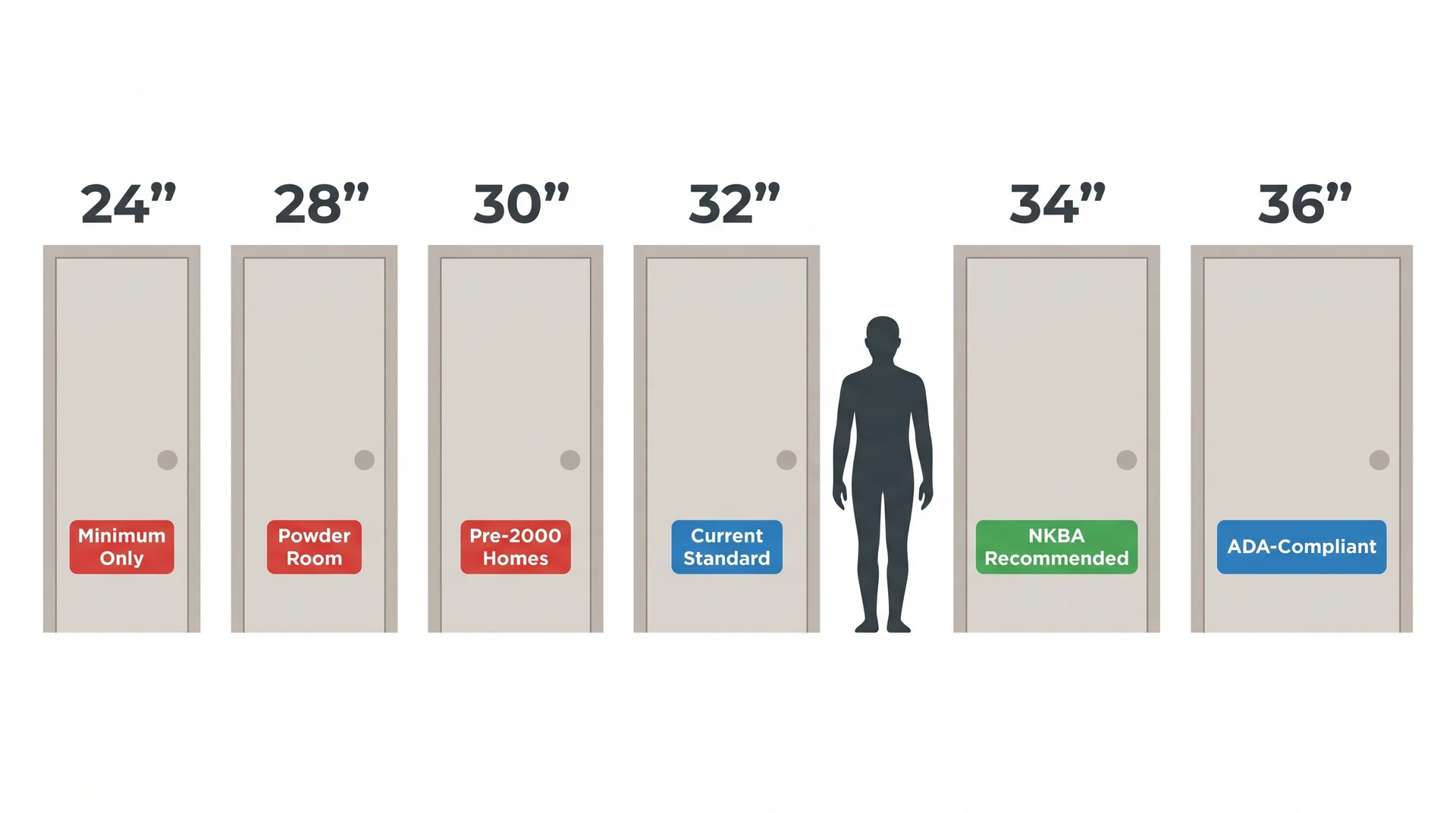
Width is the dimension that varies most and causes the most confusion when buying or ordering. Here’s how the full range maps out in real-world use:
| Door Width | Approximate Clear Opening | Where It’s Typically Used |
|---|---|---|
| 24 inches | ~22 inches | Absolute minimum; very constrained spaces only |
| 28 inches | ~26 inches | Powder rooms, small secondary baths, and older homes |
| 30 inches | ~28 inches | Most common in homes built before 2000 |
| 32 inches | ~30 inches | Current standard in newer residential construction |
| 34 inches | ~32 inches | NKBA recommended minimum; accessibility-ready |
| 36 inches | ~34 inches | ADA-compliant; best for wheelchair access |
The “clear opening” column matters more than the slab width number, and the gap between them is where most purchasing mistakes happen. The next section explains why.
Standard Bathroom Door Height
Standard interior doors in the US are 80 inches tall, which is 6 feet 8 inches. This fits the vast majority of homes and lines up with standard pre-hung door units at any home improvement store. For most bathrooms, 80 inches is where you’ll stay, and nothing is lacking about that.
If your ceilings run 9 feet or higher, an 84-inch or 96-inch door becomes worth considering. In a primary bathroom, especially, that extra height reads as an intentional design choice rather than a default, and it gives the room a more generous, considered feel. Worth thinking about if you’re already mid-remodel and the framing allows it.
Standard Bathroom Door Thickness
Interior bathroom doors are typically 1 and 3/8 inches thick. Some solid-core doors run to 1 and 3/4 inches. Thickness matters in bathrooms specifically because a solid-core door handles humidity and steam better than a hollow-core version, and gives you meaningfully better sound privacy.
If you’re choosing between hollow and solid core at the same time you’re choosing a size, solid is almost always worth the extra cost in a bathroom environment.
Door Width vs. Clear Opening: The Most Common Bathroom Door Buying Mistake
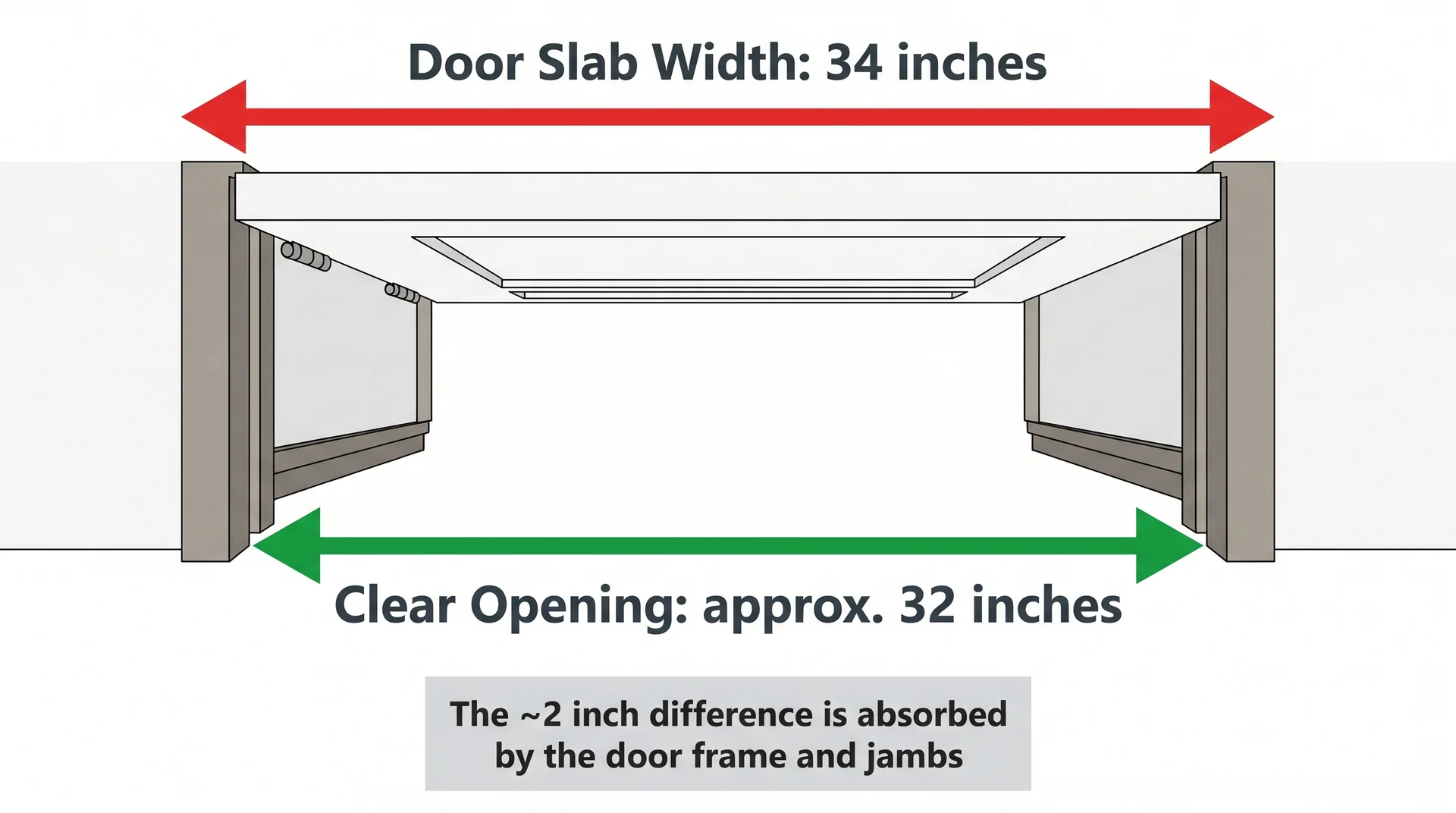
When a door is listed as 32 inches, that’s the door slab width. The actual usable opening, once the door is installed and standing fully open at 90 degrees, is roughly 2 inches smaller, because the frame, jambs, and hinges take up that space.
So a 32-inch slab gives you approximately a 30-inch clear opening. A 34-inch slab gives you approximately a 32-inch clear opening.
This matters because the NKBA’s recommendation of a 32-inch clear opening requires a 34-inch door slab. If you buy a 32-inch door expecting a 32-inch opening, you’ll fall short. That 2-inch gap is also the difference between a laundry basket fitting through cleanly or having to tilt it sideways, and between a stroller rolling through without negotiating.
- Want a 32-inch clear opening for everyday comfort? Buy a 34-inch slab.
- Want a 34-inch clear opening for wheelchair access? Buy a 36-inch slab.
- Replacing an existing door in an existing frame? Measure the old slab, not the opening.
Which Bathroom Door Size Do You Actually Need?
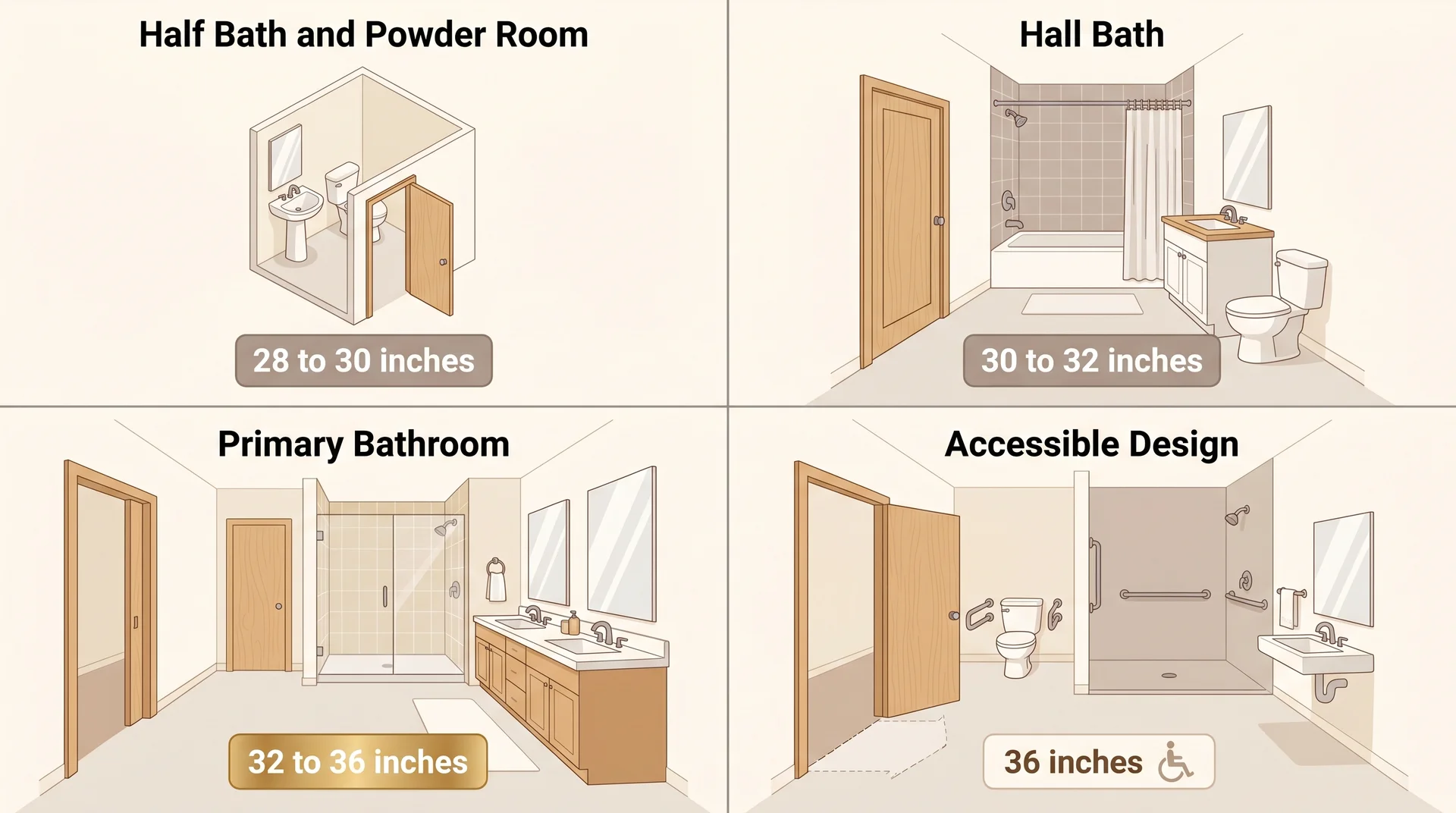
The right size isn’t the same for every bathroom in your home. Treating all interior bathroom doors identically is one of the more common oversights in residential planning, and an easy one to fix at the right stage.
Half Bath and Powder Room
A powder room is a guest space, used briefly and occasionally. That flexibility matters when framing is tight. A 24-inch door works in a powder room with genuinely constrained framing. A 28-inch door is more comfortable and more common.
That said, one of the better design moves in a powder room is going wider if the space allows it. A 30 or 32-inch door on a small, beautifully finished powder room reads as intentional and generous. If you’re designing from scratch and the framing permits it, don’t default to the minimum.
Hall Bath and Shared Bathroom
This is the everyday bathroom in most homes, and the door here affects the quality of life daily. A 28-inch door is workable in older homes where widening means moving walls. If you’re remodeling a shared hall bathroom, 32 inches is the smarter investment. It’s more comfortable across a wider range of body types and mobility levels, and it reads as more current to a future buyer if resale is on your mind.
Primary Bathroom
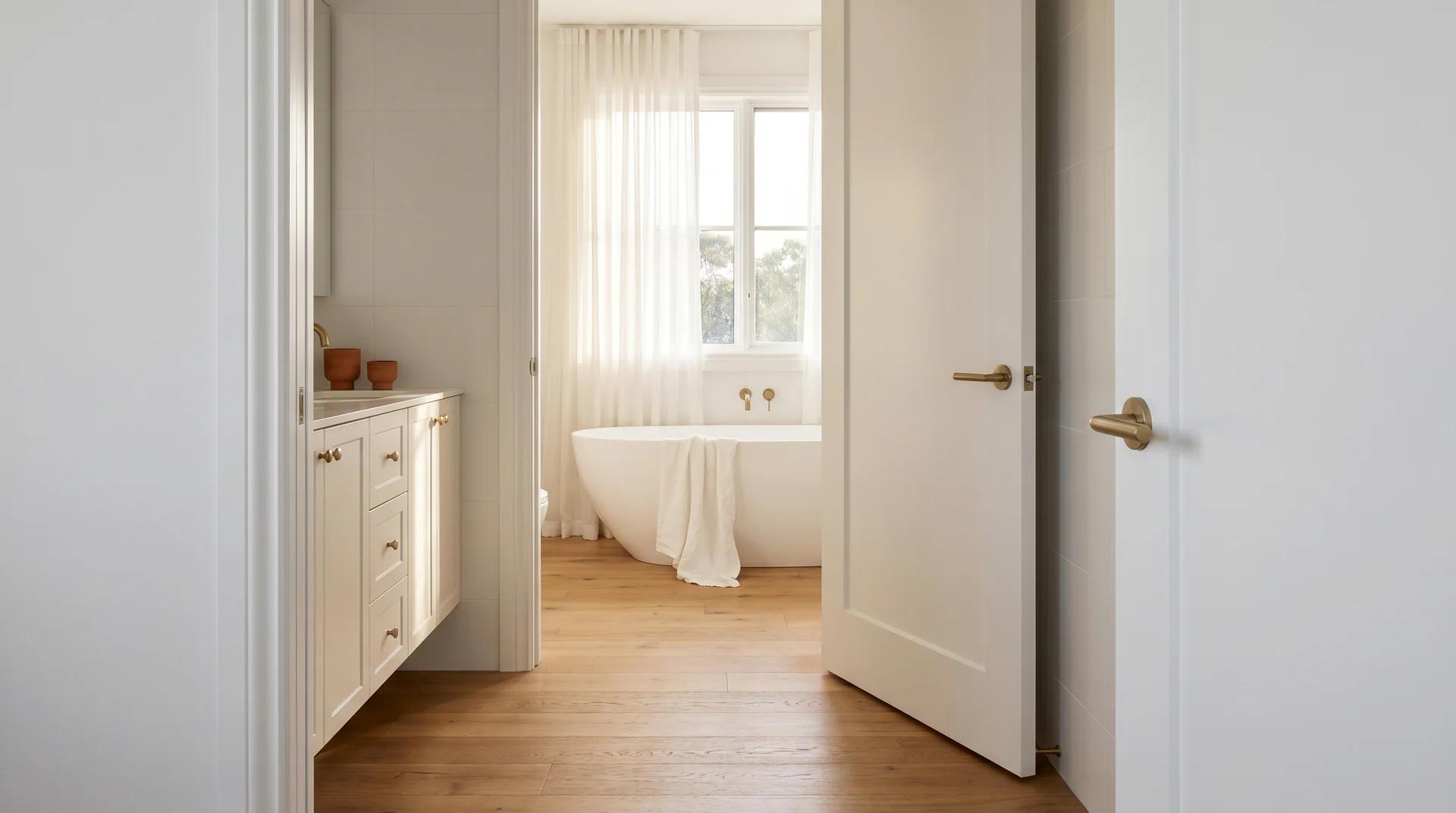
A 32-inch slab is the minimum worth considering for a primary bathroom, with 34 to 36 inches being better if your layout supports it. A wider door on a primary bathroom changes how the room reads from the outside. The proportionality matters, and you’ll feel it every single day. Sizing up costs relatively little at the remodel stage and adds meaningfully to the daily experience of your home.
Accessible Design and Aging-in-Place
If you’re designing with mobility in mind, or someone in your household uses a wheelchair or walker, the target is 36 inches wide. That delivers approximately a 34-inch clear opening, which is enough for a standard wheelchair to pass through comfortably.
This choice is also increasingly a resale strategy. Buyers thinking about aging family members or their own long-term needs treat accessibility features as genuine value additions. A 36-inch door on a main-floor bathroom is a detail that matters to a growing segment of the buyer pool, and it costs far less to build in now than to retrofit later.
Is Your Existing Bathroom Door Too Narrow?
Signs Your Bathroom Door Size Is a Problem
Some signs are obvious: you turn sideways without thinking, the door clips the toilet, and you’ve learned to open it at a specific angle, or guests come back from the bathroom slightly quieter than when they went in. Others are subtler.
Getting a laundry basket through requires a full choreography. The bathroom feels smaller from the hallway than it actually is. You’ve mentally adjusted to a door that limits your experience of the space without ever consciously deciding to accept it. That last one is worth noticing.
When to Widen vs. When to Work Around It
Widening a bathroom doorway means removing framing, potentially relocating a light switch, touching drywall on both sides, and adjusting trim for consistency. That’s not a reason to avoid it, but it is a reason to be clear-eyed about the scope before committing.
If the doorway sits on an exterior wall, widening is significantly more complex and usually not worth it for a bathroom. On an interior partition wall with no plumbing or structural elements in the way, the project is more manageable.
A good contractor can assess this in about 15 minutes. If structural widening doesn’t make sense for your space or budget, changing the door style is often the better solution.
A pocket door can convert a 28-inch hinged opening into a much more functional entry by eliminating the swing radius, which can feel like gaining several square feet without touching a single structural element.
Building Codes and ADA Standards for Bathroom Door Size
Building codes vary by jurisdiction and are updated over time. The information below reflects widely adopted guidelines and professional best practices in the US. Always check with your local building department and consult a licensed contractor before making structural changes to your home.
What the IRC Actually Says
The International Residential Code, which most US jurisdictions adopt and enforce, does not specify a minimum width for interior bathroom doors in private residential construction. That surprises most homeowners. The IRC addresses egress, ceiling heights, and safety, but leaves bathroom door width to local interpretation.
In practice, local codes vary. Some jurisdictions, including parts of California, have adopted stricter standards requiring 32-inch clear openings for all interior doors in new construction. Always check your local building department’s requirements before you begin.
ADA Guidelines and What They Mean for Your Home
ADA requirements are legally mandated for public and commercial spaces, not private residences (with some exceptions for multifamily housing). In residential design, though, ADA dimensions are widely used as a best-practice benchmark because they’re well-researched and genuinely functional.
The key ADA standard for bathroom doors is a 32-inch clear opening when the door stands fully open at 90 degrees.
The door should require no more than five pounds of force to open, the threshold should be no higher than half an inch, and lever-style hardware is preferred over round knobs for easier use with limited hand strength or dexterity.
NKBA Best Practices
The National Kitchen and Bath Association recommends a minimum 32-inch clear opening for bathroom doors, which requires a 34-inch door slab. This is the standard worth following for any new remodel or replacement project.
The NKBA also specifies that the door swing shouldn’t interfere with the toilet, shower door, or any fixture when fully open. It’s a detail that many bathroom layouts quietly fail, and it’s worth mapping out on paper before finalizing anything.
I’ve walked through beautifully finished bathrooms where the door clipped the toilet paper holder on every single entry, which erased a lot of what the renovation achieved.
How to Measure Your Bathroom Door Correctly
Measuring the Rough Opening
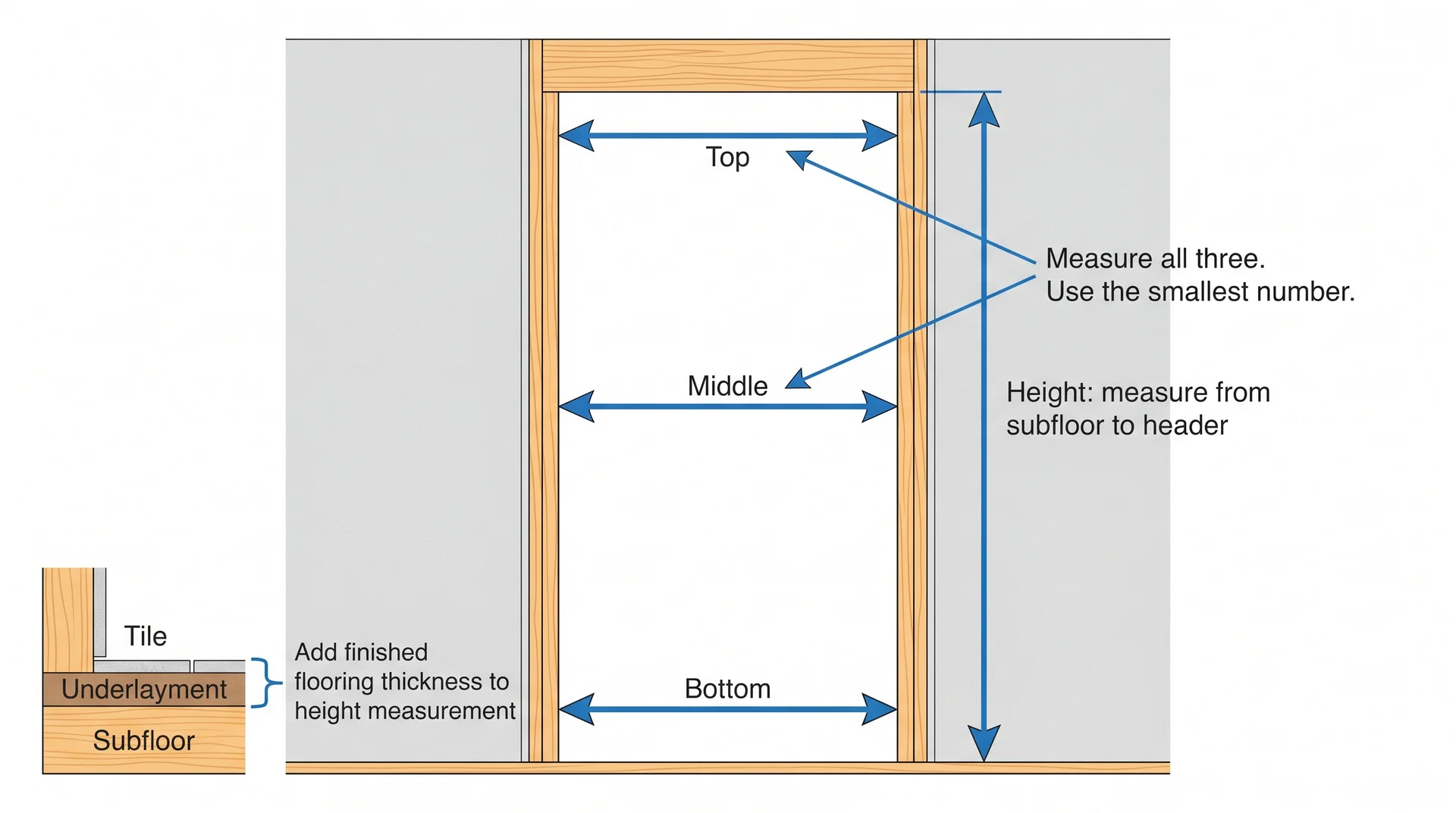
The rough opening is the framed hole in the wall before the door jamb is installed. It’s always larger than the door slab, and it’s the measurement your contractor or supplier needs.
- Measure the width at the top, middle, and bottom of the opening. Use the smallest number.
- Rough opening width = door slab width + 2 inches. A 32-inch door needs a 34-inch rough opening.
- Measure the height from the subfloor, not the finished floor, to the underside of the header.
- Add your finished flooring thickness to that number. If 3/4-inch hardwood is going in, account for it before buying.
- Standard rough opening height for an 80-inch door is 82 to 82.5 inches.
Slab vs. Pre-Hung Bathroom Doors
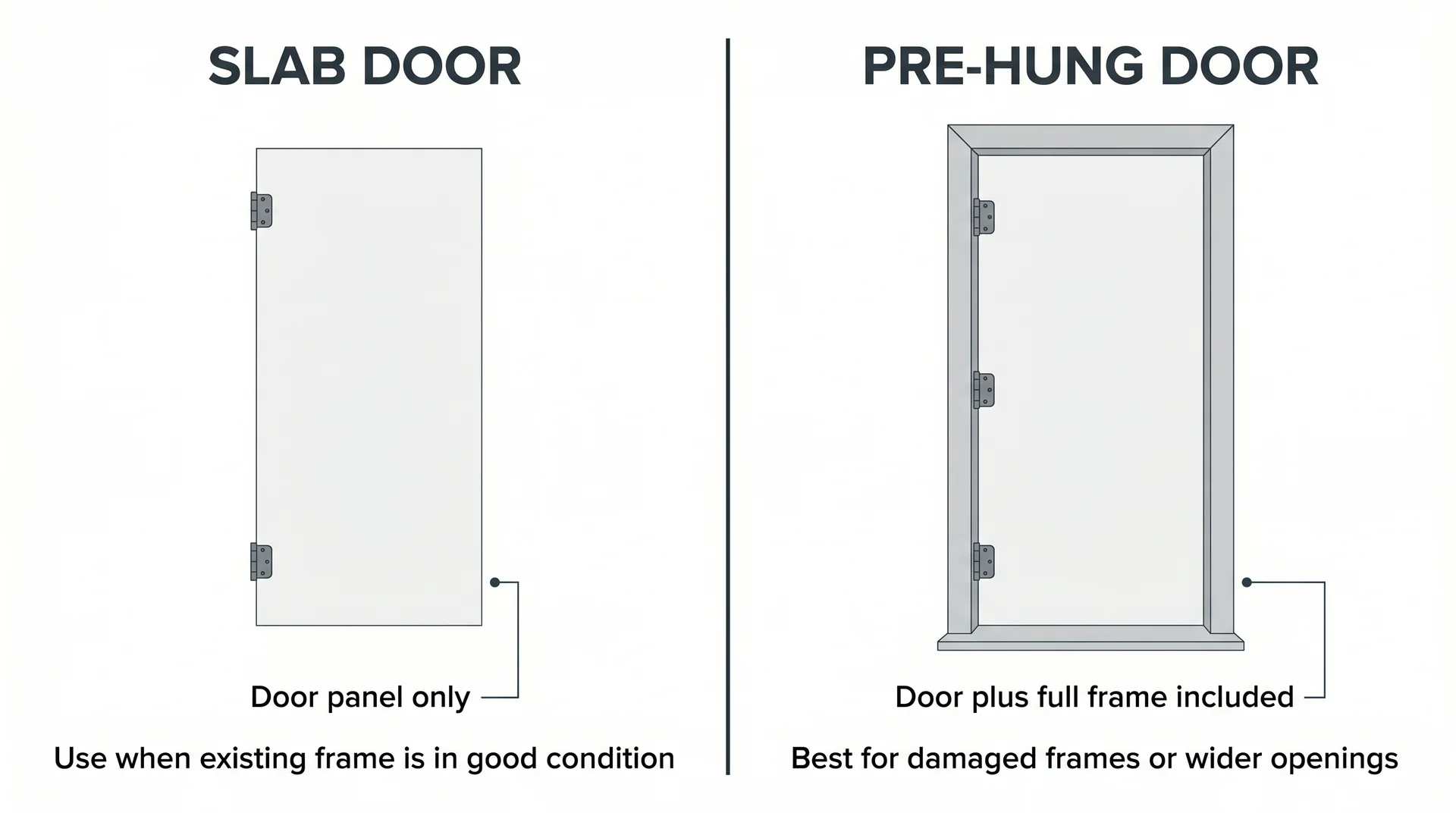
When you buy a replacement bathroom door, you’ll face this choice. A slab door is just the door itself, with no frame or hardware. It’s the right buy when your existing frame is in good condition, and you’re replacing like-for-like.
A pre-hung door comes already mounted inside its frame with hinges attached. It requires a larger rough opening because the whole frame fits inside, but it’s considerably easier to install, especially if your existing frame is damaged or you’re widening the opening.
If you’re replacing a bathroom door in an older home and the frame looks worn, warped, or moisture-damaged, a pre-hung unit is worth the extra cost. You’re fixing the underlying problem at the same time.
What to Do With a Non-Standard Opening
Older homes, particularly those built before 1960, often have openings that don’t correspond to standard slab sizes. A 27-inch opening, for example, doesn’t align with any standard door width.
Your options: trim a solid wood or solid-core door (up to about 3/4 inch total on the sides), order a custom slab to exact dimensions, reframe the opening to accept a standard size, or switch to a pocket or sliding configuration that works within the existing framing without structural changes.
Common Measuring Mistakes
Measuring in only one place. Walls are rarely perfectly plumb. Measure at least three points across the width and use the smallest.
Forgetting finished flooring. If tile or hardwood hasn’t gone in yet, that thickness affects how the door clears the floor on installation.
Confusing slab size with rough opening size. They’re never the same. Rough openings are always larger by roughly 2 inches in width.
Ignoring jamb depth. Wall thickness determines the jamb width you need. Standard 2×4 walls with drywall require a 4-9/16-inch jamb. Thicker walls need a 6-9/16-inch jamb. Getting this wrong means a frame that doesn’t sit flush with your finished wall surface.
Choosing the Right Bathroom Door Style for Your Space
Hinged Doors
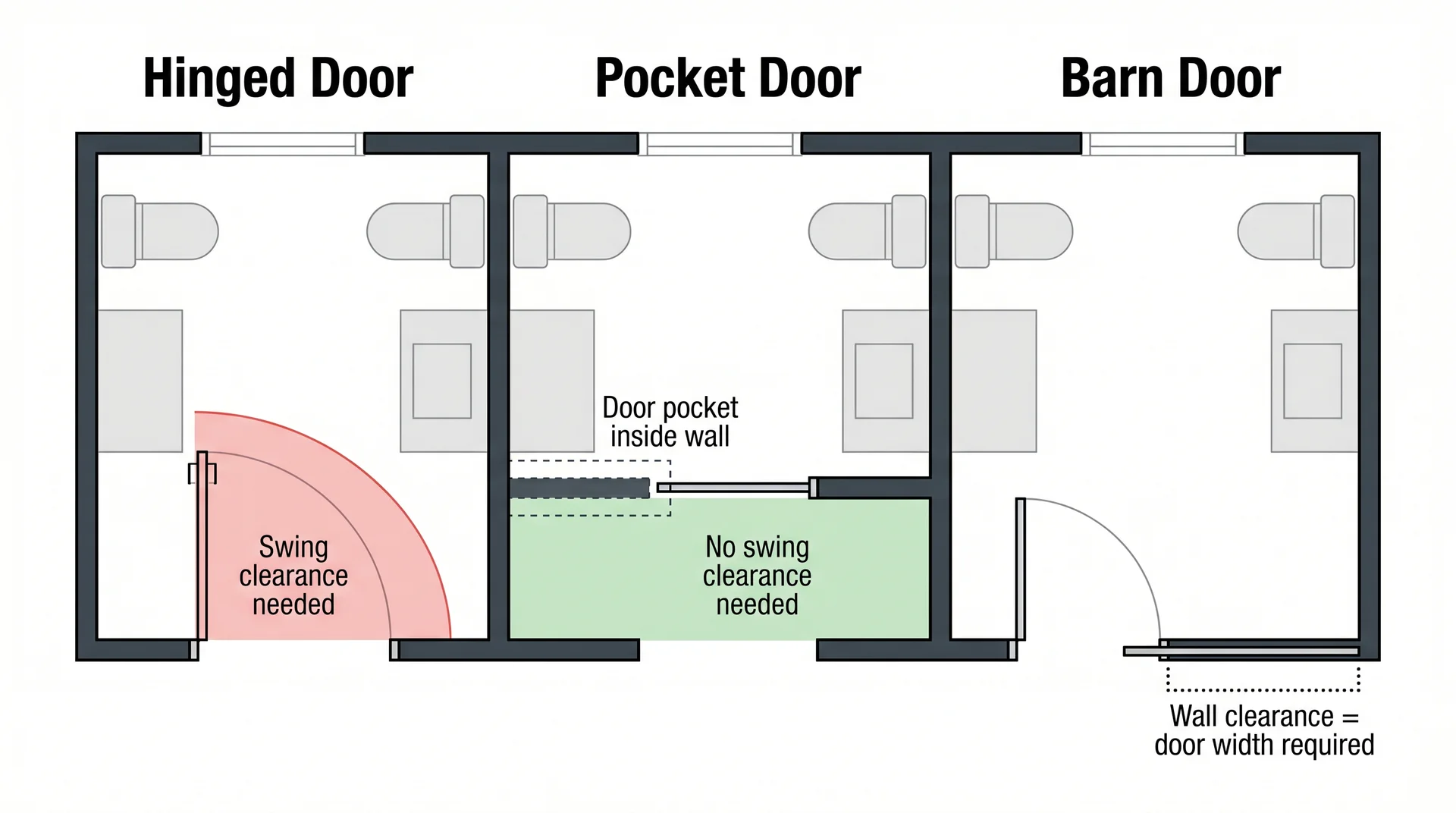
A standard hinged door is the default for good reasons: easy to install, widely available, and functional in most layouts. It requires clear floor space equal to the door width in its swing arc, though, and in tight bathrooms, that’s often where the conflict lives.
Before assuming you need to widen the frame, check whether reversing the swing direction solves the problem. Rehinging on the opposite side, or switching from an inward to an outward swing, often resolves the issue without touching the framing.
The same principle of getting dimensions right so that daily use works properly applies to other fixed elements in your home, as we cover in our guide to reach-in closet dimensions.
Pocket Doors
A pocket door slides into a wall cavity when open, requiring zero swing clearance on either side. For a tight bathroom footprint, the difference is real and immediate. The trade-offs are equally real: the wall cavity must be free of plumbing, wiring, and structural elements.
Hardware is more complex and needs more maintenance over time. Sound privacy is somewhat reduced because the track creates small gaps. For a powder room or secondary bathroom, these trade-offs are often worth it. For a primary bathroom where sound privacy matters more, invest in quality track hardware if you go this route.
Barn and Sliding Doors
Barn doors photograph beautifully and genuinely work in the right context. The practical reality for most bathrooms is more complicated.
They require unobstructed wall clearance on the slide side equal to the full door width, and they don’t seal the opening the way a hinged or pocket door does, because the track keeps the door slightly away from the frame.
In a bathroom where steam and sound privacy are real considerations, that gap matters. Where they work well: powder rooms with generous adjacent wall space, and secondary bathrooms where the aesthetic is a genuine priority over acoustic privacy.
How Door Width Changes the Way a Room Feels
A narrow door makes a beautifully designed bathroom feel like a utility space.
A wider door, particularly a full-height one at 84 or 96 inches, gives the bathroom a sense of destination rather than a room you negotiate your way into. The proportional relationship between the door and the hallway it opens from matters too. A 28-inch door on a wide hallway reads as undersized and accidental.
A 34-inch door reads as deliberate. These are the kinds of spatial decisions that experienced residential designers make on purpose, and they shape how your home feels to live in every day, long after the renovation is done and forgotten.
Bathroom Door Materials and Long-Term Performance
Solid-core doors outperform hollow-core in bathroom environments. Steam, condensation, and humidity contact bathroom doors differently than bedroom doors. A hollow-core door in a bathroom will eventually warp, swell, or delaminate at the bottom, especially in smaller bathrooms where steam concentration is high. Fiberglass and solid-core composite doors handle that environment well and maintain their fit over time. If you’re going to the effort of choosing the right size, don’t let the wrong material undercut it.
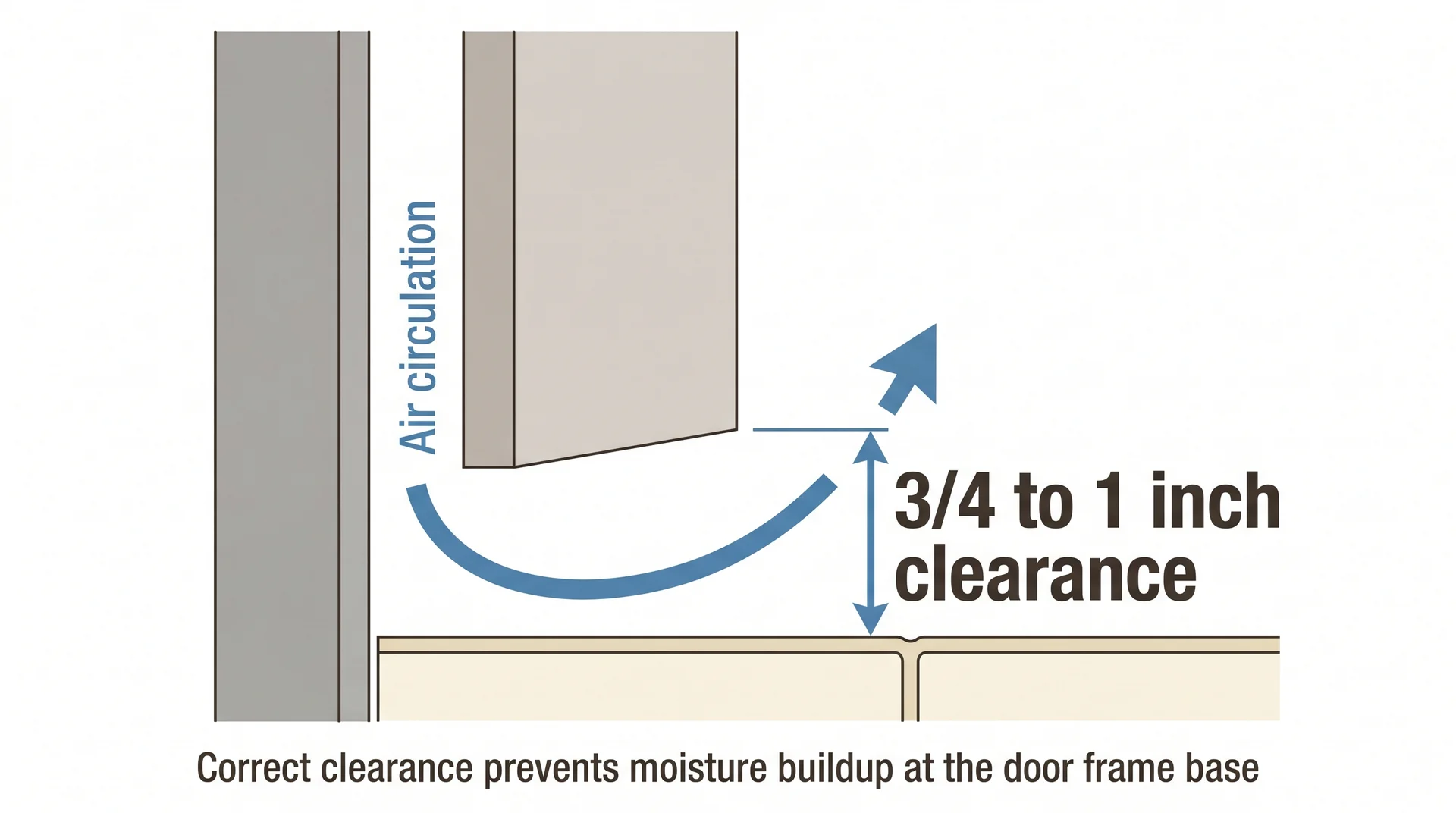
Leave at least 3/4 to 1 inch of clearance between the door bottom and the finished floor. This gap allows air to circulate under the door between uses, reducing moisture accumulation at the base of the frame and helping prevent mold along the floor perimeter.
A door sealed too tightly at the bottom is one of the quieter contributors to grout discoloration and frame rot over time. If you’re already dealing with moisture damage along the floor, our guide on how to clean grout that has turned black covers what to do next.
Match hardware to the environment. Brass, brushed nickel, and stainless steel hold up well in humid conditions. Standard zinc or painted finishes can corrode within a few years. The hardware is a small investment relative to the rest of the project, and it shows in how the door feels to use for the next decade.
Frequently Asked Questions
What is the minimum bathroom door width?
24 inches is the technical minimum for very constrained spaces. Most design professionals consider 28 inches the practical minimum for any bathroom in regular residential use. For a primary bathroom, 32 inches is the floor space worth working from.
Does a residential bathroom door have to be ADA-compliant?
ADA requirements apply to public and commercial spaces, not private residences. ADA dimensions (32-inch clear opening minimum) are widely used as a best-practice benchmark in residential design, particularly for accessible and aging-in-place projects.
Can I use a 24-inch door for a full bathroom?
You can, but it creates friction that compounds over time. A 24-inch door is better suited to a powder room with genuinely constrained framing. For a full bathroom in regular daily use, explore alternatives first, including pocket configurations that work within the same rough opening.
What size rough opening do I need for a 30-inch bathroom door?
A 30-inch door slab requires a rough opening of approximately 32 inches wide by 82 to 82.5 inches tall. Always confirm exact specifications with your specific door unit’s installation guide before framing.
Should a bathroom door swing in or out?
Most bathroom doors swing inward by default. Outward-swinging doors are used in very small bathrooms to preserve interior floor space, and they’re required in some accessible applications because an inward-swinging door can block access to a fallen person from outside the room.