

Editorial note: This article reflects the professional perspective of a licensed esthetician with clinical experience in skin barrier health and contact sensitization. It is not a substitute for advice from a board-certified dermatologist, particularly if you have a personal history of skin conditions, photosensitivity disorders, or skin cancer. |
What Baby Oil and Iodine Actually Do to Your Skin
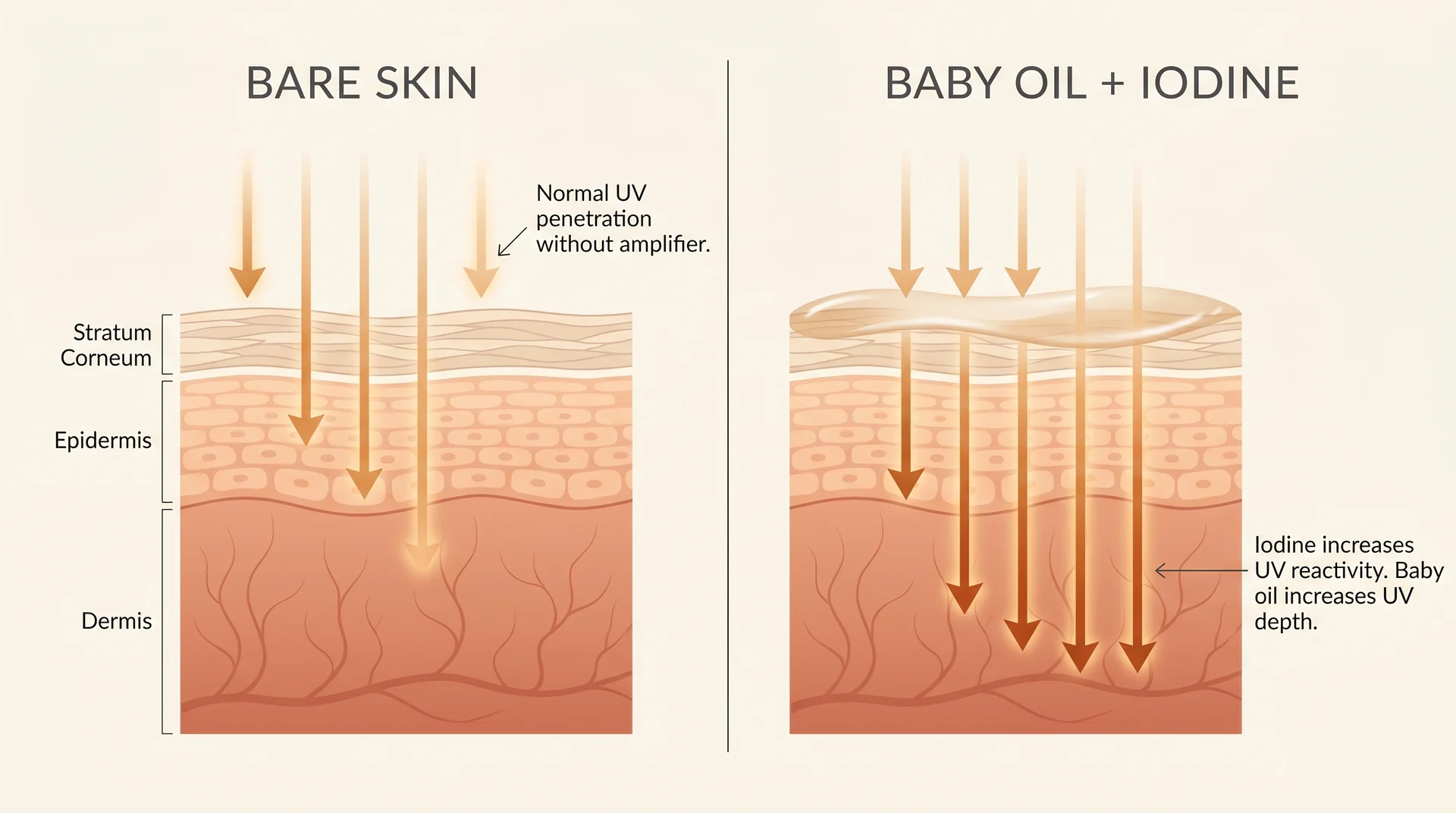
Baby oil and iodine make you tan faster because it amplifies how deeply UV radiation penetrates your skin and make your skin chemically more reactive to that UV. The speed comes entirely from escalated damage, not from improved melanin production.
Baby oil is an occlusive. It sits on the surface of your skin and creates a film that actively increases UV penetration depth, rather than simply failing to block UV the way an unprotected moisturizer would. Iodine is a photosensitizer, a substance that raises your skin’s chemical reactivity to UV light.
Together, these two don’t simply add up. They amplify each other. If you want to understand how baby oil changes your UV exposure before iodine enters the picture at all, there’s a full breakdown of how baby oil affects UV exposure on its own that covers that mechanism separately.
Iodine’s role in this mixture is almost universally misunderstood in the content currently circulating about it. Iodine is not a tanning ingredient. It doesn’t tell your melanocytes to produce more pigment.
What it does is chemically increase your skin’s sensitivity to UV radiation so your skin responds faster and more intensely to the same amount of light. The tan you get is real melanin, but it’s melanin produced as a stress response to damage your skin couldn’t adequately filter, because you deliberately made it more vulnerable to begin with.
Melanin is your skin’s emergency system. When UV hits your skin cells, melanin disperses around each cell’s nucleus to protect the DNA inside from radiation damage.
Tanning is your body working hard to limit harm that’s already in motion. Baby oil and iodine don’t improve that process. They create conditions where the UV arrives faster, penetrates deeper, and triggers that emergency response sooner than it would otherwise need to.
The Original Mixture: What It Was and What It Wasn’t
The baby oil and iodine combination came from the 1960s tanning culture, before UV-induced DNA damage was measured or understood by most people outside of a research setting.
This wasn’t a folk remedy or a beauty hack someone discovered. It was a mainstream practice in an era when a deep tan was fashionable, and sunscreen was either rudimentary or considered unnecessary by anyone who wasn’t at the beach all day. People mixed their own tanning oils routinely. This combination stuck around because it worked visibly, and visible results drove adoption.
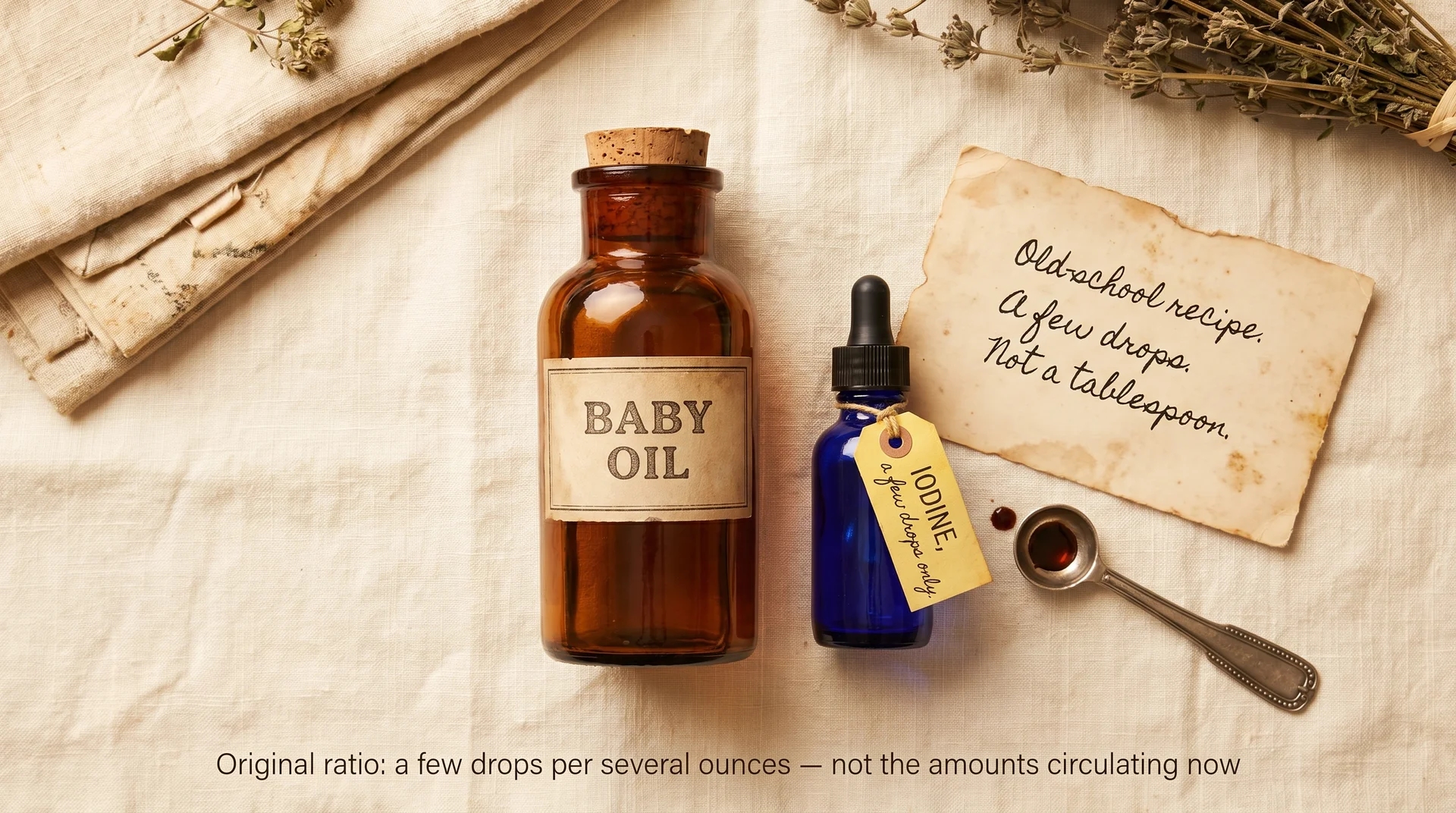
The ratio question is rarely addressed in the content, bringing this trend back, and it matters. Historically, small amounts of iodine were added to baby oil, a few drops per several ounces of oil, not anything approaching a tablespoon or a capful.
The recreations now circulating on TikTok rarely specify any ratio at all, which means users are estimating, and some are using significantly more iodine than the original formula called for.
Higher iodine concentration increases both the photosensitization effect and the risk of contact sensitization, which operates on a different timeline than the UV risk and deserves its own consideration.
“The people who developed skin cancer from that generation’s tanning habits aren’t posting on social media. The ones who didn’t are.”
The survivorship argument comes up constantly in comment sections: my grandmother used this every summer, and she’s fine. I understand why that registers as a data point.
But your grandmother’s skin accumulated UV damage across those decades, and whether it expressed as melanoma, severe photoaging, or subclinical cellular changes that never got biopsied depends on genetics, cumulative exposure, and factors that have nothing to do with whether the habit felt harmless at the time.
The Real Risk Breakdown
Baby oil and iodine create an amplified UV exposure event, and the risk plays out differently depending on your skin type, a distinction almost no article on this topic makes.
If you’ve landed on this section directly, baby oil increases how deeply UV penetrates your skin, and iodine makes your skin more chemically reactive to that UV. Together, they produce faster tanning because more damage is occurring, not because the biology is working more efficiently.
A clinical note: the information below reflects established guidance from the American Academy of Dermatology and published research on photosensitizers and contact sensitization. For individualized assessment, especially with a history of photosensitivity, PIH, or reactive skin, consult a board-certified dermatologist.
For All Skin Types
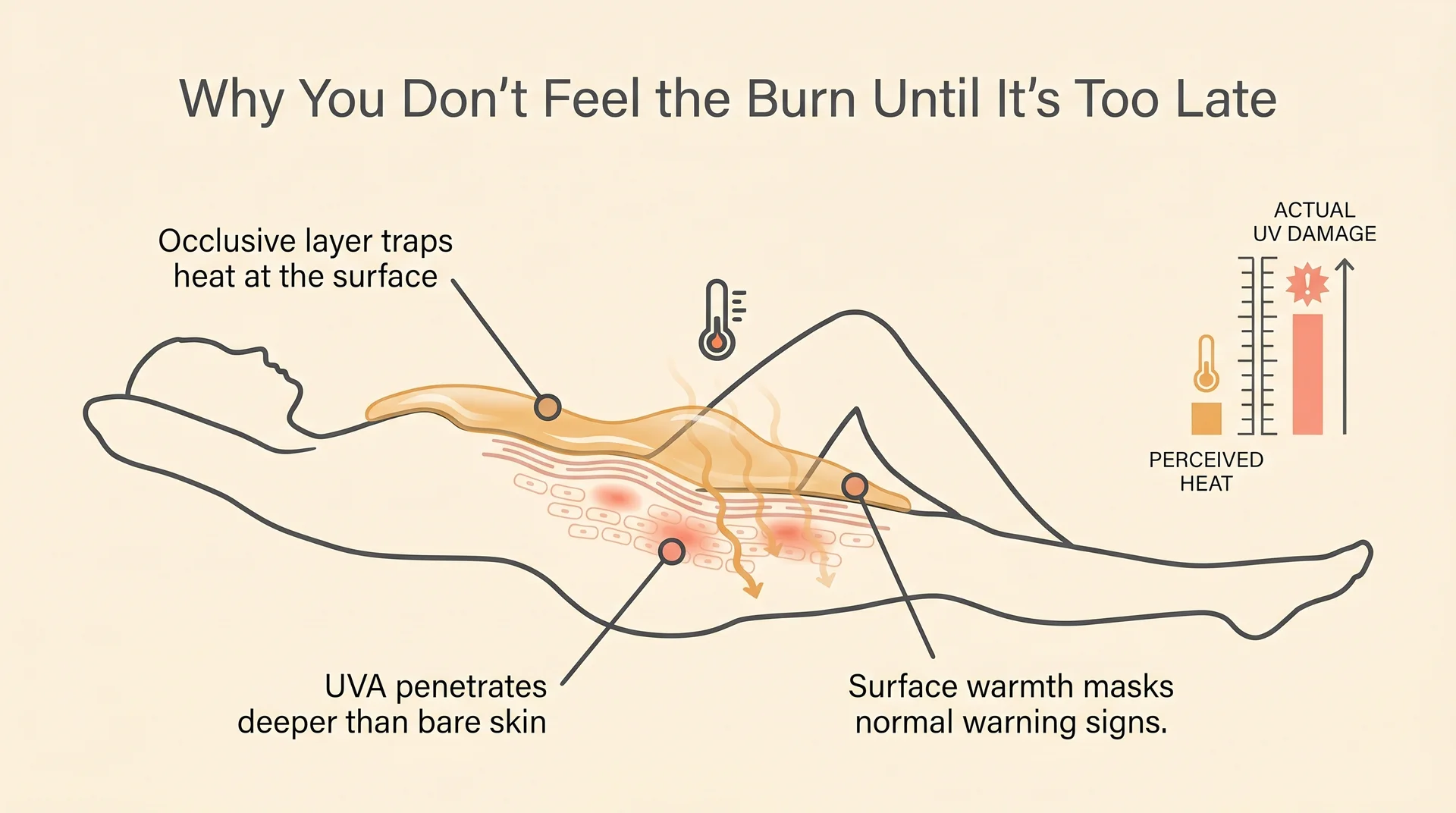
The occlusive layer of baby oil creates a barrier that retains heat at the skin surface. On a day that wouldn’t normally burn you, that trapped heat combined with increased UV penetration can push your skin past its threshold without the usual warning.
The mixture doesn’t feel dangerous the way unprotected sun exposure sometimes does. It feels like oil. The sensory feedback your skin would normally give you during a long afternoon outside is absent under that warm, slick layer, and you often don’t register what’s happened until the redness develops hours later.
According to the American Academy of Dermatology, photosensitizers applied topically during sun exposure can significantly increase the rate of UV-induced DNA damage in keratinocytes, the cells that make up the majority of your outer skin layer.
The spectrum worth thinking about here isn’t only UVB, which produces the visible burn. UVA penetrates more deeply, drives photoaging and cellular DNA damage, and does it without producing surface redness that tells you to stop.
The occlusive film from baby oil creates conditions where UVA penetrates more readily than it would on bare skin. Worth noting for anyone considering this in a tanning salon setting: the same mechanism applies at higher intensity in tanning beds, where UVA concentration is dramatically higher than outdoor sun.
For Deeper Skin Tones Specifically
This is the question that appears repeatedly in comment sections and is rarely addressed directly by published articles on this topic.
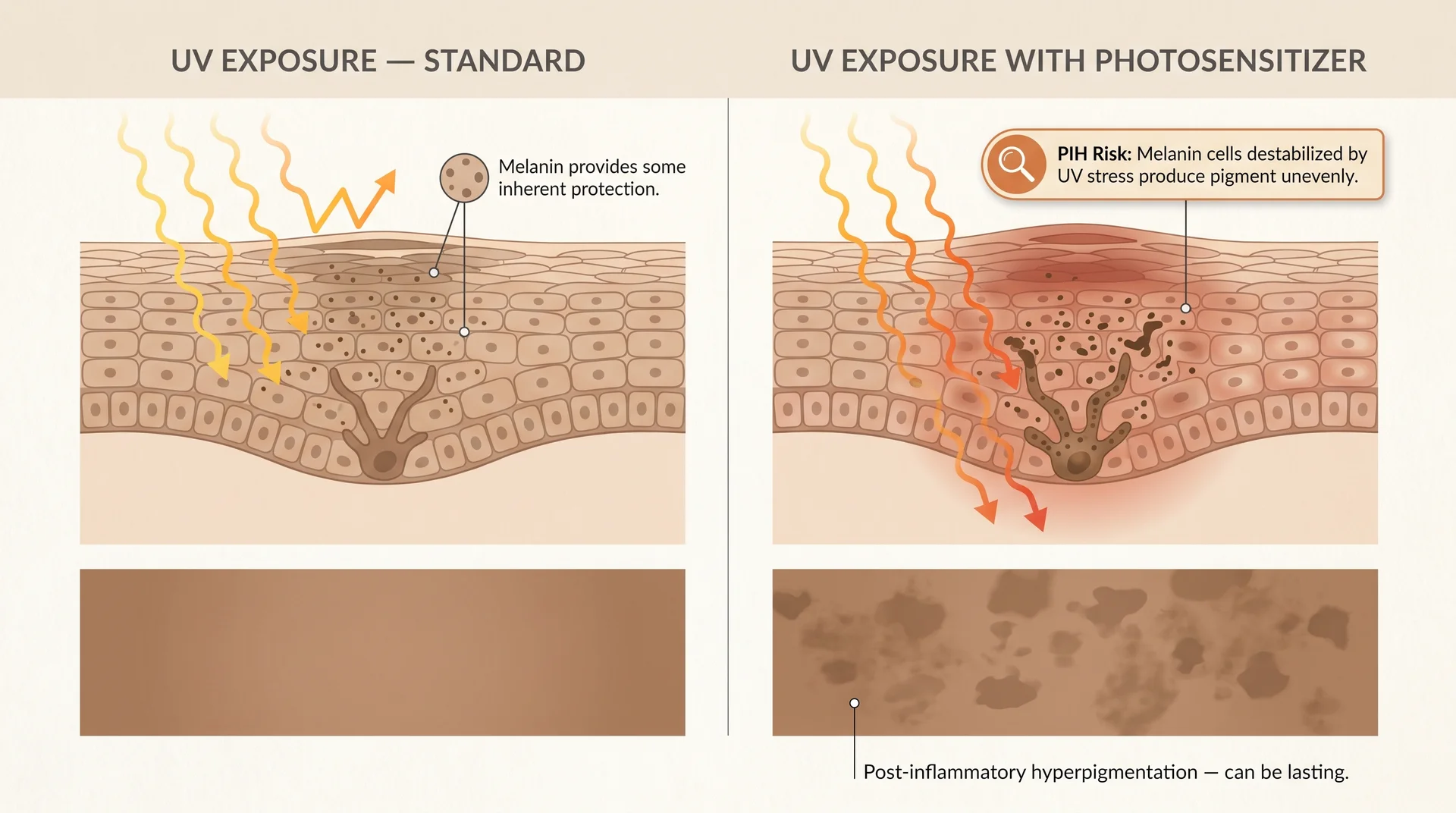
Melanin in deeper skin tones provides some inherent UV protection, but it does not neutralize a photosensitizer. Iodine increases UV reactivity regardless of your baseline melanin level. For skin of color, the more clinically significant risk isn’t the burn, though that can happen. It’s post-inflammatory hyperpigmentation.
PIH develops when melanin-producing cells, destabilized by inflammation or UV stress, produce pigment unevenly. Darker skin tones are more prone to PIH as a baseline physiological response to any skin insult.
A UV exposure event amplified by a photosensitizer and an occlusive creates exactly the kind of inflammatory stimulus that triggers it. The resulting hyperpigmentation can be lasting and is considerably harder to treat than the tan was to achieve. In my practice, clients with skin of color who have a prior history of PIH from any trigger should treat this mixture as a hard contraindication, not a risk to weigh casually.
For Acne-Prone or Sensitized Skin
Mineral oil is comedogenic for a meaningful subset of acne-prone skin types. It doesn’t cause breakouts universally, but if your skin already runs congested, a thick occlusive across your chest, shoulders, or back during extended outdoor sessions can worsen congestion in those areas. That’s the minor cosmetic concern.
The more significant issue for sensitized or compromised skin is iodine. Research published in the Contact Dermatitis journal establishes topical iodine as a documented contact sensitizer. Sensitization doesn’t typically occur on first contact. It builds with repeated exposure as your immune system registers the substance and mounts a progressively stronger response over time.
A single session with no immediate reaction doesn’t mean sensitization isn’t beginning. It means you haven’t reached the threshold yet. Once sensitization fully develops, it’s permanent. Future contact with iodine or structurally similar halogen compounds can trigger reactions indefinitely, including responses to certain antiseptics, specific medications, and contrast dyes used in medical imaging. That consequence reaches well outside your skincare routine.
For skin with an already-compromised barrier, broken or inflamed skin absorbs iodine at a higher rate. That accelerates sensitization timelines and compounds the UV vulnerability at the same time. Both processes are running faster under conditions that the user has no way of sensing in real time.
What Happens With Repeated Use
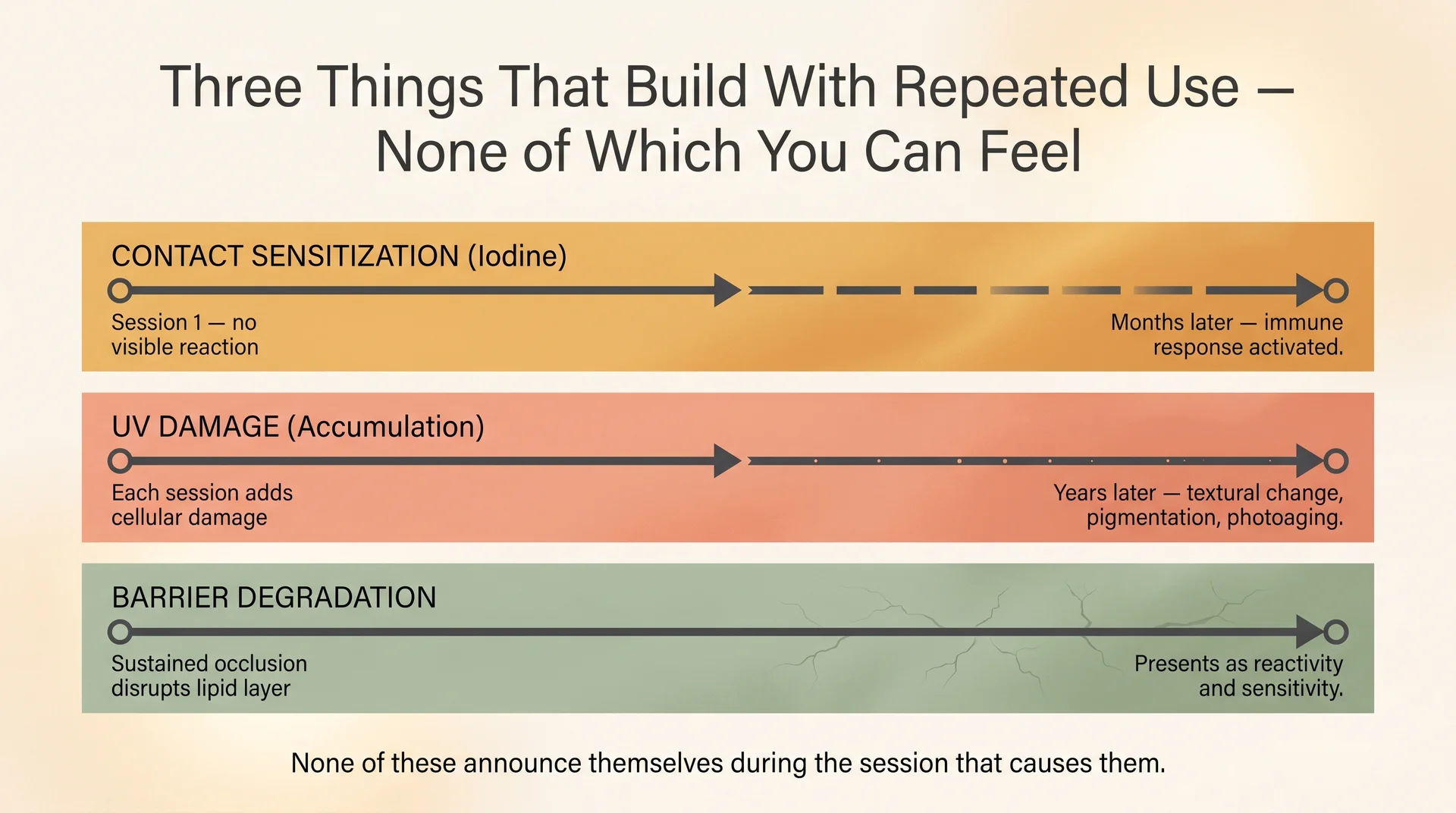
One afternoon with this mixture and a summer habit of it are not the same risk profile, and treating them as equivalent is where most of the “I was fine” reasoning falls apart.
If you’ve arrived here directly, baby oil and iodine amplify UV exposure and introduce a contact sensitizer to the skin. What changes with repeated sessions is how three separate consequences accumulate, and none of them announce themselves while they’re building.
The iodine sensitization builds silently. Research in Contact Dermatitis documents that repeated topical iodine exposure can develop a sensitization response that generalizes over time, meaning your immune system may eventually react not only to iodine but to structurally similar compounds across other categories. The gap between when sensitization starts building and when it becomes clinically visible can be months. The absence of a reaction across the first few sessions is not informative about what’s accumulating underneath.
The UV damage runs on a longer lag. The American Academy of Dermatology is consistent on this point: there is no threshold of UV-induced cellular damage below which repair is complete.
Every session where DNA damage occurs leaves some accumulation that your skin can only partially address. With a photosensitizer accelerating UV penetration across multiple sessions, that accumulation builds faster than ordinary sun exposure would produce on its own. You won’t feel it happening. When it eventually becomes visible, it arrives as textural change, uneven pigmentation, and photoaging that came faster than your genetics alone would have produced.
Barrier degradation works differently from both. Sustained occlusion under UV stress disrupts the lipid structure of the skin barrier over time, and that eventually presents as increased sensitivity, reduced moisture retention, and a skin that reacts to products it previously handled without difficulty.
I’ve seen this pattern consistently in clients who had summers of aggressive tanning habits in their twenties. By their early thirties, they’re managing reactivity and sensitivity that arrived without any apparent explanation. The explanation is time, and a habit that left no immediate trace.
If you’ve read through the risks and you’re still looking for a path to the result you actually want, the next section covers that directly.
What Actually Works Instead
There are real alternatives for every version of what you’re trying to achieve, and none of them carry the risk profile of this mixture.
| What You Want | Approach | Key Consideration |
|---|---|---|
| A real sun tan | Broad-spectrum SPF 30+ during sun exposure | Takes longer to build; cellular damage is dramatically reduced |
| A real tan, slightly faster | Tanning accelerator formulated with SPF | Look for tyrosine-based formulas; confirm SPF is included in the formula |
| Tan look without UV | DHA self-tanner | Technique matters more than which product you choose |
| Gradual, adjustable color | Bronzing drops in body moisturizer | Daily-use flexibility; buildable without a formal tanning session |
| Immediate result, no commitment | Body bronzer or tinted luminizing lotion | Washable, zero skin risk, widely underused as a category |
If You Want a Real Sun Tan
You can still tan with SPF 30 on. According to the American Academy of Dermatology, SPF 30 blocks approximately 97% of UVB rays , which means it doesn’t create a complete barrier, and your skin will produce melanin in response to the UV that gets through. It takes longer to build a tan this way. That’s worth saying plainly rather than minimizing it.
But the choice isn’t between tanning and not tanning. It’s between a tan that develops over several sessions with dramatically reduced cellular damage versus a tan that develops faster under conditions that amplify the harm underneath it.
Tanning accelerators formulated with SPF are worth considering if you want to move things along without removing your protection. Most use tyrosine, an amino acid that’s a precursor in the melanin production pathway.
The clinical evidence for tyrosine as a meaningful accelerator is modest, but these formulas aren’t photosensitizers, and the ones that include broad-spectrum SPF don’t strip your defense while you use them.
One thing worth knowing before you buy: accelerators tend to show more visible results on skin that’s already had some sun exposure. The first session or two will likely look subtler than the packaging suggests. A breakdown of tanning lotion by skin type can help narrow down which formulas make sense for your baseline.
If You Want the Look Without the UV
Self-tanner technology has genuinely improved over the last decade. The streaky, orange-fading results most people are reacting against when they look for alternatives are largely a product of older DHA formulations and application mistakes, not an inherent limitation of the category.
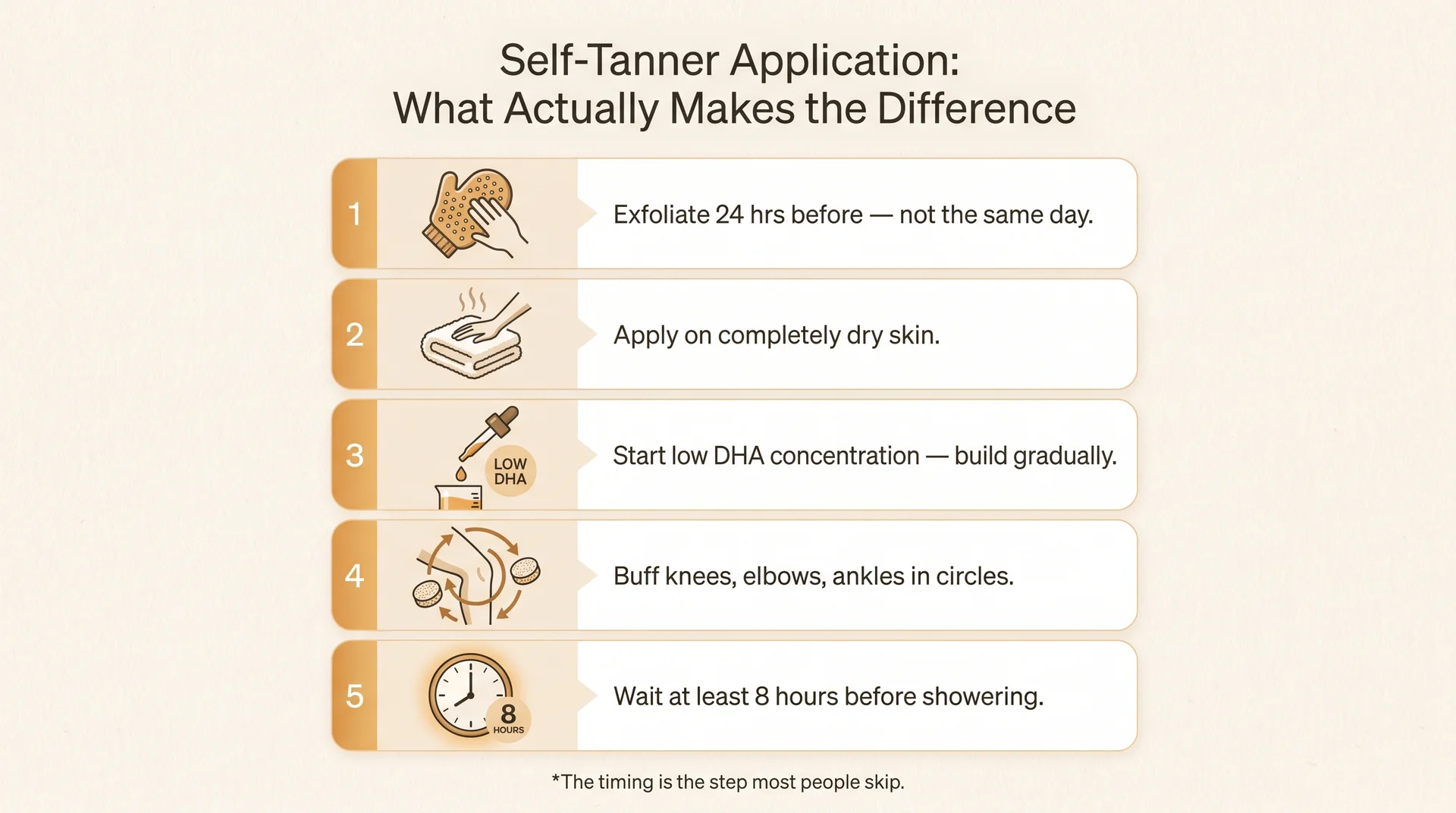
What I see go wrong most often in my practice isn’t the formula, it’s the prep and the timing. Here’s what actually makes the difference:
- Exfoliate 24 hours before, not the same day. Same-day exfoliation leaves the skin surface too uneven for consistent product absorption.
- Apply on completely dry skin. Damp skin dilutes DHA at the surface and produces uneven color development that’s difficult to predict or correct.
- Start with a lower DHA concentration for a first application if you’re fair to medium. Building gradually is more forgiving than starting too dark and waiting five days for a result you can’t undo quickly.
- Buff in circular motions over knees, elbows, and ankles. These areas are thicker and absorb more product. Without deliberate buffing, they go noticeably darker than the surrounding skin.
- Wait at least eight hours before showering. Rinsing early cuts the development window short and produces the pale, patchy result that convinces people the category doesn’t work for them. It works. The timing is the step that got skipped.
Bronzing drops added to body moisturizer are worth trying if you want flexibility without a formal self-tanner session. You control the depth by adjusting how many drops you add, and the gradual, buildable color tends to read more naturally than a single, heavier application. Knowing how to maintain color with the right aftercare makes a real difference in how evenly either option fades over time.
If You Just Want to Look Less Pale in the Short Term
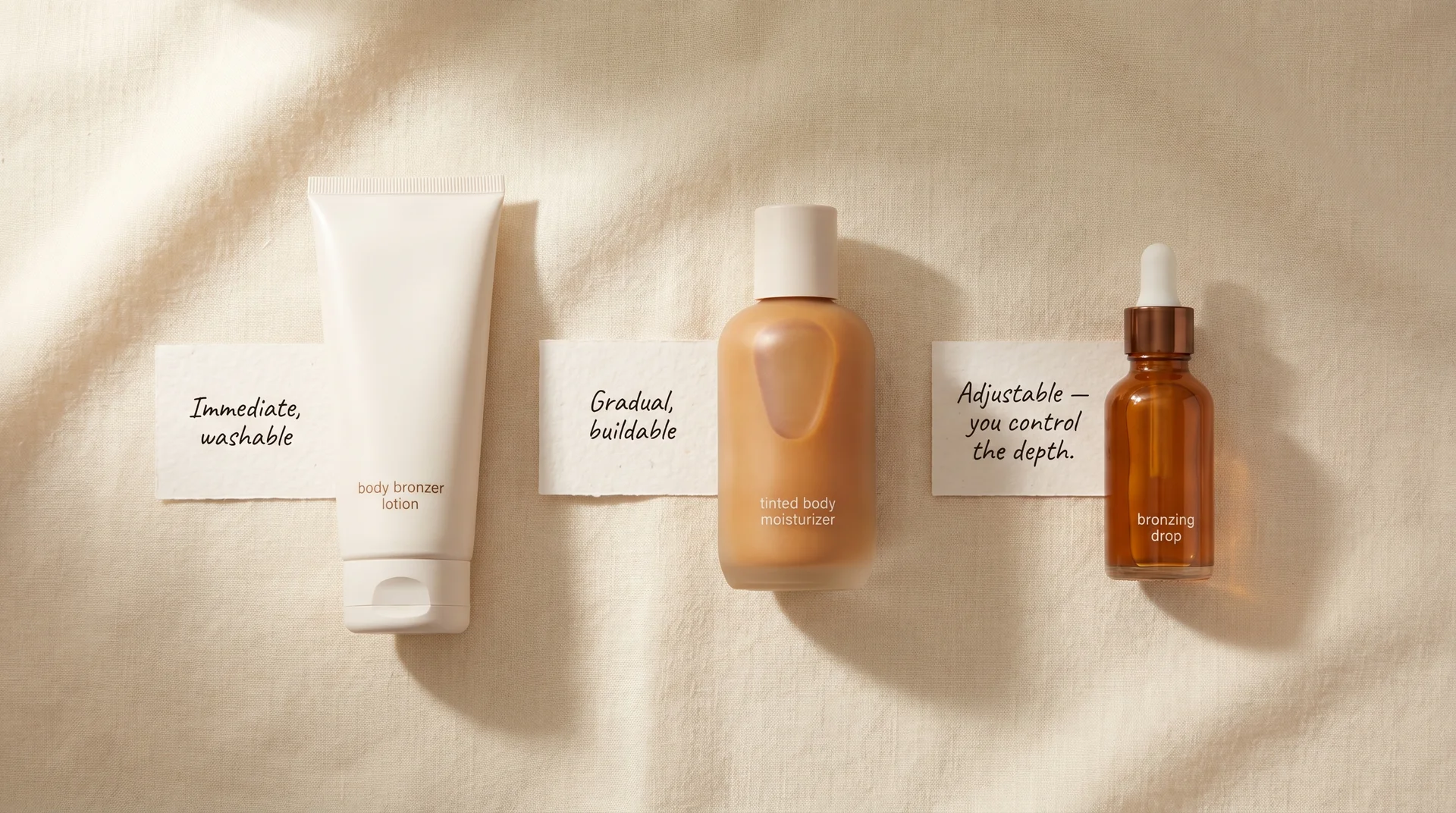
Body bronzers and tinted luminizing lotions are immediate, washable, and carry zero skin risk. The association with theatrical shimmer is mostly outdated. The current market has moved toward matte bronzing lotions and tinted body moisturizers that give a convincing color shift without sparkle, and they wash off completely.
If you’re reaching for baby oil and iodine because you want something fast, affordable, and controllable, a quality body bronzer is closer to what you’re actually after than a self-tanner session or an afternoon in the sun. Same price point. Immediate result. No development window and no skin consequences to account for afterward.
Why This Mixture Is Coming Back, and How to Think About It
The revival runs on nostalgia framing and the “natural ingredients” shorthand, and neither of those things tells you anything about what a substance does to your skin under UV exposure.
Baby oil and iodine register as simple and familiar in a way that packaged self-tanners and salon spray tans don’t. When something feels old and handmade, it reads as less chemical than something with a long ingredient label.
Mineral oil is a petrochemical derivative, and iodine is a halogen that functions as both a photosensitizer and a contact sensitizer. “Simple” and “natural” are aesthetic impressions. They don’t describe the mechanism, and the mechanism is the only thing that matters when UV is involved.
TikTok beauty content moves fast, and the feedback loop is very short. Someone uses the mixture, looks tan two days later, and posts the result. The visible outcome is immediate.
The skin damage is deferred, and deferred consequences don’t appear in a video. After more than a decade of seeing clients whose current skin problems trace back to choices that felt harmless at the time, I find the short feedback loop of social media the most structurally misleading aspect of how skincare trends spread. The harm isn’t in the post. It’s in the decade that follows it.
Two questions worth applying to any DIY skincare trend: what is the actual mechanism, and what does the risk look like with repeated use rather than a single session? If you can’t answer what an ingredient is doing to your skin and why, that’s the gap to fill before you apply it. Single-session feedback is the least reliable data point about long-term skin health.
Most of what causes lasting damage doesn’t announce itself the first time.