
Your moisturizer is on. Your serum is on. You’ve followed every step you know. And still, your skin feels tight around the cheeks, a little reactive when the weather shifts, and somehow persistently thirsty. You’re doing everything right on paper, and your skin is still telling you something is off.
In my treatment room, I call this the missing layer problem. After ten years of working with clients dealing with compromised barriers, chronic dehydration, and skin that swings between dull and reactive, I’ve learned to recognize it almost instantly. Most of the time, the fix isn’t a new serum or a stronger moisturizer. It’s a step that Korean skincare has used for decades and that most Western routines skip entirely: the Korean milky toner.
A milky toner doesn’t add a step to your routine. It makes every other step in your routine work. Your serums absorb better. Your moisturizer goes further. Your skin stops swinging between tight and reactive because it finally has what it was asking for underneath everything else. That one shift, placed correctly in a routine, is something I’ve watched change client skin more reliably than almost any targeted treatment.
A Korean milky toner is a lightweight, slightly opaque liquid applied right after cleansing and before your serums. It hydrates and, more importantly, it helps your skin hold onto that hydration by reinforcing the barrier immediately after cleansing disrupts it.
If you’ve seen it trending and wondered whether it’s actually for you, or you’ve been using one without fully understanding why it helps, this guide covers everything, including who genuinely benefits, who probably doesn’t, and how to find a formula that matches your actual skin.
What is a Korean Milky Toner?
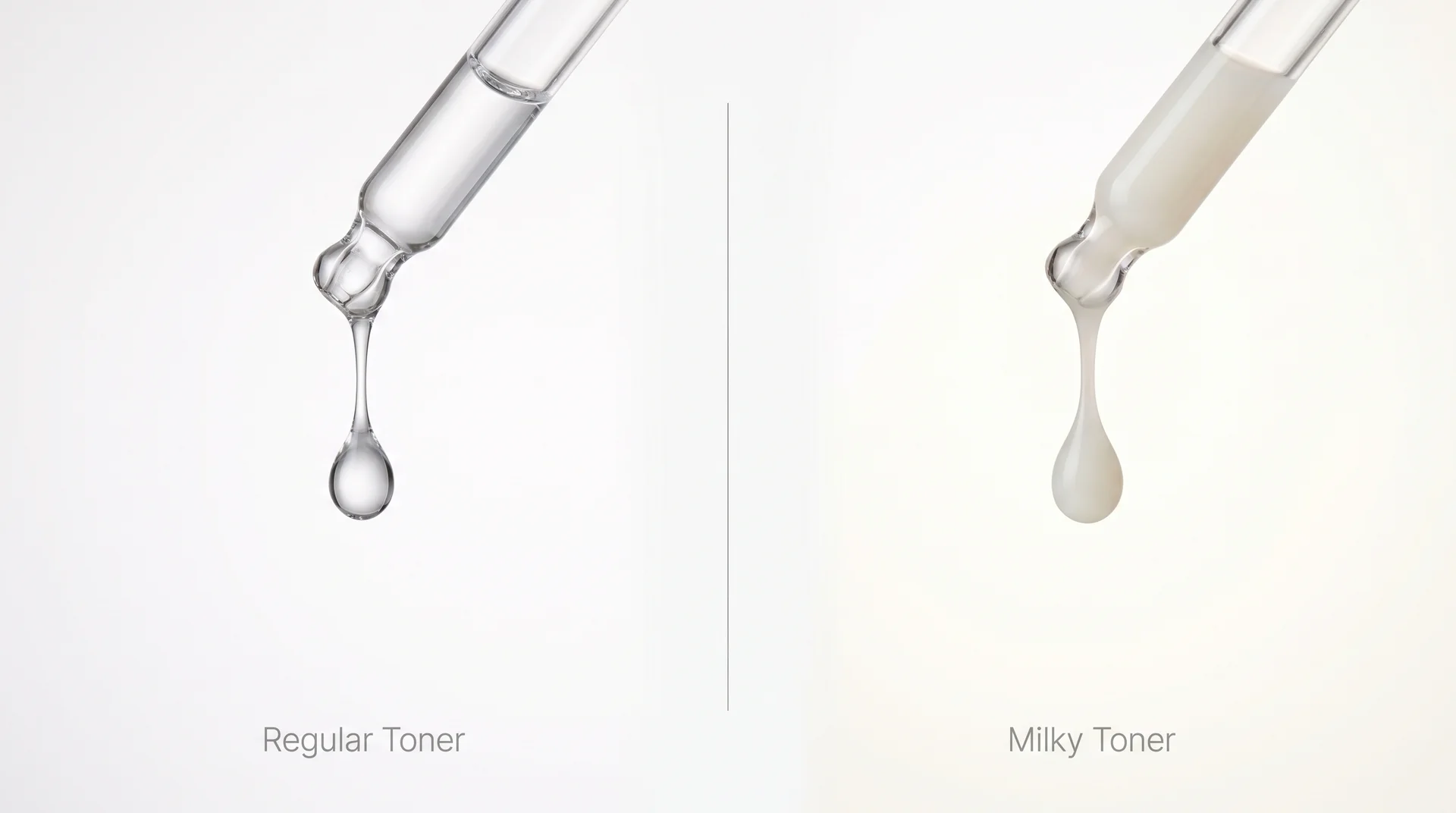
The word “toner” carries a lot of baggage. For a long time, toners meant astringent, alcohol-heavy liquids designed to strip excess oil and leave skin feeling “clean.” That tight, squeaky feeling after using one wasn’t a sign it was working. It was your skin telling you its barrier had been compromised.
Korean skincare moved in the opposite direction entirely. A Korean milky toner is formulated as a light oil-in-water emulsion: tiny droplets of skin-compatible lipids suspended in a water base, giving it a soft, slightly opaque appearance. It doesn’t feel heavy or thick. But it feels noticeably more supportive than a clear watery toner the moment it contacts your skin.
This formulation also fits neatly into the Korean skincare concept of skipcare, building a simpler, more intentional routine where each product earns its place by doing more than one thing. A well-formulated milky toner handles what a watery toner and a lightweight essence would do separately, which means one fewer step without sacrificing any benefit.
Korean Milky Toner vs Essence vs Regular Toner
| Product | Primary Purpose | Texture | Best For |
|---|---|---|---|
| Regular Toner | Hydrate, balance pH | Water-thin | Oily or balanced skin, warm climates |
| Korean Milky Toner | Hydrate and reinforce the barrier | Soft, slightly opaque | Dry, sensitized, or barrier-compromised skin |
| Essence | Deliver targeted activities | Watery to slightly viscous | Specific concerns like brightening or renewal |
Think of an essence as the prescription your skin needs and a milky toner as the preparation that helps your skin actually absorb and tolerate what comes next. One is treatment-first. The other is comfort-and-foundation-first.
Why Your Skin Might Be Asking for a Korean Milky Toner Right Now
The Post-Cleanse Problem Nobody Talks About
Cleansing, even gentle cleansing, temporarily disrupts your skin’s pH and the integrity of your outer barrier. The lipids that sit in the upper layers of your skin get partially removed with every wash. Your skin recovers, but there’s a window right after cleansing where it’s more vulnerable to moisture loss than at any other point in your day.
That window is exactly when a milky toner matters most. Applied to damp skin immediately after cleansing, it steps into that gap before the barrier has a chance to signal distress.
I’ve watched clients with chronically tight, reactive skin transform their baseline comfort within two weeks just by adding this one step, before changing anything else in their routine.
Signs Your Skin Is Asking for a Milky Toner
- Skin feels tight after cleansing, even with a gentle formula
- Makeup sits patchily because of foundation or settles into fine lines by midmorning despite moisturizer
- Skin looks dull and flat, and hydrating mists don’t fix it
- Redness and sensitivity appear randomly, especially on the cheeks and jawline
- Your skin has become reactive to actives that didn’t bother it before
- You’re in a season or climate with indoor heating or low ambient humidity
If more than two or three of those resonate, your barrier is asking for lipid support, and that’s exactly what a Korean milky toner provides.
Using Retinol or Acids? Here’s What a Milky Toner Does for You
If you’re in a retinol adjustment period, or you’ve been using exfoliating acids and your skin has become more sensitized, a milky toner is one of the most practical additions you can make.
Applying a ceramide-rich milky toner before retinol creates a light cushioning layer that reduces irritation without interfering with how retinol works.
Clinical research supports this: a ceramide-forward toner applied before retinol has been shown to reduce irritation responses meaningfully compared to applying retinol on bare skin.
I guide clients through this specific sequence whenever they’re starting a retinoid for the first time.
The Key Ingredients That Make Korean Milky Toners Work
Ceramides: The Structural Foundation of Your Skin Barrier
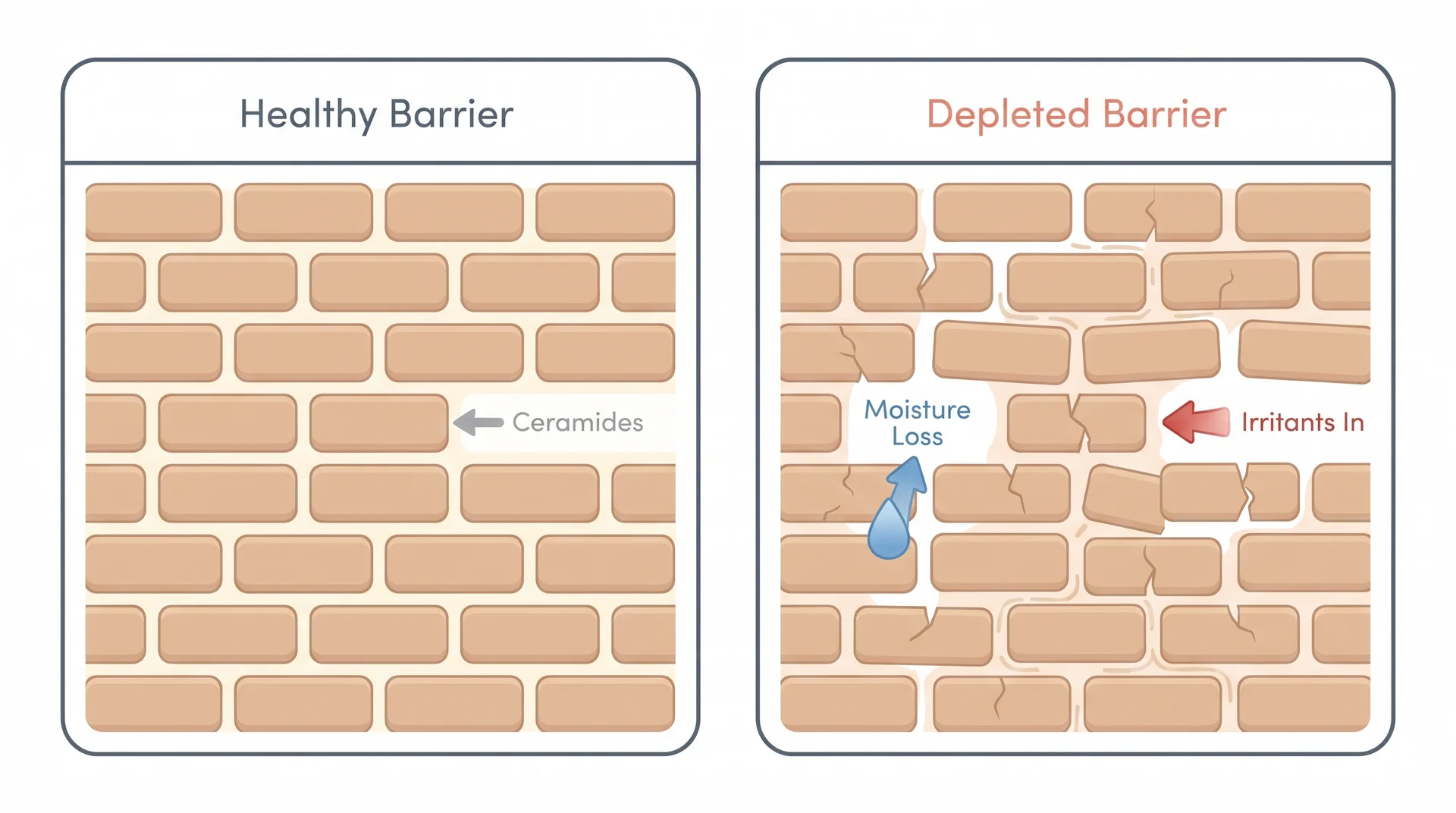
Your skin barrier functions like a brick wall. The skin cells are the bricks, and ceramides are the mortar. Ceramides are naturally occurring lipids that fill the spaces between cells in your outermost skin layer, reducing water loss and keeping irritants out.
When that mortar depletes from over-cleansing, environmental stress, harsh actives, or repeated UV exposure from tanning beds, the wall develops gaps.
Moisture escapes. Irritants enter. Your skin starts feeling reactive and tight in ways that no amount of moisturizer fully resolves, because the problem isn’t on the surface; it’s structural.
Fermented Rice Extract: Korea’s 1,000-Year Skin Ritual
Rice has been central to Korean beauty for over a thousand years. Ancient Korean women used rice water for cleansing and brightening, understanding its benefits long before modern formulation science could explain them.
Fermented rice extract in today’s milky toners takes this further. The fermentation process breaks the rice into smaller molecules that the skin can absorb more efficiently, amplifying the antioxidant, anti-inflammatory, and brightening properties.
When clients come to me dealing with dullness alongside dehydration, formulas with a high rice extract concentration (70% or more) are where I start.
Niacinamide, Panthenol, and Hyaluronic Acid: The Hydration Trifecta
Niacinamide (Vitamin B3) calms inflammation, regulates oil production, minimizes pores, and improves tone over time. It’s particularly valuable in a milky toner for combination skin because it addresses the oiliness-without-hydration cycle that keeps so many people stuck.
Panthenol (Vitamin B5) functions as both a humectant and a soothing agent, drawing moisture in while calming irritation. I reach for it most often with clients in skin recovery.
Hyaluronic acid draws water into the surface layers and works alongside the lipid ingredients to help the barrier hold that hydration in place, rather than letting it evaporate before it reaches where it’s needed.
What to Avoid on the Ingredient Label
- Heavy fragrance in a leave-on formula. In a product designed to sit on sensitized or barrier-compromised skin all day, fragrance increases the risk of irritation meaningfully. Fragrance-free formulas are the more consistent, safer choice for reactive skin.
- Fatty alcohols very high on the ingredient list. Cetearyl alcohol and behenyl alcohol are functional in formulation, but when they appear near the top of the list, the formula can feel too rich for acne-prone or easily congested skin.
- Mineral oil. Not harmful, but in a milky toner, it typically signals a mismatch between what the product is supposed to do and how it’s actually been formulated.
Which Skin Type Actually Benefits From a Korean Milky Toner?
Dry and Dehydrated Skin
If your skin is dry (lipid-deficient) or dehydrated (water-deficient), a Korean milky toner is one of the most effective additions you can make to your routine.
The ceramide and fatty acid content gives lipid-dry skin the building blocks it’s actually missing. For dehydrated-but-oily skin, the same principle applies, though you’ll want a lighter-textured formula that emphasizes niacinamide and hyaluronic acid over heavier emollients.
Oily and Acne-Prone Skin: Hear Me Out
This is the question I get most often, and the hesitation makes complete sense. But oily skin doesn’t mean hydrated skin. Oily skin produces excess sebum, and sebum is an oil, not water.
When oily skin is also dehydrated from stripping cleansers or acid overuse, it produces even more oil to compensate for the water loss it’s experiencing. A lightweight milky toner actually helps regulate that oil cycle rather than worsen it.
The key is choosing the right formula.
For oily and acne-prone skin, look for:
- A thin, almost watery milky texture, not thick or lotion-like
- Non-comedogenic, confirmed on the label
- Niacinamide as a primary active ingredient
- Fragrance-free
- No heavy plant butters or oils appear high on the ingredient list
Sensitive and Barrier-Compromised Skin
This is the skin type I’ve worked with most consistently, and where I’ve seen Korean milky toners make the most visible difference.
For sensitive or reactive skin, prioritize fragrance-free formulas that are ceramide-forward and contain centella asiatica, panthenol, or beta-glucan for additional soothing support.
Avoid formulas with multiple plant extracts, particularly citrus, menthol, or eucalyptus, which can trigger sensitivity in already reactive skin.
When You Probably Don’t Need a Korean Milky Toner
If your skin is naturally balanced, your barrier is intact, and you’re not using any actives that stress the skin, a standard hydrating toner may serve you better. A milky toner solves a specific problem.
If your skin doesn’t have that problem right now, you don’t need to manufacture one. In peak summer heat and humidity, the cushioning that makes milky toners so valuable in winter can feel like too much for some skin types, particularly oily and combination skin.
How to Use a Korean Milky Toner in Your Skincare Routine
Where It Goes and How to Apply It
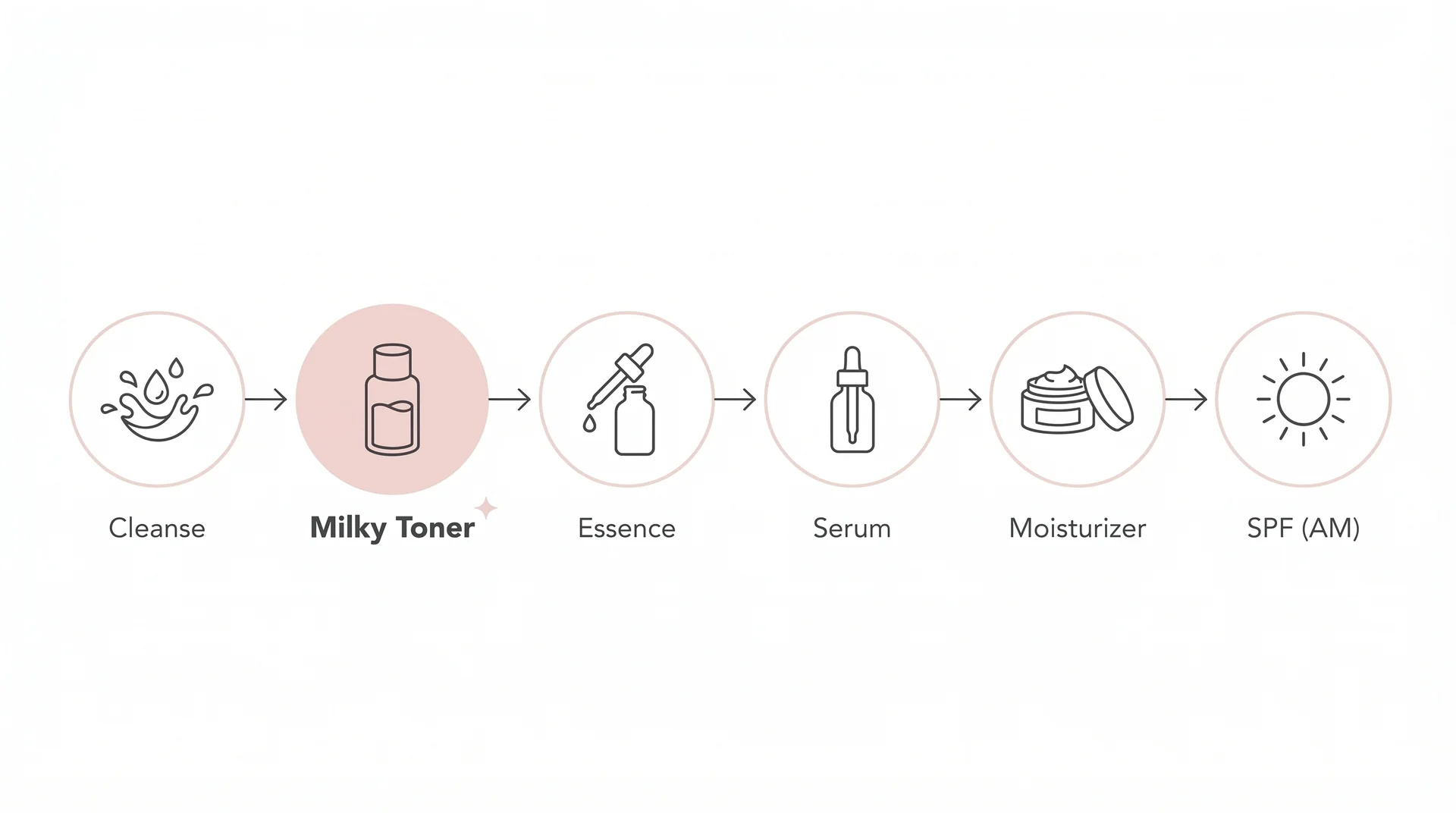
Apply your Korean milky toner immediately after cleansing, while your skin is still slightly damp. The routine order looks like this:
- Cleanse
- Korean milky toner (on damp skin)
- Essence, if you use one
- Serum or treatment
- Moisturizer
- SPF (morning only)
Pat the toner into your skin with clean hands rather than swiping with a cotton pad. Patting applies gentle pressure that improves absorption without mechanical friction, which matters especially if your skin is sensitized. You don’t need to wait for it to fully dry before moving to the next step. About sixty seconds is enough.
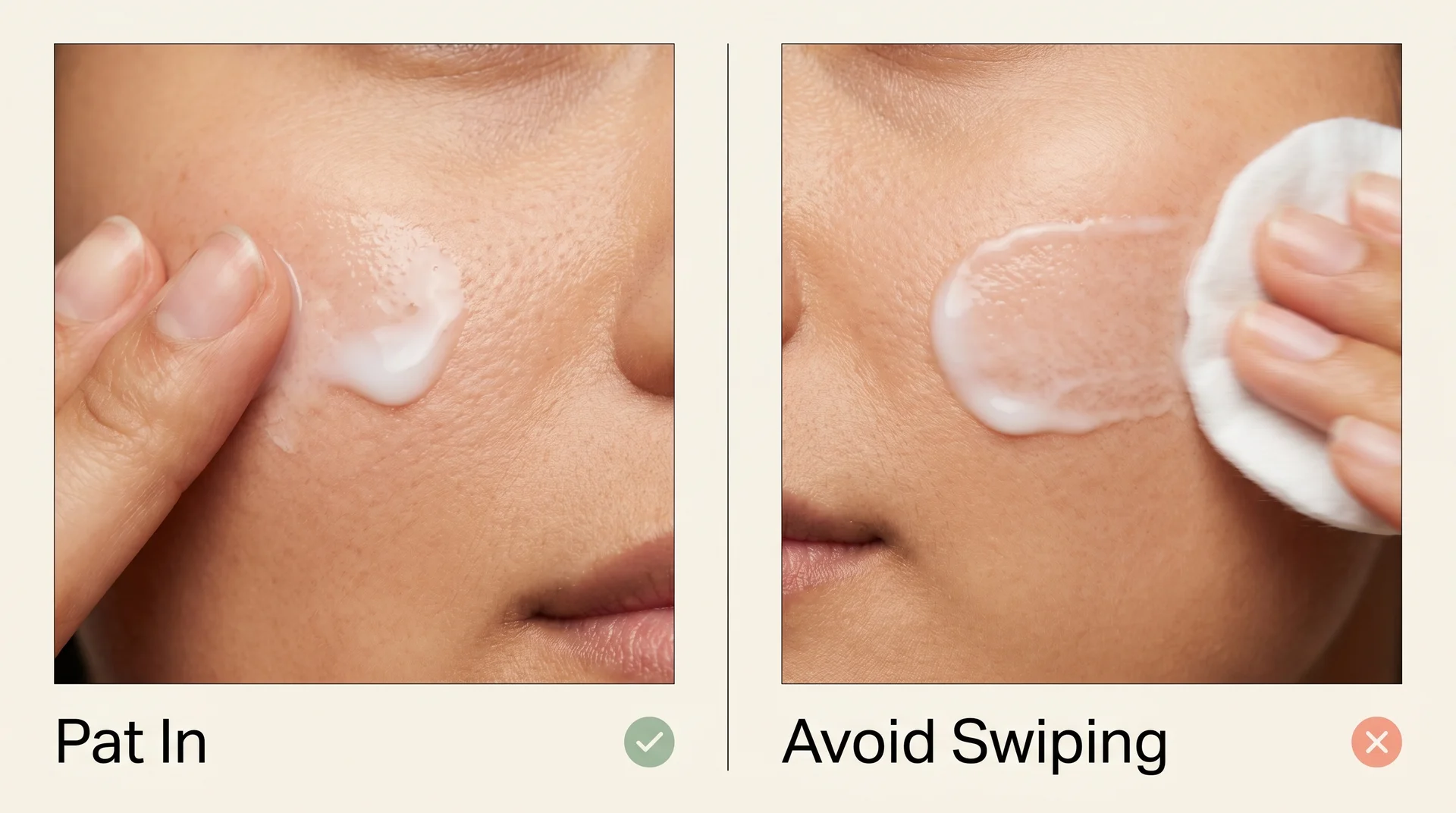
For very dry skin or during winter months, try layering two to three thin applications before continuing your routine. This is a simplified version of the Korean 7-skin method, and it meaningfully increases the hydration your barrier receives before anything else goes on top of it.
Morning vs Night Use and the Glass Skin Connection
Use a milky toner both morning and night, but the intent shifts slightly between the two. In the morning, it prepares your skin to absorb SPF more efficiently and creates a hydrated, smooth base that works beautifully under makeup.
The lit-from-within glass skin and dewy skin finishes that K-beauty is known for often start here, not with highlighter.
When the skin is properly hydrated and the barrier is functioning well, light reflects differently off it. That’s the look. At night, the milky toner’s role is recovery: setting the stage for your actives or treatments to work on comfortable, primed skin rather than reactive, depleted skin.
How to Pick the Right Korean Milky Toner for Your Skin
Match Your Concern to the Right Ingredients
| Skin Concern | Ingredients to Prioritize |
|---|---|
| Dullness and uneven tone | Rice extract (70%+), niacinamide, fermented extracts |
| Dry or dehydrated skin | Ceramides, panthenol, hyaluronic acid, glycerin |
| Barrier damage or sensitivity | Ceramide complex, centella asiatica, beta-glucan, panthenol |
| Oily or acne-prone skin | Niacinamide, lightweight rice water, non-comedogenic formula |
| Fine lines with dehydration | Ceramides, peptides, hyaluronic acid, adenosine |
| Post-retinol or post-acid sensitivity | Ceramides, panthenol, minimal actives, fragrance-free |
Texture Guide: Which Korean Milky Toner Formula Is Right for You?
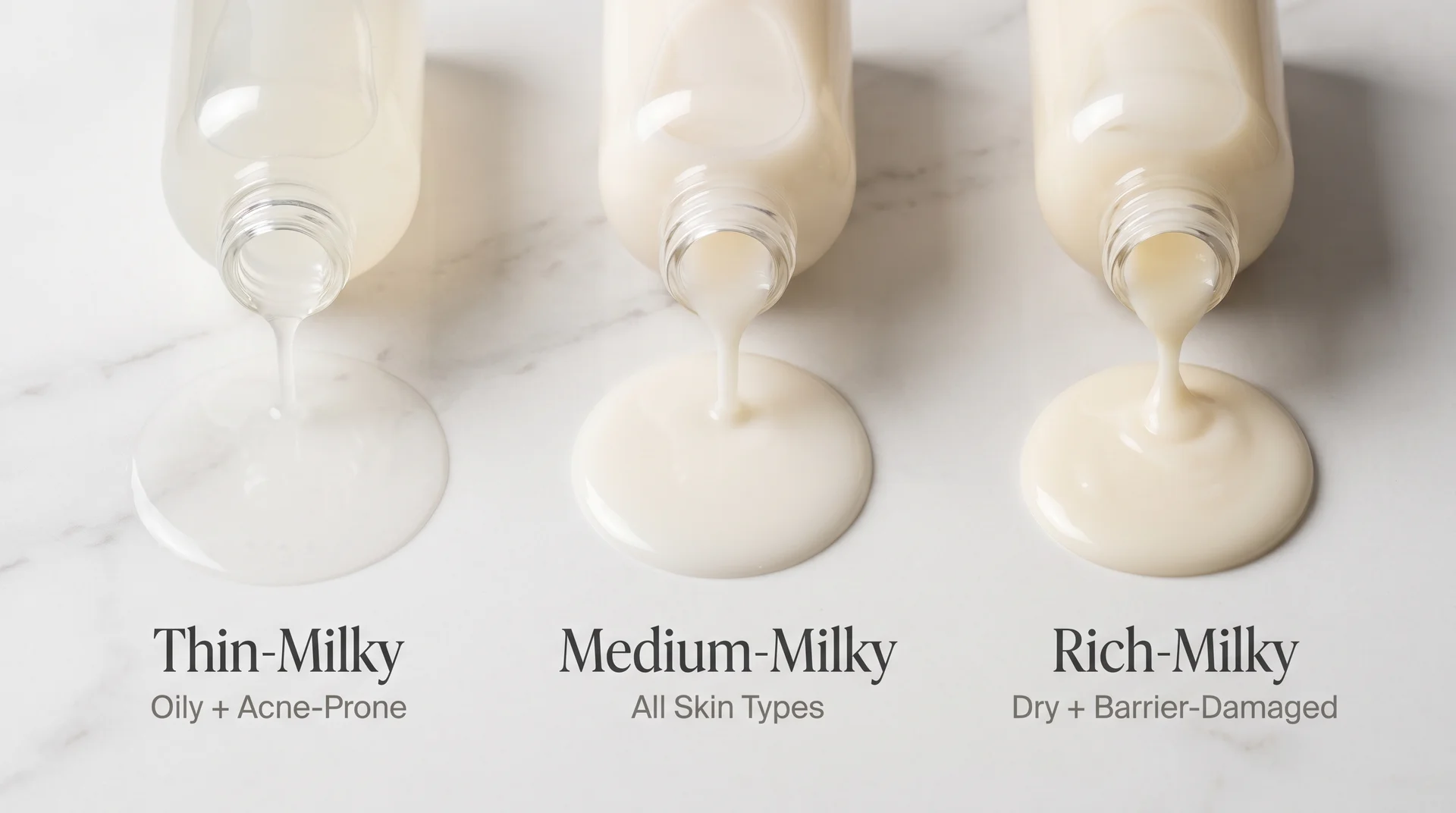
Thin-milky (almost watery with a soft opacity): Best for oily, combination, or acne-prone skin. Absorbs quickly, layers cleanly under serums, and adds no heaviness to the routine.
Medium-milky (classic milky consistency, pourable and slightly viscous): The all-skin-types sweet spot. Works well across dry, normal, and sensitized skin, delivering meaningful barrier support without tipping into lotion territory.
Rich-milky (noticeably more substantial, close to a lotion-toner hybrid): Best for very dry, severely dehydrated, or heavily compromised skin. Some of my clients with chronic dry skin use this in place of a separate lotion step and find their routine actually simplifies because of it.
Robin’s Clinical Picks by Skin Concern
These aren’t sponsored recommendations. They’re the formulas I’ve actually reached for when working with specific client concerns over the years.
- For sensitized or post-active skin: I consistently start with ceramide complex-forward formulas (ceramide NP, AP, and EOP together) paired with panthenol and minimal additional ingredients. Haruharu Wonder’s Black Rice Probiotics Barrier Essence and Then I Met You’s Birch Milk Refining Toner both fit this profile reliably.
- For dull, dehydrated skin chasing glass skin or a dewy finish: High-concentration rice extract combined with niacinamide is the combination I reach for most. I’m From Rice Toner, and the Anua Rice 70 Glow Milky Toner are the two I recommend most frequently in this category.
- For oily or acne-prone skin that’s also dehydrated: The Beauty of Joseon Glow Replenishing Rice Milk works well because it includes a sebum-control element alongside hydration, so it doesn’t tip into heaviness for skin that’s already producing oil.
- For very dry or barrier-damaged skin in winter: A rich, milky formula with a full ceramide complex and higher lipid content is what I look for. The Tony Moly Ceramide Cream Skin Refiner, in its updated formulation, is one I come back to consistently in this category.
Frequently Asked Questions
Can I use a Korean milky toner every day?
Yes. Because milky toners contain no harsh actives, they’re designed for daily use, morning and evening. Consistent daily use is actually where the barrier repair benefits accumulate over time.
Does a milky toner replace moisturizer?
It depends on your skin type and the richness of the formula. For oily or balanced skin in warm weather, a rich, milky toner followed by SPF may be enough. For dry or compromised skin, keep your moisturizer and let the milky toner improve how well it absorbs.
Is a Korean milky toner the same as a toning lotion?
They overlap, but they’re not identical. Toning lotions (also called softening lotions in K-beauty) are typically thicker and sit closer to a light lotion. Milky toners are lighter and used as the first hydration step. Some products market themselves interchangeably between the two categories.
Can I use a milky toner if I have fungal acne (Malassezia)?
Check the ingredient list carefully before using any milky toner. Malassezia feeds on certain fatty acids and esters, so formulas with plant oils or fermented lipid-heavy ingredients can aggravate it. Look for rice water-based formulas with minimal fermented ingredients and confirm compatibility with your dermatologist or a Malassezia-safe ingredient resource.
Will a Korean milky toner break me out?
If you choose a non-comedogenic formula suited to your skin type and patch test before full use, it’s unlikely. Breakouts from milky toners usually happen when someone chooses a formula that’s too rich for their skin. That’s a formulation mismatch, not a category problem.
How long before I see results from a Korean milky toner?
Most people notice improved comfort and plumpness within one to two weeks. Visible improvements in tone, texture, and barrier resilience typically take four to six weeks of consistent daily use.
Healthy skin isn’t built by chasing the right product. It’s built by consistently giving your barrier what it needs to do its own job. A Korean milky toner is often where that process starts.
| Disclaimer: This article is written for educational purposes and reflects the author’s professional experience and clinical opinion. It is not a substitute for personalized advice from a licensed dermatologist or qualified healthcare provider. If you’re managing a diagnosed skin condition or experiencing significant skin reactions, consult a medical professional before introducing new products into your routine. Individual results will vary. |