
The most frustrating thing I hear from fair-skinned clients is some version of this: “I’ve tried everything, and I either burn or go orange. I never actually tan.”
Every time I hear it, my first thought is the same. The product was not the problem. The approach was.
Fair skin does not tan the way medium or deeper skin tones do, and most tanning lotions on the market are formulated with those tones in mind.
When someone with fair skin uses a product built for that average, the result is predictably disappointing and sometimes genuinely damaging.
Here is your short answer first:
The best tanning lotion for fair skin is one that works with your melanin biology, not against it.
Fair skin produces less melanin and produces it more slowly, which means gradual tanners with low DHA concentrations, melanin-stimulating accelerators, and SPF-included formulas for outdoor use are almost always the right starting point.
Orange results come from DHA concentrations too high for lighter skin. Burns come from UV exposure without adequate prep. Both are entirely avoidable.
Everything after this explains exactly how.
| Disclaimer: This article is for educational purposes only and does not constitute medical or dermatological advice. Fair skin carries higher UV sensitivity and skin damage risk. Consult a dermatologist before starting any tanning routine. |
Know Your Skin Type First: The Fitzpatrick Scale
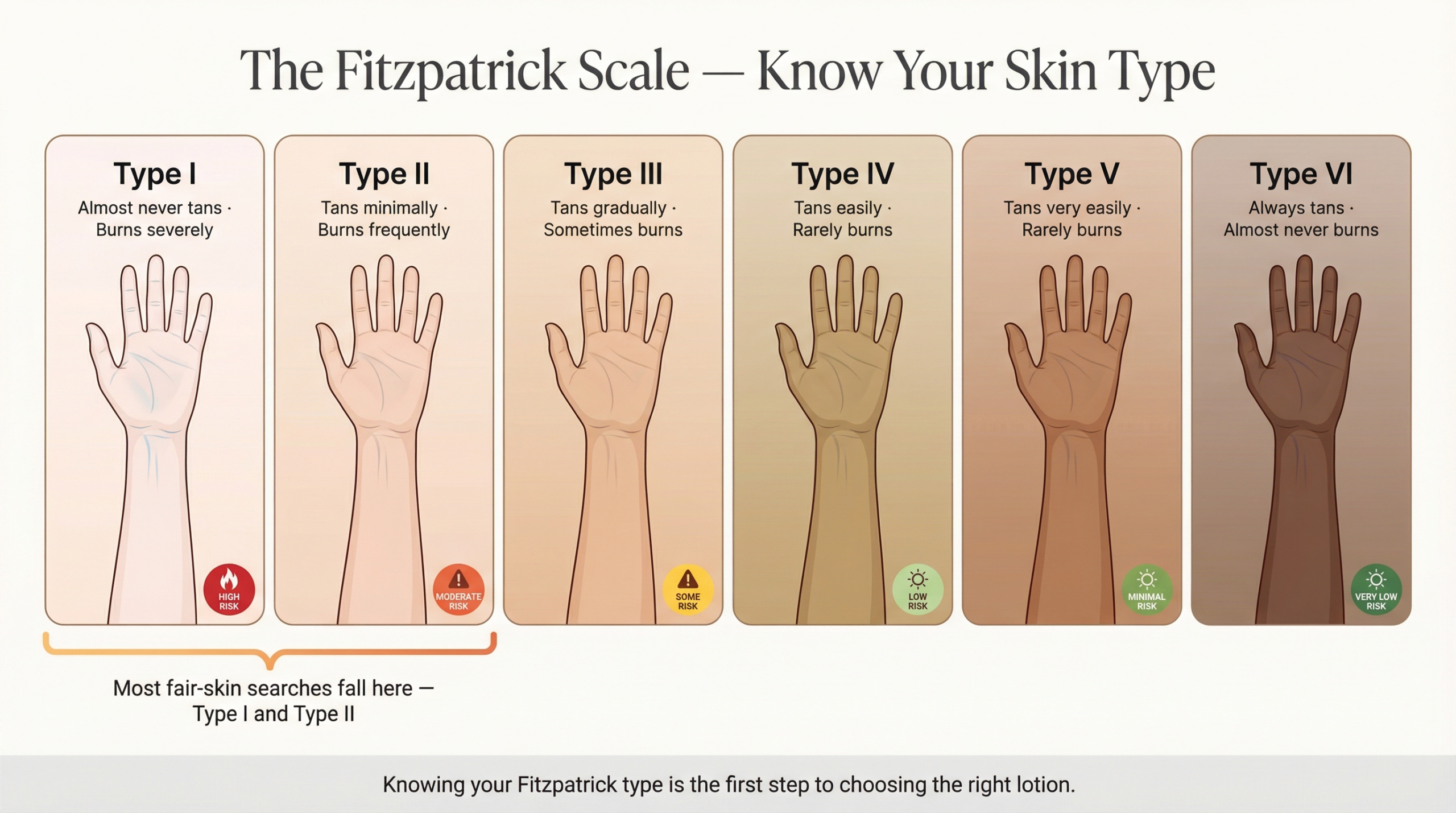
Before picking a product, you need to know where your skin sits biologically, because this changes everything about the right approach.
| Fitzpatrick Type | Skin Description | Tanning Behavior | Burn Risk |
|---|---|---|---|
| Type I | Very pale, often freckled, red or blonde hair | Rarely tans, burns very easily | Extreme |
| Type II | Fair skin, light eyes, light hair | Tans minimally, burns frequently | Very High |
| Type III | Medium skin, some freckling possible | Tans gradually, sometimes burns first | Moderate |
| Type IV | Olive or light brown skin | Tans easily, rarely burns | Low |
| Type V | Brown skin | Tans very easily, rarely burns | Very Low |
| Type VI | Deep brown or black skin | Always tans, rarely burns | Minimal |
Most people searching for “best tanning lotion for fair skin” are Type I or Type II, with some Type III tanners who have had repeated bad experiences.
If you are Type I: No lotion changes your melanin biology. What the right product does is help you achieve the safest, most natural version of your color, and supplement what your melanin cannot provide using carefully concentrated DHA.
If you are Type II or III: You have genuine tanning potential. With the right lotion, the right protocol, and realistic expectations, real, buildable color is absolutely achievable.
Why Fair Skin Burns Before It Tans
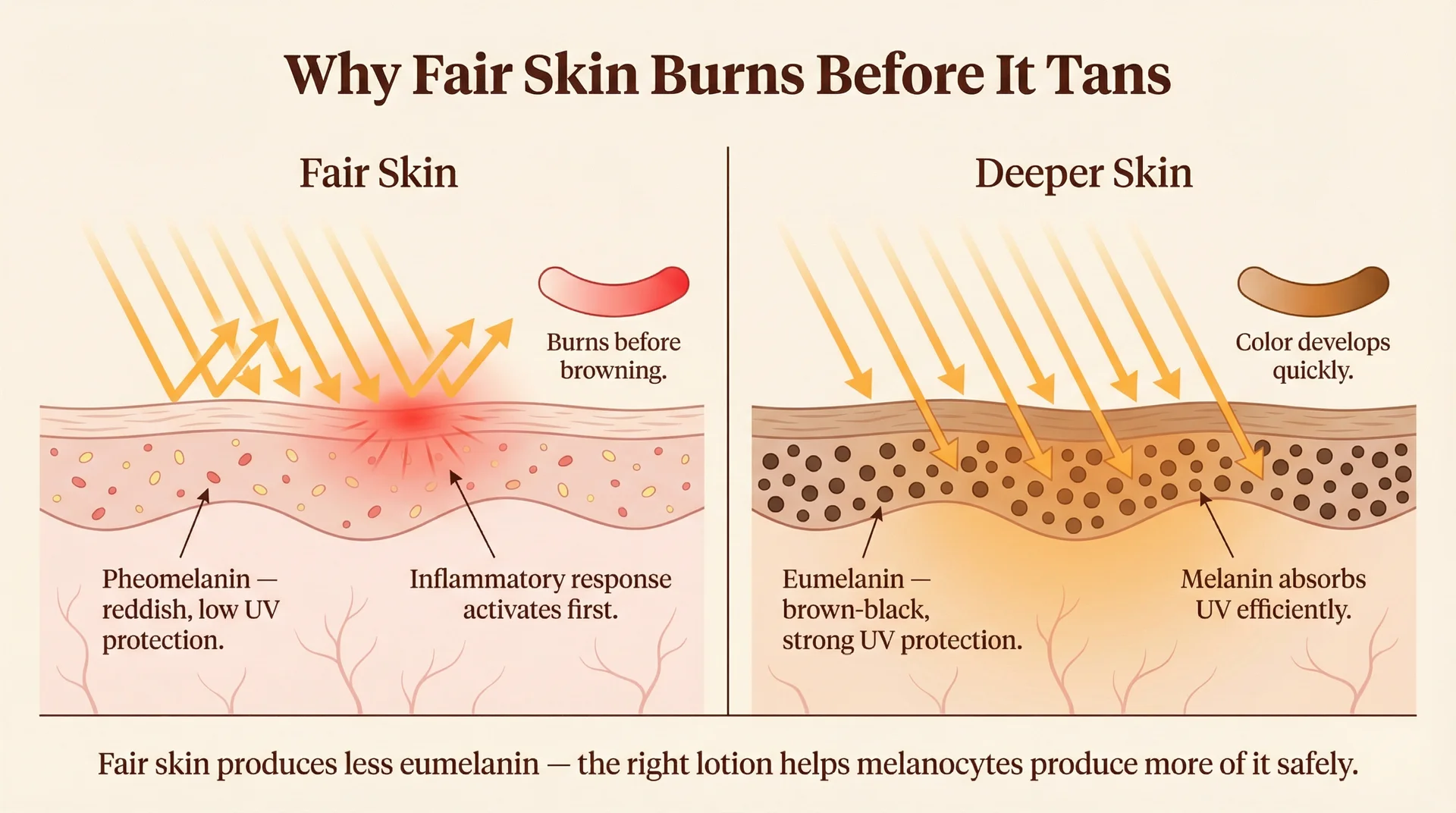
Fair skin produces less melanin and tends toward pheomelanin, a reddish-yellow pigment, rather than eumelanin, the brown-black pigment responsible for a deep, warm tan. This is why fair-skinned people often see a pink flush before they see any browning.
When UV hits lower-melanin skin, the inflammatory repair response frequently activates before the tanning response delivers visible results.
The protection melanin normally provides is simply less robust, and the skin signals distress before it can signal color.
Practically, this means fair skin needs more hydration, more preparation, and significantly lower UV exposure per session to tan productively rather than burn.
A lotion that accelerates melanin production without overwhelming the skin’s UV tolerance is what makes that possible.
Self-Tanner vs. Tanning Lotion: Understanding the Difference
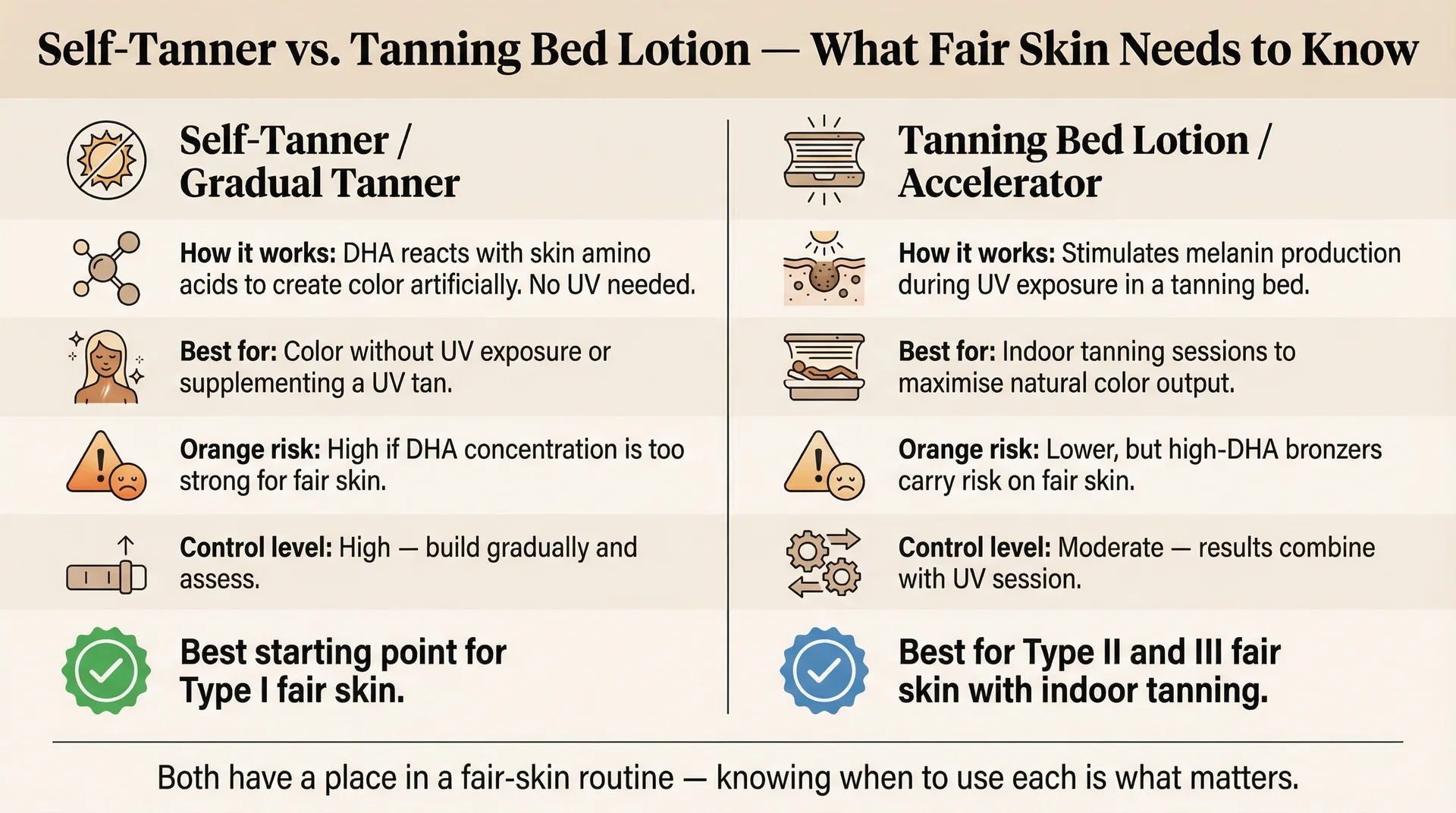
This distinction matters enormously for fair skin, and competing guides rarely address it clearly.
| Self-Tanner / Gradual Tanner | Tanning Bed Lotion / Accelerator | |
|---|---|---|
| How it works | DHA reacts with skin amino acids to create an artificial color | Enhances melanin production during UV exposure |
| Requires UV exposure? | No | Yes (tanning bed or outdoor sun) |
| Color type | Artificial (DHA-based melanoidin) | Natural (UV-induced melanin) |
| Best for fair skin when | You want color without UV exposure, or you want to supplement a UV tan | You are using a tanning bed and want maximum natural color output |
| Orange risk | High if DHA concentration is too strong for the skin tone | Lower, but bronzer-containing formulas carry some risk |
| Control level | High – you apply and assess before more UV | Moderate – results combine with UV session outcomes |
If you’re using DHA-based products, whether as a gradual self-tanner at home or a spray tan in a studio the aftercare rules are the same: certain otions break down the color before it has a chance to fully settle, and others extend it meaningfully.
Robin’s guide to the best lotion to use after a spray tan covers exactly which ingredients protect DHA color and which ones quietly strip it.
For fair skin, both categories have a place in a well-structured routine.
The key is understanding which tool to reach for and when.
If you are using a tanning bed, see our detailed guide on the best tanning bed lotion for level-by-level guidance. This post focuses on the full lotion landscape for fair skin across both indoor and outdoor contexts.
Types of Tanning Lotions and Which Ones Work for Fair Skin
1. Gradual Tanners: The Fair Skin Default
Gradual tanners use low DHA concentrations, typically 2% to 4%, to build color across multiple applications.
For fair skin, this is almost always the safest starting point. The lower concentration matters for two reasons:
Lighter skin tends to have a different amino acid distribution in the stratum corneum than deeper skin tones.
High DHA concentrations react too aggressively with that distribution and produce orange, unnatural results.
Gradual tanners give you control, letting you stop at a level that looks genuinely natural on your skin rather than overshooting into artificial territory.
The best gradual tanners for fair skin pair low DHA with strong moisturizing ingredients, because dry fair skin takes color unevenly, and that patchiness is more visible on lighter tones.
Melanin-Stimulating Accelerators
Accelerators that focus on L-Tyrosine and melanin stimulation without DHA are the other category I consistently recommend for fair-skinned clients using tanning beds. They work with your biology rather than adding artificial color on top of it.
Your melanin response is slower and smaller than that of deeper skin tones.
An accelerator gives your melanocytes the support they need to produce at their maximum natural genetic capacity.
The result will not match a DHA bronzer in one session, but it builds the deepest, most natural version of your own color over time, and that looks genuinely good on fair skin in a way that forced bronzing often does not.
DHA Bronzers: Fair-Skin-Specific Caution Required
DHA bronzers can work beautifully on fair skin when the concentration is right. The problem is that most bronzers are formulated for medium to deeper skin, using concentrations too high for lighter amino acid density.
For fair skin, look for bronzers with DHA at or below 4%.
The other fair-skin-specific risk is undertone mismatch. DHA produces a warm brown tone. On fair skin with pink or cool undertones, this reads as orange because the warmth contrasts sharply with the cool undertones underneath.
If you have pink-toned fair skin, look specifically for bronzers with green or violet color correctors in the formula to counteract the orange-warmth tendency.
SPF Tanning Lotions: Non-Negotiable for Outdoor Fair-Skin Tanning
The idea that SPF and tanning are mutually exclusive is one of the most persistently damaging myths in the tanning space for fair-skinned people specifically.
SPF does slow the tanning rate slightly, but it does not prevent tanning.
What it prevents is the burn-peel-reset cycle that derails most fair-skinned outdoor tanners. When fair skin burns, the inflammatory response damages melanocytes and can reduce tanning capacity in subsequent sessions.
The peeling that follows strips away whatever color you had started building.
An SPF 15 to 30 tanning lotion for outdoor use lets tanning happen at a pace your skin can handle. You build real color across more sessions rather than constantly resetting after burns.
Tingle Lotions: Avoid Unless Base Is Fully Established
For fair skin, the vasodilation response tingle lotions create is visually indistinguishable from sunburn and carries real inflammation risk for lower-melanin skin.
The inflammatory response that tingle lotions activate is more pronounced in skin with lower melanin protection.
My recommendation: avoid tingle lotions entirely until you have a well-established base tan from at least 8 to 10 consistent sessions, no skin sensitivity issues, and no inflammatory skin conditions. Even then, start at the absolute lowest intensity available.
Cooling Lotions
Cooling lotions with menthol or peppermint deliver comfort during heat-intensive sessions.
For fair skin, they work well as hydrating base formulas, particularly for anyone who finds tanning bed heat contributing to redness.
Their primary value is comfort and hydration rather than tan enhancement, but keeping the skin relaxed and well-moisturized during a session always contributes to more even results.
Quick-Reference Guide: Best Lotion Type by Goal
| Your Goal | Best Lotion Type | Key Ingredients | What to Avoid |
|---|---|---|---|
| Safest first-time color | Gradual Tanner (Low DHA) | DHA 2–4%, Hyaluronic Acid, Aloe | DHA above 4% |
| Natural UV tan indoors | Melanin Accelerator | L-Tyrosine, Copper Peptides, Vitamin C | Tingle formulas, heavy bronzers |
| Outdoor tanning without burning | SPF Tanning Lotion | SPF 15–30, L-Tyrosine, Aloe | Unprotected accelerators outdoors |
| Deepen color safely with bronzer | Low-DHA Bronzer | DHA under 4%, Green/Violet correctors | Warm-toned bronzers if cool undertone |
| Sensitive fair skin | Fragrance-Free Hypoallergenic | Bisabolol, Allantoin, Centella Asiatica | Synthetic fragrance, benzyl nicotinate |
| Maintain and extend existing tan | Daily Gradual Moisturiser | DHA 2%, Ceramides, Glycerin | Sulfate-heavy cleansers |
Matching Your Undertone to Your Lotion
This is the step most guides skip and the one that eliminates the orange result almost entirely.
| Undertone | What It Looks Like | Best DHA Formula Tone | What to Avoid |
|---|---|---|---|
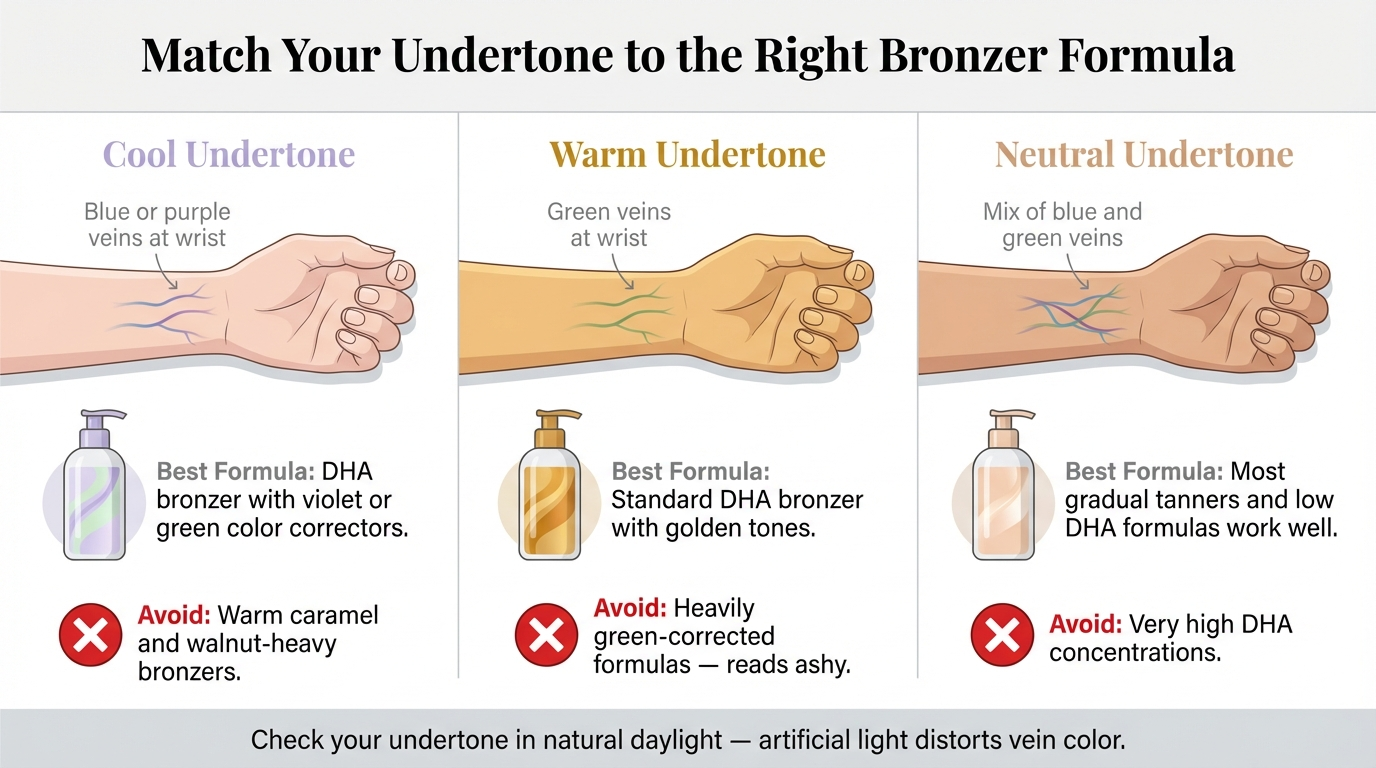
| Cool | Pink, red, or bluish veins at the wrist | DHA with green or violet color correctors | Warm-toned bronzers, caramel/walnut-heavy formulas |
| Warm | Yellow, peach, or golden veins at the wrist | Standard DHA bronzers with golden tones | Overly green-corrected formulas that read ashy |
| Neutral | A mix of blue and green veins at the wrist | Most gradual tanners and low DHA formulas | Very high DHA concentrations only |
How to find your undertone: Look at the inside of your wrist in natural daylight. Blue or purple veins indicate cool undertones. Green veins indicate warm undertones. A mix indicates neutral.
The Orange Problem: Why It Happens and How to Prevent It
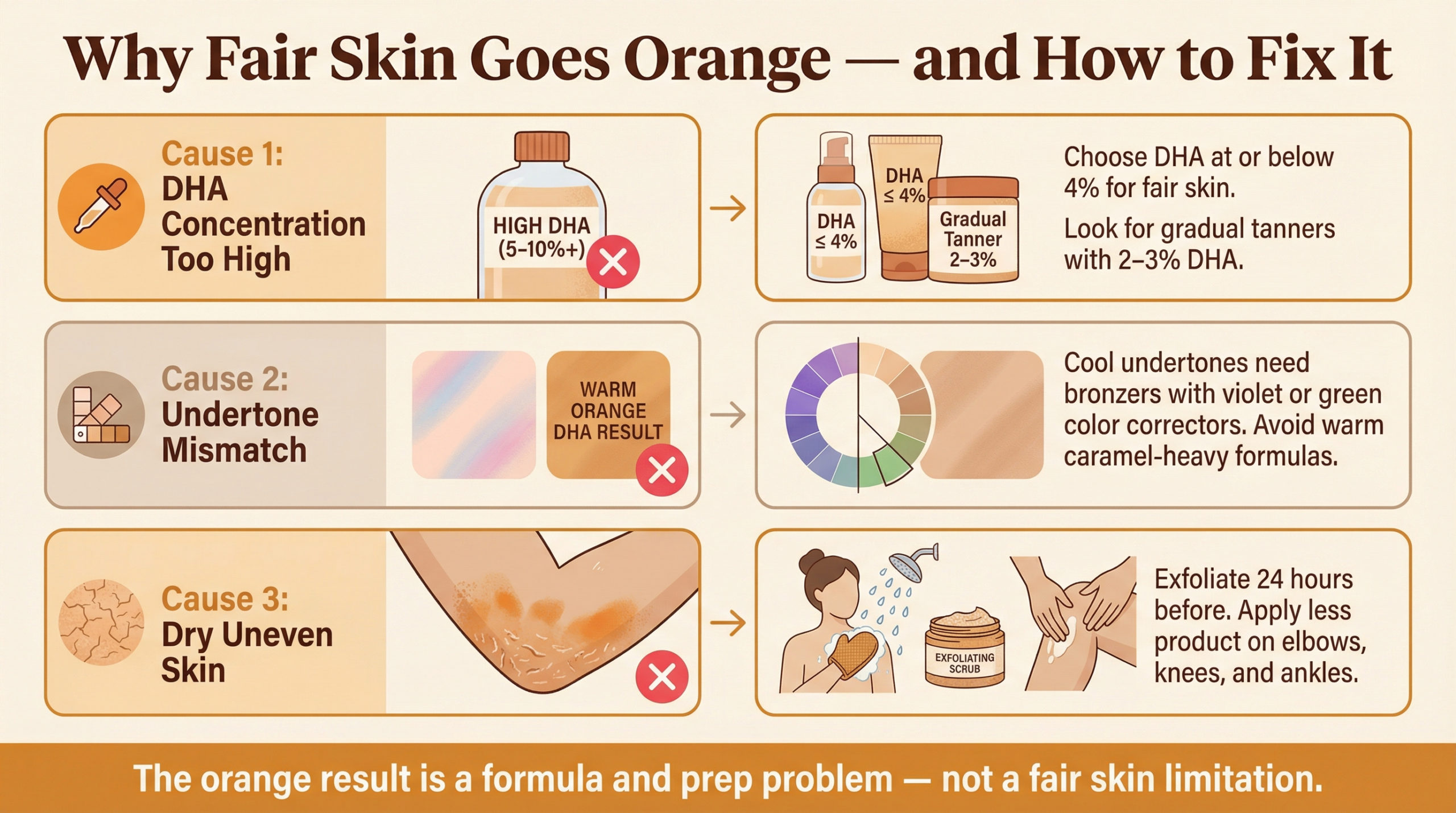
The orange result haunts fair-skinned tanners, and it comes from three specific, fixable factors:
1. DHA concentration too high for your amino acid density. Lighter skin has a lower concentration of the amino acids DHA reacts with. High-concentration DHA overwhelms that distribution and skews warm and orange rather than golden.
2. Undertone mismatch
Fair skin with pink or cool undertones sits in direct contrast to DHA’s natural warmth.
The result reads unnatural, specifically because the artificial warmth fights against the cool undertone showing through underneath.
3. Uneven application on dry skin. Dry patches absorb DHA more aggressively. On fair skin, that contrast is highly visible.
The prevention protocol:
- Choose DHA at or below 4% for fair skin
- Exfoliate thoroughly 24 hours before any DHA application
- Apply a thin layer of moisturizer to elbows, knees, and ankles before the tanning lotion
- Look for bronzers with cool-tone or color-correcting pigments
- Build gradually across multiple applications rather than applying heavily in one session
Ingredients That Work With Fair Skin
Ingredients to Look For
L-Tyrosine stimulates melanin production at the melanocyte level. The most useful active ingredient in an indoor tanning accelerator for fair skin because it helps your skin produce at its maximum natural genetic capacity.
DHA at 2% to 4% provides buildable, controllable color on fair skin without the orange result risk that higher concentrations carry.
Erythrulose is a slower-acting complement to DHA that develops over 24 to 48 hours rather than 4 to 8. The extended development time produces a more blended, natural-looking result and is significantly less prone to the patchy unevenness DHA alone creates on lighter skin.
Hyaluronic acid keeps the skin barrier hydrated during the DHA reaction, which directly improves color evenness. Dehydrated skin takes DHA unevenly, and on fair skin, that shows.
Bisabolol and allantoin calm inflammation without interfering with the tanning mechanism. Essential for fair, reactive, or sensitive skin.
Violet or green color correctors in bronzer formulas actively counteract DHA’s orange tendency on cool-toned fair skin. A real, visible difference on the right complexion.
Ingredients to Approach with Care
High DHA concentrations (above 5%) react too aggressively with lighter skin. The concentration ceiling for fair skin is 2% to 4%.
Benzyl nicotinate (the tingle active) carries genuine inflammation risk for lower-melanin skin types and visually mimics sunburn on fair skin.
Synthetic fragrance penetrates more deeply during heat-intensive sessions and causes a higher irritation rate in fair, sensitive skin. Fragrance-free is the safer default.
Walnut extract and high natural bronzer concentrations tend to produce colors that read too dark and too warm on lighter skin without the gradual control that DHA allows.
Best Tanning Lotions for Fair Skin by Category
As an esthetician, my product evaluations come down to formula quality, ingredient compatibility with fair skin specifically, and real-world consistency of results.
I have organized these by skin need rather than brand name, because the formula matters more than the label.
Best Gradual Tanner for Fair Skin
Formula profile to look for: DHA 2% to 3%, erythrulose alongside the DHA for a more natural result, hyaluronic acid as a core moisturizing base, and neutral or cool-tone color correction if a tint is included.
Top-performing products in this category:
- Bondi Sands Gradual Tanning Milk (Light/Medium) – low DHA, erythrulose blend, fragrance-light formula that works particularly well on Type II skin
- St. Tropez Gradual Tan Everyday Body Lotion (Light/Medium) – well-regarded in the fair-skin community for its buildable color and natural finish; the light/medium shade specifically avoids the orange tendency
- Jergens Natural Glow Daily Moisturiser (Fair to Medium) – the most accessible drugstore entry point for fair skin, DHA concentration is genuinely fair-skin appropriate, reliable, and widely available
Application protocol: Daily for the first 5 to 7 days to build a base, then every other day to maintain. Never skip the nightly moisturizing step between applications.
Who this is for: Type I and Type II skin, first-time tanners, and anyone who has had an orange result before and wants a controllable, low-risk approach.
Best Accelerator for Fair Skin (Indoor Tanning)
Formula profile to look for: L-Tyrosine prominently in the ingredient list, antioxidant support (Vitamin C, green tea, Vitamin E), and a lightweight moisturizing base without heavy synthetic fragrance or mineral oil.
Top-performing products in this category:
- Australian Gold Magnifique Intensifier – clean accelerator formula with L-Tyrosine and antioxidant support, no DHA, appropriate for fair skin wanting a purely melanin-based result
- Designer Skin Bombshell Intensifier – lightweight texture, melanin-focused ingredients, consistently recommended by salon professionals for lighter skin types, building a base tan
- Hempz Triple Moisture Herbal Whipped Body Crème – not marketed as a tanning accelerator but widely used as a pre-session moisturizer by fair-skinned tanners for the barrier-building hemp seed oil content
Who this is for: Type II and Type III fair skin, indoor tanners who want to build real melanin-based color rather than DHA supplementation.
Best Low-DHA Bronzer for Fair Skin
Formula profile to look for: DHA at or below 4%, erythrulose as a complementary agent, cool-tone or color-correcting pigments, hyaluronic acid for even color distribution, and no high synthetic fragrance.
Top-performing products in this category:
- Sun Laboratories Sunless Tan Daily Bronze Lotion (Light) – specifically formulated for lighter skin, low DHA, and consistent fair-skin positive reviews for natural-looking results
- Isle of Paradise Self-Tanning Drops (Light) – dropper format that lets you control DHA concentration by mixing into your regular moisturizer, ideal for fair skin that needs full concentration control
- Tan-Luxe The Body Illuminating Self-Tan Drops (Light/Medium) – similar mixing-drop format, clean ingredient profile, consistently rated well by Type II tanners for avoiding the orange result
Who this is for: Fair skin with neutral or warm undertones, experienced tanners with an established base, and anyone chasing faster visible color with proper preparation in place.
Best SPF Tanning Lotion for Fair Skin (Outdoor Use)
Formula profile to look for: SPF 15 to 30 (above SPF 30 begins to significantly limit tanning progress), broad-spectrum UVA/UVB protection, L-Tyrosine or melanin-stimulating actives, and aloe vera or niacinamide for anti-inflammatory support.
Top-performing products in this category:
- Banana Boat Moisturizing Tanning Oil SPF 15 – lightweight, L-Tyrosine included, SPF sits in the sweet spot for fair skin wanting protection without stopping tanning entirely
- Australian Gold Sunscreen Spray SPF 15 with Bronzer – broad-spectrum, natural bronzer tint, widely used by fair-skinned outdoor tanners who want to avoid the burn-reset cycle
- Coppertone Glow Sunscreen Lotion SPF 30 – slightly higher SPF for Type I skin who burns extremely easily, still allows gradual tanning while providing meaningful burn prevention
Who this is for: Outdoor tanners with Type I or Type II skin, anyone who has experienced the burn-peel-reset cycle repeatedly.
If commercial products don’t work for your skin or you’d rather control every ingredient, it is also possible to make a tanning oil at home, using low-comedogenic carrier oils chosen by skin type, and apply it over a separately applied SPF.
For sensitive or acne-prone fair skin specifically, a jojoba or hemp seed base avoids the heavier emollients that cause reactions in many commercial formulas.
Best for Sensitive Fair Skin
Formula profile to look for: Fragrance-free designation, bisabolol and allantoin as active soothing ingredients, DHA at 2% or below, no mineral oil in the first half of the ingredient list, and centella asiatica extract for barrier support.
Top-performing products in this category:
- Dove DermaSeries Gradual Self-Tan – fragrance-free, dermatologist-tested, DHA concentration genuinely appropriate for sensitive Type I and II skin
- Burt’s Bees Luminous Skin Moisturizing Body Lotion – not a dedicated self-tanner, but serves as an excellent barrier-prep base for sensitive fair skin before any tanning session
- Coola Organic Sunless Tan Firming Lotion – clean-formulated DHA product with minimal irritant ingredients, well-reviewed by rosacea and eczema sufferers who want controlled color without flare-up risk
Who this is for: Fair skin with a tendency toward redness, eczema, rosacea, or a history of reactions to tanning products.
Patch Testing for Fair Skin: A Protocol Worth Following
Fair skin has a higher reactivity baseline than most guides account for, and a five-minute patch test before committing to a full-body application saves a significant amount of discomfort.
How to patch test correctly:
- Apply a small amount of the product to the inside of your upper arm or behind your ear — areas with thinner, more reactive skin that reflect how your face and body will respond
- Leave it on for the full intended duration (for DHA products, leave for 8 hours without washing)
- Assess after 24 hours for any redness, itching, bumps, or unusual discoloration
- For tanning bed lotions, apply a test amount to your inner arm and take a short 3 to 5 minute session before committing to a full session with the product
This step is genuinely non-optional for sensitive fair skin. A reaction during a patch test is far easier to manage than one covering your entire body 8 hours into a DHA development period.
The Protocol: How to Build a Real Tan on Fair Skin
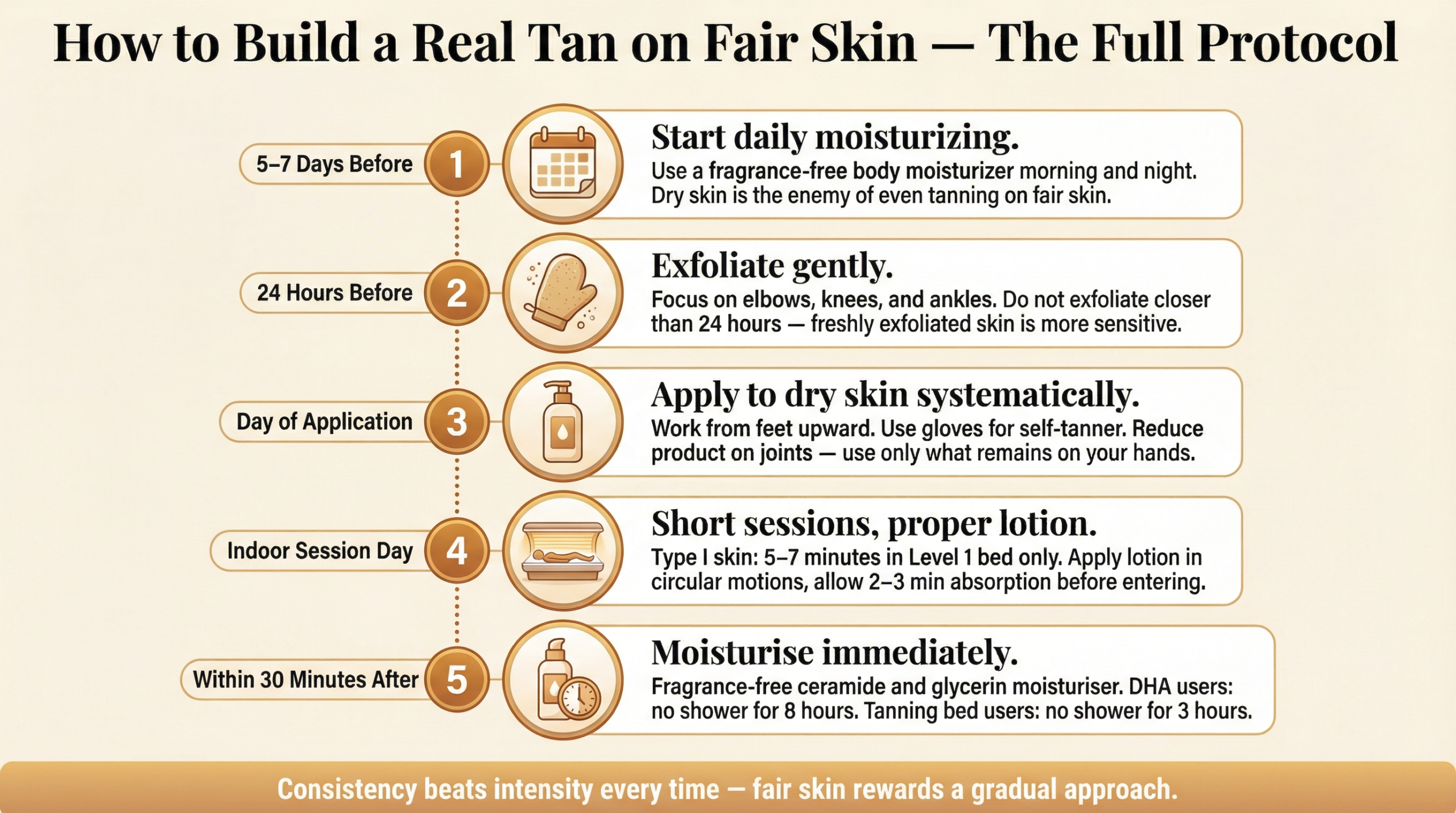
This is the sequence I walk fair-skinned clients through. The ones who follow it consistently get consistent results. The ones who skip steps get the orange results or burns they were trying to avoid.
5 to 7 Days Before You Start: Establish a daily moisturizing routine. Dry skin is the enemy of even tanning on fair skin. Use a fragrance-free body moisturizer morning and night before your first session or application.
24 Hours Before Each Session or Application: Exfoliate with a gentle physical exfoliant or mitt. Focus on elbows, knees, ankles, and any visibly dry areas. Do not exfoliate closer than 24 hours to your session — freshly exfoliated skin is temporarily more sensitive.
Day of Application (Gradual Tanner or DHA Bronzer): Apply to completely dry skin immediately after showering. Use disposable gloves. Work systematically from feet upward, blending each section before moving to the next. Reduce product quantity on joints using only what remains on your hands from the surrounding area.
Day of Indoor Tanning Session: Arrive with clean, product-free skin. Apply lotion in circular overlapping motions with noticeably less on elbows, knees, and ankles. Allow 2 to 3 minutes for absorption before entering the bed. Keep first sessions short for Type I skin; 5 to 7 minutes in a Level 1 bed is the appropriate starting point.
Post-Session and Post-Application: Apply a fragrance-free body moisturizer with ceramides and glycerin within 30 minutes. Avoid showering for 3 hours after a tanning session or 8 hours after DHA application.
Session Spacing: For indoor tanning with fair skin, every two days gives better results than daily sessions. Melanin response needs completion time between sessions. For gradual tanners, daily application for the first week followed by every other day maintains the result.
Skin Type Matching
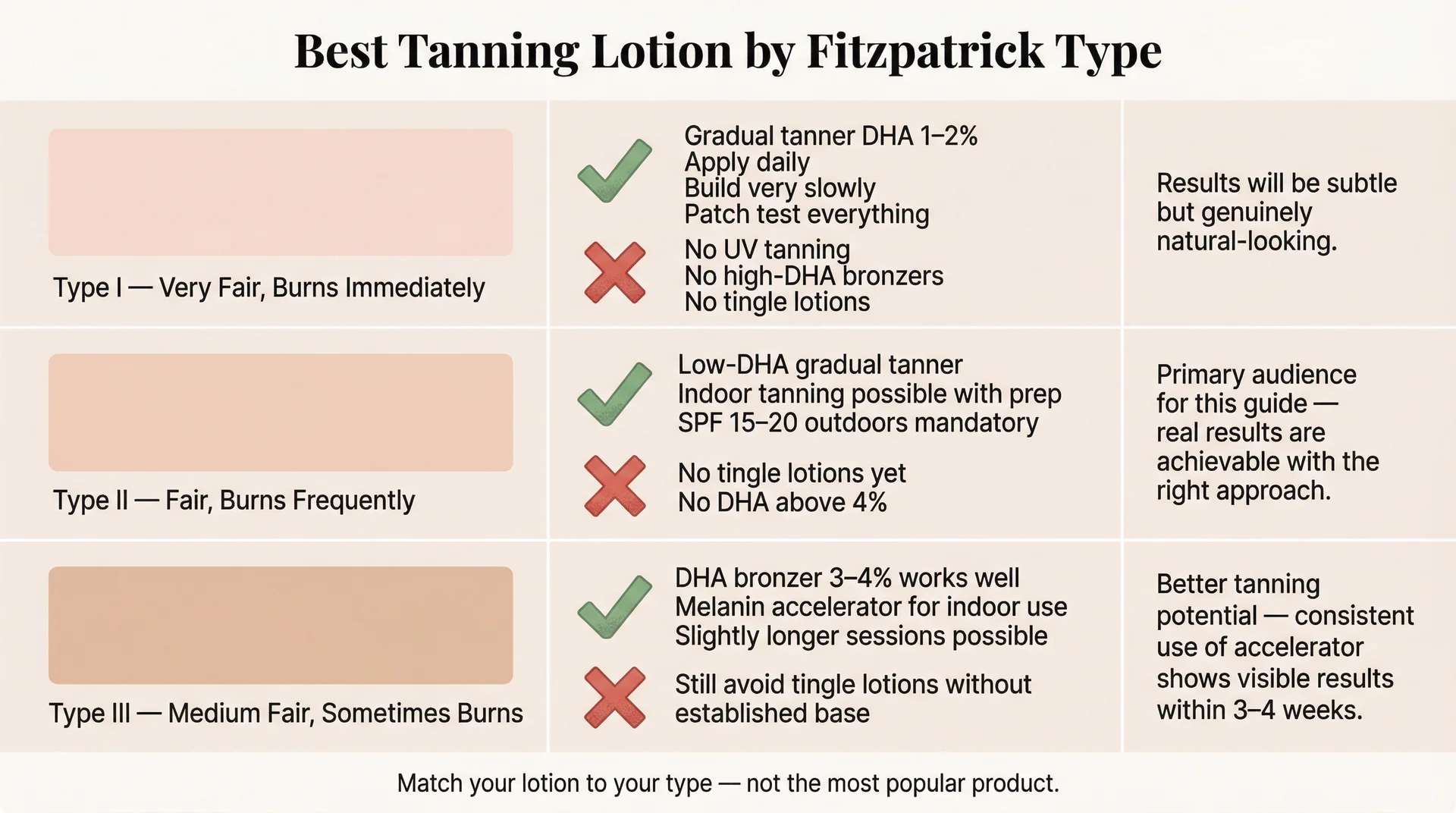
| Skin Type | Key Characteristics | Recommended Approach | DHA % Range | Additional Guidelines |
|---|---|---|---|---|
| Type I: Very Fair, Burns Immediately | Extremely fair, always burns | Avoid UV tanning; use gradual self-tanners only | 1% – 2% | Apply daily and build slowly; patch test everything; expect subtle, natural results |
| Type II: Fair, Burns Frequently | Fair skin, burns easily | Use low-DHA tanners; cautious indoor tanning is possible | Low (gradual) | Use an accelerator; increase session time slowly; SPF 15–20 for outdoor exposure |
| Type III: Medium Fair, Sometimes Burns | Light-medium skin, occasional burns | DHA bronzers + indoor tanning for base tan development | 3% – 4% | Slightly longer sessions are okay; use melanin accelerator; visible results in 3-4 weeks |
Post-Tan Skin Care for Fair Skin
Fair skin loses color faster than deeper tones because melanin density is lower, and the stratum corneum turns over quickly. Post-tan care is what closes the gap between the tan you build and the tan you keep.
Within 30 minutes of your session or application: Apply a fragrance-free body moisturizer with ceramides and glycerin. These rebuild the lipid barrier and slow the surface cell turnover that fades color.
Daily between sessions: Moisturize morning and night. This is the single highest-return habit for fair-skin tanners. Consistently hydrated skin exfoliates more slowly and visibly holds color longer.
Shower habits that protect your tan: Lukewarm water, sulfate-free body wash, and minimal shower duration on tan days. Sulfate cleansers are significantly more aggressive on the stratum corneum and visibly accelerate tan fading on fair skin over time.
Weekly maintenance: Light exfoliation once per week, once your color is built. This keeps the surface even and prevents the patchy fading that makes self-tanner results look unnatural. Follow immediately with your moisturizer.
Common Mistakes That Cost Fair-Skinned Tanners Results
Starting with high-DHA formulas. The most common cause of the orange result is what puts people off tanning permanently. Always start at the lowest DHA concentration available.
Over-tanning too early. More sessions per week do not mean more color on fair skin. It means more inflammation. Every two days is the productive maximum.
Skipping the prep. Exfoliation and hydration are the foundation of an even result. Skipping them and blaming the product is the pattern I see most often.
Using warm-toned bronzers with cool undertones. The undertone conflict creates the artificial look people mistake for their skin “not being suitable for tanning.” It is a formula mismatch, not a skin limitation.
Myths About Fair Skin and Tanning
“Fair skin just cannot tan.” Type II and Type III fair skin have real tanning potential. The issue is almost always approached rather than biology. Fair skin tans slowly and responds to gradual, consistent effort, not aggressive sessions or high-concentration products.
“SPF in a tanning lotion defeats the purpose.” Moderate SPF allows tanning at a pace your skin can handle and prevents the burn-reset cycle that keeps resetting your progress. For fair skin outdoors, SPF is a feature, not a limitation.
“The darker the bronzer, the better the result.” Higher concentration produces orange results on fair skin. The best outcome comes from lower-concentration formulas applied consistently and carefully.
Frequently Asked Questions
Can fair skin really tan, or will it just burn?
Type II and Type III fair skin have genuine tanning potential with the right protocol.
Type I skin has very limited melanin capacity but can achieve a subtle, natural-looking result with low-concentration gradual tanners over time.
The key is matching your approach to your actual biology.
What is the best tanning lotion for pale skin that does not go orange?
A gradual tanner with DHA at 2% to 4% and erythrulose as a secondary agent. If you have cool or pink undertones, specifically look for formulas with violet or green color correctors.
The orange result is a DHA concentration mismatch and undertone conflict, both of which are avoidable.
What is the best drugstore tanning lotion for fair skin?
Jergens Natural Glow in the Fair to Medium shade is the benchmark entry point for most fair skin types. Neutrogena Build-A-Tan and Coppertone Glow Gradual are solid alternatives at the same price range. All three sit in the DHA concentration range appropriate for lighter skin.
How long does it take to build a tan on fair skin?
With consistent tanning bed sessions every two days and a quality accelerator, most Type II skin will see meaningful color within 3 to 4 weeks. With a daily gradual tanner, visible color typically appears within 5 to 7 days and deepens over 2 to 3 weeks of consistent use.
Why does my tan fade so fast on fair skin?
Fair skin has a thinner stratum corneum that turns over quickly, and lower melanin density means less pigment reserve when that happens. Daily moisturizing is the most effective way to extend your tan.
Also, switch to a sulfate-free body wash; sulfate cleansers strip color noticeably faster.
Can I use a tanning lotion on my face if I have fair skin?
Do not use body tanning lotions on the face. The face has thinner, more reactive skin and a different amino acid distribution.
DHA behaves differently there, and the risk of uneven, reactive results is significantly higher.
Use a dedicated facial self-tanner at the lowest available DHA concentration and always patch test first.
What should I do if my self-tanner looks orange on my fair skin?
Stop using the product, moisturize heavily to begin natural fade, and gently exfoliate after 24 to 48 hours.
For future applications: lower DHA concentration, cool-tone color correction in the formula, thorough exfoliation beforehand, and lighter application layers.
The orange result is almost always a concentration mismatch combined with inadequate prep.
Should I use SPF in my tanning lotion if I have fair skin?
For outdoor tanning, yes, absolutely, SPF 15 to 30 is the sweet spot. For indoor tanning beds, SPF-containing products are not appropriate because they are not formulated for UV lamp exposure.
Are tingle lotions safe for fair skin?
Avoid them unless you have at least 8 to 10 sessions of an established base tan and no skin sensitivity or inflammatory skin conditions. For most fair-skinned tanners, the inflammation risk outweighs the color-deepening benefit.
A Final Note on Fair Skin and Sun Safety
I want to close with something I tell every fair-skinned client because it matters more than any product recommendation.
Fair skin carries a statistically higher risk of UV-related skin damage over a lifetime precisely because its melanin protection is lower.
That does not mean you cannot pursue a tan. It means the approach and the aftercare deserve more attention than they typically get.
Every recommendation in this guide prioritizes skin health alongside color goals, because the two are not in opposition.
A well-hydrated, barrier-supported skin tans more evenly, holds color longer, and sustains fewer long-term consequences from UV exposure than skin that is constantly burned, dried out, and reset.
Choose products that work with your skin biology, build gradually, and treat your skin barrier as something worth protecting. The result from that approach is one that actually lasts.