
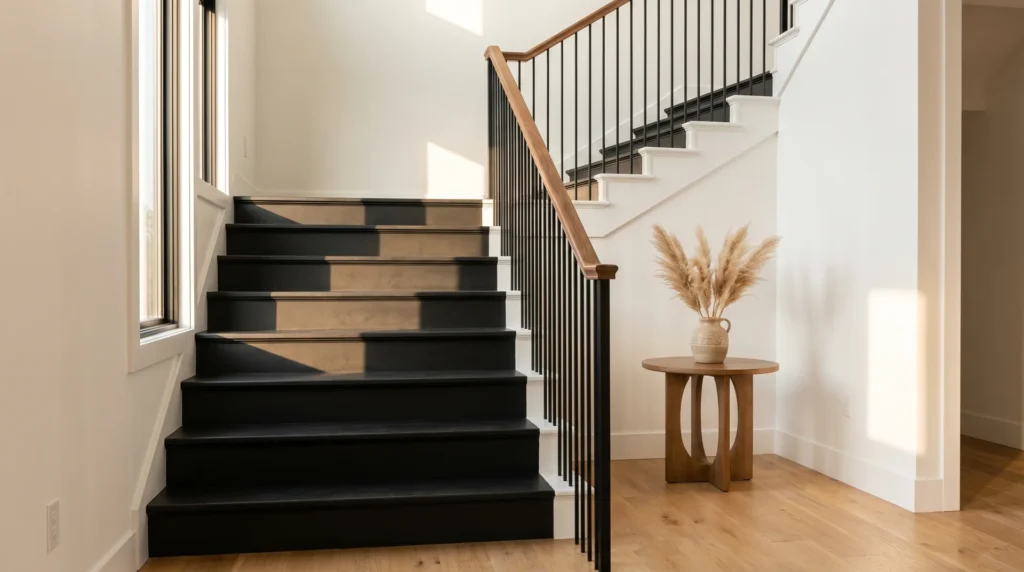
You’ve probably been staring at your staircase longer than you’d admit. It sits in the center of your home, visible from the front door, connecting every floor, and doing absolutely nothing interesting.
You’ve seen black painted stairs in renovation blogs, on Instagram, maybe in a home that stopped you mid-conversation. And now you’re here, half-convinced and half-worried that it’ll make the whole hallway feel like a cave.
I’ve specified black paint on staircases across projects ranging from airy colonial entry halls to tight townhouse stairwells. My answer is always the same: it depends entirely on what surrounds the stairs, and on which parts of them you paint.
Get those two things right, and black transforms a staircase from a functional afterthought into the most deliberate-looking move in your home.
Does Black Paint Make a Staircase Look Smaller?
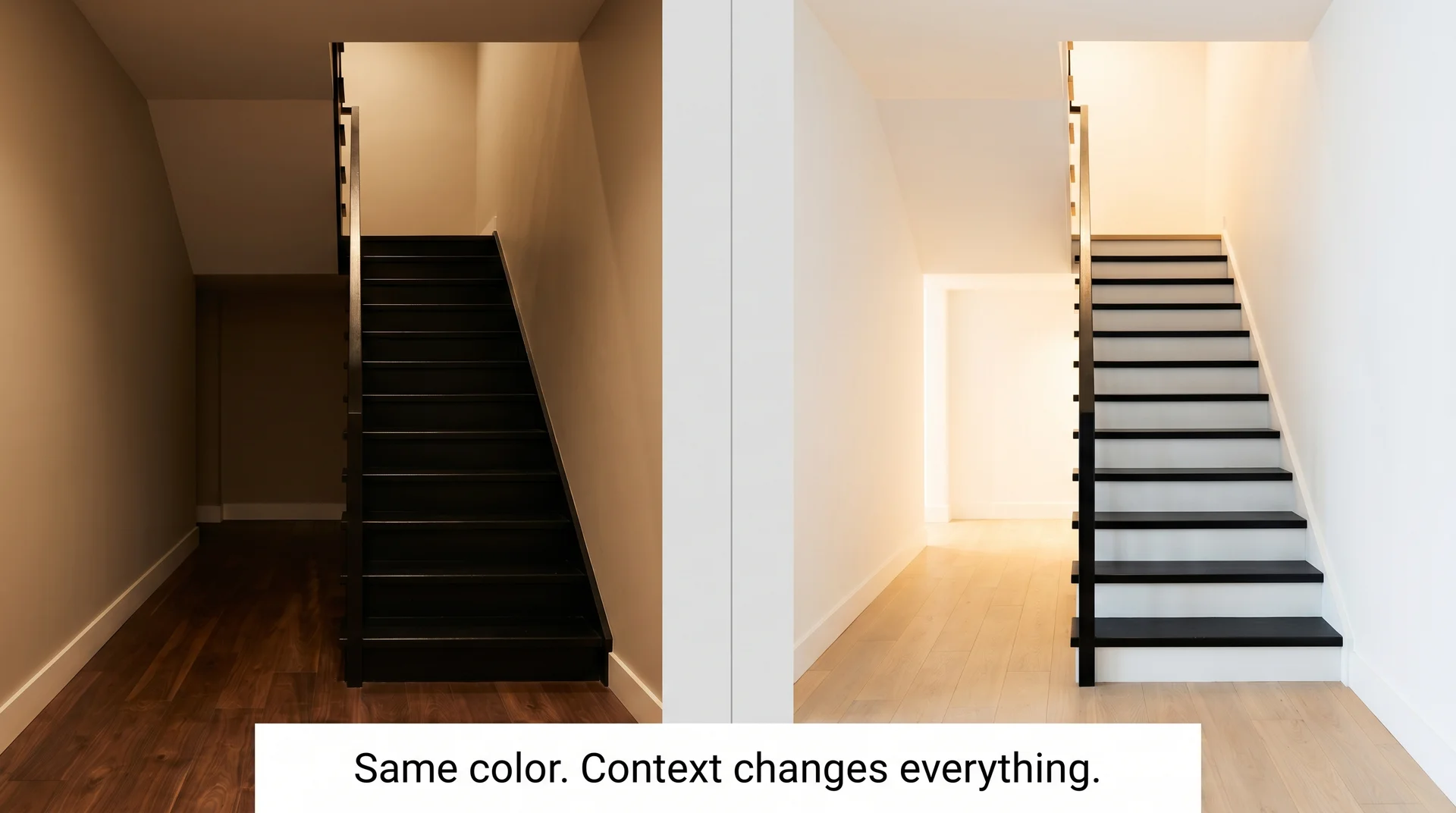
This is the question that stops most people, and it deserves a straight answer before anything else.
Dark colors recede visually. A black staircase doesn’t push forward into a room the way a pale one does. It pulls back, becomes grounded, and lets the surrounding space feel brighter and more open by contrast. Your eye reads the graphic line of each tread quickly and moves past it, instead of dwelling on a muddled mid-tone sitting heavily in the center of your field of vision.
A black staircase doesn’t darken a room. It defines one.
The logic holds when the surrounding walls are white or light, the floor creates contrast, and there’s reasonable natural light reaching the stairwell.
Where it breaks down is in a genuinely enclosed stairwell with low ceilings, no windows, and walls already painted a mid-tone. In that configuration, any dark paint amplifies compression.
Before you open a single can, spend ten minutes assessing your space honestly.
A quick self-assessment before you paint:
- Walls: White, bright off-white, or pale neutral? You’re in a good position. Mid-tone beige or taupe? Black stairs will fight them. (If you’re also thinking about adding wall treatment to your stairwell, like board and batten or wainscoting, both work well alongside black-painted stairs, though the right choice depends on your ceiling height and the style of your home.)
- Ceiling height: Standard or higher is fine. Anything that already feels compressed warrants caution.
- Natural light: Even one south-facing window changes the equation considerably.
- Floor color: Light hardwood, pale tile, and off-white LVP create a strong contrast with black treads. Dark floors absorb the black into a murky whole.
- Existing railing: A warm wood railing anchors the space well. An already-dark or black railing can tip the balance too far.
If three or more of these work in your favor, black painted stairs will very likely improve your space. If most of them work against you, a black railing-only treatment is the smarter starting point, and it’s covered below.
Black Painted Stair Ideas Worth Borrowing
Black Treads, White Risers
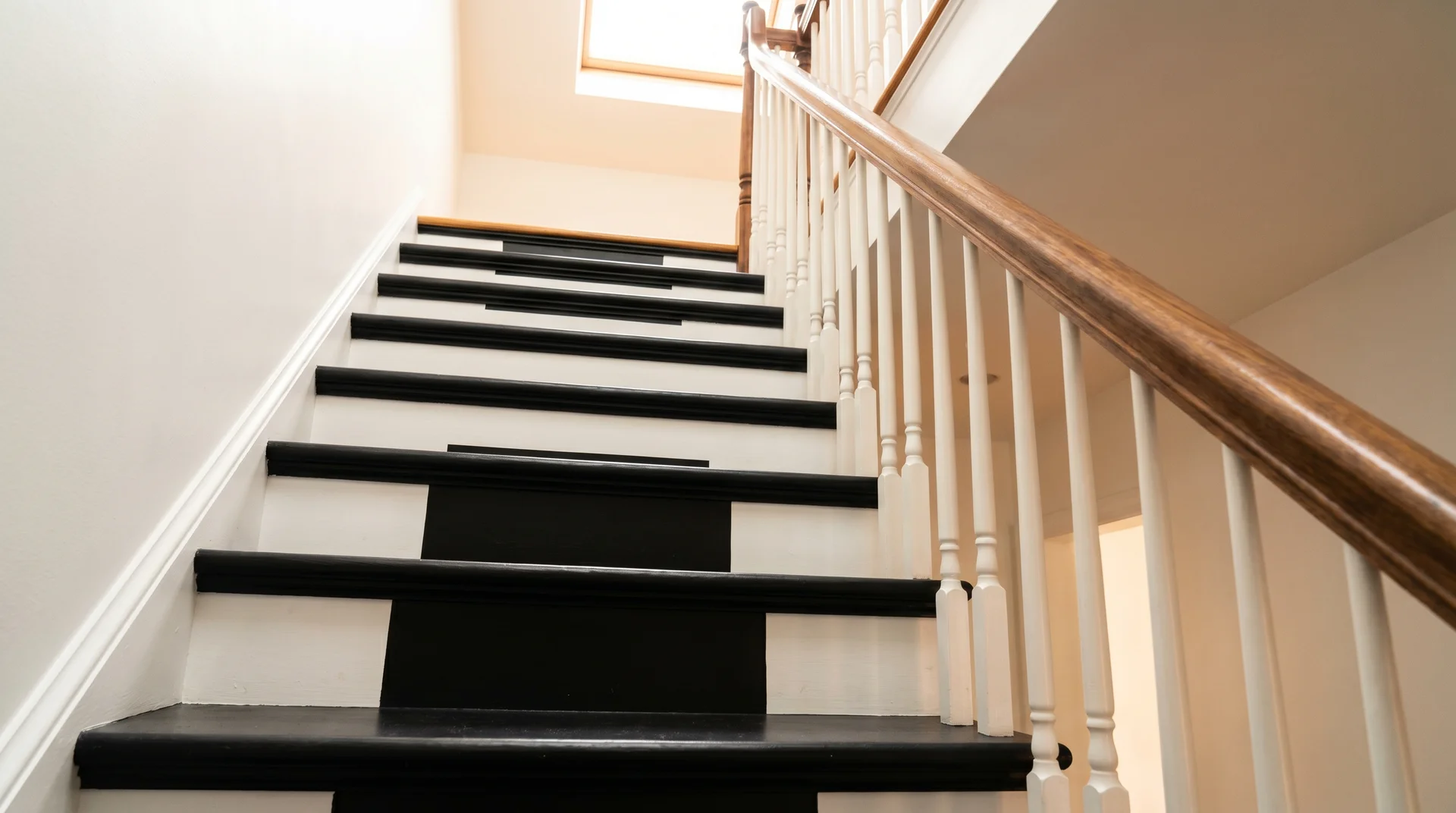
This is the combination you’ve almost certainly seen, and it earns its popularity. Black treads paired with crisp white risers create a graphic, architectural effect that reads clearly from across a room.
Your eye follows the horizontal line of each tread, which visually elongates the staircase and draws attention upward.
It suits transitional homes, modern farmhouses, and contemporary interiors, and works in most traditional spaces where the railing has enough visual interest to carry its weight.
The proportion matters more than most people expect. The quality of the black paint and the sharpness of the transition line between tread and riser will define whether this looks deliberate or amateurish.
Tape carefully, resist the urge to rush the edge cuts, and let each coat dry fully before you pull the tape.
For anyone pulling carpet off existing treads and repainting, this is one of the most dramatic before-and-after transformations in residential design for a few hundred dollars and a long weekend.
The one finishing detail worth sorting before you declare the project done is the trim at the very base of the staircase, where the bottom riser meets the floor.
Shoe molding or quarter roundat that junction is what separates a finished renovation from one that still looks like a work in progress at the bottom step.
All-Black Treads and Risers
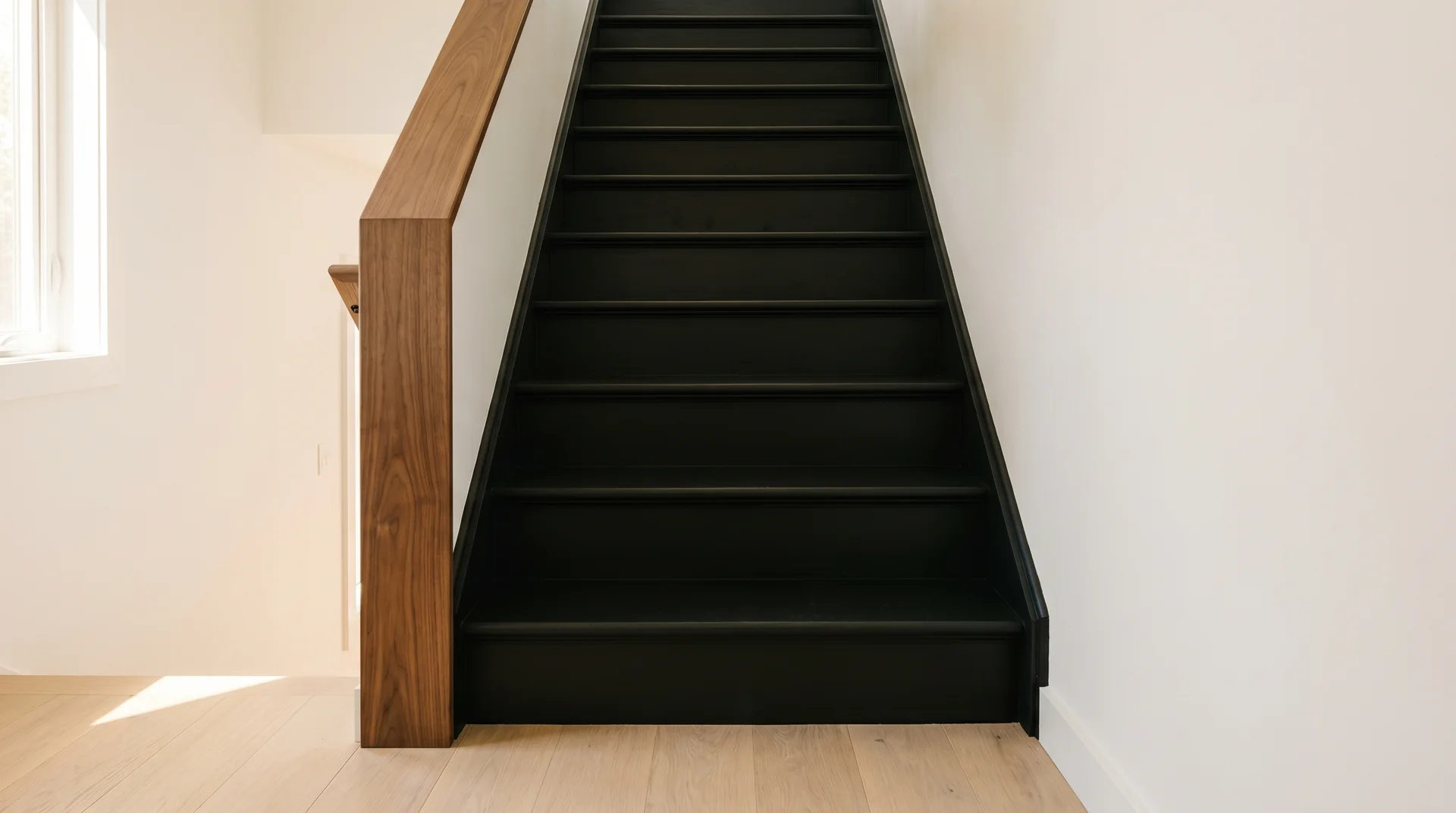
Painting both treads and risers the same black creates a completely different effect. The staircase becomes a single sculptural form rather than a series of contrasting layers. It works best against very light walls, a light floor, and a natural wood or painted white railing to break the visual mass.
One practical note: matching tread and riser in the same black can reduce the visual clarity between individual steps.
A satin finish on the treads paired with a matte finish on the risers creates a subtle sheen contrast that defines each step without introducing a second color.
I’ve seen this work beautifully in homes with modern architecture where the staircase is a feature by itself, and fall flat in traditional homes where the scale of the staircase needed the relief of a lighter color. Read your architecture before you decide.
Black Spindles and Railings Only
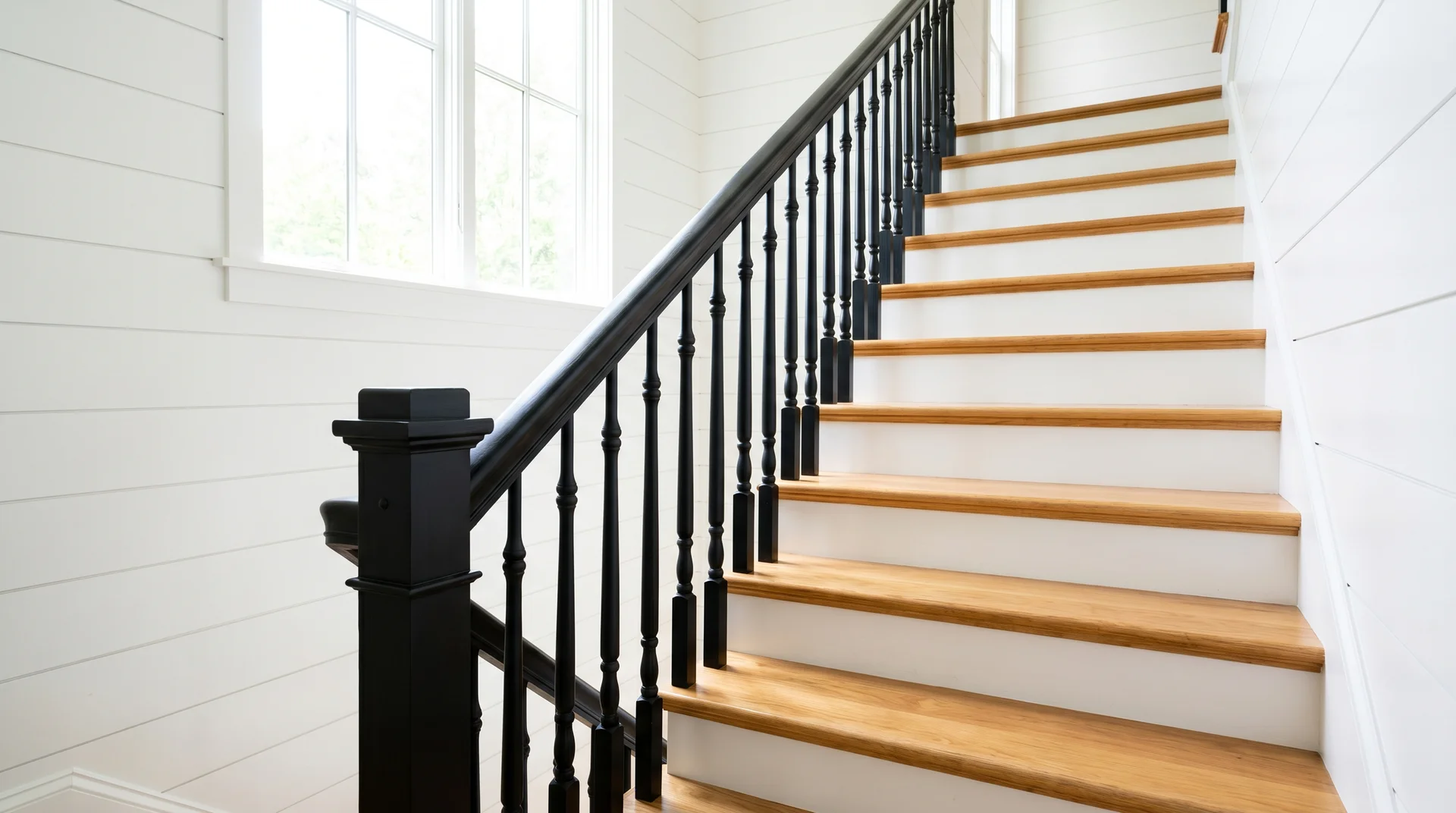
If painted treads feel like too large a commitment, the railing-only treatment is a genuinely effective alternative. Black spindles, handrail, and newel post against white risers and natural wood treads create a graphic framework that changes the character of a staircase without touching the floor surface.
This works especially well in traditional homes where ornate turned spindles benefit from being grounded in a dark color rather than blending into white woodwork.
It’s also the right move for anyone who wants the look before they’re ready to sand and seal a full set of treads.
The Painted Black Runner Effect
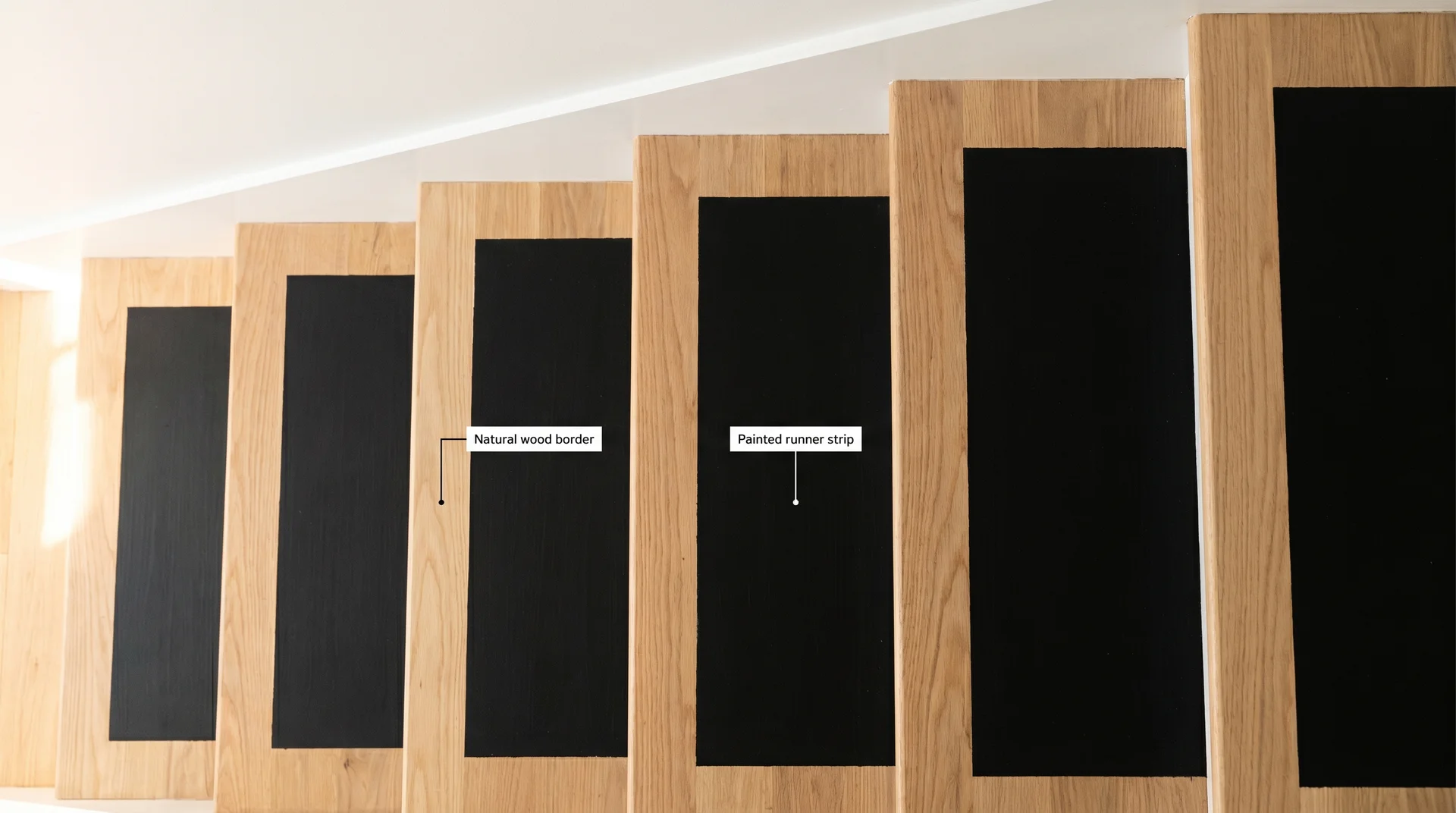
This technique is underused and genuinely striking. Tape off a centered strip down the middle of each tread, roughly 20 to 24 inches wide, paint it black using floor enamel, and leave the outer edges in white or natural wood.
The result reads as a stair runner from across the room, adds warmth and a layered feel, and costs a fraction of actual carpet. The execution requires good taping, a steady eye for centering, and patience to let each coat cure before pulling the tape.
Black with Natural Wood
A black painted staircase with a natural wood handrail is the combination that prevents the space from reading cold. Wood introduces warmth and material contrast that softens the graphic quality of black considerably.
A warm honey oak or walnut handrail against black treads creates a classic, rich look. A cool gray-toned ash reads more contemporary. Either works, but they read differently, so consider which direction suits the rest of your home first.
Which Parts of Your Stairs Should Be Black: A Designer’s Decision Guide
A standard staircase has three zones.
The tread zone is the horizontal surface you step on, including the nosing (the front edge extending beyond the riser below). This is the highest-wear surface and where paint choice matters most.
The riser zone covers the vertical faces between treads. These receive far less foot traffic and can be painted with standard trim paint.
The balustrade zone includes spindles, handrail, newel posts, and stringer boards along the sides.
| Your Situation | Recommended Approach |
|---|---|
| White/light walls, good natural light, light floors | Full black treads and risers, or treads only |
| White walls, medium light, warm wood floors | Black treads, white risers, natural wood handrail |
| Limited natural light, standard ceiling height | Black spindles and handrail only |
| Narrow enclosed stairwell | Black handrail only, or deep charcoal as a softer alternative |
| Modern home with bold architecture | All-black treads and risers as a monolithic statement |
| Traditional home with ornate spindles | Black spindles and newel posts, white risers, natural treads |
And if full black feels like too large a step, charcoal gray, deep navy, or dark forest green create the same grounding effect with slightly less commitment. Several of my clients have landed on these as a midpoint and never felt the need to go darker.
Iron Ore SW 7069 is the charcoal I’ve specified most often in this situation. It is dark enough to read as a real design decision, with enough dimension to feel distinct from flat black in the same way a near-black like Wrought Iron does, but in a Sherwin-Williams formulation at LRV 27.
How black treads sit against your existing floor matters too. Light hardwood (pale oak, maple, ash) and light tile create the cleanest contrast.
Warm medium-tone hardwood works well when the walls are white. Dark floors require white risers to create separation between the stairs and floor.
Very dark LVP or hardwood can merge with black treads into a heavy mass at floor level if you don’t introduce a lighter element somewhere.
The Best Black Paint for Stairs That Actually Holds Up
Why Regular Wall Paint Will Fail You on Stair Treads
Stairs get hit harder than almost any other surface in a home. The nosing of each tread, where heel strike concentrates, takes thousands of impacts a year.
Regular latex wall paint, even premium-grade, isn’t formulated for this level of abrasion. It scuffs within weeks and begins peeling within months.
The right paint upfront saves you a full re-sanding and repaint job within a year.
The Paint Types That Hold Up on Stair Treads
Porch and floor enamel is the most accessible option and works well for most residential staircases. Both Sherwin-Williams and Benjamin Moore make strong porch and floor enamels that cure to a hard, durable finish with water-based cleanup.
Water-based urethane-modified acrylic paints combine the easy cleanup of latex with the hardness of urethane. Sherwin-Williams ArmorSeal Tread-Plex is the most widely recommended product in this category, performs reliably in high-traffic homes without a separate topcoat, and is available at most Sherwin-Williams stores.
Oil-based floor enamel creates the hardest film of any paint option. The trade-offs are longer drying time, mineral spirits for cleanup, and stronger odor, so ventilation is mandatory. For heavily trafficked stairs, it’s worth the extra effort.
Two-part epoxy paint is the most durable option available. It requires precise mixing and has a limited application window once mixed, but the cured surface is near industrial-strength. This is the premium choice for stairs in very busy households.
For risers, standard interior trim paint in semi-gloss or satin is sufficient. They receive minimal foot contact, so durability is far less critical there than on treads.
A brief safety note: painted stair treads can be slippery, particularly with glossier finishes. Mix a non-slip additive into your final coat of tread paint, or choose a paint that includes fine grit in its formula. This is especially worth considering in homes with young children, older adults, or pets.
Which Finish Sheen to Choose for Black Stair Treads
| Finish | Durability on Treads | Cleanability | Best For |
|---|---|---|---|
| Eggshell | Low | Moderate | Risers and balustrades only, not treads |
| Satin | Good | Good | Most residential treads, hides minor flaws |
| Semi-gloss | Very good | Excellent | Sharp, graphic look; shows scuffs more |
| Gloss | Excellent | Excellent | Very controlled installs; reveals every imperfection |
Satin is the recommendation I give consistently for treads. It’s durable enough for daily traffic, hides the minor scratches and grain variations that black paint can amplify, and doesn’t create a surface that draws attention to every scuff. Semi-gloss works well if you want a sharper, more graphic look and you’re committed to regular wiping. Eggshell is the wrong call for treads: it won’t last. For risers and balustrades, semi-gloss gives the cleanest, most durable result.
Black Paint Shades Worth Knowing by Name
Not all blacks read the same on a large surface like a staircase.
- Sherwin-Williams Tricorn Black (SW 6258): A true, balanced black with no strong warm or cool undertone. The most commonly recommended black for high-contrast interior applications. In the ArmorSeal Tread-Plex formulation, it’s a strong choice for stair treads specifically.
- Benjamin Moore Onyx (2133-10): Reads slightly softer than Tricorn Black, with a very subtle warm undertone. More forgiving in homes with warm wood tones and traditional architecture.
- Valspar Kettle Black: A porch and floor formula that performs well at a lower price point. Neutral true black, available at most Lowe’s stores.
- Benjamin Moore Wrought Iron (2124-10): Near-black with a barely-there blue-charcoal undertone. In strong natural light, it shows depth rather than reading flat. A good choice if you want the statement without the severity of a true black.
Do You Need a Topcoat Over Black Stair Paint?
Porch and floor enamels, water-based urethane-modified acrylics, and oil-based floor enamels generally don’t need a separate topcoat.
The protective layer is built into the formulation.
Two-part epoxy needs nothing over it. If you use a standard latex or chalk-style paint for any reason, a topcoat of oil-based polyurethane or water-based polycrylic is the only thing standing between the paint and the wear stairs produce.
Apply it in thin coats, sand lightly between them with 400-grit paper, and allow full cure time before resuming normal traffic.
How to Prep and Paint Black Stairs Without Losing Your Mind
The prep determines whether the paint lasts three years or three months. It’s also where most DIYers cut corners and pay for it later.
The prep sequence for wooden stair treads:
- Clean everything. Degrease the treads with a TSP substitute or heavy-duty cleaner. Any oil or wax residue will prevent adhesion.
- Sand the treads. Start with 80-grit to remove the old finish or stain, then finish with 120-grit for a smooth, even surface. Vacuum thoroughly and wipe with a tack cloth.
- Fill any damage. Wood filler for knots, gaps, and worn edges. Sand smooth once dry.
- Prime. A shellac-based or oil-based primer (such as Zinsser BIN) is the most reliable choice for previously stained or glossy wood. Apply at least one coat to treads. Risers and balustrades can use a standard latex primer.
- Paint in thin coats. Two to three coats with light sanding between them using 400-grit paper. A high-density foam roller minimizes texture on the flat tread surface. Use an angled brush for edge cuts and nosings.
- Allow full cure time. Most floor enamels are dry to the touch in a few hours but take seven to ten days to reach full hardness. Treat them gently in that window.
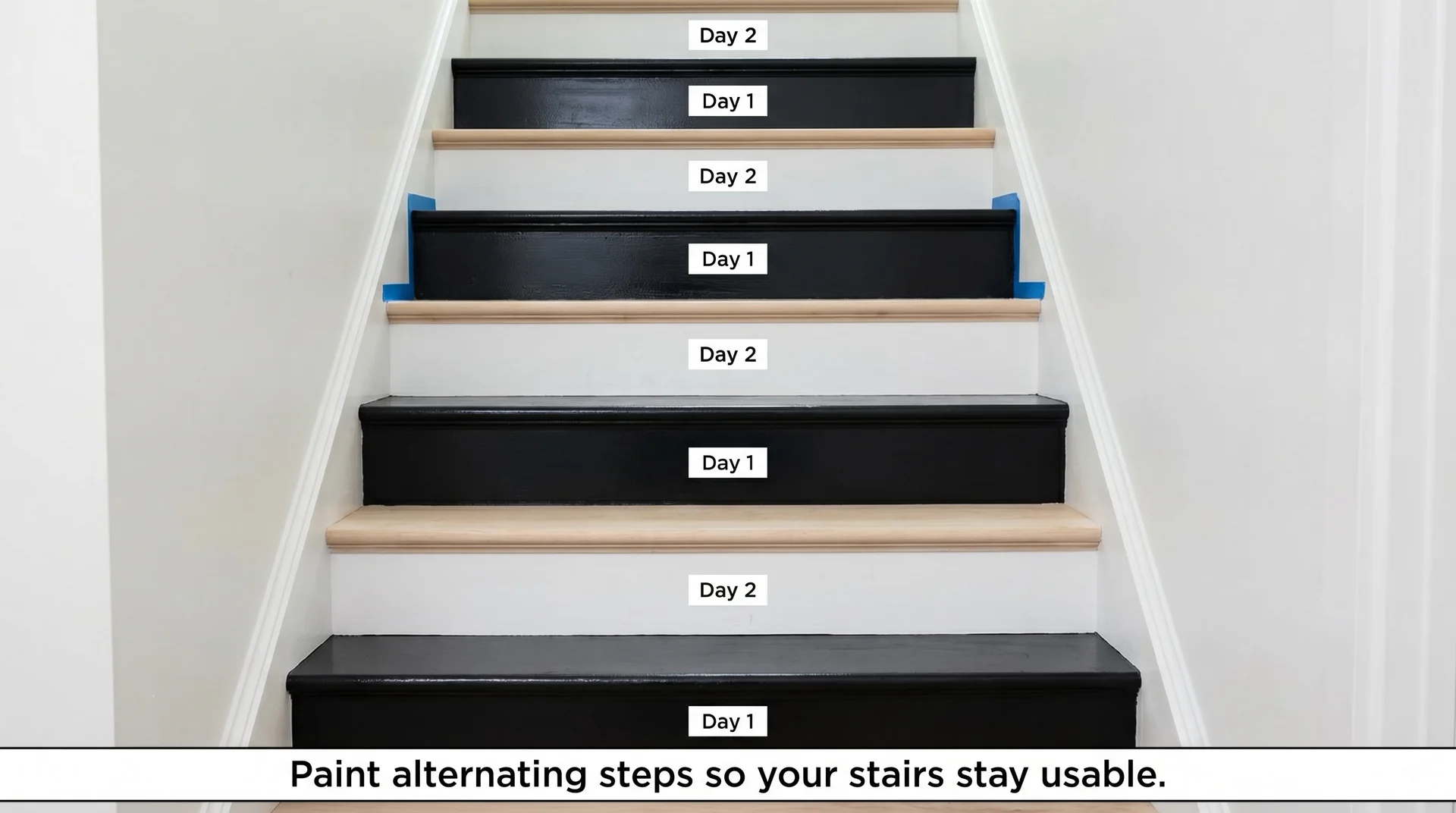
The every-other-step method: Paint alternating steps on day one, let them cure, then paint the remaining steps on day two. This keeps the staircase usable throughout the project. Mark which steps are wet with painter’s tape on the wall beside them so no one steps on fresh paint during the cure window.
What Living with Black Painted Stairs Actually Looks Like
Yes, Black Shows Dust
I’d rather give you an honest answer than an optimistic one. Black does show dust more visibly than white or medium-tone stairs, particularly on a matte or eggshell finish. Satin reduces it, but doesn’t eliminate it. Run a finger across a black surface in natural light after two days and you’ll see it.
The practical reality is manageable. Dust on black stairs responds immediately to a dry microfiber cloth or soft broom.
Compare that honestly to white risers, which show every shoe scuff, crayon incident, and dog paw mark your household produces. Most people with black stairs settle into two or three quick dry sweeps a week rather than waiting for a full cleaning session, and that trade-off feels worth it.
Touch-Ups and How Long Black Painted Stairs Last
The nosing of each tread shows wear first. With the right paint, targeted touch-ups are realistic: lightly sand the worn area, wipe clean, and apply one or two fresh coats of the same product. Touch-ups blend considerably better on black than on any pale finish. Save your paint, photograph the label, and note the exact color code and finish.
With proper prep and a floor-specific paint in satin or semi-gloss sheen, most residential households get three to five years of good-looking wear on the treads.
Families with young children, large dogs, or frequent heavy use should plan for the lower end of that range.
A stair runner over painted treads gets you the longest life of all, because the carpet protects the paint from direct wear while the black still shows cleanly at the outer edges of each tread.
How to Style Your Home Around Black Painted Stairs
Wall Colors That Work Best Next to Black Stairs
The wall color adjacent to a black staircase does more work than almost any other decision in the space. It needs to be light enough to create contrast, but warm enough that the combination doesn’t read clinical.
- Crisp white: The most effective choice. Benjamin Moore White Dove (OC-17) and Sherwin-Williams Alabaster (SW 7008) carry a barely-there warmth that prevents the cold, blue-white quality some whites take on in artificial light.
- Warm off-white: Suits homes with honey oak floors, brass hardware, or terracotta tile. Benjamin Moore Linen White (OC-146) performs well in this context.
- Light gray: Works in contemporary or Scandinavian-leaning homes. Sherwin-Williams Agreeable Gray (SW 7029) and Benjamin Moore Gray Owl (OC-52) are consistently strong performers here.
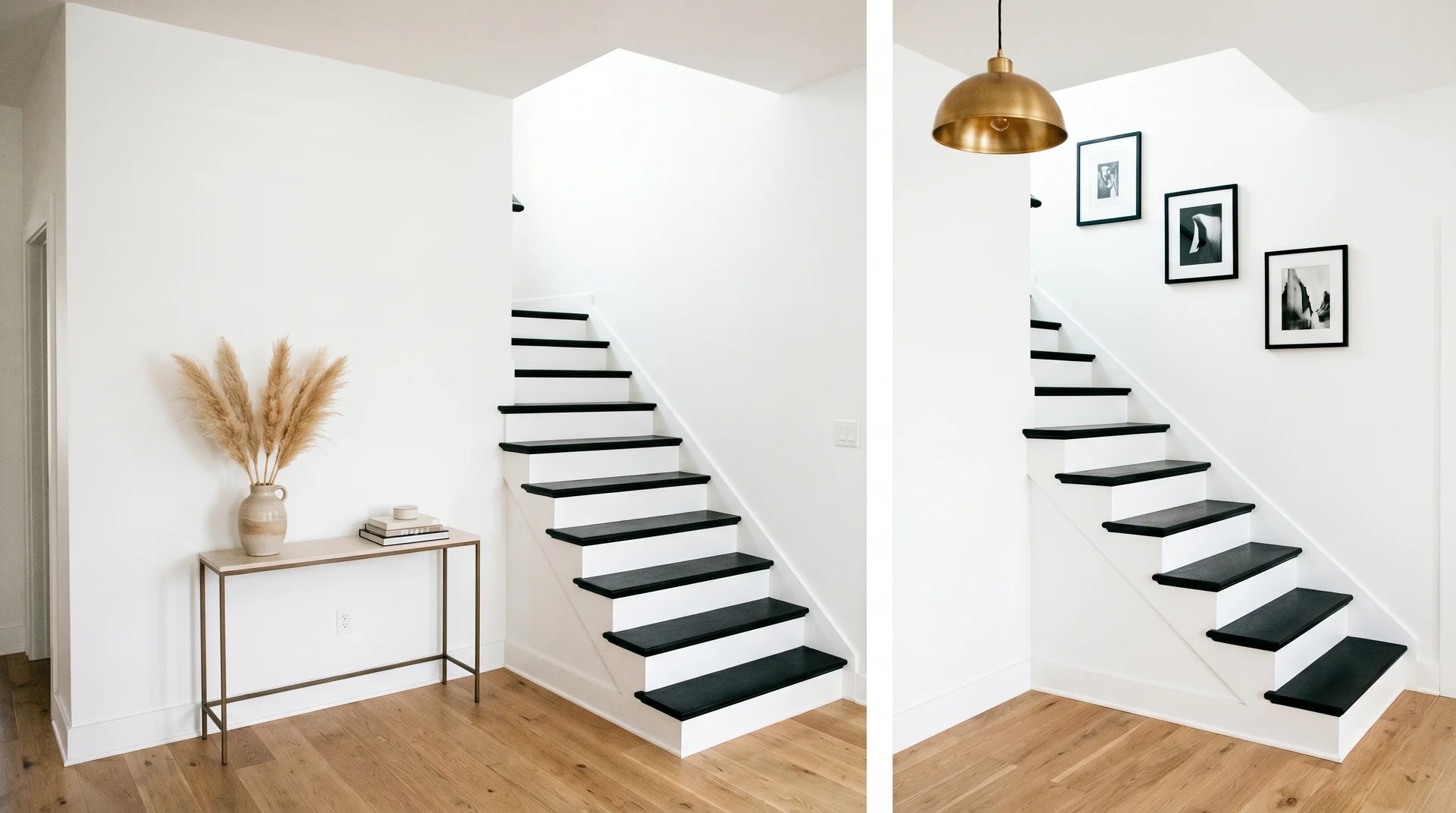
Avoid mid-tones. Any beige, tan, or medium gray on the staircase wall competes with black without providing enough contrast to make the staircase read clearly. The result looks heavy and unresolved rather than intentional.
If you’re unsure whether your current neutral qualifies, Accessible Beige SW 7036 sits at mid-range LRV 58.
You should learn exactly what that reflectance level means on a wall and whether it creates enough contrast to work alongside dark painted elements.
Stair Runners on Black Painted Stairs
A stair runner over black painted treads is one of the most successful combinations in residential stair design. The runner softens the graphic impact of the black, protects the painted surface, and adds warmth and texture that reads as collected and intentional rather than stark.
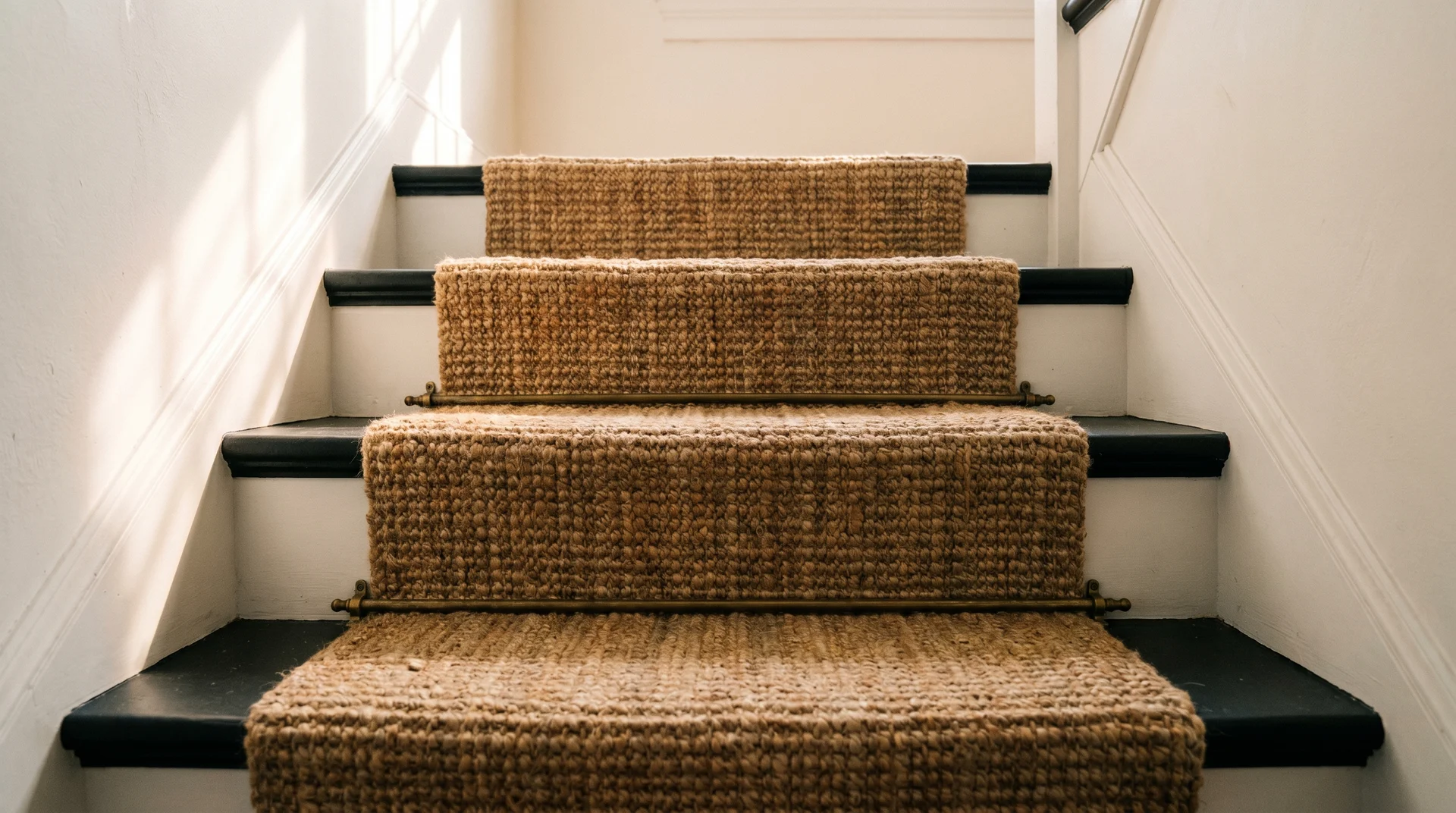
Natural fiber runners in jute, sisal, or seagrass are the most complementary choice. The material contrast between woven natural fiber and a satin-painted surface is genuinely beautiful in person.
Avoid very dark runners on black treads: they remove all the contrast that makes the combination interesting.
If you love a dark runner, shift to black treads with white risers so the runner has something light to play against.
Lighting Your Black Staircase
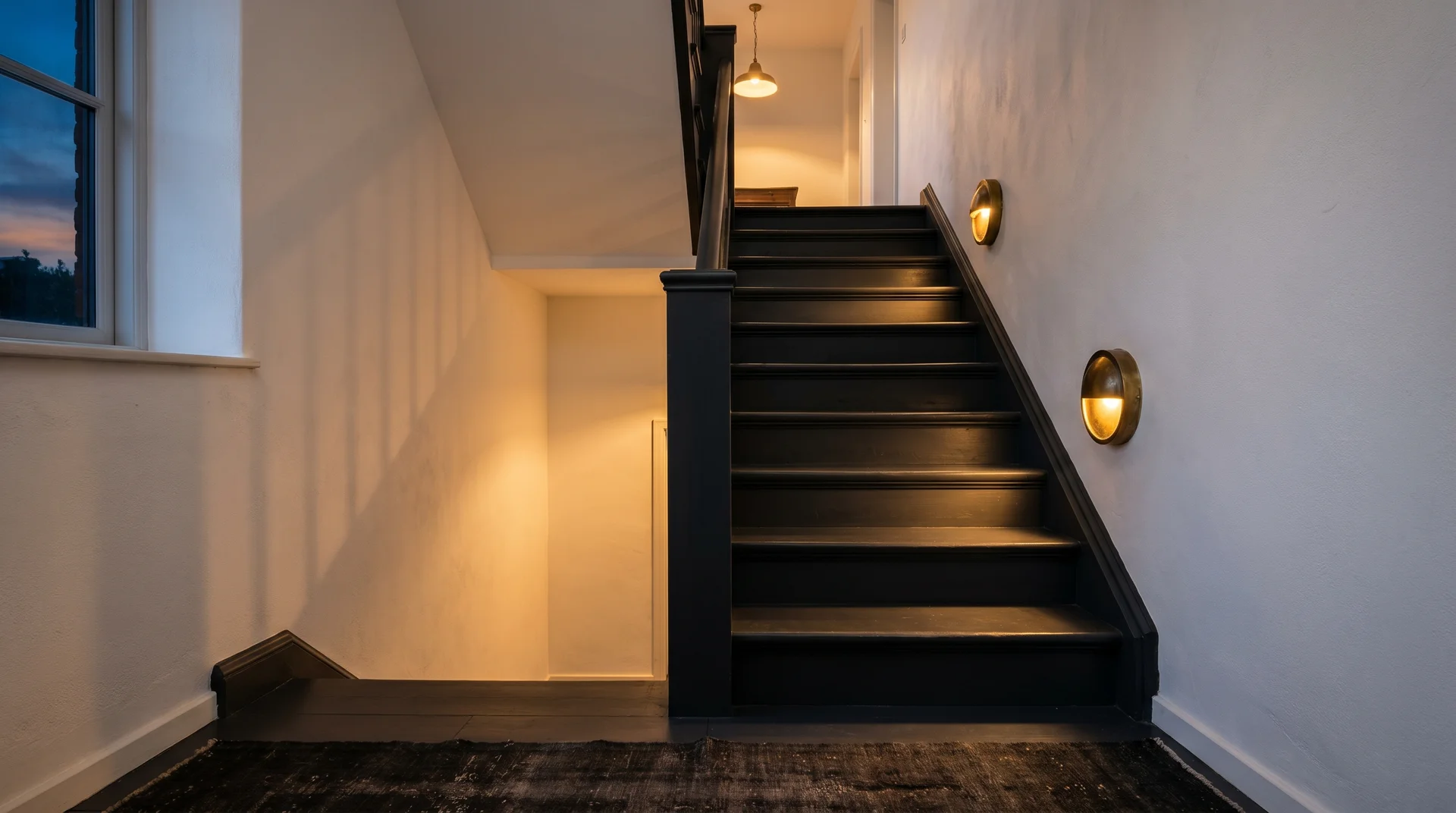
Lighting is almost always the last decision on a staircase project and almost always the one that determines whether the result looks dramatic or oppressive.
A black staircase without adequate light just looks dark. The same staircase with good light looks architectural.
- Wall sconces at intervals provide the highest single-fixture impact. One sconce per landing or every four to six steps creates a rhythm that draws the eye upward. Use warm-toned bulbs at 2700K to 3000K.
- A pendant or chandelier over the landing gives the eye a focal point and provides general illumination for the whole stairwell.
- Recessed step lighting inset into the riser face creates a subtle theatrical effect that reads especially well at night, giving each step visual separation and a sense of depth rather than darkness.
Frequently Asked Questions
Is painting stairs black a good idea?
Yes, for most homes with white or light walls, adequate natural light, and a floor color that creates contrast with black treads.
The combination improves the architectural presence of the staircase and tends to hide general wear better than lighter finishes.
Homes with very dark walls, low ceilings, and minimal natural light should start with a partial treatment, such as spindles and handrail only.
What is the best paint to use on wooden stair treads?
Sherwin-Williams ArmorSeal Tread-Plex in a satin finish is the most consistently recommended product for DIY stair projects. It’s formulated for high-traffic surfaces, requires no separate topcoat, and cleans up with water. For maximum durability, oil-based floor enamel or two-part epoxy delivers a harder film.
Does painting stairs black make the hallway look smaller?
It can, but it usually doesn’t, provided the walls are white or light and the space has some natural light. Dark color recedes visually, which tends to make the surrounding area feel brighter and more open by contrast. A dark staircase in a dark hallway is the configuration to avoid.
Can I paint just the treads black and leave the risers white?
Yes, and this is one of the most successful two-tone combinations available. Use floor-specific paint on the treads and a semi-gloss trim enamel on the risers. Tape carefully at the joint between them for a sharp, clean transition line.
How long does painted staircase paint last?
With proper prep and the right paint, three to five years is realistic for treads in a standard family household. The nosing of each tread wears first and can usually be spot-repaired. Risers and balustrades last considerably longer because they receive far less direct contact.
Do black stairs show dust more than lighter ones?
Yes, particularly on matte or eggshell finishes. Satin is easier to manage. Most households find that two or three quick dry sweeps a week keeps the staircase looking clean. In practice, white or pale stairs show scuffs and marks from daily traffic just as readily, just in a different way.
How do I use my stairs while the paint is drying?
Use the every-other-step method: paint alternating steps on day one, let them cure, then paint the remaining steps on day two. Mark wet steps with painter’s tape on the adjacent wall. Never walk on fresh tread paint, and give the paint at least 24 hours before light foot traffic and a full seven to ten days before normal heavy use.
Final Thoughts
Your staircase is one of the few places in a home where a single paint decision creates a shift that reads architectural rather than decorative.
Done right, black painted stairs cost a fraction of what most renovations demand, and the result lasts years with minimal upkeep.
Get the prep right, choose the right paint, and the rest follows more easily than you’d expect.