
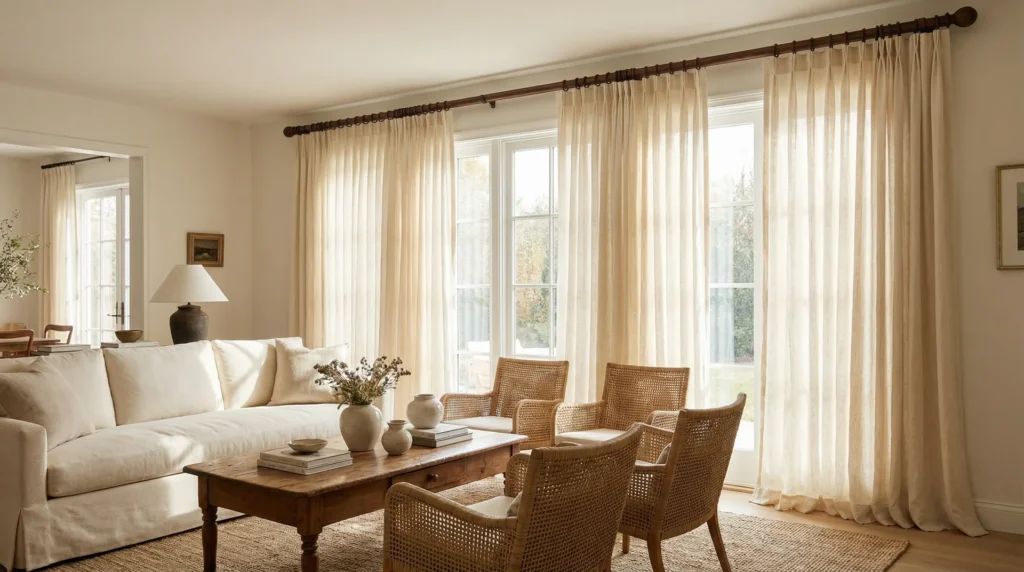
A close friend of mine once pulled brand-new curtains across a beautiful bay window, and it made my stomach drop. The curtains were gorgeous on the hanger. On the window, they looked like two thin strips of fabric that barely kissed each other in the middle.
She had measured the window, chosen a lovely linen blend, and ordered the right length. The width? She had guessed. We all guess, until we learn not to.
So let me give you the answer before anything else.
Curtains should be 1.5 to 3 times the width of your curtain rod, and your curtain rod should extend 6 to 12 inches beyond each side of your window frame. For most homes and most fabric types, a fullness ratio of 2x works beautifully as a starting point.
If your curtain rod measures 60 inches across, you want a total curtain width of 90 to 180 inches across all panels combined. Everything below helps you land precisely within that range based on your fabric, your room, and your windows.
Why Getting Curtain Width Right Changes the Entire Room
Curtains that are too narrow look flat and apologetic. They hang without movement or depth, and when you close them, they leave gaps along the edges that let light creep in. Getting the width right is what creates that “those look expensive” reaction in a room.
Over a decade of residential design work has taught me that curtain width carries enormous visual weight. A client once told me after we resized her dining room curtains, “I spent the same amount of money, but the room looks completely different.” We had only adjusted the fullness, and the space felt pulled together in a way it never had before.
There is also a lesser-talked-about benefit: width affects the visual proportion of your windows. Curtains that extend well beyond the window frame and carry generous fullness make the window itself appear larger.
If you have smaller windows in a room, you want to feel more open and airy; this is one of the most effective and affordable tricks in residential styling.
Understanding Curtain Fullness: The Concept That Changes Everything
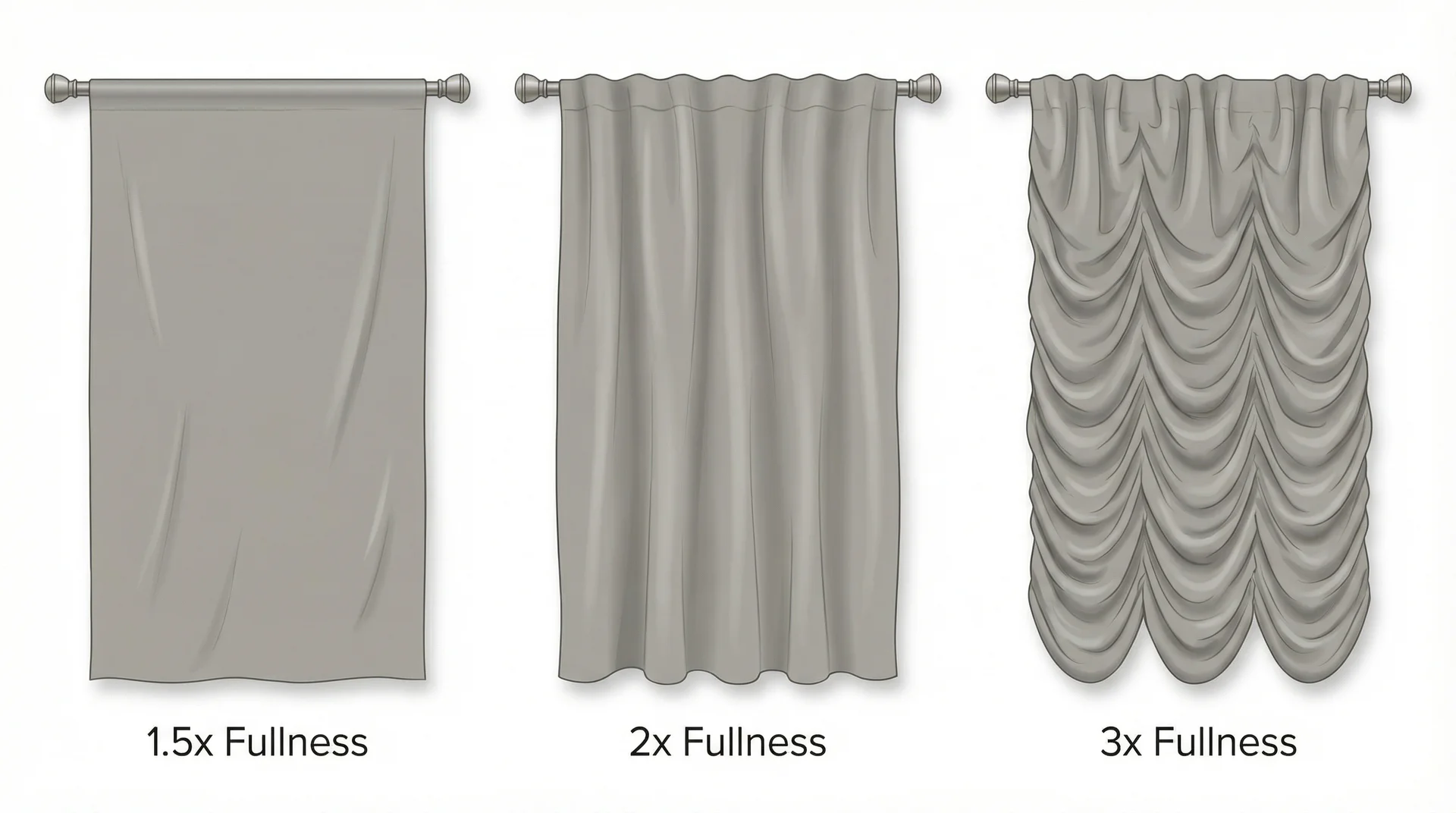
Fullness is the ratio of the total curtain fabric width to the width of your curtain rod. When curtains have a fullness ratio of 2x, the total width of all panels is twice the rod width. That extra fabric creates the soft, rolling folds that make curtains look intentional and well-designed.
Think of draping a thin scarf versus a wide, generous wrap around your shoulders. Both cover the same body, but one falls flat and one creates movement and depth. Curtain fullness works on exactly the same principle.
| Fullness Ratio | Best For | Visual Effect |
|---|---|---|
| 1.5x | Structured fabrics, modern and minimalist rooms | Tailored, flat, architectural |
| 2x | Most fabric types, most room styles | Soft folds, balanced, versatile |
| 2.5x | Lightweight and mid-weight fabrics | Relaxed, layered, comfortable |
| 3x | Sheers, voiles, lightweight linens | Luxurious, billowy, dramatic |
Start with 2x fullness as your baseline and adjust from there based on fabric weight and the mood of the room. Heavier fabrics like velvet or thick interlined drapes look best at 1.5x to 2x because the fabric already carries so much visual weight.
Sheer fabrics like voile almost always need 2.5x to 3x because their lightness means they need more width to create presence and any real sense of privacy.
How to Measure for Curtain Width Correctly
This is where most people make the mistake that leads to a sad curtain moment like my client’s.
Step 1: Hang Your Curtain Rod Before You Measure Anything
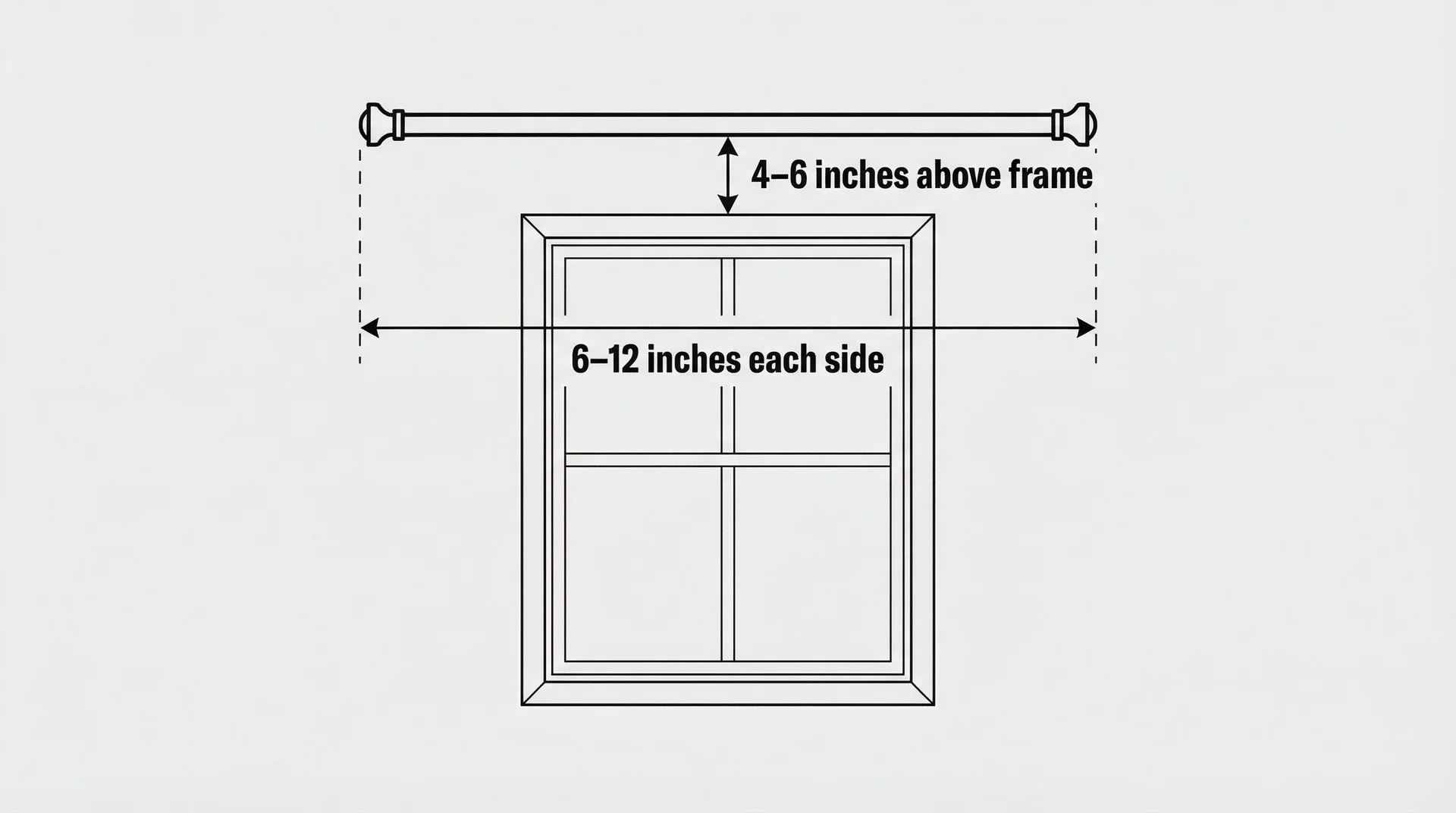
The rod placement determines your curtain width, and rod placement is a design decision as much as a functional one. Mount your curtain rod:
- 6 to 12 inches beyond the window frame on each side, so the curtains sit on the wall rather than blocking the glass when open
- 4 to 6 inches above the window frame at minimum, and closer to the ceiling if ceiling height allows, because hanging curtains high makes ceilings feel taller and windows feel grander
Once your rod is up, that is the measurement you work from.
Step 2: Measure the Full Rod Width
Measure from one end of the rod to the other, including any portion that extends beyond the brackets but excluding the finials at the very tip (unless your curtain panels will cover the finials, which some ring-top styles do). This number is your base width.
Step 3: Multiply by Your Chosen Fullness Ratio
| Rod Width | 1.5x | 2x | 2.5x | 3x |
|---|---|---|---|---|
| 48 inches | 72 in | 96 in | 120 in | 144 in |
| 60 inches | 90 in | 120 in | 150 in | 180 in |
| 72 inches | 108 in | 144 in | 180 in | 216 in |
| 84 inches | 126 in | 168 in | 210 in | 252 in |
| 96 inches | 144 in | 192 in | 240 in | 288 in |
That total is the combined width across all panels.
Step 4: Divide Across Your Panels and Account for Centre Overlap
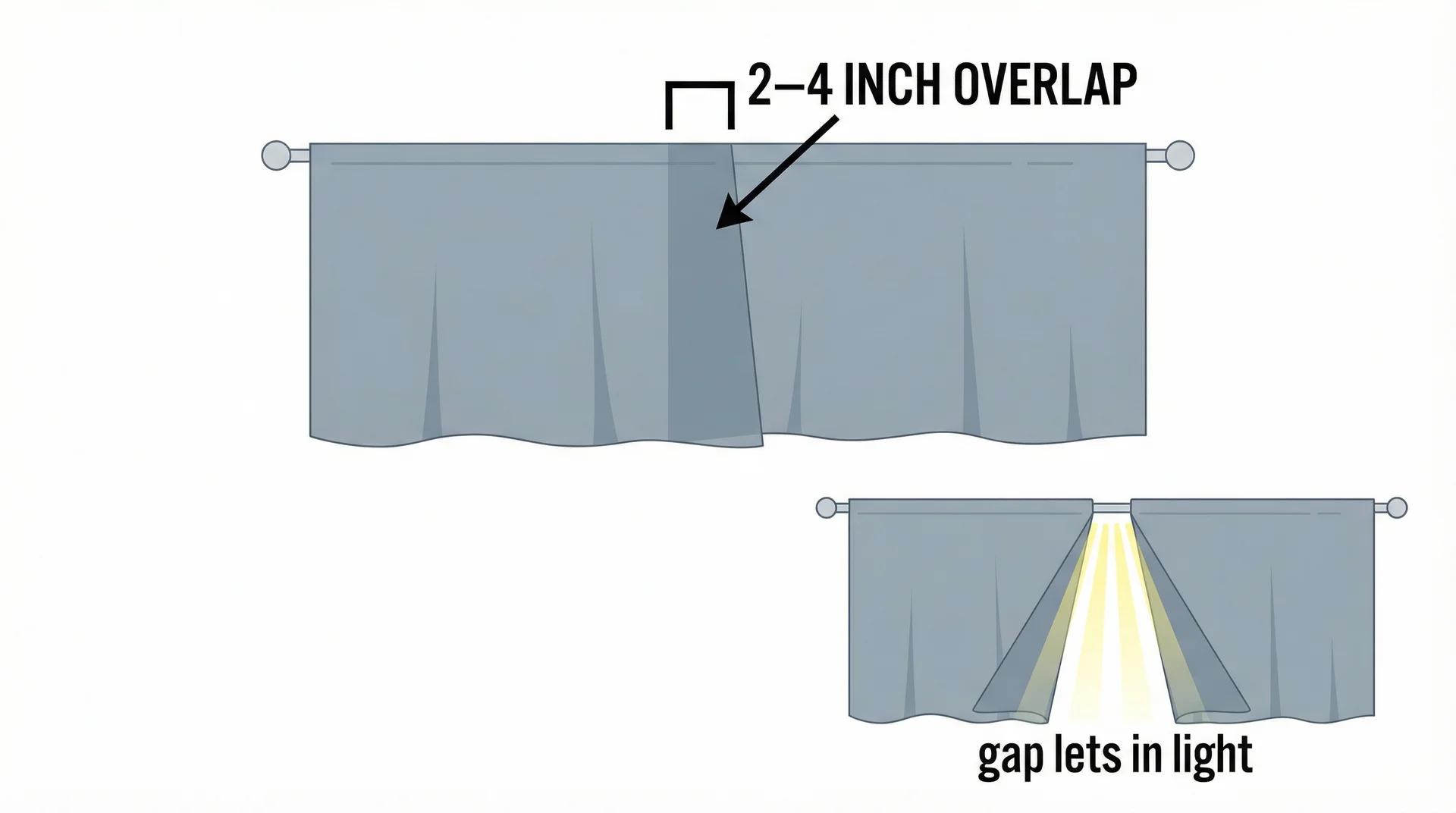
For most windows, two panels work best because they allow you to open from the centre, creating a symmetrical look. Divide your total fabric width by the number of panels to get each panel’s individual width.
One detail most people miss: when you close two panels, you want a 2 to 4 inch overlap in the centre. If you skip this, a strip of light runs straight down the middle of your window every morning. Factor an extra 4 inches into your total fabric calculation to cover this.
Quick example: Your rod measures 72 inches. At 2x fullness, your total fabric width is 144 inches, plus 4 inches for centre overlap equals 148 inches. Divided across two panels, each panel should be approximately 74 inches wide.
Standard Curtain Panel Sizes and How to Work With Them
This is something most guides skip over, and it causes a lot of confusion when you are actually standing in a shop or scrolling through options online.
Ready-made curtain panels typically come in these standard widths:
| Standard Panel Width | Common in |
|---|---|
| 46 inches | UK market standard |
| 54 inches | US market, widely available |
| 84 inches | US market, less common |
| 90 inches | UK market, pair standard |
| 108 inches | UK market, wide panels |
The label on a curtain panel shows the width of one panel, not your total coverage. A common mistake is buying a single 54-inch panel for a 60-inch rod and wondering why the curtains look skimpy.
At 2x fullness on a 60-inch rod, you need 120 inches of total fabric, which means two 54-inch panels plus a little extra, and those two panels will not quite reach 120 inches. In that case, consider three panels across or look for wider panels.
When buying ready-made curtains, always calculate your total fabric width target first, then work backward to see how many panels at a given standard width you need to reach it.
Room-by-Room Guide to Curtain Width
Living Room Curtains
The living room is where curtains make a statement. I almost always recommend 2x to 2.5x fullness here because living rooms benefit from that sense of softness and intentionality that full, sweeping curtains create.
What to keep in mind:
- The curtains should frame the window like a picture frame, sitting on the wall rather than on the glass when open
- When closed, panels should overlap 2 to 4 inches in the centre to prevent a gap of light
- The stack-back should not eat into the window glass
If your living room has a large window or a view you love, lean toward 10 to 12 inches of rod extension on each side so the curtain stack-back sits completely off the glass.
Bedroom Curtains
In bedrooms, function leads the decision. If you use blackout or lined panels for sleep quality, go to 2.5x fullness at a minimum. More fabric means fewer gaps, and fewer gaps mean a darker room.
Another approach for bedrooms is pairing blackout blinds underneath sheer curtains; you get layered light control without relying on curtain weight alone. Our curtains over blinds layering guide walks through the best blind-and-curtain pairings, room by room.
I once styled a master bedroom where the client had installed gorgeous blackout curtains sized precisely to the window width with no overlap and no extra fullness.
Light poured in from the edges every morning. We added a third panel and adjusted the rod placement, and the problem disappeared entirely.
My usual recommendations for bedrooms:
- Rod extends 8 to 10 inches beyond each side of the window frame
- Fullness ratio of 2.5x for proper light blocking
- Two panels for standard windows, three panels for wide windows over 72 inches
Kitchen and Dining Room Curtains
These spaces suit lighter, more casual curtain styles. Cafe curtains, lightweight linens, and cotton blends are popular here, and all of them benefit from higher fullness ratios because the fabrics are lighter.
For kitchen windows especially, 2.5x to 3x fullness creates that breezy, gathered look that suits the casual energy of the space without feeling overdone.
Bathroom Curtains
Privacy matters more than light in bathrooms, and the windows are usually smaller. A single panel at 2x fullness across a small bathroom window tends to do the job well.
For windows near a shower or bath, keep panels shorter, ending just below the windowsill. Floor-length curtains in a damp room will cause problems over time, and no curtain width calculation can fix that.
Floor-to-Ceiling Installations
Floor-to-ceiling curtains installed to maximise the sense of ceiling height need slightly more fullness than standard installations, typically 2.5x, because the extra length means more fabric hangs between each pleat or fold.
With a shorter curtain, imperfect fullness is less noticeable. With a floor-to-ceiling panel, every inch of fabric matters to the finished look. If you are investing in this style, do not undercut the effect by skimping on width.
The Stack-Back Calculation: The Step Most People Skip
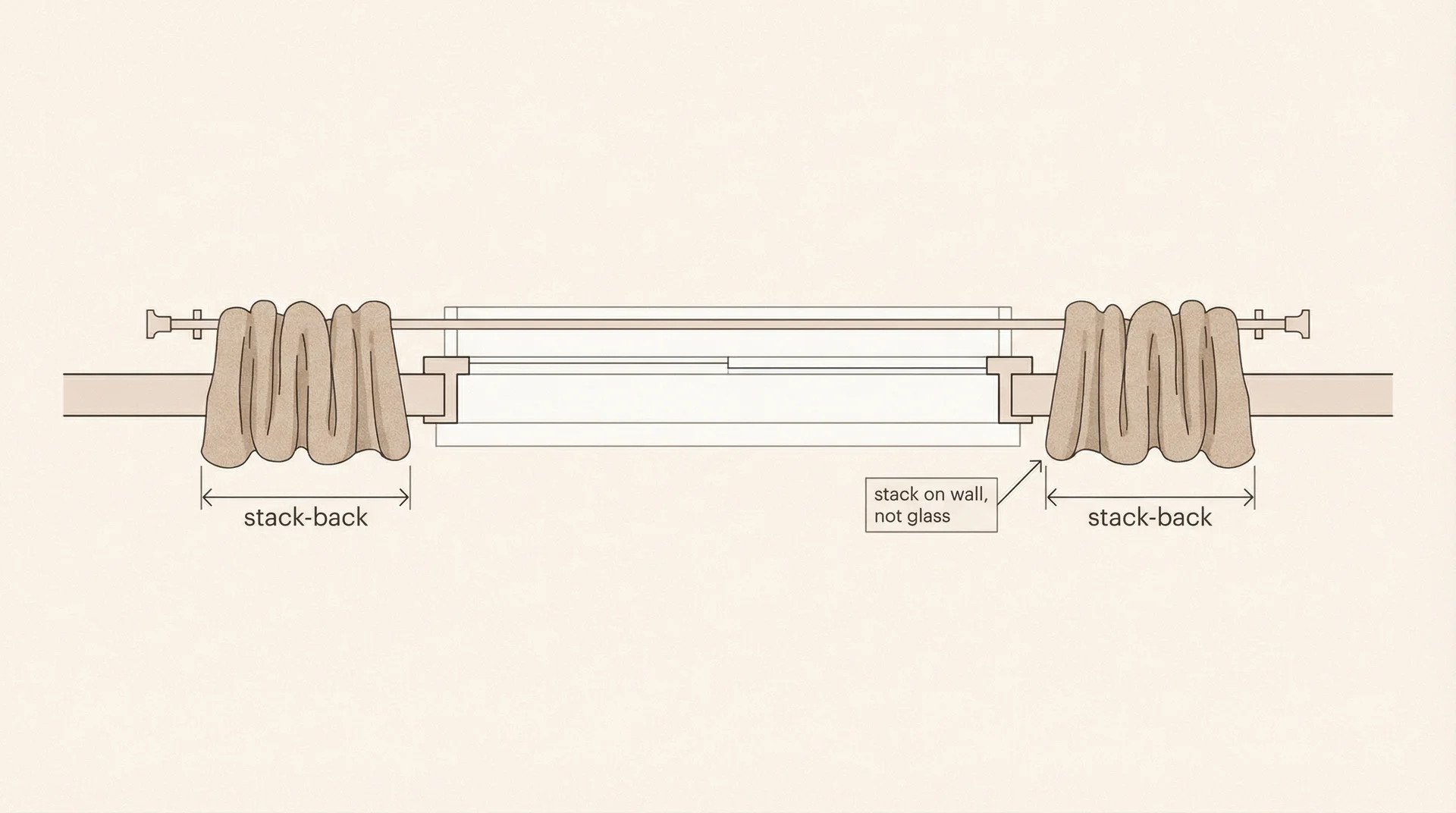
Stack-back is the space your curtains occupy when pushed fully open to the sides of the rod.
A curtain that looks correctly sized on paper can still block a portion of your window when open if you have not planned for where that fabric will go.
| Fabric Weight | Stack-Back Per Side (Approximate) |
|---|---|
| Lightweight sheers | 10 to 15% of the total rod width |
| Medium-weight linen or cotton | 15 to 20% of the total rod width |
| Heavy velvet or interlined panels | 20 to 25% of the total rod width |
If your rod is 72 inches wide and you are using medium-weight fabric at 2x fullness (144 inches total fabric), each side of the curtain will stack roughly 22 to 28 inches wide when fully open.
That is why extending the rod well beyond the window frame on each side matters so much. You want that stack to sit on the wall, not on the glass.
Curtain Width for Special Window Types
Bay Windows
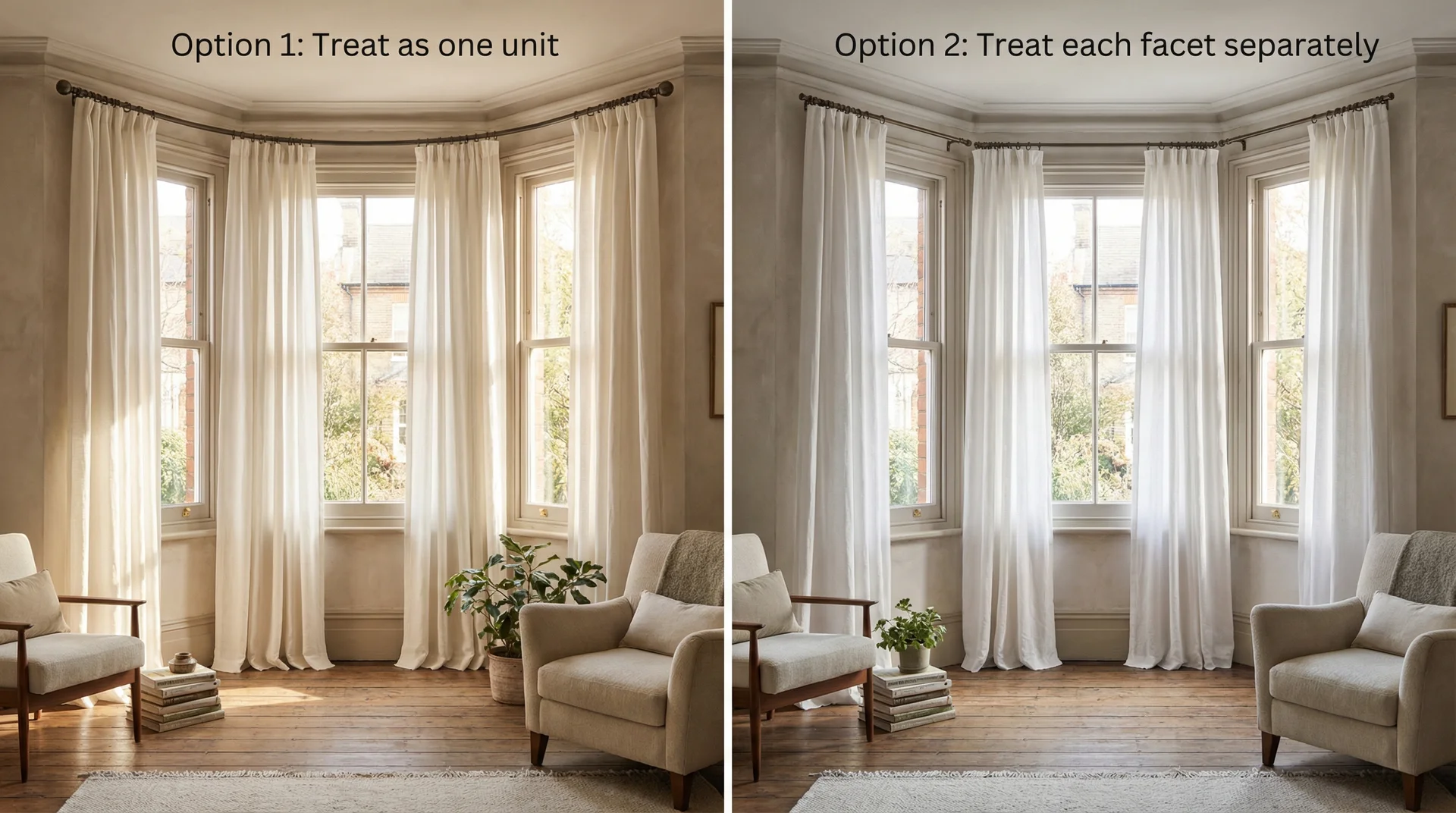
You have two solid approaches here:
Option 1: Treat the bay as one unit. Run a curved or angled rod across the full bay opening and hang curtains across the entire span. This works well for a flowing, uninterrupted look. Calculate fullness based on the full rod measurement.
Option 2: Treat each facet separately. Install individual rods on each angled section and hang separate panels per section. This gives you more control over light and privacy and tends to honour the architecture of the bay rather than obscuring it.
I lean toward Option 2 in most cases because the structure of a bay window is a feature worth showing.
Sliding Glass Doors
Sliding glass doors need curtains wide enough to stack completely off the door opening when pulled back, because any curtain that overlaps the door panel will block access. Ensure the rod extends far enough on the non-opening side to accommodate the full stack-back. Measure the door opening and add at least 24 inches on the hinge side for the stack.
Very Wide Windows (Over 100 Inches)
For very wide windows, three or four panels often work better than two because managing the weight and volume of two very wide panels becomes difficult. Distributing the fabric across more panels keeps each panel manageable and the hardware functional.
Arched Windows
Arched windows rarely work well with traditional curtains. If you want soft fabric near an arched window, use curtains on a straight rod installed below the arch and treat the arch as an architectural feature to be celebrated rather than covered.
How to Fix Curtains That Are Already Too Narrow
This question comes up more than people expect, and it has practical answers.
Add a third panel. If you have two panels that are too narrow, adding a third and distributing all three across the rod is often the quickest fix. You may need to adjust the rod length slightly to accommodate the extra fabric gracefully.
Layer with a sheer panel underneath. A sheer curtain on a second rod behind your main panels adds visual width, depth, and warmth to the window treatment, even if the outer panels are narrower than ideal.
Re-evaluate the rod placement. Sometimes, curtains that look narrow are simply hung too close to the window frame with not enough extension on each side. Moving the rod out further (and accepting a slightly larger stack-back) can make existing curtains look fuller almost instantly.
Consider new header tape. If you have custom or semi-custom curtains with gathered heading tape, a curtain maker can sometimes re-tape and re-gather the panels to a different fullness, which changes how the fabric distributes across the rod.
Heading Styles and How They Affect Width
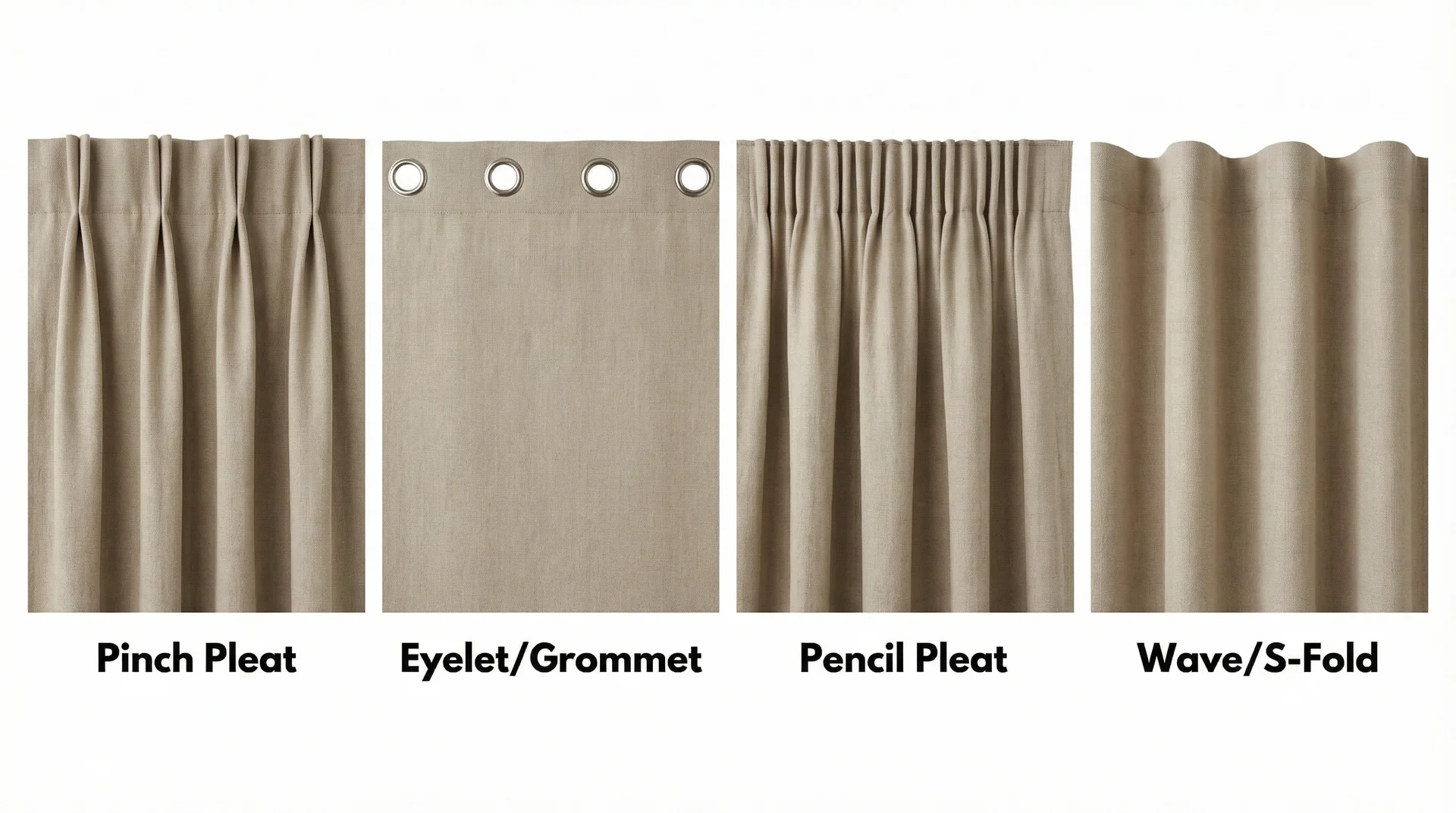
The heading style, meaning the way fabric attaches to the rod or track, affects how your fullness appears and how much fabric you actually need.
| Heading Style | Recommended Fullness | Character |
|---|---|---|
| Pinch pleat | 2x to 2.5x | Formal, structured, classic |
| Goblet pleat | 2x to 2.5x | Traditional, elegant |
| Pencil pleat | 2x to 2.5x | Versatile, tailored |
| Eyelet / Grommet | 1.5x to 2x | Modern, clean, less clutter |
| Rod pocket | 2x to 2.5x | Casual, romantic |
| Tab top | 1.5x to 2x | Relaxed, informal |
| Wave / S-fold | 2x to 2.5x | Contemporary, consistent folds |
Eyelet and tab-top headings sit slightly flatter because the fabric between each ring or tab is pulled forward rather than gathered. They need slightly less fullness to look intentional.
Pinch pleat and pencil pleat headings rely on gathered fabric to create their signature look, so they need the full 2x to 2.5x to perform properly.
Common Curtain Width Mistakes Worth Naming Directly
Measuring the window instead of the rod. Your curtain rod is your measuring point, always. A window might be 48 inches wide, but if your rod extends 12 inches beyond each side, your base measurement is 72 inches. Curtains sized to the window alone will look narrow and underwhelming.
Trusting the panel label width without doing the math. A curtain panel labelled “54 inches wide” is 54 inches wide per panel. Always calculate total fabric width first, then determine how many panels you need to reach it.
Assuming all fabrics behave the same. Velvet at 2x fullness and linen at 2x fullness look completely different. Velvet creates deep, architectural folds. Linen creates softer, more relaxed ripples. Sheer fabrics at 2x can look nearly flat. Know your fabric before committing to a fullness ratio.
Skipping the centre overlap. Two panels without a centre overlap leave a strip of light running down the middle of your window. Account for 2 to 4 inches of overlap in your total fabric calculation.
Buying the minimum and hoping for the best. Curtains almost always benefit from being slightly wider than the calculated minimum. A little extra width creates more beautiful folds and better coverage. Err toward generosity when you are uncertain.
Ignoring how fabric shrinks. If you are buying fabric to make curtains or ordering semi-custom panels in a natural fibre like linen or cotton, account for shrinkage before the first wash. Most natural fabrics shrink 3 to 5% in width after washing. If your calculation is tight, that shrinkage will take you below the minimum you need. Build in an extra 5% on your total fabric width when working with natural fibres.
A Practical Summary
Measure the rod, not the window. Install your rod first, measure it second, then calculate your curtain width from there.
Start at 2x fullness. Unless you have a specific reason to go higher or lower, 2x is the sweet spot for most fabrics, rooms, and budgets.
Plan for stack-back. Extend your rod 6 to 12 inches beyond the window frame on both sides so open curtains sit on the wall, not the glass.
Overlap panels by 2 to 4 inches in the centre. This prevents a gap of light that undermines the whole setup.
Let your fabric guide your fullness. Heavy fabrics want less. Light fabrics want more. This single principle will make curtains look custom rather than store-bought.
Buy one extra panel if you are uncertain. Fabric can vary between production runs, and a mismatched panel added later is very noticeable.
Frequently Asked Questions
How wide should curtains be for a standard window?
For a standard window measuring 36 to 48 inches wide, with a rod extending 8 inches on each side (rod width of roughly 52 to 64 inches), you want a total curtain width of 104 to 128 inches at 2x fullness. Two panels, each approximately 52 to 64 inches wide, will cover this well.
Can curtains be too wide?
Rarely, and only when very heavy fabric is used at very high fullness, because the weight can stress the rod and heading tape over time. A little extra width almost always improves the look.
Should I measure the curtain width with the curtains open or closed?
Always calculate based on the closed position, because that is when the full width of the fabric is distributed across the rod.
What is the minimum width for curtains to look intentional?
At 1.5x fullness with a structured fabric, the curtains look decent. Anything below 1.5x will look flat and undersized on almost any window.
Do standard, ready-made curtain panels come in the right widths?
Ready-made panels come in set widths, typically 46, 54, 84, or 90 inches. Check whether those widths, combined across the number of panels you plan to use, reach your total fullness target. On most windows wider than 48 inches, you will need at least two panels, and often three, to reach the right total.
How do I make a narrow window look wider with curtains?
Extend your curtain rod further beyond the window frame on each side, up to 16 inches per side in some cases, and use generous fullness. When the curtains are open, they will sit largely on the wall, exposing more of the wall around the window and making the whole window appear wider than it is.
Drawing the Curtain
Curtain width feels technical until you understand the principle behind it, and then it becomes intuitive.
Once you measure from the rod rather than the window, choose fullness based on the fabric in your hand, account for stack-back in your rod placement, and plan for that small centre overlap, the whole process becomes clear.
And the results, a room that looks considered, complete, and genuinely beautiful, make every bit of that attention worthwhile.