
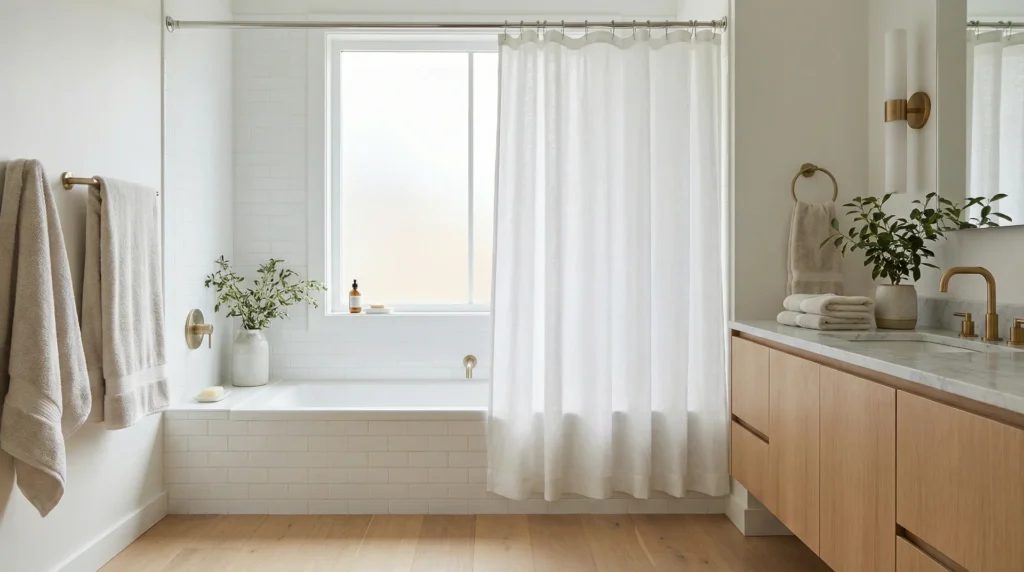
You measured the curtain rod, ordered a size that seemed perfectly logical, and hung it up. Then the water hit the floor anyway. Or the curtain looked stubby and strange in a space you knew was supposed to look good.
I have seen this happen in enough client bathrooms to know the problem is rarely taste. It is almost always sizing.
So here is the answer straight away: a standard shower curtain measures 72 inches wide by 72 inches long (183 cm × 183 cm). This fits the most common alcove bathtub setup in North American homes. If your tub opening is the standard 60 inches, a 72″×72″ curtain gives you 6 inches of overlap on each side, keeping water contained and looking proportional.
If you only need a quick confirmed number before a purchase, the short reference guide on standard shower curtain size covers exactly that.
That said, the moment your bathroom steps outside the standard blueprint, this number changes. The rest of this guide covers every variation, drawn from over a decade of advising homeowners on exactly these decisions.
Standard Shower Curtain Sizes: Quick Reference Chart
| Curtain Type | Width | Length | Best For |
|---|---|---|---|
| Standard Tub | 72″ (183 cm) | 72″ (183 cm) | Standard 60″ alcove bathtubs |
| Extra Long | 72″ (183 cm) | 84″ to 96″ (213 to 244 cm) | High ceilings, hotel aesthetic |
| Stall / Walk-In | 54″ (137 cm) | 72″ to 78″ (183 to 198 cm) | Narrow shower stalls, no tub |
| Wide / Double Panel | 108″ to 144″ (274 to 366 cm) | 72″ to 84″ | Double rods, large openings |
| Clawfoot Tub Wrap | 180″ circumference (457 cm) | 70″ to 74″ (178 to 188 cm) | Freestanding clawfoot bathtubs |
Manufacturers settled on the 72×72″ standard because the most common residential bathtub in North America runs 60 inches wide. The extra 12 inches of curtain width accounts for overlap at each end, which is what actually holds water inside the tub.
This chart is a starting point, and your specific tub width, ceiling height, and rod placement have the final say.
Shower Curtain Size by Tub Width
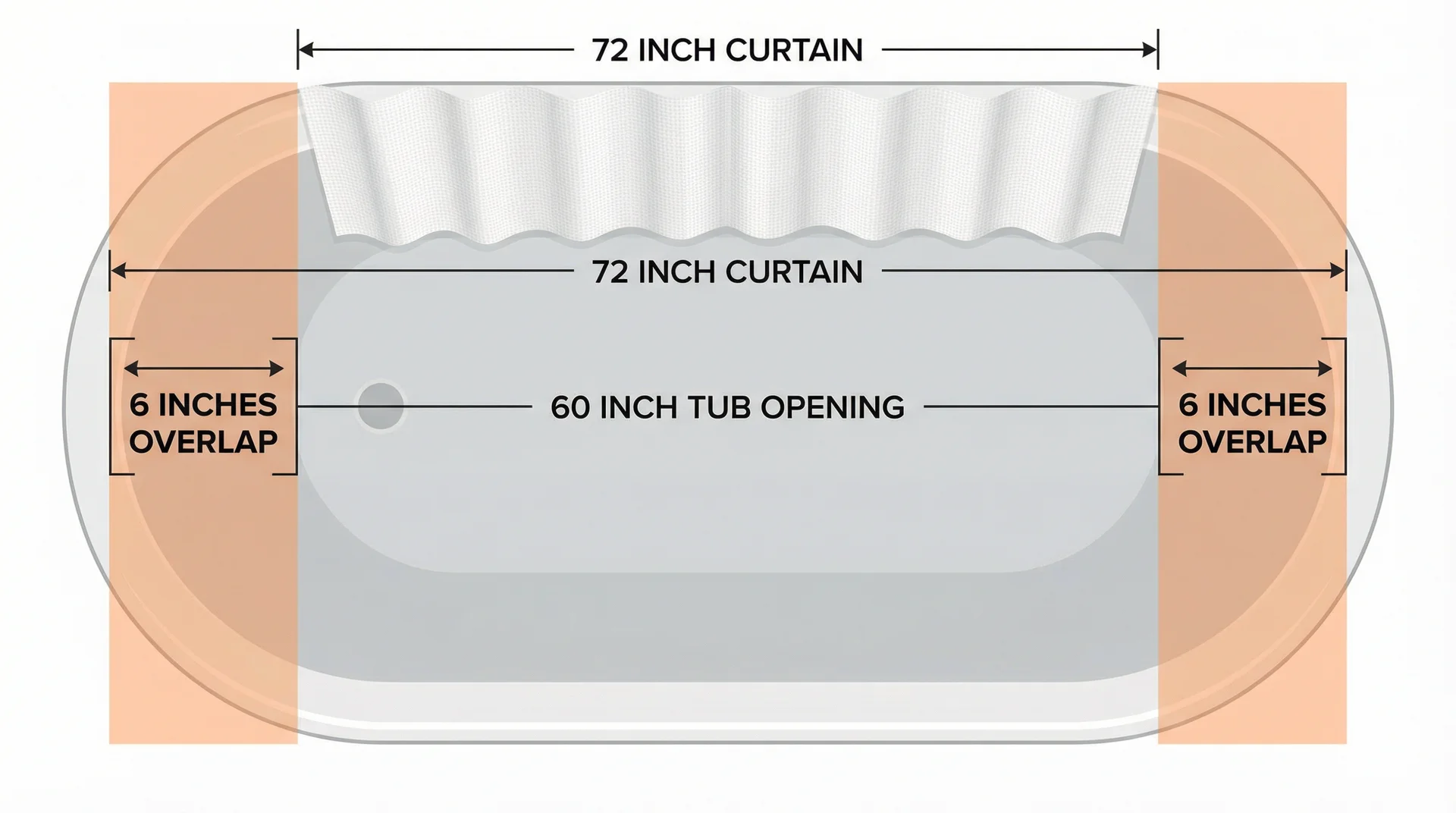
One detail that most guides skip: not all bathtubs are 60 inches wide. Older homes, compact apartments, and custom renovations all produce tubs in different widths, and matching your curtain to your actual tub opening is more important than defaulting to the 72-inch standard.
| Tub Width | Recommended Curtain Width | Overlap Per Side |
|---|---|---|
| 54″ (137 cm) | 66″ to 70″ (168 to 178 cm) | 6″ to 8″ per side |
| 60″ (152 cm) | 72″ (183 cm) | 6″ per side |
| 66″ (168 cm) | 78″ to 80″ (198 to 203 cm) | 6″ to 7″ per side |
| 72″ (183 cm) | 84″ (213 cm) | 6″ per side |
If your tub measures 54 inches wide, buying a standard 72-inch curtain creates 9 inches of excess bunching on each side. The curtain sits heavy against the walls, blocks light, and looks wrong even if you cannot immediately identify why. Measuring the opening first and matching to that number solves the problem before it starts.
Why “Standard Curtain Size” Does Not Always Fit
I remember walking into a client’s bathroom in a 1940s craftsman bungalow, and her frustration made complete sense the moment I stepped inside. She had bought a standard 72×72″ curtain for a freestanding cast-iron clawfoot tub with nearly ten-foot ceilings.
The curtain looked like a prop rather than a functional element in the space. That experience reinforced something I tell clients consistently: standard describes the average American bathroom, not yours specifically.
Three variables determine which size actually fits your bathroom.
Your Shower Type
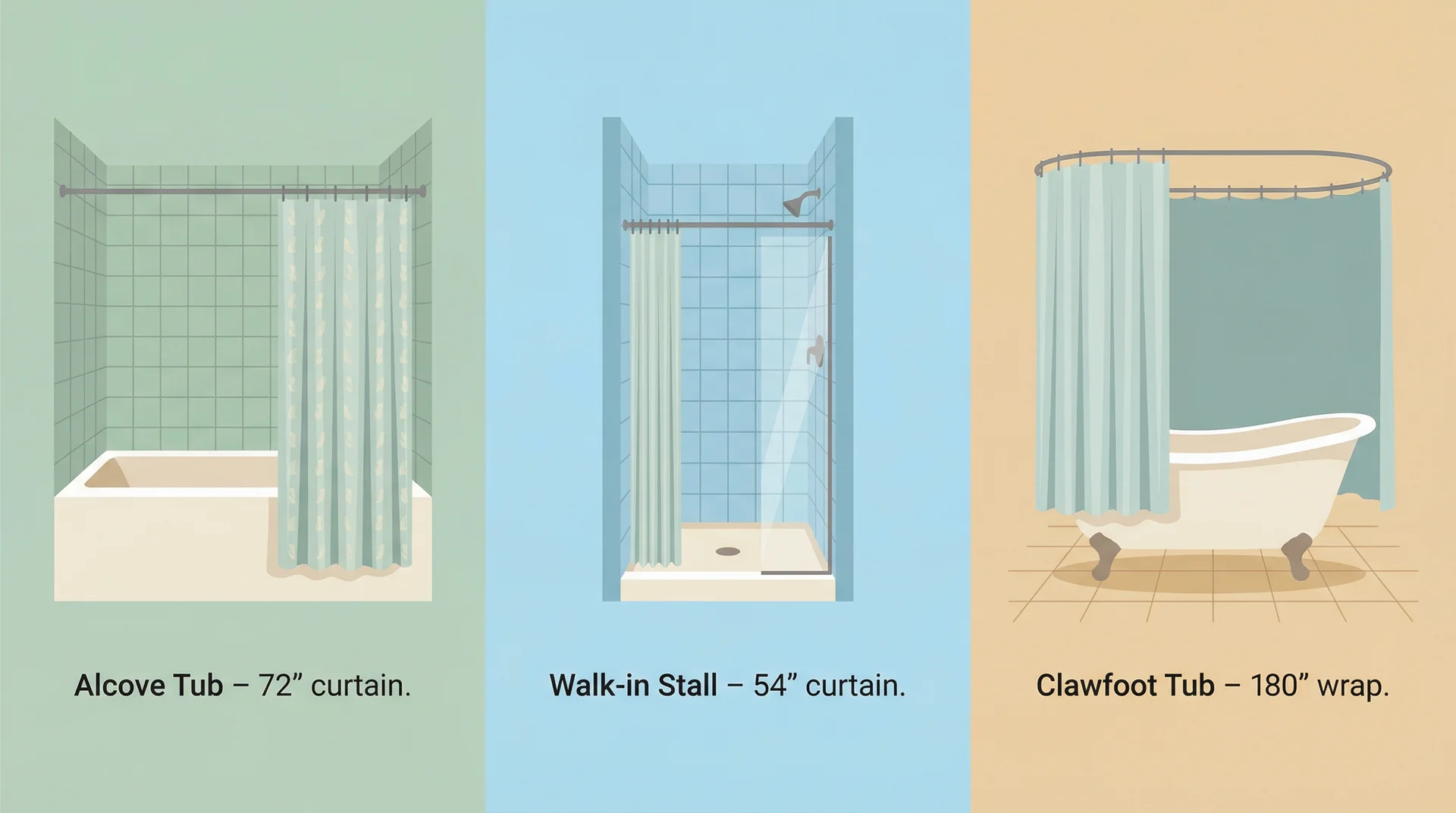
Alcove tub: Three walls surround the tub, and the curtain spans the open fourth side. A 72″ wide curtain covers a standard 60″ opening with 6 inches of overlap on each side.
Walk-in stall (no tub): These openings typically range from 36 to 48 inches wide. A standard 72″ curtain on a stall shower creates excessive bunching. A 54″ wide curtain suits most stall configurations.
Clawfoot or freestanding tub: The curtain needs to wrap all four sides of the tub, which is why wrap-around curtains measure 180 inches in total circumference. A standard alcove curtain categorically does not work here.
Wide walk-in shower: Some walk-in showers, particularly in master bathrooms, have openings wider than 60 inches. These often require double-panel setups or curtains sized specifically to the opening width plus overlap.
Your Ceiling Height
A standard 72-inch curtain was designed for an 8-foot ceiling with a rod mounted at roughly 75 to 77 inches from the floor. When ceilings go higher, that curtain looks stubby and leaves a visible gap between the curtain top and the ceiling line.
Extra-long curtains in 84″ and 96″ lengths solve the functional problem and do something useful from a design standpoint: a longer curtain hung close to the ceiling line draws the eye upward and makes the room feel taller even when it is not.
Your Rod Placement
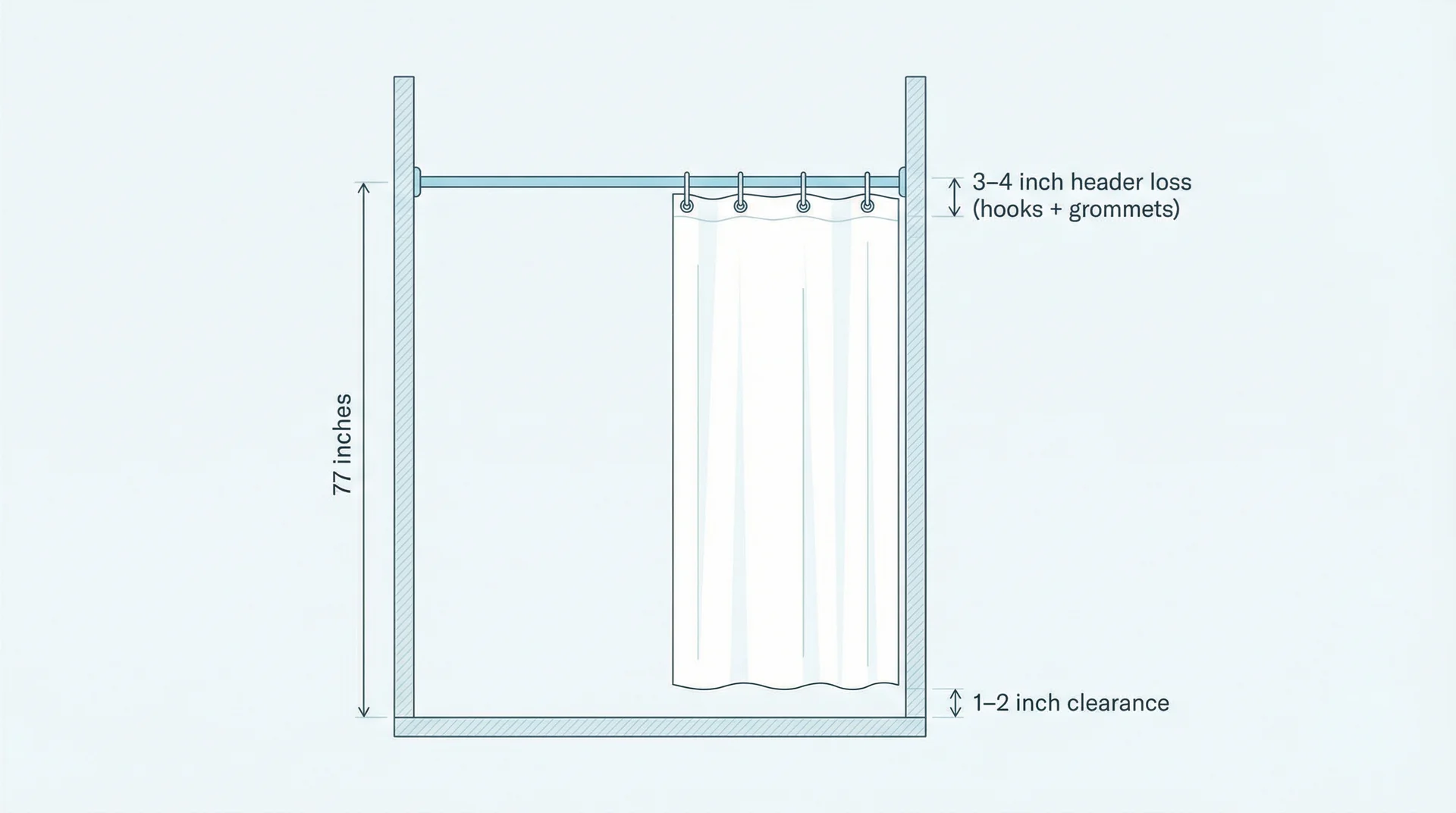
The rod height determines which curtain length you actually need to achieve the right floor clearance and visual proportion.
- Rod at 72″ from the floor: A standard 72″ curtain grazes the floor after hook clearance is deducted. An 84″ curtain serves this height better.
- Rod at 77″ from the floor: A standard 72″ curtain hangs 4 to 5 inches above the floor, which works well for most setups.
- Rod at 84″ or higher: An extra-long curtain is almost always necessary to cover the tub adequately.
The recommended rod mounting height for a standard bathroom sits between 75 and 77 inches from the floor.
How to Measure Your Shower for the Right Curtain Size
This takes about three minutes and removes all the guesswork from buying. Bring a tape measure and follow these steps.
Measuring Curtain Width
Measure the full width of your tub or stall opening from wall to wall. Then add 12 to 16 inches to that number for the overlap that keeps water from escaping at the edges.
Curtain Width = Tub Opening + 12″ to 16″
For a 60-inch tub opening:
60″+12″=72″ (minimum)
60″ + 12″ = 72″ (minimum)
60″ + 16″ = 76″ (generous coverage)
For curved rods, lean toward the wider end of that range because the outward bow of the rod increases the functional span the curtain needs to cover.
Measuring Curtain Length
Measure from the floor to where you plan to mount the rod. Then add 3 to 4 inches at the top for the header, grommets, and hooks that consume curtain length before the panel begins to fall.
Curtain Length Needed = Rod Height from Floor + 3″ to 4″
The curtain should land 1 to 2 inches above the floor, not touching it, to prevent mildew accumulation at the hem.
Quick Sizing Summary
| Measurement | Formula |
|---|---|
| Width | Tub Opening + 12″ to 16″ |
| Length | Rod Height + 3″ to 4″ for header clearance |
| Floor Clearance | The curtain should sit 1″ to 2″ above the floor |
Shower Curtain vs. Shower Liner: They Are Not the Same Size
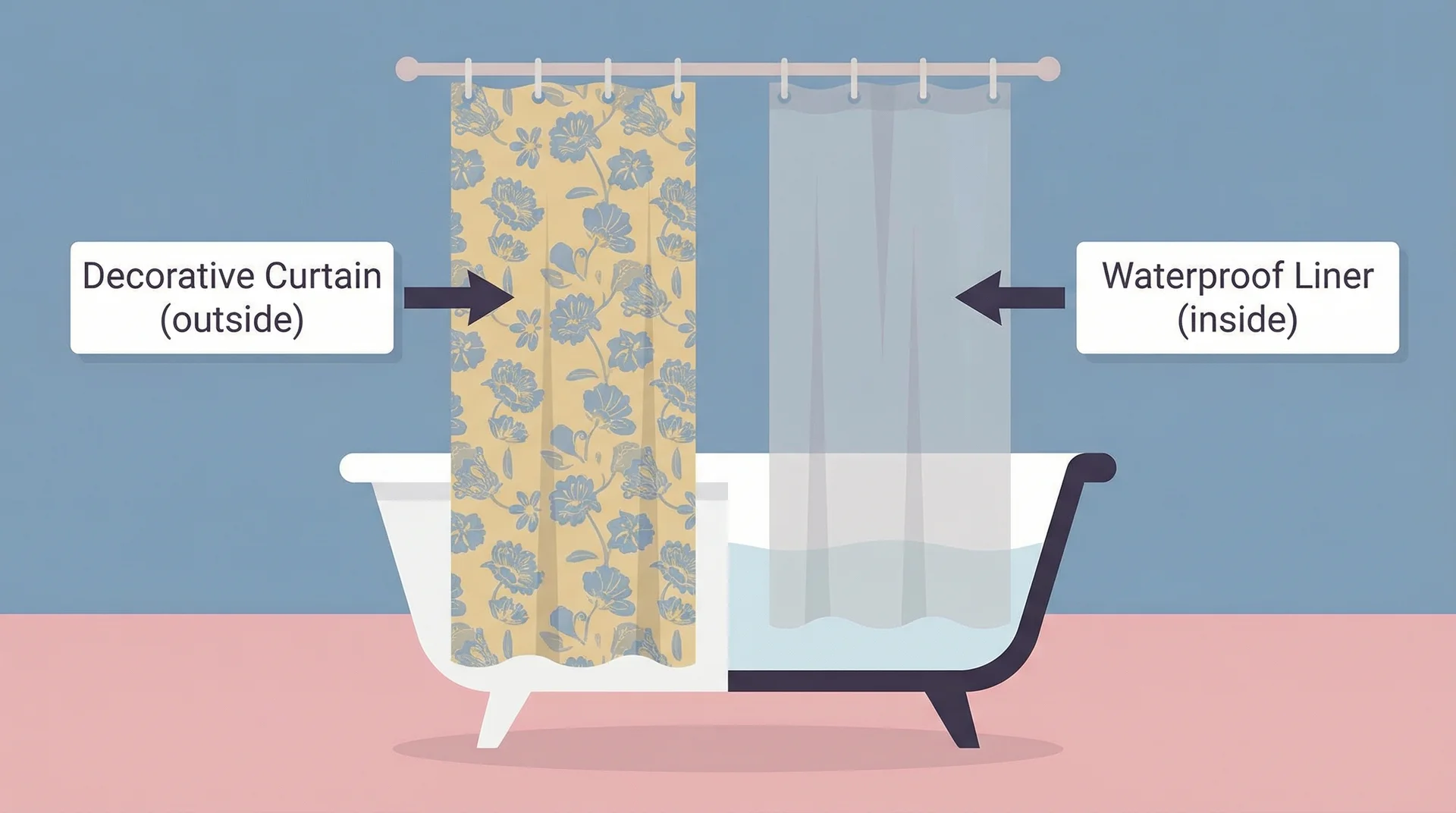
This confusion causes real problems, and I want to address it plainly because it comes up constantly in client questions.
Your curtain and your liner are two separate layers with two different jobs, sized differently on purpose.
The decorative curtain hangs outside the tub facing the bathroom. The liner hangs inside the tub against the walls, and its only job is to waterproof.
Because the liner tucks inside the tub, it needs to be slightly smaller than the curtain to sit flush against the walls without bunching against the outer panel.
| Layer | Typical Width | Typical Length | Function |
|---|---|---|---|
| Shower Curtain | 72″ (183 cm) | 72″ to 84″ (183 to 213 cm) | Decorative, privacy |
| Shower Liner | 70″ to 72″ (178 to 183 cm) | 70″ to 72″ (178 to 183 cm) | Waterproofing |
If you upgrade to an extra-long curtain for a dramatic dropped-length look, you do not need to match the liner to that length. A standard 70- to 72-inch liner does its job regardless of how long your decorative curtain hangs above it.
A liner that drags or bunches at the tub floor traps moisture and creates mildew. Weighted liners in PEVA or thick fabric press against the tub walls better during a shower, which matters in bathrooms with strong water pressure or wide openings.
What Happens If a Shower Curtain Is Too Short or Too Long?
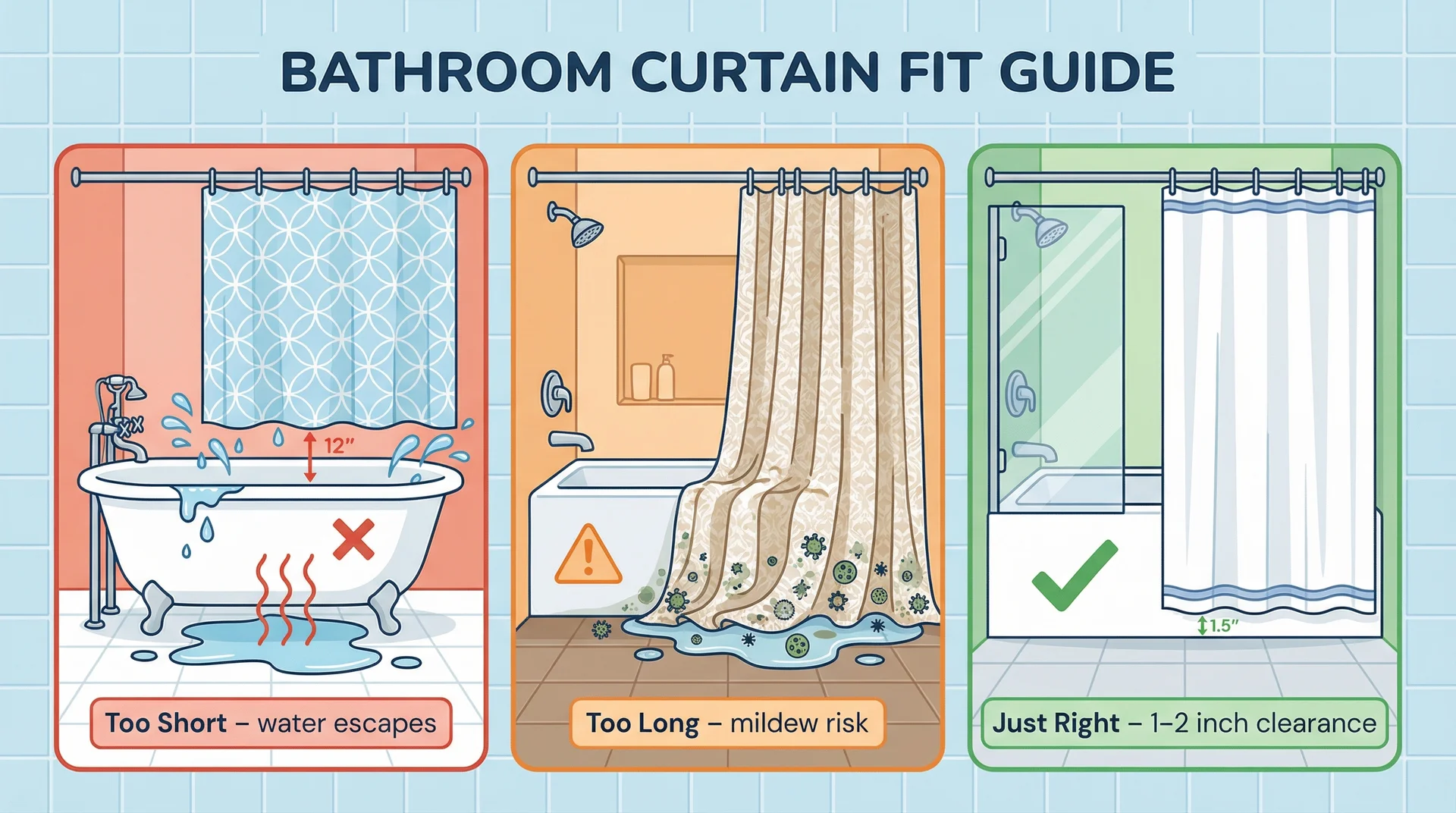
This question shows up consistently from people who bought without measuring, and it is worth answering directly because the consequences are different in each direction.
If the Curtain Is Too Short
A curtain that does not reach low enough on the tub creates a functional gap at the bottom of the tub opening. Water escapes through that gap during showering, which eventually damages the flooring and grout around the tub base.
Beyond the functional problem, a short curtain looks visually unfinished because the eye naturally expects the panel to cover the full tub height.
The fix involves either replacing the curtain with a longer option or remounting the rod lower. Remounting lower works if there is enough tub wall height to maintain proper coverage, but it also compresses the visual height of the bathroom.
If the Curtain Is Too Long
A curtain that pools on the floor stays damp, develops mildew along the hem, and traps bacteria in the wet fabric folds. It also becomes a safety issue if the extra length catches underfoot when stepping out of the tub.
The fix is either replacing the curtain with the correct length or remounting the rod higher. If neither option is practical, hemming the curtain to the correct length is a straightforward alteration that preserves the fabric and fit.
Can You Use a Regular Curtain as a Shower Curtain?
This is a question I hear from homeowners trying to save money or achieve a specific aesthetic, and the honest answer is: sometimes yes, but with conditions.
A regular fabric curtain can work as the decorative outer layer of a two-layer setup, where a proper waterproof liner handles the actual water containment. In that configuration, the outer fabric curtain never contacts water directly, which means most durable fabric panels made from cotton, linen, or canvas work well as decorative curtains.
What a regular curtain cannot do is replace a liner. Without the waterproof liner doing its job on the inside of the tub, water will soak through any fabric curtain and create damage to the floor and walls around the tub area.
The other consideration is sizing: regular curtains come in panel widths designed for windows, typically 50 to 54 inches per panel, which means you would need two panels to cover a standard tub opening adequately.
Grommet-top curtains typically mount on the same rings as standard shower curtains, which makes the installation straightforward.
Special Situations: Non-Standard Shower Configurations
Extra-Long Curtains: When to Choose 84″ or 96″
You need an extra-long curtain functionally when your ceiling sits at 9 feet or higher, or your rod is mounted above 80 inches from the floor.
You might choose one by design even in a standard-height bathroom, because a longer curtain hung close to the ceiling line creates a sense of vertical lift that transforms a compact bathroom.
I have used this approach in apartments with perfectly standard 8-foot ceilings specifically for this effect, and it works reliably.
Walk-In Shower Stalls
A 54×72″ stall curtain fits most single-entry walk-in configurations. For wider openings approaching 60 inches, a 60×72″ curtain provides better coverage without bunching. For curved or L-shaped rods, add 6 to 8 inches to your total width requirement to account for the rod’s outward extension.
Clawfoot Bathtub Setups
A 180-inch wrap-around curtain encircles the full perimeter of the tub and hangs either from a ceiling-mounted oval ring or a freestanding oval rod that surrounds the tub.
The ceiling-mount version requires accurate measurement of the tub footprint and careful centering of the ring directly above it. For this installation specifically, professional placement makes a meaningful difference in both function and visual symmetry.
Double Shower Curtain Rods
Take your total required curtain width (tub opening plus 12 to 16 inches) and divide roughly in half. Each panel should equal half the total width plus a few inches of overlap at the center.
For a 60-inch tub needing 72 total inches of coverage, each panel covers approximately 38 to 40 inches. Heavier fabrics in a two-panel setup give each panel a cleaner, more structured drape than lightweight polyester can achieve.
Does Curtain Size and Material Affect How the Bathroom Looks?
The shower curtain often covers the largest single vertical surface in a small bathroom, which means its dimensions shape the perceived ceiling height, the sense of openness, and how light moves through the space. Getting the size right is as much a design decision as a functional one.
Length and Perceived Height
Hanging a longer curtain close to the ceiling line draws the eye upward and creates height where there is not necessarily more physical space. Solid colours and vertical stripe patterns reinforce this effect. In a bathroom where you want the room to feel larger, this is one of the most cost-effective design adjustments available.
Width and Visual Weight
In a small bathroom, a curtain sized with a generous overlap on a narrow tub creates excess bunching that makes the space feel cluttered. Sizing to the minimum adequate width (12 inches over the opening rather than 16) keeps the fabric from visually dominating the room.
In a large bathroom with a wide tub or generous walk-in opening, a too-narrow curtain looks undersized and unfinished. Proportional sizing, or a double-panel approach with heavier fabric, fills the space correctly.
Material Weight and Sizing
Curtain material affects how much width you need to achieve a clean drape. Lightweight polyester and voile fabrics at exactly the minimum width sometimes press flat against the tub wall during a shower because they lack the body to resist airflow and water pressure.
Adding extra width or choosing a heavier fabric, such as cotton canvas, waffle weave, or linen, gives the curtain enough weight to hang freely and look intentional rather than limp.
Do Major Brands Follow Standard Sizing?
This matters practically because if you are shopping at IKEA, Target, Amazon, or a specialty home retailer and you need a 72×72″ curtain, you want to know whether you can trust the label.
The short answer: most major brands use standard dimensions, but the tolerances vary enough to check before buying.
| Brand / Retailer | Standard Offering | Notes |
|---|---|---|
| IKEA | 71″ × 71″ (180 × 180 cm) | Metric-aligned, slightly smaller than the US standard |
| Target / Threshold | 72″ × 72″ | US standard, reliable sizing |
| Amazon Basics | 72″ × 72″ | US standard |
| Pottery Barn | 72″ × 72″ and 72″ × 84″ | Standard and extra-long options |
| West Elm | 72″ × 74″ to 72″ × 84″ | Often runs slightly longer than standard |
| H&M Home | 71″ × 71″ (metric) | European sizing standard |
The IKEA difference is small but worth noting if you are matching a liner from a US retailer to an IKEA curtain. A 1-inch discrepancy rarely creates a visible problem, but in a tight setup where every inch of coverage counts, verifying both pieces against your measured dimensions before purchasing saves the frustration of a return.
Shower Curtain Sizes in Different Measurement Systems
If you shop from international retailers or buy from European or UK-based sources, the measurement standards differ in ways that affect both width and length.
| Region | Standard Width | Standard Length |
|---|---|---|
| United States | 72″ (183 cm) | 72″ (183 cm) |
| United Kingdom | 180 cm (71″) | 180 cm (71″) |
| European Union | 180 cm (71″) | 200 cm (79″) |
| Australia | 180 cm (71″) | 180 cm (71″) |
A 180 cm wide European curtain on a 60-inch (152 cm) North American tub provides adequate coverage functionally.
A 180 cm long European curtain in a bathroom with a rod at 77 inches (196 cm) from the floor runs slightly short once hook clearance is deducted.
Always verify both dimensions against your measured numbers before finalising any international purchase.
The 5 Sizing Mistakes I See Most Often
Mistake 1: Defaulting to 72×72″ Without Measuring
The 72×72″ curtain fits the majority of setups, and that makes it an easy default. The problem is that it gets applied to spaces it does not actually fit: stall showers, freestanding tubs, bathrooms with high ceilings, and tubs wider or narrower than 60 inches. Measuring first takes three minutes and prevents a return trip.
Mistake 2: Mounting the Rod Too Low
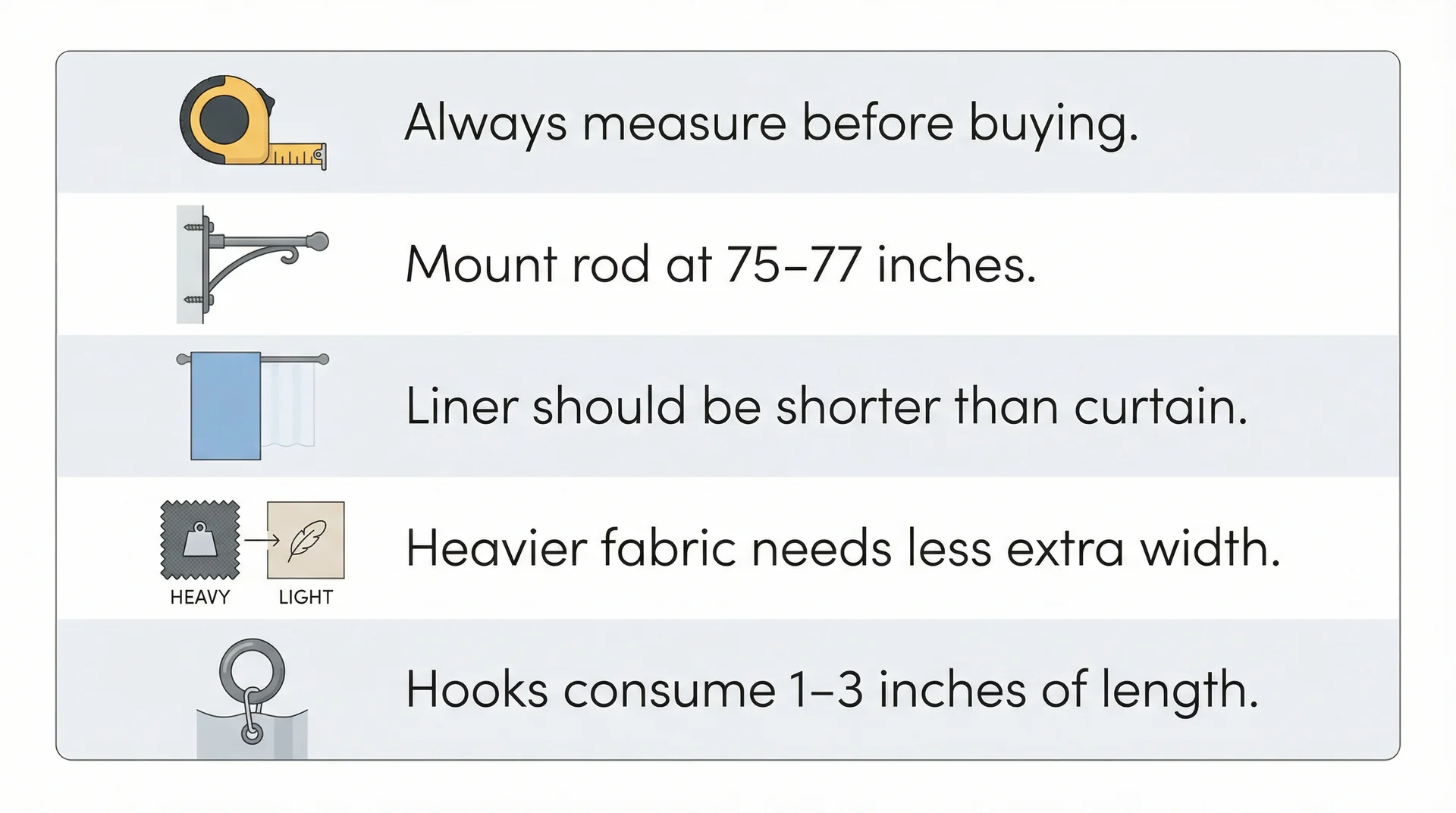
A rod at 60 to 65 inches from the floor compresses the visual height of the bathroom immediately and causes the curtain to droop toward the tub edge. Mount between 75 and 77 inches from the floor for a standard bathroom. For a more elevated look, go up to 80 to 84 inches and pair with a longer curtain.
Mistake 3: Buying the Curtain and Liner in Identical Dimensions
Buying both pieces at 72×72″ causes the liner to hang at the same level as the curtain rather than tucking inside the tub rim as it should. A liner at 70″ length paired with a 72″ curtain sits correctly and performs its waterproofing function properly.
Mistake 4: Ignoring Fabric Weight When Choosing Width
Lightweight curtain fabrics need more width than heavier fabrics to drape properly. A thin polyester curtain at the minimum width often presses flat against the tub wall during showering. Adding 8 to 10 extra inches of width or choosing a heavier fabric gives the panel enough body to hang freely.
Mistake 5: Forgetting That Hooks and Grommets Consume Curtain Length
The rings and hooks that connect the curtain to the rod consume 1 to 3 inches of the curtain’s total length before the panel begins to fall. A 72″ curtain effectively hangs at 69 to 71 inches of actual drop. In a bathroom where the measurements are tight, sizing up to the next available length resolves this cleanly.
Frequently Asked Questions
What is the most common shower curtain size?
The most common shower curtain size is 72 inches wide by 72 inches long, which fits a standard 60-inch alcove bathtub with 6 inches of overlap on each side. This size accounts for the vast majority of curtain sales in North America.
Can a shower curtain be too wide?
Yes. Excessive width creates heavy bunching along the rod, makes the space feel cluttered, and can actually reduce functional coverage at the center of the tub opening because too much fabric gathers at the ends. Aim for 12 to 16 inches of total overlap beyond your tub opening.
What size shower curtain fits a 60-inch tub?
A 72-inch wide curtain fits a 60-inch tub well, providing 6 inches of overlap on each side. For a curved rod or double-panel setup, consider sizing up to 78 to 80 inches of total width.
How long should a shower curtain hang from the floor?
The curtain should clear the floor by 1 to 2 inches. This prevents the hem from staying wet and developing mildew while maintaining a finished appearance. Achieving this requires calculating your rod height and choosing a curtain length that lands correctly after accounting for hook and grommet clearance.
Do extra-long shower curtains fit standard rods?
Yes. Extra-long curtains use the same grommets and hooks as standard curtains and hang from any rod with the same hook spacing. The only consideration is mounting the rod high enough to take advantage of the additional length rather than letting it pool on the floor.
What size curtain works on a curved rod?
For a curved rod on a standard 60-inch tub, size up to at least 78 to 80 inches wide. The outward bow of the rod increases the span the curtain needs to cover. Additional width also prevents the curtain from pulling too tightly across the curve, which causes grommet wear over time.
Is a 70×70″ shower curtain too small?
For a standard 60-inch alcove tub, a 70×70″ curtain provides only 5 inches of overlap on each side, which is marginally functional but not ideal. For a walk-in stall with a narrower opening, a 70″ wide curtain may provide adequate coverage depending on the specific stall dimensions.
Closing
Shower curtain sizing sits in the category of small home decisions that feel minor until they go wrong, and then they affect your daily routine in ways that feel disproportionately frustrating.
Water on the floor, a curtain that visually shrinks the room, a liner that bunches at the tub wall: all of these trace back to a sizing decision made with incomplete information.
The fix is three minutes of measuring and a clear understanding of the variables that matter: your tub width, ceiling height, rod placement, and the distinction between your curtain and your liner.
Get those numbers before you shop, trust them when you do, and the curtain you choose will do its job quietly and correctly every single day.