
Hyperpigmentation is the skin concern I see most consistently in my practice.
Melasma, post-inflammatory marks from old breakouts, and sun spots that have been building for years.
And tretinoin comes up in almost every one of those conversations because, when used correctly, it genuinely works better than most things available without a more aggressive in-office procedure.
What I also see consistently is people quitting tretinoin before the pigmentation has had a real chance to respond.
They start, their skin gets dry and irritated, they reach for the wrong moisturizer or no moisturizer at all, and within six weeks, the whole thing falls apart.
The hyperpigmentation stays, and they walk away convinced tretinoin does not work for them.
This guide covers everything that actually matters for using tretinoin on hyperpigmentation:
- how it works on pigment specifically
- what a realistic before-and-after timeline looks like
- which moisturizer choices make the difference between staying on it long enough to see results and bailing out at week four
Let’s get into it!
Why Hyperpigmentation Forms in the First Place
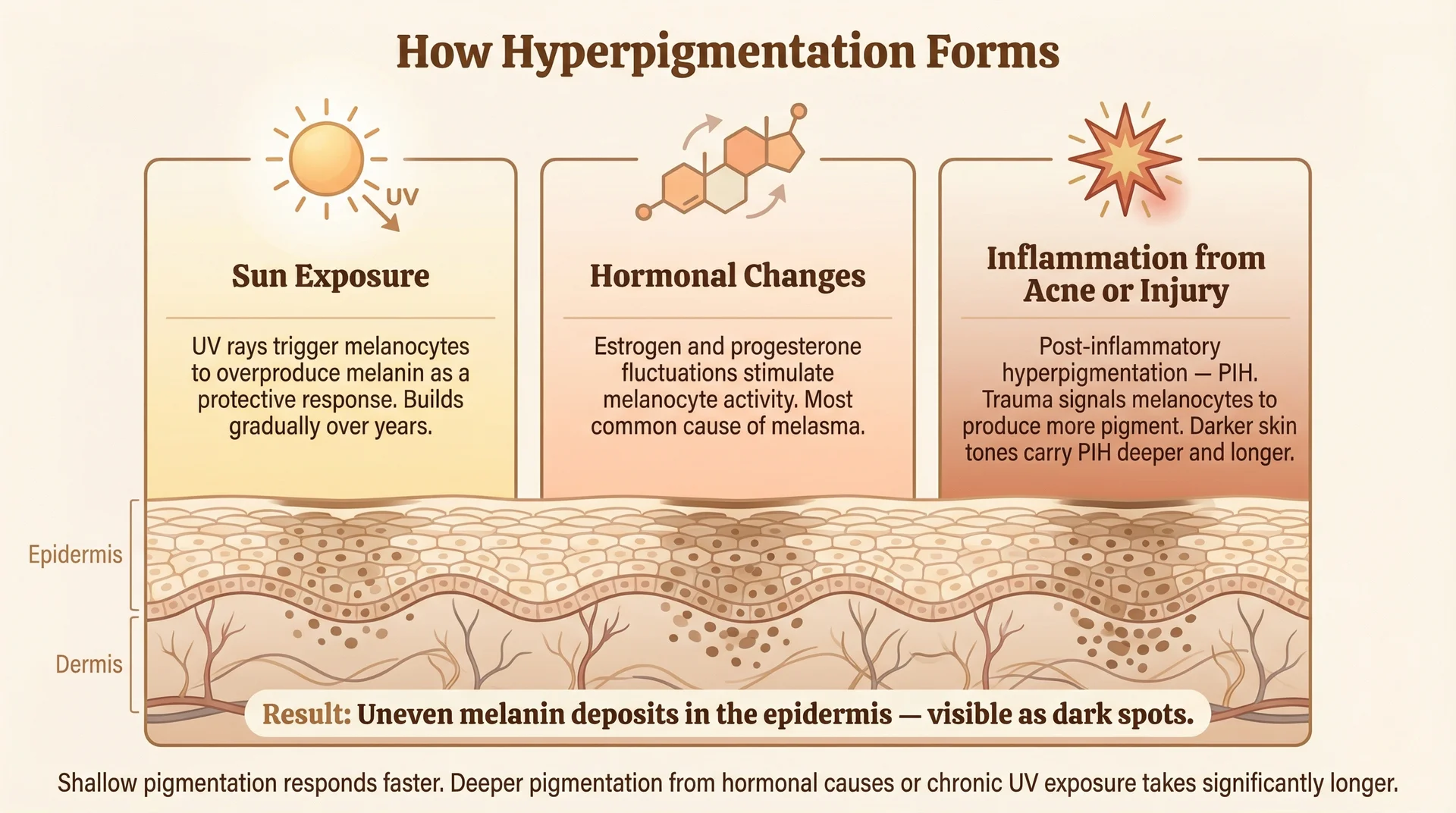
Before tretinoin can make sense as a solution, it helps to understand what you are actually treating.
Hyperpigmentation forms when melanocytes, the cells responsible for producing pigment in your skin, get triggered into overproduction.
Sun exposure, hormonal changes, and inflammation from acne or injury are the three most common triggers.
The result is an uneven deposit of melanin sitting in the upper layers of your skin.
Some of it sits shallow, some of it sits deeper in the dermis, and that depth is what largely determines how quickly any treatment will work on it.
Shallow, surface-level pigmentation from recent sun exposure tends to respond faster.
Deeper pigmentation from years of UV exposure, or post-inflammatory hyperpigmentation from hormonal acne, takes longer and requires more patience.
Post-inflammatory hyperpigmentation (PIH) is the type I deal with most in my clients. It forms after the skin experiences any kind of trauma, including acne, a bad reaction to a product, or even an aggressive facial treatment.
The inflammation signals melanocytes to produce more pigment as a protective response, and the marks that are left behind can take months to fade on their own.
On darker skin tones, PIH tends to run deeper and last longer, which is something I always factor into the timeline conversations I have with clients before they start tretinoin.
How Tretinoin Actually Works on Pigmentation
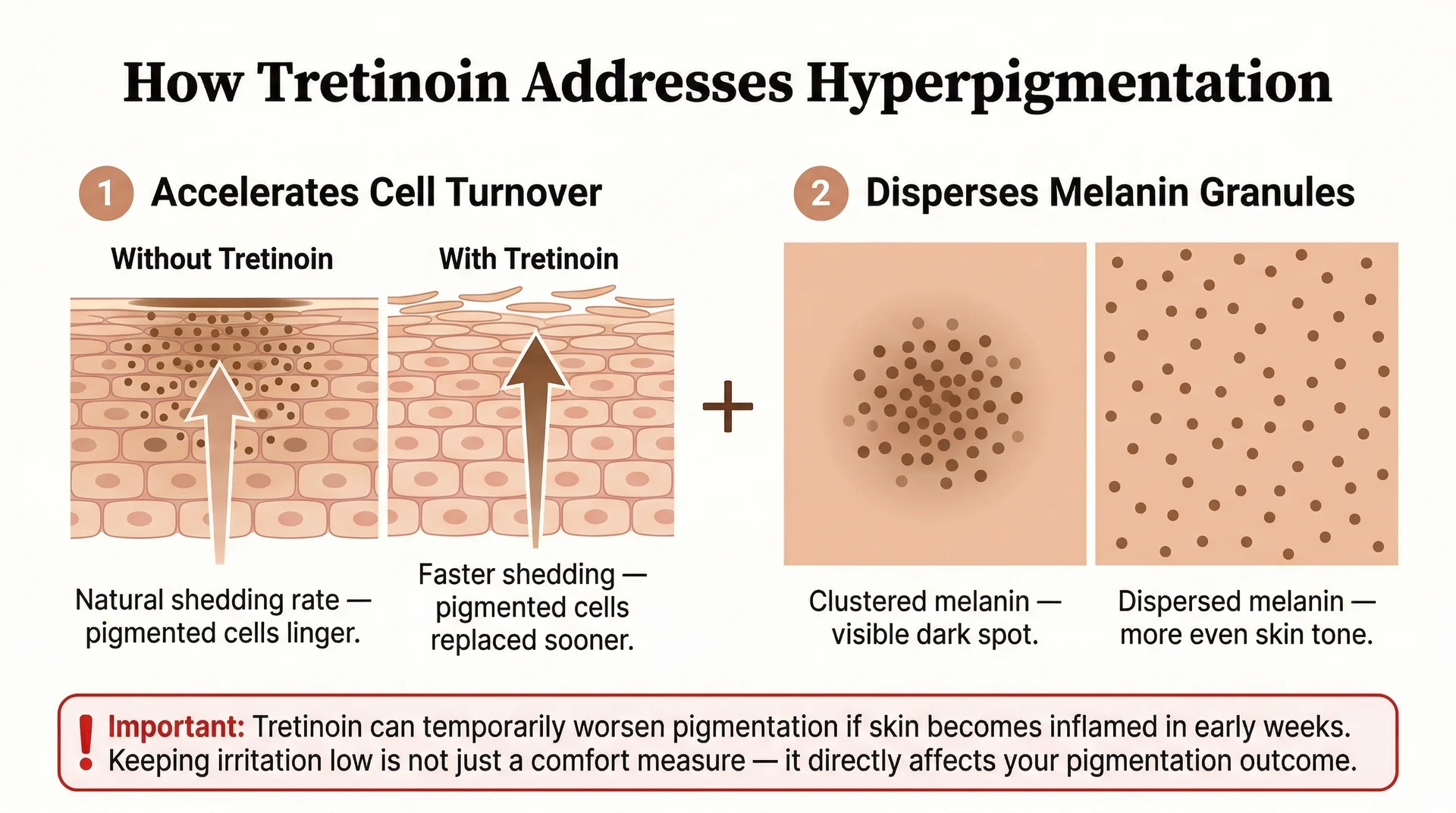
Tretinoin does not bleach or lighten skin directly. What it does is accelerate the rate at which your skin cells turn over and shed.
New cells replace old ones faster than they would naturally, and because the pigmented cells in the outer layers shed more quickly, the dark spots gradually become less concentrated and less visible.
At the same time, tretinoin works on the cellular level to disperse melanin granules more evenly across the skin.
Instead of the dense clustering of pigment that creates a visible dark spot, the melanin gets spread more uniformly, which is what gives skin a more even tone over time, rather than just fading specific spots.
This process takes time. Tretinoin does not remove years of sun damage in eight weeks.
What it consistently does for the clients I have kept on it long enough is produce visible and lasting improvement in skin tone that no brightening serum I have ever recommended can replicate on its own.
One more thing worth knowing: tretinoin can temporarily worsen hyperpigmentation in the early weeks if the skin becomes inflamed. Inflammation triggers more melanin production, which is why keeping irritation low with the right moisturizer is not just a comfort measure. It directly affects your pigmentation outcome. |
Tretinoin for Hyperpigmentation: A Realistic Before and After Timeline
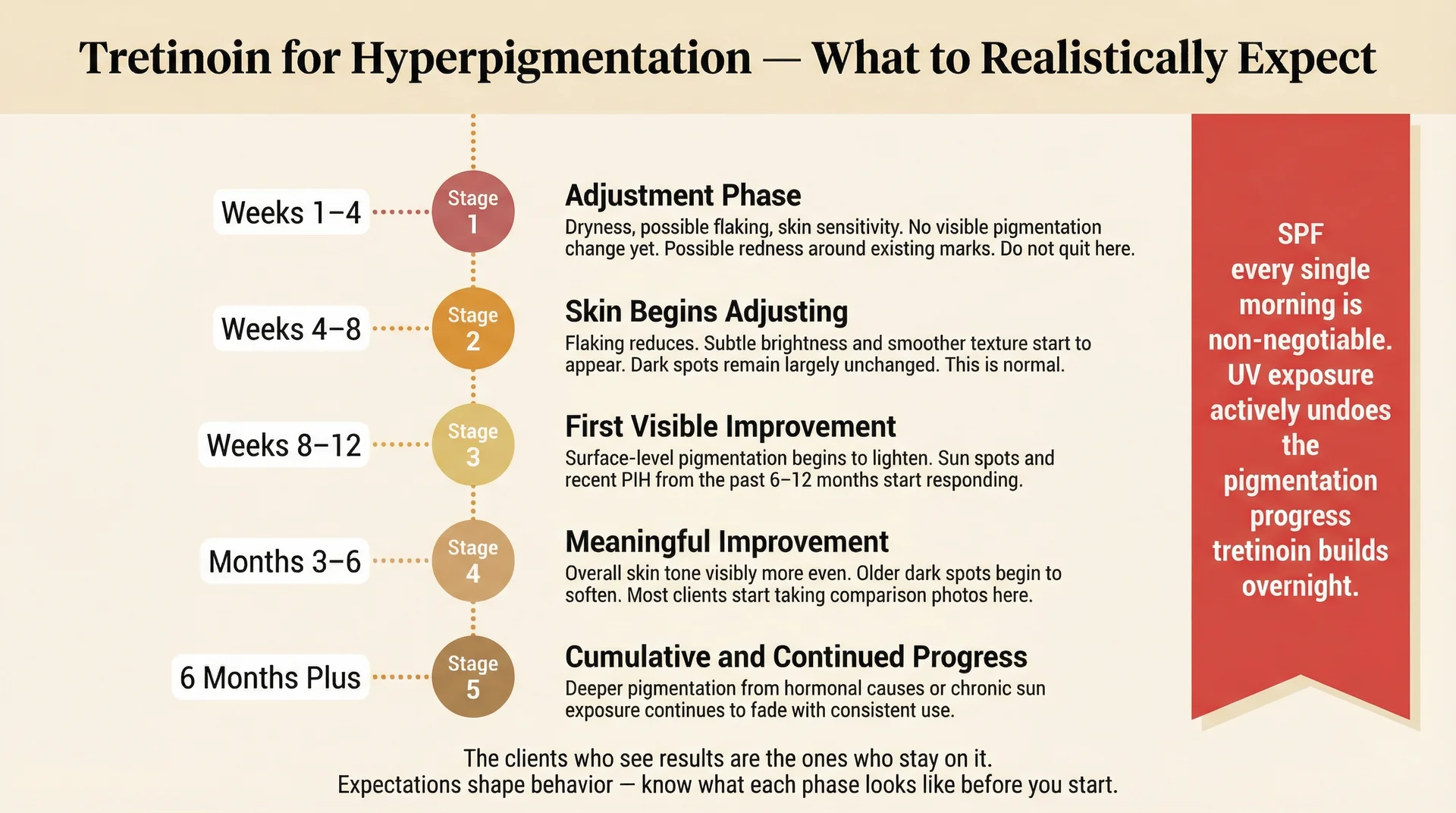
This is the section I wish more people could access before they start, because expectations shape behavior.
If you expect to see dramatic results at week four and nothing has changed yet, you quit. If you know what week four actually looks like for most people, you stay on it.
Here is an honest month-by-month breakdown based on what I have seen across years of working with clients using tretinoin for pigmentation:
| Timeframe | What most people experience |
|---|---|
| Weeks 1 to 4 | Dryness, possible flaking, and potential increase in skin sensitivity. No visible change in pigmentation yet, and possibly slight redness around existing marks. |
| Weeks 4 to 8 | Skin starts to adjust to the tretinoin. Flaking reduces. Some people begin noticing subtle brightness or a smoother overall texture, but dark spots remain largely unchanged. |
| Weeks 8 to 12 | First visible signs of improvement in surface-level pigmentation. Sun spots and recent PIH from the past six to twelve months start to look lighter. |
| Months 3 to 6 | Meaningful improvement in overall skin tone. Older dark spots begin to soften. Skin texture is noticeably more even. This is typically when clients start taking comparison photos. |
| 6 months and beyond | Continued and cumulative improvement. Deeper pigmentation from hormonal causes or chronic sun exposure continues to fade with consistent use. |
A few things affect how quickly you move through this timeline.
Skin tone plays a significant role: people with deeper skin tones tend to carry PIH in deeper layers of the dermis, and tretinoin works primarily on the upper layers first.
This means the timeline extends rather than compresses, and patience becomes even more essential. The tretinoin strength also matters.
Starting at 0.025% and moving up when your skin has adjusted tends to produce better long-term compliance than starting at 0.05% and dealing with an irritation response that forces you to stop.
And SPF usage is non-negotiable, because any UV exposure during tretinoin treatment actively works against the pigmentation improvement you are building.
I had a client with stubborn melasma along her cheekbones who had tried every brightening serum on the market before starting tretinoin at 0.025% under my guidance. At month two, she was ready to quit.
At month five, she sent me a photo of her skin in direct sunlight, and the difference was significant enough that she had stopped wearing foundation to cover those areas entirely.
Consistency and the right supporting routine were the only things that got her there.
The Moisturizer Conversation Nobody Ties to Pigmentation
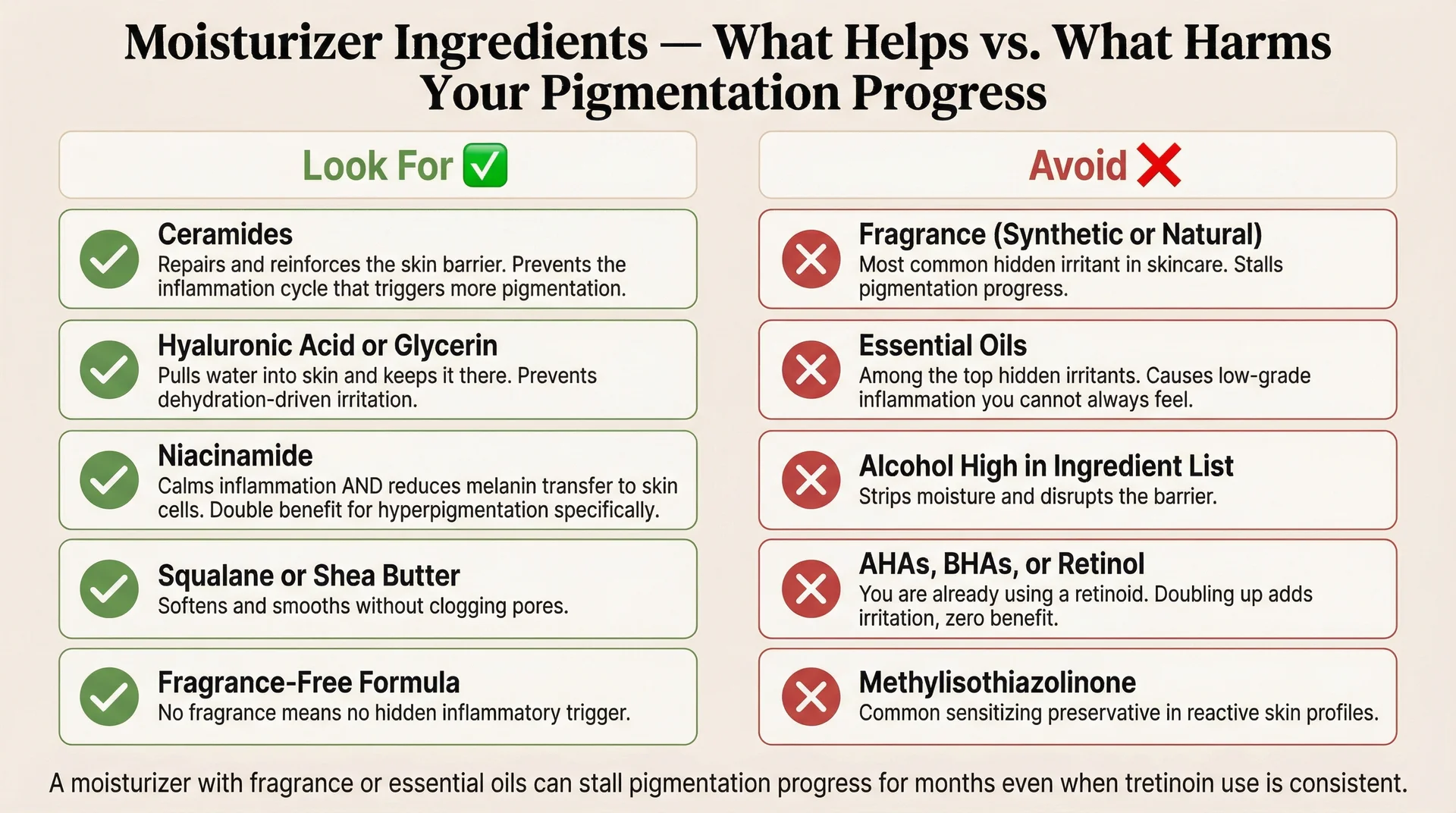
Most moisturizer guides for tretinoin focus entirely on managing dryness and irritation. That framing is correct but incomplete, especially if you are using tretinoin for hyperpigmentation.
The right moisturizer does three things simultaneously: it manages the dryness, it supports the skin barrier so inflammation stays low, and because low inflammation means less melanin stimulation, it directly supports your pigmentation outcome.
The wrong moisturizer can compromise all three.
I have seen clients using tretinoin consistently for months with minimal pigmentation improvement, and when I looked at their full routine, the moisturizer they were using contained fragrance, essential oils, or irritating preservatives.
Their skin was in a low-grade state of inflammation that they could not always feel, but the melanocytes could definitely respond to.
What to look for in a moisturizer while using tretinoin for pigmentation:
- Ceramides to actively repair and reinforce the skin barrier, which is your primary defence against the irritation cycle that triggers more pigmentation
- Hyaluronic acid or glycerin are humectants that pull water into the skin and keep it there
- Niacinamide, which serves double duty: it calms inflammation and has its own evidence base for reducing the transfer of melanin to skin cells, making it genuinely useful for hyperpigmentation rather than just irritation management
- Squalane or shea butter as emollients that soften and smooth without clogging pores
What to avoid in your moisturizer:
- Fragrance of any kind, synthetic or “natural.”
- Essential oils, which are among the most common hidden irritants in skincare
- Alcohol high in the ingredient list
- Active ingredients like AHAs, BHAs, or retinol (you are already using a retinoid; doubling up adds zero benefit and significant irritation risk)
- Preservatives like methylisothiazolinone if you have known sensitivity reactions
Moisturizers I consistently recommend to clients using tretinoin, by skin type:
| Skin type | Recommendation | Why it works |
|---|---|---|
| Dry or very dry | CeraVe Moisturizing Cream | Ceramides, hyaluronic acid, fragrance-free, genuinely occlusive |
| Sensitive or reactive | Avène Tolérance Control Soothing Skin Care | Minimalist ingredient list, specifically formulated for reactive skin |
| Oily or acne-prone | Vanicream Facial Moisturizer | Non-comedogenic, hypoallergenic, no fragrance, light enough not to sit heavily |
| Combination | La Roche-Posay Toleriane Double Repair | Barrier support without heaviness, layers well under tretinoin |
| Any type with irritation | CeraVe Healing Ointment layered on top of another moisturizer | Occlusive seal for nights when the skin feels particularly raw or stripped |
One note specifically for people using tretinoin for PIH on darker skin tones: I prioritize anti-inflammatory ingredients even more heavily in these cases. Niacinamide, as a key ingredient in your moisturizer, is worth seeking out specifically because managing inflammation is directly tied to managing melanin response in skin that is more prone to PIH. Cetaphil Moisturizing Cream and Neutrogena Hydro Boost are two widely available options that include niacinamide and tend to work well for this skin profile. |
How to Use Your Moisturizer to Protect Your Pigmentation Progress
Having the right moisturizer matters, but how you use it with tretinoin determines whether it actively supports your skin or just sits on top of it.
I covered the three application methods in detail in the “How to Apply Tretinoin” guide, but the specific context for pigmentation is worth revisiting here.
If you are in your first eight weeks on tretinoin and using it for hyperpigmentation, the sandwich method is your best starting point. Moisturize first, apply tretinoin, moisturize again.
The reasoning from a pigmentation standpoint is that the sandwich method keeps irritation low, and low irritation means the melanocytes in your skin stay calm. You trade a small amount of tretinoin penetration for a significant reduction in the inflammation that would otherwise signal your skin to produce more pigment.
Once your skin adjusts, typically somewhere between weeks eight and twelve for most people, you can move to the buffer method. Apply moisturizer first, wait fifteen minutes, then apply tretinoin. At this stage, your barrier is stronger, your irritation response is lower, and tretinoin is working more directly on the pigmentation.
The standard method, tretinoin on completely dry skin followed by moisturizer twenty minutes later, is appropriate for skin that has fully adjusted over three or more months. For many clients using tretinoin specifically for pigmentation, this is where you want to land eventually because it gives tretinoin the most direct contact with the cells you are trying to change.
| A note on seasonal adjustment: Several of my clients switch back to the sandwich method in winter, when their skin is drier and more prone to irritation even after months of tretinoin use. This is not a step backward. It is a sensible adaptation that keeps them consistent year-round, which is the variable that matters most for long-term pigmentation improvement. |
What Else Supports Tretinoin for Hyperpigmentation
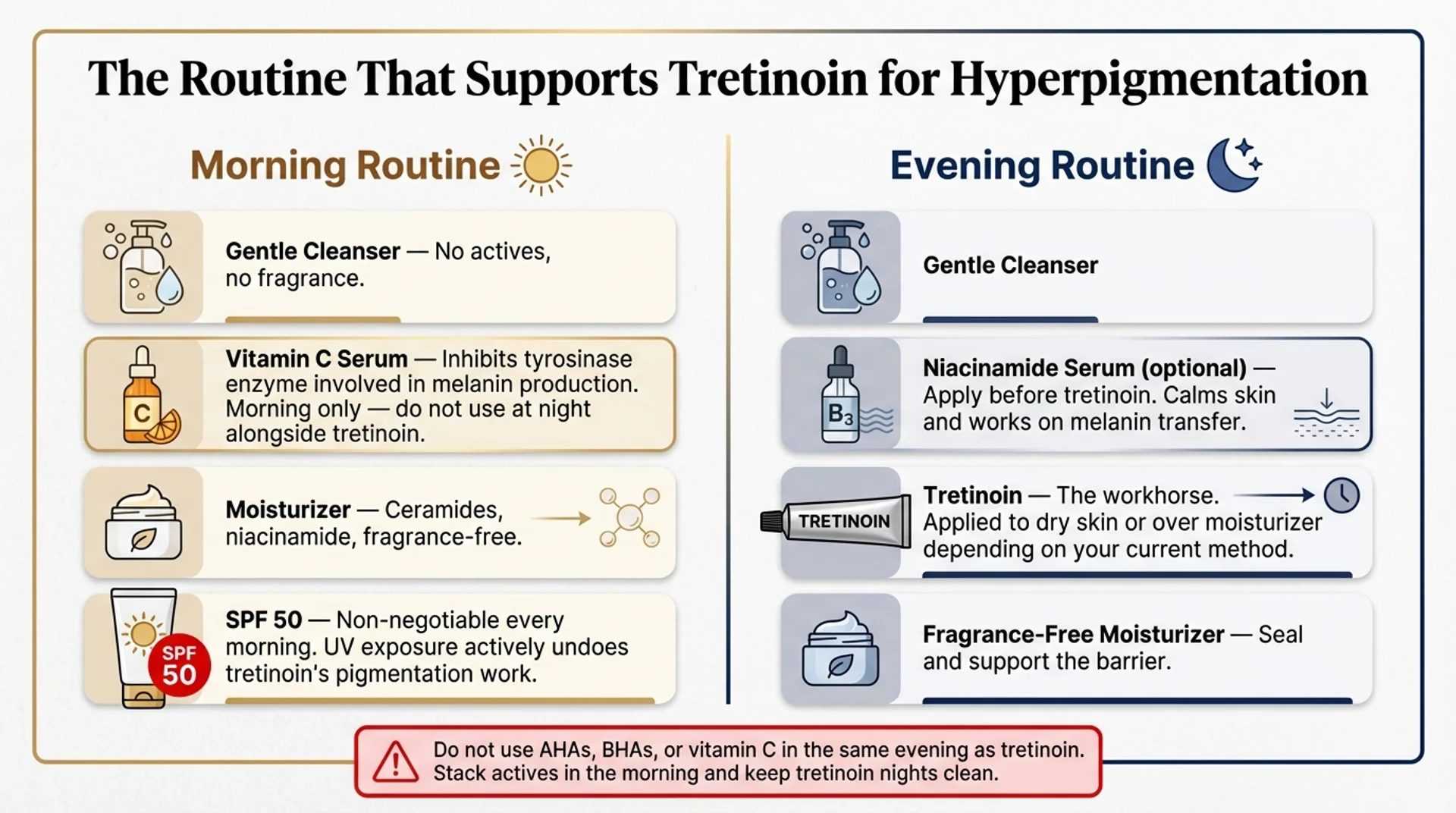
Tretinoin does the heavy lifting, but the supporting cast in your routine matters more for pigmentation than it does for most other skin concerns.
- SPF is your most important daytime step, full stop. Every morning, regardless of the weather, regardless of whether you plan to be outdoors. UV exposure is the primary driver of melanin production, and any progress tretinoin makes at night can be actively undone during the day without consistent sun protection. SPF 30 is the minimum. SPF 50 is what I personally use and what I recommend to my clients who are treating pigmentation specifically.
- Vitamin C in the morning amplifies what tretinoin does at night. Vitamin C inhibits an enzyme called tyrosinase, which is involved in melanin production. Using a stable vitamin C serum in your morning routine alongside tretinoin at night creates a two-pronged approach to pigmentation that works significantly better than either ingredient alone. Keep vitamin C in the morning only. Applying it at night alongside tretinoin increases irritation without adding benefit.
- Azelaic acid is worth knowing about. It addresses pigmentation through a different mechanism than tretinoin and layers well with a tretinoin routine when used thoughtfully. I cover this combination in full in the azelaic acid and tretinoin guide on this site, including whether you can use both in the same routine and which skin types benefit most from combining them.
- Niacinamide, if not already in your moisturizer, is worth adding as a serum. I apply it after tretinoin and before the final moisturizer layer for clients who need it. It settles redness, supports the barrier, and works on melanin transfer at the cellular level, which makes it one of the most genuinely useful additions to a tretinoin routine for pigmentation rather than just a nice-to-have.
What Most People Get Wrong When Using Tretinoin for Hyperpigmentation
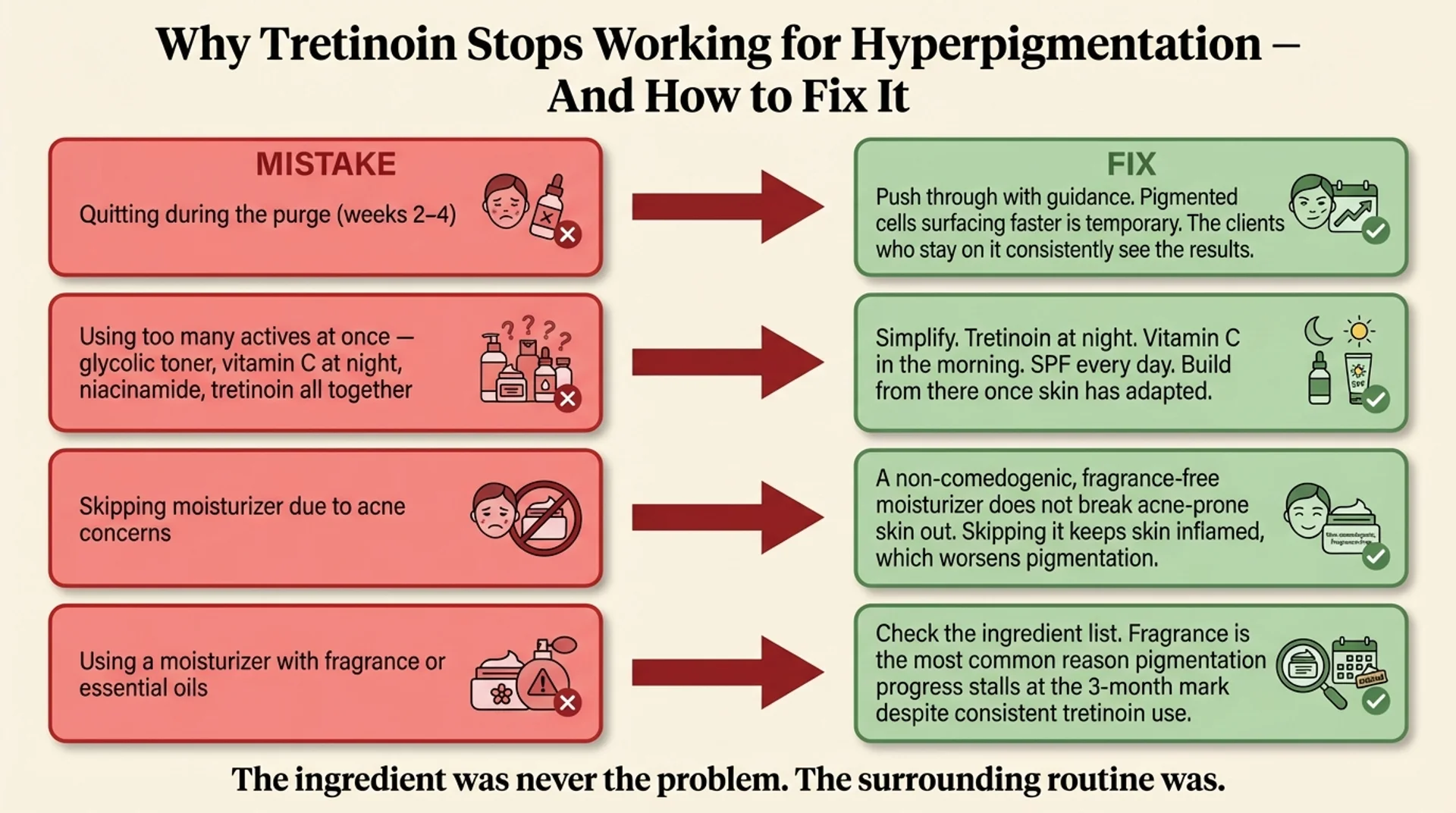
I want to address this directly because I see the same mistakes repeatedly, and they are the reason so many people conclude that tretinoin does not work for dark spots when the ingredient was never the problem.
- Quitting during the purge. In weeks two to four, some people see their skin get worse before it gets better. Existing pigmented cells can look more prominent as tretinoin accelerates their movement toward the surface. This is the purge, and it is temporary. The clients who push through it under proper guidance consistently end up with better outcomes than the ones who stop.
- Using too many actives at once. Tretinoin is already doing significant work. Adding a glycolic acid toner, a vitamin C serum at night, and a niacinamide serum on the same evening is too much acid load on a skin barrier that is already adjusting. Simplify. Tretinoin at night, vitamin C in the morning, SPF every day. Build from there once your skin has adapted.
- Skipping moisturizer because of acne concerns. I understand the instinct. Many of my acne-prone clients spent years avoiding anything remotely creamy because it broke them out. But skipping moisturizer while on tretinoin leaves your barrier unprotected, creates a dehydration cycle that can actually increase oil production, and keeps your skin in a state of low-grade inflammation that worsens pigmentation. A non-comedogenic, fragrance-free moisturizer does not break out acne-prone skin. The right one actively helps it.
- Using a moisturizer with fragrance or essential oils. This one I cannot overstate. Fragrance is the most common hidden irritant in skincare, and I have seen it stall pigmentation progress for months in clients who were otherwise doing everything right. If you are using tretinoin for dark spots and not seeing improvement at the three-month mark, check your moisturizer ingredient list before concluding that the tretinoin is not working.
Frequently Asked Questions
How quickly does tretinoin work for hyperpigmentation?
Surface-level dark spots start visibly improving around weeks 8 to 12 with consistent use. Deeper pigmentation from hormonal causes or years of sun exposure takes 3 to 6 months. Patience is the actual active ingredient here.
Will tretinoin fix hyperpigmentation?
For post-inflammatory marks and sun spots, the improvement can be significant over 6 to 12 months. Deeper hormonal pigmentation like melasma responds better when tretinoin is part of a broader routine rather than used alone.
Why shouldn’t you use tretinoin?
Tretinoin is not recommended during pregnancy. People with eczema, active rosacea, or a severely compromised skin barrier need to approach it cautiously. Starting without guidance on application method and frequency is also where most problems begin.
Why is tretinoin so popular now?
Decades of research back it up, which is rare in skincare. It addresses acne, fine lines, texture, and hyperpigmentation through one mechanism. Increased access through telehealth platforms has also made prescriptions far easier to obtain than they were ten years ago.
Why are people quitting tretinoin?
Most people quit in weeks 2 to 4 during the adjustment period, when dryness, flaking, and purge breakouts peak. They mistake the transition phase for a bad reaction. The right application method and moisturizer keep most people on it through that window.
Does tretinoin age your skin?
The opposite is true with consistent use. Tretinoin stimulates collagen production, improves skin texture, and accelerates cell turnover. The temporary dryness and sensitivity during adjustment can look rough, but that phase passes, and the long-term effects on skin quality are well established.
What should you never mix with tretinoin?
On the same night: AHAs, BHAs, benzoyl peroxide, and vitamin C. These stack irritation without adding benefit. Fragrance in your moisturizer is the other one most people overlook. Save your actives for the morning and keep tretinoin nights clean and simple.
A Final Word
Tretinoin works for hyperpigmentation. I have seen it change skin that clients had given up on, including my own clients who came to me after years of trying brightening serums that barely moved the needle.
But it works on its own timeline, and that timeline is longer than most people are told upfront.
The two things that consistently separate the clients who see results from the ones who quit are staying on it through the adjustment period and keeping the surrounding routine simple enough that the skin barrier stays intact.
The right moisturizer is not a small detail in that equation.
For pigmentation specifically, it is the thing that keeps inflammation low, keeps your skin in the routine, and keeps the progress compounding month over month.
Give it six months before you draw any conclusions. Your skin at month six will look meaningfully different from your skin at week four, and that difference is worth the patience it takes to get there.