
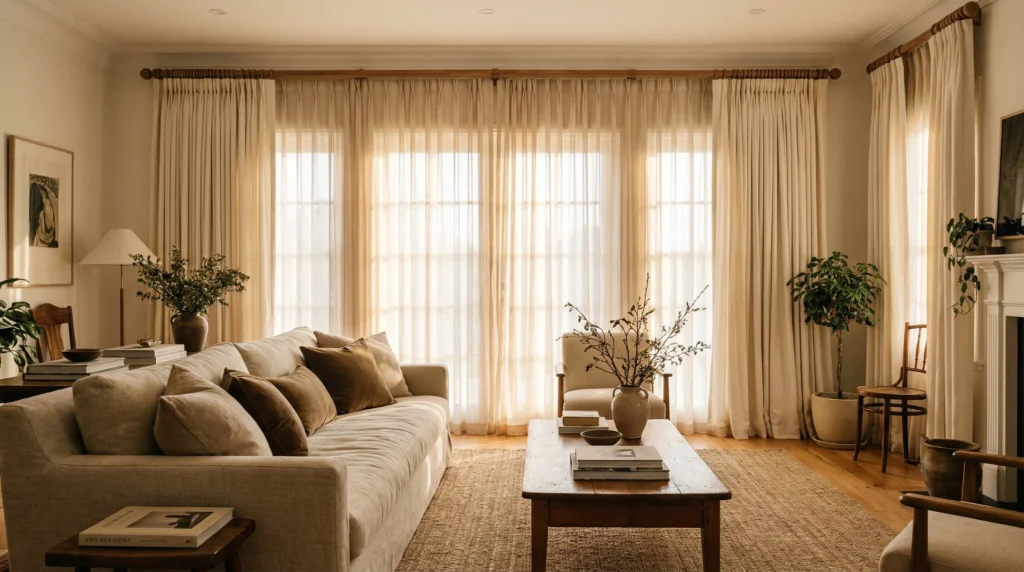
Every time I walk into a client’s home for the first time, I notice the windows before I notice anything else. Before the furniture arrangement, before the wall colours, before the rugs, the windows tell me everything about how much thought went into that room. And more often than you’d think, they’re dressed wrong.
Wrong fabric, wrong length, wrong heading, wrong function entirely. The curtains look fine at first glance, but they’re quietly working against the room.
I’ve spent over a decade in residential interior design, first as a design consultant for a furniture retailer and later as an independent interior styling advisor. The single question I get more than any other from homeowners is some version of “I just don’t know what curtains to pick.” They’re standing in a showroom or scrolling endlessly online, feeling completely lost.
So let me give you the short version right here, before we go any deeper.
Here are the main types of curtains you’ll encounter:
| Type | Best For | Key Feature |
|---|---|---|
| Sheer Curtains | Living rooms, layering | Filters light, adds softness |
| Blackout Curtains | Bedrooms, nurseries, media rooms | Blocks nearly all light |
| Room Darkening Curtains | Bedrooms, offices | Reduces light without full blackout |
| Thermal / Insulated Curtains | Cold climates, drafty windows | Regulates temperature |
| Eyelet / Grommet Curtains | Modern, contemporary rooms | Clean slide, modern look |
| Pinch Pleat Curtains | Formal, traditional rooms | Structured, elegant folds |
| Pencil Pleat Curtains | Versatile, classic spaces | Tight gathered pleats |
| Rod Pocket Curtains | Casual, stationary setups | Simple, budget-friendly |
| Tab Top Curtains | Bohemian, rustic interiors | Relaxed, fabric loops |
| Velvet Curtains | Formal rooms, cold spaces | Luxury, insulation, drama |
| Linen Curtains | Airy, relaxed interiors | Natural texture, breathable |
| Café Curtains | Kitchens, bathrooms | Covers the lower half of the window |
This table gives you the full picture immediately. The rest of this guide helps you figure out which one actually belongs in your specific room, on your specific window, with your specific goals in mind.
Why Most People Pick the Wrong Curtains
I remember a client who had just moved into a south-facing townhouse with gorgeous, tall windows in her sitting room. She bought sheer white linen curtains because they looked beautiful in the catalogue.
By July, the afternoon sun turned that room into something close to a greenhouse, and the glare off her television made the space completely unusable after 2 PM. The curtains were beautiful. They were just wrong for that window.
What I’ve learned over the years is that people choose curtains the way they choose wall art, by what looks good in isolation. The real job of a curtain goes much further than aesthetics. It manages light. It controls temperature. It offers privacy. It absorbs sound. It changes the perceived height and width of a room.
So before you think about colour or fabric, ask yourself these four questions:
- How much light do you want in this room, and when?
- How much privacy does this window need?
- Does this room get uncomfortably hot or cold near the window?
- What is the overall style of the room you’re decorating?
Your answers will immediately eliminate a huge portion of options, and what remains is where you start shopping.
Sheer Curtains: The Layer Everyone Underestimates
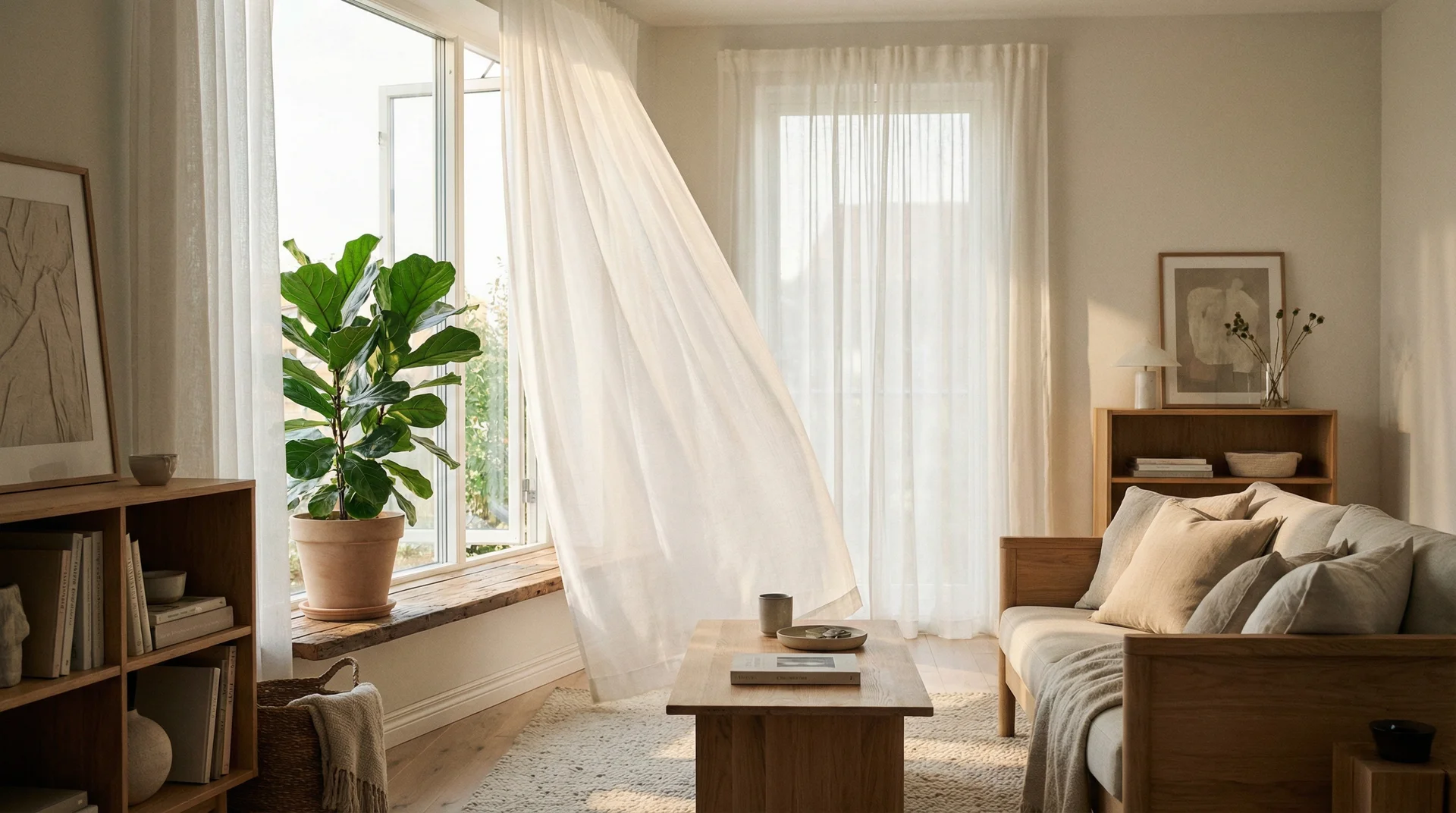
Sheer curtains are probably the most misunderstood type in the entire category. People either dismiss them as “not real curtains” or buy them, thinking they’ll do the full job on their own. Neither view does them justice.
Sheers are woven from lightweight, semi-transparent fabrics like voile, chiffon, or fine linen. Their purpose is nuanced. They scatter and soften natural light, turning harsh direct sun into something warm and diffused. They give a room a sense of movement and lightness. They provide a gentle visual barrier between your interior and the street without making the space feel closed off.
I consistently recommend sheers in living rooms and dining areas where you want to maintain a connection with the outdoors while softening daytime light. They also work brilliantly as a layering element beneath heavier drapes, which gives you full control over the room’s mood at different times of day.
One important thing to keep in mind: sheers curtains offer virtually no privacy after dark when your interior lights are on. The moment you switch on a lamp, anyone outside can see straight in. So if privacy matters to you in the evening, sheers alone will not solve that.
Sheer curtain fabrics worth knowing:
- Voile: Crisp, fine, very translucent. Works beautifully in contemporary spaces.
- Chiffon: Soft and fluid, it lends an almost romantic quality to a room.
- Lace: Traditional, textured, works best in cottage or vintage-style interiors.
- Organza: Has a slight sheen, is slightly more structured than voile, and adds formality.
For installation, sheers need to be hung at roughly 1.5 to 2 times the width of your window to achieve that soft, gathered look. A flat, sheer panel looks stiff and awkward. Let them have fullness, and they’ll reward you with beautiful natural folds.
Approximate cost range: Ready-made sheer panels typically run from £15 to £60 per panel. Custom sheers with premium fabrics like silk organza can reach £150 or more per panel.
Blackout Curtains: What They Actually Do (And What They Don’t)
The name “blackout” sets up an expectation, and I want to address it directly. Many homeowners feel frustrated when their blackout curtains still let in a thin strip of light along the edges. That light leak doesn’t come from the curtain failing. It comes from the curtain being hung too close to the wall or on a rod that’s too narrow for the window.
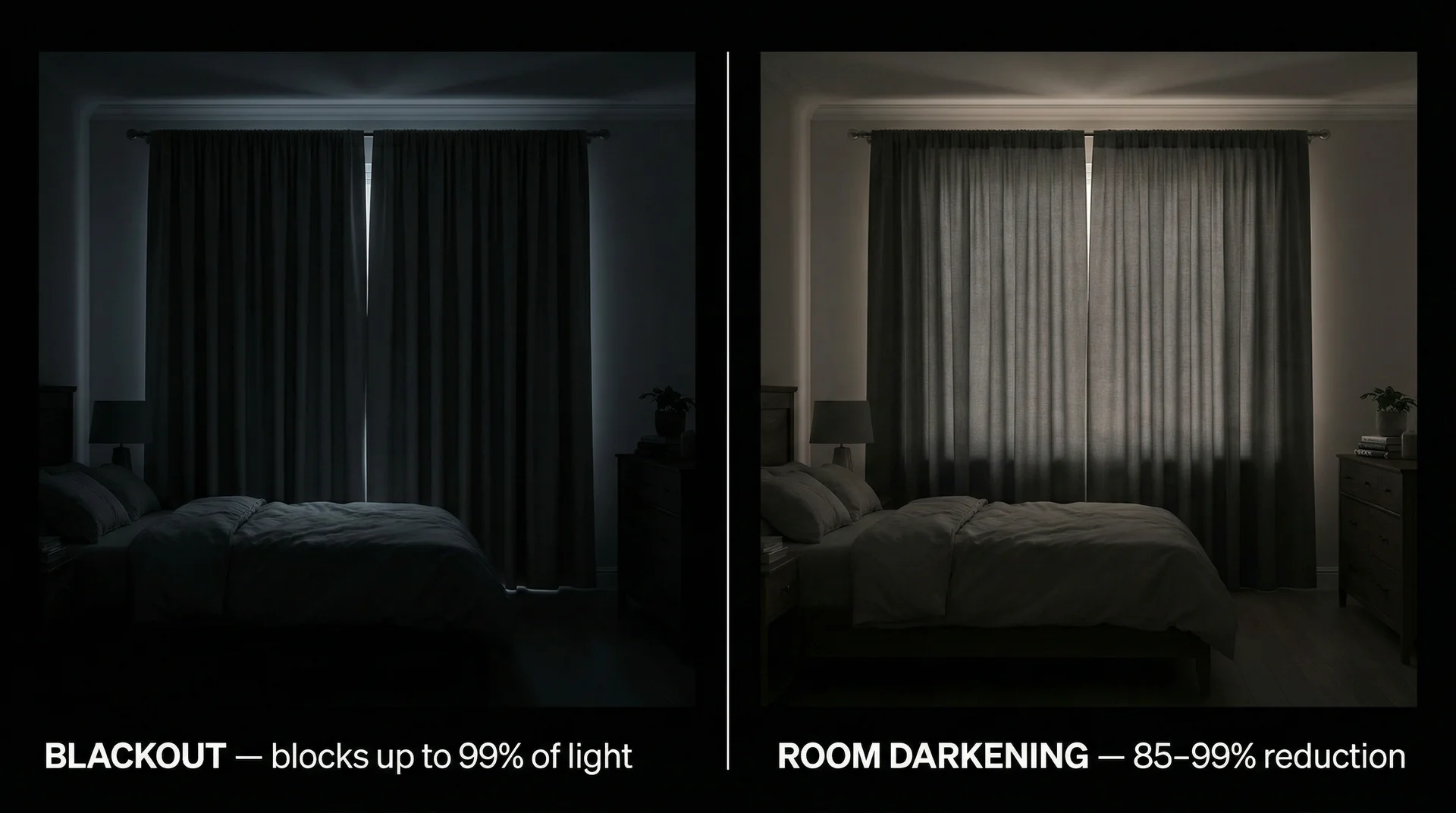
Blackout curtains work through a multi-layered fabric or bonded blackout lining that prevents light from passing through the textile itself. Good quality blackout curtains block up to 99% of light transmission and help with heat management. The gaps around the curtain are a hardware problem, not a fabric problem.
Where blackout curtains genuinely excel:
- Bedrooms where light-sensitive sleepers need complete darkness
- Nurseries and children’s rooms where daytime naps happen
- Home cinema rooms where ambient light destroys picture quality
- Shift workers’ bedrooms where sleeping during the day is non-negotiable
Beyond light control, a good blackout curtain gives you meaningful thermal and acoustic benefits. Studies in energy efficiency have shown that heavily lined curtains can reduce heat loss through windows by up to 25%, which adds up considerably during winter months.
Blackout curtains have come a very long way from the heavy, utilitarian panels they used to be. You can now find them in linen textures, velvet, and even lightweight-looking fabrics that achieve full blackout through an integrated lining rather than a single heavy weave.
One opinion I hold strongly: In a bedroom, always choose blackout over room darkening. The difference feels insignificant on paper, but matters enormously at 5 AM in summer when the sun rises early.
Approximate cost range: Ready-made blackout panels typically run from £20 to £80 per panel. Made-to-measure with premium blackout lining can reach £200 or more per panel, depending on fabric choice.
Room Darkening Curtains: The Useful Middle Ground
Room darkening curtains reduce light significantly, typically blocking between 85% and 99% of incoming light, but they stop short of a near-total blackout. In practical terms, you’ll notice a dim ambient glow through them in bright afternoon sun, but harsh glare will be gone.
They work well in:
- Home offices where you want to reduce screen glare without sitting in total darkness
- Guest bedrooms where some morning light helps guests orient themselves naturally
- Living rooms with west-facing windows where the afternoon sun creates intense, uncomfortable glare
Their fabrics tend to be somewhat lighter and more versatile aesthetically than full blackout options, which makes them easier to style in rooms that serve multiple purposes throughout the day.
Thermal and Insulated Curtains: The Ones That Actually Save You Money
If you live somewhere with harsh winters or older single-glazed windows, thermal curtains deserve serious consideration. I’ve recommended them to sceptical clients, and almost every one of them came back surprised by the difference.
Thermal curtains trap a layer of still air between the fabric and the window, which acts as insulation. Some incorporate a reflective backing that sends radiant heat back into the room during winter and deflects solar heat in summer.
According to the U.S. Department of Energy, window treatments including insulated curtains can reduce heat loss by up to 10% in a standard home. Combined with proper installation and overlapping edges, that number climbs further.
Best fabrics for thermal performance:
| Fabric | Insulation Level | Aesthetic Feel |
|---|---|---|
| Velvet | Excellent | Luxurious, formal |
| Heavy wool blend | Excellent | Warm, textured, traditional |
| Layered polyester with foam backing | Very good | Functional, modern |
| Interlined cotton | Good to very good | Elegant, natural |
One practical note: thermal curtains are heavier and require sturdier hardware. Always check the weight specifications on your curtain rods before purchasing heavy thermal panels.
Approximate cost range: £30 to £120 per ready-made panel, depending on fabric and size.
Understanding Curtain Heading Types: The Part That Changes Everything
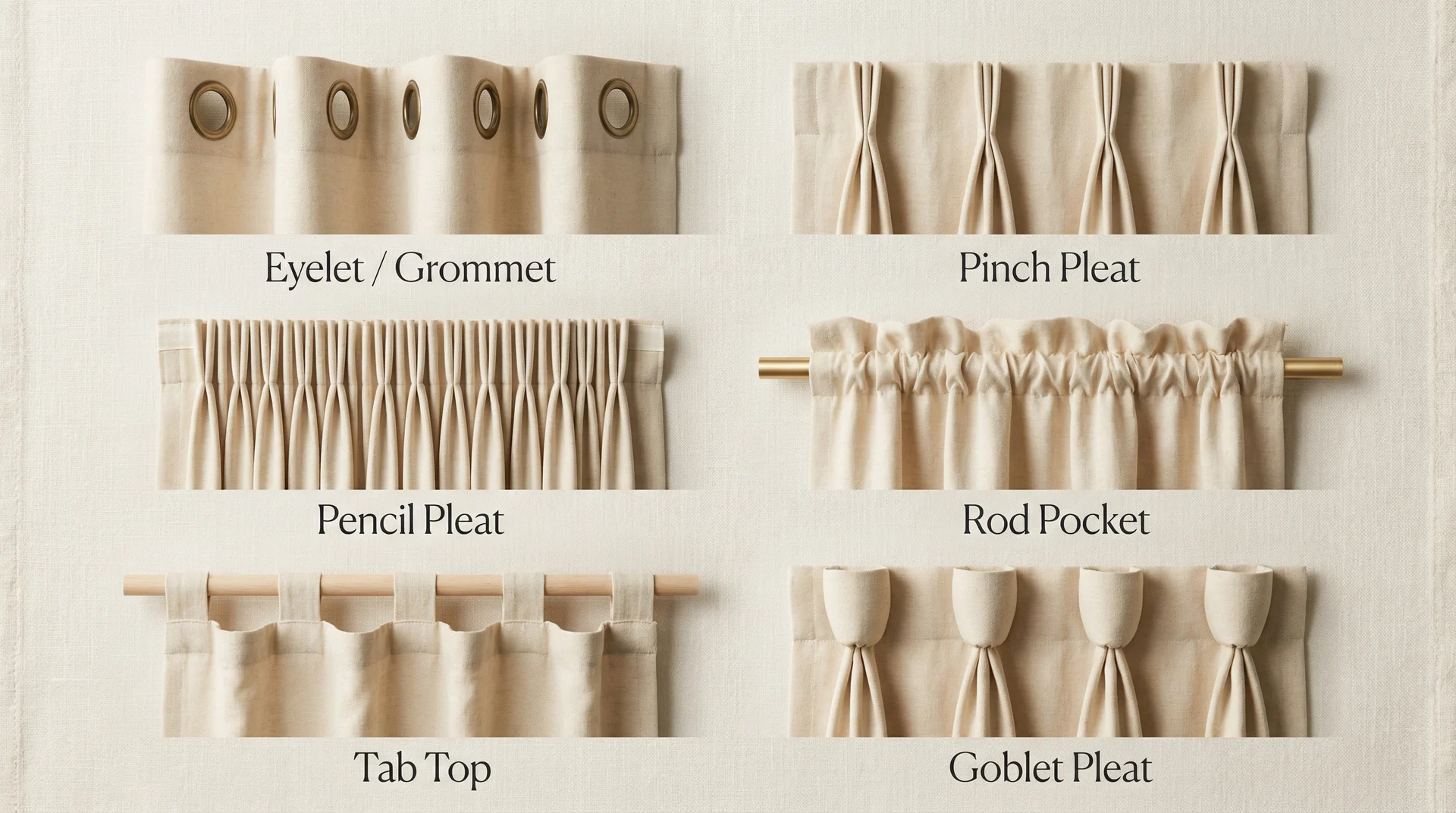
The heading type shapes almost everything you see when you look at a curtain. It determines the folds, the formality, how the curtain moves on the rod, and how much fabric you need to order.
Eyelet and Grommet Curtains
Eyelet and grommet curtains feature large metal rings punched through the top edge, through which the rod passes directly. The result is a series of clean, even folds that flow smoothly along the rod.
They suit contemporary and modern interiors and slide open and closed easily, making them practical for frequently used windows.
One caveat: the metal finish of the grommets needs to work with the rest of the room’s hardware. A warm brass eyelet in a cool-toned room with chrome fixtures creates a small but persistent visual tension.
Pinch Pleat Curtains
Pinch pleat curtains are sewn with groups of fabric pinched and stitched together at the top to create structured folds. The most common varieties are double pinch (two folds per pleat) and triple pinch (three folds per pleat). Triple pinch gives a fuller, more formal drape.
These are my personal favourites for formal living rooms and dining rooms because the consistency of the folds gives the window a tailored, finished look even when the curtains are open. They require hooks and a track or rod with rings, which means a slightly more involved installation, but the result is worth it.
Pencil Pleat Curtains
Pencil pleat curtains gather into tight, narrow pleats across the heading, resembling a row of pencils placed side by side. They’re one of the most popular styles in the UK and much of Europe, and for good reason: they work in almost any interior style from traditional to transitional.
They offer excellent fullness and drape well across all fabric types. You can also adjust the gathering to control how full or flat the curtains hang, which gives you flexibility in how dramatic or understated the final look becomes.
Rod Pocket Curtains
Rod pocket curtains have a sewn channel at the top through which the rod slides directly. They create soft, casual folds and work well in relaxed, informal spaces like reading nooks, country-style kitchens, or bedrooms with an unfussy aesthetic.
The limitation is that they’re not easy to slide open and closed, which makes them better suited to panels you plan to leave in a fixed position most of the time. If you like to open your curtains fully every morning and close them every evening, rod pocket curtains will become frustrating quickly.
Tab Top Curtains
Tab top curtains use visible loops of fabric sewn to the top edge, through which the rod passes. They have irregular folds between the tabs and a casual, relaxed character. I use them in bohemian, rustic, or eclectic interiors where that handmade quality adds to the warmth of the space.
A practical note: tabs can stretch over time with frequent use, and light tends to filter through the gaps at the top. Lining them helps with both issues.
Goblet Pleat Curtains
Goblet pleat curtains have individual pleats shaped like goblet glasses, often padded to hold their shape. They are the most formal heading style and belong in spaces where elegance is the explicit goal: formal dining rooms, grand living rooms, or bedroom suites in traditional homes.
They don’t work in casual spaces, and they benefit from professional installation to look their best. In the right context, though, the impact when you walk into the room is genuinely impressive.
Curtain Fabrics: What You’re Really Choosing
Beyond heading type and function, the fabric does an enormous amount of work in how the curtain feels, drapes, and ages. This is where I’ve seen the most regret from clients who chose based on appearance in the shop without considering how the material would behave in their specific conditions.
Linen
Linen curtains carry a natural texture and a relaxed, slightly uneven quality that works beautifully in the right space. They suit casual living rooms, bedrooms with a Scandinavian or natural aesthetic, and farmhouse kitchens. They breathe well and age beautifully, developing a gentle softness over time.
The thing about linen that surprises people is that it wrinkles easily. In a relaxed interior, those creases read as character. In a formal space, they look unkempt.
Velvet
Velvet curtains create an immediate sense of warmth and luxury. The pile catches light and gives the curtain a subtle depth of colour that changes depending on the angle you view it from. They offer excellent insulation and sound absorption, which makes them genuinely multi-functional in a way that looks entirely decorative.
I often recommend velvet in rooms where the goal is intimacy and warmth: bedroom, sitting areas, formal dining rooms, and home libraries. They’re heavy, they need sturdy hardware, and they typically require dry cleaning, but the impact they create is difficult to replicate with lighter fabrics.
Cotton
Cotton curtains are the reliable, versatile option that works in almost every situation. They’re breathable, available in an enormous range of weights and weaves, and relatively easy to maintain. The one limitation is sun exposure. Over time, direct sunlight degrades cotton fibres and causes fading. If your window receives strong, consistent sun, add a UV-protective lining.
Silk and Faux Silk
Silk curtains have an unmistakable lustre and a fluid drape that looks spectacular in formal spaces. They’re also fragile, sun-sensitive, and expensive, which is why faux silk (often woven from polyester) has become a very popular alternative.
High-quality faux silk is difficult to distinguish from the real thing at a glance and holds up considerably better under UV exposure. I use faux silk fairly often in client projects where the goal is a luxurious look without the maintenance challenges of genuine silk.
Polyester and Blended Fabrics
Modern polyester weaves can replicate the appearance of linen, cotton, and even velvet with impressive accuracy, while offering durability and easy care that natural fibres often can’t match. For families with young children, rooms with high humidity, or rental properties where practicality outweighs aesthetics, high-quality polyester blends are a genuinely sensible choice.
Curtains by Room: What Actually Works Where
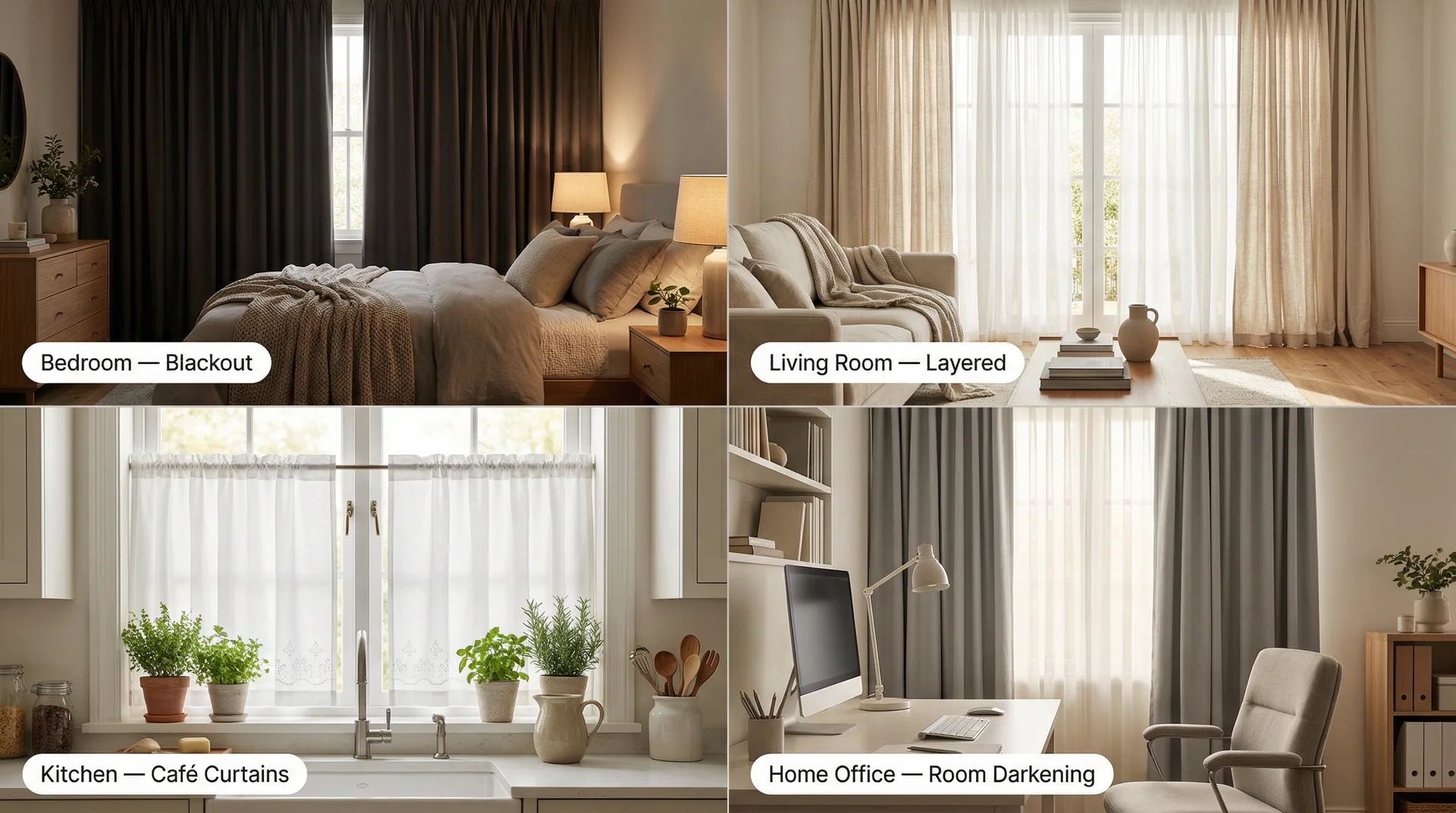
This is the section most current guides skip over, and it’s the one I get asked about most in consultations. So here is my room-by-room breakdown.
Bedroom
The bedroom’s primary job is sleep quality. Blackout curtains or deeply lined room darkening panels work best. Layer them over sheers if you enjoy waking up to soft natural light but still need darkness for sleep. Fabric choices like velvet, heavy cotton, or interlined linen add warmth and a sense of envelopment that suits most bedroom aesthetics.
Living Room
Living rooms demand flexibility. You typically want curtains that can filter light during the day, provide privacy in the evening, and look beautiful at all times. A layered setup with sheers and heavier drapes gives you that flexibility. Pinch pleat or pencil pleat headings work for more formal rooms, while eyelet or tab top styles suit relaxed, contemporary spaces.
Kitchen
Kitchens need practicality above everything else. Café curtains work brilliantly here, giving you privacy in the lower field of vision without blocking light from above. Choose fabrics that are easy to wash (cotton or polyester blends) because kitchens accumulate grease and steam. Avoid delicate fabrics like silk or velvet entirely.
Bathroom
In bathrooms, moisture resistance is the primary consideration. Choose polyester, faux silk, or specially treated cotton that can handle humidity without deteriorating or growing mildew. Keep panels short or opt for café curtains. Sheers work well in bathrooms with frosted or obscure glass where privacy isn’t the primary concern. Bathroom curtains need special consideration of their own.
Home Office
Home offices benefit from room-darkening curtains that manage glare on screens without plunging the room into darkness. Opt for neutral tones that don’t compete visually with your work setup, and choose a fabric with some weight so the curtains hang neatly and absorb some of the room’s ambient noise.
Children’s Room/Nursery
Blackout curtains are non-negotiable in a nursery or young child’s bedroom. Look for child-safe hardware (corded blinds have known safety risks, and the same principle applies to any hanging mechanism within reach). Choose machine-washable fabrics, because children’s rooms require frequent cleaning.
What Curtains Make a Room Look Bigger?
This is one of the most searched questions related to curtains, and it comes up in almost every client consultation I have. The answer lies in how you hang the curtains, not necessarily in which type you choose.
The techniques that actually work:
- Hang the rod close to the ceiling. Positioning your rod 4 to 6 inches above the window frame, or as close to the ceiling as practical, draws the eye upward and makes the ceiling feel higher.
- Extend the rod well beyond the window frame. When the curtains are open, they should sit entirely off the glass. This makes the window itself look wider and allows maximum light into the room.
- Choose floor-length curtains. Even on shorter windows, floor-length curtains create a vertical line that elongates the room visually.
- Use light colours or soft neutrals. Dark, heavy curtains absorb light and visually compress a space. In a smaller room, lighter tones keep the room feeling open.
- Avoid busy patterns in small spaces. Large prints draw attention and make a small room feel cluttered. Subtle textures or solid fabrics read better.
How to Measure for Curtains: Getting It Right the First Time
Incorrect measurements are the single most common reason curtains look wrong after installation. Here is how to avoid that.
Width
For your curtain panels to have proper fullness, they should total between 1.5 and 2.5 times the width of your window. Flat panels with minimal fullness look intentional only in specific contemporary aesthetics. In most cases, more fullness looks better and more polished.
Measure from where you intend the rod to start to where you intend it to end, not just the window frame width, especially if you plan to extend the rod beyond the frame (which I almost always recommend).
Length
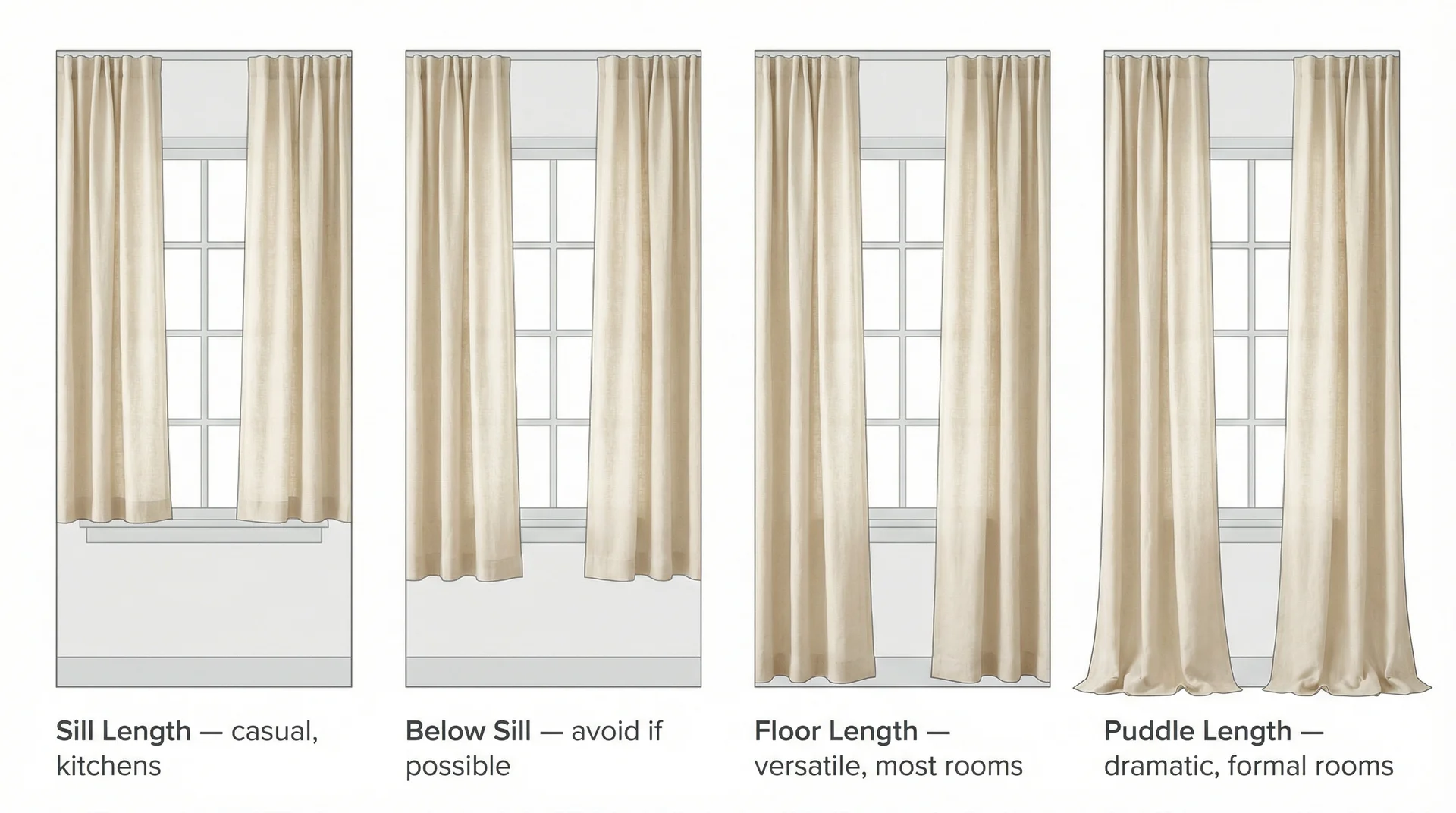
| Length Style | Visual Effect | Best For |
|---|---|---|
| Sill length | Casual, cottage-like | Kitchens, nurseries, café curtains |
| Below sill (6 to 12 inches) | Awkward in most cases | Avoid unless a radiator prevents floor length |
| Floor length (half inch above floor) | Clean, tailored, versatile | Most rooms, most styles |
| Puddle length (3 to 6 inches on floor) | Romantic, dramatic, formal | Formal living rooms, bedrooms |
Rod Placement
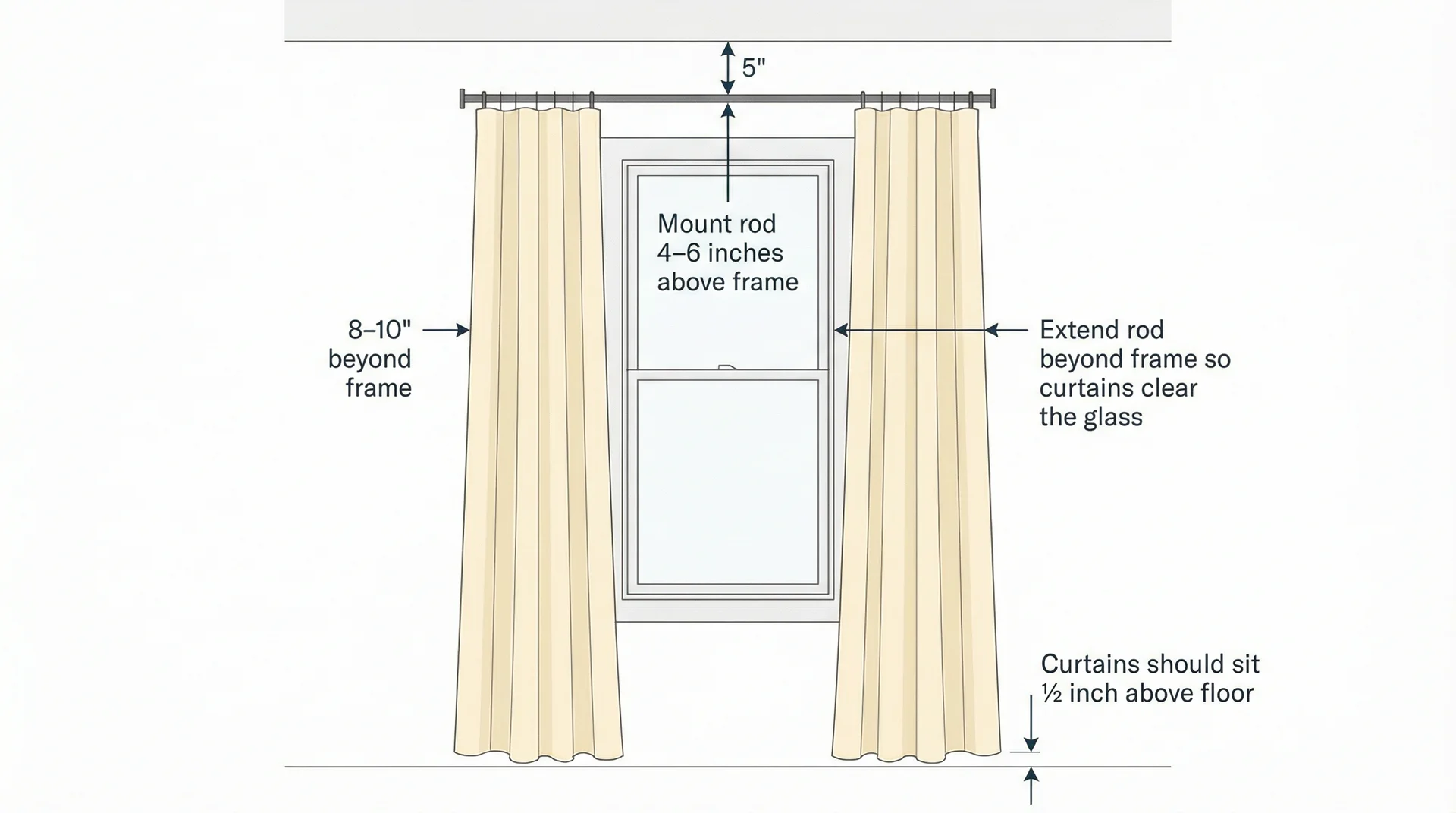
Hang your curtain rod higher than the top of the window frame. I typically hang rods 4 to 6 inches above the frame, and sometimes closer to the ceiling in rooms with standard ceiling heights.
This makes the window appear taller, and the ceiling feel higher. Hang the rod wider than the frame, too, so that when the curtains are open, they sit completely off the glass and allow maximum light in.
How Many Panels Do I Need?
For a standard window, two panels (one on each side) create the most balanced look. For very wide windows or sliding doors, you may need three or four panels to achieve adequate fullness.
A single panel works only for very narrow windows or as a deliberate asymmetric design choice.
Layering Curtains: The Technique That Gives You Complete Control
One of the most useful things I’ve learned through years of styling rooms is that the best window treatments almost always involve layering. A single curtain layer forces you to compromise between light, privacy, and aesthetics. Two layers let you address all three without sacrifice.
If you want to take the top layer further, a structured valance above your curtains adds a finished, architectural quality that bare rods simply can’t achieve.
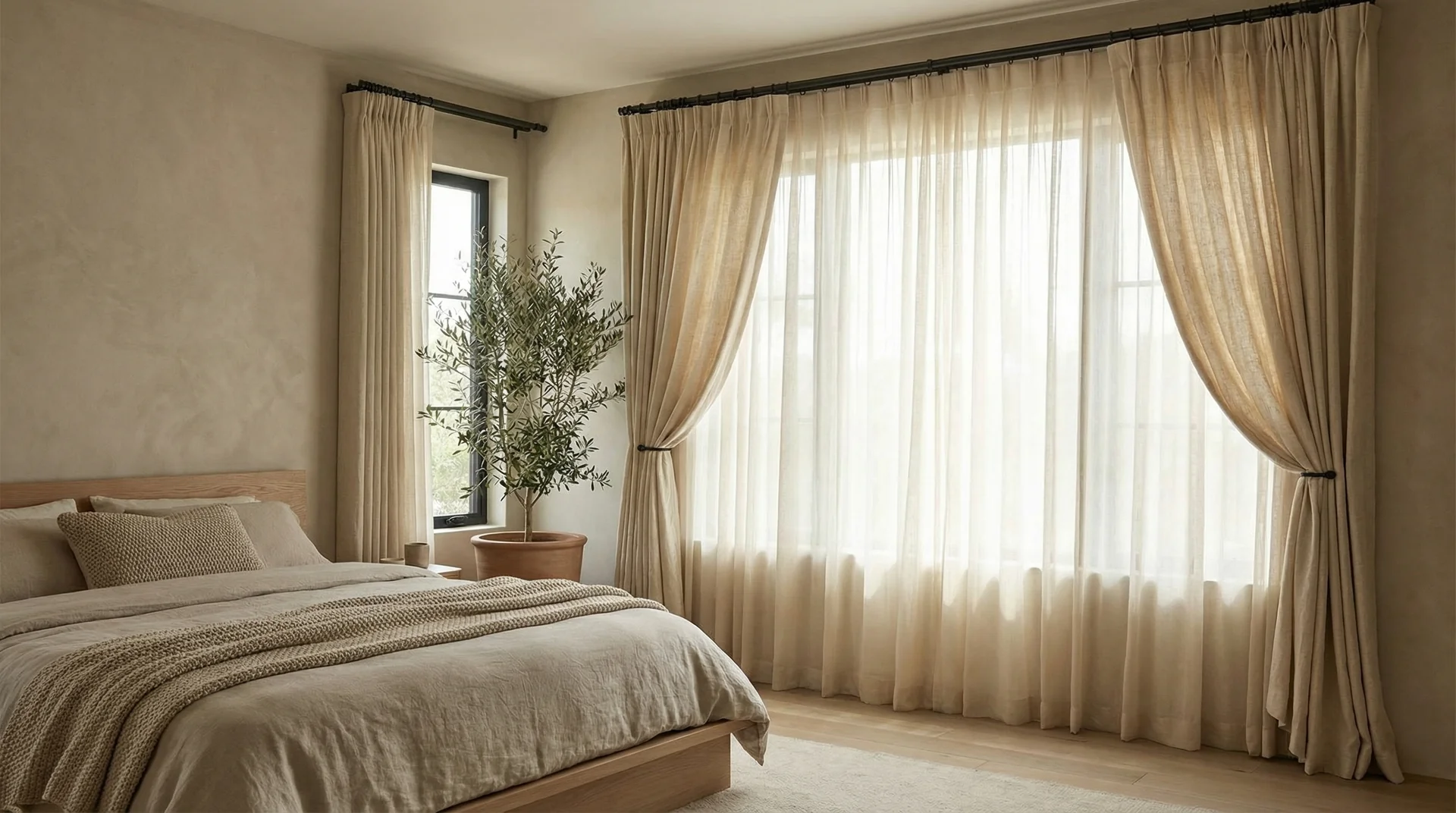
The classic combination pairs sheer curtains closest to the glass with heavier drapes or blackout panels on the outer layer. During the day, you draw back the heavier curtains and rely on the sheers for softened light and daytime privacy. In the evening, closing the outer layer gives you full privacy and, if they’re lined, warmth and sound reduction.
For this to work well, you need:
- A double bracket or double curtain track that holds both layers on separate rails
- Sheers in a width that allows them to hang with gentle fullness when the room is in its daytime mode
- Outer curtains with enough fullness to look substantial when closed
Colour, Pattern, and Texture: Making the Right Aesthetic Choice
Working with Colour
In my styling work, I follow a consistent principle: curtains should either anchor the room by pulling from a dominant colour in the space or add a deliberate contrast that energises the room. Both approaches work. The one that rarely works is choosing a curtain colour that has no relationship to anything else in the room.
A warm white or off-white curtain softens a neutral room and adds light. A deep jewel tone like emerald, navy, or plum creates a sense of luxury and intimacy. Both are valid depending on what you want the room to feel like.
Working with Pattern
Patterned curtains work best when the room’s other major elements (sofas, rugs, cushions) are predominantly solid. Introducing pattern on pattern creates visual noise that the eye struggles to process.
The exception is a maximalist aesthetic, where the skill lies in varying the scale of the patterns so they each occupy a distinct visual register.
Working with Texture
Texture is the most underused element in curtain selection. Two curtains can share the same colour and be dramatically different in feel depending on whether one is flat cotton and the other is textured linen or ribbed velvet.
In rooms with a lot of smooth, flat surfaces like lacquered furniture, glass, and polished floors, a heavily textured curtain adds warmth and visual complexity that softens the overall environment.
Curtain Trends Worth Knowing in 2025 and 2026
Curtain trends have shifted noticeably in recent years, and while I always encourage clients to prioritise their own taste and their room’s needs over trend cycles, it helps to know what’s current when you’re shopping.
What’s performing well in residential interiors right now:
- Earthy, organic tones. Clay, terracotta, warm sand, and deep olive have replaced the grey-dominant palettes of the previous decade. Curtains in these tones feel both current and timeless.
- Textured naturals. Boucle, linen blends, and slubby weaves are everywhere. The imperfection of the texture is part of the appeal.
- Floor-to-ceiling installations. The trend of hanging curtains from just above the frame is fading. Ceiling-mounted curtain tracks that run wall to wall are increasingly common in contemporary spaces.
- Warm neutrals over cool whites. Off-whites with warm undertones, like cream, ivory, and ecru, are replacing the cool, bright whites that dominated the 2010s.
- Quiet luxury aesthetics. Heavy, beautifully lined curtains in understated colours signal quality without being showy. This aesthetic rewards investment in fabric and lining over decorative detail.
Curtains vs Blinds: Which One Should You Choose?
This question comes up constantly, and the honest answer is that it depends entirely on what you need the window treatment to do.
| Factor | Curtains | Blinds |
|---|---|---|
| Light control precision | Moderate; depends on lining | High; can control exactly how much light enters |
| Aesthetic warmth | High adds softness and texture | Lower, cleaner, but cooler in feel |
| Insulation | Good to excellent with lining | Moderate; less effective than lined curtains |
| Sound absorption | Good, especially with heavy fabrics | Poor to moderate |
| Ease of cleaning | Variable; depends on fabric | Generally easier to wipe clean |
| Cost | Variable; can be expensive custom | Generally, more affordable for standard sizes |
| Best for | Formal rooms, bedrooms, and living rooms | Kitchens, bathrooms, offices, and small windows |
The best solution in many rooms is to combine both curtains and blinds, but there are certain nuances to it that you must cater to.
A roller blind for precise light control during the day, paired with curtains that frame the window and add warmth in the evening, gives you functionality that neither treatment achieves alone.
Curtain Care and Longevity
| Fabric | Care Method | Key Watchout |
|---|---|---|
| Cotton | Machine washable in most cases | Can shrink; wash before hanging if possible |
| Linen | Hand wash or delicate machine cycle | Wrinkles significantly; iron while damp |
| Velvet | Dry clean recommended | Can crush and lose pile if handled roughly |
| Silk | Dry clean only | Highly vulnerable to water spotting and sun damage |
| Faux silk / Polyester | Machine washable (cold cycle) | Use fabric softener to manage static |
| Blackout curtains | Spot clean or gentle machine wash | Washing can damage the blackout coating over time |
Sun damage is the other major longevity factor. South and west-facing windows expose curtains to the most intense UV radiation, and even high-quality fabrics fade under this kind of exposure.
Adding a UV-protective lining to any curtain in a sun-facing room is one of the most effective ways to extend its life.
Frequently Asked Questions
What is the most popular type of curtain?
Pencil pleat and eyelet curtains are consistently the most popular in the UK market. Pencil pleat suits traditional and transitional spaces, while eyelet works across modern and contemporary rooms. Both offer good fabric fullness and are widely available at most price points.
How do I choose curtains for my living room?
Start with light and privacy needs. If you want flexibility, layer sheers with heavier drapes. Choose a heading style that matches your room’s formality level: pinch pleat or pencil pleat for more formal spaces, eyelet or tab top for relaxed or contemporary rooms.
What type of curtains are best for bedrooms?
Blackout curtains or deeply lined room darkening curtains work best in bedrooms. Pair them with sheers on a double track if you want the option of soft morning light without sacrificing sleep quality.
Do curtains make a room look bigger or smaller?
Curtains hung close to the ceiling and extended well beyond the window frame make a room look bigger. Floor-length curtains also help by drawing the eye upward and creating a vertical line that elongates the space.
What curtains are best for a cold room?
Thermal or insulated curtains work best for cold rooms. Look for interlined cotton, heavy wool blends, or velvet panels with a reflective lining. Ensuring the curtains extend beyond the window frame on all sides and reach the floor will reduce the draft significantly.
How many curtain panels do I need per window?
For most standard windows, two panels (one on each side) create the best balanced look. For wide windows or sliding doors, you may need three or four panels to achieve adequate fullness when the curtains are closed.
Are curtains better than blinds?
Neither is universally better. Curtains add warmth, texture, and sound absorption. Blinds offer more precise light control and are easier to maintain in rooms with moisture or grease. Combining both gives you the best of what each treatment offers.
What type of curtains are easiest to maintain?
Polyester and polyester-blend curtains are the easiest to maintain. They’re machine washable, resistant to wrinkling, durable under frequent use, and available in a wide range of styles and colours.
Final Thoughts
Choosing the right curtain means understanding what you actually need from your window treatment, in terms of function, fabric, heading, and fit, before you fall in love with how something looks on a screen.
The best curtains I’ve ever helped clients choose were ones where the function and the aesthetic aligned completely, where the room felt pulled together, and the curtains worked quietly in the background, doing everything they were meant to do.
Take the questions I laid out early in this guide seriously. Know your light requirements. Know your window dimensions. Know your room’s aesthetic direction. Let those answers narrow your choices naturally. What remains will always be better than what you would have chosen by scrolling alone.
If you want to go deeper on any specific curtain type, styling choice, or room setup, I cover individual decisions in more detail across other guides on TheSoulNook. Every window has a right answer. Finding yours just takes a little more clarity than most people give it.