
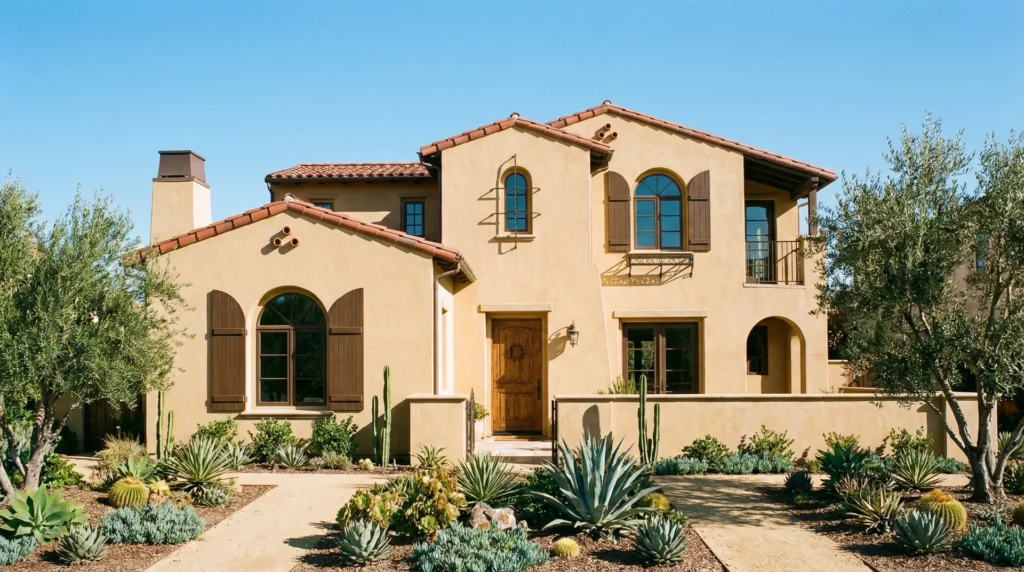
I want to start with the job that changed how I talk about stucco with homeowners.
It was in the Carolinas. A two-story colonial, built in the mid-1990s. From the street, the exterior looked perfectly fine. Clean lines, intact surface, no visible cracks. The homeowners had noticed a faint musty smell in an upstairs bedroom for two seasons and blamed it on a basement humidity issue.
A moisture inspection revealed something far worse. Water had been working silently behind the stucco for years, reaching the wall framing through an inadequately caulked window transition.
By the time we opened the wall, the OSB sheathing behind three elevations had rotted through in multiple sections. Remediation cost, stucco removal, sheathing replacement, mold treatment, and new installation came in at just over $38,000.
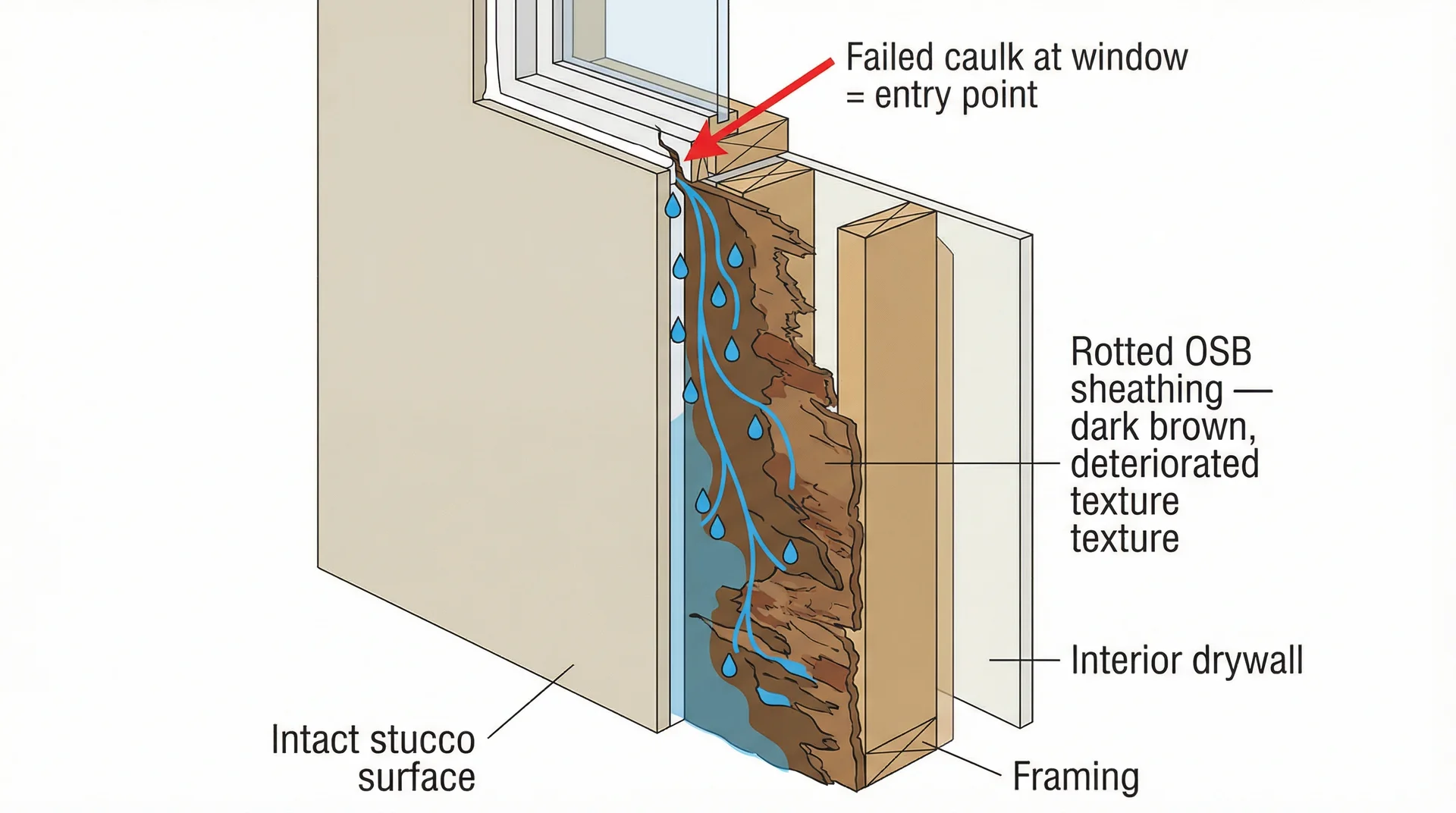
The stucco itself had never cracked. The failure was invisible until it was expensive.
That story is not an argument against stucco. It is an argument for understanding exactly where stucco performs brilliantly and exactly where it does not, before you make a $15,000 to $34,000 installation decision.
| Here is the short version: stucco siding costs $6–$17 per square foot installed, lasts 50–100 years in dry climates, is non-combustible, provides genuine thermal mass, and requires minimal active maintenance in appropriate environments. In wet climates, its moisture management limitations create a specific and serious failure pattern that makes it a poor choice without exceptional installation and ongoing vigilance. |
The right climate with a skilled installer and stucco is extraordinary. The wrong climate or a shortcut installation and the result can be structurally silent and extremely expensive. Everything below explains how to tell which scenario you are in.
Traditional Stucco vs. EIFS: The Distinction That Changes Everything
When you see a stucco-finished home, you are almost certainly looking at one of two completely different systems that happen to look nearly identical from the street. Traditional stucco and EIFS (Exterior Insulation and Finish System, commonly called synthetic stucco) are built differently, behave differently with moisture, and require different inspection and maintenance protocols.
What Traditional Stucco Is
Traditional stucco, also called hard-coat or cement stucco, is one of the oldest exterior cladding systems in recorded construction. Its basic formula, Portland cement, sand, lime, and water, has remained essentially unchanged for centuries. Modern applications add chopped fiberglass for flexibility and plasticizers for workability.
Installation involves attaching metal lath to the wall sheathing over a water-resistive barrier, then applying the stucco in three coats:
Scratch coat: The base layer, applied over the lath and scored to create a mechanical bond for the next coat. Minimum 48-hour cure.
Brown coat: The leveling layer, applied over the scratch coat to create a flat, even surface. Minimum seven-day cure before the finish coat.
Finish coat: The visible surface, tinted with integral pigment and finished to the desired texture.
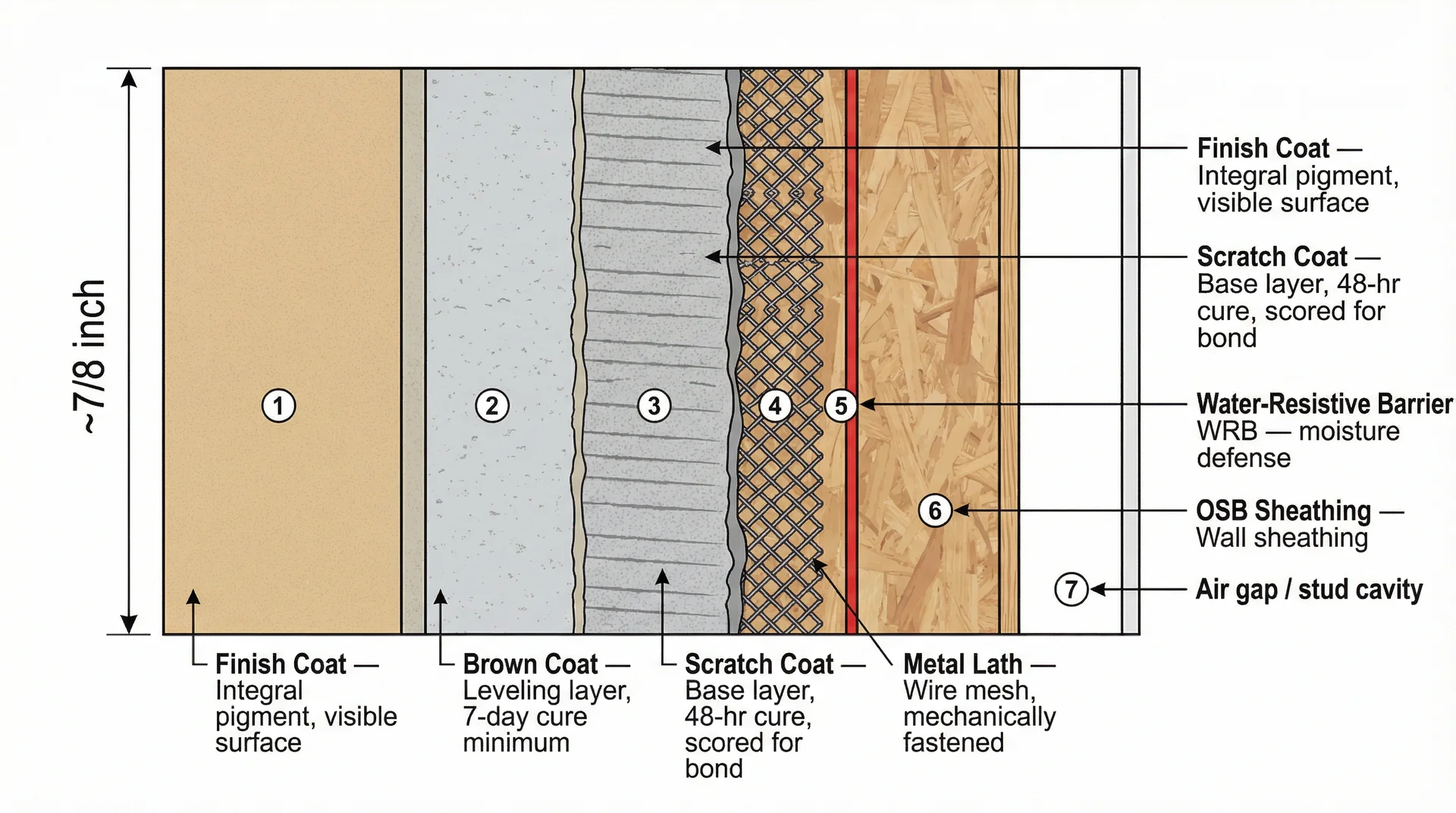
The three-coat system creates a monolithic shell approximately 7/8 inch thick. Traditional stucco is porous. It absorbs moisture and releases it as conditions change. That porosity is actually a functional advantage in appropriate climates because it allows the wall assembly to breathe. Metal flashings and weep screeds at the base of each wall section allow any incidental water to drain out rather than pool behind the cladding.
What EIFS Is
EIFS was developed in Germany after World War II as a lightweight, insulating exterior system and became widely adopted in US residential construction through the 1970s and 1980s. Its layer composition is fundamentally different:
- A fluid-applied water-resistive barrier on the wall sheathing
- Rigid expanded polystyrene (EPS) foam insulation boards adhered or mechanically fastened to the substrate
- A polymer-modified base coat applied over fiberglass mesh
- An acrylic finish coat in the desired texture and color
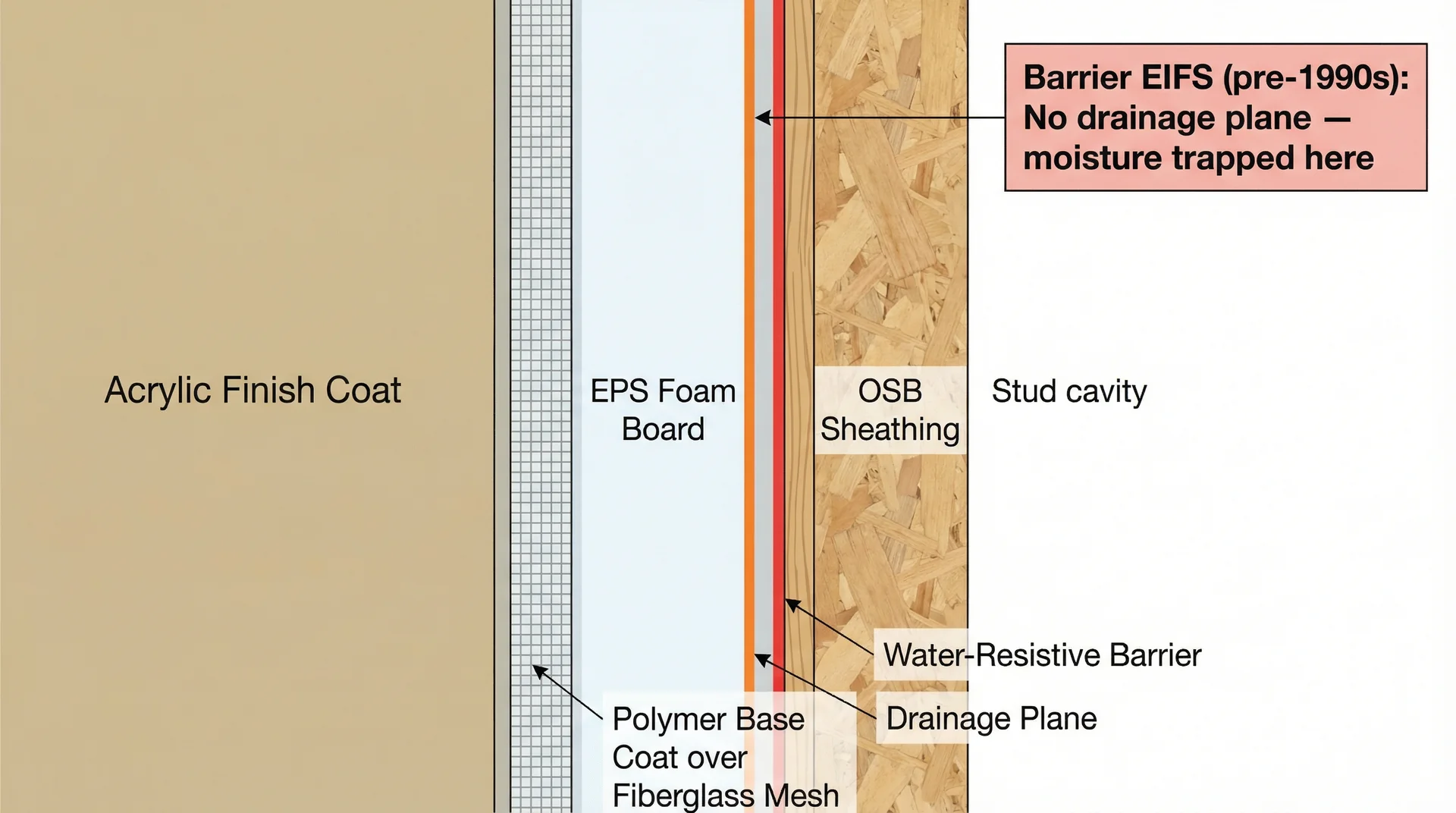
EIFS is approximately 80% lighter than traditional stucco. Its EPS foam core provides real insulation, an R-value of 3 to 5 per inch, compared to traditional stucco’s 0.20.
The fundamental problem with early EIFS installations was the barrier design. Early EIFS expected the acrylic finish to be the primary moisture defense. When water found any pathway into the system through a failed caulk joint or a small impact crack, the polystyrene foam trapped it. Traditional stucco allows moisture to migrate in and out. Early EIFS did not. The water sat against the wall sheathing and caused rot and mold at a pace that could destroy a wall assembly in two to three years, all behind a surface that looked intact.
Modern EIFS systems include drainage planes that allow infiltrating moisture to drain down and out. When installed correctly today, modern drainage EIFS performs reliably.
The challenge is that millions of homes still have barrier EIFS from 1980s and 1990s installations, and the distinction between barrier and drainage EIFS is not visible without destructive testing or probe inspection. If you are buying a home with a stucco exterior, this is worth professional moisture testing before you close.
How to Tell Them Apart
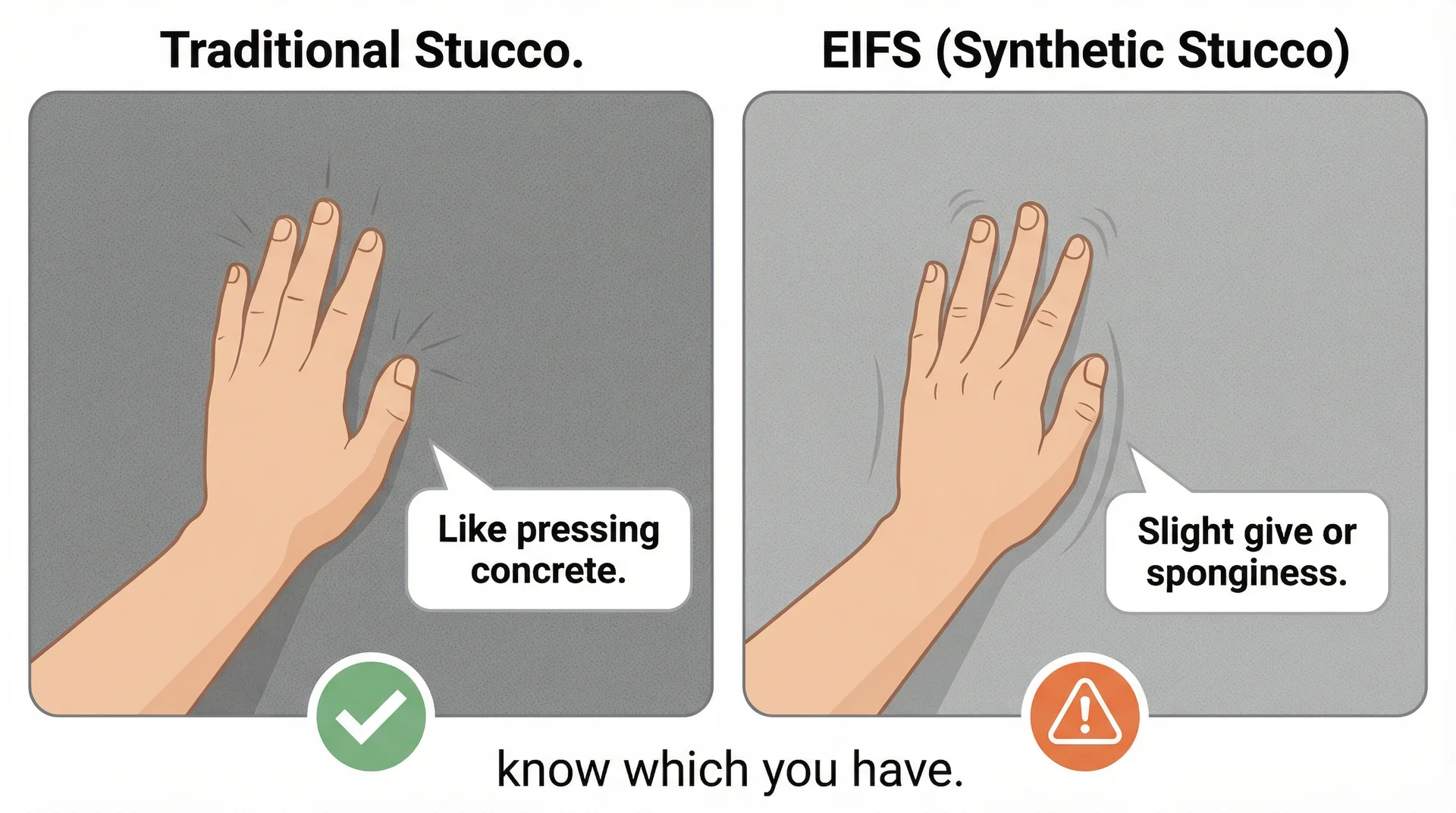
The simplest field test: press firmly on the exterior wall at several points. Traditional stucco feels completely solid, like pressing against concrete. EIFS has a slight give or sponginess because the polystyrene foam beneath compresses slightly under pressure.
A more definitive check: locate a penetration such as a light fixture or outlet box. Remove it carefully and look at the wall behind it. If you see a foam board layer (it looks like white Styrofoam), you have EIFS. Traditional stucco installations do not use this layer.
Traditional Stucco vs. EIFS at a Glance
| Factor | Traditional Stucco | EIFS (Synthetic Stucco) |
|---|---|---|
| Primary material | Portland cement, sand, lime | EPS foam, polymer base coat, acrylic finish |
| Thickness | ~7/8 inch (three-coat) | Variable, depends on foam board thickness |
| Moisture behavior | Porous, breathes, releases moisture | Drainage (modern) or barrier (older systems) |
| R-value | ~0.20 | 3.0–5.0 per inch of foam |
| Cracking tendency | More prone (cement rigidity) | Less prone (acrylic flexibility) |
| Impact resistance | High | Lower, foam dents |
| Cost installed | $6–$10/sq. ft. | $10–$18/sq. ft. |
| Best climate | Dry to arid | More climate-flexible with modern drainage |
The Full List of Stucco Pros
Longevity
In dry climates, properly installed traditional stucco lasts 50 to 100 years. Installations from the 1940s and 1950s remain structurally sound in Arizona, New Mexico, and Southern California today. That is not marketing. It is an observable reality across the region.
Fire Resistance
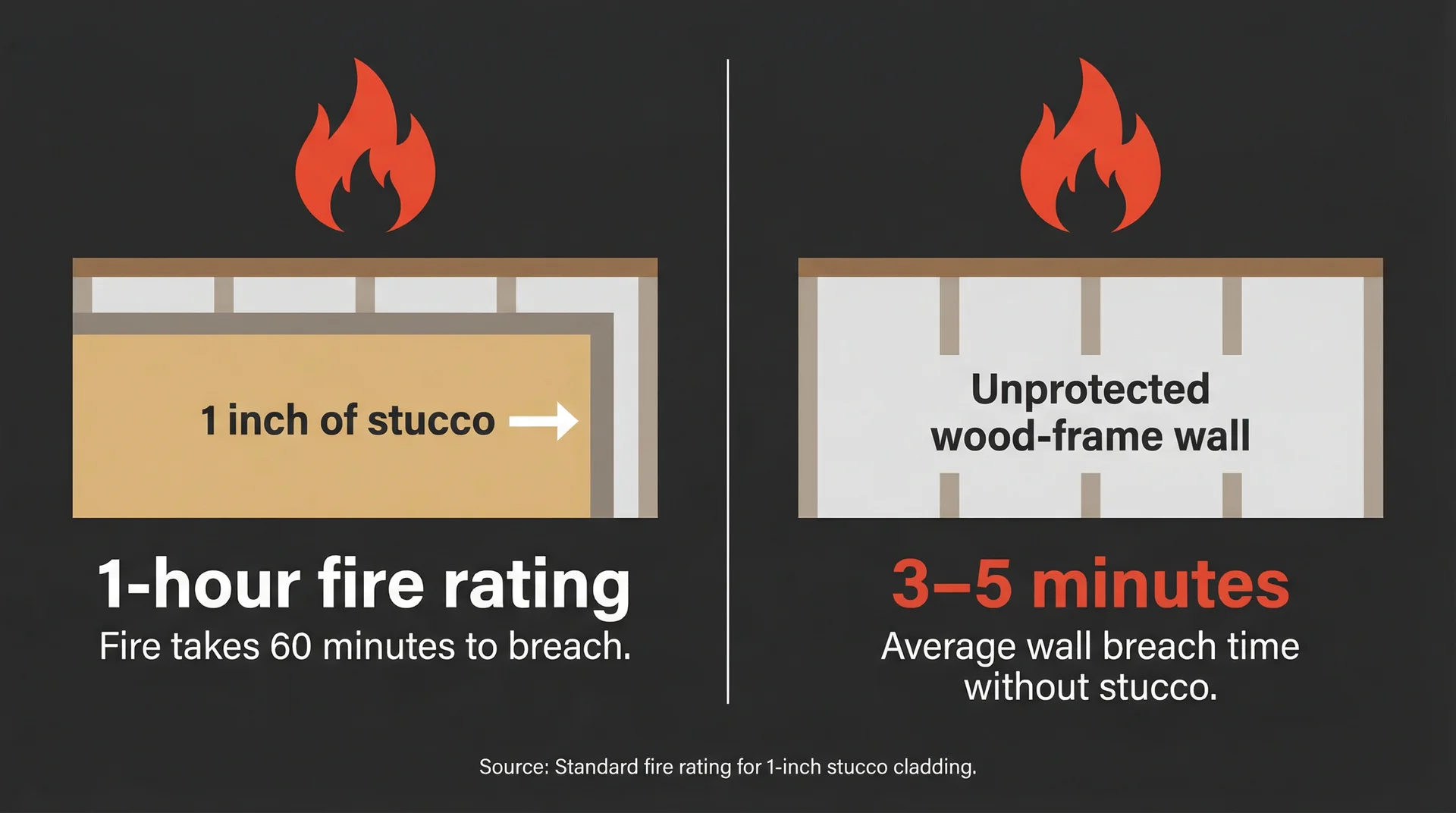
Stucco is non-combustible. A one-inch layer of stucco carries a one-hour fire wall rating. That means fire takes a full hour to burn through the cladding and reach the interior wall framing. For context, an unprotected wood-frame wall can be breached in three to five minutes. In wildfire-prone areas of the Southwest and California, this is not a minor benefit.
Sound Insulation
This one gets missed in most buying conversations. Stucco’s density dampens sound in both directions. It reduces street noise, traffic, and neighbor activity from entering the home. It also contains interior noise, which matters if your home is close to adjacent properties. Vinyl siding rattles in wind and conducts exterior noise freely. Stucco does not.
Pest and Rot Resistance
Cement-based materials do not attract termites, carpenter ants, or other wood-boring insects. Stucco does not rot. In areas where wood-based sidings fail from insect damage, stucco is structurally inert.
Thermal Mass
Dense materials absorb heat during the day and release it slowly at night, reducing the peak load on cooling systems. This is why stucco homes in desert climates often have meaningfully lower cooling costs than comparable homes with lighter cladding.
Seamless Appearance
Unlike panel-based siding, stucco has no visible joints, seams, or fasteners. This is an architectural advantage in styles where a monolithic surface is part of the design language, specifically Mediterranean, Spanish Colonial, Southwestern, and many contemporary styles.
No Painting Required (With Integral Color)
A properly specified integral-color finish coat, where pigment is mixed directly into the stucco material, does not need painting. In dry climates, this finish can go decades without a recoat.
Popularity Signals Market Acceptance
According to the US Survey of Construction, stucco was the most popular siding material for new single-family homes in 2021, 2022, and 2023, with a 26.8% market share. That widespread adoption in appropriate markets has kept contractor availability and competitive pricing strong in those regions.
The Real Stucco Cons
Moisture Risk in Wet Climates
This is where stucco earns its negative reputation, and it earns it legitimately.
In the Pacific Northwest (36 to 60 inches of annual rainfall), coastal Georgia, Florida, the Carolinas, and the Mid-Atlantic, traditional stucco absorbs moisture persistently rather than episodically. When the material never fully dries between rain events, moisture accumulates in the cement matrix. Two failure pathways develop.
The first is biological growth. Persistently damp cement surfaces support algae, moss, and mold. The discoloration starts on the surface but progressively penetrates deeper into the material.
The second is structural infiltration. As stucco remains saturated, any small gap becomes a sustained entry point for liquid water. The stucco surface can look completely intact while rot and mold progress in the wall assembly behind it for years. This is the pattern I described at the opening. It is not rare in wet climates. It is the predictable outcome.
Installation-Dependent Performance
A vinyl siding job done by a mediocre installer looks somewhat bad. A stucco job done by a mediocre installer can fail catastrophically while looking completely fine. Skipping the weep screed, omitting a proper weather-resistive barrier, or rushing cure time between coats creates failure conditions that may not become visible for five to ten years.
Crack Tendency
Cement is rigid. Normal thermal expansion and contraction of the wall assembly causes hairline cracking over time. Most of these are cosmetic. But in freeze-thaw climates, water enters hairline cracks, freezes, expands, and progressively widens them. Without proper control joints at the correct spacing (roughly every 144 square feet of wall area and at all inside corners), this cycle causes systematic cracking.
High Remediation Cost
When stucco fails from moisture infiltration, the repair is not a surface patch. It is a full excavation: remove the stucco, replace rotted sheathing, treat mold in the wall cavity, install new barriers and lath, and apply new three-coat stucco. Projects in the $30,000 to $50,000 range are routine for full-wall remediation in Mid-Atlantic and Southeast markets. This is the number to keep in mind when comparing installation costs.
Color Match on Repairs
When you repair a section of stucco, matching the color of the surrounding, weathered material is genuinely difficult. Even with the same pigment formulation, a fresh repair patch will look visibly different from adjacent stucco for one to three years until it weathers to a comparable level. On a small repair this is a minor inconvenience. On a larger repair covering 10 to 20 percent of an elevation, the color mismatch can affect the entire visual character of the wall for an extended period. There is no technical fix. It is simply a property of cement-based materials worth knowing before you commit.
No Practical DIY Option
Stucco is not a homeowner installation. The skill required to properly apply three coats, achieve consistent texture, integrate flashings, and manage cure times means this is a contractor-only project. Even repairs above a certain size benefit from professional execution to avoid texture mismatches.
Why Stucco Performs Brilliantly in Dry Climates and Struggles in Wet Ones
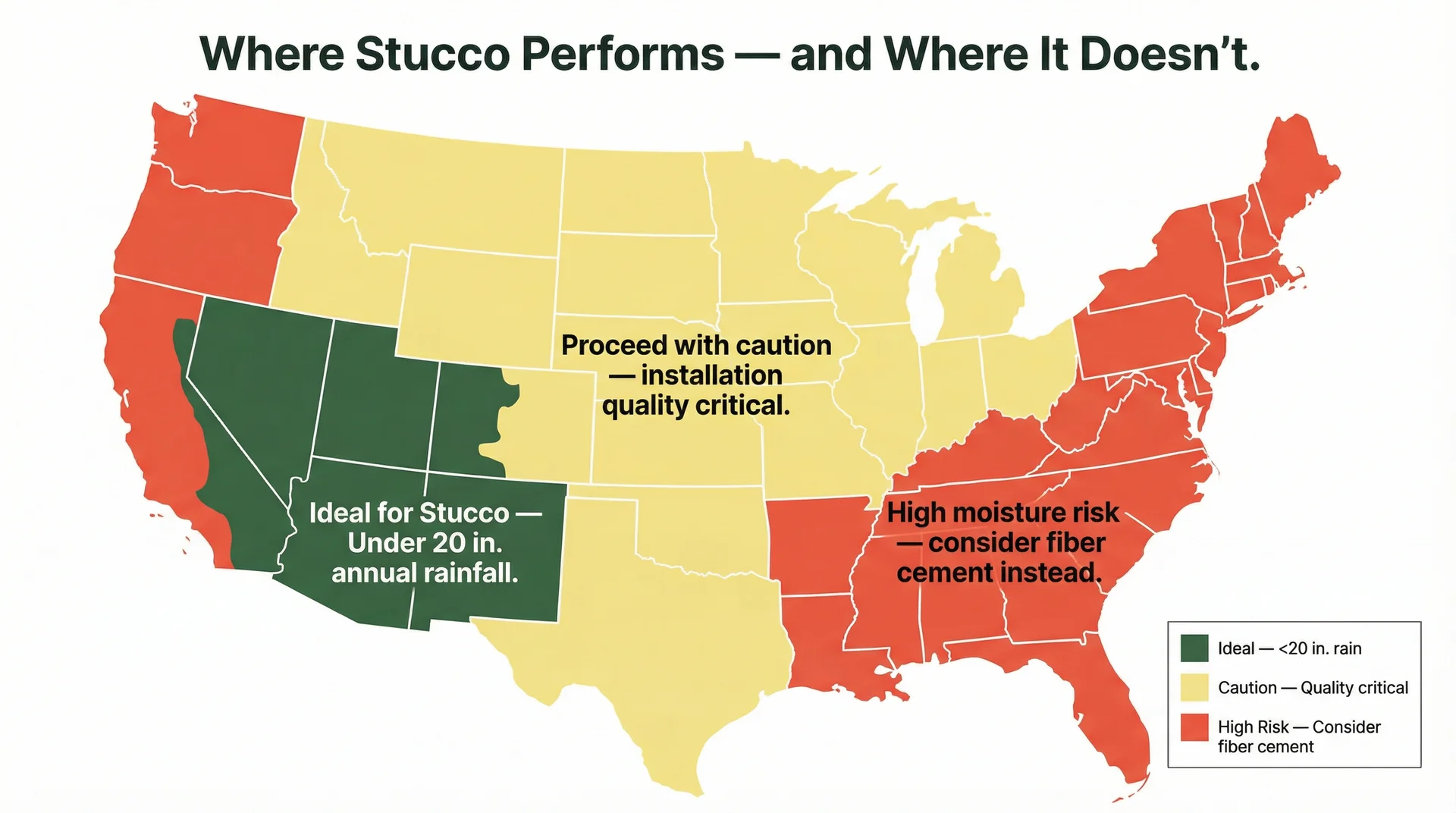
Stucco covers approximately 50% to 60% of homes in Arizona, New Mexico, Nevada, and Southern California. Installations from the 1940s and 1950s remain structurally sound in these climates today. In Phoenix, Albuquerque, and Las Vegas, stucco is genuinely among the lowest-risk, highest-longevity exterior choices available. The material’s porosity is functionally irrelevant when it absorbs limited moisture and dries completely between precipitation events.
In wet climates, the equation reverses entirely. When the material never fully dries between rain events, the porosity becomes a liability. Water doesn’t just enter the system episodically. It enters and stays, saturating the cement matrix and providing a sustained entry point at any small gap or transition. The stucco face can appear intact while the sheathing behind it rots for years.
This is not a nuanced difference. It is a material mismatch with expensive consequences.
Stucco Installation: Where Quality Lives and Dies
The three-coat system is not three equal layers applied in succession. Each coat serves a specific structural function and requires adequate cure time before the next coat goes on.
The scratch coat is the structural base. Shortcutting cure time, applying the brown coat before the scratch coat has achieved adequate strength, creates a stratified failure plane between the layers.
The brown coat is the dimensional control layer. Contractors who apply the finish coat before the brown coat has cured, a minimum of seven days in normal conditions, trap moisture between layers and create delamination risk. In production-oriented installations where crew scheduling competes with cure time, this shortcut is common.
The finish coat is where texture and color integration occur. A correctly floated finish sheds water more effectively than a poorly finished one.
What I look for on every installation I inspect:
- Continuous, properly lapped weather-resistive barrier behind the lath
- Metal lath fastened with corrosion-resistant screws at correct spacing
- Weep screed at the foundation line to allow drainage
- Proper flashing at all window and door heads
- Expansion and control joints at correct spacing
- Minimum cure times between coats
- Flexible exterior sealant at every window and door perimeter
A stucco installation that skips the weep screed, installs lath without a weather-resistive barrier, or fails to flash window heads will fail. The failure will be invisible for years.
Stucco Maintenance: What Low Maintenance Actually Means
Annual Maintenance in Dry Climates
A garden hose wash removes dust, pollen, and dirt. On north-facing walls or shaded areas where biological growth appears, a diluted bleach solution or purpose-made stucco cleaner handles removal. The critical inspection focus is transition zones: window and door perimeters, the foundation line, any penetrations, and areas where stucco meets a different material. Visual inspection twice a year catches developing problems before they become structural.
Crack Management
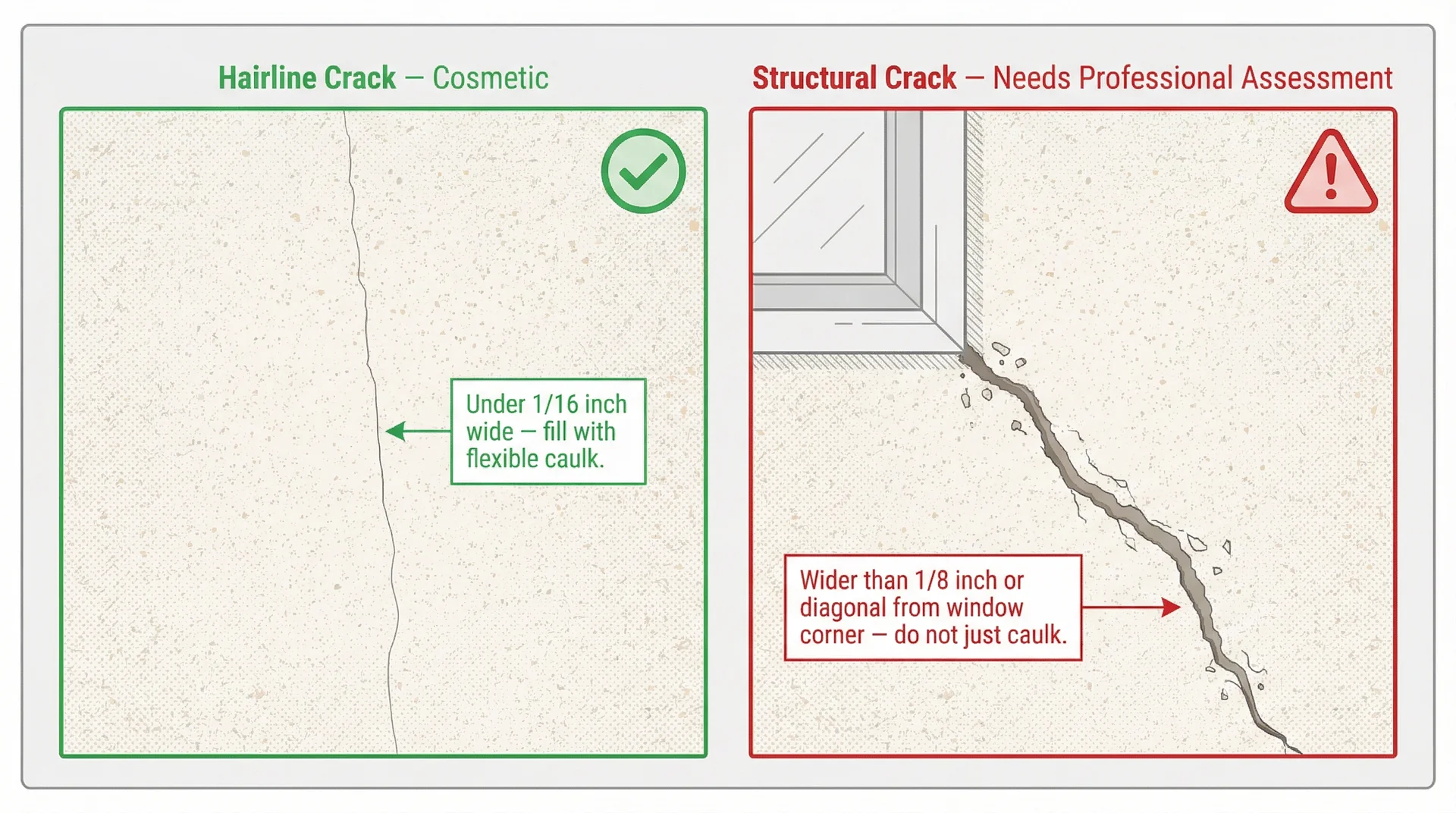
Hairline cracks less than 1/16 inch wide are common and typically cosmetic. Fill with flexible caulk, paint over the repair, and they are resolved.
Cracks wider than 1/8 inch, diagonal cracks from window corners, or clusters of cracks in the same area indicate structural movement, foundation settlement, framing deflection, or substrate issues. These require professional assessment, not DIY caulking. Filling a structural crack with surface caulk without addressing the underlying movement creates a false sense of resolution.
The repair cost hierarchy:
- Hairline crack caulking: Under $30 DIY; $8–$20 per square foot professionally
- Moderate crack and patch repair: $600–$2,658 on average
- Water damage remediation: $30–$50 per square foot; a full remediation on a mid-sized home runs $30,000 to $50,000 in Mid-Atlantic and Southeast markets
Repair vs. Replacement: When to Stop Patching
A useful guideline: if repair costs exceed 50% of the cost to replace the stucco, full replacement is likely more economical long-term. It also restarts the warranty clock, which repair work typically does not.
Repainting Stucco
Integral pigment in the finish coat eliminates painting in dry climates. If your stucco was painted, it will need repainting every 5 to 10 years. The correct product is a breathable elastomeric or acrylic exterior paint formulated for masonry. Standard exterior house paint is not the correct specification. It peels prematurely because it does not allow the moisture movement that cement surfaces require.
If the color has faded and you want to refresh it, a recoat (a thin application of new finish coat over the existing surface) at $4–$5 per square foot restores both color and surface integrity without full removal.
Stucco Cost: The Full Picture
The national average installed cost for traditional stucco runs $6.36 to $9.66 per square foot, with most homeowners spending between $14,490 for a 1,500 square foot home and $24,150 for a 2,500 square foot home (2025 data).
EIFS typically costs $10 to $18 per square foot installed, meaningfully more than traditional stucco, but includes the insulation layer traditional stucco lacks.
What Drives the Cost Range
Number of coats: One-coat stucco systems cost $3–$9.75 per square foot and are faster and less expensive. They are generally considered less durable than a properly executed three-coat system.
Home complexity: Multi-story homes, complex architectural profiles with curves, archways, and ornamental details, and homes requiring scaffolding push toward the higher end. Complex ornamental work adds 10 to 25% to the labor estimate.
Substrate condition: If existing sheathing requires repairs or replacement before the scratch coat goes on, that adds to the total.
Region: In Arizona and New Mexico, competitive pricing keeps costs lower than in the Mid-Atlantic or Southeast, where stucco specialists are fewer.
20-Year Cost Comparison: Stucco vs. Vinyl
| Factor | Traditional Stucco | Standard Vinyl |
|---|---|---|
| Installation (2,000 sq. ft.) | $16,000–$20,000 | $8,000–$12,000 |
| Maintenance at year 5 | Inspection, cleaning | Minimal |
| Maintenance at year 10 | Crack repair if needed | Cleaning |
| Recoat at year 15 | $4,000–$6,000 (if painted) | N/A |
| Potential remediation (wet climates) | $30,000–$50,000 | N/A |
| 20-year total (dry climate) | $20,000–$26,000 | $9,000–$13,000 |
| 20-year total (wet climate) | $22,000–$28,000 | $12,000–$16,000 |
| ROI at resale | ~70% | ~97% |
The resale ROI gap reflects market reality. Stucco commands a premium in regions where it is the dominant architectural material. In Scottsdale, a stucco exterior is baseline expected, and quality work carries a premium. In suburban Ohio, the same material may not translate to the same buyer perception.
Stucco vs. Other Siding Materials
Stucco vs. Fiber Cement: The Most Important Comparison for Wet Climates
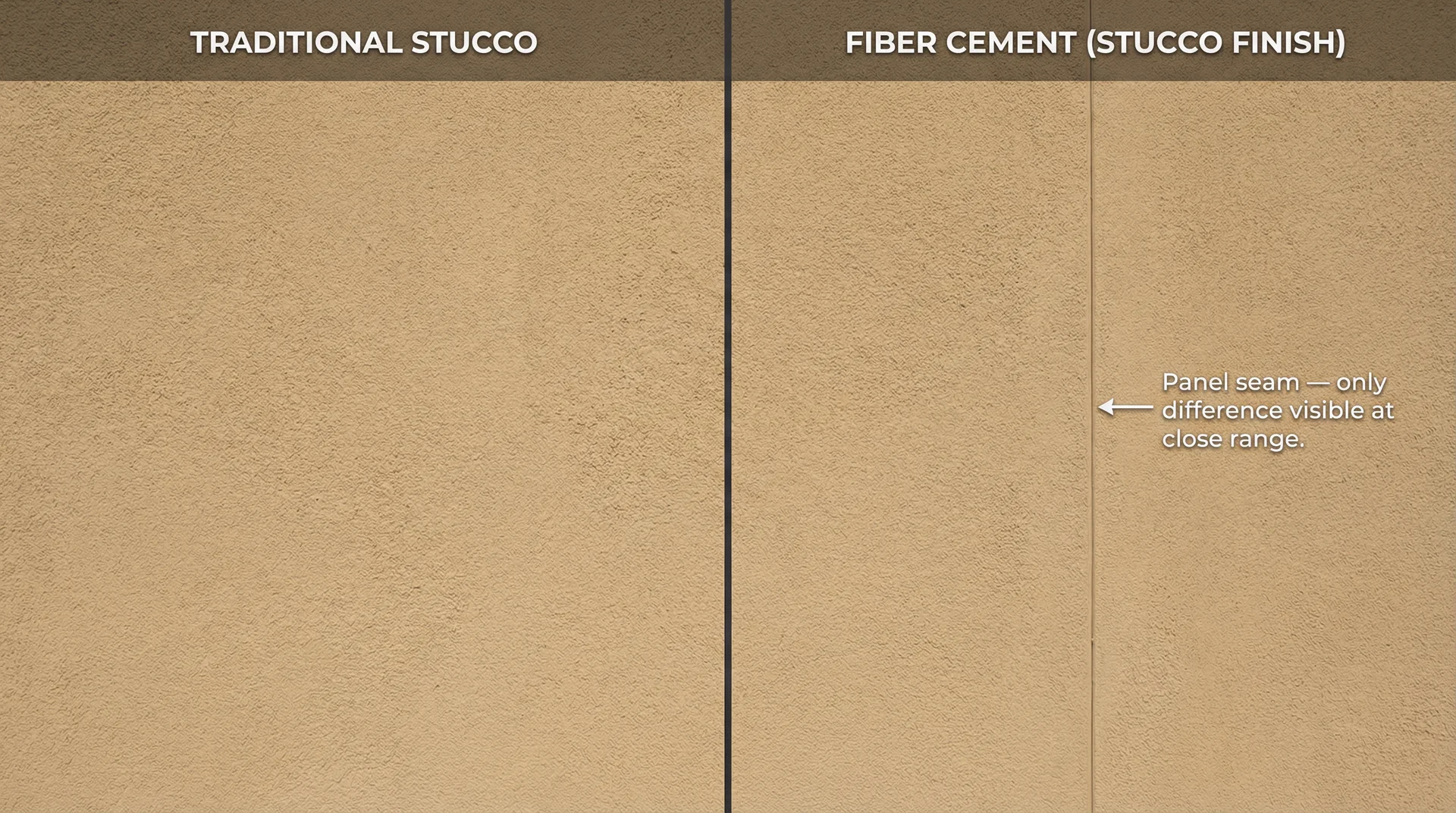
If you live in a wet climate and love the stucco aesthetic, the meaningful comparison is not stucco versus vinyl. It is stucco versus fiber cement stucco-finish panels.
James Hardie and Allura manufacture fiber cement panels with stucco-textured finishes that deliver the visual character of traditional stucco with none of its moisture management limitations. Fiber cement does not absorb moisture. Its failure mode under water exposure is paint degradation, not structural rot. The 2025 Cost vs Value Report shows fiber cement siding returning 113.7% of its cost at resale, meaning it adds more value than it costs in appropriate markets. This ROI advantage is strongest when replacing an aging or damaged exterior.
| Factor | Traditional Stucco | Fiber Cement (Stucco Finish) |
|---|---|---|
| Appearance | Authentic, seamless | Very convincing; minor panel seams visible |
| Moisture risk (wet climate) | High without exceptional installation | Low |
| Lifespan | 50–100 years (dry climate) | 25–50 years |
| Cost installed | $6–$10/sq. ft. | $8–$12/sq. ft. |
| Crack risk | Yes, inherent in cement | No |
| Color matching on repair | Difficult | Moderately difficult |
| Resale ROI | ~70% | ~113.7% (2025 Cost vs Value Report) |
| Recommended climate | Dry/arid | All climates |
For a homeowner in the Southeast who wants a stucco aesthetic but lives where stucco structurally struggles, fiber cement with a textured panel profile is the correct specification. The visual result is nearly identical at street level. The long-term performance in humid conditions is dramatically superior.
Stucco vs. Vinyl
Vinyl wins on upfront cost and resale ROI in most non-Southwest markets. Stucco wins on longevity, fire resistance, sound insulation, and architectural character. If you are in a dry climate and plan to stay in the home long-term, stucco’s higher upfront cost amortizes well. If you are in a wet climate or uncertain about long-term ownership, vinyl’s lower risk profile makes more sense.
Stucco vs. Brick
Brick costs substantially more, typically $9,880 to $13,250 for a 1,000 square foot application, versus stucco’s $2,810 to $4,400. Both achieve similar R-values (around 0.4), so neither delivers meaningful insulation on its own without additional cavity insulation. Brick requires virtually no maintenance beyond occasional repointing. Stucco requires more active crack monitoring. In most climates, brick is more durable. In wet regions specifically, brick’s drainage design is also more forgiving of moisture than traditional stucco’s.
Is Stucco Right for Your Home?
The climate dependency makes this cleaner than most siding decisions.
Stucco is the right choice if:
- You live in the Southwest (Arizona, New Mexico, Nevada, inland Southern California) or similar dry climates receiving fewer than 20 inches of annual rainfall
- Mediterranean, Spanish Colonial, or Southwestern architectural styles define your neighborhood
- You want a genuinely seamless, monolithic exterior with no panel lines or visible seams
- You are working with a stucco specialist with documented regional experience who can demonstrate correctly executed installations
Consider alternatives if:
- You live in the Pacific Northwest, Southeast, Mid-Atlantic, or any climate receiving more than 40 inches of annual rainfall
- You are buying a home with existing stucco and cannot confirm whether it is traditional or EIFS, and you cannot afford a professional moisture inspection before closing
- You want the stucco aesthetic in a wet climate (fiber cement stucco panels deliver it with the moisture performance the climate demands)
- The contractor you are evaluating cannot clearly explain weep screed placement, weather-resistive barrier specification, cure times between coats, and window head flashing integration. Vague answers indicate insufficient experience for a project you will live with for decades
Frequently Asked Questions
How long does stucco siding last?
In dry climates with proper installation, traditional stucco lasts 50 to 100-plus years. In wet climates, the practical lifespan depends heavily on installation quality and ongoing maintenance discipline. Modern drainage EIFS also achieves 50-plus year lifespans when correctly installed.
Does stucco crack?
Hairline cracks are common due to normal thermal expansion and contraction. They are typically cosmetic. Cracks wider than 1/8 inch, diagonal cracks from window corners, or multiple cracks in a pattern indicate underlying structural movement and require professional assessment.
How do I know if I have traditional stucco or EIFS?
Press firmly on the wall surface. Traditional stucco feels completely solid. EIFS has a slight sponginess because the foam beneath flexes under pressure. You can also check behind an exterior fixture. EIFS has a visible polystyrene foam board layer that traditional stucco does not.
Can stucco be used in cold climates?
Yes, with appropriate installation. Control joints at correct spacing, low-modulus sealants that remain flexible in cold temperatures, and proper drainage systems at the wall base are all required. Without these details, freeze-thaw cycling causes progressive cracking. EIFS, with its foam insulation layer and greater material flexibility, generally handles cold climates better than traditional stucco.
What causes stucco remediation to be so expensive?
The failure is buried. Removing stucco to access damaged sheathing, replacing rotted framing, treating mold in the wall cavity, installing new barriers and lath, and applying new three-coat stucco all compound rapidly. Projects ranging from $30,000 to $50,000 are routine for full-wall remediation in the Mid-Atlantic and Southeast.
Is stucco a good choice in Florida?
South Florida’s dry winter season and Mediterranean architectural character make stucco common. But hurricane exposure, high-humidity summers, and coastal salt air create real challenges for traditional stucco without meticulous installation. EIFS with modern drainage is often the better specification in Florida because its greater flexibility handles thermal expansion from extreme heat better than cement stucco, and proper drainage EIFS manages humidity more reliably. Traditional stucco in South Florida is not wrong. It just requires a contractor who understands the specific climate demands.
How do I find a qualified stucco contractor?
Ask specifically about weep screed installation, weather-resistive barrier specification, cure time management between coats, and window head flashing integration. Ask to see recently completed projects and request contact information for three previous clients. A qualified stucco contractor will answer all of these questions specifically and confidently. Vague answers about “doing it the standard way” without technical specifics indicate insufficient experience for a project you will live with for decades.
Is stucco environmentally friendly?
Cement production is energy-intensive, which gives stucco a higher carbon footprint at manufacture than vinyl or wood. Stucco’s long lifespan partially offsets this. For homeowners prioritizing sustainability, wood siding from certified sustainable sources has a lower embodied carbon footprint, though it requires more ongoing maintenance.