
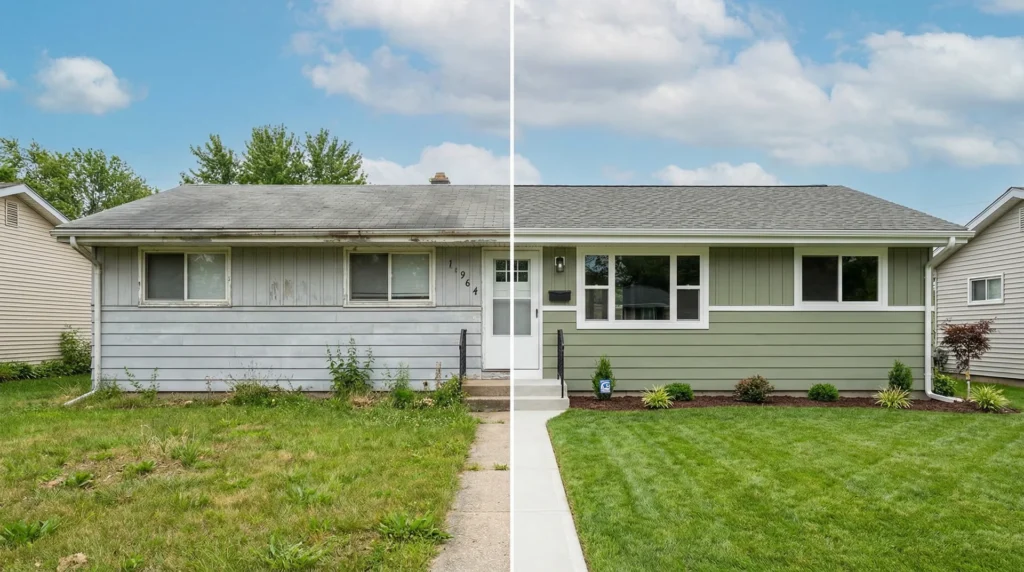
Last spring, a homeowner stopped me while I was loading up my truck. She pointed at her house and asked, “Mark, honestly, is this worth painting or should I just rip it all off?”
Her aluminum siding had gone from crisp colonial white to a chalky, faded gray that made the whole house look exhausted. I walked over, ran my hand along one of the panels, and looked at my palm. White powder. Classic oxidation.
Yes, aluminum siding can absolutely be painted. I told her that, and I’ll tell you the same thing right now. She spent about $4,200 on a professional repaint, and the house looked ten years younger within a week.
The question most people are really asking, though, is not whether aluminum takes paint. It does, and it takes it well. The real question is whether your siding is in the right condition to make painting worth the investment, and whether the job gets the prep work it actually needs.
Get those two things right, and you can expect a finish that holds for 10 to 15 years. Rush either one, and you will watch it peel before the next summer rolls around.
I have spent over 15 years working on residential exteriors across hundreds of homes. Aluminum siding repaints are some of the most satisfying jobs I complete because the transformation is dramatic and the cost savings over full replacement are genuinely significant. This guide covers everything I have learned from doing this work hands-on, so you can make a confident call about your own home.
Run Your Hand Along the Siding: Here’s What It’s Telling You
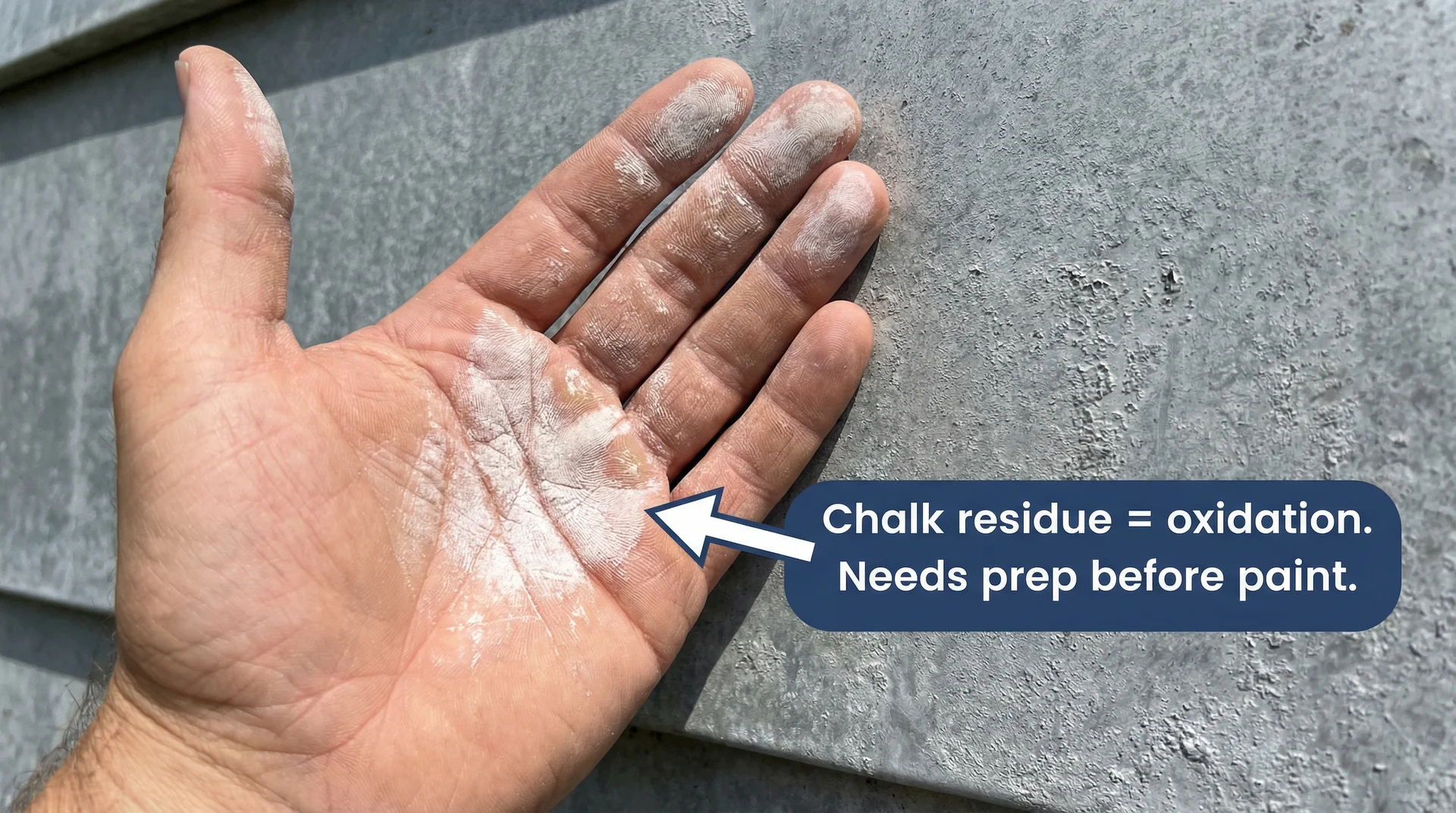
Before you pick a color or call a painter, spend two minutes doing what I do at the start of every exterior job I walk. Run your open palm firmly across the siding surface, then look at your hand.
White or gray powder? That’s oxidation, also called chalking. UV radiation has broken down the paint binder, leaving loose pigment on the surface. It looks alarming, but it does not mean you need to replace anything. It means you need proper prep before painting.
Clean hand? Your siding’s existing finish is still largely intact. Painting now produces the longest-lasting results.
Dark streaking alongside the chalk? You likely have mildew layered underneath. Still paintable, but your cleaning solution needs a bleach component.
Signs Your Siding Is Still a Good Candidate for Paint
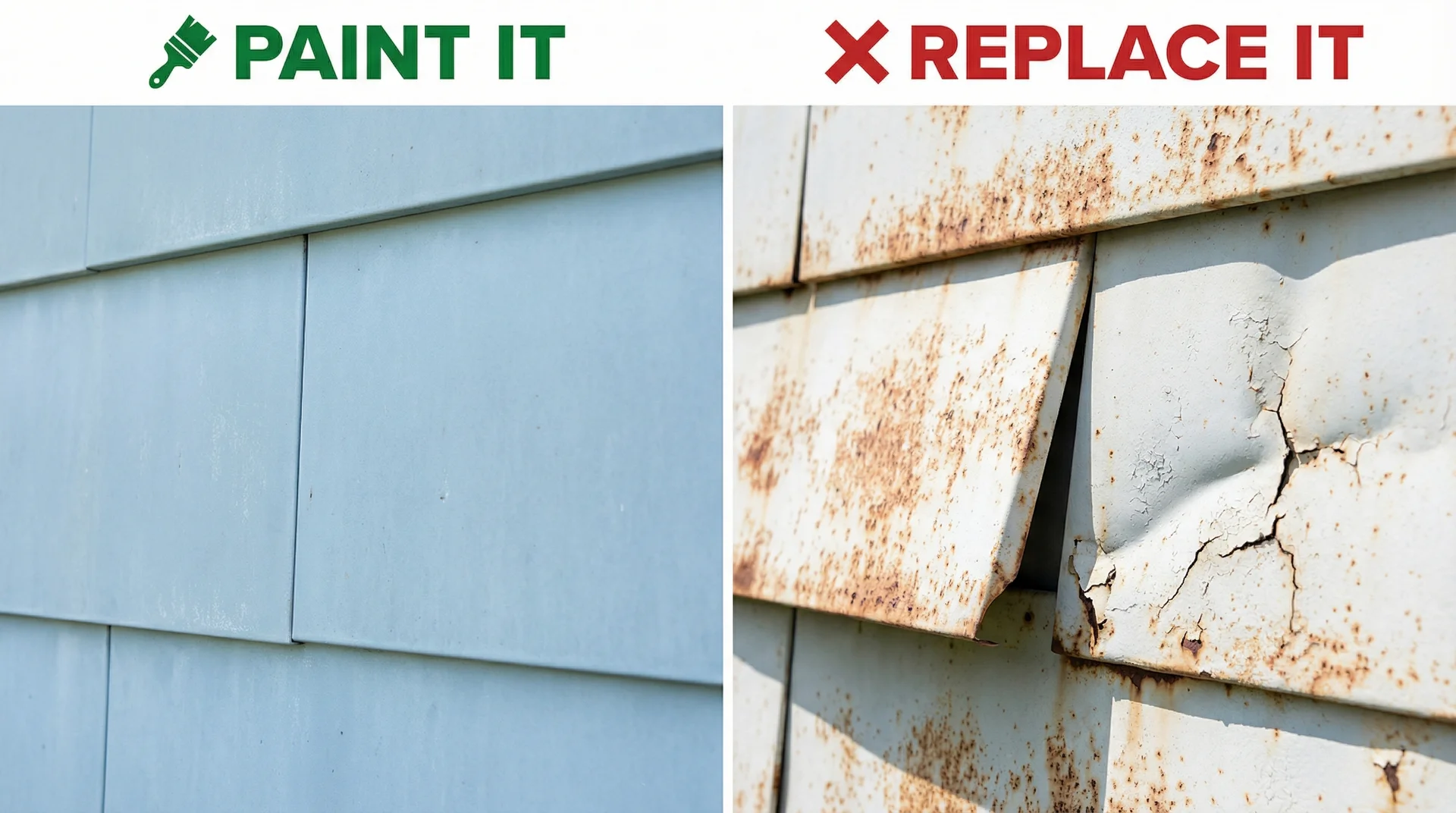
Most aluminum siding I see falls into the “go ahead and paint” category when these things are true:
- Panels are firmly attached with no warping or bowing
- Fading and chalking are the primary issues
- Any dents are shallow and cosmetic, not structural
- No open gaps or holes where water can get behind panels
- Existing paint is not peeling off in large sheets across the majority of the surface
Signs You May Be Looking at a Replacement Instead
Paint covers the surface. It does not fix what’s underneath it. Think seriously about replacement if you notice any of these:
- White rust or deep oxidation, where the aluminum itself has corroded through, looks like a rough, pitted, chalky-white texture directly on the metal
- Panels that have pulled away from the wall, bent severely, or cracked along their length
- Multiple failing paint layers lifting across most of the surface (at that point, proper prep becomes almost as expensive as replacement)
- Extensive denting from hail or impact spans large sections
If only a few panels are damaged while the rest of the siding is sound, there is a smarter middle path: replace those specific panels and paint the whole exterior. It still costs far less than full replacement and gives you a clean, uniform result.
What Makes Aluminum Siding Different from Paint
Aluminum has a couple of specific characteristics that change how you approach prep and product selection. Understanding these things up front saves you from mistakes I have seen trip up both DIYers and inexperienced painters.
Why Paint Bonds Well to Aluminum When Prep Is Done Right
Aluminum is actually one of the better exterior surfaces to paint, once you understand why adhesion fails on it. Unlike wood, aluminum does not absorb moisture and swell, which means paint does not crack from substrate movement.
Adhesion failure on aluminum is almost always a chemical bonding problem. The surface develops a thin layer of aluminum oxide that resists bonding. Remove that layer through proper cleaning and light abrasion, and paint grips the surface reliably and holds for years.
The UV and Chalking Problem Worth Knowing About
Not every wall on your house ages at the same rate. South and west-facing panels receive the most direct sun across the day and degrade measurably faster than north and east-facing walls. I have repainted homes where the south wall needed serious prep, while the north wall still had a decent finish.
Dark colors accelerate this further because they absorb more solar energy, raising surface temperature significantly.
On a hot afternoon, I have measured dark-painted aluminum running 20 to 30°F hotter than a light-colored surface nearby. That thermal stress shortens the paint film’s lifespan. If you love deep charcoal or navy, you can absolutely go for it, but plan your maintenance cycle around 8 to 10 years rather than 12 to 15.
The Lead Paint Question (Do Not Skip This If Your Home Is Pre-1978)
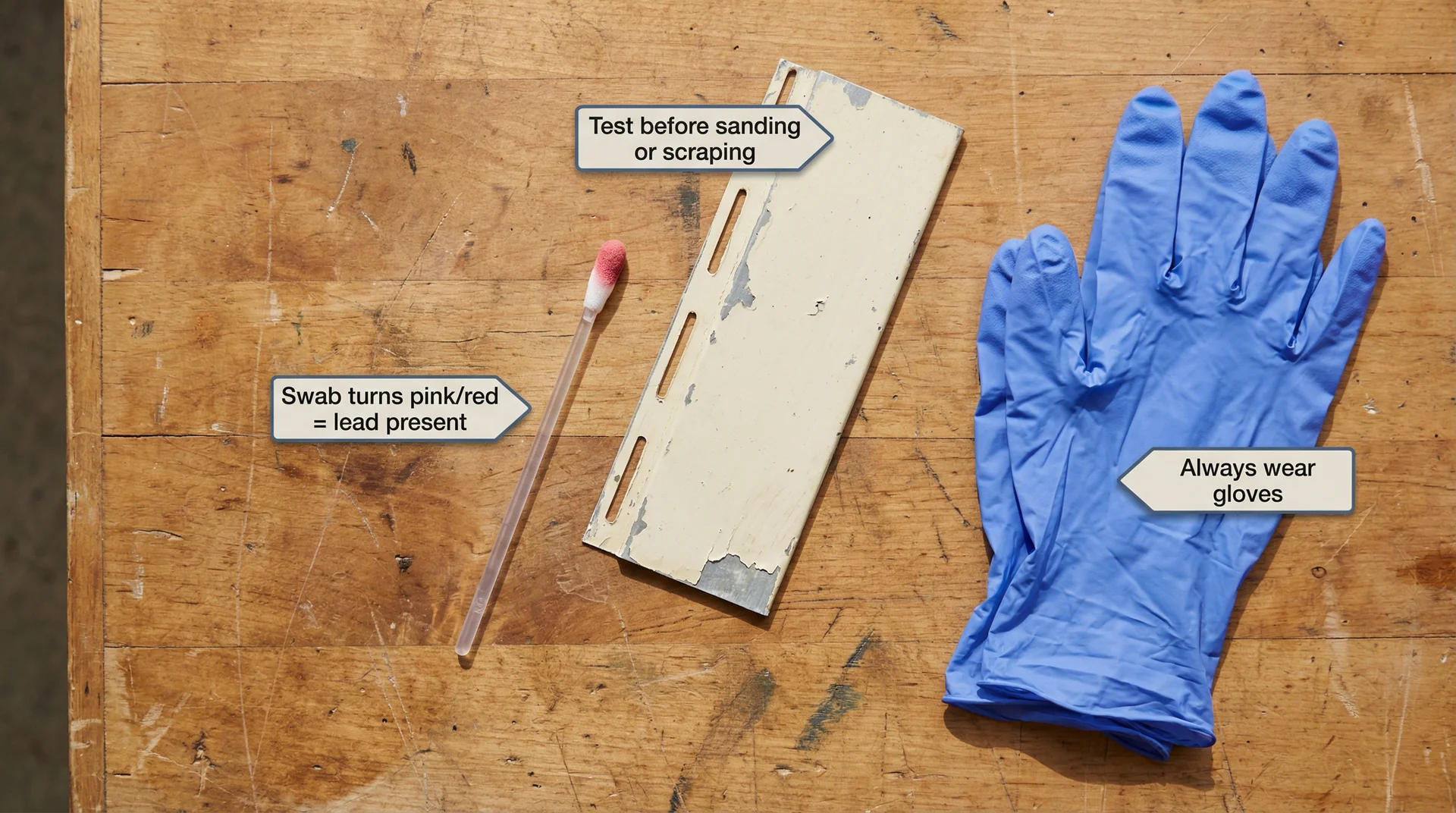
Aluminum siding was most commonly installed between the 1940s and the 1970s. If your home was built before 1978, the existing paint layers may contain lead.
Before you or anyone else sands, scrapes, or pressure washes that siding, pick up a lead testing kit from any hardware store. They run about $10 to $15 and give you a result within minutes. If the test comes back positive, stop and call a certified lead abatement professional before proceeding.
I have held lead-safe renovation certification for years, and the containment and disposal protocols exist for good reason. Lead dust from disturbed paint is genuinely hazardous, especially for children and pregnant women in the home.
If the test comes back negative, you proceed normally. Confirm it rather than assume it.
The Real Cost of Painting Aluminum Siding
Professional vs. DIY: What the Numbers Actually Look Like
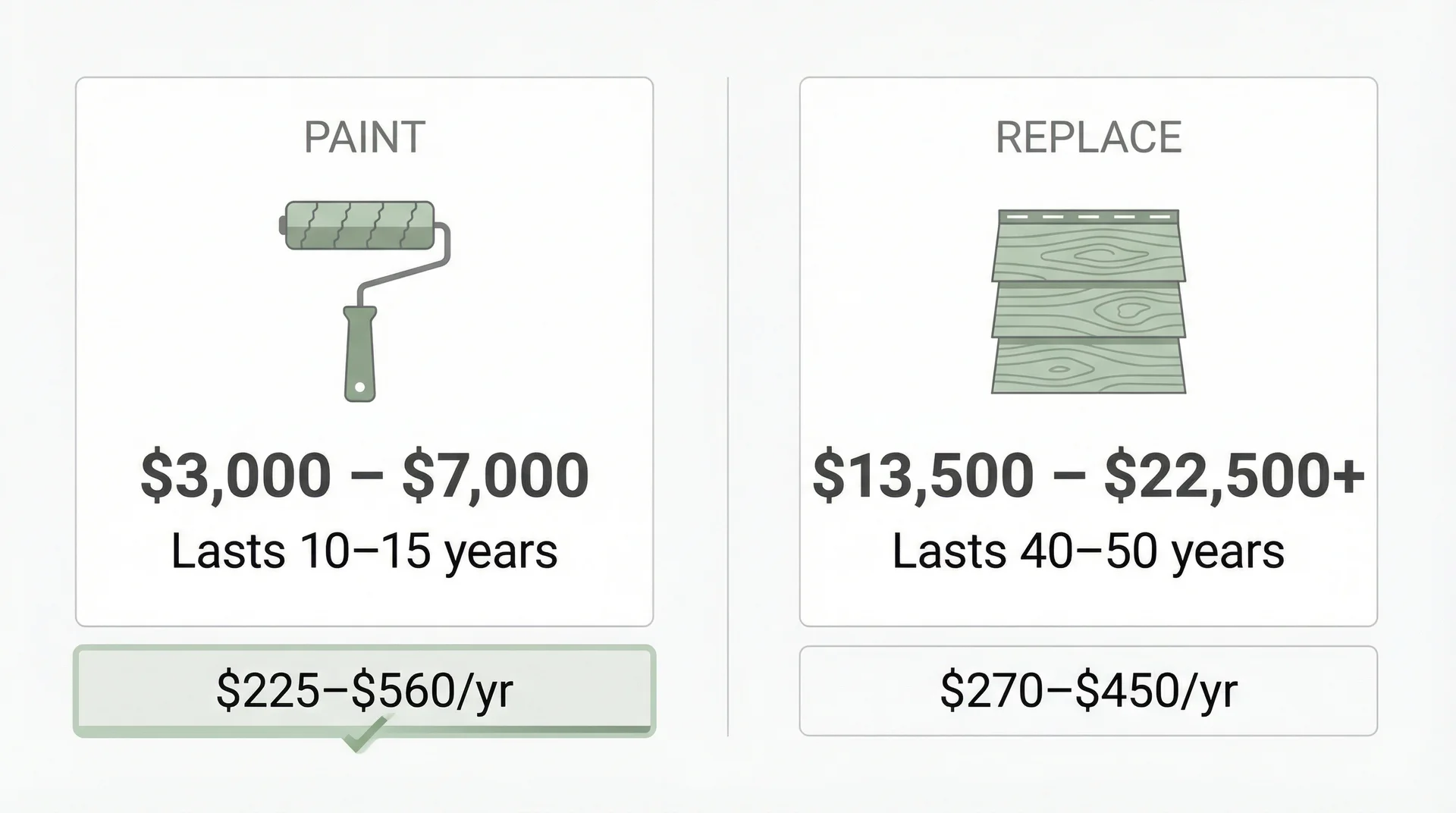
For a professionally painted exterior on an average home with roughly 2,000 square feet of siding, you are typically looking at $3,000 to $7,000. Most homeowners spend around $4,000 to $5,500 for a straightforward job on sound siding.
DIY materials for the same home generally run $800 to $1,500. The gap looks appealing until you factor in sprayer rental ($75 to $150 per day), scaffold or ladder rental for a two-story home, and the time investment. A full exterior prep and repaint realistically takes three to five days, even for someone comfortable with the work.
The place where DIY projects most often fail is not the painting itself. It’s the prep. Rushing the cleaning, chalk removal, and priming steps is how you end up with a paint job that peels within two years.
What Makes a Quote Higher or Lower
If you receive multiple estimates, these factors legitimately drive the price up:
| Factor | Impact on Cost |
|---|---|
| Heavy chalking requiring TSP wash | Adds prep time and labor |
| Multiple existing paint layers | Significant additional prep |
| Lead paint present | Requires certified abatement |
| Two-story or higher walls | Scaffold and safety equipment |
| Dents or corrosion to repair | Materials and labor |
| Bonding primer required | Costs more than standard primer |
| Three coats needed due to poor condition | Additional labor and material |
A quote that comes in significantly under the others is usually cutting one of these prep steps. Ask directly: “What is your prep process? Do you prime? How do you handle chalking?” The answers tell you what you are actually buying.
A useful habit: ask for an itemized quote, not just a total. A contractor who breaks down cleaning, repairs, primer, and paint separately is showing you what the job actually involves.
Painting vs. Replacing: The Long-Term Math
| Painting | Full Replacement (Vinyl) | |
|---|---|---|
| Upfront cost (avg. home) | $3,000–$7,000 | $13,500–$22,500+ |
| Expected lifespan | 10–15 years (well prepped) | 40–50 years |
| Estimated 50-year cost | $12,000–$28,000 | $13,500–$22,500 |
| Annual cost equivalent | ~$225–$560/year | ~$270–$450/year |
The math is closer than most people expect, and it swings heavily in favor of painting if you are not planning to stay in the home for 20-plus years. If you plan to sell within five to ten years, a quality repaint gives you a beautiful exterior and meaningful curb appeal improvement at a fraction of replacement cost.
Where replacement makes more sense is when the siding is structurally compromised, or when a homeowner plans to own the home for several more decades and wants to eliminate the repainting cycle.
How to Prepare Aluminum Siding for Paint
The preparation is the whole job. The actual painting, by comparison, is straightforward. I have seen beautifully applied paint jobs start peeling within 18 months because the prep was rushed, and I have seen modest paint jobs on properly prepped surfaces hold for 15 years without a touch-up. Take this section seriously.
Cleaning Off the Chalk and Grime
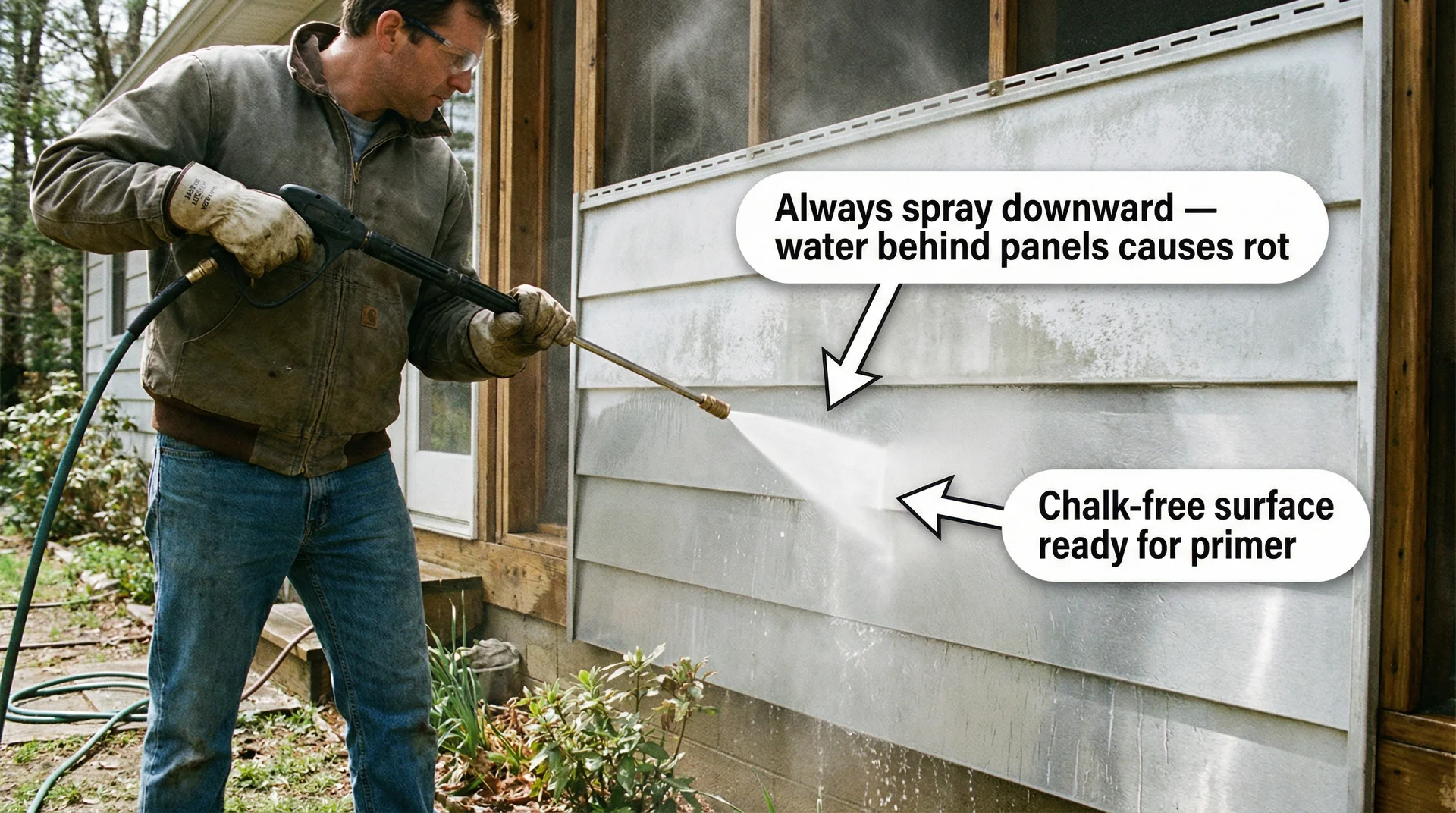
Your goal is simple: zero chalk residue, zero mildew, zero dirt before anything else touches the surface.
For heavy chalk buildup, mix trisodium phosphate (TSP) with water per the package instructions, typically about a quarter cup per gallon. Work in 10-by-10-foot sections from top to bottom, scrub with an abrasive brush, then rinse thoroughly. Wear gloves and eye protection. Cover nearby landscaping and rinse the ground around the foundation when finished.
For lighter buildup, a pressure washer with a quality house wash detergent handles most of the work. Keep the spray angled slightly downward so water does not drive up behind the siding panels. Let everything dry for at least 24 hours before moving to the next step.
If mildew appears (dark greenish-black staining), add a cup of chlorine bleach per gallon of your cleaning solution. Mildew left under fresh paint will continue to grow and lift the coating from underneath.
Repairing Dents and Corrosion
Shallow cosmetic dents fill well with exterior-grade filler. Apply it, let it cure fully, sand smooth with 120-grit paper, and wipe clean. Surface corrosion at scratches or exposed edges needs a rust converter applied before primer goes on.
Once treated and dry, prime those spots first before the full surface prime coat. Painting over active corrosion guarantees the paint will lift at those spots within a season.
Sanding: When You Need It and When You Don’t
If the existing surface is the original factory-baked enamel and it has never been repainted, a light scuff with 150 to 220-grit sandpaper is sufficient. You are creating enough surface texture for primer and paint to grip, not removing material. Wipe away all dust before priming.
If you are painting over a previous topcoat with glossy areas or peeling edges around spots where old paint has lifted, sand those areas more deliberately. Feather the edges smooth, so you avoid visible ridges in the final finish.
Priming: This Step Is Not Optional
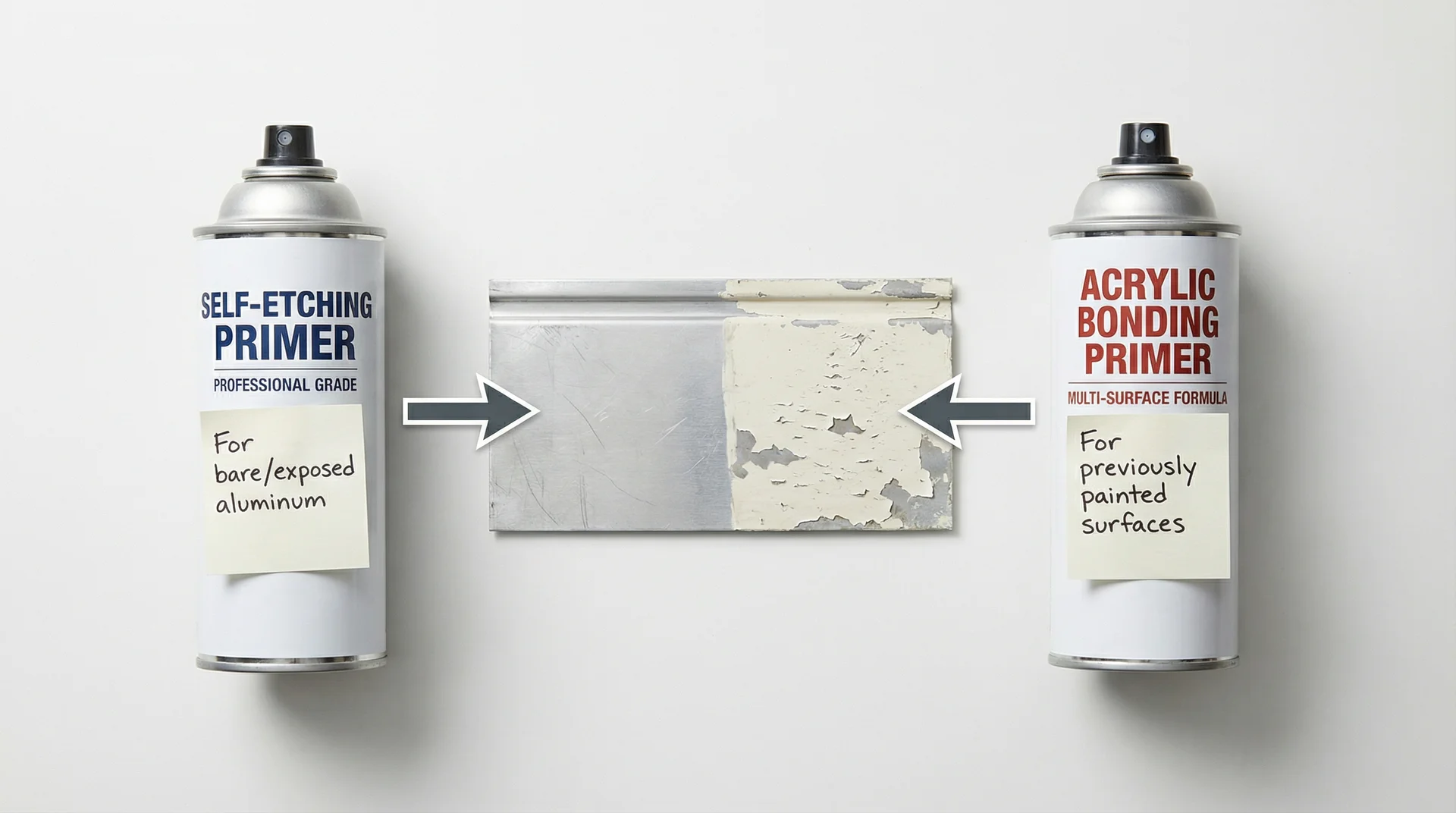
This is where the chemistry matters. Aluminum oxide forms naturally on exposed metal and actively resists paint adhesion. The right primer locks onto that oxide layer and creates a stable base for your topcoat.
For bare or exposed aluminum: Use a self-etching primer formulated for metal. This chemically bonds to the aluminum oxide layer rather than sitting on top of it.
For surfaces with intact existing paint: An acrylic bonding primer works well, or add Flood Emulsa-Bond to your first coat of acrylic latex. Mix it per label directions for the first coat only. The second coat goes on without it. I have used this approach on dozens of jobs where a full prime coat was not warranted, and the results have held up consistently over time.
Apply primer evenly with a roller, working in the same direction as the siding panels. Let it cure fully before topcoating, generally 24 hours at moderate temperatures.
Choosing the Right Paint for Aluminum Siding
100% Acrylic Latex: Why It Is the Right Call
100% acrylic exterior latex paint in a satin or eggshell finish is the correct answer for aluminum siding. Aluminum expands and contracts with temperature changes. A rigid paint film cracks and peels as the metal moves beneath it. Acrylic latex stays flexible through that thermal cycling, which is exactly why it outlasts oil-based paints on metal surfaces over time.
Oil-based paints give a smooth initial finish but chalk and crack faster on aluminum. Flat finishes show every imperfection and do not clean well. High-gloss finishes highlight surface irregularities and, on aluminum especially, draw attention to dents you would rather minimize. Satin is the practical sweet spot.
What About Elastomeric Paint?
You will see elastomeric coatings mentioned in some painting guides, and the question comes up enough that it deserves a clear answer. Elastomeric paint is thicker, more flexible, and designed to bridge hairline cracks. It works well on stucco, masonry, and concrete.
On aluminum siding, standard acrylic latex is the better choice. Aluminum does not crack the way masonry does, so elastomeric’s crack-bridging benefit does not apply here. More importantly, elastomeric needs to form a fully sealed envelope around the surface to perform correctly, which is very difficult to achieve on lapped aluminum siding panels with all their seams and edges.
If the seal is not complete, moisture gets trapped behind the thick coating and causes blistering. Stick with a high-quality 100% acrylic latex, and you get flexibility, breathability, and durability without the application complexity.
Color Choice Affects How Long Your Paint Lasts
Lighter colors (whites, light grays, pale blues, warm beiges) reflect solar radiation and keep the surface cooler. These consistently reach the 12 to 15-year mark before needing attention.
Dark colors (charcoal, navy, deep green, black) look striking and are genuinely popular right now, but on aluminum specifically, plan for 8 to 10 years rather than 12 to 15. The higher surface temperature from absorbed heat puts more stress on the paint film, particularly on south and west-facing walls.
Contrasting trim colors can dramatically elevate the final appearance without adding much cost. White or off-white trim against a mid-tone siding color gives the exterior a finished, deliberate look that holds up visually through the years.
Products That Perform on Real Jobs
These are products I have used repeatedly with consistent results:
- Sherwin-Williams Duration Exterior – exceptional adhesion and color retention, holds up well in high-UV environments
- Sherwin-Williams SuperPaint Exterior – reliable and widely available, performs well across most climates
- Benjamin Moore Aura Exterior – a premium product worth the price on homes in harsh or coastal climates
- Flood Emulsa-Bond – a paint additive, not a paint, that significantly improves adhesion on the first coat over existing paint layers
Applying the Paint
Sprayer vs. Roller vs. Brush
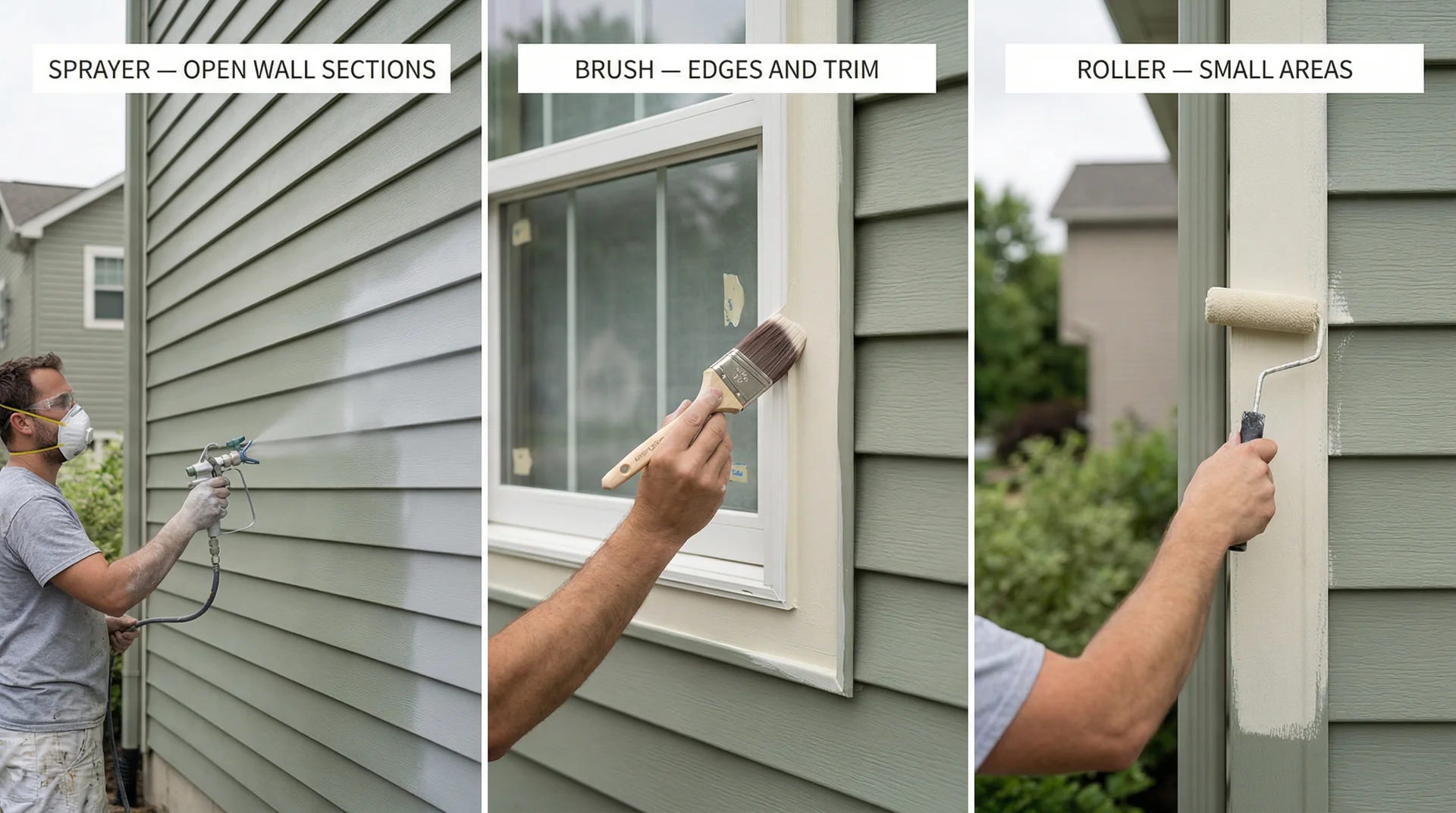
An airless sprayer gives the best result on open wall sections. The finish is smooth and professional in a way that is genuinely difficult to replicate with a roller on lapped aluminum. Do not back-roll sprayed aluminum siding; the roller texture drags wet paint and creates an uneven finish. Use brushes and small rollers for cutting in around windows, doors, and trim.
Two thin coats always outperform one thick coat. A thick single coat traps solvents, sags on vertical surfaces, and does not cure evenly. Allow the first coat to dry completely before applying the second, generally four to six hours under good conditions.
Common Mistakes That Ruin a Paint Job
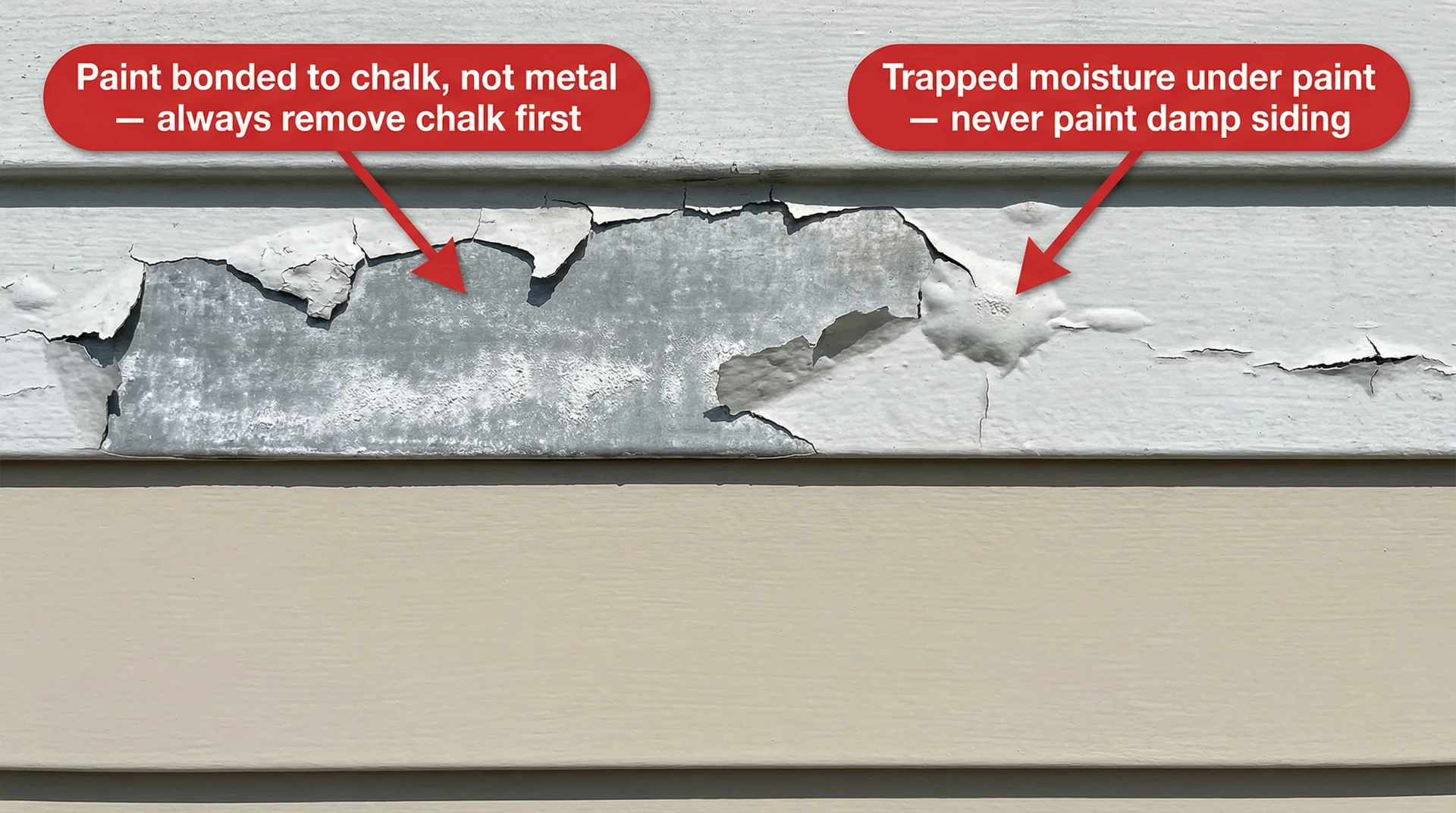
I have seen these mistakes repeatedly on both DIY projects and, frankly, on work from painters who cut corners:
- Skipping the chalk removal step – new paint bonds to the chalk layer, which has no grip on the metal, and the whole system peels
- Painting over damp siding – even slight moisture under fresh paint causes adhesion failure
- Skipping primer on bare aluminum – without primer, you are relying on chemical adhesion that the aluminum oxide layer will not support
- Painting in direct sunlight on a hot day – the paint dries before it can flow and bond properly
- One thick coat instead of two thin ones – traps solvents and creates an uneven cure
- Using the wrong primer – standard wall primer does not work on metal; you need a bonding or self-etching formula
Weather and Timing
The ideal painting conditions are an overcast day between 50°F and 85°F with humidity below 70%. Start on the shaded side of the house and follow the shade around the building as the day progresses.
Never paint if rain is forecast within 24 hours. Most acrylic latex paints require a minimum application temperature of 50°F, and both air and surface temperature need to stay above that for several hours after application.
How Long Will It Last & How to Protect That Investment
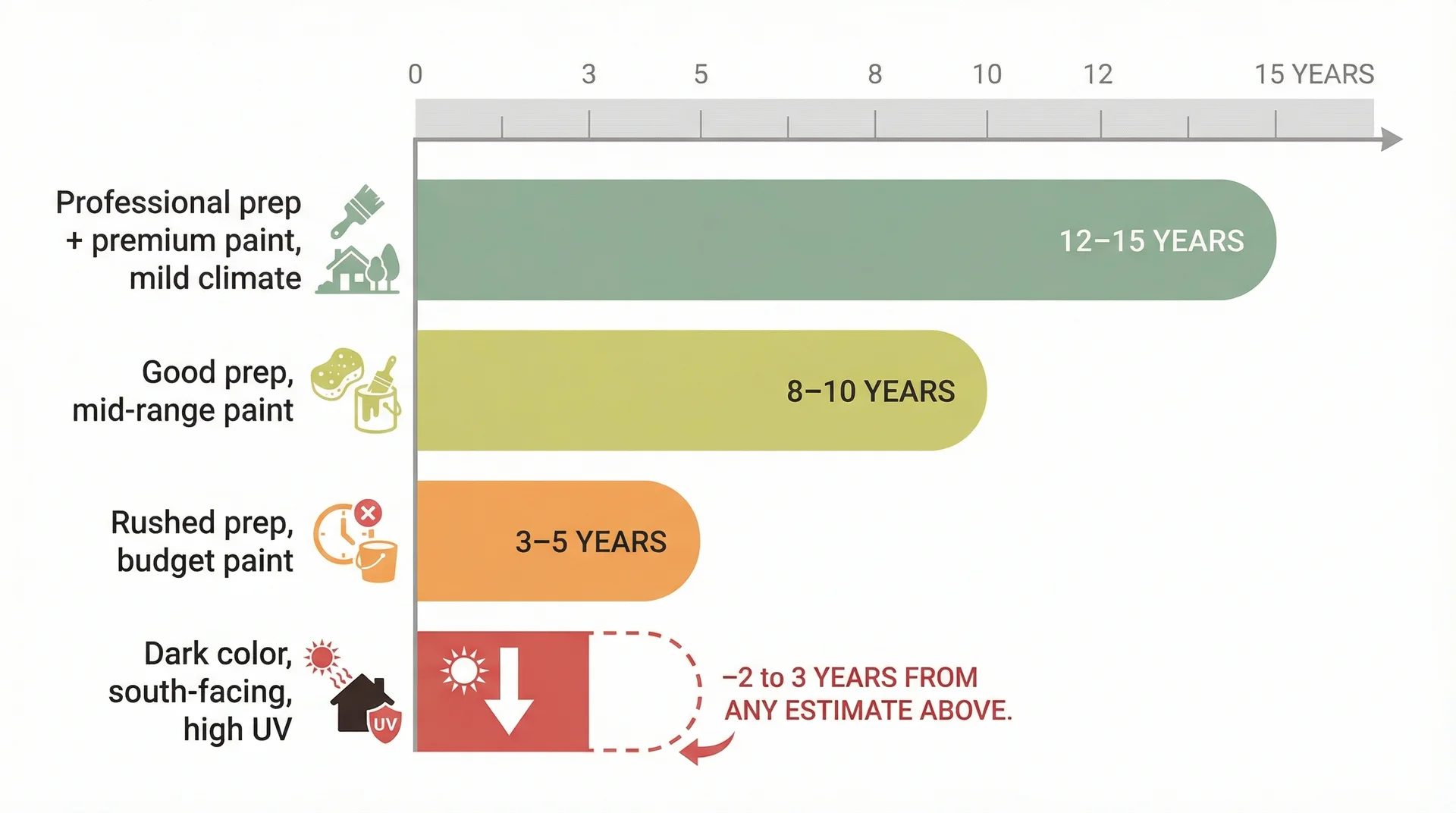
Realistic Lifespan by Condition
| Scenario | Expected Lifespan |
|---|---|
| Professional prep, premium acrylic latex, mild climate | 12–15 years |
| Professional prep, premium acrylic, harsh or coastal climate | 8–12 years |
| Good prep, mid-range paint, average climate | 8–10 years |
| Rushed prep, skipped primer, budget paint | 3–5 years |
| Dark colors, high UV, south-facing walls | Subtract 2–3 years from any estimate above |
Simple Annual Maintenance That Extends the Finish
Once a year, walk the perimeter of your home and check for:
- Early chalking returning (mild powder around year 8 to 10 is normal; you still have time before a full repaint)
- Bubbling or lifting paint at seams or around window frames (these indicate moisture intrusion and need prompt attention)
- Corrosion creep at scratches or cut panel edges
Wash the siding once a year with a mild detergent solution and a soft brush. This removes the environmental buildup that gradually breaks down paint film integrity. Touch up small problem areas immediately rather than letting a three-inch issue become a three-foot one.
When to Call a Pro vs. When DIY Makes Sense
DIY is a reasonable choice if:
- Your home is one story, or you are fully comfortable on extension ladders
- The siding is in decent shape with manageable chalking and no significant corrosion
- You are willing to rent an airless sprayer and learn how to use it before starting
- You have three to five days available, and you are not rushing
Call a professional if:
- Your home is two stories or more, especially with over complex rooflines
- You have significant chalking, corrosion, or multiple failing paint layers
- Your pre-1978 home tested positive for lead paint
- You have never used an airless sprayer, and the learning curve feels like an unnecessary risk for your own home
The most common mistake on DIY aluminum siding projects is not the painting technique. It is underestimating how long thorough prep actually takes. People get three-quarters through it and rush the final section to start painting. That last section almost always peels first.
If you hire a contractor, ask for an itemized quote and ask specifically about their prep process. A contractor who spends less than a full day on prep for an average home is cutting somewhere you will feel later.
Frequently Asked Questions
Can you paint over old paint on aluminum siding?
You can, as long as the existing paint is firmly adhered and not failing across most of the surface. Clean thoroughly, sand any glossy or loose areas, and add Emulsa-Bond to your first coat of acrylic latex for better adhesion. If old paint is lifting across large sections, stripping becomes necessary before repainting, which significantly increases cost and complexity.
Do you need to prime aluminum siding before painting?
Yes. On bare or exposed aluminum, use a self-etching primer formulated for metal. On surfaces with intact existing paint, an acrylic bonding primer or Emulsa-Bond added to the first topcoat both work. Skipping primer on aluminum is the single most common reason paint jobs fail early.
How much does it cost to paint aluminum siding?
A professional exterior repaint on a typical 2,000 square foot home runs $3,000 to $7,000, with most straightforward jobs landing around $4,000 to $5,500. DIY material costs run $800 to $1,500. Full siding replacement typically costs $13,500 to $22,500 or more.
How long does paint last on aluminum siding?
A properly prepped, professionally painted exterior in a temperate climate holds up for 10 to 15 years. In harsh climates with intense UV, heavy humidity, or coastal salt air, plan for 7 to 10 years. Poor prep and budget paint can produce failure within 3 to 5 years, regardless of climate.
What is the best paint for aluminum siding?
100% acrylic exterior latex in a satin or eggshell finish. Products that have performed well on my jobs include Sherwin-Williams Duration Exterior, Sherwin-Williams SuperPaint, and Benjamin Moore Aura Exterior. Avoid oil-based paints on aluminum and avoid elastomeric coatings, which are designed for masonry and create sealing problems on lapped metal siding.
Should I paint or replace aluminum siding?
Paint if your siding is structurally sound and the main issues are fading, chalking, or a color you are tired of. Replace if panels are deeply corroded, warped, or pulling away from the structure, or if you plan to own the home for several more decades and want to eliminate the repainting cycle. For most homeowners, a quality repaint on sound aluminum siding is the smarter financial decision by a significant margin.
Can you paint the aluminum siding a darker color than it currently is?
Yes. Just understand that darker colors run hotter on aluminum and will shorten your repaint cycle compared to lighter colors in the same conditions. Going from a light beige to deep charcoal turns a 12-year paint job into roughly an 8 to 10-year one, particularly on south and west-facing walls. That is a reasonable trade-off if the color matters to you, as long as you go in with realistic expectations.
The Bottom Line
When that homeowner stopped me in the driveway, her siding did not need to come down. It needed respect. It needed proper prep, the right primer, quality paint, and someone who understood the difference between a chalky surface ready to be refreshed and a deteriorated surface past the point where paint is a solution.
Aluminum siding has earned a slightly unfair reputation as something outdated or difficult to deal with. In my experience, it is neither. When it was installed well and maintained reasonably, it is a durable exterior that takes paint well and responds dramatically to a quality repaint. The homes I have repainted with aluminum siding almost always look stunning when the job is done right.
Your answer is yes. Aluminum siding can be painted. Whether yours should be comes down to a two-minute check with your palm, an honest look at the condition of your panels, and a realistic conversation about your timeline and budget. If those things line up in your favor, a quality repaint is one of the best value-for-money decisions you can make for your home’s exterior.