
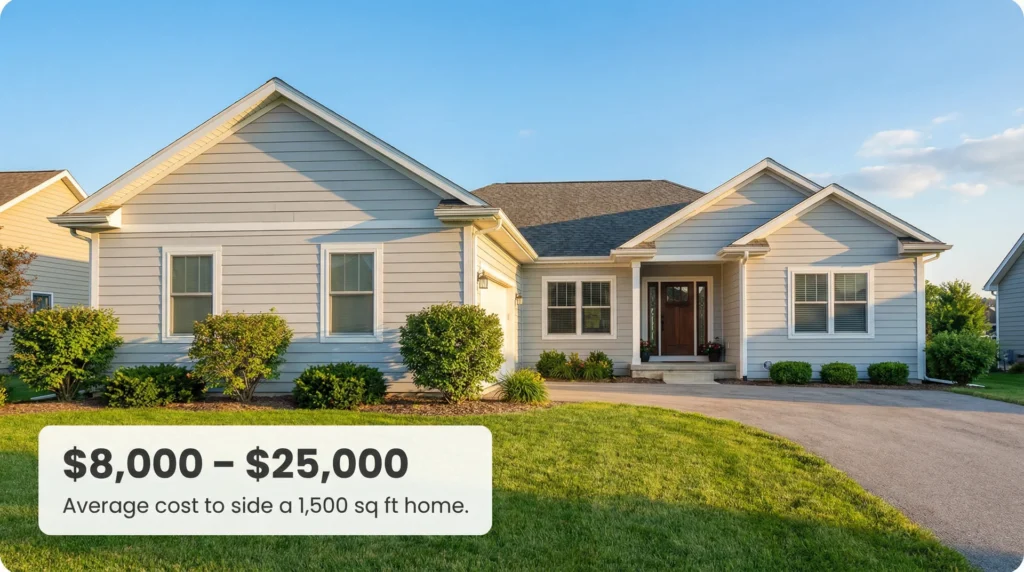
Siding a 1,500 sq ft house costs between $8,000 and $25,000, fully installed. Most homeowners land in the $10,000 to $18,000 range when they choose mid-grade materials and hire a competent crew. Vinyl on a straightforward single-story can come in under $10,000. Fiber cement on a two-story with a complex roofline can push past $20,000 without blinking.
That range exists for real reasons, and understanding those reasons is the difference between a budget that holds and one that blindsides you on day three of the job.
I’ve spent 15 years doing residential exterior work, siding systems, roofing, gutters, the full exterior envelope, and the homeowners who feel worst after a project are rarely the ones who spent more than expected. They’re the ones nobody prepared.
This guide prepares you. By the end, you’ll know your real cost range, what drives it, what to watch for in a quote, and which material actually makes sense for your situation.
What Does It Cost to Side a 1,500 Sq Ft House?
Cost by Material: The Numbers Upfront
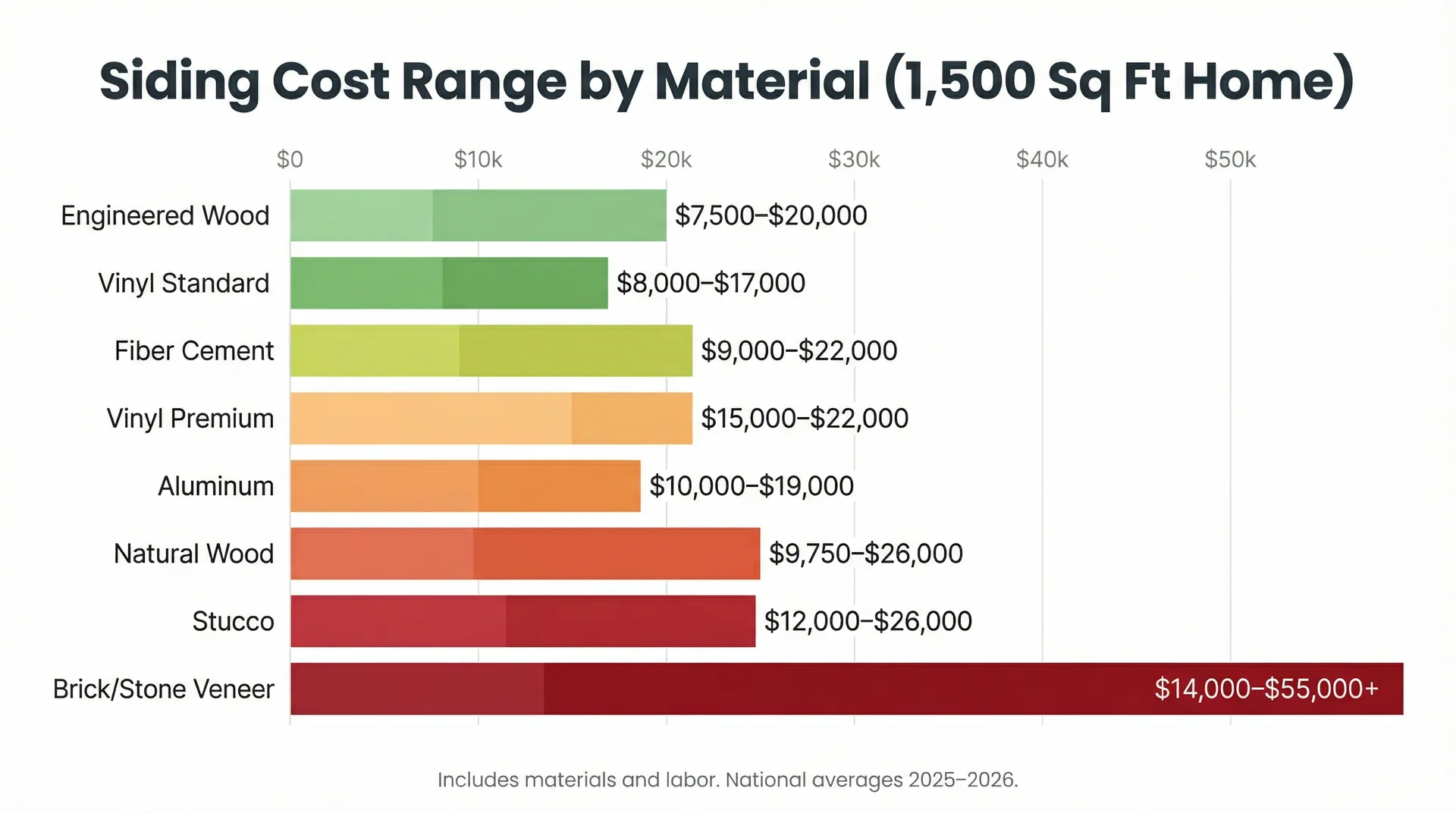
| Siding Material | Installed Cost (per sq ft) | Total Estimated Cost |
|---|---|---|
| Vinyl (standard) | $4.50 – $12.00 | $8,000 – $17,000 |
| Vinyl (insulated/premium) | $10.50 – $16.00 | $15,000 – $22,000 |
| Fiber Cement (Hardie Board) | $5.00 – $14.00 | $9,000 – $22,000 |
| Engineered Wood | $4.00 – $13.00 | $7,500 – $20,000 |
| Aluminum | $6.00 – $10.00 | $10,000 – $19,000 |
| Natural Wood | $6.00 – $17.50 | $9,750 – $26,000 |
| Stucco | $7.00 – $17.00 | $12,000 – $26,000 |
| Brick / Stone Veneer | $8.00 – $35.00 | $14,000 – $55,000+ |
Before you take these numbers to a contractor, there’s one thing you need to understand: your home’s floor area and your siding square footage are two completely different measurements.
A 1,500 sq ft single-story bungalow typically needs 1,100 to 1,400 sq ft of actual wall coverage, depending on its shape and how many windows and doors break up the exterior. A two-story home with the same floor area can need 2,000 sq ft or more of siding. That gap alone can shift your total cost by thousands, and I’ll show you exactly why below.
Why Your Quote Might Look Nothing Like These Numbers
The Floor Space vs. Wall Coverage Problem
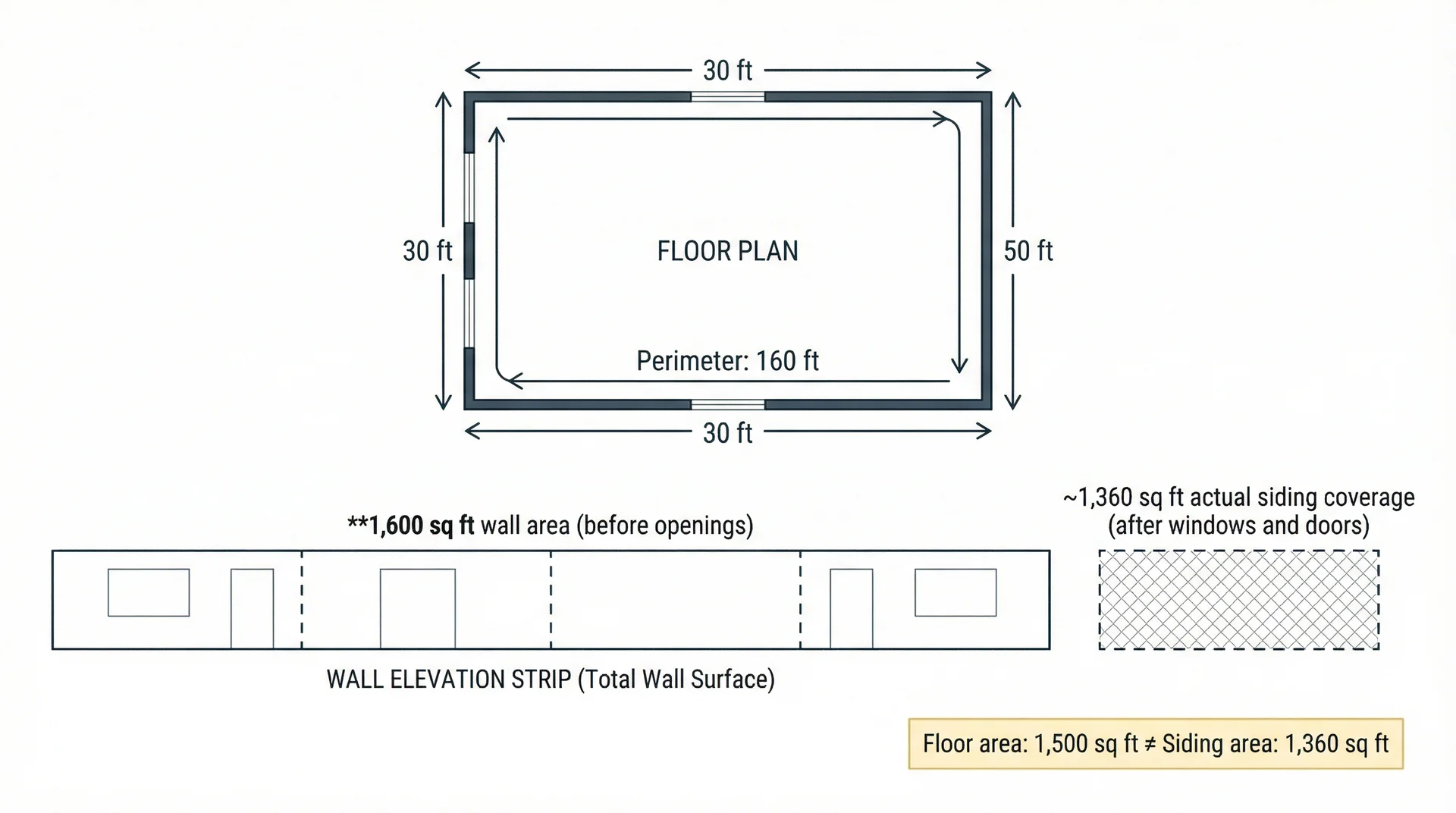
When you search “siding cost for a 1,500 sq ft house,” you’re thinking about interior square footage. Contractors think in wall surface area. These two numbers rarely match, and the difference can be significant.
Here’s how to calculate it yourself. Measure your home’s total perimeter, then multiply by your wall height. Single-story homes typically run 10 feet tall. Two-story homes run 20 feet or more.
Take a 1,500 sq ft single-story measuring 30 feet by 50 feet:
- Perimeter: 30 + 50 + 30 + 50 = 160 linear feet
- Wall area: 160 × 10 = 1,600 sq ft (before subtracting windows and doors)
- After subtracting roughly 15% for openings, approximately 1,360 sq ft of actual siding
Now run the same footprint as a two-story:
- Wall area: 160 × 20 = 3,200 sq ft of siding
Same floor area, more than double the siding. This is why two-story homes cost significantly more to build than single-story homes of the same square footage, and why you need to know this before any contractor steps on your property.
How Your Home’s Shape Affects the Price
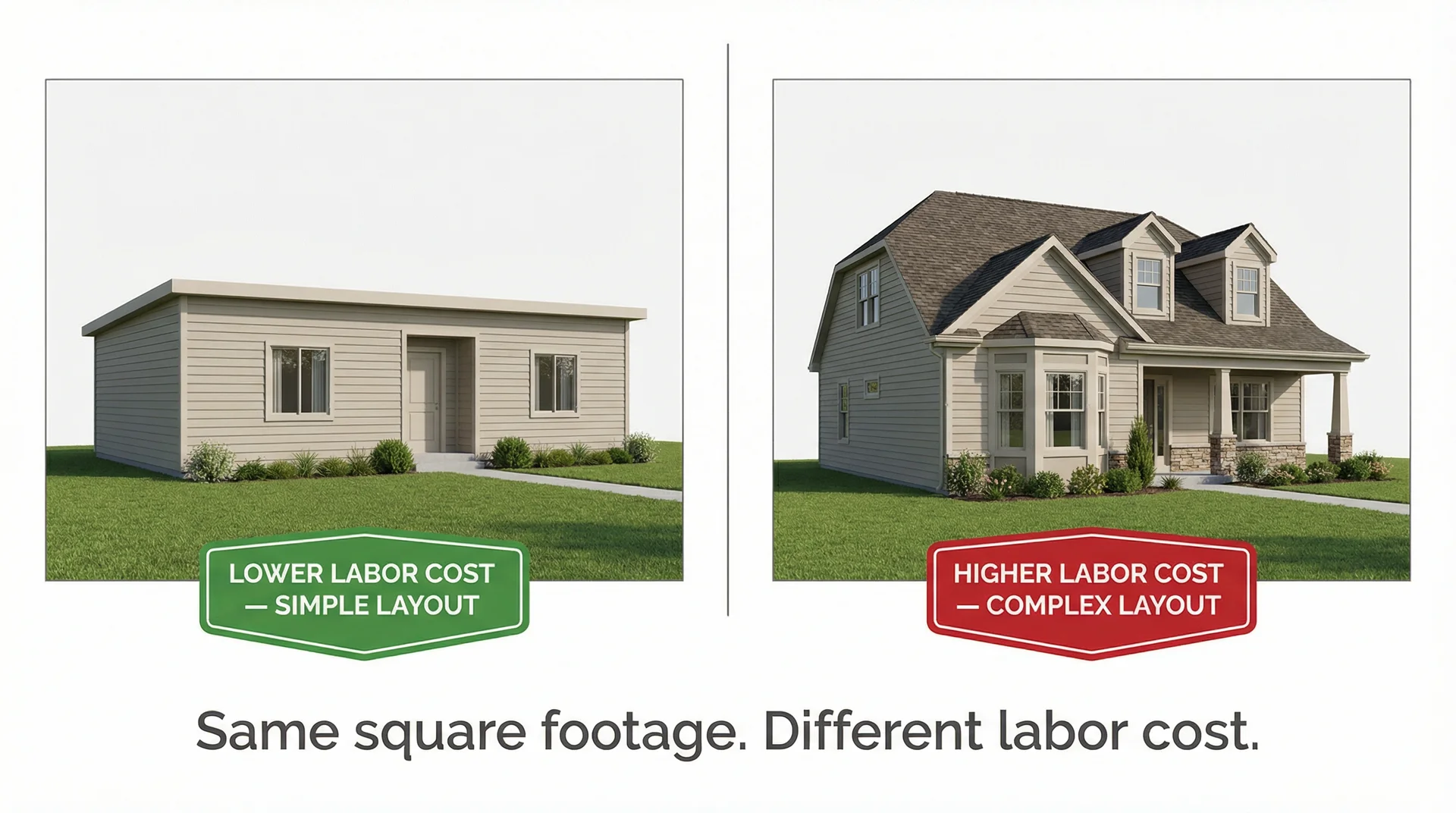
A simple rectangular ranch is one of the easiest homes to size. A two-story with dormers, bay windows, a hip roof, and multiple inside corners is a completely different project. Every corner requires extra cuts. Every window frame needs careful trim work and flashing.
Contractors price that complexity into labor, and they should, because a rushed cut around a window is exactly how moisture finds its way into your wall system.
From what I’ve seen on actual job sites, architectural complexity adds 10 to 25% to labor costs compared to a plain-box layout of the same square footage.
How Your Location Changes the Price
Labor rates vary substantially across the country. In coastal markets like California and the Northeast, siding labor runs 30 to 40% higher than in the Midwest or Southeast, simply because of local market demand, cost of living, and contractor overhead.
Materials follow a similar pattern. A fiber cement job in suburban Ohio will cost meaningfully less than the same job in San Francisco, even if every other variable is identical.
How Do You Know When to Replace Your Siding?
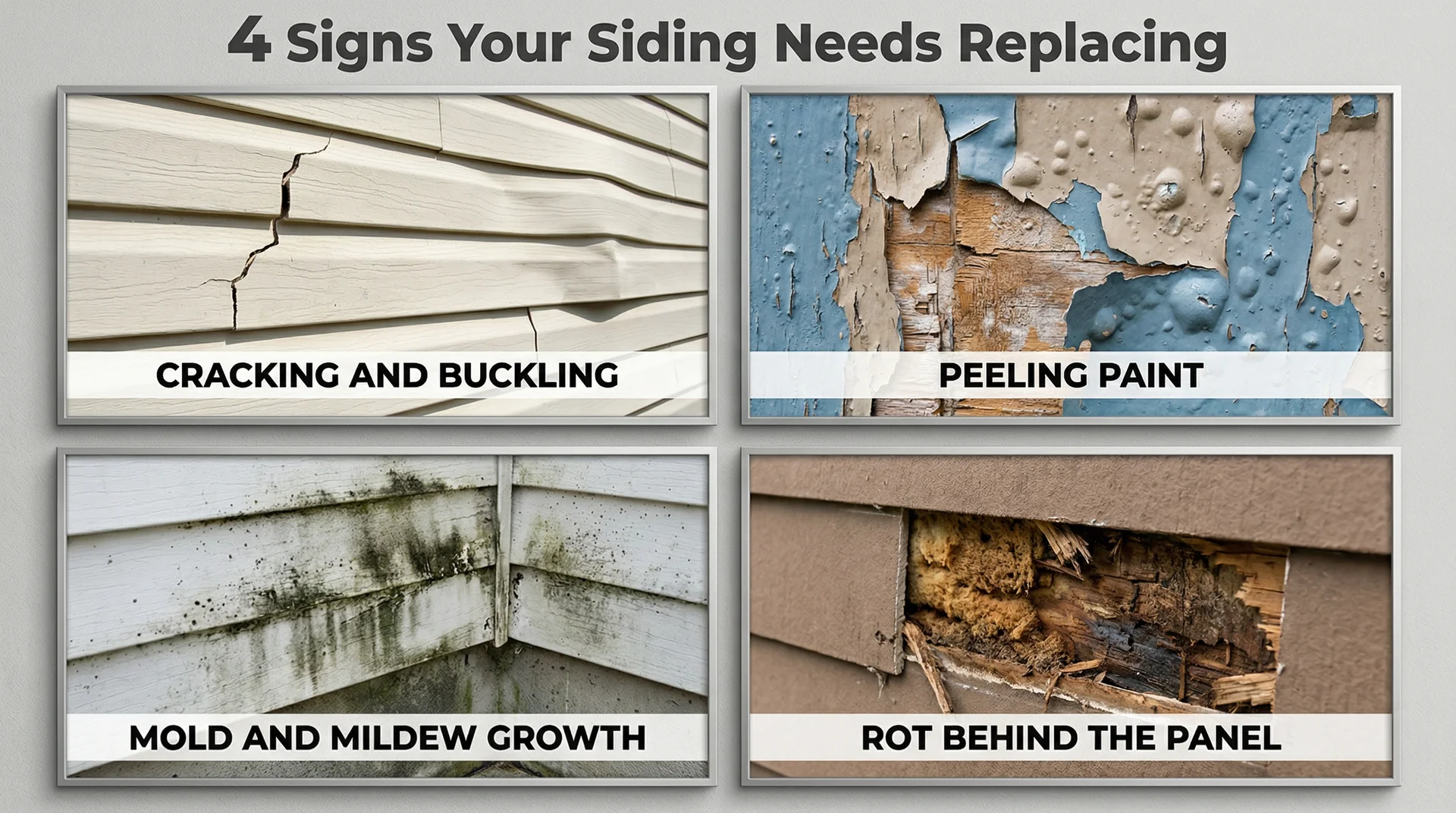
This is a question I get regularly, and it matters because timing affects both cost and scope. Replacing siding reactively, after serious damage sets in, almost always costs more than replacing it proactively, because hidden problems compound.
Watch for these signs:
- Visible cracking, warping, or buckling of panels
- Paint that’s peeling or fading faster than usual (a sign the siding is no longer sealing properly)
- Noticeably higher energy bills without another explanation
- Soft spots or sponginess when you press against the exterior wall
- Mold, mildew, or fungal growth appearing on interior walls near exterior surfaces
- Loose or missing panels after storms
- Pest activity along the exterior, particularly carpenter ants or termites, near the base of the wall
Siding that fails at the surface is often already failing underneath. By the time you see bubbling paint or soft panels on the outside, water may have been working against the sheathing behind it for months.
I’ve opened walls on what looked like minor repair jobs and found rot that had to come out before a single new panel could go up.
Breaking Down What You’re Actually Paying For
The Materials: What Each Option Really Means
Vinyl is the most widely installed siding material in the country for a straightforward reason: it delivers acceptable performance at a low upfront cost. Standard vinyl runs $4.50 to $8.00 per sq ft installed. Premium insulated vinyl, which adds rigid foam backing for better thermal performance, climbs to $10.50 to $16.00 per sq ft.
The important caveat is climate. Vinyl performs well in moderate climates and poorly in extreme ones. In regions with sustained high heat or hard freeze-thaw cycles, it becomes brittle, warps, or fades faster than the warranty implies. I’ve replaced vinyl siding on homes that looked 20 years old after only 10 because builder-grade vinyl and Ohio winters are a bad combination.
Fiber cement, most commonly sold as James Hardie board, is what I recommend most often to homeowners staying in their home for a decade or longer. It costs $5.00 to $14.00 per sq ft installed but carries a lifespan of 50 years or more. It resists fire, insects, moisture, and impact. According to the 2025 Cost vs. Value report from Zonda, fiber cement siding replacement returned 114% of its cost at resale nationally. That figure means you get back more than you spent when you sell.
Engineered wood is the option most buyers overlook. It costs $4.00 to $13.00 per sq ft installed, looks convincingly like real wood, and holds up significantly better than natural wood against rot and pests. The important caveat here is installation quality. When installed correctly with proper flashing and moisture management, it performs well for 20 to 30 years. When installed carelessly, moisture gets under it and you end up with swelling and premature failure.
Natural wood still has a place in specific contexts: historic homes, high-end custom builds, and HOA-mandated aesthetics. It costs $6.00 to $17.50 per sq ft installed and demands regular maintenance, including repainting every 5 to 10 years and ongoing treatment for moisture and pests.
Aluminum siding works well in coastal environments where saltwater exposure accelerates corrosion in other materials. It runs $6.00 to $10.00 per sq ft installed, lasts 25 to 40 years, and resists fire and insects. The downside is that it dents easily, and matching replacement panels after hail damage can be genuinely difficult. Even though the option of painting aluminum siding is mostly an option that most homeowners opt for after keeping a few things in mind.
Stucco is a different category altogether. Applied as a plaster system rather than installed as panels, it requires skilled installation and runs $7.00 to $17.00 per sq ft. It has a lifespan of 50 to 80 years in dry climates and performs poorly where freeze-thaw cycles are common.
Brick and stone veneer sit at the top of the cost spectrum at $8.00 to $35.00 per sq ft installed. Most homeowners use these materials for partial exterior accenting rather than full coverage, which keeps costs manageable while adding significant visual impact and appraisal value.
Labor: What Goes Into That Rate
Labor typically accounts for 30 to 50% of your total siding project cost. For most materials, the rate runs $1.50 to $5.00 per sq ft, and the variation isn’t arbitrary. The factors that push labor higher include:
- Multi-story installation: Scaffolding or lifts for upper-floor work adds time and equipment cost
- Architectural complexity: Dormers, tight angles, decorative trim, and multiple corners require precision cuts that slow the pace
- Material weight: Fiber cement runs roughly 1.5 times heavier than engineered wood, which adds handling time per panel
- Crew experience: More experienced crews cost more per hour and save you money over the life of the project by avoiding installation errors that cause future problems
I’ve watched homeowners choose the lowest labor quote and spend twice the savings fixing moisture intrusion two years later. Experienced installation matters in ways that don’t show up until they do.
The Costs Nobody Mentions Until They Show Up
This is the section that saves budgets. These are the costs that turn a $12,000 quote into a $16,000 reality, and most homeowners encounter at least some of them.
Old siding removal: Replacing existing siding means the old material has to come off and go somewhere. Removal runs $1,000 to $3,750 for standard materials like vinyl or wood. Asbestos abatement, which applies to some homes built before the 1980s, requires licensed specialists and costs significantly more.
House wrap and moisture barrier: A proper moisture management system sits between your wall structure and the new siding. It’s essential, and it doesn’t always appear as a line item in a basic quote. Budget $0.25 to $0.60 per sq ft for house wrap materials.
Substrate damage: When you tear off old siding, you expose the sheathing behind it. In 15 years of doing this work, I have never done a full siding tear-off without finding at least some area of rot, moisture damage, or pest activity. Sometimes it’s a small section. Sometimes it’s extensive. Budget a 15% contingency above your quote. Not as a worst-case scenario. As a realistic one.
Trim, soffits, fascia, and flashing: These elements surround your siding and are often excluded from material-only quotes. Replacing worn trim and fascia while the siding is already off is the right time to do it. Adding it later costs more in labor.
Permits and inspections: Most municipalities require a permit for full siding replacement. Fees typically run $150 to $500 depending on location. Some contractors pull permits as part of their quote. Others expect you to handle it. Confirm this before you sign.
Disposal fees: Tipping fees at local landfills or transfer stations add $200 to $600 to a project, depending on volume and local rates. This line often disappears entirely from low quotes, then reappears as a surprise invoice.
I’ve seen homeowners plan down to the dollar and then face a $2,000 substrate repair with no financial cushion. A 15% contingency above your quote isn’t pessimism. It’s honest math.
Choosing the Right Siding for Your Home
Match the Material to Your Climate First
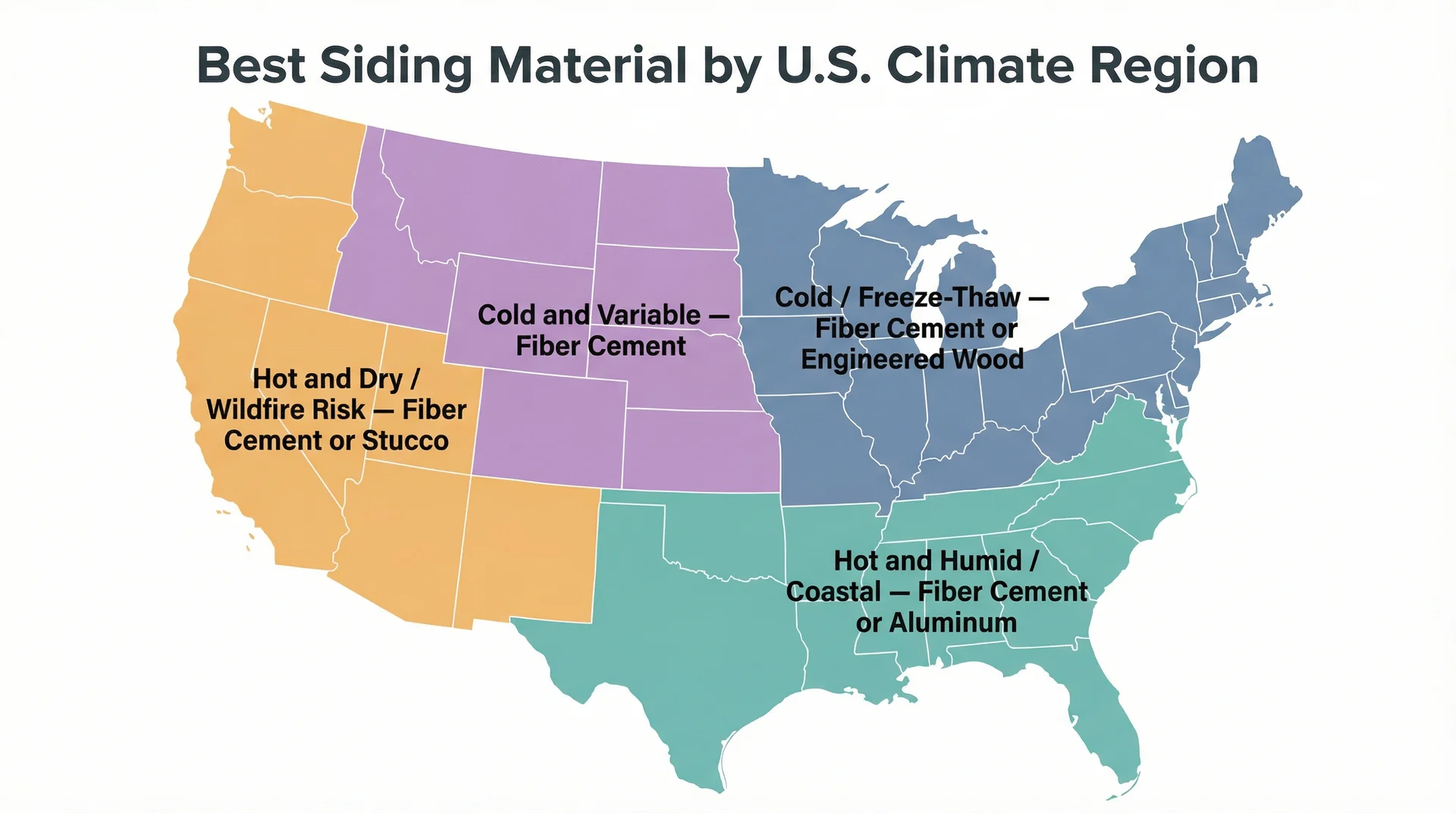
The material that performs beautifully in coastal Virginia may be a poor fit for Minnesota winters or Phoenix summers.
- Hot and humid climates (Southeast, Gulf Coast): Fiber cement and aluminum handle humidity and salt air well. Basic vinyl struggles with sustained heat and UV.
- Cold climates with freeze-thaw cycles (Midwest, Northeast): Fiber cement and engineered wood perform well. Basic vinyl becomes brittle under hard freeze.
- Hot, dry climates with wildfire risk (Southwest): Fiber cement and stucco are the standouts. Vinyl melts and burns.
- Coastal environments with salt air exposure: Aluminum and fiber cement hold up. Natural wood requires aggressive maintenance to survive.
Think in Total Cost, Not Just Day-One Price
Vinyl at $8,000 installed sounds better than fiber cement at $14,000 until you factor in a few realities. Fiber cement carries a 50-year-plus lifespan with one repainting cycle every 10 to 15 years.
Basic vinyl may need full replacement in 20 years, and it will need cleaning annually. Natural wood demands repainting every 5 to 10 years, plus periodic pest and moisture treatment. The per-year cost of fiber cement is genuinely competitive once you run the math over a realistic ownership horizon.
What Siding Does to Your Resale Value
The 2025 Cost vs. Value report from Zonda found fiber cement siding replacement returned 114% of its cost at resale nationally. Vinyl siding replacement returned 97%, meaning a $17,950 vinyl project returned roughly $17,313 in added resale value on average.
Both figures consistently outperform most interior renovations. Buyers form their first impression of a home from the exterior, and worn siding signals deferred maintenance throughout the property, whether that’s true or not.
Should You DIY or Hire a Pro?
For a full siding replacement on a 1,500 sq ft home, hire it out. I understand the appeal of saving $1.50 to $5.00 per sq ft on labor, but siding installation is one of the trades where the visible result and the invisible result can diverge significantly. A DIY install can look fine on day one and fail on moisture management by year three.
Specific risks include improper flashing around windows and doors, incorrect panel overlap, inadequate fastening that allows wind infiltration, and installation errors that void manufacturer warranties. Quality siding products often require professional installation as a condition of coverage.
If you have significant construction experience and you’re working on a simple single-story with vinyl, a partial DIY may be reasonable. Heavy fiber cement creates harmful silica dust when cut and requires a precise installation technique. Professional installation is the right call.
How Long Does Siding Installation Take?
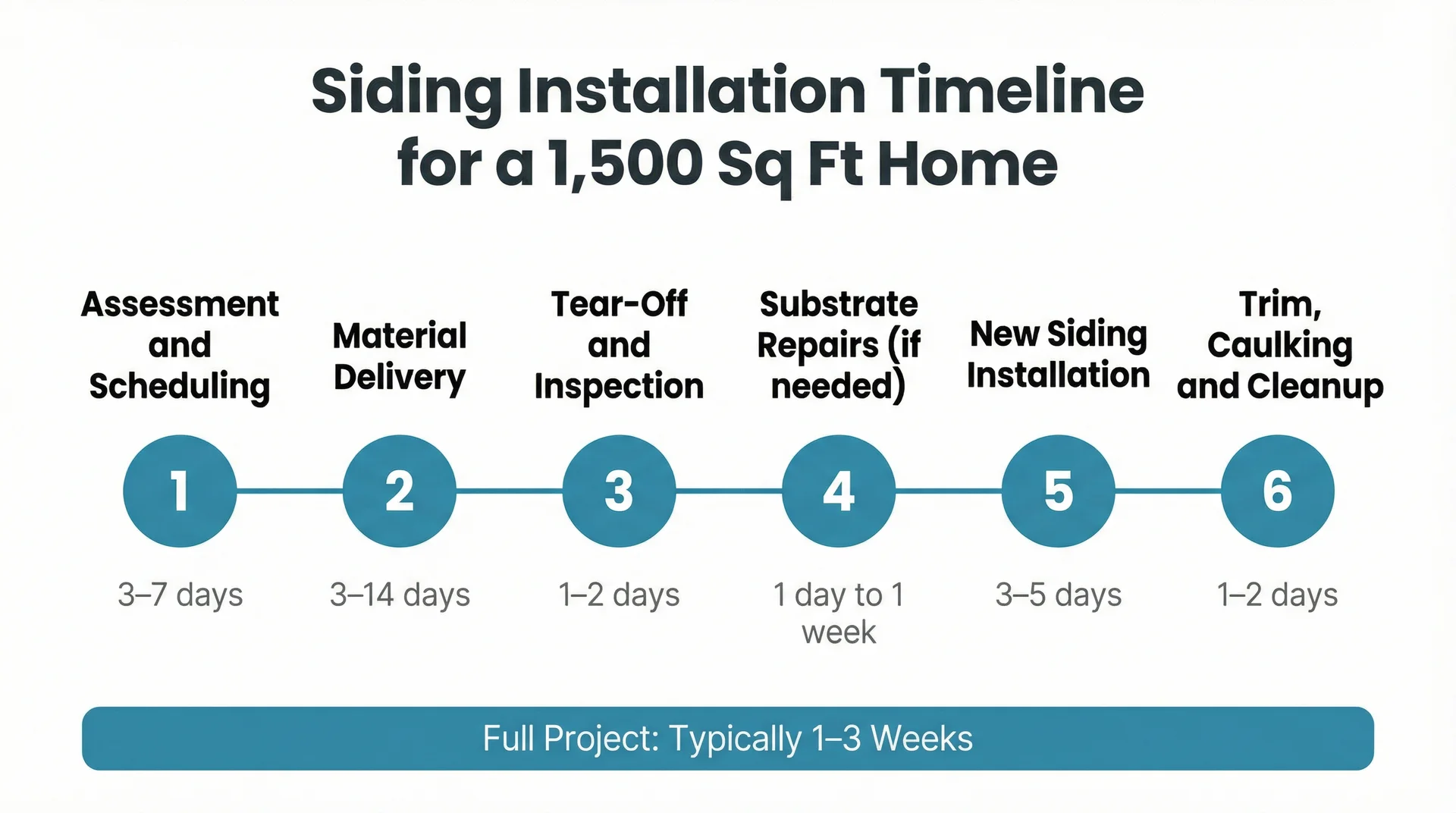
For a 1,500 sq ft home, plan for 3 to 7 days of active installation work with a professional crew. Simple single-story layouts with clean walls can come in toward the lower end. Two-story homes or homes with complex architecture push toward the higher end or beyond.
The full project timeline from first contact to final cleanup typically runs 1 to 3 weeks when you factor in contractor scheduling, material delivery, and any substrate repairs discovered during tear-off. Weather delays, which are real and unpredictable in most regions, can extend that further.
The phases look like this:
- Assessment and scheduling: A few days to a week for quotes, material selection, and contractor scheduling
- Material delivery: 3 days to 2 weeks, depending on product availability and custom orders
- Tear-off and inspection: 1 to 2 days for a home this size
- Substrate repairs (if needed): Variable. Minor rot repairs add a day. Extensive damage can add a week.
- New siding installation: 3 to 5 days for a straightforward 1,500 sq ft home
- Trim, caulking, cleanup: 1 to 2 days
Peak demand months, late spring through early fall, mean longer waits for quality crews. If you can schedule your project in late fall or early winter, you’ll find better availability and, in some markets, more competitive pricing.
Ways to Save Money on Siding Without Cutting Corners
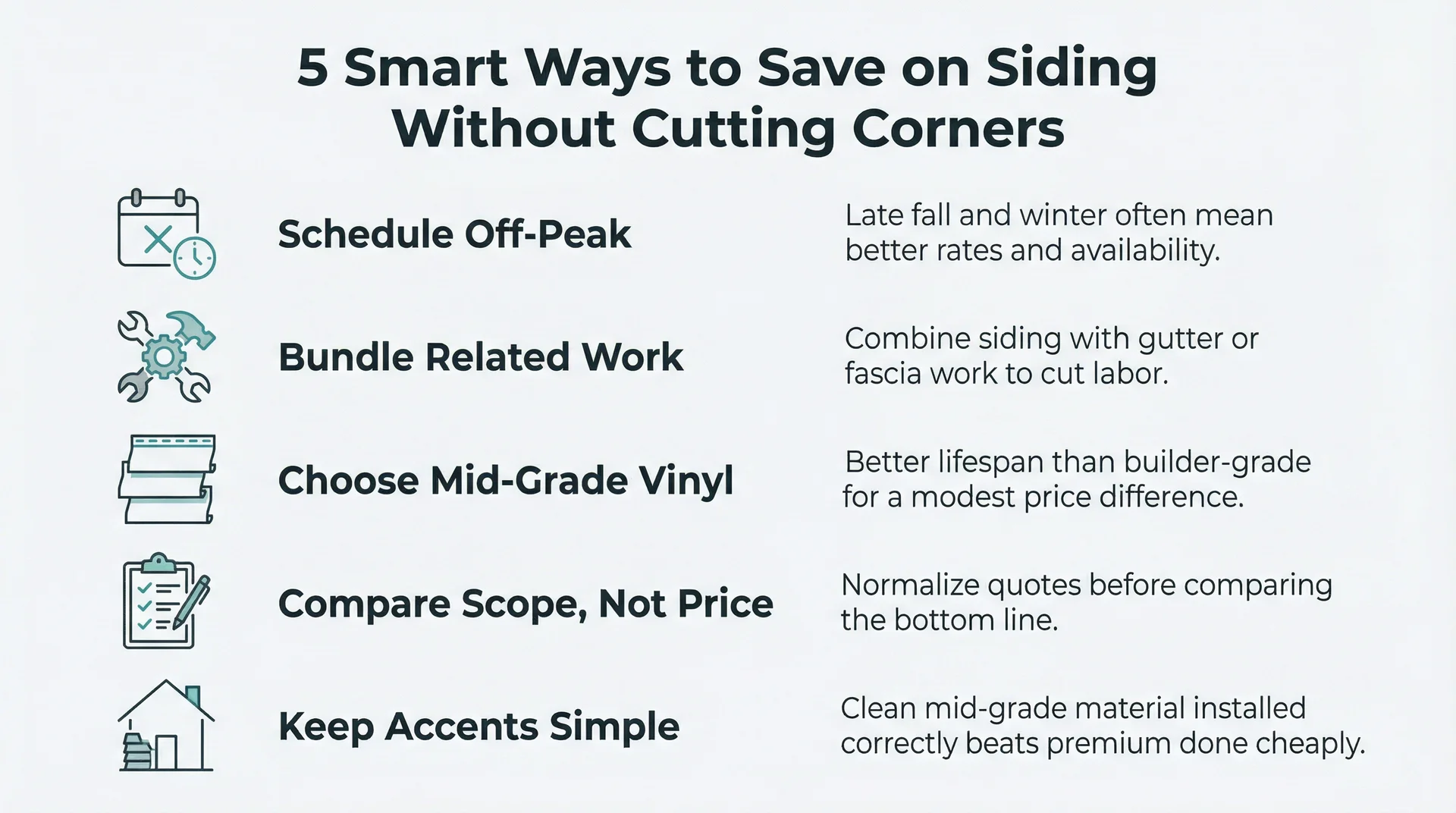
Getting a fair price on a siding project doesn’t require gambling on the cheapest quote. Here’s where the real savings actually live.
Schedule off-peak. Late fall and winter are slower seasons for exterior contractors. Better availability often translates to better pricing, and you avoid the material delays common in peak season.
Bundle related work. If your gutters, trim, or fascia also need attention, combining that work with a siding project reduces overall labor cost. Contractors charge less for incremental add-on work when they’re already set up and on site.
Go mid-grade on vinyl, not builder-grade. The price difference between builder-grade and mid-grade vinyl is modest. The performance difference, particularly in lifespan and weathering, is meaningful.
Get three quotes and compare scope, not price. The lowest quote usually reflects something excluded. Once you normalize three quotes to the same scope, materials, and removal, the pricing often converges more than the raw numbers suggest.
Avoid over-finishing. Stone veneer accents and premium trim details are appealing but expensive. If you’re value-focused, a clean mid-grade material installed correctly will outperform a premium material installed by a crew cutting corners.
How to Get a Siding Quote You Can Actually Trust
What to Ask Before Anyone Shows Up
Before any contractor walks your property, establish what their quote will and won’t include:
- Does the quote include old siding removal and disposal?
- Is house wrap or a moisture barrier included in the materials line?
- How do you handle substrate damage or rot discovered during tear-off?
- Are you licensed, bonded, and insured in this state?
- Does your warranty cover both materials and labor?
- Will you pull the required permits?
A contractor who answers these questions directly and without deflecting is demonstrating a professionalism that carries through the entire job.
Red Flags to Watch For
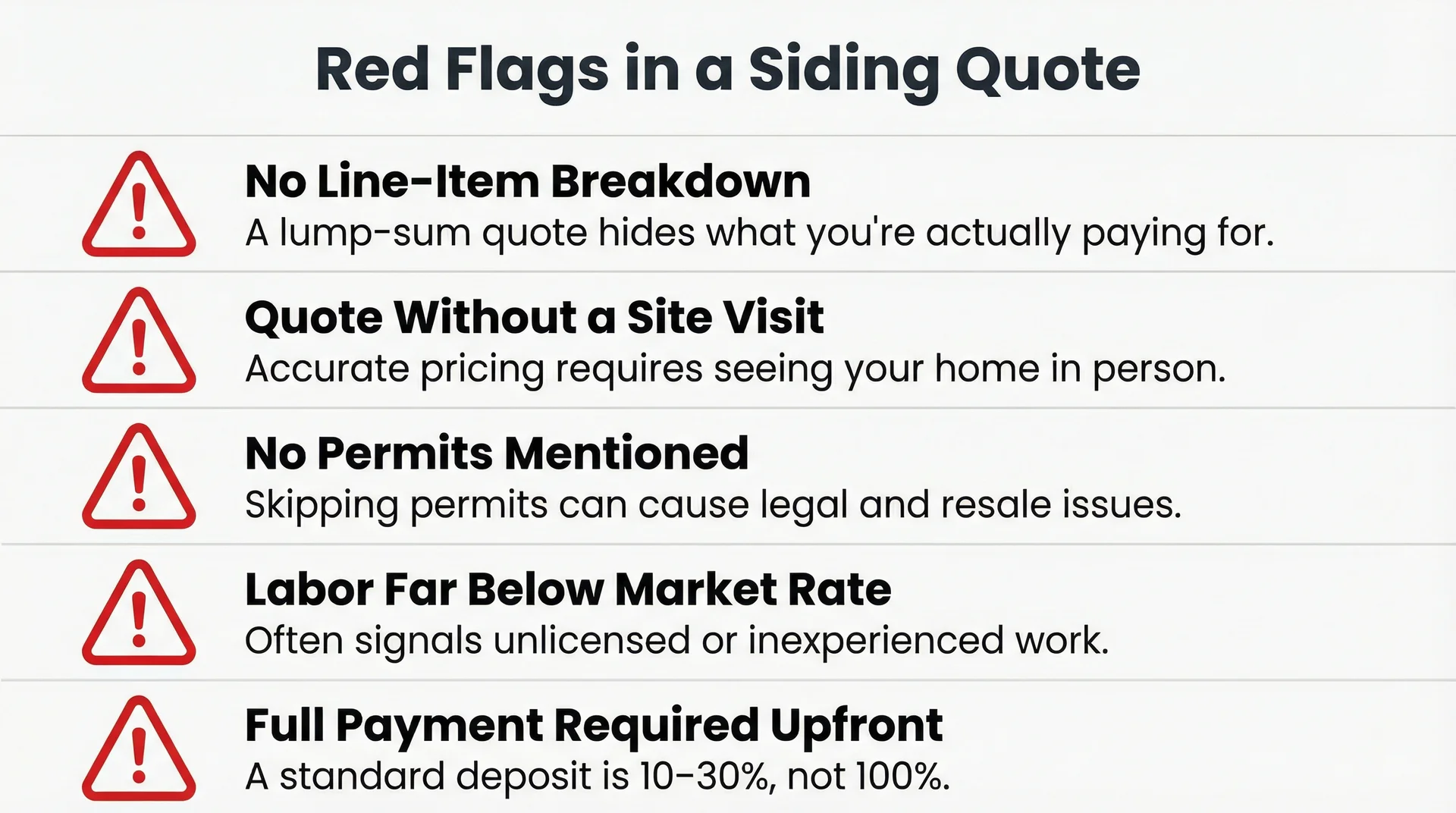
- A lump-sum quote with no line-item breakdown of materials, labor, and additional costs
- A quote submitted without a site visit
- No mention of permits or inspections
- Labor priced significantly below other quotes (often signals unlicensed work or an inexperienced crew)
- Full payment is demanded before work begins
On payment: a deposit of 10 to 30% upfront is standard and reasonable. Full payment before a single panel goes up is a serious warning sign.
How to Compare Three Quotes Correctly
When three quotes are in front of you, the instinct is to rank by price. The more useful approach is to rank by what each quote includes. A $4,000 difference between bids usually traces back to something specific: removal excluded, lower material grade, different house wrap specification, or trim work not accounted for. Normalize the quotes to the same scope before you compare the numbers.
Frequently Asked Questions
How much does vinyl siding cost for a 1,500 sq ft house?
Vinyl siding for a 1,500 sq ft home typically costs $8,000 to $17,000 fully installed, depending on the grade of vinyl and your local labor rates. Standard hollow-back vinyl sits at the lower end. Premium insulated vinyl reaches the higher end.
Is a 1,500 sq ft home the same as 1,500 sq ft of siding?
No. Your home’s floor area and its siding surface area are different measurements. A 1,500 sq ft single-story home typically needs 1,100 to 1,400 sq ft of actual wall coverage. A two-story with the same footprint can need 2,000 sq ft or more.
How long does siding last on a 1,500 sq ft house?
Standard vinyl lasts 20 to 40 years. Fiber cement lasts 50 years or more. Engineered wood lasts 20 to 30 years. Natural wood lasts 20 to 30 years with consistent maintenance. Climate and installation quality affect every material’s actual lifespan.
Does new siding increase home value?
Yes, consistently. The 2025 Cost vs. Value report found fiber cement siding replacement returned 114% of its cost at resale nationally. Vinyl siding replacement returned 97%. Both figures outperform most interior remodeling projects.
What time of year is cheapest to install siding?
Late fall and early winter tend to offer the best contractor availability and, in some markets, better material pricing. Summer is peak demand, which means higher rates and longer scheduling waits.
Can you install new siding over existing siding?
Sometimes. If the existing siding is structurally sound, flat, and free of moisture problems, new siding can go over it without removal costs. The tradeoff is added wall thickness that can create issues around windows and doors. A professional assessment is the reliable way to know whether it works for your specific home.
How much does old siding removal cost?
Removal runs $1,000 to $3,750 for standard materials like vinyl or wood on a home this size. Asbestos abatement, applicable to some homes built before 1980, requires licensed specialists and costs significantly more.
How long does it take to side a 1,500 sq ft house?
A professional crew typically completes active installation in 3 to 7 days for a home this size. The full project timeline, including scheduling, material delivery, tear-off, any substrate repairs, and cleanup, runs 1 to 3 weeks.
Mark’s Final Take
After 15 years in residential exterior construction, here’s what I’d tell a neighbor sitting across from me at the kitchen table.
If budget is your primary constraint: Go mid-grade vinyl, not builder-grade. The price difference is modest, and the lifespan difference is real. If you’re in a cold climate, insulated vinyl is worth the step up.
If you’re staying 15 years or more: Fiber cement is almost always worth the premium. The math holds. The durability holds. You won’t be making this same decision in 20 years.
If you’re planning to sell in 5 to 7 years, either high-end insulated vinyl or fiber cement gives you the strongest resale return. The 2025 data support both.
Regardless of material: Budget a 15% contingency above your quote. Inspect the house wrap specification in your contract. Confirm permits are included. And don’t hire based on the lowest number alone.
New siding is one of the few home improvements where the financial return reliably matches or exceeds the investment. The mistake I see most often isn’t choosing the wrong material. It’s going into the project underprepared and then making rushed decisions when something unexpected surfaces on day three.
Go in informed, and you’ll come out with a home that looks better, performs better, and holds its value longer than it did the day before.